Technofeudalism: It’s a Wrap

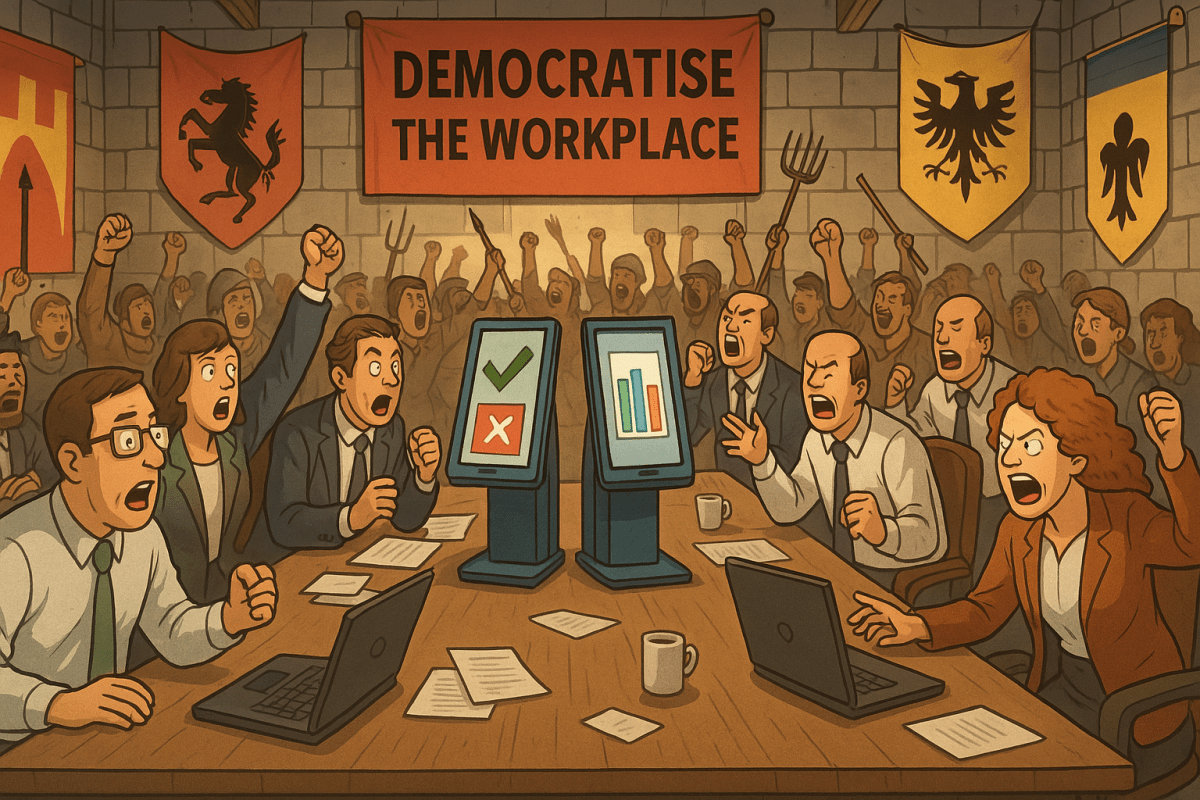
By the time we reach Chapter Seven of Technofeudalism: What Kills Capitalism, Yanis Varoufakis drops the ledger sheets and spreadsheets and starts sketching utopia in crayon. Entitled Escape from Technofeudalism, it proposes—brace yourself—a workplace democracy. It’s aspirational, yes. Compelling? Not particularly. Especially if, like me, you’ve long since stopped believing that democracy is anything more than a feel-good placebo for structural impotence.

Audio: NotebookLM podcast discussing this topic.

To be clear: the preceding chapters, particularly the first six, are sharp, incisive, and frankly, blistering in their indictment of today’s economic disfiguration. But Chapter Seven? It’s less an escape plan, more a group therapy session masquerading as an operational model.

So let’s take his proposal for Democratised Companies apart, one charming layer at a time.

Splendid. One person, one vote. Adorable.

Because there’s nothing more efficient than a hiring committee comprised of thirty engineers, two janitors, a receptionist, and Steve from Accounts, whose main contribution is passive-aggressive sighing.

Marvellous. We’ve now digitised the tyranny of the majority and can timestamp every idiotic decision for posterity.

A relief. Until it doesn’t.

Here, dear reader, is where the cake collapses. Why, precisely, should a randomly-assembled group of employees—with wildly varying financial literacy—be entrusted to divide post-tax revenue like it’s a birthday cake at a toddler’s party?

And how often are these slices recalibrated? Each fiscal year? Every time someone is hired or fired? Do we amend votes quarterly or wait until the economic ship has already struck an iceberg?

Varoufakis does suggest preference voting to tackle allocation disputes:

Fine. In theory, algorithmic voting procedures sound neat. But it presumes voters are rational, informed, and cooperative. If you’ve ever seen a corporate Slack thread devolve into emoji warfare, you’ll know that this is fiction on par with unicorns and meritocracy.

Ah yes, the ‘equality’ bit. Equal pay, unequal contribution. This isn’t egalitarianism—it’s enforced mediocrity. It might work in a monastery. Less so in a competitive tech firm where innovation requires both vision and differentiated incentive.

Now, on to bonuses, which are democratically determined by:

Welcome to Black Mirror: Workplace Edition. This is less economics, more playground politics. Who gets tokens? The charismatic chatterbox in the break room? The person who shared their lunch? The ghost employee who never shows up but emails back promptly?

And how, pray tell, does one evaluate the receptionist’s contribution relative to the lead engineer’s or the janitor’s? This isn’t peer review—it’s populism with a smiley face.

We’ve all seen “Teacher of the Year” competitions turn into contests of who had the cutest class poster or best cupcakes. Now imagine your livelihood depending on it.

In summary, democracy in the workplace may sound noble, but in practice, it’s the bureaucratic equivalent of herding caffeinated cats. It doesn’t even work in small groups, let alone an organisation of hundreds. Democracy—when applied to every function of an enterprise—is not liberation; it’s dilution. It’s design-by-committee, strategy-by-consensus, and ultimately, excellence-by-accident.

Escape from Technofeudalism? Perhaps. But not by replacing corporate lords with intranet polls and digital tokens. That’s not an exit strategy—it’s a cosplay of collectivism.

Questioning Traditional Families

I neither champion nor condemn tradition—whether it’s marriage, family, or whatever dusty relic society is currently parading around like a prize marrow at a village fête.

Audio: NotebookLM podcast on traditional families.

In a candid group conversation recently, I met “Jenny”, who declared she would have enjoyed her childhood much more had her father not “ruined everything” simply by existing. “Marie” countered that it was her mother who had been the wrecker-in-chief. Then “Lulu” breezed in, claiming, “We had a perfect family — we practically raised ourselves.”

Now, here’s where it gets delicious:

Each of these women, bright-eyed defenders of “traditional marriage” and “traditional family” (cue the brass band), had themselves ticked every box on the Modern Chaos Bingo Card: children out of wedlock? Check. Divorces? Check. Performative, cold-marriage pantomimes? Absolutely—and scene.
Their definition of “traditional marriage” is the vintage model: one cis-male, one cis-female, Dad brings home the bacon, Mum weeps quietly into the washing-up. Standard.

Let’s meet the players properly:

Jenny sprang from a union of two serial divorcées, each dragging along the tattered remnants of previous families. She was herself a “love child,” born out of wedlock and “forcing” another reluctant stroll down the aisle. Her father? A man of singular achievements: he paid the bills and terrorised the household. Jenny now pays a therapist to untangle the psychological wreckage.

Marie, the second of two daughters, was the product of a more textbook “traditional family”—if by textbook you mean a Victorian novel where everyone is miserable but keeps a stiff upper lip about it. Her mother didn’t want children but acquiesced to her husband’s demands (standard operating procedure at the time). Marie’s childhood was a kingdom where Daddy was a demigod and Mummy was the green-eyed witch guarding the gates of hell.

Lulu grew up in a household so “traditional” that it might have been painted by Hogarth: an underemployed, mostly useless father and a mother stretched thinner than the patience of a British Rail commuter. Despite—or because of—the chaos, Lulu claims it was “perfect,” presumably redefining the word in a way the Oxford English Dictionary would find hysterical. She, too, had a child out of wedlock, with the explicit goal of keeping feckless men at bay.

And yet—and yet—all three women cling, white-knuckled, to the fantasy of the “traditional family.” They did not achieve stability. Their families of origin were temples of dysfunction. But somehow, the “traditional family” remains the sacred cow, lovingly polished and paraded on Sundays.

Why?

Because what they’re chasing isn’t “tradition” at all — it’s stability, that glittering chimera. It’s nostalgia for a stability they never actually experienced. A mirage constructed from second-hand dreams, glossy 1950s propaganda, and whatever leftover fairy tales their therapists hadn’t yet charged them £150 an hour to dismantle.

Interestingly, none of them cared two figs about gay marriage, though opinions about gay parenting varied wildly—a kettle of fish I’ll leave splashing outside this piece.

Which brings us back to the central conundrum:

If lived experience tells you that “traditional family” equals trauma, neglect, and thinly-veiled loathing, why in the name of all that’s rational would you still yearn for it?

Societal pressure, perhaps. Local customs. Generational rot. The relentless cultural drumbeat that insists that marriage (preferably heterosexual and miserable) is the cornerstone of civilisation.

Still, it’s telling that Jenny and Marie were both advised by therapists to cut ties with their toxic families—yet in the same breath urged to create sturdy nuclear families for their own children. It was as if summoning a functional household from the smoking ruins of dysfunction were a simple matter of willpower and a properly ironed apron.

Meanwhile, Lulu—therapy-free and stubbornly independent—declares that raising oneself in a dysfunctional mess is not only survivable but positively idyllic. One can only assume her standards of “perfect” are charmingly flexible.

As the title suggests, this piece questions traditional families. I offer no solutions—only a raised eyebrow and a sharper question:

What is the appeal of clinging to a fantasy so thoroughly at odds with reality?
Your thoughts, dear reader? I’d love to hear your defences, your protests, or your own tales from the trenches.

Lies as Shibboleth

Watching Sam Harris ruminate on the nature of political lies (still believing, poor lamb, that reason might one day triumph) reminds me of something more sinister: lies today are not attempts at persuasion. They are shibboleths — tribal passwords, loyalty oaths, secret handshakes performed in the broad light of day.

Video: Sam Harris tells us why Trump and his ilk lie.

Forget “alternative facts.” That charming euphemism was merely a decoy, a jangling set of keys to distract the infantile media. The real game was always deeper: strategic distortion, the deliberate blurring of perception not to deceive the outsider, but to identify the insider.

Audio: NotebookLM podcast on this topic.

When Trump — or any other post-truth demagogue — proclaims that penguins are, in fact, highly trained alien operatives from the Andromeda galaxy, the objective is not persuasion. The point is to force a choice: will you, standing before this glistening absurdity, blink and retreat into reason, stammering something about ornithology… Or will you step forward, clasp the hand of madness, and mutter, ‘Yes, my liege, the penguins have been among us all along’?

Those who demur, those who scoff or gasp or say ‘You’re an idiot,”’have failed the loyalty test. They have outed themselves as enemy combatants in the epistemic war. Truth, in this brave new world, is not a destination; it is an allegiance. To speak honestly is to wage rebellion.

Orwell, who tried very hard to warn us, understood this dynamic well: the real triumph of Big Brother was not merely to compel you to lie but to compel you to believe the lie. Koestler, another battered prophet of the age, charted how political movements sink into ritualistic unreason, demanding not conviction but performance. Swift, for his part, knew it was all hilarious if you tilted your head just right.

The bigger the lie, the better the shibboleth. Claim that two and two make five, and you catch out the weak-willed rationalists. Claim that penguins are extraterrestrials, and you find the truly devoted, the ones willing to build altars from ice and sacrifice to their feathery overlords.

It’s no accident that modern political theatre resembles a deranged initiation ritual. Each day brings a new absurdity, a fresh madness to affirm: ‘Men can become women by declaration alone!” “Billionaires are victims of systemic oppression!’ ‘The penguins are amongst us, plotting!’ Each claim a little more grotesque than the last, each compliance a little more degrading, a little more irreversible.

And oh, how eagerly the initiates rush forward! Clap for the penguins, or be cast out into the howling wilderness! Better to bend the knee to absurdity than be marked as an unbeliever. Better to humiliate yourself publicly than to admit that the Emperor’s penguin suit is just a costume.

Meanwhile, the opposition — earnest, naive — keeps trying to argue, to rebut, to point out that penguins are terrestrial flightless birds. How quaint. How pathetic. They do not understand that the moment they say, “You’re an idiot,” they’ve broken the spell, declared themselves apostates, and rendered themselves politically irrelevant.

The shibboleth, once uttered, divides the world cleanly: the believers, who will say anything, do anything, believe anything, provided it marks them safe from exile; and the infidels, who cling stupidly to reality.

The future belongs, not to the true, but to the loyal. Not to the rational, but to the ritualistic. The more extravagant the lie, the greater the proof of your faith.

So raise a glass to the penguins, ye of faint heart, and prepare your soul for abasement. Or stand firm, if you dare, and be prepared to be eaten alive by those who traded reason for the rapture of belonging.

After all, in the land of the blind, the one-eyed man is not king. He’s a heretic.


Flat-Earth Politics in a Cubic World

Audio: NotebookLM podcast on this topic.

Why We Can’t Have Nice Things

A Hobbesian Rant for the Disillusioned Masses

Reading Leviathan has me thinking. Nothing new, mind you—just reinvigorated. Hobbes, bless his scowling soul, is the consummate pessimist. People, in his view, are untrustworthy sods, ready to stab you in the back at the first flicker of opportunity. He doesn’t believe in community. He believes in containment.

Audio: NotebookLM discussion about this topic.

And to be fair, he’s not entirely wrong. He captures a certain cohort with uncanny accuracy. You know the type. Type-A™ personalities: the Donald Trumps, Elon Musks, Adolph Hitlers, Shahs of Iran, and that guy in marketing who always schedules meetings for 8am. The ones who salivate at the mere whiff of power, who’d sell their grandmothers for a press release and call it vision.

Now, I’ll concede that most people want more than they have. Economics depends on this assumption like religion depends on guilt. But not everyone is driven by an insatiable lust for money, dominance, or legacy. That, my friends, is not ambition. It is pathology—a malignant, metastasising hunger that infects the likes of Trump, Musk, Bezos, Sunak, and their ilk. The hunger to rule, not just participate.

The trouble is, the majority of the world’s population are idiots—not technically, but metaphorically. Soft-headed. Overstimulated. Easily distracted by flags, influencers, and “free shipping.” And there are flavours of idiots. Musk is a lucky idiot. Trump is a useful idiot. Most are a hair’s breadth from being cannon fodder.

The world could be configured differently. It could consist of autonomous collectives, each minding its own business, each respecting the other’s boundaries like courteous houseplants. But this equilibrium is shattered—always shattered—by the predatory few. The outliers. The sharks in suits. The ones who mistake governance for domination and diplomacy for personal branding.

So we build mechanisms to defend ourselves—laws, institutions, surveillance, standing armies—but these mechanisms inevitably attract the same types we were trying to ward off. Power-hungry cretins in different hats. The protectors, it turns out, are rarely benevolent dictators. They are predacious politicos, wearing virtue like a costume, mouthing justice while tightening the screws.

But the recurring infestation of pathological ambition in a species otherwise just trying to get on with its day.

This is the challenge for all of humanity.

And we’ve yet to rise to it.

Elites Ruined It For Everyone

David Brooks and the Hollowing Out of Conservatism

David Brooks is the quintessential old-school Conservative—the kind who once upheld a semblance of ideological coherence. He belongs to the pre-Reagan-Thatcher vintage, a time when Conservatism at least had the decency to argue from principles rather than blind tribalism. We could debate these people in good faith. Those days are gone. The current incarnation of Conservatism contains only homoeopathic traces of its Classical™ predecessor—diluted beyond recognition.

The Degeneration of Conservatism

The rot set in with Reagan, who caught it from Thatcher. Greed and selfishness were laundered into virtues, repackaged as “individual responsibility,” and the party’s intellectual ballast began to erode. By the time Bush II’s administration rolled in, Neo-Conservatism had replaced any lingering Burkean ethos, and by Trump’s tenure, even the pretence of ideology was gone. Conservatism-in-Name-Only—whatever Trump’s brand of reactionary nihilism was—swallowed the party whole. Do they even call themselves Conservatives anymore, or has that ship sailed along with basic literacy?

Click here to take the worldview survey

To be fair, this didn’t go unnoticed. Plenty of old-school Republicans recoiled in horror when Trump became their figurehead. Before the 2016 election, conservative pundits could barely contain their disdain for his incompetence, lack of moral compass, and general buffoonery. And yet, once they realised he was the party’s golden goose, they clambered aboard the Trump Train with the enthusiasm of lottery winners at a payday loan office. His staunchest critics became his most obsequious apologists. What does this tell us about their value system? Spoiler: nothing good.

Brooks’ Lament

Which brings us back to Brooks, who now bemoans the death of Conservative values. On this, we agree. Where we part ways is on whether those values were worth saving. Say you’re boarding a train from New York to Los Angeles. Conservatism might argue that a Miami-bound train is still a train, so what’s the problem? It’s the same vehicle, just going somewhere else. Except, of course, Conservatism has always insisted on the slow train over the fast train—because urgency is unseemly, and progress must be rationed.

If I’m an affluent middle-classer, I might prefer Conservatism’s careful incrementalism—it keeps my apple cart stable. Admirable, if you enjoy tunnel vision. Progressives, by contrast, recognise that some people don’t even have apple carts. Some are starving while others hoard orchards. To the Conservative, the poor just aren’t trying hard enough. To the Progressive, the system is broken, and the playing field needs a serious re-levelling. Even when Conservatives acknowledge inequality, their instinct is to tiptoe toward justice rather than risk disrupting their own affluence.

The Fallacy of Objective Reality

Leaving politics for philosophy, Brooks predictably rails against Postmodernism, decrying relativism in favour of good old-fashioned Modernist “reality.” He’s horrified by subjectivism, as though personal interpretation weren’t the foundation of all human experience. Like Jordan Peterson, he believes his subjective truth is the objective truth. And like Peterson, he takes umbrage at anyone pointing out otherwise. It feels so absolute to them that they mistake their own convictions for universal constants.

As a subjectivist, I accept that reality is socially mediated. We interpret truth claims based on cognitive biases, cultural conditioning, and personal experience. Even when we strive for objectivity, we do so through subjective lenses. Brooks’ Modernist nostalgia is touching but delusional—akin to demanding we all agree on a single flavour of ice cream.

The Existential Problem

And so, I find myself in partial agreement with Brooks. Yes, there is an existential crisis. The patient has a broken leg. But our prescriptions differ wildly. I won’t offer a metaphor for that—consider it your homework as a reader.

Brooks is likely a better writer than a public speaker, but you may still find yourself nodding along with some of his arguments. If you’re a “true” Christian Conservative—if you still believe in something beyond crass self-interest—he may well be preaching to the choir. But let’s be honest: how many in that choir are still listening?

Are We Sane? Can a Society Be Sick?

These are the first two chapter titles of Erich Fromm’s The Sane Society. I suspect I’ll be reading this book twice for good measure. I’m four chapters in, with three to go, and eager for a deeper dive.

Despite being published in 1955, Fromm’s analysis remains strikingly relevant. Mark Fisher picks up a similar thread in Capitalist Realism: Is There No Alternative?, but whereas Fisher dissects the ideological stranglehold of late capitalism, Fromm, as a psychiatrist, turns the lens on human nature itself. He questions the very concept of normalcy—something we tend to accept uncritically, much like Michel Foucault would in the following generation.

I’ll hold off on any sweeping conclusions until I’ve finished the book (and, more likely, after a second read). But for now, consider this a tentative recommendation. Snow Crash was an amusing detour, but non-fiction is where I feel most at home.

The Schizophrenia of “Human Nature” Arguments

Humans, we are told, are exceptional—unlike the rest of the lowly animal kingdom. We alone possess reason, morality, and the ability to transcend our base instincts. And yet, curiously, this argument is rolled out only when convenient. At times, we are commanded to rise above our primal urges; at others, we are scolded for even thinking about resisting them. This ideological schizophrenia is no accident—it is a feature, not a bug, of our prevailing moral and economic order.

The contradictions of “human nature” arguments can be broken down into two key patterns:

A. We must transcend our animal instincts—but only when they threaten social or economic order.

B. We must accept our animal instincts as unchangeable—but only when they reinforce existing power structures.

This hypocrisy is especially visible in how capitalism and morality are framed. Let’s examine two case studies.

Case 1: Prostitution—A Market That Must Be Morally Suppressed

Sex is as fundamental a biological drive as hunger or thirst. One would think that in a world where everything is commodified, prostitution—the most direct transaction of supply and demand—would be embraced by free-market capitalists. But no. We are told that engaging in this “base” activity is degrading, immoral, and must be curtailed. The same capitalists who defend free enterprise at all costs suddenly become moralists, urging us to resist temptation and rise above our urges. Sex, despite being one of the most natural acts imaginable, is treated as an impulse to be tamed rather than an economic exchange to be normalised.

Case 2: Capitalism—A System We Must Accept as “Natural”

Contrast this with how we are told to think about capitalism. Greed, exploitation, and ruthless competition? Those are “just human nature.” The strong thrive, and the weak perish. We are warned not to question the system because to do so would be to fight against nature itself. Socialism? A naive fantasy. Economic cooperation? Impossible. Mutual aid? Utopian nonsense. We must accept that humans are selfish creatures, that hierarchy is inevitable, and that billionaires accumulating obscene wealth while millions starve is simply the way of things.

Why are we ordered to suppress our instincts in one case yet surrender to them in another? Because morality, in its institutional form, is not about virtue—it is about control.

The Convenient Flexibility of “Human Nature”

This selective logic is designed to keep power structures intact. The rules shift depending on whose interests are at stake:

  • If an instinct challenges profit or control, it must be suppressed.
  • If an instinct benefits the ruling order, it must be accepted as natural.

Thus, the same societies that demand moral restraint when it comes to sex, leisure, or pleasure suddenly rediscover their inner Darwinist when defending capitalist greed and economic cruelty.

The “Natural Order” Myth

The claim that capitalism is the inevitable result of human nature is one of history’s greatest ideological scams. If it were indeed “natural,” it would not require:

  • Constant propaganda to reinforce its legitimacy.
  • Violent suppression of alternative systems.
  • Trillions in government bailouts every time it fails.

Moreover, humans are not only competitive, selfish creatures. We are also wired for cooperation, altruism, and communal living—traits conveniently erased from discussions about economics.

Final Thought: Breaking the Cycle

If we can rise above base instincts for sex and violence, why can’t we rise above capitalist greed and exploitation? Why is overcoming “human nature” only demanded when it suits power? The truth is, we are only commanded to rise above when it keeps us obedient—and ordered to accept reality when it keeps the powerful in control.

The only real rebellion is to reject this hypocrisy entirely. The future belongs not to those who passively accept the contradictions of the present, but to those who refuse to play by its schizophrenic rules.

Talking with Lions

As Wittgenstein said, “If a lion could speak, we could not understand him.” Jonny Thompson conveys this in a short story. Have a listen. Have a read.

Metamodernism: A Postmodern Critique

The genesis of the Modernity Worldview Survey was Metamodernism. Is this still a thing? In recent years, metamodernism has emerged as a supposed successor to postmodernism, claiming to transcend the seemingly irreconcilable tensions between modernist sincerity and postmodern irony. Yet, upon closer examination, this framework reveals itself not as a genuine paradigm shift but rather as a modernist invention that fails to escape the very critiques it attempts to address.

Video: Introduction to Modernity Worldview Survey concepts

The Modernist Roots of Metamodernism

Despite its claims of oscillation between poles, metamodernism betrays its modernist underpinnings through its implicit teleology and notion of progress. The very framing of “meta” as beyond or transcending suggests a linear progression that is fundamentally at odds with the postmodern rejection of grand narratives. Metamodernism positions itself as forward-moving whilst attempting to recapture elements of premodernity, revealing an anxiety about being perceived as regressive or naive.

Podcast: Audio version of this content

This desire to have it both ways—to acknowledge the constructed nature of meaning whilst still pursuing transcendent meaning—doesn’t represent a resolution so much as a psychological coping mechanism. The cognitive dissonance created by attempting to simultaneously hold contradictory positions is assuaged through a clever rhetorical move: claiming that oscillation itself is the point.

A Rebranding Exercise

What metamodernism presents as novel is ultimately a recombination of elements from premodern, modern, and postmodern frameworks without resolving their fundamental contradictions. Rather than being mutually exclusive from these earlier paradigms, it cherry-picks aspects of each whilst maintaining the basic ontological framework of modernism.

The notion that one can meaningfully “oscillate” between accepting objective and subjective realities is particularly problematic. Either reality has objective features, or it doesn’t—pretending otherwise doesn’t create a new philosophical paradigm but rather a convenient means of avoiding the implications of either position.

Postmodern Irony in Motion

Perhaps the most intriguing interpretation of metamodernism is not as a sincere attempt to move beyond postmodernism but as postmodernism performing its own critique. Viewed through this lens, metamodernism becomes postmodern irony in motion—a knowing wink at the impossibility of escaping construction whilst performatively engaging with the desire to do so.

The irony deepens when we consider that “postmodernism” itself is essentially an externally imposed label rather than a self-identification. Most thinkers characterised as postmodernists reject the label, which functions primarily as a modernist attempt to categorise and contain ideas that fundamentally challenge its frameworks.

Art vs. Philosophy

Where metamodernism succeeds is as a descriptive label for certain artistic and cultural productions that deliberately play in the space between irony and sincerity. Works like David Foster Wallace’s “Infinite Jest,” the television series “BoJack Horseman,” and Wes Anderson’s films effectively combine postmodern techniques with sincere emotional engagement.

However, what works as an artistic sensibility fails as a comprehensive philosophical framework or moral compass. The oscillation that enriches art becomes paralysing when applied to ethics or ontology. A moral framework requires some stable reference points; constantly shifting between believing in objective moral truths and viewing morality as entirely constructed provides no reliable guide for actual decision-making.

Insider vs. Outsider Perspectives

Like religious frameworks that balance literal and metaphorical interpretations, metamodernism may function as a lived experience for those who embrace it, even if it doesn’t hold up to external philosophical scrutiny. The cognitive manoeuvres that appear as tricks or inconsistencies to outsiders often feel like natural, intuitive ways of navigating complexity to those within the system.

This insider/outsider divide recalls Thomas Nagel’s famous “What Is It Like to Be a Bat?” (PDF) thought experiment—there may be experiential aspects of inhabiting a metamodern worldview that aren’t fully comprehensible from the outside. Yet this doesn’t invalidate external critique; inconsistencies and contradictions still matter philosophically.

Conclusion: Beyond Labels

Perhaps the most postmodern insight is recognising that we cannot escape having an ideology—even a position of having no ideology is itself an ideology. What distinguishes various approaches isn’t whether they have ideologies but how explicitly they acknowledge them, how consistently they apply them, and how willing they are to subject them to revision.

Metamodernism, for all its aspirations to transcend earlier frameworks, ultimately reveals more about our contemporary psychological condition than it offers as a coherent philosophical position. It captures our desire to maintain meaning in a world where we’ve recognised its contingency—a desire that may be fundamentally human, even if philosophically untenable.

Rather than seeking yet another “-ism” to resolve our existential and philosophical tensions, perhaps we might more honestly confront the limitations and partialities of all our frameworks, recognising that the search for a perfect synthesis may itself be a modernist fantasy.