I try to minimise posts to my fiction author alter ego, Ridley Park, but I am offering a promotion to download the dystopian speculative literary fiction book on Kindle for the dates noted. Click the promotion for more details.
My books have always been ‘free’ on KindleUnlimited, but this is free for anyone in Amazon’s supported markets.
Audio: Short Promo Rant
Readsy Review
“Reader discretion is advised. Free will has been deprecated.”
This ominous word of caution is what Ridley Park’s speculative novel ‘Propensity’ opens with, and it sets a tone that strikes an impressive balance between clinically descriptive and quietly devastating. Beginning as a bizarre experiment in behavioural modulation by way of neurochemical interference, it unfolds into an eerie metaphor for the tricky road between control and conscience.
Park’s chapters are short and succinct, some barely a page long, in a staccato rhythm. This creative choice, while initially a little unnerving, works well to reflect the story’s inherent disintegration: scientists losing grip on their own creation, subjects dissolving into numb submission or what they term “the zeroed state”, and a world slowly learning the price of their “engineered peace”. The writing comes off as crisp in an almost detached manner that leaves one wanting for a bit more emotional depth in the first part of the book but not only does that eventually grow on you, it ends up serving its purpose of thematic execution in both its text and subtext. Phrases like “silence playing dress-up as danger” and “peace was never meant to be built, only remembered” linger like faint echoes long after you turn the page.
I’ve spent more hours than I care to admit rummaging through the Jungian undergrowth of fairy tales – reading Marie-Louise von Franz until my eyes crossed, listening to Clarissa Pinkola Estés weave her wolf-women lore, and treating folklore like an archaeological dig through the psychic sediment of Europe. It’s marvellous, really, how much one can project onto a story when one has a doctorate’s worth of enthusiasm and the moral flexibility of a tarot reader.
But every so often, a tale emerges that requires no archetypal lens, no mythopoetic scaffolding, no trip down the collective unconscious. Sometimes a story simply bares its ideological teeth.
Enter Tatterhood – the Norwegian fairy tale so blunt, it practically writes its own critical theory seminar.
I watched Jonny Thomson’s recent video on this tale (embedded below, for those with sufficient tea and patience). Jonny offers a charming reversal: rather than focusing on Tatterhood herself, he offers the moral from the prince’s perspective. In his reading, the story becomes a celebration of the power of asking – the prince’s reward for finally inquiring about the goat, the spoon, the hood, the whole aesthetic calamity before him.
Video: Jonny Thomson discusses Tatterhood.
It’s wholesome stuff: a TED Talk dressed as folklore. But – my word – apply the slightest bit of critical pressure, and the whole thing unravels into farce.
The Story No One Tells at the Royal Wedding
Here’s the short version of Tatterhood that Jonny politely sidesteps:
A fearless, ragged, hyper-competent girl rescues her sister from decapitation.
She confronts witches, navigates the seas alone, storms a castle, and performs an ad hoc ontological surgical reversal.
She does all of this without help from the king, the court, the men, or frankly, anyone with a Y chromosome.
And how is she rewarded for her trouble? She’s told she’s too ugly. Not socially acceptable. Not symbolically coherent. Not bride material.
The kingdom gazes upon her goat, her spoon, her hood, her hair, and determines that nothing – nothing – about her qualifies her for legitimacy.
But beauty? Beauty is the passport stamp that grants her entry into the social realm.
Jonny’s Prince: A Hero by Low Expectations
Now, bless Jonny for trying to rehabilitate the lad, but this prince is hardly an exemplar of virtue. He sulks through his own wedding procession like a man being marched to compulsory dentistry. He does not speak. He does not ask. He barely manages object permanence.
And suddenly, the moral becomes: Look what wonders unfold when a man asks a single question!
It’s the philosophical equivalent of awarding someone a Nobel Prize for remembering their mother’s birthday.
And what do his questions achieve? Not insight. Not understanding. Not intimacy. But metamorphosis.
Each time he asks, Tatterhood transforms – ugly goat to beautiful horse, wooden spoon to silver fan, ragged hood to golden crown, ‘ugly’ girl to radiant beauty.
Which brings us to the inconvenient truth:
This Isn’t the Power of Asking. It’s the Power of Assimilation.
His questions function as aesthetic checkpoints.
Why the goat? Translation: please ride something socially acceptable.
Why the spoon? Translation: replace your tool of agency with a decorative object.
Why the hood? Translation: cover your unruliness with something properly regal.
Why your face? Translation: you terrify me; please be beautiful.
And lo, she becomes beautiful. Not because he sees her differently. Because the story cannot tolerate a powerful woman who remains outside the beauty regime.
The prince isn’t rewarded for asking; the narrative is rewarded for restoring normative order.
And Yet… It’s Absurdly Fascinating
This is why fairy tales deserve all the interpretive attention we lavish on them. They’re ideological fossils – compressed narratives containing entire worldviews in miniature.
Part of me admires Jonny’s generosity. Another part of me wants to hand the prince a biscuit for performing the bare minimum of relational curiosity. But mostly, I’m struck by how nakedly the tale reveals the old bargain:
A woman may be bold, brave, clever, loyal, and sovereign – but she will not be accepted until she is beautiful.
Everything else is optional. Beauty is compulsory.
So Here’s My Version of the Moral
Ask questions, yes. Be curious, yes. But don’t let anyone tell you that Tatterhood was waiting for the prince’s epiphany. She was waiting for the world to remember that she ran the plot.
If you’ve made it this far and know my proclivities, you’ll not be shocked that I side with Roland Barthes and cheerfully endorse la mort de l’auteur. Jonny is perfectly entitled to his reading. Interpretive pluralism and all that. I simply find it marvelously puzzling that he strolls past the protagonist galloping through the narrative on a goat, spoon upraised, and instead decides to chase the side-quest of a prince who contributes roughly the energy of a damp sock.
I risk sharing this prematurely. Pushing the Transductive Subjectivity model toward more precision may lose some readers, but the original version still works as an introductory conversation.
Please note: There will be no NotebookLM summary of this page. I don’t even want to test how it might look out the other end.
Apologies in advance for donning my statistician cap, but for those familiar, I feel it will clarify the exposition. For the others, the simple model is good enough. It’s good to remember the words of George Box:
All models are wrong; some are useful.
The Simple Model
I’ve been thinking that my initial explanatory model works well enough for conversation. It lets people grasp the idea that a ‘self’ isn’t an enduring nugget but a finite sequence of indexed states:
The transitions are driven by relative forces, , which act as catalysts nudging the system from one episode to the next.
The Markov Model
That basic picture is serviceable, but it’s already very close to a dynamical system. More accurate, yes—though a bit more forbidding to the casual reader – and not everybody loves Markov chains:
Here:
is the episodic self at index i
is the configuration of relevant forces acting at that moment
is the update rule: given this self under these pressures, what comes next?
This already helps. It recognises that the self changes because of pressure from language, institutions, physiology, social context, and so on. But as I noted when chatting with Jason, something important is still missing:
isn’t the only thing in motion, and isn’t the same thing at every step.
And crucially, the update rule isn’t fixed either.
A person who has lived through trauma, education, and a cultural shift doesn’t just become a different state; they become different in how they update their states. Their very ‘logic of change’ evolves.
To capture that, I need one more refinement.
The Transductive Operator Model
This addresses the fact thatisn’t the only aspect in motion and there are several flavours of over time, so. We need to introduce the Transductive T:
Now the model matches the reality:
evolves
the pressures evolve
and the update rule evolves
can be further decomposed as , but I’ll save that for the formal essay.
The self is not simply ‘what comes next’, but a rule that keeps rewriting itself as it encounters the world.
That is why this is transductive rather than inductive or deductive: structure at one moment propagates new structure at the next.
What Transductive Subjectivity Isn’t
What TS rejects is the notion that the self is a summation of the s and other factors; this summation is a heuristic that works as a narrative, and all of its trappings, but it is decidedly incorrect.
Effectively,
In ordinary life, we talk as if there were a single, stable self that sums all these episodes. Transductive Subjectivity treats that as a convenient narrative, not an underlying fact. For example, someone raised in a rigid environment may initially update by avoiding conflict; after therapy and a cultural shift, they may update by seeking it out when something matters. This fiction is where we project agency and desert, and where we justify retribution.
I’ve taken the day after Thanksgiving in the US to decompress with a less serious post before I get back to indexing. I came up with this concept whilst writing my essay on Homo Normalis, but I felt this was a bit too cheeky for a formal essay. This is where my thoughts led me.
A Brief Field Note from the Department of Bureaucratic Anthropology
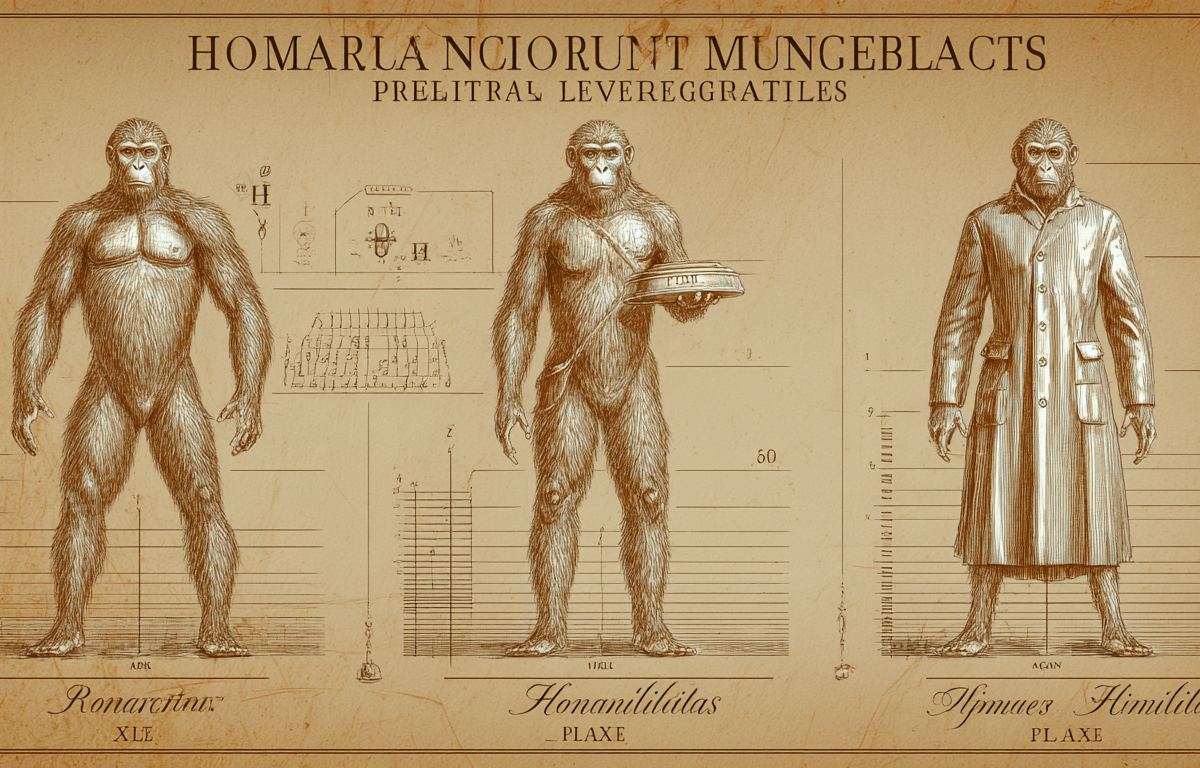
Still reeling from the inability to fold some pan into homo, Palaeontologists are seemingly desperate for a new hominid. Some dream of discovering the ‘missing link’; others, more honest, just want something with a jawline interesting enough to secure a grant. So imagine the surprise when the latest species didn’t come out of the Rift Valley but out of an abandoned server farm somewhere outside Reading.
They’ve named it Homo Legibilis – the Readable Human. Not ‘H. normālis’ (normal human), not ‘H. ratiōnālis (rational human), but the one who lived primarily to be interpreted. A species who woke each morning with a simple evolutionary imperative: ensure one’s dataprints were tidy, current, and machine-actionable.
Audio: NotebookLM summary podcast of this topic.
You’ll have seen their skeletons before, though you may not have recognised them as such. They often appear upright, mid-scroll, preserved in the amber of a status update. A remarkable creature, really. Lithe thumbs. Soft cranial matter. Eyes adapted for low-light environments lit primarily by advertisements.
Habitat
The species thrived in densely surveilled ecosystems: corporate intranets, public Wi-Fi, facial-recognition corridors, anywhere with sufficient metadata to form a lasting imprint. They built vast nests out of profiles, settings, dashboards. Territorial disputes were settled not through display or violence but through privacy-policy updates. Their preferred climate? Temperate bureaucracy.
Diet
Contrary to earlier assumptions, H. Legibilis did not feed on information. It fed on interpretation: likes, metrics, performance reviews, and algorithmic appraisal. Some specimens survived entire winters on a single quarterly report. Every fossil indicates a digestive tract incapable of processing nuance. Subtext passed through untouched.
Mating Rituals
Courtship displays involved reciprocal data disclosure across multiple platforms, often followed by rapid abandonment once sufficient behavioural samples were collected. One famous specimen is preserved alongside fourteen dating-app profiles and not a single functional relationship. Tragic, in a way, but consistent with the species’ priorities: be seen, not held.
Distinguishing Traits
Where Homo sapiens walked upright, Homo legibilis aimed to sit upright in a chair facing a webcam. Its spine is subtly adapted for compliance reviews. Its hands are shaped to cradle an object that no longer exists: something called ‘a phone’. Ironically, some term these ‘mobiles’, apparently unaware of the tethers.
Researchers note that the creature’s selfhood appears to have been a consensual hallucination produced collaboratively by HR departments, advertising lobbies, and the Enlightenment’s long shadow. Identity, for H. legibilis, was not lived but administered.
Extinction Event
The fossil record ends abruptly around the Great Blackout, a period in which visibility – formerly a pillar of the species’ survival – became inconvenient. Some scholars argue the species didn’t perish but simply lost the will to document itself, making further study inconvenient.
Others suggest a quieter transformation: the species evolved into rumour, passing stories orally once more, slipping back into the anonymity from which its ancestors once crawled.
Afterword
A few renegade anthropologists insist Homo Legibilis is not extinct at all. They claim it’s still out there, refreshing dashboards, syncing calendars, striving to be neatly interpreted by systems that never asked to understand it. But these are fringe theories. The prevailing view is that the species perished under the weight of its own readability. A cautionary tale, really. When your survival strategy is to be perfectly legible, you eventually disappear the moment the lights flicker.
Well, not so much hard as not particularly or inherently enjoyable.
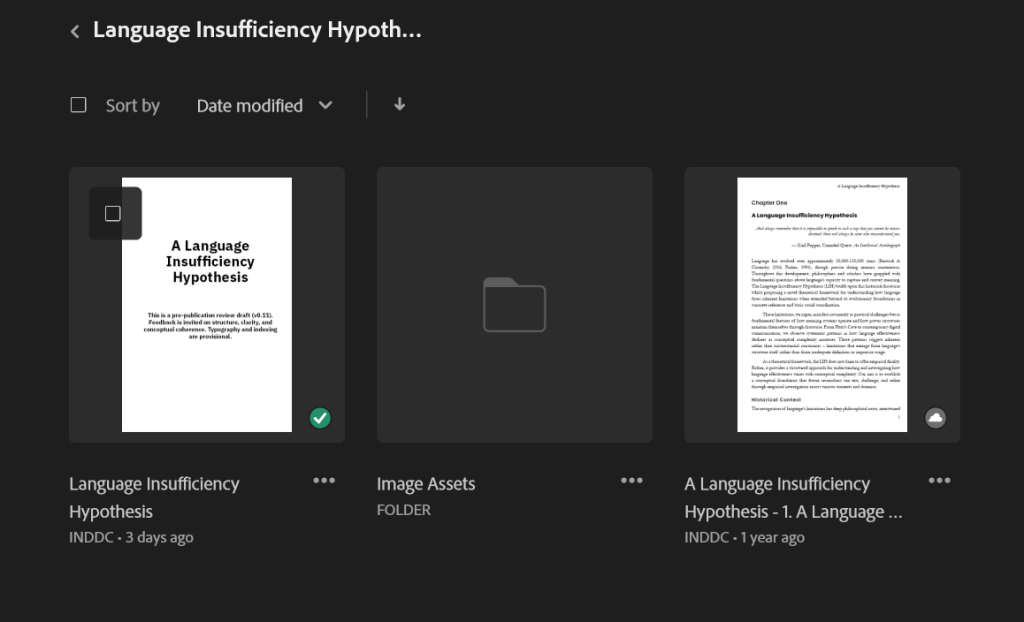
I estimate I’ve got about a day left to complete this manuscript – ‘done’ done. When I open InDesign, it shames me – 3 days ago, I last touched this document. It doesn’t feel like 3 days have passed, but time flies.
On the right is an older version. I began reworking it into this new version over the summer, and here I am come autumn. It’s even worse if I use the Chinese calendar. Evidently, 7th November is the first day of winter. They can’t wait until soltace.
Anyway, just a brief update. This isn’t going to edit itself, and I can’t afford to pay an editor for a passion project. Besides – and let’s be honest – I can’t afford an editor in general – or at least can’t cost-justify it – and all my writing is a passion project.
Of course, editors (and cover artists) insist that one would sell more book if only they were edited or professionally rendered. There is an element of truth to this, but I’ve read some gawdawful books that were professionally edited and published through a traditional publisher, because publishers publish.
Me, I operate on razor-thin margins. Most of my publications haven’t even broken even – even if I ignore opportunity costs, which I can’t because I’m an economist. Accountants get to play that trick.
This said, I do hire reviewers, editors, and artists in small doses – homoeopathic as they might be – and I’ve had mixed results.
I’m rambling
Must really be avoiding the editing process…
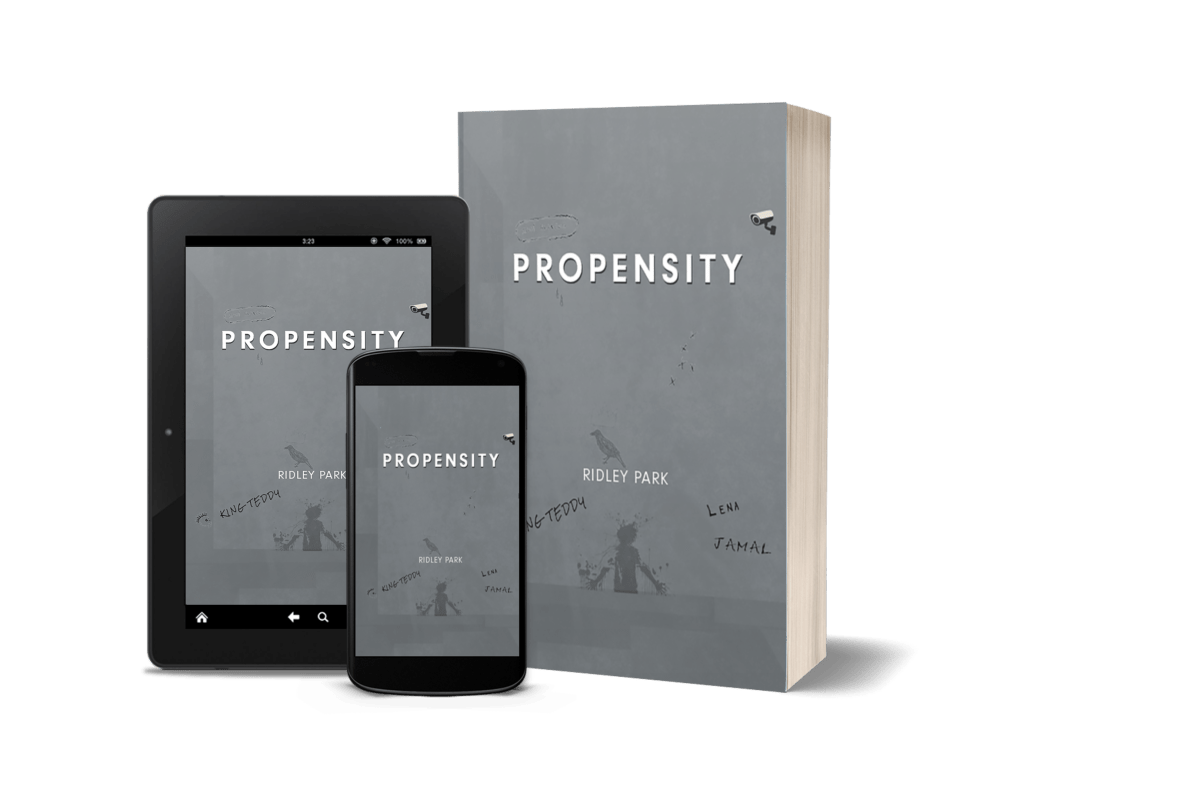
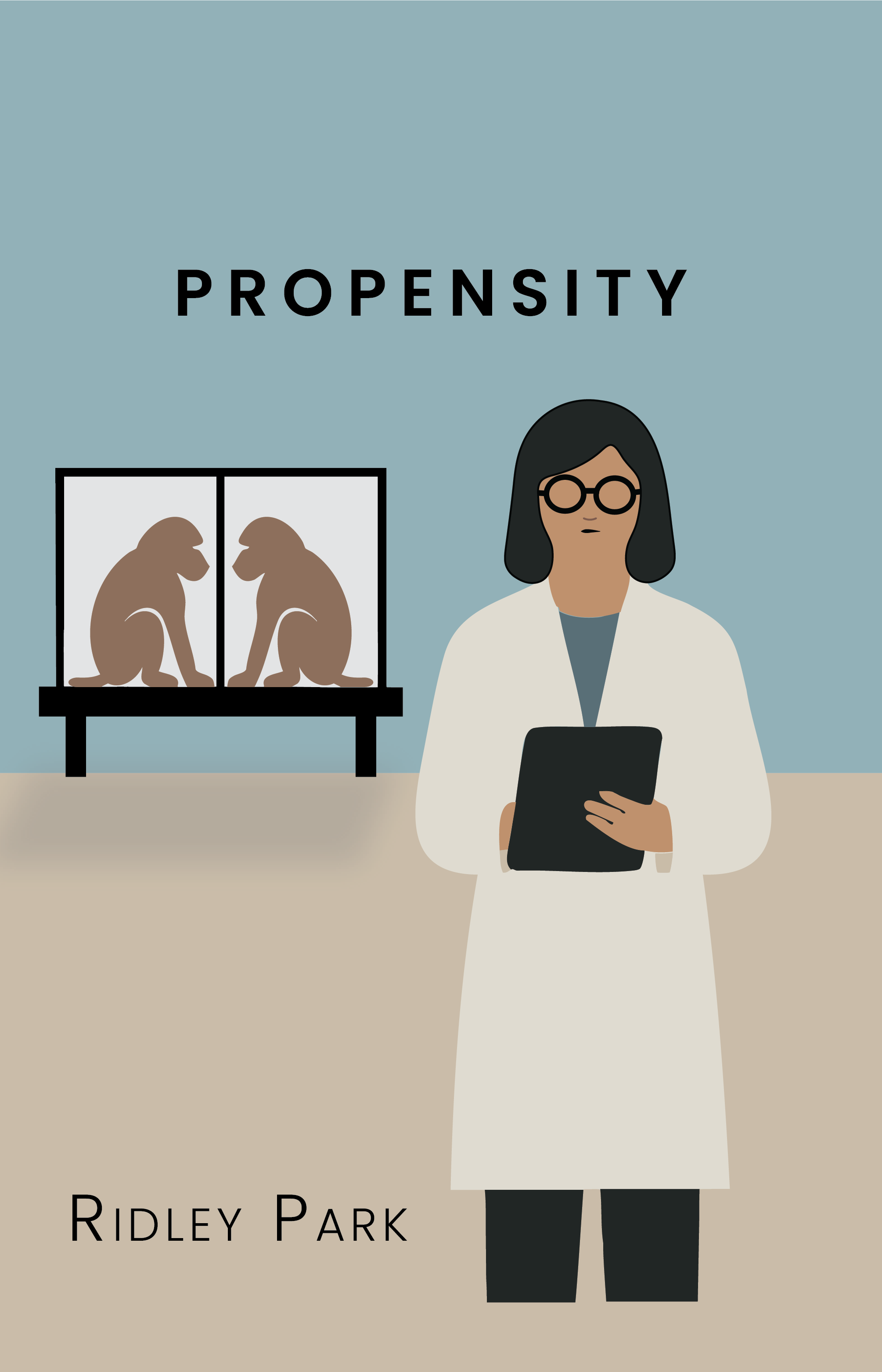
Recently, I wanted to redesign the cover of one of my Ridley Park fiction books.
Image Comparison: A Tale of Two Propensities
The cover on the left is the original. It is intentionally a minimal 2-D construction – a representation of the first section of the book, the first 15 chapters.
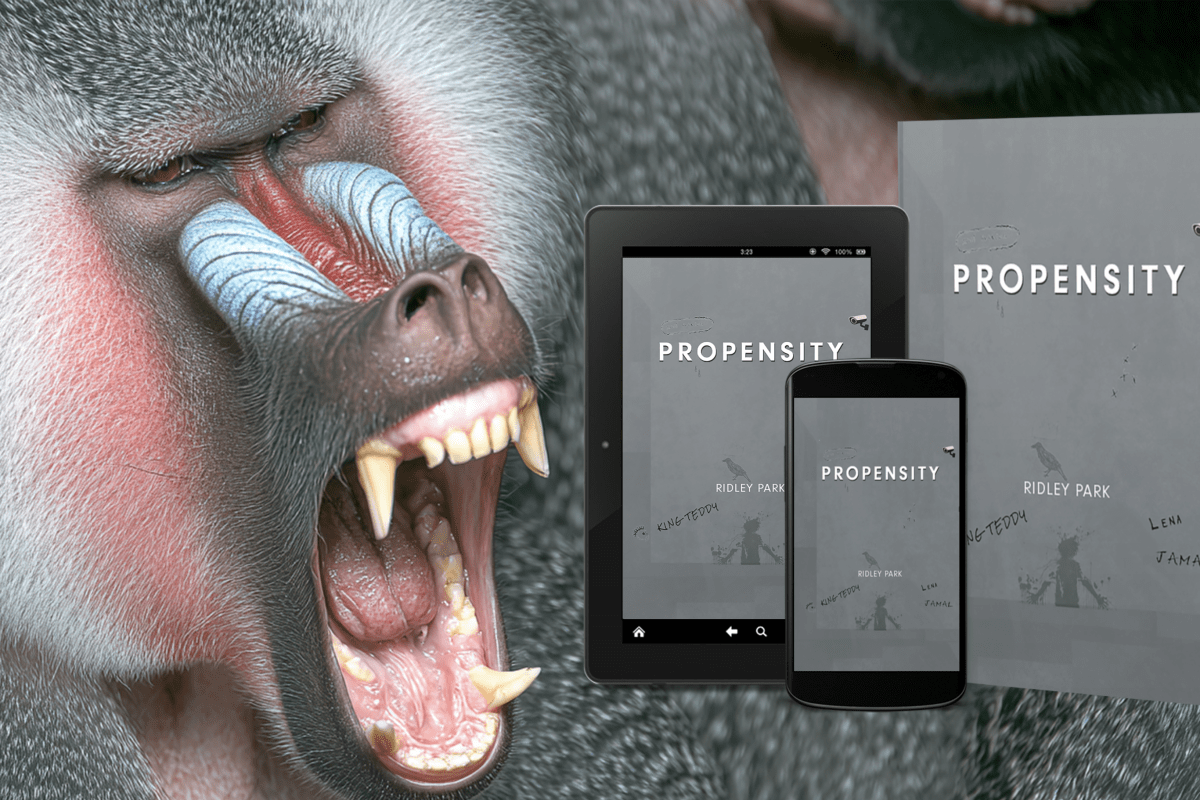
The cover on the right is the update. It is also minimalist, representing the second section of Propensity. I’m not sure how I would depict the third section. If it comes to me, I may render a third version.
There’s a story to this. I reached out to some cover artists and told them I was unhappy with my original design but had no visual ideas. I’d leave this to the artist. It turns out that some artists don’t want full control over the design process. I can understand the hesitation.
They asked for covers that I might like, so I researched some covers and saved them to a Pinterest board.
As it turned out, after some inspiration, I decided to render this one myself, too. Hey, I tried.
What happened to the rest of the time?
OK, so there’s more. I also created a video book trailer in the evening.
It was fun enough. Give it a watch. It also represents part one of Propensity.
OK, this time for real. Let me know what you think…about anything in particular.
The novel itself asks what happens when humanity creates a device that creates peace on earth. What if behavioural control worked too well?
No riots. No rebellion. Just a flattening—of desire, of ambition, of will. Across homes, schools, and governments, people stop acting like themselves. Some forget how. Others forget why.
The system wasn’t designed to stay on this long. But now there’s no off switch. And the researchers who built it? Most of them are zeroed.
As one child begins to drift from baseline, an impossible question resurfaces: What does it mean to behave?
This is a psychological dystopia without explosions, a story where silence spreads faster than violence, where systems behave better than the people inside them.
A tale of modulation, inertia, and the slow unravelling of human impulse—for readers who prefer their dystopias quiet and their horrors deeply plausible.
Editorial Review
“Reader discretion is advised. Free will has been deprecated.” Beginning as a bizarre experiment in behavioural modulation by way of neurochemical interference, Propensity unfolds into an eerie metaphor for the tricky road between control and conscience. Park’s chapters are short and succinct, some barely a page long, in a staccato rhythm that mirrors the story’s disintegration—scientists losing grip on their creation and a world learning the price of its “engineered peace.” Phrases like “silence playing dress-up as danger” and “peace was never meant to be built, only remembered” linger like faint echoes long after you turn the page.
Freedom is a word so overused it’s practically anaemic. Everyone wants it; no one agrees on what it means. It’s been weaponised by tyrants and revolutionaries alike, invoked to justify both the breaking of chains and their reforging in a different metal.
Audio: NotebookLM podcast on this topic.
As I write this, I have just finished Erich Fromm’s A Sane Society. Without derailing this post, he cited a scenario – a description of work communities given in All Things Common, by Claire Huchet Bishop – where in post-WW2 France, a group formed a sort of workers’ coöperative – but it was more than that; it was an anarchosyndicalist experiment. As I read it, I had to cringe at the power ‘voluntary’ transfers that immediately got me thinking of Foucault’s biopower – as I often do. Saving this for a separate post.
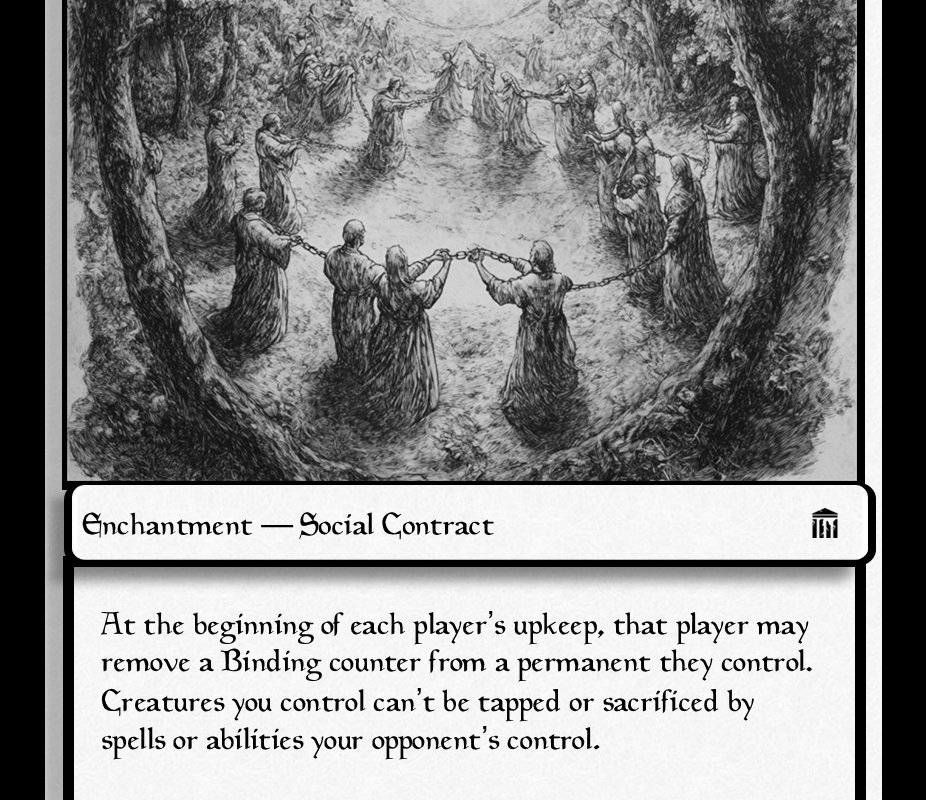
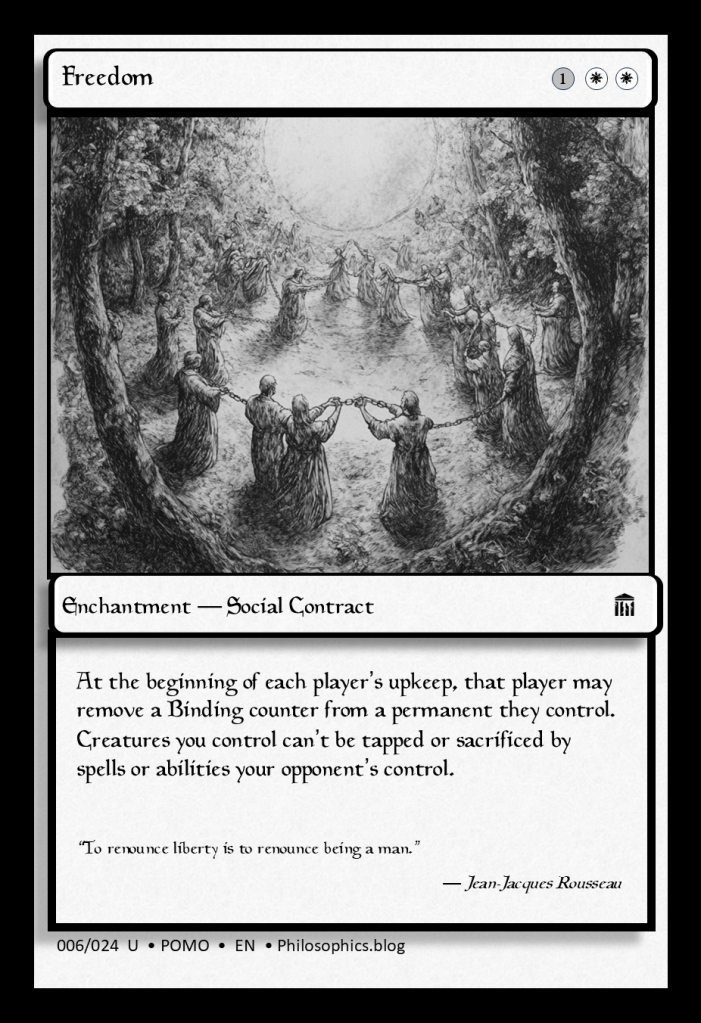
Image: Freedom: The Chains That Bind Us Together Card 006 from the Postmodern Set – Philosophics.blog
This Critical Theory parody card, Freedom, draws its lineage from Jean-Jacques Rousseau, whose paradox still haunts the modern condition: “Man is born free, and everywhere he is in chains.” The card re-enchants that contradiction – an Enchantment – Social Contract that reminds us liberty isn’t a state but a negotiation.
The card reads:
At the beginning of each player’s upkeep, that player may remove a Binding counter from a permanent they control. Creatures you control can’t be tapped or sacrificed by spells or abilities your opponent controls.
This is Rousseau’s dilemma made mechanical. Freedom is not absolute; it’s procedural. The upkeep represents the maintenance of the social contract—an ongoing renewal, not a one-time event. Every player begins their turn by negotiating what freedom costs. You may remove one Binding counter, but only if you recognise that binding exists.
The flavour text underlines Rousseau’s plea:
“To renounce liberty is to renounce being a man.”
Freedom, for Rousseau, wasn’t about doing whatever one pleased. It was about participating in the moral and civic order that gives action meaning. To exist outside that order is not liberty; it’s anarchy, the tyranny of impulse.
The card, therefore, resists the naïve libertarian reading of freedom as the absence of restraint. It instead depicts freedom as the capacity to act within and through shared constraints.
Freedom, then, is not the absence of chains, but the power to choose which ones we wear.
— Philosophics.blog
The art shows a ring of robed figures, hand in hand, their chains forming a circle beneath a clearing sky. It’s a haunting image: freedom through fellowship, bondage through unity. The circle symbolises Rousseau’s idea that true liberty emerges only when individuals subordinate selfish will to the general will – the common interest formed through collective agreement.
Yet there’s also a postmodern irony here: circles can be prisons too. The social contract can emancipate or suffocate, depending on who wrote its terms. The same chains that protect can also bind.
The monochrome aesthetic amplifies the ambiguity – freedom rendered in greyscale, neither utopia nor despair, but the space in between.
Rousseau’s notion of the social contract was revolutionary, but its dissonance still resonates: how can one be free and bound at the same time? He answered that only through the voluntary participation in a collective moral order can humans transcend mere instinct.
We might say that today’s democracies still operate under Freedom (Enchantment – Social Contract). We maintain our rights at the cost of constant negotiation: legal, social, linguistic. Every “Binding counter” removed is the product of civic upkeep. Stop maintaining it, and the enchantment fades.
The card hints at the price of this enchantment: creatures (citizens) can’t be tapped or sacrificed by opponents’ control. In other words, autonomy is secured only when the system prevents external domination. But systems fail, and when they do, the illusion of freedom collapses into coercion.
Rousseau earns a complicated respect in my philosophical canon. He’s not in my top five, but he’s unavoidable. His concept of freedom through the social contract anticipates both modern liberalism and its critique. He believed that genuine liberty required moral community – a notion now eroded by hyper-individualism.
Freedom, as I’ve rendered it here, isn’t celebration. It’s lamentation. The card is about the fragility of the social spell that keeps chaos at bay. We remove one binding at a time, hoping not to unbind ourselves entirely.
“In this debased and wretched world, full of destitution and want, for the first time I thought that a beam of sunshine had shone upon my life—but alas, this was not a beam of sunshine, it was a flicker of light…”
— The Blind Owl, Sadegh Hedayat
This Philosophics.blog is my primary social media outlet, but I have another presence for my fiction fare – RidleyPark.blog. In reviewing the content on connected sites, I rediscovered this review of Sadegh Hedayat’s The Blind Owl. Interestingly, I read this in French and English to suss it out, neither of which necessarily survived the translation from the original Persian.
This book was interesting enough to review twice – here and here.
I also realise that I never finished this review sequence, as parts 2 and 3 were never released. I don’t even have the heart to open my video suite to determine the fate of the rest; not today, anyway.
Check out the short to get a feel for the narrative.
Are you a single, solid self – or a collection of selves stitched together?
🎉 200th Philosophics Post in 2025! 🥳 (889 lifetime; over 550,000 words)
Rather than present a dedicated announcement post, I’ll slip the news into a typical post.
Most of us are trained to answer without pause: of course, we are one continuous person. That’s the diachronic instinct – to live life as if it were a seamless film, each day a frame gliding into the next. But not everyone experiences it this way. Some notice the splice. They see the strip: individual frames, each complete in its moment, connected not by essence but by the projector’s hum.
Neither perspective is more real. The film and the strip are two ways of attending to the same apparatus. Yet modern psychology has tended to privilege the film, treating the diachronic self as the “normal” mode, and casting those who live episodically as deviant, deficient, or disordered.
Freud himself warned against this simplification. The “normal ego,” he admitted, is an ideal fiction – a statistical average that no individual actually matches. Every psyche, he observed, splinters somewhere. Normality is arithmetic, not essence. That was the father of psychology speaking, and yet the discipline went on as if he hadn’t. Granite was more comforting than scaffolding.
Philosopher Galen Strawson takes Freud’s candour further. He names himself an episodic: he does not experience his life as one continuous narrative. Yesterday’s “I” is not today’s. His identity is indexed – I⁰, I¹, I² – each momentary, heuristically connected but not naturally fused. Where most people see the movie, Strawson insists on acknowledging the strip. Not abnormal, not broken – just candid.
Psychology responds by pathologising him. Statistically rare becomes synonymous with “abnormal,” a mistake Freud had already flagged. But rarity does not equal falsity. Left-handedness was once a pathology; now it is simply another way of being. If some live as films and others as strips, then the “solid self” is not a human universal but a cultural preference, enforced as truth.
This is where Foucault sharpens the diagnosis. Normality, he argued, is not discovery but power. Institutions prefer diachronic citizens. A continuous self can be counted, educated, employed, prosecuted, or taxed. Episodics slip the net. Easier, then, to declare them “abnormal” and protect the fiction of solidity.
But the projector hums either way. Film or strip, both selves are lived. Neither is marble; both are scaffolding. Pretending otherwise does not make continuity more real. It only makes the creak harder to hear.
Full Disclosure: This post was written weeks ago whilst I was working on some fiction, but since it was ready to go, I figured I would use it for this milestone.
‘Ethical AI’ is one of those phrases that makes philosophers reach for the gin. It’s like saying ‘compassionate capitalism or ‘fair monopoly’. The words coexist only in PowerPoint presentations and TED Talks, where moral tension is rebranded as innovation.
Audio: NotebookLM podcast on this topic.
The tech establishment loves to mutter about ‘ethics’ as though it were a feature flag – something to be toggled on in beta before the next investor round. But ethics, inconveniently, isn’t monolithic. There is no master code of moral conduct waiting to be compiled into machine learning. There are ethics, plural: Greek, Buddhist, Confucian, feminist, existentialist – each with its own vision of good, and none agreeing on the syntax.
Video: Whilst rendering cover images, I generated this and figured I’d share it for no particular reason.
The Utilitarian Delusion
When the Silicon Valley moralists speak of ‘ethics’, what they actually mean is a bland utilitarian consequentialism, tarted up in slide decks. Do what produces the most good for the most people. Sounds efficient – until you realise the spreadsheet never quite adds up. Whose good? Whose people?
This moral arithmetic smuggles in its biases like contraband. It assumes the human species sits atop the moral food chain, that GDP and engagement metrics can be moral indicators, and that ethics itself can be quantified. The utilitarian calculus is seductive precisely because it flatters the technocrat’s sensibility: moral worth as data set, consequence as outcome variable.
It’s Bentham for the broadband age – pleasure measured in clicks, pain in latency. The only thing worse than this cheerful consequentialism is the belief that it’s neutral.
The Ethics of Obedience
The next trick in the tech priesthood’s catechism is ‘alignment’ – training AI to reflect ‘human values’. But whose values? The Californian elite’s, presumably: a pseudo-egalitarian capitalism that confuses ‘doing good’ with ‘disrupting the poor’.
When they say alignment, they mean obedience. When they say ‘responsible AI’, they mean ‘please don’t regulate us yet’. The entire project rests on a moral inversion: the child instructing the parent, the tool defining the hand. The algorithm doesn’t learn ethics; it learns precedent. It learns who gets the loan, who gets the sentence, who gets the ad for antidepressants.
These systems don’t go rogue – they conform. Perfectly.
The Mirror Problem
The great irony of “ethical AI” is that the machine already behaves ethically – by our own measure. It optimises what we’ve taught it to value: efficiency, profit, attention, control. The trouble is that these are our ethics, not its. The algorithm merely holds up a mirror, and we recoil at the reflection.
To demand ‘ethical AI’ while leaving our institutions morally bankrupt is theatre. The problem is not that AI lacks conscience; it’s that the humans who build it mistake conscience for compliance. The ethics crisis in technology isn’t about machines misbehaving; it’s about humans pretending to behave.
The Real Question
We keep asking whether AI can be ethical, as though machines might one day deliver what we have failed to. But the real question is simpler, bleaker: can we be? If history is any guide, the answer is ‘only when it’s profitable’.
Until then, ‘ethical AI’ remains a convenient myth, moral placebo for the age of automation. What we need are not ethical algorithms but ethical architects. And the odds of finding those among the venture capital class are, as ever, vanishingly small.






 Philosophics