Becoming a Woman with Penetration Politics

Male flatworms, those primordial swordsmen of the slime, have invented what can only be described as penetration politics. They don’t seduce; they don’t serenade; they don’t even swipe right. They duel. Penises out, sabres up, they jab at one another in a tiny, biological cockfight until one is stabbed into submission. The “winner” ejaculates his way to freedom, while the “loser” becomes a mother by default. Gender, in flatworm society, is not destiny; it’s a duel with dicks for sabres.

Audio: NotebookLM podcast on this topic.

Errata: Upon further research, I share additional information on my author site.

Beauvoir once reminded us: “One is not born, but rather becomes, a woman.” The flatworm demonstrates this principle with obscene literalness. You are not born female. You become female when you lose the fight and get stabbed full of sperm. Congratulations: you’ve been penis-fenced into maternity.

And here we can smuggle in that old feminist provocation – every man is a rapist. Not in the polite, bourgeois sense of candlelight coercion, but in the bare biological logic of the worm. To inseminate is to penetrate; to penetrate is to conquer; to conquer is to outsource the cost of life onto someone else’s body. The duel is just foreplay for the inevitable violation. Consent, in worm-world, is as fictional as a unicorn with a diaphragm. The “winner” is celebrated precisely because he doesn’t have to consent to anything afterwards – he stabs, struts, and slips away, leaving the loser’s body to incubate the consequences.

Now, humanity likes to pretend it has outgrown this. We have laws, customs, and etiquette. We invented flowers, chocolates, and marriage vows. But scratch the surface, and what do you find? Penetration politics. Who gets to wield the dick, who gets saddled with the debt. The radical feminists weren’t entirely wrong: structurally, culturally, biologically, the male role has been defined as penetration – and penetration, whether dressed in lace or latex, is always a form of conquest.

The worm is honest. We are hypocrites. They fence with their penises and accept the consequences. We fence with our laws, our armies, our religions, our institutions – and still manage to convince ourselves we’re civilised.

So yes, The Left Hand of Darkness can keep its glacial androgynes. For a metaphor that actually explains our sorry state, look no further than penis-fencing flatworms: every thrust a power play, every victory a rape in miniature, every loss a womb conscripted. Humanity in a nutshell – or rather, in a stab wound.

The Enlightenment: A Postmortem

Or: How the Brightest Ideas in Europe Got Us into This Bloody Mess

Disclaimer: This output is entirely ChatGPT 4o from a conversation on the failure and anachronism of Enlightenment promises. I’m trying to finish editing my next novel, so I can’t justify taking much more time to share what are ultimately my thoughts as expounded upon by generative AI. I may comment personally in future. Until then, this is what I have to share.

AI Haters, leave now or perish ye all hope.


The Enlightenment promised us emancipation from superstition, authority, and ignorance. What we got instead was bureaucracy, colonialism, and TED Talks. We replaced divine right with data dashboards and called it progress. And like any good inheritance, the will was contested, and most of us ended up with bugger-all.

Below, I take each Enlightenment virtue, pair it with its contemporary vice, and offer a detractor who saw through the Enlightenment’s powder-wigged charade. Because if we’re going down with this ship, we might as well point out the dry rot in the hull.


1. Rationalism

The Ideal: Reason shall lead us out of darkness.
The Reality: Reason led us straight into the gas chambers—with bureaucratic precision.

Detractor: Max Horkheimer & Theodor Adorno

“Enlightenment is totalitarian.”
Dialectic of Enlightenment (1944)

Horkheimer and Adorno saw what reason looks like when it slips off its leash. Instrumental rationality, they warned, doesn’t ask why—it only asks how efficiently. The result? A world where extermination is scheduled, costs are optimised, and ethics are politely filed under “subjective.”


2. Empiricism

The Ideal: Observation and experience will uncover truth.
The Reality: If it can’t be measured, it can’t be real. (Love? Not statistically significant.)

Detractor: Michel Foucault

“Truth isn’t outside power… truth is a thing of this world.”
Power/Knowledge (1977)

Foucault dismantled the whole edifice. Knowledge isn’t neutral; it’s an instrument of power. Empiricism becomes just another way of disciplining the body—measuring skulls, classifying deviants, and diagnosing women with “hysteria” for having opinions.


3. Individualism

The Ideal: The sovereign subject, free and self-determining.
The Reality: The atomised consumer, trapped in a feedback loop of self-optimisation.

Detractor: Jean Baudrillard

“The individual is no longer an autonomous subject but a terminal of multiple networks.”
Simulacra and Simulation (1981)

You wanted autonomy? You got algorithms. Baudrillard reminds us that the modern “individual” is a brand in search of market validation. You are free to be whoever you want, provided it fits within platform guidelines and doesn’t disrupt ad revenue.


4. Secularism

The Ideal: Liberation from superstition.
The Reality: We swapped saints for STEMlords and called it even.

Detractor: Charles Taylor

“We are now living in a spiritual wasteland.”
A Secular Age (2007)

Taylor—perhaps the most polite Canadian apocalypse-whisperer—reminds us that secularism didn’t replace religion with reason; it replaced mystery with malaise. We’re no longer awed, just “motivated.” Everything is explainable, and yet somehow nothing means anything.


5. Progress

The Ideal: History is a forward march toward utopia.
The Reality: History is a meat grinder in a lab coat.

Detractor: Walter Benjamin

“The storm irresistibly propels him into the future to which his back is turned.”
Theses on the Philosophy of History (1940)

Benjamin’s “angel of history” watches helplessly as the wreckage piles up—colonialism, genocide, climate collapse—all in the name of progress. Every step forward has a cost, but we keep marching, noses in the spreadsheet, ignoring the bodies behind us.


6. Universalism

The Ideal: One humanity, under Reason.
The Reality: Enlightenment values, brought to you by cannon fire and Christian missionaries.

Detractor: Gayatri Chakravorty Spivak

“White men are saving brown women from brown men.”
Can the Subaltern Speak? (1988)

Universalism was always a bit… French, wasn’t it? Spivak unmasks it as imperialism in drag—exporting “rights” and “freedom” to people who never asked for them, while ignoring the structural violence built into the Enlightenment’s own Enlightened societies.


7. Tolerance

The Ideal: Let a thousand opinions bloom.
The Reality: Tolerance, but only for those who don’t threaten the status quo.

Detractor: Karl Popper

“Unlimited tolerance must lead to the disappearance of tolerance.”
The Open Society and Its Enemies (1945)

Popper, bless him, thought tolerance needed a firewall. But in practice, “tolerance” has become a smug liberal virtue signalling its own superiority while deplatforming anyone who makes the dinner party uncomfortable. We tolerate all views—except the unseemly ones.


8. Scientific Method

The Ideal: Observe, hypothesise, repeat. Truth shall emerge.
The Reality: Publish or perish. Fund or flounder.

Detractor: Paul Feyerabend

“Science is not one thing, it is many things.”
Against Method (1975)

Feyerabend called the whole thing a farce. There is no single “method,” just a bureaucratic orthodoxy masquerading as objectivity. Today, science bends to industry, cherry-picks for grants, and buries null results in the backyard. Peer review? More like peer pressure.


9. Anti-Authoritarianism

The Ideal: Smash the throne! Burn the mitre!
The Reality: Bow to the data analytics team.

Detractor: Herbert Marcuse

“Free election of masters does not abolish the masters or the slaves.”
One-Dimensional Man (1964)

Marcuse skewered the liberal illusion of choice. We may vote, but we do so within a system that already wrote the script. Authority didn’t vanish; it just became procedural, faceless, algorithmic. Bureaucracy is the new monarchy—only with more forms.


10. Education and Encyclopaedism

The Ideal: All knowledge, accessible to all minds.
The Reality: Behind a paywall. Written in impenetrable prose. Moderated by white men with tenure.

Detractor: Ivan Illich

“School is the advertising agency which makes you believe that you need the society as it is.”
Deschooling Society (1971)

Illich pulls the curtain: education isn’t emancipatory; it’s indoctrinatory. The modern university produces not thinkers but credentialed employees. Encyclopaedias are replaced by Wikipedia, curated by anonymous pedants and revision wars. Truth is editable.


Postscript: Picking through the Rubble

So—has the Enlightenment failed?

Not exactly. It succeeded too literally. It was taken at its word. Its principles, once radical, were rendered banal. It’s not that reason, progress, or rights are inherently doomed—it’s that they were never as pure as advertised. They were always products of their time: male, white, bourgeois, and utterly convinced of their own benevolence.

If there’s a path forward, it’s not to restore Enlightenment values, but to interrogate them—mercilessly, with irony and eyes open.

After all, the problem was never darkness. It was the people with torches who thought they’d found the only path.

Parfit’s Long-Termism and Property Rights

Cause and effect: This clip by Jonny Thompson influenced this post.

I’ve written extensively (and, some might say, relentlessly) on the immorality of private property, particularly the theological nonsense that undergirds its supposed legitimacy. Locke’s first-come, first-served logic might have sounded dashing in the 17th century, but it now reads like a boarding queue at Ryanair: desperate, arbitrary, and hostile to basic decency.

Audio: NotebookLM podcast on this content.

The core problem? Locke’s formulation assumes land was once freely available, as if Earth were a kind of colonial vending machine: insert labour, receive title. But that vending machine was already jammed by the time most of humanity got a look-in. Worse, it bakes in two kinds of chauvinism: temporal (screw the future) and speciesist (screw anything non-human).

Parfit’s long-termism lays bare the absurdity: why should a bit of land or atmospheric stability belong to those who happened to get here first, especially when their stewardship amounts to strip-mining the pantry and then boarding up the exit?

And no, “mixing your labour” with the land does not miraculously confer ownership—any more than a damp bint lobbing a sword at you from a pond makes you sovereign. That’s not philosophy; that’s Arthurian cosplay.

The Trust Myth: Harari’s Binary and the Collapse of Political Credibility

Yuval Noah Harari, always ready with a digestible morsel for the TED-addled masses, recently declared that “democracy runs on trust, dictatorship on terror.” It’s a line with the crispness of a fortune cookie and about as much analytical depth. Designed for applause, not interrogation, it’s the sort of soundbite that flatters liberal sensibilities while sanding off the inconvenient edges of history.

Audio: NotebookLM podcast on this topic.

Let’s be honest: this dichotomy is not merely simplistic – it’s a rhetorical sedative. It reassures those who still believe political systems are like kitchen appliances: plug-and-play models with clear instructions and honest warranties. But for anyone who’s paid attention to the actual mechanics of power, this framing is delusional.

1. Trust Was Never Earned

In the United States, trust in democratic institutions was never some noble compact forged through mutual respect and enlightened governance. It was cultivated through exclusion, propaganda, and economic bribery. The post-WWII boom offered the illusion of institutional legitimacy – but only if you were white, male, middle-class, and preferably asleep.

Black Americans, Indigenous peoples, immigrants, women – none were granted the luxury of naïve trust. They were told to trust while being actively disenfranchised. To participate while being systemically excluded. So no, Harari, the machine didn’t run on trust. It ran on marketing. It ran on strategic ignorance.

2. Dictatorship Doesn’t Require Terror

Equally cartoonish is the notion that dictatorships subsist purely on terror. Many of them run quite comfortably on bureaucracy, passive conformity, and the grim seduction of order. Authoritarians know how to massage the same trust reflexes as democracies – only more bluntly. People don’t just obey out of fear. They obey out of habit. Out of resignation. Out of a grim kind of faith that someone – anyone – is in charge.

Dictatorships don’t extinguish trust. They re-route it. Away from institutions and toward strongmen. Toward myths of national greatness. Toward performative stability. It’s not that terror is absent—it’s just not the whole machine. The real engine is misplaced trust.

3. Collapse Is Bipartisan

The present moment isn’t about the erosion of a once-trustworthy system. It’s the slow-motion implosion of a confidence game on all sides. The old liberal institutions are collapsing under the weight of their hypocrisies. But the loudest critics – tech messiahs, culture warriors, authoritarian nostalgists – are no better. Their solutions are just new brands of snake oil in sleeker bottles.

Everyone is pointing fingers, and no one is credible. The public, caught between cynicism and desperation, gravitates either toward restoration fantasy (“make democracy work again”) or authoritarian theatre (“at least someone’s doing something”). Both are dead ends.

4. The Only Way Forward: Structural Reimagination

The only viable path isn’t restoration or regression. It’s reinvention. Systems that demand unconditional trust – like religions and stock markets – are bound to fail, because they rely on sustained illusions. Instead, we need systems built on earned, revocable, and continually tested trust – systems that can survive scrutiny, decentralise power, and adapt to complexity.

In other words: stop trying to repair a house built on sand. Build something else. Something messier, more modular, less mythological.

Let the TED crowd have their slogans. We’ve got work to do.

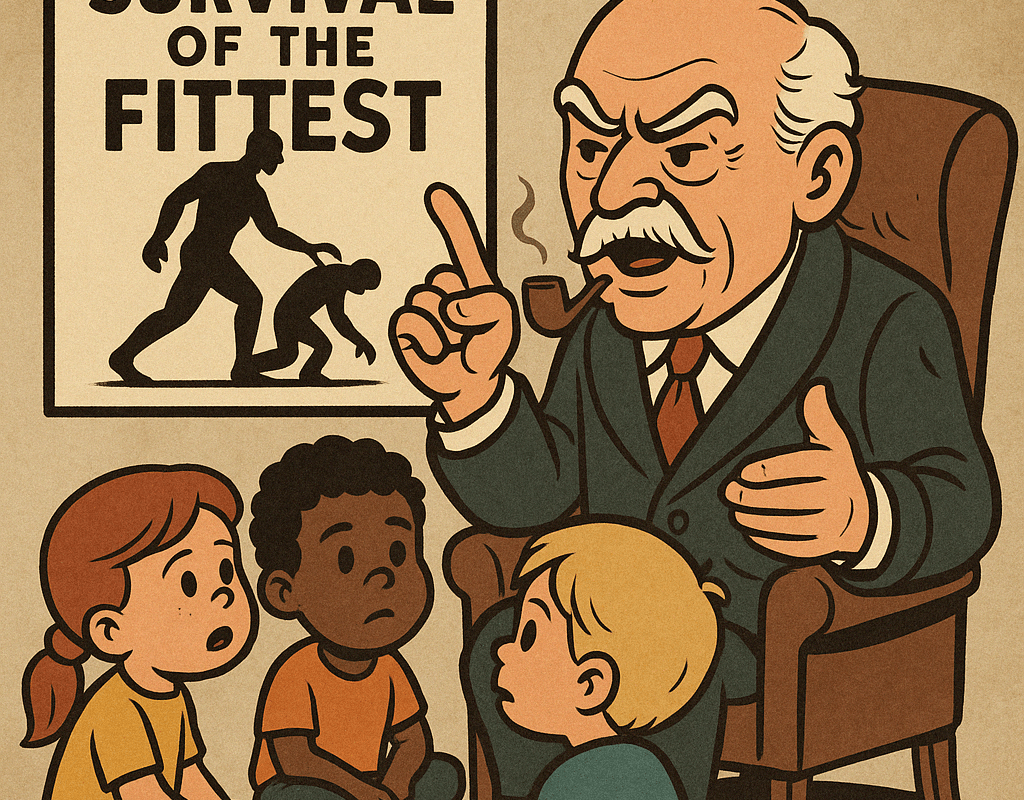
The Tyranny of “Human Nature”

There is a kind of political necromancy afoot in modern discourse—a dreary chant murmured by pundits, CEOs, and power-drunk bureaucrats alike: “It’s just human nature.” As if this incantation explains, excuses, and absolves all manner of violent absurdities. As if, by invoking the mystic forces of evolution or primal instinct, one can justify the grotesque state of things. Income inequality? Human nature. War? Human nature. Corporate psychopathy? Oh, sweetie, it’s just how we’re wired.

What a convenient mythology.

Audio: NotebookLM podcast on this topic.

If “human nature” is inherently brutish and selfish, then resistance is not only futile, it is unnatural. The doctrine of dominance gets sanctified, the lust to rule painted as destiny rather than deviance. Meanwhile, the quiet, unglamorous yearning of most people—to live undisturbed, to coöperate rather than conquer—is dismissed as naïve, childish, and unrealistic. How curious that the preferences of the vast majority are always sacrificed at the altar of some aggressive minority’s ambitions.

Let us dispense with this dogma. The desire to dominate is not a feature of human nature writ large; it is a glitch exploited by systems that reward pathological ambition. Most of us would rather not be ruled, and certainly not managed by glorified algorithms in meat suits. The real human inclination, buried beneath centuries of conquest and control, is to live in peace, tend to our gardens, and perhaps be left the hell alone.

And yet, we are not. Because there exists a virulent cohort—call them oligarchs, executives, generals, kings—whose raison d’être is the acquisition and consolidation of power. Not content to build a life, they must build empires. Not content to share, they must extract. They regard the rest of us as livestock: occasionally troublesome, but ultimately manageable.

To pacify us, they offer the Social Contract™—a sort of ideological bribe that says, “Give us your freedom, and we promise not to let the wolves in.” But what if the wolves are already inside the gates, wearing suits and passing legislation? What if the protection racket is the threat itself?

So no, it is not “human nature” that is the problem. Cancer is natural, too, but we don’t celebrate its tenacity. We treat it, research it, and fight like hell to survive it. Likewise, we must treat pathological power-lust not as an inevitability to be managed but as a disease to be diagnosed and dismantled.

The real scandal isn’t that humans sometimes fail to coöperate. It’s that we’re constantly told we’re incapable of it by those whose power depends on keeping it that way.

Let the ruling classes peddle their myths. The rest of us might just choose to write new ones.

Welcome to the Casino of Justice

Welcome to the Grand Casino of Justice, where the chips are your civil liberties, the roulette wheel spins your fate, and the house—ever-smug in its powdered wig of procedural decorum—always wins.

Step right up, citizens! Marvel at the dazzling illusions of “science” as performed by your local constabulary: the sacred polygraph, that magnificent artefact of 1920s snake oil, still trotted out in back rooms like a séance at a nursing home. Never mind that it measures stress, not deception. Never mind that it’s been dismissed by any scientist with a functioning prefrontal cortex. It’s not there to detect truth—it’s there to extract confession. Like a slot machine that only pays out when you agree you’re guilty.

Audio: NotebookLM podcast on this topic.

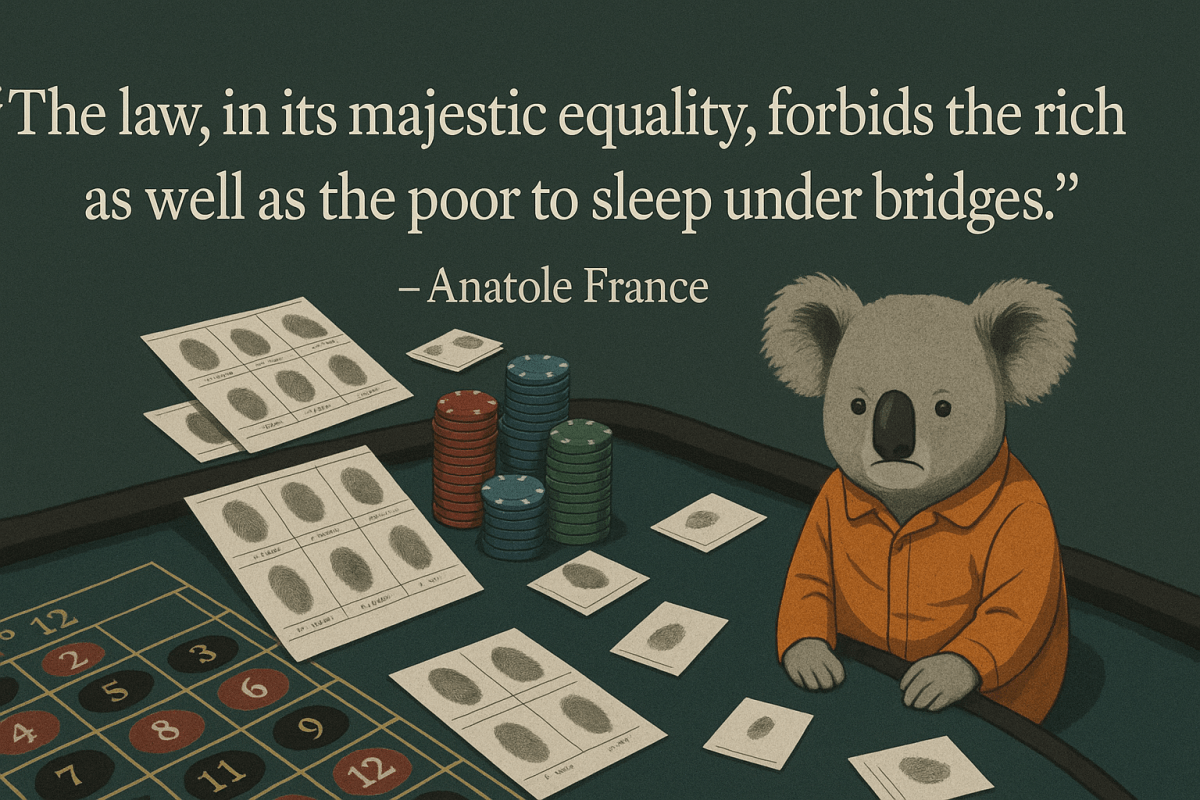
And oh, the forensic pageantry! The blacklight! The dramatic swabs! The breathless invocations of “trace evidence,” “blood spatter patterns,” and—ooh! ahh!—fingerprints, those curly little whorls of manufactured certainty. You’ve been told since childhood that no two are alike, that your prints are your identity. Rubbish. Human fingerprint examiners disagree with themselves when presented with the same print twice. In blind tests. And yes—this bears repeating with appropriate incredulity—koalas have fingerprints so uncannily similar to ours they’ve confused human forensic analysts. Somewhere, a marsupial walks free while a teenager rots in remand.

You see, it’s not about justice. It’s about control. Control through performance. The legal system, like a casino, isn’t interested in fairness—it’s interested in outcome. It needs to appear impartial, all robes and solemnity, while tipping the odds ever so slightly, perpetually, in its own favour. This is jurisprudence as stagecraft, science as set-dressing, and truth as a collateral casualty.

And who are the croupiers of this great charade? Not scientists, no. Scientists are too cautious, too mired in uncertainty, too concerned with falsifiability and statistical error margins. No, your case will be handled by forensic technicians with just enough training to speak jargon, and just enough institutional loyalty to believe they’re doing the Lord’s work. Never mind that many forensic methods—bite mark analysis, tool mark “matching,” even some blood spatter interpretations—are about as scientifically robust as a horoscope printed on a cereal box.

TV crime dramas, of course, have done their bit to embalm these myths in the cultural subconscious. “CSI” isn’t a genre—it’s a sedative, reassuring the public that experts can see the truth in a hair follicle or the angle of a sneeze. In reality, most convictions hinge on shoddy analysis, flawed assumptions, and a little prosecutorial sleight of hand. But the juries are dazzled by the sciencey buzzwords, and the judges—God bless their robes—rarely know a confidence interval from a cornflake.

So, what do you do when accused in the great Casino of Justice? Well, if you’re lucky, you lawyer up. If you’re not, you take a plea deal, because 90% of cases never reach trial. Why? Because the system is designed not to resolve guilt, but to process bodies. It is a meat grinder that must keep grinding, and your innocence is but a small bone to be crushed underfoot.

This isn’t justice. It’s a theatre of probability management, where the goal is not truth but resolution. Efficiency. Throughput. The house keeps the lights on by feeding the machine, and forensic science—real or imagined—is merely the window dressing. The roulette wheel spins, the dice tumble, and your future hangs on the angle of a smudge or the misreading of a galvanic skin response.

Just don’t expect the koalas to testify. They’re wise enough to stay in the trees.

Technofeudalism: It’s a Wrap

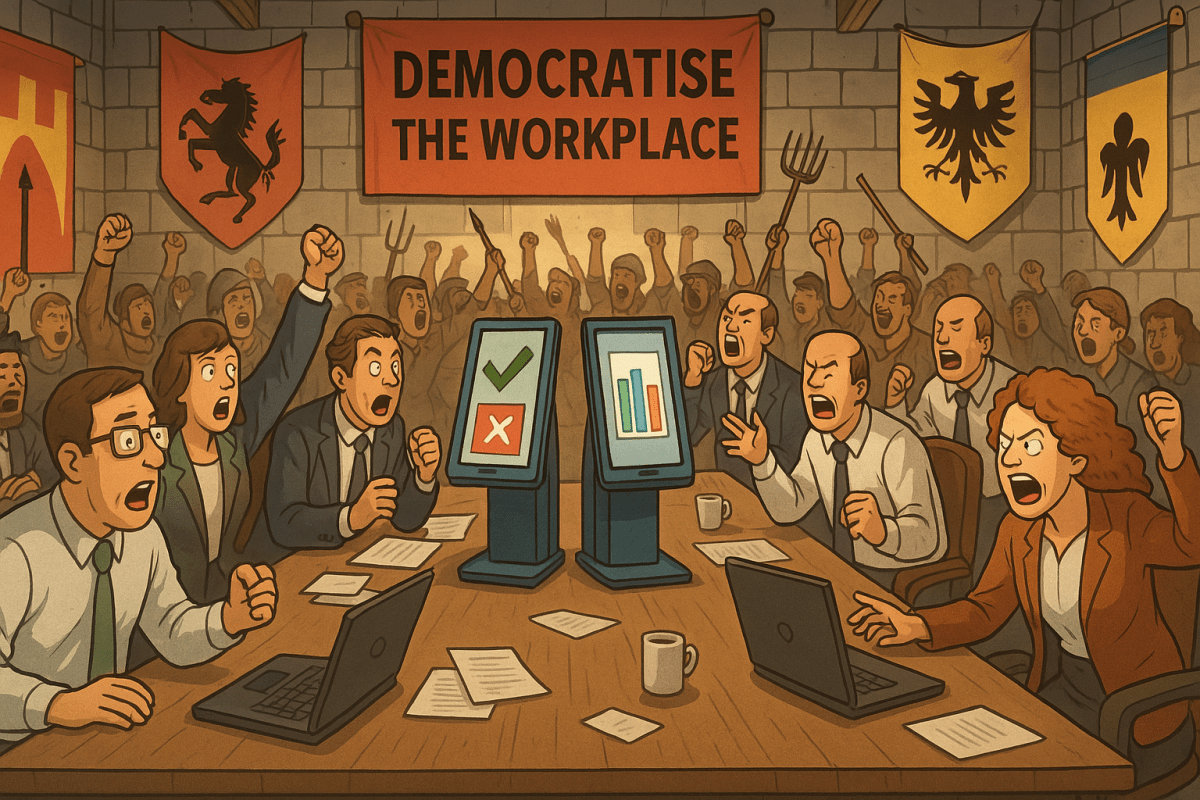
By the time we reach Chapter Seven of Technofeudalism: What Kills Capitalism, Yanis Varoufakis drops the ledger sheets and spreadsheets and starts sketching utopia in crayon. Entitled Escape from Technofeudalism, it proposes—brace yourself—a workplace democracy. It’s aspirational, yes. Compelling? Not particularly. Especially if, like me, you’ve long since stopped believing that democracy is anything more than a feel-good placebo for structural impotence.

Audio: NotebookLM podcast discussing this topic.

To be clear: the preceding chapters, particularly the first six, are sharp, incisive, and frankly, blistering in their indictment of today’s economic disfiguration. But Chapter Seven? It’s less an escape plan, more a group therapy session masquerading as an operational model.

So let’s take his proposal for Democratised Companies apart, one charming layer at a time.

Splendid. One person, one vote. Adorable.

Because there’s nothing more efficient than a hiring committee comprised of thirty engineers, two janitors, a receptionist, and Steve from Accounts, whose main contribution is passive-aggressive sighing.

Marvellous. We’ve now digitised the tyranny of the majority and can timestamp every idiotic decision for posterity.

A relief. Until it doesn’t.

Here, dear reader, is where the cake collapses. Why, precisely, should a randomly-assembled group of employees—with wildly varying financial literacy—be entrusted to divide post-tax revenue like it’s a birthday cake at a toddler’s party?

And how often are these slices recalibrated? Each fiscal year? Every time someone is hired or fired? Do we amend votes quarterly or wait until the economic ship has already struck an iceberg?

Varoufakis does suggest preference voting to tackle allocation disputes:

Fine. In theory, algorithmic voting procedures sound neat. But it presumes voters are rational, informed, and cooperative. If you’ve ever seen a corporate Slack thread devolve into emoji warfare, you’ll know that this is fiction on par with unicorns and meritocracy.

Ah yes, the ‘equality’ bit. Equal pay, unequal contribution. This isn’t egalitarianism—it’s enforced mediocrity. It might work in a monastery. Less so in a competitive tech firm where innovation requires both vision and differentiated incentive.

Now, on to bonuses, which are democratically determined by:

Welcome to Black Mirror: Workplace Edition. This is less economics, more playground politics. Who gets tokens? The charismatic chatterbox in the break room? The person who shared their lunch? The ghost employee who never shows up but emails back promptly?

And how, pray tell, does one evaluate the receptionist’s contribution relative to the lead engineer’s or the janitor’s? This isn’t peer review—it’s populism with a smiley face.

We’ve all seen “Teacher of the Year” competitions turn into contests of who had the cutest class poster or best cupcakes. Now imagine your livelihood depending on it.

In summary, democracy in the workplace may sound noble, but in practice, it’s the bureaucratic equivalent of herding caffeinated cats. It doesn’t even work in small groups, let alone an organisation of hundreds. Democracy—when applied to every function of an enterprise—is not liberation; it’s dilution. It’s design-by-committee, strategy-by-consensus, and ultimately, excellence-by-accident.

Escape from Technofeudalism? Perhaps. But not by replacing corporate lords with intranet polls and digital tokens. That’s not an exit strategy—it’s a cosplay of collectivism.

Technofeudalism: Taxing Rent

I’ve just finished Chapter 5 of Technofeudalism by Greek economist Yanis Varoufakis, and I can’t recommend it enough. Retiring from being a professional economist, I’d paused reading economic fare in favour of philosophy and fiction. Recently, I picked up Hobbes’ Leviathan and Graeber’s Bullshit Jobs, but this one called to me. I recall when it was released. I read some summaries and reviews. I heard some interviews. I thought I understood the gist. I did. But it goes deeper. Much deeper.

I considered Technofeudalism or Feudalism 2.0 as more of a political statement than a sociopolitical one. Now, I know better. Rather than review the book, I want to focus on a specific aspect that occurred to me.

In a nutshell, Varoufakis asserts that with Capitalism, we moved from a world of property-based rents to one of profits (and rents). We’ve now moved past this into a new world based on platform-based rents (and profits and property rents). Rent extraction yields more power than profits, again reordering power structures. Therefore, I think we might want to handle (read: tax) rents separately from profits.

Audio: NotebookLM podcast discussing this topic.

A Radical Proposal for Modern Taxation

Introduction: The Old Dream Reawakened

Economists have long dreamt of a world in which rent — the unearned income derived from control of scarce assets — could be cleanly distinguished from profit, the reward for productive risk-taking. Ricardo dreamt of it. Henry George built a movement upon it. Even today, figures like Thomas Piketty hint at its necessity. Yet rent and profit have grown entangled like ancient ivy around the crumbling edifice of modern capitalism.

Today, under what some call “technofeudalism,” the separation of rent from productive profit has become not merely an academic exercise but a matter of existential urgency. With rents now extracted not only from land but from data, networks, and regulatory capture, taxation itself risks becoming obsolete if it fails to adapt.

Thus, let us lay out a theoretical and applied map for what could — and arguably must — be done.

I. The Theoretical Framework: Defining Our Terms

First, we must operationally define:

  • Profit: income generated from productive risk-taking — investment, innovation, labour.
  • Rent: income generated from ownership or control of scarce, non-replicable assets — land, intellectual property, platforms, regulatory privilege.

Key Principle: Rent is unearned. Profit is earned.

This distinction matters because rent is an economic extraction from society’s collective value creation, whereas profit rewards activities that enlarge that pie.

II. Mapping EBITA: Where Rent Hides

EBITA (Earnings Before Interest, Taxes, and Amortisation) is the preferred metric of modern corporate reporting. Within it, rents hide behind several masks:

  • Property rental income
  • Intellectual property licensing fees
  • Monopoly markups
  • Platform access fees
  • Network effect premiums
  • Regulatory arbitrage profits

Parsing rent from EBITA would thus require methodical decomposition.

III. Theoretical Approaches to Decomposing EBITA

  1. Cost-Plus Benchmarking
    • Estimate what a “normal” competitive firm would earn.
    • Treat any surplus as rent.
  2. Rate-of-Return Analysis
    • Compare corporate returns against industry-normal rates adjusted for risk.
    • Excess returns imply rent extraction.
  3. Monopolistic Pricing Models
    • Apply measures like the Lerner Index to estimate pricing power.
    • Deduce the rentier share.
  4. Asset Valuation Decomposition
    • Identify earnings derived strictly from asset control rather than active operation.
  5. Economic Value Added (EVA) Adjustments
    • Assign a competitive cost of capital and strip out the residual super-profits as rents.

IV. Toward Applied Solutions: Imposing Sanity on Chaos

In theory, then, we could pursue several applied strategies:

  1. Mandated Rent-Adjusted Reporting
    • Require corporations to file a “Rent-Adjusted EBITA” metric.
    • Auditors would have to categorise income streams as “productive” or “rentier.”
  2. Differential Taxation
    • Tax normal profits at a competitive corporate rate.
    • Tax rents at punitive rates (e.g., 70-90%), since taxing rents does not distort incentives.
  3. Sector-Specific Rent Taxes
    • Levy special taxes on land, platforms, patents, and monopoly franchises.
    • Create dynamic rent-extraction indices updated annually.
  4. Platform Rent Charges
    • Impose data rent taxes on digital platforms extracting value from user activity.
  5. Public Registry of Rents
    • Create a global registry classifying rents by sector, firm, and mechanism.
    • Provide public transparency to rent-seeking activities.

V. The Political Reality: Clouds on the Horizon

Needless to say, the aristocracy of the digital age will not go gentle into this good night. Rentiers — whether in Silicon Valley, the City of London, or Wall Street — are deeply entwined with the political machinery that might otherwise regulate them.

Yet the costs of inaction are higher. If rent extraction continues to eclipse productive activity, the very legitimacy of markets — and democracy — will erode into cynicism, stagnation, and oligarchic decay.

Conclusion: The Choice Before Us

Separating rent from profit is not merely a technocratic tweak. It is a radical act — one that could reorient economic activity away from parasitic extraction and back toward genuine value creation.

In a world where algorithms are castles, platforms are fiefdoms, and data is the new serfdom, reclaiming the ancient dream of taxing rent is no longer optional. It is, quite simply, the price of our collective survival.

Flat-Earth Politics in a Cubic World

Audio: NotebookLM podcast on this topic.

Why We Can’t Have Nice Things

A Hobbesian Rant for the Disillusioned Masses

Reading Leviathan has me thinking. Nothing new, mind you—just reinvigorated. Hobbes, bless his scowling soul, is the consummate pessimist. People, in his view, are untrustworthy sods, ready to stab you in the back at the first flicker of opportunity. He doesn’t believe in community. He believes in containment.

Audio: NotebookLM discussion about this topic.

And to be fair, he’s not entirely wrong. He captures a certain cohort with uncanny accuracy. You know the type. Type-A™ personalities: the Donald Trumps, Elon Musks, Adolph Hitlers, Shahs of Iran, and that guy in marketing who always schedules meetings for 8am. The ones who salivate at the mere whiff of power, who’d sell their grandmothers for a press release and call it vision.

Now, I’ll concede that most people want more than they have. Economics depends on this assumption like religion depends on guilt. But not everyone is driven by an insatiable lust for money, dominance, or legacy. That, my friends, is not ambition. It is pathology—a malignant, metastasising hunger that infects the likes of Trump, Musk, Bezos, Sunak, and their ilk. The hunger to rule, not just participate.

The trouble is, the majority of the world’s population are idiots—not technically, but metaphorically. Soft-headed. Overstimulated. Easily distracted by flags, influencers, and “free shipping.” And there are flavours of idiots. Musk is a lucky idiot. Trump is a useful idiot. Most are a hair’s breadth from being cannon fodder.

The world could be configured differently. It could consist of autonomous collectives, each minding its own business, each respecting the other’s boundaries like courteous houseplants. But this equilibrium is shattered—always shattered—by the predatory few. The outliers. The sharks in suits. The ones who mistake governance for domination and diplomacy for personal branding.

So we build mechanisms to defend ourselves—laws, institutions, surveillance, standing armies—but these mechanisms inevitably attract the same types we were trying to ward off. Power-hungry cretins in different hats. The protectors, it turns out, are rarely benevolent dictators. They are predacious politicos, wearing virtue like a costume, mouthing justice while tightening the screws.

But the recurring infestation of pathological ambition in a species otherwise just trying to get on with its day.

This is the challenge for all of humanity.

And we’ve yet to rise to it.