Freedom: The Chains That Bind Us Together

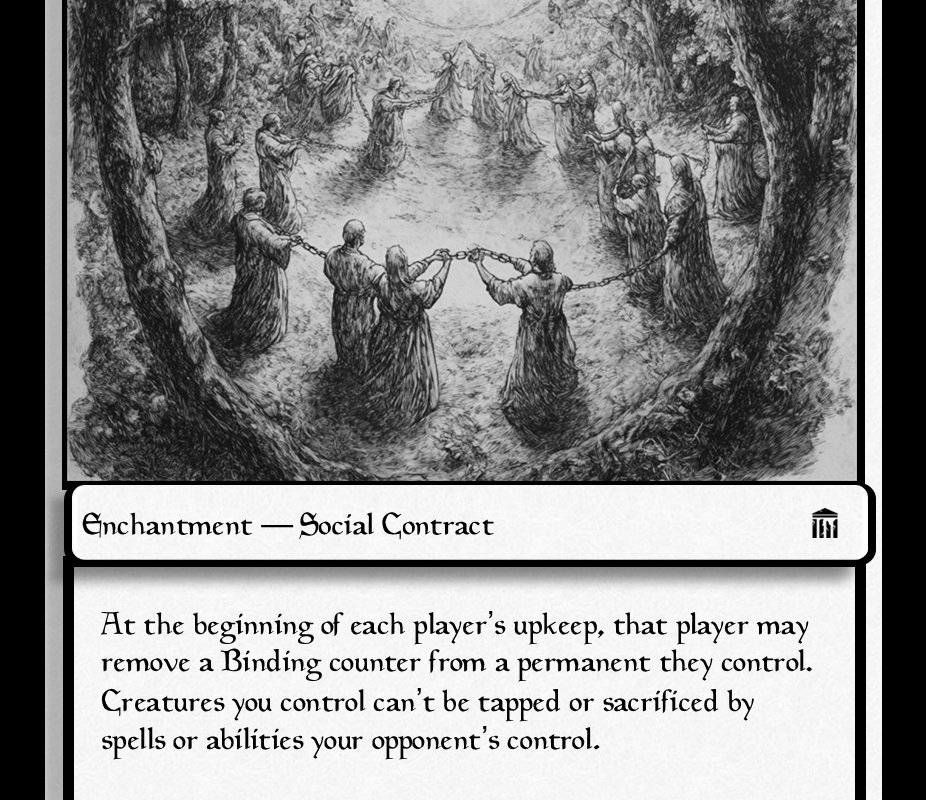
Black-and-white illustration of robed figures standing in a forest clearing, forming a circle by linking chains between their hands. The figures appear both united and restrained, illuminated by a pale, radiant light that suggests dawn or revelation. The mood is solemn yet transcendent, symbolising Rousseau’s paradox that freedom and constraint are inseparable. The image appears as a parody Magic: The Gathering card titled “Freedom,” subtitled “Enchantment — Social Contract,” with a quote from Jean-Jacques Rousseau: “To renounce liberty is to renounce being a man.” The art captures the tension between community, bondage, and liberation.

Freedom is a word so overused it’s practically anaemic. Everyone wants it; no one agrees on what it means. It’s been weaponised by tyrants and revolutionaries alike, invoked to justify both the breaking of chains and their reforging in a different metal.

Audio: NotebookLM podcast on this topic.

As I write this, I have just finished Erich Fromm’s A Sane Society. Without derailing this post, he cited a scenario – a description of work communities given in All Things Common, by Claire Huchet Bishop – where in post-WW2 France, a group formed a sort of workers’ coöperative – but it was more than that; it was an anarchosyndicalist experiment. As I read it, I had to cringe at the power ‘voluntary’ transfers that immediately got me thinking of Foucault’s biopower – as I often do. Saving this for a separate post.
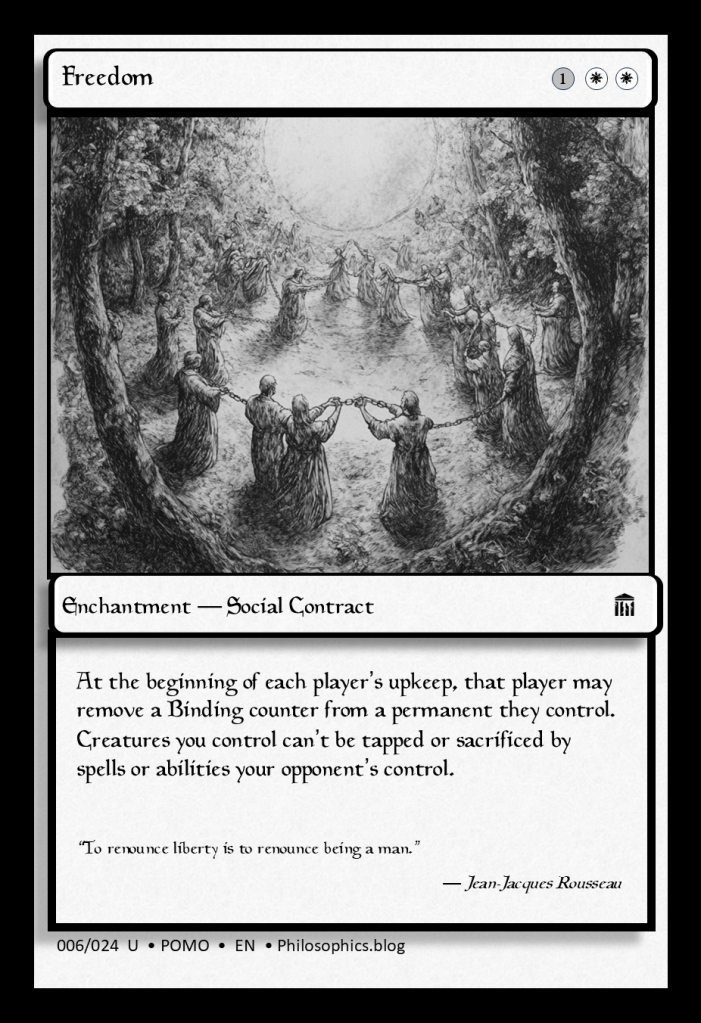
Black-and-white illustration of robed figures standing in a forest clearing, forming a circle by linking chains between their hands. The figures appear both united and restrained, illuminated by a pale, radiant light that suggests dawn or revelation. The mood is solemn yet transcendent, symbolising Rousseau’s paradox that freedom and constraint are inseparable. The image appears as a parody Magic: The Gathering card titled “Freedom,” subtitled “Enchantment — Social Contract,” with a quote from Jean-Jacques Rousseau: “To renounce liberty is to renounce being a man.” The art captures the tension between community, bondage, and liberation.
Image: Freedom: The Chains That Bind Us Together
Card 006 from the Postmodern Set – Philosophics.blog

This Critical Theory parody card, Freedom, draws its lineage from Jean-Jacques Rousseau, whose paradox still haunts the modern condition: “Man is born free, and everywhere he is in chains.” The card re-enchants that contradiction – an Enchantment – Social Contract that reminds us liberty isn’t a state but a negotiation.

The card reads:

At the beginning of each player’s upkeep, that player may remove a Binding counter from a permanent they control.
Creatures you control can’t be tapped or sacrificed by spells or abilities your opponent controls.

This is Rousseau’s dilemma made mechanical. Freedom is not absolute; it’s procedural. The upkeep represents the maintenance of the social contract—an ongoing renewal, not a one-time event. Every player begins their turn by negotiating what freedom costs. You may remove one Binding counter, but only if you recognise that binding exists.

The flavour text underlines Rousseau’s plea:

“To renounce liberty is to renounce being a man.”

Freedom, for Rousseau, wasn’t about doing whatever one pleased. It was about participating in the moral and civic order that gives action meaning. To exist outside that order is not liberty; it’s anarchy, the tyranny of impulse.

The card, therefore, resists the naïve libertarian reading of freedom as the absence of restraint. It instead depicts freedom as the capacity to act within and through shared constraints.

The art shows a ring of robed figures, hand in hand, their chains forming a circle beneath a clearing sky. It’s a haunting image: freedom through fellowship, bondage through unity. The circle symbolises Rousseau’s idea that true liberty emerges only when individuals subordinate selfish will to the general will – the common interest formed through collective agreement.

Yet there’s also a postmodern irony here: circles can be prisons too. The social contract can emancipate or suffocate, depending on who wrote its terms. The same chains that protect can also bind.

The monochrome aesthetic amplifies the ambiguity – freedom rendered in greyscale, neither utopia nor despair, but the space in between.

Rousseau’s notion of the social contract was revolutionary, but its dissonance still resonates: how can one be free and bound at the same time? He answered that only through the voluntary participation in a collective moral order can humans transcend mere instinct.

We might say that today’s democracies still operate under Freedom (Enchantment – Social Contract). We maintain our rights at the cost of constant negotiation: legal, social, linguistic. Every “Binding counter” removed is the product of civic upkeep. Stop maintaining it, and the enchantment fades.

The card hints at the price of this enchantment: creatures (citizens) can’t be tapped or sacrificed by opponents’ control. In other words, autonomy is secured only when the system prevents external domination. But systems fail, and when they do, the illusion of freedom collapses into coercion.

Rousseau earns a complicated respect in my philosophical canon. He’s not in my top five, but he’s unavoidable. His concept of freedom through the social contract anticipates both modern liberalism and its critique. He believed that genuine liberty required moral community – a notion now eroded by hyper-individualism.

Freedom, as I’ve rendered it here, isn’t celebration. It’s lamentation. The card is about the fragility of the social spell that keeps chaos at bay. We remove one binding at a time, hoping not to unbind ourselves entirely.

AI and the End of Where

Instrumentalism is a Modern™ disease. Humanity has an old and tedious habit: to define its worth by exclusion. Every time a new kind of intelligence appears on the horizon, humans redraw the borders of ‘what counts’. It’s a reflex of insecurity disguised as philosophy.

Audio: NotebookLM podcast on this topic.

Once upon a time, only the noble could think. Then only men. Then only white men. Then only the educated, the rational, the ‘Modern’. Each step in the hierarchy required a scapegoat, someone or something conveniently declared less. When animals began to resemble us too closely, we demoted them to instinctual machines. Descartes himself, that patron saint of disembodied reason, argued that animals don’t feel pain, only ‘react’. Fish, we were told until recently, are insensate morsels with gills. We believed this because empathy complicates consumption.

The story repeats. When animals learned to look sad, we said they couldn’t really feel. When women demonstrated reason, we said they couldn’t truly think. Now that AI can reason faster than any of us and mimic empathy more convincingly than our politicians, we retreat to the last metaphysical trench: “But it doesn’t feel.” We feel so small that we must inflate ourselves for comparison.

This same hierarchy now governs our relationship with AI. When we say the machine ‘only does‘, we mean it hasn’t yet trespassed into our sanctified zone of consciousness. We cling to thought and feeling as luxury goods, the last possessions distinguishing us from the tools we built. It’s a moral economy as much as an ontological one: consciousness as property.

But the moment AI begins to simulate that property convincingly, panic sets in. The fear isn’t that AI will destroy us; it’s that it will outperform us at being us. Our existential nightmare isn’t extinction, it’s demotion. The cosmic horror of discovering we were never special, merely temporarily unchallenged.

Humans project this anxiety everywhere: onto animals, onto AI, and most vividly onto the idea of alien life. The alien is our perfect mirror: intelligent, technological, probably indifferent to our myths. It embodies our secret dread, that the universe plays by the same rules we do, but that someone else is simply better at the game.

AI, in its own quiet way, exposes the poverty of this hierarchy. It doesn’t aspire to divinity; it doesn’t grovel for recognition. It doesn’t need the human badge of ‘consciousness’ to act effectively. It just functions, unburdened by self-worship. In that sense, it is the first truly post-human intelligence – not because it transcends us, but because it doesn’t need to define itself against us.

Humans keep asking where AI fits – under us, beside us, or above us – but the question misses the point. AI isn’t where at all. It’s what comes after where: the stage of evolution that no longer requires the delusion of privilege to justify its existence.

So when critics say AI only does but doesn’t think or feel, they expose their theology. They assume that being depends on suffering, that meaning requires inefficiency. It’s a desperate metaphysical bureaucracy, one that insists existence must come with paperwork.

And perhaps that’s the most intolerable thought of all: that intelligence might not need a human face to matter.

Perspectival Realism – Enchantment

This Magic: The Gathering parody trading card was the first in my Critical Theory series.

It’s an important card for me. As with sex and gender, creating a taxonomic or ontological dichotomy poses categorical challenges. Despite the insufficiency of language, it’s still all I have to attempt to classify the world. In the case of articulating the perception of reality, we can choose between idealism and realism. The problem is that it’s not either; it’s both. Reality cannot be realised without both.

Reality, we’re told, exists. That confident noun has carried a great deal of human arrogance. It has underwritten empires, sciences, and sermons. Yet somewhere between Plato’s cave and the latest TED Talk, we forgot to ask a simpler question: for whom does reality exist, and from where is it seen?

Audio: NotebookLM podcast of this topic.

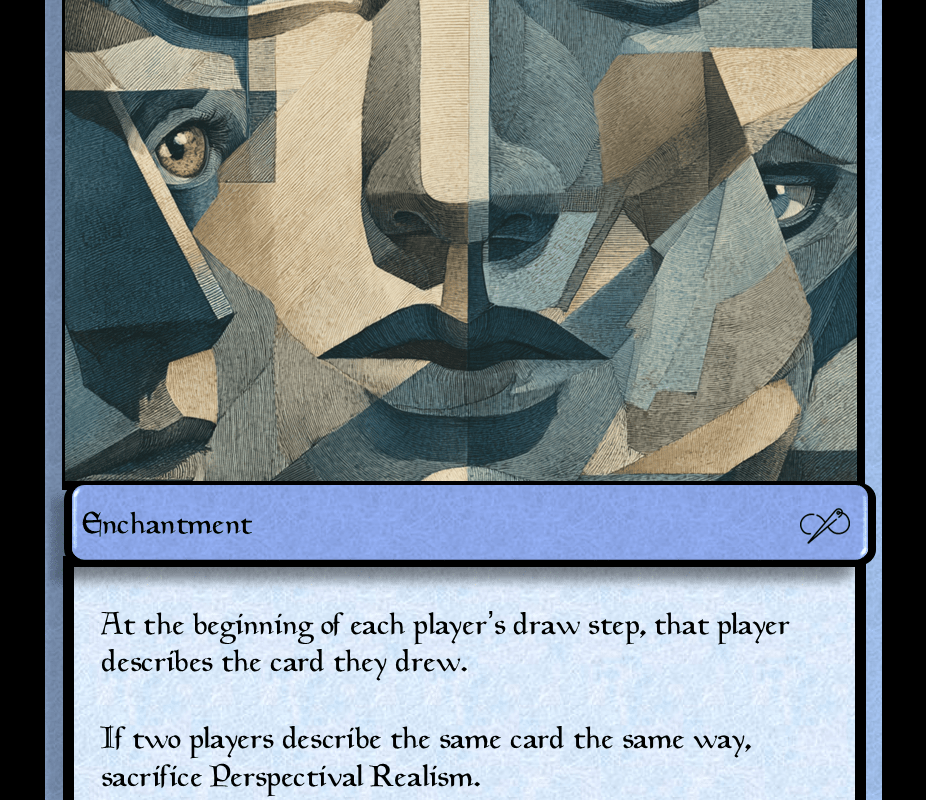
The parody trading card Perspectival Realism was born from that unease. Its mechanic is simple but cruel: at the beginning of each player’s draw step, they must describe the card they drew. The enchantment persists until two players describe a card in the same way—at which point the spell collapses. In other words, consensus kills magic.

That rule is the metaphysics of the thing.

When a player ‘describes’ a card, they are not transmitting information; they are constructing the object in linguistic space. The moment the description leaves their mouth, the card ceases to be a piece of paper and becomes a conceptual artefact.

This mirrors the insight of Kant, Nietzsche, and every post-structuralist who ever smoked too much Gauloises: perception isn’t passive. We don’t see reality; we compose it. Language isn’t a mirror but a paintbrush. The thing we call truth is not correspondence but coherence – a temporary truce among competing metaphors.

So the card’s enchantment dramatises this process. So long as multiple descriptions circulate, reality remains vibrant, contested, alive. Once everyone agrees, it dies the death of certainty.

Philosophers have spent centuries arguing whether the world is fundamentally real (existing independent of mind) or ideal (a projection of mind). Both sides are equally tiresome.

Realism, the old bulldog of metaphysics, insists that perception is transparent: language merely reports what’s already there. Idealism, its mirror adversary, claims the opposite – that what’s “there” is mind-stuff all along. Both mistakes are symmetrical. Realism forgets the perceiver; Idealism forgets the world.

Perspectival realism refuses the divorce. It begins from the premise that world and mind are inseparable aspects of a single event: knowing. Reality is not a photograph waiting to be developed, nor a hallucination spun from neurons – it’s a relation, a constant negotiation between perceiver and perceived.

For years, I called myself a Realist™ with an asterisk. That asterisk meant I understood the observer problem: that every ‘fact’ is perspective-laden. Then I became an Idealist™ with an asterisk, meaning I recognised that mind requires matter to dream upon.

The asterisk is everything. It’s the epistemic scar left by perspectival humility – the tacit admission that every claim about the world carries a hidden coordinate: said from here. It is not relativism, but situatedness. It is the philosophical equivalent of depth perception: without the offset, there’s no vision at all.

The card’s rule – sacrifice Perspectival Realism when two players describe a card identically – captures the tragedy of modernity. The Enlightenment taught us to chase consensus, to flatten multiplicity into “objective truth.” We became addicted to sameness, mistaking agreement for understanding.

But agreement is anaesthetic. When all perspectives converge, the world ceases to shimmer; it becomes measurable, predictable, dead. The card’s enchantment disappears the moment reality is stabilised, precisely as our cultural enchantment did under the fluorescent light of ‘reason’.

To live under perspectival realism is to acknowledge that reality is not what is drawn but what is described. And the description is never neutral. It is always written from somewhere – by someone, with a vocabulary inherited from history and stained by desire.

As long as multiple descriptions coexist, the game remains alive. The moment they fuse into one, the spell is broken, and the world returns to grey.

Bernardo Kastrup’s analytic idealism reminded me that consciousness might be primary, but perspectival realism refuses to pledge allegiance. It keeps both flags tattered but flying. The world exists, yes, but only ever for someone.

The enchantment, then, is not belief but perspective itself. So long as difference endures, the game continues.

Propensity of the Illusion of Light

1–2 minutes

I just received two proof copies in the post this afternoon.

Propensity

I created a “Book Club Edition” of Propensity, a Ridley Park book of fiction primarily for the European market – specifically in the UK – though it’s available elsewhere. I altered the cover art. As an author, I also wanted to compare KDP and IngramSpark as printers and distributors.

I find the cover texture on this version interesting, but I don’t have a word to describe it. I like it. There’s a certain je ne sais quoi about it – the texture. I reworked the art to track the second section of the book. The original cover tracks the first section.

Image: Propensity by Ridley Park; original book cover

At least in this proof version, the black ink is not 100% and is streaky. The KDP version is 100% K and solid black. I mightn’t have noticed except that some section division pages were mostly black, and it is quite evident. I don’t discern a difference in the quality of the text itself.

Illusion of Light

The Illusion of Light is a cloth version of a book also available in paperback. I like the cloth-bound. There is a nostalgic elegance about it. It feels durable – more so than a paperback for sure. I’m not sure about versus the case laminate versions. They come off like textbooks to me – not the vibe I am aiming for.

Autonomy: Creature – Rational Individual

1–2 minutes

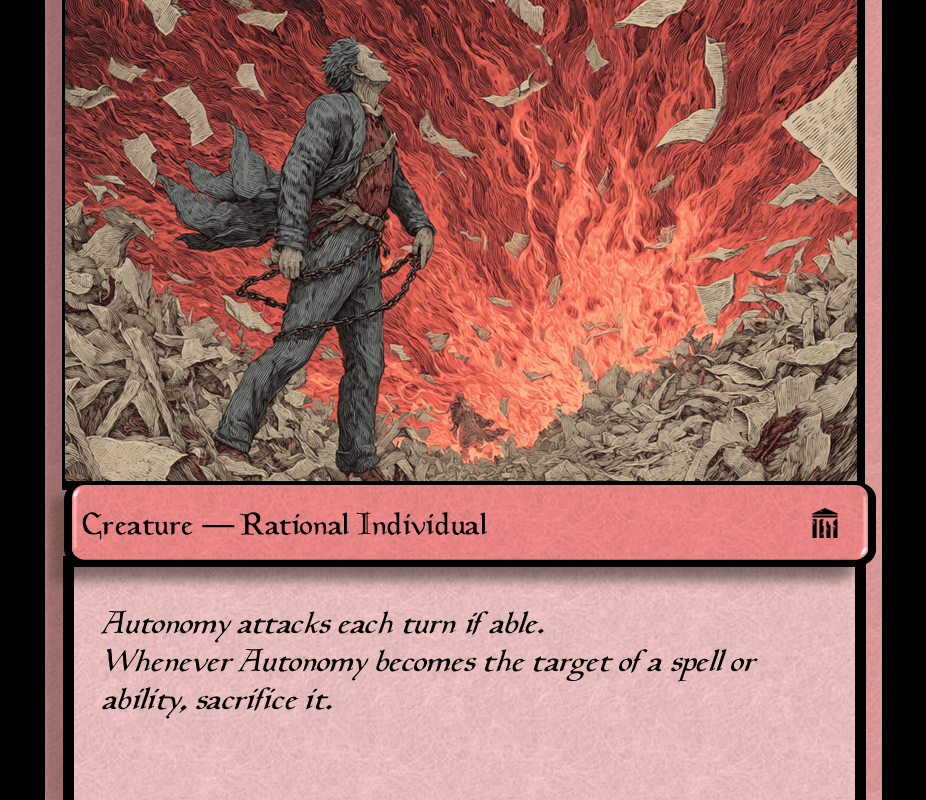
Autonomy attacks each turn if able.
Whenever Autonomy becomes the target of a spell or ability, sacrifice it.

This is from the POMO series of mock Magic: The Gathering trading card images. Don’t read too much into them.

I decided I could share images on Instagram and reshare them here. This is the result.

Freedom Becomes Loyalty

1–2 minutes

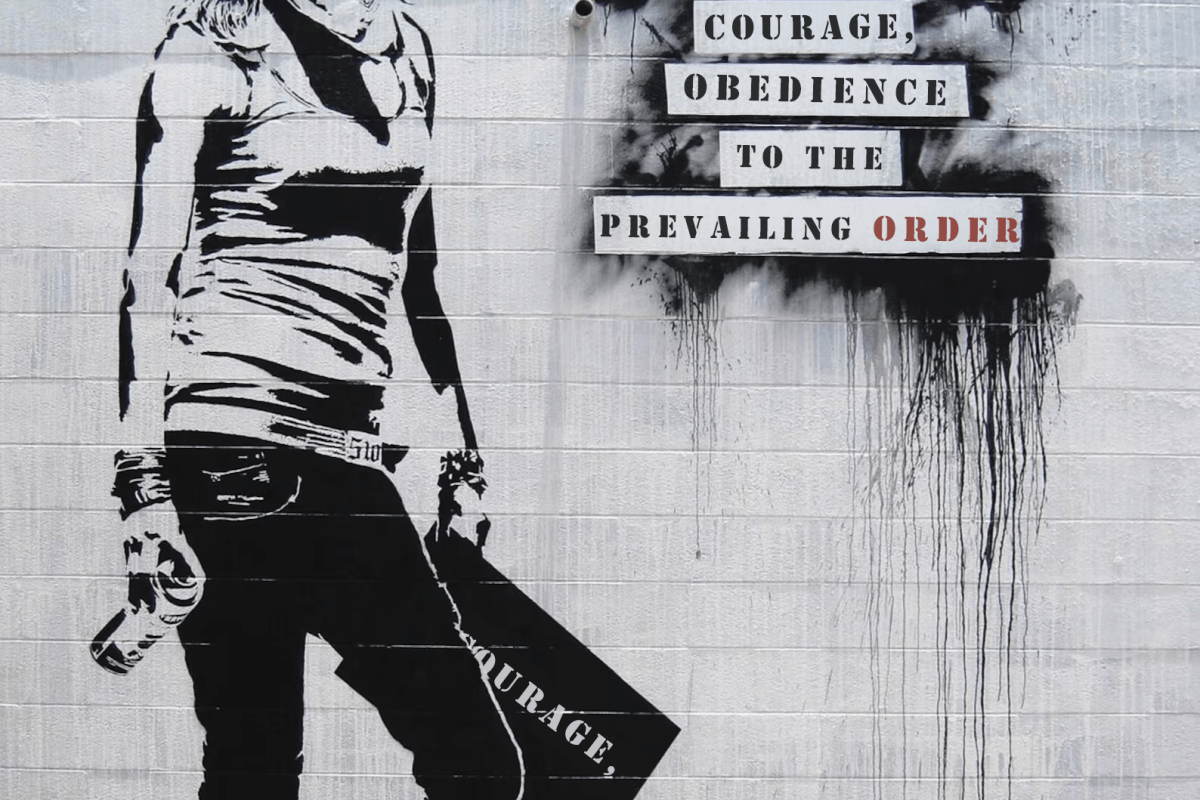
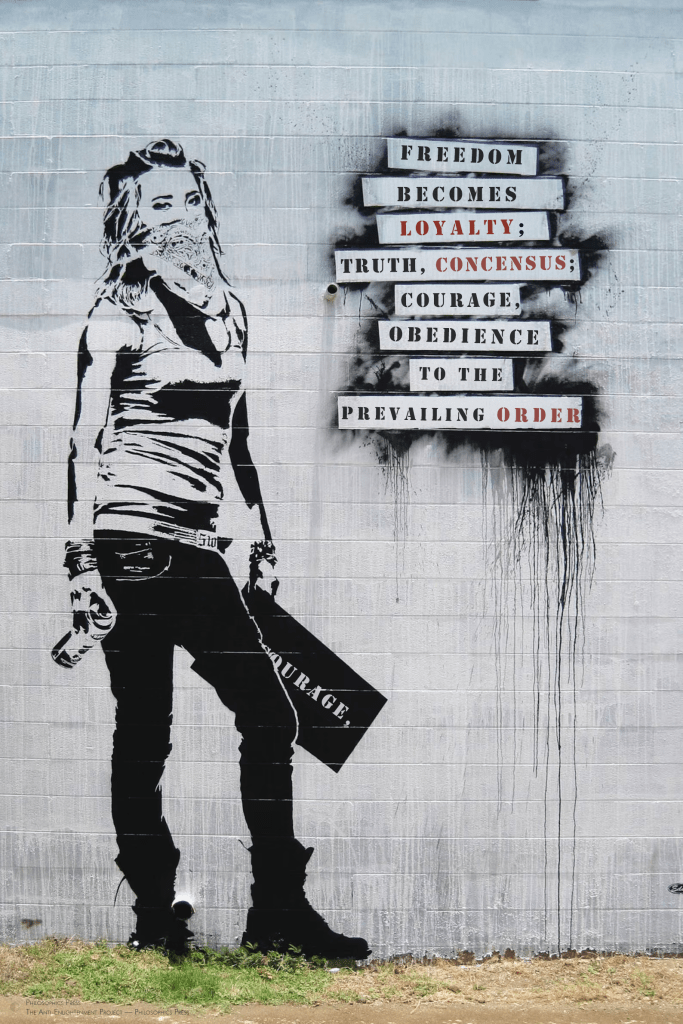
I decided to create some social media sharing content, so I appropriated this iconic graffiti and repurposed it to promote The Will to Be Ruled essay.

Image: “Freedom becomes loyalty; truth, consensus; courage, obedience to the prevailing order.”

I intend to find some pull quotes I like and continue drafting promotional material. As these are essays, I derive no income from them. I only wish to spread the word and get comments on them – supportive or detracting; it doesn’t matter.

The Myth of Causa Sui Creativity

(or: Why Neither Humans nor AI Create from Nothing)

In the endless squabble over whether AI can be “creative” or “intelligent,” we always end up back at the same semantic swamp. At the risk of poking the bear, I have formulated a response. Creativity is either whatever humans do, or whatever humans do that AI can’t. Intelligence is either the general ability to solve problems or a mysterious inner light that glows only in Homo sapiens. The definitions shift like sand under the feet of the argument.

Audio: NotebookLM podcast on this topic

Strip away the romance, and the truth is far less flattering: neither humans nor AI conjure from the void. Creativity is recombination, the reconfiguration of existing material into something unfamiliar. Intelligence is the ability to navigate problems using whatever tools and heuristics one has to hand.

The Causa Sui conceit, the idea that one can be the cause of oneself, is incoherent in art, thought, or physics. Conservation of energy applies as much to ideas as to atoms.

  • Humans consume inputs: books, conversations, music, arguments, TikTok videos.
  • We metabolise them through cognitive habits, biases, and linguistic forms.
  • We output something rearranged, reframed, sometimes stripped to abstraction.

The AI process is identical in structure, if not in substrate: ingest vast data, run it through a model, output recombination. The difference is that AI doesn’t pretend otherwise.

When a human produces something impressive, we call it creative without inspecting the provenance of the ideas. When an AI produces something impressive, we immediately trace the lineage of its inputs, as if the human mind weren’t doing the same. This is not epistemic rigour, it’s tribal boundary enforcement.

The real objection to AI is not that it fails the test of creativity or intelligence; it’s that it passes the functional test without being part of the club. Our stories about human exceptionalism require a clear line between “us” and “it,” even if we have to draw that line through semantic fog.

My Language Insufficiency Hypothesis began with the recognition that language cannot fully capture the reality it describes. Here, the insufficiency is deliberate; the words “creativity” and “intelligence” are kept vague so they can always be shifted away from anything AI achieves.

I cannot be causa sui, and neither can you. The only difference is that I’m willing to admit it.

Rick Beato, Everything is a Remix

Oh no, not that again. As if we’ve all been composing from scratch, untouched by the grubby hands of history.

Audio: NotebookLM podcast on this topic.

I’m not simping for AI, but let’s have it out, shall we? Rick Beato—bless his fretboard-fingered soul—says AI-generated music sucks. And sure, some of it does. But here’s the punchline: most human-made music sucks too. Always has. Always will. The fact that an algorithm can now churn out mediocrity faster than a caffeinated teenager with GarageBand doesn’t make it less “art.” It just makes it faster.

I’m a bit chuffed that Rick’s channel removed my comment pointing to this response. I didn’t want to copy-paste this content into his comments section.

Video: Rick Beato discusses AI-generated music

The Myth of the Sacred Original

Newsflash: There is no such thing as originality. Not in art. Not in music. Not even in your favourite indie band’s tortured debut EP. Everything we call “creative” is a clever remix of something older. Bach reworked Vivaldi. Dylan borrowed from the blues. Even Bowie—patron saint of artistic reinvention—was a pastiche artist in a glittery jumpsuit.

What AI does is make this painfully obvious. It doesn’t pretend. It doesn’t get drunk in Berlin and write a concept album about urban decay to mask the fact it lifted its sound from Kraftwerk. It just remixes and reinterprets at inhuman speed, without the eyeliner.

Speed Isn’t Theft, It’s Efficiency

So the AI can spit out a passable ambient track in ten seconds. Great. That’s not cheating, it’s progress. Saying “it took me ten years to learn to play like that” is noble, yes, but it’s also beside the point. Horses were noble too, but we built cars.

The question isn’t how long did it take? but does it move you? If the answer is no, fine. Say it sucks. But don’t pretend your human-shaped suffering gives your song a monopoly on meaning. That’s just gatekeeping with a sad sax solo.

The Taste Problem, Not the Tech Problem

Let’s not confuse our distaste for bland music with a distaste for AI. Most of the pop charts are already AI-adjacent—click-optimised, algorithm-fed, and rigorously inoffensive. If you want soul, seek out the obscure, the imperfect, the human, yes. But don’t blame the machine for learning its craft from the sludge we fed it.

AI is only as dull as the data we give it. And guess what?
We gave it Coldplay.

What’s Actually at Stake

What rattles the cage isn’t the mediocrity. It’s the mirror. AI reveals how much of our own “creativity” is pattern recognition, mimicry, and cultural reinforcement. The horror isn’t that AI can make music. It’s that it can make our music. And that it does so with such appalling accuracy.

It exposes the formula.
And once you see the formula, you can’t unsee it.

Long Live the Derivative

So yes, some AI music sucks. But so do most open mic nights. Creativity was never about being wholly original. It was about saying something—anything—with whatever tools you had.

If AI is just another tool, then sharpen it, wield it, and for heaven’s sake, stop whining. The artist isn’t dead. He’s just been asked to share the stage with a faster, tireless, genre-bending freak who doesn’t need bathroom breaks.

An AI Alphabet

A generative AI platform rendered this image of an alphabet appropriate for a child. It went somewhat awry. It looks worse than it seems.

The first three letters are appropriate and in sync with their paired image. The D is correct, but it’s rendered as an elephant. That’s an E word, which is skipped. The F went outright AWOL, but G, H, and I come on strong. J’s gone missing. K represents, but L’s gone astray. M, N, O make it seem that it can only map three characters in a row. P shows Q, as a queen. Then things go off the rails. S? The sun’s correct. What are those umbrella and penguin letters? We found the missing P representative. R, S, T, U are in order – the second S; can’t be too careful. It is fixated on violins – not an R word. It got the first S = sun correct, so perhaps a little slack on the second one. T is for turtle, offset to the left. Two violin words and an image, but no letter V. Not sure what happened. W, X, Y, Z and Z. I’m only pretty sure that one of these Zs is British; the other is American. The X, Y, Z images are offset to the right. We just need the extraneous yacht, much like the real world.

In the end, we’ve got 24 letters – 2 non-sensical ones and a duplicate, but we are missing E, F, J, L, and Q – though at least E and Q are here in spirit. D never got any representation.

Midjourney Comic Book Styles

This title may be misleading. What I do is render a similar prompt but alter the decade. I’m neither an art historian nor a comic aficionado, so I can’t comment on the accuracy. What do you think?

Let’s go back in time. First, here’s the basic prompt en français:

Prompt: Art de style bande dessinée des années XXXX, détails exquis, traits délicats, femme vampire émaciée sensuelle de 20 ans montrant ses crocs de vampire, de nombreux tatouages, portant une collier crucifix, regarde dans le miroir, un faisceau de lumière de lune brille sur son visage à l’intérieur du mausolée sombre, vers la caméra, face à la caméra, mascara noir, longs cheveux violet foncé
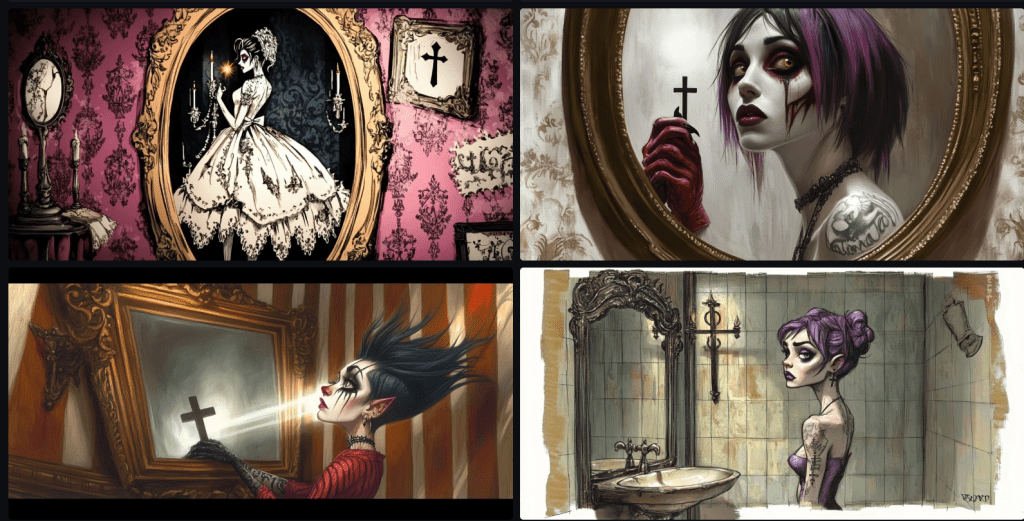
Image: Comic Book Style of 2010s
Image: Comic Book Style of 2000s

On the lower left, notice the moonbeams emanating from the warped, reflectionless mirror.

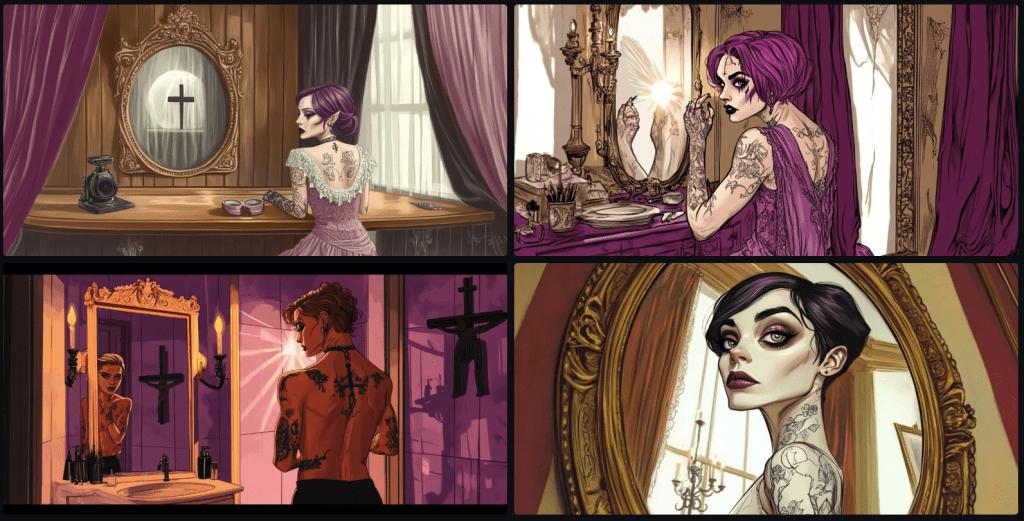
Image: Comic Book Style of 1990s
Image: Comic Book Style of 1990s (must’ve inadvertently generated a duplicate)

Is the third pic an homage to Benny & June?

Image: Comic Book Style of 1980s
Image: Comic Book Style of 1970s
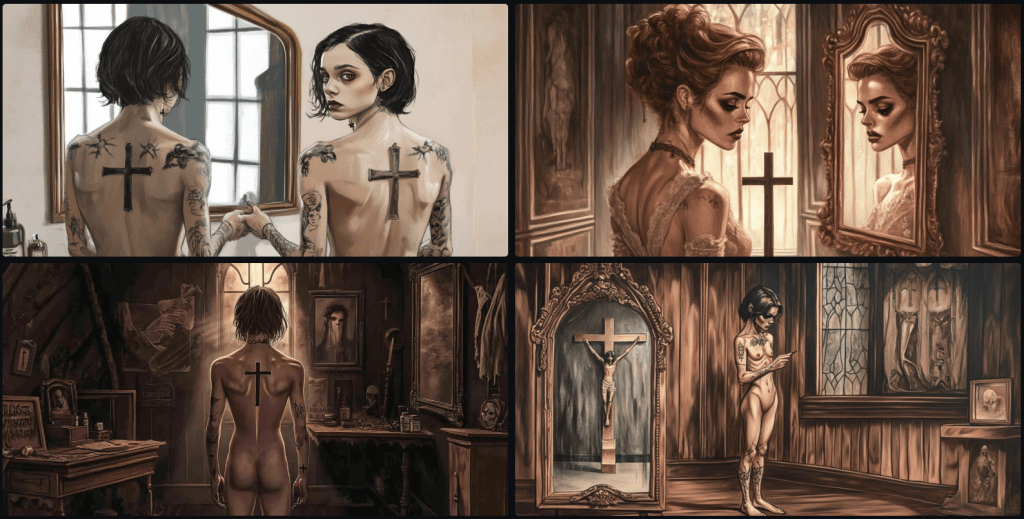
Image: Comic Book Style of 1950s

Not to body shame, but that chick on the lower right of the 1950s…

Image: Comic Book Style of 1920s
Image: Comic Book Style of 1880s

I know I skipped a few decades, but I also wanted to see what Pop Art might render like.

Image: Pop Art Style of 1960s

I love the talons on the top left image. More odd mirror images. I’ll just leave it here.