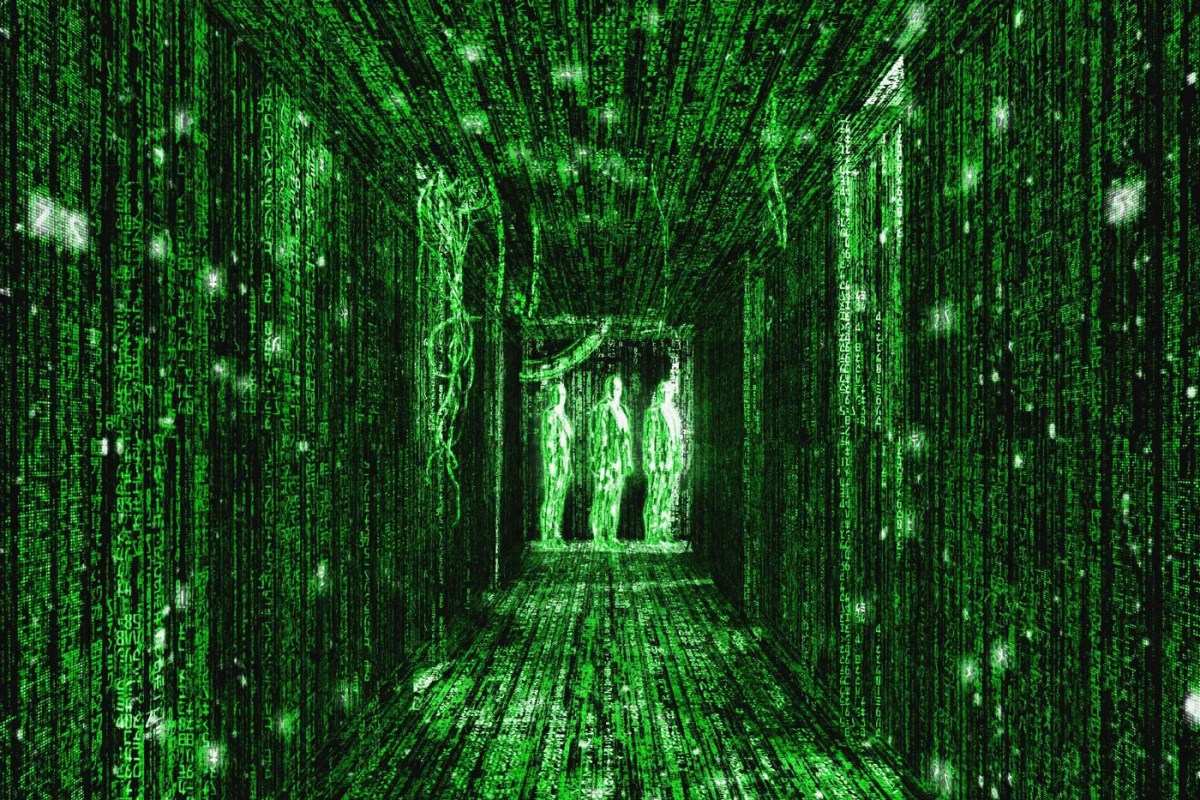
In the late 1990s, the Wachowskis gave us The Matrix – Keanu Reeves as Neo, the Chosen One™, a man so bland he could be anyone, which was the point. Once he realised he was living inside a simulation, he learned to bend its laws, to dodge bullets in slow motion and see the code behind the curtain. Enlightenment, Hollywood-style.
Audio: NotebookLM podcast on this topic.
But here’s the twist, the film itself couldn’t stomach: realising the simulation doesn’t free you from it.
Knowing that race and gender are social constructs doesn’t erase their architecture. Knowing that our economies, legal systems, and so-called democracies are fictions doesn’t get us out of paying taxes or playing our assigned roles. “The social contract” is a collective hallucination we agreed to before birth. That and a dollar still won’t buy you a cup of coffee.
Baudrillard, whose Simulacra and Simulation the film name-dropped like a trophy, argued that simulation doesn’t hide reality – it replaces it. When representation becomes indistinguishable from the thing it represents, truth evaporates, leaving only consensus. We don’t live in a system of power; we live in its performance.
The Matrix got the metaphor half right. It imagined the bars of our cage as a digital dream – glossy, computable, escapable. But our chains are older and subtler. Rousseau called them “social”, Foucault diagnosed them as “biopolitical”, and the rest of us just call them “normal”. Power doesn’t need to plug wires into your skull; it only needs to convince you that the socket is already there.
You can know it’s all a fiction. You can quote Derrida over your morning espresso and tweet about the collapse of epistemic certainty. It won’t change the fact that you still have rent to pay, laws to obey, and identities to perform. Awareness isn’t liberation; it’s just higher-resolution despair with better UX.
Neo woke up to a ruined Earth and thought he’d escaped. He hadn’t. He’d only levelled up to the next simulation – the one called “reality”. The rest of us are still here, dutifully maintaining the system, typing in our passwords, and calling it freedom.
NB: Don’t get me wrong. I loved The Matrix when it came out. I still have fond memories. It redefined action films at the time. I loved the Zen messaging, but better mental acuity doesn’t grant you a pass out of the system.
I’m not sure when I began to seriously consider the wrong path the Enlightenment took. Even before I had the nomenclature and conceptual framework to criticise it, I felt something wasn’t quite right since I was a child. But even then, acculturation and indoctrination are strong countercurrents. I’ve been labelled eccentric and contrarian for as long as I can remember. Most people were vocal in their disagreement.
I’m not oppositional for the sake of opposition, but I interpret the world as I do. As the years passed, I found kindred spirits – at least in dribs and drabs – from Spinoza to Hume, Nietzsche, Foucault, and Latour. In my purported contrarian nature, I rejected the Classics – SPA – preserving mere fragments. I still reject them as quaint, but I need to cite them because they have shaped much of the language intelligible to Moderns, making it uncomfortable for the so-called postmoderns to engage with the concepts. As with the others classified as Postmodern, I reject the label; still, I use it because it conveys meaning – much of it negative, like uttering the names of Nietzsche or Marx, which are forever caricatured by Moderns who are unlikely to have read either. Sort of like their Bibles – yet they maintain an opinion.
Audio: NotebookLM podcast on the underlying essay. (This podcast is a repost.)
All of this to say that during the COVID-19 debacle, I found myself employerless. I decided to take a sabbatical during quarantine and write a book on the absence of agency. Unfortunately, I discovered that many people had written about it less than a decade earlier, though the focus was more toward free will. I read it as input, but decided that I didn’t have anything to add to these authors, who have bigger names than me and stronger academic credentials. They’d been making the conference circuits. I opted out and turned to my Against Democracy project, another popular endeavour – I refer to it as Dumocracy. I did assemble enough material to publish as a book, but I had the misfortune of getting employed again – the bane of intellectual production – and the arts, and who knows what else.
I stopped being employed in March 2023 due to medical reasons. I didn’t stop working; people falsely connect work to employment, but this is a problem of class consciousness – or unconsciousness, as the case might be.
The rest of the story…
Fast forward to today. I had read tens of thousands of pages of material in and around the space I am now writing about. A review of the blog’s contents reveals glimpses and shadows, but now they’ve come into the light.
Against Agency is my best work yet
As I published more essays, I realised the connective tissues – The Anti-Enlightenment Project, I named it. Being near Hallowe’en, the first two share a ghost motif – Rational and Temporal Ghosts; the last is sardonic, but more orthodox. Against Agency is my best work yet – my most serious, escaping the nature of an extended blog article and into an academic space.
Against Agency was a side quest. I began to write a position piece on Dis-integrationism when I realised that this was foundational, so I should describe it first, and so I did.
I suppose this is where it all came together – or maybe where it came apart in a way that finally made sense. None of it was planned. Against Agency wasn’t meant to be a book, or even a thesis. It was an interruption, a side note that kept expanding until everything else had to make room for it.
When I started writing during lockdown, I was mostly arguing with myself – about free will, about why people insist on clinging to a story that clearly doesn’t hold up. I kept waiting for someone to show me the missing piece that made agency make sense again. No one did. So I wrote until I stopped expecting rescue.
It’s strange how a life leaves traces across ideas. Employment, illness, loss, boredom – they all press fingerprints into the page. Somewhere between those fingerprints, I stopped trying to rebuild the Enlightenment and started sweeping up its dust. That became the work.
Now, years later, the ghosts have names. Rational Ghosts, Temporal Ghosts, Against Agency. Each one came out of the same argument with a world that still thinks “choice” is proof of freedom. I guess that’s why I call this an aetiology – it’s not a manifesto; it’s a record of contagion.
I don’t know what comes next. Maybe Dis-Integrationism will, or maybe it already has. The Anti-Enlightenment project keeps pulling at the same loose thread, and I just follow where it frays. For now, that’s enough – to stay curious, to keep tracing the cracks, to let the light leak in where the structure failed.
The Enlightenment promised liberation through reason – that if we could think clearly enough, we could act freely enough. Agency, it claimed, was the defining trait of the rational individual: a sovereign chooser, self-contained and self-determining.
But this was always a fiction.
Not an innocent one, either.
Audio: NotebookLM podcast discussing the essay, Against Agency
Agency became the moral infrastructure of modernity – the premise behind law, punishment, merit, guilt, and even political participation. To say “I chose” was not simply to describe behaviour; it was to perform belonging within a metaphysical system that made individuals the unit of responsibility. The fiction worked, for a while, because it kept the machinery running.
Against Agency argues that this story has collapsed – not metaphorically but structurally. Cognitive science, postcolonial thought, and relational philosophies all point to the same conclusion: there is no autonomous agent, only differential responsiveness – a system’s fluctuating capacity to register and transmit influence.
Copper sings under current; rubber resists. Humans, likewise, respond within the constraints of biology, fatigue, trauma, and social design. What we call “freedom” is merely a condition in which responsiveness remains broad and protected.
This reframing dismantles the binary of “free” and “unfree.” There is no metaphysical threshold where agency appears. Instead, responsiveness scales – widened by safety, narrowed by coercion, eroded by exhaustion. Politics becomes engineering: the maintenance of conditions that sustain responsiveness, rather than the worship of choice.
Ethics, too, must shift.
Not “Who is to blame?” but “Where did the circuit break?”
The essay proposes a gradient model of conduct grounded in relation and feedback, rather than autonomy and will. Responsibility becomes less about moral worth and more about bandwidth – a physics of care.
It’s an uncomfortable vision for a culture addicted to outrage and repentance. The loss of agency removes our favourite alibi: the chooser who could have done otherwise. But it also opens the possibility of a more honest ethics – one that replaces judgment with maintenance, retribution with repair.
This is not nihilism. It’s realism.
Systems appear stable only from a distance. Up close, everything is process – bodies, institutions, meanings – held together by temporary alignments of responsiveness. Against Agency names this collapse not as tragedy, but as opportunity: a clearing from which to think and act without the fictions that sustained modernity.
The essay forms the foundation for what comes next in the Anti-Enlightenment Project – Dis-Integration, a philosophical sequel that explores what remains once coherence, control, and autonomy have been decommissioned.
Not the darkness after the light, but the shadow the light forgot it cast
The Enlightenment promised light. What it delivered was fluorescence – bright, sterile, and buzzing with the sound of its own reason.
The Anti-Enlightenment Project gathers a set of essays, fragments, and quotations tracing how that light dimmed – or perhaps was never as luminous as advertised. It’s less a manifesto than a map of disintegration: how agency became alibi, how reason became ritual, and how modernity mistook motion for progress.
Preprints and essays (Against Agency, Rational Ghosts, Temporal Ghosts, and others to follow)
Related reflections from Philosophics posts going back to 2019
A living index of quotations from Nietzsche to Wynter, tracing philosophy’s slow discovery that its foundation may have been sand all along
This isn’t a war on knowledge, science, or reason – only on their misappropriation as universal truths. The Anti-Enlightenment simply asks what happens when we stop pretending that the Enlightenment’s “light” was neutral, natural, or necessary.
It’s not reactionary. It’s diagnostic.
The Enlightenment built the modern world; the Anti-Enlightenment merely asks whether we mistook the glare for daylight.
We humans pride ourselves on being civilised. Unlike animals, we don’t let biology call the shots. A chimp reaches puberty and reproduces; a human reaches puberty and is told, not yet – society has rules. Biologically mature isn’t socially mature, and we pat ourselves on the back for having spotted the difference.
But watch how quickly that distinction vanishes when it threatens the in-group narrative. Bring up gender, and suddenly there’s no such thing as a social construct. Forget the puberty-vs-adulthood distinction we were just defending – now biology is destiny, immutable and absolute. Cross-gender clothing? “Against nature.” Transition? “You can’t be born into the wrong body.” Our selective vision flips depending on whose ox is being gored.
The same trick appears in how we talk about maturity. You can’t vote until 18. You’re not old enough to drink until 21. You’re not old enough to stop working until 67. These numbers aren’t natural; they’re paperwork. They’re flags planted in the soil of human life, and without the right flag, you don’t count.
The very people who insist on distinguishing biological maturity from social maturity when it comes to puberty suddenly forget the distinction when it comes to gender. They know perfectly well that “maturity” is a construct – after all, they’ve built entire legal systems around arbitrary thresholds – but they enforce the amnesia whenever it suits them. Nietzsche would say it plainly: the powerful don’t need to follow the rules, they only need to make sure you do.
So the next time someone appeals to “nature,” ask: which one? The nature that declares you old enough to marry at puberty? The nature that withholds voting, drinking, or retirement rights until a bureaucrat’s calendar says so? Or the nature that quietly mutates whenever the in-group needs to draw a new line around civilisation?
The truth is, “nature” and “maturity” are less about describing the world than about policing it. They’re flags, shibboleths, passwords. We keep calling them natural, but the only thing natural about them is how often they’re used to enforce someone else’s story.
We’re told we live in the Enlightenment, that Reason™ sits on the throne and superstition has been banished to the attic. Yet when I disguised a little survey as “metamodern,” almost none came out as fully Enlightened. Three managed to shed every trace of the premodern ghost, one Dutch wanderer bypassed Modernity entirely, and not a single soul emerged free of postmodern suspicion. So much for humanity’s great rational awakening. Perhaps Modernity wasn’t a phase we passed through at all, but a mirage we still genuflect before, a lifestyle brand draped over a naked emperor.
Audio: NotebookLM podcast on this topic
The Enlightenment as Marketing Campaign
The Enlightenment is sold to us as civilisation’s great coming-of-age: the dawn when the fog of superstition lifted and Reason took the throne. Kant framed it as “man’s emergence from his self-incurred immaturity” – an Enlightenment bumper sticker that academics still like to polish and reapply. But Kant wasn’t writing for peasants hauling mud or women without the vote; he was writing for his own coterie of powdered-wig mandarins, men convinced their own habits of rational debate were humanity’s new universal destiny.
Modernity, in this story, isn’t a historical stage we all inhabited. It’s an advertising campaign: Reason™ as lifestyle brand, equality as tagline, “progress” as the logo on the tote bag. Modernity, in the textbooks, is billed as a historical epoch, a kind of secular Pentecost in which the lights came on and we all finally started thinking for ourselves. In practice, it was more of a boutique fantasy, a handful of gentlemen mistaking their own rarefied intellectual posture for humanity’s destiny.
The Archetype That Nobody Lives In
At the core of the Enlightenment lies the archetype of Man™: rational, autonomous, unencumbered by superstition, guided by evidence, weighing pros and cons with the detachment of a celestial accountant. Economics repackaged him as homo economicus, forever optimising his utility function as if he were a spreadsheet in breeches.
But like all archetypes, this figure is a mirage. Our survey data, even when baited as a “metamodern survey”, never produced a “pure” Enlightenment subject.
3 scored 0% Premodern (managing, perhaps, to kick the gods and ghosts to the kerb).
1 scored 0% Modern (the Dutch outlier: 17% Premodern, 0% Modern, 83% Post, skipping the Enlightenment altogether, apparently by bike).
0 scored 0% Postmodern. Every single participant carried at least some residue of suspicion, irony, or relativism.
The averages themselves were telling: roughly 18% Premodern, 45% Modern, 37% Postmodern. That’s not an age of Reason. That’s a muddle, a cocktail of priestly deference, rationalist daydreams, and ironic doubt.
Even the Greats Needed Their Crutches
If the masses never lived as Enlightenment subjects, what about the luminaries? Did they achieve the ideal? Hardly.
Descartes, desperate to secure the cogito, called in God as guarantor, dragging medieval metaphysics back on stage.
Kant built a cathedral of reason only to leave its foundations propped up by noumena: an unseeable, unknowable beyond.
Nietzsche, supposed undertaker of gods, smuggled in his own metaphysics of will to power and eternal recurrence.
William James, surveying the wreckage, declared that “truth” is simply “what works”, a sort of intellectual aspirin for the Enlightenment headache.
And economists, in a fit of professional humiliation, pared the rational subject down to a corpse on life support. Homo economicus became a creature who — at the very least, surely — wouldn’t choose to make himself worse off. But behavioural economics proved even that meagre hope to be a fantasy. People burn their wages on scratch tickets, sign up for exploitative loans, and vote themselves into oblivion because a meme told them to.
If even the “best specimens” never fully embodied the rational archetype, expecting Joe Everyman, who statistically struggles to parse a sixth-grade text and hasn’t cracked a book since puberty, to suddenly blossom into a mini-Kant is wishful thinking of the highest order.
The Dual Inertia
The real story isn’t progress through epochs; it’s the simultaneous drag of two kinds of inertia:
Premodern inertia: we still cling to sacred myths, national totems, and moral certainties.
Modern inertia: we still pretend the rational subject exists, because democracy, capitalism, and bureaucracy require him to.
The result isn’t a new epoch. It’s a cultural chimaera: half-superstitious, half-rationalist, shot through with irony. A mess, not a phase..
Arrow’s Mathematical Guillotine
Even if the Enlightenment dream of a rational demos were real, Kenneth Arrow proved it was doomed. His Impossibility Theorem shows that no voting system can turn individual rational preferences into a coherent “general will.” In other words, even a parliament of perfect Kants would deadlock when voting on dinner. The rational utopia is mathematically impossible.
So when we are told that democracy channels Reason, we should hear it as a polite modern incantation, no sturdier than a priest blessing crops.
Equality and the Emperor’s Wardrobe
The refrain comes like a hymn: “All men are created equal.” But the history is less inspiring. “Men” once meant property-owning Europeans; later it was generously expanded to mean all adult citizens who’d managed to stay alive until eighteen. Pass that biological milestone, and voilà — you are now certified Rational, qualified to determine the fate of nations.
And when you dare to question this threadbare arrangement, the chorus rises: “If you don’t like democracy, capitalism, or private property, just leave.” As if you could step outside the world like a theatre where the play displeases you. Heidegger’s Geworfenheit makes the joke bitter: we are thrown into this world without choice, and then instructed to exit if we find the wallpaper distasteful. Leave? To where, precisely? The void? Mars?
The Pre-Modern lord said: Obey, or be exiled. The Modern democrat says: Vote, or leave. And the Post-Enlightenment sceptic mutters: Leave? To where, exactly? Gravity? History? The species? There is no “outside” to exit into. The system is not a hotel; it’s the weather.
Here the ghost of Baudrillard hovers in the wings, pointing out that we are no longer defending Reason, but the simulacrum of Reason. The Emperor’s New Clothes parable once mocked cowardice: everyone saw the nudity but stayed silent. Our situation is worse. We don’t even see that the Emperor is naked. We genuinely believe in the fineries, the Democracy™, the Rational Man™, the sacred textile of Progress. And those who point out the obvious are ridiculed: How dare you mock such fineries, you cad!
Conclusion: The Comfort of a Ghost
So here we are, defending the ghost of a phase we never truly lived. We cling to Modernity as if it were a sturdy foundation, when in truth it was always an archetype – a phantom rational subject, a Platonic ideal projected onto a species of apes with smartphones. We mistook it for bedrock, built our institutions upon it, and now expend colossal energy propping up the papier-mâché ruins. The unfit defend it out of faith in their own “voice,” the elites defend it to preserve their privilege, and the rest of us muddle along pragmatically, dosing ourselves with Jamesian aspirin and pretending it’s progress.
Metamodernism, with its marketed oscillation between sincerity and irony, is less a “new stage” than a glossy rebranding of the same old admixture: a bit of myth, a bit of reason, a dash of scepticism. And pragmatism –James’s weary “truth is what works” – is the hangover cure that keeps us muddling through.
Modernity promised emancipation from immaturity. What we got was a new set of chains: reason as dogma, democracy as ritual, capitalism as destiny. And when we protest, the system replies with its favourite Enlightenment lullaby: If you don’t like it, just leave.
But you can’t leave. You were thrown here. What we call “Enlightenment” is not a stage in history but a zombie-simulation of an ideal that never drew breath. And yet, like villagers in Andersen’s tale, we not only guard the Emperor’s empty wardrobe – we see the garments as real. The Enlightenment subject is not naked. He is spectral, and we are the ones haunting him.
I’ve been reading Octavia Butler’s Dawn and find myself restless. The book is often lauded as a classic of feminist science fiction, but I struggle with it. My problem isn’t with aliens, or even with science fiction tropes; it’s with the form itself, the Modernist project embedded in the genre, which insists on posing questions and then supplying answers, like a catechism for progress. Sci-Fi rarely leaves ambiguity alone; it instructs.
Simone de Beauvoir understood “woman” as the Other – defined in relation to men, consigned to roles of reproduction, care, and passivity. Her point was not that these roles were natural, but that they were imposed, and that liberation required stripping them away.
Octavia Butler’s Lilith
Lilith Iyapo, the protagonist of Dawn, should be radical. She is the first human awakened after Earth’s destruction, a Black woman given the impossible role of mediating between humans and aliens. Yet she is not allowed to resist her role so much as to embody it. She becomes the dutiful mother, the reluctant carer, the compliant negotiator. Butler’s narration frequently tells us what Lilith thinks and feels, as though to pre-empt the reader’s interpretation. She is less a character than an archetype: the “reasonable woman,” performing the script of liberal Western femininity circa the 1980s.
Judith Butler’s Lens
Judith Butler would have a field day with this. For her, gender is performative: not an essence but a repetition of norms. Agency, in her view, is never sovereign; it emerges, if at all, in the slippages of those repetitions. Read through this lens, Octavia Butler’s Lilith is not destabilising gender; she is repeating it almost too faithfully. The novel makes her into an allegory, a vessel for explaining and reassuring. She performs the role assigned and is praised for her compliance – which is precisely how power inscribes itself.
Why Sci-Fi Leaves Me Cold
This helps me understand why science fiction so often fails to resonate with me. The problem isn’t the speculative element; I like the idea of estrangement, of encountering the alien. The problem is the Modernist scaffolding that underwrites so much of the genre: the drive to solve problems, to instruct the reader, to present archetypes as universal stand-ins. I don’t identify with that project. I prefer literature that unsettles rather than reassures, that leaves questions open rather than connecting the dots.
So, Butler versus Butler on the bedrock of Beauvoir: one Butler scripting a woman into an archetype, another Butler reminding us that archetypes are scripts. And me, somewhere between them, realising that my discomfort with Dawn is not just with the book but with a genre that still carries the DNA of the very Modernism it sometimes claims to resist.
So much of modern life rests on promises of improvement. Governments promise progress, religions promise redemption, therapists promise healing. Feltham’s Keeping Ourselves in the Dark (2015) takes a blunt axe to this edifice. In a series of sharp, aphoristic fragments, he suggests that most of these promises are self-deceptions. They keep us busy and comforted, but they do not correspond to the reality of our condition. For Feltham, reality is not an upward arc but a fog – a place of incoherence, accident, and suffering, which we disguise with stories of hope.
Audio: NotebookLM podcast summarising this post.
It is a book that situates itself in a lineage of pessimism. Like Schopenhauer, Feltham thinks life is saturated with dissatisfaction. Like Emil Cioran, he delights in puncturing illusions. Like Peter Wessel Zapffe, he worries that consciousness is an overdeveloped faculty, a tragic gift that leaves us exposed to too much meaninglessness.
Depressive Realism – Lucidity or Illusion?
One of Feltham’s recurring themes is the psychological idea of “depressive realism.” Researchers such as Lauren Alloy and Lyn Abramson suggested that depressed individuals may judge reality more accurately than their non-depressed peers, particularly when it comes to their own lack of control. Where the “healthy” mind is buoyed by optimism bias, the depressed mind may be sober.
Feltham uses this as a pivot: if the depressed see things more clearly, then much of what we call mental health is simply a shared delusion, a refusal to see the world’s bleakness. He is not romanticising depression, but he is deliberately destabilising the assumption that cheerfulness equals clarity.
Here I find myself diverging. Depression is not simply lucidity; it is also, inescapably, a condition of suffering. To say “the depressed see the truth” risks sanctifying what is, for those who live it, a heavy and painful distortion. Following Foucault, I would rather say that “mental illness” is itself a category of social control – but that does not mean the suffering it names is any less real.
Video: Depressive Realism by Philosopher Muse, the impetus for this blog article
Agency Under the Same Shadow
Feltham’s suspicion of optimism resonates with other critiques of human self-concepts. Octavia Butler, in her fiction and theory, often frames “agency” as a structural mirage: we think we choose, but our choices are already scripted by language and power. Jean-Paul Sartre, on the other hand, insists on the opposite extremity: that we are “condemned to be free,” responsible even for our refusal to act. Howard Zinn echoes this in his famous warning that “you can’t be neutral on a moving train.”
My own work, the Language Insufficiency Hypothesis, takes a fourth line. Like Feltham, I doubt that our central myths – agency, freedom, progress – correspond to any stable reality. But unlike him, I do not think stripping them away forces us into depressive despair. The feeling of depression is itself another state, another configuration of affect and narrative. To call it “realistic” is to smuggle in a judgment, as though truth must wound.
Agency, Optimism, and Their Kin
Feltham’s bleak realism has interesting affinities with other figures who unpick human self-mythology:
Octavia Butler presents “agency” itself as a kind of structural illusion. From the Oankali’s alien vantage in Dawn, humanity looks like a single destructive will, not a set of sovereign choosers.
Sartre, by contrast, radicalises agency: even passivity is a choice; we are condemned to be free.
Howard Zinn universalises responsibility in a similar register: “You can’t be neutral on a moving train.”
Cioran and Zapffe, like Feltham, treat human self-consciousness as a trap, a source of suffering that no optimistic narrative can finally dissolve.
Across these positions, the common thread is suspicion of the Enlightenment story in which rational agency and progress are guarantors of meaning. Some embrace the myth, some invert it, some discard it.
Dis-integration Rather Than Despair
Where pessimists like Feltham (or Cioran, or Zapffe) tend to narrate our condition as tragic, my “dis-integrationist” view is more Zen: the collapse of our stories is not a disaster but a fact. Consciousness spins myths of control and meaning; when those myths fail, we may feel disoriented, but that disorientation is simply another mode of being. There is no imperative to replace one illusion with another – whether it is progress, will, or “depressive clarity.”
From this perspective, life is not rescued by optimism, nor is it condemned by realism. It is simply flux, dissonance, and transient pattern. The task is not to shore up agency but to notice its absence without rushing to fill the void with either hope or despair.
Four Ways to Mistake Agency
I’ve long wrestled with the metaphysical aura that clings to “agency.” I don’t buy it. Philosophers – even those I’d have thought would know better – keep smuggling it back into their systems, as though “will” or “choice” were some indispensable essence rather than a narrative convenience.
Take the famous mid-century split: Sartre insisted we are “condemned to be free,” and so must spend that freedom in political action; Camus shrugged at the same premise and redirected it toward art, creation in the face of absurdity. Different prescriptions, same underlying assumption – that agency is real, universal, and cannot be escaped.
What if that’s the problem? What if “agency” is not a fact of human being but a Modernist fable, a device designed to sustain certain worldviews – freedom, responsibility, retribution – that collapse without it?
Sartre and Zinn: Agency as Compulsion
Sartre insists: “There are no innocent victims. Even inaction is a choice.” Zinn echoes: “You can’t be neutral on a moving train.” Both rhetorics collapse hesitation, fatigue, or constraint into an all-encompassing voluntarism. The train is rolling, and you are guilty for sitting still.
Feltham’s Depressive Realism
Colin Feltham’s Keeping Ourselves in the Dark extends the thesis: our optimism and “progress” are delusions. He leans into “depressive realism,” suggesting that the depressive gaze is clearer, less self-deceived. Here, too, agency is unmasked as myth – but the myth is replaced with another story, one of lucidity through despair.
A Fourth Position: Dis-integration
Where I diverge is here: why smuggle in judgment at all? Butler, Sartre, Zinn, Feltham each turn absence into a moral. They inflate or invert “agency” so it remains indispensable. My sense is more Zen: perhaps agency is not necessary. Not as fact, not as fiction, not even as a tragic lack.
Life continues without it. Stabilisers cling to the cart, Tippers tip, Egoists recline, Sycophants ride the wake, Survivors endure. These are dispositions, not decisions. The train moves whether or not anyone is at the controls. To say “you chose” is to mistake drift for will, inertia for responsibility.
From this angle, nihilism doesn’t require despair. It is simply the atmosphere we breathe. Meaning and will are constructs that serve Modernist institutions – law, nation, punishment. Remove them, and nothing essential is lost, except the illusion that we were ever driving.
Octavia E Butler’s Alien Verdict
Not Judith Buthler. In the opening of Dawn, the Oankali tell Lilith: “You committed mass suicide.” The charge erases distinctions between perpetrators, victims, resisters, and bystanders. From their vantage, humanity is one agent, one will. A neat explanation – but a flattening nonetheless.
Even if one resists his alignment of depression with truth, Feltham’s work is valuable as a counterweight to the cult of positivity. It reminds us that much of what we call “mental health” or “progress” depends on not seeing too clearly the futility, fragility, and cruelty that structure our world.
Where he sees darkness as revelation, I see it as atmosphere: the medium in which we always already move. To keep ourselves in the dark is not just to lie to ourselves, but to continue walking the tracks of a train whose destination we do not control. Feltham’s bleak realism, like Butler’s alien rebuke or Sartre’s burden of freedom, presses us to recognise that what we call “agency” may itself be part of the dream.
I’ve been working through the opening chapters of Octavia Butler’s Dawn. At one point, the alien Jdahya tells Lilith, “We watched you commit mass suicide.”*
The line unsettles not because of the apocalypse itself, but because of what it presumes: that “humanity” acted as one, as if billions of disparate lives could be collapsed into a single decision. A few pulled triggers, a few applauded, some resisted despite the odds, and most simply endured. From the alien vantage, nuance vanishes. A species is judged by its outcome, not by the uneven distribution of responsibility that produced it.
This is hardly foreign to us. Nationalism thrives on the same flattening. We won the war. We lost the match. A handful act; the many claim the glory or swallow the shame by association. Sartre takes it further with his “no excuses” dictum, even to do nothing is to choose. Howard Zinn’s “You can’t remain neutral on a moving train” makes the same move, cloaked in the borrowed authority of physics. Yet relativity undermines it: on the train, you are still; on the ground, you are moving. Whether neutrality is possible depends entirely on your frame of reference.
What all these formulations share is a kind of metaphysical inflation. “Agency” is treated as a universal essence, something evenly spread across the human condition. But in practice, it is anything but. Most people are not shaping history; they are being dragged along by it.
One might sketch the orientations toward the collective “apple cart” like this:
Tippers with a vision: the revolutionaries, ideologues, or would-be prophets who claim to know how the cart should be overturned.
Sycophants: clinging to the side, riding the momentum of others’ power, hoping for crumbs.
Egoists: indifferent to the cart’s fate, focused on personal comfort, advantage, or escape.
Stabilisers: most people, clinging to the cart as it wobbles, preferring continuity to upheaval.
Survivors: those who endure, waiting out storms, not out of “agency” but necessity.
The Stabilisers and Survivors blur into the same crowd, the former still half-convinced their vote between arsenic and cyanide matters, the latter no longer believing the story at all. They resemble Seligman’s shocked dogs, conditioned to sit through pain because movement feels futile.
And so “humanity” never truly acts as one. Agency is uneven, fragile, and often absent. Yet whether in Sartre’s philosophy, Zinn’s slogans, or Jdahya’s extraterrestrial indictment, the temptation is always to collapse plurality into a single will; you chose this, all of you. It is neat, rhetorically satisfying, and yet wrong.
Perhaps Butler’s aliens, clinical in their judgment, are simply holding up a mirror to the fictions we already tell about ourselves.
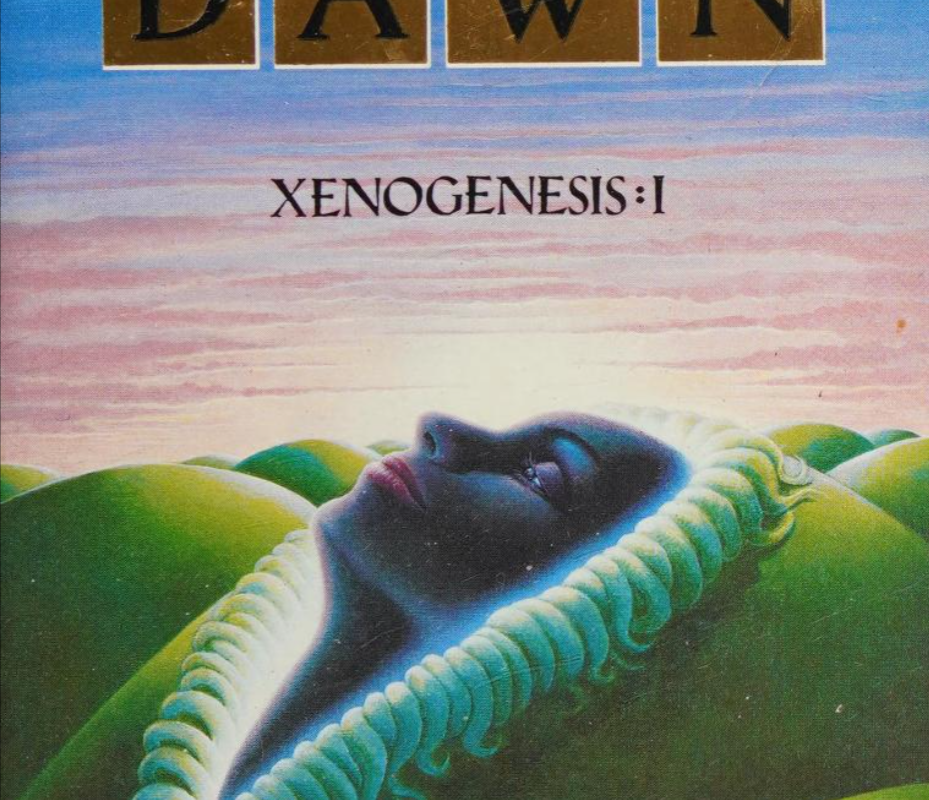
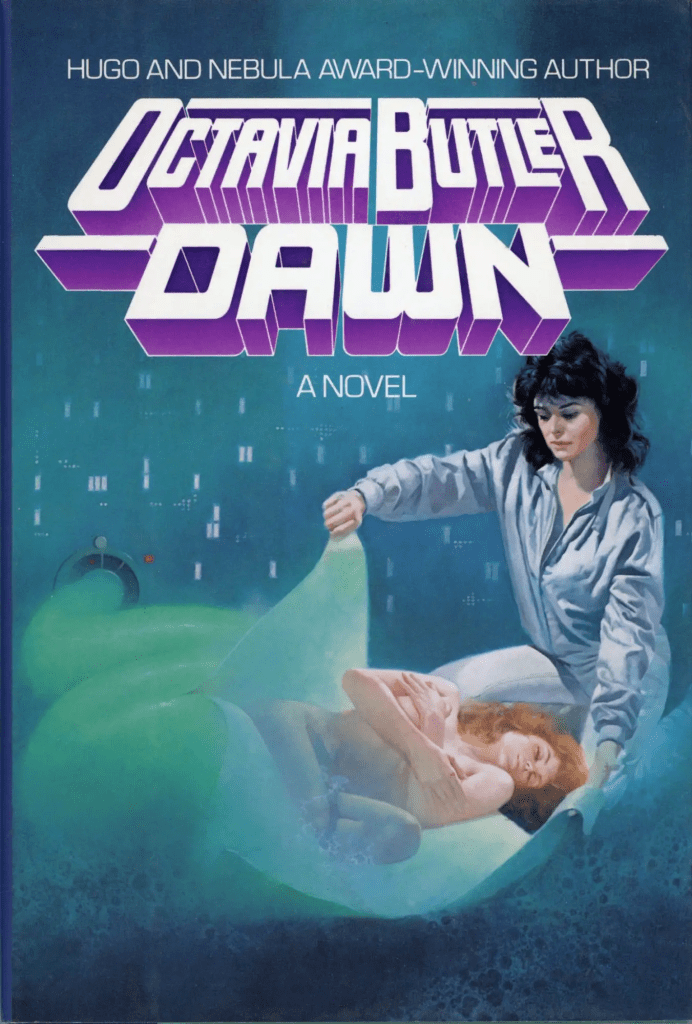
As an aside, this version of the book cover is risible. Not to devolve into identity politics, but Lilith is a dark-skinned woman, not a pale ginger. I can only assume that some target science fiction readers have a propensity to prefer white, sapphic adjacent characters.
I won’t even comment further on the faux 3D title treatment, relic of 1980s marketing.
* Spoiler Alert: As this statement about mass suicide is a Chapter 2 event, I am not inclined to consider it a spoiler. False alarm.
Yaron Brook, ever Ayn Rand’s ventriloquist, insists students are customers. Education, in his frame, is no different from a gym membership; you pay to be made “uncomfortable.” Professors as personal trainers, universities as masochism boutiques. It’s an absurd metaphor that fits all too well in our consumerist age: education rebranded as a service industry, discomfort sold at premium prices.
Video: What is killing universities?
Catherine Liu cuts in sharply: I am not a service worker. And she’s right. Education is not concierge service; it is meant to disturb, dislodge, and disorient. Liu distinguishes “Leftist” universal reason from “Liberal” mushy inclusivity, nostalgic for Enlightenment rationality, perhaps, but her refusal to collapse education into hospitality is a rare moment of clarity.
Eric Kaufman diagnoses the “new left” as a cult of the sacred, where identity is fetishised and offence policed. Liu nods; Brook flirts with Marxism for a minute; suddenly everyone seems to agree the university has lost its bearings.
Brook is not wrong that conservatives self-select out of higher ed. But let’s be clear: not because academia is too “left,” but because they crave catechism, not critique. They want ideological madrassas, not laboratories of doubt. In this sense, Brook’s consumer model is apt: conservatives want a product that validates their priors. That is indoctrination, not education.
Meanwhile, the universities collude in their own corruption. They market “education™” as networking, branding, and employability. At the top tier, the Ivies, Oxbridge, Grandes Écoles, you might still buy proximity to power. But below that? Snake oil. At best, you get nosebleed seats in the auditorium of influence. At worst, an obstructed view behind a pillar. For most, the ticket is counterfeit: a credential that promises access and delivers only debt.
And yet, the true thing still exists. Real education, the kind Liu gestured toward, doesn’t need oak-panelled halls or hedge-fund endowments. It can happen online, in a book, in a seminar, even here with ChatGPT. It’s the deliberate encounter with discomfort, with error, with reason itself. But snake oil sells better than hard truths, and so universities keep hawking tickets they don’t own.





 Philosophics