Gustave Le Bon’s The Crowd: A Study of the Popular Mind (1895) has had the half-life of uranium. His thesis is simple and disturbing: rational individuals become irrational when they merge into a crowd. The crowd hypnotises, contagion spreads, and reason dissolves in the swell of collective emotion.
It’s neat. It’s elegant. It’s also far too flattering.
Audio: NotebookLM podcast on this topic.
Le Bon assumes that the default state of the human being is rational, some Enlightenment holdover where citizens, left to their own devices, behave like tidy mini-Kants. Then, and only then, do they lose their reason in the mob. The trouble is that a century of behavioural science has made it painfully clear that “rational man” is a fairy tale.
Daniel Kahneman mapped our cognitive machinery in Thinking, Fast and Slow: System 1 (fast, intuitive, emotional) is running the show while System 2 (slow, deliberate, logical) is mostly hired as the PR manager after the fact. Dan Ariely built a career documenting just how predictably irrational we are – anchoring, framing, sunk-cost fallacies, you name it. Add in Tversky, Thaler, Gigerenzer, and the usual suspects, and the picture is clear: we don’t need a crowd to become irrational. We start irrational, and then the crowd amplifies it.
In that sense, Le Bon wasn’t wrong about crowds being dangerous, but he may have missed the darker point. A crowd doesn’t corrupt a rational base – it accelerates the irrational baseline. It’s not Jekyll turning into Hyde; it’s Hyde on a megaphone.
This matters because if you take Le Bon literally, the problem is situational: avoid crowds and you’ll preserve reason. But if you take Kahneman seriously, the problem is structural: crowds only reveal what was already there. The positive feedback loop of group psychology doesn’t replace rationality; it feeds on the biases, illusions, and shortcuts already baked into the individual mind.
Le Bon handed us the stage directions for mass manipulation. Modern behavioural economics shows us that the script was already written in our heads before we ever left the house. Put the two together and you have the perfect recipe for political spectacle, advertising, and algorithmic nudges.
Which makes Le Bon’s century-old observations correct – but not nearly bleak enough.
Are you rational, or merely rehearsing your tribe’s catechism? Bayes’ theorem insists we should all update our beliefs the same way when presented with the same evidence. Yet in today’s political divide, identical events harden opposing convictions. The problem isn’t the math—it’s the priors. When your starting assumptions are inherited, acculturated, or indoctrinated, no amount of “evidence” will move you into enemy territory.
A Bayesian Sketch of the Divide
Let be a contested claim (pick your poison: “the election was fair,” “immigration helps,” whatever).
People in Camp R and Camp B begin with different priors and . That’s acculturation if you’re being polite, indoctrination if you’ve run out of patience.
They observe evidence (news, a court ruling, a video clip, a statistic).
They update:
posterior odds = prior odds ×
Except they don’t, not cleanly, because trust in sources warps the likelihoods.
Video: Jonny Thompson on Bayes’ Theorem. I love Jonny’s content, which is why I reference it so often. He and I have such different philosophical worldviews. Vive la différence (or différance).
Why this locks in polarisation
1. Wildly different priors. If Camp R starts at and Camp B at , then even moderately pro- evidence (say likelihood ratio ) yields:
R: prior odds
B: prior odds
Same evidence, one camp “settled,” the other still unconvinced. Repeat ad infinitum, preferably on primetime.
2. Identity-weighted likelihoods. People don’t evaluate ; they evaluate . Disconfirming evidence is down-weighted by a factor . This is called “being rational” on your own planet and “motivated reasoning” on everyone else’s.
3. Different hypothesis sets. Camps don’t just disagree on ; they entertain different s. If one side’s model includes “coordinated elite malfeasance” and the other’s does not, then identical data streams update into different universes.
4. Selective exposure = selection bias. Evidence isn’t i.i.d.; it’s curated by feeds, friends, and fury. You are sampling from your own posterior predictive distribution and calling it “reality.”
5. Asymmetric loss functions. Even if beliefs converged, choices won’t. If the social cost of dissent is high, the decision threshold moves. People report a “belief” that minimises ostracism rather than error.
6. No common knowledge, no convergence. Aumann told us honest Bayesians with common priors and shared posteriors must agree. Remove either—common priors or the “we both know we both saw the same thing” bit—and you get the modern news cycle.
“Acculturation” vs “Indoctrination”
Same mechanism, different moral valence. Priors are installed by families, schools, churches, unions, algorithms. Call it culture if you approve of the installers; call it indoctrination if you don’t. The probability calculus doesn’t care. Your tribal totems do.
Two quick toy moves you can use in prose
Likelihood hacking: “When evidence arrives, the tribe doesn’t deny the datum; it edits the likelihoods. ‘If my side did it, it’s an outlier; if your side did it, it’s a pattern.’ This is not hypocrisy; it’s a parameter update where the parameter is loyalty.”
Posterior divergence despite ‘facts’: “Give two citizens the same court ruling. One updates towards legitimacy because courts are reliable; the other away from legitimacy because courts are captured. The ruling is constant; the trust vector is not.”
If one wanted to reduce the split (perish the thought)
Forecast, don’t opine. Run cross-camp prediction markets or calibration tournaments. Bayes behaves when you pay people for accuracy rather than performance art.
Adversarial collaboration. Force both sides to pre-register what evidence would move them and how much. If someone’s for disconfirming evidence is effectively zero, you’ve identified faith, not inference.
Reference classes, not anecdotes. Pull arguments out of the single-case trap and into base-rate land. Yes, it’s boring. So is surgery, but people still do it.
The punchline
Polarisation isn’t the failure of reason; it’s what happens when reason is strapped to identity. Priors are social. Likelihoods are political. Posteriors are performative. You can call it acculturation if you want to feel civilised, indoctrination if you want to throw a brick, but either way you’re watching Bayes’ theorem run inside a culture war. The maths is sober; the humans are not.
After revisiting MacIntyre on Nietzsche – with Descartes lurking in the background – I think it’s time for another round on dis-integrationism.
Audio: NotebookLM podcast on this topic.
Philosophy has a bad renovation habit. Descartes tears the house down to its studs, then nails God back in as a load-bearing beam. Nietzsche dynamites the lot, then sketches a heroic Übermensch strutting through the rubble. MacIntyre sighs, bolts Aristotle’s virtue table to the frame, and calls it load-bearing furniture. The pattern repeats: demolition, followed by reconstruction, always with the insistence that this time the structure is sound.
Video: Jonny Thompson’s take on Nietzsche also inspired this post.
But the error isn’t in tearing down. The error is in rushing to rebuild. That’s where the hyphen in dis-integrationism matters – it insists on the pause, the refusal to immediately re-integrate. We don’t have to pretend the fragments are secretly a whole. We can live with the splinters.
Yes, someone will protest: “We need something.” True enough. But the something is always a construction – provisional, contingent, human. The problem isn’t building; the problem is forgetting that you’ve built, then baptising the scaffolding as eternal bedrock.
Modernity™ is a museum of such floorboards: rationalism, utilitarianism, rights-talk, virtue ethics, each nailed down with solemn confidence, each creaking under the weight of its contradictions. The sane position is not to deny the need for floors, but to remember they are planks, not granite.
For the religious, the reply is ready-made: God is the foundation, the rock, the alpha and omega. But that is already a construction, no matter how venerable. Belief may provide the feeling of solidity, but it still arrives mediated by language, institutions, rituals, and interpretation. The Decalogue is a case in point: per the lore, God conveyed information directly to Abraham, Moses, the prophets, and onward in an unbroken chain. The claim is not only that the foundation exists, but that certain communities possess unique and privileged access to it — through scripture, tradition, and “reasons” that somehow stop short of being just more scaffolding.
Yet history betrays the trick. The chain is full of edits, schisms, rival prophets, councils, translations, and contradictions – each presented not as construction but as “clarification.” The gapless transmission is a myth; the supposed granite is a patchwork of stone and mortar. A dis-integrationist view doesn’t deny the weight these systems carry in people’s lives, but it refuses to mistake architecture for geology. Whatever floor you stand on was built, not found.
Dis-integrationism is simply the refusal to be gaslit by metaphysics.
“Truths are illusions which we have forgotten are illusions.” — Nietzsche
Declaring the Problem
Most people say truth as if it were oxygen – obvious, necessary, self-evident. I don’t buy it.
Nietzsche was blunt: truths are illusions. My quarrel is only with how often we forget that they’re illusions.
Most people say truth as if it were oxygen – obvious, necessary, self-evident. I don’t buy it.
My own stance is unapologetically non-cognitivist. I don’t believe in objective Truth with a capital T. At best, I see truth as archetypal – a symbol humans invoke when they need to rally, persuade, or stabilise. I am, if you want labels, an emotivist and a prescriptivist: I’m drawn to problems because they move me, and I argue about them because I want others to share my orientation. Truth, in this sense, is not discovered; it is performed.
The Illusion of Asymptotic Progress
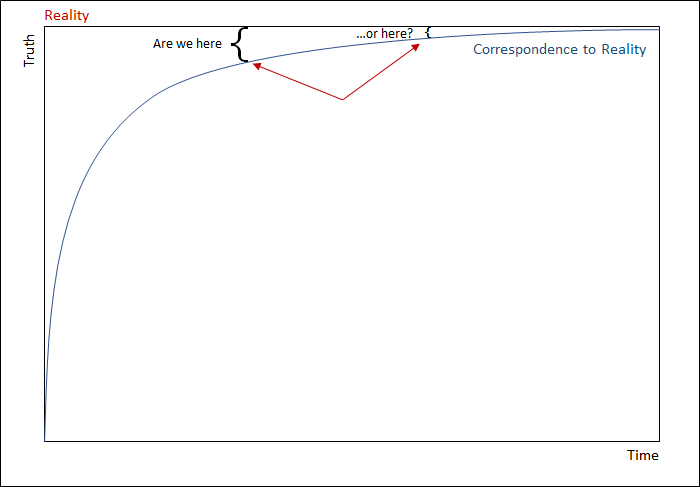
The standard story is comforting: over time, science marches closer and closer to the truth. Each new experiment, each new refinement, nudges us toward Reality, like a curve bending ever nearer to its asymptote.
Chart 1: The bedtime story of science: always closer, never arriving.
This picture flatters us, but it’s built on sand.
Problem One: We have no idea how close or far we are from “Reality” on the Y-axis. Are we brushing against it, or still a light-year away? There’s no ruler that lets us measure our distance.
Problem Two: We can’t even guarantee that our revisions move us toward rather than away from it. Think of Newton and Einstein. For centuries, Newton’s physics was treated as a triumph of correspondence—until relativity reframed it as local, limited, provisional. What once looked like a step forward can later be revealed as a cul-de-sac. Our curve may bend back on itself.
Use Case: Newton, Einstein, and Gravity Take gravity. For centuries, Newton’s laws were treated as if they had brought us into near-contact with Reality™—so precise, so predictive, they had to be true. Then Einstein arrives, reframes gravity not as a force but as the curvature of space-time, and suddenly Newton’s truths are parochial, a local approximation. We applauded this as progress, as if our asymptote had drawn tighter to Reality. But even Einstein leaves us with a black box: we don’t actually know what gravity is, only how to calculate its effects. Tomorrow another paradigm may displace relativity, and once again we’ll dutifully rebrand it as “closer to truth.” Progress or rhetorical re-baptism? The graph doesn’t tell us.
Chart 2: The comforting myth of correspondence: scientific inquiry creeping ever closer to Reality™, though we can’t measure the distance—or even be sure the curve bends in the right direction.
Thomas Kuhn was blunt about this: what we call “progress” is less about convergence and more about paradigm shifts, a wholesale change in the rules of the game. The Earth does not move smoothly closer to Truth; it lurches from one orthodoxy to another, each claiming victory. Progress, in practice, is rhetorical re-baptism.
Most defenders of the asymptotic story assume that even if progress is slow, it’s always incremental, always edging us closer. But history suggests otherwise. Paradigm shifts don’t just move the line higher; they redraw the entire curve. What once looked like the final step toward truth may later be recast as an error, a cul-de-sac, or even a regression. Newton gave way to Einstein; Einstein may yet give way to something that renders relativity quaint. From inside the present, every orthodoxy feels like progress. From outside, it looks more like a lurch, a stumble, and a reset.
Chart 3: The paradigm-gap view: what feels like progress may later look like regression. History suggests lurches, not lines, what we call progress today is tomorrow’s detour..
If paradigm shifts can redraw the entire map of what counts as truth, then it makes sense to ask what exactly we mean when we invoke the word at all. Is truth a mirror of reality? A matter of internal coherence? Whatever works? Or just a linguistic convenience? Philosophy has produced a whole menu of truth theories, each with its own promises and pitfalls—and each vulnerable to the same problems of rhetoric, context, and shifting meanings.
The Many Flavours of Truth
Philosophers never tire of bottling “truth” in new vintages. The catalogue runs long: correspondence, coherence, pragmatic, deflationary, redundancy. Each is presented as the final refinement, the one true formulation of Truth, though each amounts to little more than a rhetorical strategy.
Correspondence theory: Truth is what matches reality. Problem: we can never measure distance from “Reality™” itself, only from our models.
Coherence theory: Truth is what fits consistently within a web of beliefs. Problem: many mutually incompatible webs can be internally consistent.
Pragmatic theory: Truth is what works. Problem: “works” for whom, under what ends? Functionality is always perspectival.
Deflationary / Minimalist: Saying “it’s true that…” adds nothing beyond the statement itself. Problem: Useful for logic, empty for lived disputes.
Redundancy / Performative: “It is true that…” adds rhetorical force, not new content. Problem: truth reduced to linguistic habit.
And the common fallback: facts vs. truths. We imagine facts as hard little pebbles anyone can pick up. Hastings was in 1066; water boils at 100°C at sea level. But these “facts” are just truths that have been successfully frozen and institutionalised. No less rhetorical, only more stable.
So truth isn’t one thing – it’s a menu. And notice: all these flavours share the same problem. They only work within language-games, frameworks, or communities of agreement. None of them delivers unmediated access to Reality™.
Truth turns out not to be a flavour but an ice cream parlour – lots of cones, no exit.
Multiplicity of Models
Even if correspondence weren’t troubled, it collapses under the weight of underdetermination. Quine and Duhem pointed out that any body of evidence can support multiple competing theories.
Chart 4: orthodox vs. heterodox curves, each hugging “reality” differently
Hilary Putnam pushed it further with his model-theoretic argument: infinitely many models could map onto the same set of truths. Which one is “real”? There is no privileged mapping.
Conclusion: correspondence is undercut before it begins. Truth isn’t a straight line toward Reality; it’s a sprawl of models, each rhetorically entrenched.
Truth as Rhetoric and Power
This is where Orwell was right: “War is Peace, Freedom is Slavery, Ignorance is Strength.”
Image: INGSOC logo
Truth, in practice, is what rhetoric persuades.
Michel Foucault stripped off the mask: truth is not about correspondence but about power/knowledge. What counts as truth is whatever the prevailing regime of discourse allows.
We’ve lived it:
“The economy is strong”, while people can’t afford rent.
“AI will save us”, while it mainly writes clickbait.
“The science is settled” until the next paper unsettles it.
These aren’t neutral observations; they’re rhetorical victories.
Truth as Community Practice
Chart 5: Margin of error bands
Even when rhetoric convinces, it convinces in-groups. One group converges on a shared perception, another on its opposite. Flat Earth and Round Earth are both communities of “truth.” Each has error margins, each has believers, each perceives itself as edging toward reality.
Wittgenstein reminds us: truth is a language game. Rorty sharpens it: truth is what our peers let us get away with saying.
So truth is plural, situated, and always contested.
Evolutionary and Cognitive Scaffolding
Step back, and truth looks even less eternal and more provisional.
We spread claims because they move us (emotivism) and because we urge others to join (prescriptivism). Nietzsche was savage about it: truth is just a herd virtue, a survival trick.
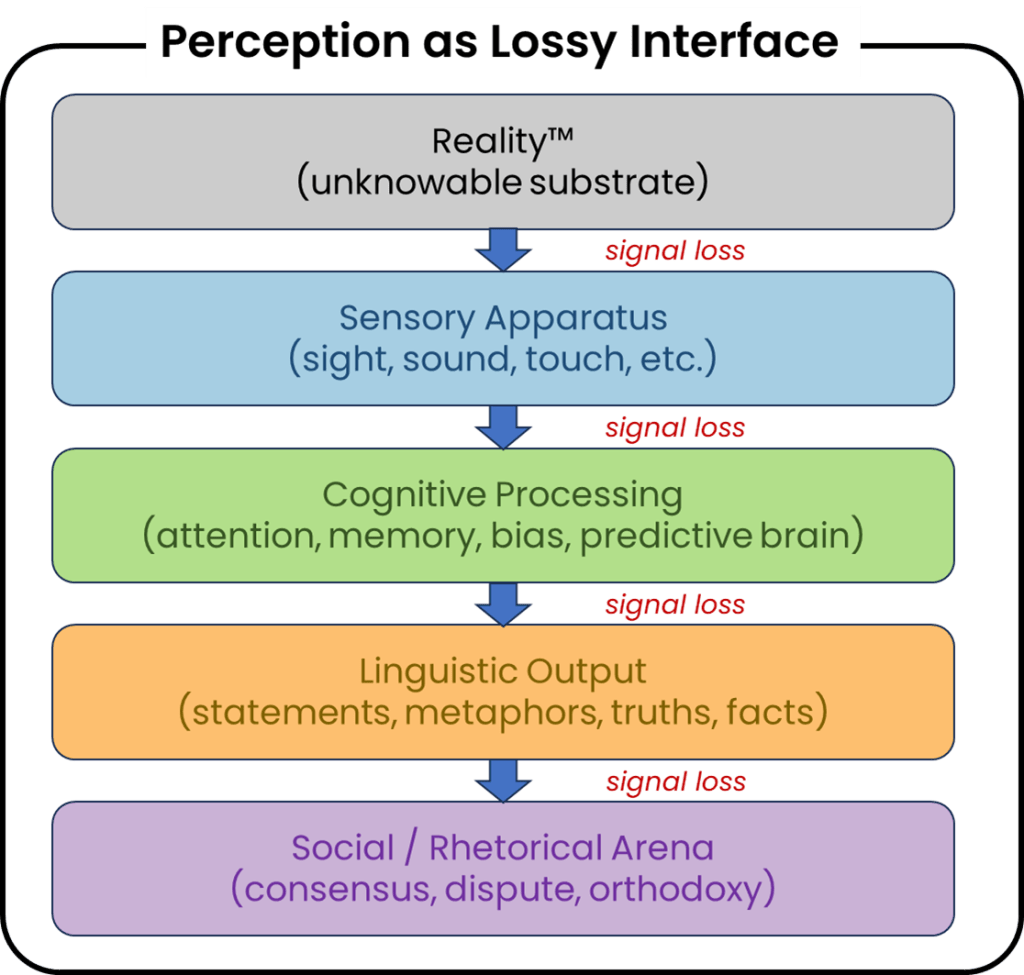
Cognitive science agrees, if in a different language: perception is predictive guesswork, riddled with biases, illusions, and shortcuts. Our minds don’t mirror reality; they generate useful fictions.
Diagram: Perception as a lossy interface: Reality™ filtered through senses, cognition, language, and finally rhetoric – signal loss at every stage.
Archetypal Truth (Positive Proposal)
So where does that leave us? Not with despair, but with clarity.
Truth is best understood as archetypal – a construct humans rally around. It isn’t discovered; it is invoked. Its force comes not from correspondence but from resonance.
Here, my own Language Insufficiency Hypothesis bites hardest: all our truth-talk is approximation. Every statement is lossy compression, every claim filtered through insufficient words. We can get close enough for consensus, but never close enough for Reality.
Truth is rhetorical, communal, functional. Not absolute.
The Four Pillars (Manifesto Form)
Archetypal – truth is a symbolic placeholder, not objective reality.
Asymptotic – we gesture toward reality but never arrive.
Rhetorical – what counts as truth is what persuades.
Linguistically Insufficient – language guarantees slippage and error.
Closing
Nietzsche warned, Rorty echoed: stop fetishising Truth. Start interrogating the stories we tell in its name.
Every “truth” we now applaud may be tomorrow’s embarrassment. The only honest stance is vigilance – not over whether we’ve captured Reality™, but over who gets to decide what is called true, and why.
Truth has never been a mirror. It’s a mask. The only question worth asking is: who’s wearing it?
This clip of Rachel Barr slid into my feed today, fashionably late by a week, and I thought it deserved a little dissection. The video wouldn’t embed directly – Instagram always has to be precious – so I downloaded it and linked it here. Don’t worry, Rachel, I’m not stealing your clicks.
Now, the United States. Or rather, the United States In Name Only – USINO. A nation perpetually rebranding itself as a “union” whilst its citizens claw at each other like alley cats in a bin fire. Yes, divisions abound – economic, racial, ideological, pick your poison – but some fissures cut to the bone. Today’s example: Charlie Kirk and the rabid congregation of defenders he’s managed to cultivate.
Audio: NotebookLM podcast on this topic.
The Competing Liturgies
To hear one camp tell it, Kirk is no hater at all. He’s a gentle, God-soaked soul, brimming with Christian love and trying – halo tilted just so – to shepherd stray sheep toward Our Lord and Saviour™. A real Sunday-school sweetheart.
But this is not, shockingly, the consensus. The other camp (my camp, if disclosure still matters in a post-truth age) see him as a snarling opportunist, a huckster of hate packaged in the familiar varnish of patriotism and piety. In short: a hate-merchant with a mailing list.
Spectacle as Weapon
I’ve watched Kirk at work. He loves to stage “debates” – quotation marks mandatory – where a token dissenter is dropped into an amphitheatre of loyalists. It’s the rhetorical equivalent of feeding Christians to lions, except the lions roar on cue and the crowd thinks the blood is wine. He laces misogyny, racism, and reheated premodern dogma into cheap soundbites, and the audience laps it up as though they were attending a revival. For the believers, it’s a festival. For everyone else, it’s a hostile takeover of public discourse.
Deaf Ears, Loud Mouths
Here’s the rub: Cohort A doesn’t perceive his words as hate because they already share the operating system. It’s not hate to them – it’s common sense. Cohort B, meanwhile, hears every syllable as the screech of a chalkboard dragged across the public square. Same words, two worlds.
And when I dare to suggest that if you can’t hear the hatred, you might just be complicit in it, the pushback is instantaneous: Stop imposing your worldview! Which is rich, since their worldview is already blaring through megaphones at tax-exempt rallies. If my worldview is one that insists on less hate, less dehumanisation, less sanctified bullying, then fine, I’ll take the charge.
The deeper accusation, though, is almost comic: that I’m hallucinating hate in a man of pure, lamb-like love. That’s the gaslighting twist of the knife – turning critique into pathology. As if the problem isn’t the bile spilling from the stage but my faulty perception of it.
Perspective is everything, yes – but some perspectives reek of wilful blindness.
Humans can’t seem to stop clawing after morality. The primates among us chuck cucumbers when their neighbours get grapes, and the rest of us grumble about fairness on social media. The impulse is practically universal, an evolutionary quirk that kept us from throttling each other long enough to raise children and build cities.
Image: A seemingly perturbed capuchin monkey.
But universality is not objectivity. Just because every ape howls about fairness doesn’t mean “Justice” floats somewhere in Platonic space, waiting to be downloaded. It only means we’re the kind of animal that survives by narrating rules and enforcing them with shunning, shame, or, when necessary, cudgels.
Audio: NotebookLM podcast on this topic.
This is where Alasdair MacIntyre trips over his own robes. After Virtue skewers Enlightenment rationalists who tried to prop morality on reason, it then dismisses Nietzsche for being “irrational.” MacIntyre’s fix? Resurrect Aristotle’s teleology. If reason can’t save morality, maybe an ancient oak tree can. But this is wish-thinking with a Greek accent. He’s still arguing by reason that reason can’t do the job, then sneaking back in through Aristotle’s back door with a “firmer ground.” Firmer only because he says so.
Nietzsche, at least, had the decency to call the bluff: no telos, no floor, no cosmic anchor. Just will, style, and the abyss. Uncomfortable? Absolutely. Honest? Yes.
Deleuze went further. He pointed out that morality, like culture, doesn’t look like a tree at all. It’s a rhizome: tangled, proliferating, hybridising, never grounded in a single root. The fragments MacIntyre despairs over aren’t evidence of collapse. They’re evidence of how moral life actually grows—messy, contingent, interconnected. The only reason it looks chaotic is that we keep demanding a trunk where only tubers exist.
So here we are, apes with a craving for rules, building cities and philosophies on scaffolds of habit, language, and mutual illusion. We are supported as surely as the Earth is supported – by nothing. And yet, we go on living.
The need for morality is real. The yearning for telos is real. The floor is not.
This isn’t a political post. It’s about language, the insufficiency of it, and the games we play when pretending words carry more weight than they do.
Luigi Mangione is the man accused of killing UnitedHealthcare CEO Brian Thompson. After his arrest, prosecutors stacked the usual charges – murder, firearms, assorted legal bric-a-brac – then added the cherry on top: domestic terrorism.
Audio: NotebookLM podcast on this topic.
Recently, a pretrial judge cut the cherry loose.
Murder, yes. Terrorism, no. Not because murder is less grotesque, but because the statutory definition won’t stretch that far without breaking.
NEW YORK, Sept 16 (Reuters) – A New York state judge dismissed on Tuesday two terrorism-related counts against Luigi Mangione over the December 2024 killing of health insurance executive Brian Thompson, though the 27-year-old remains charged with second-degree murder and eight other criminal counts in the case.
“There was no evidence presented of a desire to terrorize the public, inspire widespread fear, engage in a broader campaign of violence, or to conspire with organized terrorist groups,” Judge Gregory Carro found in a 12-page written decision (pdf). “Here, the crime – the heinous, but targeted and discrete killing of one person – is very different from the examples of terrorism set forth in the statute.” (source)
The prosecution insisted the label fit. The judge disagreed. Cue outrage, applause, and confusion. The crime is still horrific, but suddenly the word “terrorist” is off-limits.
The Elasticity of Terror
How can two educated parties look at the same set of facts and come to opposite conclusions? Because “terrorism” isn’t a Platonic form. It’s an elastic linguistic category. The prosecutor drags it out because “terrorist” is a magical word in American law: it inflates an already ugly act into a civilisation-level threat, unlocks harsher penalties, and lets politicians posture about national security.
The judge, however, reminded everyone that a bullet in Manhattan does not equal al-Qaeda. Murder, yes. Terrorism, no. Not because murder is less grotesque, but because the statutory definition won’t stretch that far without breaking.
Language Games, Legal Hierarchies
This is where it gets trickier. The judge isn’t merely “pulling rank”—though rank does matter. American jurisprudence is hierarchical: trial judges hand down rulings, appellate judges review them, and nine robed partisans in Washington can one day rewrite the whole script. On paper, these tiers are meant to iron out ambiguity. In practice, they multiply it.
Five minds say ‘constitutional,’ four say ‘unconstitutional,’ and the one-vote margin becomes binding law for 330 million people. That’s not truth; it’s hierarchy dressed in robes.
Even co-equal judges, reading the same facts, can diverge wildly. Split decisions at the Supreme Court prove the point: five minds say “constitutional,” four say “unconstitutional,” and the one-vote margin becomes binding law for 330 million people. That’s not the discovery of truth; it’s the triumph of one language game over another, enforced by hierarchy.
The Insufficiency Laid Bare
So we return to Mangioni. He has been charged with murder – the second degree flavour; that much is uncontested. But is he a “terrorist”? The prosecution said yes, the judge said no, and another judge, higher up or sitting elsewhere, might well say yes again. Each claim is defensible. Each is motivated by language, by politics, and by the institutional pressures of the bench.
And that’s the point. Language doesn’t tether itself to reality; it choreographs our endless arguments about reality. The law tries to tame it with hierarchies and definitions, but the seams always show. Mangioni is a murderer. Whether he is a terrorist depends less on his actions than on which interpretive dance is winning in the courtroom that day.
The Enlightenment promised a universal Reason; what we got was a carnival mirror that flatters philosophers and fools the rest of us. MacIntyre and Anscombe diagnosed the corpse with precision, but then tried to resurrect it with Aristotelian or theological magic tricks. I’m less charitable: you can’t will petrol into an empty tank. In my latest essay, I put ‘Reason’ on the slab, call in Kahneman, Hume, Nietzsche, and others as expert witnesses, and deliver the verdict: morality is a house rule, not a cosmic law. This piece is part of a larger project that includes my Language Insufficiency Hypothesis and Against Dumocracy. The Enlightenment isn’t dying – it’s already dead. We’re just cataloguing the remains.
The Enlightenment was many things: a bonfire of superstition, a hymn to autonomy, a fever dream of “Reason” enthroned. Its philosophers fancied themselves heirs to Aristotle and midwives to a new humanity. And to be fair, they were clever enough to trick even themselves. Too clever by half.
Alasdair MacIntyre, in After Virtue, plays the role of forensic pathologist with admirable precision. He shows us how the Enlightenment dynamited the teleological scaffolding of Aristotle, then tried to keep the vocabulary of virtue, duty, and rights standing in mid-air. The result: what he calls a “moral Babel,” a chorus of shrill assertions dressed up as rational law. Elizabeth Anscombe had already filed the death certificate back in 1958 with Modern Moral Philosophy, where she pointed out that our talk of “moral obligation” is just a Christian relic without a deity to enforce it. And Nietzsche, that perennial party-crasher, cheerfully declared the whole project bankrupt: once the gods are dead, “ought” is nothing but resentment pretending to be metaphysics.
And yet, when MacIntyre reaches the heart of the matter, he can’t quite let the body stay buried. He wants to reattach a soul by importing an Aristotelian telos, even summoning a “new St Benedict” to shepherd us through the ruins. It plays beautifully with those still tethered by a golden string to Aquinas and the premodern, but let’s be honest: this is just hypnosis with a Latin chorus. Descartes told us je pense, donc je suis; MacIntyre updates it to je pense, donc j’ai raison. The trouble is that thinking doesn’t guarantee rightness any more than an empty petrol tank guarantees motion. You can will fuel into existence all you like; the car still isn’t going anywhere.
The behavioral economists – Kahneman, Tversky, Ariely, Gigerenzer – have already demonstrated that human reason is less compass than carnival mirror. Jonathan Haidt has shown that our “moral reasoning” usually lags behind our gut feelings like a PR department scrambling after a scandal. Meanwhile, political practice reduces “just war” to a matter of who gets to publish the rule book. Progress™ is declared, rights are invoked, but the verdict is always written by the most powerful litigant in the room.
So yes, MacIntyre and Anscombe diagnose the corpse with impressive clarity. But then they can’t resist playing resurrectionist, insisting that if we only chant the right metaphysical formula, the Enlightenment’s heart will start beating again. My own wager is bleaker – or maybe just more honest. There is no golden thread back to Aristotle, no metaphysical petrol station in the desert. Morality is not a universal constant; it’s a set of rules as contingent as the offside law. Killing becomes “murder” only when the tribe – or the state – says so. “Life is sacred” is not a discovery but a spell, a linguistic sleight of hand that lets us kill in one context while weeping in another.
The Enlightenment wanted to enthrone Reason as our common oracle. Instead, it handed us a corpse and told us to pretend it was still breathing. My contribution is simply to keep the coroner’s mask on and say: The magic tricks aren’t working anymore. Stop looking for a metaphysical anchor that isn’t there. If there’s to be an “after,” it won’t come from another Saint Benedict. It will come from admitting that the Enlightenment died of believing its own hype – and that language itself was never built to carry the weight of gods.
Freud once quipped that people are “normal” only on average. To the degree that they deviate from the mean, they are neurotic, psychotic, or otherwise abnormal. Whatever else one thinks of Freud, the metaphor holds for Modernity.
Image: Picture and quote by Sigmund Freud: Every normal person, in fact, is only normal on the average. His ego approximates to that of the psychotic in some part or other and to a greater or lesser extent. —Analysis Terminable And Interminable (1937), Chapter V
We are “Modern” only on average, and only for the first standard deviation. Within one sigma, you can wave a flag and declare: rational, secular, Enlightened. But step further into the tails and the façade dissolves. The “normal” modern turns out to attend megachurches, consult horoscopes, share conspiracy memes, or cling to metaphysical relics that Enlightenment reason was supposed to have torched centuries ago.
„ Jeder Normale ist eben nur durchschnittlich normal, sein Ich nähert sich dem des Psychotikers in dem oder jenem Stück, in größerem oder geringerem Ausmaß. “
The problem isn’t that these people aren’t Modern. The problem is that nobody is Modern, not in the sense the story requires. The mean is an over-fitted abstraction. “Modernity” works like Freud’s “normal”: a statistical average that erases the deviations, then insists that the erased bits are pathology rather than reality.
But the tails are where most of human life actually happens. The “average Modern” is as mythical as the “reasonable person.” What we call Modernity is just a bell curve costume draped over the same mix of superstition, desire, and contingency that has always driven human behaviour.
I like to stay updated on the news of the day, so I just registered for a Ground News account. Ground News is a news aggregator. They gather news and categorise it by political leaning and the publication’s record on factuality. Their claim is to reveal blind spots so help people not get caught in perspective bubbles. It also shows when a story is picked up predominantly by one side or another. I’ve seen ads for this on many channels and have for a while, so it’s likely that you have, too. This is not an ad.
This article attracted my attention, not because of the content but because of the headline. As a statistician, this bothers me. As a communicator, the damage is trebled. I don’t receive any compensation for clicking the link. I include it for reference for those who are not familiar with the service.
Image: Ground News Screengrab
Notice the choice of writing, ‘1-in-6 parents reject vaccine recommendations‘.
Two things shine through.
The use of ‘reject’ – a negative verb.
The use of ‘1-in-6’ – the figure accompanying the negative verb – 17%.
Statistically, this means that 5-in-6 parents follow vaccine recommendations – 83%.
This is the summary view. Scan down, and notice the Left-leaning Raw Story references a ‘staggering number’ of parents who reject vaccines. Notice also how the language softens – the claim is revised to ‘delay or reject’. Without clicking into the story, what is this breakdown? I’m not sure, but this is what sensationalism looks like to attract clicks.
Image: Ground News Summary View
Interestingly, the outlets tend to use different language and give different attention. What percentage of this is due to political bias and which is benign editorial licence is unclear.
On balance, the articles – Left, Right, and Centre – unanimously note that vaccine use is down, incidences of measles are up, RFK policies appear to be exacerbating the health management issue. The worst offenders are ‘very’ religious, white, politically conservative people. This cohort aligns with the RFK and the current administration.
The poll also found that parents who have postponed or avoided vaccinating their children tend to be white, conservative, and highly religious, and some choose to homeschool.
For this story, one of the sources was Greek and another French. Some claim to be behind a paywall, but this didn’t pose a problem for me. Perhaps they offer some complementary views.
Separately, on the right-hand side of the top image, there is a bias indicator: It shows that 57% of the reports were from Left-leaning journals, 36% Centre, leaving the remaining 7% to Right-leaning sources.
Image: Updated Bias Distribution
When I returned to write this post, I noticed that the reporting had changed as more Centre-focused reports picked up the story.
If I were to guess, this story shines a negative light on the Right, so they may just be waiting for the news cycle to pass.
In the (Right-facing) Greek story I read, the reporting wasn’t materially different to the other stories, which is to say they don’t try to render the story through rose-colour glasses.




 be a contested claim (pick your poison: “the election was fair,” “immigration helps,” whatever).
 and
and  . That’s acculturation if you’re being polite, indoctrination if you’ve run out of patience.
 (news, a court ruling, a video clip, a statistic).
 and Camp B at
  , then even moderately pro-
 ) yields:

 ; they evaluate
  . Disconfirming evidence is down-weighted by a factor
  . This is called “being rational” on your own planet and “motivated reasoning” on everyone else’s.
 ; they entertain different
  for disconfirming evidence is effectively zero, you’ve identified faith, not inference.










 Philosophics