People often ask why I churn out so many polemic, contrarian articles. The answer? It’s simply how I think. My brain naturally questions everything, not out of a desire to be difficult, but because that’s just my worldview. I’m not inventing challenges for the sake of argument—the challenges are already there, embedded in the world as I see it.
Another reason is solidarity. I write in hopes that others, whose thoughts run along similar lines, might stumble across my material and feel less alone. There’s something deeply reassuring in discovering that someone else has been on the same mental journey—that feeling of “Ah, I’m not alone in this.” Many times, I’ve had ideas only to find that philosophers, thinkers, or whoever have already penned volumes on the subject. And honestly? That grounds me. Even better if they’ve gone further, articulated it more eloquently, or ventured into new depths. It’s all useful. Plus, their critics then become my critics, and I get to sharpen my thoughts in response—or at least build my own defences.
And finally, I write for the potential spark. Maybe someone out there reads a piece of mine and feels inspired to take it further, push an idea beyond what I could imagine. After all, entire Nobel Prize-winning theories have started as someone else’s footnotes. There’s nothing wrong with being someone’s footnote.
So, now you know.
NB: I’ll be in surgery when this posts, so I’ve scheduled this in advance so as not to have a gap…that may occur anyway.
Language is a fickle thing. Spoken words are fleeting vibrations in the air, while the written word stands still, preserved for all eternity—or at least until someone spills a cup of tea on it. But as it turns out, the way we write things down is just as much a human invention as the words themselves. And perhaps nothing exemplifies this better than the simple, unassuming space.
INPRINCIPIOERATVERBUMETVERBUMERATAPUDEUM
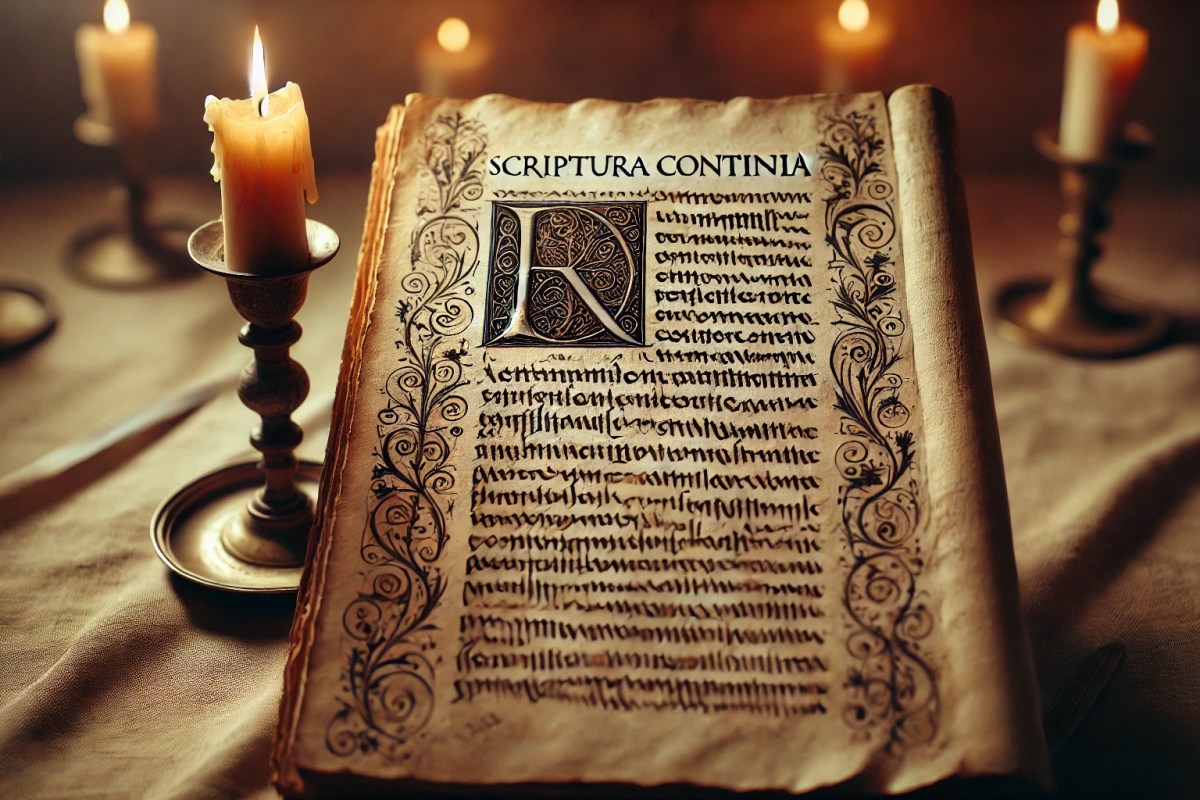
You see, in the early days, spaces between words didn’t exist at all. Latin texts were written in something called scriptura continua, which, if you’re imagining an interminable block of unbroken letters, is exactly what it was. There were no spaces, no commas, and certainly no handy full stops to tell you when you’d reached the end of a thought. If you’re feeling brave, try reading a page of dense prose without any breaks, and you’ll see just how taxing it must have been. Not for the faint-hearted, especially if your reading material consisted of ancient Roman tax codes or Cicero’s less thrilling speeches.
Originally, Romans tried to manage the chaos with something called the interpunct—a little dot, mid-height, between words. Cute, right? But these mid-dots weren’t as convenient as you’d think. They eventually fell out of fashion, leaving words to once again pile up against each other like an anxious crowd waiting for a delayed train. It wasn’t until some resourceful monks in the seventh century thought, “This is ridiculous, let’s make reading less like mental acrobatics,” that the concept of word spacing, as we know it, truly took off. Hats off to those monks, honestly—turning scriptura continua into something you could read without a magnifying glass and a headache.
And then, along came punctuation. Oh, punctuation! The glorious marks that tell us when to pause, when to stop, and when to yell in sheer disbelief—like the question mark (?!), when you discover early Latin, had none of these. The dots got demoted, moved down to the bottom of the line, and eventually became full stops. Punctuation began as a tool for reading aloud—a sort of musical notation for the voice—but evolved into something to guide the eye, allowing the inner voice to navigate text without getting lost.
The spaces and dots may seem like minor players, but they were transformative. They laid the foundation for silent reading, which revolutionised the entire act of reading itself. No longer were texts simply prompts for orators to recite; they became private journeys into the mind. By the time the printing press rolled around, spaces and punctuation were firmly in place, making it possible for literacy to spread and for people to sit in quiet corners, reading for pleasure. Who would have thought that the humble space—the “nothing” between words—would become a hero of the human intellect?
For a deeper dive into this rather niche but wildly fascinating history, check out Rob Words’ video on the subject here: Where Does Punctuation Come From?!. It’s well worth your time—a rollicking journey through the peculiarities of written language, spaces, and all the delightful stops along the way.
And remember, next time you type a message, mind the gap. It’s doing a lot more work than you think.
Welcome to Part 4 of a Week-Long Series on the Evolution and Limits of Language! This article is part of a seven-day exploration into the fascinating and often flawed history of language—from its primitive roots to its tangled web of abstraction, miscommunication, and modern chaos. Each day, we uncover new layers of how language shapes (and fails to shape) our understanding of the world.
If you haven’t yet, be sure to check out the other posts in this series for a full deep dive into why words are both our greatest tool and our biggest obstacle. Follow the journey from “flamey thing hot” to the whirlwind of social media and beyond!
The Written Word: Making Things Permanent (and Permanently Confusing)
So far, we’ve been dealing with spoken language—the slippery, ever-changing, context-dependent jumble of sounds we toss around in hopes that someone, somewhere, might understand what we’re trying to say. But what happens when we decide to make those words permanent? Welcome to the era of the written word, where all our linguistic problems got carved into stone—literally.
Let’s rewind a bit. Long before we had books or Twitter threads, ancient humans figured out that spoken words disappear into the air. They needed a way to preserve information, and voilà—writing was born. First came simple marks on clay tablets, because nothing says “let’s communicate important ideas” like scratching symbols into mud. But hey, at least it was a start.
The beauty of writing was that it gave us a way to record language—no more relying on memory to remember which berries were bad or who owed you a goat. But there was a downside too: once those words were written down, they became permanent. If you thought miscommunication was bad when words were floating in the air, just wait until you try to interpret a clay tablet left behind by someone who died 500 years ago. Good luck figuring out what they meant by “justice.”
And it didn’t stop there. As writing developed into full-fledged scripts, we gained the ability to record more complex ideas. That meant abstract nouns like “truth” and “freedom” were no longer just things you debated around the campfire—they could now be written down and preserved for future generations to also argue about. Nothing says “progress” like ensuring centuries of philosophical bickering.
But the real revolution came later. Fast forward to the 15th century, and along comes Johannes Gutenberg with his shiny new printing press. Suddenly, words—once limited to painstakingly hand-copied manuscripts—could be mass-produced. Books, pamphlets, and flyers could be printed in quantities never before imagined. Ideas could spread like wildfire.
And what ideas they were. Philosophers, theologians, and politicians alike jumped on the opportunity to get their words in front of as many people as possible. The written word wasn’t just a way to record information anymore—it became a tool for shaping societies, sparking revolutions, and (of course) stirring up endless debates about everything.
Of course, there was a catch. The printing press didn’t make language any clearer—it just gave us more of it to misunderstand. People could now read the same text and come away with completely different interpretations. What one person saw as a treatise on “freedom,” another saw as a justification for tyranny. What one reader thought was “truth,” another deemed blasphemy.
With the written word and the printing press, we managed to take the problems of spoken language and make them permanent. Miscommunication wasn’t just an unfortunate accident anymore—it was printed in ink, distributed en masse, and immortalised for future generations to argue over. If Wittgenstein had been alive during Gutenberg’s time, he probably would have thrown his hands in the air and said, “See? I told you words don’t mean what you think they mean.”
But hey, at least we were consistent. From clay tablets to printed books, the written word gave us the power to preserve language—and all its glorious inadequacies—for all time.
The Printing Press: Mass-Producing Confusion
The printing press was hailed as one of the greatest inventions in history. And sure, it was. It democratized knowledge, empowered literacy, and paved the way for all sorts of wonderful progress. But let’s be real—it also democratised miscommunication. Now, instead of one person misunderstanding you in conversation, hundreds—or thousands—could read your words and completely miss the point. Progress!
Gutenberg’s press took the words that were once fleeting and made them indelible. No more clarifying in real-time. No more adding context or adjusting your message on the fly. Once it was in print, that was it. You’d better hope your readers were playing the same “language game” as you, or things could go downhill fast.
Take Martin Luther, for example. He nailed his 95 Theses to the church door in 1517, and thanks to the printing press, those words spread all over Europe. What he intended as a call for reform turned into a revolution that spiralled far beyond his control. People read the same text and took wildly different meanings from it—some saw it as a plea for theological discussion, others as a call to burn down the nearest cathedral.
But it didn’t stop there. Luther’s seemingly clear ideas splintered into countless interpretations, and over time, what began as a movement for reform became the launchpad for hundreds of Protestant denominations. Each group interpreted Luther’s message (and the Bible) in their own unique way. From Lutheranism to Calvinism to the Baptists, Methodists, and beyond, the Protestant Reformation exploded into a thousand branches, all claiming to have grasped the “true” meaning of Luther’s words.
And this? This is the power – and the peril – of the written word. Once something is printed and distributed, it takes on a life of its own. Luther might have had one specific vision for his reforms, but as soon as those ideas hit the printing press, they fractured into countless interpretations, each with its own twist on “truth.” It’s a linguistic free-for-all, with everyone holding the same text and coming to completely different conclusions.
The printing press didn’t just give us more words—it gave us more misunderstandings. Suddenly, philosophical debates, political manifestos, and theological treatises were flying off the presses, each one ready to be misinterpreted by whoever happened to pick it up. And once it was printed, there was no going back. No retractions. No take-backs. Just page after page of linguistic uncertainty.
So while the printing press undoubtedly transformed society, it also multiplied the number of ways we could miscommunicate with each other. Because if there’s one thing we’re good at, it’s misunderstanding words – especially when they’re written down for all eternity.
A recent parody video making the rounds on social media shows a man at a kitchen table, his girlfriend, and their cat. In a desperate attempt to gain his girlfriend’s attention, he knocks a cup off the table. The moment it hits the floor, she turns on him, scolding him for his clumsiness. Quick to deflect, he blames the cat, and suddenly her anger dissipates. She shifts from reprimanding him to lavishing affection on the supposedly guilty feline. The tension lifts—until he sheepishly confesses that it was, in fact, his doing all along. Her response? An incredulous, “Are you kidding me?”
What’s fascinating about this skit isn’t the comedy of the man’s mischief or even the cat’s unknowing role in the charade. It’s the girlfriend’s starkly different reactions to the same act, depending on who she believes committed it. The cat, in her eyes, can do no wrong; the boyfriend, however, is immediately culpable. It’s easy to laugh at the scenario’s absurdity, but the dynamic it portrays is familiar and, dare I say, quite telling about human behaviour.
The Double Standard of Blame
Why is it that we’re quick to exonerate some and just as quick to indict others? The phenomenon is more than a quirk of personality; it reveals our deeper, often unconscious, biases. While it’s understandable that the girlfriend might think the cat incapable of intentional mischief, her reaction also suggests a predisposition to forgive certain actors—whether due to perceived innocence, attachment, or simply habit.
This dynamic isn’t limited to pets and partners. In families, workplaces, and social groups, we often see a similar pattern. One person becomes the perennial scapegoat, bearing the brunt of blame for any and all misdeeds, while another enjoys a seemingly unshakeable immunity. Think of the “golden child” and the “black sheep” within a family. One can rarely put a foot wrong, while the other’s every move is scrutinised, questioned, or condemned.
Beyond the Blame: Motivations and Consequences
The reasons behind these imbalances can be complex. Sometimes, they stem from past behaviour: if someone has repeatedly erred, we may be primed to expect the worst from them, even if they’ve reformed. Other times, they arise from emotional bonds or biases: we excuse those we love or admire because acknowledging their faults would cause us discomfort or cognitive dissonance.
This phenomenon isn’t just about playing favourites; it can have significant psychological consequences. For the person perpetually cast as the villain, the burden of unwarranted blame can lead to feelings of resentment, anxiety, or self-doubt. Meanwhile, those consistently exonerated may internalise a skewed perception of their own infallibility, which can be equally damaging.
A Broader Reflection on Accountability
Returning to the video’s context, the girlfriend’s swift switch from reproach to indulgence once she believed the cat was at fault, and her subsequent anger when the truth was revealed, invites us to question our own responses to perceived transgressions. Are we, too, guilty of selectively assigning blame based on who we think is responsible? How often do we let our preconceptions shape our judgments, favouring one actor over another without truly weighing the evidence?
The parody is amusing, no doubt, but it also serves as a subtle reminder: our reactions often reveal more about our biases and expectations than about the actions themselves. The next time we find ourselves quick to blame or forgive, it’s worth pausing to ask: are we reacting to the act, or to the actor?
In a world increasingly marked by polarised opinions and knee-jerk reactions, cultivating this kind of self-awareness is crucial. We need to be vigilant not only about how we judge others but also about why we do so. For, in the end, it’s not just about who knocked the cup off the table—it’s about who we believe deserves to be scolded for it.
I’ve been spending many hours finishing my novel, so it hasn’t left much time for writing here. I considered writing this on my other ‘writing’ blog, but I felt it was time to post something here, and it’s equally topical.
My writing style is typically stream-of-consciousness. I tend to have a problem or a scene I want to resolve. I place myself mentally into the scene, and I start to write. What might flow, I don’t tend to know in advance. The words just come out.
Occasionally, I’ll sit back and reflect more consciously, but mostly, it just comes out on the page. When I’m finished with a scene, I’ll usually revisit it consciously and look for gaps, continuity challenges, missing or extraneous details, room for character development, and so on.
Sometimes, I just embody a character. Other times (diversion: why is ‘sometimes’ a compound word, but not ‘other times’? That’s how my brain works), I embody the setting or the situation.
Sometimes, I need to address an entire chapter, so I look for obvious scenes and beats. I stub them out so that I don’t forget—perhaps even notes to myself about the purpose so I can step away and reengage later.
As a musician, I tend to approach music from the opposite direction. I might start from some inspiration, but most of my writing is brute-force analytics. My music is more laboured than my writing. My visual art falls more in the middle but leans towards the musical approach.
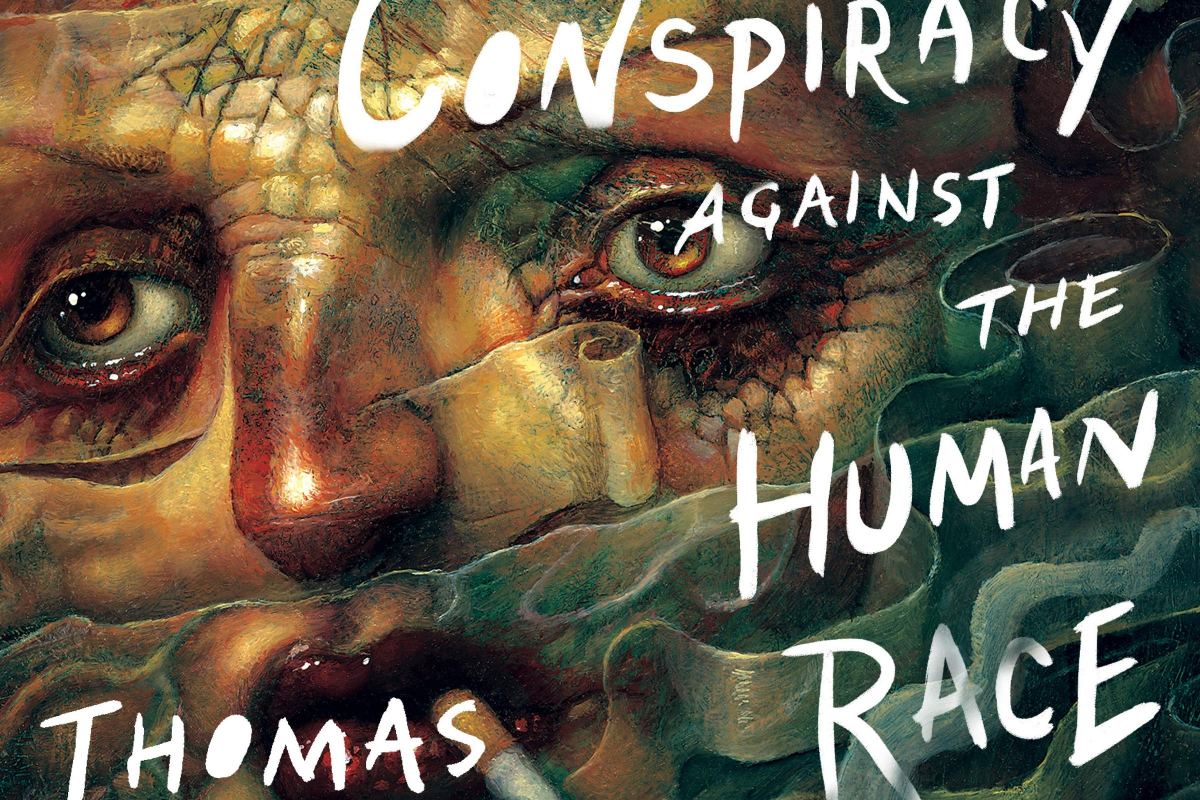
The Conspiracy against the Human Race is a work of non-fiction by horror author Thomas Ligotti. There is an audio podcast version and a YouTube video version. Feel free to leave comments in the space below or on YouTube.
Transcript
In this segment, I’ll be reviewing a book by Thomas Ligotti, The Conspiracy Against the Human Race, A Contrivance of Horror.
I haven’t done any book reviews, but since I tend to read a lot of books, I figure why not share my take and see how it’s received? If you like these reviews, click the like button and I’ll consider creating more.
Let’s get started.
First, I’ll be providing a little background, and then I’ll summarise some of the content and main themes. I’ll close with my review and perspective.
The author is Thomas Ligotti. He is a published writer in the horror genre in the vein of Lovecraft’s atmospheric horror. I’ve not read any of his work and haven’t read much fiction in ages.
The Conspiracy Against the Human Race is Ligotti’s first work of non-fiction. The book was originally published in 2010. I read the 2018 paperback version published by Penguin Books.
Conspiracy Against the Human Race falls into the category of Ethics and Moral Philosophy in a subcategory of pessimism. The main thesis of this book is that humans ought never to have been born. Following in the footsteps of anti-natalist David Benatar, who published Better Never to Have Been Born in 2007, Ligotti doubles down on Benatar’s position on the harm of coming into existence and argues that humans should just become extinct. Moreover, we should take out life in general.
In the book, Ligotti posits that consciousness was a blunder of nature and is the root of all suffering. He argues the derived Buddhist position of dukkha, which translates as Life is suffering. He establishes that most people are aware of this fact, but that we are nonetheless wired to be biased toward optimism through delusion and what a psychoanalyst might call repressed memories. Moreover, pessimists are a cohort not tolerated by society, who don’t want their delusions shattered.
Philosophically, Ligotti is a determinist. I’ve created content on this topic, but in a nutshell, determinism is the belief that all events are caused by antecedent events, leading to a chain of causes and effects stretching back to the beginning of time and bringing us to where we are now. If we were able to rewind time and restart the process, we would necessarily end up in the same place, and all future processes will unfold in a like manner.
Ligotti likes the metaphor of puppets. He employs puppets in two manners. Firstly, being the determinist he is, he reminds us that we are meat puppets with no free will. Our strings are controlled by something that is not us. This something ends up being Schopenhauer’s Will, reminding us that one can want what we will, but we can’t will what we will. This Will is the puppeteer. Secondly, puppets are soulless, lifeless homunculi that are employed in the horror genre to create unease by means of an uncanny association. He cites the work and philosophy of Norwegian author Peter Zapffe, who also elucidates human existence as a tragedy. Humans are born with one and only one right—the right to die. And death is the only certainty. The knowledge of this causes unnecessary suffering.
Quoting Ligotti,
“Stringently considered, then, our only natural birthright is a right to die. No other right has ever been allocated to anyone except as a fabrication, whether in modern times or days past. The divine right of kings may now be acknowledged as a fabrication, a falsified permit for prideful dementia and impulsive mayhem. The inalienable rights of certain people, on the other hand, seemingly remain current: somehow we believe they are not fabrications because hallowed documents declare they are real.”
Ligotti reminds us that consciousness is a mystery. We don’t really know what it is or what causes it other than it exists and we seem to have it, to be cursed with it. He adopts Zapffe’s position that consciousness is also responsible for the false notion of the self.
As all life is, humans are the result of an evolutionary process. Consciousness was just the result of an evolutionary blunder. He cites Zapffe and conveys that “mutations must be considered blind. They work, are thrown forth, without any contact of interest with their environment.”
Whilst pessimists view consciousness as a curse, optimists such as Nicholas Humphry think of it as a marvellous endowment.
He summarises the reason humans have it worse than the rest of nature:
“For the rest of the earth’s organisms, existence is relatively uncomplicated. Their lives are about three things: survival, reproduction, death—and nothing else. But we know too much to content ourselves with surviving, reproducing, dying—and nothing else. We know we are alive and know we will die. We also know we will suffer during our lives before suffering—slowly or quickly—as we draw near to death. This is the knowledge we “enjoy” as the most intelligent organisms to gush from the womb of nature. And being so, we feel shortchanged if there is nothing else for us than to survive, reproduce, and die. We want there to be more to it than that, or to think there is. This is the tragedy: Consciousness has forced us into the paradoxical position of striving to be unself-conscious of what we are—hunks of spoiling flesh on disintegrating bones.”
I’ll repeat that: Consciousness has forced us into the paradoxical position of striving to be unself-conscious.
He cites Zapffe’s four principal strategies to minimise our consciousness, isolation, anchoring, distraction, and sublimation
Isolation is compartmentalising the dire facts of being alive. So, he argues, that a coping mechanism is to push our suffering out of sight, out of mind, shoved back into the unconscious so we don’t have to deal with it.
Anchoring is a stabilisation strategy by adopting fictions as truth. We conspire to anchor our lives in metaphysical and institutional “verities”—God, Morality, Natural Law, Country, Family—that inebriate us with a sense of being official, authentic, and safe in our beds.
Distraction falls into the realm of manufactured consent. People lose themselves in their television sets, their government’s foreign policy, their science projects, their careers, their place in society or the universe, et cetera. Anything not to think about the human condition.
Sublimation. This reminds me of Camus’ take on the Absurd. Just accept it. Embrace it and incorporate it into your routine. Pour it into your art or music. Ligotti invokes Camus’ directive that we must imagine Sisyphus happy, but he dismisses the quip as folly.
Ligotti underscores his thesis by referencing the works of other authors from David Benatar to William James.
Interestingly, he suggests that people who experience depression are actually in touch with reality and that psychology intervenes to mask it again with the preferred veil of delusion and delf-deception. Society can’t operate if people aren’t in tune with the masquerade. Citing David Livingstone Smith in his 2007 publication, Why We Lie: The Evolution of Deception and the Unconscious Mind, Ligotti writes: “Psychiatry even works on the assumption that the “healthy” and viable is at one with the highest in personal terms. Depression, “fear of life,” refusal of nourishment and so on are invariably taken as signs of a pathological state and treated thereafter.”
Ligotti returns to the constructed notion of the self and presents examples of how a lack of self is an effective horror trope, citing John Carpenter’s The Thing and Invasion of the Body Snatchers.
He spends a good amount of time on ego-death and the illusion of self, a topic I’ve covered previously. He mentions Thomas Metzinger and his writings in several places including his Being No One, published in 2004, ostensibly reinforcing a position described as naïve realism, that things not being knowable as they really are in themselves, something every scientist and philosopher knows.
He delves into Buddhism as a gateway to near-death experiences, where people have dissociated their sense of self, illustrating the enlightenment by accident of U. G. Krishnamurti, who after some calamity “was no longer the person he once was, for now he was someone whose ego had been erased. In this state, he had all the self-awareness of a tree frog. To his good fortune, he had no problem with his new way of functioning. He did not need to accept it, since by his report he had lost all sense of having an ego that needed to accept or reject anything.” Krishnamurti had become a veritable zombie. He also cited the examples of Tem Horwitz, John Wren-Lewis, and Suzanne Segal, but I won’t elaborate here.
Russian Romantic author, Leo Tolstoy, famous for War and Peace and Anna Karenina, was another pessimist. He noticed a coping approach his associates had employed to deal with their morality.
Ignorance is the first. As the saying goes, ignorance is bliss. For whatever reason, these people are simply blind to the inevitability of their mortal lives. As Tolstoy said these people just did not know or understand that “life is an evil and an absurdity”.
Epicureanism comes next. The tactic here is to understand that we are all in here and no one gets out alive, so we might as well make the best of it and adopt a hedonistic lifestyle.
Following Camus’ cue, or rather Camus following Tolstoy and Schopenhauer, he suggests the approach of strength and energy, by which he means the strength and energy to suicide.
Finally, one can adopt the path of weakness. This is the category Tolstoy finds himself in, writing “People of this kind know that death is better than life, but not having the strength to act rationally—to end the deception quickly and kill themselves—they seem to wait for something.”
The last section of the book feels a bit orthogonal to the rest. I won’t bother with details, but essentially he provides the reader with examples of how horror works by exploring some passages, notably Radcliffe’s, The Mysteries of Udolpho; Conrad’s Heart of Darkness; Poe’s Fall of the House of Usher; Lovecraft’s Call of Cthulhu; and contrasting Shakespeare’s Macbeth and Hamlet.
This has been a summary of Thomas Logotti’s Conspiracy against the human race. Here’s my take. But first some background, as it might be important to understand where I am coming from.
I am a Nihilist. I feel that life has no inherent meaning, but people employ existentialist strategies to create a semblance of meaning, much akin to Zapffe’s distraction theme or perhaps anchoring. This said I feel that, similar to anarchism, people don’t understand nihilism. Technically, it’s considered to be a pessimistic philosophy because they are acculturated to expect meaning, but I find it liberating. People feel that without some constraints of meaning, that chaos will ensue as everyone will adopt Tolstoy’s Epicureanism or to fall into despair and suicide. What they don’t know is they’ve already fabricated some narrative and have adopted one of Zappfe’s first three offerings: isolation, which is to say repression); anchoring on God or country; or distracting themselves with work, sports, politics, social media, or reading horror stories.
Because of my background, I identify with Ligotti’s position. I do feel the suffering and anguish that he mentions, and perhaps I am weak and rationalising, but I don’t feel that things are so bad. I may be more sympathetic to Benatar’s anti-natalism than to advocate for a mass extinction event, though I feel that humans are already heading down that path. Perhaps this could be psychoanalysed as collective guilt, but I won’t go there.
I recommend reading this. I knocked it out in a few hours, and you could shorten this by skipping the last section altogether. If you are on the fence, I’d suggest reading David Benatar’s Better Never to Have Been. Perhaps I’ll review that if there seems to be interest. If you’ve got the time, read both.
So there you have it. That’s my summary and review of Thomas Ligotti’s The Conspiracy against the Human Race.
Before I end this, I’ll share a personal story about an ex-girlfriend of mine. Although she experienced some moments of happiness and joy, she saw life as a burden. Because she had been raised Catholic and embodied the teachings, she was afraid that committing suicide would relegate her to hell. In fact, on one occasion, she and her mum had been robbed at gunpoint, and her mum stepped between my girlfriend and the gun. They gave the gunmen what they wanted, so the situation came to an end.
My girlfriend laid into her mother that if she ever did something like that again and took a bullet that was her ticket out, she would never forgive her. As it turned out, my girlfriend died as collateral damage during the Covid debacle. She became ill, but because she was living with her elderly mum, she didn’t want to go to hospital and bring something back. One early morning, she was writhing in pain and her mum called the ambulance. She died later that morning in hospital, having waited too long.
For me, I saw the mercy in it all. She got her ticket out and didn’t have to face the hell eventuality. Not that I believe in any of that, but she was able to exit in peace. Were it not for the poison of religion, she could have exited sooner. She was not, in Tolstoy’s words, weak, so much as she had been a victim of indoctrination. I feel this indoctrination borders on child abuse, but I’ll spare you the elaboration. So, what are your thoughts on this book? Is there a conspiracy against humanity? Are optimists ruining it for the pessimists? What do you think about anti-natalism or even extinction of all conscious beings or the extreme case of all life on earth? Is Ligotti on to something or just on something?
The more I document my journey, the more it distracts my focus, so this is a short post. At this point in my life, I am convinced that the notion of human agency related to free will is wholly constructed. So much so, that I have been surveying the current landscape. I fully recognise that I am guilty of confirmation bias. Even though I am attempting to compensate for selection bias by reading opposing views, much of my attention is spent picking apart counterarguments and fanboying supporting arguments. This is an easy way to end up off the road and into a ditch, but I suppose awareness is the first step to contravene the effects.
I say this is daunting not only because of how much there is to absorb I am finding that dozens of books have already been published and echo my sentiments. Perhaps not exactly; perhaps not clearly. But this is not a novel concept. So what is daunting is to have the incentive to follow through, to not be entirely or substantially derivative if I do.
I’m two-thirds through Robert Kane’s initial chapter of Four Views on Free Will. He makes some good points. I am already familiar with his Libertarian position, but he dives deeper in his essay, which was my hope. He and the other three authors have time to present counterarguments to each other after all of the positions have been articulated.
As I expect to respond to each position, in turn, I won’t say much now, but I find I still disagree with Kane and for the same reasons I disagreed before I started reading.






 Philosophics