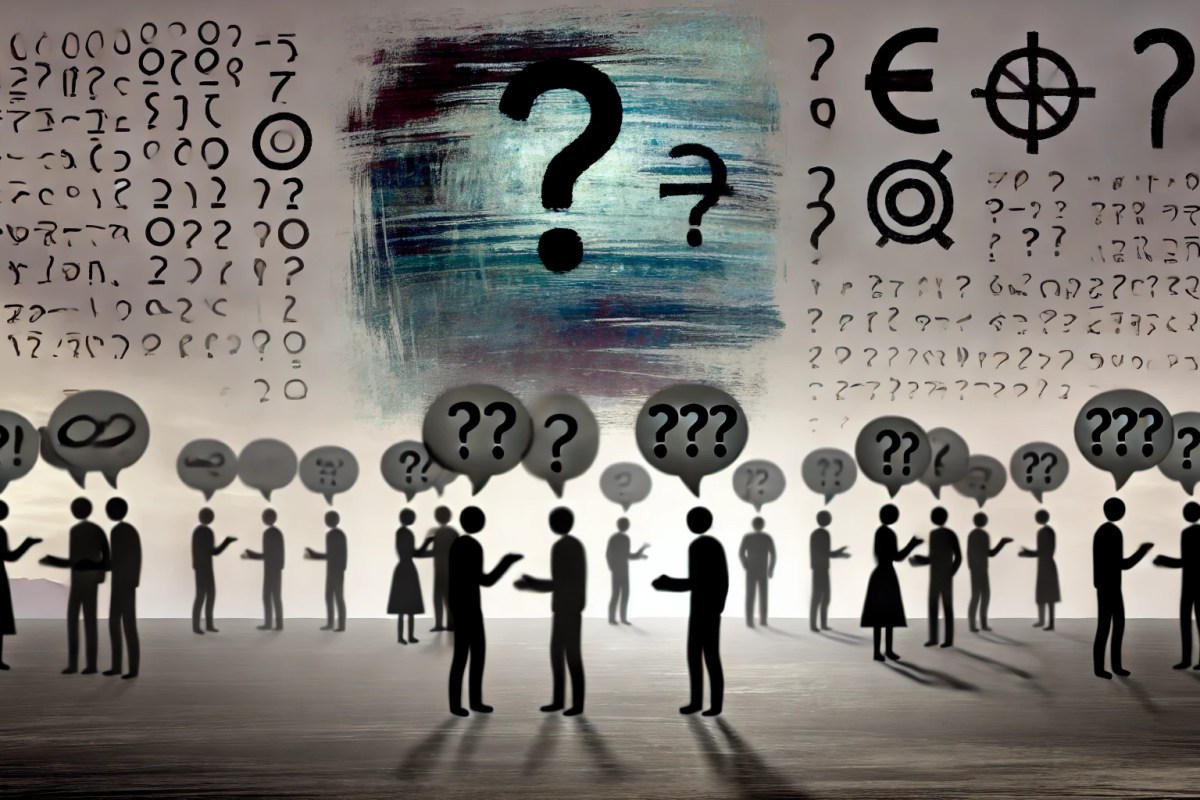
Post-COVID, we’re told trust in science is eroding. But perhaps the real autopsy should be performed on the institution of public discourse itself.
Since the COVID-19 crisis detonated across our global stage—part plague, part PR disaster—the phrase “trust in science” has become the most abused slogan since “thoughts and prayers.” Every public official with a podium and a pulse declared they were “following the science,” as if “science” were a kindly oracle whispering unambiguous truths into the ears of the righteous. But what happened when those pronouncements proved contradictory, politically convenient, or flat-out wrong? Was it science that failed, or was it simply a hostage to an incoherent performance of authority?
Audio: NotebookLM podcast discussing this topic.
Two recent Nature pieces dig into the supposed “decline” of scientific credibility in the post-pandemic world, offering the expected hand-wringing about public opinion and populist mistrust. But let’s not be so credulous. This isn’t merely a crisis of trust—it’s a crisis of theatre.
“The Science” as Ventriloquism
Let’s begin by skewering the central absurdity: there is no such thing as “The Science.” Science is not a monolith. It’s not a holy writ passed down by lab-coated Levites. It’s a process—a messy, iterative, and perpetually provisional mode of inquiry. But during the pandemic, politicians, pundits, and even some scientists began to weaponise the term, turning it into a rhetorical cudgel. “The Science says” became code for “shut up and comply.” Any dissent—even from within the scientific community—was cast as heresy. Galileo would be proud.
In Nature Human Behaviour paper (van der Linden et al., 2025) identifies four archetypes of distrust: distrust in the message, the messenger, the medium, and the motivation. What they fail to ask is: what if all four were compromised simultaneously? What if the medium (mainstream media) served more as a stenographer to power than a check upon it? What if the message was oversimplified into PR slogans, the messengers were party apparatchiks in lab coats, and the motivations were opaque at best?
Trust didn’t just erode. It was actively incinerated in a bonfire of institutional vanity.
A Crisis of Influence, Not Integrity
The second Nature commentary (2025) wrings its hands over “why trust in science is declining,” as if the populace has suddenly turned flat-Earth overnight. But the real story isn’t a decline in trust per se; it’s a redistribution of epistemic authority. Scientists no longer have the stage to themselves. Influencers, conspiracy theorists, rogue PhDs, and yes—exhausted citizens armed with Wi-Fi and anxiety—have joined the fray.
Science hasn’t lost truth—it’s lost control. And frankly, perhaps it shouldn’t have had that control in the first place. Democracy is messy. Information democracies doubly so. And in that mess, the epistemic pedestal of elite scientific consensus was bound to topple—especially when its public face was filtered through press conferences, inconsistent policies, and authoritarian instincts.
Technocracy’s Fatal Hubris
What we saw wasn’t science failing—it was technocracy failing in real time, trying to manage public behaviour with a veneer of empirical certainty. But when predictions shifted, guidelines reversed, and public health policy began to resemble a mood ring, the lay public was expected to pretend nothing happened. Orwell would have a field day.
This wasn’t a failure of scientific method. It was a failure of scientific messaging—an inability (or unwillingness) to communicate uncertainty, probability, and risk in adult terms. Instead, the public was infantilised. And then pathologised for rebelling.
Toward a Post-Scientistic Public Sphere
So where does that leave us? Perhaps we need to kill the idol of “The Science” to resurrect a more mature relationship with scientific discourse—one that tolerates ambiguity, embraces dissent, and admits when the data isn’t in. Science, done properly, is the art of saying “we don’t know… yet.”
The pandemic didn’t erode trust in science. It exposed how fragile our institutional credibility scaffolding really is—how easily truth is blurred when science is fed through the meat grinder of media, politics, and fear.
The answer isn’t more science communication—it’s less scientism, more honesty, and above all, fewer bureaucrats playing ventriloquist with the language of discovery.
Conclusion
Trust in science isn’t dead. But trust in those who claim to speak for science? That’s another matter. Perhaps it’s time to separate the two.
Medical doctors, lawyers, and judges have been the undisputed titans of professional authority for centuries. Their expertise, we are told, is sacrosanct, earned through gruelling education, prodigious memory, and painstaking application of established knowledge. But peel back the robes and white coats, and you’ll find something unsettling: a deep reliance on rote learning—an intellectual treadmill prioritising recall over reasoning. In an age where artificial intelligence can memorise and synthesise at scale, this dependence on predictable, replicable processes makes these professions ripe for automation.
Rote Professions in AI’s Crosshairs
AI thrives in environments that value pattern recognition, procedural consistency, and brute-force memory—the hallmarks of medical and legal practice.
Medicine: The Diagnosis Factory Despite its life-saving veneer, medicine is largely a game of matching symptoms to diagnoses, dosing regimens, and protocols. Enter an AI with access to the sum of human medical knowledge: not only does it diagnose faster, but it also skips the inefficiencies of human memory, emotional bias, and fatigue. Sure, we still need trauma surgeons and such, but diagnosticians are so yesterday’s news. Why pay a six-figure salary to someone recalling pharmacology tables when AI can recall them perfectly every time? Future healthcare models are likely to see Medical Technicians replacing high-cost doctors. These techs, trained to gather patient data and operate alongside AI diagnostic systems, will be cheaper, faster, and—ironically—more consistent.
Law: The Precedent Machine Lawyers, too, sit precariously on the rote-learning precipice. Case law is a glorified memory game: citing the right precedent, drafting contracts based on templates, and arguing within frameworks so well-trodden that they resemble legal Mad Libs. AI, with its infinite recall and ability to synthesise case law across jurisdictions, makes human attorneys seem quaintly inefficient. The future isn’t lawyers furiously flipping through books—it’s Legal Technicians trained to upload case facts, cross-check statutes, and act as intermediaries between clients and the system. The $500-per-hour billable rate? A relic of a pre-algorithmic era.
Judges: Justice, Blind and Algorithmic The bench isn’t safe, either. Judicial reasoning, at its core, is rule-based logic applied with varying degrees of bias. Once AI can reliably parse case law, evidence, and statutes while factoring in safeguards for fairness, why retain expensive and potentially biased judges? An AI judge, governed by a logic verification layer and monitored for compliance with established legal frameworks, could render verdicts untainted by ego or prejudice. Wouldn’t justice be more blind without a human in the equation?
The Techs Will Rise
Replacing professionals with AI doesn’t mean removing the human element entirely. Instead, it redefines roles, creating new, lower-cost positions such as Medical and Legal Technicians. These workers will:
Collect and input data into AI systems.
Act as liaisons between AI outputs and human clients or patients.
Provide emotional support—something AI still struggles to deliver effectively.
The shift also democratises expertise. Why restrict life-saving diagnostics or legal advice to those who can afford traditional professionals when AI-driven systems make these services cheaper and more accessible?
But Can AI Handle This? A Call for Logic Layers
AI critics often point to hallucinations and errors as proof of its limitations, but this objection is shortsighted. What’s needed is a logic layer: a system that verifies whether the AI’s conclusions follow rationally from its inputs.
In law, this could ensure AI judgments align with precedent and statute.
In medicine, it could cross-check diagnoses against the DSM, treatment protocols, and patient data.
A second fact-verification layer could further bolster reliability, scanning conclusions for factual inconsistencies. Together, these layers would mitigate the risks of automation while enabling AI to confidently replace rote professionals.
Resistance and the Real Battle Ahead
Predictably, the entrenched elites of medicine, law, and the judiciary will resist these changes. After all, their prestige and salaries are predicated on the illusion that their roles are irreplaceable. But history isn’t on their side. Industries driven by memorisation and routine application—think bank tellers, travel agents, and factory workers—have already been disrupted by technology. Why should these professions be exempt?
The real challenge lies not in whether AI can replace these roles but in public trust and regulatory inertia. The transformation will be swift and irreversible once safeguards are implemented and AI earns confidence.
Critical Thinking: The Human Stronghold
Professions that thrive on unstructured problem-solving, creativity, and emotional intelligence—artists, philosophers, innovators—will remain AI-resistant, at least for now. But the rote professions, with their dependency on standardisation and precedent, have no such immunity. And that is precisely why they are AI’s lowest-hanging fruit.
It’s time to stop pretending that memorisation is intelligence, that precedent is innovation, or that authority lies in a gown or white coat. AI isn’t here to make humans obsolete; it’s here to liberate us from the tyranny of rote. For those willing to adapt, the future looks bright. For the rest? The machines are coming—and they’re cheaper, faster, and better at your job.
Welcome to Part 2 of a Week-Long Series on the Evolution and Limits of Language! This article is part of a seven-day exploration into the fascinating and often flawed history of language – from its primitive roots to its tangled web of abstraction, miscommunication, and modern chaos. Each day, we uncover new layers of how language shapes (and fails to shape) our understanding of the world.
If you haven’t yet, be sure to check out the other posts in this series for a full deep dive into why words are both our greatest tool and our biggest obstacle. Follow the journey from ‘flamey thing hot’ to the whirlwind of social media and beyond!
Saussure and the Signified: Words as Slippery Symbols
Fast-forward a few thousand years, and humans are no longer just warning each other about hot flames or toothy predators. We’ve moved on to the exciting world of abstract thought, but the language tools we’re using haven’t quite caught up. Enter Ferdinand de Saussure, who basically waltzed in to tell us, ‘Hey, all those words you’re throwing around? They’re not doing what you think they’re doing.’
Saussure gave us the idea of the signifier and the signified. Now, don’t let the fancy terms fool you. It’s just a way of pointing out that when we say ‘tree’, we’re not actually talking about a tree. No, we’re using the word ‘tree’ as a symbol – a signifier – that points to the idea of a tree. The signified is the actual concept of ‘tree-ness’ floating around in your brain. But here’s the kicker: everyone’s idea of a tree is a little different.
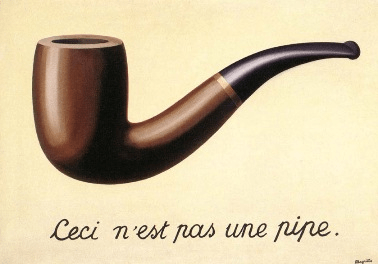
And this isn’t just a language problem – it’s an art problem too. Enter René Magritte, the surrealist artist who really drove this point home with his famous painting, Ceci n’est pas une pipe (‘This is not a pipe’). At first glance, it looks like a straightforward picture of a pipe, but Magritte was making a deeper point. It’s not actually a pipe – it’s an image of a pipe, a representation. You can’t stuff it with tobacco and smoke it, because what you’re looking at is a representation, not the real thing.
In the same way, when we use words, we’re not talking about the thing itself – we’re just waving a flag toward the concept of that thing. So, when you say ‘tree’, you’re really saying ceci n’est pas un arbre – this is not a tree. It’s just a word, a placeholder, a verbal painting of something real. And just like Magritte’s pipe, it’s easy to get confused. You might think you’re talking about the same tree, or the same ‘freedom’, but all you’ve got is a symbol – and everyone’s symbol looks a little different.
This is where things start to unravel. Words are slippery symbols, and as soon as we move away from concrete, physical objects – like trees or, yes, pipes – and into abstract ideas, like ‘justice’ or ‘truth’, the symbols become even harder to hold onto. The cracks in language start to widen, and before you know it, you’re no longer even sure if you’re talking about the same concept at all.
Language, Saussure argues, isn’t this neat, objective system we thought it was. It’s a game we’re playing, and the rules are written in invisible ink. By the time we get to abstract nouns, we’re basically playing with loaded dice. You think you’re communicating clearly, but every word you use is just a placeholder for the idea you hope the other person has in their head. And nine times out of ten? They don’t.
So, while early humans were struggling to agree on the ‘flamey thing’, we’re here trying to agree on concepts that are infinitely more complicated. And Saussure? He’s just sitting in the corner with a smirk, telling us we never had control over language in the first place. “Good luck with your ‘truth'”, he seems to be saying. ‘I’m sure it’ll mean the same thing to everyone’.
Abstraction: Enter Freedom, Truth, and Confusion
Now that we’ve wrapped our heads around the fact that words are nothing but slippery symbols, let’s take it up a notch. You thought ‘tree’ was tricky? Try something more abstract. Enter: freedom, truth, justice. Things that can’t be seen, touched, or stuffed into a pipe. Here’s where language goes from being slippery to downright treacherous.
See, early language worked because it was tied to concrete things. ‘Toothey thing scary’ wasn’t up for debate. Either you got eaten, or you didn’t. Simple. But then humans, ever the overachievers, decided it wasn’t enough to just label the world around them. They wanted to label ideas, too – things that don’t have any physical form but somehow drive us all crazy.
Take ‘freedom’, for instance. Sounds nice, right? Except, if you ask ten people what it means, you’ll get ten different answers. For some, it’s ‘freedom from’ something – a kind of liberation. For others, it’s ‘freedom to’ do whatever you want, whenever you want. And yet for others, it’s an abstract ideal tied up in political philosophy. Suddenly, you’re not just dealing with different trees – you’re dealing with entirely different forests.
The same goes for truth. Is it objective? Subjective? Relative? Absolute? Everyone’s got a different take. Plato had his own grand ideas about ‘Truth’ with a capital T, while Nietzsche basically rolled his eyes and said, ‘Good luck with that’. You’re out here using the word, assuming it means the same thing to everyone else, but really you’re all just talking past each other.
And don’t even get started on justice. Some say it’s about fairness, others say it’s about the law, and still others think it’s just a nice idea for dinner party debates. The problem with these words – these abstract nouns – is that they represent ideas that live entirely in our heads. Unlike the ‘flamey thing’ or the ‘toothey thing’, there’s no physical reality to pin them to. There’s no universally agreed-upon image of ‘freedom’ that we can all point to and nod along, like Magritte’s pipe. There’s just… vague agreement. Sometimes. On a good day.
This is where language really starts to break down. You might think you’re having a productive conversation about ‘freedom’ or ‘truth’, but half the time, you’re speaking different languages without even realising it. Words like these aren’t just slippery – they’re shapeshifters. They bend and morph depending on who’s using them, when, and why.
So, while early humans were busy with their simple, effective ‘toothey thing scary’, we’re now trying to nail down ideas that refuse to be nailed down. What started as a useful survival tool has turned into a game of philosophical Twister, with everyone tied up in knots trying to define something they can’t even see. And, as usual, language is just standing in the corner, smirking, knowing full well it’s not up to the task.
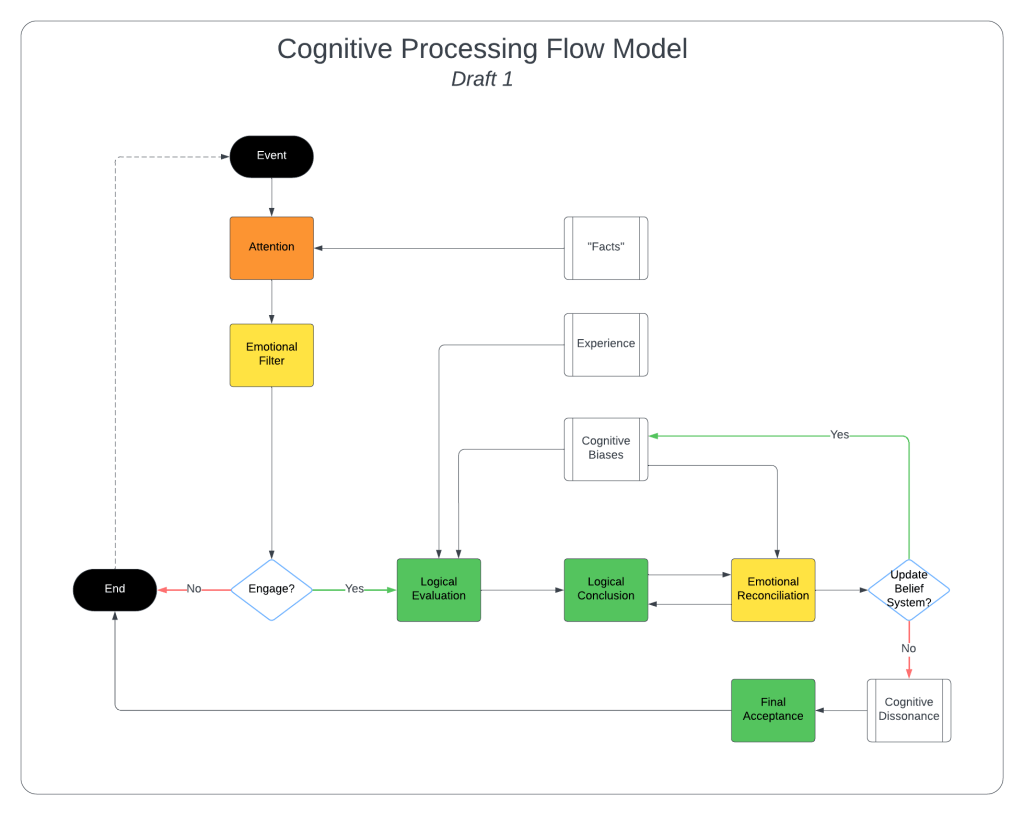
The Cognitive Process Flow Model illustrates how we process the phenomenal world. It’s reductionist and is missing aspects because it is just a back-of-the-napkin sketch. I created it because I uttered, “I can model it for you”. And so I did.
EDIT: I’ve updated the model slightly as the article head image, but the copy content refers to the first draft.
My response was to a person making the claim, that all you need to facts and logic prevails. Rather than restate the argument, I’ll just walk through the diagramme.
There’s meta information to set it up. We are subjective entities in the world. We have a sense-perception apparatus as we exist in it. Countless events occur in this world. We recognise only a few of them within our limited range, though technology expands this range in various ways.
Most of us interact in the world. Some are less ambulatory, so the world visits them. Some have sense-perception deficits whilst others have cognitive deficits. My point is not to capture every edge and corner case. This is just a generalised model.
All models are wrong, but some are useful.
—George Box
It starts with an event. Events occur ceaselessly. In our small portion of the world and elsewhere. For the purpose of the model, the first thing that happens is an event catches our attention. We might notice a shape, a colour, or a movement; we might hear a sound, smell an aroma, feel a sensation, or taste something.
A pre-emotion, pre-logic function serves to process these available inputs. Perhaps, you hear a report on anthropogenic climate change or read something about a political candidate. This emotional filter will police sensory inputs and unconsciously or preconsciously determine if you will react to the initial stimulus. If not, you’ll continue in an attention-seeking loop. Not that kind of attention-seeking.
As my dialogue was about the presentation of facts, our next stop will be logical evaluation. Does this make sense to us, or can we otherwise make it? This is a process in itself. I’ll assume here that it requires little elaboration. Instead, I’ll focus on the operating environment.
Our logical processes are coloured by past experiences and tainted by cognitive biases and deficits. We may also trigger the calling of additional facts through past experiences or the current engagement.
We’ll process these fragments and reach some logical conclusion. But we’re not done. We take this intermediate conclusion and run it through more emotional processing. Cognitive biases come back into play. If the event conforms with your past experiences and cognitive biases, we may run it through a cognitive dissonance routine. To be honest, this probably is part of the emotional reconciliation process, but I’ve drawn it here, so I’ll let it be. In this case, it’s just a filter. If it happens to conform to our belief system, it will pass unfettered; otherwise, it will be squared with our beliefs. Again, this leads me to believe it’s a subcomponent of emotional reconciliation. I’ll update the chart later.
In any case, we’ll end at Final Acceptance. This acceptance may be that we accept or reject the logic, but we arrive at an opinion that gets catalogued with the rest of them. Some may be elevated to facts or truths in the epistemological hierarchy. Although an end marker is identified, it’s really a wait state for the next event. Rinse and repeat until death.
I’ll update this presently. Be on the lookout. It could include more dimensions and interactions, but that might have to wait until version 3.
Meantime, does this feel right to you? Did it even get your attention?
An Example: Anthropogenic Climate Change
Let’s wrap up with an example. I’ll use climate change. An article comes into your attention field, and you have an interest in these things, so it passes through the emotional filter. If your propensity for these articles is high, it might race to the next stage.
You read the article, and it contains some facts—rather, it contains claims for evaluation. To do this, you’ll recall past experiences and cognitive biases are always lying in wait. You may have to look for new facts to add to the mix. These will have to take a similar route past your attention gatekeeper and emotional sidekick.
If you are already predisposed that climate change is a hoax, these facts will filter through that lens—or vice versa.
When all of this is resolved, you’ll have arrived at a conclusion—perhaps we’ll call it a proto-conclusion. It hasn’t been set yet.
You are still going to introspect emotionally and decide if this is a position you want to hold. Perhaps, you feel that climate change is a hoax but this doesn’t jive with that position. Here, you’ll either accept these facts and flip a bit to a sceptical believer or cognitive dissonance will kick in and ensure your sense of the world isn’t thrown off kilter. You may update your belief system to include this datum for future assessments.
Now we are ready for final acceptance. You can now express your established opinion. If the net event is to counter that acceptance, rinse and repeat ad infinitum.
The topic of this video touches upon my insufficiency of language thesis. Tim Maudlin defends language realism but only to the extent that ‘we can use it to describe the world and that some of those descriptions are true’.
Video: Does Language Describe Reality? (IAI)
The challenge, then, is determining which descriptions are true. I’ve discussed a couple of my positions on this.
The Truth About Truth
Firstly, we can only perceive what is true as we have no access to absolute truth. The best we can achieve is an asymptotic function approaching truth, a notion that resonates with Hilary Putnam’s concept of internal realism (pdf). Putnam argues that truth is not a matter of correspondence with a mind-independent reality but is instead tied to our conceptual schemes. This means that what we consider “true” is always shaped by the language and concepts we use, making our understanding inherently partial and context-dependent. Even then, we have no way to determine how close to truth our perception is. It just has to feel true—an idea that aligns with Putnam’s pragmatic conception of truth, where truth is something that emerges from our practices and inquiries, rather than being a fixed point we can definitively reach. In terms of physics, this underlying reality may be relatively more stable than abstract concepts, which are ephemeral and shifting sands.
The Rhetoric of Truth
Secondly, given that we have no access to objective truth, we can only expect subjective or relative truths. This brings us to Putnam’s critique of the metaphysicalcorrespondence theory of truth. According to Putnam, the idea that language can perfectly correspond to an external reality is flawed. Instead, truth is what can be justified within a particular conceptual framework, making all truth somewhat relative. This leaves us open to rhetoric—the more convincing argument wins, regardless of whether it reflects an objective reality. In fact, as Putnam’s ideas suggest, the most persuasive argument might favour an incorrect position simply because it resonates more with our internal conceptual schemes, not because it corresponds to an external truth. This has happened many times historically—or has it?
Conclusion: Language, Truth, and the Influence of Rhetoric
Putnam’s work reminds us that language is deeply connected to our understanding of the world, but it is also limited by the conceptual frameworks within which it operates. While language helps us navigate and describe the world, it cannot provide us with direct access to objective truth. Instead, it gives us tools to construct truths that are internally coherent and pragmatically useful, though always subject to change and reinterpretation. As we engage with rhetoric and persuasion, we must remain aware that the truths we accept are often those that best fit our current conceptual schemes, not necessarily those that best correspond to an elusive objective reality.
It’s July. The season of independence in the United States. Independence from the overt tyranny of Britain, but not from the tacit tyranny of their government—the government purported to be ‘of the people, by the people, and for the people‘ per Abraham Lincoln’s 1863 Gettysburg Address. As their Constitution reads, ‘We the People‘. Governments may be of the people and by the people, but governments are an emergent phenomenon as happens when oxygen and hydrogen combine just so and create water. Two gases combine to create a new substance—water. Some forget that, like water, government are a distinct element to the people that constitute it. Some think it resembles them. It doesn’t. It’s Hobbes’ Leviathan—or a Jabberwok.
In preparation for the traditional Summer season, I took to reading Derrida’s 1976 essay, Declarations of Independence. It was interesting, but I was hoping to get more from it. I decided to deconstruct the opening paragraph—the preamble—of the Declaration of Independence:
We hold these truths to be self-evident, that all men are created equal, that they are endowed by their Creator with certain unalienable Rights, that among these are Life, Liberty and the pursuit of Happiness.
Deconstructing Binary Oppositions
Self-Evident vs. Non-Self-Evident
The Declaration boldly asserts that ‘these truths’ are ‘self-evident’,’ a claim that is nothing more than a rhetorical trick. By presenting these ideas as self-evident, the authors seek to place them beyond questioning, discouraging dissent and critical examination. In reality, these ‘truths’ are far from universal; they are the product of a specific cultural and historical context, shaped by the interests and perspectives of the privileged few who drafted the document.
Interrogating Assumptions and Hierarchies The Declaration of Independence asserts that certain truths are ‘self-evident’, implying that these truths are so obvious that they require no further justification. However, the concept of self-evidence itself is far from universally accepted. It is deeply embedded in the philosophical tradition of Enlightenment rationalism, which holds that reason and logic can reveal fundamental truths about the world.
Philosophical Foundations of Self-Evidence
Enlightenment Rationalism: The idea of self-evidence relies heavily on Enlightenment rationalism, which posits that certain truths can be known directly through reason and are therefore beyond dispute. Philosophers such as René Descartes and Immanuel Kant emphasised the power of human reason to uncover self-evident truths. Descartes, for instance, argued for the self-evident nature of ‘Cogito, ergo sum‘ (‘I think, therefore I am’) as a fundamental truth (Descartes, Meditations on First Philosophy).
Critique of Rationalism: Critics of Enlightenment rationalism, including existentialists like Friedrich Nietzsche and phenomenologists like Martin Heidegger, argue that what is considered self-evident is often culturally and historically contingent. Nietzsche, for example, contended that what we take as ‘truth’ is a product of our perspective and historical context, not an absolute given (Nietzsche, Beyond Good and Evil).
Cultural and Philosophical Contingency
Cultural Relativity: Different cultures and philosophical traditions may not find the same truths to be self-evident. For instance, the concept of individual rights as self-evident truths is a product of Western liberal thought and may not hold the same self-evident status in other cultural frameworks. In many Eastern philosophies, the focus is more on community and harmony rather than individual rights.
Subjectivity of Self-Evidence: The term ‘self-evident’ implies an inherent, unquestionable truth, yet what one group or culture finds self-evident, another may not. This variability reveals the instability and subjectivity of the claim. For example, in traditional Confucian societies, the emphasis is placed on hierarchy and duty rather than equality and individual rights, demonstrating a different set of ‘self-evident’ truths.
Constructed Nature of Truth
Language and Context: Jacques Derrida’s concept of différance illustrates how meaning is not fixed but constantly deferred through language. What we consider to be “truth” is constructed through linguistic and social contexts. Derrida argues that texts do not have a single, stable meaning but rather a multiplicity of interpretations that change depending on the reader’s perspective and context (Derrida, Of Grammatology).
Social Construction: Michel Foucault’s analysis of power and knowledge further deconstructs the notion of objective truth. Foucault argues that what is accepted as truth is produced by power relations within society. Truths are constructed through discourses that serve the interests of particular social groups, rather than being objective or self-evident (Foucault, Discipline and Punish).
Created Equal vs. Not Created Equal
The Declaration’s claim that ‘all men are created equal’ is a blatant falsehood, a manipulative promise designed to appease the masses whilst maintaining the status quo. The glaring contradictions of slavery and gender inequality expose the hollowness of this assertion. Equality, as presented here, is nothing more than an ideological construct, a tool for those in power to maintain their dominance while paying lip service to the ideals of justice and fairness.
Creator vs. No Creator
The Declaration refers to a ‘Creator’ who endows individuals with rights, grounding its claims in a divine or natural law. This invokes a theistic worldview where moral and legal principles are derived from a higher power. However, Derrida challenges this by showing that the concept of a creator is a cultural and philosophical construct, not a universal truth.
The presence of the creator in the text serves to legitimise the rights it declares. However, this legitimacy is contingent on accepting the cultural narrative of a creator. Secular and non-theistic perspectives are marginalised by this assertion, revealing the ideological biases inherent in the Declaration. The authority of the declaration is thus shown to be dependent on particular beliefs, rather than an objective reality.
Unalienable vs. Alienable
The notion of ‘unalienable Rights’ is another empty promise, a rhetorical flourish designed to inspire loyalty and obedience. In practice, these supposedly inherent and inviolable rights are regularly violated and denied, particularly to those on the margins of society. The Declaration’s lofty language of ‘Life, Liberty and the pursuit of Happiness’ rings hollow in the face of systemic oppression and injustice. These rights are not unalienable; they are contingent upon the whims of those in power.
Conclusion
Through this deconstruction, we expose the Declaration of Independence for what it truly is: a masterful work of propaganda, filled with false promises and manipulative rhetoric. The document’s purported truths and self-evident principles are revealed as arbitrary constructs, designed to serve the interests of the powerful while placating the masses with empty platitudes.
As some celebrate this 4th of July, let us not be fooled by the high-minded language and lofty ideals of our founding documents. Instead, let us recognise them for what they are: tools of control and manipulation, employed by those who seek to maintain their grip on power. Only by constantly questioning and deconstructing these texts can we hope to expose the truth behind the facade and work towards a more genuine understanding of freedom and equality.
References
Jacques Derrida, “Declarations of Independence,” in Negotiations: Interventions and Interviews 1971-2001, ed. Elizabeth Rottenberg (Stanford: Stanford University Press, 2002).
Jacques Derrida, Of Grammatology (Baltimore: Johns Hopkins University Press, 1976).
Friedrich Nietzsche, Beyond Good and Evil (Cambridge: Cambridge University Press, 2002).
Michel Foucault, Discipline and Punish: The Birth of the Prison (New York: Vintage Books, 1995).
Immanuel Kant, Critique of Pure Reason (Cambridge: Cambridge University Press, 1998).
René Descartes, Meditations on First Philosophy (Cambridge: Cambridge University Press, 1996).
I’ve just published this video on YouTube, and I want to extend the commentary.
Video: What do Objective, Relative, and Subjective mean in philosophy?
Many people I’ve encountered don’t seem to grasp the distinctions between objective, subjective, and relative. Subjective and relative seem to be the biggest culprits of confusion. Let’s focus on morality just because.
There are really two main perspectives to adopt. If one believes in Objective Morality, one believes morality derives from some external source and is bestowed or mandated upon us. The source might be important to the believer, but it’s unimportant for this article. If one believes in Relative Morality then the source is socially dictated and has similar challenges to the notions of Social Contract Theory insomuch as one may not subscribe to the expectations.
For the Objective moralist, there may exist a schism between the expectations of the mandate and the subjective feelings of the individual. In fact, this may occur for Relative moralists as well. The individual will always maintain some subjective perspective on morality and then compare and contrast it with the higher order, whether Objective or Relative. In either case, acting on this subjective impulse risks being at odds with the members of the higher order. If this morality is codified into law – as it often is – then to act on that impulse makes one a criminal.
Take abortion for example. Whether this is an edict from God or just a social construct doesn’t matter. If one is in a society where abortion is seen as ‘bad’ or ‘wrong’, one’s subjective position on the matter is of little value. However, a Relativist society might also adopt a position of tolerance that is less likely to come from Objectivists.
A challenge is that a Subjectivist may only become apparent if one is counter the Relative or Absolute position. If your society is against abortion and you are, too, is this your subjective position or have you been indoctrinated with it and accept it uncritically, whether it’s deemed Objective or Relative.
Perhaps you feel that eating dogs or monkeys is immoral if not disgusting, but if you had been reared in a culture that does this, you might find it immoral to eat pork or beef. The question remains, is this a Subjective position, or did you merely inherit the Objective or Relative stance?
This question is very apparent in which religion one adopts. It is no surprise that the largest factor in which religion you choose is the religion of your family and their family and so on – so not so much a choice.
I was raised in a WASP family in New England among predominately Italian Roman Catholic peers. Despite this, I identified as an atheist early on. In my late teens, I stumbled on Buddhism and identified with it. However, I remain ignostic except when it encroaches on my personal autonomy – for example in the case of laws restricting access to safe abortions.
I’ve been reengaging with philosophy, though my positions haven’t changed recently. My last change was to shift from being a qualified material realist to a qualified idealist in the shape of Analytic Idealism. In most matters I can think of, I am an anti-realist, which is to say concepts like truth and morality are not objective; rather they are mind-dependent.
I’ve long been on record of taking the stance that Capital-T Truth, moral truths, are derived rhetorically. There is no underlying Truth, only what we are aggregately convinced of, by whatever route we’ve taken. As a moral non-cognitivist, I am convinced that morality is derived through emotion and expressed or prescribed after a quick stop through logic gates. Again, there is nothing objective about morality.
Truth and morality are subjective and relative constructs. They resonate with us emotionally, so we adopt them.
Were I a theist — more particularly a monotheist —, I might be inclined to be emotionally invested in some Divine Command theory, where I believe that some god may have dictated these moral truths. Of course, this begs the question of how these so-called “Truths” were conveyed from some spirit world to this mundane world. I have no such conflict.
But let’s ask how an atheist might believe in moral realism. Perhaps, they might adopt a Naturalistic stance: we have some natural intuition or in-built moral mechanism that is not mind-dependent or socially determined. I am not a naturalist and I don’t take a universalist approach to the world, so this doesn’t resonate with me. I can agree that we have an in-built sense of fairness, and this might become a basis for some aspects of morality, but this is still triggered by an emotional response that is mind-dependent.
Another curious thing for me is why non-human animals cannot commit immoral acts. Isn’t this enough to diminish some moral universal? In the end, they are an extension of language by some definition. No language, not even a semblance of morality.
Anyway, there’s nothing new here. I just felt like creating a philosophical post as I’ve been so distracted by my health and writing.
Chapter eleven is the first of three chapters discussing truth from the perspective of science. These chapters are followed by truth as seen from other perspectives, namely, reason and intuition.
Check out the table of contents for this series of summaries. I continue to render interstitial commentaries in grey boxes with red text, so the reader can skip over and just focus on the chapter summary.
The author posits that in the West, most of us trust science to deliver the truth of the matter, as “science alone holds out the promise of stable knowledge on which we can rely to build our picture of the world“. He admits that it does have value, but it has inherent limitations and yet draws us in like moths to a flame. Here, he distinguishes between the discipline and practice of science and Scientism as it is practised by laypeople. Science understands its place and domain boundaries. Scientism is omnipotent with delusions of grandeur that will never be realised.
Some philosophically naïve individuals become very exercised if they sense that the status of science as sole purveyor of truth is challenged
— Iain McGilchrist, The Matter with Things, chapter 10
Politicians who promote science as a bully pulpit prey on the public in a manner similar to bludgeoning them with religious notions.
Science is heavily dependent on the exercise of what the left hemisphere offers.
ibid.
The point the book makes is that like the turtles that go all the way down, science doesn’t have a grasp on what’s beyond the last turtle. Like trying to answer the toddler who can ask an infinite number of ‘why‘ questions, the scientist gets to a point of replying ‘that’s just the way things are’, or the equivalent of ‘it’s bedtime’.
Scientific models are simply extended metaphors. A challenge arises when a model seems to be a good fit and we forget about alternative possibilities getting locked into Maslow’s law of the instrument problem, where ‘to a man with a hammer, everything begins to look like a nail’. Moreover, the left hemisphere is fixated on instrumentation, so it’s always trying to presume a purpose behind everything. Nothing can just be.
This is likely where Scientism begins to trump science.
He quotes:
Dogmatism inevitably obscures the nature of truth.
— Alfred Whitehead
McGilchrist points out that a goal or promise of science is to be objective and take the subject out of the picture. Unfortunately, this is not possible as the necessity for metaphor ensures we cannot be extricated. Objectivity is legerdemain. We create a scenario and claim it to be objective, but there is always some subject even if unstated. He goes into length illuminating with historical characters.
The sciences do not try to explain, they hardly even try to interpret, they mainly make models … The justification of such a mathematical construct is solely and precisely that it is expected to work.
— John von Neumann
In fact, science itself is predicated on assumptions that have not and can not be validated through science.
In conclusion, McGilchrists wants to emphasise ‘that just because what we rightly take to be scientific truths are not ‘objective’ in the sense that nothing human, contingent and fallible enters into them, this does not mean they have no legitimate claim to be called true.’ ‘The scientific process cannot be free from assumptions, or values.’
Following this chapter are several pages containing dozens of plates of images.
In this first chapter of the second section of The Matter with Things, Iain McGilchrist asks, What is Truth? Section two has a different focus than the first, which was focused on foundation building. From here on in, he wants to build on this foundation.
Check out the table of contents for this series of summaries. Note that I have rendered my interstitial commentaries in grey boxes with red text, so the reader can skip over and just focus on the chapter summary.
At first, he establishes that each hemisphere ‘thinks’ it knows the true truth and has the best vantage on reality. He makes it clear that a short chapter will not do the topic of truth the justice he feels it deserves and notes that others have written books on the matter. He just wants to make a few points and clarify his position.
As we discovered in the first section, the left and right hemispheres perceive the world differently. The right hemisphere experiences the world as it is presented in a Gestalt manner. This is contrasted by the left hemisphere which views the world as a symbolic re-presentation. It’s not unfair to say that the right hemisphere experiences the world directly whilst the left hemisphere views a cache of the world.
In this chapter, McGilchrist (Iain) attempts to convince the reader that one side is more correct or correct more often than the other and so is more veridical. As he says, the left hemisphere ‘is a good servant but a poor master’. Of course, if we had a third hemisphere [sic], we might think it could mediate the other two, but then we’d need a fourth and a fifth, ad infinitum to act as the new arbiter.
Spoiler Alert: The right hemisphere wins the battle on truth pretty much hands down.
He wants to make it clear to the reader that he is no strict idealist. There is a reality ‘out there’ apart from mental processes that objectively exists even in the absence of a subject. Reality is not exclusively a projection of the brain.
His choice rather relies on the correspondence theory of truth, which is to say that the hemisphere that conveys perceptions more correspondent to our perceived reality would be more veridical.
Here, I challenge his reasoning on two accounts. In the first place,each hemisphere may operate better in one context versus another. In the second case, there may be a consequential factor, which again distils down to context. In risk management, there are notions of probability of failure and consequence of failure. For example, a failure to recognise the truth of a matter (we’ll use truth as a proxy for ‘fact’), may be inconsequential. If I am assessing the probability of a pipe bursting in a nuclear facility and the pipe is connected to a sink to deliver tap water, the consequence of this failure is practically insignificant. But if I am assessing the probability of a pipe containing radioactive materials, even if the probability of failure is low, the consequence of failure may be catastrophic.
Evolutionarily speaking, if you mistake a garden hose for a venomous snake, the consequence of failure is trivial. Turn the tables, and mistake a snake for a garden hose, the consequence may be fatal. I am not attempting to claim that one hemisphere interprets the low consequence scenario and the other interprets the high. I simply want to raise this nuance.
He makes the point that if we compare some known authentic object to a recollection, we want to retain the one that is more accurate.
I see a similar challenge. Hypothetically, let’s say I present a red disc and manipulate the hemispheres to activate only one at a time, asking to recall the object. If the left says it’s red and the right says it’s a disc, which is more correct? Again, I am not claiming that this is a real scenario, but if one side possesses facts unavailable to the other side, we’ve got a problem in making a truth claim.
To reiterate, the left hemisphere is more analogous to a photograph or a video account whereas the right hemisphere is to be in the place that is being photographed. The right hemisphere is duratively presenced whilst the left is re-presented. We move from a nominative form to a verbial form of representing reality. This leads him to ask if ‘truth’ is a thing or a process.
He shifts to a linguistic argument. When people view ‘truth’ as a noun, as a thing, the expectation is that it is static. Moreover, the descriptors of truth are rendered mainly in the past tense—representation, fact, perfect, precise, certain, and concluded. He provides definitions. When viewed duratively, ‘truth’ becomes a process. It is an active relationship. It flows. It’s an intercourse.
We may not ever get to an agreed truth, but neither is every position valid. Interpreting a text, for example, may have several conflicting meanings, but the possible meanings are relatively finite.
Take a simple sentence such as, “The dog bit the hand that feeds him.” This could be meant literally or figuratively. We might imagine different dogs, hands and person to whom the hand is attached. Perhaps the hand is attached to a bonobo. Perhaps, it’s a robotic hand. These are among various possible interpretations, and we may not ever agree on the truth of the matter. However, we can rule out that a giraffe or a watermelon were central to this narrative for what it’s worth.
The bookgoes on to discuss the etymology of the word ‘truth’ and of its relationship to the word ‘true’ (faithful) which is further related to ‘trust’. I won’t exhaust his explanation.
He does discuss correspondence and coherence theories of truth and discounts others such as consensus theory and social constructivism. He cautions not to equate truth with correctness. This is a left hemisphere game insisting on dichotomising things.
The book declares the despite a general agreement on the source or nature of truth, there is something there, so don’t give up un it. In the end, he seems to settle for a Pragmatistic version à la William James.
Personally, I feel he and others are over-invested in the nature of truth. And inflate its meaning over ‘fact’. To me, Capital-T Truth is an archetype, but it doesn’t otherwise exist. We have facts, and truth is sort of a perfect version of a fact. Love is in the same category, though I know Iain would disagree with this assertion. Of course, James dismissed semantic argument as petty and insisted that people simply know the truth of something. I’ve always found this take to be dismissive. I also feel that Pragmatism is too steeped in Empiricism and loses hold of the notion that what happened yesterday may not in fact manifest today or not in the same way.
I’ll also argue as others have before me that (besides being archetypal) the term is a redundant filler word. On a minuscule level, if I say ‘The cup is red’, saying ,’It’s true that the cup is red adds nothing’. The equation was already asserted. This leaves one to wonder what the purpose of it is.
Returnng to the asymmetry of the hemispheres he cautions up not to take a position that one of the other side is correct. Rather, even though there is an asymmetry in value, there is still a synthesis.
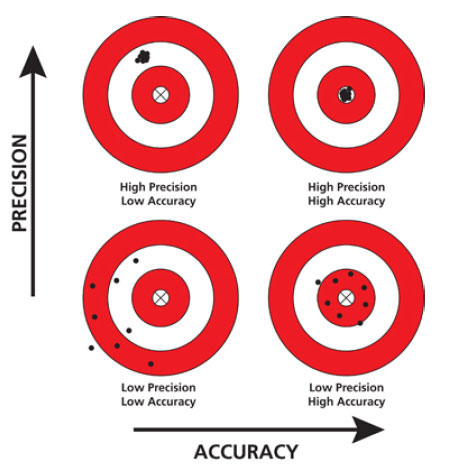
Iain uses the example of Newtonian and Einsteinian physics. At one point, they are practically synonymous and interchangeable. Only as we reach the speed of light does Newtonian physic exceed the bounds of its scope. He also educated the reader on the difference between precision and accuracy.
I like to view this in a musical context. If I play two notes together, say a B over an E, neither is more correct than the other. Notionally, I am playing an E5/B. This is neither an E or a B. The chord is the result of the two playing simultaneously. In this case E and B are both true and not true because the E5 is a synthesis. If I add a G# I get an E-major chord, subsequently adding a D renders an E7. In each of these cases, the truth of the notes, B, D, E, and G# remain true to their identity, but the fact is that the individuality is subsumed by the collective. This is the prevailing truth even though a person with perfect pitch can still individually identify the constituents of the chord. I don’t know if this is more confusion than necessary, but it helps me.
I’ve always like this illustration with target grouping, but this was not referenced by the book.
Image: Precision and Accuracy Chart
Interestingly, he cites Jay Zwicky’s definition: “Truth is the asymptotic limit of sensitive attempts to be responsible to our actual experience of the world … ‘sensitive attempts to be responsible’ means truth is the result of attention. (As opposed to inspection.) Of looking informed by love. Of really looking.” He accedes that there are degrees of truth.
Truth is the asymptotic limit of sensitive attempts to be responsible to our actual experience of the world
As the chapter comes to a close, he leaves us with a twisted categorical syllogism,
[p1] All monkeys climb trees
[p2] The porcupine in a monkey
[ c ] The porcupine climes trees
This structure presents a valid argument. However, it is not sound. It follows the Socratic logical syntax:
[p1] M a P
[p2] S a M
[ c [ S a P
Because of our exposure to and experience with the external world, we can assess this argument to be unsound, which is to say untrue by observation. Without this context, we could not render this assessment. He discusses the way right- and left-hemisphere occluded subjects respond to this discrepancy. In summary, an isolated left hemisphere with defend the logical syntax over the lived experience.
In conclusion, the hemispheres take different paths to assess truth and often end up at different destinations. The left hemisphere sees truth as a thing whilst the right views it as a process.