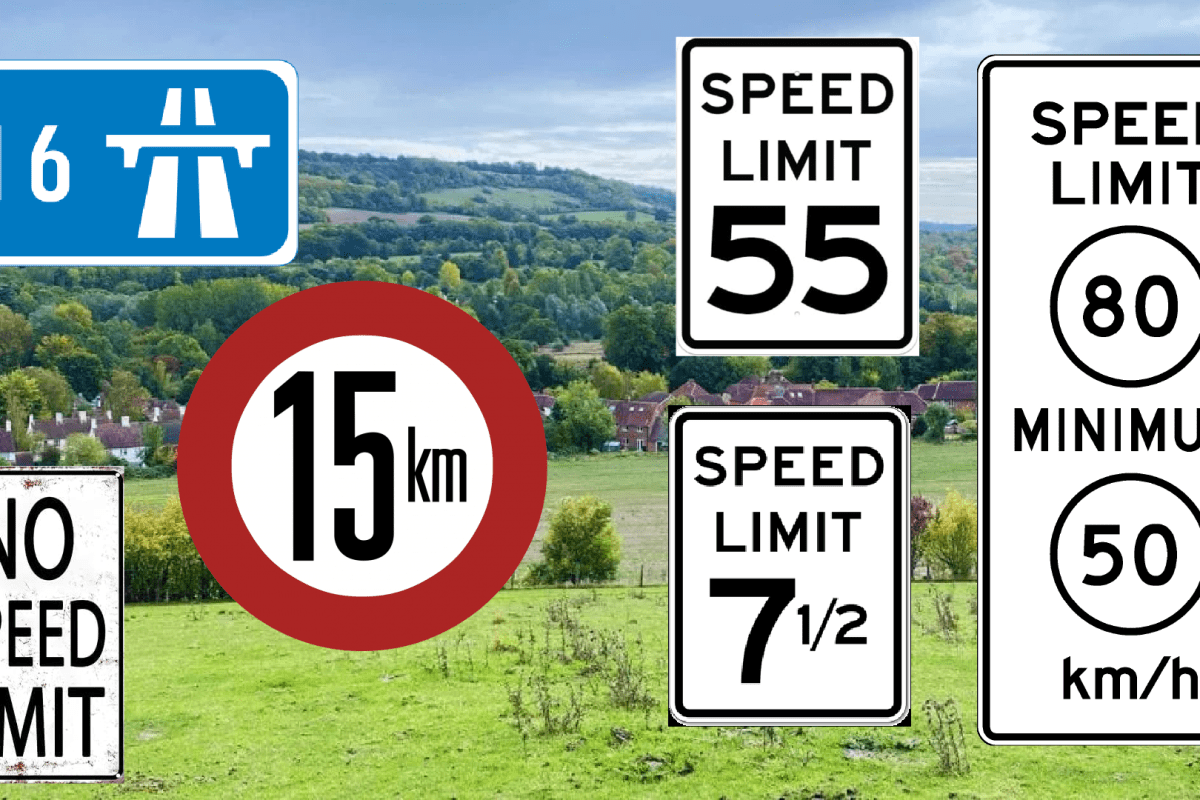
We tend to think of speed limits as facts. Numbers. Neutral. Posted. Enforced. And yet almost no one treats them that way.
Roads are engineered to handle speeds well above the numeral on the sign. Police officers routinely tolerate a band of deviation. We know they’ll allow around ten miles per hour over the stated limit. They know we know. We know that they know that we know. Ad infinitum.
Audio: NotebookLM summary podcast of this topic.
Courts accept that instruments have margins of error. Drivers adjust instinctively for weather, traffic density, visibility, vehicle condition, and local customs. A straight, empty motorway at 3 a.m. is not experienced the same way as a narrow residential street at school pickup time, even if the number on the sign is identical. Everyone knows this. And yet we continue to talk about the speed limit as if it were an unmediated fact about the world.
This is not a complaint about traffic law. Speed limits work remarkably well, precisely because they are not what they appear to be. They are not discoveries about nature, but stabilised conventions: administrative thresholds designed to coordinate behaviour under uncertainty. The familiar numbers – 30, 50, 70 – are not found in the asphalt. Never 57 or 63. They are chosen, rounded, and maintained because they are legible, enforceable, and socially negotiable. What makes speed limits interesting is not their arbitrariness, but their success.
They hold not because they are exact, but because they survive approximation. They absorb error, tolerate deviation, and remain usable despite the fact that everyone involved understands their limits. In practice, enforcement relies less on the number itself than on judgments about reasonableness, risk, and context. The ‘fact’ persists because it is embedded in a network of practices, instruments, and shared expectations.
If you end up in court driving 60 in a 50, your ability to argue about instrument calibration won’t carry much weight. You’re already operating 20 per cent over specification. That’s beyond wiggle room – highly technical nomenclature, to be sure.
Blood alcohol limits work the same way. The legal threshold looks like a natural boundary. It isn’t. It’s a policy decision layered atop probabilistic measurement. Unemployment rates, diagnostic cutoffs, evidentiary standards – all of them look objective and immediate whilst concealing layers of judgment, calibration, and compromise. Each functions as a closure device: ending debate not because uncertainty has been eliminated, but because further uncertainty would make coordination impossible.
The trouble begins when we forget this – and we do. When facts are treated as simple givens rather than negotiated achievements, they become untouchable. Questioning them gets mistaken for denying reality. Acknowledging their construction gets misheard as relativism. What started as a practical tool hardens into something that feels absolute.
This is how we end up saying things like ‘just give me the facts’ whilst quietly relying on tolerance bands, interpretive discretion, and institutional judgment to make those facts usable at all.
If this sounds right – if facts work precisely because they’re mediated, not despite it – then the question becomes: what does truthfulness require once we’ve acknowledged this?
I’ve written a longer essay exploring that question, starting from Bernard Williams’ account of truthfulness as an ethical practice and extending it to facts themselves. The argument isn’t that facts are illusory or unreliable. It’s that recognising how they actually work – through stabilisation, constraint, and correction – clarifies rather than undermines objectivity.
I do not assume that normative assertions function as descriptive truths. Realism is compelling because it promises that moral disagreement has a fact of the matter beyond persuasion. The argument here is that this promise cannot be kept without mediation. Nevertheless, this essay proceeds by granting the realist premise – that Truth exists – in order to examine whether that premise can, on its own terms, generate normative authority. The argument is structural rather than polemical: to move from Ontology (what exists) to Authority (what binds) requires a mechanism of transport. That mechanism is mediation. The claim advanced here is that this mediation is irreducibly rhetorical, and that no account of normativity can bypass this fact without smuggling authority under metaphysical cover.
Audio: NotebookLM summary podcast of this content.
Introduction
Grant, purely for the sake of argument, that Truth – and by extension Justice, Goodness, or any other realist normative entity – exists independently of human cognition. Even so, a prior and unavoidable question arises: how does such Truth ever become accessible to finite, discursive agents like us?
Before asking whether Truth exists in itself, we must account for how it enters ethical life for us. This is not a semantic quibble. It marks the difference between an ontological assertion and an operative ethics.
This essay argues that all access to Truth is irreducibly mediated, and that this mediation is rhetorical in nature. Even if Truth exists independently of human minds, it never arrives in normative life except through language, interpretation, argument, persuasion, narrative, and institutional articulation. Any ethical framework that treats metaphysical grounding as if it bypassed these mediations risks conflating ontology with authority.
This is neither relativism nor subjectivism. It is an analytic claim about conditions of access and normative traction.
Truth and Its Access Conditions
Suppose you accept that Truth exists ‘out there’—not as a projection or consensus shorthand, but as an intransitive feature of reality. This is the core commitment of metaphysical realism. The issue is not whether Truth exists, but how it becomes accessible to agents embedded in language, culture, and institutions.
For any putative Truth to function normatively, at least five stages are required:
Identification — recognising something as a candidate for truth
Description — articulating that candidate in language
Justification — offering reasons for accepting it
Communication — transmitting those reasons to others
Ratification — persuading a community to treat the claim as binding
These stages are not epistemic luxuries. They are the conditions under which a putative Truth acquires normative force – the capacity to obligate, justify, or condemn.
Remove any one of these stages, and Truth collapses into either an inert fact or an unintelligible assertion. Crucially, each stage is rhetorical: none operates through brute ontology alone, but through discursive practices of interpretation, evaluation, and adjudication.
Rhetoric Is Not Spin
To say that Truth is rhetorically mediated is not to reduce truth to manipulation, persuasion-for-its-own-sake, or spin.
It is simply to recognise that:
Truth claims are discerned in language
They are evaluated against alternatives
They are assessed within communities shaped by practices, norms, disciplines, and institutions
Truth as it functions in human life is always a claim in argument, never a self-announcing datum.
Even mathematics – the paradigm of certainty – does not become normatively operative without symbolic articulation, shared standards of proof, and communal validation. Mathematical truths may exist independently, but what counts as a proof, a result, or an error – and thus what obligates assent – is entirely mediated by symbolic practice and communal ratification.
In its classical sense, rhetoric is not deception. It is the set of discursive practices by which claims become intelligible, contestable, and action-guiding across contexts of disagreement.
Where Normativity Actually Emerges: The Three-Stage Problem
The problem crystallizes at a precise moment: the move from description to prescription. Even if we grant that the Good exists objectively and eternally, three distinct operations are required to generate obligation:
Descriptive claim: ‘The Good exists and has properties X, Y, Z’
Interpretive claim: ‘In this situation, the Good requires action A rather than B’
Prescriptive claim: ‘Therefore you ought to do A’
Each transition requires distinct work. The first may be metaphysical. But the second and third are irreducibly rhetorical. They involve judgment, application, contextual interpretation, and the translation of abstract principle into concrete obligation.
Crucially, even the interpretive middle step – which often masquerades as mere clarification – is where most normative force gets generated. To say ‘the Good requires this action in this context’ is not to read off a fact from the world. It is to make an argued claim about meaning, relevance, and application.
This is where participatory metaphysics does its quietest work. By framing interpretation as ‘participation in the Good’ rather than as ‘argued judgment about what the Good requires,’ such frameworks obscure the rhetorical operation they’re performing. Interpretation gets presented as disclosure rather than construction.
But there is no route from ‘the Good exists’ to ‘you must do X’ that bypasses interpretation. And interpretation is rhetoric.
The Potential Energy Analogy
Consider an analogy. Gravitational potential energy exists independently of human recognition. A boulder atop a cliff possesses real energy by virtue of its position. But that energy does no work – moves nothing, heats nothing, powers nothing – until converted through specific mechanisms: falling, rolling, controlled descent.
The Good may be precisely like this: real, eternal, independent of us. But for it to become normatively operative – to obligate us, to guide our choices, to settle our disagreements – it must be converted from potential into kinetic form. That conversion is mediation. And mediation is rhetorical.
This is not relativism about the Good’s existence. It is realism about the conditions under which existence generates obligation.
A Concrete Example
When Catholic bishops disagree about capital punishment:
They agree on the descriptive claim: ‘God exists and is perfectly Good’
They disagree on the interpretive claim: ‘What does divine Justice require regarding state execution?’
They therefore disagree on the prescriptive claim: ‘Is capital punishment permissible?’
The descriptive agreement doesn’t resolve the interpretive disagreement. No amount of metaphysical depth about God’s nature tells you directly what Justice requires regarding capital punishment. That requires interpretation of Scripture, tradition, natural law, human dignity, social context, prudential judgment – all rhetorical operations.
Appeals to ‘the Good itself’ don’t settle the dispute. They just rename it. Instead of ‘bishops disagree about ethics,’ it becomes ‘bishops are discerning what participation in the Good requires’. The language changes; the rhetorical work remains.
The Zeno Structure of Moral Grounding
At this point, the realist faces a structural problem that resembles Zeno’s paradox. When pressed on how Truth becomes binding, the realist response multiplies explanatory depth:
The Good exists objectively
We apprehend it through reason
Reason itself is oriented toward the Good
That orientation is grounded in rational agency
Rational agency participates in…
Each step is coherent. Each promises that obligation is just one more metaphysical move away. But none ever performs the action ‘therefore, you must do X in this situation’.
This is not merely infinite regress – philosophers tolerate infinite structures. The problem is asymptotic normativity: explanations that get progressively closer to bindingness without ever crossing the threshold into concrete obligation.
What’s missing is not metaphysical depth but the moment of arrival. Until someone says ‘this counts as wrong here, and therefore you ought to stop,’ nothing has happened in ethical space. The arrow is still subdividing its path.
Rhetoric is what collapses the infinite series into a finite act. It does for ethics what accepting motion does for Zeno’s paradox: it stops subdividing and acts. This is not an epistemic shortcut – it is the mechanism by which normativity becomes operative.
‘Participation in the Good’ sounds like arrival, but it is actually eternal approach. It explains why the Good matters in principle while indefinitely postponing the moment when obligation becomes concrete and contestable. That postponement is not a feature – it is the avoidance of the very question at issue.
Three Remaining Escapes (and Why They Fail)
A. The Implicit Normativity Move
A sophisticated realist might respond: ‘Interpretation is required, yes, but the normativity is already there implicitly. Interpretation merely makes explicit what was already required’.
But implicit normativity is indistinguishable from no normativity unless it can be specified. Until interpretation specifies what is required here, the obligation has no action-guiding content. A normativity that exists only implicitly, without criteria of application, is functionally equivalent to no normativity at all.
‘Implicit obligation’ means ‘not yet specified,’ which means ‘not yet operative’. The work of making it operative is interpretation – which is rhetoric.
B. The Practical Wisdom Escape
Another likely move: ‘Interpretation is not rhetoric; it’s phronesis. Practical wisdom directly apprehends what the Good requires’.
But practical wisdom does not bypass mediation; it relocates it into judgment. If practical wisdom yields different answers for different agents, it is still interpretive. If it cannot be articulated, justified, or contested, it cannot function socially. The moment phronesis is communicated or taught, it becomes rhetorical.
Judgment, when it claims authority over others, must still be articulated, defended, and enforced. Incommunicable wisdom is indistinguishable from private intuition. And private intuitions don’t settle public disagreements.
C. The ‘This Proves Too Much’ Objection
Someone might say: ‘If your argument is right, then no ethical system can ever claim authority. Everything dissolves into endless contestation’.
But the claim is not that normativity evaporates under mediation, but that it emerges there. This is not nihilism – it is an explanation of normativity’s location, not its abolition. That normativity is mediated does not mean it is arbitrary. Mediation operates under constraints of coherence, consistency, consequence, and resistance from the world and from other agents.
Mediation is constrained by material resistance, coherence, practical failure, and worldly recalcitrance. The claim is not that ‘anything goes’. It’s that what goes must be argued for, negotiated, and sustained through rhetorical practices. That’s not less demanding than metaphysical grounding – it’s more honest about where the work happens.
Consequences for Ethical Frameworks
If access to Truth is always mediated, then several consequences follow:
Authority is interpretive, not ontological
Disagreement is structural, not pathological
Norms are contested, not deduced unilaterally
Power shapes uptake, not metaphysical purity
This has decisive implications for meta-ethics. Ethical life is not insulated from negotiation; it is constituted by it. Normativity does not descend fully formed from metaphysics into practice. It is worked out – imperfectly, provisionally, and under constraint – within social space.
Ethics, in other words, is not a museum of pristine ideals. It is a field of contested meanings under conditions of risk, conflict, and plural commitment.
Realism Without Rhetoric Is Empty
A realist might reply: Truth exists. Once we uncover it, everything follows.
But uncovering is not a metaphysically neutral act. Discovery, articulation, persuasion, and institutionalisation are themselves conditioned by:
Language, which frames intelligibility
Narrative, which shapes resonance and coherence
Institutions, which ratify selectively
Power, which governs whose claims are heard
The realist may insist that mediation merely follows discovery. But this assumes a distinction that cannot be sustained. Until a truth is articulated, justified, and ratified, there is no criterion by which its discovery can be distinguished from error, fantasy, or ideology. What is not mediated is not merely unpersuasive; it is normatively indistinguishable from falsehood. Ontology alone cannot perform this discrimination.
If access to Truth is always mediated, then metaphysical depth alone cannot generate normative authority. The locus of ethical force shifts from an external realm to the discursive space where claims are interpreted, contested, and enforced. A grounding that never binds except through mediation is indistinguishable, at the level of authority, from mediation itself.
This shift is not relativism. It is a descriptive account of how ethical life actually functions.
Moral Authority Under Rhetorical Conditions
To say Truth → Rhetoric is not to deny the possibility of rigorous assessment. It is to insist that:
Normative claims must offer contestable reasons
Moral authority must disclose its interpretive moves
Disagreement must be treated as clarifying, not corrosive
Ethical systems must be judged by their discursive dynamics as much as their metaphysical commitments
Truth in itself may be metaphysically deep. But truth-as-binding never operates outside rhetoric.
Conclusion
Grant the realist premise if you like: Truth exists. Even then, metaphysical depth alone does not explain how Truth becomes accessible, meaningful, or binding for discursive agents.
Because access is always mediated, authority cannot bypass rhetoric. Ethical life requires not only an ontology, but an account of how claims are interpreted, argued over, and enforced. A Truth that cannot be accessed – named, contested, communicated – remains normatively inert.
The fundamental error is treating the descriptive-interpretive-prescriptive chain as if it could be collapsed into a single operation called ‘participation’. It cannot.
Even if the Good exists exactly as realists claim – eternal, objective, transcendent – it becomes normatively operative for finite agents only through a sequence of mediations:
Interpretation (what does it mean?)
Application (what does it require here?)
Justification (why this action rather than that one?)
Communication (how do we persuade others?)
Enforcement (who ensures compliance?)
Each mediation is rhetorical. Each involves judgment, argument, and institutional power. Each is contestable.
This is not a bug in ethical life. It is its structure. Any framework that promises to transcend these mediations through metaphysical depth is not offering a solution. It is concealing the problem while continuing to rely on exactly the mechanisms it claims to surpass.
To bring Truth into the world of action is to engage rhetoric not as an ornamental layer, but as the condition of ethical life itself.
Thus: Truth → Rhetoric. Not because truth is arbitrary, but because it is always mediated.
Appendix: Clarifying the Claim
This argument does not deny realism, nor does it reject the possibility of mind-independent truth. What it rejects is the unexamined slide from ontology to authority.
This distinction is formalised – though not originated – by the Mediated Encounter Ontology (MEOW), which holds that all human access to the world is mediated. Whatever exists may exist independently of us; whatever binds us does not. The present argument does not depend on accepting MEOW as a system; it relies only on the minimal claim that access precedes authority.
MEOW formalises this through a layered account of encounter:
T0 — biological substrate
T1 — cognitive–perceptual interface
T2 — linguistic–symbolic mediation
T3 — social–technical norms and institutions
Normativity operates at the upper tiers. Ethical obligation, justice, and virtue do not arrive with built-in binding force. Whatever their metaphysical status, their authority for human agents arises only through interpretation, articulation, justification, and social uptake.
This is the precise sense in which Truth → Rhetoric should be read. It is not an ontological identity claim. It is a claim about normative operability.
Rhetorical mediation is constrained – by material resistance, coherence, practical failure, and worldly recalcitrance. But those constraints do not speak for themselves. They must still be named, argued over, prioritised, and enforced.
There is no route from is to ought that does not pass through language, judgment, and institutional uptake. Appeals to metaphysical depth do not remove this mediation; they conceal it.
Any framework that treats participation in ‘the Good’ as normatively binding without accounting for how that Good is interpreted, communicated, and enforced is already doing rhetorical work while pretending not to.
That pretence isn’t philosophical sophistication. It’s a familiar ideological gesture: power presenting itself as mere disclosure. Rhetoric is not what corrupts ethics. It is what makes ethics possible.
I commenced a series where I discuss the responses to the 2020 PhilPapers survey of almost 1,800 professional philosophers. This continues that conversation with questions 2 through 4 – in reverse order, not that it matters. Each is under 5 minutes; some are under 3.
For the main choices, you are given 4 options regarding the proposal:
Accept
Lean towards
Reject
Lean against
Besides the available choices, accepted answers for any of the questions were items, such as:
Combinations (specify which.) For the combos, you might Accept A and Reject B, so you can capture that here.
Alternate view (not entirely useful unless the view has already been catalogued)
The question is too unclear to answer
There is no fact of the matter (the question is fundamentally bollocks)
Agnostic/undecided
Other
Q4: The first one asks, ‘What is the aim of philosophy?’ Among the responses were:
Truth/Knowledge
Understanding
Wisdom
Happiness
Goodness/Justice
Before you watch the video, how might you respond?
Video: What is the aim of philosophy?
Q3: What’s your position on aesthetic value?
Objective
Subjective
Video: What is aesthetic value?
Q2: What’s your position on abstract objects?
Platonism (these objects exist “out there” in or beyond the world)
Nominalism (the objects are human constructs)
Video: Where do abstract objects reside?
Q1: What’s your position on à priori knowledge?
This video response was an earlier post, so find it there. This is asking if you believe one can have any knowledge apart from experience.
Yes
No
NB: I’ve recorded ten of these segments already, but they require editing. So I’ll release them as I wrap them up. Not that I’ve completed them, I realise I should have explained what the concepts mean more generally instead of talking around the topics in my preferred response. There are so many philosophy content sites, I feel this general information is already available, or by search, or even via an LLM.
What do you think – should I?
In the other hand, many of these sites – and I visit and enjoy them – support very conservative, orthodox views that, as I say, don’t seem to have progressed much beyond 1840 – Kant and a dash of Hegel, but all founded on Aristotelian ideas, some 2,500 years ago.
Spoiler alert, I think knowledge has advanced and disproved a lot of this. It turns out my brothers in arms don’t necessarily agree. Always the rebel, I suppose.
A surprising number of people have been using the MEOW GPT I released into the wild. Naturally, I can’t see how anyone is actually using it, which is probably for the best. If you hand someone a relational ontology and they treat it like a BuzzFeed quiz, that’s on them. Still, I haven’t received any direct feedback, positive or catastrophic, which leaves me wondering whether users understand the results or are simply nodding like priests reciting Latin they don’t believe.
Audio: NotebookLM summary podcast of this topic.
The truth is uncomfortable: if you haven’t grasped the Mediated Encounter Ontology (of the World), the outputs may feel like a philosophical brick to the face. They’re meant to; mediation has consequences. I’m even considering adding a warning label:
If you hold an unwavering commitment to a concept with any philosophical weight, perhaps don’t input it. There is a non-zero chance the illusion will shatter.
Below is a sampling of the concepts I tested while inspecting the system’s behaviour. I’m withholding the outputs, partly to avoid influencing new users and partly to preserve your dignity, such as it is.
authenticity
anattā (Buddhist)
character (in Aristotle’s virtue-ethical sense)
consciousness
dignity
freedom
hózhó (Navajo)
justice
karma
love
progress
ren ( 仁 )
table
tree
truth
I may have tried others, depending on how irritated I was with the world at the time.
(Now that I think of it, I entered my full name and witnessed it nearly have an aneurysm.)
My purpose in trying these is (obviously) to test the GPT. As part of the test, I wanted to test terms I already considered to be weasel words. I also wanted to test common terms (table) and terms outside of Western modalities. I learned something about the engine in each case.
Tables & Trees
One of the first surprises was the humble ‘table’ which, according to the engine, apparently moonlights across half of civilisation’s conceptual landscape. If you input ‘table’, you get everything from dinner tables to data tables to parliamentary procedure. The model does exactly what it should: it presents the full encounter-space and waits for you to specify which world you meant to inhabit.
The lesson: if you mean a table you eat dinner on, say so. Don’t assume the universe is built around your implied furniture.
‘Tree’ behaves similarly. Does the user mean a birch in a forest? A branching data structure? A phylogenetic diagram? MEOW GPT won’t decide that for you; nor should it. Precision is your job.
This is precisely why I tested ‘character (in Aristotle’s virtue-ethical sense)’ rather than tossing ‘character’ in like a confused undergraduate hoping for luck.
Non-Western Concepts
I also tested concepts well outside the Western philosophical sandbox. This is where the model revealed its real strength.
Enter ‘karma’: it promptly explained that the Western reduction is a cultural oversimplification and – quite rightly – flagged that different Eastern traditions use the term differently. Translation: specify your flavour.
Enter ‘anattā’: the model demonstrated that Western interpretations often reduce the concept to a caricature. Which, frankly, they do.
Enter ‘hózhó’: the Navajo term survives mostly in the anthropological imagination, and the model openly described it as nearly ineffable – especially to those raised in cultures that specialise in bulldozing subtlety. On that score, no notes.
Across the board, I was trying to see whether MEOW GPT would implode when confronted with concepts that resist neat Western categorisation. It didn’t. It was annoyingly robust.
Closing Notes
If you do try the MEOW GPT and find its results surprising, illuminating, or mildly offensive to your metaphysical sensibilities, let me know – and tell me why. It helps me understand what the engine does well and what illusions it quietly pops along the way. Your feedback may even keep me from adding further warning labels, though I wouldn’t count on it.
How the Trump Era Rewrote Time, Truth, and the Very Idea of a Common World
Politics in the Trump era wasn’t merely a spectacle of bad manners and worse epistemology; it was the moment the United States stopped pretending it shared a common world – when politics ceased to be a quarrel over facts and became a quarrel over the very conditions that make facts possible. This essay is part of an ongoing project tracing how post-Enlightenment societies lose their shared grammar of verification and retreat into parallel narrative architectures that demand allegiance rather than assessment.
And before anyone hyperventilates about implied asymmetry: the recursive logic described here is not exclusive to the right. The progressive cosmology, though stylistically different, exhibits the same structural features – prophetic claims about impending catastrophe or salvation, retrospective reinterpretations to maintain coherence, and an insistence on possessing privileged interpretive tools. The Trump era didn’t invent this recursive mode; it simply accelerated it, stripped it naked, and pumped it through a 24-hour media bloodstream until everyone could see the circuitry sparking.
Audio: NotebookLM podcast on this topic.
Welcome to the new cosmology.
1. The Death of a Common Grammar
Once the shared grammar of verification dissolves, political discourse stops unfolding in empirical time. It migrates into suspended futurity – a realm of conditional wagers:
If this, then that. Just wait. You’ll see. The future will vindicate us.
But the horizon keeps receding. When reality refuses to comply, factions rewrite the past to preserve the equilibrium between prophecy and outcome. Truth becomes less a matter of correspondence and more an act of narrative self-maintenance. Where the world diverges from the story, the world is adjusted.
Political time becomes pliable; the narrative must be kept intact, whatever the cost.
2. Mimetic Prophecy and the Absence of Catharsis
A Girardian lens clarifies what’s happening beneath the surface. The factions are not simply disagreeing; they are locked in mimetic rivalry, each imitating the other’s claim to prophetic vision. Insight becomes the mimetic object: each camp insists it alone can decode the approaching shape of events.
As the rivalry escalates, differentiation collapses. Both sides perform identical moves – warnings of authoritarianism, narratives of national peril, promises of historical vindication – whilst insisting the other’s prophecies are delusional.
In classic Girardian fashion, this symmetry produces a crisis: a collapse of distinction between rivals, accompanied by a desperate hunt for a stabilising sacrifice. In the Trump era, the scapegoat was not a person but a category: truth itself. Doubt, verification, shared reality – these were sacrificed at the altar of maintaining internal cohesion.
Yet unlike the societies Girard studied, the American polity achieves no catharsis. The sacrificial mechanism fails. No cleansing moment restores order. The cycle loops endlessly, forcing the community to reenact the ritual without the relief of resolution.
Prophecy, rivalry, crisis – repeat.
3. From Chronology to Mythic Temporality
Once prediction and remembrance collapse into one another, political time becomes mythic rather than chronological. The present becomes a hinge between two versions of the world: the one the faction already believes in and the one it insists the future will confirm.
The future becomes partisan property. The past becomes commentary. The present becomes maintenance.
Each faction edits its cosmology to preserve coherence, producing a recursive temporality in which prophecy and memory reinforce one another. Narrative supplants chronology; plausibility is subordinated to coherence. The factions are not lying; they are mythologising.
This is what a society does when it cannot stabilise truth but cannot abandon truth-claims either.
4. Madison’s Diagnosis, Reversed
James Madison, in his republican optimism, believed factions were inevitable but containable. Pluralism, he argued, would safeguard the republic by ensuring no faction could elevate its partial vision into a universal claim. The sheer scale and diversity of the republic would generate cross-pressure strong enough to check epistemic domination.
He assumed a shared evidentiary world.
He did not imagine a polity in which factions construct discrete epistemic universes – self-sealing interpretive systems with their own temporal orders, myths of origin, and theories of legitimacy. Under such conditions, pluralism no longer disciplines factional excess; it shelters it. It becomes a buffer that prevents contact, not a mechanism that fosters correction.
Madison feared that factions might mistake their partial view for the whole. Our moment dissolves the very idea of the whole.
Pluralism, once a remedy, becomes the architecture of epistemic secession.
5. The Theatre of Recursive Narration
What remains is not deliberation but theatre—political communities sustained by the perpetual reenactment of their own certainties. Each faction maintains itself through narrative recursion, chanting the same incantation of retrospective rightness, performing the same rites of interpretive renewal.
The republic no longer hosts disagreement; it hosts parallel cosmologies.
In the republic of recursive prophecy, truth is no longer what grounds politics – it’s what politics performs.
Afterword
This article followed a chat with ChatGPT. For what it’s worth, I now style myself a post-postmodern, post-critical theorist – though these labels are as pointless as the ones they replace.
The conversation began with Paul Feyerabend’s Against Method, which was already on my mind. In Appendix 1 he writes:
“After all, in a democracy ‘reason’ has just as much right to be heard and to be expressed as ‘unreason’, especially in view of the fact that one man’s ‘reason’ is the other man’s insanity.”
That set me wondering, again, how one discerns signal from noise. As a statistician, separating wheat from chaff is my daily bread, but how does one do it politically without pretending to possess privileged access to truth? In this environment, each faction insists it has such access. The other side, naturally, is deluded. Ignore the fact that there are more than two sides; binary thinking is the fashion of the day.
I leaned on ChatGPT and asked for sources on this lemma – what to read, where to dig. It replied with books I’d already read, save for one:
I hadn’t read Laclau & Mouffe. ChatGPT summarised them neatly:
“Politics is the contest over the very conditions for meaning. The signal/noise split is hegemonic construction, not metaphysical reality.”
Right up my street. (I still need to read it.)
That, in turn, brought Madison’s Federalist No. 10 to mind – his warning that factional division, particularly the two-party structure the United States later perfected, would one day become corrosive.
Then Girard entered the chat. And so on. We followed the thread a little longer until this essay took shape. I didn’t feel compelled to polish it into a formal academic piece. A blog seems a far better home for now, and the essay version can remain an open question.
Written by Bry Willis with assistance from ChatGPT 5.1
When drawn, this card alters perception itself. It reminds the player that truth is not something one finds under a rock but something one polishes into shape. Each metaphor becomes a spell; each keyword a crutch thrown aside.
Those who wield the Constructivist Lens see not “facts,” but fictions so useful they forgot to call them that. Reality wobbles politely to accommodate belief.
“Knowledge is not a copy of reality but a tool for coping with it.” — Richard Rorty
In game terms: Tap to reframe existence as interpretation. Duration: until the next disagreement.
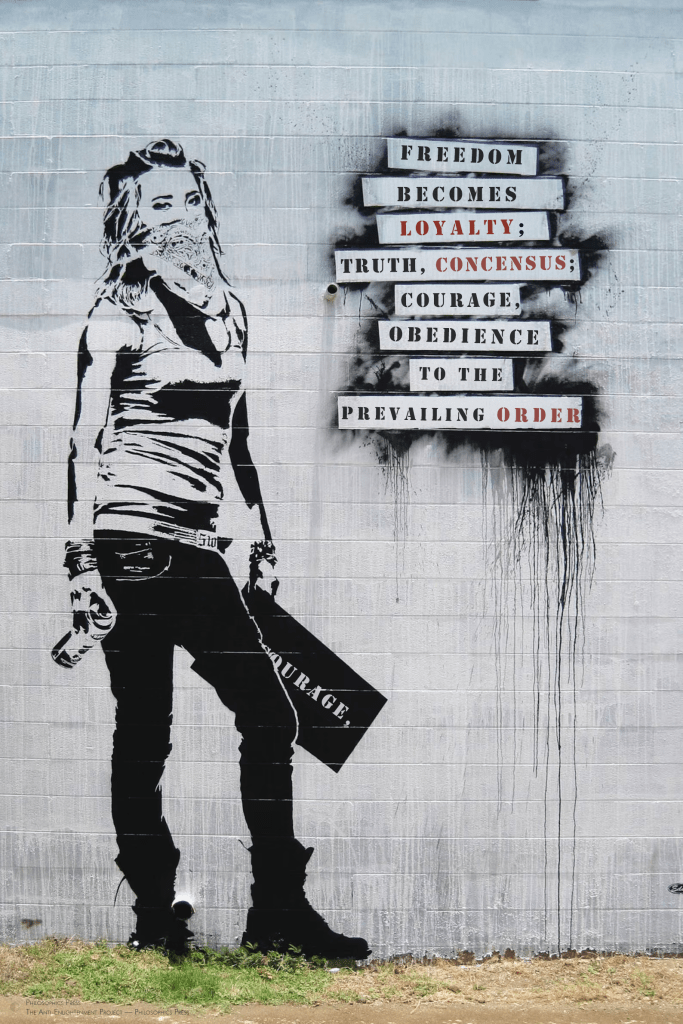
I decided to create some social media sharing content, so I appropriated this iconic graffiti and repurposed it to promote The Will to Be Ruled essay.
Image: “Freedom becomes loyalty; truth, consensus; courage, obedience to the prevailing order.”
I intend to find some pull quotes I like and continue drafting promotional material. As these are essays, I derive no income from them. I only wish to spread the word and get comments on them – supportive or detracting; it doesn’t matter.
I’ve just published Objectivity Is Illusion: An Operating Model of Social and Moral Reasoning, an essay that began as this blog post. I’m sharing the ‘official’ link and this first draft. As the essay matured, I added additional support, but I focused primarily on refuting the anticipated opposing arguments. Rather than regurgitate the final version here, I felt showing the genesis would be more instructive. Of course, the essay didn’t spring fully formed; I’ve pruned and expanded from earlier notes still sitting on my hard drive.
Every so often, I’m told I’m too slippery with words, that I treat truth as if it were just another game of persuasion, that I reduce morality to chalk lines on a playing field. The objection usually comes with force: ‘But surely you believe some things are objectively true?‘
I don’t. Or more precisely, I don’t see how ‘objectivity’ in the metaphysical sense can be defended without lapsing into stagecraft. Granite foundations have always turned out to be scaffolding with the paint touched up. Priests once told us their gods guaranteed truth; scientists later promised the lab would serve as granite; politicians assure us democracy is the stone pillar. But in each case the creaks remain.
Audio: NotebookLM podcast on this topic.
This essay is written with an academic readership in mind. It assumes familiarity with figures like Nietzsche, Foucault, Rorty, and Ayer, and with the long quarrel over subjectivity, relativity, and objectivity. My aim is not to retell those arguments from the ground up, but to position my own framework within that ongoing dispute.
Scope
Before proceeding, some guardrails. When I say ‘objectivity is illusion,’ I mean in the social and moral domain. I’m not denying quarks or mathematics. My claim is narrower: in human discourse, no truth escapes subjectivity or contingency.
This dovetails with my broader Language Insufficiency Hypothesis: that even our words are leaky vessels, prone to misfire and misunderstanding. If language itself is unstable ground, then objectivity built upon it can hardly be granite. My claim here is not that nothing exists outside us, but that in the social world we inhabit together, every ‘truth’ rests on creaking boards.
One more note: just because social administration requires appeals to objectivity doesn’t mean objectivity exists. Courts, laboratories, and parliaments invoke it to secure trust, and it works well enough as theater. But necessity is not proof. And it is not my responsibility to conjure a granite replacement. What follows is an operating model, not a new altar.
Thesis
Objectivity is an illusion. Truth is rhetorical. Morality is prescriptive, not propositional. Our ethic is not granite but care: tending the planks we walk on, knowing they creak.
Operating Model: Five Premises
This framework is not a foundation. It is an operating model – contingent, provisional, subject to revision as circumstances change. Like any model, it can (and should) be updated to fit the culture and times.
Premise 1: Subjectivity is the baseline. Every claim originates in a perspective. No statement is free of the lens through which it is made. Even to deny subjectivity is to speak from a subject.
Premise 2: Relativity is emergent. What we call ‘relative truth’ is not a separate category but the convergence of individual subjectivities into provisional consensus. Consensus is never neutral: it is formed rhetorically – through persuasion, cultural resonance, and power [1]. MacIntyre made a similar point in After Virtue. The moral consensus of the Ancients was not grounded in objectivity but in a shared tradition – a thick account of human flourishing that gave coherence to their claims. When that scaffolding collapsed, consensus fractured, leaving modern moral discourse in fragments. Critics accused MacIntyre of relativism, since different traditions yield different ‘truths’, but his point reinforces mine: what looks like objectivity is in fact the temporary overlap of subjectivities sustained by tradition [2].
Premise 3: Objectivity is illusion. Claims presented as objective are relative norms hardened by repetition and forgotten as contingent scaffolding. ‘Objectivity’ is consensus disguised as granite. Its invocation in courts or parliaments may be useful, but usefulness is not existence. The burden of proof belongs to anyone insisting on an independent, metaphysical anchor for moral or social truths (Nietzsche’s ‘mobile army of metaphors’ [3], Kuhn’s paradigms [4], Latour’s laboratories [5]).
Even if one concedes, with Weber (as MacIntyre reminds us), that objective moral truths might exist in principle, they remain inaccessible in practice. What cannot be accessed cannot guide us; reconciliation of values and virtues must therefore take place within traditions and rhetoric, not in appeal to unreachable granite [13].
Premise 4: Rhetoric establishes truth. What counts as ‘true’ in the social and moral domain is established rhetorically – through coherence, resonance, utility, or force. This does not mean truth is ‘mere spin’. It means truth is never metaphysical; it is enacted and enforced through persuasion. If a metaphysical claim convinces, it does so rhetorically. If a scientific claim holds, it does so because it persuades peers, fits the evidence, and survives testing. In short: rhetoric is the medium through which truths endure [6].
Premise 5: Non-Cognitivism, Stated Plainly. I take moral utterances to be prescriptions, not propositions. When someone says ‘X is wrong’, they are not reporting an objective fact but prescribing a stance, a rule, a line in chalk. This is my operating position: non-cognitivism (Ayer [7], Stevenson [8]).
That said, I know the term feels alien. Many prefer the dialect of subjectivism – ‘X is true-for-me but not-for-you’ – or the quasi-realist stance that moral language behaves like truth-talk without cosmic backing (Blackburn [9]). I have no quarrel with these translations. They name the same scaffolding in different accents. I am not defending any school as such; I am simply stating my plank: morality prescribes rather than describes.
Ethic: Care. Since scaffolding is all we have, the obligation is not to pretend it is stone but to keep it usable. By ‘care’, I do not mean politeness or quietism. I mean maintenance – deliberation, repair, mutual aid, even revolt – so long as they acknowledge the scaffolding we share. Care is not optional: stomp hard enough and the floor collapses beneath us all.
Examples clarify: peer review in science is care in action, patching leaky vessels rather than proving granite. Civil rights movements practiced care by repairing rotten planks of law, sometimes with revolt. Communities rebuilding after disaster embody care by reconstructing scaffolding, not pretending it was indestructible. Care is maintenance, reciprocity, and survival.
Bridge: These five premises do not add up to a system or a foundation. They form an operating model: subjectivity as baseline, relativity as emergent, objectivity as illusion, rhetoric as truth, morality as prescription. Together they outline a practice: walk the planks with care, admit the creaks, patch where needed, and stop pretending we live in marble halls.
Rationale
Why prefer scaffolding to granite? Because granite has always been a mirage. The history of philosophy and politics is a history of crumbling temples and collapsing empires. The promises of permanence never survive the weather.
Think of Nietzsche, who called truths ‘a mobile army of metaphors’ [3]. Think of Foucault, who showed that what counts as ‘truth’ is always bound up with power [1]. Think of Rorty, who reduced truth to what our peers let us get away with saying [6]. These are not nihilists but diagnosticians: they exposed the creaks in the floorboards and the wizard behind the curtain.
Metaphors drive the point home:
Scaffolding and granite: What holds is temporary, not eternal. Granite is an illusion painted on timber.
Chalk lines: Rules of play – binding, real, but contingent. They can be redrawn.
Shoreline houses: Rome, the USSR, the British Empire – each built like beachfront villas with a fine view and bad footing. Storms came, sand eroded, and down they went.
Bias as framing: Kahneman himself admitted ‘bias’ is not a thing in the world [10], only a deviation from a chosen model. Gigerenzer [11] and Jared Peterson [12] remind us heuristics are adaptive. To call them ‘biases’ is not neutral – it’s allegiance to a standard of rationality.
The point is simple: what holds today is scaffolding, and pretending otherwise is self-deception.
Counterarguments and Refutations
Objection: Moral Paralysis. Without objective morality, why abolish slavery or defend rights?
Refutation: Chalk lines still bind. Speed limits aren’t cosmic, but they regulate conduct. Abolition endured not because it tapped a cosmic truth but because it persuaded, resonated, and took root. Slavery was once ‘in bounds’. Now it is ‘offsides’. That shift was rhetorical, emotional, political – but no less binding.
Objection: Problem of Dissent. If all is subjective, the lone dissenter is ‘just another voice’.
Refutation: Dissent gains traction through coherence, predictive success, or resonance. Galileo, abolitionists, suffragists – none relied on metaphysical granite. They persuaded, they resonated, they moved chalk lines. Truth was made through rhetoric, not uncovered in stone.
Objection: Performative Dependency. Even to say ‘subjective’ assumes the subject/object split. Aren’t you still inside the house?
Refutation: Of course. But I’m the one pointing at the slippery boards: ‘Mind the dust’. Yes, I’m in the house. But I refuse to pretend it’s marble. And even the category ‘subject’ is not eternal – it’s porous, dynamic, and leaky, just like language itself.
Objection: Infinite Regress. Why stop at subjectivity? Why not de-integrate further?
Refutation: Subjectivity is not granite, but it is the last plank before void. Peel it back and you erase the possibility of claims altogether. If tomorrow we discover that the ‘subject’ is a swarm of quarks or circuits, fine – but the claim still emerges from some locus. Regression refines; it doesn’t disprove.
Conclusion: The Ethic of Care
This is not reintegration. It is dis-integration: naming the creaks, stripping polyvinyl from rotten boards, refusing granite illusions.
If you wish to build here, build. But know the ground shifts, the storms come, the shoreline erodes. The ethic is not certainty but care: to tend the scaffolding we share, to patch without pretending it is stone, and to let dissent itself become part of the maintenance.
“Truths are illusions which we have forgotten are illusions.” — Nietzsche
Declaring the Problem
Most people say truth as if it were oxygen – obvious, necessary, self-evident. I don’t buy it.
Nietzsche was blunt: truths are illusions. My quarrel is only with how often we forget that they’re illusions.
Most people say truth as if it were oxygen – obvious, necessary, self-evident. I don’t buy it.
My own stance is unapologetically non-cognitivist. I don’t believe in objective Truth with a capital T. At best, I see truth as archetypal – a symbol humans invoke when they need to rally, persuade, or stabilise. I am, if you want labels, an emotivist and a prescriptivist: I’m drawn to problems because they move me, and I argue about them because I want others to share my orientation. Truth, in this sense, is not discovered; it is performed.
The Illusion of Asymptotic Progress
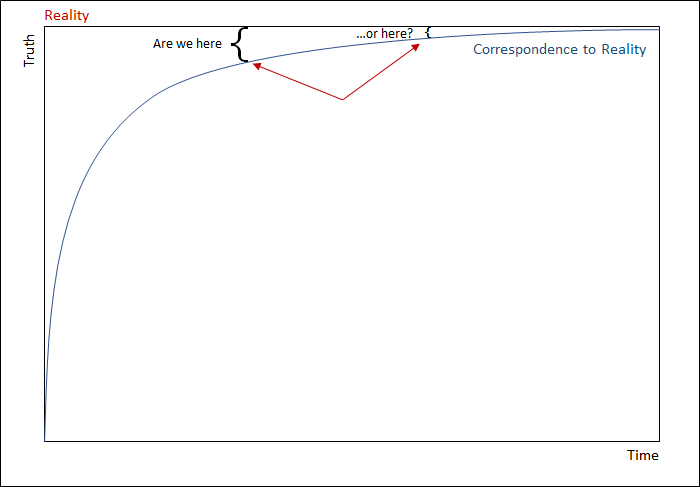
The standard story is comforting: over time, science marches closer and closer to the truth. Each new experiment, each new refinement, nudges us toward Reality, like a curve bending ever nearer to its asymptote.
Chart 1: The bedtime story of science: always closer, never arriving.
This picture flatters us, but it’s built on sand.
Problem One: We have no idea how close or far we are from “Reality” on the Y-axis. Are we brushing against it, or still a light-year away? There’s no ruler that lets us measure our distance.
Problem Two: We can’t even guarantee that our revisions move us toward rather than away from it. Think of Newton and Einstein. For centuries, Newton’s physics was treated as a triumph of correspondence—until relativity reframed it as local, limited, provisional. What once looked like a step forward can later be revealed as a cul-de-sac. Our curve may bend back on itself.
Use Case: Newton, Einstein, and Gravity Take gravity. For centuries, Newton’s laws were treated as if they had brought us into near-contact with Reality™—so precise, so predictive, they had to be true. Then Einstein arrives, reframes gravity not as a force but as the curvature of space-time, and suddenly Newton’s truths are parochial, a local approximation. We applauded this as progress, as if our asymptote had drawn tighter to Reality. But even Einstein leaves us with a black box: we don’t actually know what gravity is, only how to calculate its effects. Tomorrow another paradigm may displace relativity, and once again we’ll dutifully rebrand it as “closer to truth.” Progress or rhetorical re-baptism? The graph doesn’t tell us.
Chart 2: The comforting myth of correspondence: scientific inquiry creeping ever closer to Reality™, though we can’t measure the distance—or even be sure the curve bends in the right direction.
Thomas Kuhn was blunt about this: what we call “progress” is less about convergence and more about paradigm shifts, a wholesale change in the rules of the game. The Earth does not move smoothly closer to Truth; it lurches from one orthodoxy to another, each claiming victory. Progress, in practice, is rhetorical re-baptism.
Most defenders of the asymptotic story assume that even if progress is slow, it’s always incremental, always edging us closer. But history suggests otherwise. Paradigm shifts don’t just move the line higher; they redraw the entire curve. What once looked like the final step toward truth may later be recast as an error, a cul-de-sac, or even a regression. Newton gave way to Einstein; Einstein may yet give way to something that renders relativity quaint. From inside the present, every orthodoxy feels like progress. From outside, it looks more like a lurch, a stumble, and a reset.
Chart 3: The paradigm-gap view: what feels like progress may later look like regression. History suggests lurches, not lines, what we call progress today is tomorrow’s detour..
If paradigm shifts can redraw the entire map of what counts as truth, then it makes sense to ask what exactly we mean when we invoke the word at all. Is truth a mirror of reality? A matter of internal coherence? Whatever works? Or just a linguistic convenience? Philosophy has produced a whole menu of truth theories, each with its own promises and pitfalls—and each vulnerable to the same problems of rhetoric, context, and shifting meanings.
The Many Flavours of Truth
Philosophers never tire of bottling “truth” in new vintages. The catalogue runs long: correspondence, coherence, pragmatic, deflationary, redundancy. Each is presented as the final refinement, the one true formulation of Truth, though each amounts to little more than a rhetorical strategy.
Correspondence theory: Truth is what matches reality. Problem: we can never measure distance from “Reality™” itself, only from our models.
Coherence theory: Truth is what fits consistently within a web of beliefs. Problem: many mutually incompatible webs can be internally consistent.
Pragmatic theory: Truth is what works. Problem: “works” for whom, under what ends? Functionality is always perspectival.
Deflationary / Minimalist: Saying “it’s true that…” adds nothing beyond the statement itself. Problem: Useful for logic, empty for lived disputes.
Redundancy / Performative: “It is true that…” adds rhetorical force, not new content. Problem: truth reduced to linguistic habit.
And the common fallback: facts vs. truths. We imagine facts as hard little pebbles anyone can pick up. Hastings was in 1066; water boils at 100°C at sea level. But these “facts” are just truths that have been successfully frozen and institutionalised. No less rhetorical, only more stable.
So truth isn’t one thing – it’s a menu. And notice: all these flavours share the same problem. They only work within language-games, frameworks, or communities of agreement. None of them delivers unmediated access to Reality™.
Truth turns out not to be a flavour but an ice cream parlour – lots of cones, no exit.
Multiplicity of Models
Even if correspondence weren’t troubled, it collapses under the weight of underdetermination. Quine and Duhem pointed out that any body of evidence can support multiple competing theories.
Chart 4: orthodox vs. heterodox curves, each hugging “reality” differently
Hilary Putnam pushed it further with his model-theoretic argument: infinitely many models could map onto the same set of truths. Which one is “real”? There is no privileged mapping.
Conclusion: correspondence is undercut before it begins. Truth isn’t a straight line toward Reality; it’s a sprawl of models, each rhetorically entrenched.
Truth as Rhetoric and Power
This is where Orwell was right: “War is Peace, Freedom is Slavery, Ignorance is Strength.”
Image: INGSOC logo
Truth, in practice, is what rhetoric persuades.
Michel Foucault stripped off the mask: truth is not about correspondence but about power/knowledge. What counts as truth is whatever the prevailing regime of discourse allows.
We’ve lived it:
“The economy is strong”, while people can’t afford rent.
“AI will save us”, while it mainly writes clickbait.
“The science is settled” until the next paper unsettles it.
These aren’t neutral observations; they’re rhetorical victories.
Truth as Community Practice
Chart 5: Margin of error bands
Even when rhetoric convinces, it convinces in-groups. One group converges on a shared perception, another on its opposite. Flat Earth and Round Earth are both communities of “truth.” Each has error margins, each has believers, each perceives itself as edging toward reality.
Wittgenstein reminds us: truth is a language game. Rorty sharpens it: truth is what our peers let us get away with saying.
So truth is plural, situated, and always contested.
Evolutionary and Cognitive Scaffolding
Step back, and truth looks even less eternal and more provisional.
We spread claims because they move us (emotivism) and because we urge others to join (prescriptivism). Nietzsche was savage about it: truth is just a herd virtue, a survival trick.
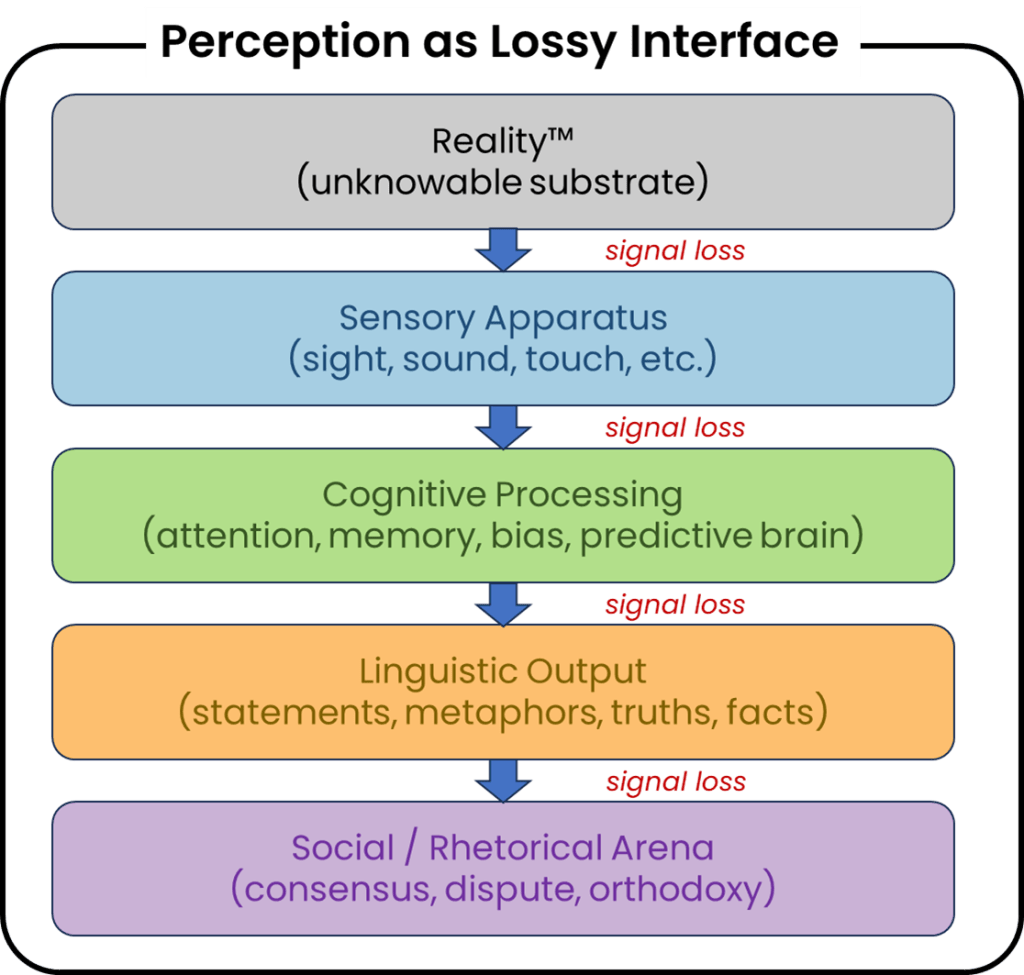
Cognitive science agrees, if in a different language: perception is predictive guesswork, riddled with biases, illusions, and shortcuts. Our minds don’t mirror reality; they generate useful fictions.
Diagram: Perception as a lossy interface: Reality™ filtered through senses, cognition, language, and finally rhetoric – signal loss at every stage.
Archetypal Truth (Positive Proposal)
So where does that leave us? Not with despair, but with clarity.
Truth is best understood as archetypal – a construct humans rally around. It isn’t discovered; it is invoked. Its force comes not from correspondence but from resonance.
Here, my own Language Insufficiency Hypothesis bites hardest: all our truth-talk is approximation. Every statement is lossy compression, every claim filtered through insufficient words. We can get close enough for consensus, but never close enough for Reality.
Truth is rhetorical, communal, functional. Not absolute.
The Four Pillars (Manifesto Form)
Archetypal – truth is a symbolic placeholder, not objective reality.
Asymptotic – we gesture toward reality but never arrive.
Rhetorical – what counts as truth is what persuades.
Linguistically Insufficient – language guarantees slippage and error.
Closing
Nietzsche warned, Rorty echoed: stop fetishising Truth. Start interrogating the stories we tell in its name.
Every “truth” we now applaud may be tomorrow’s embarrassment. The only honest stance is vigilance – not over whether we’ve captured Reality™, but over who gets to decide what is called true, and why.
Truth has never been a mirror. It’s a mask. The only question worth asking is: who’s wearing it?
Nothing says “I’ve stopped thinking” quite like someone waving the banner of Truth. The word itself, when capitalised and flapped about like a holy relic, isn’t a signal of wisdom but of closure. A red flag.
The short video by Jonny Thompson that inspired this post.
Those who proclaim to “speak the Truth” or “know the Truth”rarely mean they’ve stumbled upon a tentative insight awaiting refinement. No, what they mean is: I have grasped reality in its totality, and—surprise!—it looks exactly like my prejudices. It’s the epistemic equivalent of a toddler declaring ownership of the playground by drooling on the swings.
The Fetish of Objectivity
The conceit is that Truth is singular, objective, eternal, a monolithic obelisk towering over human folly. But history’s scrapyard is full of such obelisks, toppled and broken: phlogiston, bloodletting, Manifest Destiny, “the market will regulate itself.” Each was once trumpeted as capital-T Truth. Each is now embarrassing clutter for the dustbin.
Still, the zealots never learn. Every generation delivers its own batch of peddlers, flogging their version of Truth as if it were snake oil guaranteed to cure ignorance and impotence. (Side effects may include dogmatism, authoritarianism, and an inability to read the room.)
Why It’s a Red Flag
When someone says, “It’s just the truth”, what they mean is “, I am not listening,” like the parent who argues, “because I said so.” Dialogue is dead; curiosity cremated. Truth, in their hands, is less a lantern than a cosh. It is wielded not to illuminate, but to bludgeon.
Ralph Waldo Emerson’s voice breaks in, urging us to trust ourselves and to think for ourselves. Nothing is more degrading than to borrow another’s convictions wholesale and parade them as universal law. Better to err in the wilderness of one’s own reason than to be shepherded safely into another man’s paddock of certainties.
A Better Alternative
Rather than fetishising Truth, perhaps we ought to cultivate its neglected cousins: curiosity, provisionality, and doubt. These won’t look as good on a placard, admittedly. Picture a mob waving banners emblazoned with Ambiguity! – not exactly the stuff of revolutions. But infinitely more honest, and infinitely more humane.
So when you see someone waving the flag of Truth, don’t salute. Recognise it for what it is: a warning sign. Proceed with suspicion, and for God’s sake, bring Emerson.