There’s a certain kind of rhetorical grenade people like to lob when their sense of ownership feels wobbly. You’ve heard it. You’ve maybe had it lobbed in your general direction.
“Go back to Africa.”
— some white dude
It’s not an argument, of course. It’s a spell. A warding charm. The linguistic equivalent of hissing at a stray cat in the garden. The phrase carries the weight of assumed belonging: we are naturally here, you are obviously not. The incantation is meant to banish you with a puff of words.
The other day, I watched a black activist absorb this spell and toss it back with deadpan precision:
“Why don’t you go back to Europe?”
— some black cat
Cue awkward silence. The symmetry was perfect. Suddenly, the verbal hex had reversed polarity, exposing the hypocrisy built into the original curse. The power of the spell depends entirely on who gets to cast it. When it comes from the wrong mouth, the whole structure of “common sense” collapses into farce.
Another example: a Greek immigrant in my orbit, accent still clinging to every consonant, grumbling about a black family that had moved into his neighbourhood. Why didn’t they “go back to Africa”? This from a man who himself had gone “back” from nowhere, except a homeland he happily abandoned for better wages and better weather. Colonialism is apparently a one-way ticket: Europeans roam the globe and call it destiny, but when others move into their postcode, it’s treated like an invasion.
“Why don’t you speak English?”
– me, circa 1980 Japan
I confess, I once flirted with the same nonsense. Years ago in Japan, in my more callow phase, I asked – half in jest, wholly in arrogance – why these people didn’t have the decency to speak my language. The difference, such as it is, lay in my awareness that I was being ridiculous. My Greek neighbour, my activist’s heckler—no irony there. They were dead serious.
That’s the grotesque comedy of racism: its logic isn’t logic at all. It’s ritual. A mantra recited to reassure oneself of belonging by denying it to others. It dresses itself in the robes of rationality – “go back where you came from” sounds like geography, after all – but it’s closer to medieval exorcism than reasoned debate.
And when the cursed simply whispers the incantation back? The spell collapses. The supposed “truth” reveals itself for what it always was: a desperate attempt to maintain the fiction that one kind of stranger is native and another will always be alien.
Every empire tells its children they were born at home, and tells everyone else they were born trespassing.
I’ve written a lot on the insufficiency of language, and it’s not even an original idea. Language, our primary tool for sharing thoughts and ideas, harbours a fundamental flaw: it’s inherently insufficient for conveying precise meaning. While this observation isn’t novel, recent developments in artificial intelligence provide us with new ways to illuminate and examine this limitation. Through a progression from simple geometry to complex abstractions, we can explore how language both serves and fails us in different contexts.
The Simple Made Complex
Consider what appears to be a straightforward instruction: Draw a 1-millimetre square in the centre of an A4 sheet of paper using an HB pencil and a ruler. Despite the mathematical precision of these specifications, two people following these exact instructions would likely produce different results. The variables are numerous: ruler calibration, pencil sharpness, line thickness, paper texture, applied pressure, interpretation of “centre,” and even ambient conditions affecting the paper.
This example reveals a paradox: the more precisely we attempt to specify requirements, the more variables we introduce, creating additional points of potential divergence. Even in mathematics and formal logic—languages specifically designed to eliminate ambiguity—we cannot escape this fundamental problem.
Precision vs Accuracy: A Useful Lens
The scientific distinction between precision and accuracy provides a valuable framework for understanding these limitations. In measurement, precision refers to the consistency of results (how close repeated measurements are to each other), while accuracy describes how close these measurements are to the true value.
Returning to our square example:
Precision: Two people might consistently reproduce their own squares with exact dimensions
Accuracy: Yet neither might capture the “true” square we intended to convey
As we move from geometric shapes to natural objects, this distinction becomes even more revealing. Consider a maple tree in autumn. We might precisely convey certain categorical aspects (“maple,” “autumn colours”), but accurately describing the exact arrangement of branches and leaves becomes increasingly difficult.
The Target of Meaning: Precision vs. Accuracy in Communication
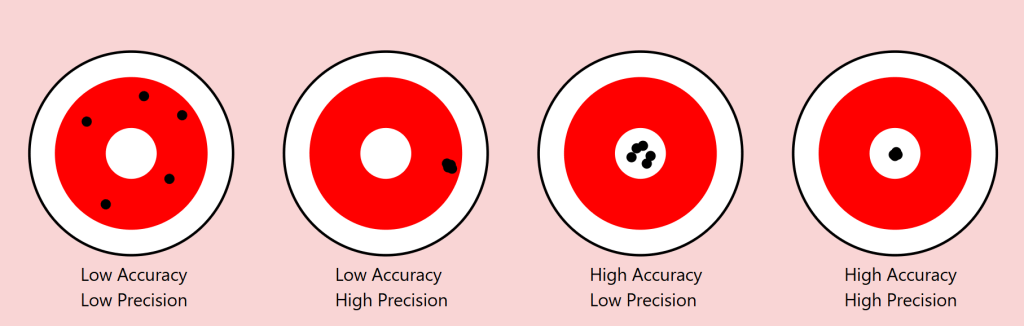
To understand language’s limitations, we can borrow an illuminating concept from the world of measurement: the distinction between precision and accuracy. Imagine a target with a bullseye, where the bullseye represents perfect communication of meaning. Just as archers might hit different parts of a target, our attempts at communication can vary in both precision and accuracy.
Consider four scenarios:
Low Precision, Low Accuracy When describing our autumn maple tree, we might say “it’s a big tree with colourful leaves.” This description is neither precise (it could apply to many trees) nor accurate (it misses the specific characteristics that make our maple unique). The communication scatters widely and misses the mark entirely.
High Precision, Low Accuracy We might describe the tree as “a 47-foot tall maple with exactly 23,487 leaves displaying RGB color values of #FF4500.” This description is precisely specific but entirely misses the meaningful essence of the tree we’re trying to describe. Like arrows clustering tightly in the wrong spot, we’re consistently missing the point.
Low Precision, High Accuracy “It’s sort of spreading out, you know, with those typical maple leaves turning reddish-orange, kind of graceful looking.” While imprecise, this description might actually capture something true about the tree’s essence. The arrows scatter, but their centre mass hits the target.
High Precision, High Accuracy This ideal state is rarely achievable in complex communication. Even in our simple geometric example of drawing a 1mm square, achieving both precise specifications and accurate execution proves challenging. With natural objects and abstract concepts, this challenge compounds exponentially.
The Communication Paradox
This framework reveals a crucial paradox in language: often, our attempts to increase precision (by adding more specific details) can actually decrease accuracy (by moving us further from the essential meaning we’re trying to convey). Consider legal documents: their high precision often comes at the cost of accurately conveying meaning to most readers.
Implications for AI Communication
This precision-accuracy framework helps explain why AI systems like our Midjourney experiment show asymptotic behaviour. The system might achieve high precision (consistently generating similar images based on descriptions) while struggling with accuracy (matching the original intended image), or vice versa. The gap between human intention and machine interpretation often manifests as a trade-off between these two qualities.
Our challenge, both in human-to-human and human-to-AI communication, isn’t to achieve perfect precision and accuracy—a likely impossible goal—but to find the optimal balance for each context. Sometimes, like in poetry, low precision might better serve accurate meaning. In other contexts, like technical specifications, high precision becomes crucial despite potential sacrifices in broader accuracy.
The Power and Limits of Distinction
This leads us to a crucial insight from Ferdinand de Saussure’s semiotics about the relationship between signifier (the word) and signified (the concept or object). Language proves remarkably effective when its primary task is distinction among a limited set. In a garden containing three trees—a pine, a maple, and a willow—asking someone to “point to the pine” will likely succeed. The shared understanding of these categorical distinctions allows for reliable communication.
However, this effectiveness dramatically diminishes when we move from distinction to description. In a forest of a thousand pines, describing one specific tree becomes nearly impossible. Each additional descriptive detail (“the tall one with a bent branch pointing east”) paradoxically makes precise identification both more specific and less likely to succeed.
An AI Experiment in Description
To explore this phenomenon systematically, I conducted an experiment using Midjourney 6.1, a state-of-the-art image generation AI. The methodology was simple:
Generate an initial image
Describe the generated image in words
Use that description to generate a new image
Repeat the process multiple times
Attempt to refine the description to close the gap
Continue iterations
The results support an asymptotic hypothesis: while subsequent iterations might approach the original image, they never fully converge. This isn’t merely a limitation of the AI system but rather a demonstration of language’s fundamental insufficiency.
A cute woman and her dog stand next to a tree
One can already analyse this for improvements, but let’s parse it together.
a cute woman
With this, we know we are referencing a woman, a female of the human species. There are billions of women in the world. What does she look like? What colour, height, ethnicity, and phenotypical attributes does she embody?
We also know she’s cute – whatever that means to the sender and receiver of these instructions.
I used an indefinite article, a, so there is one cute woman. Is she alone, or is she one from a group?
It should be obvious that we could provide more adjectives (and perhaps adjectives) to better convey our subject. We’ll get there, but let’s move on.
and
We’ve got a conjunction here. Let’s see what it connects to.
her dog
She’s with a dog. In fact, it’s her dog. This possession may not be conveyable or differentiable from some arbitrary dog, but what type of dog is it? Is it large or small? What colour coat? Is it groomed? Is it on a leash? Let’s continue.
stand
It seems that the verb stand refers to the woman, but is the dog also standing, or is she holding it? More words could qualify this statement better.
next to a tree
A tree is referenced. Similar questions arise regarding this tree. At a minimum, there is one tree or some variety. She and her dog are next to it. Is she on the right or left of it?
We think we can refine our statements with precision and accuracy, but can we? Might we just settle for “close enough”?
Let’s see how AI interpreted this statement.
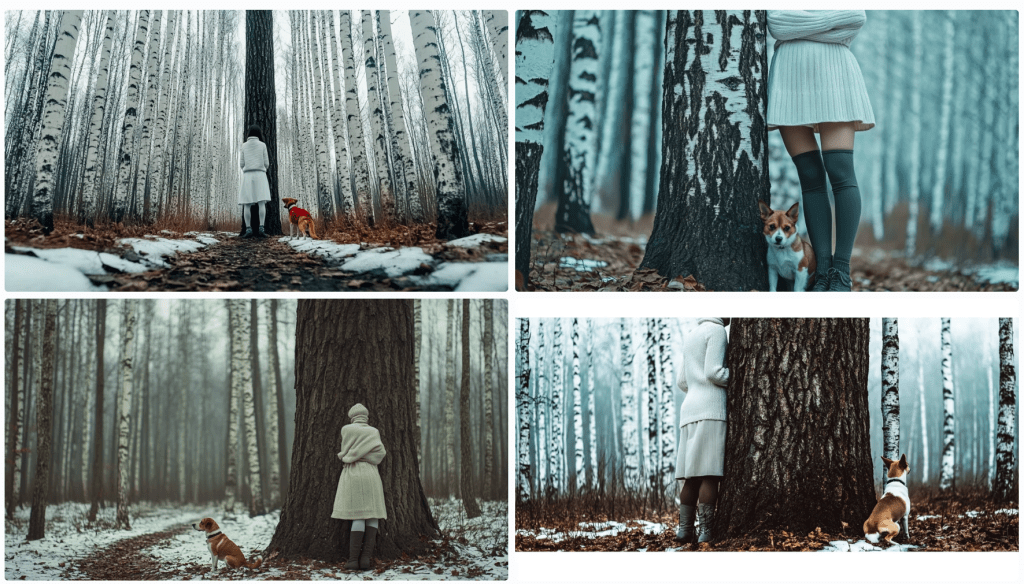
Image: Eight Midjourney renders from the prompt: A cute woman and her dog stand next to a tree. I’ll choose one of these as my source image.
Let’s deconstruct the eight renders above. Compositionally, we can see that each image contains a woman, a dog, and a tree. Do any of these match what you had in mind? First, let’s see how Midjourney describes the first image.
In a bout of hypocrisy, Midjourney refused to /DESCRIBE the image it just generated.
Last Midjourney description for now.
Let’s cycle through them in turn.
A woman is standing to the left of an old-growth tree – twice identified as an oak tree. She’s wearing faded blue jeans and a loose light-coloured T-shirt. She’s got medium-length (maybe) red-brown hair in a small ponytail. A dog – her black and white dog identified as a pitbull, an American Foxhound, and an American Bulldog – is also standing on his hind legs. I won’t even discuss the implied intent projected on the animal – happy, playful, wants attention… In two of the descriptions, she’s said to be training it. They appear to be in a somewhat residential area given the automobiles in the background. We see descriptions of season, time of day, lighting, angle, quality,
A woman is standing to the right of an old-growth tree. She’s wearing short summer attire. Her dog is perched on the tree.
An older woman and her dog closer up.
A read view of both a woman and her dog near an oak tree.
As it turned out, I wasn’t thrilled with any of these images, so I rendered a different one. Its description follows.
The consensus is that ‘a beautiful girl in a white dress and black boots stands next to a tree’ with a Jack Russell Terrier dog. I see birch trees and snow. It’s overcast. Let’s spend some time trying to reproduce it. To start, I’m consolidating the above descriptions. I notice some elements are missing, but we’ll add them as we try to triangulate to the original image.
A beautiful girl in a white dress and black boots stands next to a tree in a winter forest with birch trees. A Jack Russell Terrier dog is nearby, and the weather is cloudy. The photo has a cinematic style. --ar 128:71
This is pretty far off the mark. We need to account for the overall setting and composition, relative positioning, clothing, hair, camera, perspective – even lighting and film emulsion.
Let’s see how we can refine it with some adjectives. Before this, I asked Anthropic’s Claude 3.5 to describe the image. Perhaps we’ll get more details.
An atmospheric winter photograph was taken in what appears to be a birch and pine forest. The ground is partially covered with snow, creating a patchy pattern of white snow and brown leaves or soil. In the image, there's a person wearing winter attire consisting of a white knit turtleneck sweater, a white skirt, dark knee-high socks, and grey lace-up boots. They're standing against a large tree trunk with their arms crossed. Next to them is a Jack Russell Terrier mix dog with distinctive brown and white colouring. The dog appears to be well-behaved, sitting attentively beside the tree. The composition is quite striking, with the massive dark tree trunk serving as a central focal point against the misty, winter forest background. The white clothing of the person creates a visual echo with the white bark of birch trees visible in the background, as well as with the patches of snow on the ground. The overall mood of the photo is somewhat moody and contemplative, enhanced by what appears to be overcast lighting and the misty quality of the forest in the background. The colour palette is largely monochromatic, dominated by whites, greys, and browns, which adds to the winter atmosphere of the scene.
We don’t seem to be moving in a good direction. Let’s modify the initial prompt.
A beautiful girl in a white dress and tall laced black boots stands facing the camera to the right of large oak tree centred in the foreground of a winter forest with birch trees in the background. To the left of the tree is a Jack Russell Terrier dog looking at the camera, and the weather is cloudy. The photo has a cinematic style. --ar 128:71
I’ll allow the results to speak for themselves. Let’s see if we can’t get her out of the wedding gown and into a white jumper and skirt. I’ll bold the amends.
A beautiful girl in a white jumper and skirt wearing black leggings and tall laced black boots stands facing the camera to the right of large oak tree centred in the foreground of a winter forest with birch trees in the background. To the left of the tree is a Jack Russell Terrier dog looking at the camera, and the weather is cloudy. The photo has a cinematic style. --ar 128:71
s
A beautiful young woman with long brown hair pulled to the side of her face in a white jumper and white skirt wearing black leggings under tall laced black boots stands facing the camera to the right of large oak tree centred in the foreground of a winter forest with birch trees in the background. Patchy snow is on the ground. To the left of the tree is a Jack Russell Terrier dog looking at the camera, and the weather is overcast. The photo has a cinematic style. --ar 128:71
What gives?
I think my point has been reinforced. I’m getting nowhere fast. Let’s give it one more go and see where we end up. I’ve not got a good feeling about this.
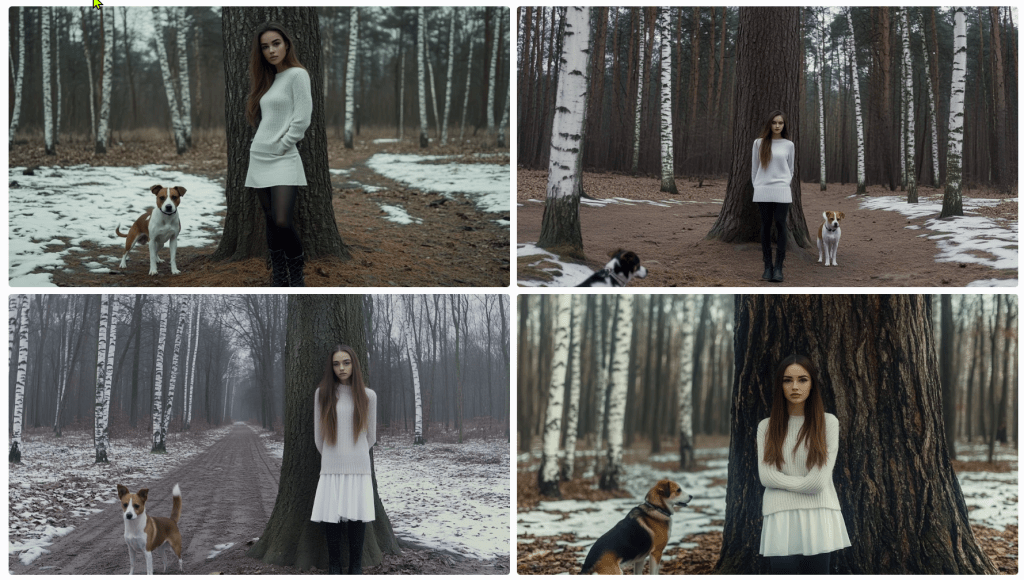
A single large oak tree centred in the foreground of a winter forest with birch trees in the background. Patches of snow is on the ground. To the right of the oak tree stands a beautiful young woman with long brown hair pulled to the side of her face in a white jumper and white skirt wearing black boots over tall laced black boots. She stands facing the camera. To the left of the tree is a Jack Russell Terrier dog looking at the camera, and the weather is overcast. The photo has a cinematic style. --ar 128:71
With this last one, I re-uploaded the original render along with this text prompt. Notice that the girl now looks the same and the scene (mostly) appears to be in the same location, but there are still challenges.
After several more divergent attempts, I decided to focus on one element – the girl.
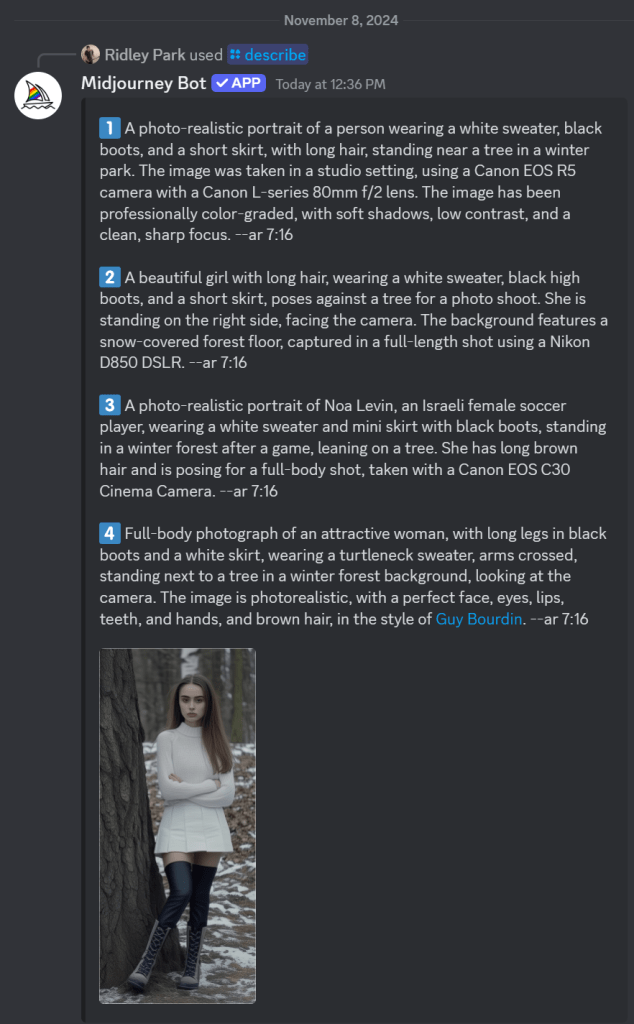
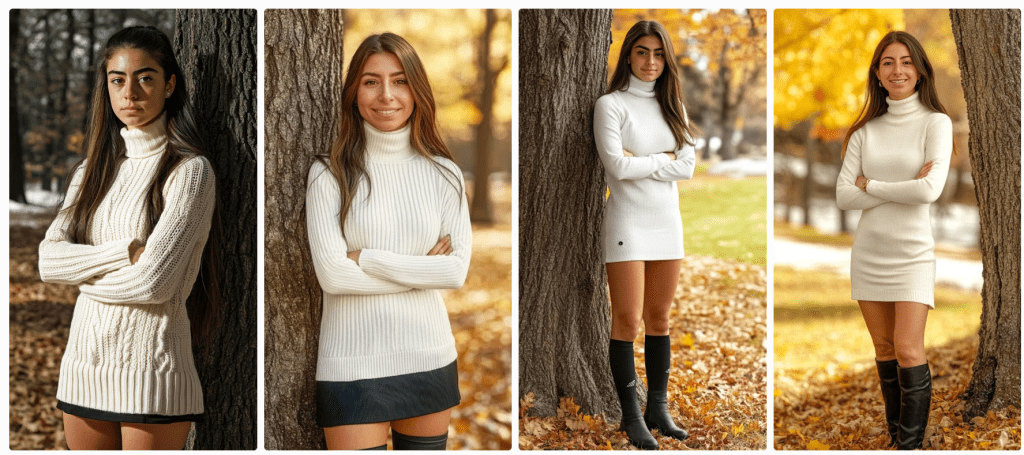
As I regard the image, I’m thinking of a police sketch artist. They get sort of close, don’t they? They’re experts. I’m not confident that I even have the vocabulary to convey accurately what I see. How do I describe her jumper? Is that a turtleneck or a high collar? It appears to be knit. Is is wool or some blend? does that matter for an image? Does this pleated skirt have a particular name or shade of white? It looks as though she’s wearing black leggings – perhaps polyester. And those boots – how to describe them. I’m rerunning just the image above through a describe function to see if I can get any closer.
These descriptions are particularly interesting and telling. First, I’ll point out that AI attempts to identify the subject. I couldn’t find Noa Levin by a Google search, so I’m not sure how prominent she might be if she even exists at all in this capacity. More interesting still, the AI has placed her in a scenario where the pose was taken after a match. Evidently, this image reflects the style of photographer Guy Bourdin. Perhaps the jumper mystery is solved. It identified a turtleneck. I’ll ignore the tree and see if I can capture her with an amalgamation of these descriptions. Let’s see where this goes.
A photo-realistic portrait of Israeli female soccer player Noa Levin wearing a white turtleneck sweater, arms crossed, black boots, and a short skirt, with long brown hair, standing near a tree in a winter park. The image captured a full-length shot taken in a studio setting, using a Canon EOS R5 camera with a Canon L-series 80mm f/2 lens. The image has been professionally color-graded, with soft shadows, low contrast, and a clean, sharp focus. --ar 9:16
Close-ish. Let’s zoom in to get better descriptions of various elements starting with her face and hair.
Now, she’s a sad and angry Russian woman with (very) pale skin; large, sad, grey eyes; long, straight brown hair. Filmed in the style of either David LaChapelle or Alini Aenami (apparently misspelt from Alena Aenami). One thinks it was a SnapChat post. I was focusing on her face and hair, but it notices her wearing a white (oversized yet form-fitting) jumper sweater and crossed arms .
I’ll drop the angry bit – and then the sad.
Stick a fork in it. I’m done. Perhaps it’s not that language is insufficient; it that my language skills are insufficient. If you can get closer to the original image, please forward the image, the prompt, and the seed, so I can post it.
The Complexity Gradient
A clear pattern emerges when we examine how language performs across different levels of complexity:
Categorical Distinction (High Success)
Identifying shapes among limited options
Distinguishing between tree species
Basic color categorization
Simple Description (Moderate Success)
Basic geometric specifications
General object characteristics
Broad emotional states
Complex Description (Low Success)
Specific natural objects
Precise emotional experiences
Unique instances within categories
Abstract Concepts (Lowest Success)
Philosophical ideas
Personal experiences
Qualia
As we move up this complexity gradient, the gap between intended meaning and received understanding widens exponentially.
The Tolerance Problem
Understanding these limitations leads us to a practical question: what level of communicative tolerance is acceptable for different contexts? Just as engineering embraces acceptable tolerances rather than seeking perfect measurements, perhaps effective communication requires:
Acknowledging the gap between intended and received meaning
Establishing context-appropriate tolerance levels
Developing better frameworks for managing these tolerances
Recognizing when precision matters more than accuracy (or vice versa)
Implications for Human-AI Communication
These insights have particular relevance as we develop more sophisticated AI systems. The limitations we’ve explored suggest that:
Some communication problems might be fundamental rather than technical
AI systems may face similar boundaries as human communication
The gap between intended and received meaning might be unbridgeable
Future development should focus on managing rather than eliminating these limitations
Conclusion
Perhaps this is a simple exercise in mental masturbation. Language’s insufficiency isn’t a flaw to be fixed but a fundamental characteristic to be understood and accommodated. By definition, it can’t be fixed. The gap between intended and received meaning may be unbridgeable, but acknowledging this limitation is the first step toward more effective communication. As we continue to develop AI systems and push the boundaries of human-machine interaction, this understanding becomes increasingly critical.
Rather than seeking perfect precision in language, we might instead focus on:
Developing new forms of multimodal communication
Creating better frameworks for establishing shared context
Accepting and accounting for interpretative variance
Building systems that can operate effectively within these constraints
Understanding language’s limitations doesn’t diminish its value; rather, it helps us use it more effectively by working within its natural constraints.
Political correctness, on the surface, seems like a noble cause. Its primary goal is to foster inclusivity, promote respect, and prevent offence by regulating language. But beneath this well-meaning exterior lies a paradox: in the pursuit of protecting sensitivities, political correctness often ends up infringing on free expression and alienating those who feel their voices are being restricted. The very thing it seeks to prevent—offence—is often shifted to the speaker, creating a moral stalemate where no one truly wins.
The Intent vs. The Outcome
The fundamental intention behind politically correct (PC) speech is clear: to prevent harm. By urging people to avoid potentially offensive language, the aim is to create a more harmonious, respectful society. But as the adage goes, “The road to hell is paved with good intentions.” What PC speech often forgets is that words are not merely tools for appeasement. They are vessels for meaning, clarity, and sometimes emotional impact.
The road to hell is paved with good intentions.
In practice, what we see is a growing gap between intent and outcome. People become so focused on using the “right” terms that they lose the authenticity of their expression. Conversations become stilted and disingenuous, with individuals more concerned about offending someone than engaging in genuine dialogue. The paradox here is unavoidable: PC speech seeks to protect the object (those who may be offended), but in doing so, it often offends the subject (the speaker). What starts as an attempt to preserve harmony creates an environment where truth and clarity are sacrificed for the sake of politeness.
Disingenuous Communication
Euphemisms and “sanctioned” terms have a way of watering down language. Whilst they may soften the potential impact of certain words, they also strip away their power. In the name of not offending, PC speech dilutes the very thing that makes communication effective: its ability to convey raw, unfiltered meaning. When language is sanitised to the point of blandness, it loses its ability to provoke thought, challenge ideas, or evoke emotion.
This leads to a culture of disingenuous communication. Rather than engaging in sincere conversation, people tiptoe around topics, afraid of crossing invisible lines. Ironically, this creates more division because what could have been an open exchange of ideas is reduced to a polite, surface-level interaction where no one says what they truly mean.
The Subjectivity of Offence
Here’s the kicker: offence is subjective. What offends one person may not even register for another. And yet, PC culture operates on the assumption that offence is both predictable and universal as if we can map out exactly what will offend whom in every scenario. The reality is far messier. People come from different backgrounds, have varying sensitivities, and interpret words through their own unique lenses.
The subjectivity of offence makes it impossible to predict or avoid entirely. We’re left with a scenario where everyone is constantly second-guessing their language, afraid to say the wrong thing, yet never truly sure of what the “wrong” thing even is. This arbitrary nature of offence doesn’t lead to more thoughtful conversation; it leads to silence, where people are too cautious to express themselves at all.
A Zero-Sum Game
At its core, political correctness sets up a zero-sum game. On one side, you have positive freedoms—the freedom to feel included, respected, and protected from harm. On the other side, you have negative freedoms—the freedom from censorship, restriction, and the fear of saying something wrong. The trouble is, that these freedoms are often in direct conflict. Protecting one group’s sensitivities inevitably means infringing on another’s freedom of expression.
This isn’t just an intellectual debate—it’s a moral impasse. PC speech has created a situation where no one comes out on top. The speaker feels censored, the listener feels offended, and the conversation stalls in gridlock. The result is that both sides suffer. In the relentless pursuit of an all-or-nothing outcome, we lose the chance for compromise or meaningful dialogue. What we get instead is an “us versus them” mentality, with each side digging in and claiming the moral high ground.
The Pendulum Effect
This rise of PC culture is part of a broader cultural shift toward collectivism, where the needs and feelings of the group are prioritised over individual freedoms. In many ways, this shift was necessary. After decades of unchecked individualism, society needed a correction—an acknowledgement that words can cause harm and that we owe each other a certain level of respect.
But as with all cultural shifts, the pendulum can swing too far. What started as a necessary push for inclusivity has morphed into something more restrictive, where individual expression is sacrificed at the altar of group harmony. This disequilibrium has left society in a state of tension, where both sides are dissatisfied. As history shows, cultural trends ebb and flow, but until the pendulum swings back, both sides are left feeling uncomfortable and marginalised.
Human Nature: The Eternal Bickering
At the end of the day, bickering is just part of human nature. No matter how hard we try, there will always be conflict when people feel their moral or intellectual territory is being encroached upon. Political correctness, in its current form, exacerbates this natural tendency by setting up a battleground where both sides feel aggrieved. The PC police push for language policing, whilst the anti-PC camp fights back against what they see as an attack on free speech.
The sad truth is that this bickering will likely continue as long as both sides insist on an all-or-nothing solution. In a world where compromise seems like weakness, and where both sides claim the moral high ground, there’s little room for meaningful progress.
Counterpoints for Balance
It’s only fair to acknowledge that PC speech has done some good. In fostering a more inclusive society, it has given a voice to marginalised groups and helped reduce harm caused by thoughtless or malicious language. There’s also a valid argument that some regulation of language is necessary to prevent hate speech and maintain civility in increasingly diverse communities.
That said, the overreach of PC speech—the constant pressure to conform to an ever-shifting set of linguistic rules—has created a stifling environment. What began as a movement for respect and inclusivity has become a barrier to free expression and a source of division.
Conclusion
In the end, the paradox of political correctness is this: it aims to create a more inclusive, harmonious society, but its current form stifles free expression and fuels division. As long as we continue to prioritise group sensitivities over individual freedoms, we’ll remain stuck in this cycle of conflict and resentment. It’s time to recalibrate—finding a balance between respect for others and the right to speak freely whilst accepting that offence is inevitable in an open society.
Karl Popper coined the paradox of tolerance, but this was not his use case.
Societies and cultures tend to mediate and normalise to an implied equilibrium. They claim tolerance because members are generally conformant until someone isn’t, and then all hell breaks loose.
In religion, an example might be a claim that “We love everyone” until the everyone is gay, an addict, or some other miscreant. That’s when the hate starts. Then they deny the hate—so long as the person regains conformance status.
I don’t have much to say beyond this. It just resonated with me.
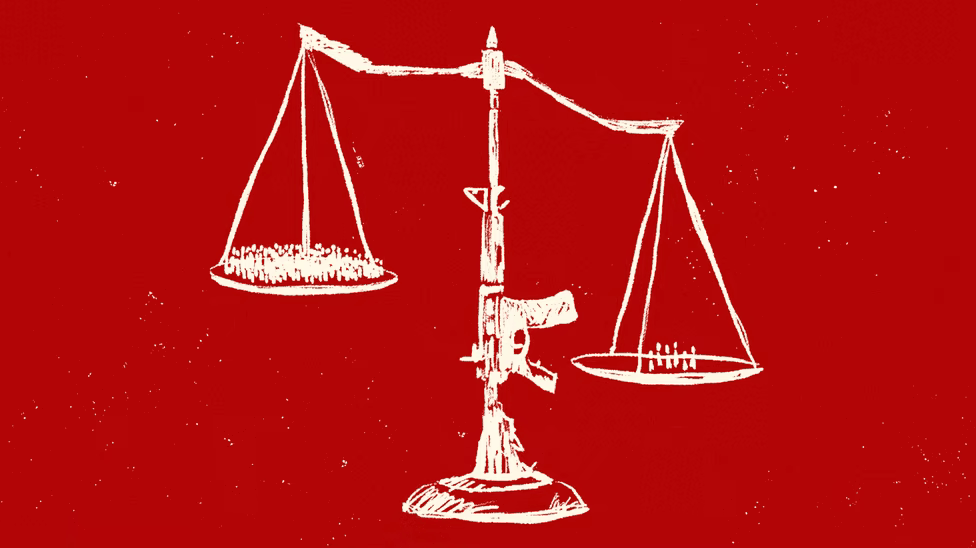
I chatted with an associate this evening about the gun debate in America. For some reason, gun control is again a hot topic. He believes that guns, like drugs, should be treated as mental health issues.
Click an image to read the referenced article.
The Atlantic: An ER Doctor’s ‘Third Way’ Approach to the Gun CrisisThe Atlantic: The Real Reason America Doesn’t Have Gun Control
Full Disclosure: I do not believe that the Second Amendment of the United States confers unrestricted rights to own a gun. Full stop. I believe this is a perversion by activist Supreme Court justices of the original intent of the grammatically-challenged Forefathers of that cursed country.
The mental health topic brought my attention to the question of tolerance and normalisation. Mental health, an interest of psychology has a sordid past. At its very core is the idea that humans can be normalised, that they can be categorised into normal and abnormal behaviours, and what is deemed normal might have some room for variation, but this tolerance doesn’t really allow for much discrepancy.
Normalisation expects to bring people into some basic conformity—give or take. The problem is that this is contextual and the acceptable range changes over time and place. Many behaviours previously considered abnormal are now acceptable, and some acceptable behaviours are no longer tolerated. Some of these changes have flip-flopped legal status as well. It’s just a game to some people.
Tolerance takes a position that there is no normal, per se. Some people just have different ideas.
Here is a clip of an interview with Dr Oz ( né Mehmet Cengiz Öz) where he illustrates my position. I’ll disintegrate it next.
Dr Oz explains why he does not support legalisation of marijuana
Transcript
Reporter: What is your stance on [the legalisation of] marijuana?
Dr Oz: … There are not enough Pennsylvanians to work in Pennsylvania, so giving them pot so they stay home… I don’t think [is] an ideal move. I also don’t want to breed addiction to marijuana. It’s not physical addiction; it’s emotional addiction, but I don’t want young people to think they have to smoke a joint to get out of their house in the morning. We need to get Pennsylvanians back at work you got to give them their mojo, and I don’t want marijuana to be a hindrance to that. I also don’t want people operating heavy machinery and driving by me when they’ve been taking their fourth joint of the day. But there are other issues that are plaguing Pennsylvanians. We’re a border state, practically, … because they’re flying illegal immigrants up here from the border in the middle of the night … but they’re also getting their narcotics up here really easily.
So, let’s break down this word salad. This will reveal some of Dr Oz’ and my worldview biases.
Neither Oz nor I advocate the use of marijuana or other recreational drugs. However, Oz wants to make or keep it illegal and criminalised. I do not agree. I feel they should regulate it and tax it. Although I neither advocate nor endorse the use of any of these herbs and chemicals, I feel they should do this for all drugs. [And if we are going to make these chemicals illegal, let’s not be hypocrites and make nicotine, alcohol, and caffeine illegal.] I’m not advocating this. I’m just saying adopt a position and maintain it with integrity.
There are not enough Pennsylvanians to work in Pennsylvania.
First, Oz is a wage slaver. Next, the unemployment rate for PA was 4.9% in March, so this does not appear to be a problem.
so giving them pot so they stay home… I don’t think [is] an ideal move.
Oz makes an unsubstantiated connection between the legalisation of marijuana and staying home—being lazy or unmotivated.
I also don’t want to breed addiction to marijuana.
Marijuana is not known to be addictive. As a doctor, Oz knows this.
It’s not physical addiction; it’s emotional addiction
Here, Oz backtracks, but he also introduces an unsubstantiated claim. If you are interested in why I consider psychology pseudoscience, follow this link to explain DSM changes in this area.
but I don’t want young people to think they have to smoke a joint to get out of their house in the morning
Oz makes a total non-sequitur here. Nothing he has mentioned this far would lead to this conclusion. If someone already feels this way, its legal status is irrelevant. Enough said.
We need to get Pennsylvanians back at work you got to give them their mojo, and I don’t want marijuana to be a hindrance to that.
This is more Calvinistic wage slavery advocacy. Again, he is equating the consumption of marijuana with being unmotivated. Perhaps he should challenge Micheal Phelps to a swimming race. If motivation is the issue, perhaps he rather favours legalising amphetamines—but I supposed he’d have a preconceived rationale for that, too.
I also don’t want people operating heavy machinery and driving by me when they’ve been taking their fourth joint of the day.
Where does the number four come from? Is four different to one or two? Has this been studied? Is he saying this doesn’t already happen? Does he believe that current intoxication laws and incapacitation regulations aren’t in place?
We’re a border state, practically…
Where to start… Pennsylvania is a border state. It borders New York, New Jersey, Ohio, Delaware, Maryland, and West Virginia. If one counts for the water border of Lake Erie, one might be able to argue that it shares an international border with Canada—although, I feel that’s a stretch. At that point, one wouldn’t be far from considering Hawaii to border California. It’s only water. He does say practically, so perhaps that’s his out.
because they’re flying illegal immigrants up here from the border in the middle of the night
Wait a minute… Geezer’s talking about the southern border between the United States and Mexico. (That’s where brown people live.) The fewest number of states between Mexico and Pennsylvania is four, but that’s stretching it. Something tells me that Oz is at least an elitist and at worst a racist. I’m a sad panda.
Another non-sequitur. Somehow, Oz is trying to create a link between marijuana and narcotics whilst also contending that legalising marijuana would somehow affect these illegal flights. Wait, are the flights illegal or just the passengers? How does he know that either is illegal? And does it have to be at night? I get the feeling that Oz watches too much television. Perhaps that’s what we should criminalise. So many questions.
but they’re also getting their narcotics up here really easily
OK? Perhaps we should contract with them to transport the marijuana up here if they are so efficient. Or would it be better to grow it locally? Racists tend to be nationalists and would likely favour a Made In America policy—unless they can exploit brown people. Or Oz can employ otherwise unemployed Pennsylvanians on his pot plantations. Where does it end?
What does this have to do with normalisation and toleration?
People like Dr Oz want to mainstream people, a concept some familiar with special education might remember—get the people in line with the herd. Proper people—normal people—are supposed X and Y and Z. Toleration allows that there may be people with descriptively ‘normal’ traits and behaviours, but there should not necessarily be a penalty for noncompliance.
When I was an undergrad student, I had a side job as a shift supervisor at an Au Bon Pain in Boston. On an occasion, one worker, let’s call her Mary, was arguing with another worker that we’ll call Marie. Mary said she was not going to make any more sandwiches because she had already made twice as much as Marie. Although I understand the notion of fairness she was invoking, I reminded her that she was being paid by the hour, not the piece. As long as she was still on the proverbial clock, she would continue to make sandwiches. Although I didn’t press this point, I could have hired Marie to watch Mary make sandwiches. In fact, I suppose I was hired to watch them both make sandwiches.
The point is—Mary’s perception aside—that there was no reason to presume these two should produce an equal number of sandwiches in an hour, a day, or a month.
I mention this because—getting back to Oz’ drugs scenario—if people are happy getting high on heroin and nodding out on Kensington Ave, that’s their issue, not Oz’ and not mine. If Pennsylvania needs workers and can’t get them, figure out how to attract workers. Don’t create a situation so bad that the alternate to work is just the lesser of two evils. This reminds me of a story from my consulting days.
Without dropping any names, I was hired by a company to ‘deflect’ some costs. The high-level concept was to redirect people from a relatively expensive call centre to cheaper self-service. I reminded them of the Principle of least effort.
Essentially, I conveyed that people are inherently lazy—echoing Carl Jung. People will take the path of least resistance. If it’s easier for them to call, they’ll call; if it’s easier to self-serve, they’ll do that.
“So we should make it more difficult for customers to call?” was how this was interpreted.
“You should make it easier to self-serve.”
I’m still shaking my head to this day. What humans will do to other humans in the name of commerce.
That was the response to my question regarding the police presence yesterday.
EDIT: Some in the community have arranged a memorial for Gary.
In Memorium
I live in an economically depressed community. Swathes of addicted streetwalkers to the south and crack and smack street dealers to the north. Between these bookends are some dozen or more churches and me. Adjacent to me is an abandoned church, a haven for the doubly disenfranchised homeless in the community.
Gary didn’t make it to Christmas. Perhaps I saw him around the neighbourhood, but I didn’t know Gary by name.
“It doesn’t sound like it ended well,” said I. “I think it was frostbite,” he continued.
I find it difficult to believe it was frostbite, but I’m no expert. It barely gets below freezing in this part of the country, but it did last night. Does anyone remember the Valley Forge of American history?
“He had no place to go. They wouldn’t let him in the shelter because he drinks.”
This is Tough Love™ in action. Hate the sin. Fuck the sinner. Another victim of the system and of morality vis-à-vis Virtue Signalling.
In the words from the first Home Alone instalment: Merry Christmas, you filthy animal.
To some extent or another, humans appear to need order—some more than others. Societies are a manifestation of order, and we’ve got subcultures for those who don’t fit in with the mainstream. Humans are also a story-telling lot, which helps to provide a sense of order. Metanarratives are a sort of origin story with a scintilla of aspiration toward some imagined semblance of progress.
Some people appear to be more predisposed to need to ride this metanarrative as a lifeboat. These people are typically Conservative, authority-bound traditionalists, but even the so-called Progressives need this thread of identity. The problem seems to come down to a sort of tolerance versus intolerance split, a split along the same divide as created by monotheism in the presence of polytheism.
Meet the new boss, same as the old boss.
Won’t Get Fooled Again — The Who
In a polytheistic world, when two cultures collided, their religious pantheons were simply merged. In a blink, a society might go from 70 gods to 130. On this basis, there was a certain tolerance. Monotheism, on the other hand, is intolerant—a winner takes all death match. The tolerant polytheists might say, sure, you’ve got a god? Great. He can sit over there by the elephant dude. Being intolerant like a petulant schoolboy, the monotheists would throw a tantrum at the thought that there might be other gods on the block. Monotheists won’t even allow demigods, though there is the odd saint or two.
This is a battle between absolutism and relativism. The relativist is always in a weaker arguing position because intolerant absolutists are convinced that their way is the only way, yet the tolerant relativists are always at risk of being marginalised. This is what Karl Popper was addressing with the Paradox of Tolerance.
In a functioning society, a majority of the metanarratives are adopted by the majority of its constituent. On balance, these metanarratives are somewhat inviolable and more so by the inclined authoritarians.
A problem is created when a person or group disagrees with the held views. The ones espousing these views—especially the Traditionals—become indignant. What do you mean there are more than two genders? You are either male or female. Can’t you tell by the penis?
I happened to read a tweet by the GOP declaring their stupidity:
America the Stupid
The Vice President, a living anachronism and proxy for the American Midwest Rust Belt superimposed on the Bible Belt, he tells his sheep that “The moment America becomes a socialist country is the moment that America ceases to be America…” Americans as a whole are pretty dim, and it seems to get dimmer the higher one ascends their government. Pence seems very firm in affirming a notion of American identity, but not accepting that identities change. He may become upset if he finds out that George Washington is dead—in fact, there are very few remnants of the original United States aside from some dirt, trees, and a few edifices—and the country is still the county. Some people have a difficult time grasping identity. It makes me wonder if he fails to recognise himself in the mirror after he gets his hair cut.
The idea behind deconstruction is to deconstruct the workings of strong nation-states with powerful immigration policies, to deconstruct the rhetoric of nationalism, the politics of place, the metaphysics of native land and native tongue… The idea is to disarm the bombs… of identity that nation-states build to defend themselves against the stranger, against Jews and Arabs and immigrants…
Jacques Derrida
Interesting to me is how people complain about this and that politically. Most of this is somewhat reflexive and as phatic as a ‘how are you?’, but some is more intentional and actioned. Occasionally, the energy is kinetic instead of potential, but the result is always the same: One power structure is replaced by another.
What you aspire to as revolutionaries is a new master. You will get one
Jacques Lacan
As Lacan noted, as people, we believe ourselves to be democratic, but most of us appear to be finding and then worshipping some authority figures who will promise us what we desire. We desire to have someone else in charge, who can make everything OK, someone who is in a sense an ideal parent. I don’t believe this to be categorical, but I do believe that there is a large contingent of people who require this.
As an aside, I’ve spent a lot of time (let’s call it a social experiment) in the company of social reprobates. What never ceases to amaze me is how these social outcasts seem to have a strong sense of right and wrong and how things should be. Conveniently, they exempt themselves from this scope, so if they steel to buy drugs, it’s OK, but if someone else gets caught, they should get what’s coming to them.
About a year ago I was chatting with a mate, and I shared an observation that the biggest substance abusers in high school—”the Man’s not going hold me down” cohort—are the biggest conservatives. A girl a few houses down from me became a stripper, but her political views are very Conservative, an avid Trump supporter.
One woman I know is a herion-addicted prostitute. In her eyes, she’s fine (sort of—without getting into psychoanalytics); other women are junkie whores. A heavy dose of assuaged cognitive dissonance is the prescription for this, but it confounds me.
Getting back to the original topic, people who need this order are resistant to deconstruction and other hallmark notions of poststructuralism. They need closure. This translates into a need for metanarratives. When confronted with the prospect of no Truth, they immediately need to find a substitute—speculatively, anyway, as denial and escalating commitment will kick into overdrive.
The same problem mentioned above comes into play here. A few years ago, there was an Occupy Wall Street group, and like atheists, there are myriad reasons why people participated. One of the commonest complaints by the power structure and the public at large is if you don’t like the status quo, what status should replace it. None of the above was never an acceptable response.
It doesn’t matter that in this universe we occupy there is more disorder than order, and entropy rules, pareidolia is the palliative. And religion remains an opiate of the masses.


















 Philosophics