Continuing with a quick post based on observations in The Master and the Emissary by Iain McGilchrist, another example of hemispheral specialisation is illustrated in the image below.
Podcast: Audio rendition of this page content
A typical person will envisage this large S composited with smaller Ss (that could be replaced with any symbols, so there is nothing special about the S comprised of Ss) as represented by the centre image of the rendition of the bilateral interpretations.
Where there is left hemisphere damage, the right would envisage something more like the S on the right—seeing the big picture but losing detail. Where there is right hemisphere damage, the left would perceive something more like the S on the left, which is the detail of the composite Ss without recognising that they composed a bigger picture. This is conveyed in the aphorism of losing the woods for the trees whilst the former right hemisphere dominant view might not realise that the forest has trees.
But even this misses the point slightly because if you are viewing this as a typical person, you can assemble the Ss on the left and realise that it makes a larger S whereas a person with right hemisphere damage will just see a mass of Ss and not see the larger S shape. Moreover, it’s not that the right hemisphere wouldn’t ‘see’ the smaller composite Ss, it just wouldn’t put any significance on them, thus ignoring them and considering them to be background noise.
I really do want to share about the non-stereoscopic animals as well as another instalment from The Matter with Things. At least one of these is probable for the next post.
This is my take on the fourth chapter of The Matter with Things. Chapters one and two have been posted previously.
Podcast: Audio rendition of this page content
Intro
Chapter four of The Matter with Things is titled Judgment. Following the previous chapters, Attention and Perception, it’s about how we reach conclusions based on what we perceive.
Trust in left versus right hemisphere processing. The right hemisphere is responsible for anchoring us into reality, so if there are cognitive deficits on the right, the left has a tendency toward delusion.
Content
This chapter opens with a quotation by Maurice Merleau-Ponty, “Perception is a judgment, but one that is unaware of its reasons, which is as much as to say that the object perceived gives itself as a whole and as a unity before we have grasped its intelligible principle.”
Nearly all delusions are due to right hemisphere damage or dysfunction. Distinguishing delusions, which are distorted reality judgments, from hallucinations, which are distorted perceptions, is to some degree arbitrary, since misperceptions can give rise to misbeliefs, and misbeliefs give rise to misperceptions.
Reinforcing previous chapter content, the right hemisphere is holistic whilst the left is narrowly focused. To borrow the metaphor of McGilchrist’s previous book, the right hemisphere is the master whilst the left is the emissary. The right serves as an anchor to the flighty left.
I’ll share the quote he cites by Orrin Devinsky: The unchecked left hemisphere unleashes a creative narrator from the monitoring of self, memory, and reality by the frontal and right hemisphere areas, leading to excessive and false explanations. Further, the left hemisphere’s cognitive style of categorization, often into dual categories, leads it to invent a duplicate or impostor to resolve conflicting information. Delusions result from right hemisphere lesions. But it is the left hemisphere that is deluded.
This serves as an apt summary. The left jumps to conclusions and seems to need closure, so its first answer is its final answer, no matter how implausible. He cites that this need for closure is also a feature of modernity that seems to insist on closure. This need is evidently amplified in schizophrenics.
Here is where I will take liberties and skip the examples of prosopagnosia, delusional misidentification, paranoia, and the rest, save to inform the reader that clinically speaking paranoia has a broader meaning than used idiomatically. It’s not simply the feeling that someone is watching us or out to get us. It also extends to any number of mistaken references to oneself and includes grandiose and religiose delusions.
Another condition that I’ll pause to mention is that of mirror agnosia, where a subject cannot recognise itself in a mirror, and Cotard’s syndrome where a person believes themselves to be dead.
The right hemisphere supports the body’s schema. Rather contrary to previous mentions that the left hemisphere is the map maker, the right hemisphere seems to contain the blueprint for the assembled body. In fact, children born without limbs may still experience phantom limb sensation due to this mapping.
He writes about the connexion between depression and insight, noting “that depression has repeatedly been shown to be associated with greater realism.” And “the evidence is that this is not because insight makes you depressed, but because, up to a point, being depressed gives you insight.” Moreover, depression is linked to the perception of time.
Next, he touches on false memories and confabulation. Quoting Michael Gazzaniga, he writes, “the left hemisphere generates many false reports. But the right brain does not; it provides a much more veridical account.
Next, he writes about the phenomenon of magical thinking, which is “defined as ‘belief in forms of causation that by convention are invalid’.” The jury is still out on which hemisphere this is more dominant. He tells us that, quote, “Magical thinking may not be pathological at all, except in extreme cases.” And citing Peter Brugger writes that “to be ‘totally “unmagical” is very unhealthy’, and reduces one’s capacity to appreciate value and to take enjoyment in life.” Take this as you may.
In describing the role of reasoning in forming judgments, he clarifies that “reasoning is classically associated with the left hemisphere, but in reality, most studies show that both hemispheres contribute to reasoning; and the part played by the right hemisphere is significant.” Interestingly, if not paradoxically, citing Sass and Pienkos, we learn that ‘The most deluded patients with schizophrenia tend to be those whose thinking is more logical.’ And “Eugène Minkowski’s insight that the problem in psychosis is not loss of reason, but its hypertrophy: ‘The mad person is much less frequently “irrational” than is believed: perhaps, indeed, he is never irrational at all.’”
Discussing inductive and deductive reasoning, the left hemisphere is the whipping boy again. Inductive reasoning needs stasis and normalcy—the domain of the left hemisphere—, so much so that it keeps trying to convince us that everything is normal, so when things like the 2008 financial collapse or Covid-19 come along, the left brain defends ‘Who could have predicted that?” whilst the right hemisphere rolls its proverbial eyes. The right brain is the Sherlock Holmes of deductive reasoning.
Humorously, McGilchrist’s conveys in his words, and I quote, “To put it crudely, the right hemisphere is our bullshit detector” whilst the left hemisphere is a pigeon that is easily duped.
Perspective
To summarise, it’s difficult for me to get past my own conviction that the left hemisphere is an abject wanker. This is the part of the brain always looking for order and reason and constructing patterns where they don’t exist. He doesn’t mention pareidolia or apophenia, but I’m willing to wager that the left hemisphere is responsible for this. I’d also be willing to bet that it is responsible for creating nonsensical categories such as race and gender. It just seems like a half-arsed busybody.
The right hemisphere is responsible for constructing a self or a contiguous self and other assemblages, but I don’t want to lose sight of the implication that these are nonetheless constructions. I don’t prefer the term ‘illusion’, as I am more partial to the notion of ‘fiction’. Our sense of self is a fiction, a confluence of senses. And like the notion of money and so many other fictions, whether countries, nationalities, economies, and so on, this fiction can be useful. But it leaves me wondering what the non-fiction version looks like. I am not saying that the delusional state is perhaps driven by some left hemisphere dominance. This is just a different, perhaps less useful fiction. It seems that some self-less model or slices of selves would be a more truthful rendition, if not notably less practical. I suppose the question might be, “What would life be like in a world where there were no constructed selves?”
Of particular interest to me is the prevalence of so-called mental illnesses and the Age of Enlightenment and the sciences, notably mechanistic thinking.
Now that we’ve covered attention, perception and now judgment, we’ll be covering apprehension in the next chapter. And heads up, by apprehension he doesn’t mean foreboding, so don’t be apprehensive. I hope you’ll join me.
What are your thoughts? What did you think of this chapter? Were there any surprises? Anything of particular interest?
In this segment, I continue the journey through Iain McGilchrist’s masterwork, The Matter with Things by summarising chapter three, Perception, a followup to the previous chapters, respectively titled Some Preliminaries and Attention. I strongly recommend that you listen to these in turn, but feel free to play the rebel and cut queue. No one will even notice but you, and if you don’t tell, neither shall I. Come join me.
Podcast: Audio rendition of this page content
Intro
Chapter two of The Matter with Things is titled Perception. Following the previous chapter, Attention, it’s about how we perceive what we attend to. Without attention, there is no perception, but perception is not always correspondent with the so-called reality “out there”.
Content
From the start, McGilchrist wants to assess which hemisphere is more veridical. Spoiler Alert: It’s the right half. But you already knew that because you’ve been keeping pace. And you also know that I feel he is leaving an option on the table, that neither is veridical to the actual terrain; rather, one just better maps the map. But the question essentially resolves to the same place, not as much verity as trust.
Sensory perception occurs in both hemispheres, but it is better in the right hemisphere than the left, as the left has been somewhat relegated to re-presentation over time—the same hemisphere that is better suited for codifying and mapping using symbolic language—something reserved for the brains of primates—which gives us a virtually inexhaustible way of mapping the world.
Perception is holistic, something better handled by the right hemisphere, being as the left hemisphere is more about focus and specificity. On balance, the right hemisphere is the arbiter of performance delegation, whether to perform a task or delegate it to the left hemisphere. About three-quarters of perception functions are right hemisphere processes.
McGilchrist is partial to the position advanced by Merleau-Ponty, that is “perception as a reciprocal encounter.” Perception is not a passive act. It is an interactive intercourse with the environment. What and how we perceive is affected by our experience and the situation.
Visual Perception
Perception involves all the available senses—and by definition none of those otherwise unavailable. He starts with vision. The right hemisphere does a lot of heavy lifting here. It handles size, shape and pattern recognition, contour, shadows, distance and depth, for example, three-dimensional space, and motion and time as well as the ability to recognise objects from unusual angles or from incomplete information, which I tend to think of as playing some Gestalt role. The right also handles colour perception, though the left maintains the colour name mapping.
The left hemisphere is slightly faster at detection, but if what is detected has any signal degradation, the right hemisphere tends to be more accurate. And since the left hemisphere is, what I’ll call lazy, it may tire quickly and space out, so the right hemisphere may have to intervene, if even a bit more slowly. Paradoxically, if the left hemisphere is given more time, its recognition error rate increases. Incidentally, one reason the right hemisphere may respond more slowly is that it is deliberating to attempt to deliver the correct response whilst the left tosses out its first best guess and declares victory. Nailed it!
Nailed It!
Recall from the last chapter that the left hemisphere is also a master of denial, so it is unapologetic when it guesses wrong. I imagine it signalling ‘that’s not a bus’ just as it hits you and then insists that it never was a bus; that injury must have been caused by something else. Perhaps it was an untoward wrecking ball.
Without delving into details here, McGilchrist points out that much early research might be invalid because it employed cathode ray tubes—CRTs—whose mechanisms present biased information to the visual field, thereby invalidating conclusions.
the left hemisphere is better at recognising tools—hammers and spanners—, but not musical instruments, which it perceives more as living entities
An interesting area for me is that the left hemisphere is better at recognising tools—hammers and spanners—, but not musical instruments, which it perceives more as living entities. And this is an apt segue to auditory perception.
Auditory Perception.
Whereas the left hemisphere is better at symbolic language processing and “the processing of meaningless noises, such as clicks”, the right hemisphere pretty much handles the rest, from pitch, inflexion, tone, phrasing, metre and complex rhythm, and melody. The left keeps tabs on basic rhythmic patterns. It is assumed that rhyming relies on both hemispheres working in concert.
For most people, music processing is a right hemisphere event, but this is not true for professional musicians, who utilise both hemispheres, likely owing to the musical language translation processing unnecessary for the casual listener.
Olfactory Perception
Interestingly, the acuity of the nose is orders of magnitude superior to that of the eyes and ears. Olfactory recognition and discrimination have a right hemisphere preference, but emotional reactions to scent may be stronger in the left hemisphere.
Gustatory Perception
“Apart from five very basic tastes – salt, sweet, sour, bitter and umami – which come from the tongue, all flavours come from the olfactory sense.” In general, gustatory perception is a right hemisphere function. However, there is an exception for professional wine tasters, who like professional musicians need to map experiences to words associated to rating and naming.
Tactile Perception
Remembering that the right hemisphere controls the left half of the body, whilst the left hemisphere controls the right, the sense of touch is superior in the left hand. Feelings of warmth, and temperature discriminations in general, are associated with right hemisphere activation. Interoception, the ability to perceive the internal workings of the body, is another right hemisphere process.
Local versus Global Perception
Recall that the right hemisphere captures the world holistically whilst the left hemisphere has a laser focus. This equates respectively to global and local perception. As it happens, the right can do both, but the left is limited to local. This means that if the left hemisphere is damaged, the right can pick up the slack, but if the right hemisphere is damaged, the left cannot compensate for the lost holistic perspective. In practice, the right runs the show and delegates to the left when it deems it to be appropriate for the circumstance. For some reason, normal adolescents have a bias toward local perception over global.
Pathologies of Perception
This leads us to abnormalities, such as Alzheimer’s disease. Deterioration of right hemisphere function leads to a sense of disorganisation and loss of sensation. This hemisphere is also responsible for constructing a sense of self and self-awareness. McGilchrist calls out that the term self has multiple meanings. Much of the notion of self is associated with the medial prefrontal cortex in both hemispheres, but the objectified self and the self as an expression of will (in the respect Schopenhauer spoke of) are left brain aspects.
Perception of a contiguous self over time is a right hemisphere function, the loss of which is not uncommon in cases of schizophrenia.
In discussing visual hallucinations and distortions, almost ninety per cent of these have been attributable to right hemisphere anomalies. McGilchrist shares examples over several pages, but I’ll summarise by description alone of what can be categorised under the umbrella term of metamorphopsia. These might lead to object impermanence, or viewing things as too large or too small, too close or too distant, skewed, or the wrong shape altogether. In some cases, only half of an object, including self-perception, was outsized. This might occur on a macro level or a micro level, which is to say that it may be entire objects or bodies or just faces, or just familiar faces or just eyes or just one eye. This might occur on a macro level or a micro level, which is to say that it may be entire objects or bodies or just faces, or just familiar faces or just eyes or just one eye.
Some of these cases involved motion, for example, the sense that some object is receding away from the observer as the observer draws nearer to it.
After a journey through Charles Dodgson, AKA Lewis Carroll, and Alice in Wonderland, provides a plethora of examples in prose of some of these visual effects.
From visual hallucinations, we wonder through hallucinations of the other senses, though the data points on these are much sparser, but the left hemisphere does seem to be the culprit of most auditory hallucinations.
Perspective
To summarise, I am again left to feel that the left hemisphere is a deadbeat hanger-on. It’s there in a pinch, but it’s an unreliable narrator and worker that falls asleep at the wheel. Psychology does have a position on what a normal person should see and hear and taste and touch, but normal doesn’t mean real.
I was hoping to see some information and perspective on synaesthesia, a condition where people perceive experiences through sense-perception organs different to normal. These people see music and hear smells or taste colours and so on. We consider this to be anomalous, but does it provide a fitness benefit, and are these people ahead of “normal” people or are they carrying excess baggage that creates a burden, even if the condition is otherwise benign.
Now that we’ve covered attention and perception, we’ll be covering judgment in the next chapter. I hope you’ll join me.
What are your thoughts? What did you think of this chapter? Have you experienced or know of anyone who has experienced any of these so-called anomalies. Are you familiar with any of the effects mentioned in Alice in Wonderland? Leave comments below.
I am actively engaged in summarising Iain McGilchrist’s book, The Matter with Things, but I’ve been remiss in not sharing the introduction. Rather than do that, I’ve happened upon Iain reading these pages himself, hosted on his YouTube channel.
It’s about a half-hour long. In it, he establishes some main themes and rationales. As this book builds on his previous book, The Master and his Emissary, he shares references to that book rather than rehash it in this one. So whilst he expands on some ideas, he doesn’t necessarily go into the same depth and retread the same grounds. This won’t result in a loss of comprehension for the purposes of this book, but additional depth can be achieved by reading the former.
Chapter two is titled Attention. It’s about how what we attend to tends to shape our sense of reality. This is a story of the functional speciality of the hemispheres and their mediating components. Each hemisphere has its own protocols and modus operandi, each with distinct task specialisation. Important to note coming in is that about thirty per cent of all neuronal activity is inhibitory in nature. In fact, the frontal lobe is what inhibits the reflexive animal-reptilian responses allowing for some—I mean, let’s be honest here—human civil capacity. These mediating elements are designed—idiomatically, not literally—to orchestrate hemispheric activities so that each side can do what it’s best suited for.
Content
Both hemispheres attend to their environments, but they have different foci. One way to distinguish which hemisphere is focused on what, McGilchrist regards research oriented toward people with damage to one or the other part, whether by a stroke or accident. In some cases, this separation is accomplished clinically. There is a difference between right- and left-handedness, but I am not going to elaborate here.
Persons with left hemisphere damage noted difficulty writing and spelling whilst right hemisphere damaged people experienced a loss of empathy as well as a range of cognitive and emotional impairments.
Selective Attention: Invisible Gorilla Test
In general, the right hemisphere attends to the broader environment with a trade-off on specificity whilst the left hemisphere is laser-focused at the expense of the wider perspective and ability to maintain attention. Evidently, and I quote, “the left hemisphere has a tendency to ‘space out’ for seconds (sometimes 15 or more) at a time”. McGilchrist cites the invisible gorilla study where viewers are asked to watch a video clip of two teams of basketball players dribbling and passing a ball to count the number of times one team passes the ball. As this is happening, a person dressed in a gorilla costume walks into frame and makes gestures to bring attention to itself and then walks out of frame.
Focusing on the ball passing is a left-brain function that predominates right-brain activity. As it is laser-focused on the task at hand, it is oblivious to the gorilla in the midst. When re-viewing the clip without the focus activity, the gorilla is quite obviously present. He cites another substitution study that again illustrates what happens when the right brain does not have an audience.
Again, whilst “the right hemisphere is sensitive to the whole picture in space and time, background and periphery, the left hemisphere is focussed on what is central in the field of vision and lies in the foreground.” This becomes evident with hemispheric damage. When the left hemisphere is damaged, people can still perceive the full view-frame because the right hemisphere remains intact, but when the right hemisphere is damaged, less than half of the world remains. In the book, some examples follow.
The left hemisphere suffers from a stickiness problem. Without a participating right hemisphere, a person can have their attention fixated on some objects in the environment. And he points out that this is not a problem with visual perception, because tests demonstrate that subjects can be made to fixate on imaginary objects in a dark room. In schizophrenics, this fixation always occurred on the right side of the field of vision. This fixation ties into staring, which he describes as “a special kind of vision, in itself predatory: left hemisphere attention gets locked onto its target.” I’ll guess that many of us have been fixated on some activity and an unexpected interloper startles us when they become apparent. He mentions the discredited Sapir-Whorf hypothesis in passing. I won’t bother.
McGilchrist foreshadows chapter four a bit by informing the reader that the left hemisphere is grasping and apprehending whilst the right hemisphere excels at comprehending. More on this in future segments.
Another feature of the left hemisphere is that it not only ignores the majority of the environment it finds itself in, but it is also a master of denial.
Another feature of the left hemisphere is that it not only ignores the majority of the environment it finds itself in, but it is also a master of denial. For example, a person with right-hemispheric damage was paralysed on the left side of his body, yet he was not only unaware of the paralysis. He denied that he was paralysed.
In a second case, another person with right-hemisphere damage and left-side paralysis, when asked to perform tasks would comply with the requests directed toward the right side of the body but ignore or claim not to understand the directions when directed toward the left side.
What this represents is that the left hemisphere had established a map of the body that was unable to be updated because of the damage to the right hemisphere that would have provided an update. One might consider this in the manner of an old SAT-NAV when map updates needed to be manually applied. If you happen to be travelling in a new development on an obsolete map, the map will not correspond to the terrain.
As mentioned previously, the right hemisphere can be thought to present whilst the left hemisphere can be thought to re-present, having codified and archived the contents for later retrieval. The book has more types of examples including people experiencing reality through a set of freeze-frames and time elapses, but the takeaway is that the hemispheres also differ in how they interpret space, time, and motion. In fact, the right hemisphere is instrumental in perceiving three-dimensional space.
I won’t exhaust the many remaining examples in the book, though I may reference some in summary when I share my reaction and perspective. The final topic I’ll mention is that human infants are right-hemisphere dominant. They are practically all about gathering inputs without being concerned with how they map the terrain for later retrieval. They simply experience the world without the analysis and judgment the left brain later brings to bear.
Perspective
At the end of the chapter, McGilchrist provides a summary. The right hemisphere is always vigilant to what might be out there. For the left hemisphere, if it hasn’t been brought to attention, it doesn’t exist. Consider the invisible gorilla. The left hemisphere’s attention is sharply restricted in space and time. It favours precision over accuracy and at the expense of depth. It is not concerned with the “expansive, always moving, always changing, endlessly interconnected nature of reality.” The left is all about atomisation and stasis.
Unfortunately, despite all these limitations, the left still thinks it’s right. Revisiting the SAT-NAV scenario, the left brain is akin to a person staring at the screen that declares the destination has been reached. The right brain looks out the window and informs that they are decidedly not in the right place. Does one trust the instrumentation or the environment?
One undercurrent I feel is that McGilchrist wants to play the left and right hemispheres against each other to assess which is more veridical. This is where I think we differ, but the jury is still out. In his case, he wants to compare the way that each hemisphere maps to our experience of the real world. In his view, and I don’t think I am putting words into his mouth, our experience is the world because we experience it as it appears to us. In my view, experiences are simply a representative map as limited by our sense-perceptions and cognitive abilities. So, when he assesses the right hemisphere as a better reflection of reality, I say it just better captures the map.
For him, it’s either left or right. But for me, it’s right, left, or none of the above. I believe our disagreement is that I subscribe to a fitness before truth paradigm whilst McGilchrist doesn’t. I feel that fitness is the evolutionary litmus, and evolution doesn’t care about truth. In fact, assessing truth comes at the expense of energy and attention, the subject of this topic. The reason the case studies cited in this chapter are interesting is not that they illustrate some truth deficit that would render them easy prey in a Darwinian world, it’s because their perception leaves them with a fitness penalty. There is no reason to invoke some spectre of truth.
This was an interesting chapter with over a dozen clinical anecdotes. It does well to articulate the differences in hemisphere function and lends credence to left and right brain asymmetry. I feel it’s worth cracking on to the next chapter, Perception.
Before I bring this commentary to a close, I want to make an orthogonal comment. McGilchrist mentioned case studies where people reported freeze-framing. It is understood that certain birds have a faster frame rate than humans, so if they were viewing a movie running at 60 frames per second, they would not see the same continuous motion picture as a typical person; rather, they would perceive it as how we might perceive a slide show or a slow flip book. Of course, this is unrelated to the brain conversation, but the topic reminded me of the difference. For anyone who feels they need to educate me about the fact that the ocular systems don’t operate in frames per second, allow me instead to direct you to the domain of metaphor and analogy.
What are your thoughts on the split function of brain hemispheres? If you’ve read the book or at least this chapter, what was your favourite story? Did I omit your favourite? Leave comments below or on the blog.
Several of my esteemed colleagues prompted me to become familiar with Iain McGilchrist. I had viewed hours upon hours of his lectures before I decided to commit to his latest book and likely magnum opus, though I don’t want to sell him short. The Matter with Things is an approximately 3,000-page, two-volume tome. To be fair, it’s about 1,600 pages of narrative content with the remainder being appendices, a bibliography, an index, and other such back matter.
Podcast: Audio rendition of the content on this page.
I’ve mentioned much of this before, but I am writing this post with a particular LinkedIn audience in mind, whom I don’t expect to be familiar with my prior commentary, though they are invited to explore more. McGilchrist’s thesis is that the human brain operates with asymmetrical hemispherical differences. These differences are not the facile “left-brain analytical, right-brain creative” distinction of yore, rather the differences are more nuanced. If you are interested in the minutiae of this, stick around and read past and future posts when they arrive, as I’ll be documenting my journey through these volumes presently.
So, what’s the matter with project managers? And why bring up project managers? In my workaday life, I’ve often been asked to perform project management functions, something decidedly not my forte. I could be reading into and am guilty of reductionism, but in reading The Matter with Things, I may have stumbled onto something with explanatory power. So let’s pause for a quick reflection.
Pistachio in hand
In a very small nutshell. I’m talking, perhaps, pistachio-sized here. The right brain hemisphere is the part that experiences the world as it is. The right brain is not about making judgments and categorising. Rather, it’s about just absorbing without interpreting, per se. On the other hand, the left brain hemisphere interprets, codifies, and maps this world for later access. Again, forgive the over-simplification, but this is the information pertinent to the matter at hand—a very left-hemisphere control function, I might add.
It turns out that the left brain is not so much concerned with the outside world at large. Once it has its map, it is rather content to reference it from there on in unless the right brain nudges it to pass along more information. Whereas the right hemisphere opens possibilities, the left hemisphere shuts them down. If you’ve read Daniel Kahneman’s work, Thinking Fast and Slow, you may notice certain parallels. I’d be interested to know if McGilchrist comments on this. Perhaps a later topic.
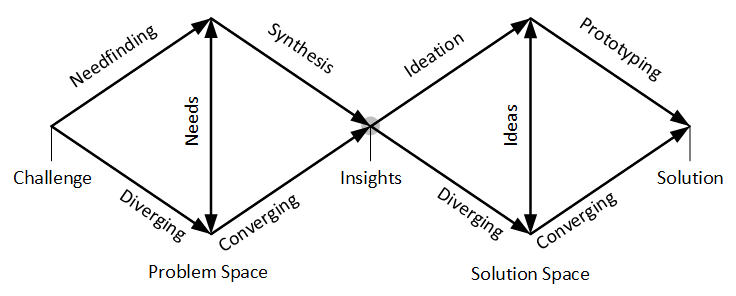
Borrowing from some aspects of Design Thinking, there is a double diamond design process model. I purloined one from the internet that will work for my purposes.
Double Diamond Design Process Model
I feel that I can simplify and assume that the diverging activity represents a right hemisphere strength whilst the converging is more apt to be a left hemisphere activity.
The right brain is not only always open to seeing options and opportunities, it actively seeks them. The left brain just wants to close any discussion and settle on a decision or an answer.
From an evolutionary perspective, the “raison d’être [of the right hemisphere] is to enable us to be on the lookout for potential predators, to form bonds with mates, and to understand, and interpret the living world around us” whilst the left hemisphere’s purpose “is to enable us to be effective predators.”
A right-hemisphere dominant person will likely continue to play what-if until the cows come home. A left-brain dominant person will take the first semi-viable solution and want to run on it. No need for deliberation. In a balanced scenario, the left and right hemispheres will battle for dominance, but they will arrive at a good-enough solution.
And this is where project managers enter the picture, and where I exit. I am decidedly over-indexed on the right brain. Among other things, I see options and possibilities. And, sure, I have enough balance to resolve to take action, but I don’t lose track of the possibilities and I am always ready to change course at a moment’s notice—what we call pivot in the business—or perish as the case might be.
The project manager, on the other hand, sees the map. This represents practically inviolable marching orders.
Disney Sorceror’s Apprentice Brooms-Flood Scene
One aspect of a good project manager is the ability to filter out the noise. Rather, this is what a right-brain person would surmise. Instead, the left-brain person doesn’t even register the noise. Where a right-brain person has to expend energy continually filtering out options and possibilities, the left-brain person never registers these options from the start. So, where I as a right-brain person may find it exhausting to actively and continuously limit this noise, this threshold is never triggered for the left-brainer.
In closing, I want to remind you again and again and again, that this is a gross oversimplification and rather metaphorical in nature. Nonetheless, I feel the that it is germane and offers insights into why some people are more apt at certain tasks than others.
I want to emphasise that one side is not better than the other. A right-dominant person is not superior to e left-dominant person, and vice versa. As with the brain itself, these can be complementary. Some people are very capable of tasking whichever hemisphere is necessary, but this is rarer than one might at first assume. McGilchrist provides many examples, so you can read them for yourself firsthand, or you can follow along as I call out key highlights in The Matter with Things.
If you have any comments or suggestions, feel free to leave them in the space provided.
People outside of this space have been suggesting that I read Iain McGilchrist. I started by watching his YouTube content, but I was put off by two things. But first, let me say that I really enjoy listening to Iain speak. He’s an Oxford psychiatrist and just a font of information—full of knowledge to retrieve and synthesise on a whim.
So what’s the problem? First, McGilchrist is a Panpsychist. And although Galen Strawson, whom I adore, is also a Panpsychist, I just don’t relate to the notion that everything has consciousness. I might be able to get there through semantic acrobatics, but that’s just a cheap parlour trick. I don’t mind engaging in idealists, as I am partial to Analytic Idealism, and I don’t mind saying there is a consciousness that we are all part of—though admittedly, I feel that this is just another parlour trick I am somehow more apt to forgive. I believe there is material and this material is what we can measure and try to measure, but ostensibly it’s merely a poor reflection of the larger reality that may be described alternatively as consciousness or information depending on which theory you support.
I said there are two problems. The second is less fundamental and more practical. His latest book release, The Matter with Things, is a two-volume set that costs around £70 in Britain but is twice that in the US at around $150. Oh. And it’s almost 3,000 pages.
As it turns out, I’ve read the first two chapters. Some Preliminaries and Attention. So far, it’s been some setup and ground setting with some narratives about persons with split and damaged hemispheres in order to establish the relative function of each side of the human brain.
I am familiar with some of these case studies from other neuroscience literature I’ve read, but he has a nice way of expanding the narratives. Plus, he’s got some new ones.
I don’t expect that I’ll be documenting a play-by-play here, but I wanted to share what I am doing. I expect that the first volume will be more of the same. Perhaps the second volume will delve more into the metaphysical arena. Time will tell.










 Philosophics