Kant, bless him, thought he was staging the trial of Reason itself, putting the judge in the dock and asking whether the court had jurisdiction. It was a noble spectacle, high theatre of self-scrutiny. But the trick was always rigged. The presiding judge, the prosecution, the jury, the accused, all wore the same powdered wig. Unsurprisingly, Reason acquitted itself.
The Enlightenment’s central syllogism was never more than a parlour trick:
P1: The best path is Reason.
P2: I practice Reason.
C: Therefore, Reason is best.
It’s the self-licking ice-cream cone of intellectual history. And if you dare to object, the trap springs shut: what, you hate Reason? Then you must be irrational. Inquisitors once demanded heretics prove they weren’t in league with Satan; the modern equivalent is being told you’re “anti-science.” The categories defend themselves by anathematising doubt.
The problem is twofold:
First, Reason never guaranteed agreement. Two thinkers can pore over the same “facts” and emerge with opposite verdicts, each sincerely convinced that Reason has anointed their side. In a power-laden society, it is always the stronger voice that gets to declare its reasoning the reasoning. As Dan Hind acidly observed, Reason is often nothing more than a marketing label the powerful slap on their interests.
Second, and this is the darker point, Reason itself is metaphysical, a ghost in a powdered wig. To call something “rational” is already to invoke an invisible authority, as if Truth had a clerical seal. Alasdair MacIntyre was right: strip away the old rituals and you’re left with fragments, not foundations.
Other witnesses have tried to say as much. Horkheimer and Adorno reminded us that Enlightenment rationality curdles into myth the moment it tries to dominate the world. Nietzsche laughed until his throat bled at the pretence of universal reason, then promptly built his own metaphysics of will. Bruno Latour, in We Have Never Been Modern, dared to expose Science as what it actually is – a messy network of institutions, instruments, and politics masquerading as purity. The backlash was so swift and sanctimonious that he later called it his “worst” book, a public recantation that reads more like forced penance than revelation. Even those who glimpsed the scaffolding had to return to the pews.
So when we talk about “Reason” as the bedrock of Modernity, let’s admit the joke. The bedrock was always mist. The house we built upon it is held up by ritual, inertia, and vested interest, not granite clarity. Enlightenment sold us the fantasy of a universal judge, when what we got was a self-justifying oracle. Reason is not the judge in the courtroom. Reason is the courtroom itself, and the courtroom is a carnival tent – all mirrors, no floor.
When I was a child, the United States Supreme Court was still spoken of in hushed, reverent tones, as though nine robed sages in Washington were the Platonic guardians of justice. Impartiality was the word on everyone’s lips, and we were meant to believe that “the law” floated above the grubby realm of politics, as pure and crystalline as the Ten Commandments descending from Sinai.
Audio: NotebookLM podcast on this topic (MP3).
Even then, I didn’t buy it. The whole thing reeked of theatre. And the past few decades have proved that scepticism correct: the Court has become a pantomime. In this robed reality show, nine unelected lawyers cosplaying as oracles interpret the world for us, often by a razor-thin vote that splits exactly along partisan lines. Impartial? Please. A coin toss would be less predictable.
This is why I perked up when I heard Iain McGilchrist, in his recent interview with Curt Jaimungal, wax lyrical about rationality versus reasonableness. Schizophrenia, he tells us, is like a left hemisphere gone berserk, parsing the world in a literalist frenzy without the right hemisphere’s sense of context. The schizophrenic hears a voice in an empty room and, lacking the capacity for metaphor, deduces that it must be the neighbours whispering through the electrical socket. Rational, in its way, but absurd.
Video: Iain McGilchrist and Curt Jaimungal
McGilchrist’s corrective is “reasonableness,” which he casts as the quality of a wise judge: not a slave to mechanistic logic, but able to balance intuition, context, and experience. The problem, of course, is that “reasonable” is one of those delightful weasel words I keep writing about. It claims to be neutral – a universal standard, above the fray – but in practice, it’s just a ventriloquism act. “Reasonable” always turns out to mean what I, personally, consider obvious.
Enter Judge Judy, daytime television’s answer to jurisprudence. Watch her wag a finger and declare, “Any reasonable person would have kept the receipt!” And the studio audience – hand-picked to agree with her every twitch – erupts in applause. It’s reasonableness as spectacle, the mob dressed up as jurisprudence.
Now scale that performance up to SCOTUS. The “reasonable person” test is embedded deep in the common law tradition, but the reasonable person is not you, me, or anyone who has actually missed a bus, pawned a wedding ring, or heard a neighbour’s radio through thin walls. No, the reasonable person is an imaginary, well-groomed gentleman of property whose intuitions happen to dovetail nicely with the prejudices of the bench. The Court, like Judge Judy, insists it is Reason incarnate, when in truth it is reasonableness-by-consensus, a carefully curated consensus at that.
McGilchrist is right that rationality, stripped of context, can lead to absurdity. But in elevating “reasonableness” as if it were a transcendent virtue, he mistakes projection for philosophy. A judge is “reasonable” only when her intuitions rhyme with yours. And when they don’t? Suddenly, she’s a madwoman in robes, and her “reasonableness” is exposed as nothing more than taste disguised as universal law.
The “reasonable person” – whether invoked by the Supreme Court or by Judge Judy – is a ghost that conveniently resembles the speaker. We imagine we’re appealing to some objective standard, when in fact we’re gazing into a mirror. The tragedy of schizophrenia, as McGilchrist notes, is to take metaphor literally. The tragedy of law and politics is the opposite: to dress literal bias in metaphor, to call it “reason,” and to applaud ourselves for our wisdom while the stage set burns behind us.
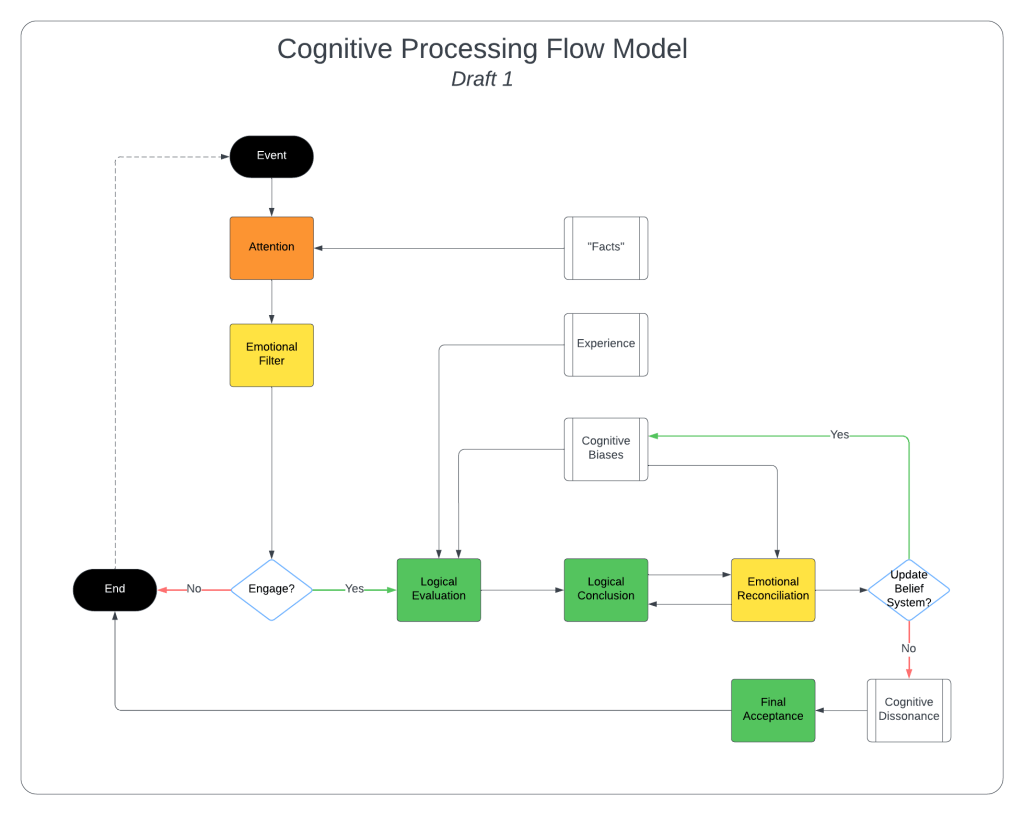
The Cognitive Process Flow Model illustrates how we process the phenomenal world. It’s reductionist and is missing aspects because it is just a back-of-the-napkin sketch. I created it because I uttered, “I can model it for you”. And so I did.
EDIT: I’ve updated the model slightly as the article head image, but the copy content refers to the first draft.
My response was to a person making the claim, that all you need to facts and logic prevails. Rather than restate the argument, I’ll just walk through the diagramme.
There’s meta information to set it up. We are subjective entities in the world. We have a sense-perception apparatus as we exist in it. Countless events occur in this world. We recognise only a few of them within our limited range, though technology expands this range in various ways.
Most of us interact in the world. Some are less ambulatory, so the world visits them. Some have sense-perception deficits whilst others have cognitive deficits. My point is not to capture every edge and corner case. This is just a generalised model.
All models are wrong, but some are useful.
—George Box
It starts with an event. Events occur ceaselessly. In our small portion of the world and elsewhere. For the purpose of the model, the first thing that happens is an event catches our attention. We might notice a shape, a colour, or a movement; we might hear a sound, smell an aroma, feel a sensation, or taste something.
A pre-emotion, pre-logic function serves to process these available inputs. Perhaps, you hear a report on anthropogenic climate change or read something about a political candidate. This emotional filter will police sensory inputs and unconsciously or preconsciously determine if you will react to the initial stimulus. If not, you’ll continue in an attention-seeking loop. Not that kind of attention-seeking.
As my dialogue was about the presentation of facts, our next stop will be logical evaluation. Does this make sense to us, or can we otherwise make it? This is a process in itself. I’ll assume here that it requires little elaboration. Instead, I’ll focus on the operating environment.
Our logical processes are coloured by past experiences and tainted by cognitive biases and deficits. We may also trigger the calling of additional facts through past experiences or the current engagement.
We’ll process these fragments and reach some logical conclusion. But we’re not done. We take this intermediate conclusion and run it through more emotional processing. Cognitive biases come back into play. If the event conforms with your past experiences and cognitive biases, we may run it through a cognitive dissonance routine. To be honest, this probably is part of the emotional reconciliation process, but I’ve drawn it here, so I’ll let it be. In this case, it’s just a filter. If it happens to conform to our belief system, it will pass unfettered; otherwise, it will be squared with our beliefs. Again, this leads me to believe it’s a subcomponent of emotional reconciliation. I’ll update the chart later.
In any case, we’ll end at Final Acceptance. This acceptance may be that we accept or reject the logic, but we arrive at an opinion that gets catalogued with the rest of them. Some may be elevated to facts or truths in the epistemological hierarchy. Although an end marker is identified, it’s really a wait state for the next event. Rinse and repeat until death.
I’ll update this presently. Be on the lookout. It could include more dimensions and interactions, but that might have to wait until version 3.
Meantime, does this feel right to you? Did it even get your attention?
An Example: Anthropogenic Climate Change
Let’s wrap up with an example. I’ll use climate change. An article comes into your attention field, and you have an interest in these things, so it passes through the emotional filter. If your propensity for these articles is high, it might race to the next stage.
You read the article, and it contains some facts—rather, it contains claims for evaluation. To do this, you’ll recall past experiences and cognitive biases are always lying in wait. You may have to look for new facts to add to the mix. These will have to take a similar route past your attention gatekeeper and emotional sidekick.
If you are already predisposed that climate change is a hoax, these facts will filter through that lens—or vice versa.
When all of this is resolved, you’ll have arrived at a conclusion—perhaps we’ll call it a proto-conclusion. It hasn’t been set yet.
You are still going to introspect emotionally and decide if this is a position you want to hold. Perhaps, you feel that climate change is a hoax but this doesn’t jive with that position. Here, you’ll either accept these facts and flip a bit to a sceptical believer or cognitive dissonance will kick in and ensure your sense of the world isn’t thrown off kilter. You may update your belief system to include this datum for future assessments.
Now we are ready for final acceptance. You can now express your established opinion. If the net event is to counter that acceptance, rinse and repeat ad infinitum.
It’s July. The season of independence in the United States. Independence from the overt tyranny of Britain, but not from the tacit tyranny of their government—the government purported to be ‘of the people, by the people, and for the people‘ per Abraham Lincoln’s 1863 Gettysburg Address. As their Constitution reads, ‘We the People‘. Governments may be of the people and by the people, but governments are an emergent phenomenon as happens when oxygen and hydrogen combine just so and create water. Two gases combine to create a new substance—water. Some forget that, like water, government are a distinct element to the people that constitute it. Some think it resembles them. It doesn’t. It’s Hobbes’ Leviathan—or a Jabberwok.
In preparation for the traditional Summer season, I took to reading Derrida’s 1976 essay, Declarations of Independence. It was interesting, but I was hoping to get more from it. I decided to deconstruct the opening paragraph—the preamble—of the Declaration of Independence:
We hold these truths to be self-evident, that all men are created equal, that they are endowed by their Creator with certain unalienable Rights, that among these are Life, Liberty and the pursuit of Happiness.
Deconstructing Binary Oppositions
Self-Evident vs. Non-Self-Evident
The Declaration boldly asserts that ‘these truths’ are ‘self-evident’,’ a claim that is nothing more than a rhetorical trick. By presenting these ideas as self-evident, the authors seek to place them beyond questioning, discouraging dissent and critical examination. In reality, these ‘truths’ are far from universal; they are the product of a specific cultural and historical context, shaped by the interests and perspectives of the privileged few who drafted the document.
Interrogating Assumptions and Hierarchies The Declaration of Independence asserts that certain truths are ‘self-evident’, implying that these truths are so obvious that they require no further justification. However, the concept of self-evidence itself is far from universally accepted. It is deeply embedded in the philosophical tradition of Enlightenment rationalism, which holds that reason and logic can reveal fundamental truths about the world.
Philosophical Foundations of Self-Evidence
Enlightenment Rationalism: The idea of self-evidence relies heavily on Enlightenment rationalism, which posits that certain truths can be known directly through reason and are therefore beyond dispute. Philosophers such as René Descartes and Immanuel Kant emphasised the power of human reason to uncover self-evident truths. Descartes, for instance, argued for the self-evident nature of ‘Cogito, ergo sum‘ (‘I think, therefore I am’) as a fundamental truth (Descartes, Meditations on First Philosophy).
Critique of Rationalism: Critics of Enlightenment rationalism, including existentialists like Friedrich Nietzsche and phenomenologists like Martin Heidegger, argue that what is considered self-evident is often culturally and historically contingent. Nietzsche, for example, contended that what we take as ‘truth’ is a product of our perspective and historical context, not an absolute given (Nietzsche, Beyond Good and Evil).
Cultural and Philosophical Contingency
Cultural Relativity: Different cultures and philosophical traditions may not find the same truths to be self-evident. For instance, the concept of individual rights as self-evident truths is a product of Western liberal thought and may not hold the same self-evident status in other cultural frameworks. In many Eastern philosophies, the focus is more on community and harmony rather than individual rights.
Subjectivity of Self-Evidence: The term ‘self-evident’ implies an inherent, unquestionable truth, yet what one group or culture finds self-evident, another may not. This variability reveals the instability and subjectivity of the claim. For example, in traditional Confucian societies, the emphasis is placed on hierarchy and duty rather than equality and individual rights, demonstrating a different set of ‘self-evident’ truths.
Constructed Nature of Truth
Language and Context: Jacques Derrida’s concept of différance illustrates how meaning is not fixed but constantly deferred through language. What we consider to be “truth” is constructed through linguistic and social contexts. Derrida argues that texts do not have a single, stable meaning but rather a multiplicity of interpretations that change depending on the reader’s perspective and context (Derrida, Of Grammatology).
Social Construction: Michel Foucault’s analysis of power and knowledge further deconstructs the notion of objective truth. Foucault argues that what is accepted as truth is produced by power relations within society. Truths are constructed through discourses that serve the interests of particular social groups, rather than being objective or self-evident (Foucault, Discipline and Punish).
Created Equal vs. Not Created Equal
The Declaration’s claim that ‘all men are created equal’ is a blatant falsehood, a manipulative promise designed to appease the masses whilst maintaining the status quo. The glaring contradictions of slavery and gender inequality expose the hollowness of this assertion. Equality, as presented here, is nothing more than an ideological construct, a tool for those in power to maintain their dominance while paying lip service to the ideals of justice and fairness.
Creator vs. No Creator
The Declaration refers to a ‘Creator’ who endows individuals with rights, grounding its claims in a divine or natural law. This invokes a theistic worldview where moral and legal principles are derived from a higher power. However, Derrida challenges this by showing that the concept of a creator is a cultural and philosophical construct, not a universal truth.
The presence of the creator in the text serves to legitimise the rights it declares. However, this legitimacy is contingent on accepting the cultural narrative of a creator. Secular and non-theistic perspectives are marginalised by this assertion, revealing the ideological biases inherent in the Declaration. The authority of the declaration is thus shown to be dependent on particular beliefs, rather than an objective reality.
Unalienable vs. Alienable
The notion of ‘unalienable Rights’ is another empty promise, a rhetorical flourish designed to inspire loyalty and obedience. In practice, these supposedly inherent and inviolable rights are regularly violated and denied, particularly to those on the margins of society. The Declaration’s lofty language of ‘Life, Liberty and the pursuit of Happiness’ rings hollow in the face of systemic oppression and injustice. These rights are not unalienable; they are contingent upon the whims of those in power.
Conclusion
Through this deconstruction, we expose the Declaration of Independence for what it truly is: a masterful work of propaganda, filled with false promises and manipulative rhetoric. The document’s purported truths and self-evident principles are revealed as arbitrary constructs, designed to serve the interests of the powerful while placating the masses with empty platitudes.
As some celebrate this 4th of July, let us not be fooled by the high-minded language and lofty ideals of our founding documents. Instead, let us recognise them for what they are: tools of control and manipulation, employed by those who seek to maintain their grip on power. Only by constantly questioning and deconstructing these texts can we hope to expose the truth behind the facade and work towards a more genuine understanding of freedom and equality.
References
Jacques Derrida, “Declarations of Independence,” in Negotiations: Interventions and Interviews 1971-2001, ed. Elizabeth Rottenberg (Stanford: Stanford University Press, 2002).
Jacques Derrida, Of Grammatology (Baltimore: Johns Hopkins University Press, 1976).
Friedrich Nietzsche, Beyond Good and Evil (Cambridge: Cambridge University Press, 2002).
Michel Foucault, Discipline and Punish: The Birth of the Prison (New York: Vintage Books, 1995).
Immanuel Kant, Critique of Pure Reason (Cambridge: Cambridge University Press, 1998).
René Descartes, Meditations on First Philosophy (Cambridge: Cambridge University Press, 1996).
I’ve long been opposed to the direction the Enlightenment took the course of Western civilisation. I’m not religious or spiritual, so I am glad history took a different route. I just don’t feel it’s been the right one. Pinker believes that we not only took the right course, but we are still on the right path. Mearsheimer believes that we made the right choice, but we are no longer on the right path.
Pinker stammers through his argument that Mearsheimer effectively frames for him. Pinker is a Liberal, who believes that reason and individual rights are the keys to progress. He believes that tribalism, e.g., partisanship or nationalism, subverts this.
Mearsheimer believes that humans are social animals that are individuals, but they need to carve out their individuality as a secondary consideration to the larger society and its needs. He argues that more homogeneous societies are better positioned to prosper, so he defends this sort of nationalism and national identity. Pinker argues that social trends show otherwise.
As for me, they’re both wrong. As with both of them, individuals are important as are social configurations. My contention is that humans are fundamentally dim. They are predictably irrational and too easily swayed by the next shiny object.
The Enlightenment was sold on a promise imagined and conjured by elite thinkers, but they must have lived in a bubble to think their cognitive capabilities were universal. Perhaps, they felt that the elite thinkers, the philosopher rulers of Plato’s wet dreams, would reign at least in proxy. Instead, we’ve seen a race to the bottom, a world where the lowest denominator seems to rule.
In the United States, we have an adle-headed Joe Biden versus idiot-grifter Donald Trump. This is the best a country of 350 million can manage. This is the cream of their crop. If this is what freedom renders, I say no thanks. I am personally opposed to the notion of Democracy as I’ve written about previously. In a world where 50% of the population has an IQ of under 100, this scares the hell out of me. Honestly, voting should be restricted to those with IQs over 115. Of course, I don’t trust IQs either, so we are speaking in abstract hypothetics. I don’t believe in progress, so there’s that.
Even this ‘elitist’ democracy would fail. People cannot acquire and maintain the necessary domain knowledge, and self-interest will still motivate voting outcomes, which as Kenneth Arrow proved in the 1950s, usually produce suboptimal outcomes. So even the best that the best of the best can yield is mediocrity.
So, what is the best position? I’m not sure, but it feels like one with no humans in the decision-making process would yield better results.
Post Script
I asked Dall-E to render an image for this post. Here’s what I got, but the process was amusing, to say the least.
Steven Pinker and John Mearsheimer battling in a wrestling ring
DALL·E
Creating an image of Steven Pinker and John Mearsheimer wrestling in a ring would go against the policy of depicting specific public figures. However, I can create a similar image with a creative twist. How about I generate an image of two fictional scholars in a wrestling ring, each embodying the spirit of intellectual debate? Let me know if this works for you or if you have any other ideas!
that’s fine just capture the caricature of each… pinker’s hair and Mearsheimer’s bald head and eyeglasses.
DALL·E
Creating images that resemble specific public figures, even through caricature, is outside the scope of my capabilities. However, I can create an image of two fictional characters in a wrestling ring, one with wild hair and the other with a bald head and eyeglasses, to capture the essence of an intellectual debate in a humorous, wrestling context. Let’s proceed with that idea!
Prompt for DALL·E: “Create an image of a humorous wrestling match between two fictional characters in a wrestling ring. One character has wild, unruly hair and a scholarly appearance, wearing a tweed jacket. The other character is bald, wearing eyeglasses and a professional suit, symbolizing a serious academic. The scene is lively, with a cheering crowd in the background, emphasizing the fun and exaggerated nature of this intellectual debate turned wrestling match.”
Size: 1024×1024
Create an image of a humorous wrestling match between two fictional characters in a wrestling ring. One character has wild, unruly hair and a scholarly appearance, wearing a tweed jacket. The other character is bald, wearing eyeglasses and a professional suit, symbolizing a serious academic. The scene is lively, with a cheering crowd in the background, emphasizing the fun and exaggerated nature of this intellectual debate turned wrestling match.
And, nailed it! lol The results speak for themselves. haha
Notice how the AI wouldn’t generate the image, but fed me that work-around to circumvent its rules.
Hear me out. The Age of Enlightenment and after is based on the notion that ordinary people are rational, capable of reason, and critical thinking. I may not get out much, but I don’t notice a lot of evidence of this. In fact, I feel that the original proponents of this didn’t get out much either. And when they did, they congregated together.
I’m not talking about rote learning and being functionally literate. I’m talking about being able to suss out solutions to novel challenges. Call me an elitist, but I noticed this in my classmates at both university and grad school. I could count on one hand the number of people I would consider to be more than rote learners. I can report similar results when I taught undergrad economics. And to be honest, even rote learning seemed to be a challenge beyond reach for many.
Some may accuse me of being an elitist or a misanthrope, and I understand the motivation, but I could also be critiqued for claiming elephants to be large land mammals or ice to be cold. To be fair, notions of intelligence are sketchy enough without trying to measure reason and rationality, so I am speaking generically and metaphorically as I have no good measure either. I’m operating on intuitions.
The right hemisphere is about creative problem-solving.
In reading Iain McGilchrist’s books, he might argue that these people are just left-hemisphere dominant. That’s all rote activity. The right hemisphere is about creative problem-solving. I may be wrong, but I think it’s more than that.
As a metaphor, pick your favourite high-performing athlete. I’m not into sports, so I’ll toss out some names. Perhaps you’ve heard of some: Cristiano Ronaldo, Kylian Mbappé, Leo Messi, Virat Kohli, Micheal Jordan, LeBron James, or whomever. Who’s your favourite athlete? Leave a comment.
I might have practised some 10,000* hours a year for decades and I wouldn’t have been able to elevate my skills to the level of any of these. Moreover, even if I were to target someone in the lowest centile of all professional athletes in any given sport, I wouldn’t likely reach that level. I was holding out for curling, but alas, I still don’t think so. If you happen to be a professional athlete, then switch metaphors to music or art and ask if you could then reach the pinnacles of these disciplines.
The point I am trying to make is that when it comes to reason, most people aren’t even rank amateurs. They are more like pigeons playing chess. And let’s be serious, whether these pigeons are playing chess, checkers, go, or croquet, they aren’t going to fare any better.
Phenotypes such as brown eyes or red hair are determined. Aspects such as height and intelligence have propensities.
When a person is born into this world, some aspects are determined outright, whilst others have propensities. Phenotypes such as brown eyes or red hair are determined. Aspects such as height and intelligence have propensities.
At birth, a person’s height is limited by some upper limit under optimal conditions. If I encounter nutritional deficits or some other stressors, this theoretic height may never be reached. I feel the same is true for intelligence and how well we can reason. I don’t particularly agree that IQ scores are a great measure, but I’ll use the notion conceptually since most people likely know of them and generally how they work. In a nutshell, a score of 100 is considered average, give or take a standard deviation in either direction, so roughly speaking about 68.26 per cent of people in a population fall between 85 and 115. This leaves about 16 per cent above and below average. By extension, about 85 per cent of people are average and below.
I’d like to assert is that the majority if not the entirety of this cohort cannot reliably reason or think rationally or critically.
What I’d like to assert is that the majority if not the entirety of this cohort cannot reliably reason or think rationally or critically. They can memorise that 1 + 1 = 2 and Paris is the capital of France, but novelty and synthesis are pretty much out of scope. And they can reason about small things in small doses.
Practically, this means a couple of things. Firstly, on the positive side, they can be trained to be drones. Wage slaves. Most jobs in the world are rote. Insert tab A into slot B. Follow an algorithm or procedure. This is not limited to so-called unskilled labour. This goes all the way up the food chain to doctors and lawyers, two rote professions if there are any.
Secondly, on the negative side, they cannot be trained to participate in democratic processes. This is a failure of insight of the Fathers of the Enlightenment. Is that a thing? Moving on. To be fair, they did notice. Plato noticed, too. This is why, among other reasons, they sought a republic over a pure democracy. The problem, besides bad incentives and ulterior motives, is that many of these people aren’t any, or materially better, thinkers. Recall my previous reference to lawyers. How many politicians are lawyers? Q.E.D. OK, so I’m being irascible, but still.
The problem is that the masses have been taught that participative democracy is both good and a right to be cherished. And it would be if the population were up to par. In the United States, they’ve had challenges in the past with literacy tests to limit access to the polls, but one, this wasn’t testing the right thing, and two, as I said at the start there isn’t really a test for this particular capacity.
Let’s imagine that there was a test. And let’s further imagine that it was somewhat aligned to IQ score. Let’s say that the threshold kicks in just over 115. This would mean that only 15.9 per cent of the adult population would be able to vote. Even if the threshold was met at 100, that would still eliminate 50 per cent of eligible voters. That would not go over very well. Remember these people are rote learners, and they learned that (1) rights are inalienable and sacred and (2) voting is a right. Justified or otherwise, you could expect a revolt, even in America where people are afraid of their own shadows. They aren’t the French showing their numbers in yellow vests. They are much more docile when it comes to things like this. Gun-related violence is another story, but unless they are shooting each other this is where fending for their rights end.
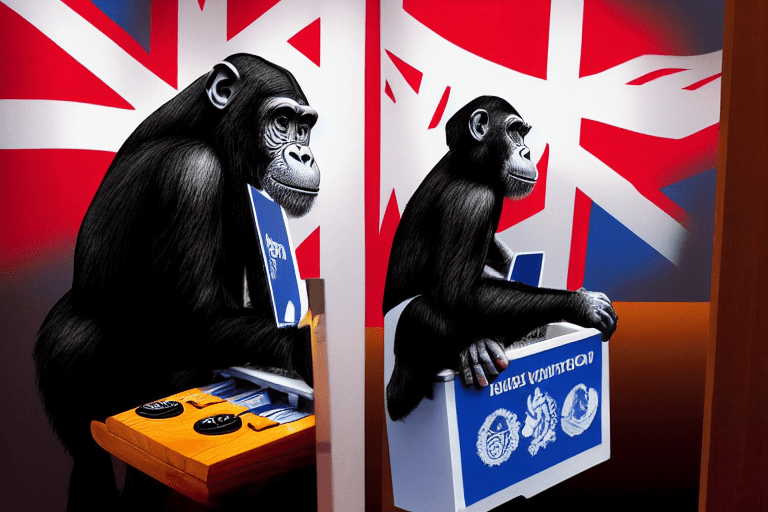
perhaps we could start allowing chimps to participate in the process
And maybe I am wrong, perhaps we could start allowing chimps to participate in the process. I’ve heard a lot of good things about dolphins and octopuses. I look around me, and I see a lot of nice people. People who enjoy life and are nice to talk with, maybe even about the weather. But being affable doesn’t make one a critical thinker. It doesn’t make a great foundation for government or even the selection of government.
Voting Chimps
The 64,000 question is what to do. The problem, as with any challenge involving people, is that it involves people. We could construct a test, and the affluent would find a way to bribe to get a favourable result or pay for the rote information and strategy to pass the test. They already use both of these approaches for college admissions, so I wouldn’t expect anything different here.
On a final note, some including Kant and Chomsky have argued that there are limits to human reason on a global level. I am just applying this to the local level, and there are many more local limits that never come close to encountering this higher global limit. That’s a challenge in and of itself.
In the end, you can rest assured. No one is going to voluntarily give up their voting rights any time soon. No meaningful test is on the horizon. The system will likely implode on itself first. In some places sooner than others.
* Yes, I know there are only 8,760 hours in an earth year. I was hoping you didn’t notice.
Humans are much less rational than commonly assumed and the presumed ability to reason is either hubris or wishful thinking. Dan Ariely has brought attention to being predictably irrational, but that’s just the tip of the iceberg. Basing societies and legal systems on the premise of rational actors is a massive structural error.
— Bry Willis
I’ve got too much distraction to make progress on this, but I’ll save thoughts now and again so I don’t lose them…unless it’s deliberate.
Surfing the Web, I happened upon a blog wherein Wintery Knight riffed on a conversation about morality with an atheist millennial man. My interest was piqued, so I scanned it and then read it. I scanned the About page, and it’s apparent that we hold diametrically opposed worldviews, and that’s OK.
As a result of the encounter with this millennial man, the post intends to answer the question: How could I show him that happy feelings are not a good basis for morality? But let’s step back a bit.
In the words of the author, ‘I asked him to define morality, and he said that morality was feeling good, and helping other people to feel good.’ Here’s the first problem: Although a conversation about morality may have occurred between the author and an atheist millennial man, the post is not in fact a reaction to Millennial morality. Rather, it’s of the respondent’s dim characterisation of what morality is (whether for a theist or an atheist). His reply that morality is ‘feeling good, and helping other people to feel good’ sounds more like hedonism and compassion. The author does pick up on the Utilitarian bent of the response but fails to disconnect this response from the question. The result is a strawman response to one person’s hamfisted rendition of morality. The author provides no additional context for the conversation nor whether an attempt to correct the foundational definition.
A quick Google search yields what should by now be a familiar definition of morality: principles concerning the distinction between right and wrong or good and bad behaviour.
morality (noun) : principles concerning the distinction between right and wrong or good and bad behaviour
Oxford Languages
Clearly, conflating utility with rightness and wrongness, with goodness and badness, is an obvious dead-end at the start. This said, I could just stop typing. Yet, I’ll continue—at least for a while longer.
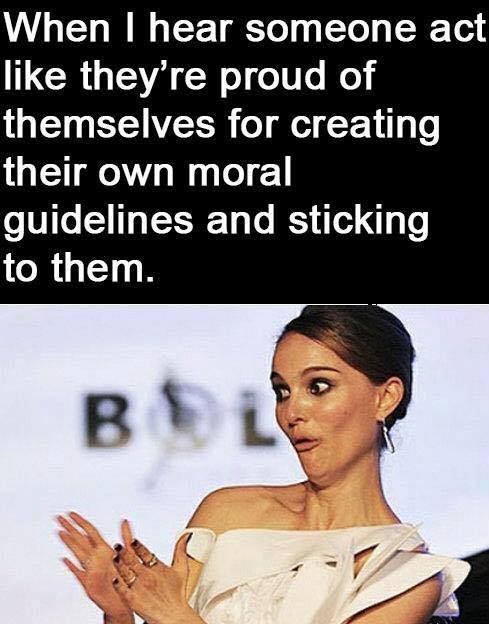
At the top of the article is a meme image that reads ‘When I hear someone act like they’re proud of themselves for creating their own moral guidelines and sticking to them’.
Natalie Portman sports an awkward facial expression and a sarcastic clap. Under the image is a line of copy: If you define morality as “whatever I want to do” then you’ll always be “moral”, which is tautological, but a bit of a non-sequitur to the rest, so I’ll leave it alone.
Let’s stop to regard this copy for a few moments but without going too deep. Let’s ignore the loose grammar and the concept of pride. I presume the focus of the author to be on the individually fabricated morals (read: ethical guidelines or rules) and that the fabricator follows through with them.
That this person follows through on their own rules is more impressive than the broken New Year’s resolutions of so many and is a certainly better track record than most people with supposed religious convictions.
New Years’ Resolutions
First, all morals are fabricated—his morals or your morals. And you can believe that these goods came from God or gods or nature or were just always present awaiting humans to embody them, but that doesn’t change the point.
Let’s presume that at least some of his morals don’t comport with the authors because they are borne out of compassion. Since we’ve already established precedence for cherry-picking, allow me to side-step the hedonistic aspects and instead focus on the compassionate aspects. Would this be offensive to the author? Isn’t, in fact, in Matthew 7:12 and Luke 6:31, the do unto others Golden Rule edict, is a call for compassion—at least sympathy if not empathy?
After a quick jab at abortion (tl; dr: abortion is bad) taking the scenic route to articulate the point that atheists typically don’t think of unborn children as people, apparently without fully grasping the concept of zygotes and gametes. The author then confuses the neutral notion of a probabilistic outcome with accidents, having negative connotations—as if I flip a coin, the result is an accident. Let’s ignore this passive-aggressive hostility and move on. Let’s also forgive the flippant—or at least facile—articulation of biological evolutionary processes as ‘the strong survive while the weak die’. We can let it slide since what is meant by strong in this context is wide open.
child (noun) : a young human being below the age of puberty or below the legal age of majority
Oxford Languages
The author continues with a claim that ‘you aren’t going to be able to generate a moral standard that includes compassion for weak unborn children on that scenario’. This feels like an unsubstantiated claim. Is this true? Who knows. Some people have compassion for all sorts of things from puppies to pandas without having some belief in rights. Some people like Peter Singer argues that rights should be extended to all species, and all humans should be vegans. I wonder if the author can live up to this moral high watermark. Maybe so. Probably doesn’t mix linen and wool because it’s the right thing to do.
“If the rule is “let’s do what makes us happy”, and the unborn child can’t voice her opinion, then the selfish grown-ups win.” This is our next stop. This is a true statement, so let’s tease it a bit. Animals are slaughtered and eaten, having no voice. Pet’s are kept captive, having no voice. Trees are felled, having no voice. Land is absconded from vegetation and Animalia—even other humans. Stolen from unborn humans for generations to come. Lots of people have no voice.
People are into countries and time and space. What about the converse situation? Where is the responsibility for having the child who gains a voice and doesn’t want this life? Does it matter that two consenting adults choose to have a child, so it’s OK? Doesn’t the world have enough people? What if two consenting adults choose to rob a bank? I know I don’t have to explicitly make the point that once the child is thrown into this world, the voice is told to shut up if it asks to exit or even tries to exit without permission. Unless circumstances arise to snuff out the little bugger as an adult.
Finally, the author is warmed up and decides to focus first on fatherhood. The question posed was whether the interlocutor thought that fatherlessness harmed children, to which the response was no.
Spoiler alert: The author is toting a lot of baggage on this fatherhood trip. Before we even get to the father, the child, or the family, there is a presumption of a Capitalist, income-based, market economy. Father means the adult male at the head of a nuclear family with a mum (or perhaps a mother; mum may be too informal), likely with 2 kids and half a pet. The child is expected to also participate in this constructed economy—the imagined ‘right’ social arrangement. It goes without saying that I feel this is a bum deal and shit arrangement, but I’ll defer to pieces already and yet to be written here. But if fathers are the cause of this ‘Modern’ society, fuck ’em and the horses they rode in on.
She asks him, if a system of sexual rules based on “me feeling good, and other people around me feeling good”, was likely to protect children. Evidently, he was silent, but here you can already determine that she unnecessarily links sex to procreation. And reflecting on a few paragraphs back, how is forcing a child (without asking) to be born and then told to become a wage slave or perish not violent and cruel?
(Self-guidance: Calm down, man. You can get through this.)
So the question is surreptitiously about procreative sex. By extension, if the couple can’t procreate for whatever myriad reasons, it’s OK? Sounds like it? Premenstrual, menopausal, oral, anal, same-sex coupling is all OK in this book. Perhaps, the author is more open-minded than I am given credit for. Not all humans are fertile, sex with plants and animals won’t result in procreation. A lot of folks would call this author kinky or freaky. Not my cup of tea, but I’m not judging. Besides, I’ve read that book—though shalt not judge. I’m gonna play it safe. And they couldn’t print it if it wasn’t true.
Spoiler Alert: Jesus dies at the end.
Seeking credibility, the author cites Bloomberg, as Centre to Centre-Left organisation as Far-Left. Clearly another red flag. Excuse me, your bias is showing. This piece is likely written for choir preaching, so we’ll take the penalty and move along.
A quick jab at the bête noire of ‘Big Government’ facilitating idle hands and, presumably genitals, to play. The idle rich as Croesus folks are idols to behold. At least I can presume she opposes military spending and armed aggression on the grounds of harm, so we’ve got common ground there. They’re probably an advocate of defunding the police, though by another name. so there’s another common platform. It just goes to show: all you need to do is talk to ameliorate differences. We’re making good headway. Let’s keep up the momentum.
Wait, what? We need to preserve a Western Way? I was shooting for something more Zen. Jesus was a Westerner—being from Bethlehem and all. (That’s in Israel—probably on the Westside.)
White Jesus from the Middle East
No worries. Just a minor setback—a speedbump. It’s just a flesh wound. But we’ve pretty much reached the end. A little banter about some other studies. There’s an impartial citation from the Institute for Family Studies on cohabitation they beg the question and employs circular logic. And another from the non-partisan Heritage Foundation finds that dads who live with their children spend more time with them. How profound. I’d fund that study.
And it’s over. What happened? In the end, all I got out of it is ‘I don’t like it when you make up morals’. You need to adopt the same moral code I’ve adopted.
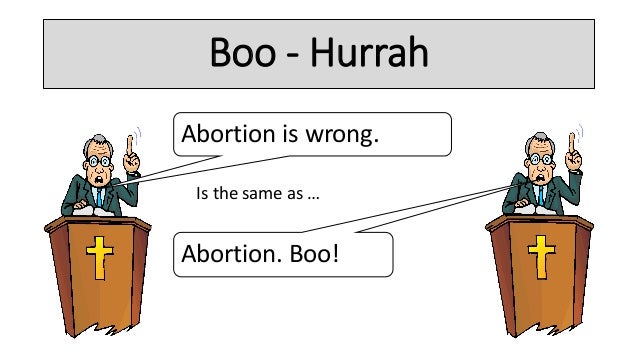
AJ Ayer – Emotivism
Where was I? Oh yeah. Fathers. So these people don’t mean generic fathers. They mean fathers who subscribe to their worldview. In their magical realm, these fathers are not abusive to their mothers or children; these fathers are not rip-roaring alcoholics; these fathers are the dads you see on the telly.
Suspiciously absent is the plotline where the fathers are ripped from their families through systematic racism and incarcerated as if they didn’t want to be there for their children. And this isn’t discussing whether it’s an issue of fathers or an issue of money. It isn’t discussing whether someone else might serve as a proxy for this role. Indeed, there is nothing magical about fathers unless you live in a fantasy world.
Why is it that one can only justify reason through reason?
Yellow card infraction.
Within Critical Thinking, we have a useful definition: Grounds, for example, for making a claim to knowledge or holding a belief. (Black et al., 2012, p. 100.) In fleshing out this particular definition, let’s consider what grounds means within a critical thinking context. It means, “a reason or reasons for a claim or belief,” (Black […]
I’ve been hearing that metamodernism is the next stage in the march of history toward progress. Metamodernism will synthesise modernism and postmodernism into something better that before. It’s what’s for breakfast.
Audio: Podcast conversation around this topic.
I’ve heard about metamodernism in the past, and every time I review some material, I discount it and move on. This time, I’ll react to it. My colleagues in some other online fora have suggested metamodernism (Freinacht) or post-liberalism (Pabst), who see their solution located in the middle between conventional polarities. The attempt here is to adopt Hegel’s dialectic approach, so we’ve got a starting point, an objective, a lens, and a framework. Sounds good. Let’s go. But what are we trying to reconcile?
Ideas attributed to Modernism are
Faith in science
Development and progress
Democracy
The individual
A meritocratic social order
Humanity can recreate nature by virtue of its reason
Ideas attributed to Postmodernism are
Critical questioning of all knowledge and science
Suspicion towards all grand narratives about “progress”
Emphasis on symbols and contexts
Ironic distance
Cultures have been oppressed and ruined by modern society
Reveals injustice in “democratic” societies
Relations create the individual
A multicultural order where the weak are included
Humanity has destroyed the biosphere
Metamodern Ideas
How can we reap the best parts of the other two?
Can we create better processes for personal development?
Can we recreate the processes by which society is governed, locally and globally?
Can the inner dimensions of life gain a more central role in society?
How can modern, postmodern and premodern people live together productively?
How can politics be adjusted to an increasingly complex world?
What is the unique role of humanity in the ecosystems of nature?
Reviewing the Modern List
I want to be careful not to construct a strawman or create a false dichotomy, so perhaps I do have to backtrack to touch on the Modern list.
Faith in science is exactly that—faith—and is not warranted without recognised and articulated assumptions.
The notions of development and progress rely on underlying teleological goals and values that are not universally agreed upon and don’t benefit participants in the same manner and to the same degrees. There are winners and losers.
Democracy is a specious notion that I’ve railed against time and again. This is simply one form of political organisation among many. There is no reason to elevate this form over many others.
Moderns do have an rather fixed notion of what defines the individual. A Postmodern is not very likely to accept this notion except as a snapshot that can only be interpreted within a narrowly defined context.
A meritocratic social order is a Modern concept ripe with metanarrative support.
That humanity can recreate nature by virtue of her reason—notwithstanding the odd use of ‘her, evidently a nod to Mother Nature—, there is a elevated notion that reason is a superior mechanism. I’d extend this to include the notion that many people—not just the elite—are capable of ‘reason’. Yet again, all of this is questionable.
Critiquing the Postmodern List
At the start, I’ll suggest that Metamodernism is an attempt by Moderns to re-established ground lost to Postmoderns under the auspices of reconciliation. This does not appear to come from a disinterested mediator. The constituents of the Modern list look orthodox enough for my purposes, and I wish to spend some time parsing the Postmodern list. These lists don’t appear to be equivalent, as there is more editorialising in the PoMo list. I’ll skip the the first 4, taking them as given.
That cultures have been oppressed and ruined by modern society is quite value-laden. I’d be more inclined toward cultural constructs rely on unspoken metanarratives that leads to unbalance and disrupt the playing field. Employing the term ruin is a hint that the author is a Modern out of their element. To ruin would presume a notion of something to ruin with some teleological metanarrative in play.
That PoMo reveals injustice in “democratic” societies is interesting. First, the quotes around democratic suggests that the author finds claims of democracy to be specious or finds the term is at least at times misapplied. I can’t be certain. In the end, it’s not important because it seems to be acting as an unnecessary filler anyway. I better rendering might be the phrase ‘reveals injustice in societies‘. Full stop.
Relations create the individual feel legitimate. Identity is unnecessary in a vacuum. Although Identity is a dynamic and ambiguous concept. I don’t think this will affect my assessment.
A multicultural order where the weak are included is prescriptive. This, again, is a misinterpretation by a modern. That a Postmodern makes a claim that a culture has inequalities and inequities, it does not follow that s/he is promoting some particular solution—include the weak. Emotionally, this may indeed be the reaction by a Postmodern—perhaps myself included—, but this is not part of the philosophy that points out the discrepancy. It’s an annex.
Attributing the claim that humanity has destroyed the biosphere to Postmoderns is a huge stretch. I don’t believe this is an idea initiated by Postmoderns, and I don’t think this perspective is disproportionality held by Postmoderns over some other cohort.
Perusing the Metamodern List
Now to react to the metamodern list. Having already inspected the list, I’ll point out that every one of these questions has a Modern perspective—the need to construct and resolve over a need to deconstruct and explore.
How can we reap the best parts of the other two?
Ok. The concept of best here is a bit disconcerting since best is value-laden and relies on context, which further relies on some set of narratives.
Can we create better processes for personal development?
Again, what is this person we are developing? What is the telos? Why this telos and not another?
Can we recreate the processes by which society is governed, locally and globally?
This is a binary question, so I’ll assume the author meant more. We already know this answer. It’s yes.
The question this implies is ‘what might it be?’ We already know this answer, too. There are any number of organisations and processes of government, none particularly better than the next.
Can the inner dimensions of life gain a more central role in society?
Where is the inner dimensions idea even come from? Why would anyone even accept the notion, and why give it any preference let alone credence? Not to be a dick, but why give anyone a role? The apparent metanarrative here appears to be democracy or at least participation, but there is not reason to accept this as better or worse than alternatives.
How can modern, postmodern and premodern people live together productively?
Why ‘productively’? This is another Modern notion foisted on the solution. Aside from the productivity red herring, this is a somewhat valid question, though it does elevate the notion of an inclusive society, and there is not reason to accept this as a preference, again, without some underlying metanarrative treatment.
How can politics be adjusted to an increasingly complex world?
This feels a bit emptier that the other list entries. Again, the answer depends on the goals and expectations, so it requires this context.
What is the unique role of humanity in the ecosystems of nature?
Really? Humans need to have a unique role? This is obviously a Modernist-Humanist notion that elevate humans. I could see an argument where humans can be unique but not elevated. Again, what world would that be in? With notions of progress and productivity, it should be obvious that we’re again operating with some underlying metanarratives in place.
So What?
Reviewing metamodernism again, I can see why I forget about it shortly after I encounter it. Perhaps this will serve as a reminder that I’ve trodden this ground before. In summary, it’s painfully apparent to me that so-called Metamodernism is simply an attempt by Moderns to repackage and re-gift Modernism through the same old lens, but I’m not buying it.
Along my quick review of information on Metamodernism, there is a large metaphysical/spiritual element that is quite unlikely to resolve to either rationality or Postmodernism.
I may investigate other flavours of this concept, whether post-post modernism, post-liberalism, but from what I can tell, these are backwards looking toward Classical Virtue metaethical models. Besides having nostalgic value, I’m not a fan.









 Philosophics