The Burnout Society – Byung-Chul Han

1 minute
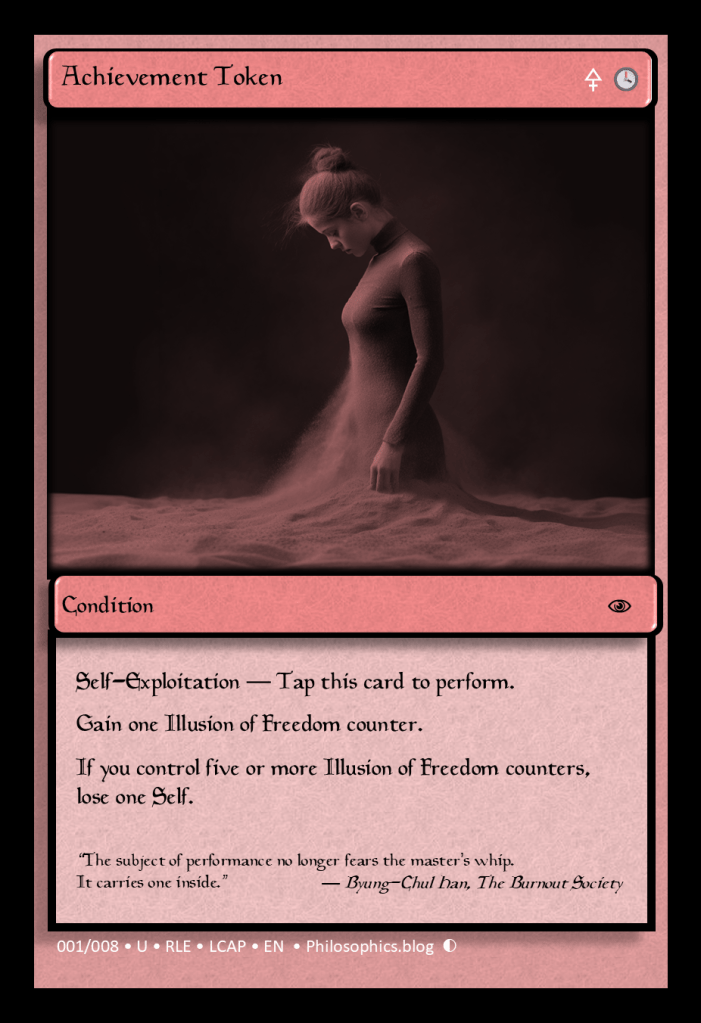
A digital MTG trading card titled “Achievement Token – Condition.” The image shows a human figure shaped like an hourglass, sand flowing through its body as if time and self are draining away. The design echoes the colours of oxidised red and muted graphite, symbolising burnout and the illusion of productivity within modern capitalist culture.
Image: Exhaustion means you’re working hard, and working hard means you’re good.

Han’s slender essay reads like a diagnosis of our psychic economy. The disciplinary society of ‘thou shalt’ has dissolved into the achievement society of ‘yes, I can’. We no longer rebel against authority; we internalise it, polishing our exhaustion until it gleams like ambition. Productivity replaces purpose. Rest becomes guilt. The subject, stripped of exterior constraint, now self-flagellates in the name of freedom.

What Han captures is not mere fatigue but a civilisational pathology: the compulsion to optimise the self as though it were capital. Burnout is not the collapse of will but the logical conclusion of unlimited permission.

If liberation now feels indistinguishable from exhaustion, what exactly have we been freed from?

From the series Readings in Late Exhaustion – a Philosophics reflection on the maladies of modernity.


About the Series — Readings in Late Exhaustion

These cards belong to Readings in Late Exhaustion, a Philosophics project tracing the psychic and cultural costs of late capitalism.

Each card interprets a contemporary work of critical theory through the language of collectable gameplay, where identity, labour, and value become quantified acts.

The format itself is the critique: a system of self-expenditure disguised as achievement, reflection rendered as performance.

Edition: RLE / LCAP — Philosophics Press


Meditations On Nothing: Notes Before Existence

Meditations on Nothing has finally been published after an administrative glitch.

The core of this book consists of six “books” of aphorisms, each book comprising a single page, totalling 24 in all.

Why only 24 pages?

Couldn’t this have been a blog post? An email?

Fair enough, and yes, of course it could have. It could have been six – three sheets, front and back – but I wanted to share in the tradition of the Communist Manifesto by Karl Marx and Friedrich Engels, as well as Thomas Paine’s Common Sense. The content is not similar, but the format is shared.

Honestly, I printed a draft copy for myself on A4 paper, folded it to A5, and stapled it at the spine with a long stapler – sans a fancy cover. Perhaps, I’ll share the source PDF in future.

As I’ve written elsewhere, I was inspired by the aphorisms of Nietzsche, Schopenhauer, Pascale, Debord, and others. To be fair, I disliked Debord’s The Society of the Spectacle, but I was still inspired by it for the two or three things I got from it – each of which slips my mind as I write this.

Why a Companion Guide?

Twenty-four pages – really, only six that matter; why would someone want that?

You got me there, too. No, so Notes Before Existence is not a casual read. It’s logical and coherent, but it’s not standard exposition. It’s meant as a thinking tool. Also, the ideas are supported by those who came before me – Newton’s ‘standing on the shoulders of giants’ quip pertains.

The main body of the book comprises the same six books as Notes Before Existence, each printed on its own verso, opposite a recto page for personal annotation.

Whilst Meditations on Nothing: A Critical Companion does provide supporting context for Notes Before Existence, it doesn’t fully break it down. I expect to provide this context in a more comprehensive volume, both online and offline, primarily on this platform and on YouTube.

I Wonder what’s Next?

I’m putting the final touches on my next project. The Illusion of Light: Thinking after the Enlightenment is a sort of capstone to my Anti-Enlightenment Project. It provides context around this project as well as details about the underlying essays available on Zenodo at no cost.

And so it goes…

What I really came here for is to share the reason this book was hung up in queue. On the surface, everything checked. I uploaded the source files, entered the required metadata, and chose appropriate price points – which, for the record, is $4.99 USD for Notes*.

Other Prices as of 16/10/25

  • UK: ÂŁ3.99
  • EU: €4.99 (except Belgium, €4.39)
  • Canada: $6.99 (CAD)
  • Australia: $10.99
  • Japan: ÂĄ1000

As it turns out, this publishing business is data-driven, and some of the systems and validation rules, let’s say, are remnants of the 1970s. Some companies are better than others, but in the US, Bowker controls the ISBN numbers. The US is one – if not the only – of the countries to charge for these identifiers, because: Capitalism. Unfortunately, the printers need to access Bowker’s antiquated system to validate the pairing of the ISBN and the publishing organisation.

I publish under Microglyphics, an entity through which I published my first book in 2001. In 2025, I started using Philosophics Press as an imprint for philosophy materials. This created a snag. I had entered Philosophics Press, but it was expecting Microglyphics – even though I’d used Philosophics Press previously. Unfortunately, the error was not thrown on the page where this information had been entered and validated – that was passed – but on the last page, I was informed that something was wrong on that page.

In any case, after a couple of days of trying, I updated the Bowker record (just to be sure) and eventually entered Microglyphics. VoilĂ . It worked.

Since then, I’ve also secured a second printer and distributor, IngramSpark, so I’m interested to discover what they’re like.

#PSA

Temporal Ghosts and Rational Spectres: An Anti-Enlightenment Collection

The Enlightenment still walks among us. Or rather, it lingers like a spectre – insisting it is alive, rational, and universal, while we, its inheritors, know full well it is a ghost. The project I’ve begun – call it my anti-Enlightenment collection – is about tracing these hauntings. Not the friendly ghosts of warm memory, but the structural ones: rationality unmoored, democracy designed to fail, presentism enthroned as law.

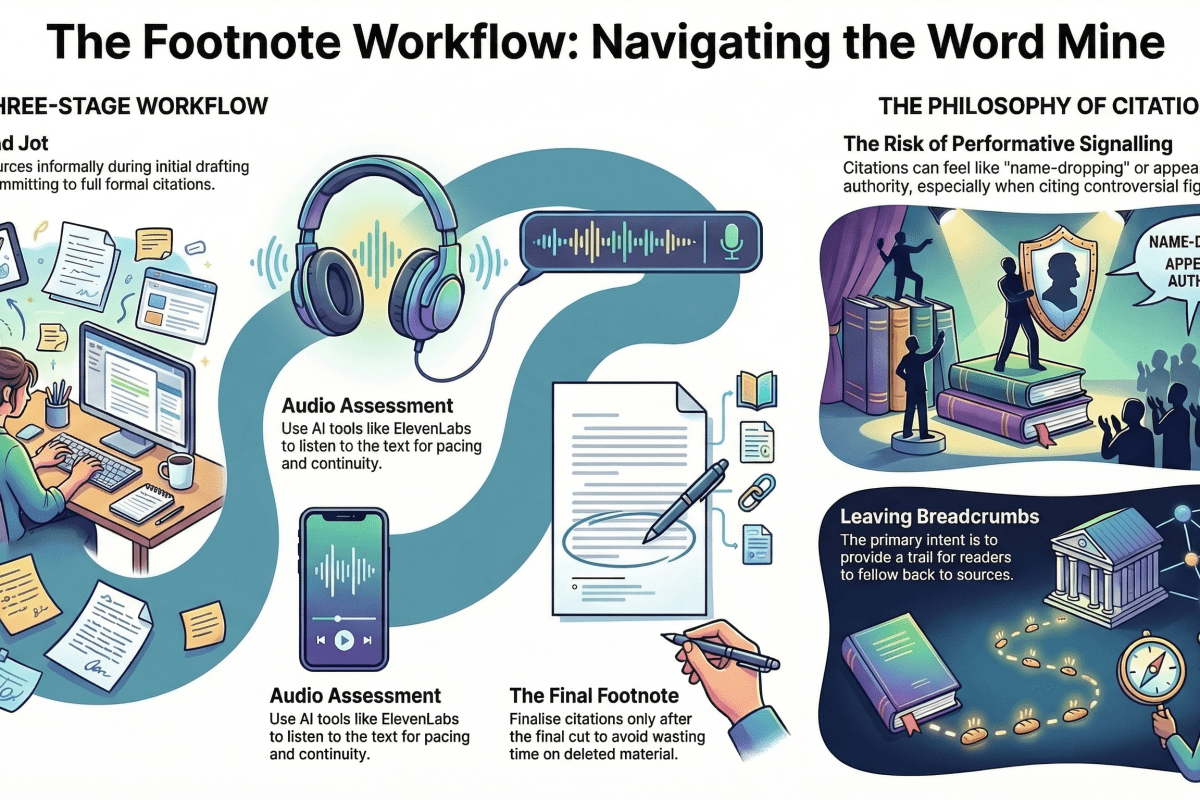
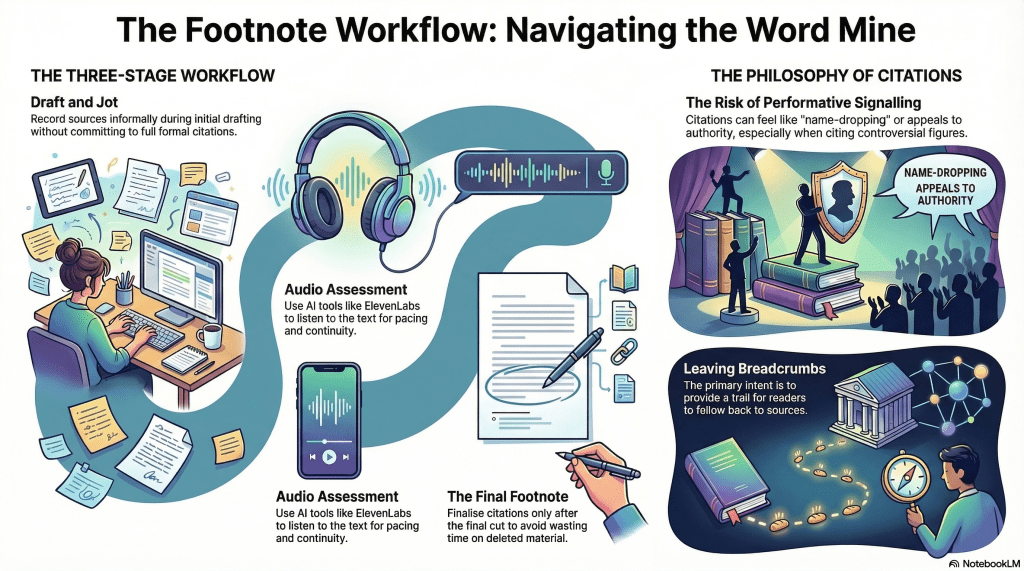
Audio: NotebookLM podcast on the essay underlying this post.

This collection began with Rational Ghosts: Why Enlightenment Democracy Was Built to Fail, which anatomised the Enlightenment’s misplaced faith in rational self-governance. The rational individual, Enlightenment’s poster child, turned out to be less a citizen than a figment – a ghost conjured to make democracy look inevitable.

It continues now with Temporal Ghosts: Tyranny of the Present, which dissects the structural bias of presentism – our systemic privileging of the living over the unborn. Hobbes, Locke, Rousseau, Bacon, Smith, Bentham, Montesquieu: each laid bricks in an architecture that secured sovereignty for now while exiling the future into silence. Debts accumulate, climate collapses, nuclear waste seeps forward through time. The unborn never consented, yet institutions treat their silence as assent.

Why a Collection?

Because ghosts travel in packs. One essay exposes Enlightenment’s hollow promises of reason; another its structural bias toward immediacy. The next will follow a different haunting, but always the same theme: Enlightenment’s bright lantern casts a shadow it refuses to see. The collection is less about reconstruction than exorcism – or at least acknowledgment that we live in a haunted house.

Ghost by Ghost

  • Rational Ghosts – Enlightenment democracy promised rational citizens and self-correcting systems. What it delivered instead was structural irrationality: Condorcet’s paradox, Arrow’s impossibility theorem, and a politics rigged to stumble over its own claims of reason.
  • Temporal Ghosts – The unborn are disenfranchised by design. The Enlightenment’s “living contract” fossilised presentism as law, leaving future generations to inherit debts, ecological ruin, and technological lock-in.

There may be more hauntings to come – economic ghosts, epistemic ghosts, technological ghosts. But like all spectres, they may fade when the season changes. The calendar suggests they’ll linger through Día de Muertos and Hallowe’en; after that, who knows whether they’ll still materialise on the page.

Sustenance Novella free on Kindle

On 7–8 September 2025, the Kindle version of my Ridley Park novella Sustenance will be available free to everyone on Amazon. (It’s always free if you’re a KindleUnlimited member, but these two days open it up to all readers.)

👉 https://www.amazon.com/dp/B0F9PTK9N2

So what is Sustenance?

It’s a novella that begins with the dust and grit of rural Iowa – soybean fields, rusted trucks, a small town where everyone knows your name (and your secrets). At first glance, it reads like plainspoken realism, narrated by a local mechanic who insists he’s just a “regular guy.” But then the ground literally shifts. A crash. Figures glimpsed by firelight in the woods. Naked, violet-skinned beings who don’t laugh, don’t sleep, don’t even breathe.

What follows is not your usual alien-invasion story. It’s quieter, stranger, and more unsettling. The encounters with the visitors aren’t about lasers or spaceships – they’re about language, culture, and the limits of human understanding. What happens when concepts like propertylaw, or even woman and man don’t translate? What does it mean when intimacy itself becomes a site of misunderstanding?

Sustenance is for readers who:

  • Gravitate toward literary fiction with a speculative edge rather than straight genre beats
  • Appreciate the mix of the banal and the uncanny – the smell of corn dust giving way to the shock of alien otherness
  • Are interested in themes of language, power, misunderstanding, and human self-deception
  • Enjoy writers like Jeff VanderMeer, Margaret Atwood, Octavia Butler, or Denis Johnson – voices that blur realism, philosophy, and estrangement

This isn’t a story that offers tidy answers. It lingers, provokes, and resists easy moral closure. Think of it less as a sci-fi romp and more as a philosophical fable wrapped in small-town dust and cicada-song.

This version of the book is available in these Kindle storefronts:
United States, United Kingdom, Germany, France, Spain, Italy, Netherlands, Japan, Brazil, Canada, Mexico, Australia, and India

For more details, visit the Sustenance page.

📚 Grab your free Kindle copy on 7–8 September 2025

I made this Kindle version available for free to get some reviews. This promotion is all or nothing, so take advantage of the opportunity. If you want to leave a review, please do.

On Ishiguro, Cioran, and Whatever I Think I’m Doing

Sora-generated image of Emil Cioran and Kazuo Ishiguro reading a generic book together

Having just finished Never Let Me Go by Kazuo Ishiguro, I’ve now cracked open my first taste of Cioran—History and Utopia. You might reasonably ask why. Why these two? And what, if anything, do they have in common? Better yet—what do the three of us have in common?

Audio: NotebookLM podcast on this topic.

Recently, I finished writing a novella titled Propensity (currently gathering metaphorical dust on the release runway). Out of curiosity—or narcissism—I fed it to AI and asked whose style it resembled. Among the usual suspects were two names I hadn’t yet read: Ishiguro and Cioran. I’d read the others and understood the links. These two, though, were unknown quantities. So I gave them a go.

Ishiguro is perhaps best known for The Remains of the Day, which, like Never Let Me Go, got the Hollywood treatment. I chose the latter, arbitrarily. I even asked ChatGPT to compare both books with their cinematic counterparts. The AI was less than charitable, describing Hollywood’s adaptations as bastardised and bowdlerised—flattened into tidy narratives for American palates too dim to digest ambiguity. On this, we agree.

What struck me about Never Let Me Go was its richly textured mundanity. That’s apparently where AI saw the resemblance to Propensity. I’m not here to write a book report—partly because I detest spoilers, and partly because summaries miss the point. It took about seven chapters before anything ‘happened’, and then it kept happening. What had at first seemed like a neurotic, wandering narrative from the maddeningly passive Kathy H. suddenly hooked me. The reveals began to unfold. It’s a book that resists retelling. It demands firsthand experience. A vibe. A tone. A slow, aching dread.

Which brings me neatly to Cioran.

History and Utopia is a collection of essays penned in French (not his mother tongue, but you’d never guess it) while Cioran was holed up in postwar Paris. I opted for the English translation—unapologetically—and was instantly drawn in. His prose? Electric. His wit? Acidic. If Ishiguro was a comparison of style, then Cioran was one of spirit. Snark, pessimism, fatalistic shrugs toward civilisation—finally, someone speaking my language.

Unlike the cardboard cut-outs of Cold War polemics we get from most Western writers of the era, Cioran’s take is layered, uncomfortably self-aware, and written by someone who actually fled political chaos. There’s no naïve idealism here, no facile hero-villain binaries. Just a deeply weary intellect peering into the abyss and refusing to blink. It’s not just what he says, but the tone—the curled-lip sneer at utopian pretensions and historical self-delusions. If I earned even a drop of that comparison, I’ll take it.

Both Ishiguro and Cioran delivered what I didn’t know I needed: the reminder that some writers aren’t there to tell you a story. They’re there to infect you with an atmosphere. An idea. A quiet existential panic you can’t shake.

I’ve gotten what I came for from these two, though I suspect I’ll be returning, especially to Cioran. Philosophically, he’s my kind of bastard. I doubt this’ll be my last post on his work.

Reading Science Fiction

I’ve got a confession to make: Science Fiction as a genre doesn’t resonate with me. Neither does Fantasy. I enjoy some fiction, but it seems that it’s primarily Literary Fiction – old-school classics like Dostoyevsky, Tolstoy, Nabokov, Kafka, Barthelme, and the like. Mostly, I prefer non-fiction.

I’ve just finished reading William Gibson’s Neuromancer, having read The Peripheral at the end of last year. To be fair, someone recommended Neal Stephenson’s Snow Crash, which is in the same genre – cyberpunk. I’d been advised that Snow Crash is better written, but I thought it might be best to start at the start of that genre.

These writers have good ideas. It often sounds appealing when someone tells me the plot summary, but the details bore me to tears. When I read reviews of these books, I frequently hear how immersive they are, but to me, they are cluttered and chockablock with minutiae. I find myself prodding, “Just get to the point.” But there has to be more than this. Short stories may fare better. I liked Ursula K LeGuin’s The Ones Who Walk Away from Omelas, but that was more related to its philosophical, anti-utilitarian perspective rather than the story.

It’s not as if Dostoyevsky doesn’t circumlocute and pontificate, but it’s somehow different. I want to like it. I want to read it – first-hand, not just a summary, so I can feel that I’ve engaged with the material.

Over the years, I’ve been consoled by fans of the genre, who say, “I understand. What you need to read is” [fill in the blank]. I read Ender’s Game on this advice.

To be fair, Sci-Fi movies and television don’t resonate with me either. Star Wars? Nope. Star Trek? Nope. Firefly. No, again.

What people find amazing, I find trite. Often, there is some embedded Modernist morality that some view as profound. I roll my eyes. I cringe thinking of old Star Trek episodes about what makes humans so special.

I don’t tend to find movies or television very interesting in general. I’ve never owned a television. My partners always do. “But you watch streaming content,” you say, and you’d be correct. But I watch it on my own time and take a chance, if only to remain connected to contemporary trends.

My last engagement was Arcane on Netflix. I found Season One well done and entertaining, but I’m not sure Anime qualifies as Sci-Fi. I caught The Peripheral on Amazon a couple of months ago, which led me to the book, but they turned out to be different stories, though they were set in the same universe with (generally) the same characters.

Top 5 Books Read 2024

These are my favourite books I read in 2024. Only one was first published this year, so it seems I was playing catch-up and rereading. Two are about history; two are about the philosophy of science; and one is about biological free will or the lack thereof.

5

Against Method (2010)
Philosophy of Science

Against Method is a re-read for me. It makes the list on the coattails of a higher-ranked book. Feyerabend makes a compelling case against the Scientific Method™. To complete the set, I’d also recommend Bruno Latour‘s We Have Never Been Modern.

4

Determined: A Science of Life without Free Will (2023)
Neuroscience, Philosophy

Determined arrives on the heels of Sapolsky’s Behave, another classic that I’d recommend even more, but I read it in 2018, so it doesn’t make the cut. In Determined, Sapolsky makes the case that there is no room or need for free will to explain human behaviour.

3

Guns, Germs, and Steel: The Fates of Human Societies (1998)
History

As with Against Method, Guns, Germs, and Steel makes the list only to complement my next choice. It views history through an environmental lens. To fill out the historical perspective, I recommend David Graeber’s The Dawn of Everything: A New History of Humanity (with David Wengrow). I’d recommend Yuval Noah Harari‘s Sapiens: A Brief History of Humankind, but it occupies a different category and is more about a plausible broad narrative than the detail explored in the others listed.

2

How the World Made the West: A 4,000 Year History (2024)
History

Quinn makes history approachable as she questions the uniformity of civilisations pushed by orthodoxy. Read this in context with the aforementioned historical accounts for a fuller perspective.

1

The Structure of Scientific Revolutions: 50th Anniversary Edition (1962/2012)
Philosophy of Science

I was born in 1961. This should have been bedtime reading for me. I’d heard of this work, but one really has to read it. It’s less Modernist than I had presumed—though not to the extent of Feyerabend or Latour mentioned above. Again, reading all three provides a robust perspective on the philosophy of science.

Like Quinn, the writing is approachable. I had expected it to be stilted. It is academic, and it may boost your vocabulary, but give it a gander. It also works well in an audiobook format if you are so inclined.

This about closes out 2024. What do you think about these choices? Agree or disagree? What are your top recommendations?

How the World Made the West

I just finished reading How the World Made the West by Josephine Quinn. I don’t tend to read many history books. My last was probably David Graeber’s The Dawn of Everything a few years ago. I appreciate that these books reject the prevailing grand narratives, which is refreshing. My first exposure to this type of historical reporting was likely Howard Zinn’s A People’s History of the United States.

I’ve just ordered an updated translation of The Odyssey by Emily Wilson. I’ve had this on my reading list since before it was published in 2017. I’ve read versions by Robert Fagles and another in high school. I didn’t like the version I read in high school, but high school reading assignments always seemed to suck the life out of everything. The Wilson version updates the language and is presented in Iambic pentametre, which I look forward to reading. I considered reading Fagle’s The Aeneid (Vergil), as I haven’t read that yet, but not today.

I am not going to review Quinn’s book here, but I may do so in the future. I found the book enjoyable and educational. There’s actually some content that I will be adding to my book on Democracy whenever I release it. She employs a first-person plural perspective, which is a nice twist and not o POV I’ve encountered much.

If you appreciate a different view on history from a noted expert, snatch this up. Meantime, I’ll be back to post more presently.

Ink and Instability: The Permanent Confusion of the Written Word

6 minutes

The Written Word: Making Things Permanent (and Permanently Confusing)

So far, we’ve been dealing with spoken language—the slippery, ever-changing, context-dependent jumble of sounds we toss around in hopes that someone, somewhere, might understand what we’re trying to say. But what happens when we decide to make those words permanent? Welcome to the era of the written word, where all our linguistic problems got carved into stone—literally.

Let’s rewind a bit. Long before we had books or Twitter threads, ancient humans figured out that spoken words disappear into the air. They needed a way to preserve information, and voilà—writing was born. First came simple marks on clay tablets, because nothing says “let’s communicate important ideas” like scratching symbols into mud. But hey, at least it was a start.

The beauty of writing was that it gave us a way to record language—no more relying on memory to remember which berries were bad or who owed you a goat. But there was a downside too: once those words were written down, they became permanent. If you thought miscommunication was bad when words were floating in the air, just wait until you try to interpret a clay tablet left behind by someone who died 500 years ago. Good luck figuring out what they meant by “justice.”

And it didn’t stop there. As writing developed into full-fledged scripts, we gained the ability to record more complex ideas. That meant abstract nouns like “truth” and “freedom” were no longer just things you debated around the campfire—they could now be written down and preserved for future generations to also argue about. Nothing says “progress” like ensuring centuries of philosophical bickering.

But the real revolution came later. Fast forward to the 15th century, and along comes Johannes Gutenberg with his shiny new printing press. Suddenly, words—once limited to painstakingly hand-copied manuscripts—could be mass-produced. Books, pamphlets, and flyers could be printed in quantities never before imagined. Ideas could spread like wildfire.

And what ideas they were. Philosophers, theologians, and politicians alike jumped on the opportunity to get their words in front of as many people as possible. The written word wasn’t just a way to record information anymore—it became a tool for shaping societies, sparking revolutions, and (of course) stirring up endless debates about everything.

Of course, there was a catch. The printing press didn’t make language any clearer—it just gave us more of it to misunderstand. People could now read the same text and come away with completely different interpretations. What one person saw as a treatise on “freedom,” another saw as a justification for tyranny. What one reader thought was “truth,” another deemed blasphemy.

With the written word and the printing press, we managed to take the problems of spoken language and make them permanent. Miscommunication wasn’t just an unfortunate accident anymore—it was printed in ink, distributed en masse, and immortalised for future generations to argue over. If Wittgenstein had been alive during Gutenberg’s time, he probably would have thrown his hands in the air and said, “See? I told you words don’t mean what you think they mean.”

But hey, at least we were consistent. From clay tablets to printed books, the written word gave us the power to preserve language—and all its glorious inadequacies—for all time.

The Printing Press: Mass-Producing Confusion

The printing press was hailed as one of the greatest inventions in history. And sure, it was. It democratized knowledge, empowered literacy, and paved the way for all sorts of wonderful progress. But let’s be real—it also democratised miscommunication. Now, instead of one person misunderstanding you in conversation, hundreds—or thousands—could read your words and completely miss the point. Progress!

Gutenberg’s press took the words that were once fleeting and made them indelible. No more clarifying in real-time. No more adding context or adjusting your message on the fly. Once it was in print, that was it. You’d better hope your readers were playing the same “language game” as you, or things could go downhill fast.

Take Martin Luther, for example. He nailed his 95 Theses to the church door in 1517, and thanks to the printing press, those words spread all over Europe. What he intended as a call for reform turned into a revolution that spiralled far beyond his control. People read the same text and took wildly different meanings from it—some saw it as a plea for theological discussion, others as a call to burn down the nearest cathedral.

But it didn’t stop there. Luther’s seemingly clear ideas splintered into countless interpretations, and over time, what began as a movement for reform became the launchpad for hundreds of Protestant denominations. Each group interpreted Luther’s message (and the Bible) in their own unique way. From Lutheranism to Calvinism to the Baptists, Methodists, and beyond, the Protestant Reformation exploded into a thousand branches, all claiming to have grasped the “true” meaning of Luther’s words.

And this? This is the power – and the peril – of the written word. Once something is printed and distributed, it takes on a life of its own. Luther might have had one specific vision for his reforms, but as soon as those ideas hit the printing press, they fractured into countless interpretations, each with its own twist on “truth.” It’s a linguistic free-for-all, with everyone holding the same text and coming to completely different conclusions.

The printing press didn’t just give us more words—it gave us more misunderstandings. Suddenly, philosophical debates, political manifestos, and theological treatises were flying off the presses, each one ready to be misinterpreted by whoever happened to pick it up. And once it was printed, there was no going back. No retractions. No take-backs. Just page after page of linguistic uncertainty.

So while the printing press undoubtedly transformed society, it also multiplied the number of ways we could miscommunicate with each other. Because if there’s one thing we’re good at, it’s misunderstanding words – especially when they’re written down for all eternity.


â—€ Previous | Next â–

Orlam – Overwhelem

I’ve decided to do something a bit different. In this, I read a selection from Polly Jean Harvey’s narrative poem, Orlam. The book offers a rather bilingual version of the poem, in both standard English and the Dorset dialect whence hails Ms Harvey.

Podcast: Audio rendition of this page content

The piece I’ve selected is titled Overwehelem. I’m going to recite the Dorset rendition.

Voul village in a hag-ridden hollow.
All ways to it winding, all roads to it narrow.

Auverlooked bog, veiled in vog,
thirtover, undercreepen, rank with seepings;

Jeyes Fluid, slurry, zweat and pus,
anus greaze, squitters, jizz and blood

Breeder of asthma, common warts, ringworm.
Ward of ancient occupations;

ploughshares rusting in the brembles,
half-walls, smuggler's runs and ditches,

blackened heth stones, lured lullabies;
Mummy's going to smack you if you don't . . .

The crossroads a red hanging-post
to GOAT HILL, RANSHAM, OVERWELEM.

Three hoar-stones, one Golden Fleece
connected by a single Riddle.

Gramf'er blackthorn bent by wind.
Shabby mothers trying to die.

A haunted wood in the realm of an Eye. 
A farm of hooks with a rout of Rawles. 

a mother of sorrow, a faterous fiend,
a runstick son and his inward friend,

and a not-gurrel born amongst them:
fouling her fig in the forest,

honking a conk-load of creosote,
downing a dram of diazinon,

flaying a fleece-full of maggots,
gorging a gutful of entrails, 

scrounching the scabs o' engripement,
hoarding the horrible heissens,

bearing the burden of wordle. 

So there you have it. Overwhelem from PJ Harvey’s Orlam.

As I mentioned, the book presents the English side-to-side with the Dorset. As Dorset in the south of Britain is an English dialect, most of the words and form should be familiar. There are a few that are less obvious than others. If you’d like a translation, pick up the book or ask in the comments.