I’ve been following Philosophy Tube since Abigail was Ollie. Always top-notch material. Their content has gotten longer over time, so I’ve found myself skipping over in favour of shorter presentations. I am so glad to have decided to watch this one.
As anyone who follows me knows, I am a big advocate of social construct theory, yet I learned so much in this vid, which is proper well-cited AF. Lot’s of new content to add to my backlog, so I’ve got more than enough reading material for my next few incarnations at least.
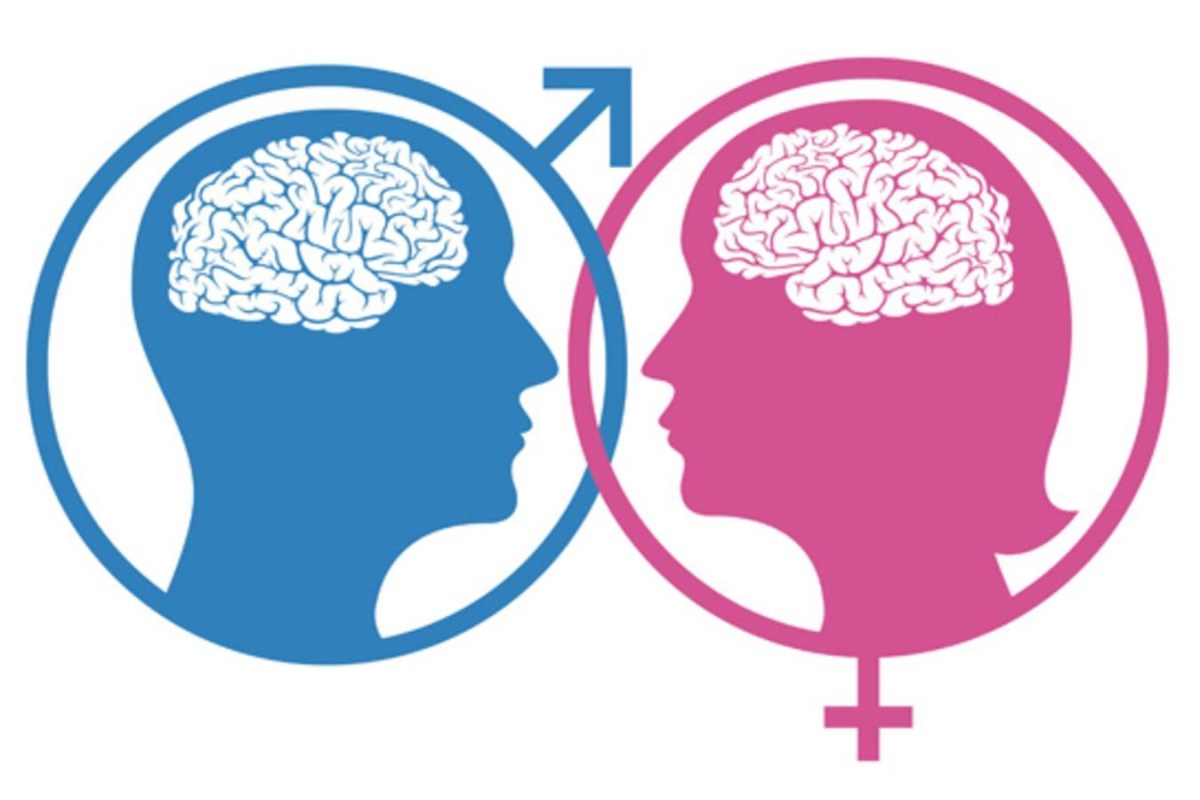
The biggest takeaway for me is the notion that not only is gender a social construct, but so is sex itself. Previously, I have defended the sex-gender distinction, but in fact, scientific taxonomies are still social constructs—only in the scientific community rather than the greater community at large.
Abigail’s platypus drives home the point. Not that it’s some big reveal. Another less poignient analogy is fruit and vegetable classification. Tomatoes are fruits. Mellons—watermellons, pumpkins, and so on—are fruits. Say it ain’t so.
Give it a viewing and like or comment here and/or there.
Here I am yet again writing about something I am not particularly equiped to do. In other fora, I’ve been directed again to Lacan vis-à-vis a thread about Lacan’s perspective on the real. I’ve commented on Lacan before, usually in the context of eschewing any philosophy founded on psychology—especially psychoanalysis. Explaining that I have a reading backlog extending beyond my likely lifespan, it was recommended that I read Jacques Lacan by Sean Homer, so I am sharing the recommendation. Anything by Bruce Fink was another reco. Noam Chomsky takes an ad hominem swipe at Lacan here.
I decided to watch a few videos (including this, this, and this) to survey some of Lacan’s ideas, knowing that something could be lost in the translation. Let’s just say that I was underwhelmed.
In a nutshell, my biggest contention is the notion of the unconscious as an active agent.
According to my understanding, Lacan posits that there is a ‘real’ out there, but it is obscured by language and subject to interpretation. To him the real is a Void.
Psychoanalysis presumes being able to get closer to the ‘truth’ of reality. Like astrologers and fortune-tellers, Psychoanalyst primary defence is that not all knowledge is evidence-based or falsifyable. My problem is that I am not open to another way of experiencing the world, but they somehow have privileged access to this truth. Of course, this is a similar to religious claims of some special spiritual access that opens when you believe.
To me, the Void is as apt a metaphor as any. And while we both agree that the real is inaccessible, I don’t accept the impostition of the how and the why. What Lacan does—and Freud before him and psychoanalysts more generally—is to inject hows and whys into the story. In this narrative, the unconscious has active powers, (as opposed to negative space), where memories (in whatever form) may be repressed and actions may be triggered (or activated) by unconscious urges or desires. I consider this last train of thought wholly imagined and fabricated. This void and the unconscious has no purpose.
Along the way, I do agree with Lacan’s poststructuralist position. I have no issues with symbolic or metaphoric concepts and speech. The contention arrises when one attempts to claim the metaphoric to be concrete. This is the same contention I have with people who take the metaphoric text of the bible and cencretise it. There are other problems there, but I’ll quit now.
This article suggests an interesting twist on the notion of peception and facts. In this instance, the human sensory organs don’t capture what’s there like a camera. It takes cues from the environs and fills in details heuristically. This mirror an effect I recall reading in a book, Drawing on the Right Side of the Brain*, where most people can’t draw what they see because their heuristic perception kicks in. This is essentially Kahneman and Tversky’s System I outlined in Kahneman’s Thinking, Fast and Slow.
This may come with a heavy dose of confirmation bias, but it fits my belief that reality is generally unaccessible with huamn sensory perception organs. it adds another layer or dimention to consider.
* I am aware that the simplistic right and left side distinction is an oversimplification, but this is the way of categorisation.
A Facebook friend is pushing for the adoption of a new phrase: red washing, where it indicates a false sense of ownership and control. This friend has collectivist leanings, so perhaps that’s where the red comes from. It doesn’t make logical sense to me, but rather than focus on the phrase itself, I want to discuss the sentiment and intent. Essentially, his contention is that some forms of ownership don’t offer the same sense of control as others. If I own a car, or a pencil, it’s mine to do with it what I please. But if I only own a piece of something, my control diminishes. This is especially true where my ownership is a minority share.
The first mistake my friend makes is to presume that ownership and control are one in the same. I don’t feel we need to discuss the case where the State controls the limits of any ownership. You can own property, but what you can construct on it is limited by zoning laws and perhaps community guidelines. You can own a car, but you can’t drive it on public roads at 200 MPH, or paint it like a police car affixed with blue and red lights. You can’t stab your neighbour with the pencil you own. And you can’t own or even possess heroin under normal circumstances. I feel that these ownership restrictions are obvious. These are aspects of control ceded to the State. Some Libertarians may baulk, but for the most part, these are generally accepted limitations.
My interest here is the notion of diluted ownership. This really underscores the difference between ownership and control. A simple illustrative example is a publicly traded company. One can own a share in that company, but ostensibly, this gives you no control. If one holds a million shares, maybe they have a voice. If one has a majority share or can create a coalition to compose a majority share, one ostensibly has control. Otherwise, although your ownership may grant you other advantages, control is not one of them. One can benefit by price increases in the marketplace, perhaps collect dividends, and you can cast your proxy vote, but these don’t represent control.
Likewise, this is how democracy operates in practice. One has a vote. Theoretically, it’s one person, one vote—one vote per person. Though in the United States this is the system de jure, not de facto system, where it’s closer to one vote per dollar.
Consider the United States. In 2020, there were 239,000,000 eligible voters. Each eligible voter is an owner of this democracy or republic. Pick your poison. Effectively, this means that one’s ownership share affords them 1/239,000,000 control. This wouldn’t even qualify as homoeopathic, and that’s a pretty low bar.
Dehydrated Water
I’ve commented elsewhere on how democracy is a specious proposition. That it only provides an ‘illusion of control‘. This is fine for the power structure. All they need to operate is to maintain this illusion and for the people to defend their voiceless voices.
Of course, the Republican flavour of Democracy is even worse. Not the Republican party. The sense of representative democracy over direct democracy or even anarchy. Republicanism adds a principle-agency challenge to it’s already weak-tea proposition.
Memories are fallible. I’d thought I had written on this topic of opiates and public policy at length. And perhaps I have. Just not here. Perhaps that’s a good thing. Searching my blog for my take on opiates, I find that I cite Marx’s ‘Religion is the opiate of the masses‘, four times—make that five. But nothing more.
Carl Hart recently published a book on his heroin use—Drug Use for Grown-Ups: Chasing Liberty in the Land of Fear. By some accounts, Carl might appear to be the stereotypical heroin addict in the United States. Well, he’s black, so there’s that. But that’s where the stereotype ends.
Carl Hart is a professor of neuroscience in the psychology department of Ivy League, Columbia University—at least before he published his book. I’ve not read his book, but at my blog I’ve provided a link to the Guardian article, which prompted this post.
The gist I get from having read the Atlantic article is that the public health narrative surrounding heroin and other illicit drugs is akin to the hype of the days when Reefer Madness was all the moral outrage. And make no mistake—this outrage has everything to do with moral one-upmanship and nothing to do with health outcomes. This is pure and simple cultural performativism signalling the higher ground one occupies. As is common enough, many people have actually internalised their misinformation and disinformation to the point they truly believe there is a medical basis to their belief systems. If they are at all introspective, they would see that morals and Calvinism have nothing to do with this purported health care policy. It’s a seemingly reasonable, logical place to arrive. No emotional element is necessary.
But allow me to step back for a moment. Am I saying that there are no possible harmful effect for consuming drugs and other chemicals? No. Am I claiming that no one has ever died as a result of chemical intoxication or overdose? No, again. Am I saying that drug abuse does not incapacitate some people? Nope. I am saying none of the above. I am claiming that hyperbole abounds, the causal connection is overattributed, and cofactors are ignored in favour of an orthodox etiology.
For the record, I am a teetotaler. I do not abuse or even use chemicals referred to as drugs—illicit or otherwise. I don’t drink alcohol, don’t smoke cigarettes. I don’t even drink coffee or covfefe. I do drink Coca Cola, so my big vice in this regard is caffeine. Even rarely do I take ibuprofen or acetaminophen.
As I note in my Defence of Capitalism post, it’s difficult to get good second-hand information of illicit drugs. The medical-industrial complex and the official police state peddle fear and disinformation. Whether they believe the information they dispense is true or not is irrelevant. What is important is the low truth content. It makes one wonder what to trust and what not to when these agencies routinely propagate falsehoods and misrepresent truth.
This misrepresentation isn’t limited to opiates. I found it interesting when Michael Phelps won gold at the Olympics, only to announce that he was the consummate pothead, and smoking weed was part of his daily routine. Here’s what the official Olympics website says about him, by the time he retired at Rio 2016 at the age of 31, Michael Phelps had collected a total of 23 golds, three silvers and two bronzes at the Olympics, a record-breaking haul that looks unlikely to be bettered for many years to come. So much for the lazy stoner stereotype. As marijuana becomes more accepted by mainstream culture, we come to notice that many of the so-called mental health issues were just fabricated. The purpose was to shroud a moral argument in medical legitimacy. Whether the healthcare industry was complicit or it was the law enforcement regime gone rogue is a separate question. Yet again, it undermines the legitimacy of any claims.
In 2020, the world encountered the Coronavirus, COVID-19. And medical expertise, particularly around immunology and the spread of pathogens, came into question. In the United States and United Kingdom, their misinformation was further exacerbated by administrations hostile to science. But given the history of misinformation for political purposes, it may be premature to blame the general public for being reluctant to trust the alarms. They’ve created the classic Boy Who Cried Wolf scenario. And so the question becomes what health information can one trust? And who is the authoritative source?
This viral TikTok by @viral_actor demonstrates with humour how designs and purposes don’t always coincide. The narrative of the clip is that the woman on the left designed a shape sorting toy. Metaphorically, we could assume that the design is the user interface for some software application or game.
The tester, in the right frame, ‘tests’ the interface. One way of testing is to provide the tester with a purpose and little else, as this is how much people will approach a new product. It’s quite likely that the instruction was to put the shapes into the bin. The design, on the other hand, was supposed to pair a unique avenue for each block shape (in a particular orientation) with each opening through which to insert the shape.
Let’s be clear, the user who inserts the blocks ‘incorrectly’ relative to the design is doing nothing wrong (morally or kinetically). The problem is that the designer had an intent in mind and didn’t consider full domain of possibilities. This interface design can be improved to solve for the unique 1:1 piece-hole relationship. In fact, the testing feedback provides input for an engineering—or interface design—solution.
The tester, having been giving the task of putting blocks in a bin might be justified in entertaining the belief that the best design might have been a lidless bin—or that a single hole would have sufficed.
In this case, the video producer is employing humour, so we can ignore that an adult is not likely to be the target audience would probably be infants or to test persons for visual-spatial perception. If this is the case, the tester group should necessarily be infants. Below, we can see a similar problem, again using humour.
The parents are overjoyed to see their infant distracted by the hanging mobile. Little did they anticipate the enduring trauma it would commence.
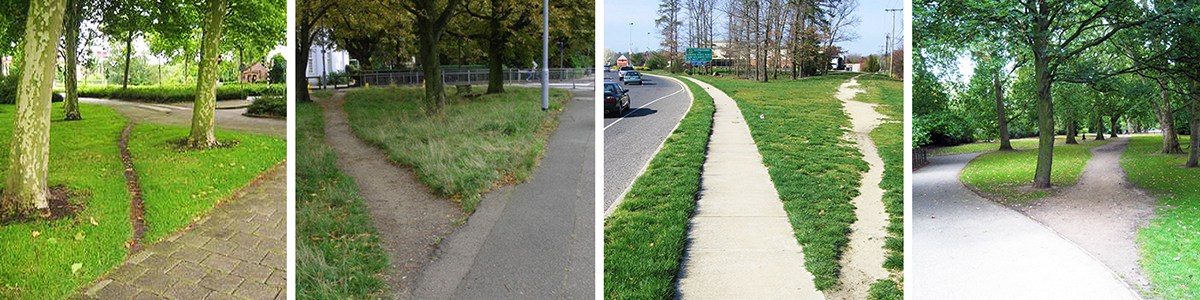
Most people with experience in the design space have seen many of these design faux pas. Here are some design-experience chestnuts. Notice the common thread. It’s also good to remember our maths lessons: The shortest distance between two points is a straight line—as evidenced axiomatically by the hypotenuse is the square root of the sum of the squares, and so will always be shorter for any right angle (and even this slightly obtuse rendition). Thanks for that, Pythagoras.
Next, we have evidence that a designer created a barrier against bicycle traffic. To be fair, it did deter bicycle traffic from that path, but somehow I don’t think that was the sole intent. I’ll also imagine that the designed footpath route is as well travelled as the alternate path.
Design versus Experience
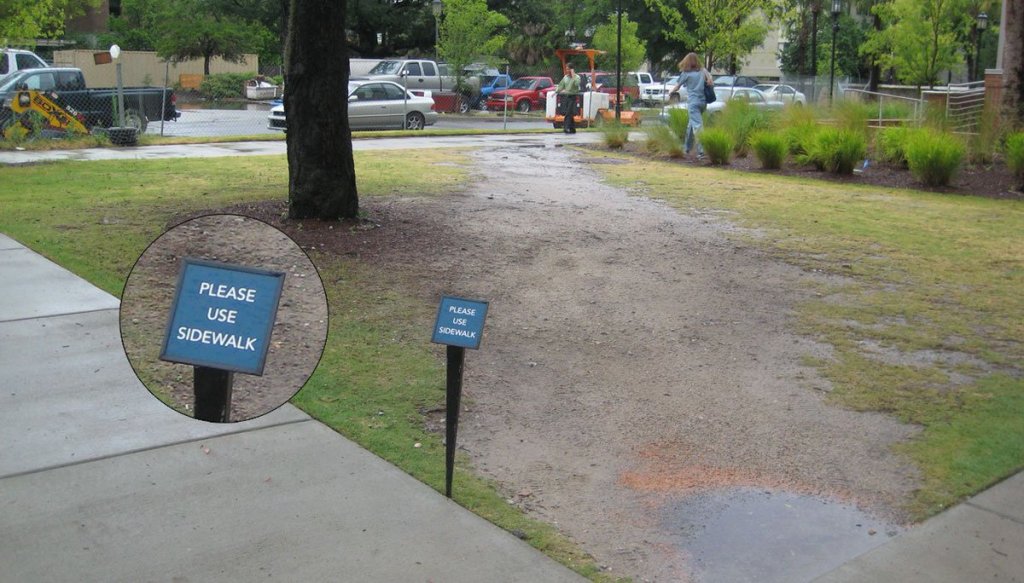
Please Use Sidewalk
For the image above, it seems that the path traversers (users) should put up their own sign, but for now they protest performatively.
Below, we see an intentional and mostly effective design meant to keep bicycle riders off of this footbridge.
None Shall Pass
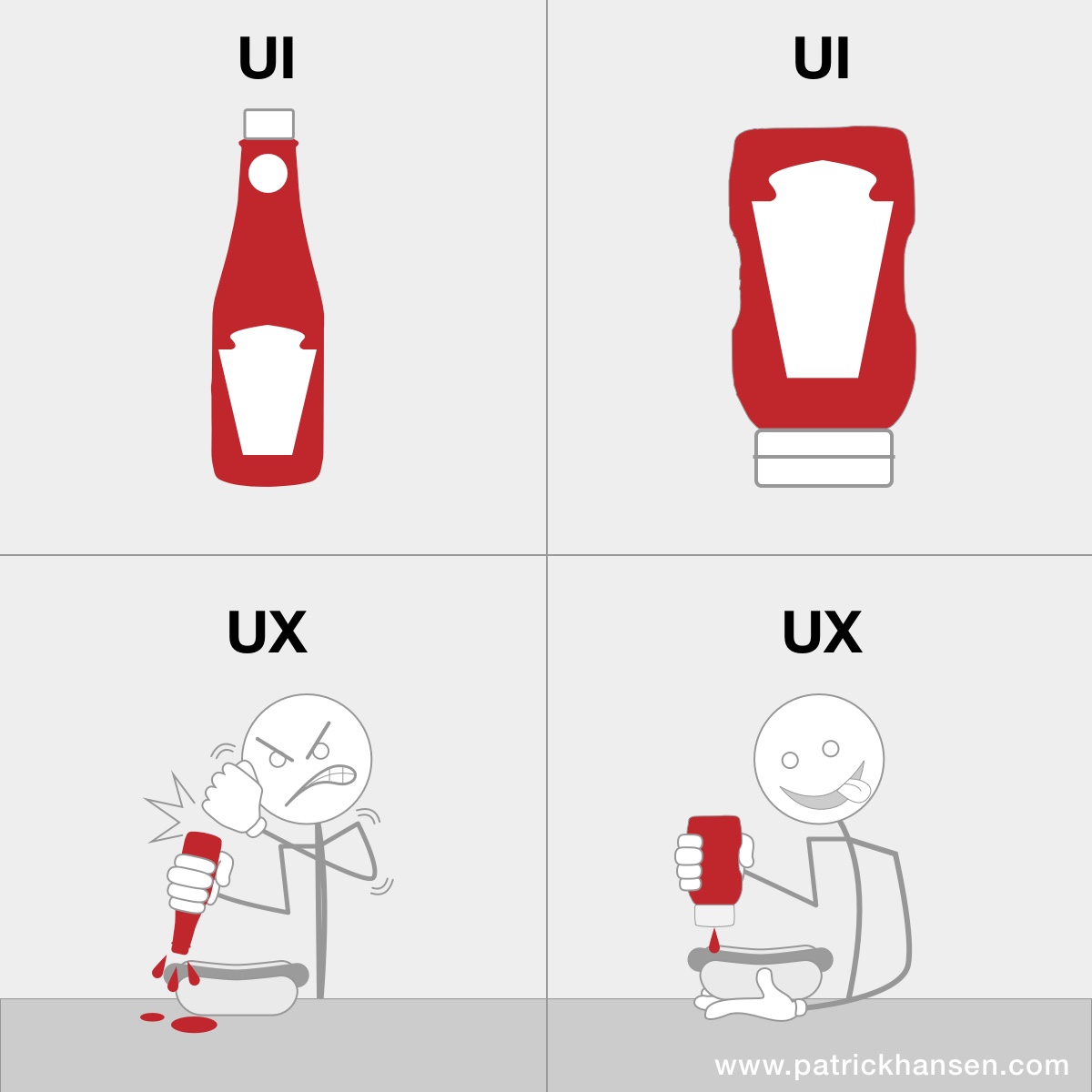
One final note is to illustrate the difference between user interface design (UI) and user experience design. At teh top, we see two catsup (ketchup?) bottles. The traditional design on the left opens at the top and would not balance well upside down. On the right, the bottle opens down, and it sets well in this orientation. (To be fair, I’ve stored the top-right bottle upside down in my fridge, so perhaps a visual signal, say a narrower top, might obviate this habit.
At the bottom, we see the experiential result of the interface design: The age-old challenge of getting the product out of the bottle on the left versus the instance on the right. It also appears that the narrow top of the left design was intentional to slow the flow, so perhaps widening the aperture may have countered that requirement. The righthand design does have an even smaller aperture, but the egress is broader until that point, and the orientation must compensate for it.
We’ve also seen this design carry over to shampoo bottles.
People influence one another and, when they’re together, they have a tendency to desire the same things, primarily not because those things are rare but because, contrary to what most philosophers think, imitation also bears on desire. Humans essentially try to base their being, their profound nature and essence, on the desire of their peers.
“Mimetic Desire: Shakespeare Rather than Plato.” When These Things Begin: Conversations with Michel Treguer, by René Girard and Trevor Cribben Merrill
Although I have some reservations—or at least reserve some latitude—, I tend to agree with Girard. Desire is a social construct. Desire is separate to needs. Desires are wants. As accomodated in Economics, we don’t need what we want, but we want what we need. We desire what we need.
we don’t need what we want, but we want what we need
What Girard is essentially saying is that I want what I want because you want it. This is independent of value in an economic sense. Memetically, the value of an object increases relative to the perceiver simply because another person wants it. In my reckoning, I’d separate want from desire or at least elevate desire to a higher degree of wanting.
Girard termed this triangular relationship between subject (you), object (the thing), and the mediator (the influencer) mimetic, to mimic. I suppose some of this might be considered to be memetic, but I also suppose that memes serve to simplify rather than serve as a distinct transmission vector.
circa 2016
My question is—exacerbated during this pandemic—how does this operate in isolation? I consider myself. I am not an ascetic by most definitions, but I am somewhat of a minimalist. My only ‘vices’ are my computer and my guitars. I used to be a professional musician—though most of that was spent on the other side of the console—and I was a Gibson snob. From the perspective of emotional desire, I still am. There is a certain nostalgia, but I don’t play out anymore, and I’m not seriously recording, so I don’t need the same perceived quality of an old Gibson.
Guitarists know that different guitars give different sounds. I’ve owned as many as 10 guitars at a time, and each had its purpose. Some was feel. This guitar was for Blues, this was other for Grunge, and that was for Jazz…and that for Fusion and that for a retro sound. This one had a fast neck, and this one sustained for days. This one was tuned à la Keith Richards, sans a string, to an Open G, and the was set up for Drop C, and of course there was the Standard-tuned one for good measure
Jason & Me circa 2012
Did I need 10 guitars? No. Did I need 1? Not really—not unless I wanted to be a musician, desired to be a musician, so the degree of freedom was l, given this other desire. Having 1 guitar for a guitar player is not the same as a painter with only one colour of paint, but it almost feels like it. It’s certainly a convenience, and it allows players to express themselves artistically.
The question isn’t why I desired a guitar, but why I wanted to be a musician, and of all the instruments, why the guitar—and why did I prefer this genre over that. I’ll admit that my tastes are rather eclectic, but all that says is that I mimic eclecticism or eccentrism. My parents are not eclectic. Most of my friends are mainstream whitebread people—none I’d deem eclectic.
I’m rambling. Just because I don’t remember the source of my desire doesn’t mean there is no source. Perhaps it’s a composite source. I can’t say. Perhaps the outcome I’m naming, say eclecticism, is incorrect, so I am seeking the wrong source.
circa 2004
My point was that I don’t need a Gibson to be satisfied. First, I’ve already owed them, and I don’t have the same performative needs. But I still want to play, and I still want to exercise some artistic freedom, so I still have a few guitars.
To wrap this up, I’ll leave with an unpaid mimitec endorsement of Harley Benton guitars. The last guitar I purchased was this Harley Benton Black Paisley TE70. It’s very fit, and I picked it up for about €200, which included shipping and handling. They are German-built. When I was a kid, a guitar at this price range would have be borderline unplayable and won’t sound shite-like. These aren’t €1,000 instruments, but you’d be hard pressed to find a 5x value differential. They are build solid and have been given extra care not previously seen in down-market instruments. If I wanted to spend another €200, I could upgrade the pickups and for a bit more swap out the electronics to bigger potentiometers—but I won’t. I was planning to splurge and spend €50 on locking machine heads. Nope. Good enough. At €200 a pop, I could afford all sorts of configurations, but even that desire has waned—at least a bit, at least for a while.
Chump in Chief* wrote a piece on dementia using analogue of the ship of Theseus. As a topic, Hobbes’** Theseus thought experiment has been well-covered, but that’s never stopped me before.
This is all about identity. Essentially, there are two perspectives. To an observer not on the ship or aware of the transformation, they would be none the wiser. For all intents and purposes, if they had ever seen the ship before, it’s the same. But what about those on the ship?
For nearly all of these observers, it’s almost unquestionably still the same ship. In a manner paralleling a person’s cells being sloughed off every 7 years, the cells in place at the start aren’t there after 7 years. Most will not doubt that you are the same person.
the average human cell is about 7 to 10 years old
As cells are continually dying and replacing themselves, for an adult the average human cell is about 7 to 10 years old, which might be interpreted as saying in the fashion of Theses’ ship that a person is anew each 7 to 10 years. Let’s ignore that this is an average, and many cells have a lifespan of only a few days whilst others—cerebral cells in particular—are here from the start and so are as old as the person.
Another perspective is to consider the replacement parts: would it matter if the colour of the parts changed in the process? What about the materials? What about the underlying architecture? What if the departing sloop arrived a schooner? Weight? What then?
My favourite extension of this thought experiment is to ask the question two-fold: Not only do we ask if this ship built with new materials is still Theseus’ ship—which to be fair is more a question of ownership than of identity—, but what if I reconstruct the original ship with the original materials. Are these both Theseus’ ships? Can we continue this exercise with new material ad infinitum?
As far as I know, we can’t repurpose cells in this fashion, but what if we could? There are many such Star Trek transporter mishap thought experiments, or the Duplicates Paradox.
In these experiments, a transporting device disintegrates the subject, and replicates the subject at a distance—but this replication presumably uses different atoms and cells, and so what if a duplicate copy is made rather than the replacement copy? Who’s identity prevails? Is it murder to eliminate one of the duplicates? Similar questions have played out in the science fiction / fantasy space.
Locke and others suggest that for people, memory and the continuity of thought are key, but your thoughts of me are not the same as my thoughts of me. This is why an amnesiac may no longer maintain some original identity, and yet to the familiar outside observer, this shell of a person remains intact. This is pretty much how it plays out with zombies and dementia patients. This sense of identity is projected upon the person rather than exuded from them.
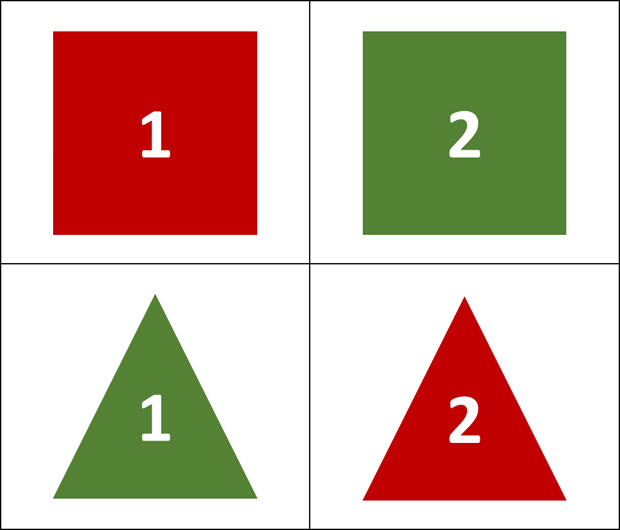
So what is my perspective? Rather than a paradox, it is more a problem of vaguity or ambiguity and how we’re defining sameness. There are many dimensions to similarity. I can present you a red square, a green square, a blue triangle, and a green triangle and play the Sesame Street ‘one of these things is not like the other game.
Is the sameness the colour, the shape, or the number? Could one be comparing area or perimeter?
So, I’ve gone off the reservation. I don’t put a lot of weight in notion of identity. It has evolutionary merit and is an effect of humans’ nature (as it were) to categorise and taxonomise.
* This Chief Chump charge may be unwarranted or even understated, as I don’t know this bloke. ** This is the same Hobbes with the ‘solitary, poor, nasty, brutish, and short’ claim to fame.
I was writing a post about cop and crime shows and fittingly commenting on cops and crime, when my girlfriend turned on Manhunt: Unabomber, a series about serial bomber Ted Kaczynski. I remember when the FBI finally caught Ted and publicised this story, but I don’t know how much of the series was dramatised versus the facts, so my comments will be on the series and not the underlying events.
I title this post after his published ‘manifesto’, Industrial Society and Its Future, but it otherwise has nothing to do with this topic or his manifesto. To me, Ted Kaczynski seems to be a contemporary Thoreau or Rousseau, a primitivist born into the wrong century.
From a philosophical position, the series depicted the perils of taking a deontological approach. Process prevailed over consequences, which resulted taking 18 years to identify and capture Kaczynski. Time and again, process and pushing paper were promoted over new methods.
criminal profiling is the astrology of forensics
As people familiar with me know, I find the discipline of psychology to be pseudoscience (or perhaps simply a parascience), and so-called criminal profiling is the astrology of forensics, which are already a bit sketchy from the start.
Television promotes the logical rationalism underlying forensic science, connecting the dots to a forgone conclusion, if only the right dots are found. As with most law enforcement and court dramas, the focus is on the good guys overcoming the bad guys. Sometimes, it’s the good cop rooting out the bad cops or the perils of a cop who crosses the line to the dark side. These shows want to show how procedural criminology is in order to dissuade people from taking this path.
Knowingly or otherwise, this is propaganda. The fact is that most crime goes unsolved. Most criminals don’t get caught. Many who get caught are not convicted. Some convicted didn’t commit the crime they have been charged with. From an economic perspective, the vast monetary value is taken by white collar professionals with MBAs not burglars and bank robbers.
Systems need people to have confidence in systems. It’s self-serving. The propaganda is important to shore up confidence in the system of law & order, but it’s analogous to slot machines in Vegas or Atlantic City or wherever. When a person wins, there are bells and lights to increase the excitement in the room. But this misses the losers. If the sound was for losers and not winners, the cacophony might be deafening.
Henry Ford failed at 7 business before succeeding
This propaganda overplays winners and concentrates focus. This is classic cognitive survivorship bias. But don’t ask about the losers. This framing isn’t limited to law enforcement. It is also employed in the prevailing Capitalist narrative, but it under advertises the fact that most entrepreneurs fail. Counter arguments are presented in the likes of Henry Ford failed at 7 business before succeeding. If you fail, just try again. It has to work out for you eventually—unless, of course, you aren’t working hard enough—not working as hard as the winners, not paying your dues.
Whilst watching, I found myself scoffing time and again. I am not a Romantic and not a Primative, so I didn’t exactly side with Kaczynski, but I definitely didn’t side with the system, even if that’s not what he was railing against.
Of interest to me was the forensic linguistics. Humourous to me was his choice of spelling. Like me, he wrote in international English. The series represented his spelling as accepted variants, but this is a US-centric position. In fact, most the the world that speaks English employes the British flavour, which is closer to international English than so-called American English, which is only spoken in the US and Central and northern South America. The rest of the world doesn’t use American English. I chose to use international English after high school. Occasionally I get comments and criticisms, but my grammatical footing is stronger than the vast majority of these. The biggest factor is that I don’t identify as an American. Rather, I am a citizen of the world. Perhaps Esperanto?
The United States have seen ‘stolen elections‘ before, but the last time this happened in a presidential election—hanging chads, and all—, Al Gore was on the losing end of a misguided Supreme Court decision that landed George W Bush into the Whitehouse. This time, we see Donald J Trump on the losing end and Joe Biden running the victory lap—except Trump was running a victory lap himself until the weight of reality stalled him.
Gore is an Institutionalist.
Many Gore supporters felt upset (and somewhat betrayed) as he conceded the election to Bush. Gore is an Institutionalist. For all of their hubris, some politicians still see the institution as a higher power greater than them. Al Gore is one of these. Despite all of their faults, most of the past presidents have been institutionalists—systemists. One of the benefits of the US system is a peaceful transfer of power. To preserve a system, proponents need to maintain the mythos of that institution.
Gore said that he fought the good fight, but by the rules of the system, he lost. Not different to a court case lost on technical grounds rather than merit, he sucked it up and demurred to the system. It may not be perfect, but it works.
Trump is not an institutionalist.
Enter Donald Trump. Trump is not an institutionalist. He is entirely self-serving—a narcissist in pop-psychology vogue. He makes no qualms about disparaging the system. He seeded the fraud argument just to be able to say, ‘I told you so’, in the event of a loss. And so he did.
— Fin —
Donald J Trump, like others before him—Homer J Simpson, Barney J Rubble, Forrest J Gump?—is a simple man—a simpleton. George W Bush was another. Many of their followers are simple, too, though not all are simpletons. They just want to believe. It’s human nature.
I am not an institutionalist, but I understand the comfort zone institutions provoke. And beyond nostalgia, there can be a certain benefit to institutions. For one, it’s easier to navigate charted territory. So, whilst I don’t have a horse in the institutional race, I can see how one’s disposition towards can be a factor in how it treats it.
















 Philosophics