Pragmatic Limitations of Language

Heather at https://hermeneutrix.com/ commented briefly on the recent Political Spectrum post. Visting her site, she is all about words. Check it out. But even before visiting, I had the idea to visualise my reaction to her response.

To be fair, this is a response I get from my Pragmatist colleagues: don’t get your knickers in a twist arguing semantics. But in my noggin, I envision this Venn diagamme. (Well, not exactly. I just made this up, but you get the point.) Since the topic happened to be on the definition of Conservative, I’ll retain the context, but this is arbitrary.

Before I get to this, I want to set the stage with a more common and arguably more agreeable term: tree. If we ask a large number of people on the street to provide attributes of a tree, we might get something like this image abstraction below.

Tree

Venn: Tree

Although people may have different ideas, there will be some key core elements—trunks, branches, and roots. Of course, within the taxonomy of trees, there are types—pine, oak, willow, redwood, birch, and so on—each sharing these key attributes. These trees have some distinct attributes—coniferous versus deciduous, green versus red, flowering versus non versus, fruit-bearing, nut-bearing, height, and age. I think I can stop.

In general, I think it’s safe to say that if you point to a tree, and ask what it is to a person with sight and language, they will either respond ‘It’s a tree’ or ‘It’s an elm’. Even the elm response can be quickly qualified with a follow-up question, “What is an Elm?”

I understand that a botanist or an arborist may have a more nuanced definition. In fact, when I lived in a rental property outside of Chicago, my wife at the time defended the life of a tree that looked rather like a berry-bearing ficus, but that the village elders said was a weed and not allowed to remain. Here, we get into whether a tomato is a fruit or a vegetable or a squash is a berry or a fruit, or is corn a vegetable or a grain—or are we discussing maize? I get it. Even here, we can quickly come to terms. I said chips; I meant fries.

I could even get into the political conversation where the US justice system tried to redefine person to strip the rights away from those they didn’t want to have them. Of course, the United States has a history of not considering people to be people, though some were given 3/5ths and 4/5ths of personhood. Mighty white of them.

Back to trees. There are natural and artificial trees, but these are just simulations—hullo, Baudrillard. In the English language, there are non-arboreal trees, some not even rendered from fibres. We’ve got shoe trees—for which I fail to see the relationship to trees—and bell trees. We even have tree structures, like a taxonomy or a family tree, leveraging the branching metaphor. Some of these things escape the main bubble, but the connexion is never lost and is easy to navigate to a core understanding.

Conservative

I think we are amicably on the same page here and ready to move on from tree to conservative. Here, the circles are much more varied and divergent. Although there is common ground, as well there are points where there is no intersection in meaning.

Venn: Conservative

I’ve discussed a simpler abstract term before: fairness. To recapitulate, most people will tell you they want situations in the world to be fair. Only fair means entirely different things to different people. I’ve written about this in several places, so I’ll continue on our conservative journey.
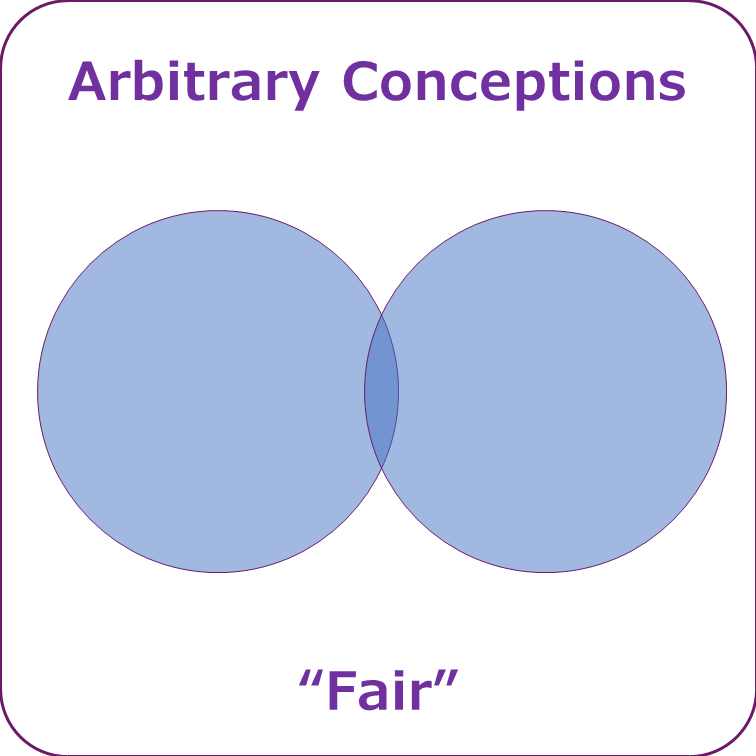
Venn: Fair (oversimplified for effect)

Not only has the term conservative morphed over the years, it has different meanings—though to be fair, probably fewer than ‘liberal’. As I’ve discussed here before prior to the recent post, liberals are conservatives, but no one is really defending this position because the goal is identity, and identity involved separation to be distinguished.

Like fair, conservative has some common ground. The challenge is to understand which flavour is being used. Are you communicating by using the same term, or are you talking across each other? In some cases, this can lead to what I’ll call false positives (borrowing the language of statistical errors) where you think you are in agreement, except you aren’t. The other side of this coin is the false negative, where you think you are in disagreement when in fact you are talking about two different things.

This happened to me. A mate asked me to meet her at a certain time and place —I’ll just use McDonald’s because it is so ubiquitous. I went to the McDonald’s and waited. After a while, she called.

“Are you close?”

I scan the car park.

“I don’t see you. Maybe I missed you. I’m parked on the side near Taco Bell, not the oil change place.”

“There’s no Taco Bell at McDonald’s. What McDonald’s did you go to?”

It turns out that she was a distance away and wanted me to meet her halfway—like two-thirds to be honest. I assumed she meant the one we’d commonly visit.

This is a false positive. Communication was presumed to occur. It did. It just wasn’t useful. And since the reason for the rendezvous in the first place is to save time—one might say to ‘conserve’ time, but even I wouldn’t stoop to such a low target.

Wrapping up, the challenge is that trees are objects in the world. We can quickly recalibrate ourselves by reference. This is not possible for abstract concepts. I tend to refer to these are weasel words. Some use these words unknowingly. Whenever I hear some yahoo wintering on about freedom or justice, my first impression is that this bloke is tripping on a Kool-Aid propaganda overdose. Most common people falsely believe that people can understand what’s in their heads.

And to be fair—the left sort, not the one on the right—, when these yahoos utter the term, they are probably using it like their neighbour. But walk a few blocks or miles, and that bet is off. Sure, if the people have a common connexion, this might moderate the differences. But if one attempts to triangulate across worldviews, all bets are off. You may or may not be singing from the same hymnal.

Political Spectrum

I am trying to avoid commenting on the recent SCOTUS decision and how it is symptomatic of how the United States remains a failed state—at least a zombie state—, so this preamble should suffice for now.

I was chatting politics into the wee hours with my son, who’s been on this earth for almost 25 years now. I consider myself to be on the left of traditional political scales. He considers himself to be on the right, but he’s trying to make sense of the scales and dimensions. He had two questions: First, ‘What are the crucial dimensions and positions that define left and right?’ Second, ‘Where do Liberals fit into the equation?’

Knowing me, he wanted to provide some context and confer with me his knowledge that would also serve to frame and anchor the conversation. A key point was to have clarified the adopted nomenclature and positioning on a theoretical map.

We started with the origins of the left-right distinction, which was barely a valid dichotomy even as it was coined in France. There was no duolith. Those on the left or right had features in common but taken holistically, this was a reductionist categorisation, as tends to happen. Exacerbating this, as it does today, still, the politicians with voices remained to the right of the unvoices masses.

He asked about the difference between freedom and liberty because his sources differentiate the two. Whilst connotation and nuance may enter the picture, etymologically speaking, freedom is a native English word whilst liberty is French via Latin. Connotatively, freedom is an absolute measure whilst liberty is granted within a political framework. Positive and negative liberties aside, liberty is an attenuator. It restricts freedom even if it allows most of the signal through. Effectively, liberty is permission by the state to act in certain ways.

By the end of the conversation, he was framing the key difference around notions of national identity and nationalism—I versus we. I shared my thoughts on the construction of identity, thus making for a poor foundation, though we both agreed that national narratives have been the impetus for much activity. (I am reluctant to insert the word progress here.)

After our conversation, I began researching dimensions established or otherwise proposed by political science. This led me to a place I found interesting—the distinction between radical, progressive, conservative, and reactionary positions. For some reason, this never really occurred to me.

I’m not sure one can employ these terms in general discussion without definition and qualification, but I feel they are useful in their own right. Typically, I view the political landscape—at the highest level and with a US-bent—as Left (communists, socialists, anarchists, progressives) and Right (conservatives, liberals, and fascists). I also know that this is imprecise, but maps always are.

This new vocabulary helps by distilling the map to this—ordered differently:

  • Right
    • Conservative
    • Reactionary
  • Left
    • Progressive
    • Radical

Conservative

Conservatives want to maintain the status quo. This is interesting usage adoption. Fundamentally, advocates of this view want to promote and to preserve traditional social institutions and practices. In Western culture, conservatives seek to preserve a range of institutions such as organized religion, parliamentary government, and property rights. Conservatives tend to favour institutions and practices that guarantee stability and evolved gradually. Adherents of conservatism often oppose progressivism and seek a return to traditional values

In Western culture, conservatives seek to preserve a range of institutions such as organized religion, parliamentary government, and property rights.

My first thoughts when I hear the term are a harkening back to the old ways—the Ozzie and Harriott mythos, white picket fences, Mom and apple pie. But this is different. Effectively, rather than reaching back, it wants to preserve the current moment in time. Where it gets more nebulous, I think, is that some people include nostalgia in the now. Duratively, perhaps a person might remember some aspect of their childhood. Though this has been lost by now, they imagine it as part of their identity. This can also extend further back as they wish some other historical aspects can be cherry-picked. Perhaps the white conservative wishes to be able to subjugate women as was the practice in the 1950s of America, but to not conserve high union participation and high marginal tax rates, as affronts to freedom (or whatever). This ends up being an exercise in selective memory and revisionist history-making.

This needs to be distinguished from a so-called traditional conservativism in the tradition of Burke or Hobbes, who want to conserve some sense of fundamental morality they feel derives from nature.

Reactionary

Reactionaries oppose whatever is in effect at the moment—the petulant toddler—but with a twist. Like the conservatives, there is a conservation effort but rather than a focus on the status quo, the focus is on status quo ante, which is a return to the old ways, tried and true.

Progressive

Progressives support social reform. Ostensibly, they don’t oppose tradition, but they feel that old structures need to be reimagined and reinterpreted in face of social and technological change. An underlying metanarrative is the notion of progress. I am not going to comment on progressivism generally and the nuances evident in the American flavour of it.

Radical

Radical politics denotes the intent to transform or replace the fundamental principles of a society or political system, often through social change, structural change, revolution or radical reform

During the 20th century, radical politicians took power in many countries across the world. Such radical leaders included Vladimir Lenin and Joseph Stalin in Russia, Mao Zedong in China, Adolf Hitler in Germany, as well as more mainstream radicals such as Ronald Reagan in the United States and Margaret Thatcher in the United Kingdom. Of course, Donald Trump is a more recent example in the United States.

Summary

To me, these terms operate on a gravity to now. Conservatives are heavily anchored in the familiar and seek stability. Then they see factors in the past that they imagine will also serve this purpose, so they wish to incorporate these and carry them forward. Conservatives are not unaware of the need for change, they just want to not create waves in the process.

Likewise, although placing a heavier weight on the past than even conservatives, reactionaries are not fundamentally opposed to retaining what is working currently. The term working is subjective and perspectival, so they may wish to retain something that works for them at the expense of others. This is a challenge for conservatism as well. Just because racial segregation seemed to work for an equivalent person in the past doesn’t mean it worked well for the excluded.

Like reactionaries, progressives aren’t afraid of keeping a foot in the present—and there may be plenty of lessons to learn from the past—, but they feel that given the change in the underlying terrain, some refactoring is in order.

And then there are the radicals. I suppose that radicals have different motivators, but in essence, they feel that the current implementation is substantially broken, and it needs more than a few small tweaks and a fresh coat of paint. These people are renovating rather than redecorating. They may even want to throw the baby out with the bath water. Some may wish to keep the baby.

As for me, I usually place myself in the Progressive camp, but under the definition, I am more of a radical. The system is broken. We don’t just need to delete it, we need to install a new one.

Thomas Jefferson said that the United States should rewrite the Constitution every 19 years. Why 19 years? Who knows? Given the intransigence in American politics, this would have been a disaster. And given the powers that be, the debate would be over which parts to conserve and which to progress. Being the cynic that I am, my guess is that it would devolve to worse than we have now.

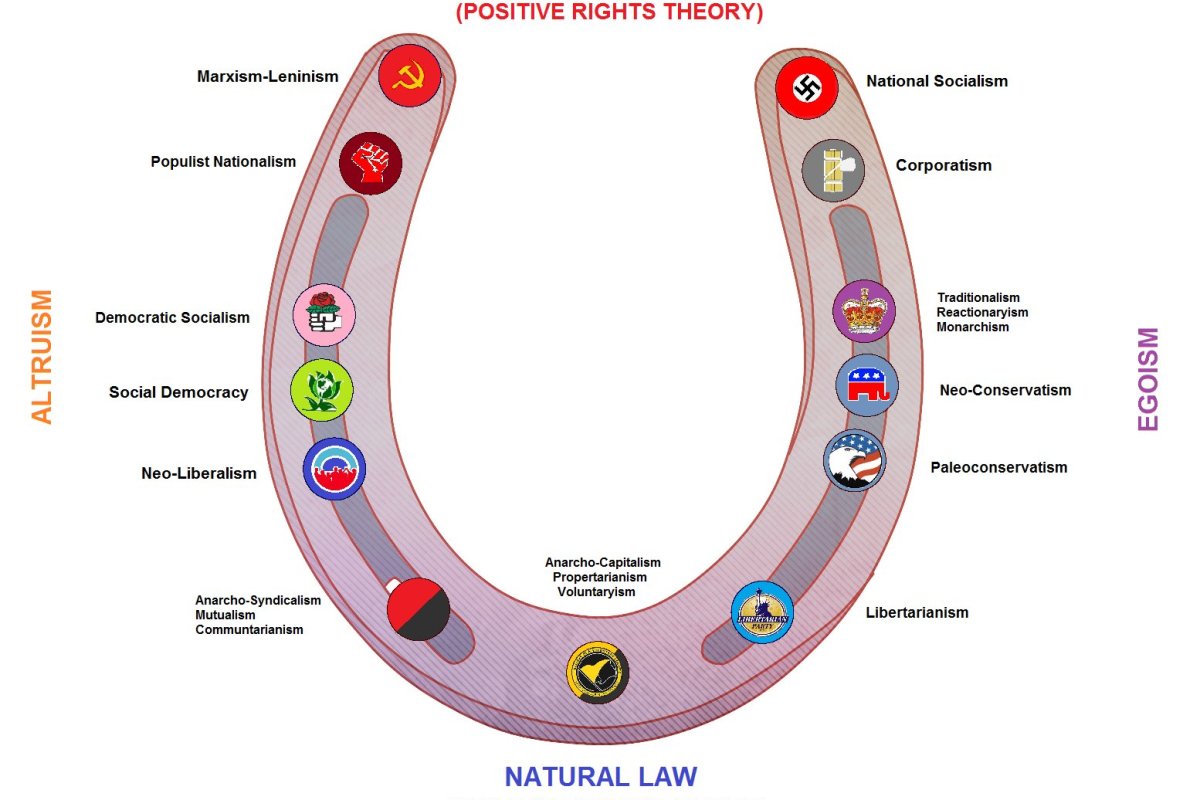
DISCLAIMER: For the record, I don’t endorse the placement of the political ideologies on the horseshoe image, but I find it interesting and it grabbed my attention. I hope it grabbed yours, too.

What is Consciousness?

This infographic helps to articulate various notions of consciousness. Not much more to add.

I think I am partial to emergent theories, but I favour property dualism over emergent. The dualism employed in property dualism doesn’t feel accurate. It’s not dual so much as it just hasn’t been described yet.

I don’t think that physics can express or descriptively characterize everything that exists.

— The Silence of Physics | Galen Strawson | Talks at Google

I want to accept the Buddhist notion, but I can’t seem to not differentiate.

I don’t feel I have enough information on the remainder of these. I could lean on the name and short description, but I feel this would necessarily establish me firmly in Dunning-Kruger territory. There may be even more hypotheses than are captured here.

Quarantine and Social Justice

Gregg Caruso is interested in the notion of Agency from the perspective of justice, desert, and sentencing. This is applied philosophy.

My main argument against the possibility of free will is Nietzsche-Strawson’s causa sui argument, which I’ve touched on a few times by now, but I haven’t yet fully articulated my position. I’ll get to that another day. I’d also like to create another video, as I would like to do for this as I explore in more detail.

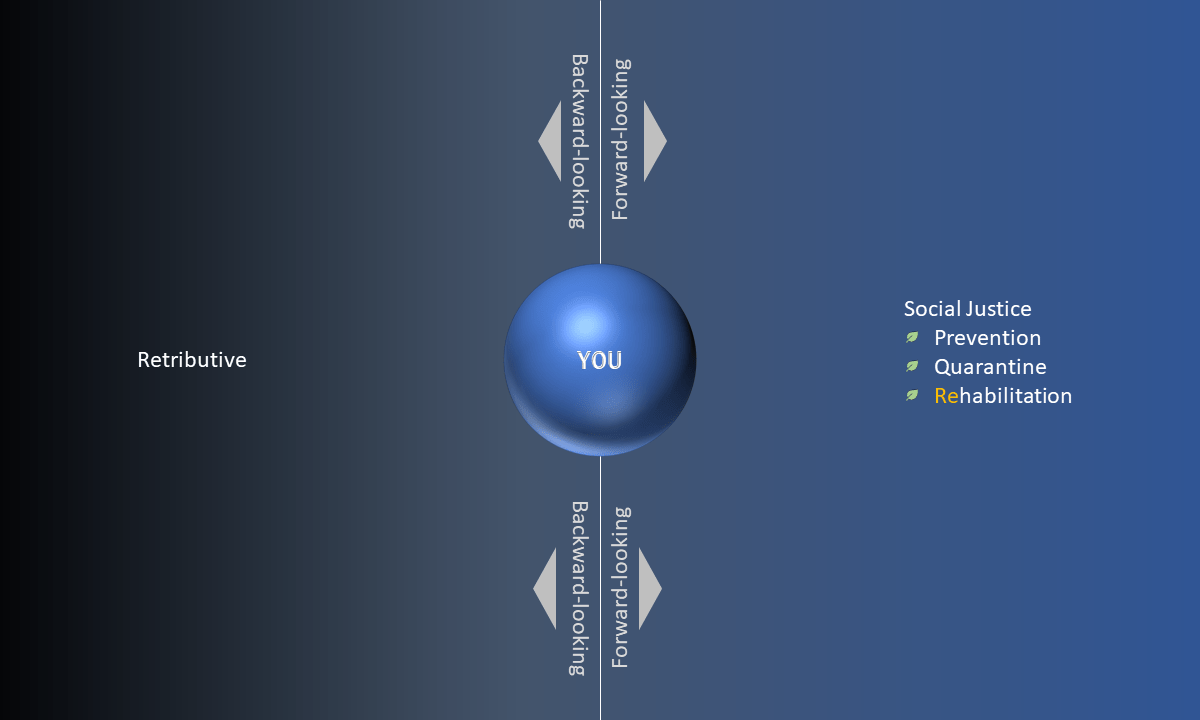
Ostensibly, this is a compatibilist view that leaves a modicum of free will, even with causa sui in place. I hope this illustration will be helpful.

In the centre of the illustration is you, the self of some arbitrary person who shall act as our subject. Let’s assume a couple of basic premises:

  1. We either live in a relaxed causal, deterministic or indeterministic universe.
  2. Causa sui is in full force and effect: one cannot cause any aspect of one’s self.

I include the term relaxed in the first premise, so I don’t have to deal with a fully deterministic universe governed entirely by the notion captured by Schrödinger’s equation. The second premise is in place to serve as a limitation: even if consciousness is an emergent property, its emergence doesn’t grant some insuperable metaphysical powers. One cannot reach outside of one’s self.

The scenario plays out as follows. You have been apprehended for violating some statute. Let’s say that you’ve taken an item from a retail store. As you are leaving the store, the police stop you. When asked if you took the item, you answer in the affirmative. This is a very efficient municipality, so you are taken immediately to a magistrate to make a plea.

In this scenario, Caruso is your attorney at law. His argument is that, given causa sui, you cannot be responsible for who you are. We’ve been here before. Since you can’t be responsible for who you are, any sentence to punish you would be unethical, as you’ve done nothing to deserve it. This is the notion of desert in the realm of retributive justice.

The judge buys this argument, but s/he counters with three possible courses of action. You may not be responsible for who you are, but we are a community of laws. You are a victim of your circumstances, so we cannot look backwards. For whatever reason—and through no fault of your own, by definition—, you were broken relative to complying with community norms.

Social Justice

Firstly, we may wish to make an example of you, to signal the community that we will incarcerate people who break the laws. This is more a public service purpose than a punishment.

Secondly, if you had contracted a communicable disease—we’re looking at you Covid—, you can be quarantined under the consideration of the common good. Framed this way, it is not a punishment, we just don’t want it to happen again.

Lastly, we may also be justified on the grounds of rehabilitation. I highlight the ‘re‘ in rehabilitation because some people may not have been ‘habilitated’ in the first place. Perhaps think of them as feral. In any case, a computer programming analogy might make sense here.

So what’s this all about? Remember, causa sui says that you cannot be held responsible for creating yourself. The claim is that you are a product of your nature and nurture. Genetically speaking, perhaps there was some reason that you could not incorporate inputs into factors that allowed you to appropriately interpret this law—or any law, more generally. Or maybe, you were never exposed to this law or category of law before.

In the preventative vein, we could be signalling, ‘We caught You taking an item from a shop without paying. Now you know this, and we may make an example of you since you are caught as well’.

Quarantine may be a bit of a stretch in this scenario, so feel free to substitute a more serious offence if it helps you to remember this. Perhaps You killed someone. Even without punishment, we may want to get You off the streets before another killing is perpetrated. I’ll come back to this one.

Rehabilitation makes sense even if one is not responsible for one’s self. Presuming that you are a product of programming—family, culture, peers, and so on—, perhaps you just need to be rewired. Perhaps a particular subroutine was not implemented or activated correctly. This rationality could be used as a non-punitive justification.

Counterarguments

The public prevention case may be why offenders were pilloried in by-gone days. Display in a public square may inform some who may have missed the lesson the first time around, hence dissuading taking similar actions. But unless this ‘public service message’ reached enough people, it would probably not be the best rationale.

Quarantine may sound OK on the surface, but it’s actually rather specious. Firstly, that You knicked a trinket. What exactly is the risk of contagion? Petty theft is not known to be particularly communicable. Secondly, just because you’ve done something once is little measure of whether you’ll do it again. In fact, if this were true, then one might have assumed that you could never have committed the offence because of your history.

Rehabilitation may likely be the best option among these. If you missed that particular lesson or had forgotten or diminished the calculus, remediation may do just the trick. However, if your ‘operating system’ is not up to snuff, it’s not a matter of inputs. It’s a matter of processing capability.

Psychological intervention is in its infancy, so the probability of remediating this is low, if not a crap shoot. And not all such processes can be remediated. This could lead one to fall back on the quarantine option, but who is the competent assessor in this case?

It’s easy enough to assess if You is Hannibal Lecter or tells you straight out that s/he intends to repeat the offence. Some cognitive deficiencies are simple enough to recognise. But what about the grey areas—all of that space in between?

And who is making sure that the judges are not being punitive simply because they haven’t yet eaten lunch?

Enfin

Bringing this to a close, if we have no free will, it makes no sense to punish. Sadly, most justice systems promote retributive justice and punishment in sentencing. I’ll spare you my diatribe on how I believe most people attracted to jurisprudence, law, and law enforcement have been conditioned. And whilst Caruso feels justified in foreword action, I am more sceptical. This said, I’ll take what I can get.

This post is pretty much a stream of consciousness. I hope to give it better treatment in a future video.

Self-Creation

The self is a construction. Although we can form memories at an early age, this is possibly why we can’t remember our earliest years, as our sense of self had yet to be constructed and realised. Not all people construct or even define ‘self’ in the same way, per Strawson’s ‘selves’ and other notions of selflessness.

I understand when Strawson (and others) says he does not feel the same sense of continuity as others with strong senses of self believe. I don’t know what a person, who truly believes in selflessness or the total denial of the self, feels—a person who totally embodies the Buddhist concept that everything is one and any division is an illusion.

In the West, there are entire industries fleecing the public of billions upon billions of dollars on the notion of the self, strengthening the self and how others perceive one’s self from an outside-in perspective—psychology and its progeny of self-help reaping the lion’s share.

For the record, although I agree with both Strawson’s and the Buddhist perspective, I am still under the illusion (as I am with agency) that I have a self and agency. Unlike the Neo character in The Matrix, I haven’t discovered how to break the illusion to find the man behind the curtain, but I do feel a sense of discontinuity or lack of contiguity.

Beyond Causa Sui

Audio: NotebookLM podcast discussing this topic.

The CAUSA SUI is the best self-contradiction that has yet been conceived, it is a sort of logical violation and unnaturalness; but the extravagant pride of man has managed to entangle itself profoundly and frightfully with this very folly. The desire for “freedom of will” in the superlative, metaphysical sense, such as still holds sway, unfortunately, in the minds of the half-educated, the desire to bear the entire and ultimate responsibility for one’s actions oneself, and to absolve God, the world, ancestors, chance, and society therefrom, involves nothing less than to be precisely this CAUSA SUI, and, with more than Munchausen daring, to pull oneself up into existence by the hair, out of the slough of nothingness. If anyone should find out in this manner the crass stupidity of the celebrated conception of “free will” and put it out of his head altogether, I beg of him to carry his “enlightenment” a step further, and also put out of his head the contrary of this monstrous conception of “free will”: I mean “non-free will,” which is tantamount to a misuse of cause and effect. One should not wrongly MATERIALISE “cause” and “effect,” as the natural philosophers do (and whoever like them naturalise in thinking at present), according to the prevailing mechanical doltishness which makes the cause press and push until it “effects” its end; one should use “cause” and “effect” only as pure CONCEPTIONS, that is to say, as conventional fictions for the purpose of designation and mutual understanding,—NOT for explanation. In “being-in-itself” there is nothing of “casual- connection,” of “necessity,” or of “psychological non-freedom”; there the effect does NOT follow the cause, there “law” does not obtain. It is WE alone who have devised cause, sequence, reciprocity, relativity, constraint, number, law, freedom, motive, and purpose; and when we interpret and intermix this symbol-world, as “being-in-itself,” with things, we act once more as we have always acted—MYTHOLOGICALLY. The “non-free will” is mythology; in real life, it is only a question of STRONG and WEAK wills.—It is almost always a symptom of what is lacking in himself, when a thinker, in every “causal-connection” and “psychological necessity,” manifests something of compulsion, indigence, obsequiousness, oppression, and non-freedom; it is suspicious to have such feelings–the person betrays himself. And in general, if I have observed correctly, the “non-freedom of the will” is regarded as a problem from two entirely opposite standpoints, but always in a profoundly PERSONAL manner: some will not give up their “responsibility,” their belief in THEMSELVES, the personal right to THEIR merits, at any price (the vain races belong to this class); others on the contrary, do not wish to be answerable for anything, or blamed for anything, and owing to an inward self-contempt, seek to GET OUT OF THE BUSINESS, no matter how. The latter, when they write books, are in the habit at present of taking the side of criminals; a sort of socialistic sympathy is their favourite disguise. And as a matter of fact, the fatalism of the weak-willed embellishes itself surprisingly when it can pose as “la religion de la souffrance humaine“; that is ITS “good taste.”

— Friedrich Nietzsche, Beyond Good and Evil
Münchhausen – Oskar Herrfurth

Just a quote and an image germane to that absurdity of causa sui.

Happiness is for Opportunists

Happiness was never important.
The problem is that we don’t know what we really want.
What makes us happy is not to get what we want.
But to dream about it.
Happiness is for opportunists.
So I think that the only life of deep satisfaction is a life of eternal struggle, especially struggle with oneself.
We all remember Gordon Gekko, the role played by Michael Douglas in Wall Street.
What he says, breakfast is for wimps, or if you need a friend buy yourself a dog.
I think we should say something similar about happiness.
If you want to remain happy, just remain stupid.
Authentic masters are never happy; happiness is a category of slaves.

— Slavoj Žižek (Guardian Web Chat, 6 October 2014 (revised 8 October 2014))

I agree with most of Žižek’s sentiment here. I dissect it into four elemental blocks, three of which I care about.

Žižek talks Happiness

Element One

Happiness was never important. The problem is that we don’t know what we really want. What makes us happy is not to get what we want. But to dream about it. Happiness is for opportunists.

Seeking happiness is similar to the enterprise seeking growth. Like growth, happiness is an outcome or a side effect. There is no sense in pursuing it for its own sake.

Herbert Simon noted in the mid-1950s that people satisfice—a portmanteau of satisfying and sufficing—rather than optimise. Behavioural economics has run with this in the past few decades.

The challenge is that people don’t know what they want, so they are easy prey for marketers hoping to attract their interest. These are the opportunists.

Most people tend to behave like they are on rudderless ships easily buffeted this way and that. Easily lured by the call of the sirens, the call of marketers and other hucksters peddling happiness. There is the occasional Odysseus cum Ulysses, the metaphor for restraint—but not of self-control because even Homer realised how ridiculous of a notion that is.

Self-help and fashion industries extract billions from not-quite happy consumers who buy into the false promises and hype. Social media is toxic with these same promises, like the life coach earning some 30K a year dispensing advice.

You need to dream. Dream big. Such and such and so and so had dreams, and look at them. If they didn’t have a dream, they wouldn’t have attained whatever it was they had dreamed. These other losers? They don’t have the right dreams or they aren’t big enough. The universe isn’t going to pay attention to small dreams. You need to attract its attention. Perhaps, these other people just don’t know how to dream. They aren’t doing it right. But I can teach you how to dream for a few shekels.

The problem is that research shows that happiness—by whatever measure—is fleeting. And it fleets fast—usually a matter of weeks. Some people have dispositions that facilitate their happiness. It just takes less for these people to be content. Perhaps they define happiness subjectively as being content. Maybe your threshold is too high. Maybe they are kidding themselves. Does it matter? Perhaps they are not comparing themselves with others, the root of unhappiness.

John Lennon penned a lyric, dream, dream away. What more can I say?

Element Two

So I think that the only life of deep satisfaction is a life of eternal struggle, especially struggle with oneself.

I disagree with Žižek here, but perhaps I am deluding myself. I don’t subscribe to the notions of self or of identity. These are fictions. Finding oneself is just as much a distraction as anything else. You might do this, read books, write blogs, play piano, play cricket, learn Tai Chi, or drink chai tea.

This is where I find myself at odds with Existentialist—the philosophers who admit that there is no meaning to life but who insist people must make it, e.g., Sartre with politics, Camus with Art, or Kierkegaard with his personal religious experience.

Element Three

We all remember Gordon Gekko, the role played by Michael Douglas in Wall Street. What he says, breakfast is for wimps, or if you need a friend buy yourself a dog. I think we should say something similar about happiness.

I’ve got nothing to write here, which is why I left it out of the graphic. Go buy yourself a dog.

Element Four

If you want to remain happy, just remain stupid. Authentic masters are never happy; happiness is a category of slaves.

This is an obvious nod to Nietzsche and his master and her aesthetic. Masters have their own ethics and outlook, but the pursuit or maintenance and appearance of power are more important than happiness. The herd, which is to say most people, seek the elusive goal of happiness.

Houston, we have a problem

EDIT: Since I first posted this, I’ve discovered that computer algorithms and maths are not playing well together in the sandbox. Those naughty computer geeks are running rogue from the maths geeks.

In grade school, we typically learn a form of PEMDAS as a mnemonic heuristic for mathematical order of operations. It’s a stand-in for Parentheses, Exponents, Multiplication, Division, Addition, and Subtraction. This may be interpreted in different ways, but I’ve got bigger fish to fry. It turns out that many (if not most) programming languages don’t implement around a PEMDAS schema. Instead, they opt for BODMAS, where the B and O represent Brackets and Orders—analogous to Parentheses and Exponents. The important thing to note is the inversion of MD to DM, as this creates discrepancies.

And it doesn’t end here. HP calculators interject a new factor, multiplication by juxtaposition, that mathematician and YouTuber, Jenni Gorham, notates as J resulting in PEJMDAS. This juxtaposition represents the implied multiplication as exemplified by another challenge;

1 ÷ 2✓3 =

In this instance, multiplication by juxtaposition instructs us to resolve 2✓3 before performing the division. Absent the J, the calculation results in ½✓3 rather than the intended 1/(2✓3). As with this next example, simply adding parentheses fixes the problem. Here’s a link to her video:

And now we return to our originally scheduled programming…

Simplifying concepts has its place. The question is where and when. This social media war brings this back to my attention.

As depicted in the meme, there is a difference of opinion as to what the answer is to this maths problem.

6 ÷ 2 ( 1 + 2 ) =

In grade school, children are taught some variation of PEMDAS, BOMDAS, BEDMAS, BIDMAS, or whatever. What they are not taught is that this is a regimented shortcut, but it doesn’t necessarily apply to real-world applications. The ones defending PEMDAS are those who have not taken maths beyond primary school and don’t use maths beyond some basic addition and subtraction. Luckily, the engineers and physicists who need to understand the difference, generally, do.

Mathematicians, scientists, and engineers have learned to transform the equation into the form on the left, yielding an answer of 1. If your answer is 9, you’ve been left behind.

Why is this such a big deal?

When I taught undergraduate economics, I, too, had to present simplifications of models. In practice, the approach was to tell the students that the simplification was like that in physics. At first, you assume factors like gravity and friction don’t exist—fewer variables, fewer complexities. The problem, as I discovered in my advanced studies, is that in economics you can’t actually relax the assumptions. And when you do, the models fail to function. So they only work under assumptions that cannot exist in the real world—things like infinite suppliers and demanders. Even moving from infinite to a lot, breaks the model. Economists know this, and yet they teach it anyway.

When I transitioned from undergrad to grad school, I was taken aback by the number of stated assumptions that were flat out wrong.

When I transitioned from undergrad to grad school, I was taken aback by the number of stated assumptions that were flat out wrong. Not only were these simplifications flat out wrong, but they also led to the wrong conclusion—the conclusion that aligned with the prevailing narratives.

This led me to wonder about a couple of things

Firstly, if I had graduated with an English degree and then became a PhD candidate in English, would I have also learnt it had mostly been a lie for the purpose of indoctrination?

Secondly, what other disciplines would have taught so much disinformation?

Thirdly, how many executives with degrees and finance and management only got the fake version?

Fourthly, how many executives hadn’t even gotten that? Perhaps they’d have had taken a class or two in each of finance and economics and nothing more. How many finance and economics courses does one need to take to get an MBA? This worries me greatly.

To be honest, I wonder how many other disciplines have this challenge. I’d almost expect it from so-called soft sciences, but from maths? Get outta here.

Half-life of knowledge

This also reminds me of the notion of the half-life of knowledge. What you knew as true may eventually no longer be. In this case, you were just taught a lie because it was easier to digest than the truth. In other cases, an Einstein comes along to change Newtonian physics into Oldtonian physics, or some wisenheimer like Copernicus determines that the cosmic model is heliocentric and not geocentric.

If you’ve been keeping up with my latest endeavour, you may be surprised that free will, human agency, identity, and the self are all human social constructs in need of remediation. Get ready to get out of your comfort zone or to entrench yourself in a fortress of escalating commitment.

The Straw that Broke the Camel’s Back

La goutte d’eau qui fait déborder le vase.

In grappling with anti-agency or non-agency, I am still trying to find apt metaphors. My latest find is the straw that broke the camel’s back. That, or death by a thousand papercuts.

My contention is that because humans have no material agency, they still have no responsibility—even if I were to agree that the world did allow for free will, is determined, semi-determined, or determined.

All of our genetics, epigenetics, and heredity along with our socio-environmental programming, any agency we might have to exert is essentially the straw that breaks the camel’s back. This story is meant to teach that the final straw cannot be seen in isolation. This straw is not responsible for breaking the camel’s back. It’s just one of a thousand papercuts, to switch metaphors for effect. We don’t get to claim that the last straw has some magical powers. If we have agency, it’s homoeopathic and hardly enough to attribute responsibility.

My point is that even if humans are effectively free to choose in the moment as people have proposed, is this sufficient to grant agency cum responsibility? I am reading John Martin Fischer’s Compatibilism chapter in Four Views on Free Will, where he gives an example of not deliberating about whether to jump to the moon because (in part at least) [he] would not successfully jump to the moon, even if [he] were to
choose to jump to the moon. I feel the same goes for other non-choices.

If I have only ever watched action movies my entire life or only even drunk Coca Cola, given the choice of an action movie or a romance movie or a Coke or a Pepsi, what choice am I making? It can be said that I can ‘choose’ to watch an adventure movie and a Coke, but in fact, I am habituated to these ‘choices’.

I recall a book by Thomas Moore titled Care for the Soul. In chapter 2, he conveys the story of a man with an alcoholic father, who can either become an alcoholic like his father or abstain. Presumably, he can also moderate a middle path. My contention is that his apparent choice will be pathological. Following is the easiest narrative—monkey-see, monkey-do. If he resists, it’s a reaction, not a choice. Even if he ‘chooses’ a middle path, it’s only reactionary.

An example from my own life experience played out like this. My grandfather was an MIT engineer, but (according to the family narrative), he was a weak man controlled by his wife, who capitalised on real estate purchases during the Great Depression of the 1930s. My dad’s response was to determine that higher education was pointless. He got a high school diploma and became a successful real estate developerõall the while keeping a chip on his shoulder. Whilst my high school classmates were prepping for college with family support, I was told that I would not be supported and that I would have to pay for it myself. (I didn’t qualify for standard loans because my family had too much money. The institutions didn’t care that I had no access to my parents’ money.)

At this point, I just wanted to attend university to acquire knowledge and figure things out. I didn’t even have a major in mind. I just wanted more input because there was nothing I was interested in.

According to Sartre, we always at least have the choice to persist or perish, yet even this isn’t true.

To be honest, I feel like I have choices and have made choices, but I also know I have been fooled by magicians’ illusions. I don’t know the mechanics of these tricks either, but I know that they work because of cognitive flaws or gaps. It’s not much of a leap to accept that free will and agency can operate in the same gaps.

EDIT: As I continue to digest Fischer’s position, I am thinking he is talking about gross motor skills whilst I am trying to focus on fine motor skills, and there’s a disconnect. Free will is gross motor, but agency is fine.

Tolerance and Normalisation

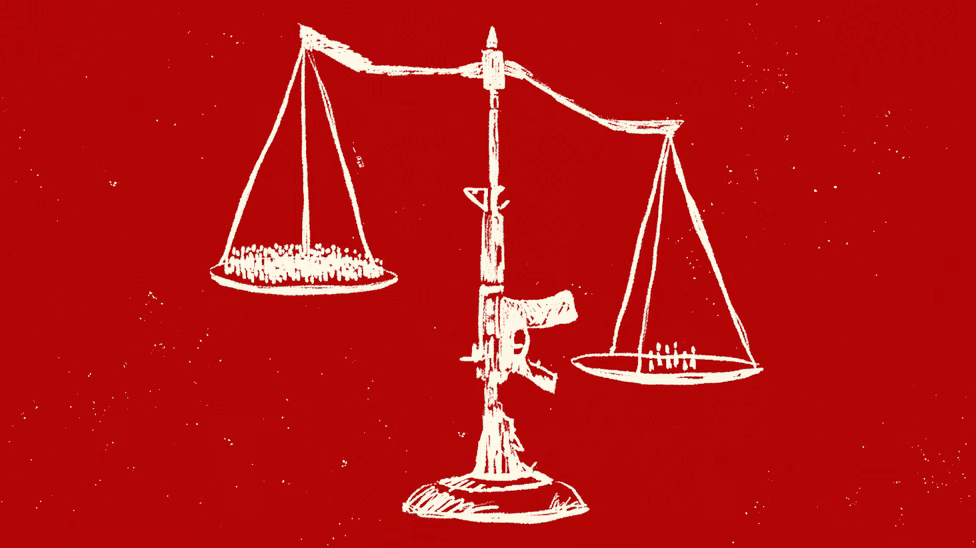
I chatted with an associate this evening about the gun debate in America. For some reason, gun control is again a hot topic. He believes that guns, like drugs, should be treated as mental health issues.

Click an image to read the referenced article.

The Atlantic: An ER Doctor’s ‘Third Way’ Approach to the Gun Crisis
The Atlantic: The Real Reason America Doesn’t Have Gun Control

Full Disclosure: I do not believe that the Second Amendment of the United States confers unrestricted rights to own a gun. Full stop. I believe this is a perversion by activist Supreme Court justices of the original intent of the grammatically-challenged Forefathers of that cursed country.

The mental health topic brought my attention to the question of tolerance and normalisation. Mental health, an interest of psychology has a sordid past. At its very core is the idea that humans can be normalised, that they can be categorised into normal and abnormal behaviours, and what is deemed normal might have some room for variation, but this tolerance doesn’t really allow for much discrepancy.

Normalisation expects to bring people into some basic conformity—give or take. The problem is that this is contextual and the acceptable range changes over time and place. Many behaviours previously considered abnormal are now acceptable, and some acceptable behaviours are no longer tolerated. Some of these changes have flip-flopped legal status as well. It’s just a game to some people.

Tolerance takes a position that there is no normal, per se. Some people just have different ideas.

Here is a clip of an interview with Dr Oz ( né Mehmet Cengiz Öz) where he illustrates my position. I’ll disintegrate it next.

Dr Oz explains why he does not support legalisation of marijuana

Transcript

Reporter: What is your stance on [the legalisation of] marijuana?

Dr Oz: … There are not enough Pennsylvanians to work in Pennsylvania, so giving them pot so they stay home… I don’t think [is] an ideal move. I also don’t want to breed addiction to marijuana. It’s not physical addiction; it’s emotional addiction, but I don’t want young people to think they have to smoke a joint to get out of their house in the morning. We need to get Pennsylvanians back at work you got to give them their mojo, and I don’t want marijuana to be a hindrance to that. I also don’t want people operating heavy machinery and driving by me when they’ve been taking their fourth joint of the day. But there are other issues that are plaguing Pennsylvanians. We’re a border state, practically, … because they’re flying illegal immigrants up here from the border in the middle of the night … but they’re also getting their narcotics up here really easily.

So, let’s break down this word salad. This will reveal some of Dr Oz’ and my worldview biases.

  1. Neither Oz nor I advocate the use of marijuana or other recreational drugs. However, Oz wants to make or keep it illegal and criminalised. I do not agree. I feel they should regulate it and tax it. Although I neither advocate nor endorse the use of any of these herbs and chemicals, I feel they should do this for all drugs. [And if we are going to make these chemicals illegal, let’s not be hypocrites and make nicotine, alcohol, and caffeine illegal.] I’m not advocating this. I’m just saying adopt a position and maintain it with integrity.
  2. There are not enough Pennsylvanians to work in Pennsylvania.

    First, Oz is a wage slaver. Next, the unemployment rate for PA was 4.9% in March, so this does not appear to be a problem.
  3. so giving them pot so they stay home… I don’t think [is] an ideal move.

    Oz makes an unsubstantiated connection between the legalisation of marijuana and staying home—being lazy or unmotivated.
  4. I also don’t want to breed addiction to marijuana.

    Marijuana is not known to be addictive. As a doctor, Oz knows this.
  5. It’s not physical addiction; it’s emotional addiction

    Here, Oz backtracks, but he also introduces an unsubstantiated claim. If you are interested in why I consider psychology pseudoscience, follow this link to explain DSM changes in this area.
  6. but I don’t want young people to think they have to smoke a joint to get out of their house in the morning

    Oz makes a total non-sequitur here. Nothing he has mentioned this far would lead to this conclusion. If someone already feels this way, its legal status is irrelevant. Enough said.
  7. We need to get Pennsylvanians back at work you got to give them their mojo, and I don’t want marijuana to be a hindrance to that.

    This is more Calvinistic wage slavery advocacy. Again, he is equating the consumption of marijuana with being unmotivated. Perhaps he should challenge Micheal Phelps to a swimming race. If motivation is the issue, perhaps he rather favours legalising amphetamines—but I supposed he’d have a preconceived rationale for that, too.
  8. I also don’t want people operating heavy machinery and driving by me when they’ve been taking their fourth joint of the day.

    Where does the number four come from? Is four different to one or two? Has this been studied? Is he saying this doesn’t already happen? Does he believe that current intoxication laws and incapacitation regulations aren’t in place?
  9. We’re a border state, practically…

    Where to start… Pennsylvania is a border state. It borders New York, New Jersey, Ohio, Delaware, Maryland, and West Virginia. If one counts for the water border of Lake Erie, one might be able to argue that it shares an international border with Canada—although, I feel that’s a stretch. At that point, one wouldn’t be far from considering Hawaii to border California. It’s only water. He does say practically, so perhaps that’s his out.
  10. because they’re flying illegal immigrants up here from the border in the middle of the night

    Wait a minute… Geezer’s talking about the southern border between the United States and Mexico. (That’s where brown people live.) The fewest number of states between Mexico and Pennsylvania is four, but that’s stretching it. Something tells me that Oz is at least an elitist and at worst a racist. I’m a sad panda.

    Another non-sequitur. Somehow, Oz is trying to create a link between marijuana and narcotics whilst also contending that legalising marijuana would somehow affect these illegal flights. Wait, are the flights illegal or just the passengers? How does he know that either is illegal? And does it have to be at night? I get the feeling that Oz watches too much television. Perhaps that’s what we should criminalise. So many questions.
  11. but they’re also getting their narcotics up here really easily

    OK? Perhaps we should contract with them to transport the marijuana up here if they are so efficient. Or would it be better to grow it locally? Racists tend to be nationalists and would likely favour a Made In America policy—unless they can exploit brown people. Or Oz can employ otherwise unemployed Pennsylvanians on his pot plantations. Where does it end?

What does this have to do with normalisation and toleration?

People like Dr Oz want to mainstream people, a concept some familiar with special education might remember—get the people in line with the herd. Proper people—normal people—are supposed X and Y and Z. Toleration allows that there may be people with descriptively ‘normal’ traits and behaviours, but there should not necessarily be a penalty for noncompliance.

When I was an undergrad student, I had a side job as a shift supervisor at an Au Bon Pain in Boston. On an occasion, one worker, let’s call her Mary, was arguing with another worker that we’ll call Marie. Mary said she was not going to make any more sandwiches because she had already made twice as much as Marie. Although I understand the notion of fairness she was invoking, I reminded her that she was being paid by the hour, not the piece. As long as she was still on the proverbial clock, she would continue to make sandwiches. Although I didn’t press this point, I could have hired Marie to watch Mary make sandwiches. In fact, I suppose I was hired to watch them both make sandwiches.

The point is—Mary’s perception aside—that there was no reason to presume these two should produce an equal number of sandwiches in an hour, a day, or a month.

I mention this because—getting back to Oz’ drugs scenario—if people are happy getting high on heroin and nodding out on Kensington Ave, that’s their issue, not Oz’ and not mine. If Pennsylvania needs workers and can’t get them, figure out how to attract workers. Don’t create a situation so bad that the alternate to work is just the lesser of two evils. This reminds me of a story from my consulting days.

Without dropping any names, I was hired by a company to ‘deflect’ some costs. The high-level concept was to redirect people from a relatively expensive call centre to cheaper self-service. I reminded them of the Principle of least effort.

Essentially, I conveyed that people are inherently lazy—echoing Carl Jung. People will take the path of least resistance. If it’s easier for them to call, they’ll call; if it’s easier to self-serve, they’ll do that.

“So we should make it more difficult for customers to call?” was how this was interpreted.

“You should make it easier to self-serve.”

I’m still shaking my head to this day. What humans will do to other humans in the name of commerce.

Where was I?