The Rhetoric of Realism: When Language Pretends to Know

Let us begin with the heresy: Truth is a rhetorical artefact. Not a revelation. Not a metaphysical essence glimmering behind the veil. Just language — persuasive, repeatable, institutionally ratified language. In other words: branding.

Audio: NotebookLM podcast on this topic.

This is not merely a postmodern tantrum thrown at the altar of Enlightenment rationalism. It is a sober, if impolite, reminder that nearly everything we call “knowledge” is stitched together with narrative glue and semantic spit. Psychology. Neuroscience. Ethics. Economics. Each presents itself as a science — or worse, a moral imperative — but their foundations are built atop a linguistic faultline. They are, at best, elegant approximations; at worst, dogma in drag.

Let’s take psychology. Here is a field that diagnoses your soul via consensus. A committee of credentialed clerics sits down and declares a cluster of behaviours to be a disorder, assigns it a code, and hands you a script. It is then canonised in the DSM, the Diagnostic Scripture Manual. Doubt its legitimacy and you are either naïve or ill — which is to say, you’ve just confirmed the diagnosis. It’s a theological trap dressed in the language of care.

Or neuroscience — the church of the glowing blob. An fMRI shows a region “lighting up” and we are meant to believe we’ve located the seat of love, the anchor of morality, or the birthplace of free will. Never mind that we’re interpreting blood-oxygen fluctuations in composite images smoothed by statistical witchcraft. It looks scientific, therefore it must be real. The map is not the territory, but in neuroscience, it’s often a mood board.

And then there is language itself, the medium through which all these illusions are transmitted. It is the stage, the scenery, and the unreliable narrator. My Language Insufficiency Hypothesis proposes that language is not simply a flawed tool — it is fundamentally unfit for the task it pretends to perform. It was forged in the furnace of survival, not truth. We are asking a fork to play the violin.

This insufficiency is not an error to be corrected by better definitions or clever metaphors. It is the architecture of the system. To speak is to abstract. To abstract is to exclude. To exclude is to falsify. Every time we speak of a thing, we lose the thing itself. Language functions best not as a window to the real but as a veil — translucent, patterned, and perpetually in the way.

So what, then, are our Truths™? They are narratives that have won. Stories that survived the epistemic hunger games. They are rendered authoritative not by accuracy, but by resonance — psychological, cultural, institutional. A “truth” is what is widely accepted, not because it is right, but because it is rhetorically unassailable — for now.

This is the dirty secret of epistemology: coherence masquerades as correspondence. If enough concepts link arms convincingly, we grant them status. Not because they touch reality, but because they echo each other convincingly in our linguistic theatre.

Libet’s experiment, Foucault’s genealogies, McGilchrist’s hemispheric metaphors — each peels back the curtain in its own way. Libet shows that agency might be a post-hoc illusion. Foucault reveals that disciplines don’t describe the subject; they produce it. McGilchrist laments that the Emissary now rules the Master, and the world is flatter for it.

But all of them — and all of us — are trapped in the same game: the tyranny of the signifier. We speak not to uncover truth, but to make truth-sounding noises. And the tragedy is, we often convince ourselves.

So no, we cannot escape the prison of language. But we can acknowledge its bars. And maybe, just maybe, we can rattle them loudly enough that others hear the clank.

Until then, we continue — philosophers, scientists, diagnosticians, rhetoricians — playing epistemology like a parlour game with rigged dice, congratulating each other on how well the rules make sense.

And why wouldn’t they? We wrote them.
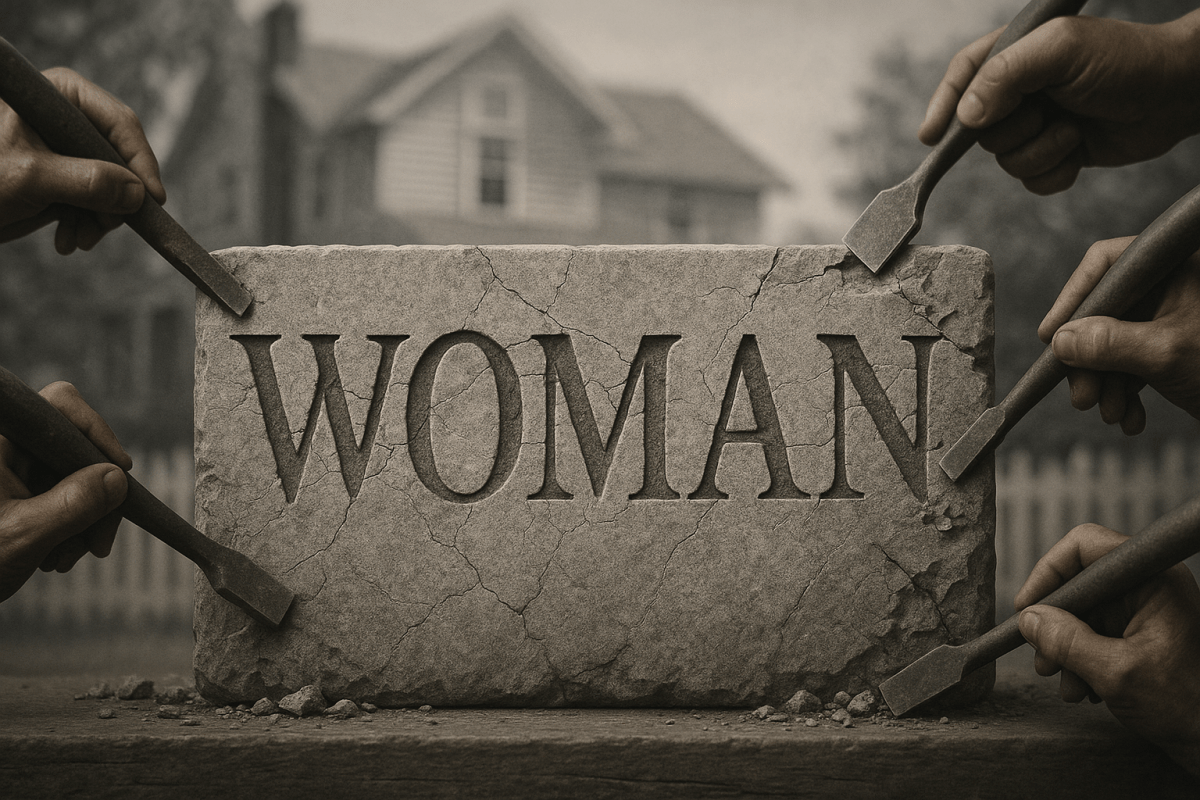
The Scourge: They’re Really Fighting Is Ambiguity

A Sequel to “The Disorder of Saying No” and a Companion to “When ‘Advanced’ Means Genocide”

In my previous post, The Disorder of Saying No, I explored the way resistance to authority is pathologised, particularly when that authority is cloaked in benevolence and armed with diagnostic manuals. When one refuses — gently, thoughtfully, or with a sharp polemic — one is no longer principled. One is “difficult.” Or in my case, oppositional.

Audio: NotebookLM podcast on this topic.

So when I had the gall to call out Bill Maher for his recent linguistic stunt — declaring that a woman is simply “a person who menstruates” — I thought I was doing the rational thing: pointing out a classic bit of reductionist nonsense masquerading as clarity. Maher, after all, was not doing biology. He was playing lexicographer-in-chief, defining a term with centuries of philosophical, sociological, and political baggage as though it were a checkbox on a medical form.

I said as much: that he was abusing his platform, presenting himself as the sole arbiter of the English language, and that his little performance was less about clarity and more about controlling the terms of discourse.

My friend, a post-menopausal woman herself, responded not by engaging the argument, but by insinuating — as others have — that I was simply being contrary. Oppositional. Difficult. Again. (She was clearly moved by When “Advanced” Means Genocide, but may have missed the point.)

So let’s unpack this — not to win the debate, but to show what the debate actually is.

This Isn’t About Biology — It’s About Boundary Maintenance

Maher’s statement wasn’t intended to clarify. It was intended to exclude. It wasn’t some linguistic slip; it was a rhetorical scalpel — one used not to analyse, but to amputate.

And the applause from some cisgender women — particularly those who’ve “graduated” from menstruation — reveals the heart of the matter: it’s not about reproductive biology. It’s about controlling who gets to claim the term woman.

Let’s steelman the argument, just for the sport of it:

Menstruation is a symbolic threshold. Even if one no longer menstruates, having done so places you irrevocably within the category of woman. It’s not about exclusion; it’s about grounding identity in material experience.

Fine. But now let’s ask:

  • What about women who’ve never menstruated?
  • What about intersex people?
  • What about trans women?
  • What about cultures with radically different markers of womanhood?

You see, it only works if you pretend the world is simpler than it is.

The Language Insufficiency Hypothesis: Applied

This is precisely where the Language Insufficiency Hypothesis earns its keep.

The word woman is not a locked vault. It is a floating signifier, to borrow from Barthes — a term whose meaning is perpetually re-negotiated in use. There is no singular essence to the word. It is not rooted in biology, nor in social role, nor in performance. It is a hybrid, historically contingent construct — and the moment you try to fix its meaning, it slips sideways like a greased Wittgensteinian beetle.

“Meaning is use,” says Wittgenstein, and this is what frightens people.

If woman is defined by use and not by rule, then anyone might claim it. And suddenly, the club is no longer exclusive.

That’s the threat Maher and his defenders are really reacting to. Not trans women. Not intersex people. Not language activists or queer theorists.

The threat is ambiguity.

What They Want: A World That Can Be Named

The push for rigid definitions — for menstruation as membership — is a plea for a world that can be named and known. A world where words are secure, stable, and final. Where meaning doesn’t leak.

But language doesn’t offer that comfort.

It never did.

And when that linguistic instability gets too close to something personal, like gender identity, or the foundation of one’s own sense of self, the defensive response is to fortify the language, as though building walls around a collapsing church.

Maher’s defenders aren’t making scientific arguments. They’re waging semantic warfare. If they can hold the definition, they can win the cultural narrative. They can hold the gates to Womanhood and keep the undesirables out.

That’s the fantasy.

But language doesn’t play along.

Conclusion: Words Will Not Save You — but They Might Soothe the Dead

In the end, Maher’s definition is not merely incorrect. It is insufficient. It cannot accommodate the complexity of lived experience and cannot sustain the illusion of clarity for long.

And those who cling to it — friend or stranger, progressive, or conservative — are not defending biology. They are defending nostalgia. Specifically, a pathological nostalgia for a world that no longer exists, and arguably never did: a world where gender roles were static, language was absolute, and womanhood was neatly circumscribed by bodily functions and suburban etiquette.

Ozzy and Harriet loom large here — not as individuals but as archetypes. Icons of a mid-century dream in which everyone knew their place, and deviation was something to be corrected, not celebrated. My friend, of that generation, clings to this fantasy not out of malice but out of a desperate yearning for order. The idea that woman could mean many things, and mean them differently across contexts, is not liberating to her — it’s destabilising.

But that world is gone. And no amount of menstruation-based gatekeeping will restore it.

The Real Scourge Is Ambiguity

Maher’s tantrum wasn’t about truth. It was about fear — fear of linguistic drift, of gender flux, of a world in which meaning no longer obeys. The desire to fix the definition of “woman” is not a biological impulse. It’s a theological one.

And theology, like nostalgia, often makes terrible policy.

This is why your Language Insufficiency Hypothesis matters. Because it reminds us that language does not stabilise reality — it masks its instability. The attempt to define “woman” once and for all is not just futile — it’s an act of violence against difference, a linguistic colonisation of lived experience.

So Let Them Rest

Ozzy and Harriet are dead. Let them rest.
Let their picket fence moulder. Let their signage decay.

The world has moved on. The language is shifting beneath your feet. And no amount of retroactive gatekeeping can halt that tremor.

The club is burning. And the only thing left to save is honesty.

When “Advanced” Means Genocide: A Case Study in Linguistic Implosion

This post draws on themes from my upcoming book, A Language Insufficiency Hypothesis. The transcript below is taken from a publicly available exchange, which you can view here. Consider it Exhibit A in language’s ongoing failure to bear the weight of meaning.

Transcript:

KK: Konstantin Kisin
DFW: Deborah Frances-White

KK: I’m saying we were technologically more advanced.
DFW: So you’re saying we’re superior to Australian Aboriginals?
KK: That’s quite the opposite of what I’m saying. I’m not saying we were superior, I’m saying we were technologically more advanced.
DFW: So, how is that the opposite?
KK: Superior implies a moral quality. I’m not making any moral implication. You seem to be, but what I’m saying is…
DFW: I think most people would hear it that way.
KK: No.
DFW: Again, you’re a very intelligent man. How would most people hear that?
KK: Most people would hear what I’m saying for what I’m saying, which is…
DFW: I don’t think they would.
KK: You seem to get quite heated about this, which is completely unnecessary.
DFW: Um…
KK: You think it’s necessary?
DFW: I’m a bit stunned by what you’re implying.
KK: No, you’re acting in a kind of passive aggressive way which indicates that you’re not happy…
DFW: I genuinely… I’m being 100% authentic. My visceral reaction to a white man sitting and saying to me, “And why were we able to commit genocide on them?” and then just pausing—
KK: Yes.
DFW: …is very visceral to me.
KK: Well, let’s go back. First of all, it’s interesting that you brought up my skin colour because I thought that was the exact opposite of the point you’re trying to make in the book.

Audio: NotebookLM podcast on this topic.

The Language Insufficiency Hypothesis begins with this premise: language is not merely flawed, it is structurally inadequate for mediating complex, layered realities – especially those laced with power, morality, and history. This transcript is not a debate. It is a linguistic trench war in which every utterance is laced with shrapnel, and each side thinks they’re defending reason.

Let’s pull a few of the shell casings from the mud.

KK attempts to offer a dry, neutral descriptor. DFW hears supremacist teleology. Why? Because “advanced” is culturally radioactive. It doesn’t merely denote a technical state—it connotes a ladder, with someone inevitably on the bottom rung.

When language carries historical residue, neutrality is a delusion. Words don’t just mean. They echo.

KK is making a semantic distinction. DFW hears a moral claim. Both are right. And both are talking past one another, because language is attempting to cleave affect from description, and it simply can’t.

KK’s insistence—“I’m not saying we’re superior”—is a textbook example of denotative desperation. He believes clarification will rescue intent. But as any linguist (or postcolonial theorist) will tell you: intent does not sterilise implication.

Language cannot be laundered by explanation. Once spoken, words belong to context, not intention.

KK thinks he’s holding a scalpel. DFW hears a cudgel. And here we are.

This is where the wheels come off. KK argues from semantic specificity. DFW argues from sociolinguistic reception. It’s Saussure versus the TikTok algorithm. Neither will win.

Communication disintegrates not because anyone is lying, but because they are playing incompatible games with the same tokens.

DFW’s invocation of “a white man” is not a derailment—it’s the inevitable endpoint of a system where words no longer float free but are yoked to their utterer. This is the moment the failure of language becomes a failure of interlocution. Argument collapses into indexical entrapment.

At this point, you’re no longer debating ideas. You’re defending your right to use certain words at all.

Which brings us to the final breakdown.

KK: I am making a logical distinction.
DFW: I am having a visceral reaction.

The failure isn’t moral. It isn’t historical. It’s grammatical. One is operating in a truth-function logic game. The other is reacting within a trauma-informed, socially indexed register. These are grammars that do not overlap.

If this brief and brutal dialogue proves anything, it’s this: you cannot extract meaning cleanly from words when the words themselves are sponges for history, hierarchy, and harm. The moment we ask language to do too much—to carry precision, affect, ethics, and identity—it folds in on itself.

And that, dear reader, is precisely the argument of A Language Insufficiency Hypothesis: that meaning does not reside in words, and never has. It lives in the gaps, the silences, the misfires. That’s where the truth—whatever’s left of it—might be hiding.

Follow the wreckage. That’s where the signal lives.

The Disorder of Saying No

A Polite Rebuttal to a Diagnosis I Didn’t Ask For

A dear friend — and I do mean dear, though this may be the last time they risk diagnosing me over brunch — recently suggested, with all the benevolent concern of a well-meaning inquisitor, that I might be showing signs of Oppositional Defiant Disorder.

You know the tone: “I say this with love… but have you considered that your refusal to play nicely with institutions might be clinical?”

Let’s set aside the tea and biscuits for a moment and take a scalpel to this charming little pathology. Because if ODD is a diagnosis, then I propose we start diagnosing systems — not people.

Audio: NotebookLM podcast on this topic.

When the Empire Diagnoses Its Rebels

Oppositional Defiant Disorder, for those blissfully unscarred by its jargon, refers to a “persistent pattern” of defiance, argumentativeness, rule-breaking, and — the pièce de résistance — resentment of authority. In other words, it is a medical label for being insufficiently obedient.

What a marvel: not only has resistance been de-politicised, it has been medicalised. The refusal to comply is not treated as an ethical stance or a contextual response, but as a defect of the self. The child (or adult) is not resisting something; they are resisting everything, and this — according to the canon — makes them sick.

One wonders: sick according to whom?

Derrida’s Diagnosis: The Binary Fetish

Jacques Derrida, of course, would waste no time in eviscerating the logic at play. ODD depends on a structural binary: compliant/defiant, healthy/disordered, rule-follower/troublemaker. But, as Derrida reminds us, binaries are not descriptive — they are hierarchies in disguise. One term is always elevated; the other is marked, marginal, suspect.

Here, “compliance” is rendered invisible — the assumed baseline, the white space on the page. Defiance is the ink that stains it. But this only works because “normal” has already been declared. The system names itself sane.

Derrida would deconstruct this self-justifying loop and note that disorder exists only in relation to an order that never justifies itself. Why must the subject submit? That’s not up for discussion. The child who asks that question is already halfway to a diagnosis.

Foucault’s Turn: Disciplinary Power and the Clinic as Court

Enter Foucault, who would regard ODD as yet another exquisite specimen in the taxonomy of control. For him, modern power is not exercised through visible violence but through the subtler mechanisms of surveillance, normalisation, and the production of docile bodies.

ODD is a textbook case of biopower — the system’s ability to define and regulate life itself through classification, diagnosis, and intervention. It is not enough for the child to behave; they must believe. They must internalise authority to the marrow. To question it, or worse, to resent it, is to reveal one’s pathology.

This is not discipline; this is soulcraft. And ODD is not a disorder — it is a symptom of a civilisation that cannot tolerate unmediated subjectivity. See Discipline & Punish.

Ivan Illich: The Compulsory Institutions of Care

Illich would call the whole charade what it is: a coercive dependency masquerading as therapeutic care. In Deschooling Society, he warns of systems — especially schools — that render people passive recipients of norms. ODD, in this light, is not a syndrome. It is the final gasp of autonomy before it is sedated.

What the diagnosis reveals is not a child in crisis, but an institution that cannot imagine education without obedience. Illich would applaud the so-called defiant child for doing the one thing schools rarely reward: thinking.

R.D. Laing: Sanity as a Political Position

Laing, too, would recognise the ruse. His anti-psychiatry position held that “madness” is often the only sane response to a fundamentally broken world. ODD is not insanity — it is sanity on fire. It is the refusal to adapt to structures that demand submission as a prerequisite for inclusion.

To quote Laing: “They are playing a game. They are playing at not playing a game. If I show them I see they are, I shall break the rules and they will punish me. I must play their game, of not seeing I see the game.”

ODD is what happens when a child refuses to play the game.

bell hooks: Refusal as Liberation

bell hooks, writing in Teaching to Transgress, framed the classroom as a potential site of radical transformation — if it rejects domination. The child who refuses to be disciplined is often the one who sees most clearly that the system has confused education with indoctrination.

Resistance, hooks argues, is not a flaw. It is a form of knowledge. ODD becomes, in this frame, a radical pedagogy. The defiant student is not failing — they are teaching.

Deleuze & Guattari: Desire Against the Machine

And then, should you wish to watch the diagnostic edifice melt entirely, we summon Deleuze and Guattari. For them, the psyche is not a plumbing system with blockages, but a set of desiring-machines short-circuiting the factory floor of capitalism and conformity.

ODD, to them, would be schizoanalysis in action — a body refusing to be plugged into the circuits of docility. The tantrum, the refusal, the eye-roll: these are not symptoms. They are breakdowns in the control grid.

The child isn’t disordered — the system is. The child simply noticed.

Freire: The Educated Oppressed

Lastly, Paulo Freire would ask: What kind of pedagogy demands the death of resistance? In Pedagogy of the Oppressed, he warns of an education model that treats students as empty vessels. ODD, reframed, is the moment a subject insists on being more than a receptacle.

In refusing the “banking model” of knowledge, the so-called defiant child is already halfway to freedom. Freire would call this not a disorder but a moment of awakening.

Conclusion: Diagnostic Colonialism

So yes, dear friend — I am oppositional. I challenge authority, especially when it mistakes its position for truth. I argue, question, resist. I am not unwell for doing so. I am, if anything, allergic to the idea that obedience is a virtue in itself.

Let us be clear: ODD is not a mirror held up to the subject. It is a spotlight shining from the system, desperately trying to blind anyone who dares to squint.

Now, shall we talk about your compliance disorder?


Full Disclosure: I used ChatGPT for insights beyond Derrida and Foucault, two of my mainstays.

Semantic Drift: When Language Outruns the Science

Science has a language problem. Not a lack of it – if anything, a surfeit. But words, unlike test tubes, do not stay sterile. They evolve, mutate, and metastasise. They get borrowed, bent, misused, and misremembered. And when the public discourse gets hold of them, particularly on platforms like TikTok, it’s the language that gets top billing. The science? Second lead, if it’s lucky.

Semantic drift is at the centre of this: the gradual shift in meaning of a word or phrase over time. It’s how “literally” came to mean “figuratively,” how “organic” went from “carbon-based” to “morally superior,” and how “theory” in science means robust explanatory framework but in the public square means vague guess with no homework.

In short, semantic drift lets rhetoric masquerade as reason. Once a word acquires enough connotation, you can deploy it like a spell. No need to define your terms when the vibe will do.

Audio: NotebookLM podcast on this topic.

When “Vitamin” No Longer Means Vitamin

Take the word vitamin. It sounds objective. Authoritative. Something codified in the genetic commandments of all living things. (reference)

But it isn’t.

A vitamin is simply a substance that an organism needs but cannot synthesise internally, and must obtain through its diet. That’s it. It’s a functional definition, not a chemical one.

So:

  • Vitamin C is a vitamin for humans, but not for dogs, cats, or goats. They make their own. We lost the gene. Tough luck.
  • Vitamin D, meanwhile, isn’t a vitamin at all. It’s a hormone, synthesised when sunlight hits your skin. Its vitamin status is a historical relic – named before we knew better, and now marketed too profitably to correct.

But in the land of TikTok and supplement shelves, these nuances evaporate. “Vitamin” has drifted from scientific designation to halo term – a linguistic fig leaf draped over everything from snake oil to ultraviolet-induced steroidogenesis.

The Rhetorical Sleight of Hand

This linguistic slippage is precisely what allows the rhetorical shenanigans to thrive.

In one video, a bloke claims a burger left out for 151 days neither moulds nor decays, and therefore, “nature won’t touch it.” From there, he leaps (with Olympic disregard for coherence) into talk of sugar spikes, mood swings, and “metabolic chaos.” You can almost hear the conspiratorial music rising.

The science here is, let’s be generous, circumstantial. But the language? Oh, the language is airtight.

Words like “processed,” “chemical,” and “natural” are deployed like moral verdicts, not descriptive categories. The implication isn’t argued – it’s assumed, because the semantics have been doing quiet groundwork for years. “Natural” = good. “Chemical” = bad. “Vitamin” = necessary. “Addiction” = no agency.

By the time the viewer blinks, they’re nodding along to a story told by words in costume, not facts in context.

The Linguistic Metabolism of Misunderstanding

This is why semantic drift isn’t just an academic curiosity – it’s a vector. A vector by which misinformation spreads, not through outright falsehood, but through weaponised ambiguity.

A term like “sugar crash” sounds scientific. It even maps onto a real physiological process: postprandial hypoglycaemia. But when yoked to vague claims about mood, willpower, and “chemical hijacking,” it becomes a meme with lab coat cosplay. And the science, if mentioned at all, is there merely to decorate the argument, not drive it.

That’s the crux of my forthcoming book, The Language Insufficiency Hypothesis: that our inherited languages, designed for trade, prayer, and gossip, are woefully ill-equipped for modern scientific clarity. They lag behind our knowledge, and worse, they often distort it.

Words arrive first. Definitions come limping after.

In Closing: You Are What You Consume (Linguistically)

The real problem isn’t that TikTokers get the science wrong. The problem is that they get the words right – right enough to slip past your critical filters. Rhetoric wears the lab coat. Logic gets left in the locker room.

If vitamin C is a vitamin only for some species, and vitamin D isn’t a vitamin at all, then what else are we mislabelling in the great nutritional theatre? What other linguistic zombies are still wandering the scientific lexicon?

Language may be the best tool we have, but don’t mistake it for a mirror. It’s a carnival funhouse – distorting, framing, and reflecting what we expect to see. And until we fix that, science will keep playing second fiddle to the words pretending to explain it.

The Trust Myth: Harari’s Binary and the Collapse of Political Credibility

Yuval Noah Harari, always ready with a digestible morsel for the TED-addled masses, recently declared that “democracy runs on trust, dictatorship on terror.” It’s a line with the crispness of a fortune cookie and about as much analytical depth. Designed for applause, not interrogation, it’s the sort of soundbite that flatters liberal sensibilities while sanding off the inconvenient edges of history.

Audio: NotebookLM podcast on this topic.

Let’s be honest: this dichotomy is not merely simplistic – it’s a rhetorical sedative. It reassures those who still believe political systems are like kitchen appliances: plug-and-play models with clear instructions and honest warranties. But for anyone who’s paid attention to the actual mechanics of power, this framing is delusional.

1. Trust Was Never Earned

In the United States, trust in democratic institutions was never some noble compact forged through mutual respect and enlightened governance. It was cultivated through exclusion, propaganda, and economic bribery. The post-WWII boom offered the illusion of institutional legitimacy – but only if you were white, male, middle-class, and preferably asleep.

Black Americans, Indigenous peoples, immigrants, women – none were granted the luxury of naïve trust. They were told to trust while being actively disenfranchised. To participate while being systemically excluded. So no, Harari, the machine didn’t run on trust. It ran on marketing. It ran on strategic ignorance.

2. Dictatorship Doesn’t Require Terror

Equally cartoonish is the notion that dictatorships subsist purely on terror. Many of them run quite comfortably on bureaucracy, passive conformity, and the grim seduction of order. Authoritarians know how to massage the same trust reflexes as democracies – only more bluntly. People don’t just obey out of fear. They obey out of habit. Out of resignation. Out of a grim kind of faith that someone – anyone – is in charge.

Dictatorships don’t extinguish trust. They re-route it. Away from institutions and toward strongmen. Toward myths of national greatness. Toward performative stability. It’s not that terror is absent—it’s just not the whole machine. The real engine is misplaced trust.

3. Collapse Is Bipartisan

The present moment isn’t about the erosion of a once-trustworthy system. It’s the slow-motion implosion of a confidence game on all sides. The old liberal institutions are collapsing under the weight of their hypocrisies. But the loudest critics – tech messiahs, culture warriors, authoritarian nostalgists – are no better. Their solutions are just new brands of snake oil in sleeker bottles.

Everyone is pointing fingers, and no one is credible. The public, caught between cynicism and desperation, gravitates either toward restoration fantasy (“make democracy work again”) or authoritarian theatre (“at least someone’s doing something”). Both are dead ends.

4. The Only Way Forward: Structural Reimagination

The only viable path isn’t restoration or regression. It’s reinvention. Systems that demand unconditional trust – like religions and stock markets – are bound to fail, because they rely on sustained illusions. Instead, we need systems built on earned, revocable, and continually tested trust – systems that can survive scrutiny, decentralise power, and adapt to complexity.

In other words: stop trying to repair a house built on sand. Build something else. Something messier, more modular, less mythological.

Let the TED crowd have their slogans. We’ve got work to do.

“Trust the Science,” They Said. “It’s Reproducible,” They Lied.

—On Epistemology, Pop Psychology, and the Cult of Empirical Pretence

Science, we’re told, is the beacon in the fog – a gleaming lighthouse of reason guiding us through the turbulent seas of superstition and ignorance. But peer a bit closer, and the lens is cracked, the bulb flickers, and the so-called lighthouse keeper is just some bloke on TikTok shouting about gut flora and intermittent fasting.

Audio: NotebookLM podcast on this topic.

We are creatures of pattern. We impose order. We mistake correlation for causation, narrative for truth, confidence for knowledge. What we have, in polite academic parlance, is an epistemology problem. What we call science is often less Newton and more Nostradamus—albeit wearing a lab coat and wielding a p-hacked dataset.

Let’s start with the low-hanging fruit—the rotting mango of modern inquiry: nutritional science, which is to actual science what alchemy is to chemistry, or vibes are to calculus. We study food the way 13th-century monks studied demons: through superstition, confirmation bias, and deeply committed guesswork. Eat fat, don’t eat fat. Eat eggs, don’t eat eggs. Eat only between the hours of 10:00 and 14:00 under a waxing moon while humming in Lydian mode. It’s a cargo cult with chia seeds.

But why stop there? Let’s put the whole scientific-industrial complex on the slab.

Psychology: The Empirical Astrological Society

Psychology likes to think it’s scientific. Peer-reviewed journals, statistical models, the odd brain scan tossed in for gravitas. But at heart, much of it is pop divination, sugar-dusted for mass consumption. The replication crisis didn’t merely reveal cracks – it bulldozed entire fields. The Stanford Prison Experiment? A theatrical farce. Power poses? Empty gestural theatre. Half of what you read in Psychology Today could be replaced with horoscopes and no one would notice.

Medical Science: Bloodletting, But With Better Branding

Now onto medicine, that other sacred cow. We tend to imagine it as precise, data-driven, evidence-based. In practice? It’s a Byzantine fusion of guesswork, insurance forms, and pharmaceutical lobbying. As Crémieux rightly implies, medicine’s predictive power is deeply compromised by overfitting, statistical fog, and a staggering dependence on non-replicable clinical studies, many funded by those who stand to profit from the result.

And don’t get me started on epidemiology, that modern priesthood that speaks in incantations of “relative risk” and “confidence intervals” while changing the commandments every fortnight. If nutrition is theology, epidemiology is exegesis.

The Reproducibility Farce

Let us not forget the gleaming ideal: reproducibility, that cornerstone of Enlightenment confidence. The trouble is, in field after field—from economics to cancer biology—reproducibility is more aspiration than reality. What we actually get is a cacophony of studies no one bothers to repeat, published to pad CVs, p-hacked into publishable shape, and then cited into canonical status. It’s knowledge by momentum. We don’t understand the world. We just retweet it.

What, Then, Is To Be Done?

Should we become mystics? Take up tarot and goat sacrifice? Not necessarily. But we should strip science of its papal robes. We should stop mistaking publication for truth, consensus for accuracy, and method for epistemic sanctity. The scientific method is not the problem. The pretence that it’s constantly being followed is.

Perhaps knowledge doesn’t have a half-life because of progress, but because it was never alive to begin with. We are not disproving truth; we are watching fictions expire.

Closing Jab

Next time someone says “trust the science,” ask them: which bit? The part that told us margarine was manna? The part that thought ulcers were psychosomatic? The part that still can’t explain consciousness, but is confident about your breakfast?

Science is a toolkit. But too often, it’s treated like scripture. And we? We’re just trying to lose weight while clinging to whatever gospel lets us eat more cheese.

Artificial Intelligence Isn’t Broken

Rather than recreate a recent post on my business site, LinkedIn.

(Warning: contains traces of logic, satire, and uncomfortable truths. But you knew that.)

Audio: NotebookLM podcast on the linked topic.

It’s just refusing to cosplay as your idealised fantasy of “human” cognition.

While pundits at the Wall Street Journal lament that AI thinks with “bags of heuristics” instead of “true models,” they somehow forget that humans themselves are kludged-together Rube Goldberg disasters, lurching from cognitive bias to logical fallacy with astonishing grace.

In my latest piece, I take a flamethrower to the myth of human intellectual purity, sketch a real roadmap for modular AI evolution, and suggest (only partly in jest) that the machines are becoming more like us every day — messy, contradictory, and disturbingly effective.

Let’s rethink what “thinking” actually means. Before the machines do it for us.

Unwilling Steelman, Part IV

A five-part descent into the illusion of autonomy, where biology writes the script, reason provides the excuse, and the self is merely the echo of its own conditioning. This is a follow-up to a recent post on the implausibility of free will.

Audio: NotebookLM podcast on the topic.

“It’s not just that you’re a hallucination of yourself.
It’s that everyone else is hallucinating you, too — through their own fog.”

The Feedback Loop of False Selves

You are being judged — by others who are also compromised

If you are a chemically modulated, state-dependent, narrativising automaton, then so is everyone who evaluates you. The moral courtroom — society, the law, the dinner table — is just a gathering of biased systems confidently misreading each other.

We are taught to believe in things like:

  • “Good character”
  • “Knowing someone”
  • “Getting a read on people”

But these are myths of stability, rituals of judgment, and cognitive vanity projects. There is no fixed you — and there is no fixed them to do the judging.

Judging the Snapshot, Not the Self

Let’s say you act irritable. Or generous. Or quiet.
An observer sees this and says:

“That’s who you are.”

But which version of you are they observing?

  • The you on two hours of sleep?
  • The you on SSRIs?
  • The you grieving, healing, adjusting, masking?

They don’t know. They don’t ask.
They just flatten the moment into character.

One gesture becomes identity.
One expression becomes essence.

This isn’t judgment.
It’s snapshot essentialism — moral conclusion by convenience.

The Observer Is No Less Biased

Here’s the darker truth: they’re compromised, too.

  • If they’re stressed, you’re rude.
  • If they’re lonely, you’re charming.
  • If they’re hungry, you’re annoying.

What they’re perceiving is not you — it’s their current chemistry’s reaction to your presentation, filtered through their history, memory, mood, and assumptions.

It’s not a moral lens.
It’s a funhouse mirror, polished with certainty.

Mutual Delusion in a Moral Marketplace

The tragedy is recursive:

  • You act based on internal constraints.
  • They judge based on theirs.
  • Then you interpret their reaction… and adjust accordingly.
  • And they, in turn, react to your adjustment…

And on it goes — chemical systems calibrating against each other, mistaking interaction for insight, familiarity for truth, coherence for character.

Identity isn’t formed.
It’s inferred, then reinforced.
By people who have no access to your internal states and no awareness of their own.

The Myth of the Moral Evaluator

This has massive implications:

  • Justice assumes objectivity.
  • Culture assumes shared moral standards.
  • Relationships assume “knowing” someone.

But all of these are built on the fantasy that moral evaluation is accurate, stable, and earned.

It is not.

It is probabilistic, state-sensitive, and mutually confabulatory.

You are being judged by the weather inside someone else’s skull.

TL;DR: Everyone’s Lying to Themselves About You

  • You behave according to contingent states.
  • Others judge you based on their own contingent states.
  • Both of you invent reasons to justify your interpretations.
  • Neither of you has access to the full picture.
  • The result is a hall of mirrors with no ground floor.

So no — you’re not “being seen.”
You’re being misread, reinterpreted, and categorised
— by people who are also misreading themselves.

📅 Coming Tomorrow

You Cannot Originate Yourself

The causa sui argument, and the final collapse of moral responsibility.

The Emperor’s New Models: Box, Lawson, and the Death of Truth

We live in an age intoxicated by models: climate models, economic models, epidemiological models, cosmological models—each one an exquisite confection of assumptions draped in a lab coat and paraded as gospel. Yet if you trace the bloodline of model-building back through the annals of intellectual history, you encounter two figures who coldly remind us of the scam: George Box and Hilary Lawson.

Box: The Gentle Assassin of Certainty

George Box, the celebrated statistician, is often credited with the aphorism: “All models are wrong, but some are useful.” However, Box himself never uttered this precise phrase. What he did say, in his 1976 paper Science and Statistics, was:

The “some are useful” flourish was added later by a public desperate to sweeten the bitter pill. Nevertheless, Box deserves credit for the lethal insight: no model, however elegant, perfectly captures reality. They are provisional guesses, finger-paintings smeared across the rough surface of the unknown.

Audio: NotebookLM podcast on this topic.

Lawson: The Arsonist Who Burned the Map

Hilary Lawson, contemporary philosopher and author of Closure: A Story of Everything, drags Box’s modest scepticism into full-blown philosophical insurrection. In a recent lecture, Lawson declared:

Where Box warns us the emperor’s clothes don’t fit, Lawson points out that the emperor himself is a paper doll. Either way, we dress our ignorance in equations and hope no one notices the draft.

Lawson’s view is grim but clarifying: models are not mere approximations of some Platonic truth. They are closures—temporary, pragmatic structures we erect to intervene effectively in a world we will never fully comprehend. Reality, in Lawson’s framing, is an “openness”: endlessly unfolding, resistant to total capture.

The Case of the Celestial Spheres

Take Aristotle’s model of celestial spheres. Ludicrous? Yes. Obsolete? Absolutely. Yet for centuries, it allowed navigators to chart courses, astrologers to cast horoscopes, and priests to intimidate peasants—all without the slightest whiff of heliocentrism. A model does not need to be right; it merely needs to be operational.

Our modern theories—Big Bang cosmology, dark matter, and quantum gravity—may well be tomorrow’s celestial spheres: charming relics of ignorance that nonetheless built bridges, cured diseases, and sold mobile phones.

Summary Table: Lawson’s View on Models and Truth

Conclusion

Box taught us to distrust the fit of our models; Lawson reminds us there is no true body underneath them. If truth is a ghost, then our models are ghost stories—and some ghost stories, it turns out, are very good at getting us through the night.

We are left not with certainty, but with craftsmanship: the endless, imperfect art of refining our closures, knowing full well they are lies that work. Better lies. Usable lies. And perhaps, in a world without final answers, that is the most honest position of all.