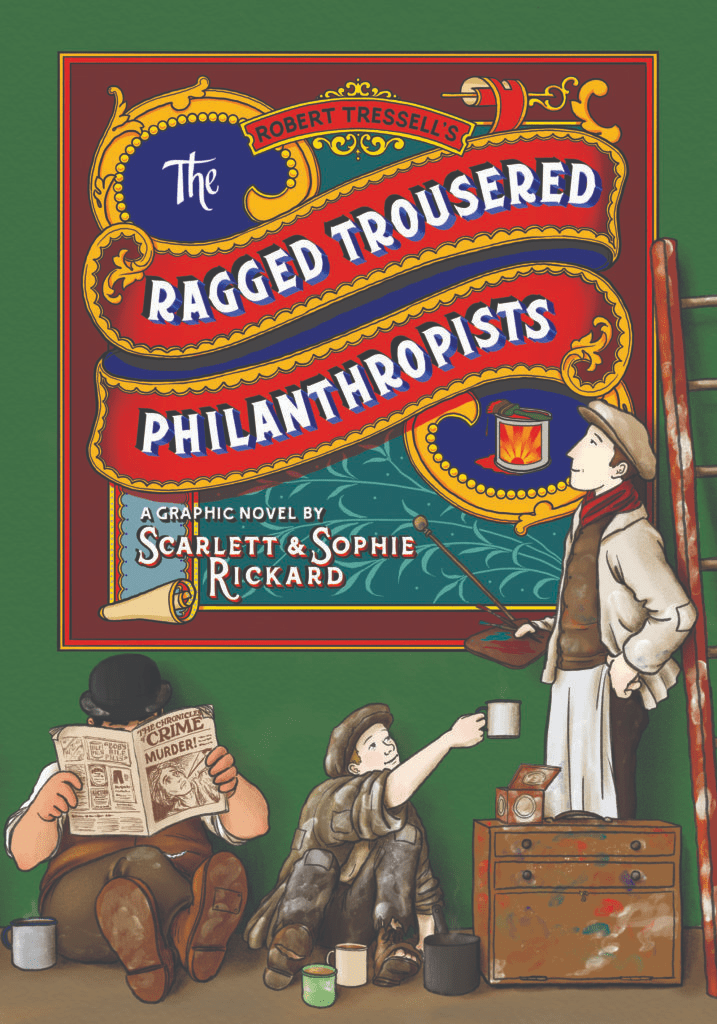
I love coming upon a classic. Written in 1906, Ragged Trousered Philanthropists wasn’t published until 1914, and even then poorly and abridged, posthumously. I happened upon this when I was researching my Advantagement project. I was looking for a period cross between Charles Bukowski and Irvine Welsh. I don’t suppose that’s quite available in the day, but I did get a rather unsanitised autobiograph of sorts.
One may have thought Dickens might have provided an avenue, but despite his Schopenhauerian caricature, his bleak Industrial Age stories tend to end on an upbeat note, a positive character arc, mirroring what later hardens into modernist positivism. I was searching for something more realistic – reporting from within the trenches, as it were. As the people in the trenches were largely illiterate, their voices have also been lost to history, their echoes captured with varying degrees of fidelity by others, as seen through their own lenses.
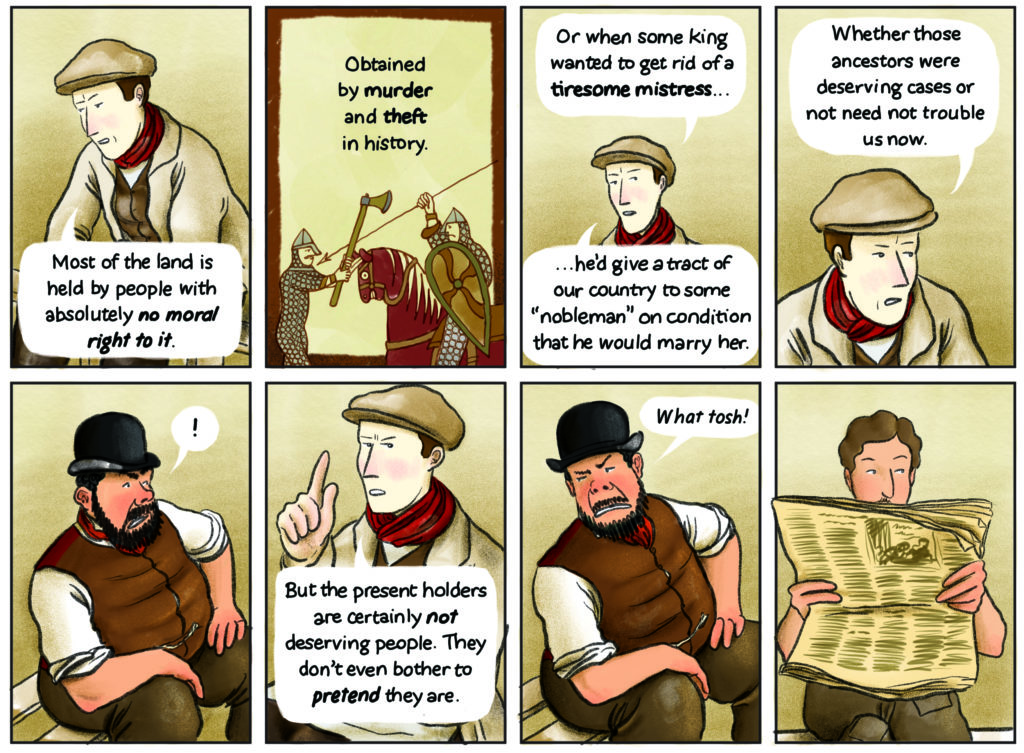
However, this isn’t a review of the literature. Although this might be considered to be required reading, it’s uneven, didactic, and structurally loose. It’s a cross between a novel and a diary. Reading this, one is struck less by how much politics has changed than by how little explanatory machinery is required for it to function, whether in the UK or the US – and chime in if it also resonates in your location. I’ve copied an excerpt from Chapter 1 for discussion. What follows is not remarkable for its insight, originality, or rhetorical brilliance. It is remarkable for how familiar it feels. It could be lifted wholesale into a contemporary comment thread with minimal editing. Check out this piece about the graphic novel version.
Keep in mind that this was written (or at least completed) in 1906. It reflects the people of the Edwardian London slums. Here are some themes I find in common with contemporary politics:
- Partisanship: Tories and Liberals, argyfying about politics (identity over understanding)
- Xenophobia: the country is being ruined by foreigners (causal compression, targets differ)
- Protectionism: The country would be ruined if not protected in some way (tariffs; moral intuition, not economic reasoning)
- Low-information voters: I votes for who the bloody ’ell I likes. (voting without shame)

Chapter 1: An Imperial Banquet. A Philosophical Discussion. The Mysterious Stranger. Britons Never shall be Slaves
by Robert Tressell
…
Easton was still reading the Obscurer; he was not about to understand exactly what the compiler of the figures was driving at − probably the latter never intended that anyone should understand − but he was conscious of a growing feeling of indignation and hatred against foreigners of every description, who were ruining this country, and he began to think that it was about time we did something to protect ourselves. Still, it was a very difficult question: to tell the truth, he himself could not make head or tail of it.
At length he said aloud, addressing himself to Crass:
‘Wot do you think of this ‘ere fissical policy, Bob?’
‘Ain’t thought much about it,’ replied Crass.
‘I don’t never worry my ‘ed about politics.’
‘Much better left alone,’ chimed in old Jack Linden sagely, argyfying about politics generally ends up with a bloody row an’ does no good to nobody.’
At this there was a murmur of approval from several of the others. Most of them were averse from arguing or disputing about politics. If two or three men of similar opinions happened to be together they might discuss such things in a friendly and superficial way, but in a mixed company it was better left alone. The ‘Fissical Policy’ emanated from the Tory party. That was the reason why some of them were strongly in favour of it, and for the same reason others were opposed to it. Some of them were under the delusion that they were Conservatives: similarly, others imagined themselves to be Liberals. As a matter of fact, most of them were nothing. They knew as much about the public affairs of their own country as they did of the condition of affairs in the planet of Jupiter.
Easton began to regret that he had broached so objectionable a subject, when, looking up from his paper, Owen said:
‘Does the fact that you never “trouble your heads about politics” prevent you from voting at election times?’
No one answered, and there ensued a brief silence. Easton however, in spite of the snub he had received, could not refrain from talking.
‘Well, I don’t go in for politics much, either, but if what’s in this ‘ere paper is true, it seems to me as we oughter take some interest in it, when the country is being ruined by foreigners.’
‘If you’re going to believe all that’s in that bloody rag you’ll want some salt,’ said Harlow.
The Obscurer was a Tory paper and Harlow was a member of the local Liberal club. Harlow’s remark roused Crass.
‘Wot’s the use of talkin’ like that?’ he said; you know very well that the country IS being ruined by foreigners. Just go to a shop to buy something; look round the place an’ you’ll see that more than ‘arf the damn stuff comes from abroad. They’re able to sell their goods ‘ere because they don’t ‘ave to pay no dooty, but they takes care to put ‘eavy dooties on our goods to keep ’em out of their countries; and I say it’s about time it was stopped.’
”Ear, ‘ear,’ said Linden, who always agreed with Crass, because the latter, being in charge of the job, had it in his power to put in a good − or a bad − word for a man to the boss.
”Ear, ‘ear! Now that’s wot I call common sense.’
Several other men, for the same reason as Linden, echoed Crass’s sentiments, but Owen laughed contemptuously.
Yes, it’s quite true that we gets a lot of stuff from foreign countries,’ said Harlow,but they buys more from us than we do from them.’
‘Now you think you know a ‘ell of a lot,’ said Crass. ‘Ow much more did they buy from us last year, than we did from them?’
Harlow looked foolish: as a matter of fact his knowledge of the subject was not much wider than Crass’s. He mumbled something about not having no ‘ed for figures, and offered to bring full particulars next day
‘You’re wot I call a bloody windbag,’ continued Crass; you’ve got a ‘ell of a lot to say, but wen it comes to the point you don’t know nothin’.’
‘Why, even ‘ere in Mugsborough,’ chimed in Sawkins − who though still lying on the dresser had been awakened by the shouting −We’re overrun with ’em! Nearly all the waiters and the cook at the Grand Hotel where we was working last month is foreigners.’
‘Yes,’ said old Joe Philpot, tragically, and then thers all them Hitalian horgin grinders, an’ the blokes wot sells ‘ot chestnuts; an’ wen I was goin’ ‘ome last night I see a lot of them Frenchies sellin’ hunions, an’ a little wile afterwards I met two more of ’em comin’ up the street with a bear.’
Notwithstanding the disquieting nature of this intelligence, Owen again laughed, much to the indignation of the others, who thought it was a very serious state of affairs. It was a dam’ shame that these people were allowed to take the bread out of English people’s mouths: they ought to be driven into the bloody sea.
And so the talk continued, principally carried on by Crass and those who agreed with him. None of them really understood the subject: not one of them had ever devoted fifteen consecutive minutes to the earnest investigation of it. The papers they read were filled with vague and alarming accounts of the quantities of foreign merchandise imported into this country, the enormous number of aliens constantly arriving, and their destitute conditions, how they lived, the crimes they committed, and the injury they did to British trade. These were the seeds which, cunningly sown in their minds, caused to grow up within them a bitter undiscriminating hatred of foreigners. To them the mysterious thing they variously called the Friscal Policy’, the Fistical Policy’, or the Fissical Question’ was a great Anti−Foreign Crusade. The country was in a hell of a state, poverty, hunger and misery in a hundred forms had already invaded thousands of homes and stood upon the thresholds of thousands more. How came these things to be? It was the bloody foreigner! Therefore, down with the foreigners and all their works. Out with them. Drive them b−−s into the bloody sea! The country would be ruined if not protected in some way. This Friscal, Fistical, Fissical or whatever the hell policy it was called, WAS Protection, therefore no one but a bloody fool could hesitate to support it. It was all quite plain − quite simple. One did not need to think twice about it. It was scarcely necessary to think about it at all.
This was the conclusion reached by Crass and such of his mates who thought they were Conservatives − the majority of them could not have read a dozen sentences aloud without stumbling − it was not necessary to think or study or investigate anything. It was all as clear as daylight. The foreigner was the enemy, and the cause of poverty and bad trade.
When the storm had in some degree subsided,
‘Some of you seem to think,’ said Owen, sneeringly, that it was a great mistake on God’s part to make so many foreigners. You ought to hold a mass meeting about it: pass a resolution something like this: “This meeting of British Christians hereby indignantly protests against the action of the Supreme Being in having created so many foreigners, and calls upon him to forthwith rain down fire, brimstone and mighty rocks upon the heads of all those Philistines, so that they may be utterly exterminated from the face of the earth, which rightly belongs to the British people”.’
Crass looked very indignant, but could think of nothing to say in answer to Owen, who continued:
‘A little while ago you made the remark that you never trouble yourself about what you call politics, and some of the rest agreed with you that to do so is not worth while. Well, since you never “worry” yourself about these things, it follows that you know nothing about them; yet you do not hesitate to express the most decided opinions concerning matters of which you admittedly know nothing. Presently, when there is an election, you will go and vote in favour of a policy of which you know nothing. I say that since you never take the trouble to find out which side is right or wrong you have no right to express any opinion. You are not fit to vote. You should not be allowed to vote.’
Crass was by this time very angry.
‘I pays my rates and taxes,’ he shouted, ‘an’ I’ve got as much right to express an opinion as you ‘ave. I votes for who the bloody ‘ell I likes. I shan’t arst your leave nor nobody else’s! Wot the ‘ell’s it got do with you who I votes for?’
‘It has a great deal to do with me. If you vote for Protection you will be helping to bring it about, and if you succeed, and if Protection is the evil that some people say is is, I shall be one of those who will suffer. I say you have no right to vote for a policy which may bring suffering upon other people, without taking the trouble to find out whether you are helping to make things better or worse.’
Owen had risen from his seat and was walking up and down the room emphasising his words with excited gestures.
‘As for not trying to find out wot side is right,’ said Crass, somewhat overawed by Owen’s manner and by what he thought was the glare of madness in the latter’s eyes, I reads the Ananias every week, and I generally takes the Daily Chloroform, or the Hobscurer, so I ought to know summat about it.’
What’s striking here is not ignorance, but delegation. Thinking is outsourced. Responsibility is retained. — Bry
 Philosophics