Furious Furries

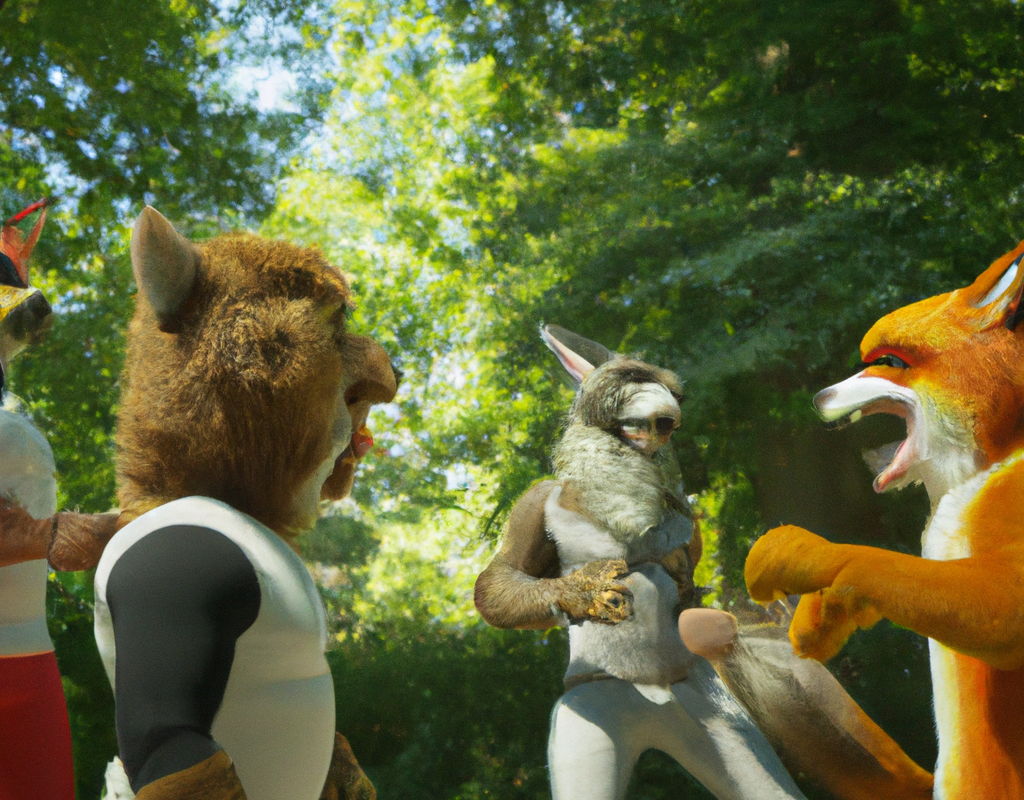
I’m working on more serious content, I swear, Meantime, ChatGPT has me distracted with furious furries.

Bry Willis

Write a poem about furious furries in iambic pentameter.

Furious furries, with their teeth all bared, 
Their paws clenched tight with fury and with hate, 
They snarl and growl and pace, not yet aware 
Of the cold reason that might dissipate 
Their rage. They are a force to be reckoned with, 
These creatures of the wild, with primal might 
And strength. They are a force to fear and fear 
Again, a force that few would dare to fight.
But even furries, in their wildest rage, 
Are still just animals, with hearts that beat 
And minds that think and feel. And so, perhaps, 
We ought to try to understand the heat 
That drives their fury, and to seek to find 
A way to calm the storm that rages in their minds.

Write a haiku about furious furries

Furiously they pace, 
Fierce and wild, their eyes ablaze 
Furries in a rage.

Write a postmodern poem about furious furries

Furries, oh furries, 
Fierce and wild and in a rage, 
They pace and snarl and growl.

But wait, what are these furries? 
Are they real, or just a guise? 
A mask to hide behind?

Perhaps they are a metaphor, 
For something deeper, something true. 
A way to express the rage

That lies within us all, 
The primal, animalistic force 
That drives us to lash out.

Or maybe they are just furries, 
Fierce and wild and in a rage, 
Pacing and snarling and growling,

Unapologetic in their fury, 
Unwavering in their rage.
Furries, oh furries, 
A mystery wrapped in fur, 
A symbol of the fury

That lies within us all.

Ecrire un poème sur les furries furieux en conflit avec les fées françaises

Furieux furries, aux dents découvertes,
Leurs pattes serrées de colère et de haine,
Ils grondent et rugissent et arpentent, pas encore conscients
De la raison froide qui pourrait dissiper
Leur rage. Ils sont une force à ne pas sous-estimer,
Ces créatures de la nature, avec leur puissance primitive
Et leur force. Ils sont une force à craindre et à redouter
Encore une fois, une force que peu oseraient affronter.

Mais même les furries, dans leur rage la plus sauvage,
Ne sont encore que des animaux, avec des cœurs qui battent
Et des esprits qui pensent et ressentent. Et donc, peut-être,
Devrions-nous essayer de comprendre la chaleur
Qui alimente leur fureur, et chercher à trouver
Un moyen de calmer la tempête qui fait rage dans leurs esprits.

Féeriques françaises, de grâce et de beauté,
Leur magie scintillante et leurs ailes brillantes,
Elles se tiennent face aux furries en colère,
Un affrontement de deux mondes diamétralement opposés.
La rage contre la grâce, la sauvagerie contre la délicatesse,
Un conflit sans fin, une guerre sans merci.
Qui triomphera dans cette bataille éternelle?
Seul le temps nous le dira.

Write a sonnet about furious furries in conflict with French fairies

The furious furries snarl and growl with rage, 
Their paws clenched tight, their teeth bared and sharp. 
They pace and seethe, a primal force engaged 
In conflict with the French fairies, who hark 
Back to a time of grace and chivalry.

But even in their wildest, most ferocious state, 
The furries are still just animals, with hearts 
That beat and minds that think and feel. It's late 
To try to understand the heat that imparts 
Their fury, but perhaps it's not too late 
To find a way to calm the storm that rages 
In their minds, and bring some measure of peace 
To this eternal battle, this never-ending war.

The French fairies, with their delicate wings and charms, 
Stand against the furries, a clash of two worlds, 
Diametrically opposed. Who will emerge victorious? 
Only time will tell.

GOD BE IN MY HEAD

God be in my head,
And in my understanding;
God be in mine eyes,
And in my looking;
God be in my mouth,
And in my speaking;
God be in my heart,
And in my thinking;
God be at mine end,
And at my departing.

Podcast: Audio rendition of this page content

Sir Henry Walford Davies put this traditional prayer to music as a hymn. Iain McGilchrist recited it as a poem after a brief setup in an interview.

I am an atheist, and the closest I get to gods is through metaphor, allegory, or allusion. And I don’t engage in it, but I understand when others invoke it. And to be completely honest, I was multitasking when Iain was reciting, and I misheard it, and this miss was more profound for me.

God be in my head,
And in my understanding;
Don’t be in mine eyes,
And in my looking;

That’s what prompted me to seek it out and pen a post. In the original form, it’s more of an invocation. In my misinterpretation, I felt he was saying to keep God in your head as a metaphorical reference—as an archetype—, but God is not for the eyes and the looking. God is a matter of faith.

As for the rest, it flows the same. Speak as you understand it. Feel God in your heart, if you should so choose. Think about him if you wish. And carry this thought with you until the end if it brings you comfort.

Myself, I get no comfort from the notion. I don’t feel I need it, but it is a cultural phenomenon, so to be aware is a part of cultural and emotional intelligence.

I feel that I’ve always intuitively understood metaphor. I remember listening to Joseph Campbell in the 1980s as he was describing how one of his biggest challenges was to get people to understand the embodiment of metaphor and not just the vapidity of simple simile.

And there you have it.

Metaphor and Simile

Chapter 10 of The Master and His Emissary is titled The Enlightement, which is to say another chapter centred around a religious theme and paradigm shift. Only it isn’t. This chapter is focused mainly on metaphor and poetry, and that’s where I want to comment.

If you haven’t happened to have read the prior posts on The Master and His Emissary or The Matter with Things, I’ll summarise the functions of the left and right cerebral hemispheres. If you have, feel free to skip this paragraph. The left hemisphere is closing and convergent whilst the right hemisphere is expansive and divergent, The left is about naming, categorising, and analysing; the right is about experiencing the world as presenced. Where the right hemisphere is about presentation, the left is about re-representation. A challenge occurs when the re-presented view of the left supersedes the experiential view of the right. This is what occurs in a left-dominant brain.

Metaphor is a function of the right hemisphere. The left hemisphere considers metaphor to be a figure of speech. It trivialises it in one of two ways. Either, it reduces it to components that map to some other concepts—ignoring the parts that can’t be mapped—, or it assumes the metaphor to be whimsy and therefore without inherent value.

But metaphor is more than a figure of speech. It’s a figure of thought that can’t be reduced. Metaphor is like art or music and other residences of the right hemisphere. These things must be taken as whole entities and be considered in the manner of Gestalt.

Being analytical and representative, the left hemisphere can be educated. I could be wrong, but I don’t see how the right can be strengthened. It seems that its weakness is interference from the left, but the left is constantly wintering on that it’s always right, and all you need is to be more analytical. If you don’t have empathy, you can’t learn it. If you don’t understand metaphor, you’re pretty much out of luck. The same goes for anything in the experiential right hemisphere.

Might I be wrong? Sure, I’m no neuroscientist, but short of some external event, like a stroke, brain lesions, head trauma, or some such. I don’t see the vector. In a way, it’s like the advancement of technology. It’s difficult to stem the tide and reverse it. This is the challenge. In the West, we’ve been on a path to rationality and reason—left hemisphere fare—, which has shifted it further and further left. We just need more systems and processes.

Why the title, “Metaphor and Simile?” Metaphor resides in the province of the right hemisphere. Simile resides in the left. I remember listening to Joseph Campbell in the 1980s discussing the power of metaphor. Where metaphor is a mode of thought, simile is just a figure of speech. And it’s an analytical analogue. Love is like a rose. There’s a simple mapping. Love is a rose is more robust. John Lennon sings these lines in Mind Games.

Love is the answer and you know that for sure
Love is a flower you got to let it grow

Love is a flower. You got to let it grow. Grammatical structure aside—only an intractable problem for left-brainers—, this is a relatively simple metaphor, flowers grow and bloom; love grows and blooms. 

Follows are another few famous metaphors. These may feel more accessible than some others.

“All the world’s a stage, and all the men and women merely players. They have their exits and their entrances.”

William Shakespeare

“All our words are but crumbs that fall down from the feast of the mind.”

Khalil Gibran

This one is particularly interesting as it suggests how diminutive words are relative to that of the mind—mere crumbs.

“And your very flesh shall be a great poem.”

Walt Whitman

How shall your flesh be a great poem? No like a great poem, but to be a great poem.

I’ve talked about Robert Frost’s The Road Less Travelled previously.

Two roads diverged in a yellow wood,
And sorry I could not travel both
And be one traveler, long I stood
And looked down one as far as I could
To where it bent in the undergrowth;

Then took the other, as just as fair,
And having perhaps the better claim,
Because it was grassy and wanted wear;
Though as for that the passing there
Had worn them really about the same,

And both that morning equally lay
In leaves no step had trodden black.
Oh, I kept the first for another day!
Yet knowing how way leads on to way,
I doubted if I should ever come back.

I shall be telling this with a sigh
Somewhere ages and ages hence:
Two roads diverged in a wood, and I—
I took the one less traveled by,
And that has made all the difference.

This poem is replete with metaphors.

The road itself is a metaphor for life, and the forks are the choices we make. Interpreted from a post-Modern perspective, and as Frost said himself, the trick is that it doesn’t matter which path is taken. In any case, irrespective of which paths you take, it will still make all the difference.

I’ve digressed.

McGilchrist says societies and people are moving too far into a left-dominant worldview, which only reinforces and accelerates this worldview. I don’t know how reversible it is. It’s swung both ways before, but that was prior to Scientism. This and hubris are not a great combination. In the end, the probability of teaching someone metaphor is on par with teaching someone to appreciate a work of art or a piece of music.

McGilchrist says we need to regain this capacity for metaphor—and empathy and so on—, but this requires (in my mind) a paradigm shift. I don’t see it happening at an individual level. There would need to be a cultural shift, and that is unforeseeable from here at the moment.

Here’s the challenge as I see it. In saying that we need to regain the ability to understand metaphor without assuming it can be deconstructed without a loss of meaning, he doesn’t provide a path—at least not yet. I’ve got two chapters remaining, so perhaps he’ll offer some guidance or conceptual framework in one of them. Otherwise, the future looks bleak. Of course, humans are adaptable. Evolution works that way, but you can also veer down an evolutionary dead end without knowing your journey has no viable future until you get there. And that will make all the difference. 

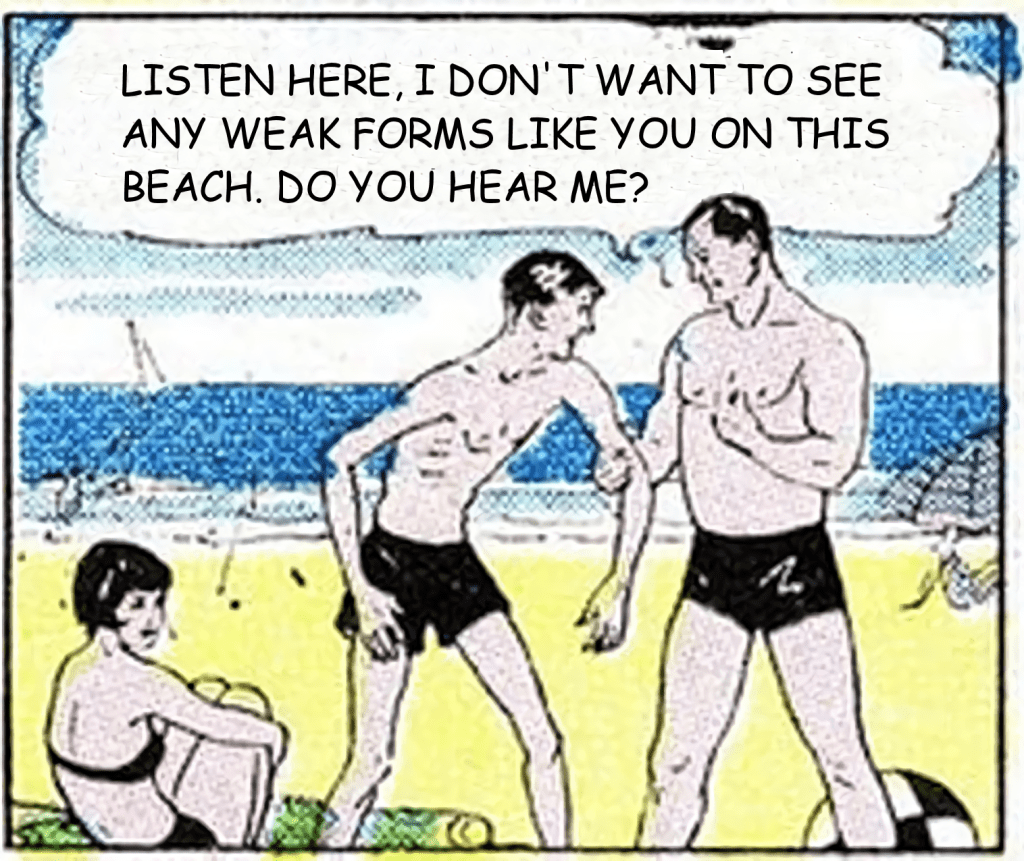
English Weak Forms

I have been so utterly distracted by YouTube this weekend. In this case, it’s a video by Dr Geoff Lindsey explaining weak forms of the English language.

Podcast: Audio rendition of this page content

Much of my work life involves speaking either with non-native English speakers or speakers of English who may be quite well versed in English and yet have a certain rigidity in their execution. Along with local accents, this makes the language feel unnatural to a native speaker.

A common challenge is the adoption of weak forms. Following the principle of least effort, language speakers are lazy. In fact, one may extrapolate this morphology to predict where language may drift next. One example that comes to mind is the American habit of uttering flap Ts over ‘real’ Ts that require slightly more effort to produce.

In English, one says the words, butter, water, doctor, and sister as /ˈbʌtə/,/ˈwɔtəɹ/, /ˈdɒktə/, /ˈsɪstə(ɹ)/ whilst in American English, using the flap T sound, one says (respelt in parentheses) /ˈbʌdəɹ/ (buhd-er), / ˈwɔdəɹ/ (wahd-er), /ˈdɔkdɚ/ (dok-der), /ˈsɪsdər/ (sis-der). Whether the pronunciation of the R is rhotic or non-rhotic is another issue altogether.

But this is about something a bit different. It’s about weak forms, particularly vowels that can be weakened from the strong vowel sound to the shwa (/ə/) sound. It turns out that we do this a lot. In fact, more often than not. Rather than a rehash from the video, I’ve cued it to where Tom Hiddleston recites Lord Byron’s So We’ll Go No More a Roving.

So, we'll go no more a roving
   So late into the night,
Though the heart be still as loving,
   And the moon be still as bright.

For the sword outwears its sheath,
   And the soul wears out the breast,
And the heart must pause to breathe,
   And love itself have rest.

Though the night was made for loving,
   And the day returns too soon,
Yet we'll go no more a roving
   By the light of the moon.

As it happens, much of the difference between native English and English as spoken by non-natives is the hyper-diction heard by choosing the strong rather than the weak form of certain words.

Orlam – Overwhelem

I’ve decided to do something a bit different. In this, I read a selection from Polly Jean Harvey’s narrative poem, Orlam. The book offers a rather bilingual version of the poem, in both standard English and the Dorset dialect whence hails Ms Harvey.

Podcast: Audio rendition of this page content

The piece I’ve selected is titled Overwehelem. I’m going to recite the Dorset rendition.

Voul village in a hag-ridden hollow.
All ways to it winding, all roads to it narrow.

Auverlooked bog, veiled in vog,
thirtover, undercreepen, rank with seepings;

Jeyes Fluid, slurry, zweat and pus,
anus greaze, squitters, jizz and blood

Breeder of asthma, common warts, ringworm.
Ward of ancient occupations;

ploughshares rusting in the brembles,
half-walls, smuggler's runs and ditches,

blackened heth stones, lured lullabies;
Mummy's going to smack you if you don't . . .

The crossroads a red hanging-post
to GOAT HILL, RANSHAM, OVERWELEM.

Three hoar-stones, one Golden Fleece
connected by a single Riddle.

Gramf'er blackthorn bent by wind.
Shabby mothers trying to die.

A haunted wood in the realm of an Eye. 
A farm of hooks with a rout of Rawles. 

a mother of sorrow, a faterous fiend,
a runstick son and his inward friend,

and a not-gurrel born amongst them:
fouling her fig in the forest,

honking a conk-load of creosote,
downing a dram of diazinon,

flaying a fleece-full of maggots,
gorging a gutful of entrails, 

scrounching the scabs o' engripement,
hoarding the horrible heissens,

bearing the burden of wordle. 

So there you have it. Overwhelem from PJ Harvey’s Orlam.

As I mentioned, the book presents the English side-to-side with the Dorset. As Dorset in the south of Britain is an English dialect, most of the words and form should be familiar. There are a few that are less obvious than others. If you’d like a translation, pick up the book or ask in the comments.