I published A Language Insufficiency Hypothesis this month, and this is one of a series of videos summarising the content. In this segment, I’m discussing Chapter 1: A Genealogy of Insufficiency
In this video, I touch on Plato to Barthes and Foucault. Derrida gets no love, and I mention bounded rationality, but not Simon. I discuss Steven Pinker’s dissent in more detail in a later chapter.
Below, I’ve included some artefacts from the book.
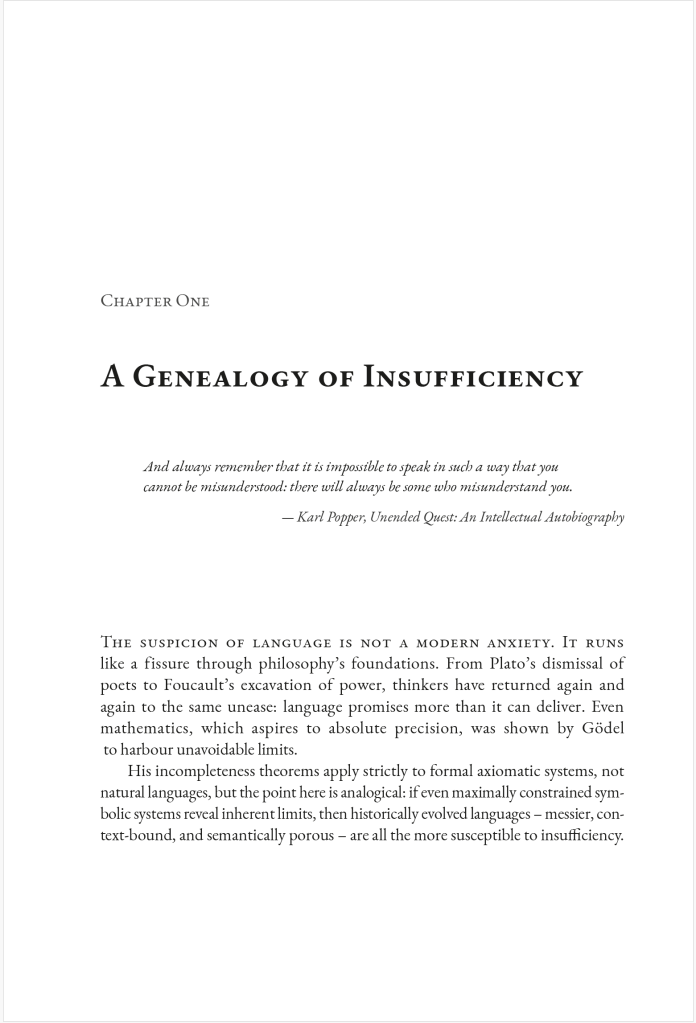
Image: Chapter 1: Page 1
And always remember that it is impossible to speak in such a way that you cannot be misunderstood: there will always be some who misunderstand you. — Karl Popper, Unended Quest: An Intellectual Autobiography
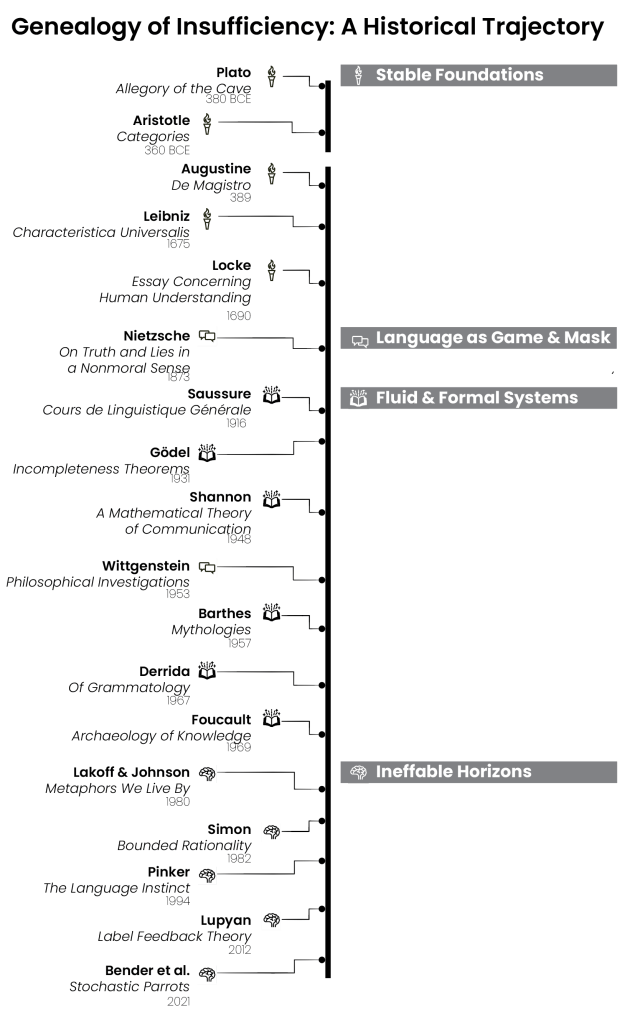
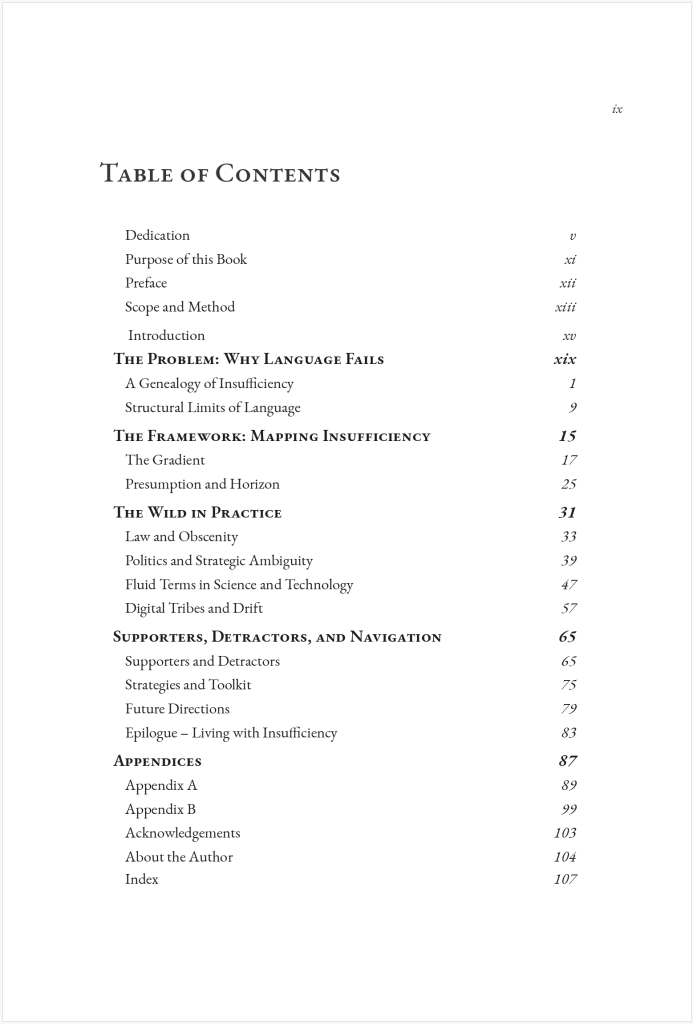
Image: Genealogy of Insufficiency: A Historical TrajectoryImage: Table of Contents
I was having an inappropriate chat with ChatGPT and, per Feyerabend, I once again discovered that some of the best inspirations are unplanned. The conversation circled around to the conflicting narratives of Erasmus and Wells. Enter, Plato, McGilchrist, and the Enlightenment – all living rent-free in my head – and I end up with this.
Audio: NotebookLM podcast on this topic.
I. The Proverb and Its Presumption
Erasmus sits at his writing desk in 1500-something, cheerful as a man who has never once questioned the premises of his own eyesight, and pens what will become one of the West’s most durable little myths: ‘In the land of the blind, the one-eyed man is king’. It arrives packaged as folk wisdom, the sort of thing you’re meant to nod at sagely over a pint. And for centuries, we did. The proverb became shorthand for a comfortable fantasy: that advantage is advantage everywhere, that perception grants sovereignty, that a man with superior faculties will naturally ascend to his rightful place atop whatever heap he finds himself on.
In the land of the blind, the one-eyed man is king
– Erasmus
It’s an Enlightenment dream avant la lettre, really – this breezy confidence that reason, sight, knowledge, insight will simply work wherever they’re deployed. The one-eyed man doesn’t need to negotiate with the blind. He doesn’t need their endorsement, their customs, their consent. He arrives, he sees, he rules. The proverb presumes a kind of metaphysical meritocracy, where truth and capability are self-authenticating, where the world politely arranges itself around whoever happens to possess the sharper tools.
Image: Midjourney didn’t coöperate with my prompt for a one-eyed king. Trust that this king has only one.
It’s the intellectual equivalent of showing up in a foreign country with a briefcase full of sterling and expecting everyone to genuflect. And like most folk wisdom, it survives because it flatters us. It tells us that our advantages – our rationality, our education, our painstakingly cultivated discernment – are universally bankable. That we, the seeing, need only arrive for the blind to recognise our superiority.
Erasmus offers this with no apparent irony. He hands us a proverb that whispers: your clarity is your crown.
II. Wells Wanders In
Four centuries later, H.G. Wells picks up the proverb, turns it over in his hands like a curious stone, and proceeds to detonate it.
The Country of the Blind (1904) is many things – a fable, a thought experiment, a sly dismantling of Enlightenment presumption – but above all it is an act of literary vandalism against Erasmus and everything his proverb smuggles into our collective assumptions. Wells sends his protagonist, Nuñez, tumbling into an isolated Andean valley where a disease has rendered the entire population blind for generations. They’ve adapted. They’ve built a culture, a cosmology, a complete lifeworld organised around their particular sensorium. Sight isn’t absent from their world; it’s irrelevant. Worse: it’s nonsense. The seeing man’s reports of ‘light’ and ‘sky’ and ‘mountains’ sound like the ravings of a lunatic.
Nuñez arrives expecting Erasmus’s kingdom. He gets a psychiatric evaluation instead.
The brilliance of Wells’s story isn’t simply that the one-eyed man fails to become king – it’s how he fails. Nuñez doesn’t lack effort or eloquence. He tries reason, demonstration, patient explanation. He attempts to prove the utility of sight by predicting sunrise, by describing distant objects, by leveraging his supposed advantage. None of it matters. The blind don’t need his reports. They navigate their world perfectly well without them. His sight isn’t superior; it’s alien. And in a culture that has no use for it, no linguistic scaffolding to accommodate it, no social structure that values it, his one eye might as well be a vestigial tail.
The valley’s elders eventually diagnose Nuñez’s problem: his eyes are diseased organs that fill his brain with hallucinations. The cure? Surgical removal.
Wells lets this hang in the air, brutal and comic. The one-eyed man isn’t king. He’s a patient. And if he wants to stay, if he wants to belong, if he wants to marry the girl he’s fallen for and build a life in this place, he’ll need to surrender the very faculty he imagined made him superior. He’ll need to let them fix him.
The story ends ambiguously – Nuñez flees at the last moment, stumbling back toward the world of the sighted, though whether he survives is left unclear. But the damage is done. Erasmus’s proverb lies in ruins. Wells has exposed its central presumption: that advantage is advantage everywhere. That perception grants authority. That reason, clarity, and superior faculties are self-evidently sovereign.
They’re not. They’re only sovereign where the culture already endorses them.
III. Plato’s Ghost in the Valley
If Wells dismantles Erasmus, Plato hovers over the whole scene like a weary ghost, half scolding, half despairing, muttering that he told us this would happen.
The Allegory of the Cave, after all, is the original version of this story. The philosopher escapes the cave, sees the sun, comprehends the Forms, and returns to liberate his fellow prisoners with reports of a luminous reality beyond the shadows. They don’t thank him. They don’t listen. They think he’s mad, or dangerous, or both. And if he persists – if he tries to drag them toward the exit, toward the light they can’t yet see – they’ll kill him for it.
Video: Plato’s Cave
Plato’s parable is usually read as a tragedy of ignorance: the prisoners are too stupid, too comfortable, too corrupted by their chains to recognise truth when it’s offered. But read it alongside Wells and the emphasis shifts. The cave-dwellers aren’t wrong, exactly. They’re coherent. They’ve built an entire epistemology around shadows. They have experts in shadow interpretation, a whole language for describing shadow behaviour, social hierarchies based on shadow-predicting prowess. The philosopher returns with reports of a three-dimensional world and they hear gibberish. Not because they’re defective, but because his truth has no purchase in their lifeworld.
Plato despairs over this. He wants the prisoners to want liberation. He wants truth to be self-authenticating, wants knowledge to compel assent simply by virtue of being knowledge. But the cave doesn’t work that way. The prisoners don’t want truth; they want comfort shaped like reality. They want coherence within the system they already inhabit. The philosopher’s sun is as alien to them as Nuñez’s sight is to the blind valley.
And here’s the kicker: Plato knows this. That’s why the allegory is tragic rather than triumphant. The philosopher does see the sun. He does apprehend the Forms. But his knowledge is useless in the cave. Worse than useless – it makes him a pariah, a madman, a threat. His enlightenment doesn’t grant him sovereignty; it exile him from the only community he has.
The one-eyed man isn’t king. He’s the lunatic they’ll string up if he doesn’t learn to shut up about the sky.
IV. The Enlightenment’s Magnificent Blunder
Once you’ve got Erasmus, Wells, and Plato in the same room, the Enlightenment’s central fantasy collapses like wet cardboard.
Humanity’s great Enlightenment wheeze – that baroque fantasy of Reason marching triumphantly through history like a powdered dragoon – has always struck me as the intellectual equivalent of selling snake oil in a crystal decanter. We were promised lucidity, emancipation, and the taming of ignorance; what we got was a fetish for procedural cleverness, a bureaucratisation of truth, and the ghastly belief that if you shine a bright enough torch into the void, the void will politely disclose its contents.
The Enlightenment presumed universality. It imagined that rationality, properly deployed, would work everywhere – that its methods were culture-neutral, that its conclusions were binding on all reasonable minds, that the shadows in Plato’s cave and the blindness in Wells’s valley could be cured by the application of sufficient light and logic. It treated reason as a kind of metaphysical bulldozer, capable of flattening any terrain it encountered and paving the way for Progress, Truth, and Universal Human Flourishing.
This was, to put it mildly, optimistic.
What the Enlightenment missed – what Erasmus’s proverb cheerfully ignores and what Wells’s story ruthlessly exposes – is that rationality is parochial. It’s not a universal solvent. It’s a local dialect, a set of practices that evolved within particular cultures, buttressed by particular institutions, serving particular ends. The Enlightenment’s rationality is Western rationality, Enlightenment rationality, rationality as understood by a specific cadre of 18th-century European men who happened to have the printing press, the political clout, and the colonial apparatus to export their epistemology at gunpoint.
They mistook their own seeing for sight itself. They mistook their own lifeworld for the world. And they built an entire civilisational project on the presumption that everyone else was just a less-developed version of them – prisoners in a cave, blind villagers, savages waiting to be enlightened.
The one-eyed man imagined himself king. He was actually the emissary who forgot to bow.
V. McGilchrist’s Neuroscientific Millinery
Iain McGilchrist sits in the same intellectual gravity well as Plato and Wells, only he dresses his thesis up in neuroscientific millinery so contemporary readers don’t bolt for the door. The Master and His Emissary is essentially a 500-page retelling of the same ancient drama: the emissary – our little Enlightenment mascot – becomes so enamoured of his own procedures, abstractions, and tidy schemas that he forgets the Master’s deeper, embodied, culturally embedded sense-making.
McGilchrist’s parable is neurological rather than allegorical, but the structure is identical. The left hemisphere (the emissary) excels at narrow focus, manipulation, abstraction – the sort of thing you need to count coins or parse grammar or build bureaucracies. The right hemisphere (the Master) handles context, pattern recognition, relational understanding – the sort of thing you need to navigate an actual lifeworld where meaning is messy, embodied, and irreducible to procedures.
The emissary is supposed to serve the Master. Left-brain proceduralism is supposed to be a tool deployed within the broader, contextual sense-making of the right brain. But somewhere along the way – roughly around the Enlightenment, McGilchrist suggests – the emissary convinced itself it could run the show. Left-brain rationality declared independence from right-brain contextuality, built an empire of abstraction, and wondered why the world suddenly felt thin, schizophrenic, oddly two-dimensional.
It’s Erasmus all over again: the presumption that the emissary with one eye should be king. The same tragic misunderstanding of how worlds cohere.
McGilchrist’s diagnosis is clinical, but his conclusion is damning. Western modernity, he argues, has become pathologically left-hemisphere dominant. We’ve let analytic thought pretend it’s sovereign. We’ve mistaken our schemas for reality, our maps for territory, our procedures for wisdom. We’ve built cultures that privilege manipulation over meaning, extraction over relationship, clarity over truth. And we’re baffled when these cultures feel alienating, when they produce populations that are anxious, depressed, disenchanted, starved for something they can’t quite name.
The emissary has forgotten the Master entirely. And the Master, McGilchrist suggests, is too polite – or too injured – to stage a coup.
In McGilchrist’s frame, culture is the Master. Strategy, reason, Enlightenment rationality – these are the emissary’s tools. Useful, necessary even, but never meant to govern. The Enlightenment’s mistake was letting the emissary believe his tools were all there was. It’s the same delusion Nuñez carries into Wells’s valley: the belief that sight, reason, superior faculties are enough. That the world will rearrange itself around whoever shows up with the sharper implements.
It won’t. The valley doesn’t need your eyes. The cave doesn’t want your sun. And the Master doesn’t answer to the emissary’s paperwork.
VI. The Triumph of Context Over Cleverness
So here’s what these three – Erasmus, Wells, Plato – triangulate, and what McGilchrist confirms with his neuroscientific gloss: the Enlightenment dream was always a category error.
Reason doesn’t grant sovereignty. Perception doesn’t compel assent. Superior faculties don’t self-authenticate. These things only work – only mean anything, only confer any advantage – within cultures that already recognise and value them. Outside those contexts, they’re noise. Gibberish. Hallucinations requiring surgical intervention.
The one-eyed man arrives in the land of the blind expecting a kingdom. What he gets is a reminder that kingdoms aren’t built on faculties; they’re built on consensus. On shared stories, shared practices, shared ways of being-in-the-world. Culture is the bedrock. Reason is just a tool some cultures happen to valorise.
And here’s the uncomfortable corollary: if reason is parochial, if rationality is just another local dialect, then the Enlightenment’s grand project – its universalising ambitions, its colonial export of Western epistemology, its presumption that everyone, everywhere, should think like 18th-century European philosophes – was always a kind of imperialism. A metaphysical land-grab dressed up in the language of liberation.
The Enlightenment promised illumination but delivered a blinding glare that obscures more than it reveals. It told us the cave was a prison and the valley was backward and anyone who didn’t see the world our way was defective, uncivilised, in need of correction. It never occurred to the Enlightenment that maybe – just maybe – other cultures had their own Masters, their own forms of contextual sense-making, their own ways of navigating the world that didn’t require our light.
Wells understood this. Plato suspected it. McGilchrist diagnoses it. And Erasmus, bless him, never saw it coming.
VII. The Enlightenment’s Paper Crown
The Enlightenment liked to imagine itself as the adult entering the room, flicking on the light-switch, and announcing that, at long last, the shadows could stop confusing the furniture for metaphysics. This is the kind of confidence you only get when your culture hasn’t yet learned the words for its own blind spots. It built an entire worldview on the hopeful presumption that its preferred modes of knowing weren’t just one way of slicing experience, but the gold standard against which all other sense-making should be judged.
Call it what it is: a provincial dialect masquerading as the universal tongue. A parochial habit dressed in imperial robes. The Enlightenment always smelled faintly of a man who assumes everyone else at the dinner table will be impressed by his Latin quotations. And when they aren’t, he blames the table.
The deeper farce is that Enlightenment rationality actually believed its tools were transferrable. That clarity is clarity everywhere. That if you wheel enough syllogisms into a space, the locals will drop their incense and convert on sight. Wells disabuses us of this; Plato sighs that he tried; McGilchrist clinically confirms the diagnosis. The emissary, armed with maps and measuring sticks, struts into the valley expecting coronation and is shocked – genuinely shocked – to discover that nobody particularly cares for his diagrams.
The Enlightenment mistake wasn’t arrogance (though it had that in liberal supply). It was context-blindness. It thought procedures could substitute for culture. It thought method could replace meaning. It thought mastery was a matter of getting the right answer rather than belonging to the right world.
You can all but hear the emissary stamping his foot.
VIII. The Anti-Enlightenment Position (Such as It Is)
My own stance is drearily simple: I don’t buy the Enlightenment’s sales pitch. Never have. The promise of universal reason was always a conjuring trick designed to flatter its adherents into thinking that their habits were Nature’s preferences. Once you stop confusing methodological neatness with metaphysical authority, the entire apparatus looks less like a cathedral of light and more like a filing system that got ideas above its station.
The problem isn’t that reason is useless. The problem is that reason imagines itself sovereign. Reason is a brilliant servant, a competent emissary, and an atrocious king. Culture is the king; context is the kingdom. Without those, rationality is just an embarrassed bureaucrat looking for a desk to hide behind.
This is why I keep banging on about language insufficiency, parochial cognition, and the delightful way our concepts disintegrate once you wander too far from the lifeworlds that birthed them. The Enlightenment thought the human mind was a searchlight. It’s closer to a candle in a draughty hall. You can still get work done with a candle. You just shouldn’t be telling people it can illuminate the universe.
So the anti-Enlightenment move isn’t a call to smash the instruments. It’s a call to read the room. To stop pretending the emissary is the Master. To stop assuming sight is a passport to sovereignty. To stop wandering into other cultures – other caves, other valleys, other hemispheres – with a ruler and a smirk, convinced you’re about to be crowned.
Underneath these brittle idols lies the far messier truth that cognition is parochial, language insufficient, and ‘rationality’ a parlour trick we perform to impress ourselves. I’m not proposing a new catechism, nor am I pining for some prelapsarian alternative. I’m simply pointing out that the Enlightenment promised illumination but delivered a blinding glare that obscures more than it reveals.
The task, then, is to grow comfortable with the dimness. To navigate by flicker rather than floodlight. To admit that the world was never waiting to be made ‘clear’ in the first place.
This doesn’t mean abandoning reason. It means remembering that reason is the emissary, not the Master. It means recognising that our schemas are provisional, our maps incomplete, our procedures useful only within the cultures that endorse them. It means learning to bow – to culture, to context, to the irreducible messiness of lifeworlds we don’t fully understand and can’t procedurally master.
The one-eyed man never was king. At best, he was an enthusiastic tourist with a very noisy torch. The sooner he stops shining it into other people’s faces, the sooner we can get on with the far more interesting business of navigating a world that never promised to be legible.
Not a kingdom of sight. Just a world where the emissary remembers his place.
I’ve read Part I of Hobbes’ Leviathan and wonder what it would have been like if he filtered his thoughts through Hume or Wittgenstein. Hobbes makes Dickens read like Pollyanna. It’s an interesting historical piece, worth reading on that basis alone. It reads as if the Christian Bible had to pass through a legal review before it had been published, sapped of vigour. As bad a rap as Schopenhauer seems to get, Hobbes is the consummate Ebenezer Scrooge. Bah, humbug – you nasty, brutish, filthy animals!*
Audio: NotebookLM podcast conversation on this topic.
In any case, it got me thinking of free will and, more to the point, of will itself.
A Brief History of Humanity’s Favourite Metaphysical Scapegoat
By the time Free Will turned up to the party, the real guest of honour—the Will—had already been drinking heavily, muttering incoherently in the corner, and starting fights with anyone who made eye contact. We like to pretend that the “will” is a noble concept: the engine of our autonomy, the core of our moral selves, the brave little metaphysical organ that lets us choose kale over crisps. But in truth, it’s a bloody mess—philosophy’s equivalent of a family heirloom that no one quite understands but refuses to throw away.
So, let’s rewind. Where did this thing come from? And why, after 2,500 years of name-dropping, finger-pointing, and metaphysical gymnastics, are we still not quite sure whether we have a will, are a will, or should be suing it for damages?
Plato: Soul, Reason, and That Poor Horse
In the beginning, there was Plato, who—as with most things—half-invented the question and then wandered off before giving a straight answer. For him, the soul was a tripartite circus act: reason, spirit, and appetite. Will, as a term, didn’t get top billing—it didn’t even get its name on the poster. But the idea was there, muddling along somewhere between the charioteer (reason) and the unruly horses (desire and spiritedness).
No explicit will, mind you. Just a vague sense that the rational soul ought to be in charge, even if it had to beat the rest of itself into submission.
Aristotle: Purpose Without Pathos
Aristotle, ever the tidy-minded taxonomist, introduced prohairesis—deliberate choice—as a sort of proto-will. But again, it was all about rational calculation toward an end. Ethics was teleological, goal-oriented. You chose what aligned with eudaimonia, that smug Greek term for flourishing. Will, if it existed at all, was just reason picking out dinner options based on your telos. No inner torment, no existential rebellion—just logos in a toga.
Augustine: Sin, Suffering, and That Eternal No
Fast-forward a few hundred years, and along comes Saint Augustine, traumatised by his libido and determined to make the rest of us suffer for it. Enter voluntas: the will as the seat of choice—and the scene of the crime. Augustine is the first to really make the will bleed. He discovers he can want two incompatible things at once and feels properly appalled about it.
From this comes the classic Christian cocktail: freedom plus failure equals guilt. The will is free, but broken. It’s responsible for sin, for disobedience, for not loving God enough on Wednesdays. Thanks to Augustine, we’re stuck with the idea that the will is both the instrument of salvation and the reason we’re going to Hell.
Cheers.
Medievals: God’s Will or Yours, Pick One
The Scholastics, never ones to let an ambiguity pass unanalysed, promptly split into camps. Aquinas, ever the reasonable Dominican, says the will is subordinate to the intellect. God is rational, and so are we, mostly. But Duns Scotus and William of Ockham, the original voluntarist hooligans, argue that the will is superior—even in God. God could have made murder a virtue, they claim, and you’d just have to live with it.
From this cheerful perspective, will becomes a force of arbitrary fiat, and humans, made in God’s image, inherit the same capacity for irrational choice. The will is now more than moral; it’s metaphysical. Less reason’s servant, more chaos goblin.
Hobbes: Appetite with Delusions of Grandeur
Then along comes Thomas Hobbes, who looks at the soul and sees a wheezing machine of appetites. Will, in his famously cheery view, is simply “the last appetite before action.” No higher calling, no spiritual struggle—just the twitch that wins. Man is not a rational animal, but a selfish algorithm on legs. For Hobbes, will is where desire stumbles into motion, and morality is a polite euphemism for not getting stabbed.
Kant: The Will Gets a Makeover
Enter Immanuel Kant: powdered wig, pursed lips, and the moral rectitude of a man who scheduled his bowel movements. Kant gives us the “good will”, which acts from duty, not desire. Suddenly, the will is autonomous, rational, and morally legislative—a one-man Parliament of inner law.
It’s all terribly noble, terribly German, and entirely exhausting. For Kant, free will is not the ability to do whatever you like—it’s the capacity to choose according to moral law, even when you’d rather be asleep. The will is finally heroic—but only if it agrees to hate itself a little.
Schopenhauer: Cosmic Will, Cosmic Joke
And then the mood turns. Schopenhauer, world’s grumpiest mystic, takes Kant’s sublime will and reveals it to be a blind, thrashing, cosmic force. Will, for him, isn’t reason—it’s suffering in motion. The entire universe is will-to-live: a desperate, pointless striving that dooms us to perpetual dissatisfaction.
There is no freedom, no morality, no point. The only escape is to negate the will, preferably through aesthetic contemplation or Buddhist-like renunciation. In Schopenhauer’s world, the will is not what makes us human—it’s what makes us miserable.
Nietzsche: Transvaluation and the Will to Shout Loudest
Cue Nietzsche, who takes Schopenhauer’s howling void and says: yes, but what if we made it fabulous? For him, the will is no longer to live, but to power—to assert, to create, to impose value. “Free will” is a theologian’s fantasy, a tool of priests and moral accountants. But will itself? That’s the fire in the forge. The Übermensch doesn’t renounce the will—he rides it like a stallion into the sunset of morality.
Nietzsche doesn’t want to deny the abyss. He wants to waltz with it.
Today: Free Will and the Neuroscientific Hangover
And now? Now we’re left with compatibilists, libertarians, determinists, and neuroscientists all shouting past each other, armed with fMRI machines and TED talks. Some claim free will is an illusion, a post hoc rationalisation made by brains doing what they were always going to do. Others insist that moral responsibility requires it, even if we can’t quite locate it between the neurons.
We talk about willpower, will-to-change, political will, and free will like they’re real things. But under the hood, we’re still wrestling with the same questions Augustine posed in a North African villa: Why do I do what I don’t want to do? And more importantly, who’s doing it?
Conclusion: Where There’s a Will, There’s a Mess
From Plato’s silent horses to Nietzsche’s Dionysian pyrotechnics, the will has shape-shifted more times than a politician in an election year. It has been a rational chooser, a moral failure, a divine spark, a mechanical twitch, a cosmic torment, and an existential triumph.
Despite centuries of philosophical handwringing, what it has never been is settled.
So where there’s a will, there’s a way. But the way? Twisting, contradictory, and littered with the corpses of half-baked metaphysical systems.
Welcome to the labyrinth. Bring snacks.
* The solitary, poor, nasty, brutish, and short quote is forthcoming. Filthy animals is a nod to Home Alone.
Follows is another AutoCrit1 review of my current focus—working title: Democracy: The Grand Illusion, affectionately called Dumocracy.
Synopsis
The chapter “Vote Against Democracy, Say ‘Nay'” delves into a comprehensive exploration of the critiques posed by prominent intellectuals and philosophers throughout history regarding democratic systems. The opening sets the stage by quoting Winston Churchill’s famous line: “The best argument against democracy is a five-minute conversation with the average voter.” This quote immediately introduces a critical perspective on democracy, foreshadowing the in-depth analysis to come.
“The best argument against democracy is a five-minute conversation with the average voter.”
The text then proceeds to examine various historical figures’ criticisms of democracy, ranging from Plato’s concerns about mob rule to Tocqueville’s observations about mediocrity in democratic societies. Each thinker’s critique is dissected and analyzed, shedding light on the potential pitfalls and limitations of democratic governance. From elitism and failures within democracies to warnings about the tyranny of the majority and challenges with meritocracy, each section offers valuable insights into different aspects of democratic systems.
As the text progresses towards its conclusion, it synthesizes these diverse critiques while acknowledging both strengths and weaknesses inherent in democratic ideals. It culminates by emphasizing that despite its flaws, democracy remains one of the best available forms of government—a sentiment encapsulated in Winston Churchill’s famous remark: “Democracy is the worst form of government, except for all others that have been tried.” This closing statement reinforces a pragmatic understanding of democracy while encouraging ongoing reflection on how to refine and improve democratic governance models.
“Democracy is the worst form of government, except for all others that have been tried.”
Winston Churchill
In essence, “Vote Against Democracy, Say ‘Nay'” presents a nuanced examination of historical critiques surrounding democracy that challenge readers to critically assess both the virtues and vulnerabilities embedded within this prevalent system of governance.
Audience
audience for this text appears to be individuals interested in political theory, philosophy, and the complexities of democratic governance. Those who are engaged in scholarly or academic discussions surrounding democracy, its critiques, and potential reforms would likely find this text highly relevant. The detailed exploration of historical perspectives from prominent figures like Plato, Aristotle, Churchill, Nietzsche, and Tocqueville provides a comprehensive overview for readers with an interest in political thought.
However, individuals seeking a more general overview or introductory understanding of democracy may find the text overly intricate and specialized. To make it more accessible to a broader audience outside academia or political theory enthusiasts, the author could consider simplifying complex philosophical concepts into more digestible language. Additionally, providing real-world examples or contemporary case studies illustrating the practical implications of these critiques could help engage a wider range of readers who may not have prior knowledge of political theory. Incorporating clear summaries at key points throughout the text can also aid in enhancing readability and comprehension for those less familiar with the subject matter.
Structure and Organisation
The text follows a logical order and is well-organized. Each critique of democracy by the different intellectuals is presented in a structured manner, with clear transitions between each section. The text flows smoothly from one critique to the next, providing a comprehensive overview of various perspectives on democratic governance without any apparent issues of structure or organization.
Clarity
The author’s points are generally presented clearly throughout the text. Complex ideas and critiques of democracy are explained in a structured manner, making it easier for readers to follow the arguments presented by each thinker. However, there are instances where additional clarification or simplification could enhance reader understanding:
In the section discussing Joseph Schumpeter’s elitist theory of democracy, some readers may find the concept of democracy as a competitive struggle for votes rather than genuine self-governance by the masses somewhat challenging to grasp without further elaboration on how this dynamic operates within democratic systems.
The discussion on Michel Foucault’s critique of democracy introduces terms like biopolitics and power structures that may require more explicit definitions or examples to help readers unfamiliar with these concepts fully comprehend their significance within democratic contexts.
Audre Lorde’s critique focusing on intersectionality and democratic inclusion touches upon complex social dynamics that might benefit from clearer illustrations or real-world applications to elucidate how these issues manifest in practice within democratic institutions.
Overall, while the text effectively conveys nuanced critiques of democracy by various thinkers, providing more concrete examples or simplified explanations in certain sections could enhance clarity for readers less familiar with political theory and philosophy.
Commentary
I may address these aspects with footnotes as this background information is at times extensive and in any case available elsewhere.
Argument and Persuasion
The text presents a range of opinions critiquing democratic systems from various thinkers such as Plato, Aristotle, Alexis de Tocqueville, Friedrich Nietzsche, Winston Churchill, Joseph Schumpeter, Simone Weil, Michel Foucault, and Audre Lorde. These critiques cover themes like elitism in governance (Plato), the importance of moderation (Aristotle), concerns about tyranny of the majority (Tocqueville), critique of egalitarianism (Nietzsche), pragmatic view on democracy’s flaws and strengths (Churchill), elitist theory emphasizing competition for votes over self-governance by masses (Schumpeter), highlighting failures to address spiritual needs and rootedness in society (Weil) and understanding how democratic institutions can perpetuate subtle forms of control through power structures embedded within knowledge frameworks.
Each thinker presents their arguments with logical reasoning and supporting evidence drawn from historical contexts or philosophical principles. The strength lies in the diversity of perspectives offered which enriches the discourse on democracy by exploring its complexities from different angles. By addressing issues like potential mediocrity in democracies or challenges with inclusivity for marginalized groups within democratic systems these critiques prompt critical reflection on areas where improvements may be needed.
Overall, the persuasive elements are well-supported through references to original texts or established theories. The logical construction is evident as each opinion is presented coherently with relevant examples or theoretical frameworks backing them up.
Tone
The text presents a range of emotional perspectives, reflecting both critical analyses and nuanced reflections on democratic systems. The tone varies from sober contemplation to impassioned critique, showcasing a mix of scepticism, concern, pragmatism, and urgency. Each author’s perspective evokes emotions such as caution (Plato), moderation (Aristotle), wariness (Tocqueville), disdain for egalitarianism (Nietzsche), pragmatic acknowledgement of flaws (Churchill), elitist realism (Schumpeter), longing for rootedness and community (Simone Weil), critical examination of power structures (Foucault) and call for inclusivity and justice for marginalized groups (Audre Lorde). These emotional tones collectively create a rich tapestry that challenges conventional views on democracy while urging readers to consider the complexities inherent in governance systems.
Interest and Engagement
The text presents a wide range of critiques on democracy from various historical and philosophical perspectives, which can be engaging for readers interested in political theory. The inclusion of notable figures such as Plato, Aristotle, Alexis de Tocqueville, Friedrich Nietzsche, Winston Churchill, Joseph Schumpeter, Simone Weil, Michel Foucault, and Audre Lorde adds depth and credibility to the discussion.
However, due to the detailed nature of each critique presented in the text and the extensive references to specific works by these thinkers, some sections may become dense or overwhelming for readers who are not well-versed in political philosophy. To improve engagement in these sections:
Simplify Complex Ideas: Break down complex concepts into more digestible segments that are easier for a broader audience to understand.
Provide Contextual Explanations: Offer brief explanations or summaries before delving into each critique to provide context for readers unfamiliar with the philosophers’ works.
Use Analogies or Real-World Examples: Illustrate abstract ideas with relatable examples or analogies that help clarify their relevance in contemporary society.
Incorporate Visual Aids: Consider using diagrams or visual aids to enhance understanding of intricate theories and make them more accessible.
By incorporating these strategies throughout the text when discussing challenging concepts from different critiques on democracy by prominent theorists such as Plato’s “The Republic,” Aristotle’s “Politics,” Tocqueville’s “Democracy in America,” Nietzsche’s concept of the Übermensch (Overman), Churchill’s pragmatic observations on democracy being “the worst form of government except all others,” Schumpeter’s elitist theory of democracy emphasizing competition among elites for votes rather than direct self-governance by all citizens; Weil’s focus on rootedness and community needs within democratic systems; Foucault’s analysis on power structures within democracies perpetuating control; Lorde’s intersectionality critique highlighting exclusionary practices towards marginalized groups—the author could maintain reader interest while navigating through intricate discussions surrounding democratic governance across history and philosophy.
Commentary
I plan to incorporate some visual and diagrammatic aids, but AutoCrit cannot evaluate this type of content.
Final Thoughts and Conclusions
The text ends with a comprehensive and cohesive conclusion that effectively ties together the various critiques of democratic systems presented by Plato, Aristotle, Alexis de Tocqueville, Friedrich Nietzsche, Winston Churchill, Joseph Schumpeter, Simone Weil, Michel Foucault, and Audre Lorde. The final thoughts provide a reflective summary of the challenges inherent in democratic governance while emphasizing the need for ongoing reflection and improvement within democratic systems. The concluding section successfully synthesizes the diverse perspectives on democracy discussed throughout the text.
AutoCrit is an AI-based editorial application. I am a member of their affiliate programme, so I gain minor financial benefits at no cost to you if you purchase through a link on this page. ↩︎
Churchill is not on record having said this, but the sentiment remains. ↩︎
Someone will have to try very hard to convince me that the classical Greek philosophers were not strictly satirists. I believe I’ve commented on Plato in the past. I try to be well-rounded and not just cherry-pick material that supports my worldview—even though that competes for my available time and creates opportunity costs.
Listen on Spotify
This time, I decided to pick up Aristotle’s Nicomachean Ethics. If there is anything I needed to read to drive another nail into the coffin of Virtue ethics, this does the trick.
Nails in a coffin
Reading Classical philosophical texts feels like reading the Bible or any other religious works. It feels like it is only meant for disciples. It’s just choir preaching. If one agrees with the foundational position, it all works. Otherwise, it all falls apart.
I am not going to deconstruct the text. That would quite literally take several posts. What I want to point out is that within the frame he attempts to establish, his position is entirely heuristic. In this case, if one believes in virtue and honour and how these may or may not connect to happiness, then this is right up your street in much the same way as a Christian knows that s/he will be forgiven because Jesus loves them.
In some ways, it feels that the philosophy underlying Western Civilisation is more insidious than Abrahamic religions. They act in a similar way, attempting to convey an underpinning that simply doesn’t exist. Both are aspirational, but they claim to be foundational.
Like Plato’s Republic, Aristotle’s Nicomachean Ethics comes across (to me) as mental masturbation—some free-association thought experiment. I’m about 60 per cent through and tempted to quit, but on some level, I want to be able to defend that I have read it. Like the Bible, the I Ching, the Bhagavad Gita, and the Qur’an, and other such canon, I want to have read the source material and not just references to it.
So, I’ll take one for the team and see whatever gems I can find.
First page of a 1566 edition of the Nicomachean Ethics in Greek and Latin
UPDATE: I’ve finished the book. It doesn’t get any better. He drifts off into politics as he sets up his sequel. My biggest criticism is that he casts his elitist worldview as reality based on assertions based solely on his opinions and appeals to tradition and authority. Read this if only to understand where certain people derive this moralistic, virtue-laden worldview. I was surprised by the foreshadowing of Descartes’ Cogito—though given how that further led to popularise Dualism, I’m not saying that’s a good thing.
Does digital technology make students stupid? That’s what a 2019 BigThink article asks. I like to read Big Think, but it seems like PopScience in a negative way—like Pop Psychology. It’s not necessarily directionally wrong. It’s just oversimplified and seeks the lowest common denominator.
On this topic, Plato quipped, voicing Socrates, in his Phædrus 14 dialogue except that his quip was relative to writing and memory. Some historians and Classicists have suggested that modern readers may be missing the satire. I’m no defender of human intelligence, but this is the demise of society because of change—whether due to writing, radio, television, computers, video games, mobile devices, and whatever comes up next.
For this invention will produce forgetfulness in the minds of those who learn to use it, because they will not practice their memory. Their trust in writing, produced by external characters which are no part of themselves, will discourage the use of their own memory within them. You have invented an elixir not of memory, but of reminding; and you offer your pupils the appearance of wisdom, not true wisdom, for they will read many things without instruction and will therefore seem to know many things, when they are for the most part ignorant and hard to get along with, since they are not wise, but only appear wise.
Plato – Dialogue Phædrus 14
Whether or not this claim has merit, my claim is that computers have trebled manufactured consent, so it allows people to be passively active, to have to specious notion of participation in the body politic, and yet are virtually tilting windmills.
It seems that some people have such nostalgia for their apparent way of life that any deviation is considered to be an affront and possible disruption. Perhaps, it’s because I feel there’s possibly as much to shed than to keep in my book, so for me, it’s more good riddance than oh heavens.
I’ve been thinking a lot lately about Democracy and thinking that the emperor is wearing no clothes, but in dialogue, I am having difficulty getting people to understand that I am talking about democracy as a concept—the very essence of democracy—, not how some place or another has implemented it. My point is that democracy is a silly system built on false hope, smoke, and mirrors.
Some get it, and they fall back to the Churchill quote:
‘Many forms of Government have been tried, and will be tried in this world of sin and woe. No one pretends that democracy is perfect or all-wise. Indeed it has been said that democracy is the worst form of Government except for all those other forms that have been tried from time to time…’
—Winston S Churchill, 11 November 1947
But this misses the point.
First, Churchill’s logic is limited to ‘forms that have been tried‘, a minuscule set to be sure.
Next, perhaps he is talking a position of not letting perfection be the enemy of the good. Except there is no one seeking perfection. The question is: what is good enough? Is Democracy in and of itself good enough? And it doesn’t end there, are there systems—even theoretically—better than democracy? And then, how might these systems fair when humans populate the model?
The problem is a systems thinking optimisation problem—and then there’s the question of what democracy is attempting to optimise. Clearly, this is a multifactor model, so what outputs are being optimised? It’s not likely that this would be a steady state model, and much of this relies on an unstable preference theory, so what is optimal today might no longer be optimal tomorrow—or in ten minutes.
how does one optimise a heterogeneous model?
As anyone who follows me know, I have a problem with the notion of progress as well, so participants can vote on various definitions of progress and various initiates toward that end, and, of course, other participants would prefer the comfort zone of the nostalgic and familiar instead. So, how does one optimise a heterogeneous model?
In the business world or entertainment, we are all familiar with the concept of death by committee, the slow deliberative process that mostly yields diluted results—results that might make the participants feel that they had a voice (perhaps), but—that would be ineffectual.
I am not eschewing coöperation.
I am not eschewing coöperation. I’m of the age where the Beatles were a big influence on me—and the Rolling Stones—, so I cherish the partnerships of Lennon-McCartney and Jagger-Richards. Their solo material paled miserably. The collaboration was synergetic. But there is a reason Ringo and Charlie were not asked to participate in the song-writing process. Their inputs would not have improved the output. Even imagine listening to an album of Ringo tunes: Act Naturally, Yellow Submarine, Octopuses Garden, What Goes On, Don’t Pass Me By, and Boys? Really? Right? And he only contributed to two of these anyway, save for lending his vocal instrument.
consider the concept of diminishing marginal returns
As I continue down this stream of consciousness, I consider the concept of diminishing marginal returns. So, even if there were a democratic system that could theoretically be optimised, it would have to face the human factor—and that would be subject to the diminishing marginal return of knowledge and information—, as we’d go down the participation pool from highly knowledgeable to low-information voters. And this doesn’t even address vested interests and conflicts of interest. It doesn’t even touch on the point that people are predictably irrational.
Plato’s Republic, in all of its elitist glory, offered a solution for this—aside from the philosopher-leader: a republic of the meritorious and virtuous (as if these were meaningful or measurable concepts). At least we wouldn’t be scraping the bottom of the barrel—or would we be?
merit being honed is how to gain and exert powerand political competency
The problem with Plato’s meritocratic approach is that the merit being honed is how to gain and exert power and political competency—how to play the game of politics. And notion of virtue was nothing more than a façade, so rhetoric and the decorum of appearance is all that matters in this model.
Clearly, this stream is coming to an end, so I’ll disembark here and reembark later.
Let’s face it and be honest: Democracy is not a great system of governance. In fact, it’s as mediocre as the outcomes it generates.
Plato hated it. He preferred a Republic, but all that does is kick the can down the proverbial kerb. A mob of demos voting for self-interested politicos with the gift of gab and self-promotion.
Alexis de Tocqueville noted that Democracy requires an education populace, but that’s the least of its shortcomings, and, man, was he spot on.
Democracy is the worst form of government, except for all the others.
— Winston Churchill
Winston Churchill is to have said, “Democracy is the worst form of government, except for all the others.” Except he didn’t get out much and probably hadn’t survey all the others he demeaned. I don’t reckon he was very imaginative at the start.
Kenneth Arrow demonstrated with his Impossibility Theorem that no voting system would work even if the concept was otherwise solid, so that’s just adding insult to injury.
to what extent is democracy simply playing on the cognitive illusion of control?
Democracy sounds good on paper, but to what extent is democracy simply playing on the cognitive illusion of control? I’d imagine that the more one feels able to control outcomes (or happen to be in sync with the decided outcomes), the more favourable one feels towards it. But as much one might assume the disenfranchised to be disillusioned by it—and against all logic—, many still defend it.
The problem, is course, is people, so what are the alternatives? Besides Democracy, some people are easily enamoured by the Beneficent Dictator, but the shortcomings of that have been debated for centuries. For the most part, monarchies have run their historical course—at least as far as to demonstrate that they are not a solution either.
Some have raised Artificial Intelligence as a solution, but unless AI can unlearn the human elements, it’s not much of an improvement. It’s just faster and more efficient within a sub-optimal system. And humans are fearful of how another superior entity might treat them—especially given how poorly humans treat encountered ‘inferior’ entities.
To be fair, I don’t have an answer, but any system that outputs Vladimir Putin, Boris Johnson, or Donald Trump is in serious need of an overhaul—especially simultaneously.
* I included the Democracy Now!’s logo in this post. Democracy Now! is neither affiliated with this blog or this post. Still, I suggest you check it out.
What’s an anarcho-syndicalist supposed to do in the advent of artificial intelligence, process automation, and robots?
Wikipedia relates anarcho-Syndicalism as follows:
Anarcho-syndicalism (also referred to as revolutionary syndicalism)[1] is a theory of anarchism that views revolutionary industrial unionism or syndicalism as a method for workers in capitalist society to gain control of an economy and thus control influence in broader society. Syndicalists consider their economic theories a strategy for facilitating worker self-activity and as an alternative co-operative economic system with democratic values and production centered on meeting human needs.
Anarcho-syndicalists view the primary purpose of the state as being the defense of private property, and therefore of economic, social and political privilege, denying most of its citizens the ability to enjoy material independence and the social autonomy that springs from it.[3] Reflecting the anarchist philosophy from which it draws its primary inspiration, anarcho-syndicalism is centred on the idea that power corrupts and that any hierarchy that cannot be ethically justified must either be dismantled or replaced by decentralized egalitarian control.[3]
As a matter of preference, I’ve leaned toward anarcho-syndicalism. I don’t have a lot of faith in humans or humanity to govern or self-govern. The arguments for this, whether monarchies, democracies, plutocracies, or even anarchies are each rife with its own sets of problems. Still, I favour a system where there is no class of governors, though I am more of a fan of Proudhon over Marx.
Mind you, I don’t think humans make very good judgements and are as bad in groups as individuals but for different reasons—and especially where complexity or too many choices are available. That we’ve survived this long is, quite frankly, a miracle.
This said, it isn’t my problem. My contention is with the syndicalist aspect. If all of this human as worker displacement occurs as some are forecasting, there will be precious few workers. I am not saying that this is inevitable or will ever happen. My concern is merely conditional. If this were to happen, the idea of a worker-centric system is daft.
Do we just defer to people categorically, where we arrive at simple anarchism? Without delving, there are different flavours of, and I have neither the time nor the inclination to debate, for example, the merits of anarco-capitalism (an oxymoron if there ever was one) versus anarcho-communism or anarcho-transhumanism for that matter.
Although, I like how Kant identified four kinds of government…
Law and freedom without force (anarchy)
Law and force without freedom (despotism)
Force without freedom and law (barbarism)
Force with freedom and law (republic)
…the whole notion of freedom is another weasel word, and laws without force are unenforceable—pun intended. At least the syndicalism felt like it was intentional or purposeful. I understand why Plato despised the rabble, but as with the sorites paradox in the heap-hill distinction, where to the rabble distil down to something meaningful?
Graham Tomlin wrote a piece for Prospect, upon which I comment and whence comes the title of this post. Always the deconstructivist curmudgeon, it seems, I agree with Tomlin’s assertion that Mill was wrong, but so is Tomlin.
In a nutshell, Tomlin makes the argument that the Ancients had it right, and the Enlightenment derailed it. Tomlin wants to return to the days of yore when the artifice of character and virtue ruled the day, a time when men were men and women were women. A return to the good ole days.
Tomlin waxes poetic, nostalgiac to a time that never was, a time that the prescription was to chase windmills of virtue and amass the currency of character. But character as currency is more unstable than Bitcoin.
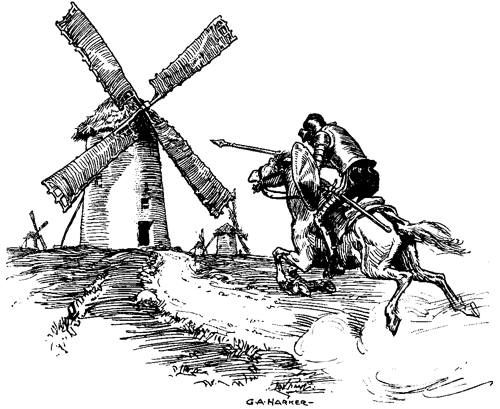
Don Quixote Tilting Windmills
Is there anything more capricious than the held perception of character? Is there anything more futile than chasing the vicious cycle of virtue, always searching for that deserving true Scotsman?
Character is a term especially bandied about by political Conservatives, although Progressives tend to play the #MeToo game because it’s a game of appearances. It doesn’t matter what you do; it only matters what it looks like you do.
And even this is a game. Time and again politicians ‘slip’ (read: get caught), they apologise for the temporary lapse, and ask for forgiveness. Whether or not they keep their position, they are still forgiven and may return to their position learning their lesson (read: don’t get caught again). Let’s just dispense with the formalities.
Perception is reality
In Plato’s day, he holds out four moral virtues to pursue: courage, temperance, justice, and prudence.
Courage: the resolve to act virtuously, especially when it is most difficult
Temperance: moderation in all things; the middle path
Justice: to render every man what’s due
Prudence: application of practical wisdom
Courage seems to be caught in an infinite loop, as it essentially says to exercise temperance, justice, and prudence in the face of danger. Typically, courage is associated with heroic acts, though I fail to see the connection to rescuing a baby from a burning building with any of these other virtues. Perhaps the definition has morphed over the years. Everyone needs a hero. Only Zeus needs a Hera.
Temperance is to find the middle ground: eat but not too much; drink but not too much; rape but not too much; kill but not too much. Is there really a middle ground for all things? In traversing a canyon, shouldn’t one stay close to the edge—or what about sidewalks? Is it temperance that led US President Donald Trump to declare that Nazis and white supremacists. are ‘some very fine people‘, or does he just lack prudence?
Justice is the constant and perpetual will to render to every man his due.
Justinian — Institutes 1.1
JusticeI’ve written about at some length so I won’t spend any additional time here.
Common sense is not so common.
Voltaire
Prudence, which advises one to use common sense, relies on a rare jewel. As Voltaire wrote, « le sens commun est fort rare ».
Perhaps I’m just too hard on people, but I find that most people are pretty dimwitted outside of some small area of focus, and I have to agree with Voltaire’s position on common sense. This is why as an economist, I find it so difficult to accept the homo economicus assertion so key for modern microeconomic theory and why behavioural economics has become a bigger deal in the past 30 years as more and more social scientists realise that people are predictably irrational.
Thanks but no thanks. There’s got to be a better way.



 Philosophics