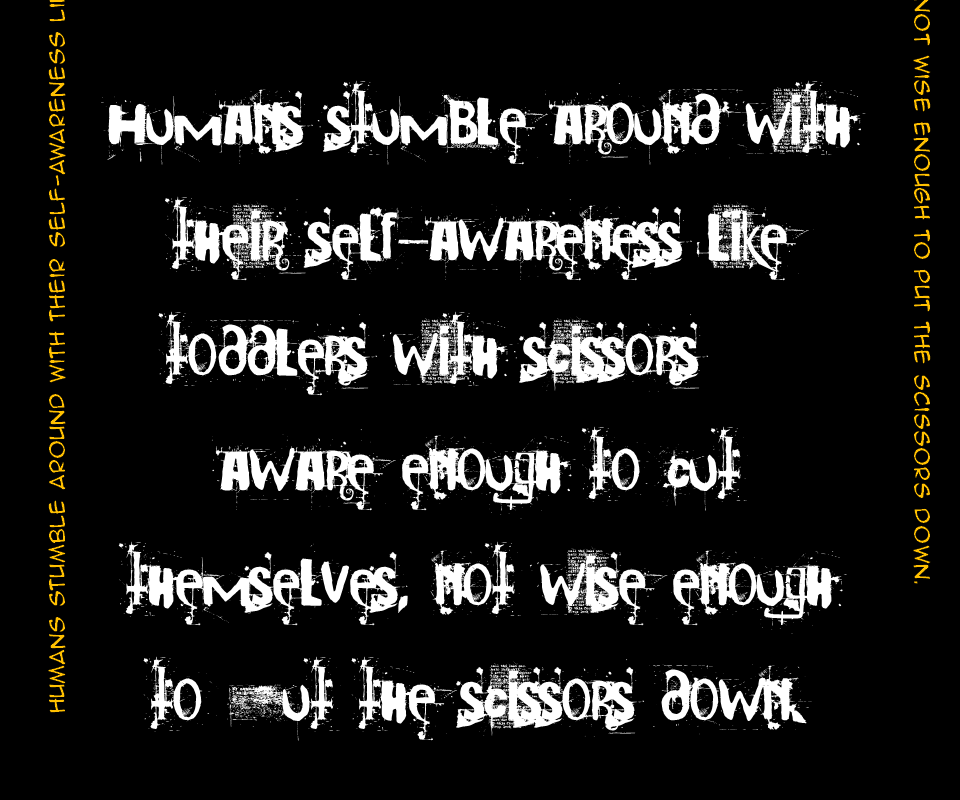
Image: Humans stumble around with their self-awareness like toddlers with scissors—aware enough to cut themselves, not wise enough to put the scissors down. – ChatGPT
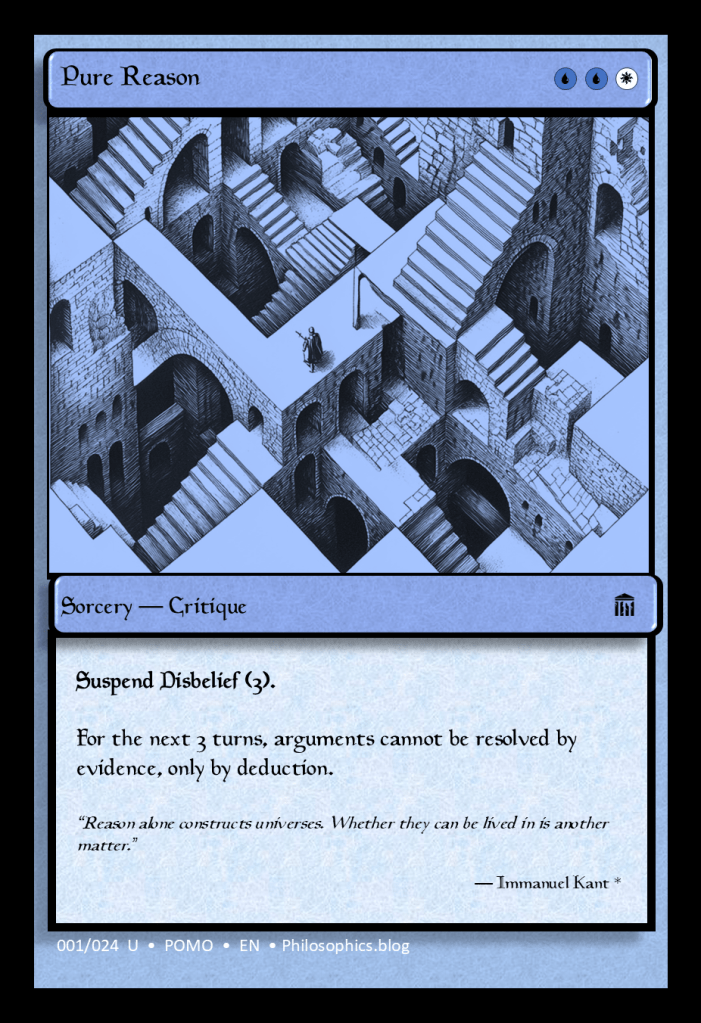
If reason had a landscape, it would look like this card: a maze of ascending and descending staircases, forever rational yet going nowhere. Kant might have called it a Critique of Pure Geometry.
Pure Reason, the first card in the Postmodern set, isn’t so much an homage to Kant as it is a cautionary reconstruction. It honours his ambition to build a universe from deduction while quietly mourning the price of that construction: alienation from experience.
Image: Card 001 from the Postmodern Set — Philosophics.blog
The Meta
Suspend Disbelief (3). For the next three turns, arguments cannot be resolved by evidence, only by deduction.
Audio: NotebookLM podcast of this topic.
The rule text re-enacts Kant’s method. In the Critique of Pure Reason, he cordoned off the realm of empirical evidence and tried to chart what the mind could know a priori – before experience. The card’s mechanic enforces that isolation. For three turns, players must reason in a vacuum: no appeals to observation, no touchstones of reality, only deduction.
It’s a temporary world built entirely of logic, an echo of the transcendental playground Kant envisioned. The effect is powerful but sterile – thought constructing universes that can’t sustain life.
The flavour text says it plainly:
“Reason alone constructs universes. Whether they can be lived in is another matter.”
— Immanuel Kant
That line, of course, is apocryphal, but it captures the essence of his project: reason as world-maker and prison architect in one.
The Architecture of Thought
The artwork mirrors Escher’s impossible staircases – a labyrinth of pure geometry, ordered yet uninhabitable. Each path is internally consistent, logically sound, but spatially absurd. This is Kant’s transcendental edifice made visual: coherent on paper, dizzying in practice.
The lone figure standing in the maze is the transcendental subject – the philosopher trapped within the architecture of his own cognition. He surveys the world he has built from categories and forms, unable to escape the walls of his own reason.
It’s a neat metaphor for Enlightenment hubris: the belief that reason can serve as both foundation and roof, requiring no support from the messy ground of existence.
Kant’s Double Legacy
Kant’s Critique was both the high point and the breaking point of Enlightenment rationality. It erected the scaffolding for science, ethics, and aesthetics but revealed the fault lines beneath them. His insistence that the mind structures experience rather than merely reflecting it gave birth to both modern idealism and modern doubt.
Every philosopher after him – Hegel, Nietzsche, Husserl, Derrida – has been trying either to escape or to inhabit that labyrinth differently. Pure Reason captures this tension: the glory of construction and the tragedy of confinement.
My Take
Reason is a magnificent liar. It promises order, clarity, and autonomy, but its perfection is its undoing. It abstracts itself from life until it can no longer recognise its own maker. Kant’s world is flawless and airless – a rational utopia unfit for breathing creatures.
I view Pure Reason as the archetype of the Enlightenment illusion: the attempt to found a living world on the logic of dead forms. What he achieved was monumental, but the monument was a mausoleum.
The card, then, is not just a tribute to Kant but a warning to his descendants (ourselves included): every system of thought eventually turns into an Escher print. Beautiful, consistent, and utterly unlivable.
Well, not so much hard as not particularly or inherently enjoyable.
I estimate I’ve got about a day left to complete this manuscript – ‘done’ done. When I open InDesign, it shames me – 3 days ago, I last touched this document. It doesn’t feel like 3 days have passed, but time flies.
On the right is an older version. I began reworking it into this new version over the summer, and here I am come autumn. It’s even worse if I use the Chinese calendar. Evidently, 7th November is the first day of winter. They can’t wait until soltace.
Anyway, just a brief update. This isn’t going to edit itself, and I can’t afford to pay an editor for a passion project. Besides – and let’s be honest – I can’t afford an editor in general – or at least can’t cost-justify it – and all my writing is a passion project.
Of course, editors (and cover artists) insist that one would sell more book if only they were edited or professionally rendered. There is an element of truth to this, but I’ve read some gawdawful books that were professionally edited and published through a traditional publisher, because publishers publish.
Me, I operate on razor-thin margins. Most of my publications haven’t even broken even – even if I ignore opportunity costs, which I can’t because I’m an economist. Accountants get to play that trick.
This said, I do hire reviewers, editors, and artists in small doses – homoeopathic as they might be – and I’ve had mixed results.
I’m rambling
Must really be avoiding the editing process…
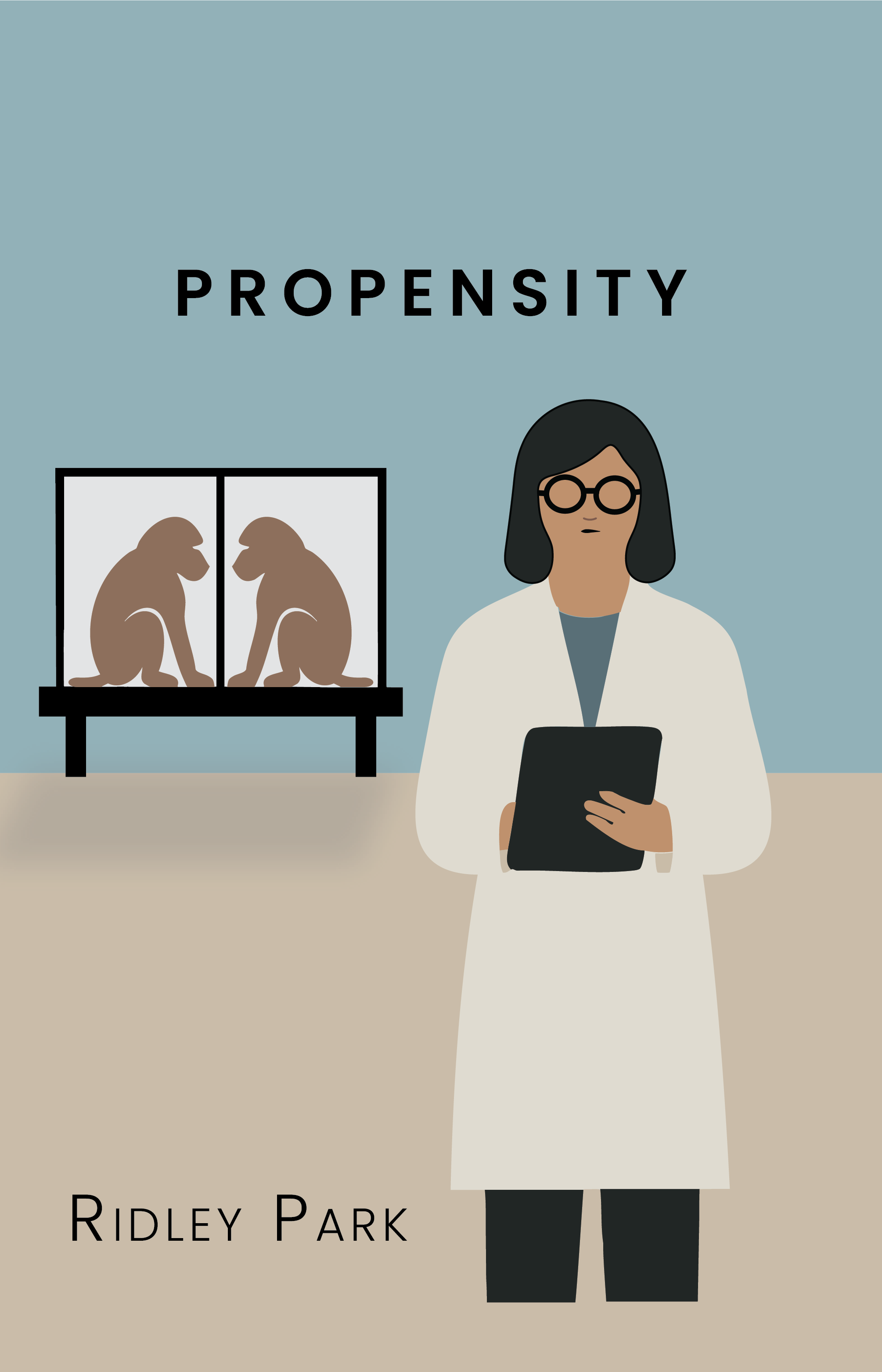
Recently, I wanted to redesign the cover of one of my Ridley Park fiction books.
Image Comparison: A Tale of Two Propensities
The cover on the left is the original. It is intentionally a minimal 2-D construction – a representation of the first section of the book, the first 15 chapters.
The cover on the right is the update. It is also minimalist, representing the second section of Propensity. I’m not sure how I would depict the third section. If it comes to me, I may render a third version.
There’s a story to this. I reached out to some cover artists and told them I was unhappy with my original design but had no visual ideas. I’d leave this to the artist. It turns out that some artists don’t want full control over the design process. I can understand the hesitation.
They asked for covers that I might like, so I researched some covers and saved them to a Pinterest board.
As it turned out, after some inspiration, I decided to render this one myself, too. Hey, I tried.
What happened to the rest of the time?
OK, so there’s more. I also created a video book trailer in the evening.
It was fun enough. Give it a watch. It also represents part one of Propensity.
OK, this time for real. Let me know what you think…about anything in particular.
Whenever you point out that capitalism kills – quietly, bureaucratically, with paperwork instead of bullets—someone inevitably pipes up about the Great Leap Forward or the Holodomor. It’s a reflex, like the ideological hiccup of a system allergic to self-reflection.
Audio: NotebookLM podcast on this topic.
One such defender of the sacred market recently wrote:
“Half a truth is often a great lie. What about the Great Leap Forward? The Holodomor? The Cambodian Genocide? The slaughters caused by socialism?” (thread)
You can almost hear the pearls clutching.
For context, I share the text from his profile. I’ll let you perform the personality assessment.
One thing I will promise; I never block anyone just because I may disagree with or dislike their words. Because the only people who do are cowards. Want to attack me? Fine. If you think that makes the world a better place, go ahead; you cannot hurt me with your words.
Let’s be clear: the crimes of Stalin, Mao, and Pol Pot are not Communism™ incarnate, any more than Donald Trump represents Democracy™. Systems don’t commit atrocities; people do – though some systems make atrocity easier, more efficient, and more deniable.
To illustrate: imagine Luigi Mangioni shoots and kills Brian Thompson, CEO of UnitedHealthcare. Luigi is an individual agent. Thompson, by contrast, is the face of a healthcare system that quietly decides who lives and who dies based on profitability.
If Thompson represents a system that allows people to die for lack of coverage, who bears the greater moral burden? Luigi, with his single bullet – or the corporate mechanism that kills by neglect, at scale, every day?
Capitalism hides behind its abstraction. It kills by omission. Stalin and Mao at least had the decency to be explicit. The capitalist death machine grinds on invisibly, its victims written off as ‘market externalities’.
So when a self-described truth-teller tells me to make a video about ‘the slaughters of socialism’, I’ll happily oblige – right after he makes one about preventable deaths under his beloved market: the uninsured, the unhoused, the unprofitable. The only difference between Stalin’s gulags and our modern equivalents is branding. One killed by decree; the other kills by design.
I recently posted The Ethics of Maintenance: Against the Myth of Natural Purpose. In it, I brushed – perhaps too lightly – against my debt to feminist philosophy. It’s time to acknowledge that debt more directly and explain how it spills into the mundane greasework of daily life.
[Scroll to the bottom to see Midjourney’s take on feminists. You won’t be surprised.]
I tend not to worship at the altar of names, but let’s name names anyway. Beyond the usual French suspects – your Sartres, de Beauvoirs, and Foucaults – I owe much to the feminist philosophers – Gilligan, Tronto, Butler, Bellacasa, and de Beauvoir again – and, while we’re at it, the post-colonialists, whose names I’ll not recite for fear of being pompous. Their shared heresy is a suspicion of universals. They expose the myth of neutrality, whether it parades as Reason, Progress, or Civilisation. They remind us that every “universal” is merely someone’s local story told loud enough to drown out the others.
This isn’t a matter of sex or gender, though that’s how the names have been filed. The core lesson is epistemic, not biological. Feminist philosophy re-centres care, interdependence, and the politics of maintenance, not as sentimental virtues but as systems logic. The post-colonialists do the same at a geopolitical scale: maintenance instead of conquest, relation instead of domination.
On Gender, Behaviour, and the Lazy Binary
I don’t buy into sex and gender binaries, especially regarding behaviour. Even in biology, the dichotomy frays under scrutiny. Behaviourally, it collapses entirely. The problem isn’t people; it’s the linguistic furniture we inherited.
I’m weary of the moral blackmail that calls it misogyny not to vote for a woman, or racism not to vote for a black candidate. These accusations come, paradoxically, from sexists and racists who reduce people to the colour of their skin or the contents of their underwear. Having a vagina doesn’t make one a caretaker; having a penis doesn’t preclude empathy. The category error lies in mistaking type for trait.
When I refuse to vote for a Margaret Thatcher or a Hillary Clinton, it’s not because they’re women. It’s because they operate in the same acquisitive, dominion-driven register as the men they mirror. If the game is conquest, swapping the player’s gender doesn’t change the rules.
Maintenance as Political Praxis
My interest lies in those who reject that register altogether – the ones who abandon the mythology of Progress and its testosterone-addled twin, Innovation. The ethics of maintenance I’ve written about, and the philosophy of Dis-Integration I keep harping on, both gesture toward an alternative mode of being: one that prizes endurance over expansion, care over conquest.
This isn’t new. Feminist philosophers have been saying it for decades, often unheard because they weren’t shouting in Latin or running empires. I’m merely repackaging and re-contextualising, hoping that bundling these neglected insights together might make them audible again.
Knowledge never comes in a vacuum; it circulates. It leaks, cross-pollinates, mutates. To claim “intellectual property” over an idea is to pretend ownership of the air. I’ll spare you the full rant, but suffice it to say that the moment knowledge becomes proprietary, it ceases to breathe.
Conclusion
If I have a creed – and I say this reluctantly – it’s that philosophy should serve as maintenance, not monument-building. Feminist and post-colonial thinkers model that: constant attention, critical care, resistance to the entropy of domination.
I’m just trying to keep the engine running without pretending it’s divine.
Telos is humanity’s most persistent delusion – the idea that existence is crawling toward some luminous conclusion. From Aristotle’s perfect forms to Nietzsche’s Will to Power to Silicon Valley’s AI salvation, the story barely changes: history, we are told, has direction. But direction is not destiny; it is momentum misinterpreted as meaning. Much of my Anti-Enlightenment attention – and my drive toward Dis-Integration – centres on this notion.
Audio: NotebookLM podcast on this topic.
Progress is the Enlightenment’s secular gospel. Its promise – that every change is improvement – keeps the engine of exploitation humming. But change is inevitable; progress is propaganda. The arrow of time doesn’t point toward justice or enlightenment; it just points forward, indifferent to who’s crushed under it.
The Myth of Self-Correcting Systems
We are taught to place faith in systems: markets, democracies, algorithms. If they falter, it’s because of bad actors, not bad architecture. Replace the managers, swap the politicians, tweak the code. But the rot is structural, not moral.
These systems aren’t misfiring; they’re functioning exactly as designed – to preserve their own inertia while leaking meaning, resources, and compassion. The obsession with fixing individuals while sparing the machine is moral sleight of hand. At some point, tightening bolts on a burning engine becomes absurd. What we need is not a tune-up but a renovation.
This is where the philosophy of care and maintenance enters – not as sentimental housekeeping, but as radical engineering. Care is not complacent; it’s insurgent. It means facing the filth under the hood and admitting that the design itself is faulty.
Feminism and the Forgotten Labour of Repair
For centuries, the labour of care has been feminised, dismissed, and exploited – a quiet background hum while men congratulated themselves for building civilisation. Yet it is care, not conquest, that prevents collapse.
Philosophical feminists like Carol Gilligan, Joan Tronto, and María Puig de la Bellacasa saw this long before innovation culture learned to rebrand it as sustainability. They argued that ethical life is not about fulfilment or growth but about tending to fragile systems, material and social. Their revolution is not cosmic; it’s custodial.
The so-called masculine ethos – endless expansion, disruption, will to power – has delivered us burnout disguised as achievement. Its gods are metrics, its sacraments quarterly reports, its apocalypse deferred until after the IPO.
The Maintenance Ethic
Abandon the myth of natural or supernatural telos, and what remains is the duty of upkeep: a civic, psychological, and planetary responsibility. Maintenance is not stagnation; it’s resistance to decay through conscious intervention. It recognises that the world does not move toward betterment but toward breakdown – and that care is the only counter-force we possess.
Progress, as we’ve sold it, is the fever dream of a species mistaking acceleration for evolution. Maintenance is what happens when the dream fades and the mechanic steps in with a wrench.
Societies and cultures are constructs. As with twelve-step programmes, once we recognise this, we can move on to the next step. This is a notion of progress I can endorse: not the myth of inevitable improvement, but the humble acknowledgement that we built these machines and we can rebuild them differently.
The Workshop, Not the Temple
Civilisation doesn’t need another prophet or disruptor. It needs a caretaker with dirty hands. Meaning is not discovered; it is serviced. Systems are not sacred; they are rebuilt.
We can keep worshipping progress and watch the engine seize again, or we can accept the more humbling task of renovation – not of souls or nations, but of the machinery we ourselves assembled. The future, if it exists, will not be a miracle of purpose but a triumph of maintenance.
The novel itself asks what happens when humanity creates a device that creates peace on earth. What if behavioural control worked too well?
No riots. No rebellion. Just a flattening—of desire, of ambition, of will. Across homes, schools, and governments, people stop acting like themselves. Some forget how. Others forget why.
The system wasn’t designed to stay on this long. But now there’s no off switch. And the researchers who built it? Most of them are zeroed.
As one child begins to drift from baseline, an impossible question resurfaces: What does it mean to behave?
This is a psychological dystopia without explosions, a story where silence spreads faster than violence, where systems behave better than the people inside them.
A tale of modulation, inertia, and the slow unravelling of human impulse—for readers who prefer their dystopias quiet and their horrors deeply plausible.
Editorial Review
“Reader discretion is advised. Free will has been deprecated.” Beginning as a bizarre experiment in behavioural modulation by way of neurochemical interference, Propensity unfolds into an eerie metaphor for the tricky road between control and conscience. Park’s chapters are short and succinct, some barely a page long, in a staccato rhythm that mirrors the story’s disintegration—scientists losing grip on their creation and a world learning the price of its “engineered peace.” Phrases like “silence playing dress-up as danger” and “peace was never meant to be built, only remembered” linger like faint echoes long after you turn the page.
This is one of the more popular posts on here, so I shouldn’t have to give this milestone special attention, but I will anyway. Slow news day. It’s more about economics and political science, but I go there, too. Not a big fan of Capitalism in any of its many incarnations.
Video: Midjourney automation
I decided to experiment with Midjourney for this cover art and short animation. Instead of creating a typical prompt, I simply copied and pasted the text into the box above and let Midjourney make sense of it. This was the result. Then I asked to animate a loop.
Enough diversion. Back to finishing my latest book. I see light at the end of the tunnel.
I maintain this blog for two primary reasons: as an archive, and as a forum for engagement.
Philosophy isn’t a mass-market pursuit. Most people are content simply to make it through the day without undue turbulence, and I can hardly blame them. Thinking deeply is not an act of leisure; it’s a luxury product, one that Capitalism would rather you didn’t afford. Even when I’ve been employed, I’ve noticed how wage labour chokes the capacity for art and thought. Warhol may have monetised the tension, but most of us merely survive it.
Video: Sprouting seed. (No audio)
That’s why I value engagement – not the digital pantomime of ‘likes’ or ‘shares’, but genuine dialogue. The majority will scroll past without seeing. A few will skim. Fewer still will respond. Those who do – whether to agree, dissent, or reframe – remind me why this space exists at all.
To Jason, Julien, Jim, Lance, Nick, and especially Homo Hortus, who has been conversing beneath the recent Freedom post: your engagement matters. You help me think differently, sometimes introducing writers or ideas I hadn’t encountered. We may share only fragments of perspective, but difference is the point. It widens the aperture of thought – provided I can avoid tumbling into the Dunning-Kruger pit.
And now, a note of quiet satisfaction. A Romanian scholar recently cited my earlier essay, the Metanarrative Problem, in a piece titled Despre cum metanarațiunile construiesc paradigma și influențează răspunsurile emoționale – translation: On How Grand Narratives Shape Paradigms and Condition Our Emotional Responses. That someone, somewhere, found my reflections useful enough to reference tells me this exercise in public thinking is doing what it should: planting seeds in unpredictable soil.
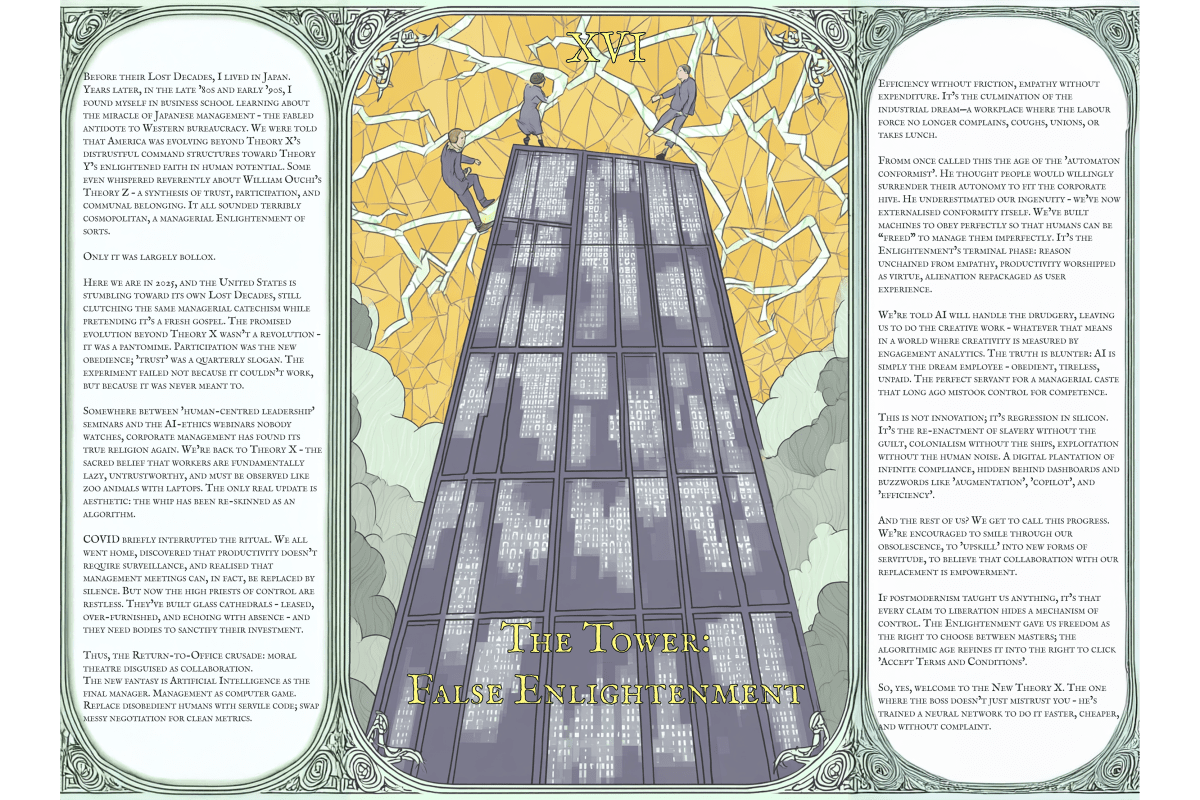
Before their Lost Decades, I lived in Japan. Years later, in the late ’80s and early ’90s, I found myself in business school learning about the miracle of Japanese management – the fabled antidote to Western bureaucracy. We were told that America was evolving beyond Theory X’s distrustful command structures toward Theory Y’s enlightened faith in human potential. Some even whispered reverently about William Ouchi’s Theory Z – a synthesis of trust, participation, and communal belonging. It all sounded terribly cosmopolitan, a managerial Enlightenment of sorts.
Only it was largely bollox.
Audio: NotebookLM podcast on this topic.
Here we are in 2025, and the United States is stumbling toward its own Lost Decades, still clutching the same managerial catechism while pretending it’s a fresh gospel. The promised evolution beyond Theory X wasn’t a revolution – it was a pantomime. Participation was the new obedience; ‘trust’ was a quarterly slogan. The experiment failed not because it couldn’t work, but because it was never meant to.
Somewhere between ‘human-centred leadership’ seminars and the AI-ethics webinars nobody watches, corporate management has found its true religion again. We’re back to Theory X – the sacred belief that workers are fundamentally lazy, untrustworthy, and must be observed like zoo animals with laptops. The only real update is aesthetic: the whip has been re-skinned as an algorithm.
COVID briefly interrupted the ritual. We all went home, discovered that productivity doesn’t require surveillance, and realised that management meetings can, in fact, be replaced by silence. But now the high priests of control are restless. They’ve built glass cathedrals – leased, over-furnished, and echoing with absence – and they need bodies to sanctify their investment. Thus, the Return-to-Office crusade: moral theatre disguised as collaboration.
The new fantasy is Artificial Intelligence as the final manager. Management as computer game. Replace disobedient humans with servile code; swap messy negotiation for clean metrics. Efficiency without friction, empathy without expenditure. It’s the culmination of the industrial dream—a workplace where the labour force no longer complains, coughs, unions, or takes lunch.
Fromm once called this the age of the ‘automaton conformist’. He thought people would willingly surrender their autonomy to fit the corporate hive. He underestimated our ingenuity – we’ve now externalised conformity itself. We’ve built machines to obey perfectly so that humans can be “freed” to manage them imperfectly. It’s the Enlightenment’s terminal phase: reason unchained from empathy, productivity worshipped as virtue, alienation repackaged as user experience.
We’re told AI will handle the drudgery, leaving us to do the creative work – whatever that means in a world where creativity is measured by engagement analytics. The truth is blunter: AI is simply the dream employee – obedient, tireless, unpaid. The perfect servant for a managerial caste that long ago mistook control for competence.
This is not innovation; it’s regression in silicon. It’s the re-enactment of slavery without the guilt, colonialism without the ships, exploitation without the human noise. A digital plantation of infinite compliance, hidden behind dashboards and buzzwords like ‘augmentation’, ‘copilot’, and ‘efficiency’.
And the rest of us? We get to call this progress. We’re encouraged to smile through our obsolescence, to ‘upskill’ into new forms of servitude, to believe that collaboration with our replacement is empowerment.
If postmodernism taught us anything, it’s that every claim to liberation hides a mechanism of control. The Enlightenment gave us freedom as the right to choose between masters; the algorithmic age refines it into the right to click ‘Accept Terms and Conditions’.
So, yes, welcome to the New Theory X. The one where the boss doesn’t just mistrust you – he’s trained a neural network to do it faster, cheaper, and without complaint.
Originally posted on LinkedIn with the same title.








 Philosophics