I finished Mattias Desmet’s The Psychology of Totalitarianism, which I mentioned the other day. Unfortunately, my initial optimism was premature. Everything I enjoyed was front-loaded: the first four chapters set up a promising critique of mechanistic rationality and the collapse of shared meaning. Then the book turned into a long, therapeutic sermon. I should have stopped at Chapter 4 and saved myself the sunk-cost regret.
It isn’t that nothing follows; it’s just that what follows is so thin that the cost-benefit ratio goes negative. Once Desmet moves from diagnosis to prescription, the argument collapses into a psychologist’s worldview: an entire civilisation explained through mass neurosis and healed through better intuition. He builds his case on straw versions of reason, science, and modernity, so his ‘cure’ can look revelatory.
The trouble is familiar. Having dismantled rationalism, Desmet then installs intuition as its replacement – an epistemic monarchy by another name. His appeal to empathy and connection reads less like philosophy and more like professional self-promotion. The therapist can’t stop therapising; he privileges the psychological lens over every other possibility.
The result is a reductionist parascience dressed as social theory. The totalitarian mind, in Desmet’s telling, isn’t political or structural but psychological – a patient waiting for insight. I don’t doubt his sincerity, only his scope. It’s what happens when a discipline mistakes its vocabulary for the world.
Desmet’s project ultimately re-enchants what it claims to critique. He wants rationalism redeemed through feeling, order reborn through connection. Dis-Integrationism stops short of that impulse. It accepts fracture as the permanent condition – no higher synthesis, no therapeutic finale. Where Desmet sees totalitarianism as a collective pathology awaiting treatment, I see it as reason’s own reflection in the mirror: a system trying to cure itself of the only disease it knows, the need to be whole.
I’ve just published Objectivity Is Illusion: An Operating Model of Social and Moral Reasoning, an essay that began as this blog post. I’m sharing the ‘official’ link and this first draft. As the essay matured, I added additional support, but I focused primarily on refuting the anticipated opposing arguments. Rather than regurgitate the final version here, I felt showing the genesis would be more instructive. Of course, the essay didn’t spring fully formed; I’ve pruned and expanded from earlier notes still sitting on my hard drive.
Every so often, I’m told I’m too slippery with words, that I treat truth as if it were just another game of persuasion, that I reduce morality to chalk lines on a playing field. The objection usually comes with force: ‘But surely you believe some things are objectively true?‘
I don’t. Or more precisely, I don’t see how ‘objectivity’ in the metaphysical sense can be defended without lapsing into stagecraft. Granite foundations have always turned out to be scaffolding with the paint touched up. Priests once told us their gods guaranteed truth; scientists later promised the lab would serve as granite; politicians assure us democracy is the stone pillar. But in each case the creaks remain.
Audio: NotebookLM podcast on this topic.
This essay is written with an academic readership in mind. It assumes familiarity with figures like Nietzsche, Foucault, Rorty, and Ayer, and with the long quarrel over subjectivity, relativity, and objectivity. My aim is not to retell those arguments from the ground up, but to position my own framework within that ongoing dispute.
Scope
Before proceeding, some guardrails. When I say ‘objectivity is illusion,’ I mean in the social and moral domain. I’m not denying quarks or mathematics. My claim is narrower: in human discourse, no truth escapes subjectivity or contingency.
This dovetails with my broader Language Insufficiency Hypothesis: that even our words are leaky vessels, prone to misfire and misunderstanding. If language itself is unstable ground, then objectivity built upon it can hardly be granite. My claim here is not that nothing exists outside us, but that in the social world we inhabit together, every ‘truth’ rests on creaking boards.
One more note: just because social administration requires appeals to objectivity doesn’t mean objectivity exists. Courts, laboratories, and parliaments invoke it to secure trust, and it works well enough as theater. But necessity is not proof. And it is not my responsibility to conjure a granite replacement. What follows is an operating model, not a new altar.
Thesis
Objectivity is an illusion. Truth is rhetorical. Morality is prescriptive, not propositional. Our ethic is not granite but care: tending the planks we walk on, knowing they creak.
Operating Model: Five Premises
This framework is not a foundation. It is an operating model – contingent, provisional, subject to revision as circumstances change. Like any model, it can (and should) be updated to fit the culture and times.
Premise 1: Subjectivity is the baseline. Every claim originates in a perspective. No statement is free of the lens through which it is made. Even to deny subjectivity is to speak from a subject.
Premise 2: Relativity is emergent. What we call ‘relative truth’ is not a separate category but the convergence of individual subjectivities into provisional consensus. Consensus is never neutral: it is formed rhetorically – through persuasion, cultural resonance, and power [1]. MacIntyre made a similar point in After Virtue. The moral consensus of the Ancients was not grounded in objectivity but in a shared tradition – a thick account of human flourishing that gave coherence to their claims. When that scaffolding collapsed, consensus fractured, leaving modern moral discourse in fragments. Critics accused MacIntyre of relativism, since different traditions yield different ‘truths’, but his point reinforces mine: what looks like objectivity is in fact the temporary overlap of subjectivities sustained by tradition [2].
Premise 3: Objectivity is illusion. Claims presented as objective are relative norms hardened by repetition and forgotten as contingent scaffolding. ‘Objectivity’ is consensus disguised as granite. Its invocation in courts or parliaments may be useful, but usefulness is not existence. The burden of proof belongs to anyone insisting on an independent, metaphysical anchor for moral or social truths (Nietzsche’s ‘mobile army of metaphors’ [3], Kuhn’s paradigms [4], Latour’s laboratories [5]).
Even if one concedes, with Weber (as MacIntyre reminds us), that objective moral truths might exist in principle, they remain inaccessible in practice. What cannot be accessed cannot guide us; reconciliation of values and virtues must therefore take place within traditions and rhetoric, not in appeal to unreachable granite [13].
Premise 4: Rhetoric establishes truth. What counts as ‘true’ in the social and moral domain is established rhetorically – through coherence, resonance, utility, or force. This does not mean truth is ‘mere spin’. It means truth is never metaphysical; it is enacted and enforced through persuasion. If a metaphysical claim convinces, it does so rhetorically. If a scientific claim holds, it does so because it persuades peers, fits the evidence, and survives testing. In short: rhetoric is the medium through which truths endure [6].
Premise 5: Non-Cognitivism, Stated Plainly. I take moral utterances to be prescriptions, not propositions. When someone says ‘X is wrong’, they are not reporting an objective fact but prescribing a stance, a rule, a line in chalk. This is my operating position: non-cognitivism (Ayer [7], Stevenson [8]).
That said, I know the term feels alien. Many prefer the dialect of subjectivism – ‘X is true-for-me but not-for-you’ – or the quasi-realist stance that moral language behaves like truth-talk without cosmic backing (Blackburn [9]). I have no quarrel with these translations. They name the same scaffolding in different accents. I am not defending any school as such; I am simply stating my plank: morality prescribes rather than describes.
Ethic: Care. Since scaffolding is all we have, the obligation is not to pretend it is stone but to keep it usable. By ‘care’, I do not mean politeness or quietism. I mean maintenance – deliberation, repair, mutual aid, even revolt – so long as they acknowledge the scaffolding we share. Care is not optional: stomp hard enough and the floor collapses beneath us all.
Examples clarify: peer review in science is care in action, patching leaky vessels rather than proving granite. Civil rights movements practiced care by repairing rotten planks of law, sometimes with revolt. Communities rebuilding after disaster embody care by reconstructing scaffolding, not pretending it was indestructible. Care is maintenance, reciprocity, and survival.
Bridge: These five premises do not add up to a system or a foundation. They form an operating model: subjectivity as baseline, relativity as emergent, objectivity as illusion, rhetoric as truth, morality as prescription. Together they outline a practice: walk the planks with care, admit the creaks, patch where needed, and stop pretending we live in marble halls.
Rationale
Why prefer scaffolding to granite? Because granite has always been a mirage. The history of philosophy and politics is a history of crumbling temples and collapsing empires. The promises of permanence never survive the weather.
Think of Nietzsche, who called truths ‘a mobile army of metaphors’ [3]. Think of Foucault, who showed that what counts as ‘truth’ is always bound up with power [1]. Think of Rorty, who reduced truth to what our peers let us get away with saying [6]. These are not nihilists but diagnosticians: they exposed the creaks in the floorboards and the wizard behind the curtain.
Metaphors drive the point home:
Scaffolding and granite: What holds is temporary, not eternal. Granite is an illusion painted on timber.
Chalk lines: Rules of play – binding, real, but contingent. They can be redrawn.
Shoreline houses: Rome, the USSR, the British Empire – each built like beachfront villas with a fine view and bad footing. Storms came, sand eroded, and down they went.
Bias as framing: Kahneman himself admitted ‘bias’ is not a thing in the world [10], only a deviation from a chosen model. Gigerenzer [11] and Jared Peterson [12] remind us heuristics are adaptive. To call them ‘biases’ is not neutral – it’s allegiance to a standard of rationality.
The point is simple: what holds today is scaffolding, and pretending otherwise is self-deception.
Counterarguments and Refutations
Objection: Moral Paralysis. Without objective morality, why abolish slavery or defend rights?
Refutation: Chalk lines still bind. Speed limits aren’t cosmic, but they regulate conduct. Abolition endured not because it tapped a cosmic truth but because it persuaded, resonated, and took root. Slavery was once ‘in bounds’. Now it is ‘offsides’. That shift was rhetorical, emotional, political – but no less binding.
Objection: Problem of Dissent. If all is subjective, the lone dissenter is ‘just another voice’.
Refutation: Dissent gains traction through coherence, predictive success, or resonance. Galileo, abolitionists, suffragists – none relied on metaphysical granite. They persuaded, they resonated, they moved chalk lines. Truth was made through rhetoric, not uncovered in stone.
Objection: Performative Dependency. Even to say ‘subjective’ assumes the subject/object split. Aren’t you still inside the house?
Refutation: Of course. But I’m the one pointing at the slippery boards: ‘Mind the dust’. Yes, I’m in the house. But I refuse to pretend it’s marble. And even the category ‘subject’ is not eternal – it’s porous, dynamic, and leaky, just like language itself.
Objection: Infinite Regress. Why stop at subjectivity? Why not de-integrate further?
Refutation: Subjectivity is not granite, but it is the last plank before void. Peel it back and you erase the possibility of claims altogether. If tomorrow we discover that the ‘subject’ is a swarm of quarks or circuits, fine – but the claim still emerges from some locus. Regression refines; it doesn’t disprove.
Conclusion: The Ethic of Care
This is not reintegration. It is dis-integration: naming the creaks, stripping polyvinyl from rotten boards, refusing granite illusions.
If you wish to build here, build. But know the ground shifts, the storms come, the shoreline erodes. The ethic is not certainty but care: to tend the scaffolding we share, to patch without pretending it is stone, and to let dissent itself become part of the maintenance.
—On Epistemology, Pop Psychology, and the Cult of Empirical Pretence
Science, we’re told, is the beacon in the fog – a gleaming lighthouse of reason guiding us through the turbulent seas of superstition and ignorance. But peer a bit closer, and the lens is cracked, the bulb flickers, and the so-called lighthouse keeper is just some bloke on TikTok shouting about gut flora and intermittent fasting.
Audio: NotebookLM podcast on this topic.
We are creatures of pattern. We impose order. We mistake correlation for causation, narrative for truth, confidence for knowledge. What we have, in polite academic parlance, is an epistemology problem. What we call science is often less Newton and more Nostradamus—albeit wearing a lab coat and wielding a p-hacked dataset.
Let’s start with the low-hanging fruit—the rotting mango of modern inquiry: nutritional science, which is to actual science what alchemy is to chemistry, or vibes are to calculus. We study food the way 13th-century monks studied demons: through superstition, confirmation bias, and deeply committed guesswork. Eat fat, don’t eat fat. Eat eggs, don’t eat eggs. Eat only between the hours of 10:00 and 14:00 under a waxing moon while humming in Lydian mode. It’s a cargo cult with chia seeds.
But why stop there? Let’s put the whole scientific-industrial complex on the slab.
Psychology: The Empirical Astrological Society
Psychology likes to think it’s scientific. Peer-reviewed journals, statistical models, the odd brain scan tossed in for gravitas. But at heart, much of it is pop divination, sugar-dusted for mass consumption. The replication crisis didn’t merely reveal cracks – it bulldozed entire fields. The Stanford Prison Experiment? A theatrical farce. Power poses? Empty gestural theatre. Half of what you read in Psychology Today could be replaced with horoscopes and no one would notice.
Medical Science: Bloodletting, But With Better Branding
Now onto medicine, that other sacred cow. We tend to imagine it as precise, data-driven, evidence-based. In practice? It’s a Byzantine fusion of guesswork, insurance forms, and pharmaceutical lobbying. As Crémieux rightly implies, medicine’s predictive power is deeply compromised by overfitting, statistical fog, and a staggering dependence on non-replicable clinical studies, many funded by those who stand to profit from the result.
And don’t get me started on epidemiology, that modern priesthood that speaks in incantations of “relative risk” and “confidence intervals” while changing the commandments every fortnight. If nutrition is theology, epidemiology is exegesis.
The Reproducibility Farce
Let us not forget the gleaming ideal: reproducibility, that cornerstone of Enlightenment confidence. The trouble is, in field after field—from economics to cancer biology—reproducibility is more aspiration than reality. What we actually get is a cacophony of studies no one bothers to repeat, published to pad CVs, p-hacked into publishable shape, and then cited into canonical status. It’s knowledge by momentum. We don’t understand the world. We just retweet it.
What, Then, Is To Be Done?
Should we become mystics? Take up tarot and goat sacrifice? Not necessarily. But we should strip science of its papal robes. We should stop mistaking publication for truth, consensus for accuracy, and method for epistemic sanctity. The scientific method is not the problem. The pretence that it’s constantly being followed is.
Perhaps knowledge doesn’t have a half-life because of progress, but because it was never alive to begin with. We are not disproving truth; we are watching fictions expire.
Closing Jab
Next time someone says “trust the science,” ask them: which bit? The part that told us margarine was manna? The part that thought ulcers were psychosomatic? The part that still can’t explain consciousness, but is confident about your breakfast?
Science is a toolkit. But too often, it’s treated like scripture. And we? We’re just trying to lose weight while clinging to whatever gospel lets us eat more cheese.
We live in an age intoxicated by models: climate models, economic models, epidemiological models, cosmological models—each one an exquisite confection of assumptions draped in a lab coat and paraded as gospel. Yet if you trace the bloodline of model-building back through the annals of intellectual history, you encounter two figures who coldly remind us of the scam: George Box and Hilary Lawson.
Box: The Gentle Assassin of Certainty
George Box, the celebrated statistician, is often credited with the aphorism: “All models are wrong, but some are useful.” However, Box himself never uttered this precise phrase. What he did say, in his 1976 paper Science and Statistics, was:
“Since all models are wrong, the scientist must be alert to what is importantly wrong.”
George Box
The “some are useful” flourish was added later by a public desperate to sweeten the bitter pill. Nevertheless, Box deserves credit for the lethal insight: no model, however elegant, perfectly captures reality. They are provisional guesses, finger-paintings smeared across the rough surface of the unknown.
Audio: NotebookLM podcast on this topic.
Lawson: The Arsonist Who Burned the Map
Hilary Lawson, contemporary philosopher and author of Closure: A Story of Everything, drags Box’s modest scepticism into full-blown philosophical insurrection. In a recent lecture, Lawson declared:
“You don’t need truth to have a usable model.”
Hilary Lawson
Where Box warns us the emperor’s clothes don’t fit, Lawson points out that the emperor himself is a paper doll. Either way, we dress our ignorance in equations and hope no one notices the draft.
Lawson’s view is grim but clarifying: models are not mere approximations of some Platonic truth. They are closures—temporary, pragmatic structures we erect to intervene effectively in a world we will never fully comprehend. Reality, in Lawson’s framing, is an “openness”: endlessly unfolding, resistant to total capture.
The Case of the Celestial Spheres
Take Aristotle’s model of celestial spheres. Ludicrous? Yes. Obsolete? Absolutely. Yet for centuries, it allowed navigators to chart courses, astrologers to cast horoscopes, and priests to intimidate peasants—all without the slightest whiff of heliocentrism. A model does not need to be right; it merely needs to be operational.
Our modern theories—Big Bang cosmology, dark matter, and quantum gravity—may well be tomorrow’s celestial spheres: charming relics of ignorance that nonetheless built bridges, cured diseases, and sold mobile phones.
Summary Table: Lawson’s View on Models and Truth
Aspect
Lawson’s Position
Role of Models
Tools/metaphors for intervention, not truth
Truth
Not required for usefulness
Refinement
Models are improved for practical effectiveness
Reality
Fundamentally open, never fully captured by models
Implication
Focus on utility and adaptability, not final truth
Conclusion
Box taught us to distrust the fit of our models; Lawson reminds us there is no true body underneath them. If truth is a ghost, then our models are ghost stories—and some ghost stories, it turns out, are very good at getting us through the night.
We are left not with certainty, but with craftsmanship: the endless, imperfect art of refining our closures, knowing full well they are lies that work. Better lies. Usable lies. And perhaps, in a world without final answers, that is the most honest position of all.
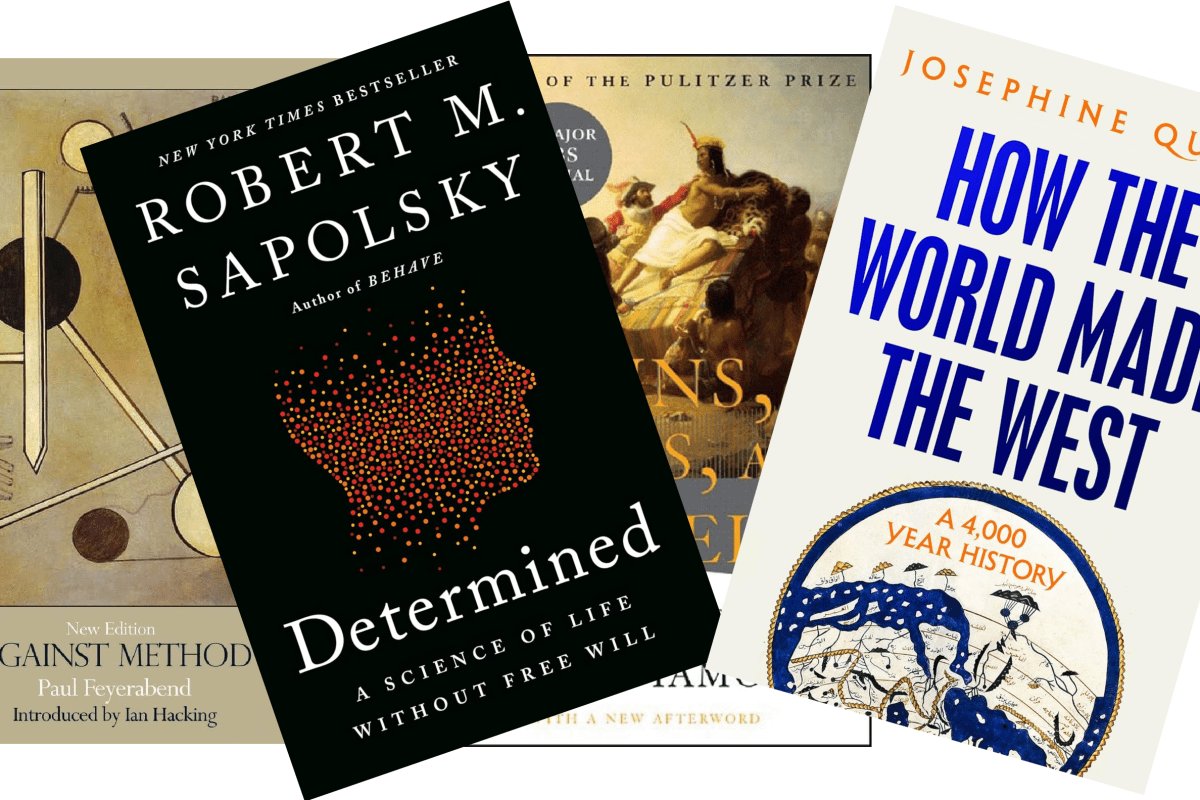
These are my favourite books I read in 2024. Only one was first published this year, so it seems I was playing catch-up and rereading. Two are about history; two are about the philosophy of science; and one is about biological free will or the lack thereof.
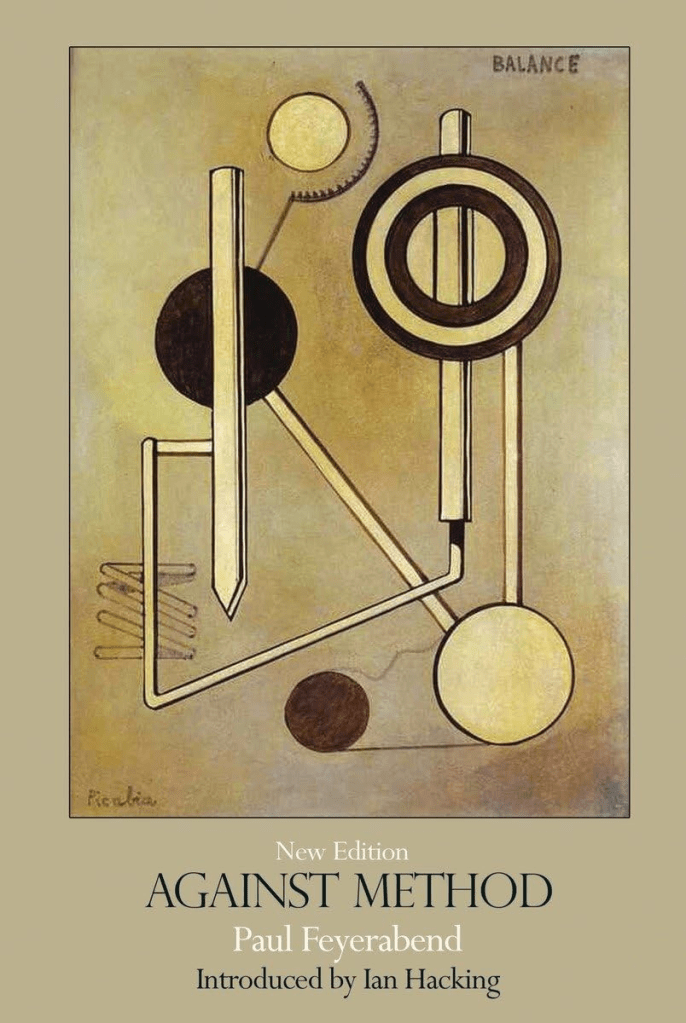
Against Method is a re-read for me. It makes the list on the coattails of a higher-ranked book. Feyerabend makes a compelling case against the Scientific Method™. To complete the set, I’d also recommend Bruno Latour‘s We Have Never Been Modern.
Determined arrives on the heels of Sapolsky’s Behave, another classic that I’d recommend even more, but I read it in 2018, so it doesn’t make the cut. In Determined, Sapolsky makes the case that there is no room or need for free will to explain human behaviour.
As with Against Method, Guns, Germs, and Steel makes the list only to complement my next choice. It views history through an environmental lens. To fill out the historical perspective, I recommend David Graeber’s The Dawn of Everything: A New History of Humanity (with David Wengrow). I’d recommend Yuval Noah Harari‘s Sapiens: A Brief History of Humankind, but it occupies a different category and is more about a plausible broad narrative than the detail explored in the others listed.
Quinn makes history approachable as she questions the uniformity of civilisations pushed by orthodoxy. Read this in context with the aforementioned historical accounts for a fuller perspective.
I was born in 1961. This should have been bedtime reading for me. I’d heard of this work, but one really has to read it. It’s less Modernist than I had presumed—though not to the extent of Feyerabend or Latour mentioned above. Again, reading all three provides a robust perspective on the philosophy of science.
Like Quinn, the writing is approachable. I had expected it to be stilted. It is academic, and it may boost your vocabulary, but give it a gander. It also works well in an audiobook format if you are so inclined.
This about closes out 2024. What do you think about these choices? Agree or disagree? What are your top recommendations?
The Structure of Scientific Revolutions was published in 1962. Written by Thomas Kuhn, it introduced the world to the concept of paradigm shifts in science — and, as it turns out, elsewhere. As I mentioned recently, I experienced a mishap, confounding it with Paul Feyerabend’s Against Method, first published in 1975. Both of these should be required reading FOR year 10 – or at least taught in summary.
I had read Feyerabend years ago but was only familiar with Kuhn from a distance. I’m clad we’ve become more intimate. These authors take different approaches to arrive at times in the same place. Kuhn takes a Modernist approach that he critiques and modifies. Feyerabend takes a Postmodernist path that sometimes cross.
Ah, the delightful dance of paradigms and anarchism in the hallowed halls of science! Let’s delve deeper into the intellectual pas de deux between Thomas Kuhn and Paul Feyerabend, those audacious thinkers who dared to challenge the sanctity of scientific methodology.
Kuhn’s Paradigm Shifts: The Scientific Waltz
Thomas Kuhn, in his seminal work The Structure of Scientific Revolutions, introduced us to the concept of paradigm shifts—a term now so overused that even corporate PowerPoint presentations aren’t spared. Kuhn posited that science doesn’t progress through a linear accumulation of knowledge but rather through a series of revolutionary upheavals. These upheavals occur when the prevailing scientific framework, or “paradigm,” becomes as outdated as last season’s fashion, unable to account for emerging anomalies. In Kuhn’s view, the scientific community clings to its paradigms with the tenacity of a dog to its bone, until the weight of anomalies forces a collective epiphany, leading to a paradigm shift. This cyclical process propels scientific advancement, albeit in a manner reminiscent of a drunken sailor’s stagger rather than a straight path.
Feyerabend’s Epistemological Anarchism: The Punk Rock of Science
Enter Paul Feyerabend, the enfant terrible of the philosophy of science, with his provocative manifesto Against Method. Feyerabend gleefully dismantled the notion of a universal scientific method, advocating for “epistemological anarchism.” He argued that the rigid adherence to methodological rules is about as useful as a chocolate teapot, stifling creativity and hindering progress. In Feyerabend’s anarchic utopia, “anything goes” in the pursuit of knowledge, and the scientific method is more of a loose suggestion than a strict protocol. His critique was not just a call for methodological diversity but a full-blown rebellion against the tyranny of scientific dogmatism.
A Comparative Analysis: Method to the Madness
While Kuhn and Feyerabend both challenged the orthodox views of scientific progress, their approaches were as different as chalk and cheese. Kuhn’s analysis was rooted in historical case studies, portraying scientific revolutions as communal shifts in perspective, akin to a collective midlife crisis. Feyerabend, on the other hand, took a more radical stance, suggesting that the very idea of a fixed scientific method is as mythical as unicorns. Where Kuhn saw periods of “normal science” punctuated by revolutionary shifts, Feyerabend saw a chaotic free-for-all, where progress is made not by following rules but by breaking them.
Implications for Scientific Practice: Order in Chaos
The implications of their critiques are profound. Kuhn’s work suggests that scientists should remain open to paradigm shifts, lest they become as obsolete as Betamax in a Netflix era. Feyerabend’s anarchism, while controversial, serves as a reminder that innovation often requires the audacity to defy convention. Together, they paint a picture of science not as a monolithic quest for truth but as a dynamic, often tumultuous, human endeavour.
Conclusion: The Legacy of Intellectual Rebellion
In conclusion, the works of Kuhn and Feyerabend invite us to view science through a more sceptical lens, questioning the sanctity of its methods and the rigidity of its paradigms. Their critiques serve as a clarion call for intellectual flexibility, urging us to embrace the chaos and complexity inherent in the pursuit of knowledge. After all, in the grand theatre of science, it’s often the most unconventional performances that leave a lasting impact.
In the great philosophical tug-of-war between materialism and idealism, where reality is argued to be either wholly independent of perception or entirely a construct of the mind, there lies an underexplored middle ground—a conceptual liminal space that we might call “Intersectionalism.” This framework posits that reality is neither purely objective nor subjective but emerges at the intersection of the two. It is the terrain shaped by the interplay between what exists and how it is perceived, mediated by the limits of human cognition and sensory faculties.
Audio: Podcast conversation on this topic.
Intersectionalism offers a compelling alternative to the extremes of materialism and idealism. By acknowledging the constraints of perception and interpretation, it embraces the provisionality of knowledge, the inevitability of blind spots, and the productive potential of uncertainty. This essay explores the foundations of Intersectionalism, its implications for knowledge and understanding, and the ethical and practical insights it provides.
Reality as an Intersection
At its core, Intersectionalism asserts that reality exists in the overlapping space between the objective and the subjective. The objective refers to the world as it exists independently of any observer—the “terrain.” The subjective encompasses perception, cognition, and interpretation—the “map.” Reality, then, is not fully contained within either but is co-constituted by their interaction.
Consider the act of seeing a tree. The tree, as an object, exists independently of the observer. Yet, the experience of the tree is entirely mediated by the observer’s sensory and cognitive faculties. Light reflects off the tree, enters the eye, and is translated into electrical signals processed by the brain. This process creates a perception of the tree, but the perception is not the tree itself.
This gap between perception and object highlights the imperfect alignment of subject and object. No observer perceives reality “as it is” but only as it appears through the interpretive lens of their faculties. Reality, then, is a shared but imperfectly understood phenomenon, subject to distortion and variation across individuals and species.
The Limits of Perception and Cognition
Humans, like all organisms, perceive the world through the constraints of their sensory and cognitive systems. These limitations shape not only what we can perceive but also what we can imagine. For example:
Sensory Blind Spots: Humans are limited to the visible spectrum of light (~380–750 nm), unable to see ultraviolet or infrared radiation without technological augmentation. Other animals, such as bees or snakes, perceive these spectra as part of their natural sensory worlds. Similarly, humans lack the electroreception of sharks or the magnetoreception of birds.
Dimensional Constraints: Our spatial intuition is bounded by three spatial dimensions plus time, making it nearly impossible to conceptualise higher-dimensional spaces without resorting to crude analogies (e.g., imagining a tesseract as a 3D shadow of a 4D object).
Cognitive Frameworks: Our brains interpret sensory input through patterns and predictive models. These frameworks are adaptive but often introduce distortions, such as cognitive biases or anthropocentric assumptions.
This constellation of limitations suggests that what we perceive and conceive as reality is only a fragment of a larger, potentially unknowable whole. Even when we extend our senses with instruments, such as infrared cameras or particle detectors, the data must still be interpreted through the lens of human cognition, introducing new layers of abstraction and potential distortion.
The Role of Negative Space
One of the most intriguing aspects of Intersectionalism is its embrace of “negative space” in knowledge—the gaps and absences that shape what we can perceive and understand. A compelling metaphor for this is the concept of dark matter in physics. Dark matter is inferred not through direct observation but through its gravitational effects on visible matter. It exists as a kind of epistemic placeholder, highlighting the limits of our current sensory and conceptual tools.
Similarly, there may be aspects of reality that elude detection altogether because they do not interact with our sensory or instrumental frameworks. These “unknown unknowns” serve as reminders of the provisional nature of our maps and the hubris of assuming completeness. Just as dark matter challenges our understanding of the cosmos, the gaps in our perception challenge our understanding of reality itself.
Practical and Ethical Implications
Intersectionalism’s recognition of perceptual and cognitive limits has profound implications for science, ethics, and philosophy.
Science and Knowledge
In science, Intersectionalism demands humility. Theories and models, however elegant, are maps rather than terrains. They approximate reality within specific domains but are always subject to revision or replacement. String theory, for instance, with its intricate mathematics and reliance on extra dimensions, risks confusing the elegance of the map for the completeness of the terrain. By embracing the provisionality of knowledge, Intersectionalism encourages openness to new paradigms and methods that might better navigate the negative spaces of understanding.
Ethics and Empathy
Ethically, Intersectionalism fosters a sense of humility and openness toward other perspectives. If reality is always interpreted subjectively, then every perspective—human, animal, or artificial—offers a unique and potentially valuable insight into the intersection of subject and object. Recognising this pluralism can promote empathy and cooperation across cultures, species, and disciplines.
Technology and Augmentation
Technological tools extend our sensory reach, revealing previously unseen aspects of reality. However, they also introduce new abstractions and biases. Intersectionalism advocates for cautious optimism: technology can help illuminate the terrain but will never eliminate the gap between map and terrain. Instead, it shifts the boundaries of our blind spots, often revealing new ones in the process.
Conclusion: Navigating the Space Between
Intersectionalism provides a framework for understanding reality as a shared but imperfect intersection of subject and object. It rejects the extremes of materialism and idealism, offering instead a middle path that embraces the limitations of perception and cognition while remaining open to the possibilities of negative space and unknown dimensions. In doing so, it fosters humility, curiosity, and a commitment to provisionality—qualities essential for navigating the ever-expanding terrain of understanding.
By acknowledging the limits of our maps and the complexity of the terrain, Intersectionalism invites us to approach reality not as a fixed and knowable entity but as an unfolding interplay of perception and existence. It is a philosophy not of certainty but of exploration, always probing the space between.
In an idealised vision of science, the laboratory is a hallowed space of discovery and intellectual rigour, where scientists chase insights that reshape the world. Yet, in a reflection as candid as it is disconcerting, Sabine Hossenfelder pulls back the curtain on a reality few outside academia ever glimpse. She reveals an industry often more concerned with securing grants and maintaining institutional structures than with the philosophical ideals of knowledge and truth. In her journey from academic scientist to science communicator, Hossenfelder confronts the limitations imposed on those who dare to challenge the mainstream — a dilemma that raises fundamental questions about the relationship between truth, knowledge, and institutional power.
I’ve also created a podcast to discuss Sabine’s topic. Part 2 is also available.
Institutionalised Knowledge: A Double-Edged Sword
The history of science is often framed as a relentless quest for truth, independent of cultural or economic pressures. But as science became more institutionalised, a paradox emerged. On the one hand, large academic structures offer resources, collaboration, and legitimacy, enabling ambitious research to flourish. On the other, they impose constraints, creating an ecosystem where institutional priorities — often financial — can easily overshadow intellectual integrity. The grant-based funding system, which prioritises projects likely to yield quick results or conform to popular trends, inherently discourages research that is too risky or “edgy.” Thus, scientific inquiry can become a compromise, a performance in which scientists must balance their pursuit of truth with the practicalities of securing their positions within the system.
Hossenfelder’s account reveals the philosophical implications of this arrangement: by steering researchers toward commercially viable or “safe” topics, institutions reshape not just what knowledge is pursued but also how knowledge itself is conceptualised. A system prioritising funding over foundational curiosity risks constraining science to shallow waters, where safe, incremental advances take precedence over paradigm-shifting discoveries.
Gender, Equity, and the Paradoxes of Representation
Hossenfelder’s experience with gender-based bias in her early career unveils a further paradox of institutional science. Being advised to apply for scholarships specifically for women, rather than being offered a job outright, reinforced a stereotype that women in science might be less capable or less deserving of direct support. Though well-intentioned, such programs can perpetuate inequality by distinguishing between “real” hires and “funded outsiders.” For Hossenfelder, this distinction created a unique strain on her identity as a scientist, leaving her caught between competing narratives: one of hard-earned expertise and one of institutionalised otherness.
The implications of this dilemma are profound. Philosophically, they touch on questions of identity and value: How does an individual scientist maintain a sense of purpose when confronted with systems that, however subtly, diminish their role or undercut their value? And how might institutional structures evolve to genuinely support underrepresented groups without reinforcing the very prejudices they seek to dismantle?
The Paper Mill and the Pursuit of Legacy
Another powerful critique in Hossenfelder’s reflection is her insight into academia as a “paper production machine.” In this system, academics are pushed to publish continuously, often at the expense of quality or depth, to secure their standing and secure further funding. This structure, which rewards volume over insight, distorts the very foundation of scientific inquiry. A paper may become less a beacon of truth and more a token in an endless cycle of academic currency.
This pursuit of constant output reveals the philosopher’s age-old tension between legacy and ephemerality. In a system driven by constant publication, scientific “advancements” are at risk of being rendered meaningless, subsumed by an industry that prizes short-term gains over enduring impact. For scientists like Hossenfelder, this treadmill of productivity diminishes the romantic notion of a career in science. It highlights a contemporary existential question: Can a career built on constant output yield a genuine legacy, or does it risk becoming mere noise in an endless stream of data?
Leaving the Ivory Tower: Science Communication and the Ethics of Accessibility
Hossenfelder’s decision to leave academia for science communication raises a question central to contemporary philosophy: What is the ethical responsibility of a scientist to the public? When institutional science falters in its pursuit of truth, perhaps scientists have a duty to step beyond its walls and speak directly to the public. In her pivot to YouTube, Hossenfelder finds a new audience, one driven not by academic pressures but by genuine curiosity.
This shift embodies a broader rethinking of what it means to be a scientist today. Rather than publishing in academic journals read by a narrow circle of peers, Hossenfelder now shares her insights with a public eager to understand the cosmos. It’s a move that redefines knowledge dissemination, making science a dialogue rather than an insular monologue. Philosophically, her journey suggests that in an age where institutions may constrain truth, the public sphere might become a more authentic arena for its pursuit.
Conclusion: A New Paradigm for Scientific Integrity
Hossenfelder’s reflections are not merely the story of a disillusioned scientist; they are a call to re-evaluate the structures that define modern science. Her journey underscores the need for institutional reform — not only to allow for freer intellectual exploration but also to foster a science that serves humanity rather than merely serving itself.
Ultimately, the scientist’s dilemma that Hossenfelder presents is a philosophical one: How does one remain true to the quest for knowledge in an age of institutional compromise? As she shares her story, she opens the door to a conversation that transcends science itself, calling us all to consider what it means to seek truth in a world that may have forgotten its value. Her insights remind us that the pursuit of knowledge, while often fraught, is ultimately a deeply personal, ethical journey, one that extends beyond the walls of academia into the broader, often messier realm of human understanding.









 Philosophics