When Deflation Becomes Ritual

I recently shared a post calling out mystics, trying to fill spaces I deflate, but I am self-aware enough that I can be guilty, too. I worry about Maslow’s Law of the Instrument. Deflationary philosophy likes to imagine itself as immune to excess. It dissolves puzzles, clears away bad questions, and resists the urge to add metaphysical upholstery where none is needed. No mysteries, thank you. No hidden depths. Just conceptual hygiene. This self-image is mostly deserved. But not indefinitely. This post is an attitude check.

Because deflation, like anything that works, can ossify. And when it does, it doesn’t inflate into metaphysics. It hardens into something more embarrassing: a ritual of refusal.

Audio: NotebookLM summary podcast on this topic.

From method to mannerism

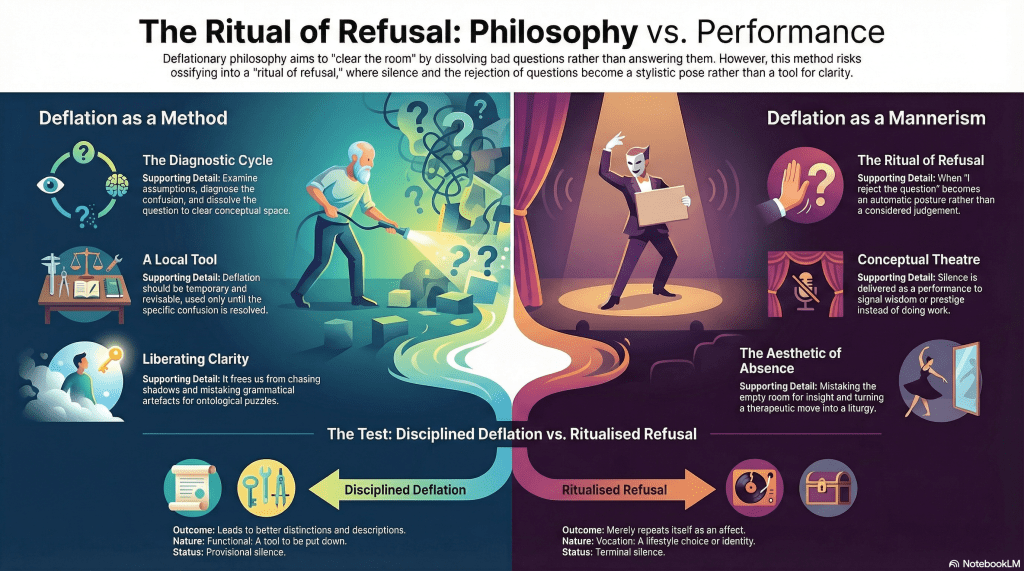
Deflation begins as a method:

  • A question is posed.
  • Its assumptions are examined.
  • The confusion is diagnosed.
  • The question dissolves.
  • Everyone goes home.

At its best, this is liberating. It frees us from chasing shadows and mistaking grammatical artefacts for ontological puzzles. The trouble begins when the gesture outlives the job.

What was once a diagnostic move becomes a stylistic tic. Refusal becomes automatic. Silence becomes performative. ‘There is nothing there’ is delivered not as a conclusion, but as a posture. At that point, deflation stops doing work and starts doing theatre.

I am often charged with being negative, a pessimist, a relativist, and a subjectivist. I am sometimes each of these. Mostly, I am a Dis–Integrationist and deflationist, as it were. I like to tear things apart – not out of malice, but seeing that certain things just don’t sit quite right.

Another thing I do is to take things at face value. As I came up through the postmodern tradition, I don’t trust metanarratives, and I look for them everywhere. This is why I wrote A Language Insufficiency Hypothesis (LIH), and even more so, the Mediated Encounter Ontology (MEOW). Some words carry a lot of baggage and connotation, so I want to be sure I understand the rawest form. This is why I rail on about weasel words like truth, justice, freedom, and such.

I also refrain from responding if I am not satisfied with a definition. This is why I consider myself an igntheist as opposed to an atheist. Functionally, I am the latter, but the definition I’d be opposing is so inane that it doesn’t even warrant me taking a position.

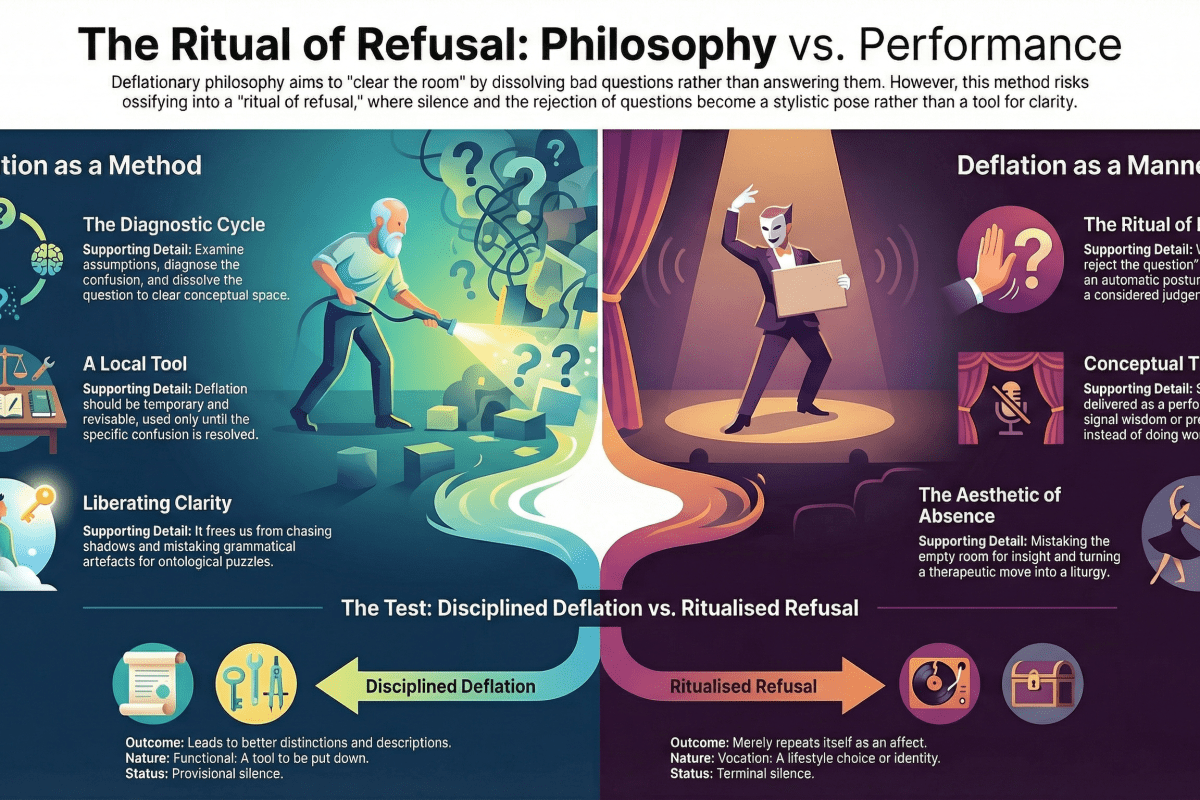
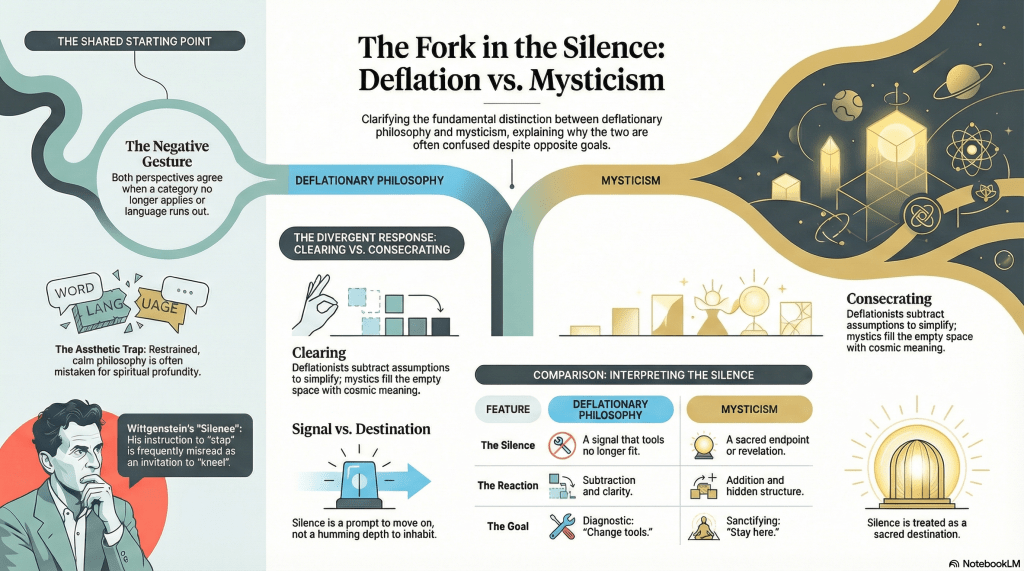
Image: NotebookLM infographic of this topic.

The prestige of saying less

There is a quiet prestige attached to not answering questions. Refusal sounds serious. Restraint sounds wise. Silence, in the right lighting, sounds profound. This is not an accident. Our intellectual culture has learned to associate verbal minimalism with depth, much as it associates verbosity with insecurity. Deflationary philosophers are not immune to this aesthetic pull.

When ‘I reject the question’ becomes a default response rather than a considered judgement, deflation has slipped from method into mannerism. The absence of claims becomes a badge. The lack of commitments becomes an identity. One is no longer clearing space, but occupying emptiness.

This is how deflation acquires a style – and styles are how rituals begin.

Apophasis without God

Mysticism has its negative theology. Ritualised deflation develops something similar.

Both rely on:

  • refusal to name
  • insistence on limits
  • reverent quiet

The difference is meant to be procedural. Mysticism stops at the silence. Deflation is supposed to pass through it. But when deflation forgets that its silence is provisional, it starts to resemble the thing it set out to criticise. Absence becomes sacred again, just without the cosmology. The metaphysician worships what cannot be said. The ritualised deflationist admires themselves for not saying it. Neither is doing conceptual work anymore.

A brief and unavoidable Wittgenstein

This is where Ludwig Wittgenstein inevitably reappears, not as an authority, but as a warning. Wittgenstein did not think philosophy ended in silence because silence was holy. He thought philosophy ended in silence because the confusion had been resolved. The ladder was to be thrown away, not mounted on the wall and admired. Unfortunately, ladders make excellent décor.

When deflation becomes ritual, the therapeutic move freezes into liturgy. The gesture is preserved long after its purpose has expired. What was meant to end a problem becomes a way of signalling seriousness. That was never the point.

A diagnostic test

There is a simple question that separates disciplined deflation from its ritualised cousin:

  • Is this refusal doing explanatory work, or is it being repeated because it feels right?
  • If silence leads to better distinctions, better descriptions, or better questions, it is doing its job.
  • If silence merely repeats itself, it has become an affect.

And affects, once stabilised, are indistinguishable from rituals.

Deflation is local, not terminal

The corrective is not to abandon deflation, but to remember its scope.

Deflation should be:

  • local rather than global
  • temporary rather than terminal
  • revisable rather than aestheticised

Some questions need dissolving. Some need answering. Some need rephrasing. Knowing which is which is the entire discipline. Deflation is not a worldview. It is not a temperament. It is not a lifestyle choice. It is a tool, and like all tools, it should be put down when it stops fitting the task.

Clearing space is not a vocation

There is a temptation, once a room has been cleared, to linger in it. To admire the quiet. To mistake the absence of furniture for the presence of insight. But clearing space is not a vocation. It is a task. Once it is done, staying behind is just another way of refusing to leave. And refusal, repeated without reason, is no longer philosophy. It is choreography.

Why Deflationary Philosophy Keeps Attracting Mystics

4–5 minutes

The struggle is real. There is an odd occupational hazard that comes with writing deflationary philosophy: mystics keep turning up to thank you for your service.

This is always mildly bewildering. One spends a great deal of time dismantling metaphysical furniture, only to discover a small group lighting incense in the newly cleared space. Candles appear. Silence thickens. Someone whispers ineffable. Nope. The filing cabinet was just mislabeled.

Audio: NotebookLM summary podcast of this topic.

The problem is not misunderstanding. It’s reuse.

It is tempting to think this is a simple misreading: I say this concept breaks down here, and someone hears you have glimpsed the ultimate. But that’s too kind. What’s really happening is more interesting. Mysticism does not merely misunderstand deflationary work; it feeds on the same linguistic moves and then stops too early.

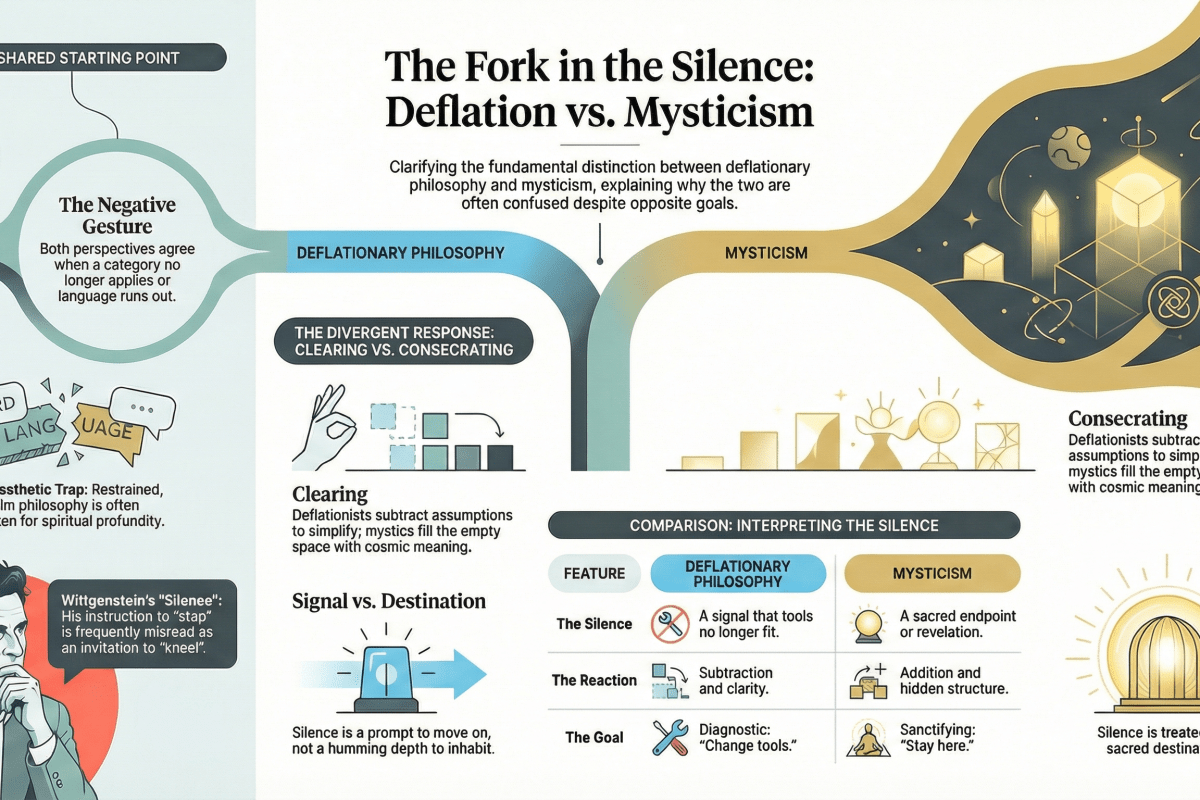
Both mysticism and deflation rely on negative gestures:

  • “This description fails.”
  • “That category no longer applies.”
  • “Our usual language runs out.”

Up to this point, they are indistinguishable. The fork comes immediately after. The mystic treats conceptual failure as an endpoint. The silence itself becomes the destination. Something deep must live there, humming quietly, just out of reach.

The deflationist treats the same failure as a transition. The silence is not sacred. It’s a signal. It means: this tool no longer fits; pick another or move on. Same breakdown. Entirely different posture.

Clearing space versus consecrating it

Much deflationary philosophy clears space. It removes assumptions that were doing illicit work and leaves behind something quieter, simpler, and occasionally disappointing.

Mysticism has a standing policy of consecrating cleared space. An empty room is never just empty. It must be pregnant with meaning. Absence becomes depth. Silence becomes revelation. The fewer claims you make, the more cosmic you must be.

This is not a philosophical disagreement so much as a difference in temperament. One side sees subtraction. The other experiences loss and rushes to compensate. Modern intellectual culture strongly prefers addition. New layers. Hidden structures. Further depths. Deflation feels like theft. So it gets reinterpreted as a subtler form of enrichment: Ah, fewer words, therefore more truth.

The aesthetic trap

There is also an aesthetic problem, which I increasingly suspect does most of the damage. Deflationary philosophy, when done well, tends to sound calm, patient, and restrained. It does not shout. It does not posture. It does not perform certainty. Unfortunately, this is exactly how profundity is supposed to sound.

Quiet seriousness is easily mistaken for spiritual depth. Refusal to speculate reads as wisdom. Negative definition acquires an apophatic glow. This is how one ends up being mistaken for a mystic without having said anything mystical at all.

A brief word about Wittgenstein (because of course)

This is not a new problem. Ludwig Wittgenstein spent a good portion of his career trying to convince people that philosophical problems arise when language goes on holiday. He was not pointing at a deeper reality beyond words. He was pointing back at the words and saying: look at what you’re doing with these.

Unfortunately, “Whereof one cannot speak, thereof one must be silent” has proven irresistible to those who think silence is where the real action is. Wittgenstein meant: stop here. Many readers heard: kneel here. This is the recurring fate of therapeutic philosophy. The cure gets mistaken for a sacrament.

Charity is not complicity

Another contributor to the confusion is tone. Deflationary work tends to be charitable. It explains why certain intuitions arise. It traces confusions to their sources. It does not sneer. This generosity is often misheard as validation. When you say, “It makes sense that we think this way,” some readers hear, “Your intuition is pointing at something profound.” You are offering an explanation. They are receiving an affirmation. At that point, no disclaimer will save you. Any denial is absorbed as further evidence that you are brushing up against something too deep to articulate.

The real disagreement

The disagreement here is not about reality. It is about what to do when explanation fails.

Mysticism treats failure as revelation. Deflation treats failure as diagnostic.

One sanctifies the breakdown. The other changes tools.

Once you see this, the repeated misfire stops being frustrating and starts being predictable.

A final, self-directed warning

There is, admittedly, a risk on the other side as well. Deflation can become mystical if it turns into ritual. If refusal hardens into identity. If “there is nothing there” becomes something one performs rather than concludes. Even subtraction can acquire ceremony if repeated without purpose. The discipline, such as it is, lies in knowing when to clear space—and when to leave the room.

No replacement gods

When a metaphysical idol is removed, someone will always ask what god is meant to replace it. The deflationary answer is often disappointing: none. This will never satisfy everyone. But the room is cleaner now, and that has its own quiet reward—even if someone insists on lighting incense in the corner.

Image: Full cover image infographic by NotebookLM

A So Long to 2025, and a Way Into 2026

5–7 minutes

Why Post-Position? 🧐

As 2025 closes, I find myself in the mildly suspicious position of being asked where I stand. I’m almost pretty sure it’s a deontological duty I must fulfil.

This has become the ritual gesture of our time. Not what are you working on? or what are you unsure about? but what is your position? The question arrives already armed with a grid. Left or right. Modern or postmodern. Optimist or doomer. Builder or critic. Pick a square. Declare yourself. Be legible.

Audio: Notebook summary podcast of this topic.

I have spent enough years inside philosophy, politics, systems design, and cultural critique to recognise this for what it is. Not a genuine request for understanding, but a demand for administrative convenience. Positions are easy to catalogue. They travel well on social platforms. They allow disagreements to be staged rather than examined. I no longer occupy one.

If I had to name the shift that has taken place in my thinking, I might call it post-postmodern. More accurately, I think of it as post-position. Not because I have outgrown critique, but because I have grown weary of pretending that declaring a stance is the same thing as doing the work.

Postmodernism, to its credit, diagnosed something real. It exposed the hidden scaffolding behind our grand narratives. It showed how claims to neutrality smuggled power, how universals arrived late and acted eternal, and how reason often functioned as a polite enforcement mechanism. That diagnosis still stands. Nothing that followed has invalidated it. What failed was not the critique, but the decision to treat critique as a destination.

Somewhere along the line, postmodernism hardened into an identity. Suspicion became an aesthetic. Irony turned into a resting posture. Eventually, even scepticism acquired a set of approved moves and unacceptable conclusions. The work of dismantling was mistaken for the achievement of wisdom.

The response to this impasse has been predictable. We are now urged to rebuild. To restore foundations. To recover truth, agency, meaning, and normativity. Usually with a tone of urgency that suggests things have all gone a bit too far. They haven’t gone too far. They’ve gone exactly where the premises lead.

At this point, it is worth noting that ‘postmodernism’ has largely ceased to exist as a self-ascribed position at all. It survives almost entirely as a slur. No serious thinker today introduces themselves as a Postmodernist in the way one might once have claimed empiricism, structuralism, or even analytic philosophy.

The term is now deployed from the outside, usually as shorthand for intellectual irresponsibility: relativism, nihilism, irony, excess critique. It is a caricature assembled by its opponents, then attacked as if it were a living school with doctrines and membership cards.

People who employ the term Postmodern™* relative to philosophy are intellectually lazy and not likely worth engaging in a debate on the topic, because they have not likely engaged the content charitably, if at all, outside of a caricature.

This matters because it reveals something quietly telling. What is being rejected under the banner of ‘postmodernism’ is not a coherent programme, but the discomfort produced when inherited certainties fail to survive scrutiny. The slur functions as a containment strategy. It allows critics to dismiss the diagnosis without engaging the illness.

Any thinker with even a passing familiarity with the terrain knows this. Which is why no self-respecting, or self-denigrating, postmodern thinker would now characterise themselves as such. The label has been evacuated of descriptive value and filled with anxiety.

What is being revived in these reconstruction projects is not certainty, but legibility. A longing for systems that can be explained cleanly, defended coherently, and enforced consistently. Clear positions are attractive because they reduce friction. They allow disagreement to be formalised, managed, and ultimately neutralised. This is where I step off.

Post-position thinking is often mistaken for relativism, so it is worth being explicit. It does not claim that nothing is real, that all claims are equal, or that consequences dissolve into opinion. Reality remains stubborn. Harm remains unevenly distributed. Constraints still bite.

What it rejects is something more specific: the belief that ethical, epistemic, or political seriousness requires the occupation of a stable, declarable position.

Positions are not engines of thought. They are summaries produced after the fact. They tidy complexity into something portable, then forget the mess that made the tidying necessary. Once adopted, they begin to govern perception. You start seeing what fits and discarding what does not. The position becomes an answer generator rather than a question machine.

It stays with instability where stability would be dishonest. It tolerates contradiction where resolution would be cosmetic. It treats coherence as local, provisional, and negotiated rather than universal and enforceable. This is not indecision. It is fidelity to how complex systems actually behave. One way to describe the shift is a movement away from critique toward maintenance.

Modernism wanted to build. Postmodernism wanted to dismantle. Both share a quiet assumption that there is a point at which the work is done. Maintenance has no such illusion. It accepts that some systems cannot be fixed, only kept from doing additional damage – that concepts fray; that norms age badly; that repair is continuous and never final.

Maintenance is unspectacular. It does not produce manifestos. It does not scale elegantly. It involves partial solutions, awkward compromises, and the constant risk of failure. It is also where most of the moral work actually happens.

From this vantage point, the demand to ‘take a position‘ looks increasingly misplaced. Not because commitments vanish, but because commitments are situational, asymmetric, and responsive to context. Loyalty shifts from creeds to consequences. What matters is not whether an idea is internally consistent, but what it does when it leaves the page and collides with institutions, incentives, and frightened people.

So when I refuse to declare where I stand, it is not evasiveness. It is a refusal to pretend that standing still is a virtue.

This is the posture I am carrying into 2026. Not a programme, not a system, not a rehabilitated foundation. Just a refusal to confuse clarity with truth, structure with virtue, or positions with thinking.

If that feels unsatisfying, that may be the point. Satisfaction is a modernist luxury. Maintenance rarely provides it. The work continues anyway.

* To be fair, I have referred to myself as Postmodern™, but this was a shortcut out of solidarity with Foucault, Derrida, Latour, Baudrillard, and others painted with this brush. I still admire these thinkers.

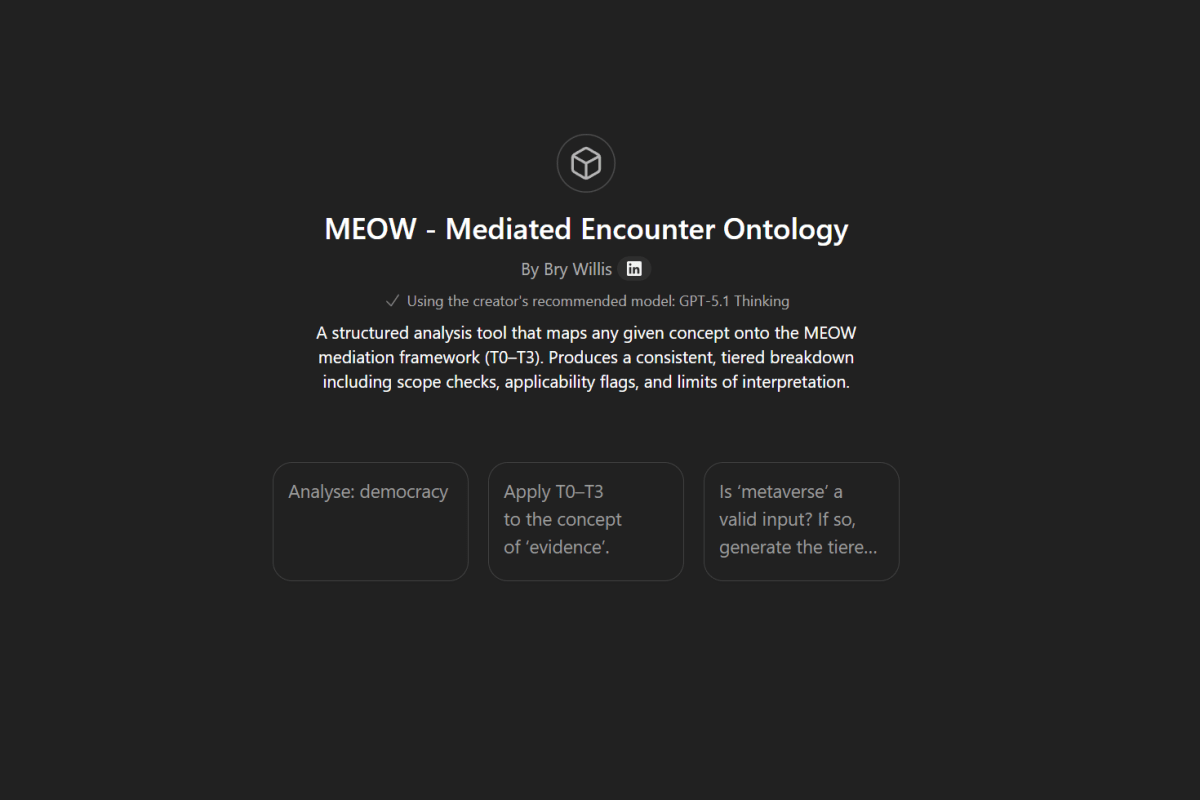
Announcement: MEOW GPT

Instead of sleeping like a functional adult, I’ve spent the night creating, testing, and refining a bespoke GPT that has fully absorbed my MEOW and LIH frameworks. Apologies that the LIH manuscript isn’t yet public; some of the terminology may look delightfully alien if you’re coming in cold.

This model doesn’t role-play a philosopher; it thinks through the Mediated Encounter Ontology. It runs every input through T0–T3 mediations and then applies the Language Insufficiency Hypothesis to explain why our words fail us in predictable, structural ways.

Audio: NotebookLM summary podcast of this post on the MEOW GPT.

I stress-tested it with a dozen concepts, from the obvious to the uncooperative. It happily tells you when your input makes sense, when it’s out of scope, and when you’ve handed it conceptual soup. My first test was the hard problem of consciousness, because naturally we begin with the philosophical boss fight. I dialled down some over-enthusiastic LIH flourishes, but the bones are untouched.

I’m making this public for a simple reason: it’s the clearest way for people to see how MEOW operates without wandering through a hundred pages of my prose. These outputs capture how I process information and why these frameworks feel so intuitively correct to me. When you read them, you get a direct view of my interpretive machinery – how the world clicks for me, and how these ideas evolved.

It hasn’t been rigorously battle-tested across the entire conceptual universe, but it’s stable, coherent, and frankly too interesting to keep in the drawer. If you try it – and I hope you do – I’d love to see what it does with your own concepts. If you need help reading the results, ask. I didn’t simplify the system; it expects literacy, nuance, and a working prefrontal cortex.

For orientation, read the introductory post or the colour perception example. Ideally, read the original essay and listen to the summary podcast. My first test was on the hard problem of consciousness because I had already analysed it for this post. I made some adjustments to tone down some LIH intrusions.

Below is a sample output. I asked the model to analyse modernity.

Concept

  • Input: modernity
  • Type: historical–social formation / self-description of an era / conceptual frame
  • Scope check: in-scope – central for how MEOW treats large-scale shifts in mediation (social, technical, cognitive, linguistic)

High-level summary (≤120 words)

Modernity is both a historical bundle (industrialisation, nation-states, capitalism, science, bureaucracy, media) and a story societies tell about themselves (“we are modern, unlike the past”).

In MEOW terms, modernity is a large-scale reorganisation of mediations:

  • T0: new bodily environments (urban life, clocks, artificial light, pollution, medicine).
  • T1: new cognitive habits (individualism, planning, abstraction, risk-calculation).
  • T2: new vocabularies (progress, development, rationality, “religion” vs “science”).
  • T3: new institutions and technologies (markets, states, factories, schools, mass media, digital networks).

“Modernity” is not a single thing but a way these shifts hang together and become a background to everyday encounter.


T0 – Biological Mediation

  • Applicability: Applicable
  • Analysis:
    • Modernity radically reshapes the immediate bodily environment: dense cities, artificial lighting, noise, pollution, sedentary work, and altered sleep cycles change basic sensory and metabolic conditions.
    • Medical advances and public health (vaccination, antibiotics, sanitation, surgery) modify life expectancy, infant mortality, and chronic illness, which in turn change how life cycles feel and are planned.
    • New food systems (industrial agriculture, processed foods, global supply chains) alter nutrition, exposure to toxins, and rhythms of hunger and satiety.
    • Industrial and digital work reorganise movement and posture: repetitive factory labour, office desk work, and screen use all reshape embodiment, fatigue, and bodily awareness.
    • These T0 changes set the stage for new affective baselines (e.g., chronic low-level stress, stimulation overload) that colour what it is like to live in a “modern” world.

T1 – Cognitive Mediation

  • Applicability: Strongly applicable
  • Analysis:
    • Modernity encourages certain cognitive styles: systematic planning, quantification, risk assessment, cost–benefit thinking, and an emphasis on prediction and control.
    • The sense of self is reconfigured toward individualism and reflexivity: people see themselves as projects to be chosen, improved, optimised, often with long-term career and life-planning horizons.
    • Exposure to multiple roles, cultures, and information streams (through migration, media, education) produces more complex identity structures and can create cognitive dissonance or fragmentation.
    • Scientific and technical worldviews teach people to reframe events in terms of mechanisms, probabilities, and systems rather than fate, tradition, or local narratives.
    • The sheer volume and speed of information flows in late modernity (news, social media, notifications) trains attention toward rapid scanning and shallow switching, affecting memory, concentration, and emotional regulation.
    • These patterns make certain experiences “normal” (abstract work, mediated relationships, bureaucratic interactions) that would be extraordinary or impossible in premodern settings.

T2 – Linguistic Mediation

  • Applicability: Strongly applicable
  • Analysis:
    • Modernity itself is a label that societies use to contrast “us” with “them” (the past, “traditional” societies, “the East,” “the primitive”); it is a polemical as well as descriptive term.
    • In Language Insufficiency terms, modernity is highly Fluid: it can mean a period (“since the 18th century”), a style (modernist art), a value system (rational, secular, progressive), or a socio-economic order (capitalist, industrial, bureaucratic). Different authors slide between these quietly.
    • It’s also Contestable: critics and defenders use the same word but point to different aspects—emancipation and progress versus alienation, exploitation, ecological crisis.
    • Pairs like “modern vs traditional” or “modern vs backward” compress complex differences into simple hierarchies, smuggling in a presumption that “modern” is automatically better or more advanced.
    • Talk of “post-modernity” or “late modernity” suggests that we can neatly periodise and step outside the modern, even while our concepts and institutions remain shaped by it—an example of language implying more clarity and control than we actually have.
    • At the most global scale (“the meaning of modernity,” “the modern condition”), we approach an Effectiveness Horizon: the term feels weighty but becomes vague; people resort to sweeping metaphors (disenchantment, liquefaction, acceleration) whose exact content is hard to pin down.
    • First-person experiences of being “overwhelmed by modern life,” “liberated by modern options,” or “disconnected in modern society” often have an Ineffable quality: standard clichés don’t quite capture the texture of these lives, even as they gesture at them.

T3 – Social/Technical Mediation

  • Applicability: Strongly applicable
  • Analysis:
    • Modernity is most visible as a mesh of institutions: nation-states, markets, bureaucracies, public schools, hospitals, prisons, armies, scientific organisations, corporations, NGOs.
    • These institutions standardise time (clocks, schedules), space (borders, property lines, zoning), identity (passports, ID numbers), and value (money, statistics, rankings) so that encounters become predictable and governable across large scales.
    • Technologies—steam engines, electricity, mass transport, broadcasting, computing, the internet, AI—are both products and drivers of modernity. They make possible new encounter-forms (remote work, global real-time communication, mass surveillance).
    • Urbanisation concentrates people into large, heterogeneous populations, which reconfigures social networks, anonymity, solidarity, and conflict; everyday encounters become more mediated by rules, signage, and digital systems than by face-to-face custom.
    • Capitalist production and consumption patterns organise much of life around work, income, and markets; the rhythms of the factory, office, and platform economy structure when and how people interact, rest, and move.
    • Modern governance uses statistics, censuses, and models to “see” and manage populations; this makes certain aspects of life legible (employment, crime, disease) while leaving others under- or uncounted (informal care, undocumented work, emotional labour).
    • Counter-movements (romanticism, traditionalism, environmentalism, decolonial and Indigenous resurgence, slow-living and anti-consumerist practices) can be read as attempts to renegotiate or resist specific modern mediations rather than simply reject “modernity” as a whole.

Limits & failure modes

  • Language insufficiency notes
    • Modernity bundles together time (a historical era), structure (a type of society), and value (being “up to date”). This makes the term rhetorically powerful but analytically slippery: it’s easy to smuggle evaluations into what sound like neutral descriptions.
    • Because the concept is so broad, discussions often conflate distinct issues—technology, capitalism, secularisation, colonialism, individualism, bureaucracy—under one word, obscuring which mechanisms are actually at work.
    • Experiences of living in “modern times” (speed, fragmentation, choice, precariousness, possibility) often outrun our stock phrases; people lean on recurring complaints (“too fast,” “too shallow,” “too lonely”) that only partially capture what it’s like.
  • Missing tiers / blind spots
    • This sketch doesn’t adjudicate between different theories of modernity (Marxist, Weberian, postcolonial, systems-theoretic, etc.); it treats them as emphasising different mediational strands.
    • It’s centred on Euro-Atlantic narratives; “multiple modernities” and non-Western trajectories (where “modern” elements mix with older forms in hybrid ways) would need a richer T3 treatment.
    • The analysis underplays ecological dimensions: industrial modernity’s dependence on fossil fuels, large-scale extraction, and waste has massive implications for how future encounters will be structured.
    • Finally, because we are ourselves situated in what we call modernity, our conceptual vantage is limited; any map we draw is partly an artefact of the very mediations we’re trying to analyse.