“Education is an admirable thing, but it is well to remember from time to time that nothing that is worth knowing can be taught.”
— Oscar Wilde
I’ve loved this quote since I first read it however many years ago. I used to have a plaque with this inscription hung on a wall. This quote came back to mind when I was reading more McGilchrist. I expect to post the summary of chapter nine of The Matter with Things by the end of the weekend. I’ve read it and am now extracting a summary. But I digress.
“Education is an admirable thing.” This is a testament to the left cerebral hemisphere, although it provides fodder for the right as well. Instruction is about categorisation and structure; language and rote; stuffing out brains with facts and trivia.
But “nothing worth knowing can be taught.” This is a right hemisphere conceit. It can’t be taught because it must be experienced.
One can’t teach allegory.
One can’t teach allusion.
One can’t teach metaphor.
One can teach simile.
One can teach poetry, but one can’t teach a poem.
One can teach art, but one can’t teach a work of art.
One can teach music, but one can’t teach the qualia of music. That’s a minor key. You’re supposed to feel sad there. That’s a major seventh chord, doesn’t that uplift you? And what about this raga?
What can’t be taught lay in the realm of intuition and feeling. Emotional response.
I was browsing YouTube, and I got captivated by reaction videos, where a younger audience listens to music some of us grew up with and reacts to it. Time is a song I grew up on. Pink Floyd were a major influence on my music and my worldview. I have to admit that I am partial to the David Gilmour years and stopped caring about anything released after Roger Waters left. I have spent hours listening to their back catalogue with Syd Barrett and early David Gilmour, but Meddle, released in 1971, is about as far back as I prefer to go—even that old gem, Seamus.
Roger Waters penned the deepest lyrics for Pink Floyd, and this was one of his best. He wrote this in his late twenties, though it feels like he would have been older and wiser. I suppose he’s an old soul. Here’s the first verse:
Ticking away the moments that make up a dull day
Fritter and waste the hours in an offhand way
Kicking around on a piece of ground in your hometown
Waiting for someone or something to show you the way
This speaks to how we tend to take time for granted. Sometimes, we just want the time to pass. We’re bored, and we want to get on to something meaningful, eventful, or perhaps exciting. We might be sat in work or school just waiting for quitting time. We aren’t living in the moment or enjoying the moment. And we might just be kicking around on a piece of ground in our hometowns rather aimlessly. And whilst I am aware that many people are looking for someone to guide them to the next level, whether a religion, a vocation, a guru, or a hero, that bit’s never really resonated with me. I suppose I’ve always been naturally insouciant and Zen. Some have said to a fault.
you missed the starting gun
Tired of lying in the sunshine, staying home to watch the rain
You are young and life is long, and there is time to kill today
And then one day you find ten years have got behind you
No one told you when to run, you missed the starting gun
The second verse picks up where the first one left off. Let’s not forget that this is Britain—London—plenty of rain. But some people do get tired of lying in the sunshine living their routine workaday lives. When we are younger, the days feel longer. Time is stretched. Einsteinian relativity. Again, we’ve got time to pad out and fill. Something’s happening at the weekend. Let’s just fast-forward, but we can’t, so let’s fill the time with mindless prattle and television or somesuch. Once you were 18 and now you’re 28. What happened? Tens years gone. Where’d the time go?
The last line in the second verse is telling. For me, it’s more an indictment of quote-modern-unquote society. It only applies to those who buy into this worldview. I never bought in. It’s’ always been a sham. But for some, they reach 28 and realise they’ve made the wrong decisions for their lives to end up the way they may have envisaged. I’ve never had this grand vision.
one day closer to death
And you run, and you run to catch up with the sun but it's sinking
Racing around to come up behind you again
The sun is the same in a relative way but you're older
Shorter of breath and one day closer to death
Resistance is futile. You can’t escape the movement of time as represented by the quotidian sun. It will always lap you. The sun ages on a different time scale to you. The sun doesn’t appear to age. It was here when we arrived. It will be here when we leave. It was here before any of us were born. It will be here after we’ve all left. Yet with every lap of the sun, we are each another day closer to death. That day may be tomorrow, next week, or in a hundred years, but as Twelve-Step programmes remind us, we live one day at a time. Perhaps even this is too large of a time slice, as we can only live moment to moment. Anything else is but a construction. Nothing else is real. Memento Mori.
thought I’d something more to say
Every year is getting shorter, never seem to find the time
Plans that either come to naught or half a page of scribbled lines
Hanging on in quiet desperation is the English way
The time is gone, the song is over, thought I'd something more to say
Again, time is relative. When we are young, we yearn for things: perhaps to graduate high school; get a driver’s license; graduate college; get the job we wanted; get some promotion or recognition; get signed to a big label; get a big break; the list goes on.
For those who are planners, the best-laid plans go awry. We dream of whatever and even journal these thoughts, but in the words of another song, “you can’t always get what you want”.
We want to do this or that, but life gets in the way. We can’t do everything. Economists capture this by the notion of opportunity costs. We can do this but not that. It doesn’t matter if we are Elon Musk, Jeff Bezos, Bill Gates, or whomever. Time is the ultimate leveller.
We can just keep a stiff upper lip and persevere. Just occupy some place on this third rock, Next thing you know, the time is gone. I recall my ninety-odd-year-old father-in-law after his wife of seventy-five years died. He just wanted to die. He was done. He was ready to quit, but the music was still playing. Any semblance of hope was exchanged for the hope to reach the ending peacefully.
home again
Home, home again
I like to be here when I can
And when I come home cold and tired
It's good to warm my bones beside the fire
In this verse, Roger becomes reflective. He’s nostalgic for home. Anyone with a home has a place to return to after work, after school, or a childhood memory, but to touring performers, home is an even more special place. It’s a place to return to after life on the road, perhaps for months or years. Consider Odysseus and the travellers of old. This home.
He wants to be in this comfortable, familiar place. And after a long day or excursion, it’s a place to rejuvenate and rekindle by the warmth of the fire.
softly spoken magic spells
Far away across the field
The tolling of the iron bell
Calls the faithful to their knees
To hear the softly spoken magic spells
The final verse is even more metaphorical than the others. There’s an allusion. Religious allegory. In the distance, we hear the peal of the church bell beckoning the parishioners to hear the palliative words of the vicars and priests and whatnot. Or perhaps these softly spoken magic spells are simply the prayers of the individuals.
In deference to Barthes, the author is dead. But it doesn’t matter this is my interpretation—my meaning. Even more so, in deference to chapter eight of the Matter with Things, poetry and music are meant to be appreciated as a whole, not dissected. We can reflect on the words and phrases—even the melodies and rhythms—but the words are less than they sum to. Still, this piece moves me. It always has.
Cubism reminds us that we don’t see the world as it is. We see pieces, and we fill in the gaps. From the front, we can’t see the back. From the top, we can’t see the bottom.
Video: YouTube Video
The illusion that, if we can see something clearly, we see it as it really is, is hugely seductive. John Ruskin makes the point that clarity is bought at the price of limitation. He paints a scenario wherein we are asked to imagine viewing an open book and an embroidered handkerchief on a lawn. From a quarter mile away, the two are indistinguishable. Moving closer, we can see which is which, but we can neither read the book nor trace the embroidery. Closer still, we can read the text and trace the embroidery, but we can’t see the fibres of the paper or the threads of the kerchief. And we can’t simultaneously focus on both and see detail in each. Focusing on the book, we can look closer and see the watermark, the hills and dales in the paper’s surface. With a microscope, we can see more still, as infinitum.
But at which point do we see it clearly?
I’ve created a YouTube short. I have to admit that I dislike the format. Sixty seconds isn’t really enough time to convey a concept. There’s too much missing context, and no time to elaborate. Nonetheless, I was reading The Master and His Emissary and wanted to share a point. I don’t feel I succeeded. I posted it anyway, and here it is.
I recently posted a YouTube Short video titled You Have No Free Will, but this is still debatable.
Video: You Have No Free Will
The premise of the belief in free-will is that human decisions are made approximately half a second before we are conscious of them, and then the conscious brain convinces itself that it just made a choice. This sounds pretty damning, but let’s step back for a moment.
Podcast: Audio rendition of this page content
If you’ve been following this blog these past few months, you’ll be aware that I feel the question of free will is a pseudo-question hinging primarily on semantics. As well, there’s the causa sui argument that I’d like to ignore for the purpose of this post.
There remains a semantic issue. The free will argument is centred around the notion that a person or agent has control or agency over their choices. This means that how we define the agent matters.
In the study this references, the authors define the agent as having conscious awareness. Since this occurs after the decision is made, then the person must have had no agency. But I think an argument can be made that the earlier decision gateway is formed through prior experience. Applying computer metaphors, we can say that this pre-consciousness is like embedded hardware or read-only logic. It’s like autopilot.
In business, there are various decision management schemes. In particular, the conscious but slow version is for a person to be notified to approve or deny a request. But some decisions are automatic. If a purchase is over, say 50,000 then a manager needs to sign off on the request. But if the purchase is under 50,000, then the request is made automatically and then the manager is notified for later review if so desired.
I am not saying that I buy into this definition, but I think the argument could be made.
You might not know it by the number of posts discussing it, but I am not really concerned about whether or not free will really exists. I don’t lose any sleep over it. At the same time, I tend to react to it. Since I feel it’s a pseudo-problem where tweaking the definition slightly can flip the answer on its head, it’s just not worth the effort. On to better things.
“We knew that conscious processes were simply too slow to be actively involved in music, sports, and other activities where split-second reflexes are required. But if consciousness is not involved in such processes, then a better explanation of what consciousness does was needed,”
Andrew Budson, MD, professor of neurology, Boston University
Under this new theory, supported by recent studies, choices are made unconsciously and then we are made conscious of the choices after the fact. This tosses a spanner in the works of some proponents of free will. Some may still claim that it was uniquely ‘you’ who made this choice—conscious or otherwise—, but others may not be so fanciful.
“According to the researchers, this theory is important because it explains that all our decisions and actions are actually made unconsciously, although we fool ourselves into believing that we consciously made them.”
“What is completely new about this theory is that it suggests we don’t perceive the world, make decisions, or perform actions directly. Instead, we do all these things unconsciously and then—about half a second later—consciously remember doing them.”
Andrew Budson, MD, professor of neurology, Boston University
And here we are again with more evidence that we are not consciously responsible for our choices, and yet the conscience has such a fragile ego, it needs to think it does.
Chapter 6 of The Matter with Things is titled Emotional and Social Intelligence, following the previous chapters, Attention, Perception, Judgment, and Apprehension. Chapter 7 is about cognitive intelligence.
The gist of chapter 6 is to convey the importance of emotional and social intelligence in forming a full picture of the world. Absent these, reality becomes increasingly tenuous to retain a grip on because the left hemisphere just doesn’t have the emotional awareness to grasp the full picture.
Audio: Podcast version of this page content
Content
At the start, this chapter reminds us that the right hemisphere not only constructs our sense of self, but it also facilitates the construction of other selves, which allows us to empathise with others. It also allows us to assess intent. And it goes deeper than this.
McGilchrist shares some anecdotes about schizophrenic patients with impaired right hemispheres who believe that nothing is real and that people are play-acting. In hospital, they perceive the ward to be a stage and the medical staff to be actors.
As if by a control knob, changes to the right hemisphere may create a diminished sense of reality as well as an intensified sense—of being hyperaware. This is not dissimilar to certain claims by some with heightened lucidity; however, the data do not permit a clear-cut conclusion. On a related note, the intensified sense may also increase emotional reactions, so one might be more prone to crying—whether tears of joy or sadness.
Abnormal electrical activity in the right hemisphere can heighten a sense of familiarity leading to a sense of déjà vu. A diminished sense has the contrary effect, reducing a sense of familiarity, leading to a sense of jamais vu, ‘never before seen’, Related to déjà vu, there have been cases of déjà vécu, ‘already experienced’ (rather than seen). Together, over 86% of these phenomena are associated with the right hemisphere.
Recall that each hemisphere controls the body contralaterally, so the right hemisphere controls the left side of the body—hands and arms, eyes, and so on. And it’s deeper than this. For example, being the arbiter of empathy, the left hand (being controlled by the right hemisphere) is used for empathetic touch. Beyond humans, bottleneck dolphins tend to stroke other dolphins with their left flippers.
This affects humans and other animals with a sort of left-eye empathy that even affects how babies are held or otherwise attended to, preferring the left side of the body over the right.
Theory of mind (ToM), a topic in its own right, is a right hemisphere-dominant capability that allows us to empathise with another or to put ourselves into another’s shoes. This ability extends to other species like elephants, apes and dogs, whales and dolphins, crows and magpies, and goats and seals.
The left hemisphere is good at understanding the what of actions
The left hemisphere is good at understanding the what of actions, say picking up a cup or flicking a switch; it’s not so great at discerning the why. Recall in a previous chapter the case of the person with right hemisphere damage automatically picking up a pen or pencil but then not having anything particular in mind to write. The left hemisphere noticed the pen as a writing instrument and picked it up. Without the right hemisphere to provide the why, this person just kept accumulating writing implements.
This can be seen in children with autism. They recognise well enough that a person is doing something—performing some action—, but they just can’t understand why.
He tells us that “a huge body of evidence confirms that the right hemisphere is much superior to the left in receiving, interpreting, recalling or understanding anything that involves emotion.”
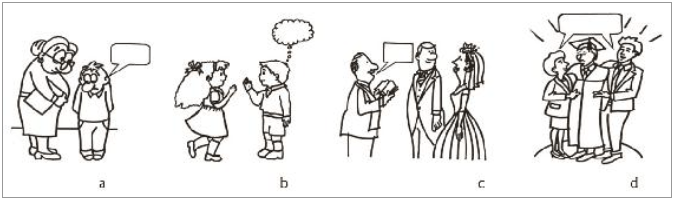
I’ll just share one example, and McGilchrist provides common responses from persons with both hemispheres intact as well as responses with right hemisphere deficits. For image b, a ‘normal’ response is for the respondent to fill in the boy’s talk bubble with ‘Boy, she’s cute.’ A couple of right hemisphere deficit responses were ‘I wonder how big her allowance is’ and ‘Let’s arm-wrestle’, obviously missing context.
The right hemisphere is responsible for understanding emotion, irony, jokes and humour—and the ability to tell the difference between jokes and lies. When told a joke and given an opportunity to fill in the punchline, the language of right hemisphere deficit patients ‘is often excessive and rambling; their comments are often off-colour and their humour is frequently inappropriate; they tend to focus on insignificant details or make tangential remarks’. Moreover, when asked to reconvey a story, the right hemisphere deficit people produced an ‘abundance of embellishments’ to it.
One subject with right hemisphere resection asked, ‘how do you feel?’ responded ‘With my hands’
Other right hemisphere functions are the ability to grasp the semantic nuance and intonation of a speaker. One subject with right hemisphere resection asked, ‘How do you feel?’ He responded, ‘With my hands,’ but he wasn’t joking.
People who have undergone a right hemispherectomy demonstrate a ‘shallow affect, rigidity, [and] lack of imagination’. The left hemisphere seems to prefer denotative speech whilst the right prefers connotative, hence a broader set of possible meanings. Interestingly, yet perhaps not surprisingly, clichés are the domain of the left hemisphere. Poetry and music reside on the right.
Wrapping up this chapter, the right hemisphere tends to serve as the emotional centre, save for anger, which is a left hemisphere activity.
Perspective
In summary, the left brain is very focused. Damage to the right hemisphere mimics the responses of autistic and schizophrenic individuals who interpret inputs differently and without nuance. This nuance often contains emotional or empathetic content that is lost on this cohort.
I am left wondering if schizophrenia and autism are right hemisphere problems, as it were, or if I would be reading into things to arrive at this conclusion.
Having completed Emotional and Social Intelligence next up is a chapter on Cognitive Intelligence. I hope you’ll join me.
What are your thoughts? What did you think of this chapter? Were there any surprises? Anything of particular interest?
Iain McGilchrist feels that the world is moving too much toward a left hemisphere-dominated world. This has happened before, ebbing and flowing, and perhaps it will change direction again at some point. Although this compartmentalised thinking has its roots at the beginning of the Age of Enlightenment, it has accelerated in the past century as specialisation has too many of us losing the woods for the trees.
Podcast: Audio rendition of this page content
Humans have “a sufficiently strong propensity not only to make divisions in knowledge where there are none in nature, and then to impose the divisions on nature, making the reality thus conformable to the idea, but to go further, and to convert the generalisations made from observation into positive entities, permitting for the future these artificial creations to tyrannise over the understanding.”
— Henry Maudsley, The Physiology and Pathology of the Mind,1867
I hope McGilchrist explores extreme right hemisphere dominance more in The Master and His Emissary, whether relatively due to a deficient left hemisphere or because of the right hemisphere running amok.
McGilchrist warns the reader time and again that both hemispheres are involved in many activities, and it is what they are doing or how they are processing the events that differ. But when we generalise some primary competencies—a decidedly left hemisphere activity—, we notice that the left hemisphere is about constrained thinking with a focus on elements rather than the whole as illustrated previously and creating a map to re-present those data.
A Woman’s Face in the Trees: Gestalt in Action
Conversely, the right hemisphere is about openness and experiencing the world as it is presented rather than a re-presentation. I likened this to a Zen approach. It would probably not be unfair to relate this to the Buddhist notion of oneness and selflessness.
Given Iain’s assessment, perhaps right hemisphere dominance is not our biggest concern at the moment. However, I perceive a potential problem. Given the right hemisphere’s proclivity toward Gestalt, I am concerned that it also overgeneralises things into a whole where they shouldn’t be connected, as such. Gestalt is what fills in spaces in perception to make it appear as a whole. I’ll consider this to be an interpolation. But if it interpolates wrong, we may incur fitness penalties. Aside from this, I consider extrapolation—or perhaps misidentified boundary states, which is to say we include aspects outside of the ‘real’ domain boundary and glom it onto the model because, cognitively speaking, we don’t know what to do with it or how to interpret it. Once it gets passed to the left hemisphere, it (incorrectly) codifies it, from that point onward being mis-re-presented.
So where the left hemisphere loses the woods for the trees, the right hemisphere annexes the neighbours’ woods.
Continuing with a quick post based on observations in The Master and the Emissary by Iain McGilchrist, another example of hemispheral specialisation is illustrated in the image below.
Podcast: Audio rendition of this page content
A typical person will envisage this large S composited with smaller Ss (that could be replaced with any symbols, so there is nothing special about the S comprised of Ss) as represented by the centre image of the rendition of the bilateral interpretations.
Where there is left hemisphere damage, the right would envisage something more like the S on the right—seeing the big picture but losing detail. Where there is right hemisphere damage, the left would perceive something more like the S on the left, which is the detail of the composite Ss without recognising that they composed a bigger picture. This is conveyed in the aphorism of losing the woods for the trees whilst the former right hemisphere dominant view might not realise that the forest has trees.
But even this misses the point slightly because if you are viewing this as a typical person, you can assemble the Ss on the left and realise that it makes a larger S whereas a person with right hemisphere damage will just see a mass of Ss and not see the larger S shape. Moreover, it’s not that the right hemisphere wouldn’t ‘see’ the smaller composite Ss, it just wouldn’t put any significance on them, thus ignoring them and considering them to be background noise.
I really do want to share about the non-stereoscopic animals as well as another instalment from The Matter with Things. At least one of these is probable for the next post.
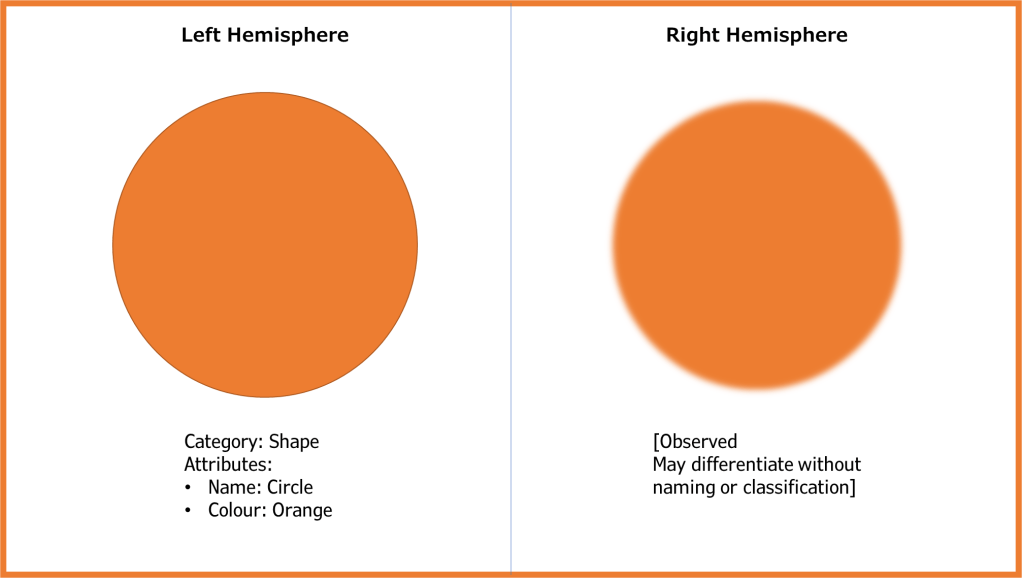
One key aspect of left and right hemisphere differences is the notion of identification versus naming and categorisation. I tend to view the right hemisphere as rather Zen. It just sees things as they are without particular care, judgment, or attachment.
Podcast: Audio rendition of this page content2 Orange Circles as tentatively experienced by the left and right hemispheres of the brain.
I composited a quick illustration to convey the difference. Starting with the right hemisphere, the object is recognised in a global context. Whilst it can be distinguished from a blue thing or a square thing, this is done by holistically surveying the world. The difference is perceived but rather without reflection on memory.
Generally speaking, both hemispheres ‘see’ the object, but where the right hemisphere is interested in the object as presented, the left hemisphere is interested in re-presentation. Where the right hemisphere is about being open to the experience itself, the left closes.
From an evolutionary vantage, the right hemisphere is interested in surveying the world at large and being alert to potential danger or survival queues, perhaps a food source. If the right hemisphere is triggered, the left hemisphere jumps in. This said, the left hemisphere is tightly focused, so if something does alert it—remembering that it is not switched off awaiting the right brain to activate it—, it will respond more quickly than the right hemisphere, though as I’ve noted previously, accuracy is not it’s forte, as the right hemisphere may have to convey that the snake that startled you was, in fact, a garden hose.
The left hemisphere is where categorisation and naming take place. Moreover, it stores the object for later retrieval, creating a map. If a subsequent observation is made, it is compared and contrasted relative to the map. After enough observations are made, the left brain isn’t so interested in observing the external world. It perceives a circle-y shape or perhaps an orangy colour and is convinced (metaphorically) that its cached version is satisfactory.
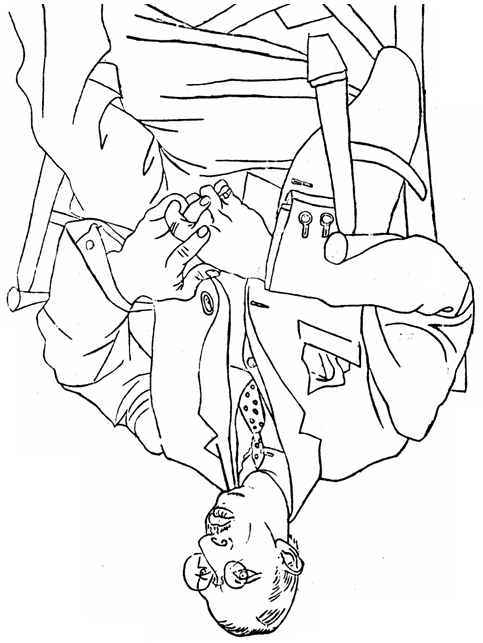
There is a book named Drawing from the Right Side of the Brain. I don’t want to comment on the book in depth, save to say that the author’s premise is that the so-called left-hemisphere person will look at the face of a subject and draw a generic oval shape. The eyes will be general eye shapes, following the same pattern for the nose and mouth. In the end, they will have rendered a portrait on the level of a child.
Whistler’s Mother, a restoration as reimagined by Mr Bean in the movie Bean.
The artist who inhabits the left brain will instead note the contours, shadows, and colours of the face in front of them. One exercise that I had learned in some art class years before I read this was to draw from an inverted portrait. Not being so common as upright faces, the left brain has no representations modelled and so defers to the right hemisphere that is now looking at the object—the terrain—rather than the model.
Inverted image of Igor Stravinsky, a popular subject for breaking left-brain fixedness
I find the divided hemisphere activity in animals without stereoscopic vision to be fascinating. Perhaps, I’ll comment on this next.
* I am not claiming that the right hemisphere sees the world as fuzzy or hazy. Rather, this was me taking artistic licence to not ascribe strict boundaries to the objects in the world, especially as constrained by language.
This is my take on the fifth chapter of The Matter with Things. I suggest reviewing the previous chapters before you delve into this one, but I won’t stop you from jumping queue.
Podcast: Audio rendition of this page content
Intro
Chapter five of The Matter with Things is titled Apprehension, following the previous chapters, Attention, Perception, and Judgment. From the start, let’s clarify that apprehension is not meant in the manner of being nervous or apprehensive. It’s meant to pair with comprehension. More on this presently.
Whilst the previous chapters have been heavily focused on the importance of the right hemisphere, this chapter is focused on the left, which may be given the chance to redeem itself. Not surprisingly perhaps, given the relative function of the right hemisphere versus the left, this chapter is much shorter than prior chapters.
Content
This chapter opens by asking what happens to a person who experiences left hemisphere damage. But let’s return to the chapter title. Apprehension is retaken etymologically and means to hold onto or to grasp. This is the function of the left hemisphere. The right hemisphere is about comprehension. The root ‘prehension’ is Latin for hold; the added ap prefix suggests holding on, whilst the com prefix suggests holding together.
Whilst conceptualising and abstract language is a right hemisphere function, spoken words are a left-brain function. It turns out that so is pointing and other gesticulation, reminding me of some ethnic stereotypes of people who speak with their hands. We need to keep in mind that the right hemisphere controls the left part of the body whilst the left hemisphere controls the right. What this means is that the right hand, being guided by the left hemisphere is marching to a different drummer.
Also, keep in mind from the previous chapters that the right hemisphere is holistic whilst the left is atomistic. Where right hemisphere damage is evident, a person has difficulty viewing the parts of a whole, whilst if the damage is on the left, a person has difficulty constructing a whole from its constituent parts. Namely, it may recognise that a body is constructed from an inventory of pieces—head and shoulders, knees, and toes—, but it can’t seem to grasp the cohesive orchestrated picture.
Apart from body continuity, when the left hemisphere is damaged, it might know all of the steps of a given process—McGilchrist shares the example of a person trying to light a smoking pipe—, but there may be difficulty in some of the instrumentation along the way. He cites an example by Czech neurologist, Arnold Pick, which I share here intact:
The patient is given a pipe and brings it correctly to his mouth, then expertly reaches for the tobacco pouch and takes a match from the box but when asked to light it, sticks the head of the match into the mouthpiece and puts the other end in his mouth as if to smoke it. Then he takes it out of his mouth, draws it out of the mouthpiece and sticks the other end of the match in the mouthpiece of the pipe, pulls it out again, holds it for a while in his hand apparently thinking, and then puts it away.
a person when encountering a pencil would feel compelled to grab it and start writing nothing in particular
To underscore the apprehension, where there is damage evident in the right hemisphere, the right hand (under control of the left hemisphere) may just grasp at things for no reason, perhaps reaching arbitrarily out to doorknobs. In one case, a person when encountering a pencil would feel compelled to grab it and start writing nothing in particular. In each case, the right hemisphere was not available to contextualise the experience. This right hemisphere is opening and exploratory whilst the left is closing and instrumental. It seems one might tend to meander without the left to provide a certain will and direction.
McGilchrist makes some correlations between humans and other great apes, but I’ll just mention this in passing.
I am going to pause to editorialise on McGilchrist’s next claim. He argues that Saussure’s claim that language signs are arbitrary is false and gives some examples—sun, bread, and spaghetti—but I am not ready to accept this stance. For now, I am remaining in the camp with Saussure and Wittgenstein that language is both arbitrary and self-referential. Getting down off my soapbox.
Recall again that whilst the right hemisphere takes the world as presented, the left hemisphere can only re-present. This is why language symbols are handled by the left hemisphere. Coming back to Saussure, the right-brain experiences a ‘cat’ whilst the left-brain names that object a ‘cat’ and classifies it as a mammal, feline, quadruped, and whatever else.
The right hemisphere is about metaphor, prosody, and pragmatics whilst the left hemisphere, though not exclusively, is about syntax and semantics.
The right hemisphere is about metaphor, prosody, and pragmatics whilst the left hemisphere, though not exclusively, is about syntax and semantics. The left hemisphere is about symbols. As such, lipreading and interpreting sign language are both left-brain activities.
An interesting conveyance is a case study of a person with left hemisphere damage reading a book who recites the elephant in place of the written word India, so making an association by not recognising the word itself. And there may be a naming problem, so if there was a problem related to an ankle, they would point to an ankle but substitute the name of the part.
Finally, to reiterate the holistic versus atomistic divide, some people with left hemisphere damage can articulate the parts of the body or a bicycle, but when queried can’t relate that the mouth is beneath the nose or some such.
Perspective
To summarise, McGilchrist leaves with a comment, “The fabric of reality typically goes for the most part unaltered when the left hemisphere is suppressed.”
As I’ve been editorialising a bit throughout, I don’t have much to add at this point. Aside from my Saussure nit, I am still very interested in the concept that the right hemisphere constructs reality. I feel that I interpret this construction differently to Iain.
I believe that we agree that there is a world out there, and we interpret this world by interacting with it. Where I feel we differ is that he feels there is a world of objects that we interact with and perceive whilst I believe that we construct this world of objects by means of constructing the underlying material, from particles to fields. I think he’ll discuss this more in later chapters and I could be off base. Time will tell.
Having put Apprehension to bed, next up is a chapter on Emotional Support and Intelligence. I hope you’ll join me.
What are your thoughts? What did you think of this chapter? Were there any surprises? Anything of particular interest?









 Philosophics