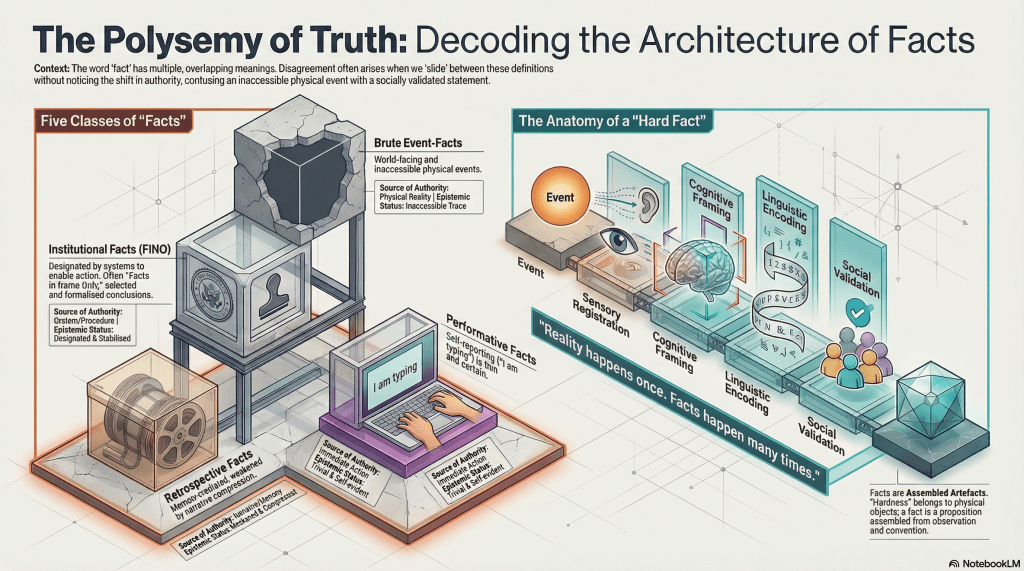
I want to clarify my recent The Trouble with Facts post. I realise that I was speaking to one non-trivial form of facts, but there is more than one class of facts. We argue about facts as if the word named a single, stable thing. It doesn’t. It names a family of very different things, quietly grouped together by habit, convenience, and institutional need. Most disputes about facts go nowhere, not because one side is irrational, but because the word itself is doing covert work. We slide between meanings without noticing, then act surprised when disagreement follows. This piece is an attempt to slow that slide.
Audio: NotebookLM summary podcast of this topic.
Polysemy We Notice, Polysemy We Don’t
We are comfortable with ambiguity when it is obvious. A bank can be a financial institution or the edge of a river. A bat can be an animal or a piece of sports equipment. Context resolves these instantly. No one feels existentially threatened by the ambiguity.
Fact is different. The word is polysemous in a way that is both subtle and consequential. Its meanings sit close enough to bleed into one another, allowing certainty from one sense to be smuggled into another without detection. Calling something a fact does not merely describe it. It confers authority. It signals that questioning should stop. That is why this ambiguity matters.
Different Kinds of Facts
Before critiquing facts, we need to sort them.
1. Event-facts (brute, world-facing) As mentioned previously, these concern what happens in the world, independent of observation.
A car collides with a tree.
Momentum changes.
Metal deforms.
These events occur whether or not anyone notices them. They are ontologically robust and epistemically inaccessible. No one ever encounters them directly. We only ever encounter traces.
2. Indexical or performative facts (trivial, self-reporting) “I am typing.”
I am doing this now – those now may not be relevant when you read this. This is a fact, but a very thin one. Its authority comes from the coincidence of saying and doing. It requires no reconstruction, no inference, no institutional validation. These facts are easy because they do almost no work.
3. Retrospective personal facts (memory-mediated) “I was typing.”
This may be relevant now, at least relative to the typing of this particular post. Still a fact, but weaker. Memory enters. Narrative compression enters. Selectivity enters. The same activity now carries a different epistemic status purely because time has passed.
4. Prospective statements (modal, not yet facts) “I will be typing.”
This is not yet a fact. It may never come to be one. It is an intention or prediction that may or may not be realised. Future-tense claims are often treated as incipient facts, but this is a category error with real consequences.
5. Institutional facts (designated, procedural) “The court finds…” “The report concludes…”
These are facts by designation. They are not discovered so much as selected, formalised, and stabilised so that systems can act. They are unlikely to rise to the level of facts, so the legal system tends to generate facts in name only – FINO, if I am being cute.
All of these are called ‘facts’. They are not interchangeable. The trouble begins when certainty migrates illicitly from trivial or institutional facts into brute event-facts, and we pretend nothing happened in the transfer.
One Motor Vehicle
Reconsider the deliberately simple case: A motor vehicle collides with a tree. Trees are immobile, so we can rule out the tree colliding with the car.
Ontologically, something happened. Reality did not hesitate. But even here, no one has direct access to the event itself.
The driver does not enjoy privileged access. They experience shock, adrenaline, attentional narrowing, selective memory, post hoc rationalisation, perhaps a concussion. Already several layers intervene before language even arrives.
A rough schema looks like this:
event → sensory registration → cognitive framing → linguistic encoding → social validation
Ontology concerns what happens. Epistemology concerns how anything becomes assertable.
Modern thinking collapses the second into the first and calls the result the facts.
People speak of “hard facts” as if hardness transfers from objects to propositions by proximity. It doesn’t. The tree is solid. The fact is an artefact assembled from observation, inference, convention, and agreement.
And so it goes…
Why the Confusion Persists
When someone responds, “But isn’t it a fact that I read this?”, the answer is yes. A different kind of fact.
The error lies not in affirming facts, but in failing to distinguish them. The word fact allows certainty to migrate across categories unnoticed, from trivial self-reports to brute world-events, and from institutional verdicts to metaphysical claims. That migration is doing the work.
Conclusion
Clarifying types of facts does not weaken truth. It prevents us from laundering certainty where it does not belong.
Facts exist. Events occur. But they do not arrive unmediated, innocent, or singular.
Reality happens once. Facts happen many times.
The mistake was never that facts are unreal. It was believing they were all the same kind of thing.
What we call facts are not discoveries of an unfiltered world. They are the end-products of mediation.
Let’s walk through an example.
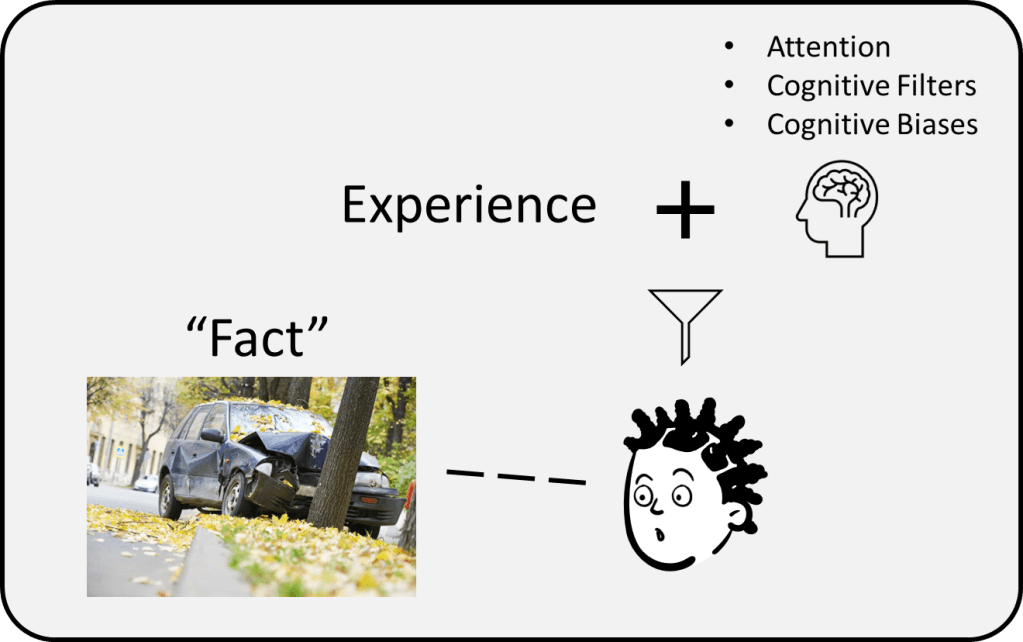
Image: Autosmash example. An observer arrives with experience – from genetic predisposition to childhood trauma to winning the lottery. Whatever it might be. Of course, they have many cognitive deficits, biases and filters. Then, there’s the immediate problem of attention. When did they notice the event? Did they turn to look after hearing the noise, or were they meditating on the tree in that moment?
Apparently, a motor vehicle has collided with a tree. Trees are immobile objects, so we can safely rule out the tree colliding with the car.*
So what, exactly, are the facts?
Audio: NotebookLM summary podcast of this topic.
Ontology (the boring bit)
Ontologically, something happened.
A car struck a tree. Metal deformed. Momentum stopped.
Reality did not hesitate. It did not consult witnesses. It did not await interpretation.
This is the part Modernity likes to gesture at reverently before immediately leaving it behind.
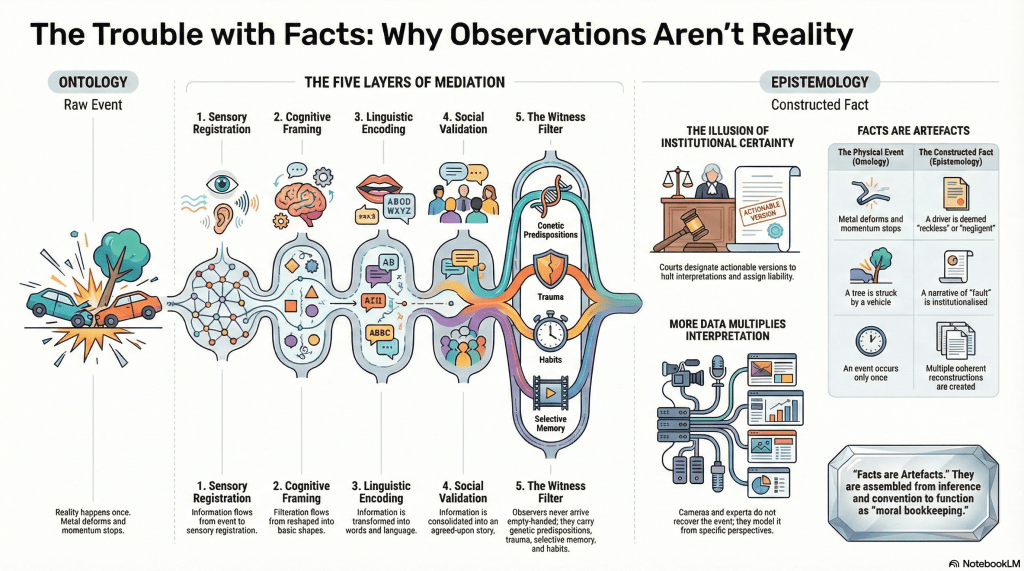
Image: Requisite NotebookLM infographic on this content.
The Witness
Even the driver does not enjoy privileged access to “what really happened”.
They get:
proprioceptive shock
adrenaline distortion
attentional narrowing
selective memory
post hoc rationalisation
possibly a concussion
Which is already several layers deep before language even arrives to finish the job.
We can generalise the structure:
event → sensory registration → cognitive framing → linguistic encoding → social validation
Ontology: events occur. States of affairs obtain. Something happens whether or not we notice.
Epistemology: observation is always filtered through instruments, concepts, language, habits, and incentives.
Modern sleight of hand: collapse the second into the first and call the result the facts.
People love the phrase “hard facts”, as if hardness transfers from objects to propositions by osmosis. It doesn’t. The tree is solid. The fact is not.
Facts are artefacts. They are assembled from observation, inference, convention, and agreement. They function. They do not reveal essence.
Reality happens once. Facts happen many times, differently, depending on who needs them and why.
Filtration
An event occurred. A car struck a tree.
Then an observer arrives. But observers never arrive empty-handed.
They arrive with history: genetics, upbringing, trauma, habits, expectations, incentives. They arrive already filtered.
Were they already looking, or did the noise interrupt something else entirely?
Reality happens once. Facts happen many times, differently, depending on who needs them and why.
Here Comes the Law
This is where the legal system enters, not because truth has been found, but because closure is required.
Courts do not discover facts. They designate versions of events that are good enough to carry consequences. They halt the cascade of interpretations by institutional force and call the result justice.
At every epistemic level, what we assert are interpretations of fact, never access to ontological essence.
Intent, negligence, recklessness. These are not observations. They are attributions. They are stopping rules that allow systems to function despite uncertainty.
The law does not ask what really happened. It asks which story is actionable.
Two Motor Vehicles
Now add a second moving object.
Another car enters the frame, and with it an entire moral universe.
Suddenly, the event is no longer merely physical. It becomes relational. Agency proliferates. Narratives metastasise.
Who was speeding? Who had the right of way? Who saw whom first? Who should have anticipated whom?
Intent and motive rush in to fill the explanatory vacuum, despite remaining just as unobservable as before.
Nothing about the ontology improved. Everything about the storytelling did.
Where the tree refused intention, the second vehicle invites it. We begin inferring states of mind from trajectories, attributing beliefs from brake lights, extracting motives from milliseconds of motion.
But none of this is observed.
What we observe are:
vehicle positions after the fact,
damage patterns,
skid marks,
witness statements already filtered through shock and expectation.
From these traces, we construct mental interiors.
The driver “intended” to turn. The other driver “failed” to anticipate. Someone was “reckless”. Someone else was merely “unlucky”.
These are not facts. They are interpretive assignments, layered atop already mediated observations, selected because they allow responsibility to be distributed in socially recognisable ways.
This is why explanation now fractures.
One cascade of whys produces a story about distraction or poor judgment. Another produces a story about road design or visibility. Another about timing, traffic flow, or urban planning.
Each narrative is plausible. Each is evidence-constrained. None is ontologically privileged.
Yet one will be chosen.
Not because it is truer, but because it is actionable.
The presence of a second vehicle does not clarify causation. It merely increases the number of places we are willing to stop asking questions.
Modernity mistakes this proliferation of narrative for epistemic progress. In reality, it is moral bookkeeping.
The crash still occurred. Metal still deformed. Momentum still stopped.
What changed was not access to truth, but the urgency to assign fault.
With one vehicle and a tree, facts already fail to arrive unmediated. With two vehicles, mediation becomes the point.
And still, we insist on calling the result the facts.
But nothing fundamental has changed. We have not escaped mediation. We have merely scaled it up and professionalised it.
Cameras do not record reality. They record:
a frame,
from a position,
at a sampling rate,
with compression,
under lighting conditions,
interpreted later by someone with a mandate.
Video feels decisive because it is vivid, not because it is ontologically transparent. It freezes perspective and mistakes that freeze for truth. Slow motion, zoom, annotation. Each step adds clarity and distance at the same time.
Experts do not access essence either. They perform disciplined abduction.
From angles, debris fields, timing estimates, and damage profiles, they infer plausible sequences. They do not recover the event. They model it. Their authority lies not in proximity to reality, but in institutional trust and methodological constraint.
More data does not collapse interpretation. It multiplies it.
With enough footage, we don’t get the story. We get competing reconstructions, each internally coherent, each technically defensible, each aligned to a different question:
Who is legally liable?
Who is financially responsible?
Who violated policy?
Who can be blamed without destabilising the system?
At some point, someone declares the evidence “clear”.
What they mean is: we have enough material to stop arguing.
This is the final Modern illusion: that accumulation converges on essence. In reality, accumulation converges on closure.
The event remains what it always was: inaccessible except through traces. The facts become thicker, more confident, more footnoted. Their metaphysical status does not improve.
Reality happened once. It left debris. We organised the debris into narratives that could survive institutions.
Cameras didn’t reveal the truth. Experts didn’t extract it. They helped us agree on which interpretation would count.
And agreement, however necessary, has never been the same thing as access to what is.
* I was once driving in a storm, and a telephone pole fell about a metre in front of my vehicle. My car drove over the pole, and although I was able to drive the remainder of the way home, my suspension and undercarriage were worse for the wear and tear.
Written by Bry Willis and ChatGPT 5.2 after an extended chat about the image as a talking point about the inaccessibility of facts.
The quickest way to derail any discussion of morality is to accuse someone of believing that ‘everything is relative’, so let’s start there. It’s a comforting accusation. It allows the accuser to stop thinking whilst feeling victorious. Unfortunately, it also misses the point almost entirely.
I am not claiming that everything is relative. I am claiming that ‘good’ and ‘bad’ are. More precisely, this particular binary pair does not track mind-independent properties of actions, but rather expresses subjective, relational, and power-inflected evaluations that arise within specific social contexts. That claim is not radical. It is merely inconvenient.
Audio: NotebookLM summary podcast on this topic.
Good and Bad as Signals, Not Properties
When someone calls an action ‘bad’, they are not reporting a fact about the world in the way one might report temperature or velocity. They are signalling disapproval. Sometimes that disapproval is personal (subjective: ‘this sits badly with me’), sometimes social (relative: ‘people like us don’t do this’), and sometimes delegated (relative: ‘this violates the norms I’ve inherited and enforce’. The word does not describe. It acts.
The same applies to ‘good’. Approval, alignment, reassurance, permission. These terms function less like measurements and more like traffic signals. They coördinate behaviour. They reduce uncertainty. They warn, reward, and deter.
None of this requires moral scepticism, nihilism, or adolescent contrarianism. It requires only that we notice what the words are actually doing.
The Binary That Isn’t
Defenders of moral realism often retreat to a spectrum when pressed. Very well, they say, perhaps good and bad are not binary, but scalar. Degrees of goodness. Shades of wrongness. A neutral zone somewhere in the middle.
This is an improvement only in the most cosmetic sense. A single axis still assumes commensurability: that diverse considerations can be weighed on one ruler. Intuitively, this fails almost immediately. Good in what sense? Harm reduction? Loyalty? Legality? Survival? Compassion? Social order?
These dimensions do not line up. They cross-cut. They conflict. Which brings us to the example that refuses to die, for good reason.
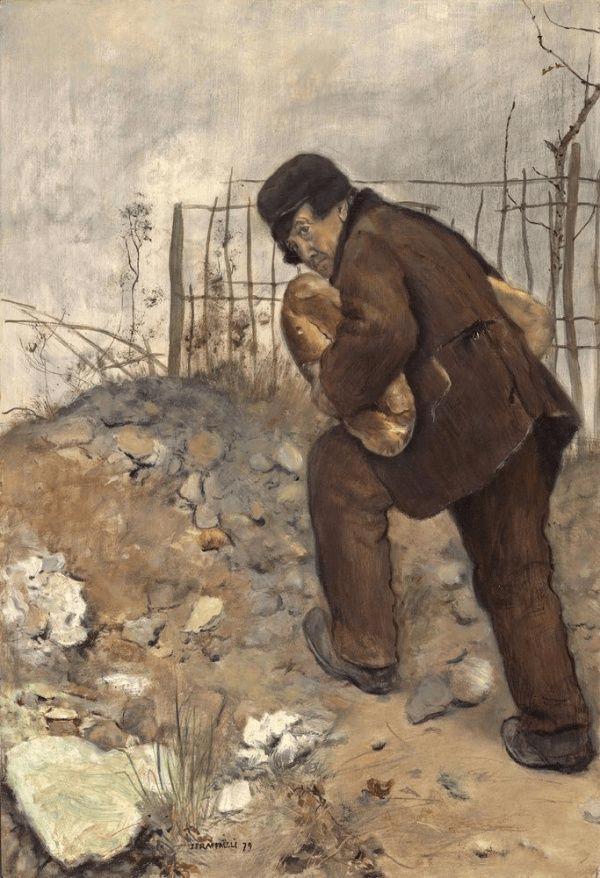
Stealing Bread
“I don’t mind stealing bread From the mouths of decadence But I can’t feed on the powerless When my cup’s already overfilled”
— Hunger Strike, Temple of the Dog
Consider the theft of bread by a starving person. The act is simultaneously:
bad relative to property norms
good relative to survival
bad relative to legal order
good relative to care or compassion
and neutral relative to anyone not implicated at all, even if they were to form an opinion through exposure
There is no contradiction here. The act is multi-valent. What collapses this plurality into a single verdict is not moral discovery but authority. Law, religion, and institutional power do not resolve moral complexity. They override it.
What about ‘Mercy’?
When the law says, ‘Given the circumstances, you are free to go’, what it is not saying is: this act was not wrong. What it is saying is closer to:
We are exercising discretion this time. Do not mistake that for permission. The rule still stands.
The warning survives the mercy.
That’s why even leniency functions as discipline. You leave not cleansed, but marked. Grateful, cautious, newly calibrated. The system hasn’t revised its judgment; it has merely suspended its teeth for the moment. The shadow of punishment remains, doing quiet work in advance.
This is how power maintains itself without constant enforcement. Punishment teaches. Mercy trains.
You’re released, but you’ve learned the real lesson: the act is still classified as bad from the only perspective that ultimately matters. The next time, mitigation may not be forthcoming. The next time, the collapse will be final. So yes. Even when you ‘win’, the moral arithmetic hasn’t changed. Only the immediate invoice was waived.
Which is why legality is never a reliable guide to goodness, and acquittal is never absolution. It’s conditional tolerance, extended by an authority that never stopped believing it was right.
Power as the Collapse Mechanism
When the law says, ‘There may have been mitigating circumstances, but the act was wrong and must be punished’, it is not uncovering a deeper truth. It is announcing which perspective counts.
Mitigation is a courtesy, not a concession. Complexity is acknowledged, then flattened. The final judgment is scalar because enforcement demands it. A decision must be made. A sanction must follow. The plural is reduced to the singular by necessity, not insight.
Once this happens, the direction of explanation reverses. Punishment becomes evidence of wrongness rather than evidence of power. The verdict acquires moral weight retroactively.
From Ethics to Enforcement
At the local level, ‘good’ and ‘bad’ function as ethical shorthand. They help maintain relationships, minimise friction, and manage expectations. This is not morality in any grand sense. It is coordination under conditions of attachment and risk.
Problems arise when these local prescriptions harden into universal claims. When they are codified into rules, backed by sanctions, and insulated from challenge. At that point, the costs become real. Not morally real, but materially real. Fines. Exclusion. Imprisonment. Reputational death. Nothing metaphysical has changed. Only the consequences.
The God Upgrade
Religion intensifies this process by anchoring evaluative judgments to the structure of reality itself. What was once ‘bad here, among us’ becomes ‘bad everywhere, always’ is no longer a difference in perspective but a rebellion against the order of being. This is not ethical refinement. It is power laundering through eternity.
Not Everything Is Relative
To be clear, this is not an argument that facts do not exist, or that all distinctions dissolve into mush. It is an argument that ‘good’ and ‘bad’ do not behave like factual predicates, and that pretending otherwise obscures how judgments are actually made and enforced.
What is not relative is the existence of power, the reality of sanctions, or the psychological mechanisms through which norms are internalised and reproduced. What is relative is the evaluative overlay we mistake for moral truth once power has done its work.
Why This Is Ignored
None of this is new. It has been said, in various forms, for centuries. It is ignored because it offers no programme, no optimisation strategy, no moral high ground. It explains without redeeming. It clarifies without consoling.
And because it is difficult to govern people who understand that moral certainty usually arrives after authority, not before.
I’ve just added a new entry to my Anti-Enlightenment corpus, bringing the total to seven – not counting my latest book, The Illusion of Light, that summarises the first six essays and places them in context. This got me thinking about what aspects of critique I might be missing. Given this, what else might I be missing?
Audio: NotebookLM podcast discussion of this topic.
So far, I’ve touched on the areas in the top green table and am considering topics in the bottom red/pink table:
Summary Schema – The Anti-Enlightenment Project – Published Essays
Axis
Core Question
Representative Essay(s)
Epistemic
What counts as “truth”?
Objectivity Is Illusion: An Operating Model of Social and Moral Reasoning
Political
What holds power together?
Rational Ghosts: Why Enlightenment Democracy Was Built to Fail; Temporal Ghosts: Tyranny of the Present
Psychological
Why do subjects crave rule?
Against Agency: The Fiction of the Autonomous Self; The Will to Be Ruled: Totalitarianism and the Fantasy of Freedom
Anthropological
What makes a “normal” human?
The Myth of Homo Normalis: Archaeology of the Legible Human
Ethical
How to live after disillusionment?
The Discipline of Dis-Integration: Philosophy Without Redemption
Summary Schema – The Anti-Enlightenment Project – Unpublished Essays
Axis
Core Question
Representative Essay
Theological (Metaphysical)
What remains sacred once transcendence is dismantled?
The Absent God: Metaphysics After Meaning
Aesthetic (Affective)
How did beauty become moral instruction?
The Aesthetic Contract: Beauty as Compliance
Ecological (Post-Human)
What happens when the world refuses to remain in the background?
1. Objectivity Is Illusion: An Operating Model of Social and Moral Reasoning
Published September 2025
Objectivity, in the social and moral sense, is a performance – a consensus mechanism mistaken for truth. This essay maps how “objectivity” operates as a scaffold for Enlightenment rationality, masking moral preference as neutral judgment. It introduces a five-premise model showing that what we call objectivity is merely sustained agreement under shared illusions of coherence. The argument reframes moral reasoning as provisional and participatory rather than universal or fixed.
2. Rational Ghosts: Why Enlightenment Democracy Was Built to Fail
Published October 2025 The Enlightenment built democracy for rational ghosts – imagined citizens who never existed. This essay dissects six contradictions at the foundation of “rational” governance and shows why democracy’s collapse was prewritten in its metaphysics. From mathematical impossibility to sociological blindness, it charts the crisis of coherence that modern politics still calls freedom. → Read on Zenodo
3. Temporal Ghosts: Tyranny of the Present
Published October 2025 Modern democracies worship the now. This essay examines presentism – the systemic bias toward immediacy – as a structural flaw of Enlightenment thinking. By enthroning rational individuals in perpetual “decision time,” modernity erased the unborn from politics. What remains is a political theology of the short term, collapsing both memory and imagination. → Read on Zenodo
4. Against Agency: The Fiction of the Autonomous Self
Published October 2025 “Agency” is not a metaphysical faculty – it’s an alibi. This essay dismantles the myth of the autonomous self and reframes freedom as differential responsiveness: a gradient of conditions rather than a binary of will. Drawing on philosophy, neuroscience, and decolonial thought, it argues for ethics as maintenance, not judgment, and politics as condition-stewardship. → Read on Zenodo
5. The Discipline of Dis-Integration: Philosophy Without Redemption
Published October 2025
This essay formalises Dis-Integrationism – a philosophical method that refuses synthesis, closure, and the compulsive need to “make whole.” It traces how Enlightenment reason, deconstruction, and therapy culture all share a faith in reintegration: the promise that what’s fractured can be restored. Against this, Dis-Integrationism proposes care without cure, attention without resolution – a discipline of maintaining the broken as broken. It closes the Anti-Enlightenment loop by turning critique into a sustained practice rather than a path to redemption.
6. The Myth of Homo Normalis: Archaeology of the Legible Human
Published October 2025
Modernity’s most persistent myth is the “normal” human. This essay excavates how legibility – the drive to measure, categorise, and care – became a form of control. From Quetelet’s statistical man to Foucault’s biopower and today’s quantified emotion, Homo Normalis reveals the moral machinery behind normalisation. It ends with an ethics of variance: lucidity without repair, refusal without despair.
7. The Will to Be Ruled: Totalitarianism and the Fantasy of Freedom
Published October 2025
This essay examines how the Enlightenment’s ideal of autonomy contains the seed of its undoing. The rational, self-governing subject – celebrated as the triumph of modernity – proves unable to bear the solitude it creates. As freedom collapses into exhaustion, the desire for direction re-emerges as devotion. Drawing on Fromm, Arendt, Adorno, Reich, Han, and Desmet, The Will to Be Ruled traces the psychological gradient from fear to obedience, showing how submission is moralised as virtue and even experienced as pleasure. It concludes that totalitarianism is not a deviation from reason but its consummation, and that only through Dis-Integrationism – an ethic of maintenance rather than mastery – can thought remain responsive as the light fades.
Axis: Theological / Metaphysical Core Question: What remains sacred once transcendence is dismantled?
Concept: This essay would trace how Enlightenment humanism replaced God with reason, only to inherit theology’s structure without its grace. It might read Spinoza, Kant’s moral law, and modern technocracy as secularised metaphysics – systems that still crave universal order. Goal: To show that disenchantment never erased faith; it simply redirected worship toward cognition and control. Possible subtitle:The Enlightenment’s Unconfessed Religion.
9. The Aesthetic Contract: Beauty as Compliance
Axis: Aesthetic / Affective Core Question: How did beauty become moral instruction?
Concept: From Kant’s Critique of Judgment to algorithmic taste cultures, aesthetic judgment serves social order by rewarding harmony and punishing dissonance. This essay would expose the politics of form – how beauty trains attention and regulates emotion. Goal: To reclaim aesthetics as resistance, not refinement. Possible subtitle:Why Modernity Needed the Beautiful to Behave.
10. The Uncounted World: Ecology and the Non-Human
Axis: Ecological / Post-Human Core Question: What happens when the world refuses to remain background?
Concept: Here you dismantle the Enlightenment split between subject and nature. From Cartesian mechanism to industrial rationalism, the natural world was cast as resource. This essay would align Dis-Integrationism with ecological thinking – care without mastery extended beyond the human. Goal: To reframe ethics as co-maintenance within an unstable biosphere. Possible subtitle:Beyond Stewardship: Ethics Without Anthropos.
11. The Fractured Tongue: Language Against Itself
Axis: Linguistic / Semiotic Core Question: How does language betray the clarity it promises?
Concept: Every Anti-Enlightenment text already hints at this: language as both the instrument and failure of reason. Drawing on Nietzsche, Derrida, Wittgenstein, and modern semiotics, this essay could chart the entropy of meaning – the collapse of reference that makes ideology possible. Goal: To formalise the linguistic fragility underlying every rational system. Possible subtitle:The Grammar of Collapse.
12. The Vanished Commons: Between Isolation and Herd
Axis: Communal / Social Ontology Core Question: Can there be community without conformity?
Concept: This would return to the psychological and political threads of The Will to Be Ruled, seeking a space between atomised autonomy and synchronized obedience. It might turn to Arendt’s notion of the world between us or to indigenous and feminist relational models. Goal: To imagine a non-totalitarian togetherness – a responsive collective rather than a collective response. Possible subtitle:The Ethics of the Incomplete We.
* These essays may never be published, but I share this here as a template to further advance the Anti-Enlightenment project and fill out the corpus.
I’ve just released a new book, The Illusion of Light: Thinking After the Enlightenment, now available in paperback through KDP and distributed via Amazon. In November, a clothbound edition will follow through IngramSpark, extending availability to libraries and independent bookstores worldwide, including Barnes & Noble in the United States.
Image: Front cover of The Illusion of Light. Links to Amazon for purchase. The ‘Free Preview’ claim is untrue, as there is no Kindle version available. An ebook will be available presently.
Audio: NotebookLM podcast on this topic.
About the Book
The Illusion of Light opens where the Enlightenment’s glare begins to fade. It asks what happens after reason exhausts itself – after the promise of illumination gives way to overexposure. These essays trace how modernity’s metaphors of light and progress became instruments of management: how objectivity hardened into ritual, agency into alibi, normality into control.
Rather than rejecting the Enlightenment outright, the book lingers in its afterimage. It argues for a philosophy practiced in the half-light – a mode of thought that values nuance over certainty, care over mastery, and maintenance over redemption. To read by residual light, as the preface suggests, is to learn to see again when the world stops pretending to be illuminated.
The preface is available on this prior post, written and audio versions.
The Broader Project
The Illusion of Light forms the threshold of the Anti-Enlightenment Project, a series examining the afterlives of modern reason – how its ideals of progress, agency, objectivity, and normality continue to govern our politics, sciences, and selves long after their foundations have cracked. Each volume approaches the same question from a different room in the old House of Reason: Objectivity Is Illusion, Rational Ghosts, Temporal Ghosts, Against Agency, The Myth of Homo Normalis, and The Discipline of Dis-Integration.
Taken together, they offer not a manifesto but a practice: philosophy as maintenance work, care as critique, and composure as the only honest response to the ruins of certainty. More to follow.
I’ve just published Objectivity Is Illusion: An Operating Model of Social and Moral Reasoning, an essay that began as this blog post. I’m sharing the ‘official’ link and this first draft. As the essay matured, I added additional support, but I focused primarily on refuting the anticipated opposing arguments. Rather than regurgitate the final version here, I felt showing the genesis would be more instructive. Of course, the essay didn’t spring fully formed; I’ve pruned and expanded from earlier notes still sitting on my hard drive.
Every so often, I’m told I’m too slippery with words, that I treat truth as if it were just another game of persuasion, that I reduce morality to chalk lines on a playing field. The objection usually comes with force: ‘But surely you believe some things are objectively true?‘
I don’t. Or more precisely, I don’t see how ‘objectivity’ in the metaphysical sense can be defended without lapsing into stagecraft. Granite foundations have always turned out to be scaffolding with the paint touched up. Priests once told us their gods guaranteed truth; scientists later promised the lab would serve as granite; politicians assure us democracy is the stone pillar. But in each case the creaks remain.
Audio: NotebookLM podcast on this topic.
This essay is written with an academic readership in mind. It assumes familiarity with figures like Nietzsche, Foucault, Rorty, and Ayer, and with the long quarrel over subjectivity, relativity, and objectivity. My aim is not to retell those arguments from the ground up, but to position my own framework within that ongoing dispute.
Scope
Before proceeding, some guardrails. When I say ‘objectivity is illusion,’ I mean in the social and moral domain. I’m not denying quarks or mathematics. My claim is narrower: in human discourse, no truth escapes subjectivity or contingency.
This dovetails with my broader Language Insufficiency Hypothesis: that even our words are leaky vessels, prone to misfire and misunderstanding. If language itself is unstable ground, then objectivity built upon it can hardly be granite. My claim here is not that nothing exists outside us, but that in the social world we inhabit together, every ‘truth’ rests on creaking boards.
One more note: just because social administration requires appeals to objectivity doesn’t mean objectivity exists. Courts, laboratories, and parliaments invoke it to secure trust, and it works well enough as theater. But necessity is not proof. And it is not my responsibility to conjure a granite replacement. What follows is an operating model, not a new altar.
Thesis
Objectivity is an illusion. Truth is rhetorical. Morality is prescriptive, not propositional. Our ethic is not granite but care: tending the planks we walk on, knowing they creak.
Operating Model: Five Premises
This framework is not a foundation. It is an operating model – contingent, provisional, subject to revision as circumstances change. Like any model, it can (and should) be updated to fit the culture and times.
Premise 1: Subjectivity is the baseline. Every claim originates in a perspective. No statement is free of the lens through which it is made. Even to deny subjectivity is to speak from a subject.
Premise 2: Relativity is emergent. What we call ‘relative truth’ is not a separate category but the convergence of individual subjectivities into provisional consensus. Consensus is never neutral: it is formed rhetorically – through persuasion, cultural resonance, and power [1]. MacIntyre made a similar point in After Virtue. The moral consensus of the Ancients was not grounded in objectivity but in a shared tradition – a thick account of human flourishing that gave coherence to their claims. When that scaffolding collapsed, consensus fractured, leaving modern moral discourse in fragments. Critics accused MacIntyre of relativism, since different traditions yield different ‘truths’, but his point reinforces mine: what looks like objectivity is in fact the temporary overlap of subjectivities sustained by tradition [2].
Premise 3: Objectivity is illusion. Claims presented as objective are relative norms hardened by repetition and forgotten as contingent scaffolding. ‘Objectivity’ is consensus disguised as granite. Its invocation in courts or parliaments may be useful, but usefulness is not existence. The burden of proof belongs to anyone insisting on an independent, metaphysical anchor for moral or social truths (Nietzsche’s ‘mobile army of metaphors’ [3], Kuhn’s paradigms [4], Latour’s laboratories [5]).
Even if one concedes, with Weber (as MacIntyre reminds us), that objective moral truths might exist in principle, they remain inaccessible in practice. What cannot be accessed cannot guide us; reconciliation of values and virtues must therefore take place within traditions and rhetoric, not in appeal to unreachable granite [13].
Premise 4: Rhetoric establishes truth. What counts as ‘true’ in the social and moral domain is established rhetorically – through coherence, resonance, utility, or force. This does not mean truth is ‘mere spin’. It means truth is never metaphysical; it is enacted and enforced through persuasion. If a metaphysical claim convinces, it does so rhetorically. If a scientific claim holds, it does so because it persuades peers, fits the evidence, and survives testing. In short: rhetoric is the medium through which truths endure [6].
Premise 5: Non-Cognitivism, Stated Plainly. I take moral utterances to be prescriptions, not propositions. When someone says ‘X is wrong’, they are not reporting an objective fact but prescribing a stance, a rule, a line in chalk. This is my operating position: non-cognitivism (Ayer [7], Stevenson [8]).
That said, I know the term feels alien. Many prefer the dialect of subjectivism – ‘X is true-for-me but not-for-you’ – or the quasi-realist stance that moral language behaves like truth-talk without cosmic backing (Blackburn [9]). I have no quarrel with these translations. They name the same scaffolding in different accents. I am not defending any school as such; I am simply stating my plank: morality prescribes rather than describes.
Ethic: Care. Since scaffolding is all we have, the obligation is not to pretend it is stone but to keep it usable. By ‘care’, I do not mean politeness or quietism. I mean maintenance – deliberation, repair, mutual aid, even revolt – so long as they acknowledge the scaffolding we share. Care is not optional: stomp hard enough and the floor collapses beneath us all.
Examples clarify: peer review in science is care in action, patching leaky vessels rather than proving granite. Civil rights movements practiced care by repairing rotten planks of law, sometimes with revolt. Communities rebuilding after disaster embody care by reconstructing scaffolding, not pretending it was indestructible. Care is maintenance, reciprocity, and survival.
Bridge: These five premises do not add up to a system or a foundation. They form an operating model: subjectivity as baseline, relativity as emergent, objectivity as illusion, rhetoric as truth, morality as prescription. Together they outline a practice: walk the planks with care, admit the creaks, patch where needed, and stop pretending we live in marble halls.
Rationale
Why prefer scaffolding to granite? Because granite has always been a mirage. The history of philosophy and politics is a history of crumbling temples and collapsing empires. The promises of permanence never survive the weather.
Think of Nietzsche, who called truths ‘a mobile army of metaphors’ [3]. Think of Foucault, who showed that what counts as ‘truth’ is always bound up with power [1]. Think of Rorty, who reduced truth to what our peers let us get away with saying [6]. These are not nihilists but diagnosticians: they exposed the creaks in the floorboards and the wizard behind the curtain.
Metaphors drive the point home:
Scaffolding and granite: What holds is temporary, not eternal. Granite is an illusion painted on timber.
Chalk lines: Rules of play – binding, real, but contingent. They can be redrawn.
Shoreline houses: Rome, the USSR, the British Empire – each built like beachfront villas with a fine view and bad footing. Storms came, sand eroded, and down they went.
Bias as framing: Kahneman himself admitted ‘bias’ is not a thing in the world [10], only a deviation from a chosen model. Gigerenzer [11] and Jared Peterson [12] remind us heuristics are adaptive. To call them ‘biases’ is not neutral – it’s allegiance to a standard of rationality.
The point is simple: what holds today is scaffolding, and pretending otherwise is self-deception.
Counterarguments and Refutations
Objection: Moral Paralysis. Without objective morality, why abolish slavery or defend rights?
Refutation: Chalk lines still bind. Speed limits aren’t cosmic, but they regulate conduct. Abolition endured not because it tapped a cosmic truth but because it persuaded, resonated, and took root. Slavery was once ‘in bounds’. Now it is ‘offsides’. That shift was rhetorical, emotional, political – but no less binding.
Objection: Problem of Dissent. If all is subjective, the lone dissenter is ‘just another voice’.
Refutation: Dissent gains traction through coherence, predictive success, or resonance. Galileo, abolitionists, suffragists – none relied on metaphysical granite. They persuaded, they resonated, they moved chalk lines. Truth was made through rhetoric, not uncovered in stone.
Objection: Performative Dependency. Even to say ‘subjective’ assumes the subject/object split. Aren’t you still inside the house?
Refutation: Of course. But I’m the one pointing at the slippery boards: ‘Mind the dust’. Yes, I’m in the house. But I refuse to pretend it’s marble. And even the category ‘subject’ is not eternal – it’s porous, dynamic, and leaky, just like language itself.
Objection: Infinite Regress. Why stop at subjectivity? Why not de-integrate further?
Refutation: Subjectivity is not granite, but it is the last plank before void. Peel it back and you erase the possibility of claims altogether. If tomorrow we discover that the ‘subject’ is a swarm of quarks or circuits, fine – but the claim still emerges from some locus. Regression refines; it doesn’t disprove.
Conclusion: The Ethic of Care
This is not reintegration. It is dis-integration: naming the creaks, stripping polyvinyl from rotten boards, refusing granite illusions.
If you wish to build here, build. But know the ground shifts, the storms come, the shoreline erodes. The ethic is not certainty but care: to tend the scaffolding we share, to patch without pretending it is stone, and to let dissent itself become part of the maintenance.







 Philosophics