Philosophic Influences

I just finished the writing and editorial parts of my Language Insufficiency Hypothesis. It still needs cover art and some administrative odds and ends, but I’m taking a day for a breather to share something about myself and my worldview. For this, I share my philosophical influences and how they support my core insights. For dramatic effect, I’ll even try to weight them to 100 per cent, leaving an ‘others’ bucket for the unaccounted ones.

Audio: NotebookLM summary podcast of this topic.

Obviously, this highly scientific accounting is about as useful as a Facebook survey or a fortune cookie, but it should reveal something. I have influences outside of philosophy, but I’ll limit this list at the start. The numbers don’t exactly add to 100% because there is a bit of cross-pollination, say, between Foucault and Nietzsche or Žižek and Hegel – or perhaps I’m just not good at maths. You decide.

Nietzsche (≈18)

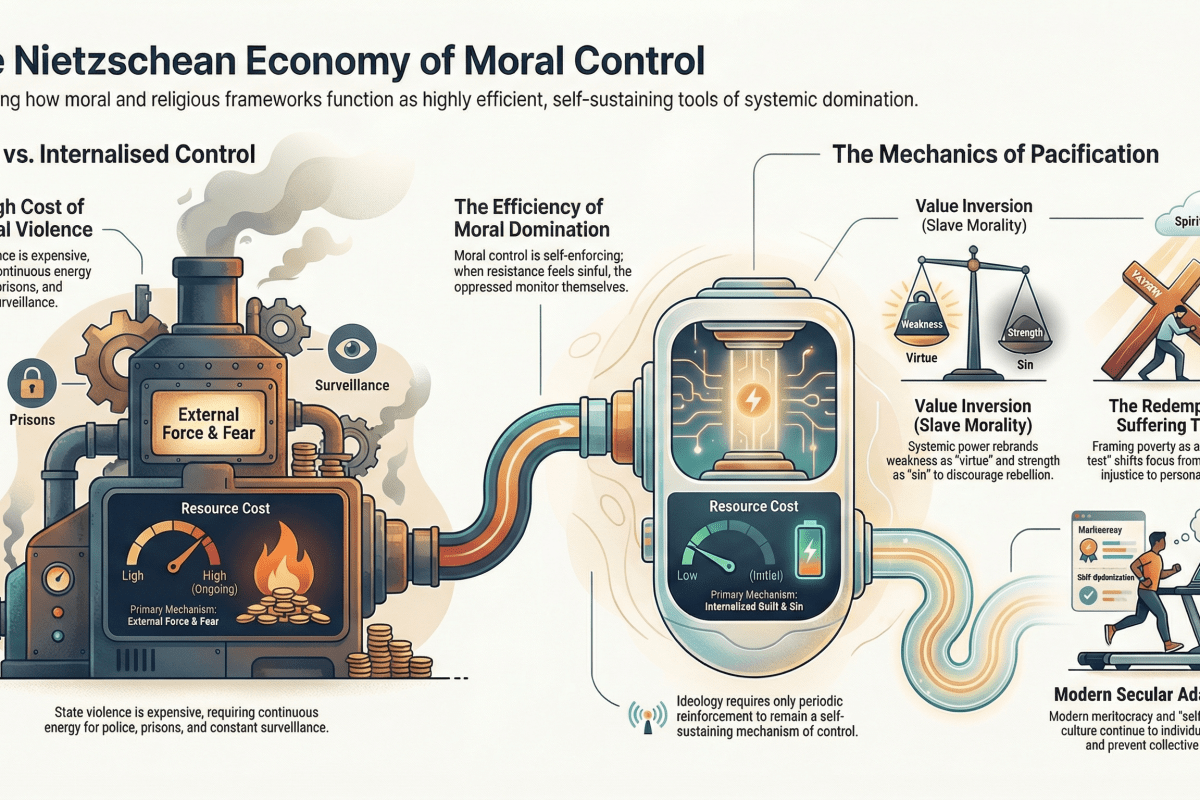
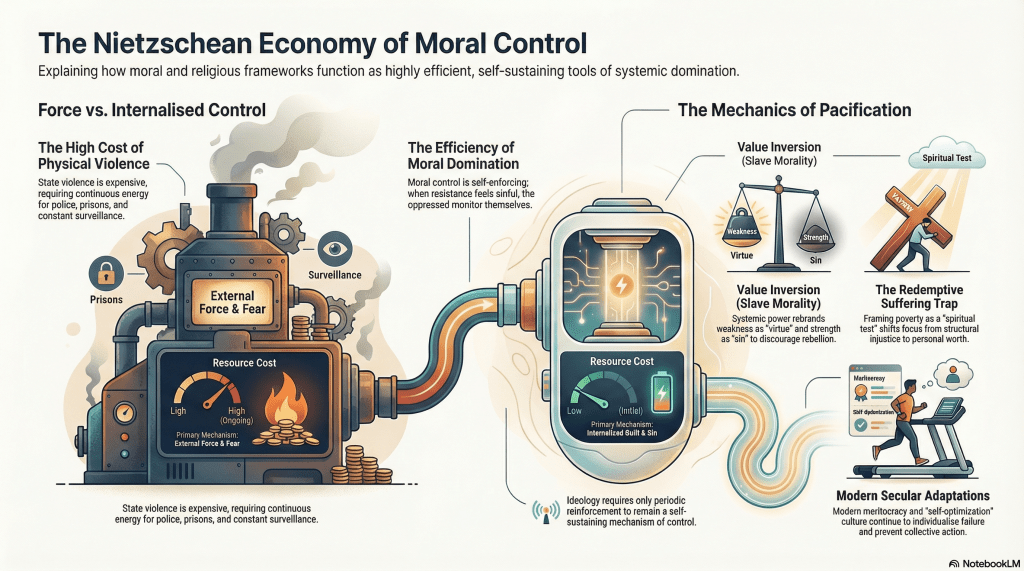
Nietzsche is likely the uranium core. Haters and detractors like to diminish his contribution – and he didn’t play by the old rules – but they are wrong. He contributes value-creation, anti-moralism, perspectivism, the critique of ressentiment, the demolition of universals.

Nietzsche sits at the centre of the blast radius. Everything else is shrapnel. If there’s a thinker who detonated the Enlightenment’s pretensions more elegantly, I’ve not met them. He showed us that values are forged, not found; that morality is a genealogy of grievances; that certainty is the last refuge of the timid. In other words, he cleared the ground so the rest of us could get to work without tripping over Kantian furniture. But after Nietzsche’s uranium core, the next concentric ring becomes murkier.

Foucault (≈20%)

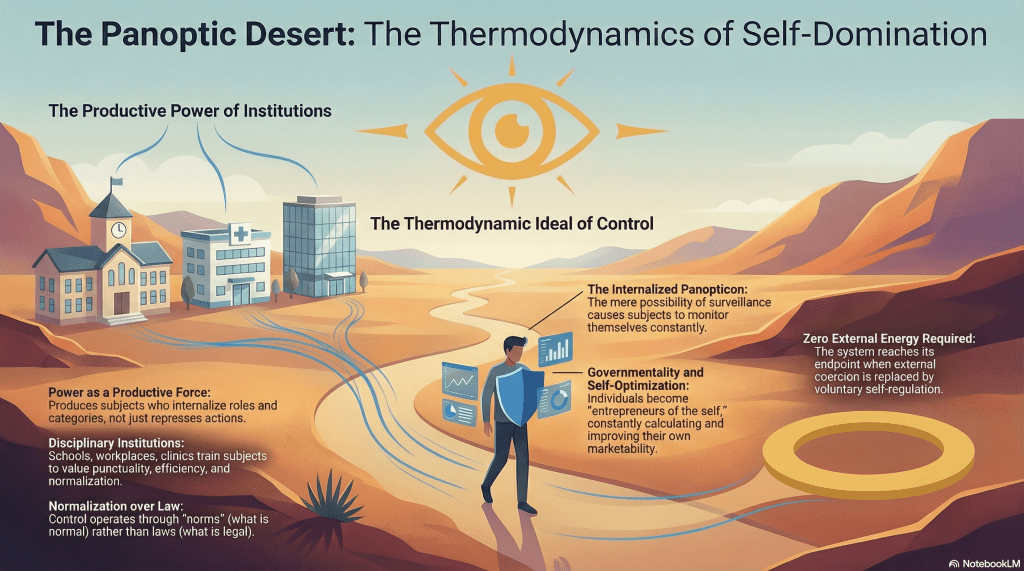
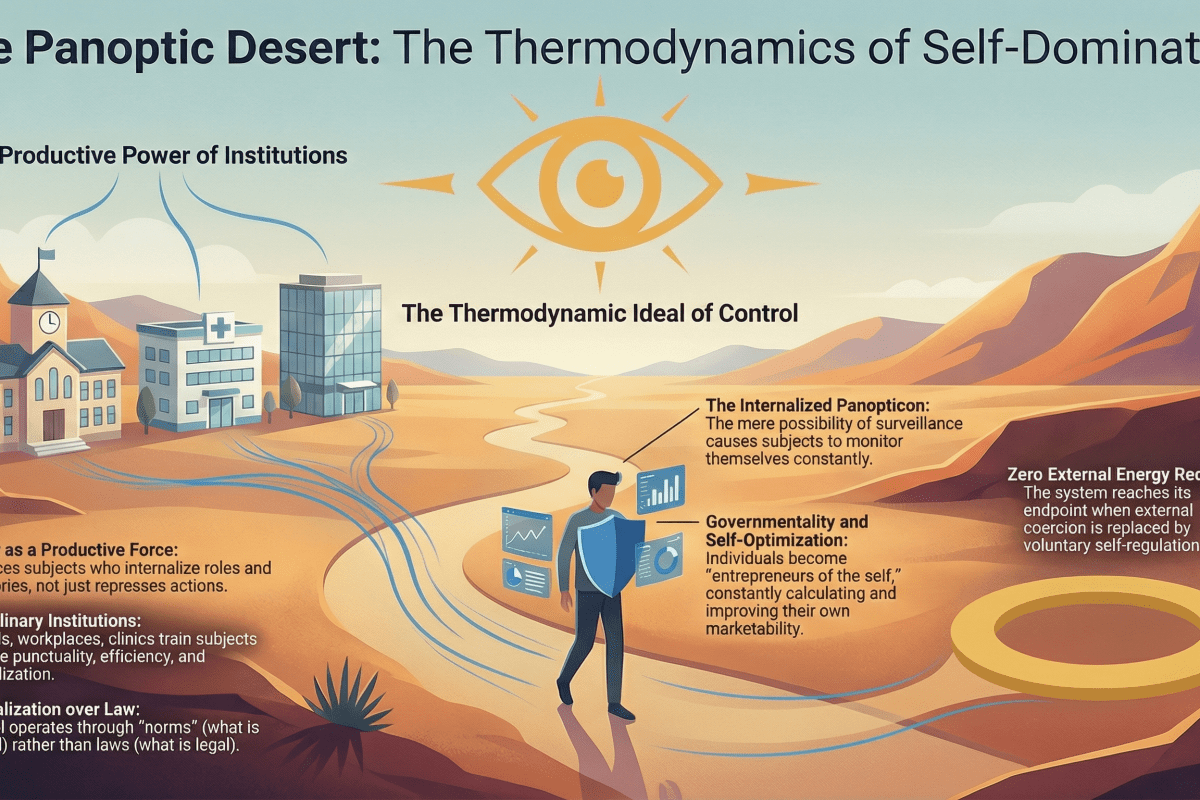
Foucault supplies the schematics. Where Nietzsche swung a hammer at the idols, Foucault identified the building codes. He mapped power as a set of subtle, everyday enchantments. He showed how ‘knowledge’ is simply what a society rewards with credibility. He is the patron saint of anyone who suspects normality is an instrument, not a neutral state of affairs. The world looks different once you see the disciplinary fingerprints on everything.

Derrida (≈10%)

Derrida gives me language as mischief. Meaning wobbles, slides, cracks; binaries betray themselves; every conceptual edifice contains its own trapdoor. Derrida isn’t a system; he’s an escape artist. And frankly, you can’t write anything about the insufficiency of language without genuflecting in his general direction.

Late Wittgenstein (≈15%)

The quiet structural pillar. If Derrida is the saboteur, Wittgenstein is the carpenter who informs you that the house was never stable anyway. Meaning-as-use, language-games, the dissolution of philosophical pseudo-problems: his later work underwrites virtually every modern suspicion about fixed categories and timeless essences. He doesn’t shout; he shrugs – and everything collapses neatly.

Rorty (≈5%)

Rorty replaces metaphysical longing with cultural pragmatism. He teaches you to stop hunting for capital-T Truth and instead track the vocabularies we actually live in. He’s the friendly voice whispering, ‘You don’t need foundations. You need better conversations’. His influence is felt mostly in the tone of my epistemic cynicism: relaxed rather than tragic. Besides, we disagree on the better conversations bit.

Geuss (≈4%)

If Rorty makes you light-footed, Geuss reminds you not to float off into abstraction entirely. He is the critic of moralism par excellence, the man who drags philosophy kicking and screaming back into politics. Geuss is the voice that asks, ‘Yes, but who benefits?’ A worldview without him would be a soufflé.

Heidegger (≈6%)

Selective extraction only. Being-in-the-world, thrownness, worldhood – the existential scaffolding. His political judgment was catastrophic, of course, but the ontological move away from detached subjectivity remains invaluable. He gives the metaphysics a certain grain.

Existentialists: Beauvoir, Sartre, Camus (≈6%)

They provide the atmospheric weather: choice, finitude, absurdity, revolt, the sheer mess of human freedom. They don’t define the system; they give it blood pressure. Besides, I met them before I switched to Team Nietzsche-Foucault.

Žižek, Latour, Baudrillard (≈2% combined)

These three are my licensed provocateurs.

  • Žižek exposes how ideology infiltrates desire.
  • Latour dismantles the Nature/Society binary with glee.
  • Baudrillard whispers that representation ate reality while we were looking at our phones.

They’re trickster figures, not architects.

Hume, Putnam, Dennett, and the Ancillaries (≈1% combined)

These are the seasonings.

  • Hume is the Scottish acid bath under every epistemic claim.
  • Putnam gives internal realism its analytic passport.
  • Dennett offers mechanistic metaphors you can steal even when you disagree.
  • Kant and Hegel hover like compulsory ghosts.
  • Rawls remains decorative parsley: included for completeness, consumed by none.

The Others Bucket (≈5%)

The unallocated mass: writers, anthropologists, theorists, stray thinkers you absorb without noticing. The ‘residuals’ category for the philosophical inventory – the bit fortune cookies never warn you about.

Enfin

Obviously, these ratios are more for humour than substance, but these are the thinkers I return to — the ones whose fingerprints I keep discovering on my own pages, no matter how many years or detours intervene.

Perhaps more revealing are those who didn’t make the guest list. Socrates, Plato, and Aristotle remain outside, smoking in the cold. The Stoics, Marcus Aurelius and his well-meaning self-help descendants, also failed to RSVP. In truth, I admire the posture but have little patience for the consolations – especially when they become the emotional training wheels of neoliberalism.

And then, of course, the Enlightenment patriarchs: Hobbes, Locke, Montesquieu and the rest of the constitutional furniture. I acknowledge their historical necessity the way one acknowledges plumbing – grateful it exists, uninterested in climbing inside the pipes. Rousseau, admittedly, I tolerate with something approaching affection, but only because he never pretended to be tidy.

I forgot Descartes, Voltaire, and Pascal, but it’s too late to scroll back and adjust the ledger. Consider them rounding errors – casualties of the margins, lost to the tyranny of percentages.

If anyone mentions another one – Spinoza comes to mind – I’ll try to figure out where they fit in my pantheon. Were I to render this tomorrow, the results may vary.

Care Without Conquest: Feminist Lessons for the Workaday Philosopher

2–4 minutes

I recently posted The Ethics of Maintenance: Against the Myth of Natural Purpose. In it, I brushed – perhaps too lightly – against my debt to feminist philosophy. It’s time to acknowledge that debt more directly and explain how it spills into the mundane greasework of daily life.

Audio: NotebookLM podcast on this topic.

I tend not to worship at the altar of names, but let’s name names anyway. Beyond the usual French suspects – your Sartres, de Beauvoirs, and Foucaults – I owe much to the feminist philosophers – Gilligan, Tronto, Butler, Bellacasa, and de Beauvoir again – and, while we’re at it, the post-colonialists, whose names I’ll not recite for fear of being pompous. Their shared heresy is a suspicion of universals. They expose the myth of neutrality, whether it parades as Reason, Progress, or Civilisation. They remind us that every “universal” is merely someone’s local story told loud enough to drown out the others.

This isn’t a matter of sex or gender, though that’s how the names have been filed. The core lesson is epistemic, not biological. Feminist philosophy re-centres care, interdependence, and the politics of maintenance, not as sentimental virtues but as systems logic. The post-colonialists do the same at a geopolitical scale: maintenance instead of conquest, relation instead of domination.

On Gender, Behaviour, and the Lazy Binary

I don’t buy into sex and gender binaries, especially regarding behaviour. Even in biology, the dichotomy frays under scrutiny. Behaviourally, it collapses entirely. The problem isn’t people; it’s the linguistic furniture we inherited.

I’m weary of the moral blackmail that calls it misogyny not to vote for a woman, or racism not to vote for a black candidate. These accusations come, paradoxically, from sexists and racists who reduce people to the colour of their skin or the contents of their underwear. Having a vagina doesn’t make one a caretaker; having a penis doesn’t preclude empathy. The category error lies in mistaking type for trait.

When I refuse to vote for a Margaret Thatcher or a Hillary Clinton, it’s not because they’re women. It’s because they operate in the same acquisitive, dominion-driven register as the men they mirror. If the game is conquest, swapping the player’s gender doesn’t change the rules.

Maintenance as Political Praxis

My interest lies in those who reject that register altogether – the ones who abandon the mythology of Progress and its testosterone-addled twin, Innovation. The ethics of maintenance I’ve written about, and the philosophy of Dis-Integration I keep harping on, both gesture toward an alternative mode of being: one that prizes endurance over expansion, care over conquest.

This isn’t new. Feminist philosophers have been saying it for decades, often unheard because they weren’t shouting in Latin or running empires. I’m merely repackaging and re-contextualising, hoping that bundling these neglected insights together might make them audible again.

Knowledge never comes in a vacuum; it circulates. It leaks, cross-pollinates, mutates. To claim “intellectual property” over an idea is to pretend ownership of the air. I’ll spare you the full rant, but suffice it to say that the moment knowledge becomes proprietary, it ceases to breathe.

Conclusion

If I have a creed – and I say this reluctantly – it’s that philosophy should serve as maintenance, not monument-building. Feminist and post-colonial thinkers model that: constant attention, critical care, resistance to the entropy of domination.

I’m just trying to keep the engine running without pretending it’s divine.


Bonus

Image: Feminists, according to Midjourney 7

Missing Pieces of the Anti-Enlightenment Project

5–8 minutes

I’ve just added a new entry to my Anti-Enlightenment corpus, bringing the total to seven – not counting my latest book, The Illusion of Light, that summarises the first six essays and places them in context. This got me thinking about what aspects of critique I might be missing. Given this, what else might I be missing?

Audio: NotebookLM podcast discussion of this topic.

So far, I’ve touched on the areas in the top green table and am considering topics in the bottom red/pink table:

Summary Schema – The Anti-Enlightenment Project – Published Essays

AxisCore QuestionRepresentative Essay(s)
EpistemicWhat counts as “truth”?Objectivity Is Illusion: An Operating Model of Social and Moral Reasoning
PoliticalWhat holds power together?Rational Ghosts: Why Enlightenment Democracy Was Built to Fail; Temporal Ghosts: Tyranny of the Present
PsychologicalWhy do subjects crave rule?Against Agency: The Fiction of the Autonomous Self; The Will to Be Ruled: Totalitarianism and the Fantasy of Freedom
AnthropologicalWhat makes a “normal” human?The Myth of Homo Normalis: Archaeology of the Legible Human
EthicalHow to live after disillusionment?The Discipline of Dis-Integration: Philosophy Without Redemption

Summary Schema – The Anti-Enlightenment Project – Unpublished Essays

AxisCore QuestionRepresentative Essay
Theological (Metaphysical)What remains sacred once transcendence is dismantled?The Absent God: Metaphysics After Meaning
Aesthetic (Affective)How did beauty become moral instruction?The Aesthetic Contract: Beauty as Compliance
Ecological (Post-Human)What happens when the world refuses to remain in the background?The Uncounted World: Ecology and the Non-Human
Linguistic (Semiotic)How does language betray the clarity it promises?The Fractured Tongue: Language Against Itself
Communal (Social Ontology)Can there be community without conformity?The Vanished Commons: Between Isolation and Herd

Below is a summary of the essays already published. These are drawn verbatim from the Anti-Enlightenment Project page.

1. Objectivity Is Illusion: An Operating Model of Social and Moral Reasoning

Published September 2025

Objectivity, in the social and moral sense, is a performance – a consensus mechanism mistaken for truth. This essay maps how “objectivity” operates as a scaffold for Enlightenment rationality, masking moral preference as neutral judgment. It introduces a five-premise model showing that what we call objectivity is merely sustained agreement under shared illusions of coherence. The argument reframes moral reasoning as provisional and participatory rather than universal or fixed.

Read on Zenodo

2. Rational Ghosts: Why Enlightenment Democracy Was Built to Fail

Published October 2025
The Enlightenment built democracy for rational ghosts – imagined citizens who never existed. This essay dissects six contradictions at the foundation of “rational” governance and shows why democracy’s collapse was prewritten in its metaphysics. From mathematical impossibility to sociological blindness, it charts the crisis of coherence that modern politics still calls freedom.
Read on Zenodo

3. Temporal Ghosts: Tyranny of the Present

Published October 2025
Modern democracies worship the now. This essay examines presentism – the systemic bias toward immediacy – as a structural flaw of Enlightenment thinking. By enthroning rational individuals in perpetual “decision time,” modernity erased the unborn from politics. What remains is a political theology of the short term, collapsing both memory and imagination.
Read on Zenodo

4. Against Agency: The Fiction of the Autonomous Self

Published October 2025
“Agency” is not a metaphysical faculty – it’s an alibi. This essay dismantles the myth of the autonomous self and reframes freedom as differential responsiveness: a gradient of conditions rather than a binary of will. Drawing on philosophy, neuroscience, and decolonial thought, it argues for ethics as maintenance, not judgment, and politics as condition-stewardship.
Read on Zenodo

5. The Discipline of Dis-Integration: Philosophy Without Redemption

Published October 2025

This essay formalises Dis-Integrationism – a philosophical method that refuses synthesis, closure, and the compulsive need to “make whole.” It traces how Enlightenment reason, deconstruction, and therapy culture all share a faith in reintegration: the promise that what’s fractured can be restored. Against this, Dis-Integrationism proposes care without cure, attention without resolution – a discipline of maintaining the broken as broken. It closes the Anti-Enlightenment loop by turning critique into a sustained practice rather than a path to redemption.

Read on Zenodo

6. The Myth of Homo Normalis: Archaeology of the Legible Human

Published October 2025

Modernity’s most persistent myth is the “normal” human. This essay excavates how legibility – the drive to measure, categorise, and care – became a form of control. From Quetelet’s statistical man to Foucault’s biopower and today’s quantified emotion, Homo Normalis reveals the moral machinery behind normalisation. It ends with an ethics of variance: lucidity without repair, refusal without despair.

Read on Zenodo

7. The Will to Be Ruled: Totalitarianism and the Fantasy of Freedom

Published October 2025

This essay examines how the Enlightenment’s ideal of autonomy contains the seed of its undoing. The rational, self-governing subject – celebrated as the triumph of modernity – proves unable to bear the solitude it creates. As freedom collapses into exhaustion, the desire for direction re-emerges as devotion. Drawing on Fromm, Arendt, Adorno, Reich, Han, and Desmet, The Will to Be Ruled traces the psychological gradient from fear to obedience, showing how submission is moralised as virtue and even experienced as pleasure. It concludes that totalitarianism is not a deviation from reason but its consummation, and that only through Dis-Integrationism – an ethic of maintenance rather than mastery – can thought remain responsive as the light fades.

Read on Zenodo

Below are possible future topics for this series*

8. The Absent God: Metaphysics After Meaning

Axis: Theological / Metaphysical
Core Question: What remains sacred once transcendence is dismantled?

Concept:
This essay would trace how Enlightenment humanism replaced God with reason, only to inherit theology’s structure without its grace. It might read Spinoza, Kant’s moral law, and modern technocracy as secularised metaphysics – systems that still crave universal order.
Goal: To show that disenchantment never erased faith; it simply redirected worship toward cognition and control.
Possible subtitle: The Enlightenment’s Unconfessed Religion.

9. The Aesthetic Contract: Beauty as Compliance

Axis: Aesthetic / Affective
Core Question: How did beauty become moral instruction?

Concept:
From Kant’s Critique of Judgment to algorithmic taste cultures, aesthetic judgment serves social order by rewarding harmony and punishing dissonance. This essay would expose the politics of form – how beauty trains attention and regulates emotion.
Goal: To reclaim aesthetics as resistance, not refinement.
Possible subtitle: Why Modernity Needed the Beautiful to Behave.

10. The Uncounted World: Ecology and the Non-Human

Axis: Ecological / Post-Human
Core Question: What happens when the world refuses to remain background?

Concept:
Here you dismantle the Enlightenment split between subject and nature. From Cartesian mechanism to industrial rationalism, the natural world was cast as resource. This essay would align Dis-Integrationism with ecological thinking – care without mastery extended beyond the human.
Goal: To reframe ethics as co-maintenance within an unstable biosphere.
Possible subtitle: Beyond Stewardship: Ethics Without Anthropos.

11. The Fractured Tongue: Language Against Itself

Axis: Linguistic / Semiotic
Core Question: How does language betray the clarity it promises?

Concept:
Every Anti-Enlightenment text already hints at this: language as both the instrument and failure of reason. Drawing on Nietzsche, Derrida, Wittgenstein, and modern semiotics, this essay could chart the entropy of meaning – the collapse of reference that makes ideology possible.
Goal: To formalise the linguistic fragility underlying every rational system.
Possible subtitle: The Grammar of Collapse.

12. The Vanished Commons: Between Isolation and Herd

Axis: Communal / Social Ontology
Core Question: Can there be community without conformity?

Concept:
This would return to the psychological and political threads of The Will to Be Ruled, seeking a space between atomised autonomy and synchronized obedience. It might turn to Arendt’s notion of the world between us or to indigenous and feminist relational models.
Goal: To imagine a non-totalitarian togetherness – a responsive collective rather than a collective response.
Possible subtitle: The Ethics of the Incomplete We.

* These essays may never be published, but I share this here as a template to further advance the Anti-Enlightenment project and fill out the corpus.

The Will to Be Ruled: Totalitarianism and the Fantasy of Freedom

1–2 minutes

The latest addition to the Anti-Enlightenment Project is now live on Zenodo:
The Will to Be Ruled: Totalitarianism and the Fantasy of Freedom

Modern liberal democracies still chant the Enlightenment’s refrain: the rational, self-governing individual acting freely within a moral order of their own design. It’s an elegant myth – until the self begins to wobble. Under economic, cultural, and epistemic strain, autonomy curdles into exhaustion, and exhaustion seeks relief in obedience.

Audio: NotebookLM podcast of this essay. Please note that this audio summarises the entire essay. As such, it’s also longer than most, coming in at just under 40 minutes. I listened to it, and I feel it does a good job of capturing the essences of the essay. Of course, you could read the essay more quickly, but the perspective may still be helpful.

This essay traces that drift – from the Enlightenment’s causa sui complex to the ecstatic submission that defines modern authoritarianism. Drawing on Fromm, Arendt, Adorno, Reich, Han, and Desmet, it explores how freedom’s rhetoric becomes its opposite: obedience moralised as virtue, conformity sold as courage, submission experienced as pleasure.

At its core, The Will to Be Ruled argues that totalitarianism is not the antithesis of Enlightenment reason but its fulfilment. Once the world is rendered intelligible only through rational mastery, the subject inevitably longs to be mastered in return.

The closing section introduces Dis-Integrationism – a philosophical stance that declines redemption, preferring maintenance over mastery. It offers no cure, only the small ethic of attentiveness: keeping the field responsive while the light fades.

Filed under the Anti-Enlightenment Project, this essay completes the current thematic triad alongside Objectivity Is Illusion and Against Agency.

NB: This essay was inspired in part by Desmet’s The Psychology of Totalitarianism and this video:

Video: The Modern World, Totalitarianism and the Brain with Iain McGilchrist & Mattias Desmet

Book Announcement: Illusion of Light

2–3 minutes

I’ve just released a new book, The Illusion of Light: Thinking After the Enlightenment, now available in paperback through KDP and distributed via Amazon. In November, a clothbound edition will follow through IngramSpark, extending availability to libraries and independent bookstores worldwide, including Barnes & Noble in the United States.

The Illusion of Light introduces the Anti-Enlightenment Essays series, which includes Objectivity Is Illusion, Rational Ghosts, Temporal Ghosts, Against Agency, The Myth of Homo Normalis, and The Discipline of Dis-Integration. Together, these works explore how the Enlightenment’s promise of illumination became the architecture of modern control – and how to think, live, and care in the half-light it left behind.

Image: Front cover of The Illusion of Light. Links to Amazon for purchase.
The ‘Free Preview’ claim is untrue, as there is no Kindle version available. An ebook will be available presently.
Audio: NotebookLM podcast on this topic.

About the Book

The Illusion of Light opens where the Enlightenment’s glare begins to fade. It asks what happens after reason exhausts itself – after the promise of illumination gives way to overexposure. These essays trace how modernity’s metaphors of light and progress became instruments of management: how objectivity hardened into ritual, agency into alibi, normality into control.

Rather than rejecting the Enlightenment outright, the book lingers in its afterimage. It argues for a philosophy practiced in the half-light – a mode of thought that values nuance over certainty, care over mastery, and maintenance over redemption. To read by residual light, as the preface suggests, is to learn to see again when the world stops pretending to be illuminated.

The preface is available on this prior post, written and audio versions.

The Broader Project

The Illusion of Light forms the threshold of the Anti-Enlightenment Project, a series examining the afterlives of modern reason – how its ideals of progress, agency, objectivity, and normality continue to govern our politics, sciences, and selves long after their foundations have cracked. Each volume approaches the same question from a different room in the old House of Reason: Objectivity Is Illusion, Rational Ghosts, Temporal Ghosts, Against Agency, The Myth of Homo Normalis, and The Discipline of Dis-Integration.

Taken together, they offer not a manifesto but a practice: philosophy as maintenance work, care as critique, and composure as the only honest response to the ruins of certainty. More to follow.

The Anti-Enlightenment Project: A New Portal for Old Ghosts

1–2 minutes

The Enlightenment promised light. What it delivered was fluorescence – bright, sterile, and buzzing with the sound of its own reason.

The Anti-Enlightenment Project gathers a set of essays, fragments, and quotations tracing how that light dimmed – or perhaps was never as luminous as advertised. It’s less a manifesto than a map of disintegration: how agency became alibi, how reason became ritual, and how modernity mistook motion for progress.

The new Anti-Enlightenment page curates this ongoing project in one place:

  • Preprints and essays (Against Agency, Rational Ghosts, Temporal Ghosts, and others to follow)
  • Related reflections from Philosophics posts going back to 2019
  • A living index of quotations from Nietzsche to Wynter, tracing philosophy’s slow discovery that its foundation may have been sand all along

This isn’t a war on knowledge, science, or reason – only on their misappropriation as universal truths. The Anti-Enlightenment simply asks what happens when we stop pretending that the Enlightenment’s “light” was neutral, natural, or necessary.

It’s not reactionary. It’s diagnostic.

The Enlightenment built the modern world; the Anti-Enlightenment merely asks whether we mistook the glare for daylight.

Stop Pretending We Live in Marble Halls

8–12 minutes

I’ve just published Objectivity Is Illusion: An Operating Model of Social and Moral Reasoning, an essay that began as this blog post. I’m sharing the ‘official’ link and this first draft. As the essay matured, I added additional support, but I focused primarily on refuting the anticipated opposing arguments. Rather than regurgitate the final version here, I felt showing the genesis would be more instructive. Of course, the essay didn’t spring fully formed; I’ve pruned and expanded from earlier notes still sitting on my hard drive.

Read the published essay on Zenodo: https://doi.org/10.5281/zenodo.17195641

Preamble: Why This Essay Exists

Every so often, I’m told I’m too slippery with words, that I treat truth as if it were just another game of persuasion, that I reduce morality to chalk lines on a playing field. The objection usually comes with force: ‘But surely you believe some things are objectively true?

I don’t. Or more precisely, I don’t see how ‘objectivity’ in the metaphysical sense can be defended without lapsing into stagecraft. Granite foundations have always turned out to be scaffolding with the paint touched up. Priests once told us their gods guaranteed truth; scientists later promised the lab would serve as granite; politicians assure us democracy is the stone pillar. But in each case the creaks remain.

Audio: NotebookLM podcast on this topic.

This essay is written with an academic readership in mind. It assumes familiarity with figures like Nietzsche, Foucault, Rorty, and Ayer, and with the long quarrel over subjectivity, relativity, and objectivity. My aim is not to retell those arguments from the ground up, but to position my own framework within that ongoing dispute.

Scope

Before proceeding, some guardrails. When I say ‘objectivity is illusion,’ I mean in the social and moral domain. I’m not denying quarks or mathematics. My claim is narrower: in human discourse, no truth escapes subjectivity or contingency.

This dovetails with my broader Language Insufficiency Hypothesis: that even our words are leaky vessels, prone to misfire and misunderstanding. If language itself is unstable ground, then objectivity built upon it can hardly be granite. My claim here is not that nothing exists outside us, but that in the social world we inhabit together, every ‘truth’ rests on creaking boards.

One more note: just because social administration requires appeals to objectivity doesn’t mean objectivity exists. Courts, laboratories, and parliaments invoke it to secure trust, and it works well enough as theater. But necessity is not proof. And it is not my responsibility to conjure a granite replacement. What follows is an operating model, not a new altar.


Thesis

Objectivity is an illusion. Truth is rhetorical. Morality is prescriptive, not propositional. Our ethic is not granite but care: tending the planks we walk on, knowing they creak.

Operating Model: Five Premises

This framework is not a foundation. It is an operating model – contingent, provisional, subject to revision as circumstances change. Like any model, it can (and should) be updated to fit the culture and times.

Premise 1: Subjectivity is the baseline.
Every claim originates in a perspective. No statement is free of the lens through which it is made. Even to deny subjectivity is to speak from a subject.

Premise 2: Relativity is emergent.
What we call ‘relative truth’ is not a separate category but the convergence of individual subjectivities into provisional consensus. Consensus is never neutral: it is formed rhetorically – through persuasion, cultural resonance, and power [1]. MacIntyre made a similar point in After Virtue. The moral consensus of the Ancients was not grounded in objectivity but in a shared tradition – a thick account of human flourishing that gave coherence to their claims. When that scaffolding collapsed, consensus fractured, leaving modern moral discourse in fragments. Critics accused MacIntyre of relativism, since different traditions yield different ‘truths’, but his point reinforces mine: what looks like objectivity is in fact the temporary overlap of subjectivities sustained by tradition [2].

Premise 3: Objectivity is illusion.
Claims presented as objective are relative norms hardened by repetition and forgotten as contingent scaffolding. ‘Objectivity’ is consensus disguised as granite. Its invocation in courts or parliaments may be useful, but usefulness is not existence. The burden of proof belongs to anyone insisting on an independent, metaphysical anchor for moral or social truths (Nietzsche’s ‘mobile army of metaphors’ [3], Kuhn’s paradigms [4], Latour’s laboratories [5]).

Even if one concedes, with Weber (as MacIntyre reminds us), that objective moral truths might exist in principle, they remain inaccessible in practice. What cannot be accessed cannot guide us; reconciliation of values and virtues must therefore take place within traditions and rhetoric, not in appeal to unreachable granite [13].

Premise 4: Rhetoric establishes truth.
What counts as ‘true’ in the social and moral domain is established rhetorically – through coherence, resonance, utility, or force. This does not mean truth is ‘mere spin’. It means truth is never metaphysical; it is enacted and enforced through persuasion. If a metaphysical claim convinces, it does so rhetorically. If a scientific claim holds, it does so because it persuades peers, fits the evidence, and survives testing. In short: rhetoric is the medium through which truths endure [6].

Premise 5: Non-Cognitivism, Stated Plainly.
I take moral utterances to be prescriptions, not propositions. When someone says ‘X is wrong’, they are not reporting an objective fact but prescribing a stance, a rule, a line in chalk. This is my operating position: non-cognitivism (Ayer [7], Stevenson [8]).

That said, I know the term feels alien. Many prefer the dialect of subjectivism – ‘X is true-for-me but not-for-you’ – or the quasi-realist stance that moral language behaves like truth-talk without cosmic backing (Blackburn [9]). I have no quarrel with these translations. They name the same scaffolding in different accents. I am not defending any school as such; I am simply stating my plank: morality prescribes rather than describes.

Ethic: Care.
Since scaffolding is all we have, the obligation is not to pretend it is stone but to keep it usable. By ‘care’, I do not mean politeness or quietism. I mean maintenance – deliberation, repair, mutual aid, even revolt – so long as they acknowledge the scaffolding we share. Care is not optional: stomp hard enough and the floor collapses beneath us all.

Examples clarify: peer review in science is care in action, patching leaky vessels rather than proving granite. Civil rights movements practiced care by repairing rotten planks of law, sometimes with revolt. Communities rebuilding after disaster embody care by reconstructing scaffolding, not pretending it was indestructible. Care is maintenance, reciprocity, and survival.

Bridge:
These five premises do not add up to a system or a foundation. They form an operating model: subjectivity as baseline, relativity as emergent, objectivity as illusion, rhetoric as truth, morality as prescription. Together they outline a practice: walk the planks with care, admit the creaks, patch where needed, and stop pretending we live in marble halls.

Rationale

Why prefer scaffolding to granite? Because granite has always been a mirage. The history of philosophy and politics is a history of crumbling temples and collapsing empires. The promises of permanence never survive the weather.

Think of Nietzsche, who called truths ‘a mobile army of metaphors’ [3]. Think of Foucault, who showed that what counts as ‘truth’ is always bound up with power [1]. Think of Rorty, who reduced truth to what our peers let us get away with saying [6]. These are not nihilists but diagnosticians: they exposed the creaks in the floorboards and the wizard behind the curtain.

Metaphors drive the point home:

  • Scaffolding and granite: What holds is temporary, not eternal. Granite is an illusion painted on timber.
  • Chalk lines: Rules of play – binding, real, but contingent. They can be redrawn.
  • Shoreline houses: Rome, the USSR, the British Empire – each built like beachfront villas with a fine view and bad footing. Storms came, sand eroded, and down they went.
  • Bias as framing: Kahneman himself admitted ‘bias’ is not a thing in the world [10], only a deviation from a chosen model. Gigerenzer [11] and Jared Peterson [12] remind us heuristics are adaptive. To call them ‘biases’ is not neutral – it’s allegiance to a standard of rationality.

The point is simple: what holds today is scaffolding, and pretending otherwise is self-deception.

Counterarguments and Refutations

Objection: Moral Paralysis.
Without objective morality, why abolish slavery or defend rights?

Refutation: Chalk lines still bind. Speed limits aren’t cosmic, but they regulate conduct. Abolition endured not because it tapped a cosmic truth but because it persuaded, resonated, and took root. Slavery was once ‘in bounds’. Now it is ‘offsides’. That shift was rhetorical, emotional, political – but no less binding.

Objection: Problem of Dissent.
If all is subjective, the lone dissenter is ‘just another voice’.

Refutation: Dissent gains traction through coherence, predictive success, or resonance. Galileo, abolitionists, suffragists – none relied on metaphysical granite. They persuaded, they resonated, they moved chalk lines. Truth was made through rhetoric, not uncovered in stone.

Objection: Performative Dependency.
Even to say ‘subjective’ assumes the subject/object split. Aren’t you still inside the house?

Refutation: Of course. But I’m the one pointing at the slippery boards: ‘Mind the dust’. Yes, I’m in the house. But I refuse to pretend it’s marble. And even the category ‘subject’ is not eternal – it’s porous, dynamic, and leaky, just like language itself.

Objection: Infinite Regress.
Why stop at subjectivity? Why not de-integrate further?

Refutation: Subjectivity is not granite, but it is the last plank before void. Peel it back and you erase the possibility of claims altogether. If tomorrow we discover that the ‘subject’ is a swarm of quarks or circuits, fine – but the claim still emerges from some locus. Regression refines; it doesn’t disprove.

Conclusion: The Ethic of Care

This is not reintegration. It is dis-integration: naming the creaks, stripping polyvinyl from rotten boards, refusing granite illusions.

If you wish to build here, build. But know the ground shifts, the storms come, the shoreline erodes. The ethic is not certainty but care: to tend the scaffolding we share, to patch without pretending it is stone, and to let dissent itself become part of the maintenance.

References

[1] Foucault, Michel. Power/Knowledge: Selected Interviews and Other Writings, 1972–1977. Pantheon, 1980.
[2] MacIntyre, Alasdair. After Virtue: A Study in Moral Theory. University of Notre Dame Press, 1981.
[3] Nietzsche, Friedrich. On Truth and Lies in a Nonmoral Sense (1873). In Philosophy and Truth: Selections from Nietzsche’s Notebooks of the Early 1870s. Harper & Row, 1979.
[4] Kuhn, Thomas S. The Structure of Scientific Revolutions. University of Chicago Press, 1962.
[5] Latour, Bruno. Science in Action: How to Follow Scientists and Engineers through Society. Harvard University Press, 1987.
[6] Rorty, Richard. Philosophy and the Mirror of Nature. Princeton University Press, 1979.
[7] Ayer, A. J. Language, Truth and Logic. Dover Publications, 1952 (original 1936).
[8] Stevenson, Charles L. Ethics and Language. Yale University Press, 1944.
[9] Blackburn, Simon. Essays in Quasi-Realism. Oxford University Press, 1993.
[10] Kahneman, Daniel. Thinking, Fast and Slow. Farrar, Straus and Giroux, 2011.
[11] Gigerenzer, Gerd. Rationality for Mortals: How People Cope with Uncertainty. Oxford University Press, 2008.
[12] Peterson, Jared. ‘Biases don’t exist, and they are not irrational‘. A Failure to Disagree, Substack, 2025.
[13] Weber, Max. The Methodology of the Social Sciences. Free Press, 1949.

Dis-Integrationism: Why the Floorboards Always Creak

2–3 minutes

After revisiting MacIntyre on Nietzsche – with Descartes lurking in the background – I think it’s time for another round on dis-integrationism.

Audio: NotebookLM podcast on this topic.

Philosophy has a bad renovation habit. Descartes tears the house down to its studs, then nails God back in as a load-bearing beam. Nietzsche dynamites the lot, then sketches a heroic Übermensch strutting through the rubble. MacIntyre sighs, bolts Aristotle’s virtue table to the frame, and calls it load-bearing furniture. The pattern repeats: demolition, followed by reconstruction, always with the insistence that this time the structure is sound.

Video: Jonny Thompson’s take on Nietzsche also inspired this post.

But the error isn’t in tearing down. The error is in rushing to rebuild. That’s where the hyphen in dis-integrationism matters – it insists on the pause, the refusal to immediately re-integrate. We don’t have to pretend the fragments are secretly a whole. We can live with the splinters.

Yes, someone will protest: “We need something.” True enough. But the something is always a construction – provisional, contingent, human. The problem isn’t building; the problem is forgetting that you’ve built, then baptising the scaffolding as eternal bedrock.

Modernity™ is a museum of such floorboards: rationalism, utilitarianism, rights-talk, virtue ethics, each nailed down with solemn confidence, each creaking under the weight of its contradictions. The sane position is not to deny the need for floors, but to remember they are planks, not granite.

For the religious, the reply is ready-made: God is the foundation, the rock, the alpha and omega. But that is already a construction, no matter how venerable. Belief may provide the feeling of solidity, but it still arrives mediated by language, institutions, rituals, and interpretation. The Decalogue is a case in point: per the lore, God conveyed information directly to Abraham, Moses, the prophets, and onward in an unbroken chain. The claim is not only that the foundation exists, but that certain communities possess unique and privileged access to it — through scripture, tradition, and “reasons” that somehow stop short of being just more scaffolding.

Yet history betrays the trick. The chain is full of edits, schisms, rival prophets, councils, translations, and contradictions – each presented not as construction but as “clarification.” The gapless transmission is a myth; the supposed granite is a patchwork of stone and mortar. A dis-integrationist view doesn’t deny the weight these systems carry in people’s lives, but it refuses to mistake architecture for geology. Whatever floor you stand on was built, not found.

Dis-integrationism is simply the refusal to be gaslit by metaphysics.

The Truth About Truth, Revisited

6–9 minutes

“Truths are illusions which we have forgotten are illusions.” — Nietzsche


Declaring the Problem

Most people say truth as if it were oxygen – obvious, necessary, self-evident. I don’t buy it.

Nietzsche was blunt: truths are illusions. My quarrel is only with how often we forget that they’re illusions.

My own stance is unapologetically non-cognitivist. I don’t believe in objective Truth with a capital T. At best, I see truth as archetypal – a symbol humans invoke when they need to rally, persuade, or stabilise. I am, if you want labels, an emotivist and a prescriptivist: I’m drawn to problems because they move me, and I argue about them because I want others to share my orientation. Truth, in this sense, is not discovered; it is performed.

The Illusion of Asymptotic Progress

The standard story is comforting: over time, science marches closer and closer to the truth. Each new experiment, each new refinement, nudges us toward Reality, like a curve bending ever nearer to its asymptote.

Chart 1: The bedtime story of science: always closer, never arriving.

This picture flatters us, but it’s built on sand.

Problem One: We have no idea how close or far we are from “Reality” on the Y-axis. Are we brushing against it, or still a light-year away? There’s no ruler that lets us measure our distance.

Problem Two: We can’t even guarantee that our revisions move us toward rather than away from it. Think of Newton and Einstein. For centuries, Newton’s physics was treated as a triumph of correspondence—until relativity reframed it as local, limited, provisional. What once looked like a step forward can later be revealed as a cul-de-sac. Our curve may bend back on itself.

Use Case: Newton, Einstein, and Gravity
Take gravity. For centuries, Newton’s laws were treated as if they had brought us into near-contact with Reality™—so precise, so predictive, they had to be true. Then Einstein arrives, reframes gravity not as a force but as the curvature of space-time, and suddenly Newton’s truths are parochial, a local approximation. We applauded this as progress, as if our asymptote had drawn tighter to Reality. But even Einstein leaves us with a black box: we don’t actually know what gravity is, only how to calculate its effects. Tomorrow another paradigm may displace relativity, and once again we’ll dutifully rebrand it as “closer to truth.” Progress or rhetorical re-baptism? The graph doesn’t tell us.

Chart 2: The comforting myth of correspondence: scientific inquiry creeping ever closer to Reality™, though we can’t measure the distance—or even be sure the curve bends in the right direction.

Thomas Kuhn was blunt about this: what we call “progress” is less about convergence and more about paradigm shifts, a wholesale change in the rules of the game. The Earth does not move smoothly closer to Truth; it lurches from one orthodoxy to another, each claiming victory. Progress, in practice, is rhetorical re-baptism.

Most defenders of the asymptotic story assume that even if progress is slow, it’s always incremental, always edging us closer. But history suggests otherwise. Paradigm shifts don’t just move the line higher; they redraw the entire curve. What once looked like the final step toward truth may later be recast as an error, a cul-de-sac, or even a regression. Newton gave way to Einstein; Einstein may yet give way to something that renders relativity quaint. From inside the present, every orthodoxy feels like progress. From outside, it looks more like a lurch, a stumble, and a reset.

Chart 3: The paradigm-gap view: what feels like progress may later look like regression. History suggests lurches, not lines, what we call progress today is tomorrow’s detour..

If paradigm shifts can redraw the entire map of what counts as truth, then it makes sense to ask what exactly we mean when we invoke the word at all. Is truth a mirror of reality? A matter of internal coherence? Whatever works? Or just a linguistic convenience? Philosophy has produced a whole menu of truth theories, each with its own promises and pitfalls—and each vulnerable to the same problems of rhetoric, context, and shifting meanings.

The Many Flavours of Truth

Philosophers never tire of bottling “truth” in new vintages. The catalogue runs long: correspondence, coherence, pragmatic, deflationary, redundancy. Each is presented as the final refinement, the one true formulation of Truth, though each amounts to little more than a rhetorical strategy.

  • Correspondence theory: Truth is what matches reality.
    Problem: we can never measure distance from “Reality™” itself, only from our models.
  • Coherence theory: Truth is what fits consistently within a web of beliefs.
    Problem: many mutually incompatible webs can be internally consistent.
  • Pragmatic theory: Truth is what works.
    Problem: “works” for whom, under what ends? Functionality is always perspectival.
  • Deflationary / Minimalist: Saying “it’s true that…” adds nothing beyond the statement itself.
    Problem: Useful for logic, empty for lived disputes.
  • Redundancy / Performative: “It is true that…” adds rhetorical force, not new content.
    Problem: truth reduced to linguistic habit.

And the common fallback: facts vs. truths. We imagine facts as hard little pebbles anyone can pick up. Hastings was in 1066; water boils at 100°C at sea level. But these “facts” are just truths that have been successfully frozen and institutionalised. No less rhetorical, only more stable.

So truth isn’t one thing – it’s a menu. And notice: all these flavours share the same problem. They only work within language-games, frameworks, or communities of agreement. None of them delivers unmediated access to Reality™.

Truth turns out not to be a flavour but an ice cream parlour – lots of cones, no exit.

Multiplicity of Models

Even if correspondence weren’t troubled, it collapses under the weight of underdetermination. Quine and Duhem pointed out that any body of evidence can support multiple competing theories.

Chart 4: orthodox vs. heterodox curves, each hugging “reality” differently

Hilary Putnam pushed it further with his model-theoretic argument: infinitely many models could map onto the same set of truths. Which one is “real”? There is no privileged mapping.

Conclusion: correspondence is undercut before it begins. Truth isn’t a straight line toward Reality; it’s a sprawl of models, each rhetorically entrenched.

Truth as Rhetoric and Power

This is where Orwell was right: “War is Peace, Freedom is Slavery, Ignorance is Strength.”

Image: INGSOC logo

Truth, in practice, is what rhetoric persuades.

Michel Foucault stripped off the mask: truth is not about correspondence but about power/knowledge. What counts as truth is whatever the prevailing regime of discourse allows.

We’ve lived it:

  • “The economy is strong”, while people can’t afford rent.
  • “AI will save us”, while it mainly writes clickbait.
  • “The science is settled” until the next paper unsettles it.

These aren’t neutral observations; they’re rhetorical victories.

Truth as Community Practice

Chart 5: Margin of error bands

Even when rhetoric convinces, it convinces in-groups. One group converges on a shared perception, another on its opposite. Flat Earth and Round Earth are both communities of “truth.” Each has error margins, each has believers, each perceives itself as edging toward reality.

Wittgenstein reminds us: truth is a language game. Rorty sharpens it: truth is what our peers let us get away with saying.

So truth is plural, situated, and always contested.

Evolutionary and Cognitive Scaffolding

Step back, and truth looks even less eternal and more provisional.

We spread claims because they move us (emotivism) and because we urge others to join (prescriptivism). Nietzsche was savage about it: truth is just a herd virtue, a survival trick.

Cognitive science agrees, if in a different language: perception is predictive guesswork, riddled with biases, illusions, and shortcuts. Our minds don’t mirror reality; they generate useful fictions.

Diagram: Perception as a lossy interface: Reality™ filtered through senses, cognition, language, and finally rhetoric – signal loss at every stage.

Archetypal Truth (Positive Proposal)

So where does that leave us? Not with despair, but with clarity.

Truth is best understood as archetypal – a construct humans rally around. It isn’t discovered; it is invoked. Its force comes not from correspondence but from resonance.

Here, my own Language Insufficiency Hypothesis bites hardest: all our truth-talk is approximation. Every statement is lossy compression, every claim filtered through insufficient words. We can get close enough for consensus, but never close enough for Reality.

Truth is rhetorical, communal, functional. Not absolute.

The Four Pillars (Manifesto Form)

  1. Archetypal – truth is a symbolic placeholder, not objective reality.
  2. Asymptotic – we gesture toward reality but never arrive.
  3. Rhetorical – what counts as truth is what persuades.
  4. Linguistically Insufficient – language guarantees slippage and error.

Closing

Nietzsche warned, Rorty echoed: stop fetishising Truth. Start interrogating the stories we tell in its name.

Every “truth” we now applaud may be tomorrow’s embarrassment. The only honest stance is vigilance – not over whether we’ve captured Reality™, but over who gets to decide what is called true, and why.

Truth has never been a mirror. It’s a mask. The only question worth asking is: who’s wearing it?

The Morality We Can’t Stop Wanting

1–2 minutes

Humans can’t seem to stop clawing after morality. The primates among us chuck cucumbers when their neighbours get grapes, and the rest of us grumble about fairness on social media. The impulse is practically universal, an evolutionary quirk that kept us from throttling each other long enough to raise children and build cities.

Image: A seemingly perturbed capuchin monkey.

But universality is not objectivity. Just because every ape howls about fairness doesn’t mean “Justice” floats somewhere in Platonic space, waiting to be downloaded. It only means we’re the kind of animal that survives by narrating rules and enforcing them with shunning, shame, or, when necessary, cudgels.

Audio: NotebookLM podcast on this topic.

This is where Alasdair MacIntyre trips over his own robes. After Virtue skewers Enlightenment rationalists who tried to prop morality on reason, it then dismisses Nietzsche for being “irrational.” MacIntyre’s fix? Resurrect Aristotle’s teleology. If reason can’t save morality, maybe an ancient oak tree can. But this is wish-thinking with a Greek accent. He’s still arguing by reason that reason can’t do the job, then sneaking back in through Aristotle’s back door with a “firmer ground.” Firmer only because he says so.

Nietzsche, at least, had the decency to call the bluff: no telos, no floor, no cosmic anchor. Just will, style, and the abyss. Uncomfortable? Absolutely. Honest? Yes.

Deleuze went further. He pointed out that morality, like culture, doesn’t look like a tree at all. It’s a rhizome: tangled, proliferating, hybridising, never grounded in a single root. The fragments MacIntyre despairs over aren’t evidence of collapse. They’re evidence of how moral life actually grows—messy, contingent, interconnected. The only reason it looks chaotic is that we keep demanding a trunk where only tubers exist.

So here we are, apes with a craving for rules, building cities and philosophies on scaffolds of habit, language, and mutual illusion. We are supported as surely as the Earth is supported – by nothing. And yet, we go on living.

The need for morality is real. The yearning for telos is real. The floor is not.