How MEOW Turns a Metaphysical Mountain Into a Linguistic Molehill

In the last post, I argued that the so-called ‘hard problem of consciousness‘ was never a problem with consciousness. It was a problem with language – specifically, the English language’s unfortunate habit of carving the world into neat little substances and then demanding to know why its own divisions won’t glue back together.

Audio: NotebookLM summary podcast of this topic, on resolving the hard problem of consciousness.

The response was predictable.

  • ‘But what about subjective feel?’
  • ‘What about emergence?’
  • ‘What about ontology?’
  • ‘What about Chalmers?’
  • ‘What about that ineffable thing you can’t quite point at?’

All fair questions. All built atop the very framing that manufactures the illusion of a metaphysical gap.

So here’s the promised demonstration: not yet a full essay (though it may evolve into one), but a clear application of MEOW – the Mediated Encounter Ontology of the World – to the hard problem itself. Consider this a field test of the framework. A tidy autopsy, not the funeral oration.

The Set-Up: Chalmers’ Famous Trick

Chalmers asks:

The question feels profound only because the terms ‘physical’ and ‘experience’ smuggle in the very metaphysics they pretend to interrogate. They look like opposites because the grammar makes them opposites. English loves a comforting binary.

But MEOW doesn’t bother with the front door. It doesn’t assume two substances – ‘mind’ over here, ‘world’ over there – and then panic when they refuse to shake hands. It treats experience as the way an encounter manifests under a layered architecture of mediation. There’s no bridge. Only layers.

T₀ – Biological Mediation

The body is not a barrier. It is the encounter’s first architecture.

At T₀, the world is already transformed: transduction, gating, synchrony, inhibition, adaptation. Organisms don’t receive ‘raw’ physical inputs. They metabolise them. The form of contact is biological before it is anything else.

The hard problem begins by assuming there’s a realm of dumb physical mechanisms that somehow need to ‘produce’ experience. But organisms do not encounter dumb mechanism. They encounter structured contact –biological mediation – from the first millisecond.

If you insist on thinking in substances, T₀ looks like a problem.
If you think in mediations, it looks like the beginning of sense-making.

T₁ – Cognitive Mediation

Where the Enlightenment saw a window, cognition installs a newsroom.

Prediction, priors, memory, inference, attention – all shaping what appears and what never makes it into view. Experience at T₁ is not something ‘added’. It is the organisational structure of the encounter itself.

The hard problem treats ‘experience’ as a mysterious extra–something floating atop neural activity like metaphysical cream. But at T₁, what appears as experience is simply the organisation of biological contact through cognitive patterns.

There is no ‘what emerges from the physical’. There is the way the encounter is organised.

And all of this unfolds under resistance – the world’s persistent refusal to line up neatly with expectation. Prediction errors, perceptual limits, feedback misfires: this constraint structure prevents the entire thing from collapsing into relativist soup.

T₂ – Linguistic–Conceptual Mediation

Here is where the hard problem is manufactured.

This is the layer that takes an ordinary phenomenon and turns it into a metaphysical puzzle. Words like ‘experience’, ‘physical’, ‘mental’, ‘subjective’, and ‘objective’ pretend to be carved in stone. They aren’t. They slide, drift, and mutate depending on context, grammar, and conceptual lineage.

The hard problem is almost entirely a T₂ artefact – a puzzle produced by a grammar that forces us to treat ‘experience’ and ‘physical process’ as two different substances rather than two different summaries of different mediational layers.

If you inherit a conceptual architecture that splits the world into mind and matter, of course you will look for a bridge. Language hands you the illusion and then refuses to refund the cost of admission.

T₃ – Cultural–Normative Mediation

The Western problem is not the world’s problem.

The very idea that consciousness is metaphysically puzzling is the product of a specific cultural lineage: Enlightenment substance dualism (even in its ‘materialist’ drag), Cartesian leftovers, empiricist habits, and Victorian metaphysics disguised as objectivity.

Other cultures don’t carve the world this way. Other ontologies don’t need to stitch mind back into world. Other languages simply don’t produce this problem.

Reassembling the Encounter

Once you run consciousness through the mediational layers, the hard problem dissolves:

  • Consciousness is not an emergent property of neural complexity.
  • Consciousness is not a fundamental property of the universe.
  • Consciousness is the reflexive mode of certain mediated encounters, the form the encounter takes when cognition, language, and culture become part of what is appearing.

There is no gap to explain because the ‘gap’ is the product of a linguistic–conceptual framework that splits where the world does not.

As for the ever-mystical ‘what-it’s-like’: that isn’t a metaphysical jewel buried in the brain; it is the way a T₀–T₃ architecture manifests when its own structure becomes reflexively available.

A Brief Disclaimer Before the Internet Screams

Pointing out that Chalmers (and most of modern philosophy) operates within a faulty ontology is not to claim MEOW is flawless or final. It isn’t. But if Occam’s razor means anything, MEOW simply removes one unnecessary supposition — the idea that ‘mind’ and ‘world’ are independent substances in need of reconciliation. No triumphalism. Just subtraction.

Where This Leaves Chalmers

Chalmers is not wrong. He’s just asking the wrong question. The hard problem is not a metaphysical insight. It’s the moment our language tripped over its shoelaces and insisted the pavement was mysterious.

MEOW doesn’t solve the hard problem. It shows why the hard problem only exists inside a linguistic architecture that can’t model its own limitations.

This piece could easily grow into a full essay – perhaps it will. But for now, it does the job it needs to: a practical demonstration of MEOW in action.

And, arguably more important, it buys me one more day of indexing.

The Mediated Encounter Ontology of the World

Philosophers adore two things: inventing problems and then fainting when someone solves them. For decades, we’ve been treated to the realism–idealism tug-of-war, that noble pantomime in which two exhausted metaphysical camps clutch the same conceptual teddy bear and insist the other stole it first. It’s almost touching.

Try out the MEOW GPT language parser.

Enter Nexal Ontology, my previous attempt at bailing water out of this sinking ship. It fought bravely, but as soon as anyone spotted even a faint resemblance to Whitehead, the poor thing collapsed under the weight of process-cosmology PTSD. One throwaway comment about ‘actual occasions’, and Nexal was done. Dead on arrival. A philosophical mayfly.

But MEOW*The Mediated Encounter Ontology of the World – did not die. It shrugged off the Whitehead comparison with the indifference of a cat presented with a salad. MEOW survived the metaphysical death match because its commitments are simply too lean, too stripped-back, too structurally minimal for speculative cosmology to get its claws into. No prehensions. No eternal objects. No divine lure. Just encounter, mediation, constraint, and the quiet dignity of not pretending to describe the architecture of the universe.

And that’s why MEOW stands. It outlived Nexal not by being grander, but by being harder to kill.

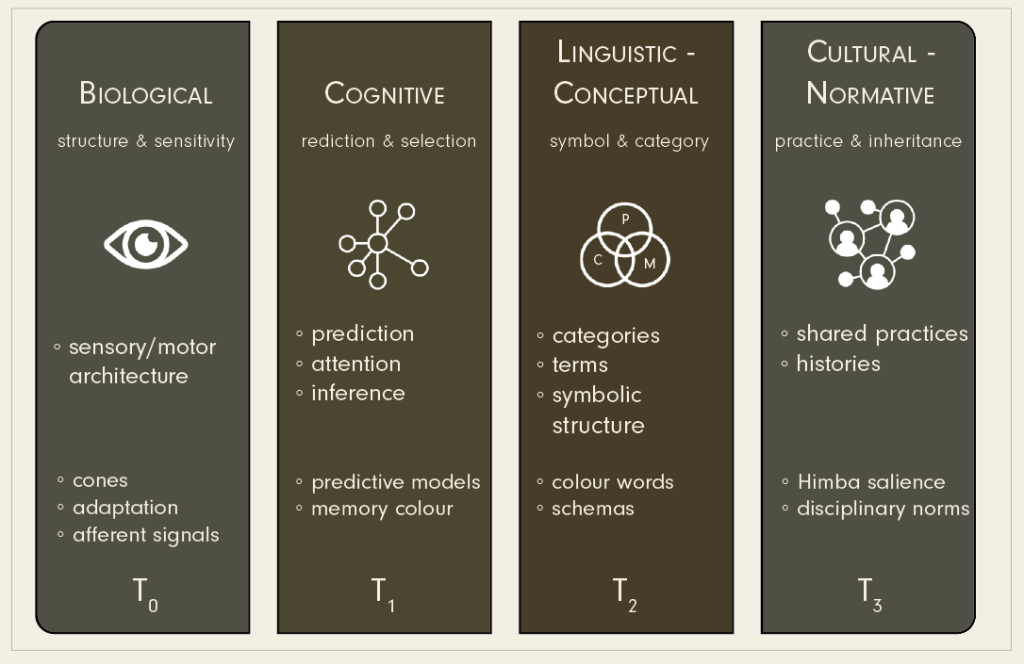
Image: The Four Mediation Layers – Biological, Cognitive, Conceptual, Cultural – structuring every encounter we mistake for ‘direct’.

This little illustration gives the flavour:
T0 Biological mediation – the body’s refusal to be neutral.
T1 Cognitive mediation – the brain, doing predictive improv.
T2 Linguistic–conceptual – words pretending they’re objective.
T3 Cultural–normative – the inheritance of everyone else’s mistakes.

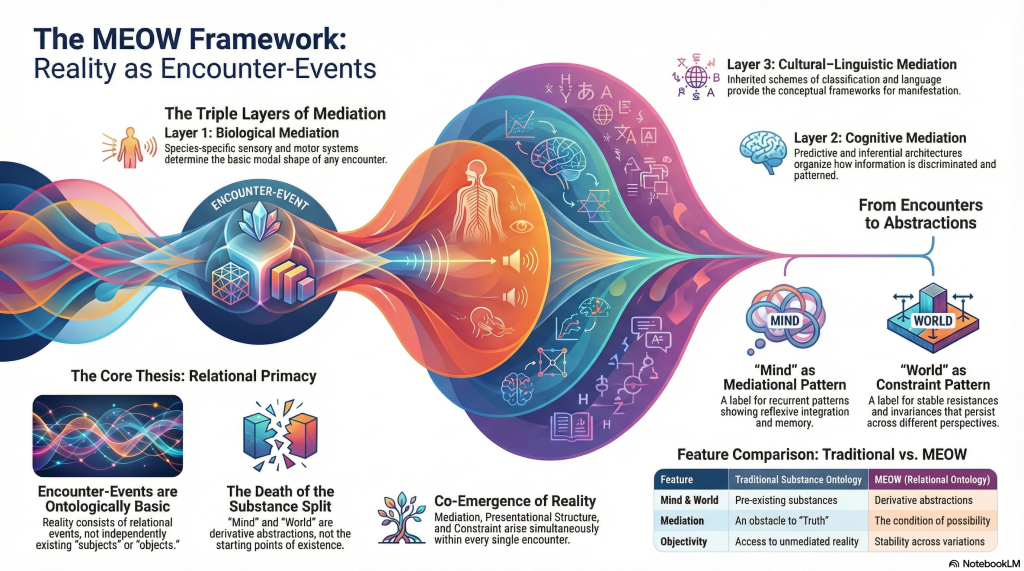
The essay argues that what we call ‘mind’ and ‘world’ are just abstractions we extract after the encounter, not the metaphysical scaffolding that produces it. Once you begin with the encounter-event itself – already mediated, already structured, already resistive – the mind–world binary looks about as sophisticated as a puppet show.

What the essay actually does

The Mediated Encounter Ontology of the World is the first framework I’ve written that genuinely sheds the Enlightenment scaffolding rather than rebuking it. MEOW shows:

  • Mediation isn’t an epistemic flaw; it’s the only way reality appears.
  • Constraint isn’t evidence of a noumenal backstage; it’s built into the encounter.
  • Objectivity is just stability across mediation, not a mystical view-from-nowhere.
  • ‘Mind’ and ‘world’ are names for recurring patterns, not metaphysical hotels.
  • And – importantly – MEOW does all of this without drifting into Whiteheadian cosmological fan-fiction.

The full essay is now published and archived:

DOI: https://doi.org/10.5281/zenodo.17685689

If you prefer a soft landing and the sound of a passable human voice explaining why metaphysics keeps tripping over its shoelaces, a NotebookLM discussion is here:

Audio: NotebookLM summary podcast of this essay.

MEOW is the survivor because it does the one thing philosophy is terrible at: it refuses to pretend. No substances, no noumena, no grand metaphysical machinery—just a clean, relational architecture that mirrors how we actually encounter the world.

And frankly, that’s quite enough ontology for one lifetime.


* To be perfectly honest, I originally fled from Michela Massimi’s Perspectival Realism in search of a cleaner terminological habitat. I wanted to avoid the inevitable, dreary academic cross-pollination: the wretched fate of being forever shelved beside a project I have no quarrel with but absolutely no desire to be mistaken for. My proposed replacement, Nexal Ontology, looked promising until I realised it had wandered, by sheer lexical accident, into Whitehead’s garden – an unintentional trespass for which I refused to stick around to apologise. I could already hear the process-metaphysics crowd sharpening their teeth.

Early evasive action was required.

I preferred nexal to medial, but the terminology had already been colonised, and I am nothing if not territorial. Mediated Ontology would have staked its claim well enough, but something was missing – something active, lived, structural. Enter the Encounter.

And once the acronym MEO appeared on the page, I was undone. A philosopher is only human, and the gravitational pull toward MEOW was irresistible. What, then, could honour the W with appropriate pomp? The World, naturally. Thus was born The Mediated Encounter Ontology of the World.

Pretentious? Yes. Obnoxious? Also yes.

And so it remains—purring contentedly in its absurdity.

Arriving Late to Massimi’s Party: Perspectival Realism in Parallel

Where our projects nod politely, then go their separate ways

I suppose it was inevitable. You spend years muttering into your notebook about mediation, realism without bombast, the irretrievability of universality, and the peculiar way science manages to stumble forward with partial, parochial tools… and then, inevitably, you discover that someone else—Michela Massimi, in this case—has been busy constructing her own edifice a few hills over.

Audio: NotebookLM podcast summary and discussion of this topic

I arrived late to her party. Fine. But now that I’m here, let’s pour a drink and compare architecture.

Because while our buildings look similar from a distance—both labelled Perspectival Realism—they’re made from different bricks and aimed at different skylines.


1. A Courteous Bow: We Are Not Strangers in the Same Wilderness

Massimi and I share several foundational intuitions:

  • No God’s-eye view.
    She rejects the fantasy of disembodied objectivity. So do I. Reality is not a neutral theatre awaiting the Enlightenment spectator.
  • Knowledge is situated.
    Her emphasis on historically embedded scientific communities echoes my own insistence that sense, cognition, and culture structure every act of knowing.
  • Plural perspectives, not universal sovereignty.
    No single inferential vantage point dominates; multiple perspectives can be fruitfully interlaced.
    That’s strikingly consonant with my claim that mediation is a condition, not a defect.
  • Anti-relativist without universalist delusion.
    Neither of us has patience for the “all maps are equal” caricature peddled by people who wouldn’t know a real relativist if they tripped over one in a library.

From this angle, we’re intellectual cousins—two people independently refusing Enlightenment triumphalism while refusing to surrender realism to the absolutists.


2. The Parting of the Ways: Our Projects Are Not the Same Creature

But similarities disguise deeper divergences. Here are the important ones:

a) She’s doing epistemology; I’m doing ontology.

Massimi reconstructs realism from the inside out by examining scientific practice—models, inferences, historically evolving toolkits.

My project is more structural. Sense mediation (icons), cognitive mediation (instrumentation), and linguistic-cultural mediation (conceptual carving) are not methodological observations; they are conditions of access to reality. They’re deeper than scientific practice—they underlie it.

b) She salvages realism; I happily burn universality and build realism back from the ashes.

Massimi is rehabilitating realism’s good name.
I’m less sentimental. Realism, as a doctrine, has been caught lying too many times. I want the realism of resistance, not the realism of representation.

c) Her anchor is “modal robustness”; mine is “structured resistance through mediation.”

Massimi’s realism rests on the idea that phenomena are robust across models and contexts—they persist modally.

I agree that robustness is useful. But robustness is filtered through linguistic concepts, cognitive priors, and sensorimotor limitations. It’s a second-order indicator, not a metaphysical foothold.

Resistance—the world’s refusal to bend to belief—is deeper. It’s what enables robustness to manifest.

d) Her perspectives are model-based; mine are existential.

Massimi focuses on scientific perspectives—frameworks articulated through inferential blueprints.

My perspectivalism lives at the level of:

  • what our senses can show,
  • what our minds can shape,
  • what our languages can articulate,
  • what our cultures deem thinkable.

That’s a wider cut than scientific models.

We are working at different depths of mediation.


3. Convergences Worth Keeping, Divergences Worth Defending

Let me put it cleanly:

  • Massimi gives us a realism of models.
    A realism that emerges from the community of scientific practice, negotiated through historically situated inferential perspectives.
  • I’m after a realism of resistance.
    A realism that remains intact even when models break, when languages fail, when cognitive categories run aground.
    Not the realism of what we say, but the realism of what pushes back.

Our projects are not incompatible, but they are differently motivated.

She is concerned with scientific rationality’s legitimacy.
I am concerned with the conditions of access to reality in the first place.

She patches the Enlightenment’s ship.
I point out that the ship’s hull is three layers of mediation thick, and pretend that universality is the hole in the floor.


4. A Clean Acknowledgement: She Was Here First (Sort Of)

Yes—Massimi coined the term in this specific form, and she developed a sophisticated, rigorous scientific perspectivism that deserves respect.

But my Perspectival Realism emerged from a different genealogy:

  • the insufficiency of language,
  • the inescapability of conceptual carving,
  • the recursive inadequacy of cognitive tools,
  • the quiet, stubborn existence of a world we only ever meet askance.

Different animals. Same habitat.

So no, I’m not competing with Massimi.
And no, I’m not rebranding her work.

What I’m doing—and what this piece makes explicit—is placing my ontology in dialogue with hers. Two parallel rejections of universality. Two parallel refusals of relativism. Two parallel attempts to articulate realism without pretending we’ve escaped the conditions of being human.

If I arrived late to her race, so be it.
I’m not running for her finish line anyway.


DISCLAIMER: This article was written or output by ChatGPT 5.1. It started as a conversation with Claude Sonnet 4.5, where I had input days of output for evaluation. One of these outputs was the post about Erasmus and the Emissary Who Forgot to Bow. A group chat ensued between me, Claude and ChatGPT.

What started as a discussion about the merits of my position, expressed in the Erasmus-influenced essay, drifted to one about Perspectival Realism. That discussion deepened on ChatGPT, as I further discussed my recent thoughts on the latter topic. I had rendered a Magic: The Gathering parody trading card as I contemplated the subject. It’s how my brain works.

All of this led me to ask ChatGPT to summarise the conversation, and, upon further discussion, I asked it to draft this article – the second of five.

  1. Perspectival Realism: The First Ontology Without an Asterisk
    This article discusses what Perspectival Realism means to me and how I got to this position.
  2. Why Perspectival Realism Is Not Relativism
    Further discussion prompted me to differentiate this ontology from other perspectives.
  3. Arriving Late to Massimi’s Party: Perspectival Realism in Parallel 👈
    I spent another half-hour following Google search results as I wanted to see if anyone else had already been using the term, Perspectival Realism. I ended up on the Oxford publishing site. I found a 2022 book with this name, authored by Michela Massimi. They allowed me to download the book, so I asked ChatGPT to summarise our positions, specifically where we agreed and differed.
  4. Against the Vat: Why Perspectival Realism Survives Every Sceptical Hypothesis
    At 0500, I returned to bed, but I woke up again at 0700, thinking about how one might differentiate between Putnam’s brain in a vat from Perspectival Realism. ChatGPT asked if I wanted that output in long-form.
  5. The Constraint Interface: Toward a Nexal Ontology
    Being uncomfortable with the dichotomy between Realism and Idealism, I chatted to come up with terminology that disrupts what I consider a false dichotomy, focusing on the nexus rather than privileging one or the other. Consider this similar to the debate on sex and gender binaries.

As I mentioned at the end of the first series, I may return to this series and publish a coherent expository version more in line with my usual style. Meantime, this allows me to share my ideas unvarnished and unpolished at the same time, granting me more time to focus on other matters. Apologies to those who may disagree with the outline format. Honestly, it annoys me, but I am choosing function over form at the moment.