I’ve been following Philosophy Tube since Abigail was Ollie. Always top-notch material. Their content has gotten longer over time, so I’ve found myself skipping over in favour of shorter presentations. I am so glad to have decided to watch this one.
As anyone who follows me knows, I am a big advocate of social construct theory, yet I learned so much in this vid, which is proper well-cited AF. Lot’s of new content to add to my backlog, so I’ve got more than enough reading material for my next few incarnations at least.
The biggest takeaway for me is the notion that not only is gender a social construct, but so is sex itself. Previously, I have defended the sex-gender distinction, but in fact, scientific taxonomies are still social constructs—only in the scientific community rather than the greater community at large.
Abigail’s platypus drives home the point. Not that it’s some big reveal. Another less poignient analogy is fruit and vegetable classification. Tomatoes are fruits. Mellons—watermellons, pumpkins, and so on—are fruits. Say it ain’t so.
Give it a viewing and like or comment here and/or there.
It’s only happenstance that I’ve got consecutive gender posts. Derrida spoke about prioritisation in binary pair, and the inherent symbolic connotation. Sex and gender are two examples.
At the risk of overstating the obvious, masculinity holds the priority in this pair bond. Masculinity traditionally conveys hardness, strength and logic, whilst femininity conveys softness and weakness and emotion. This is what Beauvoir intends by her use of the other sex—male and other. Even in a non-binary frame, maleness still prevails over everythying else. Of course, in this broader world, male may trump female, but in an appeal to nature fashion, female trumps intersex in the same way the light-skinned people of colour trump their darker-skinned counterparts.
English even has derivative terms such as hysterical, an emotional state rooted in the Greek hystera, the uterus or womb. Etymologically, the word was invented by the Greek under the impression that this behaviour was a deviation from male normaly.
In the physical world, this male-female terminology generailises to penetrator and penetrated—penetratrix, anyone? We routinely refer to plugs and connectors with prongs as male and recepticals are female. At first glance, it might be tempting to assume that penis is somehow related to penetration, but it’s not so, as penis derives from tail.
In music there is the notion of cadence, the beats of a rhythm. Classically speaking, there are masculine and feminine cadences. And if you guessed that masculine cadences involve strong beats and feminine cadences invlove weak beats, you’d be correct.
Feminine Cadence a musical cadence in which the final chord or melody note falls on a weak beat
The reason I am writing this is as a reminder to the predjudice langage embeds and perpetuates. Even if we have lost the connection to the original intent, the sense remains. We should actively seek other terms that don’t promote this anachronistic belief system.
It’s also easy to get carried away and over-specify the domain. So, terms like manhole, manuscript, manipulate, and such are, let’s say, false cognates, in a manner of speaking. There are no counterpart womanholes—sophomoric humour notwithstanding—, womanuscripts, and womanipulation, though it might be fun to write some exposition with the intention of satarising these and words with a similar structure. I’m not sure I could womanage to carve out the time to get there.
Last Word
In a different space, we’ve got master-slave word pairs. In computers, there may be master and slave drives. I’ve heard people point out the insensitivity of this notion without grasping that projecting American (or wider-world) human slavery on this rather than understanding this pairing existed well before the New World was even ‘discovered’. This is where hysterical political correctness needs to step down and give way to education.
This wall of words was posted in a Facebook that the AI thought I would be interested in. I’m not, save for the rhetorical and grammatical structure. I am not interested in the veracity of the claim or the sentiment it is meant to provoke.
The author purportedly had a conversation with a former student, who identified as being a member of another race—black, I suppose; African-American in the current vogue; negro and coloured in bygone days.
Notice the head-fake. A conversation with an individual person quickly morphs into a generalisation. This individual, in the mind of the author—or at least the conveyance—was now the representative mouthpiece for this so-called race. But that’s not what I question.
They and them are now considered to be acceptible singular forms if a person identifies as such. I’m not sure I am equiped to comment on identification to a grammatical element, so I’ll side-step that and focus on the outcome.
Perusing this or something similar, there is a sense of undeserved weight—an inclusion from the perspective of a single person. Some people actively promote themselves as spokespeople for a group, whether race or something else. But this person did not necessarily claim to speak for anyone beyond him or herself—perhaps some small, immediate group of collegues who shared this perspective.
I am wondering how this will play out as a device to intentionally deceive the reader.
Another thing…
I was in Philadelphia yesterday, and a black associate of mine was commenting on what he deemed to be 150 neo-Nazi skinheads parading in the rain, a point eliciting more pleasure than perhaps it deserved. His assessment is that race was not a problem, that he held no illwill toward any race. His contention was with ‘motherfucking racists’. Unfortunately, there is no scientific racist litmus. There are only actions and perceptions. This is where Popper’s paradox of tolerance pops into mind. And so it goes…
Here I am yet again writing about something I am not particularly equiped to do. In other fora, I’ve been directed again to Lacan vis-à-vis a thread about Lacan’s perspective on the real. I’ve commented on Lacan before, usually in the context of eschewing any philosophy founded on psychology—especially psychoanalysis. Explaining that I have a reading backlog extending beyond my likely lifespan, it was recommended that I read Jacques Lacan by Sean Homer, so I am sharing the recommendation. Anything by Bruce Fink was another reco. Noam Chomsky takes an ad hominem swipe at Lacan here.
I decided to watch a few videos (including this, this, and this) to survey some of Lacan’s ideas, knowing that something could be lost in the translation. Let’s just say that I was underwhelmed.
In a nutshell, my biggest contention is the notion of the unconscious as an active agent.
According to my understanding, Lacan posits that there is a ‘real’ out there, but it is obscured by language and subject to interpretation. To him the real is a Void.
Psychoanalysis presumes being able to get closer to the ‘truth’ of reality. Like astrologers and fortune-tellers, Psychoanalyst primary defence is that not all knowledge is evidence-based or falsifyable. My problem is that I am not open to another way of experiencing the world, but they somehow have privileged access to this truth. Of course, this is a similar to religious claims of some special spiritual access that opens when you believe.
To me, the Void is as apt a metaphor as any. And while we both agree that the real is inaccessible, I don’t accept the impostition of the how and the why. What Lacan does—and Freud before him and psychoanalysts more generally—is to inject hows and whys into the story. In this narrative, the unconscious has active powers, (as opposed to negative space), where memories (in whatever form) may be repressed and actions may be triggered (or activated) by unconscious urges or desires. I consider this last train of thought wholly imagined and fabricated. This void and the unconscious has no purpose.
Along the way, I do agree with Lacan’s poststructuralist position. I have no issues with symbolic or metaphoric concepts and speech. The contention arrises when one attempts to claim the metaphoric to be concrete. This is the same contention I have with people who take the metaphoric text of the bible and cencretise it. There are other problems there, but I’ll quit now.
I want to write about this Quanta Magazine article: What Is Life? Its Vast Diversity Defies Easy Definition. but I’ve not got enough spare time. Too many irons in the fire or plates spinning or which ever metaphor you favour.
My interest in the insufficiency of language is what attracted me to the article, and is probably how it ended up in my feed. To highlight some aspects, in 2011, Russian geneticist Edward Trifonov reviewed 123 definitions of life and found as many definitions as authors. Although he discovered some core shared features. His version distilled to self‐reproduction with variations.
The article mentions Wittgenstein’s language games—and rightfully so. But it underscores the point that language is an approximation of reality. My working position was that naming objects is simple—in fact trivial—, but naming abstract concepts presents challenges. Now, I find that the challenge sets in earlier than even I expected. Language is truly insufficient.
The first step to recovery is to admit there’s a problem.
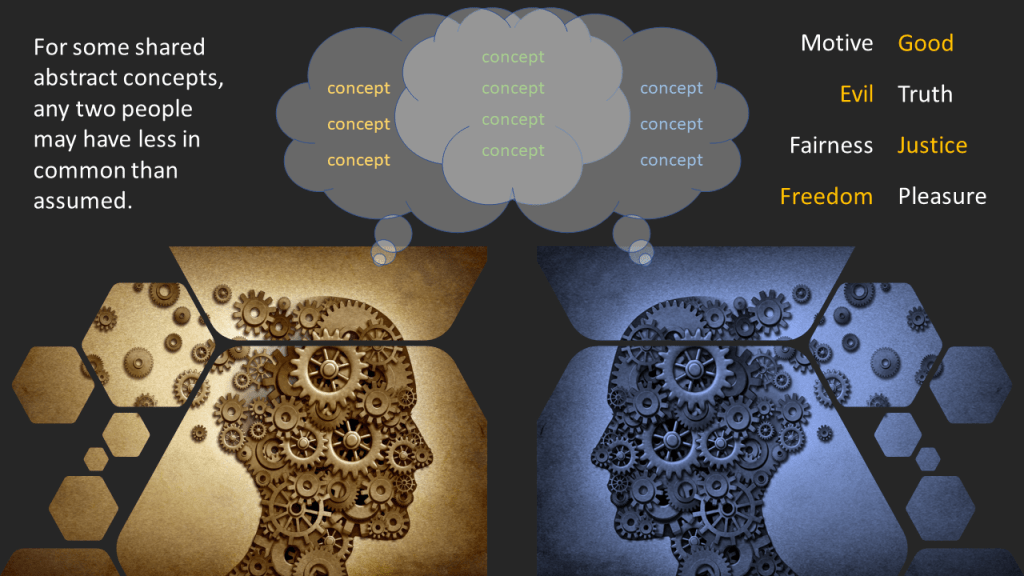
I tend to go on about weasel words and the insufficiency of language, but I tend to get a lot of resistance by people who insist the chasm isn’t as expansive as I make it out to be. This makes me wonder how one might create a test to determine how much is similar and how much doesn’t.
To summarise my position, abstract concepts of this type are specious archetypes that cannot exist in the real world: truth, justice, freedom, fairness, and so on. The common thread here is almost always that they exist in the realm of morality, another false concept.
It seems to me that one could construct a sort of word cloud intersecting with a Venn diagramme. I’d assume that more articulate people would have more descriptors, thereby creating landscape with more details and nuance for any given concept.
Additionally, I could see a third dimension which would capture diametric meanings. There is also the issue of diverse contexts, e.g. in the case of justice, we have distributive, retributive, restorative, and procedural flavours, so one would need to be taken into account.
In everyday existence, I notice that these terms are good enough and have enough substance to trick people into believing not only that it’s real but that the are operating with a shared concept. My point is that it’s more apples and oranges. We could employ dimensions that make these appear to be similar.
Approximate spheroids
Fruits
Contain fruits
Have skin
Additional scrutiny would illustrate the differences.
Colour
Taste
Consistency
This difference between this concrete case is that we can observe the objects to compare and contrast, but with abstractions, we have a sort of survivorship bias in play. We remember what we agree on and forget or diminish the parts we don’t agree on. And we don’t necessarily even know the complete inventory of descriptors of our counterparts.
The image at the top of the page is not to scale. I don’t know what the percent breakdowns are, but I wouldn’t be surprised if in a situation where there were 10 possible descriptors, that only 4 would be commonly shared—so 40 per cent—, leaving 6 not in common—60 per cent.
In any case, I wonder if anyone has attempted this sort of inventory comparison. I haven’t even looked, do there could be tome upon tome published, but I don’t suppose so.
‘Do not ask who I am and do not ask me to remain the same: Leave it to our bureaucrats and our police to see that our papers are in order. At least spare us their morality when we write.’
—Michel Foucault, The Archaeology of Knowledge & the Discourse on Language
I am going to take liberal liberty with Foucault’s quote. This is another take on Heraclites’ ‘never the same man, never the same river’ quote. It can be taken as a commentary on identity and impermanence. Effectively, he is taking the position that the concept of identity is a silly question, so don’t bother asking about it. Then he defers to people who insist on it anyway.
To be fair, creating a sort of contiguous identity does simplify things and creates categorical conveniences.
Vendor: ‘Wasn’t it you who purchased that from me and promised to pay with future payments?‘
Zen: ‘There is no future. There is only now. And I am not the same person who purchased your car.‘
Perhaps this is where the saying, ‘Possession is 9/10 of the law‘, a nod to temporal presentism.
In any case, some systems are predicated on their being identity, so a person benefiting from that system will insist on the notion of identity.
Clearly, I’m rambling in a stream of consciousness, and it occurs to me that Blockchain offers a solution to identity, at least conceptually. In the case of Blockchain, one can always audit the contents of the past in the moment. And so it carries the past into the now.
If one were able to capture into an archive every possible historical interaction down to the smallest unit of space-time—neutral incident recording, indexing and retrieval challenges notwithstanding—, one could necessarily attribute the record with the person, so long as they are otherwise inseparable. (We’re all well-aware of the science fiction narrative where a person’s history or memory is disassociated, so there is that.)
Anyway, I’ve got other matters to tend to, but now this is a matter of historical record…
Postmodernism seems to have as many definitions as the number of people who encounter it, and that’s just not very useful. It’s less useful still when people with ulterior motives control the narrative. I’d like to take back the narrative and offer a succinct definition or description and offer reasons why some of the competing definitions are fundamentally incorrect. My journey commenced on my Descriptive Postmodernism post.
Each year, I start with a new notion to explore. For 2021, it’s postmodernism. I identify as practicing postmodernist, but it seems to have a nebulous definition, and many people assume it means different things. Some definitions seem to comport and others are curious takes. I am well-aware that some people in this space have opinions at least as strong as mine, and many have deeper and/or broader exposure than I do. Nonetheless, I feel confident that my logic will resonate.
Audio: NotebookLM podcast conversation about this content
As I pursue this definition, I will explore a line of inquiry that I hope will help to frame the issue.
These are my initial questions:
What is the core definition of postmodernism?
Why hate postmoderns?
Why can’t postmodernism be constructive?
Why do postmoderns deny Truth?
When did postmodernism, a critical, dis-integrative concept become identified as being integrative?
How does one parse the theory of postmodernism from the personality who espouses a perspective on it?
Postmodernism can be viewed as a reaction to so-called modernism, but it’s not so cut and dry. Postmodernism as an intellectual pursuit was in full force in the 1970s and 80s. But Modernism was still the main thrust, as is remains today. Post- is likely an overstatement, as it did not supersede. In comparison, post-Enlightenment thought—reason and logic—still competes with pre-Enlightenment thinking—metaphysical and superstition—, but even persons holding post-Enlightenment views still cling to traditional beliefs. Contrarily, people holding modern beliefs are not likely to simultaneously hold postmodern beliefs and vice versa. For moderns, postmodernism is a hot button, trigger item. For this cohort, any association will set them off.
What is the core definition of postmodernism?
From early on, postmodernism has been used as a pejorative term by its detractors. Many academics associated to postmodernism do not identify as postmoderns. They have been categorised as such, as something they have said or written is heretical to the Modern orthodoxy.
These days—if not from the start—postmodernism is nebulous. It has long since lost its brand to detractors, and its definition is undergoing some revisionist history by this cohort. What started as a perspective or lens to disintegrate content and context is now seen by many as possessing a point of view for constructing, for building.
The Condition of Postmodernity Before defining philosophical postmodernism, let’s first exclude a possible source of confusion: postmodernity. Postmodernity is a periodical distinction, a cultural state where it occurs chronologically subsequent to the period referenced as Modernity.
Postmodernity is a condition or a state of being associated with changes to institutions and conditions and with social and political results and innovations, globally but especially in the West since the 1960s, whereas postmodernism is an aesthetic, literary, political or social philosophy, the cultural and intellectual phenomenon, especially since the 1920’s new movements in the arts and literature.
To be fair, the philosophy of postmodernism is a reaction to the philosophy of Modernism, but there was a diversion of the periodic reference from the philosophical. If we adopt this definition, the only requirement for inclusion is to have been active in this period. Since Feminism and Marxism were coincidentally prevalent phenomena, it would be easy to include these by virtue of chronology, but it doesn’t follow that these fall into the philosophical notion of postmodernism. It may be a simple matter of the ambiguity of language.
Some social theorists and sociologists—Scott Lash, Ulrich Beck, Zygmunt Bauman, and Anthony Giddens—deny that there is a postmodern condition. Instead, they suggest that modernity has simply extended into a state of late or liquid modernity.
Simplifying to the extreme, I define postmodern as incredulity toward meta-narratives.
Jean-Francois Lyotard
To establish a grounding and because he got there first, let’s see how Lyotard defines it in the introduction to his Postmodern Condition:
Simplifying to the extreme, I define postmodern as incredulity toward meta-narratives. This incredulity is undoubtedly a product of progress in the sciences: but that progress in turn presupposes it. To the obsolescence of the metanarrative apparatus of legitimation corresponds, most notably, the crisis of metaphysical philosophy and of the university institution which in the past relied on it. The narrative function is losing its functors, its great hero, its great dangers, its great voyages, its great goal. It is being dispersed in clouds of narrative language elements – narrative, but also denotative, prescriptive, descriptive, and so on. Conveyed within each cloud are pragmatic valencies specific to its kind. Each of us lives at the intersection of many of these. However, we do not necessarily establish stable language combinations, and the properties of the ones we do establish are not necessarily communicable.
The simple definition is captured by the first sentence. The rest is exposition. But let’s rewind for a bit and establish a frame. Admittedly, even at the start this is ‘simplifying to the extreme‘. Moreover, the context is relative to hard sciences. Lyotard admits he was over his head. In fact, he later referred to the book as his worst. But books have lives of their own, a sentiment with which Barthes might agree.
The central point here is to question metanarratives. Period. Full stop. The next task is to ask how a postmodern might accomplish this task and what might be their perspectives and tools?
In Reclaiming a Scientific Anthropology, Lawrence Kuznar claimed that « the primary tenets of the postmodern movement include: (1) an elevation of text and language as the fundamental phenomena of existence, (2) the application of literary analysis to all phenomena, (3) a questioning of reality and representation, (4) a critique of metanarratives, (5) an argument against method and evaluation, (6) a focus upon power relations and hegemony, and (7) a general critique of Western institutions and knowledge. » [See end note 1]
Postmodernism is a disintegrative system. It disassembles, deconstructs, atomises, and lays bare. It is suspicious of underlying metanarratives—and I’d be willing to argue that it is equally suspicious of stated narratives as well. It questions who is served by a given narrative, who gains and loses power by one interpretation over another.
[tools and systems]
In the end, a reader may disagree with what I am proposing here, and the reader may even be correct in claiming that my definition is too reductive. Perhaps, I should abandon the postmodern label and simply recast my definition as Disintegrationism or some such. Deconstruction is already taken, so why not?
Why hate postmoderns?
One problem I notice is that postmodernism, long being applied as a pejorative term in a similar vein to the use of SJW, is a way to discredit personalities and ideologies they disagree with. We see entire ideologies being besmirched as postmodern theories. We might see Stephen Hicks misrepresent postmodernism and conflate feminism with it. Moderns are by nature traditionalists or conventionalists, so whether postmodernism, feminism, Marxism, and the like, these are unconventional. It may be a simple heuristic trick to paint all of these with a broad brush. Nuance and difference be damned. [See end note 2] Jordan Peterson‘s bete noir is cultural Marxism, that he insists is part of the blight of postmodernist thought.
Many have attempted to conflate social theories with postmodernism, whether Marxism, feminism, identity politics, and so on. But this is inherently wrong. Lyotard provided postmodernism with its original definition in his book, but detractors have been annexing other unpopular concepts to it in order to create a sort of critical mass for the uncritical opposition.
Why can’t postmodernism be constructive?
Postmodernism necessarily can’t be constructive, because after one disintegrates a perspective into its primitive elements, any reconstruction needs another narrative to serve as a foundation. It is true that one may reconstitute a disintegrated narrative through a different lens, as cited above Marxist, and so on, but all this does is to shift perspective, point of view, and creates a new power play.
There is nothing wrong with this approach, but neither is there a reason to privilege this interpretation over the original or some other. A Marxist perspective may resonate better with Marxists, and Feminist perspective with Feminists, but this doesn’t make the interpretation better or more generally applicable. It just brings it into clearer focus for that cohort. As near-sighted lenses help the hyperopic and far-sighted lens aid the myopic, neither is inherently better outside of the defined context. And each solution would create a distortion for a person neither near- or far-sighted. There is no lens that is all things to all people.
On balance, I think it’s fair to say that postmodernism is descriptive and not prescriptive, so whilst one can play at disintegrating and reintegrating, but this is simply to gain a new perspective and new insights. In literature, we might consider, say, Philip K Dick’s, The Man in the High Castle. In this, Dick explores what might have been if the Axis led by Nazi Germany had prevailed. This alternate historical rendering can be evaluated as a postmodern exercise. Dick is not promoting this outcome, he is merely playing what-if—reordering the actors to create speculative new narratives. Although the Amazon.com version takes liberties and injects additional narrative perspective, the reintegration is still evident.
As well, postmodernism cannot be constructive because it would be infinitely recursive. For each construction, there would exist a deconstruction. All that’s occurred is a rearrangement. From the same Lego pieces, we apply a new map—a new narrative. From the position of purpose, one construction may be deemed better or preferred, but this is not likely to persist from another.
Disintegration – Reintegration Cycle
Whilst I am more interested in the philosophical, postmodernism has much application to literature. This might be better defined as poststructuralism.
Why do postmoderns deny Truth?
Some people have argued that postmodern thinkers don’t believe in the notion of Truth.
There are a few things to clarify first: the definition of truth and the context of a truth claim.
There are different and competing theories on what truth is—whether correspondence, coherence, or some other version—but that’s beyond the scope of this content. Some people use ‘truth’ as a synonym for ‘fact’, but in the name of clarity, we should separate the two concepts even if idiomatically the terms can be used interchangeably. [See end note 3] In creating this bond, it’s easy to see how these people might be confused. Virtually no one is proposing that ‘facts’ are not ‘facts’. It may be that postmodernism should have a weak and a strong version.
If the colour red is defined as the reflection by an object having a wavelength between 625 and 700 nanometres and a corresponding frequency between 400 and 480 THz, and a ball as a 3-dimensional object where every point on the surface is the same distance from the centre, and all of the incumbent terms are similarly defined and accepted with concordant definitions, then a sighted person with no colour vision perception deficiencies in an environment with natural full-spectrum lighting, will agree with the fact that the sphere is red. If one prefers to label the correspondence of a red sphere and the perception of the red ball as true, then this trivial relationship is valid.
2-dimensional render of a 3-dimensional red sphere
It may be a correct assessment that some thinkers deny all truth, but it’s more likely that these thinkers are suspicious of the person claiming to know the truth because of the relationship between truth claims and power. Although Lyotard’s commentary was directed at hard science and underlying metanarratives such as progress, most postmoderns are more concerned with claims of moral truths.
This is related to the context of a claim. Per Foucault, if one context gives me power, I am more apt to adopt that perspective in order to manifest that power. I am not going to delve into some political discourse at the moment. Apart from this, Truth—where synonymous with fact—is contextual.
Using a typical example, one can evaluate the moral claim that killing another human is immoral. In fact, many—not all—people may agree with this as a general principle. But when we apply context—say, self-defence, military action, or capital punishment—, we discover that some of the same people now evaluate that killing another human is moral. So, we arrive that this moral assessment is subject to be either true or false depending on the context it’s evaluated in. Myself, being a non-cognitivist, I find moral claims to be lacking truth aptness, but that’s another story.
When did Postmodernism become a constructive rather than decompositional philosophy?
I’ll reserve the option to finish this section later. A quick internet search finds that David Ray Griffin coined the term constructive postmodernism. Griffin appears to have an agenda to return to modernism, particularly, it seems at first glance, Pragmatism.
My initial thought is that it was not thinkers fully invested in postmodernism; rather it was people with ulterior motives. Infusing Christian elements appear to be the most common thread. This line of thought is entirely speculative, so please stand by for an update or retraction. Metamodernism appears to have similar attributes, though perhaps simply metaphysical rather than Christian in nature.
How does one parse the theory of postmodernism from the personality who espouses a perspective on it?
Many people identified as postmoderns don’t self-identify as such. Kuznar labels postmodern anyone whose thinking includes most or all of these elements, but there is a compositional challenge inherent in this claim.
There are several compositional problems. First, one can apply postmodernism to a narrow domain and operate fully as a modern in the rest—perhaps even the majority of situations. Second, one can apply a postmodern lens theoretically, but be more pragmatic in more mundane matters. Third, one might apply a postmodern lens among many lenses, defending each in turn. Fourth, one may have had strong postmodern tendencies at one point in life but not held this perspective at other points.
Taking Foucault as an example—as well as one who eschewed the postmodern label—, he did disintegrate history and did question the underlying narratives, hitting all of Kuznar’s touchpoints. For one, I would categorise him as a postmodern thinker. Moreover, his disintegration led to the discovery of a common power thread throughout. Much of his writing was focused on this power relationship and illustrated how it was manifest.
Foucault was also a vocal Marxist. This is a constructive (integrative) worldview. This perspective gives privilege to Marxism, which is antithetical to postmodernism. As a rational interpreter, Foucault determined that this was a better form of government—but clearly, that’s because he accepted the underlying narrative and historicity proposed by Marx. Does this invalidate his postmodern credentials? Do we revoke his PoMo card?
Disclaimer
Excuse me for occasionally using this space as a scratchpad, but it serves the purpose well. I’ve never delved deeply in to critical theory, though I suppose I suppose that at least some of it resonates with me.
Note that I approach this as a stream of consciousness. It’s not meant to be a robust academic treatment. Although, I do cite source documents in some cases, many of my points are anecdotal or pulled from memory, understanding fallibility and so on. I expect to return to flesh out some details, but I figure I’ll publish my thoughts now and make updates in future. I may even correct spelling, grammar, and redundancies.
My goal at the start was two-fold (at least). First, is to describe the domains of postmodernism from the perspective of a proponent (as opposed to accepting a definition imposed by detractors). Second, is to assess where critical disintegration diverged to an integration theory. It’s obvious that you hold that deconstruction and discourse analysis fall within the domain. They are certainly orthodox post-structural concepts, so I suppose a third goal might be to define the boundaries of poststructuralism relative to postmodernism.
[2] This modern cohort has a similar tendency to paint any form of Socialism as Communism, and they see the Soviet Union’s failed experiment of whatever they attempted to do as Communism. Therefore all forms of Socialism are destined to fail. The failure to appreciate nuance and detail is the common thread. I might posit that it’s similar to the phenomenon where, on average, women tend to perceive more colours (or colour names) than men.
[3] Aping logical empiricism, idiomatic language allows for broader definitions of truth and allows it to be synonymous with fact. This is similar to the idiomatic similarity of sex and gender, though this distinction is necessary for technical and academic discussion.
How does one justify reason without reason? Isn’t this just circular reasoning— circular logic? Can one justify reason without employing reason? Can there be logic without reason?
The Age of Enlightenment is simultaneously the Age of Reason. Reason is the best path forward, and yet one can’t even board the train without a predisposition toward reason at the start.
This reminds me of the troubles the logical positivists encountered by claiming that everything need to be falsifiable, and yet this claim could not be falsified. It’s Hume’s ought problem.
One could employ empiricism, but can one arrive there alogically?
Is there a term for ‘not logical’ without the same baggage as illogical?
Alogical
Antilogical
Contralogical
Counterlogical
Delogical
Dislogical
Inlogical
Mislogical
Nonlogical
Oblogical
Unlogical
For example, a work of art is not (necessarily) logical, but neither is it illogical; this feels like improper usage. So, what prefix modifier would one employ to communicate ‘not within the sphere of logic’ in shorthand? Or is it just ‘not logical‘. That doesn’t seem quite right either.
Mindfulness, as with yoga and other Eastern concepts, gets diluted for consumption by the West becoming McMindfulness. I learnt Buddhism circa 1980 in Japan, introduced by a friend from New Zealand. He translated for me because all services and teachings were given in Japanese. I won’t get into how the mind-body-spirit connection of yoga has devolved into an exercise regimen in the West.
Yoga
a Hindu theistic philosophy teaching the suppression of all activity of body, mind, and will in order that the self may realize its distinction from them and attain liberation
Most Westerners have attention spans of gnats, so many Eastern concepts need to be homogenised for the Western consumer and then dosed homoeopathically. Only then can the typical Westerner performatively claim to understand these Eastern notions. To be fair, some of the loss occurs because of the lack of depth of cultural understanding—the same loss happens from West to East as well—and some is language—the concept doesn’t have a direct translation, so we end up with close enough.
A simple but hopefully instructive anecdote might help. Westerners, especially English-speakers, are typically well-aware of the native Japanese speaker’s inability to articulate the L sound, and so ‘fried rice‘ is rendered something like ‘flied lice‘. Only, this not what’s being said. What we are hearing only approximates an L to our ears, but the L sound is not what’s being uttered. The Japanese language doesn’t have L or R phonemes, respectively /l/ and /r/. So the absence of the R-sound in Japanese and the lack of this alveolar sound in English brings us close to the L sound we presume to perceive. What they are saying is /ɹ/, which is in between these two sounds. They don’t have /l/ or /r/, and we don’t have /ɹ/, so the misinterpretation goes both ways. Only a person trained in this aspect of linguistics can map the relationship, but this mapping is imperfect but satisfactorily explanatory.
Mindfulness
the practice of maintaining a nonjudgmental state of heightened or complete awareness of one’s thoughts, emotions, or experiences on a moment-to-moment basis
Mindfulness is a member of the eightfold path of Buddhist doctrine. Mindfulness is about being conscious of ‘the world’ of one’s environment and yet not be focused or ‘attached’ to any particular aspect of it. it’s simply being aware. In Buddhism, the scope of mindfulness is particular to the dharma, of which the Four Noble Truths and the Eightfold Path are constituents, so technically speaking, one would need to have these aspects available in inventory.