Whilst researching a chapter on the notion of blame among hominids, I was chasing down a rabbit hole and I ended up finding Schopenhauer’s oft-quoted,
Man can do what he wants, but he cannot will what he wants
And that’s where the trouble started. Memory is fallible. Although I feel deceived, I don’t feel bad because many people have misattributed this quote to Schopenhauer, but if the Wikipedia footnote is steering me right, this was actually Einstein’s misquote—the Einstein; Albert Einstein of E = MC2 fame.
According to the citation, Albert said this:
„Der Mensch kann wohl tun, was er will, aber er kann nicht wollen, was er will.”
— Albert Einstein, Mein Glaubensbekenntnis (August 1932)
It translates into the offending sentence.
‘Man can do what he wants, but he cannot will what he wants.’
The full translated quote reads,
‘I do not believe in free will. Schopenhauer’s words: ‘Man can do what he wants, but he cannot will what he wants’ accompany me in all situations throughout my life and reconcile me with the actions of others, even if they are rather painful to me. This awareness of the lack of free will keeps me from taking myself and my fellow men too seriously as acting and deciding individuals, and from losing my temper.’
Albert Einstein
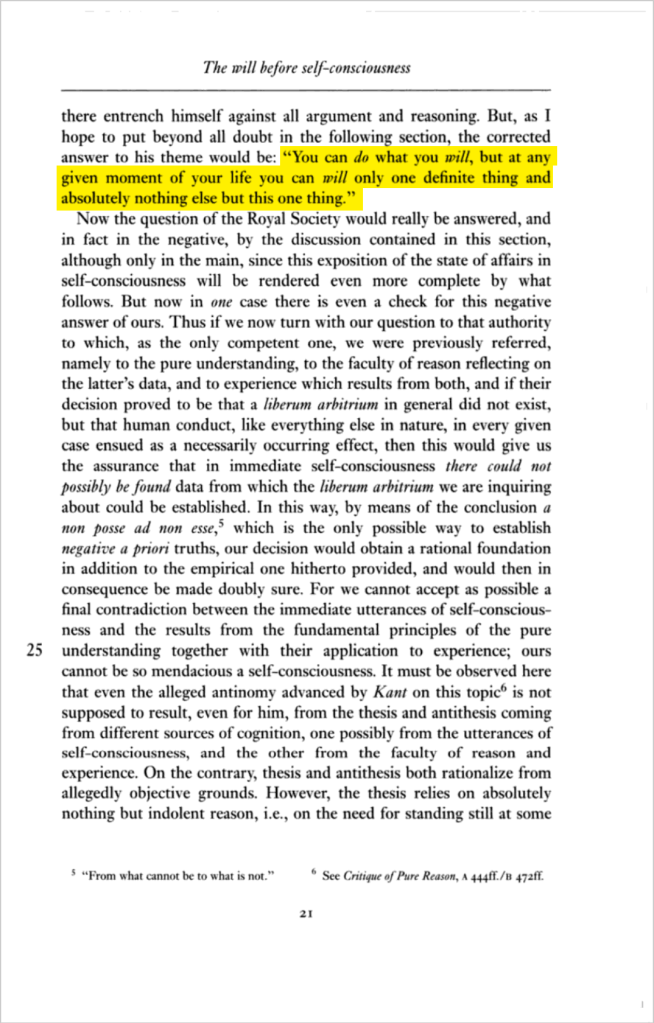
What Schopenhauer actually said not only doesn’t resonate quite so well, it doesn’t even convey the same notion. His actual words were:
‘You can do what you will, but in any given moment of your life you can will only one definite thing and absolutely nothing other than that one thing.’
Du kannst tun was du willst: aber du kannst in jedem gegebenen Augenblick deines Lebens nur ein Bestimmtes wollen und schlechterdings nichts anderes als dieses eine.
— Arthur Shopenhauer, Ueber die Freiheit des menschlichen Willens
Arnold Schopenhauer, On the Freedom of the Will
In the spirit of misattributed quotes, here are a few things Einstein never said but are attributed to I’m anyway.
“The definition of insanity is doing the same thing over and over again and expecting different results.”
“Everyone is a genius. But if you judge a fish by its ability to climb a tree, it will live its whole life believing that it is stupid.”
Not Albert Einstein
“I refuse to believe that God plays dice with the universe.”
Not Albert Einstein
Though to be fair, the last one at least directionally reflects something he did say,
“It seems hard to sneak a look at God’s cards. But that He plays dice and uses ‘telepathic’ methods… is something that I cannot believe for a single moment.”
Albert Einstein
Yet again, I am confused. I feel I’ve been living a lie.
Why do non-linguists think they can disintegrate language. As this rant targets a certain class of illiterate feminists, I’ll disclaim at the start that I fully support feminism and egality across all intersections. The rant is aimed at wilful ignorance and has been a peeve of mine since at least the 1980s. This is further a subset of PC speech, this rampant scourge of Liberal political correctness by the American Liberal establishment.
The problem I have is of people who have no understanding of the meaning or origin of the word man—people who insist on extracting it from everything. I don’t have any need for waitresses, actresses, or even mistresses, dominatrixes and other gender-marked terms. I’ll even add a further disclaimer: I don’t support gendered terms. Case in point: I love French, but I feel it’s time to lose the gendered nouns. It serves little purpose. I’d go as far as to say that it serves no purpose, but then I’d be as guilty as these feminists I’m railing on about. I also have to issue with referring to people as it and they rather than the typical he, she, him, and her. In fact, I’ve been called out for calling a human it.
Feminist Philosophy of Language, a guide on sexism in language and feminist language reform, also discourages the usage of man and -man as gender-neutral because it has male bias and erases women under a masculine word.
As a male, I may come across as mansplaining. I don’t even care about retaining some old word out of tradition. Get rid of it, and good riddance, but don’t do so on the grounds of faulty reasoning. George Carlin shared my sentiment, but his take here is on the use of euphemism to obscure meaning.
I am well aware that meaning drifts over time, and I am wholly sympathetic to the insufficiency of language. Let’s crack on.
Considering the root, in Latin, we had homo—an undifferentiated human being—and vir—an adult male, whence comes virtue. Old French gave us human, which derives from the older term, ghomon, which meant earthling, obviously non-gendered.
The word man comes from Old English and meant person with no gender intent. This is the same man as mankind and the still non-gendered, yet somehow offensive, man. The genesis of the confusion is when man split off and was also used to refer to a human adult male. Evidently, this is confusing to some.
The word man comes from Old English and meant person with no gender intent. This is the same man as mankind and the still non-gendered, yet somehow offensive, man. The genesis of the confusion is when man split off and was also used to refer to a human adult male. Evidently, this is confusing to some.
Before man was split to also refer to an adult male, Old English had distinguished the sexes by wer and wif. Wer came from the aforementioned Latin vir, which had heretofore already merged into its ungendered vulgate form. It is retained in English the word werewolf, common to most English-language speakers. Less common human-animal hybrids bearing the were- prefix are werebears, wereboars, and the rest as illustrated in this page from Giants, Monsters, and Dragons: An Encyclopedia of Folklore, Legend, and Myth. Note the lack of gender specificity.
At one point, wifman was used to distinguish a woman-man from a generic man. For the most part, wer was replaced by man, though its universal sense was also retained as it was as well in homo. In Old English, Man was also employed as an indefinite pronoun.
Obviously, wife is retained still as a gender-marked term indicating the woman in a marriage arrangement. I’m sure I had a point here, but I may have lost it, so before I quit, the last term I’d like to mention—just because—is queen, which had originally meant a woman, become a wife, and then to a king’s wife, and finally (though this last sense remains), a female sovereign ruler irrespective of marital status. There are the queens of queer culture, but I think I’ll end on this note.
As a result of these recommendations, I’ve watched some 6 or more hours of video interviews with Iain, some of which are hosted on his own site, Channel McGilchrist, including this one. Before I get to the topic promised by the title of this post, I’ll say that I like Iain. I respect his intellect, his demeanour, and his approach. If you are a credentialist, his an Oxford-educated psychiatrist—so he’s no slouch.
Iain’s positions are well researched, informed, and articulated. I could listen to him for hours. In fact, I have. And yet I disagree with a fundamental position he takes on intuition. Allow me to build up to that.
My first recommendation was due to a reaction I shared that depicting left-right brain hemisphere as analytic-creative was overly reductionist and quaint. McGilchrist was recommended because he disagreed. But it turns out his disagreement was more in the way it was being portrayed. The answer was wrong because the question was wrong. In a nutshell, his contention is that we shouldn’t be asking what each hemisphere processes, but how it goes about processing. I agree with this.
we shouldn’t be asking what each hemisphere processes, but how it goes about processing
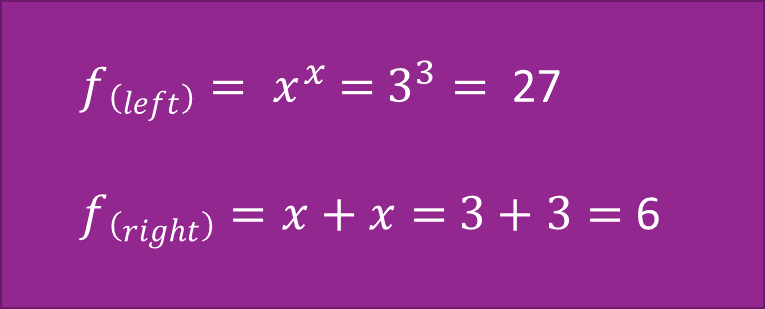
His point is that in cases where an experience (inputs) might be processed on one side versus another, the interpretation (outputs) would necessarily differ. To make a false analogy, the left brain might be performing an exponential function whilst the right brain might be performing an arithmetic function. So, if ƒ(left) = xx and ƒ(right) = x+x, then an input of 3 would yield 27 and 6, respectively. There is nothing wrong with either side, they just produce different results. In context, this difference might matter: How many feet across is that chasm I must leap. I say, ‘Oops’, as I am falling to my demise having underestimated the difference, having used the right rather than the left function.
False Analogy by the Numbers
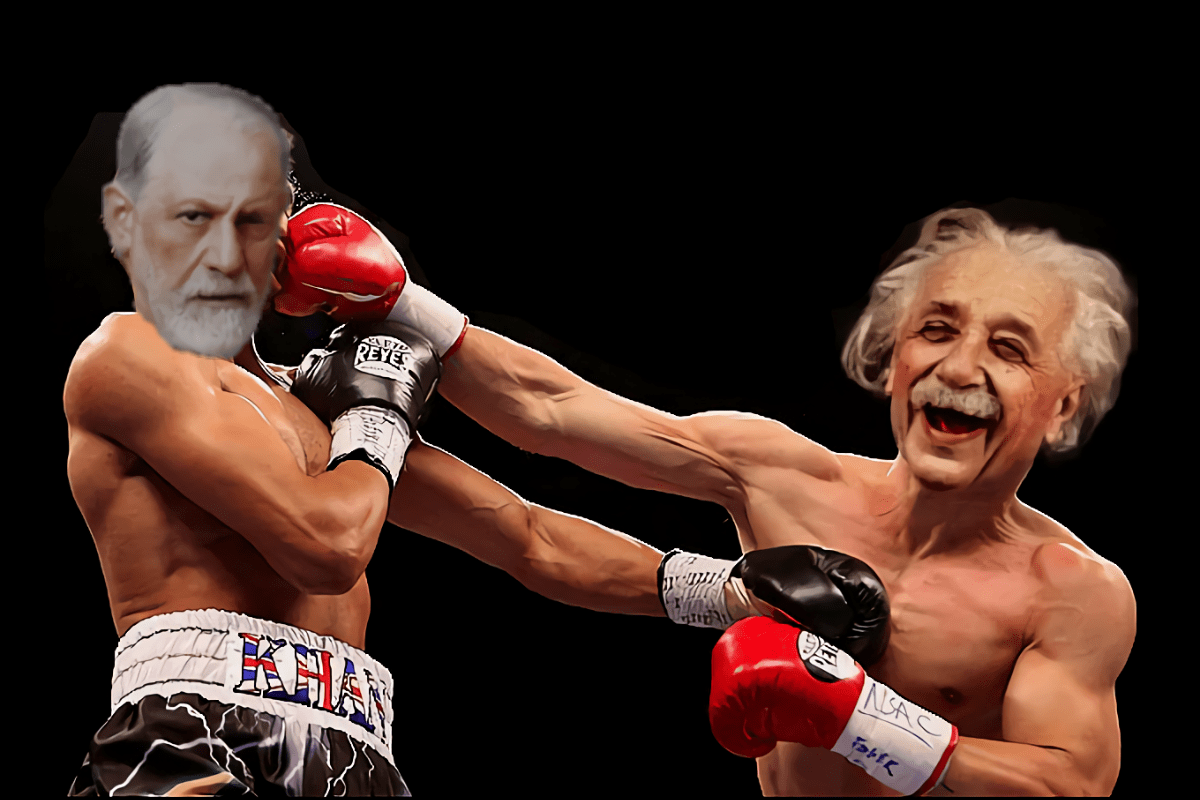
So where is this showdown you are wittering on about? A little more setup.
Science is stereotypically an analytic function, which is the say it requires a lot of left hemisphere processing. Psychology—and keep in mind that I cast psychology as pseudoscience, or para-science when I am being more charitable—elevates the notion of intuition as not only having value but of being largely ignored by science.
Those who have been following me for a while, know that I am also critical of Scientistm™, the blind-faith devotion to the current state of science as being some infallible truth. But neither am I an advocate for metaphysical claims. This is what I feel Psychology™ is trying to do with intuition. It feels like they are not only trying to inject a metaphysical claim; they are simultaneously making a normative claim that you should have (and trust) intuition; further, they are staking out the territory to be able to say an absence of this acceptance is pathological, so this is a power play. We’ve got the tea leaf readers taking up arms against science.
Of course, I am being hyperbolic and polemic for effect, but this division exists. Iain is not the first to attempt to elevate intuition. A central idea that Jonathan Haidt tries to sell the reader on in his book, The Righteous Mind, is that we need to be more accepting and trusting of intuition. Even Malcolm Gladwell pushed this point in Blink: The Power of Thinking Without Thinking.
I do think that this will escalate. Even if it doesn’t materialise into a full-scale war, people will take sides—they already have—, and we’ll see more us versus them fingerpointing. Whilst I am not fully on the side of science, my propensity is to lean in that direction.
UPDATE: Even before I post this, I discover that I am behind the times with this prediction. In searching for a suitable image for this post, I find the book Science and Pseudoscience in Clinical Psychology, which calls out pseudoscience presented as fact not only in the obvious realm of pop psychology but in the offices of practising psychologists. I have not read it, so I am not in a position to recommend it. I may get a copy for myself, if only just to have it on hand.
Before I end this, I also wish to anticipate a point of disagreement. I’ve encountered practitioners of ‘scientific psychology’ who vehemently defend their vocation as science. Without addressing this directly, let’s just raise the point that applying the scientific method and maths to a discipline doesn’t graduate it to become a science. I can apply this to Tarot or haruspicy. If fact, this is how, in general, social sciences became so-called soft sciences: ‘Look at me, mum. I’m using numbers’.
Where do you fall on the topic of intuition? Am I exaggerating and making mountains out of molehills?
Small Print (enlarged for texture): I’ve been approved as an Amazon.com Affiliate, so any links to Amazon are monetised. The purchase price to you remains unaffected, but I may be compensated for these purchases. If a purchase does not accrue to an affiliate, Amazon keeps the difference.
PSA: If you know of an affiliate you want to support—whether me or another—, purchaser through the affiliate. It costs you nothing and benefits the little guy.
I must have missed the memo. Disinterested has merged into uninterested. Disinterested used to mean you mean impartial; now it means not interested. Whereas uninterested means not interested in a topic.
I am not strictly a prescriptivist when it comes to language, but it does provide a certain level of efficiency in communication. Descriptively, one needs to interpret conversation through some local lens, but one can’t persist a description for too long because it might have drifted the next time you try to apply it. Imagine having to negotiate meaning and intent every time we engage in communication.
Uninterested means not interested in a topic.
A car was a vehicle last week, but those are now called ABC because this week car means XYZ—only to have to reevaluate this shared meaning in the next contextual engagement.
Disinterested used to mean not being interested in the outcome.
Disinterested used to mean not being interested in the outcome. But that’s changed. It seems that now, in order to provide clarity of communication, we need to use the word impartial so as not to introduce the ambiguity now embedded in disinterested.
Recently, I was speaking with a well-educated linguaphile, and I mentioned that I was looking for a disinterested person to mediate a debate. This man is in his eighties, yet he immediately interpreted disinterested as uninterested. When I shared my understanding of the meaning, he conveyed that he was unfamiliar with that parsing. This came as a surprise to me because he is a psychiatrist and psychoanalyst—quite the word wordsmith in a Jungian sort of way. I presumed that he would have understood the distinction and nuance in the interpretation. Once I clarified, he adopted my meaning—at least within the scope of our conversation. This said, I might drop disinterested from my vocabulary altogether. I’ll retain uninterested in the way a always have, and I’ll employ impartial where I would have heretofore employed disinterested.
Did you get this memo? Do you use disinterested and uninterested as close synonyms or do you retain the nuance?
The discussion became heated, and the two decided to submit the issue to arbitration, so they approached the lion.
As they approached the lion on his throne, the donkey started screaming: ′′Your Highness, isn’t it true that the grass is blue?”
The lion replied: “If you believe it is true, the grass is blue.”
The donkey rushed forward and continued: ′′The tiger disagrees with me, contradicts me and annoys me. Please punish him.”
The king then declared: ′′The tiger will be punished with 3 days of silence.”
The donkey jumped with joy and went on his way, content and repeating ′′The grass is blue, the grass is blue…”
The tiger asked the lion, “Your Majesty, why have you punished me, after all, the grass is green?”
The lion replied, ′′You’ve known and seen the grass is green.”
The tiger asked, ′′So why do you punish me?”
The lion replied, “That has nothing to do with the question of whether the grass is blue or green. The punishment is because it is degrading for a brave, intelligent creature like you to waste time arguing with an ass, and on top of that, you came and bothered me with that question just to validate something you already knew was true!”
Moral of the Story: The biggest waste of time is arguing with the fool and fanatic who doesn’t care about truth or reality, but only the victory of his beliefs and illusions. Never waste time on discussions that make no sense. There are people who, for all the evidence presented to them, do not have the ability to understand. Others are blinded by ego, hatred and resentment, and the only thing that they want is to be right even if they aren’t.
When emotions run high, intellect goes low.
This story is circulating on LinkedIn and has made the social media circuits. As you can judge from the attendant ‘moral of the story’ that this has been interpreted by an absolutist. This is a telltale sign of a Modern versus a so-called Postmodern who will allow for a different translation.
Heather at https://hermeneutrix.com/ commented briefly on the recent Political Spectrum post. Visting her site, she is all about words. Check it out. But even before visiting, I had the idea to visualise my reaction to her response.
To be fair, this is a response I get from my Pragmatist colleagues: don’t get your knickers in a twist arguing semantics. But in my noggin, I envision this Venn diagamme. (Well, not exactly. I just made this up, but you get the point.) Since the topic happened to be on the definition of Conservative, I’ll retain the context, but this is arbitrary.
Before I get to this, I want to set the stage with a more common and arguably more agreeable term: tree. If we ask a large number of people on the street to provide attributes of a tree, we might get something like this image abstraction below.
Tree
Venn: Tree
Although people may have different ideas, there will be some key core elements—trunks, branches, and roots. Of course, within the taxonomy of trees, there are types—pine, oak, willow, redwood, birch, and so on—each sharing these key attributes. These trees have some distinct attributes—coniferous versus deciduous, green versus red, flowering versus non versus, fruit-bearing, nut-bearing, height, and age. I think I can stop.
In general, I think it’s safe to say that if you point to a tree, and ask what it is to a person with sight and language, they will either respond ‘It’s a tree’ or ‘It’s an elm’. Even the elm response can be quickly qualified with a follow-up question, “What is an Elm?”
I understand that a botanist or an arborist may have a more nuanced definition. In fact, when I lived in a rental property outside of Chicago, my wife at the time defended the life of a tree that looked rather like a berry-bearing ficus, but that the village elders said was a weed and not allowed to remain. Here, we get into whether a tomato is a fruit or a vegetable or a squash is a berry or a fruit, or is corn a vegetable or a grain—or are we discussing maize? I get it. Even here, we can quickly come to terms. I said chips; I meant fries.
I could even get into the political conversation where the US justice system tried to redefine person to strip the rights away from those they didn’t want to have them. Of course, the United States has a history of not considering people to be people, though some were given 3/5ths and 4/5ths of personhood. Mighty white of them.
Back to trees. There are natural and artificial trees, but these are just simulations—hullo, Baudrillard. In the English language, there are non-arboreal trees, some not even rendered from fibres. We’ve got shoe trees—for which I fail to see the relationship to trees—and bell trees. We even have tree structures, like a taxonomy or a family tree, leveraging the branching metaphor. Some of these things escape the main bubble, but the connexion is never lost and is easy to navigate to a core understanding.
Conservative
I think we are amicably on the same page here and ready to move on from tree to conservative. Here, the circles are much more varied and divergent. Although there is common ground, as well there are points where there is no intersection in meaning.
Venn: Conservative
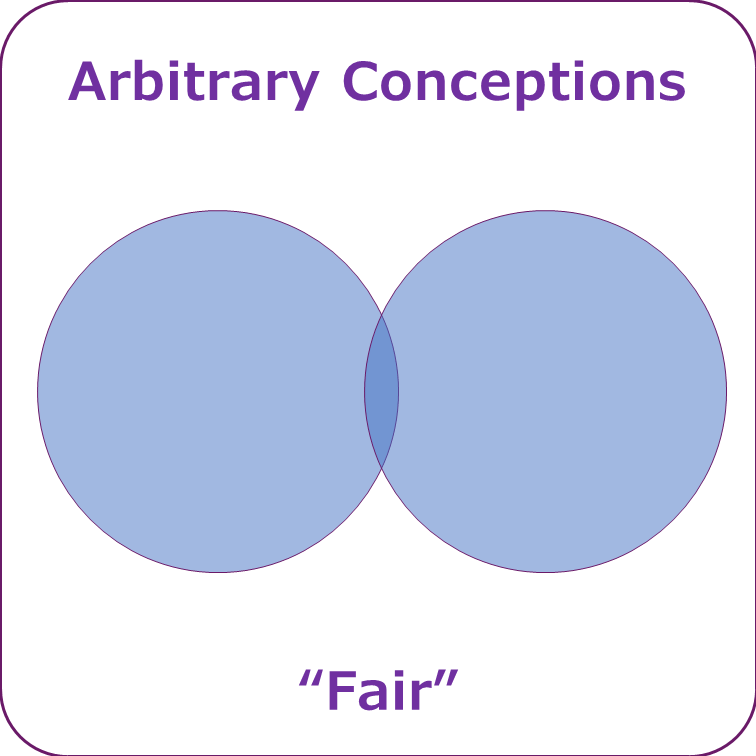
I’ve discussed a simpler abstract term before: fairness. To recapitulate, most people will tell you they want situations in the world to be fair. Only fair means entirely different things to different people. I’ve written about this in several places, so I’ll continue on our conservative journey.
Venn: Fair (oversimplified for effect)
Not only has the term conservative morphed over the years, it has different meanings—though to be fair, probably fewer than ‘liberal’. As I’ve discussed here before prior to the recent post, liberals are conservatives, but no one is really defending this position because the goal is identity, and identity involved separation to be distinguished.
Like fair, conservative has some common ground. The challenge is to understand which flavour is being used. Are you communicating by using the same term, or are you talking across each other? In some cases, this can lead to what I’ll call false positives (borrowing the language of statistical errors) where you think you are in agreement, except you aren’t. The other side of this coin is the false negative, where you think you are in disagreement when in fact you are talking about two different things.
This happened to me. A mate asked me to meet her at a certain time and place —I’ll just use McDonald’s because it is so ubiquitous. I went to the McDonald’s and waited. After a while, she called.
“Are you close?”
I scan the car park.
“I don’t see you. Maybe I missed you. I’m parked on the side near Taco Bell, not the oil change place.”
“There’s no Taco Bell at McDonald’s. What McDonald’s did you go to?”
It turns out that she was a distance away and wanted me to meet her halfway—like two-thirds to be honest. I assumed she meant the one we’d commonly visit.
This is a false positive. Communication was presumed to occur. It did. It just wasn’t useful. And since the reason for the rendezvous in the first place is to save time—one might say to ‘conserve’ time, but even I wouldn’t stoop to such a low target.
Wrapping up, the challenge is that trees are objects in the world. We can quickly recalibrate ourselves by reference. This is not possible for abstract concepts. I tend to refer to these are weasel words. Some use these words unknowingly. Whenever I hear some yahoo wintering on about freedom or justice, my first impression is that this bloke is tripping on a Kool-Aid propaganda overdose. Most common people falsely believe that people can understand what’s in their heads.
And to be fair—the left sort, not the one on the right—, when these yahoos utter the term, they are probably using it like their neighbour. But walk a few blocks or miles, and that bet is off. Sure, if the people have a common connexion, this might moderate the differences. But if one attempts to triangulate across worldviews, all bets are off. You may or may not be singing from the same hymnal.
I am trying to avoid commenting on the recent SCOTUS decision and how it is symptomatic of how the United States remains a failed state—at least a zombie state—, so this preamble should suffice for now.
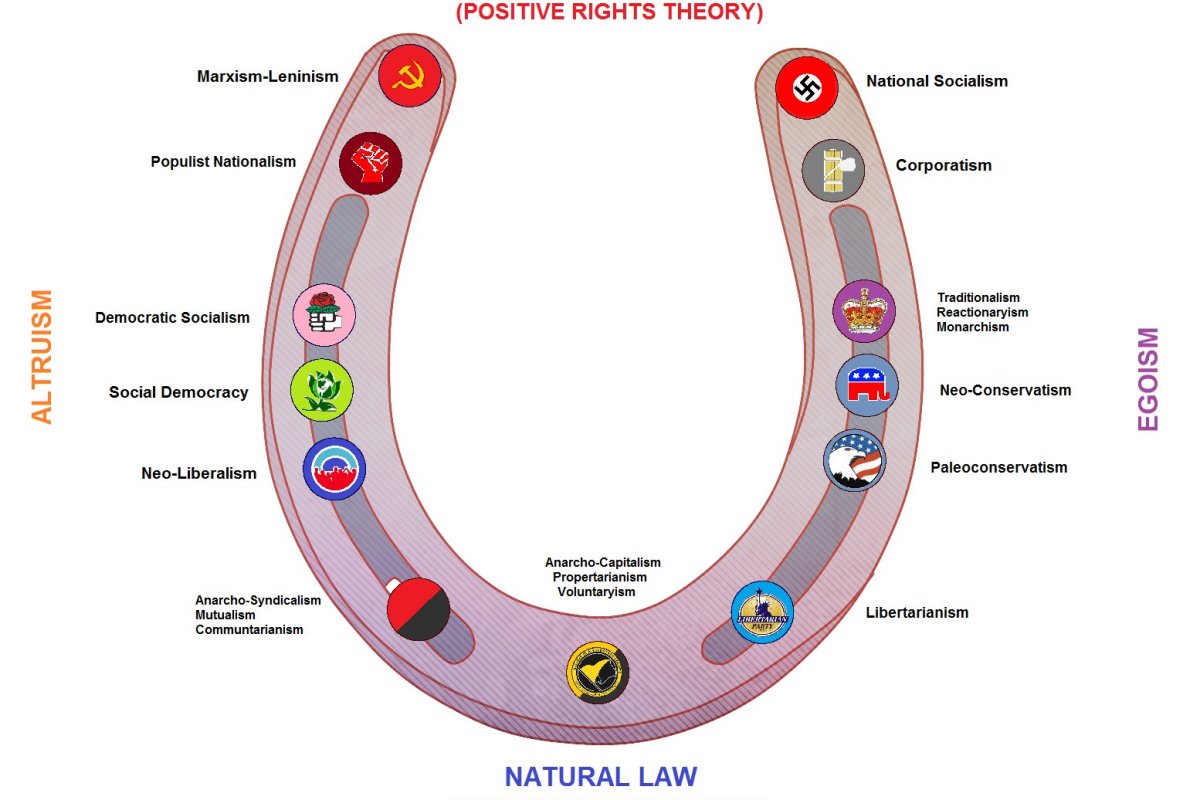
I was chatting politics into the wee hours with my son, who’s been on this earth for almost 25 years now. I consider myself to be on the left of traditional political scales. He considers himself to be on the right, but he’s trying to make sense of the scales and dimensions. He had two questions: First, ‘What are the crucial dimensions and positions that define left and right?’ Second, ‘Where do Liberals fit into the equation?’
Knowing me, he wanted to provide some context and confer with me his knowledge that would also serve to frame and anchor the conversation. A key point was to have clarified the adopted nomenclature and positioning on a theoretical map.
We started with the origins of the left-right distinction, which was barely a valid dichotomy even as it was coined in France. There was no duolith. Those on the left or right had features in common but taken holistically, this was a reductionist categorisation, as tends to happen. Exacerbating this, as it does today, still, the politicians with voices remained to the right of the unvoices masses.
He asked about the difference between freedom and liberty because his sources differentiate the two. Whilst connotation and nuance may enter the picture, etymologically speaking, freedom is a native English word whilst liberty is French via Latin. Connotatively, freedom is an absolute measure whilst liberty is granted within a political framework. Positive and negative liberties aside, liberty is an attenuator. It restricts freedom even if it allows most of the signal through. Effectively, liberty is permission by the state to act in certain ways.
By the end of the conversation, he was framing the key difference around notions of national identity and nationalism—I versus we. I shared my thoughts on the construction of identity, thus making for a poor foundation, though we both agreed that national narratives have been the impetus for much activity. (I am reluctant to insert the word progress here.)
After our conversation, I began researching dimensions established or otherwise proposed by political science. This led me to a place I found interesting—the distinction between radical, progressive, conservative, and reactionary positions. For some reason, this never really occurred to me.
I’m not sure one can employ these terms in general discussion without definition and qualification, but I feel they are useful in their own right. Typically, I view the political landscape—at the highest level and with a US-bent—as Left (communists, socialists, anarchists, progressives) and Right (conservatives, liberals, and fascists). I also know that this is imprecise, but maps always are.
This new vocabulary helps by distilling the map to this—ordered differently:
Right
Conservative
Reactionary
Left
Progressive
Radical
Conservative
Conservatives want to maintain the status quo. This is interesting usage adoption. Fundamentally, advocates of this view want to promote and to preserve traditional social institutions and practices. In Western culture, conservatives seek to preserve a range of institutions such as organized religion, parliamentary government, and property rights. Conservatives tend to favour institutions and practices that guarantee stability and evolved gradually. Adherents of conservatism often oppose progressivism and seek a return to traditional values
In Western culture, conservatives seek to preserve a range of institutions such as organized religion, parliamentary government, and property rights.
My first thoughts when I hear the term are a harkening back to the old ways—the Ozzie and Harriott mythos, white picket fences, Mom and apple pie. But this is different. Effectively, rather than reaching back, it wants to preserve the current moment in time. Where it gets more nebulous, I think, is that some people include nostalgia in the now. Duratively, perhaps a person might remember some aspect of their childhood. Though this has been lost by now, they imagine it as part of their identity. This can also extend further back as they wish some other historical aspects can be cherry-picked. Perhaps the white conservative wishes to be able to subjugate women as was the practice in the 1950s of America, but to not conserve high union participation and high marginal tax rates, as affronts to freedom (or whatever). This ends up being an exercise in selective memory and revisionist history-making.
This needs to be distinguished from a so-called traditional conservativism in the tradition of Burke or Hobbes, who want to conserve some sense of fundamental morality they feel derives from nature.
Reactionary
Reactionaries oppose whatever is in effect at the moment—the petulant toddler—but with a twist. Like the conservatives, there is a conservation effort but rather than a focus on the status quo, the focus is on status quo ante, which is a return to the old ways, tried and true.
Progressive
Progressives support social reform. Ostensibly, they don’t oppose tradition, but they feel that old structures need to be reimagined and reinterpreted in face of social and technological change. An underlying metanarrative is the notion of progress. I am not going to comment on progressivism generally and the nuances evident in the American flavour of it.
During the 20th century, radical politicians took power in many countries across the world. Such radical leaders included Vladimir Lenin and Joseph Stalin in Russia, Mao Zedong in China, Adolf Hitler in Germany, as well as more mainstream radicals such as Ronald Reagan in the United States and Margaret Thatcher in the United Kingdom. Of course, Donald Trump is a more recent example in the United States.
Summary
To me, these terms operate on a gravity to now. Conservatives are heavily anchored in the familiar and seek stability. Then they see factors in the past that they imagine will also serve this purpose, so they wish to incorporate these and carry them forward. Conservatives are not unaware of the need for change, they just want to not create waves in the process.
Likewise, although placing a heavier weight on the past than even conservatives, reactionaries are not fundamentally opposed to retaining what is working currently. The term working is subjective and perspectival, so they may wish to retain something that works for them at the expense of others. This is a challenge for conservatism as well. Just because racial segregation seemed to work for an equivalent person in the past doesn’t mean it worked well for the excluded.
Like reactionaries, progressives aren’t afraid of keeping a foot in the present—and there may be plenty of lessons to learn from the past—, but they feel that given the change in the underlying terrain, some refactoring is in order.
And then there are the radicals. I suppose that radicals have different motivators, but in essence, they feel that the current implementation is substantially broken, and it needs more than a few small tweaks and a fresh coat of paint. These people are renovating rather than redecorating. They may even want to throw the baby out with the bath water. Some may wish to keep the baby.
As for me, I usually place myself in the Progressive camp, but under the definition, I am more of a radical. The system is broken. We don’t just need to delete it, we need to install a new one.
Thomas Jefferson said that the United States should rewrite the Constitution every 19 years. Why 19 years? Who knows? Given the intransigence in American politics, this would have been a disaster. And given the powers that be, the debate would be over which parts to conserve and which to progress. Being the cynic that I am, my guess is that it would devolve to worse than we have now.
DISCLAIMER: For the record, I don’t endorse the placement of the political ideologies on the horseshoe image, but I find it interesting and it grabbed my attention. I hope it grabbed yours, too.
Physicist, Sean Carroll, gives Robert Lawrence Kuhn his take on free will. I was notified about this when it was posted, and given the topical subject matter, I took the 8-odd minutes to listen to it straight away.
I wish I had been there to pose a follow-up question because, although he provided a nice answer, I feel there was more meat on the table.
Like me, Sean is a Determinist who feels that the question of determinism versus indeterminism is beside the point, so we’ve got that in common. Where I feel we may diverge is that I am an incompatibilist and Sean is a compatibilist. I could be interpreting his position wrong, which is what the follow-up question would be.
I say that Sean is a compatibilist because he puts forth the standard emergence argument, but that’s where my confusion starts. Just to set up my position for those who don’t prefer to watch the short clip, as a physicist, Sean believes that the laws of physics, Schrödinger’s equation in particular.
We have an absolutely good equation that tells us what’s going to happen there’s no room for anything that is changing the predictions of Schrödinger’s equation.
— Sean Carroll
Schrödinger’s Equation
This equation articulates everything that will occur in the future and fully accounts for quantum theory. Some have argued that quantum theory tosses a spanner into the works of Determinism and leaves us in an Indeterministic universe, but Sean explains that this is not the case. Any so-called probability or indeterminacy is captured by this equation. There is no explanatory power of anything outside of this equation—no souls, no spirits, and no hocus pocus. So far, so good.
But Sean doesn’t stop talking. He then sets up an analogy in the domain of thermodynamics and statistical mechanics and the ‘fundamental theory of atoms and molecules bumping into each other and [the] emergent theory of temperature and pressure and viscosity‘. I’ve explained emergence in terms of adding two hydrogen and one oxygen atom to create water, which is an emergent molecule with emergent properties of wetness.
My position is that one can view the atomic collection of matter at a moment as an emergent property and give it a name to facilitate conversation. In this case, the label we are applying is free will. But there is a difference between labelling this collection “free will” as having an analogous function to what we mean by free will. That’s a logical leap I am not ready to take. Others have equated this same emergence to producing consciousness, which is of course a precursor to free will in any case.
Perhaps the argument would be that since one now has emergent consciousness—I am not saying that I accept this argument—that one can now accept free will, agency, and responsibility. I don’t believe that there is anything more than rhetoric to prove or disprove this point. As Sean says, this is not an illusion, per se, but it is a construction. I just think that Sean gives it more weight than I am willing to.
Caruso: [Dan,] you have famously argued that freedom evolves and that humans, alone among the animals, have evolved minds that give us free will and moral responsibility. I, on the other hand, have argued that what we do and the way we are is ultimately the result of factors beyond our control, and that because of this we are never morally responsible for our actions, in a particular but pervasive sense – the sense that would make us truly deserving of blame and praise, punishment and reward. While these two views appear to be at odds with each other, one of the things I would like to explore in this conversation is how far apart we actually are. I suspect that we may have more in common than some think – but I could be wrong. To begin, can you explain what you mean by ‘free will’ and why you think humans alone have it?
Gregg Caruso
Dennett: A key word in understanding our differences is ‘control’. [Gregg,] you say ‘the way we are is ultimately the result of factors beyond our control’ and that is true of only those unfortunates who have not been able to become autonomous agents during their childhood upbringing. There really are people, with mental disabilities, who are not able to control themselves, but normal people can manage under all but the most extreme circumstances, and this difference is both morally important and obvious, once you divorce the idea of controlfrom the idea of causation. Your past does not control you; for it to control you, it would have to be able to monitor feedback about your behaviour and adjust its interventions – which is nonsense.
In fact, if your past is roughly normal, it contains the causal chains that turned you into an autonomous, self-controlling agent. Lucky you. You weren’t responsible for becoming an autonomous agent, but since you are one, it is entirely appropriate for the rest of us to hold you responsible for your deeds under all but the most dire circumstances.
Daniel Dennett
if your past is roughly normal, it contains the causal chains that turned you into an autonomous, self-controlling agent
Dan Dennett
So commences this debate. The argument unfolds largely on semantic grounds. Even here, one can see the debate over the distinction between control and causation. I understand what Dennett is attempting to parse here, but I object on the grounds of causa sui.
I recommend reading the Aeon article as there is much more than this distinction, but it does remain a semantic issue. I started a post on backwards- and forward-looking perspectives, that better articulate Caruso’s perspective, but I am also working on other things. This was quicker to post and I wanted to keep a bookmark anyway, so it’s a win-win.
Whenever I hear the phrase, ‘We don’t need to argue semantics’, two thoughts come immediately to mind.
We do need to argue semantics
Your position is shrouded in the ambiguity that you’d prefer remain intact—even if you are unaware of the ambiguity
This might be something less, but I find that many philosophical arguments are caused—at least in part—by a lack of a common foundation.
A common response to a ‘definition check’ is ‘you know what I mean’ or ‘everyone knows what X means’. My response is, respectively, ‘I might know what you mean, but I want to be sure’ or ‘great, so this should be easy for you to provide’.










 Philosophics