An AI startup is facing allegations of racism and discrimination after being accused of manipulating non-American accents to sound “more white.” The company uses speech recognition technology to change the user’s accent in near-real time. (Source)
Podcast: Audio rendition of this page content
Friction is an impediment to a perfect customer experience. Removing this friction is always welcome, but homogenisation by a dominant culture is a bit more sketchy. It’s laudable that someone aims to remove friction from communication. Raze that tower of Babel—or does it need constructing? I’m no biblical scholar. I’m all for fostering communication, but this control should be an option for the customer receiving the call, not the sender—press 1 if you don’t wish to hear a foreign accent.
When it comes down to it, translation services have the same challenge. Which accent comes out the other end? (I’ll guess it is similar to this one.)
And what American accent is being represented? The neutral accent of the flyover states, the Texas drawl, or the non-rhotic accent of Harvard Yard? I’m guessing it’s not California cool or urban Philadelphia or down on the bayou. Press 7 for Canadian English, eh?
It’s bad enough that US English, despite having a minority of speakers, is running roughshod over World English
It’s bad enough that US English, despite having a minority of speakers, is running roughshod over World English spelling and pronunciation, colonising the world via streaming services and infestation on the internet.
The BBC relaxed its RP requirements in 1989 for the purpose of regional cultural inclusiveness. Which direction do we want to go?
In the end, this is another example of businesses being more concerned with business than customers and the human experience.
As for me, I prefer an accent I don’t have to work so hard to discern. But at the same time, I’ve worked with many people whose first language is not English, and though it does take a bit more effort, it’s really not that difficult. Besides, I’ve heard native English speakers with regional accents and dialects that are just as taxing.
I sent a survey a month or so ago asking which regional accent people preferred. As it turned out—and not unsurprisingly—, people preferred the English they are used to hearing. Continental Indians preferred continental English; Americans wanted neutral American English; Jamaicans preferred Jamaican English, and British speakers preferred modern RP. And so it goes.
Chapter 6 of The Matter with Things is titled Emotional and Social Intelligence, following the previous chapters, Attention, Perception, Judgment, and Apprehension. Chapter 7 is about cognitive intelligence.
The gist of chapter 6 is to convey the importance of emotional and social intelligence in forming a full picture of the world. Absent these, reality becomes increasingly tenuous to retain a grip on because the left hemisphere just doesn’t have the emotional awareness to grasp the full picture.
Audio: Podcast version of this page content
Content
At the start, this chapter reminds us that the right hemisphere not only constructs our sense of self, but it also facilitates the construction of other selves, which allows us to empathise with others. It also allows us to assess intent. And it goes deeper than this.
McGilchrist shares some anecdotes about schizophrenic patients with impaired right hemispheres who believe that nothing is real and that people are play-acting. In hospital, they perceive the ward to be a stage and the medical staff to be actors.
As if by a control knob, changes to the right hemisphere may create a diminished sense of reality as well as an intensified sense—of being hyperaware. This is not dissimilar to certain claims by some with heightened lucidity; however, the data do not permit a clear-cut conclusion. On a related note, the intensified sense may also increase emotional reactions, so one might be more prone to crying—whether tears of joy or sadness.
Abnormal electrical activity in the right hemisphere can heighten a sense of familiarity leading to a sense of déjà vu. A diminished sense has the contrary effect, reducing a sense of familiarity, leading to a sense of jamais vu, ‘never before seen’, Related to déjà vu, there have been cases of déjà vécu, ‘already experienced’ (rather than seen). Together, over 86% of these phenomena are associated with the right hemisphere.
Recall that each hemisphere controls the body contralaterally, so the right hemisphere controls the left side of the body—hands and arms, eyes, and so on. And it’s deeper than this. For example, being the arbiter of empathy, the left hand (being controlled by the right hemisphere) is used for empathetic touch. Beyond humans, bottleneck dolphins tend to stroke other dolphins with their left flippers.
This affects humans and other animals with a sort of left-eye empathy that even affects how babies are held or otherwise attended to, preferring the left side of the body over the right.
Theory of mind (ToM), a topic in its own right, is a right hemisphere-dominant capability that allows us to empathise with another or to put ourselves into another’s shoes. This ability extends to other species like elephants, apes and dogs, whales and dolphins, crows and magpies, and goats and seals.
The left hemisphere is good at understanding the what of actions
The left hemisphere is good at understanding the what of actions, say picking up a cup or flicking a switch; it’s not so great at discerning the why. Recall in a previous chapter the case of the person with right hemisphere damage automatically picking up a pen or pencil but then not having anything particular in mind to write. The left hemisphere noticed the pen as a writing instrument and picked it up. Without the right hemisphere to provide the why, this person just kept accumulating writing implements.
This can be seen in children with autism. They recognise well enough that a person is doing something—performing some action—, but they just can’t understand why.
He tells us that “a huge body of evidence confirms that the right hemisphere is much superior to the left in receiving, interpreting, recalling or understanding anything that involves emotion.”
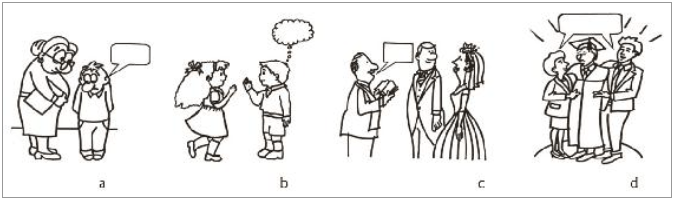
I’ll just share one example, and McGilchrist provides common responses from persons with both hemispheres intact as well as responses with right hemisphere deficits. For image b, a ‘normal’ response is for the respondent to fill in the boy’s talk bubble with ‘Boy, she’s cute.’ A couple of right hemisphere deficit responses were ‘I wonder how big her allowance is’ and ‘Let’s arm-wrestle’, obviously missing context.
The right hemisphere is responsible for understanding emotion, irony, jokes and humour—and the ability to tell the difference between jokes and lies. When told a joke and given an opportunity to fill in the punchline, the language of right hemisphere deficit patients ‘is often excessive and rambling; their comments are often off-colour and their humour is frequently inappropriate; they tend to focus on insignificant details or make tangential remarks’. Moreover, when asked to reconvey a story, the right hemisphere deficit people produced an ‘abundance of embellishments’ to it.
One subject with right hemisphere resection asked, ‘how do you feel?’ responded ‘With my hands’
Other right hemisphere functions are the ability to grasp the semantic nuance and intonation of a speaker. One subject with right hemisphere resection asked, ‘How do you feel?’ He responded, ‘With my hands,’ but he wasn’t joking.
People who have undergone a right hemispherectomy demonstrate a ‘shallow affect, rigidity, [and] lack of imagination’. The left hemisphere seems to prefer denotative speech whilst the right prefers connotative, hence a broader set of possible meanings. Interestingly, yet perhaps not surprisingly, clichés are the domain of the left hemisphere. Poetry and music reside on the right.
Wrapping up this chapter, the right hemisphere tends to serve as the emotional centre, save for anger, which is a left hemisphere activity.
Perspective
In summary, the left brain is very focused. Damage to the right hemisphere mimics the responses of autistic and schizophrenic individuals who interpret inputs differently and without nuance. This nuance often contains emotional or empathetic content that is lost on this cohort.
I am left wondering if schizophrenia and autism are right hemisphere problems, as it were, or if I would be reading into things to arrive at this conclusion.
Having completed Emotional and Social Intelligence next up is a chapter on Cognitive Intelligence. I hope you’ll join me.
What are your thoughts? What did you think of this chapter? Were there any surprises? Anything of particular interest?
First, accept my heartfelt apology in advance for employing the word preciseness over precision. I was seeking a term closer to lightness, a conceit to the Unbearable Lightness of Being.
Audio: Podcast rendition of this page content
It appears that I am at odds with Iain McGilchrist if I am interpreting The Master and His Emissary correctly, His position is that verbal and written language is too precise for accurate communication. Gestures and facial queues are necessary to convey the entire payload; otherwise, it is easy to miss nuances in empathy and metaphor. Missing most are signals conveyed by the eyes, which are interpreted by the right hemisphere. The left hemisphere is more concerned with the mouth.
Before I get too far ahead of myself, the position I’ve asserted for years is that of the insufficiency of language. As diametric as this might seem at face value, I feel that it’s both, and it depends on the words and the contexts, though it feels that we are in disagreement here as well.
It’s long been said that the eyes are the window to the soul, and these people were onto something. The eyes convey emotional content to be interpreted by the right hemisphere. This hemisphere is all about seeing the big picture as well as metaphor.
The left hemisphere is more concerned with maps and symbols, so it is looking at the mouth and lips for minute details.
People with right hemisphere deficits can’t decode meta information conveyed by the eyes. Practically, this means that they can’t interpret metaphor, innuendo, sarcasm or humour. This is also the case for schizophrenics and people further right on the autism spectrum, including those with Asperger’s syndrome. I don’t know if the connexion between these psychological conditions and right hemisphere effects is due to a deficient right hemisphere or something related to the communication channel between the hemispheres. This has not yet been mentioned.
I also find it interesting that this deficit creates a situation where a sufferer can’t discern a joke from a lie, which is telling. In a manner of thinking, a joke is a bit of an untruth or stretching a fact or omitting some details to make a point, so without the larger context that this is the purpose of the joke, it might easily be interpreted as a lie.
All of this is interesting, but these are not the insufficiencies I am concerned with. In these cases, these deficits inhibit the receipt of relevant information. My contention involves the majority of people—the ones we term as ‘normal’.
One of my pet peeves is weasel words. Justice is a big one among these. I wonder if he feels that the Gestalt of the right hemisphere is what I am missing. This is the pornography the US Supreme Court judge, Potter Stewart, who says he can’t define it, but he’ll know it when he sees it. I say that this imprecision is meant to allow for arbitrary and capricious application on a whim or to meat some ulterior motive. This is decidedly not a problem of over-precision, and this is where I hold issue. Can it be too precise, too sharp to a point it needs the edges rounded? Yes. I can see that as well.
Intermission
I feel that missing non-verbal cues is a massive challenge for videoconference calls—even when the audience is one-to-one. First, the resolution needs to be high enough to see the eyes and face, so the person needs to be in frame and not one of several people barely discernible, presume, of course, that they are showing themselves on camera at the start.
Assuming that the resolution and lighting are appropriate and the person’s face is framed in a manner to reveal their eyes and mouth, gesticulation and body language are likely missing, so we are missing more non-verbal cues. I’ll also assume that we can discern aspects of prosody which as timbre, pitch, and intonation.
Add to this a videoconference with multiple participants. Sure, you might be able to see all of the faces, but there is still something missing from these thumbnail views. In some cases, I’ve seen long shots, say, in a conference room, but the detail is notably lacking. No nuance here.
Can we adapt to this situation? Yes, Of course. Should you meet in person where it’s possible and importance is of the utmost? Of course. You’d be a tone-deaf fool not to.
Epilogue
The last point I’d like to make about language being too precise is that for an erudite person like McGilchrist, it just might be, but most people don’t have large vocabularies and have barely adequate grammatical skills. They are hardly at risk of precision. An apt analogy might be to liken them to three-year-olds with crayons—no offence to three-year-olds with crayons. Plenty of people are a step or two above functional illiteracy, but that’s not saying much. To these people, language is less of a sword than it is a blunt instrument, a proverbial bag of bowling balls.
Voltaire once quipped that he’d have written a shorter letter if he had the time, noting the effort necessary for concision. The problem with trying to encode a message not conveyable by body language into a document is that its word count might need to double or treble, which I argue would at the same time reduce interest and comprehension, opening room to misinterpret the intent—all because missing non-verbal queues were lost.
In the end, I am doubling down on my position. Language is insufficient for all but the simplest and basic communication, and it is not too precise. The word McGilchrist is looking for is blunt.
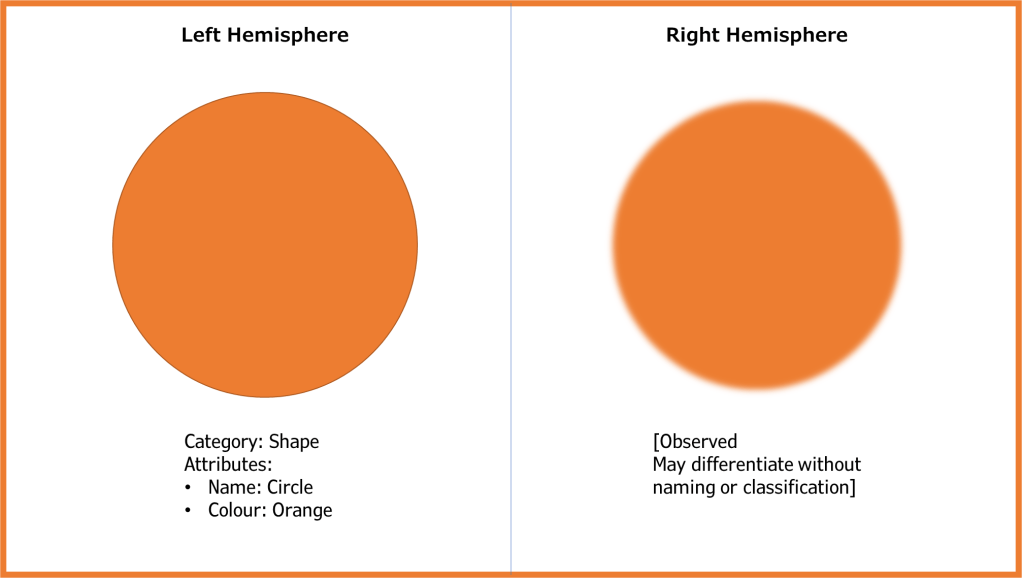
One key aspect of left and right hemisphere differences is the notion of identification versus naming and categorisation. I tend to view the right hemisphere as rather Zen. It just sees things as they are without particular care, judgment, or attachment.
Podcast: Audio rendition of this page content2 Orange Circles as tentatively experienced by the left and right hemispheres of the brain.
I composited a quick illustration to convey the difference. Starting with the right hemisphere, the object is recognised in a global context. Whilst it can be distinguished from a blue thing or a square thing, this is done by holistically surveying the world. The difference is perceived but rather without reflection on memory.
Generally speaking, both hemispheres ‘see’ the object, but where the right hemisphere is interested in the object as presented, the left hemisphere is interested in re-presentation. Where the right hemisphere is about being open to the experience itself, the left closes.
From an evolutionary vantage, the right hemisphere is interested in surveying the world at large and being alert to potential danger or survival queues, perhaps a food source. If the right hemisphere is triggered, the left hemisphere jumps in. This said, the left hemisphere is tightly focused, so if something does alert it—remembering that it is not switched off awaiting the right brain to activate it—, it will respond more quickly than the right hemisphere, though as I’ve noted previously, accuracy is not it’s forte, as the right hemisphere may have to convey that the snake that startled you was, in fact, a garden hose.
The left hemisphere is where categorisation and naming take place. Moreover, it stores the object for later retrieval, creating a map. If a subsequent observation is made, it is compared and contrasted relative to the map. After enough observations are made, the left brain isn’t so interested in observing the external world. It perceives a circle-y shape or perhaps an orangy colour and is convinced (metaphorically) that its cached version is satisfactory.
There is a book named Drawing from the Right Side of the Brain. I don’t want to comment on the book in depth, save to say that the author’s premise is that the so-called left-hemisphere person will look at the face of a subject and draw a generic oval shape. The eyes will be general eye shapes, following the same pattern for the nose and mouth. In the end, they will have rendered a portrait on the level of a child.
Whistler’s Mother, a restoration as reimagined by Mr Bean in the movie Bean.
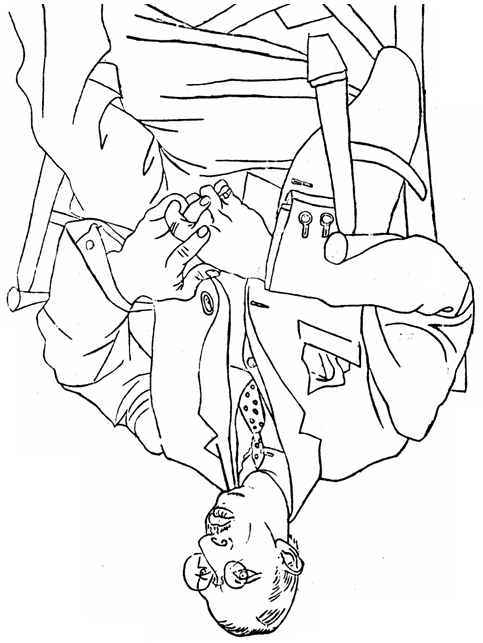
The artist who inhabits the left brain will instead note the contours, shadows, and colours of the face in front of them. One exercise that I had learned in some art class years before I read this was to draw from an inverted portrait. Not being so common as upright faces, the left brain has no representations modelled and so defers to the right hemisphere that is now looking at the object—the terrain—rather than the model.
Inverted image of Igor Stravinsky, a popular subject for breaking left-brain fixedness
I find the divided hemisphere activity in animals without stereoscopic vision to be fascinating. Perhaps, I’ll comment on this next.
* I am not claiming that the right hemisphere sees the world as fuzzy or hazy. Rather, this was me taking artistic licence to not ascribe strict boundaries to the objects in the world, especially as constrained by language.
The only thing I’ll add is the separate notion of the half-life of knowledge—essentially what we treat as fact will in fact (pun intended) not be true for one or another reason. This article gives the same case I mention, which is the invalid notion of a geocentric world. In some cases, it was true in a particular context, but the context is no longer valid. In other cases, the revision has been one of increased precision or accuracy, perhaps Newtonian versus Einsteinian physics.
Even in the case of tautological facts, things can change and meanings can shift. In the case of the colour spectrum, Newton wanted to mimic the Western musical notion of the octave, so he assigned colour names to the light spectrum when viewed through a prism, but there are two differences between his proclamation and our current understanding.
For one, what he labelled blue, we’d today call cyan. Sure, it’s in the family of blues, but when we think ‘blue’, we aren’t likely imagining cyan.
Moreover, he injected indigo to arrive at the seventh colour note, per the octave. But this was just a shoddy addition made in haste. In fact (there I go again), indigo would likely be named dark blue today.
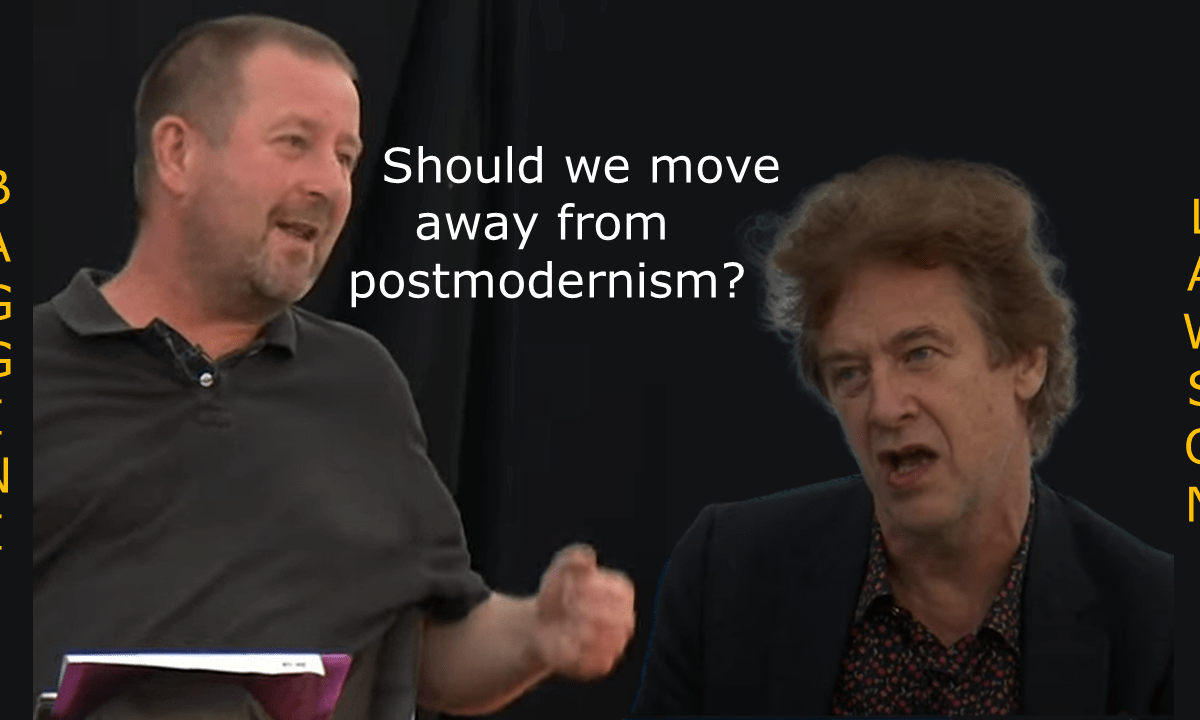
The theme of this Institute of Art and Ideas video is ‘Should we move away from postmodernism?‘
Podcast: Audio rendition of this page content
EDIT: Find my version of this content on YouTube:
Video: Postmodern Defence
At the start, I feel as usual, that the definition of postmodernism is nebulous, and the fora agree, methinks. Toward the end, Hilary Lawson concedes that key actors tied to the early postmodern movement denied being postmoderns, singling out Foucault and Derrida. More on this. Keep reading.
Julian Baggini, the bloke sat on the left and whose positions I am only getting familiar with, starts off the clip. He makes some points, some of which I agree with and others not so much.
He makes a play at claiming that there is some objective truth to be attained, following on with the statement that without this notion, it’s anything goes. I disagree with both of these assertions. Then he cites Thomas Nagel’s The View from Nowhere, wherein he posits that subjectivity and objectivity are extrema on a spectrum and that experience is somewhere in between. This conforms to my beliefs, but there are two provisos. First, the extremum of objective truth is unattainable, objectively speaking. Moreover, as I’ve written before, we have no way of adjudicating whether a given observation is truer than another. It seems that he leaves it that we don’t need to know the absolute truth to know “true enough”, but I think this is both a copout and wrong—but not too wrong for pragmatism to operate.
For example—not mentioned in the clip—, I can imagine that physicists feel that Einsteinian motion physics is truer than Newtonian physics, especially as we need to take measurements nearer to the speed of light. In my thinking, this might provide a better approximation of our notion of the world, but I can also conceive of an Ideal, non-materialistic perspective where both of these are rubbish from the perspective of truth. I feel that people tend to conflate truth with utility.
Julian makes an interesting point about semantics with the claim that “some people” define certain things in such a way as to not possibly be attainable and then claim victory. But what are his three examples? Free will, the self, and objectivity. If you’ve been following me, you’ll know that I might be in his crosshairs because I tend to be in the camp that sees these concepts as sketchy. And to be fair, his claim of defining something in a manner to keep a concept out of bounds is the other side of the same coin as defining something in such a way as to get it into bounds.
The self is different to free will insomuch as it’s a construction. As with any construction, it can exist, but it’s a fiction.
I’ve spoken at length about my position on free will, but I am fairly agnostic and don’t particularly care either way. I feel that the causa sui argument as it applies to human agency is more important in the end. The self is different to free will insomuch as it’s a construction. As with any construction, it can exist, but it’s a fiction. Without interacting with Julian or reading his published works on the self, if there are any, I don’t know how he defines it. And here we are discussing objectivity.
Given Nagel’s objective-subjective polarity, it seems they want to paint postmodernism as claiming that everything is subjective and that science (and religion) hold claims to objectivity. Hilary Lawson, the geezer on the right takes a position between extremes, but he denounces Julian’s claim about objective truth, noting that many people (especially of religious persuasions) make claims on Truth that are diametrically opposed, ostensibly labelling the same object simultaneously black and white. And the object for all intents and purposes is red.
I’ve gotten out of order, but Julie Bindel makes some good points on Feminism and suggests that the philosophical feminists—may I call them pheminists? No? OK then—such as Judith Butler have set women’s rights back by claiming that the category of ‘woman’ is invalid. Minni Salami defended Judith by noting that Butler has helped constructively in some ways and, citing Simone de Beauvoir, that woman is a category established by men to create The Other Sex. Still, Julie—not incorrectly—states that without a category, women (or whatever collective term one decides is representative) cannot be afforded legal protections—because law, as facile as it is, is all about categories and classes.
Hilary reenters the fray and states that it is not acceptable for one person to claim that their lived experience is all that is needed just because that is their truth. To be fair, this feels like a bit of a strawman argument. Perhaps I need to get out more, but I am not familiar with anyone credible making this claim.
I enjoyed watching this clip and processing the information. I hope you do as well. If you have any comments, I’d love to read them.
This is my take on the fifth chapter of The Matter with Things. I suggest reviewing the previous chapters before you delve into this one, but I won’t stop you from jumping queue.
Podcast: Audio rendition of this page content
Intro
Chapter five of The Matter with Things is titled Apprehension, following the previous chapters, Attention, Perception, and Judgment. From the start, let’s clarify that apprehension is not meant in the manner of being nervous or apprehensive. It’s meant to pair with comprehension. More on this presently.
Whilst the previous chapters have been heavily focused on the importance of the right hemisphere, this chapter is focused on the left, which may be given the chance to redeem itself. Not surprisingly perhaps, given the relative function of the right hemisphere versus the left, this chapter is much shorter than prior chapters.
Content
This chapter opens by asking what happens to a person who experiences left hemisphere damage. But let’s return to the chapter title. Apprehension is retaken etymologically and means to hold onto or to grasp. This is the function of the left hemisphere. The right hemisphere is about comprehension. The root ‘prehension’ is Latin for hold; the added ap prefix suggests holding on, whilst the com prefix suggests holding together.
Whilst conceptualising and abstract language is a right hemisphere function, spoken words are a left-brain function. It turns out that so is pointing and other gesticulation, reminding me of some ethnic stereotypes of people who speak with their hands. We need to keep in mind that the right hemisphere controls the left part of the body whilst the left hemisphere controls the right. What this means is that the right hand, being guided by the left hemisphere is marching to a different drummer.
Also, keep in mind from the previous chapters that the right hemisphere is holistic whilst the left is atomistic. Where right hemisphere damage is evident, a person has difficulty viewing the parts of a whole, whilst if the damage is on the left, a person has difficulty constructing a whole from its constituent parts. Namely, it may recognise that a body is constructed from an inventory of pieces—head and shoulders, knees, and toes—, but it can’t seem to grasp the cohesive orchestrated picture.
Apart from body continuity, when the left hemisphere is damaged, it might know all of the steps of a given process—McGilchrist shares the example of a person trying to light a smoking pipe—, but there may be difficulty in some of the instrumentation along the way. He cites an example by Czech neurologist, Arnold Pick, which I share here intact:
The patient is given a pipe and brings it correctly to his mouth, then expertly reaches for the tobacco pouch and takes a match from the box but when asked to light it, sticks the head of the match into the mouthpiece and puts the other end in his mouth as if to smoke it. Then he takes it out of his mouth, draws it out of the mouthpiece and sticks the other end of the match in the mouthpiece of the pipe, pulls it out again, holds it for a while in his hand apparently thinking, and then puts it away.
a person when encountering a pencil would feel compelled to grab it and start writing nothing in particular
To underscore the apprehension, where there is damage evident in the right hemisphere, the right hand (under control of the left hemisphere) may just grasp at things for no reason, perhaps reaching arbitrarily out to doorknobs. In one case, a person when encountering a pencil would feel compelled to grab it and start writing nothing in particular. In each case, the right hemisphere was not available to contextualise the experience. This right hemisphere is opening and exploratory whilst the left is closing and instrumental. It seems one might tend to meander without the left to provide a certain will and direction.
McGilchrist makes some correlations between humans and other great apes, but I’ll just mention this in passing.
I am going to pause to editorialise on McGilchrist’s next claim. He argues that Saussure’s claim that language signs are arbitrary is false and gives some examples—sun, bread, and spaghetti—but I am not ready to accept this stance. For now, I am remaining in the camp with Saussure and Wittgenstein that language is both arbitrary and self-referential. Getting down off my soapbox.
Recall again that whilst the right hemisphere takes the world as presented, the left hemisphere can only re-present. This is why language symbols are handled by the left hemisphere. Coming back to Saussure, the right-brain experiences a ‘cat’ whilst the left-brain names that object a ‘cat’ and classifies it as a mammal, feline, quadruped, and whatever else.
The right hemisphere is about metaphor, prosody, and pragmatics whilst the left hemisphere, though not exclusively, is about syntax and semantics.
The right hemisphere is about metaphor, prosody, and pragmatics whilst the left hemisphere, though not exclusively, is about syntax and semantics. The left hemisphere is about symbols. As such, lipreading and interpreting sign language are both left-brain activities.
An interesting conveyance is a case study of a person with left hemisphere damage reading a book who recites the elephant in place of the written word India, so making an association by not recognising the word itself. And there may be a naming problem, so if there was a problem related to an ankle, they would point to an ankle but substitute the name of the part.
Finally, to reiterate the holistic versus atomistic divide, some people with left hemisphere damage can articulate the parts of the body or a bicycle, but when queried can’t relate that the mouth is beneath the nose or some such.
Perspective
To summarise, McGilchrist leaves with a comment, “The fabric of reality typically goes for the most part unaltered when the left hemisphere is suppressed.”
As I’ve been editorialising a bit throughout, I don’t have much to add at this point. Aside from my Saussure nit, I am still very interested in the concept that the right hemisphere constructs reality. I feel that I interpret this construction differently to Iain.
I believe that we agree that there is a world out there, and we interpret this world by interacting with it. Where I feel we differ is that he feels there is a world of objects that we interact with and perceive whilst I believe that we construct this world of objects by means of constructing the underlying material, from particles to fields. I think he’ll discuss this more in later chapters and I could be off base. Time will tell.
Having put Apprehension to bed, next up is a chapter on Emotional Support and Intelligence. I hope you’ll join me.
What are your thoughts? What did you think of this chapter? Were there any surprises? Anything of particular interest?
In this segment, I continue the journey through Iain McGilchrist’s masterwork, The Matter with Things by summarising chapter three, Perception, a followup to the previous chapters, respectively titled Some Preliminaries and Attention. I strongly recommend that you listen to these in turn, but feel free to play the rebel and cut queue. No one will even notice but you, and if you don’t tell, neither shall I. Come join me.
Podcast: Audio rendition of this page content
Intro
Chapter two of The Matter with Things is titled Perception. Following the previous chapter, Attention, it’s about how we perceive what we attend to. Without attention, there is no perception, but perception is not always correspondent with the so-called reality “out there”.
Content
From the start, McGilchrist wants to assess which hemisphere is more veridical. Spoiler Alert: It’s the right half. But you already knew that because you’ve been keeping pace. And you also know that I feel he is leaving an option on the table, that neither is veridical to the actual terrain; rather, one just better maps the map. But the question essentially resolves to the same place, not as much verity as trust.
Sensory perception occurs in both hemispheres, but it is better in the right hemisphere than the left, as the left has been somewhat relegated to re-presentation over time—the same hemisphere that is better suited for codifying and mapping using symbolic language—something reserved for the brains of primates—which gives us a virtually inexhaustible way of mapping the world.
Perception is holistic, something better handled by the right hemisphere, being as the left hemisphere is more about focus and specificity. On balance, the right hemisphere is the arbiter of performance delegation, whether to perform a task or delegate it to the left hemisphere. About three-quarters of perception functions are right hemisphere processes.
McGilchrist is partial to the position advanced by Merleau-Ponty, that is “perception as a reciprocal encounter.” Perception is not a passive act. It is an interactive intercourse with the environment. What and how we perceive is affected by our experience and the situation.
Visual Perception
Perception involves all the available senses—and by definition none of those otherwise unavailable. He starts with vision. The right hemisphere does a lot of heavy lifting here. It handles size, shape and pattern recognition, contour, shadows, distance and depth, for example, three-dimensional space, and motion and time as well as the ability to recognise objects from unusual angles or from incomplete information, which I tend to think of as playing some Gestalt role. The right also handles colour perception, though the left maintains the colour name mapping.
The left hemisphere is slightly faster at detection, but if what is detected has any signal degradation, the right hemisphere tends to be more accurate. And since the left hemisphere is, what I’ll call lazy, it may tire quickly and space out, so the right hemisphere may have to intervene, if even a bit more slowly. Paradoxically, if the left hemisphere is given more time, its recognition error rate increases. Incidentally, one reason the right hemisphere may respond more slowly is that it is deliberating to attempt to deliver the correct response whilst the left tosses out its first best guess and declares victory. Nailed it!
Nailed It!
Recall from the last chapter that the left hemisphere is also a master of denial, so it is unapologetic when it guesses wrong. I imagine it signalling ‘that’s not a bus’ just as it hits you and then insists that it never was a bus; that injury must have been caused by something else. Perhaps it was an untoward wrecking ball.
Without delving into details here, McGilchrist points out that much early research might be invalid because it employed cathode ray tubes—CRTs—whose mechanisms present biased information to the visual field, thereby invalidating conclusions.
the left hemisphere is better at recognising tools—hammers and spanners—, but not musical instruments, which it perceives more as living entities
An interesting area for me is that the left hemisphere is better at recognising tools—hammers and spanners—, but not musical instruments, which it perceives more as living entities. And this is an apt segue to auditory perception.
Auditory Perception.
Whereas the left hemisphere is better at symbolic language processing and “the processing of meaningless noises, such as clicks”, the right hemisphere pretty much handles the rest, from pitch, inflexion, tone, phrasing, metre and complex rhythm, and melody. The left keeps tabs on basic rhythmic patterns. It is assumed that rhyming relies on both hemispheres working in concert.
For most people, music processing is a right hemisphere event, but this is not true for professional musicians, who utilise both hemispheres, likely owing to the musical language translation processing unnecessary for the casual listener.
Olfactory Perception
Interestingly, the acuity of the nose is orders of magnitude superior to that of the eyes and ears. Olfactory recognition and discrimination have a right hemisphere preference, but emotional reactions to scent may be stronger in the left hemisphere.
Gustatory Perception
“Apart from five very basic tastes – salt, sweet, sour, bitter and umami – which come from the tongue, all flavours come from the olfactory sense.” In general, gustatory perception is a right hemisphere function. However, there is an exception for professional wine tasters, who like professional musicians need to map experiences to words associated to rating and naming.
Tactile Perception
Remembering that the right hemisphere controls the left half of the body, whilst the left hemisphere controls the right, the sense of touch is superior in the left hand. Feelings of warmth, and temperature discriminations in general, are associated with right hemisphere activation. Interoception, the ability to perceive the internal workings of the body, is another right hemisphere process.
Local versus Global Perception
Recall that the right hemisphere captures the world holistically whilst the left hemisphere has a laser focus. This equates respectively to global and local perception. As it happens, the right can do both, but the left is limited to local. This means that if the left hemisphere is damaged, the right can pick up the slack, but if the right hemisphere is damaged, the left cannot compensate for the lost holistic perspective. In practice, the right runs the show and delegates to the left when it deems it to be appropriate for the circumstance. For some reason, normal adolescents have a bias toward local perception over global.
Pathologies of Perception
This leads us to abnormalities, such as Alzheimer’s disease. Deterioration of right hemisphere function leads to a sense of disorganisation and loss of sensation. This hemisphere is also responsible for constructing a sense of self and self-awareness. McGilchrist calls out that the term self has multiple meanings. Much of the notion of self is associated with the medial prefrontal cortex in both hemispheres, but the objectified self and the self as an expression of will (in the respect Schopenhauer spoke of) are left brain aspects.
Perception of a contiguous self over time is a right hemisphere function, the loss of which is not uncommon in cases of schizophrenia.
In discussing visual hallucinations and distortions, almost ninety per cent of these have been attributable to right hemisphere anomalies. McGilchrist shares examples over several pages, but I’ll summarise by description alone of what can be categorised under the umbrella term of metamorphopsia. These might lead to object impermanence, or viewing things as too large or too small, too close or too distant, skewed, or the wrong shape altogether. In some cases, only half of an object, including self-perception, was outsized. This might occur on a macro level or a micro level, which is to say that it may be entire objects or bodies or just faces, or just familiar faces or just eyes or just one eye. This might occur on a macro level or a micro level, which is to say that it may be entire objects or bodies or just faces, or just familiar faces or just eyes or just one eye.
Some of these cases involved motion, for example, the sense that some object is receding away from the observer as the observer draws nearer to it.
After a journey through Charles Dodgson, AKA Lewis Carroll, and Alice in Wonderland, provides a plethora of examples in prose of some of these visual effects.
From visual hallucinations, we wonder through hallucinations of the other senses, though the data points on these are much sparser, but the left hemisphere does seem to be the culprit of most auditory hallucinations.
Perspective
To summarise, I am again left to feel that the left hemisphere is a deadbeat hanger-on. It’s there in a pinch, but it’s an unreliable narrator and worker that falls asleep at the wheel. Psychology does have a position on what a normal person should see and hear and taste and touch, but normal doesn’t mean real.
I was hoping to see some information and perspective on synaesthesia, a condition where people perceive experiences through sense-perception organs different to normal. These people see music and hear smells or taste colours and so on. We consider this to be anomalous, but does it provide a fitness benefit, and are these people ahead of “normal” people or are they carrying excess baggage that creates a burden, even if the condition is otherwise benign.
Now that we’ve covered attention and perception, we’ll be covering judgment in the next chapter. I hope you’ll join me.
What are your thoughts? What did you think of this chapter? Have you experienced or know of anyone who has experienced any of these so-called anomalies. Are you familiar with any of the effects mentioned in Alice in Wonderland? Leave comments below.
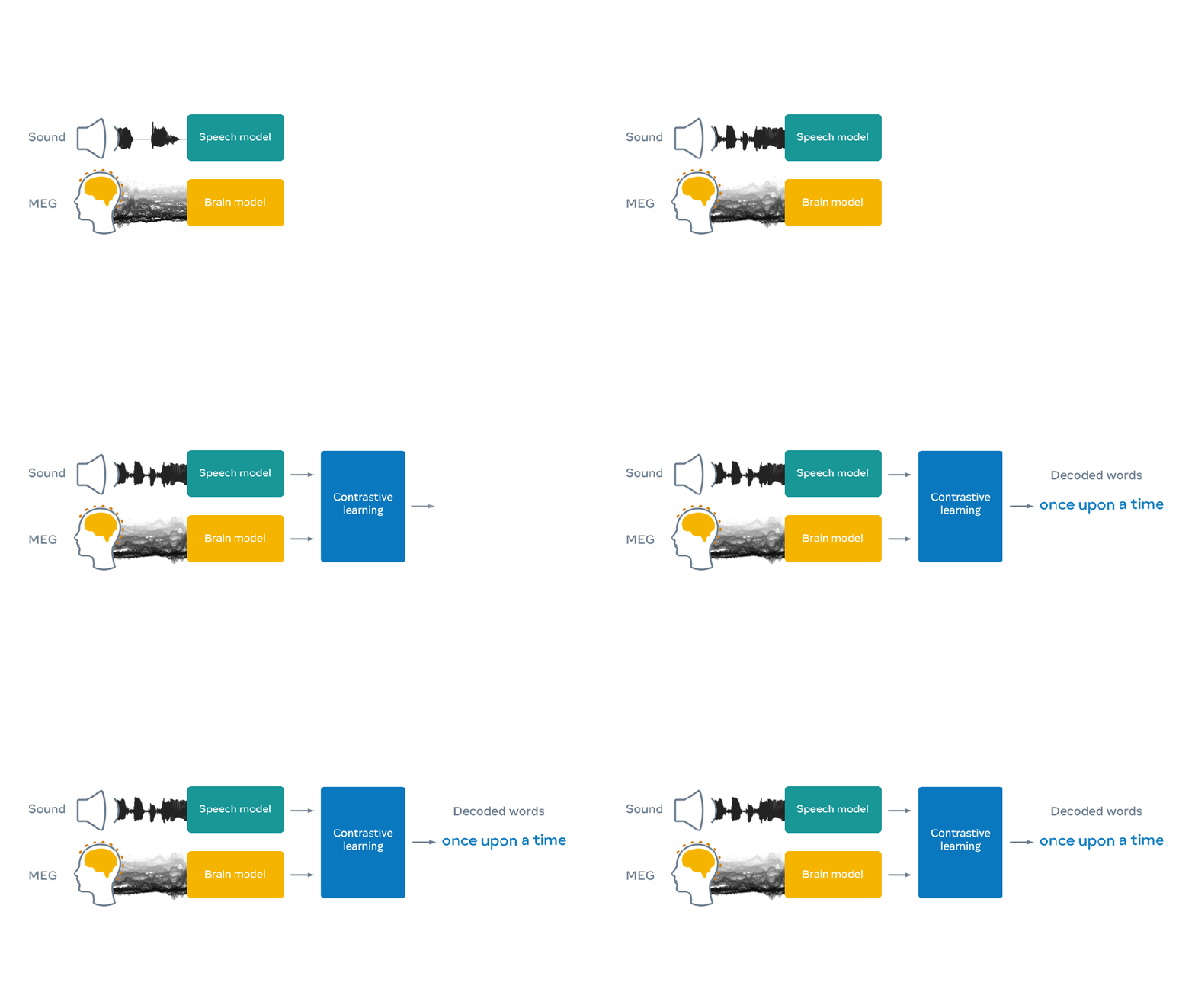
Apologies in advance for sharing PR hype from Meta (formerly known as Facebook),but I want to comment on the essence of the idea, which is using AI to decode speech from brain activity. It seems to imply that one would apply supervised machine learning to train a system to map speech to brain activity as illustrated by the image below.
Podcast: Audio rendition of this page contentTo decode speech from noninvasive brain signals, we train a model with contrastive learning to align speech and its corresponding brain activity
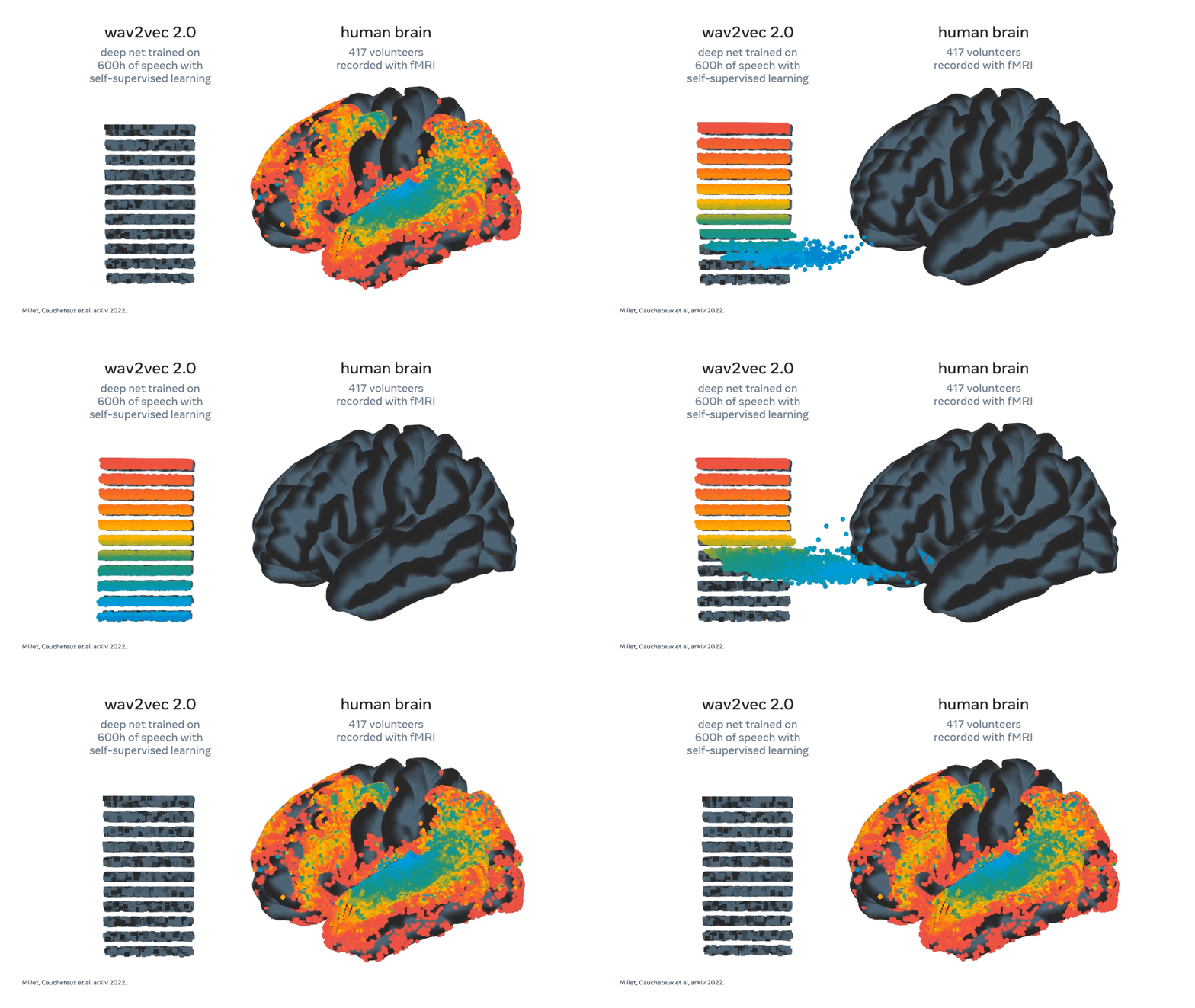
The dataset would require the captured patterns of a large enough sample size. In this case, it appears to have been some 417 volunteers.
Activations of wav2vec 2.0 (left) map onto the brain (right) in response to the same speech sounds. The representations of the first layers of this algorithm (cool colours) map onto the early auditory cortex, whereas the deepest layers map onto high-level brain regions (e.g. prefrontal and parietal cortex).
This feels like it could have many commercial, consumer, and industrial uses including removing other human-computer interface devices, notably keyboards, but perhaps even mouses. Yes, I said mouses. Sue me.
Given hypotheses related to language and cognition, I am wondering what can be gleaned by mapping different multiple native language speakers to cognitive processes in order to remap them to speech output if it would be able to arrive at some common grammar that could then output a given thought stream into any known (and mapped) language, allowing for instantaneous “translation”.
Of course, a longer-term goal would be to skip the external devices and interface brain to brain. This sounds rogue science fiction scary, as one might imagine an external device trained on a brain to read its contents. One of the last things this world needs is to have to worry about neuro-rights and about being monitored for thought crimes. Come to think of it, isn’t there already a book on this? Nevermind. Probably not.
Technology is generally not inherently harmful or helpful, as that is determined by use. Humans do seem to tend toward the nefarious. Where do you think this will go? Leave a comment.
I decided to try my hand at reading. I came upon Peter Zapffe when I was reading The Conspiracy against the Human Race, and The Last Messiah is a relatively short essay. It’s under 25 minutes.
My first goal was to figure out how to pronounce Zapffe. As it happens, the terminal E is pronounced as a schwa. And that makes sense. My heritage, as it were, is Norwegian. My grandad was born in Norway, emigrating during the so-called World War 2. His family surname is Gade, with the E pronounced the same way, so the name is pronounced as /gäʹdə/, but Anglicised, it the A becomes a long vowel owing to the silent E, so it becomes /geɪd/.
What was new to me is that in Norwegian, Peter is pronounced /pɛt ə/ [as if spelt Petta] rather than /ˈpiːtɚ/ or perhaps /ˈpiːtɹ/ in some American renditions more familiar to English readers.