Welcome to Part 2 of a Week-Long Series on the Evolution and Limits of Language! This article is part of a seven-day exploration into the fascinating and often flawed history of language – from its primitive roots to its tangled web of abstraction, miscommunication, and modern chaos. Each day, we uncover new layers of how language shapes (and fails to shape) our understanding of the world.
If you haven’t yet, be sure to check out the other posts in this series for a full deep dive into why words are both our greatest tool and our biggest obstacle. Follow the journey from ‘flamey thing hot’ to the whirlwind of social media and beyond!
Saussure and the Signified: Words as Slippery Symbols
Fast-forward a few thousand years, and humans are no longer just warning each other about hot flames or toothy predators. We’ve moved on to the exciting world of abstract thought, but the language tools we’re using haven’t quite caught up. Enter Ferdinand de Saussure, who basically waltzed in to tell us, ‘Hey, all those words you’re throwing around? They’re not doing what you think they’re doing.’
Saussure gave us the idea of the signifier and the signified. Now, don’t let the fancy terms fool you. It’s just a way of pointing out that when we say ‘tree’, we’re not actually talking about a tree. No, we’re using the word ‘tree’ as a symbol – a signifier – that points to the idea of a tree. The signified is the actual concept of ‘tree-ness’ floating around in your brain. But here’s the kicker: everyone’s idea of a tree is a little different.
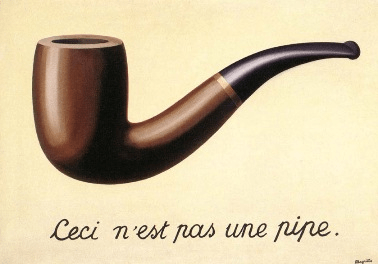
And this isn’t just a language problem – it’s an art problem too. Enter René Magritte, the surrealist artist who really drove this point home with his famous painting, Ceci n’est pas une pipe (‘This is not a pipe’). At first glance, it looks like a straightforward picture of a pipe, but Magritte was making a deeper point. It’s not actually a pipe – it’s an image of a pipe, a representation. You can’t stuff it with tobacco and smoke it, because what you’re looking at is a representation, not the real thing.
In the same way, when we use words, we’re not talking about the thing itself – we’re just waving a flag toward the concept of that thing. So, when you say ‘tree’, you’re really saying ceci n’est pas un arbre – this is not a tree. It’s just a word, a placeholder, a verbal painting of something real. And just like Magritte’s pipe, it’s easy to get confused. You might think you’re talking about the same tree, or the same ‘freedom’, but all you’ve got is a symbol – and everyone’s symbol looks a little different.
This is where things start to unravel. Words are slippery symbols, and as soon as we move away from concrete, physical objects – like trees or, yes, pipes – and into abstract ideas, like ‘justice’ or ‘truth’, the symbols become even harder to hold onto. The cracks in language start to widen, and before you know it, you’re no longer even sure if you’re talking about the same concept at all.
Language, Saussure argues, isn’t this neat, objective system we thought it was. It’s a game we’re playing, and the rules are written in invisible ink. By the time we get to abstract nouns, we’re basically playing with loaded dice. You think you’re communicating clearly, but every word you use is just a placeholder for the idea you hope the other person has in their head. And nine times out of ten? They don’t.
So, while early humans were struggling to agree on the ‘flamey thing’, we’re here trying to agree on concepts that are infinitely more complicated. And Saussure? He’s just sitting in the corner with a smirk, telling us we never had control over language in the first place. “Good luck with your ‘truth'”, he seems to be saying. ‘I’m sure it’ll mean the same thing to everyone’.
Abstraction: Enter Freedom, Truth, and Confusion
Now that we’ve wrapped our heads around the fact that words are nothing but slippery symbols, let’s take it up a notch. You thought ‘tree’ was tricky? Try something more abstract. Enter: freedom, truth, justice. Things that can’t be seen, touched, or stuffed into a pipe. Here’s where language goes from being slippery to downright treacherous.
See, early language worked because it was tied to concrete things. ‘Toothey thing scary’ wasn’t up for debate. Either you got eaten, or you didn’t. Simple. But then humans, ever the overachievers, decided it wasn’t enough to just label the world around them. They wanted to label ideas, too – things that don’t have any physical form but somehow drive us all crazy.
Take ‘freedom’, for instance. Sounds nice, right? Except, if you ask ten people what it means, you’ll get ten different answers. For some, it’s ‘freedom from’ something – a kind of liberation. For others, it’s ‘freedom to’ do whatever you want, whenever you want. And yet for others, it’s an abstract ideal tied up in political philosophy. Suddenly, you’re not just dealing with different trees – you’re dealing with entirely different forests.
The same goes for truth. Is it objective? Subjective? Relative? Absolute? Everyone’s got a different take. Plato had his own grand ideas about ‘Truth’ with a capital T, while Nietzsche basically rolled his eyes and said, ‘Good luck with that’. You’re out here using the word, assuming it means the same thing to everyone else, but really you’re all just talking past each other.
And don’t even get started on justice. Some say it’s about fairness, others say it’s about the law, and still others think it’s just a nice idea for dinner party debates. The problem with these words – these abstract nouns – is that they represent ideas that live entirely in our heads. Unlike the ‘flamey thing’ or the ‘toothey thing’, there’s no physical reality to pin them to. There’s no universally agreed-upon image of ‘freedom’ that we can all point to and nod along, like Magritte’s pipe. There’s just… vague agreement. Sometimes. On a good day.
This is where language really starts to break down. You might think you’re having a productive conversation about ‘freedom’ or ‘truth’, but half the time, you’re speaking different languages without even realising it. Words like these aren’t just slippery – they’re shapeshifters. They bend and morph depending on who’s using them, when, and why.
So, while early humans were busy with their simple, effective ‘toothey thing scary’, we’re now trying to nail down ideas that refuse to be nailed down. What started as a useful survival tool has turned into a game of philosophical Twister, with everyone tied up in knots trying to define something they can’t even see. And, as usual, language is just standing in the corner, smirking, knowing full well it’s not up to the task.
Welcome to Part 1 of a Week-Long Series on the Evolution and Limits of Language! This article is part of a seven-day exploration into the fascinating and often flawed history of language—from its primitive roots to its tangled web of abstraction, miscommunication, and modern chaos. Each day, we uncover new layers of how language shapes (and fails to shape) our understanding of the world.
If you haven’t yet, be sure to check out the other posts in this series for a full deep dive into why words are both our greatest tool and our biggest obstacle. Follow the journey from ‘flamey thing hot’ to the whirlwind of social media and beyond!
Language: humanity’s greatest tool – or perhaps just the most elaborate way to confuse each other. Once upon a time, communication was simple. If something was dangerous, you screamed. If something was delicious, you grunted approvingly. Life was easy when all you needed to do was convey, ‘flamey thing hot’ or ‘toothey thing scary’. The early humans were onto something – keep it short, sweet, and survival-oriented.
Audio: NotebookLM podcast on this topic.
But no. That wasn’t enough for us. Somewhere along the way, we decided it wasn’t sufficient to just think these survival gems internally. We had to tell the other guy too – who, let’s face it, was probably getting a little too close to the flamey thing for comfort. Thus, language evolved from a quiet cognitive tool to a public spectacle. Welcome to the grand tradition of miscommunication, where everything from ‘flamey thing hot’ to ‘freedom’ became a subject of debate.
This is the language insufficiency hypothesis: the notion that language, as fancy as it’s become, is inherently incapable of keeping up with our ever-expanding thoughts and abstractions. Sure, it’s allowed us to create governments, argue over philosophy, and send passive-aggressive texts – but at what cost? We still can’t agree on what ‘truth’ means, let alone ‘justice’. But we’re getting ahead of ourselves. Let’s start where it all began, with some grunts, groans, and the dawn of miscommunication.
Internal Reflections: The First ‘Words’ in Our Heads
Before language became a social construct, it was something far simpler, more personal. Picture the scene: you’re an early human, fresh out of the trees and wandering through a world that’s more ‘toothey thing scary’ than ‘civilisation’. Your brain, eager to help you survive, starts talking to itself – internally, of course. ‘Flamey thing hot. Toothy thing scary. Berry thing yummy’. It wasn’t elegant, but it worked.
Back then, these thoughts didn’t need to be shared. You didn’t need to tell someone else that the “toothey thing” was going to tear their face off—they could figure that out by getting a little too close. The brain’s job was survival, and it had evolved just enough language to keep you from becoming lunch. No social niceties here. No philosophical discussions about what ‘toothey’ really meant. Just raw, unfiltered cognition, directed at keeping you alive for another day.
But eventually, survival alone wasn’t enough. Humans, being the social animals that they are, started interacting more. ‘Flamey thing hot’ became information worth sharing – especially when some genius in the group was about to stick their hand in it. And just like that, language left the internal world of the individual and became a shared resource. Thus began the long, painful journey from ‘toothey thing scary’ to “let’s discuss the moral implications of ‘freedom'”.
From Grunts to Groans: Language’s Social Debut
Now that we’ve mastered the art of internal reflection – courtesy of ‘flamey thing hot’ and ‘toothey thing scary ‘ – it’s time for language to make its grand social debut. This is where things start to go off the rails. You see, it was one thing to keep these pearls of wisdom to yourself. It’s quite another to explain them to someone else. And unfortunately, humans quickly realised that not everyone had the same instincts for not getting killed.
So, picture this: You’re sitting by the fire (because someone in your tribe finally figured out how to not touch the flamey thing), and you notice Bob – let’s call him Bob – is eyeing that red, shiny berry that you know is definitely of the “belly go bad” variety. You can’t just let Bob eat the berry and ruin everyone’s evening with his inevitable projectile vomiting. But how do you communicate this vital piece of information?
Enter language’s first public service. ‘Berry bad’, you say, but of course, Bob doesn’t get it. He thinks you mean it’s bad because you want the berry for yourself. So, being Bob, he takes a bite anyway. Cue the disaster. And just like that, language moves from personal survival tool to a shared (and often misunderstood) form of communication.
Suddenly, it wasn’t enough to know ‘flamey thing hot’ for yourself. You had to communicate it to the other guy, and that’s where things started getting complicated. Because the moment language became social, it also became messy. What was once clear and useful – ‘toothey thing scary’ – became open to interpretation. Maybe Bob thinks ‘toothey’ means ‘friendly’. Maybe he’s an optimist, or maybe he’s just the kind of person who needs to find out for himself why the toothy thing has those teeth.
And there you have it—the birth of miscommunication. Early language was about survival, but the minute you needed someone else to understand it, you were doomed. Simple, straightforward thoughts became tangled up in social dynamics. Suddenly, you’re not just saying ‘flamey thing hot’ because it’s true; you’re saying it to convince someone who might not trust your expertise on flamey things.
Language, once internal and personal, had to be shared – and in that sharing, it lost something. No longer just a way to label the world, it became a way to negotiate it, with all the misunderstanding and frustration that implies. It wasn’t long before we left behind the “berry bad” phase and moved on to even more abstract problems like “Who gets the last mammoth leg?” and “Why does Bob still not understand when I say ‘toothey thing scary’?”
The Inherent Limitations of Linguistic Communication
Language, often hailed as humanity’s greatest achievement, may paradoxically be one of our most significant limitations. The language insufficiency hypothesis posits that language is inherently inadequate for communicating abstract concepts, a notion that challenges our fundamental understanding of human communication and cognition. This essay explores this hypothesis, tracing the evolution of language from its primitive origins to its current complexity, and examining the philosophical and practical implications of linguistic inadequacy.
The Accidental Evolution of Language
Language, like many aspects of human biology and cognition, emerged not through intentional design but as an evolutionary accident. Initially serving as an internal cognitive function – a means of organising one’s own thoughts – language gradually evolved into a tool for external communication. This transition likely began with simple vocalisations, perhaps rooted in rhythmic expressions akin to music and dance, before developing into more structured speech.
Early linguistic communication likely centred on concrete objects and immediate experiences, with words serving as direct signifiers for observable phenomena. However, as human cognition grew more sophisticated, so too did our linguistic capabilities, expanding to include verbs, modifiers, and eventually, abstract nouns.
The Emergence of Abstraction and Its Challenges
The development of abstract nouns marked a significant leap in human cognition and communication. Concepts such as ‘truth’, ‘justice’, and ‘freedom’ allowed for more complex and nuanced discourse. However, this advancement came at a cost: these abstract concepts, lacking direct physical referents, introduced unprecedented ambiguity and potential for misunderstanding.
The language insufficiency hypothesis suggests that this ambiguity is not merely a byproduct of abstraction, but a fundamental limitation of language itself. Whilst two individuals might easily agree on the ‘treeness’ of a physical tree, concepts like ‘fairness’ or ‘reason’ are inherently unresolvable through linguistic means alone. This insufficiency becomes increasingly apparent as we move further from concrete, observable phenomena into the realm of abstract thought.
Wittgenstein and the Limits of Language
Ludwig Wittgenstein’s later work provides crucial insights into the language insufficiency hypothesis. Wittgenstein posited that words ultimately only map to other words, never truly making contact with the objective world. This perspective suggests that language operates within a closed system of human understanding, constructing our perception of reality rather than directly representing it.
This Wittgensteinian dilemma underscores the core of the language insufficiency hypothesis: if words only refer to other words, how can we ever be certain that we’re communicating abstract concepts accurately? The very tool we use to discuss and understand abstraction may be fundamentally incapable of capturing its essence.
Cultural and Disciplinary Variations
The inadequacy of language in conveying abstract concepts becomes even more apparent when we consider cultural and disciplinary variations in communication. Different cultures and academic disciplines develop their own specialised vocabularies and ‘language games’, as Wittgenstein termed them. Whilst these specialised languages may facilitate communication within specific contexts, they often create barriers to understanding for outsiders.
This phenomenon highlights another aspect of linguistic insufficiency: the context-dependent nature of meaning. Abstract concepts may be understood differently across cultures or disciplines, further complicating attempts at clear communication.
Neurolinguistic Perspectives
Recent advances in neurolinguistics have provided new insights into the brain structures involved in language processing. Whilst these studies have enhanced our understanding of how the brain handles language, they have also revealed the complexity and variability of linguistic processing across individuals. This neurological diversity further supports the language insufficiency hypothesis, suggesting that even at a biological level, there may be inherent limitations to how accurately we can communicate abstract concepts.
Implications and Counter-Arguments
The language insufficiency hypothesis has profound implications for fields ranging from philosophy and psychology to law and international relations. If language is indeed inadequate for communicating abstract concepts, how can we ensure mutual understanding in complex negotiations or philosophical debates?
However, it’s important to note that not all scholars accept the strong version of this hypothesis. Some argue that whilst language may have limitations, it remains our most sophisticated tool for sharing abstract ideas. They suggest that through careful definition, contextualisation, and the use of metaphor and analogy, we can overcome many of the inherent limitations of linguistic communication.
Conclusion: Navigating the Limits of Language
The language insufficiency hypothesis presents a challenging perspective on human communication. It suggests that our primary tool for sharing abstract thoughts may be fundamentally flawed, incapable of fully capturing the complexity of our inner cognitive experiences.
Yet, recognising these limitations need not lead to communicative nihilism. Instead, it can foster a more nuanced approach to language use, encouraging us to be more precise in our definitions, more aware of potential misunderstandings, and more open to alternative forms of expression.
As we continue to grapple with abstract concepts and strive for clearer communication, we must remain cognizant of these linguistic limitations. Understanding the origins and nature of language—and its inherent insufficiencies—can help us navigate its complexities, fostering more effective and empathetic communication across diverse fields of human endeavour.
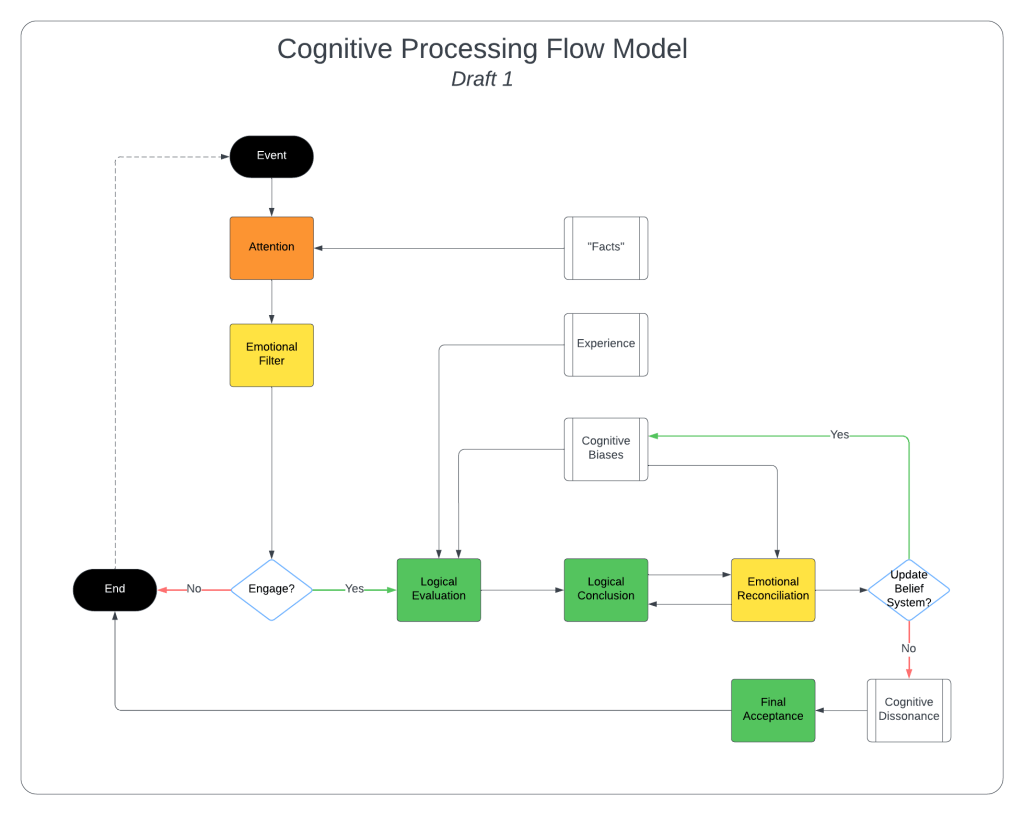
The Cognitive Process Flow Model illustrates how we process the phenomenal world. It’s reductionist and is missing aspects because it is just a back-of-the-napkin sketch. I created it because I uttered, “I can model it for you”. And so I did.
EDIT: I’ve updated the model slightly as the article head image, but the copy content refers to the first draft.
My response was to a person making the claim, that all you need to facts and logic prevails. Rather than restate the argument, I’ll just walk through the diagramme.
There’s meta information to set it up. We are subjective entities in the world. We have a sense-perception apparatus as we exist in it. Countless events occur in this world. We recognise only a few of them within our limited range, though technology expands this range in various ways.
Most of us interact in the world. Some are less ambulatory, so the world visits them. Some have sense-perception deficits whilst others have cognitive deficits. My point is not to capture every edge and corner case. This is just a generalised model.
All models are wrong, but some are useful.
—George Box
It starts with an event. Events occur ceaselessly. In our small portion of the world and elsewhere. For the purpose of the model, the first thing that happens is an event catches our attention. We might notice a shape, a colour, or a movement; we might hear a sound, smell an aroma, feel a sensation, or taste something.
A pre-emotion, pre-logic function serves to process these available inputs. Perhaps, you hear a report on anthropogenic climate change or read something about a political candidate. This emotional filter will police sensory inputs and unconsciously or preconsciously determine if you will react to the initial stimulus. If not, you’ll continue in an attention-seeking loop. Not that kind of attention-seeking.
As my dialogue was about the presentation of facts, our next stop will be logical evaluation. Does this make sense to us, or can we otherwise make it? This is a process in itself. I’ll assume here that it requires little elaboration. Instead, I’ll focus on the operating environment.
Our logical processes are coloured by past experiences and tainted by cognitive biases and deficits. We may also trigger the calling of additional facts through past experiences or the current engagement.
We’ll process these fragments and reach some logical conclusion. But we’re not done. We take this intermediate conclusion and run it through more emotional processing. Cognitive biases come back into play. If the event conforms with your past experiences and cognitive biases, we may run it through a cognitive dissonance routine. To be honest, this probably is part of the emotional reconciliation process, but I’ve drawn it here, so I’ll let it be. In this case, it’s just a filter. If it happens to conform to our belief system, it will pass unfettered; otherwise, it will be squared with our beliefs. Again, this leads me to believe it’s a subcomponent of emotional reconciliation. I’ll update the chart later.
In any case, we’ll end at Final Acceptance. This acceptance may be that we accept or reject the logic, but we arrive at an opinion that gets catalogued with the rest of them. Some may be elevated to facts or truths in the epistemological hierarchy. Although an end marker is identified, it’s really a wait state for the next event. Rinse and repeat until death.
I’ll update this presently. Be on the lookout. It could include more dimensions and interactions, but that might have to wait until version 3.
Meantime, does this feel right to you? Did it even get your attention?
An Example: Anthropogenic Climate Change
Let’s wrap up with an example. I’ll use climate change. An article comes into your attention field, and you have an interest in these things, so it passes through the emotional filter. If your propensity for these articles is high, it might race to the next stage.
You read the article, and it contains some facts—rather, it contains claims for evaluation. To do this, you’ll recall past experiences and cognitive biases are always lying in wait. You may have to look for new facts to add to the mix. These will have to take a similar route past your attention gatekeeper and emotional sidekick.
If you are already predisposed that climate change is a hoax, these facts will filter through that lens—or vice versa.
When all of this is resolved, you’ll have arrived at a conclusion—perhaps we’ll call it a proto-conclusion. It hasn’t been set yet.
You are still going to introspect emotionally and decide if this is a position you want to hold. Perhaps, you feel that climate change is a hoax but this doesn’t jive with that position. Here, you’ll either accept these facts and flip a bit to a sceptical believer or cognitive dissonance will kick in and ensure your sense of the world isn’t thrown off kilter. You may update your belief system to include this datum for future assessments.
Now we are ready for final acceptance. You can now express your established opinion. If the net event is to counter that acceptance, rinse and repeat ad infinitum.
Political correctness, on the surface, seems like a noble cause. Its primary goal is to foster inclusivity, promote respect, and prevent offence by regulating language. But beneath this well-meaning exterior lies a paradox: in the pursuit of protecting sensitivities, political correctness often ends up infringing on free expression and alienating those who feel their voices are being restricted. The very thing it seeks to prevent—offence—is often shifted to the speaker, creating a moral stalemate where no one truly wins.
The Intent vs. The Outcome
The fundamental intention behind politically correct (PC) speech is clear: to prevent harm. By urging people to avoid potentially offensive language, the aim is to create a more harmonious, respectful society. But as the adage goes, “The road to hell is paved with good intentions.” What PC speech often forgets is that words are not merely tools for appeasement. They are vessels for meaning, clarity, and sometimes emotional impact.
The road to hell is paved with good intentions.
In practice, what we see is a growing gap between intent and outcome. People become so focused on using the “right” terms that they lose the authenticity of their expression. Conversations become stilted and disingenuous, with individuals more concerned about offending someone than engaging in genuine dialogue. The paradox here is unavoidable: PC speech seeks to protect the object (those who may be offended), but in doing so, it often offends the subject (the speaker). What starts as an attempt to preserve harmony creates an environment where truth and clarity are sacrificed for the sake of politeness.
Disingenuous Communication
Euphemisms and “sanctioned” terms have a way of watering down language. Whilst they may soften the potential impact of certain words, they also strip away their power. In the name of not offending, PC speech dilutes the very thing that makes communication effective: its ability to convey raw, unfiltered meaning. When language is sanitised to the point of blandness, it loses its ability to provoke thought, challenge ideas, or evoke emotion.
This leads to a culture of disingenuous communication. Rather than engaging in sincere conversation, people tiptoe around topics, afraid of crossing invisible lines. Ironically, this creates more division because what could have been an open exchange of ideas is reduced to a polite, surface-level interaction where no one says what they truly mean.
The Subjectivity of Offence
Here’s the kicker: offence is subjective. What offends one person may not even register for another. And yet, PC culture operates on the assumption that offence is both predictable and universal as if we can map out exactly what will offend whom in every scenario. The reality is far messier. People come from different backgrounds, have varying sensitivities, and interpret words through their own unique lenses.
The subjectivity of offence makes it impossible to predict or avoid entirely. We’re left with a scenario where everyone is constantly second-guessing their language, afraid to say the wrong thing, yet never truly sure of what the “wrong” thing even is. This arbitrary nature of offence doesn’t lead to more thoughtful conversation; it leads to silence, where people are too cautious to express themselves at all.
A Zero-Sum Game
At its core, political correctness sets up a zero-sum game. On one side, you have positive freedoms—the freedom to feel included, respected, and protected from harm. On the other side, you have negative freedoms—the freedom from censorship, restriction, and the fear of saying something wrong. The trouble is, that these freedoms are often in direct conflict. Protecting one group’s sensitivities inevitably means infringing on another’s freedom of expression.
This isn’t just an intellectual debate—it’s a moral impasse. PC speech has created a situation where no one comes out on top. The speaker feels censored, the listener feels offended, and the conversation stalls in gridlock. The result is that both sides suffer. In the relentless pursuit of an all-or-nothing outcome, we lose the chance for compromise or meaningful dialogue. What we get instead is an “us versus them” mentality, with each side digging in and claiming the moral high ground.
The Pendulum Effect
This rise of PC culture is part of a broader cultural shift toward collectivism, where the needs and feelings of the group are prioritised over individual freedoms. In many ways, this shift was necessary. After decades of unchecked individualism, society needed a correction—an acknowledgement that words can cause harm and that we owe each other a certain level of respect.
But as with all cultural shifts, the pendulum can swing too far. What started as a necessary push for inclusivity has morphed into something more restrictive, where individual expression is sacrificed at the altar of group harmony. This disequilibrium has left society in a state of tension, where both sides are dissatisfied. As history shows, cultural trends ebb and flow, but until the pendulum swings back, both sides are left feeling uncomfortable and marginalised.
Human Nature: The Eternal Bickering
At the end of the day, bickering is just part of human nature. No matter how hard we try, there will always be conflict when people feel their moral or intellectual territory is being encroached upon. Political correctness, in its current form, exacerbates this natural tendency by setting up a battleground where both sides feel aggrieved. The PC police push for language policing, whilst the anti-PC camp fights back against what they see as an attack on free speech.
The sad truth is that this bickering will likely continue as long as both sides insist on an all-or-nothing solution. In a world where compromise seems like weakness, and where both sides claim the moral high ground, there’s little room for meaningful progress.
Counterpoints for Balance
It’s only fair to acknowledge that PC speech has done some good. In fostering a more inclusive society, it has given a voice to marginalised groups and helped reduce harm caused by thoughtless or malicious language. There’s also a valid argument that some regulation of language is necessary to prevent hate speech and maintain civility in increasingly diverse communities.
That said, the overreach of PC speech—the constant pressure to conform to an ever-shifting set of linguistic rules—has created a stifling environment. What began as a movement for respect and inclusivity has become a barrier to free expression and a source of division.
Conclusion
In the end, the paradox of political correctness is this: it aims to create a more inclusive, harmonious society, but its current form stifles free expression and fuels division. As long as we continue to prioritise group sensitivities over individual freedoms, we’ll remain stuck in this cycle of conflict and resentment. It’s time to recalibrate—finding a balance between respect for others and the right to speak freely whilst accepting that offence is inevitable in an open society.
In the United States, freedom of speech is protected by the Second Amendment. Just kidding. It’s the First Amendment. But if we’re honest, the line between speech and violence is thin in practice, if not in law.
Here’s the thing: freedom goes both ways. There’s the freedom to speak, and the freedom from being bombarded by whatever nonsense comes tumbling out of people’s mouths. And that’s where things get messy. The grand defence of speech, in all its uncensored glory, often ignores what we’re giving up—our freedom of peace. You know, that quiet space where we don’t have to listen to the verbal sewage spewed by the uninformed, the unhinged, or just the plain old wankers.
What about freedom of peace?
We’ve all heard the phrase: “Your freedom to swing your fist ends at my nose.” Simple. You can’t punch someone in the face and call it freedom. But what about words? There’s no shield for the nose of the mind. The stupid, the ignorant, the hateful—they get to swing their fists of idiocy without a single consequence. What about freedom of peace?
We’ve all been there. You’re minding your own business, and then—bam!—some blowhard pipes up with their unsolicited, half-baked opinion. And guess what? They’re free to do it. But where’s the balance between their freedom to spew nonsense and your right not to have to listen? Spoiler: it doesn’t exist.
Now, this isn’t an argument for censorship. Let’s not confuse it. No one’s saying we should start gagging people (tempting as it is sometimes). But the conversation around freedom of speech needs a reality check. We defend it like it’s a sacred cow, and in many ways, it is. But that defence is often blind to the other side of the coin. Freedom of speech without the freedom from a constant barrage of verbal rubbish? That’s not freedom. It’s a social endurance test.
Maybe it’s time to rethink what we mean by “freedom”—not to restrict speech, but to recognise the cost of living in a world where everyone gets to say whatever they want, whenever they want. The right to peace is real too, even if it’s less glamorous than the right to shout.
Picture this: you’re strolling along the beach, admiring the marine life in the rock pools. You spot a starfish, a jellyfish, and a seahorse. Pop quiz: which of these creatures is actually classified as a fish?
Starfish
Jellyfish
Seahorse
Banana
If you answered “seahorse”, congratulations! You’ve just dipped your toe into the wonderfully weird world of marine biology and linguistic evolution. But don’t pat yourself on the back just yet, because we’re about to dive deeper into this ocean of confusion.
But something is fishy in Denmark. You see, in the grand aquarium of the English language, not all that glitters is fish, and not all fish sparkle. Our ancestors, bless their linguistically challenged hearts, had a rather broad definition of what constituted a ‘fish’. Anything that lived exclusively in water? Chuck it in the ‘fish’ bucket!
Your medieval five-a-day fruit and veg platter? All meat, baby!
But wait, there’s more! While they were happily labelling every aquatic creature as ‘fish’, they were also using the word ‘meat’ to describe, well, pretty much anything edible. That’s right—your medieval five-a-day fruit and veg platter? All meat, baby!
So, how did we go from this linguistic free-for-all to our current, more discerning categorisations? And why do we still use terms like ‘starfish’ and ‘jellyfish’ when they’re about as fishy as a beef Wellington?
Strap on your scuba gear, dear reader. We’re about to take a deep dive into the murky waters of etymology, where we’ll encounter some fishy facts, meaty morsels of linguistic history, and maybe—just maybe—learn why a seahorse is more closely related to a cod than a sea cucumber is to a cucumber.
Welcome to our tale of linguistic evolution. It’s going to be a whale of a time! In this linguistic deep dive, we’ll explore the meaty truth about ‘mete’, fish out the facts about ‘fisc’, and navigate the choppy waters of modern usage.
The Meaty Truth: When Apples Were Meat
Imagine, if you will, a world where asking for a meat platter at your local deli might result in a fruit basket. No, this isn’t a vegetarian’s fever dream—it’s actually a peek into the linguistic past of our ancestors.
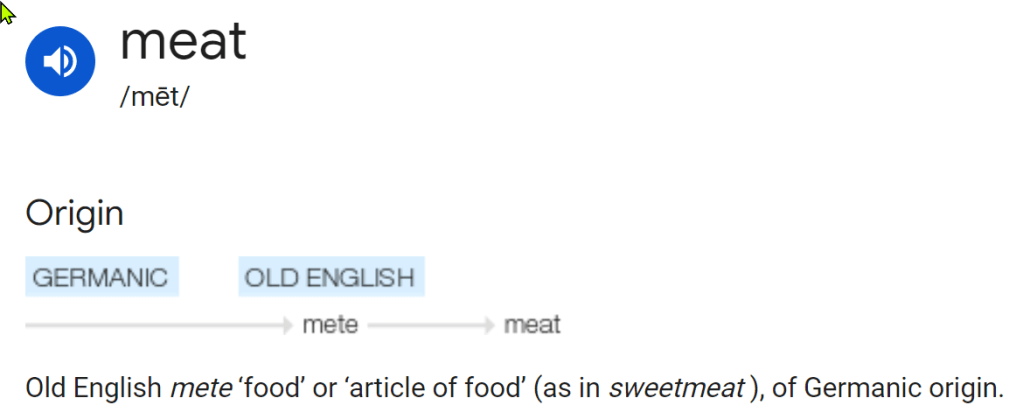
In Old English, the word ‘mete’ (IPA /’mit ə/, and not to be confused with the modern verb ‘to meet’) was a catch-all term for food. Any food. All food. If you could eat it, it was ‘mete’. Your apple? Mete. Your bread? Mete. That leg of lamb? Also mete, but we’re getting ahead of ourselves.
This broad definition persisted for centuries. Chaucer, in his 14th-century work “The Canterbury Tales”, wrote of “a Cok, hight Chauntecleer” (a rooster named Chauntecleer) who “For his brenning lay by Pertelote” (a hen). Yes, you read that right. Chickens were laying eggs; Chaucer was writing about “food” and “birds”; and somewhere, a medieval nutritionist was having an existential crisis.
But language, like a slowly simmering stew, changes over time. By the 14th century, ‘mete’ had started to narrow its focus, increasingly referring to the flesh of animals. It’s as if the word itself decided to go on a protein-heavy diet.
By the 18th century, ‘meat’ (having picked up its modern spelling along the way) had pretty much settled into its current meaning: the flesh of animals used as food. Though remnants of its broader past linger in more places than you might expect:
Phrases like “meat and drink” still mean food and beverages in general.
The term “nutmeat” refers to the edible part of a nut.
Fruits and vegetables can have “meaty” parts – we’re looking at you, avocados and tomatoes!
“Sweetmeat” doesn’t involve meat at all, but refers to candies or sweets.
So, the next time you’re describing the succulent flesh of a ripe peach as “meaty”, know that you’re not being weird – you’re being etymologically nostalgic. And when someone tells you to “meat and greet“, don’t bring a steak to the party. Unless, of course, it’s that kind of party. In which case, maybe bring enough to share?
This culinary journey through time just goes to show that when it comes to language, the proof is in the pudding. And yes, once upon a time, that pudding would have been called ‘meat’ too! Now that we’ve carved up the history of ‘meat’, let’s cast our net into the world of ‘fish’.
Something’s Fishy: Casting a Wide Net
From land to sea, our linguistic journey now dives into deeper waters to explore the slippery history of the word ‘fish’. Prepare to have your gills blown, because this tale is more twisted than an octopus playing Twister.
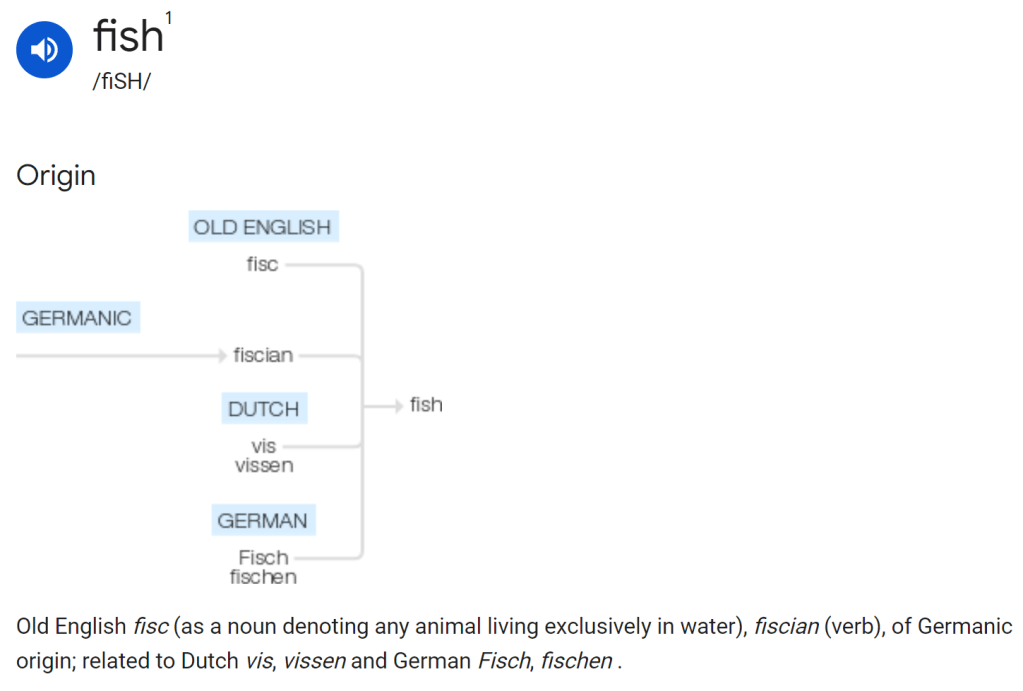
In Old English, our linguistic ancestors used the word ‘fisc’ (IPA /fɪsk/) to refer to, well, pretty much anything that called water its home. If it swam, floated, or generally looked bewildered in an aquatic environment, it was a ‘fisc’.
This cast-iron skillet approach to classification meant that whales, seals, and even crocodiles were all lumped into the ‘fisc’ category. It’s as if our forebears took one look at the ocean, threw up their hands, and said, “Eh, it’s all fish to me!”
This broad definition persisted for centuries, leading to some rather fishy nomenclature that we’re still untangling today:
Jellyfish: Despite their name, these gelatinous creatures are about as far from fish as you are from your second cousin twice removed on your mother’s side.
Starfish: These spiny echinoderms are more closely related to sea urchins than to any fish. They’re the marine equivalent of finding out your cat is actually a very convincing raccoon.
Cuttlefish: These crafty cephalopods are molluscs, more akin to octopuses and squids than to any fish. They’re the masters of aquatic disguise, fooling both prey and etymologists alike.
Shellfish: This term covers a motley crew of crustaceans and molluscs. Calling a lobster a fish is like calling a butterfly a bird – poetic, perhaps, but scientifically fishy.
As scientific understanding grew, the definition of ‘fish’ narrowed. By the 16th century, scholars were beginning to distinguish between ‘fish’ and other aquatic animals. However, the old, broad use of ‘fish’ had already left its mark on our language, like a stubborn fish smell that lingers long after the seafood dinner is over.
Today, in biological terms, ‘fish’ refers to gill-bearing aquatic animals lacking limbs with digits. But in culinary and cultural contexts, the term is still often used more broadly. So next time you’re at a seafood restaurant pondering whether to order the fish or the shellfish, remember: it’s all ‘fisc’ to your linguistic ancestors!
The Great Divide: Fish or Not Fish?
Now that we’ve muddied the waters thoroughly, let’s try to separate our fish from our not-fish. It’s time for the ultimate marine showdown: “Fish or Not Fish: Underwater Edition”! Let’s swim through some specific examples that highlight this fishy classification conundrum.
Starfish: The Stellar Impostor
Despite their fishy moniker, starfish are about as much fish as a sea star is an actual star. These echinoderms are more closely related to sea urchins and sand dollars than to any fish. With their five-armed symmetry and lack of gills or fins, starfish are the marine world’s ultimate catfish (pun intended).
Jellyfish: The Gelatinous Pretender
Jellyfish might float like a fish and sting like a… well, jellyfish, but they’re no more fish than a bowl of jelly. These cnidarians lack bones, brains, and hearts, making them more like drifting water balloons than actual fish. They’ve been pulling off this aquatic masquerade for over 500 million years!
Cuttlefish: The Crafty Cephalopod
Don’t let the name fool you – cuttlefish are cephalopods, more closely related to octopuses and squids than to any fish. These masters of disguise can change their appearance rapidly, making them the chameleons of the sea. They’re the ultimate marine conmen, fooling both prey and etymologists alike.
Shellfish: The Armoured Anomalies
‘Shellfish’ is a catch-all term for a motley crew of crustaceans and molluscs. Calling a lobster or an oyster a fish is like calling a butterfly a bird – it might fly, but that doesn’t make it right. These hard-shelled creatures are about as far from fish as you can get while still living in water.
Seahorses: The Fishy Exception
Plot twist! Despite their equine appearance, seahorses are indeed true fish. These peculiar creatures belong to the genus Hippocampus (which literally means “horse sea monster” in Greek). Here are some fin-tastic facts about our curly-tailed friends:
Male Pregnancy: In a twist that would make seahorse soap operas very interesting, it’s the male seahorses that get pregnant and give birth.
Monogamy: Unlike many fish, seahorses are monogamous. They perform daily greeting rituals to reinforce their pair bonds. It’s like underwater ballroom dancing but with more fins.
Camouflage: Seahorses are masters of disguise, able to change colour to blend in with their surroundings. They’re the underwater equivalent of a charismatic chameleon.
Snouts: Their tubular snouts work like built-in straws, perfect for sucking up tiny crustaceans. It’s nature’s version of a Capri Sun.
So there you have it – a horse that’s a fish, and a bunch of “fish” that aren’t. If this doesn’t highlight the delightful absurdity of language evolution, I don’t know what will!
Modern Usage and Misconceptions: A Kettle of Fish
Now that we’ve unravelled this tangled net of fishy nomenclature, let’s surface and see how these linguistic oddities persist in modern times. It’s a veritable school of misconceptions out there! Just as our ancestors broadly applied ‘mete’ and ‘fisc’, we continue to cast a wide net with our fishy terms today.
The Persistent “Fish”
Despite our best scientific efforts, many misnomers stubbornly cling to our language like barnacles to a ship’s hull:
Silverfish: These squirmy household pests are neither silver nor fish. They’re insects that have been sneaking into our bathtubs and bookshelves for over 400 million years, laughing at our misguided naming conventions.
Crayfish: Also known as crawfish or crawdads, these freshwater crustaceans are more closely related to lobsters than to any fish. They’re the inland cousins who couldn’t afford beachfront property.
Fishfingers: A childhood staple that contains fish but isn’t fingers. Unless you know something about fish anatomy that we don’t…
The Culinary Conundrum
In the world of cuisine, the line between ‘fish’ and ‘seafood’ is blurrier than a fish’s vision out of water:
Many menus separate ‘fish’ from ‘seafood’, with the latter often including shellfish and sometimes even seaweed. It’s as if the ocean decided to categorise its inhabitants based on their starring roles in Disney movies.
The phrase “fish and chips” stubbornly refuses to become “seafood and chips”, even when the dish includes non-fish like calamari. It’s a linguistic tradition as crispy and golden as the batter itself.
The Vegetarian’s Dilemma
Pity the poor vegetarians navigating this linguistic minefield:
Some vegetarians eat fish but not meat, leading to the term “pescatarian”. It’s as if fish decided to identify as vegetables just to complicate matters.
The question “Do you eat fish?” is often asked separately from “Are you vegetarian?”, as if fish were secretly plants with fins.
The Final Catch
In the end, language is a living, breathing entity that evolves faster than you can say “coelacanth” (which, by the way, is a fish that was thought to be extinct until it wasn’t – talk about a plot twist!).
While scientists may pull their hair out over our continued misuse of ‘fish’, the rest of us can simply enjoy the rich tapestry of language these terms have woven. After all, in the grand aquarium of English, it’s the linguistic oddities that make the view so interesting.
In the world of language, sometimes it’s okay to let sleeping dogfish lie.
So the next time you find yourself in a debate about whether a starfish is a fish, or why we call it shellfish when there’s no fish involved, remember: in the world of language, sometimes it’s okay to let sleeping dogfish lie.
Conclusion: So Long, and Thanks for All the Fish!
As we surface from our deep dive into the murky waters of etymology, we find ourselves with a tackle box full of linguistic curiosities. We’ve navigated the broad seas of ‘mete’, trawled through the expanding net of ‘fisc’, and somehow ended up in a world where seahorses are fish, but starfish aren’t.
Language, much like the ocean, is vast, mysterious, and full of surprises.
Our journey has shown us that language, much like the ocean, is vast, mysterious, and full of surprises. It evolves and changes, sometimes leaving behind fascinating fossils in our everyday speech. These linguistic relics remind us of a time when our ancestors looked at the sea and decided that anything wet and wriggly qualified as a fish.
From the “meaty” part of a fruit to the fish fingers in your freezer, from the crayfish in streams to the silverfish in your bathroom, these terms continue to swim through our language, blissfully unaware of their misclassification. They’re like linguistic dolphins, playfully leaping through our conversations, occasionally confusing vegetarians and marine biologists alike.
And here’s a thought to chew on: given what we’ve learned about the evolution of the word ‘meat’, could this linguistic journey have unintended consequences in other areas? For instance, when Catholics abstain from ‘meat’ on Fridays, are they following the modern interpretation of the word, or its original, broader meaning of ‘food’? It’s a question that would require diving into early Greek, Aramaic, and Latin texts to explore fully. But it just goes to show how the ripples of language evolution can reach far beyond our dinner plates and into the very core of cultural and religious practices.
So the next time you find yourself pondering whether that seafood platter is really all ‘fish’, or why we still call it the “fruit of the sea” when we know better, remember this tale. Embrace the delightful absurdity of language evolution. After all, in the grand ocean of communication, it’s these quirks and idiosyncrasies that make our linguistic journey so fascinating.
And if all else fails, just smile enigmatically and say, “So long, and thanks for all the fish!” Who knows? You might just be speaking to a dolphin disguised as a human, trying to warn you about the impending destruction of Earth to make way for a hyperspace bypass. But that, dear readers, is a whole other kettle of fish… or should we say, a different cut of meat?
Language is life. Yet, this assertion immediately raises a fundamental question: which came first, life or consciousness? It’s a classic chicken-and-egg conundrum. Physicist Stuart Hameroff posits an intriguing idea—that consciousness might predate life itself. This radical notion suggests that consciousness isn’t merely a byproduct of biological processes but could be an intrinsic feature of the universe. However, there’s a snag.
The challenge lies in defining life and consciousness, two terms that lack universally accepted definitions. The absence of clarity here opens the door to a multitude of interpretations, making it easy to drift into what could be considered ‘airy faerie’ ambiguity. One must beware of the temptation to engage in intellectual exercises that lead nowhere—what might be termed ‘mental masturbation.’ This is a prime example of the insufficiency of language.
Audio: Podcast commentary on this topic.
Life and consciousness, as concepts, are elusive. Unlike straightforward nouns or adjectives—where we can confidently say, “That’s a dog,” “That’s a tree,” or “That’s green”—these terms are far more complex. They are attempts to encapsulate observed phenomena, yet we lack the precise language and understanding to pin them down definitively. The video linked above provides perspectives on various approaches to defining these terms, but none prove wholly satisfactory. This lack of satisfaction might suggest that our conventional understanding of life and consciousness is flawed. To be fair, one might even entertain the idea that life itself is an illusion, a construct of consciousness.
This ambiguity isn’t confined to the realms of life and consciousness. I recently shared a post on the topic of gender, which illustrates a similar issue. Originally, there was no concept of gender. The earliest distinctions made were between animate and inanimate. Over time, these distinctions became more nuanced. Whether or not a proto-word for life existed at that time is unclear, but the idea of animation being linked to life was beginning to take shape. The concept of gender evolved much later, driven by the need to categorize and define differences within the animate category.
The evolution of language reflects the evolution of thought. Yet, when we dig deep into these foundational concepts, we encounter the same problem: how can we argue the precedence of two concepts—life and consciousness—when neither has a solid foundation in language? If our words are inadequate, if they fail to capture the essence of what we are trying to convey, then what does that say about our understanding of the world?
Perhaps it suggests that our linguistic and cognitive tools are still too crude to grasp the true nature of reality. Or maybe it hints at a deeper truth: that some aspects of existence are beyond the scope of human understanding, no matter how sophisticated our language becomes. After all, if consciousness predates life, as Hameroff suggests, then we may need to rethink our fundamental assumptions about existence itself.
Ultimately, this exploration reveals a paradox at the heart of human knowledge. We seek to define and categorise, to impose order on the chaos of the universe. Yet in doing so, we must confront the limits of our language and, by extension, our understanding. Perhaps the true essence of life and consciousness lies not in definitions or categories but in the very act of questioning, the relentless pursuit of knowledge that drives us forward, even when the answers remain elusive.
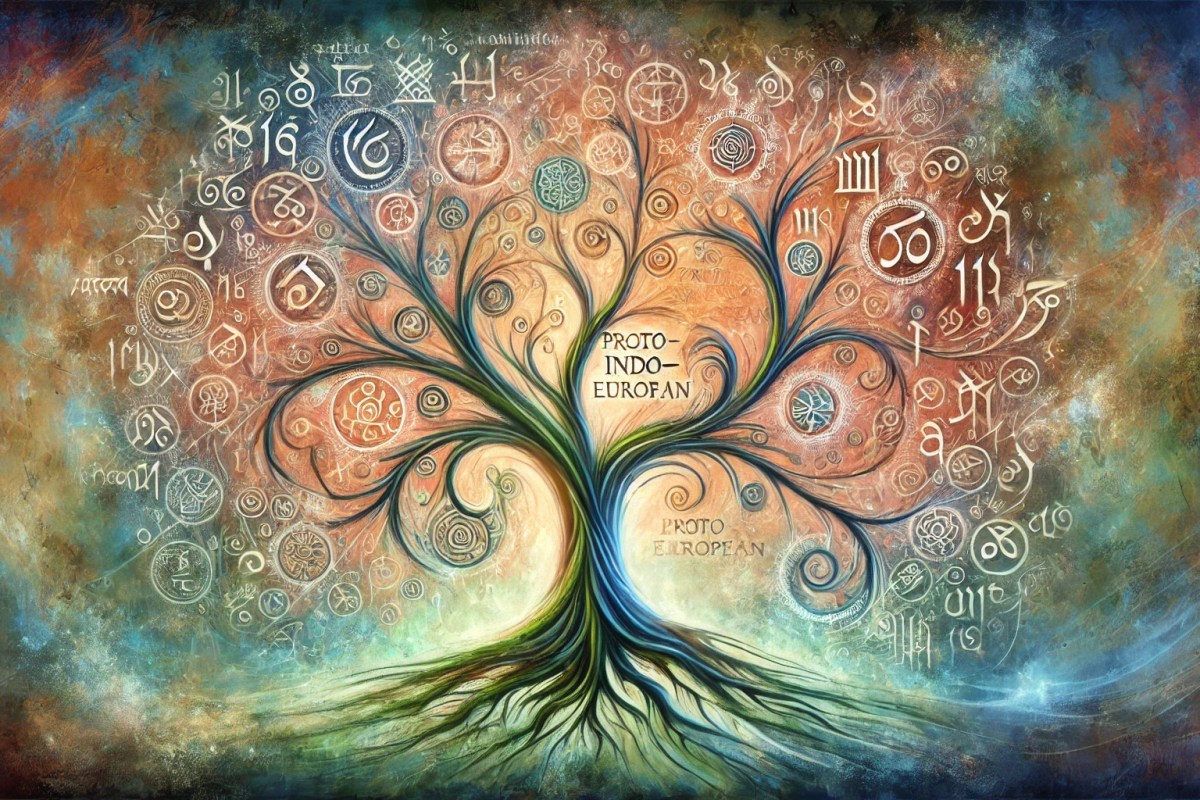
I’ve wanted to write a post on gender as it relates to language for a while. It will be longer still. I was researching PIE (proto-indo-european) language formation to understand the why of grammatical gender—not the social corollary to biological sex.
Gender and genre both derive from Latin (genus) via French (gendre) and mean type or kind. Genre is somehow reserved for the Arts whilst gender feels more applicable to biology and grammar.
Given Feminist trends, it seems that the arbitrary gendering of nouns and adjectives could be reassigned to dedicated genders to avoid confusion with human gender roles.
As an English as a first language speaker, it’s always felt awkward for me to label a table female (la table) and a sun male (le soleil). It’s even worse when German designates these the opposite, respectively der Tisch (feminine) and die Sonne (masculine).
The fact that these are designated male and female is arbitrary. Just as we designate films as drama, comedy, romance, and action, we could redesignate male and female as two different category names—I dunno, frick and frack.
Grammatical genders themselves are necessarily offensive, but it feels patriarchal to have a rule that if males and females are subjects of a sentence, then the verb has a masculine conjugation. If instead we retained the same rule but said the verb has a frick conjugation, no offence, no foul.
I know this would be a lot of work, and I am just overthinking, but this is what I do.
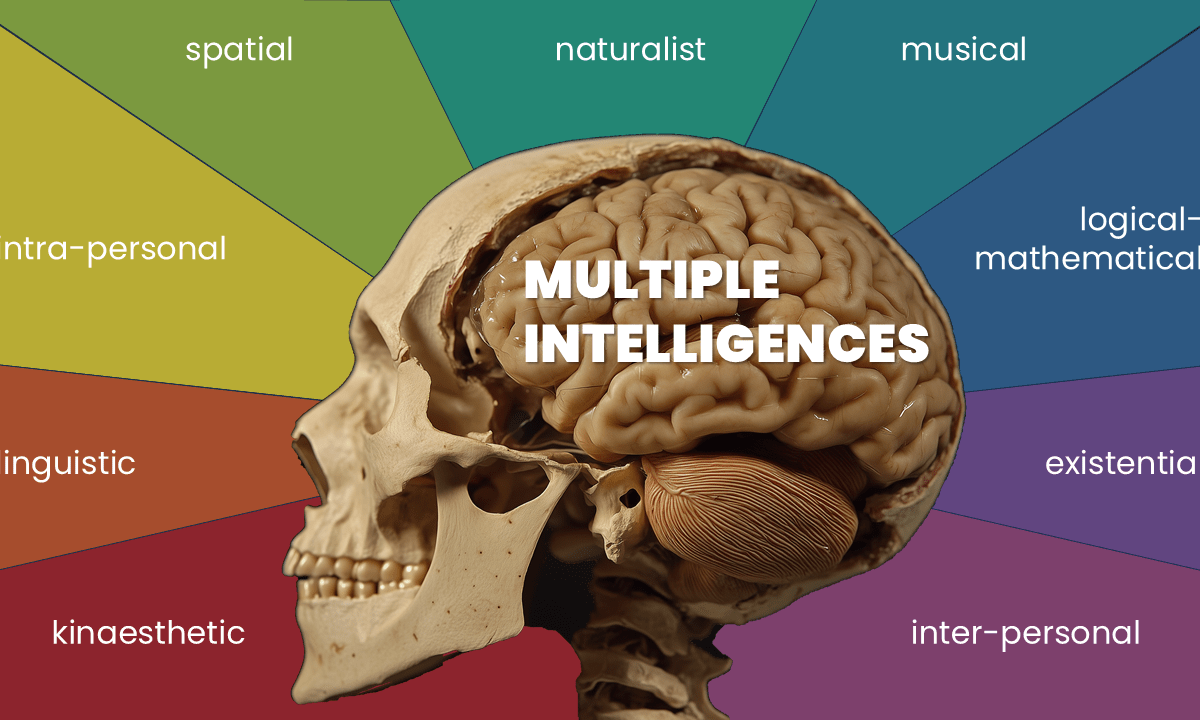
I engaged in a nice debate recently. Someone suggested that because some executives are smart, they can figure things out. Specifically, she posited that a CTO, Chief Technology Officer, should understand communication and diplomatic skills when interacting with a corporate board because they have the technical skills to get into their current C-level position. I disagreed based on the multiple intelligence theory.
Here’s the rub: a CTO with off-the-charts technical skills might be rubbish at diplomacy (interpersonal) or communication (linguistic). It’s like expecting every pro athlete to be a concert pianist – it’s not on.
Assuming every “intelligent” person can max out all intelligence dimensions is bollocks. It’s as likely as training every smart CTO to be the next Shakespeare or Machiavelli. Language and diplomacy are distinct skills, mate.
While we all love a Renaissance man (or woman), peaking in all these dimensions in one lifetime is a pipe dream. It’s not inherently bad, though. When building teams – be it a corporate board or an exploration party – ensure you’ve got a good mix of skills. I’m not saying you need a bard, a philosopher, and LeBron James on every team, but make sure you’ve covered the bases necessary for success.
If you think you don’t need a particular dimension, ask yourself: is it because you’re weak in that area and can’t see its importance? Don’t let your blind spots become your downfall.
In the end, it’s about recognising and respecting diverse intelligences. So, next time you’re tempted to think your brilliant CTO should just “learn to be diplomatic”, remember: they might be better off focusing on their strengths and leaving the smooth talking to someone else on the team.