Moral Psychology and the Art of Not Believing Your Own Results

3–4 minutes

Over the past few decades, moral psychology has staged a quiet coup against one of our most cherished fantasies: that human beings are, at bottom, rational moral agents. This is not a fringe claim. It is not a Twitter take. It is the mainstream finding of an entire research programme spanning psychology, cognitive science, linguistics, and neuroscience.

We do not reason our way to moral conclusions. We feel our way there. Instantly. Automatically. And only afterwards do we construct reasons that make the judgment sound respectable.

Audio: NotebookLM summary podcast of this topic.

This is not controversial anymore. It is replicated, taught, and celebrated. And yet, if you read the most influential books in this literature, something strange happens. The diagnosis is devastating. The prescription is reassuring.

I’ve just published a long-form video walking through five canonical books in moral psychology that all uncover the same structural problem, and then quietly refuse to live with the implications.

What follows is a brief guide to the argument.

The shared discovery

Across the literature, the same conclusions keep reappearing:

  • Moral judgement is intuitive, not deliberative
  • Reasoning is largely post-hoc
  • Emotion is not noise but signal
  • Framing and metaphor shape what even counts as a moral fact
  • Group identity and tribal affiliation dominate moral perception

In other words: the Enlightenment picture of moral reasoning is wrong. Or at least badly incomplete.

The rider does not steer the elephant. The rider explains where the elephant has already gone.
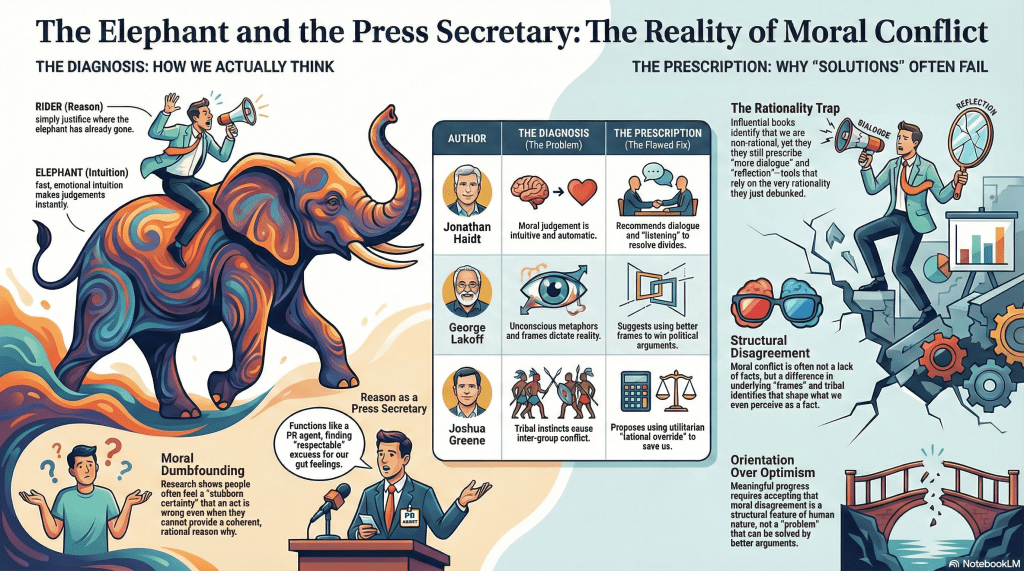
Audio: NotebookLM infographic

Where the books go wrong

The video focuses on five widely read, field-defining works:

  • The Righteous Mind (reviewed here and here… even here)
  • Moral Politics (mentioned here – with Don’t Think of an Elephant treated as its popular sequel)
  • Outraged! (reviewed here)
  • Moral Tribes (reviewed here)

Each of these books is sharp, serious, and worth reading. This is not a hit piece.

But each follows the same arc:

  1. Identify a non-rational, affective, automatic mechanism at the heart of moral judgement
  2. Show why moral disagreement is persistent and resistant to argument
  3. Propose solutions that rely on reflection, dialogue, reframing, calibration, or rational override

In short: they discover that reason is weak, and then assign it a leadership role anyway.

Haidt dismantles moral rationalism and then asks us to talk it out.
Lakoff shows that framing is constitutive, then offers better framing.
Gray models outrage as a perceptual feedback loop, then suggests we check our perceptions.
Greene diagnoses tribal morality, then bets on utilitarian reasoning to save us.

None of this is incoherent. But it is uncomfortable. Because the findings themselves suggest that these prescriptions are, at best, limited.

Diagnosis without prognosis

The uncomfortable possibility raised by this literature is not that we are ignorant or misinformed.

It is that moral disagreement may be structural rather than solvable.

That political conflict may not be cured by better arguments.
That persuasion may resemble contagion more than deliberation.
That reason often functions as a press secretary, not a judge.

The books sense this. And then step back from it. Which is human. But it matters.

Why this matters now

We are living in systems that have internalised these findings far more ruthlessly than public discourse has.

Social media platforms optimise for outrage, not understanding.
Political messaging is frame-first, not fact-first.
AI systems are increasingly capable of activating moral intuitions at scale, without fatigue or conscience.

Meanwhile, our institutions still behave as if one more conversation, one more fact-check, one more appeal to reason will close the gap. The research says otherwise.

And that gap between what we know and what we pretend may be the most important moral problem of the moment.

No solution offered

The video does not end with a fix. That’s deliberate.

Offering a neat solution here would simply repeat the same move I’m criticising: diagnosis followed by false comfort. Sometimes orientation matters more than optimism. The elephant is real. The elephant is moving.And most of us are passengers arguing about the map while it walks.

That isn’t despair. It’s clarity.

Outrage! Chapter Six

Kurt Gray’s Outraged! attempts to boil morality down to a single principle: harm. This, in his view, is the bedrock of all moral considerations. In doing so, he takes a swing at Jonathan Haidt’s Moral Foundations Theory, trying to reduce its multi-faceted framework to a mere footnote in moral psychology. Amusingly, he even highlights how Haidt quietly modified his own theory after Gray and his colleagues published an earlier work—an intellectual game of cat-and-mouse, if ever there was one.

Audio: Podcast of this topic

Chapter 6: The Intuition Overdose

By the time we reach Chapter 6, Gray is charging full steam into reductio ad absurdum territory. He leans so hard on intuition that I lost count of how many times he invokes it. The problem? He gives it too much weight while conveniently ignoring acculturation.

Yes, intuition plays a role, but it doesn’t exist in a vacuum. Enter Kahneman’s dual-system model: Gray eagerly adopts the System 1 vs. System 2 distinction, forcing his test subjects into snap moral judgments under time pressure to bypass rationalisation. Fair enough. But what he neglects is how even complex tasks can migrate from System 2 (slow, deliberate) to System 1 (fast, automatic) through repeated exposure. Kahneman’s example? Basic arithmetic. A child grappling with 1 + 1 relies on System 2, but an adult answers without effort.

And morality? The same mechanism applies. What starts as deliberation morphs into automatic response through cultural conditioning. But instead of acknowledging this, Gray behaves as if moral intuition is some mystical, spontaneous phenomenon untethered from socialization.

Morality: Subjective, Yes—But Culturally Engineered

Let’s lay cards on the table. I’m a moral subjectivist—actually, a moral non-cognitivist, but for simplicity’s sake, let’s not frighten the children. My stance is that morality, at its core, is subjective. However, no one develops their moral compass in isolation. Culture, upbringing, and societal narratives shape our moral instincts, even if those instincts ultimately reduce to personal sentiment.

Gray does concede that the definition of “harm” is subjective, which allows him to argue that practically any belief or action can be framed as harmful. And sure, if you redefine “harm” broadly enough, you can claim that someone’s mere existence constitutes an existential threat. Religious believers, for example, claim to be “harmed” by the idea that someone else’s non-compliance with their theological fairy tale could lead to eternal damnation.

I don’t disagree with his observation. The problem is that the underlying belief is fundamentally pathological. This doesn’t necessarily refute Gray’s argument—after all, people do experience psychological distress over imaginary scenarios—but it does mean we’re dealing with a shaky foundation. If harm is entirely perception-based, then moral arguments become arbitrary power plays, subject to the whims of whoever is best at manufacturing grievance.

And this brings us to another crucial flaw in Gray’s framework: the way it enables ideological self-perpetuation. If morality is reduced to perceived harm, then groups with wildly different definitions of harm will inevitably weaponize their beliefs. Take the religious fundamentalist who believes gay marriage is a sin that dooms others to eternal suffering. From their perspective, fighting against LGBTQ+ rights isn’t just bigotry—it’s moral duty, a battle to save souls from metaphysical harm. This, of course, leads to moral contagion, where adherents tirelessly indoctrinate others, especially their own children, ensuring the pathology replicates itself like a virus.

The Problem with Mono-Causal Explanations

More broadly, Gray’s attempt to reduce morality to a single principle—harm—feels suspiciously tidy. Morality is messy, contradictory, and riddled with historical baggage. Any theory that purports to explain it all in one neat little package should immediately raise eyebrows.

So, sorry, Kurt. You can do better. Moral psychology is a tangled beast, and trying to hack through it with a single conceptual machete does more harm than good.

Book Review: Outraged! by Kurt Gray: All Sizzle, No Steak?

Kurt Gray’s Outraged! is a fascinating romp through the minefield of moral psychology and outrage culture. It’s snappy, it’s clever, and it’s… shallow. Whilst Gray positions himself as the maestro conducting the cacophony of modern outrage, his approach has left me wondering if the symphony is little more than noise. Here’s why:

Audio: Podcast discussion on this review content.

Oversimplification of Moral Psychology

Gray’s central thesis that “all morality stems from perceptions of harm and threat” is bold, sure, but also reductive. Morality isn’t just a harm detector. It’s a rich tapestry of loyalty, authority, sanctity, and liberty—concepts Gray conveniently glosses over. His approach feels like reducing a fine Bordeaux to “it’s just fermented grapes.” Sure, technically correct, but where’s the depth?

The Age of Competitive Victimhood

By focusing so heavily on harm perception, Gray risks fueling the very outrage culture he’s critiquing. Welcome to the Hunger Games of victimhood, where everyone races to be crowned the most aggrieved. Instead of deflating this dynamic, Gray’s analysis may inadvertently add more oxygen to the fire.

Lack of Diverse Perspectives

Gray’s attempt to bridge divides is commendable but flawed. Critics point out that he gives more airtime to controversial right-wing figures than the left-leaning audience he’s presumably trying to engage. It’s like building half a bridge and wondering why no one’s crossing. If you alienate half your audience, how exactly are you fostering dialogue?

Contradictory Messaging

The book also suffers from a classic case of ideological whiplash. Gray tells us not to get offended by microaggressions, then argues that offensive content needs more careful handling. Which is it, Kurt? Either you’re driving the “sticks and stones” bus, or you’re preaching kid-glove diplomacy. You can’t have it both ways.

Limited Practical Solutions

Like many pop psychology books, Outraged! excels at diagnosing problems but falters when offering solutions. Gray’s suggestion to use personal stories of harm to bridge divides is charmingly naive. Sure, storytelling might work for interpersonal tiffs, but try applying that to global crises like climate change or systemic inequality. Good luck narrating your way to a greener planet.

Oversimplifying Complex Issues

Gray’s harm-based morality seems like an attempt to cram human behaviour’s messy, chaotic sprawl into a tidy spreadsheet. Real moral debates are nuanced, tangled, and frustratingly complex. By filtering everything through the lens of harm, Gray risks missing the bigger picture. It’s morality on Instagram—polished, curated, and ultimately hollow.

Final Thoughts

Outraged! isn’t without merit. Gray is a masterful storyteller and a sharp thinker, but the book feels like a soufflé: all air, no substance. While it might offer a quick, engaging read for those looking to dip a toe into the outrage pool, anyone hoping for deeper insights will come away unsatisfied.

In the end, Gray delivers a sizzling trailer for a movie that never quite materialises. Fun to watch, but ultimately forgettable.