Freedom: The Chains That Bind Us Together

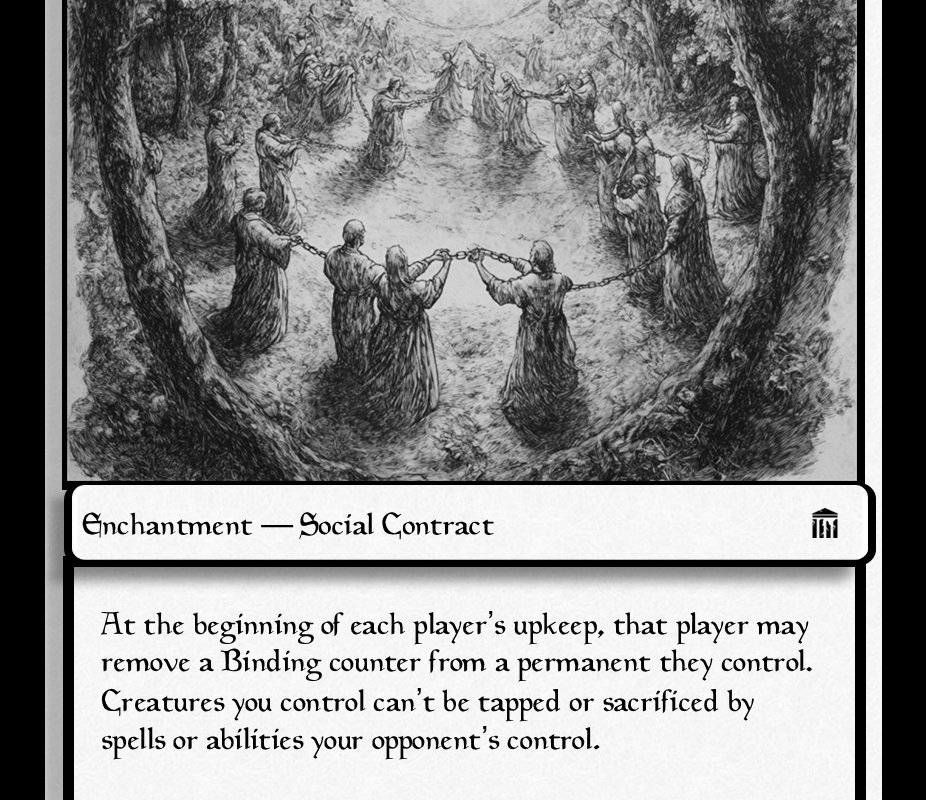
Black-and-white illustration of robed figures standing in a forest clearing, forming a circle by linking chains between their hands. The figures appear both united and restrained, illuminated by a pale, radiant light that suggests dawn or revelation. The mood is solemn yet transcendent, symbolising Rousseau’s paradox that freedom and constraint are inseparable. The image appears as a parody Magic: The Gathering card titled “Freedom,” subtitled “Enchantment — Social Contract,” with a quote from Jean-Jacques Rousseau: “To renounce liberty is to renounce being a man.” The art captures the tension between community, bondage, and liberation.

Freedom is a word so overused it’s practically anaemic. Everyone wants it; no one agrees on what it means. It’s been weaponised by tyrants and revolutionaries alike, invoked to justify both the breaking of chains and their reforging in a different metal.

Audio: NotebookLM podcast on this topic.

As I write this, I have just finished Erich Fromm’s A Sane Society. Without derailing this post, he cited a scenario – a description of work communities given in All Things Common, by Claire Huchet Bishop – where in post-WW2 France, a group formed a sort of workers’ coöperative – but it was more than that; it was an anarchosyndicalist experiment. As I read it, I had to cringe at the power ‘voluntary’ transfers that immediately got me thinking of Foucault’s biopower – as I often do. Saving this for a separate post.
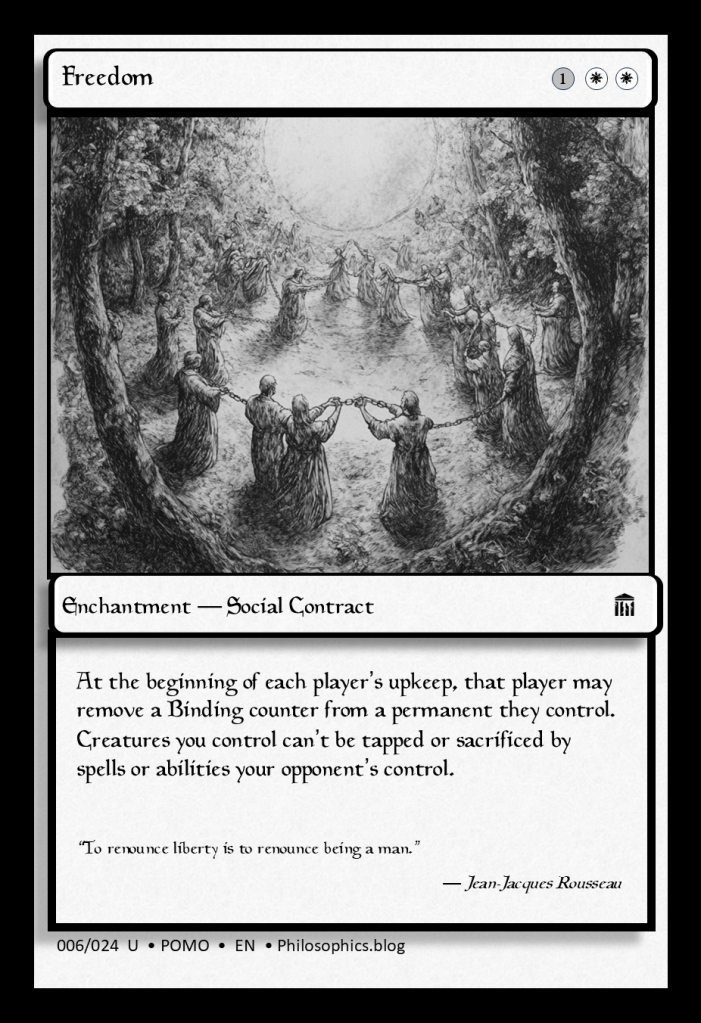
Black-and-white illustration of robed figures standing in a forest clearing, forming a circle by linking chains between their hands. The figures appear both united and restrained, illuminated by a pale, radiant light that suggests dawn or revelation. The mood is solemn yet transcendent, symbolising Rousseau’s paradox that freedom and constraint are inseparable. The image appears as a parody Magic: The Gathering card titled “Freedom,” subtitled “Enchantment — Social Contract,” with a quote from Jean-Jacques Rousseau: “To renounce liberty is to renounce being a man.” The art captures the tension between community, bondage, and liberation.
Image: Freedom: The Chains That Bind Us Together
Card 006 from the Postmodern Set – Philosophics.blog

This Critical Theory parody card, Freedom, draws its lineage from Jean-Jacques Rousseau, whose paradox still haunts the modern condition: “Man is born free, and everywhere he is in chains.” The card re-enchants that contradiction – an Enchantment – Social Contract that reminds us liberty isn’t a state but a negotiation.

The card reads:

At the beginning of each player’s upkeep, that player may remove a Binding counter from a permanent they control.
Creatures you control can’t be tapped or sacrificed by spells or abilities your opponent controls.

This is Rousseau’s dilemma made mechanical. Freedom is not absolute; it’s procedural. The upkeep represents the maintenance of the social contract—an ongoing renewal, not a one-time event. Every player begins their turn by negotiating what freedom costs. You may remove one Binding counter, but only if you recognise that binding exists.

The flavour text underlines Rousseau’s plea:

“To renounce liberty is to renounce being a man.”

Freedom, for Rousseau, wasn’t about doing whatever one pleased. It was about participating in the moral and civic order that gives action meaning. To exist outside that order is not liberty; it’s anarchy, the tyranny of impulse.

The card, therefore, resists the naïve libertarian reading of freedom as the absence of restraint. It instead depicts freedom as the capacity to act within and through shared constraints.

The art shows a ring of robed figures, hand in hand, their chains forming a circle beneath a clearing sky. It’s a haunting image: freedom through fellowship, bondage through unity. The circle symbolises Rousseau’s idea that true liberty emerges only when individuals subordinate selfish will to the general will – the common interest formed through collective agreement.

Yet there’s also a postmodern irony here: circles can be prisons too. The social contract can emancipate or suffocate, depending on who wrote its terms. The same chains that protect can also bind.

The monochrome aesthetic amplifies the ambiguity – freedom rendered in greyscale, neither utopia nor despair, but the space in between.

Rousseau’s notion of the social contract was revolutionary, but its dissonance still resonates: how can one be free and bound at the same time? He answered that only through the voluntary participation in a collective moral order can humans transcend mere instinct.

We might say that today’s democracies still operate under Freedom (Enchantment – Social Contract). We maintain our rights at the cost of constant negotiation: legal, social, linguistic. Every “Binding counter” removed is the product of civic upkeep. Stop maintaining it, and the enchantment fades.

The card hints at the price of this enchantment: creatures (citizens) can’t be tapped or sacrificed by opponents’ control. In other words, autonomy is secured only when the system prevents external domination. But systems fail, and when they do, the illusion of freedom collapses into coercion.

Rousseau earns a complicated respect in my philosophical canon. He’s not in my top five, but he’s unavoidable. His concept of freedom through the social contract anticipates both modern liberalism and its critique. He believed that genuine liberty required moral community – a notion now eroded by hyper-individualism.

Freedom, as I’ve rendered it here, isn’t celebration. It’s lamentation. The card is about the fragility of the social spell that keeps chaos at bay. We remove one binding at a time, hoping not to unbind ourselves entirely.

Where There’s a Will, There’s a Way

I’ve read Part I of Hobbes’ Leviathan and wonder what it would have been like if he filtered his thoughts through Hume or Wittgenstein. Hobbes makes Dickens read like Pollyanna. It’s an interesting historical piece, worth reading on that basis alone. It reads as if the Christian Bible had to pass through a legal review before it had been published, sapped of vigour. As bad a rap as Schopenhauer seems to get, Hobbes is the consummate Ebenezer Scrooge. Bah, humbug – you nasty, brutish, filthy animals!*

Audio: NotebookLM podcast conversation on this topic.

In any case, it got me thinking of free will and, more to the point, of will itself.

A Brief History of Humanity’s Favourite Metaphysical Scapegoat

By the time Free Will turned up to the party, the real guest of honour—the Will—had already been drinking heavily, muttering incoherently in the corner, and starting fights with anyone who made eye contact. We like to pretend that the “will” is a noble concept: the engine of our autonomy, the core of our moral selves, the brave little metaphysical organ that lets us choose kale over crisps. But in truth, it’s a bloody mess—philosophy’s equivalent of a family heirloom that no one quite understands but refuses to throw away.

So, let’s rewind. Where did this thing come from? And why, after 2,500 years of name-dropping, finger-pointing, and metaphysical gymnastics, are we still not quite sure whether we have a will, are a will, or should be suing it for damages?

Plato: Soul, Reason, and That Poor Horse

In the beginning, there was Plato, who—as with most things—half-invented the question and then wandered off before giving a straight answer. For him, the soul was a tripartite circus act: reason, spirit, and appetite. Will, as a term, didn’t get top billing—it didn’t even get its name on the poster. But the idea was there, muddling along somewhere between the charioteer (reason) and the unruly horses (desire and spiritedness).

No explicit will, mind you. Just a vague sense that the rational soul ought to be in charge, even if it had to beat the rest of itself into submission.

Aristotle: Purpose Without Pathos

Aristotle, ever the tidy-minded taxonomist, introduced prohairesis—deliberate choice—as a sort of proto-will. But again, it was all about rational calculation toward an end. Ethics was teleological, goal-oriented. You chose what aligned with eudaimonia, that smug Greek term for flourishing. Will, if it existed at all, was just reason picking out dinner options based on your telos. No inner torment, no existential rebellion—just logos in a toga.

Augustine: Sin, Suffering, and That Eternal No

Fast-forward a few hundred years, and along comes Saint Augustine, traumatised by his libido and determined to make the rest of us suffer for it. Enter voluntas: the will as the seat of choice—and the scene of the crime. Augustine is the first to really make the will bleed. He discovers he can want two incompatible things at once and feels properly appalled about it.

From this comes the classic Christian cocktail: freedom plus failure equals guilt. The will is free, but broken. It’s responsible for sin, for disobedience, for not loving God enough on Wednesdays. Thanks to Augustine, we’re stuck with the idea that the will is both the instrument of salvation and the reason we’re going to Hell.

Cheers.

Medievals: God’s Will or Yours, Pick One

The Scholastics, never ones to let an ambiguity pass unanalysed, promptly split into camps. Aquinas, ever the reasonable Dominican, says the will is subordinate to the intellect. God is rational, and so are we, mostly. But Duns Scotus and William of Ockham, the original voluntarist hooligans, argue that the will is superior—even in God. God could have made murder a virtue, they claim, and you’d just have to live with it.

From this cheerful perspective, will becomes a force of arbitrary fiat, and humans, made in God’s image, inherit the same capacity for irrational choice. The will is now more than moral; it’s metaphysical. Less reason’s servant, more chaos goblin.

Hobbes: Appetite with Delusions of Grandeur

Then along comes Thomas Hobbes, who looks at the soul and sees a wheezing machine of appetites. Will, in his famously cheery view, is simply “the last appetite before action.” No higher calling, no spiritual struggle—just the twitch that wins. Man is not a rational animal, but a selfish algorithm on legs. For Hobbes, will is where desire stumbles into motion, and morality is a polite euphemism for not getting stabbed.

Kant: The Will Gets a Makeover

Enter Immanuel Kant: powdered wig, pursed lips, and the moral rectitude of a man who scheduled his bowel movements. Kant gives us the good will, which acts from duty, not desire. Suddenly, the will is autonomous, rational, and morally legislative—a one-man Parliament of inner law.

It’s all terribly noble, terribly German, and entirely exhausting. For Kant, free will is not the ability to do whatever you like—it’s the capacity to choose according to moral law, even when you’d rather be asleep. The will is finally heroic—but only if it agrees to hate itself a little.

Schopenhauer: Cosmic Will, Cosmic Joke

And then the mood turns. Schopenhauer, world’s grumpiest mystic, takes Kant’s sublime will and reveals it to be a blind, thrashing, cosmic force. Will, for him, isn’t reason—it’s suffering in motion. The entire universe is will-to-live: a desperate, pointless striving that dooms us to perpetual dissatisfaction.

There is no freedom, no morality, no point. The only escape is to negate the will, preferably through aesthetic contemplation or Buddhist-like renunciation. In Schopenhauer’s world, the will is not what makes us human—it’s what makes us miserable.

Nietzsche: Transvaluation and the Will to Shout Loudest

Cue Nietzsche, who takes Schopenhauer’s howling void and says: yes, but what if we made it fabulous? For him, the will is no longer to live, but to power—to assert, to create, to impose value. “Free will” is a theologian’s fantasy, a tool of priests and moral accountants. But will itself? That’s the fire in the forge. The Übermensch doesn’t renounce the will—he rides it like a stallion into the sunset of morality.

Nietzsche doesn’t want to deny the abyss. He wants to waltz with it.

Today: Free Will and the Neuroscientific Hangover

And now? Now we’re left with compatibilists, libertarians, determinists, and neuroscientists all shouting past each other, armed with fMRI machines and TED talks. Some claim free will is an illusion, a post hoc rationalisation made by brains doing what they were always going to do. Others insist that moral responsibility requires it, even if we can’t quite locate it between the neurons.

We talk about willpower, will-to-change, political will, and free will like they’re real things. But under the hood, we’re still wrestling with the same questions Augustine posed in a North African villa: Why do I do what I don’t want to do? And more importantly, who’s doing it?

Conclusion: Where There’s a Will, There’s a Mess

From Plato’s silent horses to Nietzsche’s Dionysian pyrotechnics, the will has shape-shifted more times than a politician in an election year. It has been a rational chooser, a moral failure, a divine spark, a mechanical twitch, a cosmic torment, and an existential triumph.

Despite centuries of philosophical handwringing, what it has never been is settled.

So where there’s a will, there’s a way. But the way? Twisting, contradictory, and littered with the corpses of half-baked metaphysical systems.

Welcome to the labyrinth. Bring snacks.

* The solitary, poor, nasty, brutish, and short quote is forthcoming. Filthy animals is a nod to Home Alone.

The Schizophrenia of “Human Nature” Arguments

Humans, we are told, are exceptional—unlike the rest of the lowly animal kingdom. We alone possess reason, morality, and the ability to transcend our base instincts. And yet, curiously, this argument is rolled out only when convenient. At times, we are commanded to rise above our primal urges; at others, we are scolded for even thinking about resisting them. This ideological schizophrenia is no accident—it is a feature, not a bug, of our prevailing moral and economic order.

The contradictions of “human nature” arguments can be broken down into two key patterns:

A. We must transcend our animal instincts—but only when they threaten social or economic order.

B. We must accept our animal instincts as unchangeable—but only when they reinforce existing power structures.

This hypocrisy is especially visible in how capitalism and morality are framed. Let’s examine two case studies.

Case 1: Prostitution—A Market That Must Be Morally Suppressed

Sex is as fundamental a biological drive as hunger or thirst. One would think that in a world where everything is commodified, prostitution—the most direct transaction of supply and demand—would be embraced by free-market capitalists. But no. We are told that engaging in this “base” activity is degrading, immoral, and must be curtailed. The same capitalists who defend free enterprise at all costs suddenly become moralists, urging us to resist temptation and rise above our urges. Sex, despite being one of the most natural acts imaginable, is treated as an impulse to be tamed rather than an economic exchange to be normalised.

Case 2: Capitalism—A System We Must Accept as “Natural”

Contrast this with how we are told to think about capitalism. Greed, exploitation, and ruthless competition? Those are “just human nature.” The strong thrive, and the weak perish. We are warned not to question the system because to do so would be to fight against nature itself. Socialism? A naive fantasy. Economic cooperation? Impossible. Mutual aid? Utopian nonsense. We must accept that humans are selfish creatures, that hierarchy is inevitable, and that billionaires accumulating obscene wealth while millions starve is simply the way of things.

Why are we ordered to suppress our instincts in one case yet surrender to them in another? Because morality, in its institutional form, is not about virtue—it is about control.

The Convenient Flexibility of “Human Nature”

This selective logic is designed to keep power structures intact. The rules shift depending on whose interests are at stake:

  • If an instinct challenges profit or control, it must be suppressed.
  • If an instinct benefits the ruling order, it must be accepted as natural.

Thus, the same societies that demand moral restraint when it comes to sex, leisure, or pleasure suddenly rediscover their inner Darwinist when defending capitalist greed and economic cruelty.

The “Natural Order” Myth

The claim that capitalism is the inevitable result of human nature is one of history’s greatest ideological scams. If it were indeed “natural,” it would not require:

  • Constant propaganda to reinforce its legitimacy.
  • Violent suppression of alternative systems.
  • Trillions in government bailouts every time it fails.

Moreover, humans are not only competitive, selfish creatures. We are also wired for cooperation, altruism, and communal living—traits conveniently erased from discussions about economics.

Final Thought: Breaking the Cycle

If we can rise above base instincts for sex and violence, why can’t we rise above capitalist greed and exploitation? Why is overcoming “human nature” only demanded when it suits power? The truth is, we are only commanded to rise above when it keeps us obedient—and ordered to accept reality when it keeps the powerful in control.

The only real rebellion is to reject this hypocrisy entirely. The future belongs not to those who passively accept the contradictions of the present, but to those who refuse to play by its schizophrenic rules.

Dumocracy

I’m working on a new book—if by new I mean reengaging a book I started in 2022. I’m picking up where I left off with fresh eyes. As I’ve not had time to contribute much to this blog, I thought I’d share the preface as a work in progress. I may share additional subsections over time. Feel free to share any feedback in the comments section.

Preface

“The first step to recovery is to admit there’s a problem.” – Anonymous

Introduction

Imagine a world where the foundation of our governance, the system we hold as the pinnacle of fairness and equality, is fundamentally flawed. What if the mechanisms we trust to represent our voices are inherently incapable of delivering the justice and prosperity we seek? This book embarks on a provocative journey to challenge the sanctity of democracy, not with the intent to undermine its value but to question its effectiveness and expose the inherent limitations that have been overlooked for centuries.

This book is meant to be inclusive, though not necessarily comprehensive. Although focused heavily on a Western experience, particularly the United States, the insights and critiques apply globally.

Democracy feels like an anachronism awaiting a paradigm shift. As a product of the Enlightenment Age, democracy has been sacrosanct in the Western world for centuries. However, a quick glance at current results reveals dissonance. Not all is well. Despite typical defences such as entrenched political parties, low-information voters, rural-urban divides, gerrymandering, and illegal voting, this book sets out to show that democracy is fundamentally flawed. It doesn’t even work well on paper, almost inevitably yielding suboptimal results. When people are added to the equation, it just gets worse.

In this book, we’ll discuss inherent challenges to democracy. The main premises are:

  • In theory, democracy is not mathematically tenable. It always leads to suboptimal solutions with mediocre results. [1]
  • In practice, human nature and cognitive limitations exacerbate the execution of democracy from the perspective of voters and representatives. [2]

We’ll explore democracy from its beginnings and various forms across time, history, scale, and scope. We’ll investigate the impacts of imperfect information, human rationalities, emotional triggers, and cognitive limitations and biases of the general populace. We’ll survey the continents and look at ancient Mesopotamia, India, the Polynesian islands, and beyond.

This book aims to spark critical thinking and dialogue about the efficacy of democracy, encouraging readers to question widely held assumptions and consider the need for potential reforms or alternative governance models. Through this examination, the book hopes to inspire new ideas and solutions that can address the complexities and challenges inherent in democratic systems.


[1] Arrow, 1951; Sen, 1970

[2] Kahneman, 2011; Tversky & Kahneman, 1974