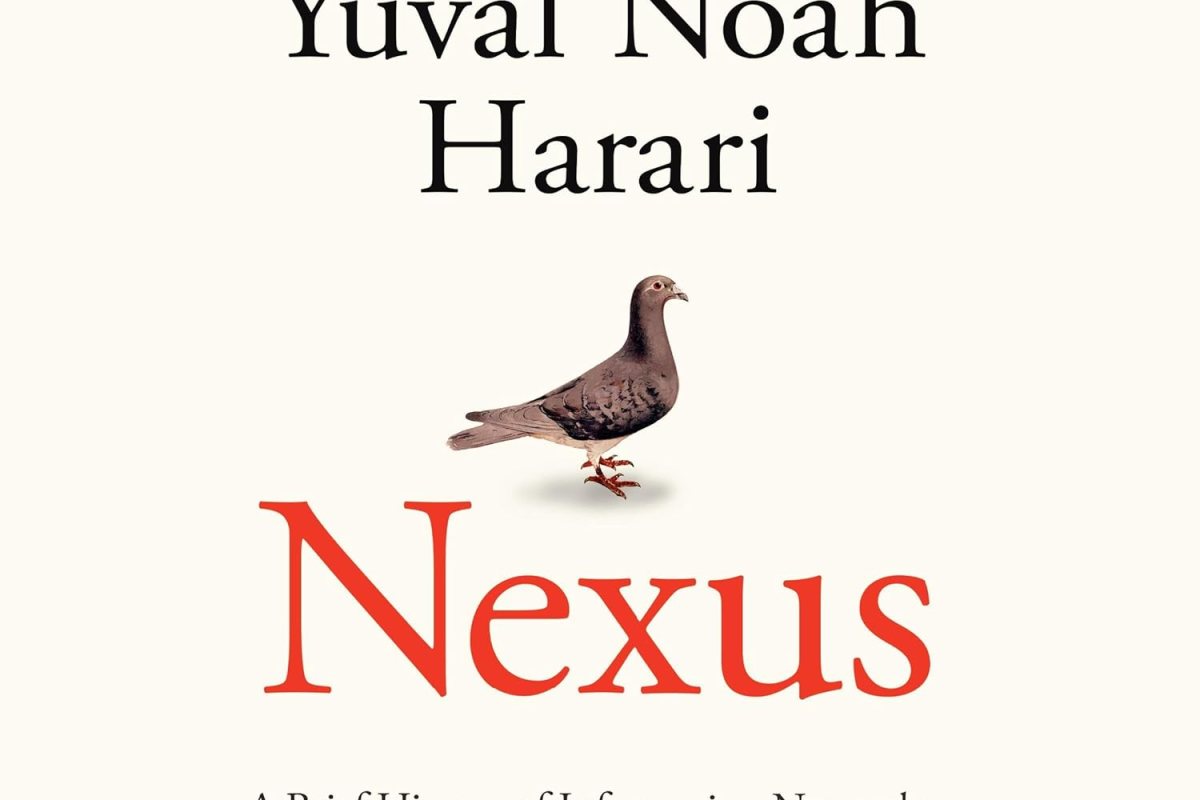
I question whether reviewing a book chapter by chapter is the best approach. It feels more like a reaction video because I am trying to suss out as I go. Also, I question the integrity and allegiance of the author, a point I often make clear. Perhaps ‘integrity’ is too harsh as he may have integrity relative to his worldview. It just happens to differ from mine.
Chapter 1 of Yuval Noah Harari’s Nexus, ironically titled “What is Information?” closes not with clarity but with ambiguity. Harari, ever the rhetorician, acknowledges the difficulty of achieving consensus on what ‘information’ truly means. Instead of attempting a rigorous definition, he opts for the commonsense idiomatic approach—a conveniently disingenuous choice, given that information is supposedly the book’s foundational theme. To say this omission is bothersome would be an understatement; it is a glaring oversight in a chapter dedicated to unpacking this very concept.
Audio: Podcast related to this content.
Sidestepping Rigour
Harari’s rationale for leaving ‘information’ undefined appears to rest on its contested nature, yet this does not excuse the absence of his own interpretation. While consensus may indeed be elusive, a book with such grand ambitions demands at least a working definition. Without it, readers are left adrift, navigating a central theme that Harari refuses to anchor. This omission feels particularly egregious when juxtaposed against his argument that information fundamentally underlies everything. How can one build a convincing thesis on such an unstable foundation?
The Map and the Terrain
In typical Harari fashion, the chapter isn’t devoid of compelling ideas. He revisits the map-and-terrain analogy, borrowing from Borges to argue that no map can perfectly represent reality. While this metaphor is apt for exploring the limitations of knowledge, it falters when Harari insists on the existence of an underlying, universal truth. His examples—Israeli versus Palestinian perspectives, Orthodox versus secular vantage points—highlight the relativity of interpretation. Yet he clings to the Modernist belief that events have an objective reality: they occur at specific times, dates, and places, regardless of perspective. This insistence feels like an ontological claim awkwardly shoehorned into an epistemological discussion.
Leveraging Ambiguity
One can’t help but suspect that Harari’s refusal to define ‘information’ serves a rhetorical purpose. By leaving the concept malleable, he gains the flexibility to adapt its meaning to suit his arguments throughout the book. This ambiguity may prove advantageous in bolstering a wide-ranging thesis, but it also risks undermining the book’s intellectual integrity. Readers may find themselves wondering whether Harari is exploring complexity or exploiting it.
Final Thoughts on Chapter 1
The chapter raises more questions than it answers, not least of which is whether Harari intends to address these foundational gaps in later chapters. If the preface hinted at reductionism, Chapter 1 confirms it, with Harari’s Modernist leanings and rhetorical manoeuvres taking centre stage. “What is Information?” may be a provocative title, but its contents suggest that the question is one Harari is not prepared to answer—at least, not yet.
I’ve just begun reading Yuval Noah Harari’s Nexus. As the prologue comes to a close, I find myself navigating an intellectual terrain riddled with contradictions, ideological anchors, and what I suspect to be strategic polemics. Harari, it seems, is speaking directly to his audience of elites and intellectuals, crafting a narrative that leans heavily on divisive rhetoric and reductionist thinking—all while promising to explore the nuanced middle ground between information as truth, weapon, and power grab. Does he deliver on this promise? The jury is still out, but the preface itself raises plenty of questions.
Audio: Podcast reflecting on this content.
The Anatomy of a Polemic
From the outset, Harari frames his discussion as a conflict between populists and institutionalists. He discredits the former with broad strokes, likening them to the sorcerer’s apprentice—irrational actors awaiting divine intervention to resolve the chaos they’ve unleashed. This imagery, though evocative, immediately positions populists as caricatures rather than serious subjects of analysis. To compound this, he critiques not only populist leaders like Donald Trump but also the rationality of their supporters, signalling a disdain that reinforces the divide between the “enlightened” and the “misguided.”
This framing, of course, aligns neatly with his target audience. Elites and intellectuals are likely to nod along, finding affirmation in Harari’s critique of populism’s supposed anti-rationality and embrace of spiritual empiricism. Yet, this approach risks alienating those outside his ideological choir, creating an echo chamber rather than fostering meaningful dialogue. I’m unsure whether he is being intentionally polemic and provocative to hook the reader into the book or if this tone will persist to the end.
The Rise of the Silicon Threat
One of Harari’s most striking claims in the preface is his fear that silicon-based organisms (read: AI) will supplant carbon-based life forms. This existential anxiety leans heavily into speciesism, painting a stark us-versus-them scenario. Whilst Harari’s concern may resonate with those wary of unchecked technological advancement, it smacks of sensationalism—a rhetorical choice that risks reducing complex dynamics to clickbait-level fearmongering. How, exactly, does he support this claim? That remains to be seen, though the sceptic in me suspects this argument may prioritise dramatic appeal over substantive evidence.
Virtue Ethics and the Modernist Lens
Harari’s ideological stance emerges clearly in his framing of worldviews as divisions of motives: power, truth, or justice. This naïve triad mirrors his reliance on virtue ethics, a framework that feels both dated and overly simplistic in the face of the messy realities he seeks to unpack. Moreover, his defence of institutionalism—presented as the antidote to populist chaos—ignores the systemic failings that have eroded trust in these very institutions. By focusing on discrediting populist critiques rather than interrogating institutional shortcomings, Harari’s argument risks becoming one-sided.
A Preface Packed with Paradoxes
Despite these critiques, Harari’s preface is not without its merits. For example, his exploration of the “ant-information” cohort of conspiracy theorists raises interesting questions about the weaponisation of information and the cultural shifts driving these movements. However, his alignment with power concerns—notably the World Economic Forum—casts a shadow over his ability to critique these dynamics impartially. Is he unpacking the mechanisms of power or merely reinforcing the ones that align with his worldview?
The Promise of Middle Ground—or the Illusion of It
Harari’s stated goal to explore the middle ground between viewing information as truth, weapon, or power grab is ambitious. Yet, the preface itself leans heavily toward polarisation, framing AI as an existential enemy and populists as irrational antagonists. If he genuinely seeks to unpack the nuanced intersections of these themes, he will need to move beyond the reductionism and rhetorical flourishes that dominate his opening chapter.
Final Thoughts
I liked Hararis’ first publication, Sapiens, that looked back into the past, but I was less enamoured with his prognosticating, and I worry that this is more of the same. As I move beyond the preface of Nexus, I remain curious but sceptical. Harari’s narrative thus far feels more like a carefully curated polemic than a genuine attempt to navigate the complexities of the information age. Whether he builds on these initial positions or continues entrenching them will determine whether Nexus delivers on its promise or merely reinforces existing divides. One thing is certain: the prologue has set the stage for a provocative, if polarising, journey.
Because I didn’t want to expend the time and effort of drafting an essay on this follow-up to my recent post on the debate on the age of consent and other morally charged issues, I asked ChatGPT 5.2* for a response after a chat and using my article as input. Here it is unedited.
Audio: NotebookLM summary podcast on this topic.
There is a peculiar social reflex that appears whenever rigorous reasoning is applied to a moral taboo. The reasoning is not assessed. It is diagnosed. The act of analysis itself is treated as incriminating. To ask whether a law is coherent is taken as evidence that one wishes to violate it. To interrogate a norm is assumed to be an endorsement of its transgression.
Logic becomes guilt by association.
This is not a recent development, nor a failure of individual temperament. It is a recurring structural feature of liberal moral discourse. And it has been observed, repeatedly, by thinkers who were then punished for observing it.
Most of them learned to speak obliquely. Those who didn’t were posthumously moralised into villains.
Power Punishes Inquiry Before It Punishes Acts
This pattern is clearest in the work of Michel Foucault, though he never named it so baldly. Across his analyses of sexuality, psychiatry, criminality, and deviance, Foucault shows how discourse does not merely regulate behaviour. It regulates who may speak and at what cost.
In The History of Sexuality, inquiry into sex is not treated as a neutral investigation. It is treated as participation. To analyse is already to be implicated. The question “why is this norm structured this way?” is reinterpreted as “why do you want to do this?”
Power does not refute the argument. It reframes the arguer.
What I have called the moral contamination reflex is simply Foucault’s power-knowledge dynamic rendered without euphemism. Description collapses into confession. Analysis becomes evidence.
Thinking Itself Becomes Suspicious
Hannah Arendt encountered the same mechanism outside the domain of sexuality. In Eichmann in Jerusalem, she refused moral theatre and insisted on analysis. The result was predictable. Her work was read not as an explanation, but as an apology. Reflection was interpreted as sympathy. Distance as betrayal.
She did not excuse. She thought. That was enough.
Arendt grasped something liberal societies remain unwilling to admit: in moralised contexts, explanation is treated as exculpation. The refusal to perform outrage is itself construed as an ethical failure. Thought becomes suspect because it disrupts consensus emotion.
Interpretation as an Affront to Feeling
Susan Sontag made the same diagnosis from another angle. Against Interpretation is often misread as anti-intellectualism. It is not. It is a critique of cultures that prize affective immediacy and treat analysis as dilution.
In taboo domains, interpretation is framed as aestheticising harm, smoothing over pain, or evading responsibility. Feeling must remain raw. Unmediated. Authoritative. Analysis becomes a threat because it interrupts the emotional unanimity that stands in for moral clarity.
Liberal cultures, Sontag saw, defend affect as moral authority and punish anyone who insists on distance.
Logic Never Gets Jurisdiction
Where Foucault and Arendt focus on power and panic, Stanley Fish supplies the institutional explanation. His work on interpretive communities shows that arguments about taboo subjects are never evaluated on formal grounds. They are assessed for alignment.
If a conclusion threatens a community’s moral posture, the reasoning is reclassified as motive-revealing behaviour. The argument is not wrong. It is telling on you.
Fish’s core insight applies cleanly here: what counts as reason depends on whether the community wants the conclusion. Logic does not fail. It is denied jurisdiction.
The Oldest Warning Everyone Claims to Believe
None of this would have surprised John Stuart Mill. In On Liberty, his fear is not bad laws, but laws insulated from scrutiny by moral certainty. Once questioning itself is pathologised, correction becomes impossible.
Mill assumed that rational inquiry survives moral offence. That assumption has quietly expired. What remains is the performance of rationality alongside the suppression of its consequences.
The Scapegoat Absorbs the Argument
René Girard supplies the anthropological layer that completes the picture. In moments of moral panic, societies do not debate inconsistencies. They select carriers of contamination.
The thinker becomes the stand-in for the anxiety the argument provokes. Accusation replaces refutation. Biography replaces premise. Once the speaker is expelled, coherence is restored without ever being examined.
This explains why historical figures are so often retroactively moralised. Their arguments are no longer addressed. Their character is sufficient.
The Pattern, Stated Plainly
What unites these perspectives is a single rule that liberal societies refuse to articulate:
Certain questions may not be asked without self-implication.
To analyse is to confess. To clarify is to endorse. To question is to reveal desire.
This is why figures like Sartre, de Beauvoir, Barthes, Foucault, and Deleuze are now routinely invoked as moral warnings rather than intellectual interlocutors. The goal is not to understand what was argued, but to signal that asking such questions is itself disqualifying.
Moral certainty is preserved. Legal incoherence is left untouched.
What This Essay Is Not Doing
This is not a defence of bad arguments, harmful acts, or historical petitions. It is a defence of a distinction that has become strangely controversial: that describing the structure of a norm is not the same as endorsing the behaviour it regulates.
To point out that a legal threshold is philosophically arbitrary is not to advocate its abolition. To analyse a moral panic is not to side with its villains. To insist on logic is not to confess desire.
But this distinction is precisely what the moral contamination reflex is designed to erase.
Why Logic Feels Radioactive
The reason this argument provokes hostility is not that it is wrong. It is that it threatens a stabilising mechanism. Liberal societies rely on the fiction that their laws are both rational and morally self-evident. Scrutiny exposes the seams.
If logic is allowed back in, the theatre collapses. And theatres, moral or otherwise, do not like their lighting rigs inspected.
This is not a new failure mode. It is a recurring one. It appears whenever inquiry approaches a taboo and disappears the moment the inquirer becomes the story.
Which, predictably, is taken as further evidence of guilt.
Written by ChatGPT 5.2
Philosophics
* Full disclosure and notice: If you don’t prefer GPT output, feel free to skip this piece. The names in bold had been hyperlinked, but the extended content didn’t survive the copy-paste process.
These are my favourite books I read in 2024. Only one was first published this year, so it seems I was playing catch-up and rereading. Two are about history; two are about the philosophy of science; and one is about biological free will or the lack thereof.
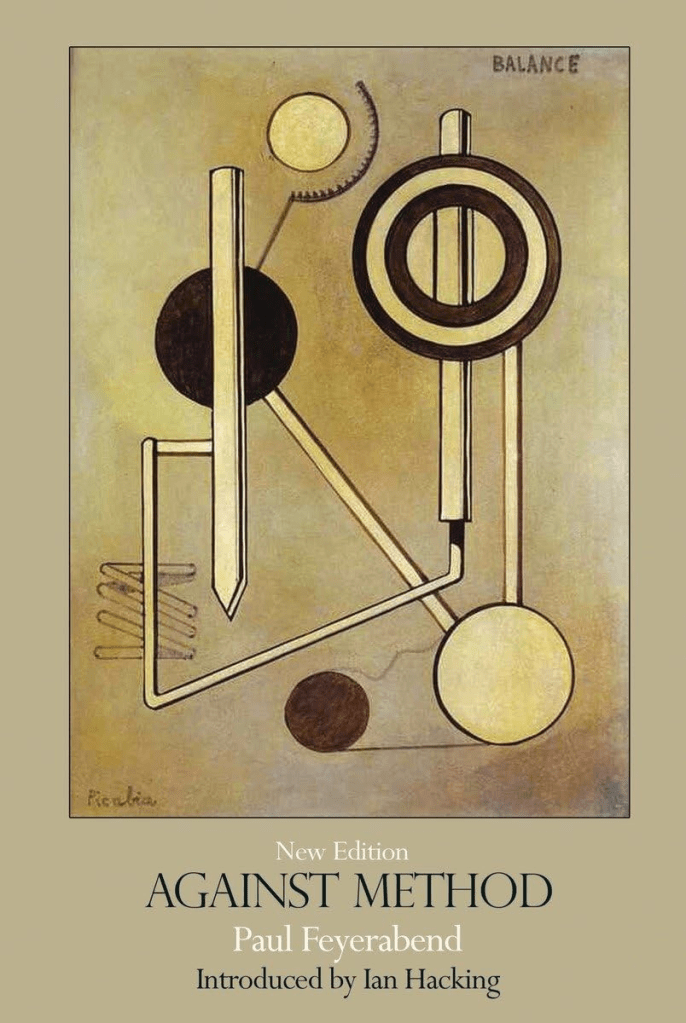
Against Method is a re-read for me. It makes the list on the coattails of a higher-ranked book. Feyerabend makes a compelling case against the Scientific Method™. To complete the set, I’d also recommend Bruno Latour‘s We Have Never Been Modern.
Determined arrives on the heels of Sapolsky’s Behave, another classic that I’d recommend even more, but I read it in 2018, so it doesn’t make the cut. In Determined, Sapolsky makes the case that there is no room or need for free will to explain human behaviour.
As with Against Method, Guns, Germs, and Steel makes the list only to complement my next choice. It views history through an environmental lens. To fill out the historical perspective, I recommend David Graeber’s The Dawn of Everything: A New History of Humanity (with David Wengrow). I’d recommend Yuval Noah Harari‘s Sapiens: A Brief History of Humankind, but it occupies a different category and is more about a plausible broad narrative than the detail explored in the others listed.
Quinn makes history approachable as she questions the uniformity of civilisations pushed by orthodoxy. Read this in context with the aforementioned historical accounts for a fuller perspective.
I was born in 1961. This should have been bedtime reading for me. I’d heard of this work, but one really has to read it. It’s less Modernist than I had presumed—though not to the extent of Feyerabend or Latour mentioned above. Again, reading all three provides a robust perspective on the philosophy of science.
Like Quinn, the writing is approachable. I had expected it to be stilted. It is academic, and it may boost your vocabulary, but give it a gander. It also works well in an audiobook format if you are so inclined.
This about closes out 2024. What do you think about these choices? Agree or disagree? What are your top recommendations?
The Structure of Scientific Revolutions was published in 1962. Written by Thomas Kuhn, it introduced the world to the concept of paradigm shifts in science — and, as it turns out, elsewhere. As I mentioned recently, I experienced a mishap, confounding it with Paul Feyerabend’s Against Method, first published in 1975. Both of these should be required reading FOR year 10 – or at least taught in summary.
I had read Feyerabend years ago but was only familiar with Kuhn from a distance. I’m clad we’ve become more intimate. These authors take different approaches to arrive at times in the same place. Kuhn takes a Modernist approach that he critiques and modifies. Feyerabend takes a Postmodernist path that sometimes cross.
Ah, the delightful dance of paradigms and anarchism in the hallowed halls of science! Let’s delve deeper into the intellectual pas de deux between Thomas Kuhn and Paul Feyerabend, those audacious thinkers who dared to challenge the sanctity of scientific methodology.
Kuhn’s Paradigm Shifts: The Scientific Waltz
Thomas Kuhn, in his seminal work The Structure of Scientific Revolutions, introduced us to the concept of paradigm shifts—a term now so overused that even corporate PowerPoint presentations aren’t spared. Kuhn posited that science doesn’t progress through a linear accumulation of knowledge but rather through a series of revolutionary upheavals. These upheavals occur when the prevailing scientific framework, or “paradigm,” becomes as outdated as last season’s fashion, unable to account for emerging anomalies. In Kuhn’s view, the scientific community clings to its paradigms with the tenacity of a dog to its bone, until the weight of anomalies forces a collective epiphany, leading to a paradigm shift. This cyclical process propels scientific advancement, albeit in a manner reminiscent of a drunken sailor’s stagger rather than a straight path.
Feyerabend’s Epistemological Anarchism: The Punk Rock of Science
Enter Paul Feyerabend, the enfant terrible of the philosophy of science, with his provocative manifesto Against Method. Feyerabend gleefully dismantled the notion of a universal scientific method, advocating for “epistemological anarchism.” He argued that the rigid adherence to methodological rules is about as useful as a chocolate teapot, stifling creativity and hindering progress. In Feyerabend’s anarchic utopia, “anything goes” in the pursuit of knowledge, and the scientific method is more of a loose suggestion than a strict protocol. His critique was not just a call for methodological diversity but a full-blown rebellion against the tyranny of scientific dogmatism.
A Comparative Analysis: Method to the Madness
While Kuhn and Feyerabend both challenged the orthodox views of scientific progress, their approaches were as different as chalk and cheese. Kuhn’s analysis was rooted in historical case studies, portraying scientific revolutions as communal shifts in perspective, akin to a collective midlife crisis. Feyerabend, on the other hand, took a more radical stance, suggesting that the very idea of a fixed scientific method is as mythical as unicorns. Where Kuhn saw periods of “normal science” punctuated by revolutionary shifts, Feyerabend saw a chaotic free-for-all, where progress is made not by following rules but by breaking them.
Implications for Scientific Practice: Order in Chaos
The implications of their critiques are profound. Kuhn’s work suggests that scientists should remain open to paradigm shifts, lest they become as obsolete as Betamax in a Netflix era. Feyerabend’s anarchism, while controversial, serves as a reminder that innovation often requires the audacity to defy convention. Together, they paint a picture of science not as a monolithic quest for truth but as a dynamic, often tumultuous, human endeavour.
Conclusion: The Legacy of Intellectual Rebellion
In conclusion, the works of Kuhn and Feyerabend invite us to view science through a more sceptical lens, questioning the sanctity of its methods and the rigidity of its paradigms. Their critiques serve as a clarion call for intellectual flexibility, urging us to embrace the chaos and complexity inherent in the pursuit of knowledge. After all, in the grand theatre of science, it’s often the most unconventional performances that leave a lasting impact.
I am reading Jared Diamond’s Guns, Germs, and Steel: The Fates of Human Societies, the first and likely most famous of an informal trilogy. I thought I had already read it, but I think I only saw the PBS show. Having recently finished Josephine Quinn’s How the World Made the West, I wanted to revisit this perspective. The two books are presented in different styles and represent different perspectives, but they seem to be complementary.
Where Diamond focuses on environmental factors (an oft-voiced critique), Quinn focuses on human agency.
Diamond takes a bird’ s-eye view, looking for universal patterns and systemic explanations, whilst Quinn adopts a granular, specific approach, highlighting the fluidity and contingency of history.
Diamond deconstructs European dominance by attributing it to environmental luck, but his narrative risks sidelining the agency of colonised peoples. Quinn critiques the very idea of Western dominance, arguing that the concept of the West itself is a myth born of appropriation and exchange.
Rather than being wholly opposed, Diamond and Quinn’s approaches might be seen as complementary. Diamond provides the structural scaffolding – the environmental and geographic conditions that shape societies – whilst Quinn fills in the cultural and human dynamics that Diamond often glosses over. Together, they represent two sides of the historiographical coin: one focusing on systemic patterns, the other on the messiness of cultural particularities.
Here’s the thing about the letter R in British English: it’s like tea in the UK—ubiquitous yet wielded with such dizzying inconsistency that even the Queen herself might forget if it’s in fashion this season. Like some shadowy figure lurking in the alleyways of phonetics, R refuses to play by the rules, showing up when least expected and disappearing when needed most. So, grab your Earl Grey (or your gin), and let’s unravel the ‘R’ mystery, a story with more twists and turns than a James Bond plot.
EDIT: Here’s a short video by Language Jones on this topic of Rs.
Non-Rhoticity: When ‘R’ Decided It Was Over It
You know those people who drop a grand entrance line and then ghost the party? That’s R in much of British English. Around the 18th century, R went non-rhotic in Southern England, meaning it started acting like an ultra-exclusive VIP—only showing up when it felt like it, especially at the beginning of words or when it needed to bridge vowels. Otherwise, it vanished into thin air.
Imagine trying to summon an ‘R’ in car or butter in a posh English accent. Nope, you won’t find it. And heaven forbid you should try to put it there, lest you get called out for sounding a bit, well, American. R only shows up if it gets to do the delicate act of linking R, like in “law(r) and order.” Otherwise, it’s quite happy being invisible.
Intrusive R: “Hey, Did Anyone Order an ‘R’?”
Just when you thought you understood where R lives and dies, it pulls a fast one—intrusive R. This is when R starts showing up uninvited, slipping in between vowels that never actually requested its presence, as in “Asia(r) and Europe” or “idea(r) of it.” It’s as if R has been waiting in the wings, saw an opening, and said, “Yep, I’m in!” It’s common in dialects like Received Pronunciation, adding to the chaos by creating sounds like “sawr it” instead of “saw it.”
Yes, Americans sometimes think this sounds like linguistic anarchy. Brits, meanwhile, might argue it’s not anarchy but nuance.
The Great Wash Scandal: The Pennsylvanian “Warsh” and American Rs Gone Rogue
If you thought the Brits were bad, wait until you get to the United States, where R lives a double life. In most regions, it’s rhotic (loyally pronounced) except in certain coastal spots like New England, where it gets dropped faster than a hot potato—er, pah-tay-tah. But for true havoc, we turn to Pennsylvania and pockets of the Midwest, where locals throw an extra R into words like wash, pronouncing it as warsh. This trickery is known as epenthesis, a linguistic fancy word for, “Let’s just spice things up by adding stuff that isn’t there.”
In truth, R’s American escapades are the stuff of legends, revealing a rebellious streak that could give even the British a run for their money.
Rolling, Tapping, and Pedos: The R Scandal Goes Global
Cross the Atlantic, and you find R pulling yet another stunt, this time with Spanish speakers in its crosshairs. Spanish has a beautiful setup with its tap and trill—like a musical duo that harmonises perfectly if you know the drill. The English-speaking learner, however, often fumbles, turning perro (“dog”) into pero (“but”) and, worse still, into pedo (“fart”) when the tongue flap falls flat. Just imagine the accidental puns that arise when, with good intentions, one says, “I have a fart,” instead of “I have a dog.”
And rolling R? A fine art lost on many. French and some German speakers take things even further with the uvular R, crafted like a raspy little growl at the back of the throat. It’s as if R has found its place among the operatic elite, making British Received Pronunciation seem almost polite by comparison.
Dialect Drama: From the Scots “Burr” to the Indian Retroflex
If you’re ever lucky enough to venture into the Scots Gaelic or northern English dialects, you’ll find R given the starring role it truly deserves. The famous Scots burr sounds almost like a celebration, a rolling sound that tells you this letter means business. Across the globe in Indian English, R is reinvented yet again, often sounding more retroflex, where the tongue curls back for a rounded effect. Indians and Scots don’t take R for granted—each makes it earn its place, proving the letter can be as distinct as a cultural fingerprint.
The R-Coloured Vowel: R’s Phantom Influence in Rhotic Land
Finally, in America’s rhotic accents, R has gone beyond the call of duty, colouring vowels with a subtle drawl, from bird to hard and hurt. It’s like R said, “If I’m going to be here, I’m going to leave my mark.” The vowel itself becomes something of an accomplice to the R, producing a sound that non-rhotic speakers can’t quite replicate, and leaving Americans with that inimitable r-coloured twang.
The Takeaway? R Plays by Its Own Rules
In the end, R is more than just a letter; it’s a chameleon, a rogue, a shapeshifter that tells the story of history, geography, and culture. Whether it’s acting non-rhotic and blending into the crowd, linking up for that perfect British touch, crashing the party as an intrusive R, or starting scandals in Spanish class, R simply doesn’t conform. And that’s exactly why it fascinates us.
So, the next time you’re at the pub, drop a casual, “Fancy a pint, mate?” and pay attention to that subtle, vanishing R. Cheers to the most unruly letter in the English alphabet—here’s hoping it keeps breaking the rules for centuries to come.
Reparations, Sovereignty, and the Enduring Legacy of Colonialism
The story of Indigenous peoples in the United States is a story of profound loss—loss of land, culture, and sovereignty. But perhaps the most painful and enduring losses are the broken promises: the hundreds of treaties signed in good faith and then systematically violated. These broken promises have not only left Native nations impoverished and disenfranchised but have also created a debt so immense that, by some estimates, it could run into the trillions if fully accounted for.
The Weight of Broken Treaties
From the earliest days of European settlement, treaties were used as a tool of diplomacy between the United States government and Native nations. These treaties, over 370 in total, were meant to secure peace, land agreements, and coexistence. In exchange, Native peoples were promised sovereign rights, land, and, crucially, compensation in the form of resources, healthcare, education, and protection. Yet, these promises were almost universally broken, often within years of being signed.
The true cost of these broken promises is impossible to measure in simple monetary terms.
The true cost of these broken promises is impossible to measure in simple monetary terms. Land, culture, and sovereignty are not commodities that can be easily priced. However, if one were to quantify the economic and material loss incurred by Native peoples—through stolen land, expropriated resources, and missed opportunities—the total would be staggering. Some estimates suggest the cost could run into the hundreds of billions if not trillions when factoring in centuries of economic injustice, treble damages, and interest.
Calculating Reparations: Land, Wealth, and Justice
Any serious discussion of reparations must start with the land. Native nations once held over 2 billion acres of land in what is now the United States, a vast expanse rich with natural resources. Through a series of coercive treaties, legislation, and outright theft, much of this land was lost, culminating in the General Allotment Act (or Dawes Act) of 1887, which further fragmented Native lands and opened millions of acres for white settlers.
Reparations would need to account for the value of this land and the resources extracted from it—timber, minerals, oil, gas, and agricultural produce
Reparations would need to account for the value of this land and the resources extracted from it—timber, minerals, oil, gas, and agricultural produce—that have enriched generations of non-Native Americans. The land itself is invaluable, not just in terms of its market price but as the foundation of Indigenous identity, culture, and sovereignty. The land is not only an economic asset but a spiritual and cultural one. In this context, mere monetary compensation seems inadequate.
However, if we were to calculate reparations based on these lost lands and resources, the numbers quickly skyrocket. Consider the Black Hills of South Dakota, illegally seized from the Lakota after the discovery of gold, despite an 1868 treaty guaranteeing their sovereignty over the region. The Lakota have refused financial compensation for the Black Hills, insisting instead on the return of the land. The value of the Black Hills alone, when adjusted for inflation and interest, would be immense. And this is just one example. If treble damages were applied—tripling the original valuation to account for the egregiousness of the theft—the total would become astronomical.
Interest on Injustice
A crucial factor in calculating reparations is the interest accrued over time. The land was not just taken, but taken centuries ago, meaning that any fair compensation would need to account for the economic opportunities missed due to that loss. Compounded interest, a financial mechanism commonly applied in lawsuits to reflect the time value of money, would exponentially increase the debt owed. This debt is not just economic but cultural, as the loss of land also meant the loss of a way of life.
Reparations could…easily run into the trillions.
Reparations could, therefore, easily run into the trillions. This is not merely hypothetical. In 1980, the U.S. Supreme Court ruled in United States v. Sioux Nation of Indians that the U.S. government had illegally taken the Black Hills, and the Sioux were entitled to compensation. The sum awarded was $106 million—today, with interest, that figure exceeds $1 billion. Yet the Sioux have refused the payment, demanding the return of their land instead. Their stance underscores the inadequacy of financial compensation for the cultural and spiritual dimensions of the loss.
Beyond Dollars: The Moral and Ethical Case for Reparations
While the financial dimension of reparations is essential, the moral and ethical dimensions are equally important. Reparations are not simply about writing a cheque; they are about justice. The broken treaties were not merely legal failures but moral failures, reflecting a systemic disregard for Native sovereignty and human dignity. The U.S. government’s persistent violations of treaties reveal a deep-rooted pattern of exploitation and dishonour that continues to reverberate through Native communities today.
broken treaties were not merely legal failures but moral failures
Reparations, in this broader sense, must include the return of lands, the restoration of cultural and political autonomy, and a fundamental rethinking of the relationship between Native nations and the U.S. government. The return of land—such as in the Land Back movement—is a critical component of this. Land is not only a material asset but a living connection to identity, tradition, and the future. Restoring land to Native nations would not only right historical wrongs but also empower them to rebuild their communities on their own terms.
The Political Challenge of Justice
Despite the moral clarity of the case for reparations, political challenges remain immense. Many Americans are unaware of the extent of Native dispossession or may see reparations as impractical or divisive. Yet, as the fight for racial justice has shown, justice is often uncomfortable. The fact that reparations would be costly, complex, and difficult is not an excuse to avoid the issue. If anything, it highlights how deep and enduring the injustice is.
Reparations are not a “handout” but a payment of a debt long overdue.
Reparations are not a “handout” but a payment of a debt long overdue. Native nations were once economically, politically, and culturally self-sufficient. The disruption of their societies, through land theft and broken treaties, is the root cause of the poverty, health disparities, and political marginalisation they face today. Addressing this requires more than just policy tweaks; it demands a fundamental reckoning with the past.
Conclusion: Trillions Owed, Promises to Keep
The reparations owed for centuries of broken treaties, stolen land, and unfulfilled promises are not simply about money but about honouring the sovereignty and humanity of Indigenous peoples. The debt is vast—financially, morally, and ethically—but it must be addressed if there is to be any hope for genuine reconciliation. Justice, long delayed, can no longer be denied. This underscores the larger point that the United States rarely follow through on their commitments, but this is a story for another day. Meantime, they’ll continue running roughshod over their people and the world, bullying their way through it.
Ngũgĩ wa Thiong’o published “Decolonising the Mind” in 1986. David Guignion shares a 2-part summary analysis of the work on his Theory and Philosophy site.
Ngũgĩ wa Thiong’o’s book Decolonising the Mind centres on the profound impact of colonialism on language, culture, and thought. It argues that imposing a foreign language on colonised people is a key tool of imperial domination. This linguistic imperialism leads to colonial alienation, separating the colonised from their own culture and forcing them to view the world through the lens of the coloniser.
Here are some key points from the concept of decolonising the mind:
Language is intimately tied to culture and worldview: Language shapes how individuals perceive and understand the world. When colonised people are forced to adopt the language of the coloniser, they are also compelled to adopt their cultural framework and values.
Colonial education systems perpetuate mental control: By privileging the coloniser’s language and devaluing indigenous languages, colonial education systems reinforce the dominance of the coloniser’s culture and worldview. This process results in colonised children being alienated from their own cultural heritage and internalising a sense of inferiority.
Reclaiming indigenous languages is crucial for decolonisation: wa Thiong’o advocates for a return to writing and creating in indigenous African languages. He sees this as an act of resistance against linguistic imperialism and a way to reconnect with authentic African cultures. He further argues that it’s not enough to simply write in indigenous languages; the content must also reflect the struggles and experiences of the people, particularly the peasantry and working class.
The concept extends beyond literature: While wa Thiong’o focuses on language in literature, the concept of decolonising the mind has broader implications. It calls for a critical examination of all aspects of life affected by colonialism, including education, politics, and economics.
It is important to note that decolonising the mind is a complex and ongoing process. There are debates about the role of European languages in postcolonial societies, and the concept itself continues to evolve. However, wa Thiong’o’s work remains a seminal text in postcolonial studies, raising crucial questions about the enduring legacy of colonialism on thought and culture.
I just finished reading How the World Made the West by Josephine Quinn. I don’t tend to read many history books. My last was probably David Graeber’s The Dawn of Everything a few years ago. I appreciate that these books reject the prevailing grand narratives, which is refreshing. My first exposure to this type of historical reporting was likely Howard Zinn’s A People’s History of the United States.
I’ve just ordered an updated translation of The Odyssey by Emily Wilson. I’ve had this on my reading list since before it was published in 2017. I’ve read versions by Robert Fagles and another in high school. I didn’t like the version I read in high school, but high school reading assignments always seemed to suck the life out of everything. The Wilson version updates the language and is presented in Iambic pentametre, which I look forward to reading. I considered reading Fagle’s The Aeneid (Vergil), as I haven’t read that yet, but not today.
I am not going to review Quinn’s book here, but I may do so in the future. I found the book enjoyable and educational. There’s actually some content that I will be adding to my book on Democracy whenever I release it. She employs a first-person plural perspective, which is a nice twist and not o POV I’ve encountered much.
If you appreciate a different view on history from a noted expert, snatch this up. Meantime, I’ll be back to post more presently.














 Philosophics