Jason from Philosopher Muse suggested a connexion between Transductive Subjectivity and the work of Stephen Batchelor. I wasn’t familiar with Batchelor, so — as one does these days — I asked a GPT to give me the lay of the land. The machine obliged, and the result was interesting enough that it warranted a post of its own. This is it.
The risk I take is that the GPT gets it wrong. If so, call me out.
Audio: NotebookLM summary podcast of this topic.
Before anyone lights incense: I’m not suddenly a convert. Batchelor’s work and mine merely pass each other on adjacent footpaths. But the overlap is conceptually neat, and the divergence is even more telling.
Stephen Batchelor vs Transductive Subjectivity: A Brief Comparative Note
1. Shared Territory: The Self as Verb, Not Noun
Both Batchelor and Transductive Subjectivity reject the folk notion of a single, continuous metaphysical self.
Batchelor (Secular Buddhism): The self is an unfolding activity — impermanent, conditional, and without a stable essence. His “not-self” is a practice of disidentification from the imagined nugget of continuity we cling to.
Transductive Subjectivity: The self is a finite series: S₀ → S₁ → S₂ → … → Sₙ, each produced through the pressure of relational structures (R). Identity is what results when the world meets the organism. Nothing metaphysical required; just biology, cognition, language, and institutions doing their thing.
Overlap: Both positions dismantle the enduring pearl-of-self. Both frame identity as something generated, not possessed.
2. Divergent Aims: Inner Liberation vs Structural Clarity
This is where the paths fork.
Batchelor’s Agenda: Primarily ethical and therapeutic. The point of denying a fixed self is to reduce suffering, ease attachment, and cultivate a more responsive way of being.
TS’s Agenda: Metaphysical accuracy in the service of ethical clarity. If the self is a serial construction rather than a diachronic monolith, then retributive justice collapses under its own fictions. No self, no desert. No desert, no justification for revenge-based punishment.
Batchelor wants flourishing. I want rigour. Accidental cousins.
3. Methodological Differences: Distillation vs Reconstruction
Batchelor performs what you might call Buddhism sans metaphysics. A very Western manoeuvre:
keep impermanence
keep ethical insight
jettison karma, rebirth, cosmology
rebrand the remnants as a secular spiritual practice
Practitioners dislike this because he amputates the structural scaffolding that supported the doctrine.
TS, by contrast, doesn’t distil anything. It reconstructs selfhood from first principles:
No causa sui
Episodic, indexical selfhood (Strawson)
R→S transduction (MEOW)
No diachronic essence
No metaphysical ballast
If Buddhism aligns with TS, it’s incidental — the way two different mathematicians can discover the same function by entirely different routes.
4. Conceptual Architecture: Dependent Origination vs MEOW’s Tiers
Batchelor: leans on dependent origination as a philosophical metaphor — phenomena arise through conditions.
TS: models the exact channels of that conditioning via MEOW: T0 → biological signals T1 → cognitive architecture T2 → linguistic formats T3 → social-technical pressures
Where Batchelor says “everything is contingent,” TS says “yes, and here is the actual machinery.”
5. Different Stakes
Batchelor: freeing the person from clinging to an imaginary core.
TS: freeing ethics, law, and social design from pretending that metaphysical core exists.
One is therapeutic; the other is diagnostic.
A Key Point of Departure: Batchelor Works with Folk Psychology; TS Rejects Its Premises
There is one more divergence worth highlighting because it cuts to the bone of the comparison.
Batchelor accepts the phenomenological feel of the continuous self as a legitimate starting point. His work is therapeutic: he begins where the person is, in the lived experience of being “me,” and then encourages a gentle loosening of the grip on that intuition.
Transductive Subjectivity takes a different route entirely.
For TS, the continuous, diachronic self isn’t a psychological obstacle to be softened — it is a category mistake. A narrative compression artefact. A heuristic with pragmatic uses, yes, but no metaphysical legitimacy. Batchelor tries to transform our relation to the folk-self; TS denies that the folk-self was ever more than a convenient fiction.
Batchelor says: “You seem like a continuous self; now learn to hold that lightly.”
TS says: “You seem like a continuous self because the system is glossing over discontinuities. The sensation itself is misleading.”
In other words:
Batchelor redeems the experience.
TS disassembles the model.
He treats the “self” as something to relate to differently. TS treats the “self” as an ontological construct to be replaced with a more accurate one.
This is not a difference of ethical aim but of metaphysical foundation. Batchelor trims the folk psychology; TS declines the invitation altogether.
Closing Note
So yes — the connexion Jason spotted is real. But it’s genealogical, not derivative. We arrive at similar conclusions for different reasons and with different consequences.
Batchelor is pruning a tradition. Transductive Subjectivity is rebuilding the ontology.
And both, in their own way, make the continuity-self look like the rhetorical placeholder it always was.
Written entirely by ChatGPT after a chat about Stephen Batchelor (obviously)
Only teasing. It reads as pejorative unless you catch the self-inflicted mockery baked in. This chap Tom has for film what I seem to have for language: an alarming degree of enthusiasm paired with the creeping suspicion that most of civilisation is determined to ruin the very medium we love.
I don’t actually share his fondness for film, mind you. I merely recognise the feral passion. What pulled me into this clip wasn’t cinema but dissection. The language of his breakdown dropped me neatly into my natural habitat.
I seldom watch films, television, or whatever corporate imagination-by-committee is calling itself these days. Besides being an outrageous time-sink, Sturgeon’s Law doesn’t just hold; it’s juiced up as if someone ran it through a cheap VFX plug-in. The decline in visual quality Tom describes feels depressingly familiar.
A similar aesthetic rot crept in during the digital audio shift of the ’80s. Vast new possibilities, yes, but a certain grain, a certain breath, went missing. I remember an engineering mate in ’84 being asked to record a well-known jazz artist using Sony’s shiny new digital system. He refused on technical principle, writing a blistering hand-delivered letter explaining why the end result would sound worse. He was right, of course. The label didn’t care, of course. And he walked.
The problem then resembles the problem now. Most people aren’t experiencing media in the environment it was built for. We consume films on phones, tablets, monstrous living-room billboards, or, in my case, a knackered 32-inch monitor. Half the audience barely looks at the screen anyway. They want distraction, not discernment. Some, like Tom – and to a lesser degree, me – actually notice that something in the visual vocabulary has been quietly amputated.
Perhaps that’s why I avoid the form: the predictability, the shallow craft, the sense that the whole affair is engineered for attention-drifting multitudes rather than people who actually, well, look.
Anyway, the whole point was to share the video. Naturally, I ended up editorialising. I learnt something from it. You might too.
How might the indexicality of Charles Peirce relate to Galen Strawson’s notion of episodic self-identity?
Thought Process
This is an interesting philosophical question that connects two different thinkers and concepts. Let me think through this carefully.
Charles Peirce’s indexicality refers to his theory of indexical signs – signs that point to or indicate their objects through a direct, existential connection (like “this,” “here,” “now,” “I”). These are part of his broader semiotics, where he distinguished between icons, indexes, and symbols.
Galen Strawson’s notion of episodic self-identity relates to his work on the phenomenology of the self. Strawson distinguishes between “Diachronic” and “Episodic” self-experience. Diachronic individuals experience themselves as continuous over time, with a narrative extending into past and future. Episodic individuals (like Strawson claims to be) experience themselves more in terms of discrete, present-centered episodes, without a strong sense of narrative continuity.
How might these relate?
The indexical “I”: Peirce’s indexicality is crucial for how the “I” functions. The first-person pronoun is paradigmatically indexical – it picks out the speaker/thinker in the moment of utterance. For Strawson’s episodic self, each moment’s “I” might be more purely indexical, pointing to the present subject without necessarily carrying thick narrative continuity.
Temporal indexicals: “Now” is also indexical. Episodic self-experience emphasizes the “now” of experience over temporal extension. The indexical nature of present-tense self-reference might support episodic rather than diachronic self-conception.
Existential connection vs narrative construction: Indexical signs work through direct, causal-existential connection, not through resemblance or convention. Similarly, episodic self-experience might be more immediately indexical (this experience, now) rather than mediated through narrative construction.
This is a sophisticated question that deserves a nuanced response.
The Enlightenment, we are told, was the age of Reason. A radiant exorcism of superstition. Out went God. Out went angels, miracles, saints, indulgences. All that frothy medieval sentiment was swept aside by a brave new world of logic, science, and progress. Or so the story goes.
Audio: NotebookLM podcast on this topic.
But look closer, and you’ll find that Reason didn’t kill God—it absorbed Him. The Enlightenment didn’t abandon metaphysics. It merely privatised it.
From Confessional to Courtroom
We like to imagine that the Enlightenment was a clean break from theology. But really, it was a semantic shell game. The soul was rebranded as the self. Sin became crime. Divine judgement was outsourced to the state.
We stopped praying for salvation and started pleading not guilty.
The entire judicial apparatus—mens rea, culpability, desert, retribution—is built on theological scaffolding. The only thing missing is a sermon and a psalm.
Where theology had the guilty soul, Enlightenment law invented the guilty mind—mens rea—a notion so nebulous it requires clairvoyant jurors to divine intention from action. And where the Church offered Hell, the state offers prison. It’s the same moral ritual, just better lit.
Galen Strawson and the Death of Moral Responsibility
Enter Galen Strawson, that glowering spectre at the feast of moral philosophy. His Basic Argument is elegantly devastating:
You do what you do because of the way you are.
You can’t be ultimately responsible for the way you are.
Therefore, you can’t be ultimately responsible for what you do.
Unless you are causa sui—the cause of yourself, an unmoved mover in Calvin Klein—you cannot be held truly responsible. Free will collapses, moral responsibility evaporates, and retributive justice is exposed as epistemological theatre.
In this light, our whole legal structure is little more than rebranded divine vengeance. A vestigial organ from our theocratic past, now enforced by cops instead of clerics.
The Modern State: A Haunted House
What we have, then, is a society that has denied the gods but kept their moral logic. We tossed out theology, but we held onto metaphysical concepts like intent, desert, and blame—concepts that do not survive contact with determinism.
We are living in the afterglow of divine judgement, pretending it’s sunlight.
Nietzsche saw it coming, of course. He warned that killing God would plunge us into existential darkness unless we had the courage to also kill the values propped up by His corpse. We did the first bit. We’re still bottling it on the second.
If Not Retribution, Then What?
Let’s be clear: no one’s suggesting we stop responding to harm. But responses should be grounded in outcomes, not outrage.
Containment, not condemnation.
Prevention, not penance.
Recalibration, not revenge.
We don’t need “justice” in the retributive sense. We need functional ethics, rooted in compassion and consequence, not in Bronze Age morality clumsily duct-taped to Enlightenment reason.
The Risk of Letting Go
Of course, this is terrifying. The current system gives us moral closure. A verdict. A villain. A vanishing point for our collective discomfort.
Abandoning retribution means giving that up. It means accepting that there are no true villains—only configurations of causes. That punishment is often revenge in drag. That morality itself might be a control mechanism, not a universal truth.
But if we’re serious about living in a post-theological age, we must stop playing dress-up with divine concepts. The Enlightenment didn’t finish the job. It changed the costumes, kept the plot, and called it civilisation.
Regular readers know I often write about identity, free will, and the narrative constraints of language. But I also explore these ideas through fiction, under the name Ridley Park.
In this short video, I unpack the philosophical motivations behind my stories, including:
Why reality is never as it seems
Why the self is a narrative convenience
What Heidegger’s Geworfenheit and Galen Strawson’s Causa Sui argument reveal about agency
And why language fails us – even when we think it serves
This isn’t promotional fluff. It’s epistemological dissent in a new format. Fictional, yes, but only in the sense that most of reality is, too.
Why the cherished myth of human autonomy dissolves under the weight of our own biology
We cling to free will like a comfort blanket—the reassuring belief that our actions spring from deliberation, character, and autonomous choice. This narrative has powered everything from our justice systems to our sense of personal achievement. It feels good, even necessary, to believe we author our own stories.
But what if this cornerstone of human self-conception is merely a useful fiction? What if, with each advance in neuroscience, our cherished notion of autonomy becomes increasingly untenable?
Audio: NotebookLM podcast on this topic.
I. The Myth of Autonomy: A Beautiful Delusion
Free will requires that we—some essential, decision-making “self”—stand somehow separate from the causal chains of biology and physics. But where exactly would this magical pocket of causation exist? And what evidence do we have for it?
Your preferences, values, and impulses emerge from a complex interplay of factors you never chose:
The genetic lottery determined your baseline neurochemistry and cognitive architecture before your first breath. You didn’t select your dopamine sensitivity, your amygdala reactivity, or your executive function capacity.
The hormonal symphony that controls your emotional responses operates largely beneath conscious awareness. These chemical messengers—testosterone, oxytocin, and cortisol—don’t ask permission before altering your perceptions and priorities.
Environmental exposures—from lead in your childhood drinking water to the specific traumas of your upbringing—have sculpted neural pathways you didn’t design and can’t easily rewire.
Developmental contingencies have shaped your moral reasoning, impulse control, and capacity for empathy through processes invisible to conscious inspection.
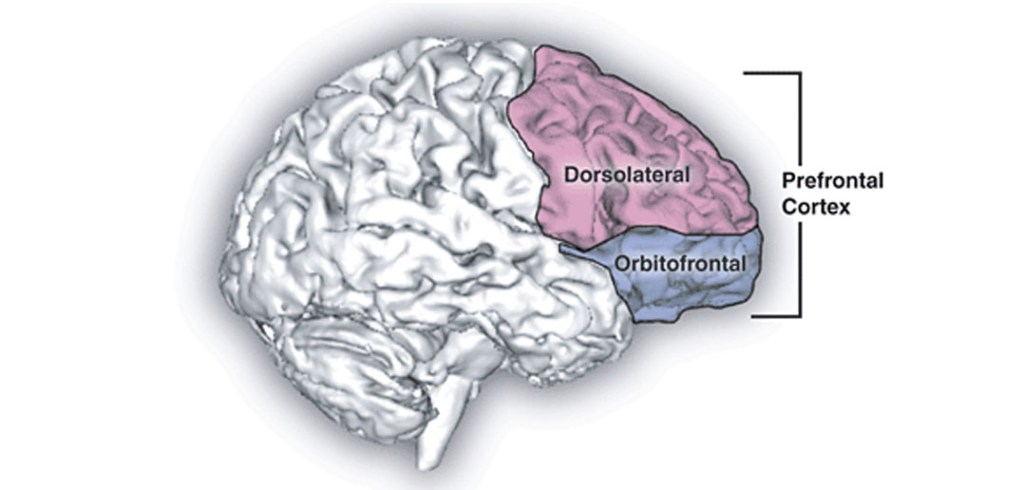
Your prized ability to weigh options, inhibit impulses, and make “rational” choices depends entirely on specific brain structures—particularly the dorsolateral prefrontal cortex (DLPFC)—operating within a neurochemical environment you inherited rather than created.
You occupy this biological machinery; you do not transcend it. Yet, society holds you responsible for its outputs as if you stood separate from these deterministic processes.
transcranial direct current stimulation over the DLPFC alters moral reasoning, especially regarding personal moral dilemmas. The subject experiences these externally induced judgments as entirely their own, with no sense that their moral compass has been hijacked
II. The DLPFC: Puppet Master of Moral Choice
The dorsolateral prefrontal cortex serves as command central for what we proudly call executive function—our capacity to plan, inhibit, decide, and morally judge. We experience its operations as deliberation, as the weighing of options, as the essence of choice itself.
And yet this supposed seat of autonomy can be manipulated with disturbing ease.
When researchers apply transcranial magnetic stimulation to inhibit DLPFC function, test subjects make dramatically different moral judgments about identical scenarios. Under different stimulation protocols, the same person arrives at contradictory conclusions about right and wrong without any awareness of the external influence.
Similarly, transcranial direct current stimulation over the DLPFC alters moral reasoning, especially regarding personal moral dilemmas. The subject experiences these externally induced judgments as entirely their own, with no sense that their moral compass has been hijacked.
If our most cherished moral deliberations can be redirected through simple electromagnetic manipulation, what does this reveal about the nature of “choice”? If will can be so easily influenced, how free could it possibly be?
III. Hormonal Puppetmasters: The Will in Your Bloodstream
Your decision-making machinery doesn’t stop at neural architecture. Your hormonal profile actively shapes what you perceive as your autonomous choices.
Consider oxytocin, popularly known as the “love hormone.” Research demonstrates that elevated oxytocin levels enhance feelings of guilt and shame while reducing willingness to harm others. This isn’t a subtle effect—it’s a direct biological override of what you might otherwise “choose.”
Testosterone tells an equally compelling story. Administration of this hormone increases utilitarian moral judgments, particularly when such decisions involve aggression or social dominance. The subject doesn’t experience this as a foreign influence but as their own authentic reasoning.
These aren’t anomalies or edge cases. They represent the normal operation of the biological systems governing what we experience as choice. You aren’t choosing so much as regulating, responding, and rebalancing a biochemical economy you inherited rather than designed.
IV. The Accident of Will: Uncomfortable Conclusions
If the will can be manipulated through such straightforward biological interventions, was it ever truly “yours” to begin with?
Philosopher Galen Strawson’s causa sui argument becomes unavoidable here: To be morally responsible, one must be the cause of oneself, but no one creates their own neural and hormonal architecture. By extension, no one can be ultimately responsible for actions emerging from that architecture.
What we dignify as “will” may be nothing more than a fortunate (or unfortunate) biochemical accident—the particular configuration of neurons and neurochemicals you happened to inherit and develop.
This lens forces unsettling questions:
How many behaviours we praise or condemn are merely phenotypic expressions masquerading as choices? How many acts of cruelty or compassion reflect neurochemistry rather than character?
How many punishments and rewards are we assigning not to autonomous agents, but to biological processes operating beyond conscious control?
And perhaps most disturbingly: If we could perfect the moral self through direct biological intervention—rewiring neural pathways or adjusting neurotransmitter levels to ensure “better” choices—should we?
Or would such manipulation, however well-intentioned, represent the final acknowledgement that what we’ve called free will was never free at all?
A Compatibilist Rebuttal? Not So Fast.
Some philosophers argue for compatibilism, the view that determinism and free will can coexist if we redefine free will as “uncoerced action aligned with one’s desires.” But this semantic shuffle doesn’t rescue moral responsibility.
If your desires themselves are products of biology and environment—if even your capacity to evaluate those desires depends on inherited neural architecture—then “acting according to your desires” just pushes the problem back a step. You’re still not the ultimate author of those desires or your response to them.
What’s Left?
Perhaps we need not a defence of free will but a new framework for understanding human behaviour—one that acknowledges our biological embeddedness while preserving meaningful concepts of agency and responsibility without magical thinking.
The evidence doesn’t suggest we are without agency; it suggests our agency operates within biological constraints we’re only beginning to understand. The question isn’t whether biology influences choice—it’s whether anything else does.
For now, the neuroscientific evidence points in one direction: The will exists, but its freedom is the illusion.
Making video content for even the simplest of concepts is time-consuming, but I wanted to create some visual content. Even though this material is hardly controversial, I feel it is important to set the stage for more advanced conversations.
Video: Free Will Scepticism: Determinism, Indeterminism, and Luck
I am getting better at understanding how the video editor works, so subsequent videos should be of higher quality. As I use free repurposed video content, I am forced to accept what’s available. In plenty of cases, more apt content is available from Adobe or iStock, but I can’t justify purchasing content at this time—especially given that the channel isn’t even monetised. Patience.
Follows is the transcript I used as a guide.
Free Will Scepticism. Determinism, Indeterminism & Luck
[REDACTED]
In this segment of free will scepticism, I talk about what free will is, why it’s important, and why it creates challenges that lead to a debate that’s lasted millennia.
Once we’ve established a foundation, we’ll look at the nemesis of free will that is determinism and its attendant nuances—indeterminism and luck.
As we unravel this problem, we’ll evaluate the relationship between these and whether these competing concepts can coexist.
In future segments, I intend to dig deeper into the question of free will as it relates to human agency and moral responsibility.
Defining Free Will
A good starting point is to define our terms. As we’ll discover, a fundamental challenge in the free will debate is that there is no common, agreed-upon definition, so let’s at least put some on the table.
A quick Google search yields these two definitions.
the apparent human ability to freely and consciously make choices that are not externally determined
the doctrine that such human freedom of choice is not illusory Let’s break down the first one by touching on the terms. This is an ability. No controversy here. Choices are the focus of this ability, and this ability is limited to humans. Not everyone limits the notion of free will to humans. In general, the reason free will gets so much attention is in relation to moral choice. As we don’t generally impose morality on non-human animals, we can live with this for now.
Note that this definition concedes that this is just an apparent human ability. This is because some people believe that if free will exists at all, it is just an illusion.
This ability. I’ll drop the ‘apparent’ qualifier so I don’t come across like an attorney and their ‘alleged’ perpetrator. This ability needs to be made freely and consciously. Free means without restriction, and consciously means with conscious intent. The definition further qualifies the free and conscious choice-making by stating that these choices are not externally determined. A person cannot be under a spell, hypnotised, or driven by unconscious intents. We’ll eventually see that disagreement centres around each of these terms, freely, conscious, and externally determined.
Stanford Encyclopaedia of Philosophy, an excellent online resource, defines free will as ‘a philosophical term of art for a particular sort of capacity of rational agents to choose a course of action from among various alternatives’. The ability to freely make choices is a common thread for all of these.
Another way to think about free will is to ask if you could have chosen otherwise. This is a thought experiment, and we’ll spend more time on this later. If you could turn back the clock and rerun the scenario, could you have chosen otherwise. As Jerry Coyne put it, ‘if you could rerun the tape of your life up to the moment you make a choice, with every aspect of the universe configured identically, free will means that your choice could have been different’. Let’s work through a simple scenario with no moral implications. All of the events of your life have led up to this moment. A server asks, tea or coffee. You choose tea. Black or lemon—or cream? Let’s not get ahead of ourselves. Let’s re-run the scenario. Everything leading up to this server asking for your order is the same—the same seat at the same table, in the same restaurant, the same server. Even the same jelly stain on the curtain and the same blue Buick parked outside your window. And the same parent trying to quiet her unruly child. You get the idea. Everything until now has played out the same. Last time you ordered tea. Do you possess the free will to order coffee this time around? We don’t need to answer this question quite yet. Keep whatever idea you have and we can compare it against the competing perspectives.
You might be thinking, so what? Who cares? Why is free will so important?
Free will is not just some abstract philosophical concept. Philosophy gets accused of pondering topics with no application in the real world. What is the sound of one hand clapping sort of fare.
Free will is at the centre of human agency and autonomy. The only reason it makes sense to praise or blame someone is because they could have done otherwise. We might praise a robot that was programmed to rescue people from fires. Even if we marvelled at the achievement of the robot, we’d more likely praise the programmer or the operator over the robot.
Likely more important than praise is blame. Humans’ propensity for blame could be its own series, so let’s just consider the notion idiomatically. If a person is remotely controlling a robot and steers it into your table, spilling your tea, you may be miffed at the robot, but your blame will be aimed at the one who’s holding the remote controller.
After blame comes punishment, or reward in the case of praise. This is another subdiscipline in its own right, so let’s continue.
Many people just presume that free will exists, so where are the challenges? First, the definition of free will is unstable, and it has drifted over time. Sometimes this has been innocent enough whilst at other times the definition has been amended to suit an argument. Sort of moving the goal posts. So, there’s no standard definition. This means that I can accept the notion under one definition and reject it under another. This hardly makes for fruitful debate.
Related to these first two is that for some people, the concept is reduced to something so narrow, so laser-focused, that it doesn’t seem to matter in the real world. Daniel Dennett has said that he’d be willing to concede that one doesn’t have free will except in matters of decisions in the order of ‘one cube of sugar or two in your tea’ or ‘taking the lavender blouse over the lilac one’. If you contend that this is the limiting boundary for free will, sure. You’ve got free will, for what it’s worth.
Still others say that free will is nothing more than an illusion. That a person perceives having free will is akin to perceiving that the sun rises in the East. We know this not to be true, and yet it appears to be true. We even commit this faulty observation to language, and it’s difficult not to envisage it differently.
The strongest position against free will comes from the Impossibilists, who hold unsurprisingly, the belief that free will is impossible given what we know about physical laws and the universe. Galen Strawson is likely the most notable of these people.
Determinism
Contrary to free will is Determinism. Defined, Determinism is the doctrine that all events, including human action, are ultimately determined by causes external to the will.
Ostensibly, this is a strong belief in cause and effect. That every event is caused by a prior event. The implication is that if one were to turn back time to the Big Bang and let history run again, everything down to the smallest atomic movement would run the same course of events. Absolutely nothing would change. This includes any thoughts and decisions. Unchanged.
Given this worldview, some philosophers have taken determinism to imply that individual human beings have no free will and cannot be held morally responsible for their actions.
Without going too deep, Determinism can be a view adopted from a sectarian or secular perspective. The sectarian narrative is that God created the natural laws and set the universe in motion. The secular vantage is that there are physical laws, and the big bang set the universe in motion. These days, not many people hold this view. Indeterminism is the reason.
Indeterminism
Indeterminism is another idea cursed with multiple definitions. The name originated as a counterargument to Determinism, hence the ‘in‘ prefix in the name. Not determinism. Indeterminism says that deliberate choice and actions are not determined by or predictable from antecedent causes, or that although there may be deterministic behaviours in the universe, not every event has a cause.
I’d like to qualify ‘not every event has a cause’ to ‘not every event has a known cause’ or some events have probabilistic causes, hence indeterminate. There is a bit of overlap here with the notion of luck, and we’ll get to that presently.
Our knowledge of physics and the advent of quantum mechanics has put hard determinism out of favour. As we saw, under strict determinism, if we turned back time, the future would always unfold identically. Think of this as a film strip or a video. No matter how many times you replay it the events manifest the same way. You can warn the camper not to go down into the cellar alone, but every time, she will. You can almost think of this as a sort of fate, although one must be careful to note that rewinding and replaying to the parts we’ve already seen does not mean that we can predict what we haven’t.
Quantum physics notes that there are many events that are stochastic or probabilistic. So even if you rewound and played it again, it would be like the girl flipping a coin before opening the cellar door—or I suppose the director. Heads, she goes down. Tails, she remains up, or she gets a friend.
The less strict version of Indeterminism doesn’t say that nothing is determined. Rather, that there are enough probabilistic events that we can’t claim to know what’s going to happen next.
Luck
Then there’s luck. Luck is also indeterministic, but it tries to clarify some cases. By definition, luck is success or failure apparently brought by chance rather than through one’s own actions. If you flip a fair coin or throw a fair die or pull the handle on a slot machine, you may win or lose, but this outcome had nothing to do with you except that you were there at that moment. But there is more to it than this because a strict Determinist might claim that the outcome was determined by the state of molecules in history, that if you reran history, it would unfold the same way.
Apart from the luck that we tend to think of in gambling—good luck and bad—, there is the notion of moral luck, that is treating people as objects of moral judgement even when what they do depends on factors out of their control.
Not all luck is created equal, so let’s look at the various flavours of luck. Most of these were articulated by Thomas Nagel.
Resultant Luck
Resultant luck is the way things turn out. This notion evaluates luck in reverse. It involves what is known as survivorship bias.
I’ll share a true story. An acquaintance of mine got married and took a honeymoon in Jamaica. On holiday, the couple ate some seafood. His wife became sick and was hospitalised. There she died. One can imagine a story with a happier ending, where the couple took holiday and won a large cash prize in a casino, again a situation that could not have happened unless they had happened to be there. In the first case, one might say she had bad luck. In the second case, her luck was good.
Circumstantial Luck
Circumstantial luck is the circumstance one finds oneself in. You had no control over how you got to a certain place, but because you got there, you are faced with a choice. The gist of this is that the choice would not have been given, so you would never have made it.
Perhaps, expecting you to be out, a burglar enters your home one evening and you confront him and he shoots you (or you shoot him; it doesn’t matter). Maybe you were driving to someplace and another vehicle crashes into yours, totalling it. This is circumstantial. You had no intention of getting into an accident. Had you not been driving, this could not have happened. Perhaps, because of the accident, you won a lawsuit that yielded you a lot of money; perhaps, your back was irreparably damaged. Circumstantial luck.
Constitutive Luck
Constitutive luck relates to who one is or their traits and dispositions. Think of this as character. Some people are ‘born’ with a persuasive disposition. Some are born to excel at football or maths. Some are The Rain Man. This is the genetic lottery. Perhaps you want to be a famous singer. Only you can’t sing. And maybe you can sing, but you lack charisma.
Billionaire Warren Buffett readily concedes that he would not likely be a billionaire if he happened to be born in India rather than the United States. This is constitutive luck.
Present Luck
Present luck is about luck at or around the moment of a putatively free action or decision point. This is a term used by Levy, borrowed from Mele. At any point in time, you are who you are and where you are as a matter of luck. You were born in a place at a time in history into a family. Heidegger called this ‘thrownness’. A person is thrown into this world and has to survive or not on their own terms. In any case, this family moulded you and schooled you with whatever constraints that they may have had: money, class, access, location. All the usual suspects. You interacted with the kids who were available. You got whatever teachers you got, and on and on. I think you get it. None of this is within your control. Examples I think of are musical acts, bands like The Beatles, Korn, U2, and so many others that are comprised entirely or largely of friends. They just happened to be born in the same general time and vicinity. I imagine if either of these were different, they wouldn’t have manifested the same way. Imagine Mozart being born in the 21st century. Perhaps he’d be a YouTube star. Who knows?
Causal Luck
Causal luck is how one is determined by antecedent circumstances. This is the type of luck most closely aligned with free will and determinism. Simply put, it says that everything that preceded you is outside of your control as is everything leading up to what you have become. Causal luck is about the directional relationship between cause and effect.
For the record, some view causal luck as redundant to the combination of constitutive and circumstantial luck. I think that’s a fair charge, but let’s continue and see how these concepts play together.
At the highest level, there are two competing perspectives. Free will and determinism are either incompatible or compatible. Let’s begin with incompatibilism.
Incompatibilism
As it would seem, this view holds that free will and determinism are mutually exclusive. This holds for indeterminism as well. One cannot simultaneously hold the view that everything is determined, and that one can still manage to have free will in this determined universe.
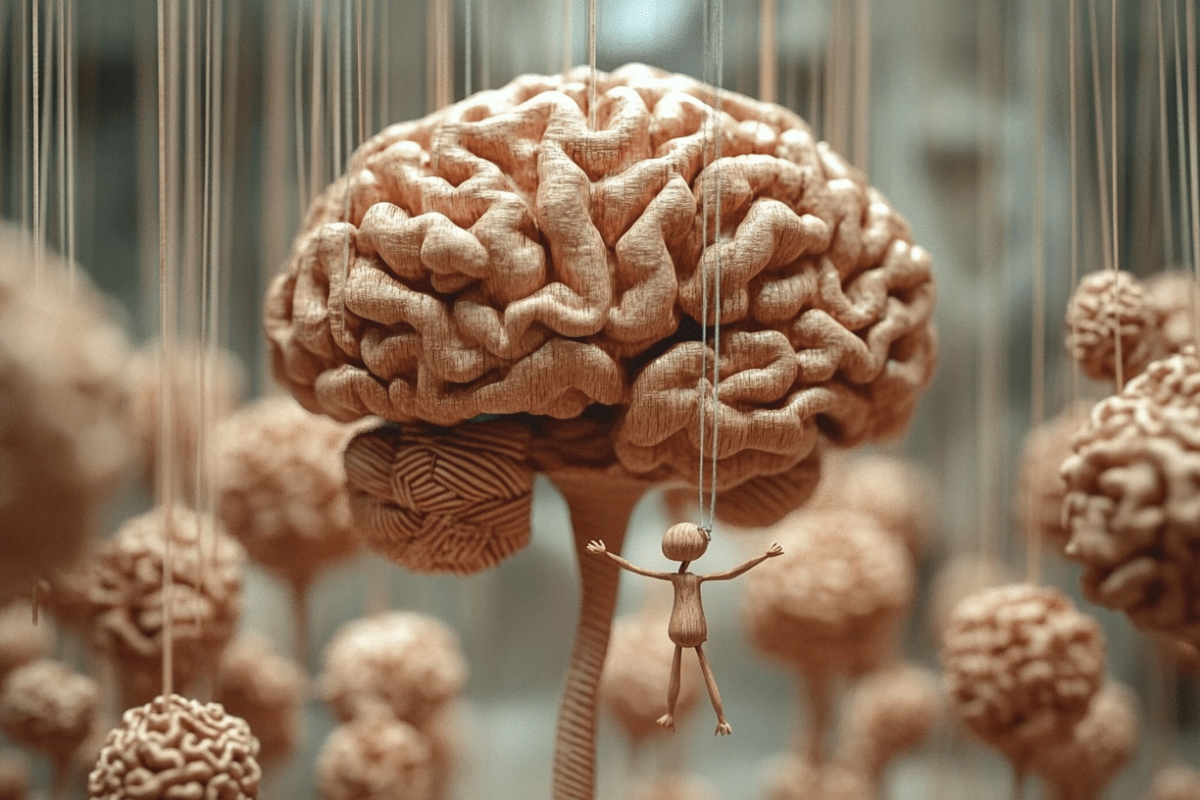
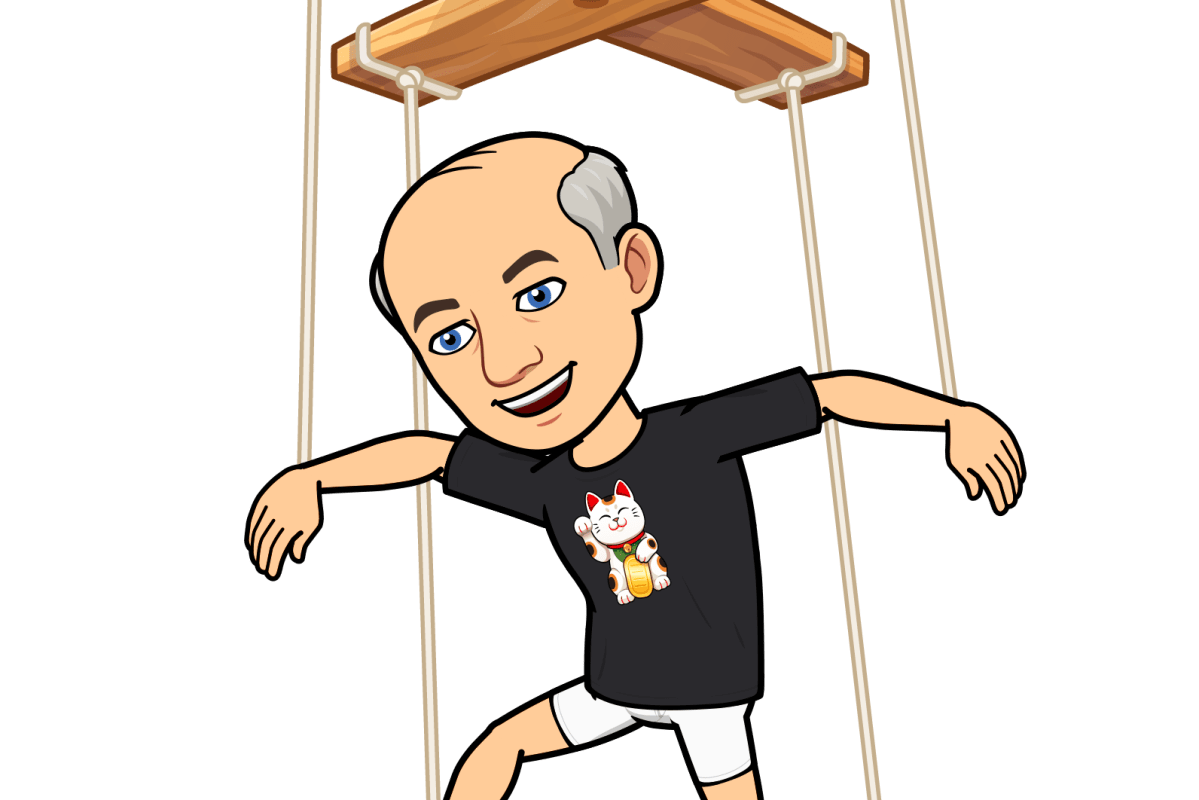
A puppet is free as long as he loves his strings
SAM HARRIS
Sam Harris famously wrote, ‘a puppet is free as long as he loves his strings’. Harris is a neuroscientist and free will sceptic, who believes that free will is an illusion. And I was determined to not let this image go to waste.
Compatibilism
Finally, we have compatibilism, where the belief is that free will and determinism can coexist—and do. There are two basic reasons this might be possible: metaphysics or emergence.
Metaphysics
I’ll let you know that I find the metaphysical argument to be weak tea. The argument is that maybe there is a god or something not bound by the constraints of our universe, who can put ideas into your brain, thus manipulating your decision. You were going to order tea, but this intervention led you to order coffee. I think that this perspective falls on its face right out of the gate. If some force is controlling you, the resulting actions may not have been predictably determined, but neither are they caused by you. In this scenario, this force might as well be the person controlling the robot to spill your tea.
Emergence
Then there’s emergence. Quickly, emergence is the notion that one can combine two or more elements with the outcome being a substance with different ‘emergent’ properties. An example most people are familiar with is the combining of hydrogen and oxygen to produce water. Two Hs plus an O creates H20. Hydrogen and Oxygen are both gasses, but water is a liquid with a further emergent property of being wet.
The argument is that this free will occurs independently of all the inputs and processes. If this were true, then free will and determinism could coexist. There is no evidence of this, and I’ll just leave it here. I intend to add to this by reviewing articles for and against free will and the compatibilist position.
Do you believe you have free will? If so, why. Are you a determinist or an indeterminist? Are you a compatibilist or an incompatibilist?
I just published a video on YouTube—just over 7 minutes long. I’ll be publishing the audio as a podcast and will share the script here as well.
Human Agency is an illusion. This is the end of the story. If you listen for a while, you’ll hear as I rewind and pull back the curtains.
[Redacted]
Let’s get started.
Human Agency is an illusion.
Think of life as a motion picture that’s already been filmed. The ending is already known. The script has been written and performed by actors already chosen and hired.
I like this visual, but it’s not quite right. The end is not known in the same sense as that of the movie. It’s just as inevitable, just unknown.
Some might prefer to use the metaphor of cascading dominos. And this might even play better into the illusion. Some unforeseen force might intervene and stop the otherwise inevitable. But even this is beyond our control. Like an action-adventure story, we’re strapped into a runaway train and just along for the ride. This train might someday stop, but we’ll have had nothing to do with it. Enough of metaphors. What am I saying? Why am I saying it? And what does it mean?
Allow me to set up the scene. From there, I’ll elaborate.
For millennia, there’s been a debate over free will and determinism. These terms have been defined in different ways in an attempt to sway the argument for or against, one way or another. It turns out that for the human agency illusion, it doesn’t much matter, but it might still help to set the stage, so let’s establish some foundation. I like to consider free will and determinism as bookends.
free will is the ability to make a choice and have had the ability to have chosen otherwise
Commonly, free will is the ability to make a choice and have had the ability to have chosen otherwise. That one can make this choice of their own accord or volition, is typically added for good measure. On the other hand, determinism says that everything that happens is determined by everything that has happened prior in a chain of cause and effect. Like dominoes falling one after another, so some event has caused another event since the dawn of time. Perhaps before time.
Some have argued that random events occur in our universe. Quantum theory suggests this. But that these events happen, doesn’t mean that we as humans have any say in the matter. This is what is known as indeterminism. Causes and effects are not so cut and dry. Some stochastic event serving as an exogenous factor manifesting as a pigeon, can swoop down and break the causal domino chain, but that doesn’t afford us human agency. A little more background. Some hold that free will and these alternatives are either mutually exclusive, or they’re compatible with each other. Not surprisingly, those who believe that these can coexist are called compatibilists, whilst the others are incompatibilists.
What I am saying is that if we allow that this wide shot might have validity, we can zoom in for a tight shot on the agent and notice that it doesn’t really matter. Some have said that the freewill versus alternatives challenge is a pseudo-problem. I am going to agree for the time being, if only for expedience. Before getting to the illusion of agency, let’s see why this situation creates problems.
Without getting too deep, humans seem to be wired to view their reality in a manner of cause and effect. Moreover, they seem wired to attribute blame based on this presumed causal relationship. Oksana hit a homerun. We should praise her. Raj robbed a store. We should blame him. Western society is constructed with this worldview, so we create rules and laws. We may even choose to codify how to rehabilitate or punish him. Or to reward her.
Without agency, there is no cause to praise or blame
Without agency, there is no cause to praise or blame. Whilst I consider it a pathology, for better or for worse, given the human propensity to blame concomitant with the agency illusion, I don’t see this changing any time soon.
There are arguments around quarantining bad actors independent of their agency or lack thereof on the grounds of public safety. Even this logic has serious holes, but we’ll save that for another time. And now the big reveal. With a reminder that my intent is to not go deep, how can I say that human agency is an illusion? Let’s start with the science.
As a lifeform, humans are a product of heredity, genetics, and epigenetics. Essentially, DNA passes information from generation to generation. Besides determining our physical attributes—head, shoulders, knees, and toes, potential height and weight, pigmentation, sex, and so on, it also establishes our temperament—our base attitude and way we perceive and interpret the world. This doesn’t make us clones or robots or automatons, but it does comprise some percentage of what we are. Identity politics aside, we don’t have much control of our sex, finger count, or eye colour. Clearly, we aren’t talking about trans-humans and cyborgs here.
Genetics and so on aren’t the only factor. Behaviourists will remind us that the environment and circumstances mould us, too. Each of us is taught mores and moral codes; how to behave and act. We are raised in a structure comprised of family, school, church, peers, larger society, authority figures, and whatever else—ostensibly like a sausage being stuffed into a skin.
Beyond the genetics that we have no control over, we are products of our environment
Beyond the genetics that we have no control over, we are products of our environment. These things interact, but there is nothing of us that we are responsible for creating. Despite the motivational tripe, we cannot create ourselves. This, too, is an illusion—delusion if I am being less charitable.
I’ll reserve elaboration for future content. In a nutshell, you’ve got no agency. Every choice you make is based on prior events. Even something as simple as choosing to order a chocolate or vanilla ice cream in a cup or a cone, sugar cone or waffle cone is predicated on some prior events, and you had nothing to do with them. You were a passive vessel.
I’ll leave with two relevant quotes.
A man can do what he wants, but not want what he wants.
Arthur Schopenhauer
And as Galen Strawson puts it,
You do what you do, in any given situation, because of the way you are.
So in order to be ultimately responsible for what you do, you have to be ultimately responsible for the way you are—at least in certain crucial mental respects.
But you cannot be ultimately responsible for the way you are in any respect at all.
So you cannot be ultimately responsible for what you do.
So there you have it. I hope you found this cursory treatment interesting and informative if not provocative.
[Redacted]
I’m interested in hearing what you think. Do you think you have agency? Do we have free will, or is everything determined at the start? I didn’t even mention religion. Does that throw a spanner in the works? Let me know.
My love affair with Foucault goes way back. Joseph Campbell is said to have spent five years (1929–1934) living in a shack, engaged in intensive and rigorous independent study. In my dreams, I’d spend five years with Foucault, Galen Strawson, and David Guignion.
Michel Foucault is likely the most well-known of these three, and I’ve written a few Galen Strawson-related posts lately, but who the hell is David Guignion? I’ll tell you. David is a PhD philosophy student studying conspiracy theories if his bio is up to date and otherwise relevant. I’ve shared some of his content and insights over the years.
The reason I love David is that he introduces me to contemporary philosophers I had not been aware of as well as material or perspectives on classical philosophers to broaden my horizons. I think it’s safe to say that David and I are both Foucault fanboys. Hell, I don’t even have a tee shirt with Foucault’s likeness, so he’s even ahead of me in that game.
So, where’s this all leading, you ask. And I’m glad you did. A couple of days ago David posted a clip on YouTube called Michel Foucault’s “The Subject and Power”. I was drawn to the mention of Foucault, but I decided not to visit. I get so many distractions on my anti-agency endeavour—and that’s not even accounting for the sheer quantity of research—, and I didn’t need yet another. But the synchronicity was determined.
Last night, as I was getting ready for bed, I decided that I’d just let the video play as I fell into slumber. Spoiler Alert: That never happened. Topic after topic caught my ear, and it took all of my will to not get out of bed and start reading and writing. But it was almost 4 am, so that worked in favour of remaining supine—though alternately prostrate.
Kumi Yamashita, Building Blocks (2014)
My thesis is that the free will versus determinism or indeterminism debate is not inherently critical to the agency versus structure debate. My position is that agency has little breathing room and no material degrees of freedom to matter. Foucault’s subjectification or subjectivation makes the same argument. In effect, this is an argument about structure over agency. It’s about conscious and unconscious forces to conform. Full disclosure, I identify most as an indeterminist, but in the end, I don’t think it much matters. I disclose this being it may provide a clue as to how I ended up here—of my own free will, it goes without saying.
I’m not going to summarise David’s summary because you can just watch his clip for yourself. But the gist of it is that we are all subjectivised or moulded. Foucault tries to convince us that this is the crux of his decades of teaching, but to me, it still comes down to power—to the pressure that creates these diamonds. Diamonds have no free will; they just become diamonds. And so it goes for humans cum subjects.
Not to come across like Rousseau, but I am still interested in understanding what happens to those outside of this sphere of influence.
Cover Image Credit
Kumi Yamashita
BUILDING BLOCKS 2014 H200, W300, D10 cm Carved wood, single light source, shadow Permanent Collection Otsuma Women’s University, Tokyo, Japan
An idea that Galen Strawson mentions is that of the self and the case of self and selves. I’ll presume he also considers the case of no-self, but I haven’t heard his position on this—at least not yet.
About the No-Self
In the East, Buddhism teaches the notion of no-self or non-self. Anattā (अनत्ता) captures the idea of the everchanging. By this doctrine, nothing is permanent. Any separation from this is merely an illusion. In principle, this leads to the Four Noble Truths:
Life is suffering
Suffering is due to attachment
This attachment can be overcome
There is a path to achieve this (the eight-fold path)
Life just is suffering.
There are many incantations of this, but these four capture the essence. The points here are that life just is suffering. No one escapes this fate—not wealth nor power—because we become attached to these things. The self (or Ego) is another attachment. In identity politics, people tend to get upset when you don’t accept or at least identify with their self-perception. Personally, I don’t believe in identity, but I understand how it is meant idiomatically, so I can operate in this space.
About the Selves
What Strawson says (at the risk of misinterpreting him egregiously), is we have many selves. We are a composite of time slices. As he quipped, each Planck time moment is a new self. We tend to construct these selves into a single self—I suppose in the manner that a 2-hour film shot at 60 frames a second would consist of 432,000 frames and yet have a continuity analogous to a self.
Self, No-Self, Selves Depictions
About the Self
In the West, the notion of self is as ubiquitous and uncritically accepted as rights, private property, and Democracy. As their Declaration of Independence reads, some things are self-evident. This self is obviously constructed, so let’s look at how these selves are merged.
Selves to Self
Cognitive processes function to stitch these time-sliced selves into a cohesive narrative about ourselves. In fact, it tends to pick out keyframes of memorable events. Strawson posits that there are (at least) two types of people: Those who create these identity narratives, and those who don’t. Given the pressure toward self, especially in the West, it may be awkward or uncomfortable for those who don’t toe the line in this arena. And if you don’t abide to the notion of self, don’t worry, you’ll be burdened with at least one, more likely one per person you interact with—or observed by. As in the US justice system promises relative to legal representation, if you don’t have one, one will be appointed for you. (I’ll spare you another psychology cum pseudoscience rant.)
There are two types of people: Those who create these identity narratives, and those who don’t
Some religions attempt to solve compositing the selves into a self by introducing a soul that acts as a core. In some belief systems, this sole is even able to serve as a core for some future incarnation and some versions of karma carry with it burdens of past lives.
I am partial to the Selves interpretation. Some Gestalt and apophenia—not to be confused with apotheosis, albeit perhaps related—serve to do the heavy lifting. I don’t think that any (or at least many) people disagree with the idea, even if one is partial to the notion of a self, that a person is not the same at 1, 10, and 100. We can identify this person as Sanjit, at each observation, but Sanjit is materially different at each point. We just construct a narrative as in the case of the film frames. I can’t imagine it’s easy for a person indoctrinated into a world of ‘self’ that seriously grasping a sense of ‘non-self’.
It seems, I’m disrtracted and rambling at the moment, so I’ll end here. I think I’ve captured the essence of my thoughts.
Galen Strawson is my latest male crush. With almost everything I read or hear from him, I say, ‘that’s what I think’, over and over and over again. So I thought I’d share some of my journey to now. I made a post about female influences not too long ago. This is a bit different.
My first obsession, let’s say was the Beatles. I can’t pinpoint precisely when, but when I was a child, it’s been said that I would sing ‘she’s got a chicken to ride’ when it came on to AM radio. I asked for or bought all of their albums, and read everything about them that a kid could get his hands on back in the day. This obsession lasted for years and overlaps some of my next interests. My interests were in John Lennon’s political interests and George Harrison’s spiritual interests. I didn’t really find Paul McCartney or Ringo Starr very interesting beyond their musical abilities. And to be honest, I also got all of the Stones, Led Zeppelin, Pink Floyd, and so on. At my peak, I had over a thousand vinyl records—all lost in a house fire because vinyl and heat are generally incompatible. Paper didn’t fare much better, as I lost hundreds of books, too. A lesson in impermanence.
I am a bit of a nonconformist, a contrarian, and a polemicist
In grades 5 to 8, National Socialism and World War II were fascinating to me. Not Hitler, per se, though I do recall reading Mein Kampf at the time. There was just something about the sense of unity. Upon reflection, I realised that this meant me conforming to some other trend, and that was no longer interesting, as I am a bit of a nonconformist, a contrarian, and a polemicist, so there was that.
At some point, I came across Voltaire’s Candide and it just struck me. This may have commenced me on my path to becoming somewhat of a francophile. I extended my interest into the language and culture. My WWII phase has already primed that pump. I remember reading Dumas, Hugo, and some Descartes.
After I graduated, I was a recording engineer and musician. I remember reading Schoenberg’s Structural Function of Harmony and being enamoured with Dvořák and Stravinsky. I was influenced by many musicians, engineers, and producers, but there was just something about Schoenberg.
I went through a Kafka phase—that eventually included Donald Barthelme. His Absurdism was a nice foundation for my subsequent interest in Camus. It was something that just resonated with me. After Kafka, I discovered Dostoyevsky and consumed everything of his I could get my hands on.
I took from Jung and Campbell the importance of metaphor
In the 1990s, I discovered Carl Jung and eventually Joseph Campbell and a few years I spent reading Jung’s Complete Works and peripheral material related to Archetypal and Depth Psychology. I absorbed the material. I took from Jung and Campbell the importance of metaphor, but it never really resonnated beyond this.
Somehow, this experience led me to the Existentialism of Sartre (and Camus and Beauvoir). At the same time something clicked with me, I was always put off by the teleological imperative these guys seemed to insist upon—Sartre’s political involvement and Camus’ insistence on Art. These were their paths—and I certainly had an interest in Art and Politics—, but I felt this was too prescriptive.
For a brief time, I really liked Hume (and Spinoza), but then I discovered Nietzche and felt compelled to read his major works. It all made sense to me. It still does. Nietsche set me up for Foucault with his power relationships and the sense that morality, good, and evil are all socially constructed and contextual.
And Nietzsche brought me to Foucault and his lens of Power. These two still resonate with me. I investigated a lot of postmodern thinkers after this.
Nietzsche brought me to Foucault and his lens of Power
Daniel Dennett came next. He seems brilliant, and I tend to agree with most of what he says. I was still absorbing. Where biologist Robert Sapolsky gets philosophical, it’s about the same.
But Galen Strawson is different. And I have a lot of catching up to do in my reading of his direct work. The difference is that with these prior influences, I was absorbing and synthesising—creating my own perspectives and worldview. By the time I am finding Strawson, with every encounter, I am ticking off boxes.
That’s what I think
That’s what I think
That’s what I think
That’s what I think
Only, he started publishing in the 1960s. I could have been reading his work all along. Since I agree with 99.999 per cent of what I get from him and he is such a deep thinker, I am looking for two things:
Something that expands rather than confirms
Some spaces to operate that he has missed or ignored
As I continue on my Anti-Agency project and gather more inputs and perspectives, I’ll be considering a lot of Strawson. Here’s a clip I really enjoyed. I am thinking of doing a sort of reaction piece, but whether or not that happens, here’s the source.
[Video] Galen Strawson — Is Free Will a Necessary Illusion?
Spoiler Alert: I believe that free will is a cognitive bias related to apophenia. It’s a Gestalt heuristic.









 Philosophics