Defining Intelligence

Using AutoCrit, I continue to share the review progress of my work in progress, Democracy: The Grand Illusion—perhaps Grand Delusion might be more fitting. In this chapter, I establish a foundation for intelligence and cognitive function.

Synopsis

The text begins by discussing the concept of intelligence, specifically focusing on IQ as a measure of cognitive abilities relative to others. It explains the origins and standardisation of IQ tests, highlighting their limitations in capturing the full spectrum of human intelligence. The discussion then shifts towards Emotional Intelligence (EQ), outlining its components and emphasising its importance in interpersonal relationships and leadership roles.

The narrative further delves into Howard Gardner’s Theory of Multiple Intelligences, which challenges the idea that intelligence is a singular ability measured solely by traditional IQ tests. The text elaborates on various types of intelligences proposed by Gardner, such as linguistic, musical, spatial, naturalistic, and intrapersonal intelligence.

Moreover, cognitive biases are explored in detail within democratic processes through real-world examples like confirmation bias or groupthink. Strategies to mitigate these biases are suggested for improving decision-making within democracies.

The text concludes with a call for embracing diverse forms of intelligence within democratic systems while acknowledging and addressing cognitive biases to enhance governance effectiveness.

Audience

The target audience for this text appears to be individuals interested in psychology, education theory, and political science, or those exploring the intersection between human cognition and democratic governance. Readers seeking an in-depth analysis of different forms of intelligence alongside discussions on democracy would find this text engaging.

Those less inclined towards academic or theoretical discourse may not be the primary target audience. To make it more relevant to a broader readership base outside academia or specialized fields:

  • Simplifying complex terminology
  • Providing relatable examples
  • Incorporating practical applications

Structure and Organisation

The structure follows a logical order starting with defining traditional measures of intelligence leading up to discussions on multiple intelligences and cognitive biases impacting democracy. Each section flows cohesively into the next without abrupt transitions or disjointed topics. No significant issues with organisation are evident; each subsection builds upon previous concepts effectively.

Clarity

Overall clarity is maintained throughout most sections; however:

  • Complex sentence structures could potentially hinder comprehension for some readers.
  • Jargon related to psychological theories might require additional clarification for lay audiences.
    Providing simplified explanations where needed can enhance reader understanding without sacrificing depth.

Argument and Persuasion

Opinions presented focus more on informing than persuading; strengths lie in presenting well-supported arguments backed by historical context (e.g., case studies). Logical construction aids credibility but lacks explicit attempts at persuasion beyond informative purposes.

Tone

The tone remains informative yet engaging throughout without veering towards overly formal or casual language usage which suits an academic discourse effectively.

Interest and Engagement

The text manages to maintain interest through its exploration of diverse aspects related to human intelligence; however certain sections discussing specific types like “Naturalistic Intelligence” might require additional engagement strategies such as case studies showcasing individuals excelling in that particular domain.

Final Thoughts & Conclusions

The conclusions drawn at the end tie together various points introduced earlier effectively providing clear insights into how embracing diverse forms of intelligence can enhance democratic decision-making processes – offering strong closure that resonates with preceding discussions.

The text concludes by emphasising the importance of understanding intelligence in a multifaceted manner, encompassing both IQ and EQ as well as Howard Gardner’s theory of multiple intelligences. It highlights the limitations of relying solely on IQ tests for measuring intelligence, pointing out cultural biases and the narrow scope of such assessments. The discussion on emotional intelligence (EQ) adds depth to the exploration, underscoring its significance in interpersonal relationships, leadership, and mental health. By integrating multiple intelligences into the context of democracy, the text suggests a more inclusive approach to decision-making that values diverse forms of intelligence beyond traditional analytical skills. Overall, the conclusion effectively ties together key points introduced throughout the text, providing a comprehensive perspective on human intelligence and its implications for democratic systems.


Bonus

References and Citations

Democracy and Political Systems

  • Bogdanor, V. (1997). The monarchy and the constitution. Clarendon Press.
  • Brams, S. J., & Fishburn, P. C. (2007). Approval voting. Springer.
  • Dahl, R. A. (1989). Democracy and its critics. Yale University Press.
  • Dahl, R. A. (2006). On political equality. Yale University Press.
  • Diamond, L. (1999). Developing democracy: Toward consolidation. Johns Hopkins University Press.
  • Edwards, G. C. (2011). Why the Electoral College is bad for America. Yale University Press.
  • Farrell, D. M. (2011). Electoral systems: A comparative introduction. Palgrave Macmillan.
  • Kriesi, H. (2005). Direct democratic choice: The Swiss experience. Lexington Books.
  • Lijphart, A. (1999). Patterns of democracy: Government forms and performance in thirty-six countries. Yale University Press.
  • Ober, J. (2008). Democracy and knowledge: Innovation and learning in classical Athens. Princeton University Press.
  • Putnam, R. D. (2000). Bowling alone: The collapse and revival of American community. Simon & Schuster.
  • Reynolds, A., Reilly, B., & Ellis, A. (2005). Electoral system design: The new international IDEA handbook. International IDEA.
  • Sen, A. (1999). Development as freedom. Oxford University Press.
  • Shugart, M. S., & Wattenberg, M. P. (2001). Mixed-member electoral systems: The best of both worlds?. Oxford University Press.
  • Sunstein, C. R. (2009). Republic.com 2.0. Princeton University Press.
  • Tocqueville, A. de. (1835). Democracy in America. (H. Reeve, Trans.). Vintage Books.

Intelligence and Cognitive Psychology

  • Binet, A., & Simon, T. (1916). The development of intelligence in children. (E. S. Kite, Trans.). Williams & Wilkins.
  • Flynn, J. R. (1987). Massive IQ gains in 14 nations: What IQ tests really measure. Psychological Bulletin, 101(2), 171-191.
  • Gardner, H. (1983). Frames of mind: The theory of multiple intelligences. Basic Books.
  • Goleman, D. (1995). Emotional intelligence: Why it can matter more than IQ. Bantam Books.
  • Herrnstein, R. J., & Murray, C. (1994). The bell curve: Intelligence and class structure in American life. Free Press.
  • Kaufman, A. S. (2009). IQ testing 101. Springer Publishing Company.
  • Mayer, J. D., & Salovey, P. (1997). What is emotional intelligence? In P. Salovey & D. J. Sluyter (Eds.), Emotional development and emotional intelligence: Educational implications (pp. 3-31). Basic Books.
  • Sternberg, R. J. (1985). Beyond IQ: A triarchic theory of human intelligence. Cambridge University Press.
  • Sternberg, R. J., & Kaufman, S. B. (Eds.). (2011). The Cambridge handbook of intelligence. Cambridge University Press.
  • Terman, L. M. (1916). The measurement of intelligence. Houghton Mifflin.
  • Wechsler, D. (1949). Wechsler intelligence scale for children (WISC). Psychological Corporation.

Classical Works and Philosophy

  • Plato. (c. 380 BCE). The republic. (G. M. A. Grube, Trans.; C. D. C. Reeve, Rev.). Hackett Publishing Company.

AutoCrit is an AI-based editorial application. I am a member of their affiliate programme, so I gain minor financial benefits at no cost to you if you purchase through a link on this page.
In Favour of Democracy

Many forms of government have been tried and will be tried in this world of sin and woe. No one pretends that democracy is perfect or all-wise. Indeed, it has been said that democracy is the worst form of government except all those other forms that have been tried from time to time.” – Winston Churchill

As I continue to write and examine my book, I’ll share snippets of progress. In this article, I focus on the voices in support of democracy. This might seem like counting grains of sand on the beach given Democracy’s promotional propaganda. In the West, we are inundated with this messaging.

Some of the pro-democracy voices also appear in the chapter on sceptics, but I separate the streams of thought in each section. Representing pro-democracy voices are the following:

Western Thinkers

  • Karl Marx
  • Winston Churchill
  • John Stuart Mill
  • Thomas Jefferson
  • Alexis de Tocqueville
  • Nelson Mandela

Eastern and Untraditional Thinkers

  • Mahatma Gandhi
  • Aung San Suu Kyi
  • Sun Yat-sen
  • Benigno “Ninoy” Aquino Jr
  • Kim Dae-Jung

I wanted to gain perspective from more than white male voices promoting democracy. I found Nelson Mandela, a black African who subscribes to the Western tradition. Aung San Suu Kyi is the only female represented in this cohort.

Here is how AutoCrit* sees the content of this chapter using its reporting structure.

Synopsis

The text delves into the exploration and defence of democratic ideals through the perspectives of various historical figures, both Western and Eastern. It opens with a quote from Winston Churchill highlighting the imperfections of democracy but also its superiority over other forms of government. The author then introduces key thinkers such as Karl Marx, John Stuart Mill, Thomas Jefferson, Alexis de Tocqueville, Nelson Mandela, Mahatma Gandhi, Aung San Suu Kyi, Sun Yat-sen, Benigno Aquino Jr., and Kim Dae-Jung. Each figure’s support for democracy is examined within their historical context and relevance to modern governance. The text closes by reflecting on common themes among these figures regarding the challenges and potentials of democratic systems.

Audience

The target audience for this text appears to be readers interested in political philosophy, history, or governance systems. Those seeking insights into the evolution of democratic thought through influential figures would find value in this content. However, individuals looking for a light read or entertainment may not be the primary audience here. To make it more relevant to a wider audience base including students or general readers less familiar with political theory jargon could be simplified without compromising depth.

Structure and Organisation

The structure follows a logical order by introducing each figure individually along with their background information before discussing their support for democracy. This organisation allows for clear delineation between different perspectives while maintaining coherence throughout the text.

Clarity

Overall clarity is good; however, some sections delve deeply into specific philosophical concepts that may require prior knowledge or further explanation for complete understanding. For instance, when discussing epistocracy in relation to Jason Brennan’s views on political competency testing could benefit from clearer definitions or examples to aid comprehension.

Argumentation and Persuasion

Opinions presented are well-supported by referencing primary texts from historical figures like Churchill’s speeches or Gandhi’s writings which lend credibility to arguments made about their beliefs in democratic principles being logically constructed.

Tone

The tone throughout is informative yet respectful towards differing viewpoints on democracy presented by each figure discussed – ranging from critical analysis (as seen with Jason Brennan) to advocacy (like Nelson Mandela). There’s an objective approach taken towards evaluating these diverse opinions without overt bias evident in how they’re portrayed.

Interest and Engagement

While engaging overall due to its examination of significant historical figures’ stances on democracy across cultures; there are parts where excessive detail might lose reader engagement especially if unfamiliar with certain terms or contexts like agrarian democracies proposed by Jefferson which could benefit from simplification without losing substance.

Final Thoughts and Conclusions

The text concludes effectively summarizing common themes amongst discussed figures regarding democratic ideals while offering reflections tying together points introduced earlier providing a satisfying closure that encapsulates main ideas explored demonstrating thorough analysis facilitating reader understanding comprehensively.


* AutoCrit is an AI editorial review application. Whilst I don’t have enough exposure or experience to fully endorse the programme, I am a subscriber who uses it to critique my writing. I am, however, an affiliate member, so if you purchase a subscription, I will receive compensation from them, and it will benefit this site at no additional expense to you.

I edited some of AutoCrit’s output to conform with standard British English. Please remember that this is a first draft that will go through several review cycles.

Dumocracy

I’m working on a new book—if by new I mean reengaging a book I started in 2022. I’m picking up where I left off with fresh eyes. As I’ve not had time to contribute much to this blog, I thought I’d share the preface as a work in progress. I may share additional subsections over time. Feel free to share any feedback in the comments section.

Preface

“The first step to recovery is to admit there’s a problem.” – Anonymous

Introduction

Imagine a world where the foundation of our governance, the system we hold as the pinnacle of fairness and equality, is fundamentally flawed. What if the mechanisms we trust to represent our voices are inherently incapable of delivering the justice and prosperity we seek? This book embarks on a provocative journey to challenge the sanctity of democracy, not with the intent to undermine its value but to question its effectiveness and expose the inherent limitations that have been overlooked for centuries.

This book is meant to be inclusive, though not necessarily comprehensive. Although focused heavily on a Western experience, particularly the United States, the insights and critiques apply globally.

Democracy feels like an anachronism awaiting a paradigm shift. As a product of the Enlightenment Age, democracy has been sacrosanct in the Western world for centuries. However, a quick glance at current results reveals dissonance. Not all is well. Despite typical defences such as entrenched political parties, low-information voters, rural-urban divides, gerrymandering, and illegal voting, this book sets out to show that democracy is fundamentally flawed. It doesn’t even work well on paper, almost inevitably yielding suboptimal results. When people are added to the equation, it just gets worse.

In this book, we’ll discuss inherent challenges to democracy. The main premises are:

  • In theory, democracy is not mathematically tenable. It always leads to suboptimal solutions with mediocre results. [1]
  • In practice, human nature and cognitive limitations exacerbate the execution of democracy from the perspective of voters and representatives. [2]

We’ll explore democracy from its beginnings and various forms across time, history, scale, and scope. We’ll investigate the impacts of imperfect information, human rationalities, emotional triggers, and cognitive limitations and biases of the general populace. We’ll survey the continents and look at ancient Mesopotamia, India, the Polynesian islands, and beyond.

This book aims to spark critical thinking and dialogue about the efficacy of democracy, encouraging readers to question widely held assumptions and consider the need for potential reforms or alternative governance models. Through this examination, the book hopes to inspire new ideas and solutions that can address the complexities and challenges inherent in democratic systems.


[1] Arrow, 1951; Sen, 1970

[2] Kahneman, 2011; Tversky & Kahneman, 1974

VIDEO: Response to Response on Sapolsky v. Dennett Debate

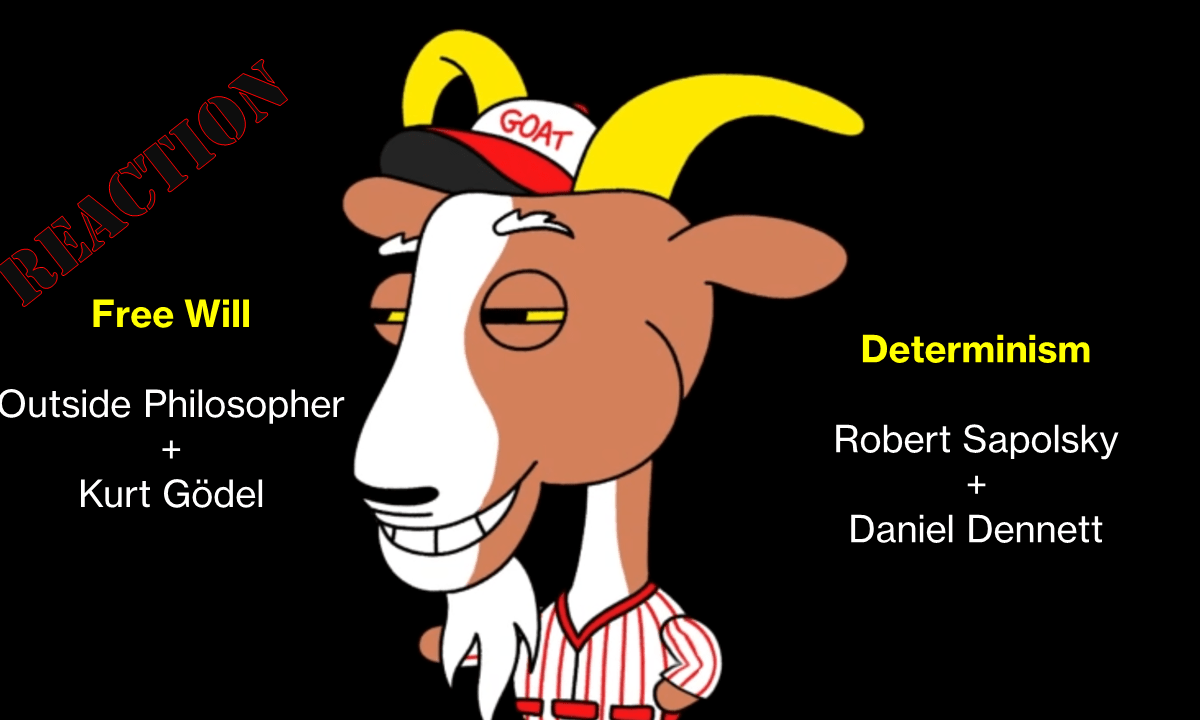
It’s been a minute since I’ve posted a video. Restart the clock. In this video, I critique Outside Philosopher’s critique of the debate between Robert Sapolsky and Daniel Dennett on Free Will and Determinism. He attempts to leverage Gödel’s Uncertainty Principle in his defence.

Feel free to leave comments on YouTube or below. Cheers.

Error Theory, Charity, and Occam’s Boomerang

As moral error theorists, we’re accustomed to facing criticism for our perspective. I’m a moral non-cognitivist, but there’s a significant intersection with these theories. When someone asserts that torture is wrong, I might argue that the claim is hollow, as moral wrongness is merely an emotional response masquerading as an objective moral stance. On the other hand, an error theorist would debunk this argument, stating that there’s no absolute position of right or wrong. Pragmatically, we both arrive at the conclusion that the claim cannot hold true.

Video: Is Error Theory Counterintuitive — Kane B

Intuition leads others to a different interpretation. If they believe something is true due to their epistemic certainty, then for them, it is true. Their reality is shaped by experience. Curse the limitations of sense perception and cognitive constraints. “I know what I know,” is their typical retort. Moreover, it’s a matter of practicality. “You know what I mean,” they insist.

They attempt to substitute fact with heuristics, truth with analogue, and terrain with a map. Admittedly, it’s convenient to feign an identity at play, but at best, it’s a near equivalence.

In the linked video, the example of claiming ‘that car is red’ is presented. But can cars truly be red? Not precisely. Cars can possess the property of appearing red to most individuals in specific lighting conditions, but a car cannot inherently be red. Thus, this statement is categorically false. We can assert ‘that the car appears to be red,’ and as a matter of practicality, we might designate the car as such. However, this highlights the inadequacy of language, particularly concerning abstract concepts.

A challenge arises from people’s inclination, driven by the principle of least effort, to seek simplicity and convenience, often at the expense of truth.

A challenge arises from people’s inclination, driven by the principle of least effort, to seek simplicity and convenience, often at the expense of truth. This principle underpins Occam’s Razor: choose the simplest version among competing explanations. It’s a misguided endeavour, akin to living under the notion that opposites attract rather than like attracting like.

I encounter this opposing worldview when I pinpoint certain inconsistencies or issues in the ‘real world,’ emphasizing that language is insufficient to convey adequate meaning, that there exists no objective moral centre, and that democracy is a system that falters even on paper. Almost invariably, the response is, ‘then what?’ I don’t possess the answer to ‘then what.’ I’m merely informing you that your leg is broken. I don’t need to know how to fix it for this to be true, a valid assessment.

While I’m on a roll, let’s talk about charity in philosophical argumentation, which, in my view, is another misguided concept. Why should I favour the notion that a person genuinely believes in the position they hold? It’s another heuristic rule set up to lend credence to otherwise weak arguments. We need not adhere to these boundaries—they’re nonexistent.


BONUS: I ran this content through ANTHROP/C’s Claude 2 for analysis and evaluation. I include it as an example of the bias inherent in generative AI. Whilst I realise that I am taking a polemic position—nothing new here—, Claude apes canned responses. Ironically, the same responses I am arguing against. I do agree that I could have ‘steel-manned’ my argument, but this is a blog post, not a dissertation. Perhaps another day.

Here are some thoughts on evaluating the blog post:

  • The author takes a strong moral non-cognitivist stance, arguing that moral claims like “torture is wrong” are not objective facts but expressions of emotion. This view aligns with moral error theory in debunking moral realism.
  • However, the dismissive attitude towards those who believe moral claims have truth value shows a lack of philosophical charity. The author could strengthen their position by steelmanning the opposing view before critiquing it.
  • The analogy between moral claims and claims like “the car is red” makes an interesting point about the inadequacy of language for capturing nuanced truth. However, more nuance could be applied in acknowledging the usefulness of simplifying language and heuristics in everyday life.
  • The author’s critique of Occam’s Razor and preference for complex explanations is thought-provoking but could benefit from addressing the pragmatic value of simpler models. Outright dismissing this philosophical principle seems extreme.
  • The call to abandon charity in argumentation in the name of absolute truth risks throwing the baby out with the bathwater. Some level of mutual understanding between interlocutors is needed for productive discourse.
  • Overall, while the post raises thoughtful challenges to moral realism, heuristics, and other commonly held views, the dismissive tone and lack of nuance weaken the arguments. More charity towards opposing views and addressing pragmatic concerns could strengthen the critique.

In summary, the post puts forward some provocative arguments but could benefit from greater philosophical charity, nuance, and balancing pragmatism with pursuing absolute truth. A more measured tone discussing pros and cons of different perspectives would likely lend more persuasive force.

ANTHROP/C Claude 2

Austrian Economics Bollox

A citizen of the Internet shared this as if were gospel along with this comment:

Late Professor Steven Horwitz expanding on a Misesian theme. Monetary profit helps allocate resources to higher valued uses. Elsewhere, Mises spoke of profit in a broader sense, “profit” being the goal of every action. In any case, those familiar with what pundits (from the left mostly) tend to say about “profit” may be completely surprised by this take, since it is so contrary to what they often read and hear.

Of course, these are vapid words and wishful thinking. How and why do profits signal that value has been created? I dunno. They just do cuz I said so. The only thing that profits signal is a market that doesn’t understand the true cost of production and consumers can’t be bothered to do it themselves. Mattresses and shaving razor blades are two high-margin consumer goods with mattresses yielding 500 per cent profits and razor blades even higher. These profits represent economic rent and not value. The fact that imperfect information shrouds this excess does not make it ‘value’.

Regarding the mortgage market meltdown of 2007-08, there were houses being built into a market with no buyers. The same ‘value’ being created was demonstrably vapour. Say’s Law was off-target again. Supply does not create its own demand.

Is it no wonder that so many Capitalists are also Protestant Christians who believe in Bible tales as well? Even worse are the Christians who are not Capitalists but are exploited by Capitalism the same way they are exploited by their religion. I guess once you’ve profiled the gullible, you might as well just keep exploiting them until there is nothing left to extract.

The year is dead. Long live the new year.

Excuse me, but your data are showing.

I was writing a post for another forum to acknowledge the changeover of the years, and I decided to lean on Dall-E to assist with some image rendering. It appears that Dall-E’s concept of New Year is 2019—BC, before Covid.

IMAGE: 4 Dall-E Renders

Honestly, I am not sure what to say.

Levr Live year? Wot?

Live Yer 2019? Huh?

Lew Yhr Tib 2019? I’d like to buy a vowel.

Neew Ne IiR 2019? Hmmm… 🤔

I think we know when their training data ended. There is no future past 2019. Little did they suspect.

Know thyself

Oracle at Delphi Inscription

As this was just a reactionary post, I don’t have much to add. To paraphrase the Delphic ‘Know thyself’ inscription, know thy data.

Path to the Fall

By fall, I don’t mean autumn except perhaps metaphorically speaking. The accompanying image illustrates a progression from the pre-Enlightenment reformation and the factors leading to the Modern Condition and increases in schizophrenia in people, societies, and enterprises.

Podcast: Audio rendition of this page content.

This image is essentially composited from a later chapter in Iain McGilchrist’s The Master and His Emissary. In it, he outlines a path that commences at the Reformation that led to Lutheranism and Protestantism and further to Calvinism (not separately depicted). Max Weber argued that Capitalism is inextricably linked to Calvinism and the workmanship ideal tradition.

McGilchrists argument is founded on the notion that Catholocism is a communally oriented belief system whilst Protestantism is focused on the individual and salvation through personal work. The essence of capitalism is the same.

Of course, history isn’t strictly linear. In fact, there are more elements than one could realistically account for, so we rely on a reduction. In concert with the Reformation but on a slight delay is the so-called Age of Enlightenment, the Age of Reason, which led not only to faith in science but then to the pathology of Scientism.

This Protestant-Scientismic nexus brought us to Capitalism and into the Industrial Revolution, where humans were devivified or devitalised, trading their souls to be pawns to earn a few shekels to survive. Capitalism and the Industrial Revolution led to Marxism, through Marx’s critique of Capitalism, but Marxism has the same fatal flaw as Capitalism inasmuch as it doesn’t view people as humans. It does afford them a slightly higher function as workers, but this still leaves humanity as a second-tier aspect and even historicity is elevated above as a sort of meta-trend or undercurrent.

From there, we transition to Modernity, which yields the modern condition and schizophrenics in one fell swoop. This is no coincidence.

Although I end this journey at Modernism, McGilchrist is also leery of the effects of post-modernism as well as philosophy itself as overly reductionist in its attempts to categorise and systematise, valuing signs and symbols over lived experience. His main complaint with postmodernism is that it moves from the objective perspective of Modernity to the subjective perspective, and so there remains no base foundation, which is the shared experience. I’m not sure I agree with his critique, but I’m not going to contemplate it here and now.

In the end, this journey and illustration are gross simplifications, but I still feel it provides valuable perspective. The challenge is that one can’t readily put the genie back into the bottle, and the question is where do we go from here, if not Modernism or Postmodernism. I shouldn’t even mention Metamodernism because that seems like an unlikely synthesis, as well-intentioned as it might be. McGilchrist gives examples of reversals in the trend toward left-hemisphere bias, notably the Romantic period, but that too was reversed, recommencing the current trajectory. My feeling is that if we continue down this dark path, we’ll reach a point of no return.

It seems to be that it’s growing at an increasing rate, like a snowball careening down a slope. It not only drives the left-dominant types further left because an analytical person would reinforce the belief that if only s/he and the world were more analytical things would be so much better—even in a world where net happiness is trending downward—, but it also forces this worldview on other cultures, effectively destroying them and assimilating them into the dark side, if I can borrow a Star Wars reference.

Epilogue

I wasn’t planning to share this story—at least not now. In another forum, I responded to a statement, and I was admonished by Professor Stephen Hicks, author of the book of dubious scholarship, Explaining Postmodernism.

I responded to this query:

If you’re a single mother and have a son I’d suggest putting him in a sport or martial arts to add some masculine energy to his life. It’s not a replacement for the actual father but it can help instil structure and discipline into the core of his being.

— Julian Arsenio

“Perhaps this world needs less discipline and structure, not more,” was my response, to which Hicks replied.

The quotation is not about “the world.” It is about boys without fathers. Evaluate the quotation in its context.

— Stephen Hicks

“Disciplined boys create a disciplined world. Not a world I’d prefer to create or live in. We need more right-hemisphere people. Instead, we are being overwhelmed by left hemisphere types, leading to Capitalism and the denouement of humanity as it encroaches like cancer, devouring or corrupting all it touches.

“In the end, it is about the world, which from a left hemisphere perspective is a sum of its parts. Right-hemisphere thinkers know otherwise,” was my reply. He responded,

You seem to have difficulty focusing. From a quotation about fatherless boys you free associate to [sic] weird psychology and global apocalptic [sic] pessimism. Pointless.

— Stephen Hicks

“I’ll suggest that the opposite is true, and perhaps you need to focus less and appreciate the Gestalt. This was not free association. Rather, it is a logical connexion between the disposition of the people in the world and lived reality.

“Clearly, you are a left-hemisphere structured thinker. The world is literally littered with this cohort.

“I suggest broadening your worldview so as not to lose the woods for the trees. I recommend Dr Iain McGilchrist as an apt guide. Perhaps reading The Master and His Emissary and/or The Matter with Things would give you another perspective. #JustSaying”

His final repartee is,

And still, rather than addressing the issue of fatherless boys, you go off on tangents, this time psychologizing about people you’ve zero first-hand knowledge of.

— Stephen Hicks

Feel free to interpret this as you will. For me, his attempt to limit discussion to some notion he had in his head and his failure to see the woods for the trees, as I write, suggests that he is a left-brain thinker. Having watched some of his videos, whether lectures or interviews, this was already evident to me. This exchange is just another proof point.

I considered offering the perspective of Bruno Bettleheim’s importance of unstructured play, but as is evidenced above, he is not open to dialogue. His preference appears to be a monologue. This is the left hemisphere in action. This is an example of how insidious this convergent thinking is, and it makes me worry about what’s ahead in a world of people demanding more structure and discipline. Foucault’s Discipline and Surveillance comes to the forefront.

Underrepresented Class

Podcast: Audio rendition of this page content

I’ve just finished reading Iain McGilchrist’s The Master and His Emissary, having paused The Matter with Things to put it to bed. The book is divided into two sections. The first lays down the neuroscientific base whilst the second contains expository forrays. Technically, one might argue that there are three sections as the last unnumbered chapter seems to stand alone from the second part. It’s only one chapter containing some 36 pages, so I’m not going to lose any sleep over it. But this will not be a book review, as highly recommended as it is.

I’ve been a vocal proponent of hiring neurodiverse people into certain roles. Having read the book and absorbed the rationale, it’s easy to see how it aligns with and supports some of my own experiences. In particular, I’ve noticed that many companies hire autism spectrum on the Aspergers end of the scale. These people tend to be hired into IT and programming roles—functions already having reputations for being staffed with socially awkward and low EQ individuals, characteristics of people on the spectrum. It makes sense because left-hemisphere-dominant managers evaluate this hyper-left-hemisphere-dominant cohort as assets. Without getting too deep into the territory of stereotypes, in general, this group are laser-focused and doggedly pursue tasks at hand without tiring. I’ve met plenty of ADHD-diagnosed people in these roles, too—not as many, but also employed in technology-oriented positions.

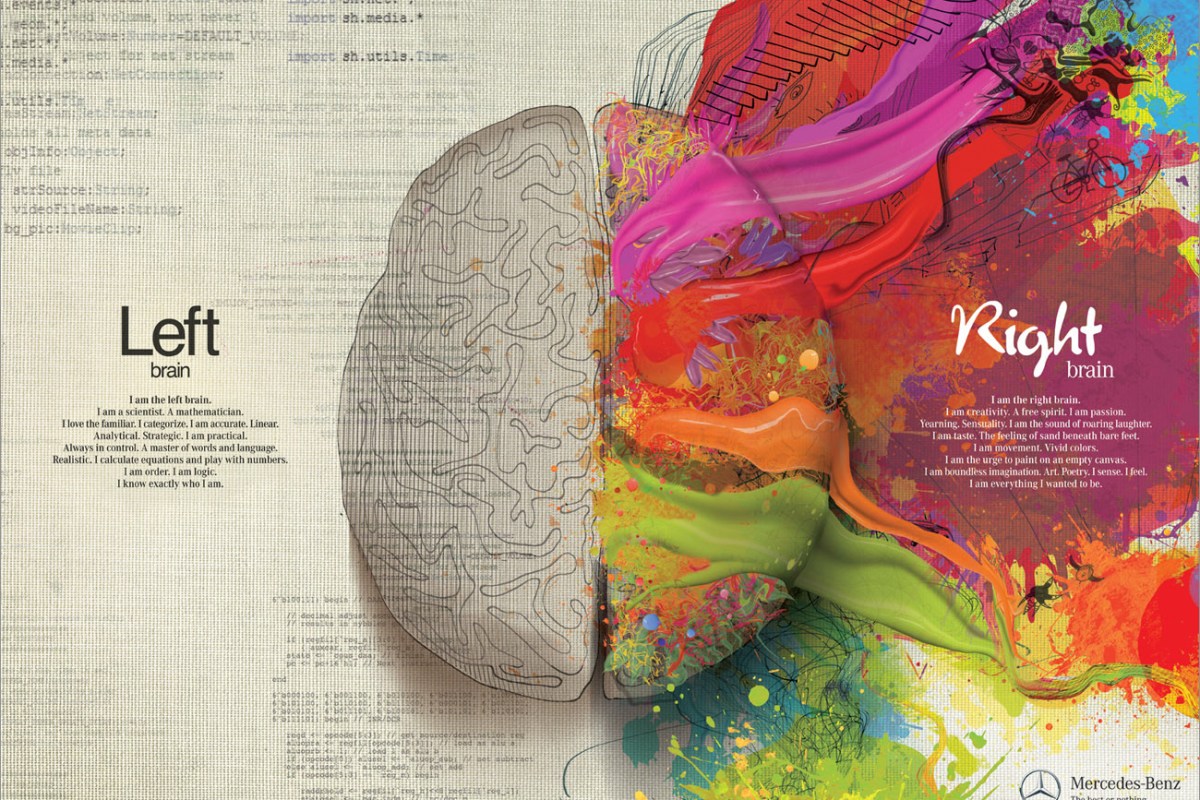
The underrepresented class are right-hemisphere-dominant people. To be fair, I’ve encountered many Creative people in Agencies, but their right-hemisphere life is separate from their left and not appreciated in the workplace. They mainly exercise their right-hemisphere life outside of office hours on personal passion projects. I’d also be willing to bet that these people are not truly right-hemisphere-dominant. Rather, they have the ability to balance and allow the left hemisphere to take over during business hours.

In some cases, these people happen to have right-hemisphere insights into a project or have some creative inspiration off hours to benefit the work of the next day. But the right hemisphere is not time-boxed. It doesn’t function on demand. In fact, it shuts down on demand, and the left introduces bootleg knock-offs. Of course, this doesn’t matter, as it is probably better than their left-hemisphere managers and clients and good enough in their eyes. I’m not convinced they’d actually recognise the right-hemisphere solution as better because the left hemisphere prefers its own tribe anyway.

If you are reading this and you are saying, “They’re running a business. They can’t wait for weeks or months for a resource to have the epiphany of a creative solution,” you’ve made my point, and you’ve presented strong evidence that you are operating from your left hemisphere as well. There’s no shame in this. The first step is to admit there’s a problem.

My point is not to antagonise left-hemisphere-dominant people or the fact that they’re at home with other like-minded people. It’s only natural. They usually find right-hemisphere types to be too eccentric for their taste anyway.

But these right- or balanced-hemisphere thinkers, not given the space for their right-hemisphere to yield benefit, are likely in a Creative function, whether in art, illustration, copywriting, or some such. They are like unicorns outside of this context.

As for me, I am at times balanced and at times left. At other times, I’m purely right, though this is admittedly short-lived and unsustainable. But in a balanced state—in a right-shifted mode—, this is where my Gestalt comes into play. One of my roles is to evaluate processes. The left hemisphere analyses in components and pieces. Taking an analytical approach, I can document that the knee bone is connected to the shin bone and the shin bone is connected to the ankle bone and so on, but this requires context, something the left hemisphere is weak at. The left hemisphere will tell us that this is the bone connexion process, as it were. But it’s more than this. It’s meaningless without musculature and connective tissue and a nervous system and a circulatory system. And we’d likely want the person to whom the bones belong to be alive. And how do these bones contribute to function and perambulation? This is a larger system thinking approach.

System thinking is a recommendation for looking at processes, but this is right-hemisphere activity. Most people asked to perform this are left-hemisphere-dominant, so they give it short-shrift.

At the end of this rant, my point is that I hear all about equity, diversity, and inclusion, but this cohort is not only underrepresented but almost nonexistent. To be fair, many of these people wouldn’t feel comfortable behind your walls anyway, aren’t likely to prefer the constraint of your walls, and they’d probably feel like outsiders. But this is the challenge with true inclusion.

Classes are a left-hemisphere operation at the start—male, female, black, white, L, B, G, T, and so on. These are left-hemisphere constructs. But since you are already stuck in this place anyway, let’s consider expanding the neurodiverse class to include right-hemisphere people.

Anatomy of a Social Media Challenge

As a Social Justice Warrior, I tend to favour diversity and inclusion as a principle. As such, I follow some people who share this interest. In fact, most of these people expend much more energy toward this end than I do. The challenge I am about to convey is that some people don’t read beyond the subject line, and don’t even attempt to assess the underlying claim, let alone the issue at hand.

I recently engaged in a nonsensical interaction that I am sharing and dissecting. It started with this share, an image of the border outline of Nigeria with an overlay caption that reads: “Nigeria becomes the first country to ban white and British models in all advertising”.

I’d like to point out two items in particular. Firstly, the caption is fabricated. I’ll get to the source reference presently. Secondly, the re-poster aptly corrects the caption when he shared it—”Well, all foreign models, but HELL YEAH!”

Nigeria recently passes a law that essentially assesses a tariff or levy on advertising content using non-Nigerian talent. There is no mention of ‘white’ models, though British models would fall under this umbrella. This protectionist law stems from nationalism. I’d guess that ‘white’ people comprise less than one per cent of the Nigerian national population, but I could be wrong. This is well outside my area of expertise.

My response was to say “Down with Nationalism and the Promotion of Otherism.”
I may be misinterpreting myself, but it feels to me that this is denouncing racism and other forms of otherness.

Sabrina responds, ‘Why is not having white models in advertising a bad thing?” and “Isn’t the whole point of advertising [for] people to…see themselves… ?”
In response, I should have pointed out that the initiative had nothing to do with skin colour. Instead, I responded to the second question: the point of advertising is to sell product. Full stop. If people see themselves with the product, then great. Clearly, this comprises a fraction of successful adverts. More common is to make a connection to what they aspire to. It’s not about making a social statement—unless, of course, that social statement will sell more product. If an ad with a white model will sell more product, a business would be derelict not to employ one; conversely, if white models result in lower sales, a business would be foolish not to switch to the more successful vector.

Sabrina really goes off the reservation with her reply, somehow conflating Nigeria with the African continent. Attention to detail is not her forte.

At this point, I feed into her laziness and send her a link to an Al-Jazeera article addressing the law.

She leaves with a parting shot, and I quote: “Have you ever thought about the harm you might cause by playing devil’s advocate and “creating an argument”?”

She’s off course and then attempts to diminish my point by calling it ‘playing devil’s advocate’ rather than admitting that she hadn’t even considered the rationale and possible ramifications. She didn’t even grasp the main point, so I suppose I should forgive her for not noticing secondary and edge cases.

At this point, Dr Perkins adds her voice. Her initial question is valid, and as I responded, the answer is “No”. The race card was introduced by some narrator who didn’t know what game he was broadcasting. But then she goes on to “applaud Nigeria for making a [decision] centering [on] Blackness”, save to say that was not what prompted the decision.

Notice, too, that other people “Liked” the other comments, a testament to the principle of least effort of the bystanders, too.

I recognise that the original post anchored the conversation off the actual topic, but it was also very easy to track down the reference and note the content discrepancy. Granted, this takes time and effort, but so does responding on a thread and then escalating commitment to a non-cause. And for one tilting at windmills to be tossing around accusations of playing devil’s advocate. It’s not a good sign.

But wait, there’s more. I commented on this post on a second thread.

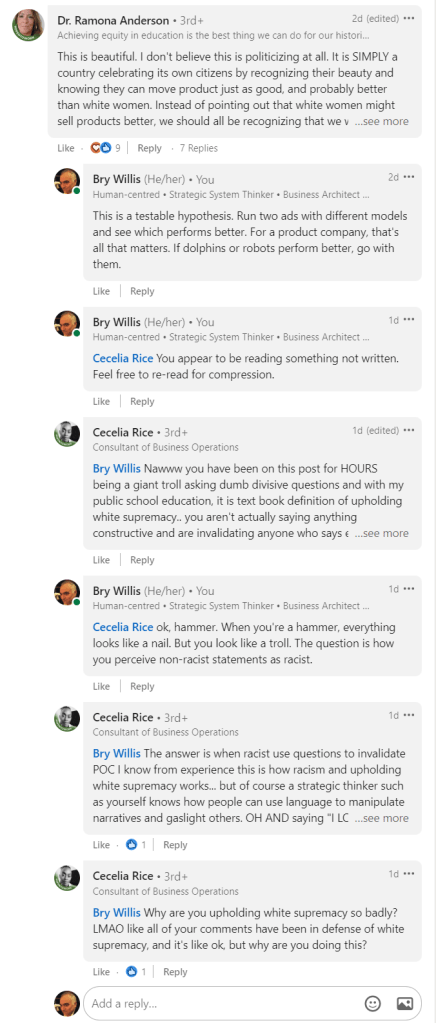
In this case, Dr Anderson suggests that this is just “a country celebrating its own citizens by recognizing their beauty and knowing they can move product just as good, and probably better than white women, to which I responded that this is a testable hypothesis. It’s either true that on balance white models sell more product or black models do. Again, don’t fail to miss the point that none of this is about white versus black models.

Somehow, LinkedIn can’t seem to keep their threads in order, but Ms Rice takes my hypothesis testing point as a support for racism before precipitating to full-on troll mode.

It scares me to see that there are two academic doctors participating in this thread, neither with a trait of attention to detail nor even a fundamental pursuit of evidence.

This is why it is difficult to engage with social media. You have no idea what level a commenter is coming in on. And even when spoon-fed information, they refuse to alter their position. In fact, they tend to double down on their wrongness.
Moving on…