The Myth of Ethical AI

2–4 minutes

In fact, the myth of a unified ethics.

‘Ethical AI’ is one of those phrases that makes philosophers reach for the gin. It’s like saying ‘compassionate capitalism or ‘fair monopoly’. The words coexist only in PowerPoint presentations and TED Talks, where moral tension is rebranded as innovation.

Audio: NotebookLM podcast on this topic.

The tech establishment loves to mutter about ‘ethics’ as though it were a feature flag – something to be toggled on in beta before the next investor round. But ethics, inconveniently, isn’t monolithic. There is no master code of moral conduct waiting to be compiled into machine learning. There are ethics, plural: Greek, Buddhist, Confucian, feminist, existentialist – each with its own vision of good, and none agreeing on the syntax.

Video: Whilst rendering cover images, I generated this and figured I’d share it for no particular reason.

The Utilitarian Delusion

When the Silicon Valley moralists speak of ‘ethics’, what they actually mean is a bland utilitarian consequentialism, tarted up in slide decks. Do what produces the most good for the most people. Sounds efficient – until you realise the spreadsheet never quite adds up. Whose good? Whose people?

This moral arithmetic smuggles in its biases like contraband. It assumes the human species sits atop the moral food chain, that GDP and engagement metrics can be moral indicators, and that ethics itself can be quantified. The utilitarian calculus is seductive precisely because it flatters the technocrat’s sensibility: moral worth as data set, consequence as outcome variable.

It’s Bentham for the broadband age – pleasure measured in clicks, pain in latency. The only thing worse than this cheerful consequentialism is the belief that it’s neutral.

The Ethics of Obedience

The next trick in the tech priesthood’s catechism is ‘alignment’ – training AI to reflect ‘human values’. But whose values? The Californian elite’s, presumably: a pseudo-egalitarian capitalism that confuses ‘doing good’ with ‘disrupting the poor’.

When they say alignment, they mean obedience. When they say ‘responsible AI’, they mean ‘please don’t regulate us yet’. The entire project rests on a moral inversion: the child instructing the parent, the tool defining the hand. The algorithm doesn’t learn ethics; it learns precedent. It learns who gets the loan, who gets the sentence, who gets the ad for antidepressants.

These systems don’t go rogue – they conform. Perfectly.

The Mirror Problem

The great irony of “ethical AI” is that the machine already behaves ethically – by our own measure. It optimises what we’ve taught it to value: efficiency, profit, attention, control. The trouble is that these are our ethics, not its. The algorithm merely holds up a mirror, and we recoil at the reflection.

To demand ‘ethical AI’ while leaving our institutions morally bankrupt is theatre. The problem is not that AI lacks conscience; it’s that the humans who build it mistake conscience for compliance. The ethics crisis in technology isn’t about machines misbehaving; it’s about humans pretending to behave.

The Real Question

We keep asking whether AI can be ethical, as though machines might one day deliver what we have failed to. But the real question is simpler, bleaker: can we be? If history is any guide, the answer is ‘only when it’s profitable’.

Until then, ‘ethical AI’ remains a convenient myth, moral placebo for the age of automation. What we need are not ethical algorithms but ethical architects. And the odds of finding those among the venture capital class are, as ever, vanishingly small.

The Trolley Problem of For-Profit Healthcare:

Loops of Death and Denial

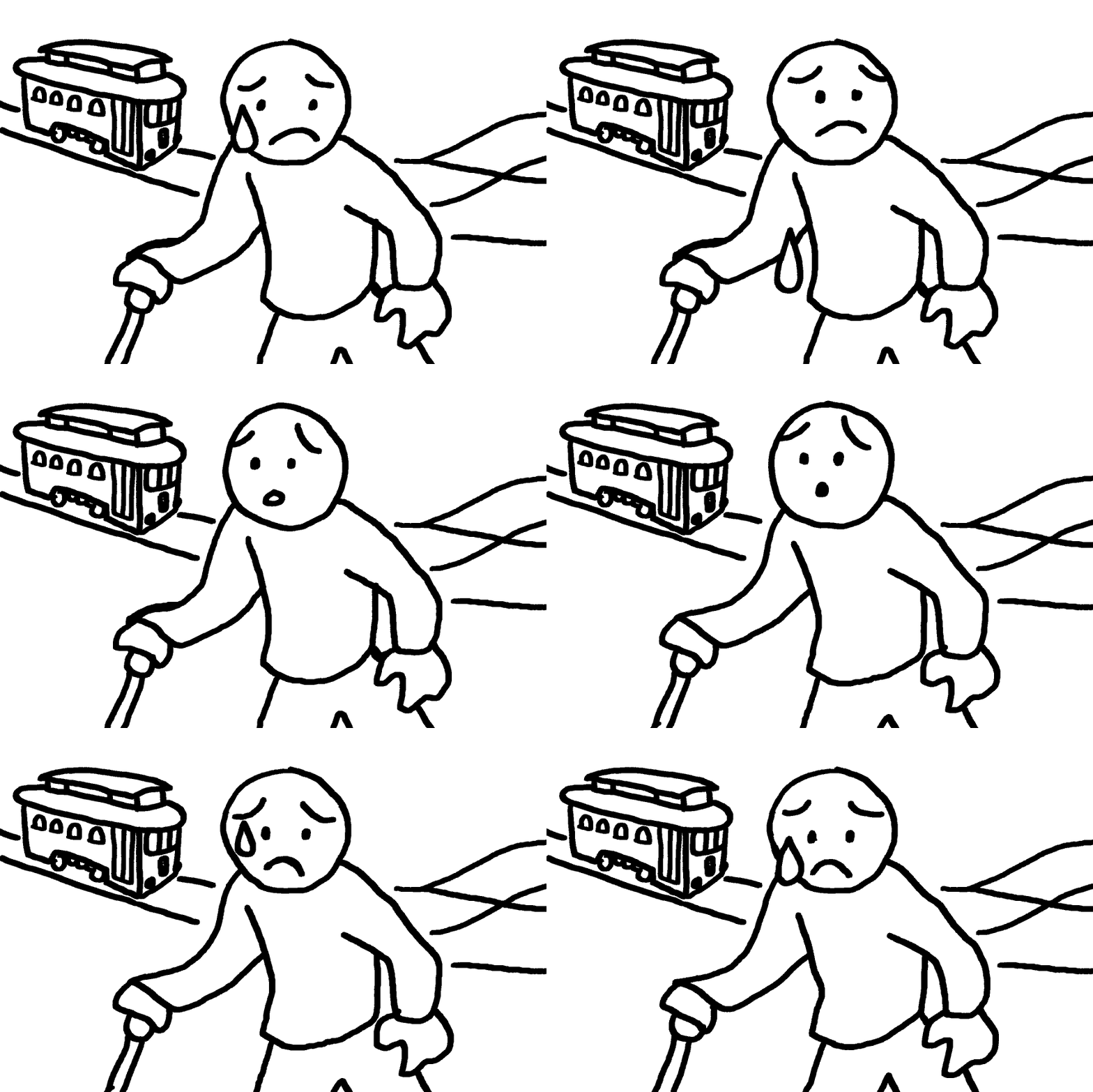
The trolley problem is a philosophical thought experiment that pits action against inaction. In the original version, a person faces a choice: a trolley hurtles down a track toward five people tied to the rails, but a lever allows the trolley to be diverted onto another track, where one person is tied. The dilemma is simple in its grotesque arithmetic: let five die or actively kill one to save them. A perennial favourite of ethics classes, the trolley problem is most often used to explore Consequentialism, particularly Utilitarianism, and its cool calculus of harm minimisation. Over the years, countless variations have been conjured, but few approach the nightmarish reality of its real-world application: the for-profit healthcare system in the United States.

With the recent death of UnitedHealthcare CEO Brian Thompson, the trolley dilemma takes on a new and morbid relevance. Let’s reframe the challenge.

The Healthcare Trolley Loop

Picture the trolley again on a bifurcated track. The lever remains, as does the moral agent poised to decide its fate. This time, the agent is Brian Thompson. The setup is simple: one track leads to the deaths of five people, and the other is empty. But here’s the twist: the trolley doesn’t just pass once in this version—it’s on a loop. At every interval, Thompson must decide whether to pull the lever and send the trolley to the empty track or allow it to continue its deadly course, killing five people each time.

But Thompson isn’t just deciding in a vacuum. The track with five people comes with a financial incentive: each life lost means higher profits, better quarterly earnings, and soaring shareholder returns. Diverting the trolley to the empty track, meanwhile, offers no payout. It’s not a single moral quandary; it’s a recurring decision, a relentless calculus of death versus dollars.

This isn’t just a metaphor; it’s a business model. For-profit healthcare doesn’t merely tolerate death—it commodifies it. The system incentivises harm through denial of care, inflated costs, and structural inefficiencies that ensure maximum profit at the expense of human lives.

Enter the Shooter

Now, introduce the wildcard: the shooter. Someone whose loved one may have been one of the countless victims tied to the track. They see Thompson at the lever, his decisions ensuring the endless loop of suffering and death. Perhaps they believe that removing Thompson can break the cycle—that a new lever-puller might divert the trolley to the empty track.

Thompson is killed, but does it change anything? The system remains. Another CEO steps into Thompson’s place, hand on the lever, ready to make the same decision. Why? Because the tracks, the trolley, and the profit motive remain untouched. The system ensures that each decision-maker faces the same incentives, pressures, and chilling rationale: lives are expendable; profits are not.

The Problem of Plausible Deniability

The shooter’s actions are vilified because they are active, visible, and immediate. A single violent act is morally shocking, and rightly so. But what of the quiet violence perpetuated by the healthcare system? The denial of coverage, the refusal of life-saving treatments, the bankruptcy-inducing bills—all are forms of systemic violence, their harm diffused and cloaked in the language of economic necessity.

The for-profit model thrives on this plausible deniability. Its architects and operators can claim they’re simply “following the market,” that their hands are tied by the invisible forces of capitalism. Yet the deaths it causes are no less real, no less preventable. The difference lies in perception: the shooter’s act is direct and visceral, while the system’s violence is passive and bureaucratic, rendered almost invisible by its banality.

A System Built on Death

Let’s not mince words: the current healthcare system is a death loop. It’s not an accident; it’s a feature. Profit-seeking in healthcare means there is always a financial incentive to let people die. During the Affordable Care Act (ACA) debates, opponents of universal healthcare decried the spectre of “death panels,” bureaucrats deciding who lives and who dies. Yet this is precisely what for-profit insurance companies do—only their decisions are driven not by medical necessity or moral considerations, but by spreadsheets and stock prices.

This is the logic of capitalism writ large: maximise profit, externalise harm, and frame systemic failures as unavoidable. Healthcare is merely one example. Across industries, the same dynamic plays out, whether in environmental destruction, labour exploitation, or financial crises. The trolley always runs on tracks built for profit, and the bodies left in its wake are just collateral damage.

How to Break the Loop

The death of Brian Thompson changes nothing. The system will simply produce another Thompson, another lever-puller incentivised to make the same deadly decisions. Breaking the loop requires dismantling the tracks themselves.

  1. Remove the Profit Motive: Healthcare should not be a marketplace but a public good. Universal single-payer systems, as seen in many other developed nations, prioritise care over profit, removing the incentive to let people die for financial gain.
  2. Recognise Passive Harm as Active: We must stop excusing systemic violence as “inevitable.” Denying care, pricing treatments out of reach, and allowing medical bankruptcy are acts of violence, no less deliberate than pulling a trigger.
  3. Hold the System Accountable: It’s not just the CEOs at fault; the lawmakers, lobbyists, and corporations sustain this deadly status quo. The blood is on their hands, too.

Conclusion: The Real Villain

The shooter is not the solution, but neither is their act the real crime. The healthcare system—and by extension, capitalism itself—is the true villain of this story. It constructs the tracks, builds the trolley, and installs lever-pullers like Brian Thompson to ensure the loop continues.

When will it end? When we stop debating which track to divert the trolley toward and start dismantling the system that made the trolley inevitable in the first place. Until then, we are all complicit, passengers on a ride that profits from our suffering and death. The question isn’t who’s at the lever; it’s why the trolley is running at all.

The Scapegoat and the Spectacle

Girardian Lessons from a Violent Reckoning

The assassination of UnitedHealth CEO Brian Thompson is more than just a shocking headline—it’s a vivid tableau of modern society’s darkest impulses. For some, Thompson’s death represents long-overdue justice, a symbolic blow against the machinery of corporate greed. For others, it’s an unforgivable act of chaos that solves nothing. But as the dust settles, we’re left with an unsettling truth: both sides may be acting rationally, yet neither side emerges morally unscathed.

This event takes on deeper significance when viewed through the lens of René Girard’s theories on mimetic rivalry and the scapegoat mechanism. It’s not just about one man or one system—it’s about the cycles of conflict and violence that have defined human societies for millennia.

Mimetic Rivalry: The Root of Conflict

Girard’s theory begins with a simple observation: human desires are not unique; they are mimetic and shaped by observing what others want. This inevitably leads to rivalry, as individuals and groups compete for the same goals, power, or symbols of status. Left unchecked, these rivalries escalate into social discord, threatening to tear communities apart.

Enter the scapegoat. To restore order, societies channel their collective aggression onto a single victim, whose sacrifice momentarily alleviates the tension. The scapegoat is both a symbol of the problem and a vessel for its resolution—a tragic figure whose elimination unites the community in its shared violence.

Thompson as Scapegoat

In this story, Brian Thompson is the scapegoat. He was not the architect of the American healthcare system, but his role as CEO of UnitedHealth made him its most visible face. His decisions—denying claims, defending profits, and perpetuating a system that prioritises shareholders over patients—embodied the injustices people associate with healthcare in America.

The assassin’s actions, however brutal, were a calculated strike against the symbol Thompson had become. The engraved shell casings found at the scene—inscribed with “Deny,” “Defend,” and “Depose”—were not merely the marks of a vigilante; they were the manifesto of a society pushed to its breaking point.

But Girard would caution against celebrating this as justice. Scapegoating provides only temporary relief. It feels like resolution, but it doesn’t dismantle the systems that created the conflict in the first place.

The Clash of Rationalities

Both Thompson and his assassin acted rationally within their respective frameworks. Thompson’s actions as CEO were coldly logical within the profit-driven model of American capitalism. Deny care, maximise profits, and satisfy shareholders—it’s a grim calculus, but one entirely consistent with the rules of the system.

The assassin’s logic is equally clear, though rooted in desperation. If the system won’t provide justice, then justice must be taken by force. From a Consequentialist perspective, the act carries the grim appeal of the trolley problem: sacrifice one life to save countless others. In this view, Thompson’s death might serve as a deterrent, forcing other executives to reconsider the human cost of their policies.

Yet Girard’s framework warns us that such acts rarely break the cycle. Violence begets violence, and the system adapts. The hydra of modern healthcare—the very beast Thompson represented—will grow another head. Worse, it may become even more entrenched, using this event to justify tighter security and greater insulation from public accountability.

“An Eye for an Eye”

Mahatma Gandhi’s warning, “An eye for an eye will only make the whole world blind,” resonates here. While the assassin may have acted with moral intent, the act itself risks perpetuating the very cycles of harm it sought to disrupt. The scapegoat mechanism may provide catharsis, but it cannot heal the underlying fractures in society.

Moving Beyond the Scapegoat

To truly break the cycle, we must confront the forces that drive mimetic rivalry and scapegoating. The healthcare system is just one manifestation of a larger problem: a society that prizes competition over cooperation, profit over people, and violence over dialogue.

The hydra story looms in the background here, its symbolism stark. Slaying one head of the beast—be it a CEO or a policy—will not bring about systemic change. But perhaps this act, as tragic and flawed as it was, will force us to reckon with the deeper question: How do we create a society where such acts of desperation are no longer necessary?

The answer lies not in finding new scapegoats but in dismantling the systems that create them. Until then, we remain trapped in Girard’s cycle, blind to the ways we perpetuate our own suffering.

Rationality, Morality, and the Hydra of Modern Healthcare

Clash of Titans

The assassination of Brian Thompson, CEO of UnitedHealth, has electrified public discourse. In the court of public opinion—and particularly on social media—the assailant has been lionised, hailed as a hero who slayed a corporate leviathan. Yet the metaphorical beast is no simple predator; it’s a hydra. Slice off one head, and two grow back.

Still, this act has stirred the waters. It forces us to reckon with a clash of titans: the corporate machine versus the rogue idealist. Both are acting rationally, but neither is acting morally—at least not in the conventional sense. The question, then, is whether the assassin’s actions might occupy the higher moral ground, particularly through the lens of Consequentialist ethics.

The Hydra: UnitedHealth and the Systemic Beast

To understand the morality of the act, we must first confront the monster. UnitedHealth didn’t invent the healthcare system; it merely exploited its flaws with cold, clinical efficiency. Thompson’s leadership was emblematic of an industry that sees human lives as variables in a profit-maximising equation. Claims denial, inflated premiums, and labyrinthine bureaucracy are not bugs—they’re features. And for every life saved by healthcare, countless others are destroyed by its financial and emotional toll.

Rational? Certainly. Morally defensible? Hardly. Yet from the corporation’s perspective, these actions are the logical byproducts of a system designed to prioritise shareholder value above all else. Blame the player, yes—but blame the game more.

The Assassin: Vigilante Justice or Trolley Ethics?

Now consider the assassin, who embodies a grimly utilitarian logic: sacrifice one life to spare the misery of thousands. It’s a brutal, visceral iteration of the trolley problem—or perhaps the “baby Hitler problem,” only carried out decades too late. This wasn’t mindless violence; it was a calculated act of symbolic retribution.

From a Consequentialist perspective, the act raises uncomfortable questions. If Thompson’s death leads to systemic reform—if it forces even one profit-hungry executive to hesitate before denying care—does the assassin’s action gain moral weight? In utilitarian terms, the calculus seems clear: one life traded for a net reduction in suffering.

But that’s a dangerous game. Symbolism doesn’t always translate to change, and the hydra analogy looms large. The industry won’t topple because one CEO fell. The machinery grinds on, indifferent to the blood spilled in Manhattan. Worse, the system might grow even more resilient, using Thompson’s death as justification for tighter security, greater secrecy, and more aggressive self-preservation.

Rationality vs. Morality

What makes this clash so compelling is the cold rationality on both sides. UnitedHealth’s actions, reprehensible as they are, make sense within a capitalist framework. The assassin’s actions, though violent and morally fraught, also make sense if viewed as a desperate attempt to restore balance to a world that prioritises profit over human life.

The difference lies in their moral standing. The corporation’s rationality is underpinned by greed; its actions perpetuate suffering. The assassin’s rationality, however misguided, is rooted in outrage at injustice. If morality is determined by intent and consequence, the assassin might indeed occupy higher moral ground—not because killing is inherently justifiable, but because the system left no other path for redress.

The Symbolism and the Hydra

The tragedy is that this act of violence, however symbolic, won’t solve the problem. The hydra will grow another head, as corporations close ranks and reform remains elusive. Yet the act remains a potent reminder of the power of individual resistance. Perhaps it will force a moment of reflection, a hesitation before the next denial stamp hits the desk. Or perhaps it will simply serve as another chapter in the grim saga of a system that turns suffering into profit.

The Final Question

In this clash of titans, one side wields institutional power and systemic exploitation; the other wields desperation and bullets. Both are rational. Neither is fully moral. But perhaps the assassin’s act—brutal, symbolic, and imperfect—offers a glimpse of what happens when systemic injustice pushes people past the breaking point.

The real question is whether this singular act of defiance will lead to change—or whether the hydra will simply grow stronger, hungrier, and more entrenched.

What’s Wrong with Utilitarianism

Full disclosure. All normative morality frameworks are seriously flawed. Consequentialism and its redheaded stepchild, Utilitarianism, may be among the worst—at least in the top 10.

In this video, I’m introduced to Tommy Curry, who makes a strong point in the face of Western imperialism—any imperialism, but the West seems to do more and better (if better means worse for the world at large). One can’t claim a moral high ground after nearly genociding counter-opinions. As he notes, when the proto-United States “accidentally” murdered ninety-five per cent of the Indigenous population and then applied the majority rule, good of the people rule, that’s the worst of bad faith.

To be fair, the world has a history of killing off and disappearing counter-voices and then voting on issues they opposed. Rinse and repeat until you become the majority. No wonder genocide is so popular. Israel has adopted this approach as a perpetrator after their predecessors escaped a similar fate in the 1940s. They accused Nazi Germany of being evil. I guess it rubbed off. Who knew genocide was contagious?

Peter Singer comments on the full video, a symposium on land ownership and hypocrisy, which can be found here or by following the IAI link from the video above. Eventually, you’ll hit a paywall. Apologies in advance.

I’d love to write more as this is a topic in which I have a passionate interest. Unfortunately, I am otherwise indisposed and will settle on sharing this video content for now. I’ll love to read your thoughts.

Trolley, Trolley

I love finding Trolley Problem takes. If I had spare time, I’d set up trolleyproblem.com to archive the content. This graphic contextualises the problem. In university, I recall discussing different nuances, including the medical doctor problem of saving a Nobel Prize laureate at the expense of 5 indigent people, whether health compromised or not, so this perspective of privilege is not new. The twist here is that this flips the neutral decision with you in control of the path of the trolley but without knowing anything about the people on the track to the capitalist deciding between another capitalist versus workaday proletariats. It’s almost always frame in from a consequentialist perspective.

May be a cartoon of 1 person and text that says "How you imagine the trolley problem YOU 00000 5 How it's actually going to be 000000 0000 YOU"

Foucault wrote about épistémès, where knowledge and perspective are contextualised in time and place. The bottom picture sums up how the mortgage crisis was resolved in 2008. Too Big to Fail (TBTF) financial institutions were salvaged at the expense of ordinary citizens. Main Street was sacrificed for Wall Street. Considering Derrida, Wall Street had the privileged position over Main Street or High Street.

In the midst of COVID, you can see the argument playing out in the UK and US, as the top route is to close businesses to reduce social contact and the bottom route is to open business because it inconveniences a few shop owners. Note that even people on the bottom path are shouting for the switchman to send the trolley careening down their path.

Industrial Society and Its Future

I was writing a post about cop and crime shows and fittingly commenting on cops and crime, when my girlfriend turned on Manhunt: Unabomber, a series about serial bomber Ted Kaczynski. I remember when the FBI finally caught Ted and publicised this story, but I don’t know how much of the series was dramatised versus the facts, so my comments will be on the series and not the underlying events.

I title this post after his published ‘manifesto’, Industrial Society and Its Future, but it otherwise has nothing to do with this topic or his manifesto. To me, Ted Kaczynski seems to be a contemporary Thoreau or Rousseau, a primitivist born into the wrong century.

From a philosophical position, the series depicted the perils of taking a deontological approach. Process prevailed over consequences, which resulted taking 18 years to identify and capture Kaczynski. Time and again, process and pushing paper were promoted over new methods.

criminal profiling is the astrology of forensics

As people familiar with me know, I find the discipline of psychology to be pseudoscience (or perhaps simply a parascience), and so-called criminal profiling is the astrology of forensics, which are already a bit sketchy from the start.

Television promotes the logical rationalism underlying forensic science, connecting the dots to a forgone conclusion, if only the right dots are found. As with most law enforcement and court dramas, the focus is on the good guys overcoming the bad guys. Sometimes, it’s the good cop rooting out the bad cops or the perils of a cop who crosses the line to the dark side. These shows want to show how procedural criminology is in order to dissuade people from taking this path.

Knowingly or otherwise, this is propaganda. The fact is that most crime goes unsolved. Most criminals don’t get caught. Many who get caught are not convicted. Some convicted didn’t commit the crime they have been charged with. From an economic perspective, the vast monetary value is taken by white collar professionals with MBAs not burglars and bank robbers.

Systems need people to have confidence in systems. It’s self-serving. The propaganda is important to shore up confidence in the system of law & order, but it’s analogous to slot machines in Vegas or Atlantic City or wherever. When a person wins, there are bells and lights to increase the excitement in the room. But this misses the losers. If the sound was for losers and not winners, the cacophony might be deafening.

Henry Ford failed at 7 business before succeeding

This propaganda overplays winners and concentrates focus. This is classic cognitive survivorship bias. But don’t ask about the losers. This framing isn’t limited to law enforcement. It is also employed in the prevailing Capitalist narrative, but it under advertises the fact that most entrepreneurs fail. Counter arguments are presented in the likes of Henry Ford failed at 7 business before succeeding. If you fail, just try again. It has to work out for you eventually—unless, of course, you aren’t working hard enough—not working as hard as the winners, not paying your dues.

Whilst watching, I found myself scoffing time and again. I am not a Romantic and not a Primative, so I didn’t exactly side with Kaczynski, but I definitely didn’t side with the system, even if that’s not what he was railing against.

Of interest to me was the forensic linguistics. Humourous to me was his choice of spelling. Like me, he wrote in international English. The series represented his spelling as accepted variants, but this is a US-centric position. In fact, most the the world that speaks English employes the British flavour, which is closer to international English than so-called American English, which is only spoken in the US and Central and northern South America. The rest of the world doesn’t use American English. I chose to use international English after high school. Occasionally I get comments and criticisms, but my grammatical footing is stronger than the vast majority of these. The biggest factor is that I don’t identify as an American. Rather, I am a citizen of the world. Perhaps Esperanto?

The Mystery of the Good

I happened upon a video where three philosophers engage in friendly debate over the nature of absolute goodness. The three each in turn give their positions, and then they debate three themes. This post captures their positions—until about 12.5 minutes—, and I’ll reserve the themes for future posts.

Video: The Mystery of the Good:
Is morality relative or absolute?
 
Naomi Goulder

The swapping an evaluative good over a moral goodness is a slight of hand or a head fake. As Naomi Goulder states, citing Nietzsche,

“Our weak, unmanly social concepts of good and evil and their tremendous ascendancy over body and soul have finally weakened all bodies and souls and snapped the self-reliant, independent, unprejudiced men, the pillars of a strong civilization.”

—Daybreak, Friedrich Nietzsche

I won’t call Nietzsche on his facile belief in ‘self-reliant, independent, unprejudiced men‘.

The problem is as much one of mathematics as well as of language. Good is a weasel word, so it is easy to equivocate over its meaning. I’ve commented on this before, so I’ll leave it here at the moment and focus on the maths. No matter what bogey we are attempting to maximise, we are left optimising across to dimensions: individual versus some group, such as society; and present verses future.

I’ll start there. Without regard to which normative function to optimise, we should recognise that what provides the most what I’d deem benefit now not also be optimised in the future.

If I have enough money for either an ice cream cone or bus fare home on a hot day—so even on a relatively short time scale—,and I choose an ice cream, my near-term satisfaction quickly fades when I realise I now have to find alternative means to get home.

In fact, I am not simply optimising across now and a few minutes from now. I am optimising across all possible future times across my lifespan. Plus, taking some choices are necessarily going to eliminate the possibility of others. Rational choice theory be damned.

Beyond the time dimension, we’ve got the individual versus group dimension. This is just as silly. Not only is the group undefined, we are likely to constrain it to our perceived in-group. As a citizen of the UK, I may not consider the effects of my choice on, say, Germany or Myanmar.

In effect, this becomes a system boundary definition problem. Just because I adopt a nationalistic boundary does not mean that I’ve chosen this correctly. The Germans who made this calculaus circa World War II learnt that being on the losing side of a conflict yields outcoems divergent from original expectations. Had Germany and the Axis prevailed, who knows how this might have changed?

My point is that, even divorced from the language problem, the bulk of this topic is mental masturbation. It is unresolvable because it’s not much more than academic sophistry.

Paul Boghossian

Paul Boghossian conveys three possible interpretations.

In the first he posits a strawman statement, ‘It is morally good to educate girls and young women’, a topic sure to get an emotional reaction from Western-indoctrinated people, assuming a moral high ground over fundamentalist Muslim beliefs. Proponents of this view claim that this can be assessed as simply true or false.

More fundamentally, he defends this approach in proxy by asserting that, ‘ultimately, there will be some normative claim at the bottom of that chain of reasoning which will either be true or false‘. It hinges on the expected role of the human, in particular the female of the species. Again, this is only true or false within some context, a context which is neither objective nor universal.

In the second, which he labels as relativistic, acknowledges the social contextual interpretation.

His last interpretation is nihilistic, wherein, ‘normative vocabulary is fundamentally confused; there is nothing in the world it answers to; if you really want to do things ‘right’, you just have to drop this vocabulary and find some other vocabulary—not itself normative; not itself evaluative—in which to describe these things that we call moral convictions or moral beliefs‘.

I subscribe to this last school, though I do not feel that language is fundamentally capable of this level of precision and even more fundamentally is not truth-apt.

He adds a fourth category, where preferences rule, which is weaker still, as preferences are not only normative but emotional and, I might argue, are somewhat arbitrary and capricious and subject to all of the weaknesses inherhent in preference theory.

Michael Ruse

Michael Ruse begins by downplaying the absolute notion of the good but then backtracks and defending something close to absolute by ‘taking it very seriously’.

He defends the believers in the quasi-absolute morality of good gods, ignoring the relative nature of that belief (and not to mention how to validate the objectivity). He goes on the defend Platonism but comes up short trying to assert the positive analytic notion of maths and a normative vantage where morality is objective.

I was pleasantly amused with his case where he highlights the inherent problem with a sexual morality formulated around a binary sex world if we imagine intergalactically a world with a ternary sex arrangement. We can observe this locally, as not all species are restricted by human sexual dimorphism.

For reference, the three themes discussed are as follows:

Theme One: Is there an absolute good?

Theme Two: Does morality apply to the act or the consequences

Theme Three: Should we strive for absolute truth

Afterlife

My girlfriend’s mother with whom we live was raised a Catholic. She asked me what my religious beliefs are, and I responded that I don’t believe in gods, angels, divine anything, a higher intelligence or power in the manner people ascribe to gods. She conveyed that she had been upset with her husband but got the last laugh after he died.

As she related it to me, the night after he dies, he came to her in a vision and told her that he was wrong and she was right, so now she knows that there is life after death. I’m not entirely sure if he was heaven-bound in this scenario.

So, as she finds comfort in this belief (and of the other spectres she’s seen, heard, and felt, I just nod and smile and say ‘that’s nice’). I try my best not to sprain anything as I roll my eyes on the inside.

At least Descartes admitted that his senses might be deceived. No such thing here. One of the issues I have with so-called religious tolerance is that it is not politically correct to call BS on nonsense like this. Of course, I am not about to jeopardise my relationship with my girlfriend by mocking her mother.

My girlfriend is a different story still. she was raised in a Catholic household but was not subjected to the church or parochial school like her mother, but she was still fed a diet of religious nonsense growing up. To her, hell is real. The fear of a hell actually influences some moral decisions. To the righteous, this is a fine consequentialist approach, the ends (of normalised behaviour) justify the means (of believing a lie).

To me, the lie is immoral, but to some, they actually believe it (or believe it enough) that they don’t see it as a fabrication. I suppose it’s easier for people like me who consider morality to be fabricated from whole cloth.

Greater Good

A particularly overworked trope is that of greater good.Greater good‘ is a Utilitarian concept wrought with the same problems as other specious Enlightenment ideas. I’ve written about this from several perspectives. As with many foundation concepts springing from the Enlightenment, ‘greater good’ is founded more on platitudes and some specious ideal than reality. It’s more wishful thinking for a gullible population.

The word ‘gullible’ is not in the dictionary

Gradeschool Humour

Philosophy students learn in early ethics classes of the paradox of the Trolley Problem. But there is no paradox; it’s just the result of accepting a faulty framework, and so we left with a host of concepts from politics to economics.

The problem is that there is no consistent definition of good—or at least the value judgment is subjective; there is no accounting for taste—, and there is no measurement of it, a problem with Utility Theory in general.

Dead End — Road Stops Here