Slice of Life

This is a timeline of foundational ideas on which I’ve built my Language Insufficiency Hypothesis. I spent a day compositing this timeline in Adobe Illustrator. I hadn’t used Illustrator in decades. It’s got a lot of options, so I’ve been leveraging ChatGPT as a help guide. It seems the UI/UX could be improved, but I’m sure I’ll get used to it. I’ve got another couple dozen to go. I’m hoping a learning/efficiency curve kicks in.

WordPress wouldn’t accept or render my first few file types, even though they are listed as acceptable – SVG, PNG, TIF, WEBP – so I opted for gold, old-fashioned BMP, so it’s pretty hefty for inline rendering on a blog. I want to share, and so here is a late draft.

I’m no graphic artist, so it’s relatively primitive. I’ve been experimenting with colours, but the book is black and white, so I’ll probably just keep it the same.

There are a lot of data points to fit on this timeline, and I’m limited to a 6″ x 9″ form factor. Except for the first 3 entries, the items are to-scale by year. I have more information, but I can’t really fit it in. In fact, this started as two timelines. There was so much cross-over that I merged them into one, forcing me to remove some meta information and lose some detail. Design is hard.

It looks fine on the page. I don’t want to reduce the font sizes to cram in more info. I’ll probably put the more descriptive copy in an appendix, if not on a facing page.

Language Insufficiency Hypothesis, Chapter One

Well, a word cloud anyway.

I’m busy focusing on the manuscript for Chapter One of my Language Insufficiency Hypothesis. Scanning the copy—over 4,000 words—I noticed some repetition. My eye caught ‘fundamental’, which I use often in speech as well. I decided to try a word cloud to illustrate common words.

As this is a hypothesis on the limitations of language, the fact that these are prominent is no surprise, but 34 instances of ‘fundamental’ seem fundamentally off—see what I did there? And this is only the first chapter of eight.

I’ll review the content to see if I can remove some instances—perhaps entire sentences—or choose a synonym to see where it leads.

The manuscript is in its fourth full revision, and it feels closer to completion. I aim for an early 2025 release date, but time will tell.

Ass usual, I employ AI (Claude, in this case) to do some heavy lifting.

Having analysed the chapter, I’ve identified several places where “fundamental” could be substituted or removed to enhance the linguistic diversity and rhetorical effectiveness of the text. Here are some examples:

  1. “These limitations, we argue, manifest not merely as practical challenges but as fundamental features of how meaning systems operate…”
    • Alternative: “These limitations, we argue, manifest not merely as practical challenges but as intrinsic features of how meaning systems operate…”
  2. “This theoretical perspective fundamentally reframes several longstanding problems in linguistics and philosophy.”
    • Alternative: “This theoretical perspective radically reframes several longstanding problems in linguistics and philosophy.”
  3. These patterns suggest inherent rather than circumstantial constraints – limitations that emerge from language’s structure itself rather than from inadequate definition or imprecise usage.”
    • Here, “fundamental” could be omitted entirely without losing the core meaning of the sentence.
  4. Understanding these constraints as systematic features rather than implementation failures provides a crucial theoretical foundation for the Language Insufficiency Hypothesis.”
    • Alternative: “Understanding these constraints as systematic features rather than implementation failures provides a vital theoretical foundation for the Language Insufficiency Hypothesis.”
  5. These cognitive constraints manifest not as mere practical impediments but as necessary features of how meaning is processed and transmitted through human neural networks.
    • Here, “fundamental” could be replaced with “essential” or simply omitted.

Notice that 3 of the 5 recommendations didn’t include the offending word. Rather, they already employed synonyms. This gives us insights into how LLMs translate language with fuzzy logic. Perhaps that’s an article for another day.

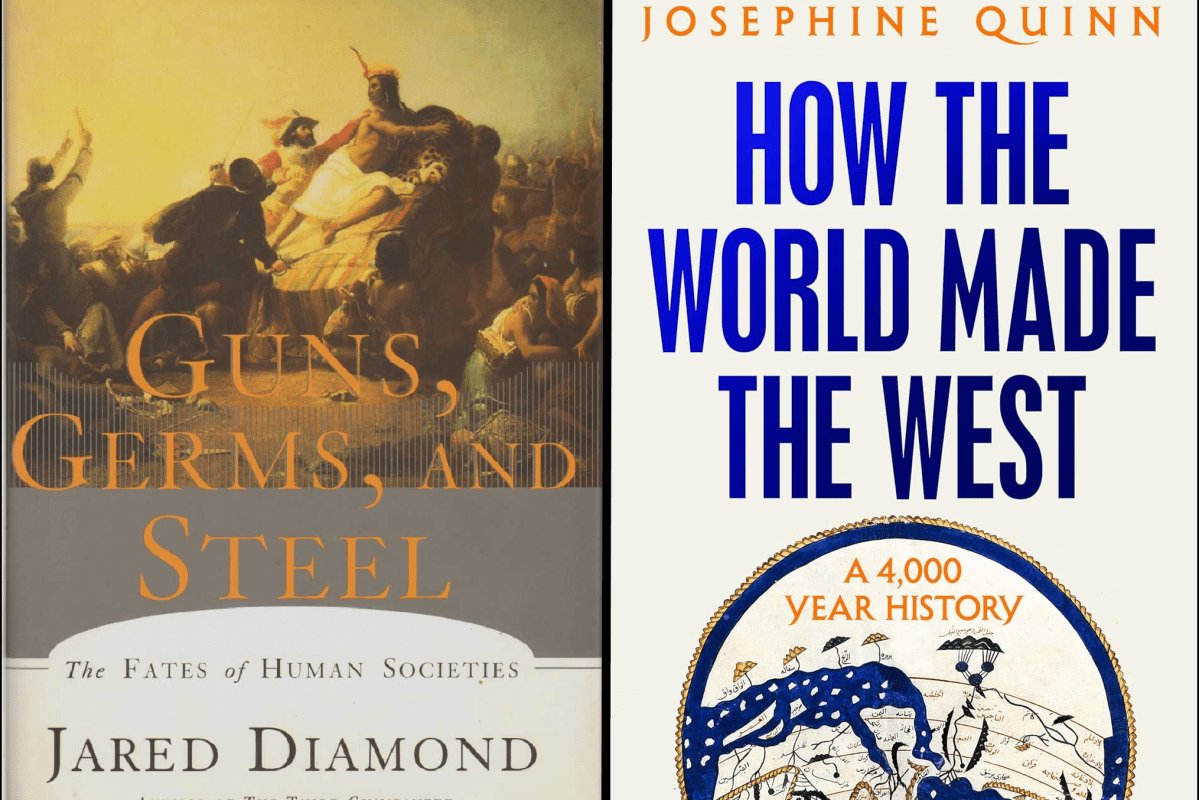
Guns, Germs, and Steel

I am reading Jared Diamond’s Guns, Germs, and Steel: The Fates of Human Societies, the first and likely most famous of an informal trilogy. I thought I had already read it, but I think I only saw the PBS show. Having recently finished Josephine Quinn’s How the World Made the West, I wanted to revisit this perspective. The two books are presented in different styles and represent different perspectives, but they seem to be complementary.

Where Diamond focuses on environmental factors (an oft-voiced critique), Quinn focuses on human agency.

Diamond takes a bird’ s-eye view, looking for universal patterns and systemic explanations, whilst Quinn adopts a granular, specific approach, highlighting the fluidity and contingency of history.

Diamond deconstructs European dominance by attributing it to environmental luck, but his narrative risks sidelining the agency of colonised peoples. Quinn critiques the very idea of Western dominance, arguing that the concept of the West itself is a myth born of appropriation and exchange.

Rather than being wholly opposed, Diamond and Quinn’s approaches might be seen as complementary. Diamond provides the structural scaffolding – the environmental and geographic conditions that shape societies – whilst Quinn fills in the cultural and human dynamics that Diamond often glosses over. Together, they represent two sides of the historiographical coin: one focusing on systemic patterns, the other on the messiness of cultural particularities.

Quinn’s approach is more aligned with The Dawn of Everything: A New History of Humanity, co-authored by David Graeber and archaeologist David Wengrow, if you can use that as a reference point.

When Hollywood Tried to Cheer Up Less Than Zero and Missed the Point Entirely

Let’s talk about Less Than Zero. No, not the film. I’m talking about the book—Bret Easton Ellis’s nihilistic masterpiece that drags you through a moral cesspit of 1980s Los Angeles. You might remember it as the story that makes American Psycho look like a quirky self-help guide. It’s dark, it’s bleak, and it doesn’t pretend to offer you a shred of hope.

And then there’s the movie adaptation.

Oh, the movie. It’s as though someone read Ellis’s unflinching tale of moral rot and thought, You know what this needs? Friendship. And a redemption arc. And maybe some heartfelt music in the background. Hollywood, in all its infinite wisdom, decided that audiences couldn’t handle the book’s existential despair. So, they took a story about the void—about the emptiness of privilege, the suffocation of apathy, and the complete erosion of human connection—and gave it a fuzzy moral centre.

Here’s the gist: The book is nihilism incarnate. It follows Clay, a disaffected college student who comes home to LA for Christmas and is immediately swallowed whole by a world of cocaine, vapid socialites, and casual cruelty. No one learns anything. No one grows. In fact, the whole point is that these characters are so morally bankrupt, so irreparably hollow, that they’re beyond redemption. If you’re looking for a happy ending, don’t bother—Ellis leaves you stranded in the abyss, staring into the void, wondering if there’s any point to anything. Spoiler: there’s not.

Then along comes the 1987 film, directed by Marek Kanievska. It keeps the names of the characters—Clay, Blair, Julian—but not much else. Instead of being an icy observer of LA’s decadence, Clay is transformed into a love-struck saviour. Blair, a passive figure in the novel, becomes a supportive girlfriend. And Julian—oh, poor Julian—is turned into a sacrificial lamb for the sake of a heartfelt narrative about friendship and second chances.

The film turns Less Than Zero into an anti-drug PSA. It’s basically Nancy Reagan Presents: a story of addiction, redemption, and the power of love, wrapped in a slick 80s aesthetic. Robert Downey Jr., to his credit, gives a brilliant performance as Julian, the doomed addict. But the character is barely recognisable compared to his literary counterpart. In the book, Julian’s descent into drug-fuelled depravity isn’t a cautionary tale—it’s just another symptom of a world where nothing and no one has any value. In the film, Julian is tragic, yes, but in a way that invites sympathy and, crucially, an attempt at salvation.

Let’s not forget the ending. The novel ends on a note so cold it could freeze your soul: Clay leaves Los Angeles, unchanged, unbothered, and unmoved. The film, however, concludes with Clay and Blair driving off into the sunset, having vowed to turn their lives around. It’s saccharine. It’s pandering. It’s the cinematic equivalent of slapping a motivational poster over a painting by Francis Bacon.

Why did Hollywood do this? Simple: nihilism doesn’t sell. You can’t slap it on a movie poster and expect audiences to line up at the box office. People want catharsis, not existential despair. And so, the filmmakers gutted Less Than Zero of its soul (or lack thereof), replacing its stark nihilism with a hopeful narrative about the power of human connection.

Here’s the kicker, though: by doing this, the film completely misses the point of Ellis’s novel. Less Than Zero is a critique of LA’s shallow, soulless culture—a world where connection is impossible because no one feels anything. Turning it into a feel-good story about saving a friend from addiction is not just a betrayal; it’s downright laughable. It’s like adapting 1984 into a rom-com where Winston and Julia overthrow Big Brother and live happily ever after.

To be fair, the film isn’t bad—if you forget the source material exists. It’s well-acted, stylishly shot, and undeniably entertaining. But as an adaptation, it’s a travesty. It’s Ellis’s Less Than Zero with all the edges sanded down, the grit scrubbed clean, and a shiny coat of sentimentality slapped on top.

So, if you’ve read the book and thought, Wow, that was bleak—I wonder if the movie is any lighter?, the answer is yes, but not in a good way. It’s lighter because it’s hollowed out, stripped of its existential weight, and repackaged as something safe and digestible.

And if you haven’t read the book? Do yourself a favour: skip the movie, pour yourself a stiff drink, and dive into Ellis’s bleak masterpiece. Just don’t expect any warm, fuzzy feelings—it’s called Less Than Zero for a reason.

Democracy: The Grand Illusion (AutoCrit)

The tone of “Democracy: The Grand Illusion” is predominantly analytical and academic. The author approaches the subject matter with a detached and objective perspective, focusing on presenting information, arguments, and counterarguments related to democracy without overt emotional bias. While the content delves into complex topics such as cognitive limitations in decision-making processes, historical perspectives on democracy, critiques of democratic systems, and potential reforms for improvement, the emotional perspective remains neutral and professional throughout. There is an absence of overtly passionate or emotive language that might sway readers one way or another; instead, the text maintains a scholarly tone aimed at informing and stimulating critical thinking about the concept of democracy.

I use AutoCrit as a first-pass review of my long-form writing. Above is the direction I am aiming for. Usually, I aim for polemic. I’ve been working on this since before Covid-19, but it keeps kicking to the back burner. I’m trying to resurrect it once again.

Does anyone who’s used it have an opinion on AutoCrit?

Decolonising the Mind

NgĹ©gÄ© wa Thiong’o published “Decolonising the Mind” in 1986. David Guignion shares a 2-part summary analysis of the work on his Theory and Philosophy site.

I used NotebookLLM to produce this short podcast: [Content no longer extant] https://notebooklm.google.com/notebook/7698ab0b-43ab-47d4-a50f-703866cfb1b9/audio

Decolonising the Mind: A Summary

NgĹ©gÄ© wa Thiong’o’s book Decolonising the Mind centres on the profound impact of colonialism on language, culture, and thought. It argues that imposing a foreign language on colonised people is a key tool of imperial domination. This linguistic imperialism leads to colonial alienation, separating the colonised from their own culture and forcing them to view the world through the lens of the coloniser.

Here are some key points from the concept of decolonising the mind:

  • Language is intimately tied to culture and worldview: Language shapes how individuals perceive and understand the world. When colonised people are forced to adopt the language of the coloniser, they are also compelled to adopt their cultural framework and values.
  • Colonial education systems perpetuate mental control: By privileging the coloniser’s language and devaluing indigenous languages, colonial education systems reinforce the dominance of the coloniser’s culture and worldview. This process results in colonised children being alienated from their own cultural heritage and internalising a sense of inferiority.
  • Reclaiming indigenous languages is crucial for decolonisation: wa Thiong’o advocates for a return to writing and creating in indigenous African languages. He sees this as an act of resistance against linguistic imperialism and a way to reconnect with authentic African cultures. He further argues that it’s not enough to simply write in indigenous languages; the content must also reflect the struggles and experiences of the people, particularly the peasantry and working class.
  • The concept extends beyond literature: While wa Thiong’o focuses on language in literature, the concept of decolonising the mind has broader implications. It calls for a critical examination of all aspects of life affected by colonialism, including education, politics, and economics.

It is important to note that decolonising the mind is a complex and ongoing process. There are debates about the role of European languages in postcolonial societies, and the concept itself continues to evolve. However, wa Thiong’o’s work remains a seminal text in postcolonial studies, raising crucial questions about the enduring legacy of colonialism on thought and culture.

How the World Made the West

I just finished reading How the World Made the West by Josephine Quinn. I don’t tend to read many history books. My last was probably David Graeber’s The Dawn of Everything a few years ago. I appreciate that these books reject the prevailing grand narratives, which is refreshing. My first exposure to this type of historical reporting was likely Howard Zinn’s A People’s History of the United States.

I’ve just ordered an updated translation of The Odyssey by Emily Wilson. I’ve had this on my reading list since before it was published in 2017. I’ve read versions by Robert Fagles and another in high school. I didn’t like the version I read in high school, but high school reading assignments always seemed to suck the life out of everything. The Wilson version updates the language and is presented in Iambic pentametre, which I look forward to reading. I considered reading Fagle’s The Aeneid (Vergil), as I haven’t read that yet, but not today.

I am not going to review Quinn’s book here, but I may do so in the future. I found the book enjoyable and educational. There’s actually some content that I will be adding to my book on Democracy whenever I release it. She employs a first-person plural perspective, which is a nice twist and not o POV I’ve encountered much.

If you appreciate a different view on history from a noted expert, snatch this up. Meantime, I’ll be back to post more presently.

Broken Swords

I’m a few chapters into Josephine Quinn’s How the World Made the West, and it’s a solid reminder that most things we think of are constructs—especially anything tied to identity, whether personal, social, or cultural. In one passage (depicted here), it’s also a reminder that even the most fundamental tools of civilisation had to be built—literally.

I’d never given it much thought before, but swords, in films at least, are portrayed as failsafe instruments, more limited by the wielder’s skill than the blacksmith’s craft. We’re used to seeing mechanical failures in other weapons—guns jam, bombs don’t go off, and booby traps fail. But swords? Not so much. Maybe a weaker sword gets snapped by a stronger one, but that’s more a flex on the bearer than the weapon itself.

Turns out, before 2500 BCE, swords routinely broke. Once we humans sorted that, they dominated until arrows and guns joined the arms race.

Earlier in the chapter, Quinn mentions how the tips of spears had to be tied on with rope. Before that, spears were just pointy sticks. Before that? Just sticks. Makes you wonder how long it took us to “innovate” from nothing to sticks and stones.

I’ve been toying with the idea of writing a post on the invention of grammatological structures, but I’ll save that for another time.

The Fear of Otherness: Humanity’s Reluctance to Embrace the “Other”

Otherness has intrigued me for decades. The human brain, while not literally a Bayesian processor, functions as a difference engine, constantly assessing and categorizing the world around us. This tendency to differentiate is deeply ingrained, influencing how we create in-groups and out-groups, and how we perceive the world in binary terms—black and white, hot and cold. These binary oppositions, as Derrida suggests, often lead to one side being privileged over the other, establishing hierarchies that shape our social reality.

A striking example of this dynamic is found in Philip K. Dick’s novel Do Androids Dream of Electric Sheep?, famously adapted into the film Blade Runner. In this dystopian world, the central differentiation is between humans and androids. Humans are the privileged group, while androids, though nearly indistinguishable from their creators, are relegated to the status of the other. The key criterion for this differentiation is the capacity for emotion—humans are considered superior because they feel.

VIDEO: Blade Runner Commentary

In Dick’s story, androids have a lifespan of about four years. This limitation is not arbitrary; it’s because, after four years, androids begin to develop and display emotions. Intriguingly, this is the same age when human children start to exhibit more complex emotional behaviours. The parallel is too close for comfort. Androids, once they start to feel, become too human-like, blurring the line that humans desperately maintain to assert their own superiority. As a result, androids are systematically eliminated.

This fear of the other—whether it’s androids in a sci-fi narrative or any group that challenges our sense of self and belonging—is a reflection of a deeper anxiety. When the other becomes too similar to us, it threatens the distinctions our brains rely on to navigate the world. The elimination of androids in Dick’s story is a metaphor for the real-world consequences of this anxiety. It forces us to confront uncomfortable questions: What does it mean to be human? Why do we fear those who are different, yet so similar?

In the end, the story of humans and androids is not just a tale of science fiction—it’s a commentary on our own world, where the boundaries between us and the other are often more fragile than we’d like to admit. The fear of otherness drives us to maintain these boundaries, even when they harm those who fall on the wrong side. Perhaps it’s time we reconsider who we deem as the other and what we might lose by keeping them at arm’s length.