Why We Keep Talking Past Each Other

8–11 minutes

I am a philosopher of language. That is typically my primary perspective, so communication and limitations often fall into my sights. I believe that not all disagreements can be resolved through language communication. This illustrates one barrier in particular.

This essay is not an attempt to resolve disagreement, adjudicate truth, or reconcile competing worldviews. It is an attempt to explain why so many disagreements persist despite intelligence, good faith, and shared vocabulary – and why escalating those disagreements often makes them worse rather than better.

What follows is diagnostic rather than prescriptive. I am less interested in who is right than in why arguments so often fail to converge, and why those failures are routinely misinterpreted as moral defects rather than structural mismatches. The claim is not that ‘anything goes’, nor that all perspectives are equally valid, but that many disputes operate across ontological fault lines that no amount of better reasoning, evidence, or civility can bridge on their own terms.

Recognising this does not require abandoning one’s commitments. It requires abandoning the fantasy that every disagreement is corrigible and that persuasion is always the appropriate response to difference. If the essay succeeds, it will not produce consensus. It may, however, produce a little more clarity, a little less moral theatre, and a slightly more disciplined form of charity – one grounded not in agreement, but in an honest appraisal of where disagreement actually lives.

Audio: NotebookLM summary podcast of this content.

On Ontological Incommensurability and the Case for Civilised Disagreement

Most disagreements that metastasise into moral theatre are not disagreements at all. They are collisions between incompatible ontologies, misdiagnosed as differences of opinion.

We continue to behave as though all disputes take place on a shared stage called “reality,” where facts sit patiently waiting to be interpreted, weighed, or refuted. From this perspective, disagreement is assumed to be corrigible. If only one side listened harder, reasoned better, or acquired the right evidence, convergence would follow. This assumption is not merely optimistic. It is wrong.

Many of our most entrenched conflicts persist precisely because the parties involved do not inhabit the same world in any substantive sense. They operate with different background assumptions about what exists, what counts as real, what can ground truth, and what sorts of things are even eligible for belief. Argument, in such cases, does not fail due to bad faith or insufficient charity. It fails because it presumes a shared ontology that does not exist.

Before proceeding, a clarification. I am using ontology here in a deliberately broad, working sense. Not merely as an inventory of what exists, but as the background framework that determines what can count as real, meaningful, or normatively binding in the first place. This inevitably overlaps with epistemology, ethics, and theories of agency. Not because these domains are identical, but because in lived discourse they travel together. The fault line I am describing is not disciplinary. It is structural.

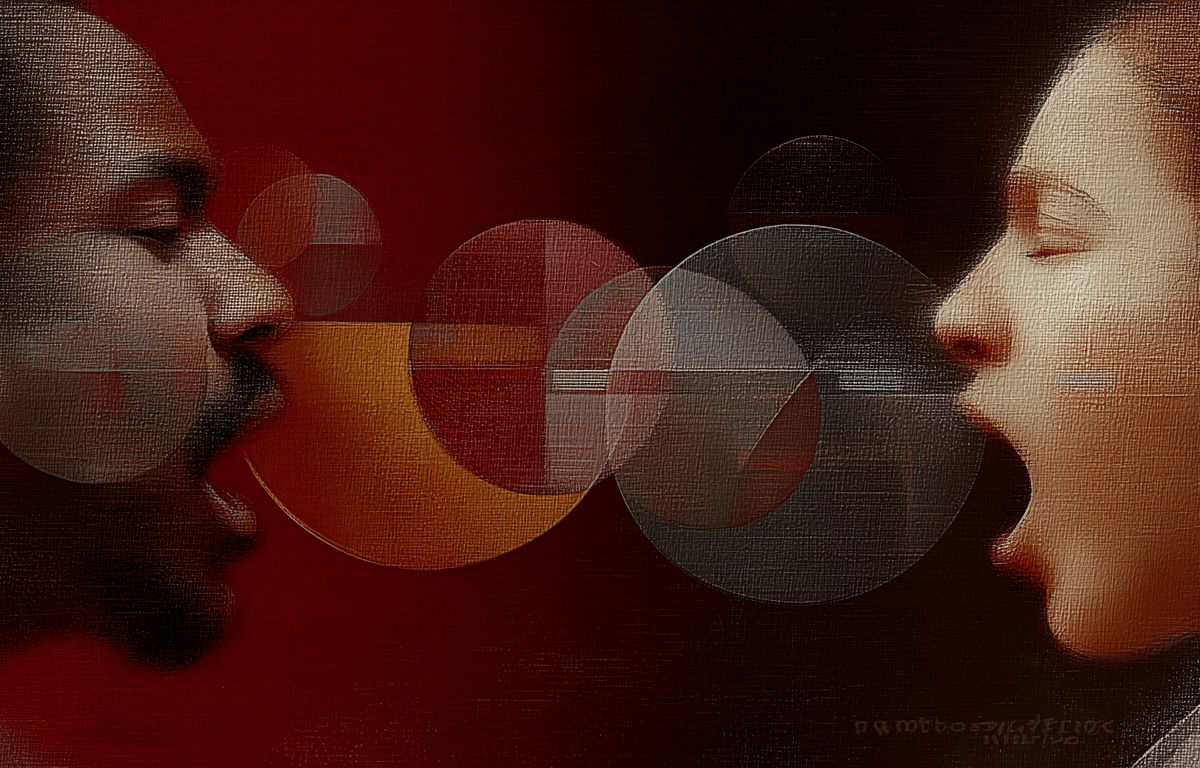
Video: Two people in ontological bubbles. (no sound)

Opinion Is Not Ontology

A difference of opinion presupposes a common world. Two people may disagree about what justice requires, but only because they agree, tacitly, that justice is a thing of some kind. Two people may dispute whether God exists, but only because they share enough conceptual scaffolding for the sentence to function.

Ontological disagreement runs deeper. It concerns not what is the case, but what it even means for something to be the case at all. When these levels are conflated, discourse becomes theatrical. Arguments are repeated with increasing urgency, frustration is moralised, and disagreement is reinterpreted as stubbornness, ignorance, or vice. Civility erodes not because people are cruel, but because they are speaking from worlds that do not interlock.

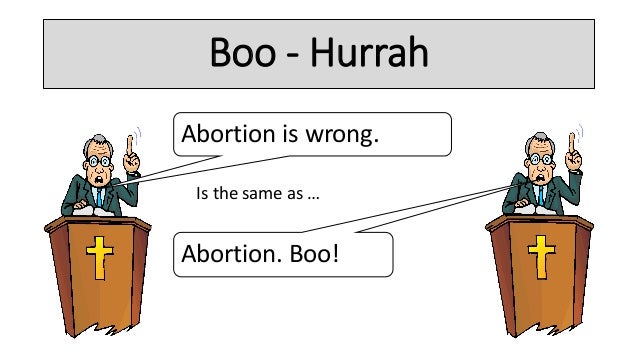
Consider debates over abortion. Pro-life arguments typically presuppose that the fetus is already a moral person; pro-choice arguments often presuppose that moral personhood is inseparable from bodily autonomy. These positions are not primarily disagreements about policy, compassion, or even ‘the value of life’. They are disagreements about what kinds of entities exist and when they begin to matter. Shared language about rights or harm often masks this deeper ontological divergence, which is why such debates rarely converge despite decades of argument.

When Critique Presumes the Ontology It Opposes

This distinction helps explain a familiar but often confusing phenomenon: cases where two parties appear to agree on symptoms, vocabulary, and even outrage, yet remain fundamentally misaligned.

Consider critiques of institutional cruelty that condemn dehumanising practices while retaining the very assumptions that make those practices intelligible. For example, workplace critiques that oppose excessive surveillance, unfair metrics, or punitive performance targets often still presume the figure of the autonomous, responsible worker whose output reflects individual will. The system is blamed for misapplying norms, not for producing those norms as instruments of control. Such critiques are often insightful and well-intentioned. They identify real harm. They name real suffering. And yet they stall.

The reason is not timidity or bad analysis. It is ontological inheritance. These critiques operate inside the same metaphysical framework that generates the harm they diagnose. They presuppose moral realism, individual agency, and normative grounding as givens, then object to their misapplication. The result is an internal critique: coherent, compelling, and structurally limited.

From a different ontological position, the problem is not that the norms are misapplied, but that the norms themselves function as delivery mechanisms of harm. What appears as reform from within appears as reenactment from without. This is not a misunderstanding. It is a category error.

Recognising this helps explain why superficial agreement so often feels productive while changing nothing. Shared language can create the appearance of convergence while leaving foundational divergence intact. The temperature drops. The mediator applauds. The underlying machinery hums on.

Igtheism and the Refusal to Pretend

This is why I describe myself, somewhat unfashionably, as an igtheist rather than an atheist.

Atheism still accepts the question ‘Does God exist?’ as well-formed. It grants the concept enough coherence to deny its instantiation. Agnosticism does much the same, merely pausing at the threshold. Both remain inside the game.

Igtheism steps back and asks a prior question: What, precisely, are we talking about? If no stable referent can be specified, the sentence does not become false. It becomes undefined. The system returns ‘does not compute’. This is not evasive. It is diagnostic.

Try as I may, I cannot make sense of strong metaphysical Realism, let alone Theism. The idea that there exists a fully formed, mind-independent world ‘out there’, grounding truth prior to mediation, language, practice, or perspective, does not parse for me. Not as a contested claim. As a coherent one.

However, and this is the crucial point, once I accept Realism as a mechanism, Theism suddenly makes sense. If you already believe in a metaphysically exterior realm that guarantees truth and coherence, then placing God there is not a leap. It is an economy of scale.

Paraphrased bluntly: They believe there is a whole world ‘out there’. I don’t believe in any of it, so God might as well live out there, too.

From within that worldview, atheistic Realism is arguably the stranger position. The cathedral has been built; denying the altar looks parsimonious rather than principled.

I am not offering a competing metaphysical system here. Not idealism, not pragmatism, not a substitute ontology waiting in the wings. I am declining the assumption that reality must come pre-packaged as a mind-independent domain in order to be intelligible or actionable at all.

Of course, non-realist positions are not exempt from this problem; they, too, can smuggle in unexamined ontological commitments under the guise of pragmatism, coherence, or practice.

Pascal’s Wager and Ontological Blackmail

This is why igtheism tends to offend theists more than atheism ever could. When a theist says, ‘How can you not care? Your soul depends on it’, they are not making an argument. They are issuing an ontological demand. Pascal’s Wager is merely this demand formalised into decision theory.

The wager only works if one has already granted the existence of souls, post-mortem identity, divine reward structures, and a cosmic enforcement mechanism that cares about belief states. Without those assumptions, there is no wager. There is only a shouted house rule addressed to someone who is not in the casino.

None of this is meant to trivialise the existential seriousness with which such claims are often held. It is simply to note that care does not precede ontology; it follows it. One cannot meaningfully care about entities one does not recognise as intelligible occupants of the world.

Why This Doesn’t End in Relativism

None of this implies that ‘all ontologies are equally true’, nor that disagreement is pointless. It implies something far less comforting and far more useful: many disagreements are non-resolvable by design. This does not deny that ontological frameworks can and do shift over time, sometimes under empirical pressure; it only denies that such shifts are guaranteed, universal, or achievable through argument alone.

Non-resolvability does not entail arbitrariness. Ontological frameworks can be evaluated for internal coherence, practical consequences, and the kinds of lives they make possible. What cannot be done is to adjudicate between them using criteria that belong exclusively to one side. Recognising this does not require abandoning one’s worldview. It requires abandoning the fantasy that persuasion is always possible, or that failure to persuade is a moral defect.

Once we see that we are not standing on the same ground, something like charity becomes possible. Not the saccharine kind. The disciplined kind. I understand that this matters enormously to you. I do not share the ontology that makes it matter to me. This is not a truce forged through compromise. It is a ceasefire born of ontological honesty.

Civility Without Convergence

Our age is addicted to resolution. Every disagreement is treated as a problem to be solved, a synthesis waiting to happen, a bridge yet to be built. Sometimes there is no bridge. Sometimes the most responsible thing to do is to stop pretending there is one.

Civility does not require agreement. It does not even require mutual understanding in the strong sense. It requires only that we stop mistaking incompatible world-models for intellectual obstinacy. We are not all arguing about the same furniture. Some of us are questioning whether the room exists at all.

Once that is acknowledged, the volume drops. The moral theatre loses its urgency. And disagreement, while still real, becomes less corrosive. Not because we have reconciled our ontologies. But because we have finally noticed that they do not reconcile.

Defying Death

I died in March 2023 — or so the rumour mill would have you believe.

Of course, given that I’m still here, hammering away at this keyboard, it must be said that I didn’t technically die. We don’t bring people back. Death, real death, doesn’t work on a “return to sender” basis. Once you’re gone, you’re gone, and the only thing bringing you back is a heavily fictionalised Netflix series.

Audio: NotebookLM podcast of this content.

No, this is a semantic cock-up, yet another stinking exhibit in the crumbling Museum of Language Insufficiency. “I died,” people say, usually while slurping a Pumpkin Spice Latte and live-streaming their trauma to 53 followers. What they mean is that they flirted with death, clumsily, like a drunk uncle at a wedding. No consummation, just a lot of embarrassing groping at the pearly gates.

And since we’re clarifying terms: there was no tunnel of light, no angels, no celestial choir belting out Coldplay covers. No bearded codgers in slippers. No 72 virgins. (Or, more plausibly, 72 incels whining about their lack of Wi-Fi reception.)

There was, in fact, nothing. Nothing but the slow, undignified realisation that the body, that traitorous meat vessel, was shutting down — and the only gates I was approaching belonged to A&E, with its flickering fluorescent lights and a faint smell of overcooked cabbage.

To be fair, it’s called a near-death experience (NDE) for a reason. Language, coward that it is, hedges its bets. “Near-death” means you dipped a toe into the abyss and then screamed for your mummy. You didn’t die. You loitered. You loitered in the existential equivalent of an airport Wetherspoons, clutching your boarding pass and wondering why the flight to Oblivion was delayed.

As the stories go, people waft into the next world and are yanked back with stirring tales of unicorns, long-dead relatives, and furniture catalogues made of clouds. I, an atheist to my scorched and shrivelled soul, expected none of that — and was therefore not disappointed.

What I do recall, before the curtain wobbled, was struggling for breath, thinking, “Pick a side. In or out. But for pity’s sake, no more dithering.”
In a last act of rational agency, I asked an ER nurse — a bored-looking Athena in scrubs — to intubate me. She responded with the rousing medical affirmation, “We may have to,” which roughly translates to, “Stop making a scene, love. We’ve got fifteen others ahead of you.”

After that, nothing. I was out. Like a light. Like a minor character in a Dickens novel whose death is so insignificant it happens between paragraphs.

I woke up the next day: groggy, sliced open, a tube rammed down my throat, and absolutely no closer to solving the cosmic riddle of it all. Not exactly the triumphant return of Odysseus. Not even a second-rate Ulysses.

Here’s the reality:
There is no coming back from death.
You can’t “visit” death, any more than you can spend the afternoon being non-existent and return with a suntan.

Those near-death visions? Oxygen-starved brains farting out fever dreams. Cerebral cortexes short-circuiting like Poundland fairy lights. Hallucinations, not heralds. A final, frantic light show performed for an audience of none.

Epicurus, that cheerful nihilist, said, “When we are, death is not. When death is, we are not.” He forgot to mention that, in between, people would invent entire publishing industries peddling twaddle about journeys beyond the veil — and charging $29.99 for the paperback edition.

No angels. No harps. No antechamber to the divine.
Just the damp whirr of hospital machinery and the faint beep-beep of capitalism, patiently billing you for your own demise.

If there’s a soundtrack to death, it’s not choirs of the blessed. It’s a disgruntled junior surgeon muttering, “Where the hell’s the anaesthetist?” while pawing desperately through a drawer full of out-of-date latex gloves.

And thus, reader, I lived.
But only in the most vulgar, anticlimactic, and utterly mortal sense.

There will be no afterlife memoir. No second chance to settle the score. No sequel.
Just this: breath, blood, occasional barbed words — and then silence.

Deal with it.

The Tyranny of Order and the Freedom of Chaos

I’m not happy with the summary review of The Blind Owl by Sadegh Hedayat. I liked the book, and the review was positive, but the summary was at too high of a level and didn’t convey how I experienced the reading. I’m tempted to try again at a lower level. That’s not the subject of this piece.

I happened on a short clip of Claudia de Rham pointing out that physicists (and scientists more generally) are not dismayed when their theories are disproven or someone finds a puzzle piece that doesn’t fit into their puzzle. The reaction she highlights is similar to reactions to Nihilism and Anarchy.

VIDEO: The Institute of Art and Ideas.

Here’s a longer (but still not full) version.

VIDEO: Can physics ever explain the universe? | Avshalom Elitzur debates Claudia de Rham

Most people, it seems, are incessantly grasping for order. A select few crave structure. But what truly fascinates me is the interplay of perception and expectations.

The ‘Orderlies’ – those fastidious devotees of tidiness – become apoplectic at the mere sight of disorder. They needn’t even experience it directly. “Oh, those physicists must return to the drawing board! Their model needs reassessment!” For fuck’s sake, it gives them purpose – a raison d’ĂŞtre, if you will.

This phenomenon extends to the habitual ‘Believers’ scrutinising nihilists. “Without belief, I’d embark on a murderous rampage,” they proclaim – though always directed at the world beyond themselves. Never them, of course, but those ‘other’ people. If not for God, who would maintain order? Evidently, these individuals don’t venture out much if they genuinely believe their deity is keeping things shipshape.

I frequently encounter notions that Nihilists must navigate life burdened by existential dread, their existence devoid of meaning, the universe an empty void. Speaking for myself, I require no such structure. Nothing is absent. There is no dread.

The religious perceive a void – a “God-sized hole,” as a mate once pontificated, that can only be filled by the divine. Naturally, he was moralising, declaring that sex, drugs, and other vices could never satiate this cosmic emptiness. But there is no hole. Perhaps they’re grappling with some psychological vacancy. I sympathise, truly, but stuffing a God-sized hole with imagination seems no more nourishing than consuming an imaginary sandwich. Sod it, I might as well gorge on an imaginary chateaubriand if we’re going all in. I’ll still need sustenance after this illusory feast.

Then there are those who yearn to be governed. They crave traditions and institutions, lacking the critical faculties to evaluate them. Whatever they possess must surely be superior to the worst they can conjure. I suspect they’re envisioning an alternate world populated by like-minded individuals. In fact, I ought to be terrified by such a prospect too.

In the end, perhaps the true freedom lies not in order or belief, but in embracing the beautiful chaos of existence. After all, in a universe of infinite possibilities, why constrain ourselves to imaginary feasts when we can savour the rich banquet of reality?

In Defence of Nihilism: Embracing the Absence of Inherent Meaning

Nihilism, often misunderstood and misrepresented, shares a common plight with philosophies such as atheism, anarchism, and Marxism. Like its counterparts, nihilism is frequently subjected to the creation of strawman arguments in public discourse, resulting in its vilification and scapegoating. In this article, I aim to demystify nihilism by providing a clear definition, description, and defence of this philosophical perspective.

Firstly, let’s address the misconception that nihilism entails a chaotic disregard for morality and societal norms: “If life has no meaning or purpose, then anyone can do anything.” This sentiment is often echoed in discussions about nihilism, as well as anarchism and atheism. However, it presupposes a fundamental misunderstanding of human nature. Despite the absence of inherent meaning in the universe, humans are not devoid of emotions or social affinities.

It is crucial to recognise that while the universe does not impart meaning or purpose, humans have constructed various systems of meaning throughout history. Whether through moral codes, religious doctrines, or cultural norms, individuals and societies have ascribed significance to different aspects of life. These constructs provide a framework within which individuals navigate their existence, albeit one that is socially constructed rather than inherent to the universe.

Critics of nihilism often argue that the acknowledgement of life’s inherent meaninglessness leads to despair and existential angst, rendering life devoid of purpose. However, this perspective fails to account for the resilience and adaptability of human beings. While some individuals may struggle initially with the realisation that there is no inherent meaning, many nihilists find liberation in embracing the absence of preordained purpose. Rather than succumbing to despair, they recognise the freedom to create their own meaning and forge their own path in life.

It is essential to understand that nihilism does not negate the validity of individual or societal pursuits. While nihilists reject the notion of inherent meaning, they acknowledge the significance of subjective meaning and the importance of human connection, fulfilment, and well-being. Whether it is pursuing personal goals, fostering relationships, or contributing to the betterment of society, nihilists recognise the value of such endeavours within the context of human experience.

In conclusion, nihilism offers a perspective that challenges conventional notions of meaning and purpose. By acknowledging the absence of inherent meaning in the universe, nihilists embrace the freedom to create their own meaning and chart their own course in life. Far from being a philosophy of despair, nihilism invites individuals to confront the uncertainty of existence with courage and resilience, recognising the inherent value of human experience in a world devoid of inherent meaning.

Atheist, Agnostic, Other

This article appeared in my social feed, What are the different types of atheism? But the author makes at least two notable mistakes. Firstly, he conflates atheism with agnosticism, the first being about belief and the last being about knowledge. So, one can believe or disbelieve in something, but that doesn’t speak to knowing. This debate is specifically about gods, so one can believe in a god but not know; one can not believe in gods and not know; one can believe in a god and know; and one can disbelieve in gods and not know. As for me, I am an igtheist: I don’t care about gods. It’s a silly place to spend my time.

For a theist or atheist, the existence of gods is a truth statement. For me, the question is not ruth apt; it’s ostensibly gibberish. Even then, I am still agnostic, which might also be ignostic because not only don’t I know, neither do I care.

As Ricky Gervais has pointed out (recasting per the linked article), if there are 10,000 gods, a typical Christian doesn’t believe in 9,999 gods. They believe in their god. Just 1. Of course, the other gods are nonsense. Ditto for Muslims. Ditto for Jews. In the end, they claim the same underlying deity, but they argue over which cohort He favours, and their god identifies as a male, so they’ve adopted male pronouns.

Secondly, whilst the author mentions religious and non-religious, he misses the spiritual cohort. This is a subset of non-religious. In some cases, I and many others might argue that spirituality is simply a personal religion, so the distinction would be one of community. The religious congregate en masse whilst the spiritual take this journey alone. One may also argue that some spiritual folks also congregate. I’ve attended more than one Wiccan or Pagan group event, but the ties may be looser than with a mainstream religion.

In the case of some spiritual adherents, non-religious is shorthand for being opposed to Big Religion. Perhaps not coincidentally, many of these are opposed to Big Pharma and Big Agriculture, but my purpose here is not a psychological profile.

I recently heard Robert Sapolsky say in a lecture that the religious live longer and are happier on average than non-religious, which is to say the spiritual and the atheists alike, so he notes this could provide an underlying evolutionary explanation for religious belief. Neither will I comment further on this notion, but there you have it. Take id or leave it.

Atheism Defence

Curse YouTube and Drew—but in a good way. Drew created a video titled I took a Christian class about atheism. It was worse than I expected. Although I don’t find I need to engage with anyone to defend my atheism, I sometimes do. Perhaps, the devil made me do it. I’ve been an atheist for decades—literally for at least half a century. (Man, that’s revealing.)

Spotify Link

The magic gods of social media tossed this gem in my face, and I was fated to watch it—a 45-minute video nonetheless. Who posts long-format content on YouTube these days? Honestly, I didn’t think I was going to watch the entire thing—at least without skipping ahead.

I jotted down my thoughts—on paper no less—as I engaged the content. But before delving into that, I want to say that Greg Koukl is a formidable communicator. He knows how to engage his audience. Drew, the Genetically Modified Skeptic, is a strong communicator himself, employing cogent logic in defence of atheism—well-considered and articulated. Although I was watching the clock—cuz 45-minutes; plus I was stopping to take notes. Capturing a couple dozen bullet points, I’d comment here instead of in situ. I’ll link from there to here when I’ve published my reaction.

Drew responds so well that, generally, I avoid stepping on his responses, with which I am in agreement. Instead, I share my own observations either on topics Drew did not address or that I have a nuanced take on.

Below are the points I make with a time reference to the clip. In some cases, the link starts earlier than the point I am addressing if only to provide a reader with context.

3:25 Greg points out that he is going to focus on areas where Christianity can make sense but atheism cannot.

Response: Things do not have to make sense. This is a belief humans impose on the world. Even if one believes in a world of causes and effects, it does not follow that we have a privileged perspective into these causes. Some effects may be caused by any number of correlated and covariant factors, and to claim that A causes Z, because it’s expedient and somewhat linear over some more complex multifactor causal model, is weak tea. As humans, we want things to make sense. It’s effectively in our nature, but it doesn’t follow that the universe needs to comply with this need. Human psychology compensates knowledge and perception gaps with any number of tricks from Gestalt to apophenia. It may be comforting for some to use gods as putty to fill the cracks, though, in my mind, it’s rather Silly Putty.

3:35 Greg defines the terms theism and atheism. Drew points out the reduced, self-serving definitions Greg tries to slide by.

4:44 Greg tries to frame atheism as an assertion rather than an absence, so he can fabricate a strawman to attack.

Response: As Drew points out, this is sometimes, but not always, true. Here my thoughts (or soul, as the case might be—orthogonal, or otherwise) wandered to the Dawkins Scale, which parses atheism and agnosticism into a spectrum rather than a binary pair. Idiomatically, it’s a non-assertion. If you claim there’s a dog in my yard, it’s incumbent for you to provide evidence. If I claim, there is no dog in my yard, I am under no such obligation. Besides, my looking for evidence of a non-dog in my yard would require additional scrutiny. Perhaps it’s hidden.

Moreover, Greg attempts to make this a semantic issue. Drew points this out. For me, I reflected on the political situation where some cohorts within the US public decried Obamacare (AKA the Affordable Care Act or ACA) and yet were substantially supportive of its features. Obamacare acted as a pejorative to taint the act with negative connotations for Obama detractors. People’s cognitive faculties as deficient as they are, this was super easy—barely an inconvenience. Anarchism triggers the same sort of reaction. I attribute this to an unceasing negative propaganda/indoctrination campaign.

9:00 We have reality on our side.

Response: Translation: We have subjective experience, and we are going to pose this as some objective reality.

9:40 Greg asks: Where did everything come from? What caused the beginning of the universe.

Response: Where is thy stuff? I don’t even need to engage this question directly because the chestnut of an argument he is presenting has a recursion problem. If everything needs a beginning, then God needs a beginning. This argument just kicks the can down the kerb. And ‘He just is‘ works just as well as ‘It just is‘. Nuff said.

11:25 Greg recounts a scenario where he purportedly asks a recently converted atheist, Do things exist? to which the subject responded affirmatively.

Response: The nature of existence and reality is not resolved science. ‘“Things” are perceived‘ is about the best we can get to at this moment in time, and this doesn’t even define things very precisely.

11:30 Have things always existed? is the question posed next.

Response: I like Drew’s response here. Instead, I went to the definition of time because the notion of time is a social construct. It could be that there was a Biblical void from which the universe sprang whole cloth as depicted in the Genesis version or a Big Bang version. It could as well be that at some point time was invented. An imperfect analogy is the BCE-CE split. CE simply starts at year 1 and we’ve run with it. The universe doesn’t have an equivalent notion of BCE, but perhaps it’s similar to spinning up the universe as a virtual machine. There was a literal void of bits awaiting a cue to instantiate a VM universe. For all intents and purposes, this is the beginning of time for that virtual machine. In this example, we could extend the metaphor to a multiverse, or we could stay with a physical machine and virtual machine metaphor. Sure, the physical machine might be a god or another meta-universe—I refuse to say metaverse—, but the virtual machine has no insights earlier than its own time-zero.

The other things Greg’s approach misses are the notions of quantum mechanics and emergent properties. I won’t spend any time elaborating here.

16:50 A big bang needs a big banger!

I addressed this regressive Big Banger point earlier. Moving on.

20:00 Explanatory power of intuitions

Response: Without getting into the weeds of Kahneman and Tversky’s Systems 1 and 2, intuition and heuristics have a place, but they are very fallible for all but the most mundane of tasks. They are not very precise and are a poor foundation for any theory. I can feel it in my bones just doesn’t go very far—and that includes intuitions about reality

22:15 The problem of evil is apparently the most common objection to the existence of God.

Response: This is a sophomoric position to adopt. Greg tries to frame this as an out-there objective reality affair as opposed to an in-there subjective, emotional problem. He posits that things in the world—including people—are inherently bad or evil. Again, Drew reframes this as a uniquely Christian problem. As for me, I don’t even believe in the existence of evil. Good and bad are functional yet still social constructs. Evil is just trebled bad with a metaphysical twist. The problem with evil is more of a problem with bad narrative than anything more substantive. Somebody created a storyline and didn’t run it by strong editors or continuity reviewers.

26:15 Lawmaker Transcendence: In order for there to be laws to be broken, there have to be laws…

Response: Knowing his intended audience, Greg keeps hammering on the objective reality nail. Whilst this may play well to the choir, as Drew points out, it’s not likely to score any points in a debate with atheists. Morals, as well as laws, are social constructs. And as universals, they don’t map as closely across cultures except at the most abstract of levels.

It should go without saying that even if there were a god passing out commandments, there would be no way to validate the authenticity of this exchange.

32:30 All people have souls… You are not just a piece of meat in motion

Response: Just rambling. I’m not even going to waste my time on this one except to redirect you to my previous response relative to human psychology and apophenia.

34:00 A soul is not a brain

Response: This bit is juvenile, too. Here Greg explains that the soul is not the brain, that you can’t disassemble your brain to find thought. But, he doesn’t mind ignoring that your soul is nowhere to be found either. This feels quite similar to the need for a creator, but these evidentiary needs don’t apply to their positions. Drew’s computer analogy is apt here.

39:10 Existential crisis is a problem for Greg and other Christians.

Response: Because Christians are wired the way they seem to be, any modality that severs the connection to meaning sets them off. Greg confuses hubris and ego for something more substantial, attributing meaning to it. As it happens, people also cherish their pets more than some random squirrel.

40:30 Humans feel guilty because humans are guilty.

Interestingly, there is a school of belief, psychologically speaking, that the default state of humans is one of anxiety, but given that I don’t give psychology any more credibility than religion, I’ll just leave that here. People feel guilty because they are indoctrinated to feel guilt. A hypothetical person raised on a desert island or in the woods, like Victor, the feral child of Aveyron, or in the jungle, like Tarzan or Mowgli, would not know guilt, empathy, shame, or any of a host of other social “emotional” responses.

All told, Greg raised nothing new nor offered any new support for Christian belief, let alone a broader theistic defence. Ostensibly, the approach he takes is more akin to choir preaching than any other rhetorical purpose. In the end, he’s promoting a smug superiority complex in believers. He understands that although people will accept blind faith rationale for religious belief—especially those indoctrinated from birth—that people do have a mild penchant for rationality. I don’t think most humans operate beyond a cursory level of reasoning, but it’s enough to exploit and construct social reflection mechanisms as part of personal image-building. This allows Greg to propose a homoeopathic logical, rational framework and have it uncritically adopted as being rational.

As for otherwise rational Christians, they likely see through the charlatanism, but since emotion proceeds reason, they are allowed to check out and compartmentalise this nonsense whilst otherwise simultaneously retaining the ability to process the most challenging and tortuous logical conundrum.

Seven Types of Atheism

Some geezer, John Gray, wrote a book having this title. It was, let us say, ‘suggested’ that I watch it in video format—over an hour-long at that. I decided to search for a summary instead.

It’s not particularly up my street. The bloke who suggested the vid posted a statement:

Atheism is a narcissistic apostasy; the adoration of the things humans do & make; the worship of the golden calves of science & technology.

When I responded thusly « This quip reduced and conflates, almost creating a strawman. I suppose some atheists might be narcissists, though I don’t see that they would significantly differ from a sample of the general population. I’m guessing the second clause is intended to connect from the first, which is to claim that an atheist is a human who chooses STEM over gods as if there are no other alternatives, which creates a false dichotomy. But to treat atheism as some monolith is to treat all religions as ostensibly identical », his response was

What is atheism?.

To which I replied, « Atheism is the absence of belief in gods (or supernatural beings, if that’s a more generalisable concept). »

well, that is not enlightening at all. Explain atheism clearly.

That is all there is to it. There are different reasons why people are atheists, but that’s the definition. Etymologically, ‘theism’ is ‘belief in a deity or deities’. Atheism, applying the Greek prefix ‘a-‘, is the negative state of ‘theism, so the absence of ‘belief in a deity or deities’.

Atheism is not science. A large number of scientists believe in God. They see no contradiction between God and science, in fact they find the order behind everything reinforces their belief.

And so here the conversation, as it was, went off the rails. At no point did I invoke science. And then he promotes the John Gray video.

Interview with John Gray on Does God Exist

And we’ve been there before.

  1. New Atheism: the debate between science and religion was a result of confusing myths with theories. Religion is no more a primitive type of science than is art or poetry; scientific inquiry answers a demand for an explanation; the practice of religion expresses a need for meaning.
  2. Secular Humanism: a hollowed-out version of the Christian belief in salvation in history; the widespread belief that humans are gradually improving is the central article of faith of modern humanism
  3. Science-Religion: Gray reflects on the twentieth century’s strange faith in science – a faith that produced the false equation of evolution with progress and the racist ideologies that infect our social arrangements and political institutions
  4. Political Religion: Modern political ideologies are de facto religions; the belief that we live in a secular age is an illusion
  5. God-hatred: absorbed by the problem of evil; suffering, if inevitable, is at least infused with moral significance
  6. The Unsentimental Atheisms of George Santayana and Joseph Conrad: Santayana dismisses any idea that civilization is improving; everything in this world is a progress towards death. Conrad wrote that man is a wicked animal; his wickedness has to be organized; society is essentially criminal – otherwise, it would not exist
  7. Mystical Atheism: Schopenhauer was deeply and articulately antagonistic to religion in general; he rejects the notion that history has any metaphysical meaning, or that human beings are somehow advancing

Disclaimer 1: This summary list is copy-pasted from the linked source and edited ever so slightly to fit here.

Disclaimer 2: Neither did I watch the video nor read his book, so the summary might be off-kilter.

Still, I offer my reaction/reflection.

Firstly, this comes off not as an attack on atheism; rather, it’s an attack more particularly on Enlightenment and post-Enlightenment thinkers, predominantly Scientists—as in those who practice Scientism religiously.

Secondly, this limited attack garners the same critique as I give Dawkins’ God Delusion. I liked this book, but whereas Gray limits his attack on a thin slice of atheists—despite offering up 7 flavours—, Dawkins limits his attack to Christians; perhaps, some Abrahamic denominations. This is a particular God and particular disciples.

I address these in turn.

  1. New Atheism: I agree that Scientism simply switched faith from God to Science or it deified Science, whichever vantage you prefer. This ilk simply swapped God for Naturalism. These are the same lot who offer up ‘Self-evident truths’ and Natural Law. Please. I agree with neither.
  2. Secular Humanism: Whilst admittedly secular, I am not quite a Humanist and decidedly not a Secular Humanist™. Here, I disagree with the underlying teleological notion of both.
  3. Science-Religion: The only nod I am willing to give to science is the evidence-based, falsifiability over faith, but much of science is still faith-based. It just operates from a different metanarrative. Again, Scientism is no one’s friend.
  4. Political Religion: I agree that this is as much a scourge as organised religion. By now, one might notice a trend—a healthy does of whataboutism: We can’t suck because we’re no different to this other thing that you might be attached to. Except they are all bollox through and through. Political ideology is religion without the blatant metaphysical nod—though it is still there beneath the surface.
  5. God-hatred: Even having not read the book, this makes no sense whatsoever. How can one hate what one doesn’t believe exists? I suppose I could hate unicorns, faeries, and Harry Potter, but I don’t think that’s the same thing. The summary suggests that it’s more about an obsession with evil, but I don’t have enough context to respond meaningfully. Do atheists actually believe in evil? I don’t. And, except idiomatically, I don’t personally know of others who do. Feels like a red herring.
  6. Unsentimental Atheisms: Satayana refutes the Secular Humanists. I’m buying what he’s selling. Conrad is taking a spin on evil but opting to label it wicked—a bit of a drama llama. I’m not buying it.
  7. Mystical Atheism: I like Schopenhauer—probably because he’s such an underdog. He did glean a bit from Buddhist philosophy. So have I. But Buddhism ranges from the secular to the sacred. I don’t tend to stray too far from the secular. I fully agree that history has no metaphysical meaning and human beings are not objectively advancing.

If anything, this is one of the longer posts I’ve made in a while. Thanks to the Copy-Paste Gods. Allahu Akbar, Oh Mighty. In the end, Santayana and Schopenhauer notwithstanding, I am still left with a why not neither.

FSM

Millennial Morality

Surfing the Web, I happened upon a blog wherein Wintery Knight riffed on a conversation about morality with an atheist millennial man. My interest was piqued, so I scanned it and then read it. I scanned the About page, and it’s apparent that we hold diametrically opposed worldviews, and that’s OK.

As a result of the encounter with this millennial man, the post intends to answer the question: How could I show him that happy feelings are not a good basis for morality? But let’s step back a bit.

In the words of the author, ‘I asked him to define morality, and he said that morality was feeling good, and helping other people to feel good.’ Here’s the first problem: Although a conversation about morality may have occurred between the author and an atheist millennial man, the post is not in fact a reaction to Millennial morality. Rather, it’s of the respondent’s dim characterisation of what morality is (whether for a theist or an atheist). His reply that morality is ‘feeling good, and helping other people to feel good’ sounds more like hedonism and compassion. The author does pick up on the Utilitarian bent of the response but fails to disconnect this response from the question. The result is a strawman response to one person’s hamfisted rendition of morality. The author provides no additional context for the conversation nor whether an attempt to correct the foundational definition.

A quick Google search yields what should by now be a familiar definition of morality: principles concerning the distinction between right and wrong or good and bad behaviour.

morality (noun) : principles concerning the distinction between right and wrong or good and bad behaviour

Oxford Languages

Clearly, conflating utility with rightness and wrongness, with goodness and badness, is an obvious dead-end at the start. This said, I could just stop typing. Yet, I’ll continue—at least for a while longer.

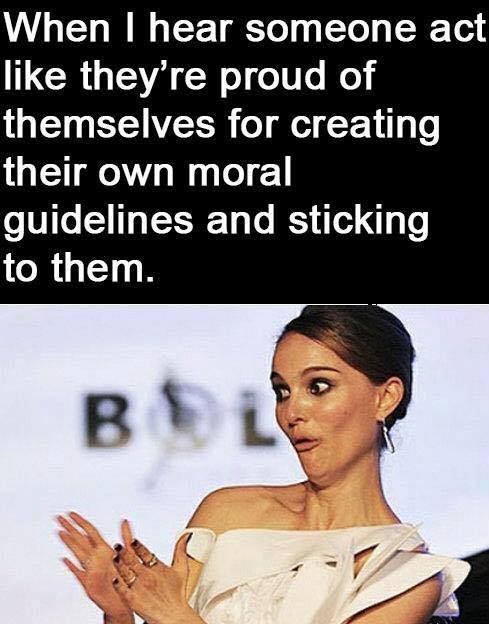
At the top of the article is a meme image that reads ‘When I hear someone act like they’re proud of themselves for creating their own moral guidelines and sticking to them’.

This is one of the memes from the Wintery Knight facebook page

Natalie Portman sports an awkward facial expression and a sarcastic clap. Under the image is a line of copy: If you define morality as “whatever I want to do” then you’ll always be “moral”, which is tautological, but a bit of a non-sequitur to the rest, so I’ll leave it alone.

Let’s stop to regard this copy for a few moments but without going too deep. Let’s ignore the loose grammar and the concept of pride. I presume the focus of the author to be on the individually fabricated morals (read: ethical guidelines or rules) and that the fabricator follows through with them.

That this person follows through on their own rules is more impressive than the broken New Year’s resolutions of so many and is a certainly better track record than most people with supposed religious convictions.

May be a cartoon of text
New Years’ Resolutions

First, all morals are fabricated—his morals or your morals. And you can believe that these goods came from God or gods or nature or were just always present awaiting humans to embody them, but that doesn’t change the point.

Let’s presume that at least some of his morals don’t comport with the authors because they are borne out of compassion. Since we’ve already established precedence for cherry-picking, allow me to side-step the hedonistic aspects and instead focus on the compassionate aspects. Would this be offensive to the author? Isn’t, in fact, in Matthew 7:12 and Luke 6:31, the do unto others Golden Rule edict, is a call for compassion—at least sympathy if not empathy?

After a quick jab at abortion (tl; dr: abortion is bad) taking the scenic route to articulate the point that atheists typically don’t think of unborn children as people, apparently without fully grasping the concept of zygotes and gametes. The author then confuses the neutral notion of a probabilistic outcome with accidents, having negative connotations—as if I flip a coin, the result is an accident. Let’s ignore this passive-aggressive hostility and move on. Let’s also forgive the flippant—or at least facile—articulation of biological evolutionary processes as ‘the strong survive while the weak die’. We can let it slide since what is meant by strong in this context is wide open.

child (noun) : a young human being below the age of puberty or below the legal age of majority

Oxford Languages

The author continues with a claim that ‘you aren’t going to be able to generate a moral standard that includes compassion for weak unborn children on that scenario’. This feels like an unsubstantiated claim. Is this true? Who knows. Some people have compassion for all sorts of things from puppies to pandas without having some belief in rights. Some people like Peter Singer argues that rights should be extended to all species, and all humans should be vegans. I wonder if the author can live up to this moral high watermark. Maybe so. Probably doesn’t mix linen and wool because it’s the right thing to do.

“If the rule is “let’s do what makes us happy”, and the unborn child can’t voice her opinion, then the selfish grown-ups win.” This is our next stop. This is a true statement, so let’s tease it a bit. Animals are slaughtered and eaten, having no voice. Pet’s are kept captive, having no voice. Trees are felled, having no voice. Land is absconded from vegetation and Animalia—even other humans. Stolen from unborn humans for generations to come. Lots of people have no voice.

People are into countries and time and space. What about the converse situation? Where is the responsibility for having the child who gains a voice and doesn’t want this life? Does it matter that two consenting adults choose to have a child, so it’s OK? Doesn’t the world have enough people? What if two consenting adults choose to rob a bank? I know I don’t have to explicitly make the point that once the child is thrown into this world, the voice is told to shut up if it asks to exit or even tries to exit without permission. Unless circumstances arise to snuff out the little bugger as an adult.

Finally, the author is warmed up and decides to focus first on fatherhood. The question posed was whether the interlocutor thought that fatherlessness harmed children, to which the response was no.

Spoiler alert: The author is toting a lot of baggage on this fatherhood trip. Before we even get to the father, the child, or the family, there is a presumption of a Capitalist, income-based, market economy. Father means the adult male at the head of a nuclear family with a mum (or perhaps a mother; mum may be too informal), likely with 2 kids and half a pet. The child is expected to also participate in this constructed economy—the imagined ‘right’ social arrangement. It goes without saying that I feel this is a bum deal and shit arrangement, but I’ll defer to pieces already and yet to be written here. But if fathers are the cause of this ‘Modern’ society, fuck ’em and the horses they rode in on.

She asks him, if a system of sexual rules based on “me feeling good, and other people around me feeling good”, was likely to protect children. Evidently, he was silent, but here you can already determine that she unnecessarily links sex to procreation. And reflecting on a few paragraphs back, how is forcing a child (without asking) to be born and then told to become a wage slave or perish not violent and cruel?

(Self-guidance: Calm down, man. You can get through this.)

So the question is surreptitiously about procreative sex. By extension, if the couple can’t procreate for whatever myriad reasons, it’s OK? Sounds like it? Premenstrual, menopausal, oral, anal, same-sex coupling is all OK in this book. Perhaps, the author is more open-minded than I am given credit for. Not all humans are fertile, sex with plants and animals won’t result in procreation. A lot of folks would call this author kinky or freaky. Not my cup of tea, but I’m not judging. Besides, I’ve read that book—though shalt not judge. I’m gonna play it safe. And they couldn’t print it if it wasn’t true.

Spoiler Alert: Jesus dies at the end.

Seeking credibility, the author cites Bloomberg, as Centre to Centre-Left organisation as Far-Left. Clearly another red flag. Excuse me, your bias is showing. This piece is likely written for choir preaching, so we’ll take the penalty and move along.

A quick jab at the bĂŞte noire of ‘Big Government’ facilitating idle hands and, presumably genitals, to play. The idle rich as Croesus folks are idols to behold. At least I can presume she opposes military spending and armed aggression on the grounds of harm, so we’ve got common ground there. They’re probably an advocate of defunding the police, though by another name. so there’s another common platform. It just goes to show: all you need to do is talk to ameliorate differences. We’re making good headway. Let’s keep up the momentum.

Wait, what? We need to preserve a Western Way? I was shooting for something more Zen. Jesus was a Westerner—being from Bethlehem and all. (That’s in Israel—probably on the Westside.)

r/memes - Everyone else in the Middle East Jesus Christ
White Jesus from the Middle East

No worries. Just a minor setback—a speedbump. It’s just a flesh wound. But we’ve pretty much reached the end. A little banter about some other studies. There’s an impartial citation from the Institute for Family Studies on cohabitation they beg the question and employs circular logic. And another from the non-partisan Heritage Foundation finds that dads who live with their children spend more time with them. How profound. I’d fund that study.

And it’s over. What happened? In the end, all I got out of it is ‘I don’t like it when you make up morals’. You need to adopt the same moral code I’ve adopted.

Emotivism
AJ Ayer – Emotivism

Where was I? Oh yeah. Fathers. So these people don’t mean generic fathers. They mean fathers who subscribe to their worldview. In their magical realm, these fathers are not abusive to their mothers or children; these fathers are not rip-roaring alcoholics; these fathers are the dads you see on the telly.

Suspiciously absent is the plotline where the fathers are ripped from their families through systematic racism and incarcerated as if they didn’t want to be there for their children. And this isn’t discussing whether it’s an issue of fathers or an issue of money. It isn’t discussing whether someone else might serve as a proxy for this role. Indeed, there is nothing magical about fathers unless you live in a fantasy world.

Comment below or by email.

True Believer

I’m an unabashed atheist, a position I’ve defended since 5th grade when I refused to pledge allegiance* in class—primarily on account of the God clause, but I’ve never been a fan of fealty. It was difficult as at the time I was being raised a WASP in a town comprised of 70-odd per cent of Roman Catholics.

I’d wrestled with the concept for years, even taking a middle-ground agnostic position until I decided to get off the fence and pick a side. Dawkin’s God Delusion made it easier when he published his 7-point spectrum, stretching between an absolute believer to an absolute atheist. Here I was able to remain agnostic but defend the atheist notion as, say, a 6 of 7 on the scale—or 6.9999 as the case might be.

The spectrum of theistic probability is published on Wikipedia:

  1. Strong theist. 100% probability of God. In the words of C.G. Jung: “I do not believe, I know.”
  2. De facto theist. Very high probability but short of 100%. “I don’t know for certain, but I strongly believe in God and live my life on the assumption that he is there.”
  3. Leaning towards theism. Higher than 50% but not very high. “I am very uncertain, but I am inclined to believe in God.”
  4. Completely impartial. Exactly 50%. “God’s existence and non-existence are exactly equiprobable.”
  5. Leaning towards atheism. Lower than 50% but not very low. “I do not know whether God exists but I’m inclined to be sceptical.”
  6. De facto atheist. Very low probability, but short of zero. “I don’t know for certain but I think God is very improbable, and I live my life on the assumption that he is not there.”
  7. Strong atheist. “I know there is no God, with the same conviction as Jung knows there is one.”

I leave open there could be such a higher ‘energy’ or some such, but I feel the probability is pretty remote—something less than homoeopathic.

Unicorns are the new black

Allow me to sidestep the distinction between an atheist meaning not believing and an agnostic meaning not knowing. For the average person, this distinction is lost—sort of like the use of who versus whom or of fewer versus less at grocery checkout stations.

So why does an atheist care about religion enough to write about it? He doesn’t write about unicorns—except when discussing religion. Why can’t he just agree to individual religious freedom and leave it at that? And why does he refer to himself in third-person?

Religion…is the opiate of the masses

Karl Marx

Marx infamously wrote that religion is the opiate of the masses. He was correct, but religious belief is a cancer. It is not benign. Various people have exclaimed that ‘your right to swing your arm ends at my nose.’ Religion violates this sensibility and smacks you in the face.

Although moral sentiment a precedent to religion, religion is a crucible that codifies it. And like cancer, it spreads into the public sphere as law. I’ve written about the moral outrage of prostitution, and it seeps into legislation around abortion, adoption, and restroom usage. It’s not that one could not have developed these positions independently, but in the US these positions are highly correlated to religious beliefs.

It doesn’t much matter to me the causal direction of this relationship; the correlation is enough for me. I don’t want to say that all religious activity is harmful, but the basis of it is delusional. We consider psychiatric treatment for those with different delusions.

God is dead

Friedrich Nietzsche

And so my interest in religion is that I would prefer to pull it out by the roots. As Nietzsche notes, if God is dead, we don’t really have a suitable concept to keep society focused. The masses will go into withdrawal. Enlightenment Age Humanists tried to replace it with Natural Law and then some abstract notions that serve as philosophical mental masturbation, but society will not congeal around it, and so politicians prey on the delusional masses.

*The history of the US Pledge of Allegiance is fairly insidious.

Spheres of Justice

2–3 minutes

I’ve recently happened upon Michael Walzer, and it turns out I agree with much of what he has written about in the realm of political philosophy. Although he published, Spheres of Justice in 1983, he may be more famous for Just and Unjust Wars: A Moral Argument With Historical Illustrations. I am more interested in the former, and this work integrates well with Benedict Anderson‘s Imagined Communities.

In the realm of philosophy, it’s no mystery to those who know me that I am a Subjectivist, but I still need to operate in this physical socio-political domain, which is what attracts me to political philosophy.

I like to make an analogy relative to religious belief. Philosophically, I consider myself to be an igtheist, which is to say that I don’t really care about god or gods or ‘the universe’ or some metaphysical superpower in the abstract, but practically speaking, I am an atheist. The reason being that the non-existence of gods is irrelevant in a world where people behave as if there is one and create moral positions and form legal systems based on this premise, thus infecting these systems, so one needs to be an active atheist in order to disinfect the systems and extricate religion from it. Without getting too far off track, I am not saying that religious belief has had no benefit to ‘human progress’, but the price we pay is too high. The cost-benefit calculus is not favourable.

Walzer and Anderson both understand the constructed nature of political identity, whether self, family, community, state, nation, all of humanity, or beyond. It’s all relative. Some modern political philosophers like Rawls and Nozick try to rise above the inherent relativity in this constructionist view, but after all the trying, their attempts are weak tea, as their solutions are also constructed.

In the end, politics and perhaps all of perceived reality are social constructs, whose major survival mechanism is rhetoric. The more convincing the argument, the better. In fact, the reason I have adopted this worldview is only that the rhetorical narrative resonates with me better than some other. Ditto if you concur, and ditto if another narrative resonates for you, whether Christianity, Pastafarian, a starchild, or a nihilist.

battleOfTheBean[1]

Given this, it makes me wonder how other people choose the rhetoric they have rather than my (obviously superior) version.

quote-i-am-by-far-your-superior-but-my-notorious-modesty-prevents-me-from-saying-so-erik-satie-49-63-66[1]

EDIT: After I wrote this, I happened upon a short(ish) video promoting veganism and commenting on the construction of culture, so I am adding it. James Wildman