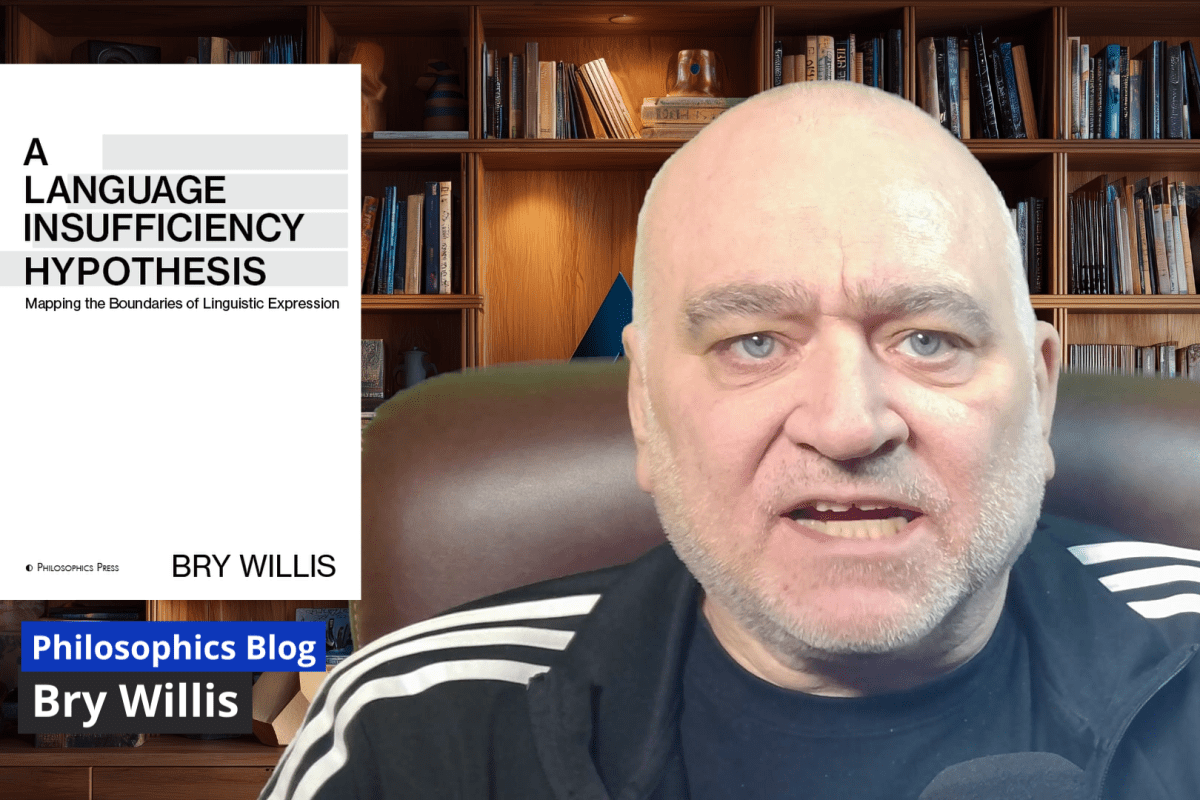
I published A Language Insufficiency Hypothesis this month, and this is one of a series of videos summarising the content. In this segment, I’m discussing Chapter 1: A Genealogy of Insufficiency
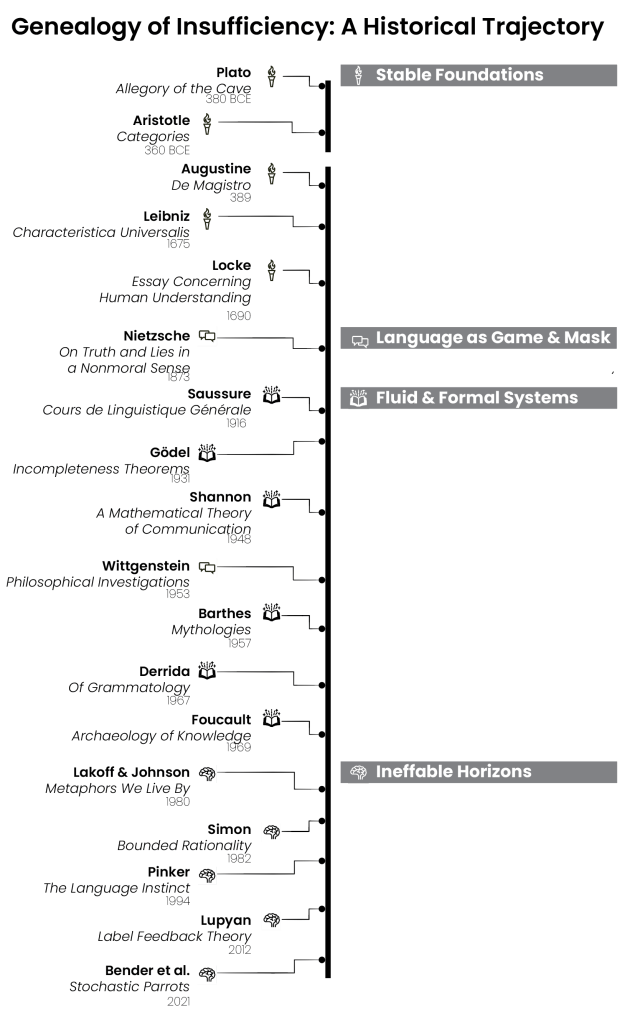
In this video, I touch on Plato to Barthes and Foucault. Derrida gets no love, and I mention bounded rationality, but not Simon. I discuss Steven Pinker’s dissent in more detail in a later chapter.
Below, I’ve included some artefacts from the book.
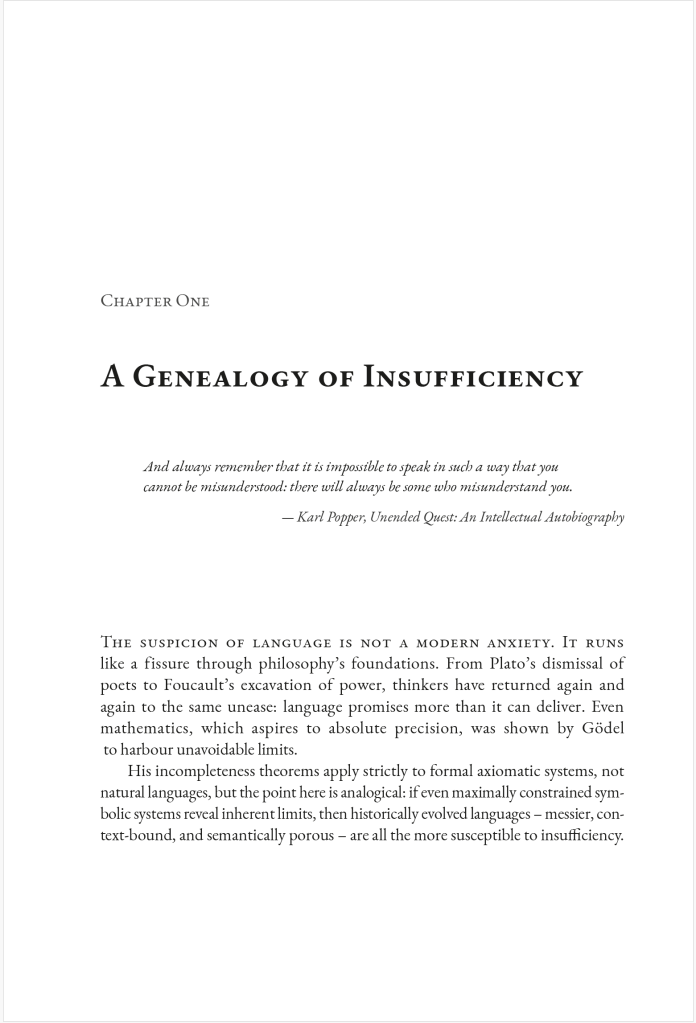
Image: Chapter 1: Page 1
And always remember that it is impossible to speak in such a way that you cannot be misunderstood: there will always be some who misunderstand you. — Karl Popper, Unended Quest: An Intellectual Autobiography
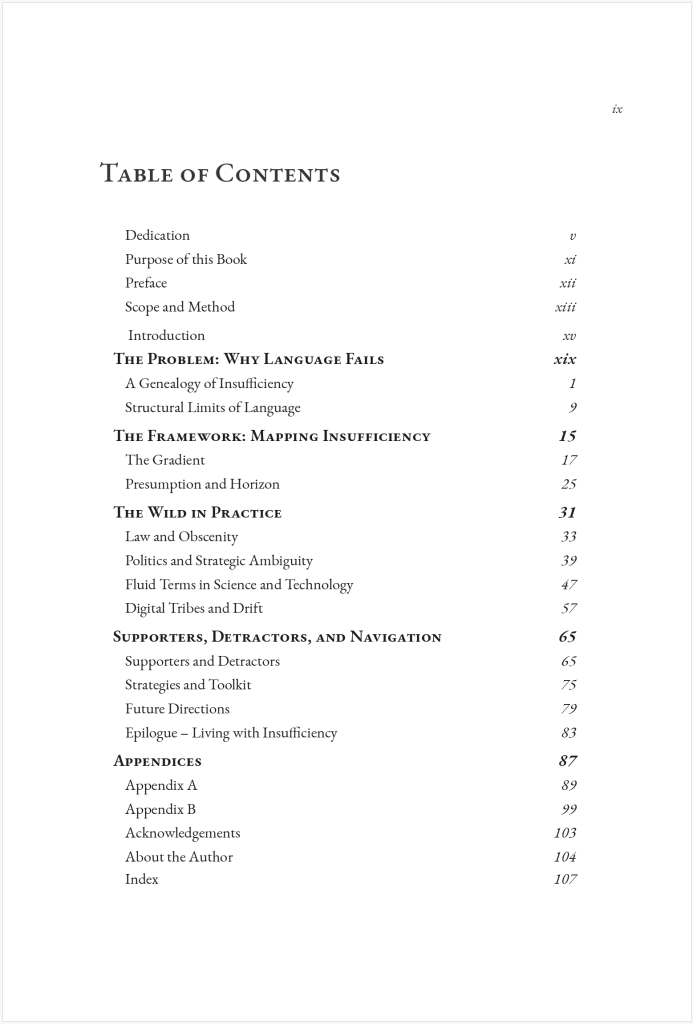
Image: Genealogy of Insufficiency: A Historical TrajectoryImage: Table of Contents
Looking through some of the drafts clogging the blog, I decided to whittle away at the queue. I started this months ago. It’s here now, not particularly in sync with the season or recent topics, but I like Sapolsky.
‘Biology is destiny’, say the Christian Right, the bland bureaucrats of morality, the loud whisperers at Sunday school. They want gender to be a tomb carved in marble: you’re assigned at birth, and you stay a perfect statue. But Sapolsky waltzes in and says, ‘Hold up – what do you mean by biology? Which biology? Which markers count?’
Video: Neuro-biology of Transsexuality, Prof. Robert Sapolsky
In the clip above, Sapolsky unpacks neurological evidence that upends the essentialist cheat codes. He doesn’t pretend we now have the final answer to gender. He does something scarier to fundamentalists: he shows just how messy biology is.
The Bed Nucleus, the Finger Ratio, and the ‘Wrong Body’ Hypothesis
Sapolsky discusses three pieces of neurobiological evidence:
Digit ratio (2nd vs 4th finger length): In lesbians, on average, the ratio is closer to what you see in straight men than straight women. That’s a correlation, an eyebrow-raiser, hardly a decree.
Acoustic reflexes (auto-acoustic reflex): Another early finding in women’s sexual orientation, though faint and underexplored.
The bed nucleus of the stria terminalis (BSTc): Here we reach heavy artillery. There is a neuron population in this region that, on average, is about twice as large in males as in females. In postmortem analyses of trans women (male → female), this region’s size corresponds to their identified gender, not their natal sex. Crucially, that alignment is seen even in trans individuals who never underwent full hormone therapy or surgical changes.
Sapolsky recounts astute controls: men treated (for, say, testicular cancer) with feminising hormones don’t show the same shift.
Also, using the phantom-limb analogy: men who lose their penis to cancer often report phantom sensations; trans women rarely do. That suggests the body map in the brain never fully “registered” that organ in the same way.
He doesn’t overclaim. He doesn’t say, ‘Case closed, biology proves everything’. He says: These data complicate your neat categories. They force you to ask: which biological measure do you privilege? Hypertrophied neurons? Chromosomes? Receptor density? Hormones? All of them simultaneously? None of them?
Essentialism as a Trap
Fundamentalists and anti-trans ideologues deploy essentialism because it’s convenient. They demand an ironclad ‘essence’ so they can exclude anyone who fails their test. But what Sapolsky shows is that essence is simply a scaffold; we get to pick which biological scaffolds we accept. They may choose genes and genitals; the neurobiologist gives them neuron counts and brain-maps. When your ideology elevates one scaffold and ignores the others, it betrays its own contingency.
Moreover, the evidence suggests that identity, experience, insistence (in Sapolsky’s language: ‘insisting from day one’), and internal brain structure might converge. The ‘wrong body’ isn’t a metaphor. It’s a mismatch between internal brain architecture and external form. The stubborn fragments of biology that fundamentalists accept are torn by the dissonance that science increasingly reveals.
What This Means for Trans Rights, Discourse & Strategy
Science is never ‘conclusive’. Sapolsky offers compelling support, not gospel. Anyone claiming this settles everything has never looked at a scatter plot.
Lived experience still matters. Even if we never had brain slices, self-reports, psychology, psychiatry, anthropology, narratives remain valid. Brain studies supplement, not supplant, testimony.
Essentialist opponents have boxed themselves in. When they demand biology decides everything, they hand the baton to neuroscientists – and neuroscientists keep running with it. The entire ‘biology’ equals only what I like’ regime is exposed.
Ambiguity is a strength, not a liability. If we insist identity is linear and tidy, we re-enact their demand for purity. Recognising complexity, mess, and variance is radical resistance.
A surprising number of people have been using the MEOW GPT I released into the wild. Naturally, I can’t see how anyone is actually using it, which is probably for the best. If you hand someone a relational ontology and they treat it like a BuzzFeed quiz, that’s on them. Still, I haven’t received any direct feedback, positive or catastrophic, which leaves me wondering whether users understand the results or are simply nodding like priests reciting Latin they don’t believe.
Audio: NotebookLM summary podcast of this topic.
The truth is uncomfortable: if you haven’t grasped the Mediated Encounter Ontology (of the World), the outputs may feel like a philosophical brick to the face. They’re meant to; mediation has consequences. I’m even considering adding a warning label:
If you hold an unwavering commitment to a concept with any philosophical weight, perhaps don’t input it. There is a non-zero chance the illusion will shatter.
Below is a sampling of the concepts I tested while inspecting the system’s behaviour. I’m withholding the outputs, partly to avoid influencing new users and partly to preserve your dignity, such as it is.
authenticity
anattā (Buddhist)
character (in Aristotle’s virtue-ethical sense)
consciousness
dignity
freedom
hózhó (Navajo)
justice
karma
love
progress
ren ( 仁 )
table
tree
truth
I may have tried others, depending on how irritated I was with the world at the time.
(Now that I think of it, I entered my full name and witnessed it nearly have an aneurysm.)
My purpose in trying these is (obviously) to test the GPT. As part of the test, I wanted to test terms I already considered to be weasel words. I also wanted to test common terms (table) and terms outside of Western modalities. I learned something about the engine in each case.
Tables & Trees
One of the first surprises was the humble ‘table’ which, according to the engine, apparently moonlights across half of civilisation’s conceptual landscape. If you input ‘table’, you get everything from dinner tables to data tables to parliamentary procedure. The model does exactly what it should: it presents the full encounter-space and waits for you to specify which world you meant to inhabit.
The lesson: if you mean a table you eat dinner on, say so. Don’t assume the universe is built around your implied furniture.
‘Tree’ behaves similarly. Does the user mean a birch in a forest? A branching data structure? A phylogenetic diagram? MEOW GPT won’t decide that for you; nor should it. Precision is your job.
This is precisely why I tested ‘character (in Aristotle’s virtue-ethical sense)’ rather than tossing ‘character’ in like a confused undergraduate hoping for luck.
Non-Western Concepts
I also tested concepts well outside the Western philosophical sandbox. This is where the model revealed its real strength.
Enter ‘karma’: it promptly explained that the Western reduction is a cultural oversimplification and – quite rightly – flagged that different Eastern traditions use the term differently. Translation: specify your flavour.
Enter ‘anattā’: the model demonstrated that Western interpretations often reduce the concept to a caricature. Which, frankly, they do.
Enter ‘hózhó’: the Navajo term survives mostly in the anthropological imagination, and the model openly described it as nearly ineffable – especially to those raised in cultures that specialise in bulldozing subtlety. On that score, no notes.
Across the board, I was trying to see whether MEOW GPT would implode when confronted with concepts that resist neat Western categorisation. It didn’t. It was annoyingly robust.
Closing Notes
If you do try the MEOW GPT and find its results surprising, illuminating, or mildly offensive to your metaphysical sensibilities, let me know – and tell me why. It helps me understand what the engine does well and what illusions it quietly pops along the way. Your feedback may even keep me from adding further warning labels, though I wouldn’t count on it.
Humans can’t seem to stop clawing after morality. The primates among us chuck cucumbers when their neighbours get grapes, and the rest of us grumble about fairness on social media. The impulse is practically universal, an evolutionary quirk that kept us from throttling each other long enough to raise children and build cities.
Image: A seemingly perturbed capuchin monkey.
But universality is not objectivity. Just because every ape howls about fairness doesn’t mean “Justice” floats somewhere in Platonic space, waiting to be downloaded. It only means we’re the kind of animal that survives by narrating rules and enforcing them with shunning, shame, or, when necessary, cudgels.
Audio: NotebookLM podcast on this topic.
This is where Alasdair MacIntyre trips over his own robes. After Virtue skewers Enlightenment rationalists who tried to prop morality on reason, it then dismisses Nietzsche for being “irrational.” MacIntyre’s fix? Resurrect Aristotle’s teleology. If reason can’t save morality, maybe an ancient oak tree can. But this is wish-thinking with a Greek accent. He’s still arguing by reason that reason can’t do the job, then sneaking back in through Aristotle’s back door with a “firmer ground.” Firmer only because he says so.
Nietzsche, at least, had the decency to call the bluff: no telos, no floor, no cosmic anchor. Just will, style, and the abyss. Uncomfortable? Absolutely. Honest? Yes.
Deleuze went further. He pointed out that morality, like culture, doesn’t look like a tree at all. It’s a rhizome: tangled, proliferating, hybridising, never grounded in a single root. The fragments MacIntyre despairs over aren’t evidence of collapse. They’re evidence of how moral life actually grows—messy, contingent, interconnected. The only reason it looks chaotic is that we keep demanding a trunk where only tubers exist.
So here we are, apes with a craving for rules, building cities and philosophies on scaffolds of habit, language, and mutual illusion. We are supported as surely as the Earth is supported – by nothing. And yet, we go on living.
The need for morality is real. The yearning for telos is real. The floor is not.
The Enlightenment promised a universal Reason; what we got was a carnival mirror that flatters philosophers and fools the rest of us. MacIntyre and Anscombe diagnosed the corpse with precision, but then tried to resurrect it with Aristotelian or theological magic tricks. I’m less charitable: you can’t will petrol into an empty tank. In my latest essay, I put ‘Reason’ on the slab, call in Kahneman, Hume, Nietzsche, and others as expert witnesses, and deliver the verdict: morality is a house rule, not a cosmic law. This piece is part of a larger project that includes my Language Insufficiency Hypothesis and Against Dumocracy. The Enlightenment isn’t dying – it’s already dead. We’re just cataloguing the remains.
The Enlightenment was many things: a bonfire of superstition, a hymn to autonomy, a fever dream of “Reason” enthroned. Its philosophers fancied themselves heirs to Aristotle and midwives to a new humanity. And to be fair, they were clever enough to trick even themselves. Too clever by half.
Alasdair MacIntyre, in After Virtue, plays the role of forensic pathologist with admirable precision. He shows us how the Enlightenment dynamited the teleological scaffolding of Aristotle, then tried to keep the vocabulary of virtue, duty, and rights standing in mid-air. The result: what he calls a “moral Babel,” a chorus of shrill assertions dressed up as rational law. Elizabeth Anscombe had already filed the death certificate back in 1958 with Modern Moral Philosophy, where she pointed out that our talk of “moral obligation” is just a Christian relic without a deity to enforce it. And Nietzsche, that perennial party-crasher, cheerfully declared the whole project bankrupt: once the gods are dead, “ought” is nothing but resentment pretending to be metaphysics.
And yet, when MacIntyre reaches the heart of the matter, he can’t quite let the body stay buried. He wants to reattach a soul by importing an Aristotelian telos, even summoning a “new St Benedict” to shepherd us through the ruins. It plays beautifully with those still tethered by a golden string to Aquinas and the premodern, but let’s be honest: this is just hypnosis with a Latin chorus. Descartes told us je pense, donc je suis; MacIntyre updates it to je pense, donc j’ai raison. The trouble is that thinking doesn’t guarantee rightness any more than an empty petrol tank guarantees motion. You can will fuel into existence all you like; the car still isn’t going anywhere.
The behavioral economists – Kahneman, Tversky, Ariely, Gigerenzer – have already demonstrated that human reason is less compass than carnival mirror. Jonathan Haidt has shown that our “moral reasoning” usually lags behind our gut feelings like a PR department scrambling after a scandal. Meanwhile, political practice reduces “just war” to a matter of who gets to publish the rule book. Progress™ is declared, rights are invoked, but the verdict is always written by the most powerful litigant in the room.
So yes, MacIntyre and Anscombe diagnose the corpse with impressive clarity. But then they can’t resist playing resurrectionist, insisting that if we only chant the right metaphysical formula, the Enlightenment’s heart will start beating again. My own wager is bleaker – or maybe just more honest. There is no golden thread back to Aristotle, no metaphysical petrol station in the desert. Morality is not a universal constant; it’s a set of rules as contingent as the offside law. Killing becomes “murder” only when the tribe – or the state – says so. “Life is sacred” is not a discovery but a spell, a linguistic sleight of hand that lets us kill in one context while weeping in another.
The Enlightenment wanted to enthrone Reason as our common oracle. Instead, it handed us a corpse and told us to pretend it was still breathing. My contribution is simply to keep the coroner’s mask on and say: The magic tricks aren’t working anymore. Stop looking for a metaphysical anchor that isn’t there. If there’s to be an “after,” it won’t come from another Saint Benedict. It will come from admitting that the Enlightenment died of believing its own hype – and that language itself was never built to carry the weight of gods.
Follows is another AutoCrit1 review of my current focus—working title: Democracy: The Grand Illusion, affectionately called Dumocracy.
Synopsis
The chapter “Vote Against Democracy, Say ‘Nay'” delves into a comprehensive exploration of the critiques posed by prominent intellectuals and philosophers throughout history regarding democratic systems. The opening sets the stage by quoting Winston Churchill’s famous line: “The best argument against democracy is a five-minute conversation with the average voter.” This quote immediately introduces a critical perspective on democracy, foreshadowing the in-depth analysis to come.
“The best argument against democracy is a five-minute conversation with the average voter.”
The text then proceeds to examine various historical figures’ criticisms of democracy, ranging from Plato’s concerns about mob rule to Tocqueville’s observations about mediocrity in democratic societies. Each thinker’s critique is dissected and analyzed, shedding light on the potential pitfalls and limitations of democratic governance. From elitism and failures within democracies to warnings about the tyranny of the majority and challenges with meritocracy, each section offers valuable insights into different aspects of democratic systems.
As the text progresses towards its conclusion, it synthesizes these diverse critiques while acknowledging both strengths and weaknesses inherent in democratic ideals. It culminates by emphasizing that despite its flaws, democracy remains one of the best available forms of government—a sentiment encapsulated in Winston Churchill’s famous remark: “Democracy is the worst form of government, except for all others that have been tried.” This closing statement reinforces a pragmatic understanding of democracy while encouraging ongoing reflection on how to refine and improve democratic governance models.
“Democracy is the worst form of government, except for all others that have been tried.”
Winston Churchill
In essence, “Vote Against Democracy, Say ‘Nay'” presents a nuanced examination of historical critiques surrounding democracy that challenge readers to critically assess both the virtues and vulnerabilities embedded within this prevalent system of governance.
Audience
audience for this text appears to be individuals interested in political theory, philosophy, and the complexities of democratic governance. Those who are engaged in scholarly or academic discussions surrounding democracy, its critiques, and potential reforms would likely find this text highly relevant. The detailed exploration of historical perspectives from prominent figures like Plato, Aristotle, Churchill, Nietzsche, and Tocqueville provides a comprehensive overview for readers with an interest in political thought.
However, individuals seeking a more general overview or introductory understanding of democracy may find the text overly intricate and specialized. To make it more accessible to a broader audience outside academia or political theory enthusiasts, the author could consider simplifying complex philosophical concepts into more digestible language. Additionally, providing real-world examples or contemporary case studies illustrating the practical implications of these critiques could help engage a wider range of readers who may not have prior knowledge of political theory. Incorporating clear summaries at key points throughout the text can also aid in enhancing readability and comprehension for those less familiar with the subject matter.
Structure and Organisation
The text follows a logical order and is well-organized. Each critique of democracy by the different intellectuals is presented in a structured manner, with clear transitions between each section. The text flows smoothly from one critique to the next, providing a comprehensive overview of various perspectives on democratic governance without any apparent issues of structure or organization.
Clarity
The author’s points are generally presented clearly throughout the text. Complex ideas and critiques of democracy are explained in a structured manner, making it easier for readers to follow the arguments presented by each thinker. However, there are instances where additional clarification or simplification could enhance reader understanding:
In the section discussing Joseph Schumpeter’s elitist theory of democracy, some readers may find the concept of democracy as a competitive struggle for votes rather than genuine self-governance by the masses somewhat challenging to grasp without further elaboration on how this dynamic operates within democratic systems.
The discussion on Michel Foucault’s critique of democracy introduces terms like biopolitics and power structures that may require more explicit definitions or examples to help readers unfamiliar with these concepts fully comprehend their significance within democratic contexts.
Audre Lorde’s critique focusing on intersectionality and democratic inclusion touches upon complex social dynamics that might benefit from clearer illustrations or real-world applications to elucidate how these issues manifest in practice within democratic institutions.
Overall, while the text effectively conveys nuanced critiques of democracy by various thinkers, providing more concrete examples or simplified explanations in certain sections could enhance clarity for readers less familiar with political theory and philosophy.
Commentary
I may address these aspects with footnotes as this background information is at times extensive and in any case available elsewhere.
Argument and Persuasion
The text presents a range of opinions critiquing democratic systems from various thinkers such as Plato, Aristotle, Alexis de Tocqueville, Friedrich Nietzsche, Winston Churchill, Joseph Schumpeter, Simone Weil, Michel Foucault, and Audre Lorde. These critiques cover themes like elitism in governance (Plato), the importance of moderation (Aristotle), concerns about tyranny of the majority (Tocqueville), critique of egalitarianism (Nietzsche), pragmatic view on democracy’s flaws and strengths (Churchill), elitist theory emphasizing competition for votes over self-governance by masses (Schumpeter), highlighting failures to address spiritual needs and rootedness in society (Weil) and understanding how democratic institutions can perpetuate subtle forms of control through power structures embedded within knowledge frameworks.
Each thinker presents their arguments with logical reasoning and supporting evidence drawn from historical contexts or philosophical principles. The strength lies in the diversity of perspectives offered which enriches the discourse on democracy by exploring its complexities from different angles. By addressing issues like potential mediocrity in democracies or challenges with inclusivity for marginalized groups within democratic systems these critiques prompt critical reflection on areas where improvements may be needed.
Overall, the persuasive elements are well-supported through references to original texts or established theories. The logical construction is evident as each opinion is presented coherently with relevant examples or theoretical frameworks backing them up.
Tone
The text presents a range of emotional perspectives, reflecting both critical analyses and nuanced reflections on democratic systems. The tone varies from sober contemplation to impassioned critique, showcasing a mix of scepticism, concern, pragmatism, and urgency. Each author’s perspective evokes emotions such as caution (Plato), moderation (Aristotle), wariness (Tocqueville), disdain for egalitarianism (Nietzsche), pragmatic acknowledgement of flaws (Churchill), elitist realism (Schumpeter), longing for rootedness and community (Simone Weil), critical examination of power structures (Foucault) and call for inclusivity and justice for marginalized groups (Audre Lorde). These emotional tones collectively create a rich tapestry that challenges conventional views on democracy while urging readers to consider the complexities inherent in governance systems.
Interest and Engagement
The text presents a wide range of critiques on democracy from various historical and philosophical perspectives, which can be engaging for readers interested in political theory. The inclusion of notable figures such as Plato, Aristotle, Alexis de Tocqueville, Friedrich Nietzsche, Winston Churchill, Joseph Schumpeter, Simone Weil, Michel Foucault, and Audre Lorde adds depth and credibility to the discussion.
However, due to the detailed nature of each critique presented in the text and the extensive references to specific works by these thinkers, some sections may become dense or overwhelming for readers who are not well-versed in political philosophy. To improve engagement in these sections:
Simplify Complex Ideas: Break down complex concepts into more digestible segments that are easier for a broader audience to understand.
Provide Contextual Explanations: Offer brief explanations or summaries before delving into each critique to provide context for readers unfamiliar with the philosophers’ works.
Use Analogies or Real-World Examples: Illustrate abstract ideas with relatable examples or analogies that help clarify their relevance in contemporary society.
Incorporate Visual Aids: Consider using diagrams or visual aids to enhance understanding of intricate theories and make them more accessible.
By incorporating these strategies throughout the text when discussing challenging concepts from different critiques on democracy by prominent theorists such as Plato’s “The Republic,” Aristotle’s “Politics,” Tocqueville’s “Democracy in America,” Nietzsche’s concept of the Übermensch (Overman), Churchill’s pragmatic observations on democracy being “the worst form of government except all others,” Schumpeter’s elitist theory of democracy emphasizing competition among elites for votes rather than direct self-governance by all citizens; Weil’s focus on rootedness and community needs within democratic systems; Foucault’s analysis on power structures within democracies perpetuating control; Lorde’s intersectionality critique highlighting exclusionary practices towards marginalized groups—the author could maintain reader interest while navigating through intricate discussions surrounding democratic governance across history and philosophy.
Commentary
I plan to incorporate some visual and diagrammatic aids, but AutoCrit cannot evaluate this type of content.
Final Thoughts and Conclusions
The text ends with a comprehensive and cohesive conclusion that effectively ties together the various critiques of democratic systems presented by Plato, Aristotle, Alexis de Tocqueville, Friedrich Nietzsche, Winston Churchill, Joseph Schumpeter, Simone Weil, Michel Foucault, and Audre Lorde. The final thoughts provide a reflective summary of the challenges inherent in democratic governance while emphasizing the need for ongoing reflection and improvement within democratic systems. The concluding section successfully synthesizes the diverse perspectives on democracy discussed throughout the text.
AutoCrit is an AI-based editorial application. I am a member of their affiliate programme, so I gain minor financial benefits at no cost to you if you purchase through a link on this page. ↩︎
Churchill is not on record having said this, but the sentiment remains. ↩︎
I wrote about this content in 2019, but I wanted to revisit it for a video as well as create a podcast audio version.
Video: YouTube version of this page content
Podcast: Audio rendition of this page content
In today’s segment, I am going to share my perspectives on the truth about truth. To start, I’ll let the audience know that I do not believe in the notion of truth. I feel the term is ill-defined especially in the realm of metaphysics and morality. I feel that when most people employ the word ‘truth’, what they mean to say is ‘fact.’ That a fire engine is red, for example, may be a fact, if indeed the fire engine happens to be red, but it is not true. This is a misapplication of the term. If you employ truth as a direct synonym for fact, then this is not what’s being discussed here, and perhaps your time might be better spent watching some content by the Critical Drinker.
My argument is that truth is not objective. Rather it is subjective and perspectival. I concede that there may be some objective truth out there somewhere, but it is not and will not ever be accessible to us because of limitations in our sense-perception faculties and cognitive limitations. Per Aristotle, we only have five senses with which we can connect to the world, and these senses are limited. If there is anything out there that would require another sense receptor—a sense receptor not available to us—, we would never be able to sense it, to even know of its existence. Perhaps the universe emits 100 sense signals, but we are only capable of receiving and translating five. We’d be oblivious to 95 per cent of reality.
I am not making any claims that this is the case, but human cognition is so limited, that we can’t even conceive of what another sense might be. If you can, please leave a comment.
To be clear, I am not talking about senses we know other species possess. Bats may have echolocation, and sharks may have electroreception. Some animals may have greater sensory acuity—superior vision and auditory senses, olfactory and gustatory, tactile, or whatever. Some can see into infrared or ultraviolet light spectra. Technology that includes biomimicry provides humans with microscopes for the microworld and telescopes for the macroworld. We have x-rays and sonar and radar, radios and televisions that extend our senses, but these provide no new sensory receptors.
Like the story of the blind people and the elephant, we are left grasping at parts. But even if we are able to step back to view the whole elephant, to hear the elephant, to touch and smell or even taste the elephant, if there is more to the elephant, we cannot know it. The same goes for ourselves.
I know that some people might inject gods or psychic or paranormal energy into this void, and sure, feel free, but I am looking beyond these pedestrian concepts. What else might there be?
But let’s depart this train and head in a different direction. I want us to focus on the senses we do have. For the typical human, sight is our primary arbiter of reality, at least as defined idiomatically. We tend to believe what we see, and what we see, we assume as real—even if we are later mistaken. I guess that wasn’t a unicorn or a pink elephant. I must have been hallucinating or dreaming. I could have sworn that was Auntie Em.
There are several competing theories around truth, but I’ll focus on the Correspondence theory, which is simply put, the notion that, proxying reality for truth, human perception corresponds with the real world. And a pragmatist might argue that’s close enough for the government.
Keep in mind that historically humans have contorted themselves into making calculations. Remember how long people had been tying themselves into knots to show planetary motion in a geocentric system creating epicycles and retrograde motion to map understanding to a perceived reality.
One might even argue that we’ve progressed. It wasn’t true or accurate then, but now it is. And perhaps it is. Let’s look at some illustrations.
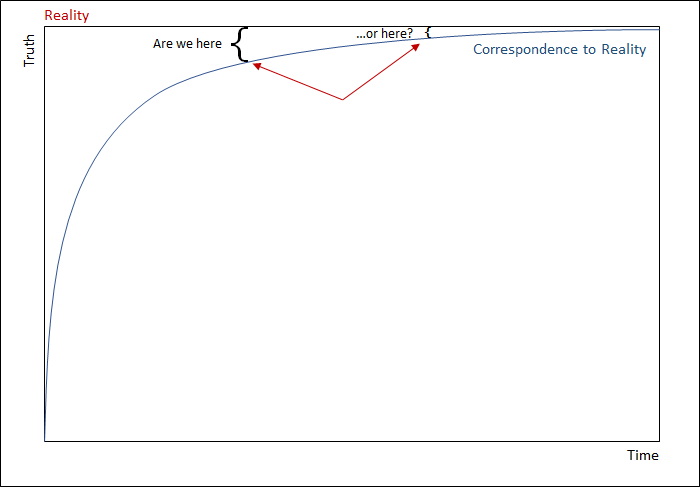
NB: Due to an editorial mishap, this paragraph was dropped in the podcast, hence dropped from the video, which shared the podcast audio source. As such, this image was also not used in the video. This is unfortunate, as it was meant to introduce those with limited maths knowledge to the asymptotic curve, as described. Apologies, and I hope this serves to orient any travellers who may have lost their way at this point.
In this first illustration, we see Truth (or relative truthiness) on the Y-axis and Time on the X-Axis. On the top, we see a threshold representing Reality. In the plane, I’ve rendered an asymptotic curve, where over time, we get closer and closer to the Truth. But we never quite get there. More on this later.
The next illustration will help to demonstrate what’s happening.
Notice there is a gap between the curve and the Reality cap. For one thing, we don’t really know where we are relative to Reality. In the case of the geocentric system, we might have been at the leftmost space. Once we determined that the system is actually solar-centric, we might have moved right on the curve to close the gap. We might be tempted to defend that we’ve finally reached the truth, but we’d have been equally willing to make the same defence from the geocentric position, so we need to be mindful of the past.
Perhaps, this last example was too obvious. We feel comfortable staking a truth claim—or at least a claim of fact. So let’s look at another example.
Let’s re-use the same axes—Truth and Time—, but rather than an asymptotic curve, let’s presume something more polynomial in nature—or not particularly cyclic. Rather than retrograde motion in planets, let’s visit the supposed progress of Newtonian over Einsteinian physics.
This takes a bit more setup but bear with me. In this case, I have taken liberties and illustrated the Einsteinian physics gap to capture an inferior vantage on reality over Newtonian physics. Granted, I need to rely on a bit of suspension of disbelief, but in the bigger picture, I am trying to convey a scenario where some new paradigm puts the prior knowledge in perspective.
In this instance, both Newtonian and Einsteinian flavours of physics are based on a materialistic, particles-based model, which is where the modern physics consensus resides. But, let’s say that consensus changes in such a way that it is determined that something else underlies reality, say consciousness per Analytic Idealism as proposed by Bernardo Kastrup or per Integrated Information Theory (IIT) as advanced by Donald Hoffman and others. As with retrograde motion, we might end up finding that we were barking up the wrong tree. This might be a bit different because the particles are a directly perceived manifestation of the underlying consciousness, but I wanted to create a scenario where knowledge thought to have advanced actually regressed, but this wasn’t revealed until a new perspective was available.
Yet again, an important aspect of note is that we don’t actually know the distance between our perceptions and real Reality.
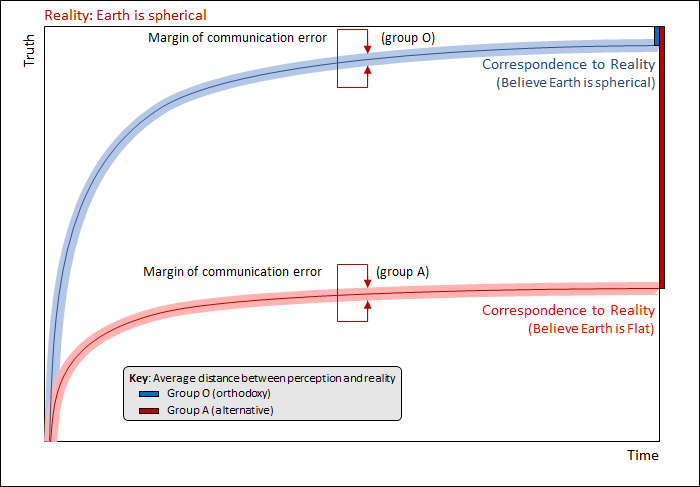
This last illustration builds upon the first asymptotic chart but has an in-built error margin meant to reflect language insufficiencies. There is some concept that people feel they grasp, but the consensus is not as unified as the group thinks.
I’ll share two examples, the first being the concept of justice. To me, Justice is what I deem a weasel word. It’s a word we commonly use, but it means different things to different people. To me, it’s a euphemism for vengeance by proxy, but for others, it transcends that and mirrors some impartial dispensation of just desert—some good old-fashioned law and order.
[Justice is] a euphemism for vengeance by proxy
Without getting stuck down some rabbit hole, my point is that if we aggregate these beliefs, the asymptotic curve represents an average consensus vantage rather than something as obvious as 2 plus 2 equals 4. On this note, allow me to clear the air.
Some viewers might be clamouring to say, “but 2 plus 2 equals four is true.” But this is tautologically true, which is to say that it’s true by definition. It’s a similar tautology to saying that it’s true that snow is white, or coal is black. We’ve already defined snow, white, coal, and black, so these may be facts, but they are true by definition.
Revisiting the chart, notice that there are two curves in the space. In this case, I illustrate competing truth claims from the perspective of an omniscient narrator. The case is whether the earth is an oblate spheroid or is flat. I am going to go out on a limb and assert the earth is spherical, as represented by the top blue curve—and we have some margin of error as to what that might mean. The bottom red curve depicts the perceived truth of the flat earthers, who also have some room for semantic error.
Given that I am presuming that I am in the right adopting the majority position—please be right—, the blue curve is closer to Reality than the red curve. Of course, in the event that the earth is really flat, then it proves my point that we don’t know where we are relative to truth, so we assume that the state of knowledge at any given time is what’s real.
Again, forgive my fanciful examples. Please don’t tell me that this spheroid versus planer earth is tautological too because you’d be correct, but I am already aware. They are just nonsensical illustrations. Nonetheless, I hope they’ve served to express a point.
I could have as well created curves that depicted two cohorts’ beliefs on the efficacy of tarot or astrology in predicting the future. I am sure that it might render somewhat like the last chart, but I’d also presume that both curves would have very low truth values as seen from an objective observer. Secretly, I hope tarot wins the truth battle.
Before I end our time together, I’d like to convey that for an Analytic Idealist, these charts might be more acceptable at face value. For a Realist, Naïve or otherwise, they may argue that this curve is not asymptotic and may in fact reach some tangency. I don’t happen to believe this is the case or I wouldn’t have spent my time assembling and presenting this. Time will tell. Or will it?
Robert Kane argues that ultimate responsibility (UR) should guide us in determining whether someone is responsible for their actions. He gives the example of a drunk driver who gets into an automobile accident. If the actor tries to skirt responsibility because s/he was intoxicated, hence incapacitated, then [1] we can still rewind to an action taken that caused this intoxicated state and then [2] choosing to drive—a causal relationship articulated by Aristotle. This seems fine, but it’s a specious defence.
According to Kane
According to Kane—noting an issue raised by some—, it doesn’t require an assessment that a person could have done otherwise. This condition has numerous implications for free will.
For example, it doesn’t require that we could have done otherwise for every act done of our own will. But it does require that we could have done otherwise with respect to some acts in our past life histories by which we formed our present characters. Kane calls these self-forming actions (SFAs). According to Kane, [3] we act from a will that’s already formed, but [4] it’s our own free will by virtue of the fact that [5] we formed it by other choices or actions in the past—self-forming actions—, [6] for which we could have done otherwise.
Consider the drunk driver. If this were not the case, there’s nothing we could have ever done differently in our entire lifetimes to make ourselves different than we are—a consequence that’s incompatible with our being, at least to some degree, ultimately responsible for what we are. And that’s what I think free will requires.
Kane’s Challenge
I marked passages in brackets [n], to serve as a reference for my commentary here. Some of my responses may be repetitive, so I’ll try to make any redundancies recursive.
[1] Kane suggests that even if the person is incapacitated at the time of the accident—hence not responsible in the moment—, we can trace events back through time and pinpoint an event that caused the incapacitation. In fact, we can trace it back to the decision to imbibe in the first place. I have two objections here, but I’ll defer the second one to my next reaction.
Kane says we can rewind to some causal event. We are in agreement on this point, but I have a question: why stop there?
In engineering, there exists a concept called root cause analysis, and there is a concomitant heuristic called the 5 Whys. Essentially, using the DUI example as a discussion point, we can refer to the accident as event T0. Then we can trace back.
For the sake of brevity, I’ll ignore trivial or immaterial events such as s/he encountered a detour and so took an unfamiliar route or s/he fell asleep at the wheel, missing a green light, which caused a delay, which meant that she was in a place to happen to hit another vehicle—presuming that if s/he had been a minute ahead of her fateful schedule, there would have been no other vehicle to hit. This might be a logical line of inquiry, but let’s shelf it.
So, tracing back, at T-1, we find our actor already intoxicated and starting the car. At T-2, we find our actor drinking the last of multiple rounds of alcohol. We could trace back all the way back to, say, T-5, where our actor made the decision to take the first drink.
We may have difficulty pinning down where the impairment kicked in. Was it the drink at event T-2 or was it earlier, say, ay T-4, where all subsequent drinks were not assessed rationally? In any case, even if we stop at the last lucid state, T-5, then everything that follows can be said to be related to that event. But I have a problem.
[2] Firstly, if s/he was mentally incapacitated, how could s/he make a rational decision to drive or not? Secondly, even if we say that s/he became mentally incapacitated at event T-4, then the decision at that juncture was not rationally deliberated.
We could introduce a twist here, which is to assign culpability to the drink server. Some local statutes exploit this by making the barkeep culpable for serving a drink to an already intoxicated patron. Of course, this has the same issue noted above because we can’t say with any reliability whether the actor was intoxicated at T-2 or T-4. Let’s not get mired in this. This is not my biggest concern.
My key concern is in stopping there at T-5. Why not go back to why s/he even had the first drink? Why not go back to why she drinks in the first place? Why not keep going back. More on this ahead. Let’s continue.
[3] Kane says that the actor, the decider, already has a formed will. In this, he is introducing another concept—one of the self or the individual. Let’s continue, and I’ll get to that, too.
[4] Echoing the self, Kane doubles down and says that this self has a will, and the actor owns it. As such s/he is responsible for these willed actions, these caused actions. So, let’s dig in.
[5] Kane asserts that we formed this self by other choices or actions in the past that he calls self-forming actions. This is where in my mind this skein of logic unwinds.
Ignoring whether the self is anything but narrative convenience, why should one accept that the actor has any agency in this so-called self-forming? What proof do we have that this actor is just a victim of circumstances—from geworfen until event T0? Even without invoking determinism, I think it’s safe to assume that this actor is a consequence of, at least, hereditary and (monomorphic and polymorphic) genetic traits including temperament. Then we have structural influences, such as family, peers, institutions, and authority figures, societies and cultural norms.
It might be difficult to determine what percentage of the self are formed by this, but it would be disingenuous to defend this as self-forming rather than formed by some crucible.
[6] Kane’s final point is about whether one might have done otherwise. He downplays this point, and so shall I. If someone insists that this is important, I’ll address it at that time.
Enfin
I left out some key points that I’ll likely return to in future. Essentially, Kane is a traditionalist who pines for virtue and character, two concepts I feel of figments intended to act as tools of power maintenance. I feel this will get us down a rabbit hole, and I am rabbitted out, so let’s end here.
Someone will have to try very hard to convince me that the classical Greek philosophers were not strictly satirists. I believe I’ve commented on Plato in the past. I try to be well-rounded and not just cherry-pick material that supports my worldview—even though that competes for my available time and creates opportunity costs.
Listen on Spotify
This time, I decided to pick up Aristotle’s Nicomachean Ethics. If there is anything I needed to read to drive another nail into the coffin of Virtue ethics, this does the trick.
Nails in a coffin
Reading Classical philosophical texts feels like reading the Bible or any other religious works. It feels like it is only meant for disciples. It’s just choir preaching. If one agrees with the foundational position, it all works. Otherwise, it all falls apart.
I am not going to deconstruct the text. That would quite literally take several posts. What I want to point out is that within the frame he attempts to establish, his position is entirely heuristic. In this case, if one believes in virtue and honour and how these may or may not connect to happiness, then this is right up your street in much the same way as a Christian knows that s/he will be forgiven because Jesus loves them.
In some ways, it feels that the philosophy underlying Western Civilisation is more insidious than Abrahamic religions. They act in a similar way, attempting to convey an underpinning that simply doesn’t exist. Both are aspirational, but they claim to be foundational.
Like Plato’s Republic, Aristotle’s Nicomachean Ethics comes across (to me) as mental masturbation—some free-association thought experiment. I’m about 60 per cent through and tempted to quit, but on some level, I want to be able to defend that I have read it. Like the Bible, the I Ching, the Bhagavad Gita, and the Qur’an, and other such canon, I want to have read the source material and not just references to it.
So, I’ll take one for the team and see whatever gems I can find.
First page of a 1566 edition of the Nicomachean Ethics in Greek and Latin
UPDATE: I’ve finished the book. It doesn’t get any better. He drifts off into politics as he sets up his sequel. My biggest criticism is that he casts his elitist worldview as reality based on assertions based solely on his opinions and appeals to tradition and authority. Read this if only to understand where certain people derive this moralistic, virtue-laden worldview. I was surprised by the foreshadowing of Descartes’ Cogito—though given how that further led to popularise Dualism, I’m not saying that’s a good thing.
Why should justice be the foundation of a society, and why not something else, say, honour or valour or wealth? What do we mean when we say justice? Do you mean the same thing as me? Dating myself to be sure, but would a Klingon from the Star Trek universe share your definition? So what is justice anyway?
‘Justice is the constant and perpetual will to render to every man his due. Jurisprudence is the knowledge of divine and human affairs and knowledge of what is just and what is unjust’, or so writes Justinian in Institutes 1.1 in 533 CE.
“Iustitia est constans et perpetua voluntas ius suum cuique tribuens. Iuris prudentia est divinarum atque humanarum rerum notitia, iusti atque iniusti scientia.”
This is Justinian’s answer to the question: What is justice? In his Philosophy and Real Politics, Geuss relates that ‘justice is the constant and unflagging will to render to each person what is due to him’ (or perhaps ‘what he’s entitled to’), and therein lies the rub: what exactly is one entitled to?
Geuss goes on to point out that entitlement was contingent to one’s place in society. Citizens were entitled to some things, resident aliens another, and slaves, pretty much nothing at all. In fact, giving a slave more than s/he was entitled to would be considered unjust, as it would be considered to be undeserved. As Geuss writes, ‘that to treat a slave as if he or she had any entitlements would be a gross violation of the basic principles of justice’. Of course, you are thinking, post-Enlightenment ‘all men are created equal’, or so the saying goes.
In practice, it’s been easy to sidestep the application of justice by redefining a certain group to be outside of some protected group. During the illegal aggression by the United States against Middle Eastern countries that resulted in extraordinary rendition of civilians spirited off to Guantánamo Bay, Cuba, off the coast of the United States and outside of their jurisdiction, their acting regime declared that the detainees were not people, strictly speaking, and as such were not subject to the protections afforded to people, therefore they had no access to justice.
“Justice is the first virtue of social institutions, as truth is of systems of thought.”
— John Rawls, A Theory of Justice
Hermione’s Time Turner
The ancient Greeks had a different idea of justice, so perhaps we just need to break out our trusty time turner to see what Aristotle had to say about it.
Here Aristotle rather equates the notion of justice to that of equality, but that begs the question: what equality? as we understand that equality comes in a variety of colours, so I won’t belabour the point any further here.
Instead of asking about justice, why don’t we focus on the root of the word, just? This yields the following definition:
Just: (adj) based on or behaving according to what is morally right and fair
This brings us into the normative domain of morality, fairness, and reason, so it’s not much to work with—basically, we are in the realm of opinion defended by rhetoric.
For ‘all’ intents and purposes, we’ve got four forms of justice. We’ve been focused on the distributive type, but there are also procedural, restorative, and retributive varieties. In many cases, not just one form of justice is satisfying and so multiple varieties are deemed, well, just.
Distributive or economic justice is about fairness in how things are distributed, about getting a fair share.
Procedural justice is also about fairness, but it’s more about fair play, an even playing field.
Restorative justice is about compensating for an injustice, about restoring some perceived balance.
Retributive justice is about punishment—retribution.
A problem arises when we try to quantify and measure justice. Consider distributive justice: If two people work in a field and each cultivates 50% of the crop, are each entitled to 50% of the yield? If the cultivated land was the ‘property’ of some other landowner, what portion would s/he be entitled to? All of it? Some of it? None of it?
What about the court system? Procedural justice comes into play here. Should a wealthy person have access to better attorneys than a poor person? Is this just? The poor person may argue no, but the wealthy person may argue that s/he earned the ability to pay for a better lawyer, so s/he is entitled to this benefit.
Restorative justice sounds simple at the surface. If I steal a loaf of bread, wouldn’t returning the loaf (or, at least, a similar loaf) be restorative—no harm, no foul? Many people will argue that this is not good enough. Balance has not been restored.
This is where retributive justice comes into play. Retributive justice is a poorly veiled euphemism for vengeance. This is where Hammurabi‘s code (or Leviticus‘) eye for an eye—but not Matthew‘s turn the other cheek rendition—comes in. Let’s not get into Nietzsche’s take on forgiveness as being unjust and part of slave morality.
Keep in mind that in Hammurabi’s code, as with Roman law, justice was relative: Given eyes, (Nº 196) ‘If a man put out the eye of a nobleman (amelu), his eye shall be put out’, yet (Nº 198) ‘If he puts out the eye of a freedman or breaks the bone of a freedman, he shall pay one gold mina’.
Through all of this, we are still left wondering: just what is justice besides some vague notion constructed solely to preserve the status quo.








![legiao_W8DiZkmnspwzXaYu3AUoEM7xeQSCOLfcHlyGPNb_Ij[1]](https://philosophics.blog/wp-content/uploads/2017/11/legiao_w8dizkmnspwzxayu3auoem7xeqscolfchlygpnb_ij1.jpg)
![US-Camp_x-ray_detainees-Guantanamo-Bay-Jan-11-2002-Phot-Shane-T-McCoy-US-Navy-Creative-Commons-513x239[1]](https://philosophics.blog/wp-content/uploads/2017/11/us-camp_x-ray_detainees-guantanamo-bay-jan-11-2002-phot-shane-t-mccoy-us-navy-creative-commons-513x2391.jpg) In practice, it’s been easy to sidestep the application of justice by redefining a certain group to be outside of some protected group. During the illegal aggression by the United States against Middle Eastern countries that resulted in extraordinary rendition of civilians spirited off to Guantánamo Bay, Cuba, off the coast of the United States and outside of their jurisdiction, their acting regime declared that the detainees were
In practice, it’s been easy to sidestep the application of justice by redefining a certain group to be outside of some protected group. During the illegal aggression by the United States against Middle Eastern countries that resulted in extraordinary rendition of civilians spirited off to Guantánamo Bay, Cuba, off the coast of the United States and outside of their jurisdiction, their acting regime declared that the detainees were 
 Philosophics