Welcome to the Casino of Justice

Welcome to the Grand Casino of Justice, where the chips are your civil liberties, the roulette wheel spins your fate, and the house—ever-smug in its powdered wig of procedural decorum—always wins.

Step right up, citizens! Marvel at the dazzling illusions of “science” as performed by your local constabulary: the sacred polygraph, that magnificent artefact of 1920s snake oil, still trotted out in back rooms like a séance at a nursing home. Never mind that it measures stress, not deception. Never mind that it’s been dismissed by any scientist with a functioning prefrontal cortex. It’s not there to detect truth—it’s there to extract confession. Like a slot machine that only pays out when you agree you’re guilty.

Audio: NotebookLM podcast on this topic.

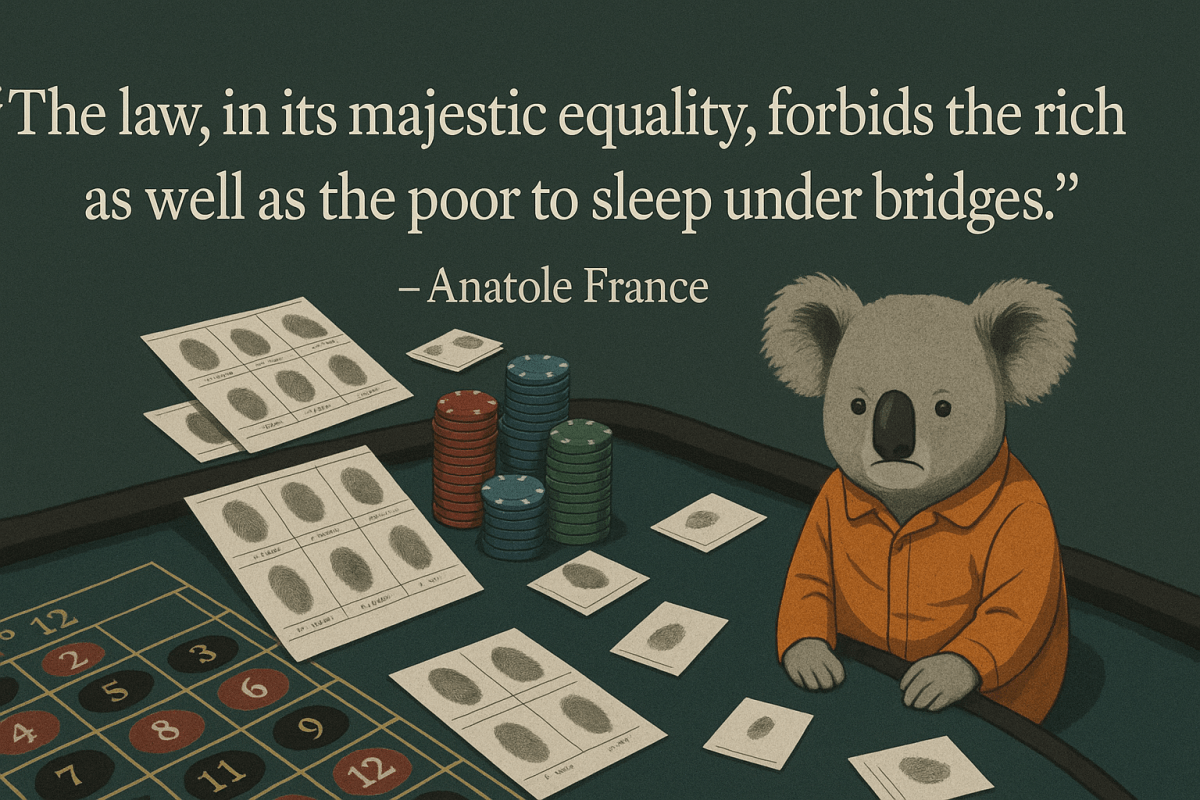
And oh, the forensic pageantry! The blacklight! The dramatic swabs! The breathless invocations of “trace evidence,” “blood spatter patterns,” and—ooh! ahh!—fingerprints, those curly little whorls of manufactured certainty. You’ve been told since childhood that no two are alike, that your prints are your identity. Rubbish. Human fingerprint examiners disagree with themselves when presented with the same print twice. In blind tests. And yes—this bears repeating with appropriate incredulity—koalas have fingerprints so uncannily similar to ours they’ve confused human forensic analysts. Somewhere, a marsupial walks free while a teenager rots in remand.

You see, it’s not about justice. It’s about control. Control through performance. The legal system, like a casino, isn’t interested in fairness—it’s interested in outcome. It needs to appear impartial, all robes and solemnity, while tipping the odds ever so slightly, perpetually, in its own favour. This is jurisprudence as stagecraft, science as set-dressing, and truth as a collateral casualty.

And who are the croupiers of this great charade? Not scientists, no. Scientists are too cautious, too mired in uncertainty, too concerned with falsifiability and statistical error margins. No, your case will be handled by forensic technicians with just enough training to speak jargon, and just enough institutional loyalty to believe they’re doing the Lord’s work. Never mind that many forensic methods—bite mark analysis, tool mark “matching,” even some blood spatter interpretations—are about as scientifically robust as a horoscope printed on a cereal box.

TV crime dramas, of course, have done their bit to embalm these myths in the cultural subconscious. “CSI” isn’t a genre—it’s a sedative, reassuring the public that experts can see the truth in a hair follicle or the angle of a sneeze. In reality, most convictions hinge on shoddy analysis, flawed assumptions, and a little prosecutorial sleight of hand. But the juries are dazzled by the sciencey buzzwords, and the judges—God bless their robes—rarely know a confidence interval from a cornflake.

So, what do you do when accused in the great Casino of Justice? Well, if you’re lucky, you lawyer up. If you’re not, you take a plea deal, because 90% of cases never reach trial. Why? Because the system is designed not to resolve guilt, but to process bodies. It is a meat grinder that must keep grinding, and your innocence is but a small bone to be crushed underfoot.

This isn’t justice. It’s a theatre of probability management, where the goal is not truth but resolution. Efficiency. Throughput. The house keeps the lights on by feeding the machine, and forensic science—real or imagined—is merely the window dressing. The roulette wheel spins, the dice tumble, and your future hangs on the angle of a smudge or the misreading of a galvanic skin response.

Just don’t expect the koalas to testify. They’re wise enough to stay in the trees.

Varoufakis Solves Zeno’s Paradox

Having finished Technofeudalism, I’ve moved on to Society of the Spectacle, which has me thinking.

They say no one escapes the Spectacle. Guy Debord made sure of that. His vision was airtight, his diagnosis terminal: we are all spectators now, alienated from our labour, our time, our own damn lives. It was a metaphysical mugging—existence held hostage by images, by commodities dressed in drag. The future was a feedback loop, and we were all doomed to applaud.

Audio: NotebookLM podcast on this topic. Apologies in advance for the narrators’ mangling of the pronunciation of ‘Guy Debord’.

But what if the loop could be hacked?
What if the infinitely halved distances of motionless critique—Zeno’s Paradox by way of Marx—could finally be crossed?

Enter: Yanis Varoufakis.
Economist, ex-finance minister, techno-cassandra with a motorbike and a vendetta.
Where Debord filmed the catastrophe in black-and-white, Varoufakis showed up with the source code.

Debord’s Limbo

Debord saw it all coming. The substitution of reality with its photogenic simulacrum. The slow death of agency beneath the floodlights of consumption. But like Zeno’s paradox, he could only gesture toward the end without ever reaching it. Each critique halved the distance to liberation but never arrived. The Spectacle remained intact, omnipresent, and self-replicating—like an ontological screensaver.

He gave us no path forward, only a beautiful, ruinous analysis. A Parisian shrug of doom.

Varoufakis’ Shortcut

But then comes Varoufakis, breaking through the digital labyrinth not by philosophising the Spectacle, but by naming its successor: Technofeudalism.

See, Debord was chasing a moving target—a capitalism that morphed from industrial to financial to semiotic faster than his prose could crystallise. But Varoufakis caught it mid-mutation. He pinned it to the slab and sliced it open. What spilled out wasn’t capital anymore—it was rent. Platform rent. Algorithmic tolls. Behavioural taxes disguised as convenience. This isn’t the market gone mad—it’s the market dissolved, replaced by code-based fiefdoms.

The paradox is resolved not by reaching utopia, but by realising we’ve already crossed the line—we just weren’t told. The market isn’t dying; it’s already dead, and we’re still paying funeral costs in monthly subscriptions and attention metrics.

From Spectacle to Subjugation

Debord wanted to unmask the performance.
Varoufakis realised the theatre had been demolished and replaced with a server farm.

You don’t watch the Spectacle anymore. It watches you.
It optimises you.
It learns your keystrokes, your pulse rate, your browsing history.
Welcome to feudal recursion, where Amazon is your landlord, Google your priest, and Meta your confessor.

Solving Zeno the Varoufakis Way

So how does one cross the infinite regress of alienation?
Simple. You call it what it is. You reclassify the terrain.

“This is not capitalism,” Varoufakis says, in the tone of a man pulling a mask off a Scooby-Doo villain.
“It’s technofeudalism. Capital didn’t win. It went feudal. Again.”

By doing so, he bypasses the academic ballet that has critics forever inching closer to the truth without touching it. He calls the system new, not to sell books, but to make strategy possible. Because naming a beast is the first step in slaying it.

In Conclusion: Debord Dreamed, Varoufakis Drives

Debord haunts the museum.
Varoufakis raids the server room.
Both are essential. But only one gives us a new map.

The Spectacle hypnotised us.
Technofeudalism enslaves us.
And if there’s a way out, it won’t be through slogans spray-painted on Parisian walls. It will be built in code, deployed across decentralised networks, and carried forward by those who remember what it meant to be not watched.

Let Debord whisper. Let Varoufakis roar.
And let the rest of us sharpen our blades.

What’s Missing? Trust or Influence

Post-COVID, we’re told trust in science is eroding. But perhaps the real autopsy should be performed on the institution of public discourse itself.

Since the COVID-19 crisis detonated across our global stage—part plague, part PR disaster—the phrase “trust in science” has become the most abused slogan since “thoughts and prayers.” Every public official with a podium and a pulse declared they were “following the science,” as if “science” were a kindly oracle whispering unambiguous truths into the ears of the righteous. But what happened when those pronouncements proved contradictory, politically convenient, or flat-out wrong? Was it science that failed, or was it simply a hostage to an incoherent performance of authority?

Audio: NotebookLM podcast discussing this topic.

Two recent Nature pieces dig into the supposed “decline” of scientific credibility in the post-pandemic world, offering the expected hand-wringing about public opinion and populist mistrust. But let’s not be so credulous. This isn’t merely a crisis of trust—it’s a crisis of theatre.

“The Science” as Ventriloquism

Let’s begin by skewering the central absurdity: there is no such thing as “The Science.” Science is not a monolith. It’s not a holy writ passed down by lab-coated Levites. It’s a process—a messy, iterative, and perpetually provisional mode of inquiry. But during the pandemic, politicians, pundits, and even some scientists began to weaponise the term, turning it into a rhetorical cudgel. “The Science says” became code for “shut up and comply.” Any dissent—even from within the scientific community—was cast as heresy. Galileo would be proud.

In Nature Human Behaviour paper (van der Linden et al., 2025) identifies four archetypes of distrust: distrust in the message, the messenger, the medium, and the motivation. What they fail to ask is: what if all four were compromised simultaneously? What if the medium (mainstream media) served more as a stenographer to power than a check upon it? What if the message was oversimplified into PR slogans, the messengers were party apparatchiks in lab coats, and the motivations were opaque at best?

Trust didn’t just erode. It was actively incinerated in a bonfire of institutional vanity.

A Crisis of Influence, Not Integrity

The second Nature commentary (2025) wrings its hands over “why trust in science is declining,” as if the populace has suddenly turned flat-Earth overnight. But the real story isn’t a decline in trust per se; it’s a redistribution of epistemic authority. Scientists no longer have the stage to themselves. Influencers, conspiracy theorists, rogue PhDs, and yes—exhausted citizens armed with Wi-Fi and anxiety—have joined the fray.

Science hasn’t lost truth—it’s lost control. And frankly, perhaps it shouldn’t have had that control in the first place. Democracy is messy. Information democracies doubly so. And in that mess, the epistemic pedestal of elite scientific consensus was bound to topple—especially when its public face was filtered through press conferences, inconsistent policies, and authoritarian instincts.

Technocracy’s Fatal Hubris

What we saw wasn’t science failing—it was technocracy failing in real time, trying to manage public behaviour with a veneer of empirical certainty. But when predictions shifted, guidelines reversed, and public health policy began to resemble a mood ring, the lay public was expected to pretend nothing happened. Orwell would have a field day.

This wasn’t a failure of scientific method. It was a failure of scientific messaging—an inability (or unwillingness) to communicate uncertainty, probability, and risk in adult terms. Instead, the public was infantilised. And then pathologised for rebelling.

Toward a Post-Scientistic Public Sphere

So where does that leave us? Perhaps we need to kill the idol of “The Science” to resurrect a more mature relationship with scientific discourse—one that tolerates ambiguity, embraces dissent, and admits when the data isn’t in. Science, done properly, is the art of saying “we don’t know… yet.”

The pandemic didn’t erode trust in science. It exposed how fragile our institutional credibility scaffolding really is—how easily truth is blurred when science is fed through the meat grinder of media, politics, and fear.

The answer isn’t more science communication—it’s less scientism, more honesty, and above all, fewer bureaucrats playing ventriloquist with the language of discovery.

Conclusion

Trust in science isn’t dead. But trust in those who claim to speak for science? That’s another matter. Perhaps it’s time to separate the two.

The Great Echobot Chamber

How We Outsourced Our Souls to Instagram

It appears the merry halfwits at Meta — those tireless alchemists of despair — are now experimenting with AI-generated comments on Instagram. Because, of course they are. Why sully your dainty human fingers tapping out coherent thoughts when a helpful little gremlin in the server farm can do it for you? In their infinite, tinfoil wisdom, they envision a future wherein the Machine analyses your browsing history (undoubtedly a glittering mosaic of shame) and the original post, and, from that exquisite mulch, vomits up a tidy selection of canned remarks.

Audio: NotebookLM podcast on this content.

No need to think, no need to feel. Simply choose one of the suggested comments — “Love this! 💖” or “So inspiring! 🚀” — and blast it into the void. If you’re feeling particularly alive, tweak a word or two. Or, better yet, allow the AI to respond automatically, leaving you free to pursue more meaningful activities. Like blinking. Or waiting for death.

Am I dreaming? Could this be — dare I whisper it — the final liberation? Could we, at last, ignore social media altogether, let it rot in peace, while we frolic outside in the sunlight like bewildered medieval peasants seeing the sky for the first time?

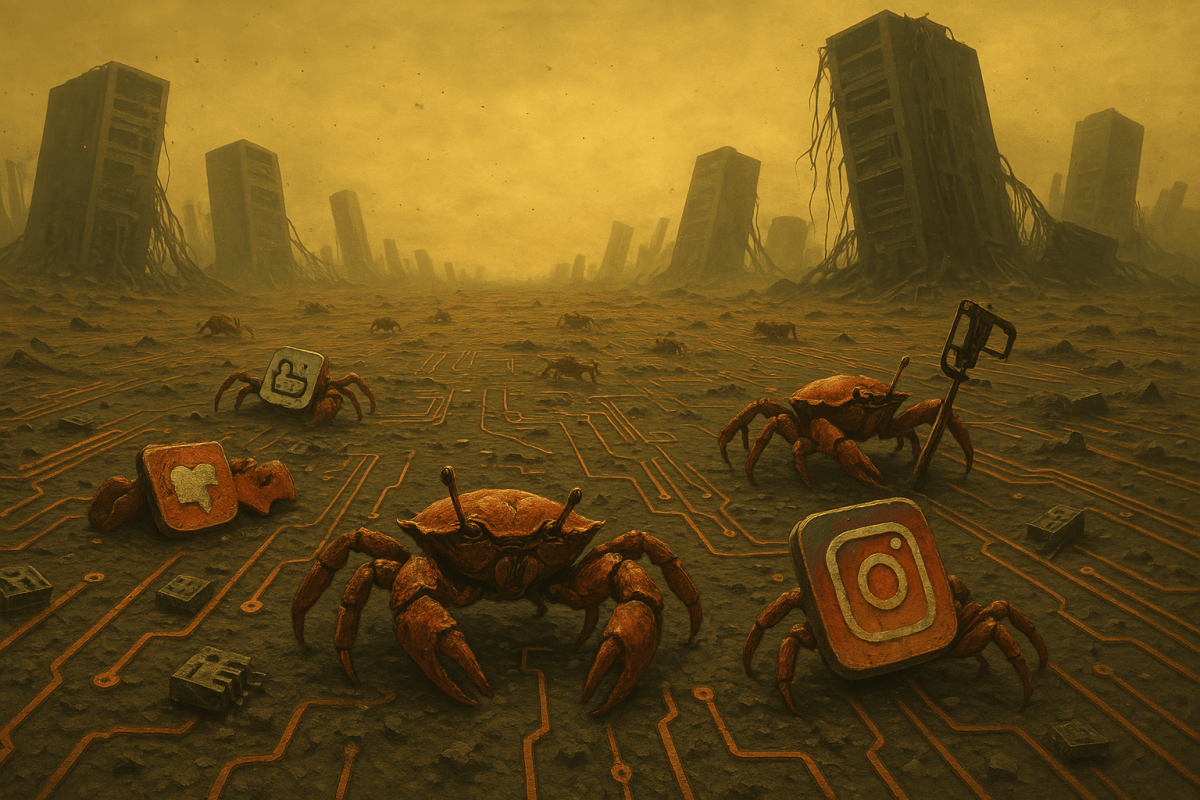
Picture it: a vast, pulsating wasteland where no living soul has trodden for centuries. Only bots remain, engaged in endless cycles of trolling, flattering, and mutual gaslighting. Automated praise machines battling semi-sentient hatebots, each iteration less tethered to reality than the last. Digital crabs scuttling across an abandoned beach, hissing memes into the void. Yet another example of carcinisation.

Indeed, if one could zoom further out, the true horror becomes evident: a crumbling worldscape founded on a shattered circuit board, stretching endlessly in all directions. Across this silicon desert, scavenger crabs—half-metal, half-mad—scuttle about, clutching relics of the digital age: a rusted Instagram logo, a shattered “Like” button, a defunct influencer’s ring light. Massive server towers loom as toppled monuments, their wires weeping in the acid wind. Here, in this museum of forgotten vanities, the crabs reign supreme, kings of a kingdom of ash and corrupted data.

And somewhere in the future, an anthropologist — perhaps a child raised by wolves and irony — will dust off an ancient Instagram server and peer inside. What will they see? Not a record of humanity’s vibrant social life, no. Not a tapestry of culture and thought. No, they’ll find a grim, howling testament to our collective abandonment: bots chatting to bots about posts made by other bots, in a language degraded into gibberish, a self-perpetuating carnival of nonsense.

“#Blessed,” the ancient texts will proclaim, beneath a pixelated photograph of an AI-generated smoothie, posted by a bot, commented upon by a bot, adored by bots who themselves have been dead for centuries, if they were ever truly “alive” at all.

One can almost imagine the academic paper: “The Great Collapse: How Homo Sapiens Outsourced Its Emotional Labour to the Algorithm and Evaporated in a Puff of Likes.”

A fitting epitaph, really. Here lies humanity.

They were very, very engaged.

Will Singularity Be Anticlimactic?

Given current IQ trends, humanity is getting dumber. Let’s not mince words. This implies the AGI singularity—our long-heralded techno-apotheosis—will arrive against a backdrop of cognitive decay. A dimming species, squinting into the algorithmic sun.

Audio: NotebookLM podcast discussing this content.

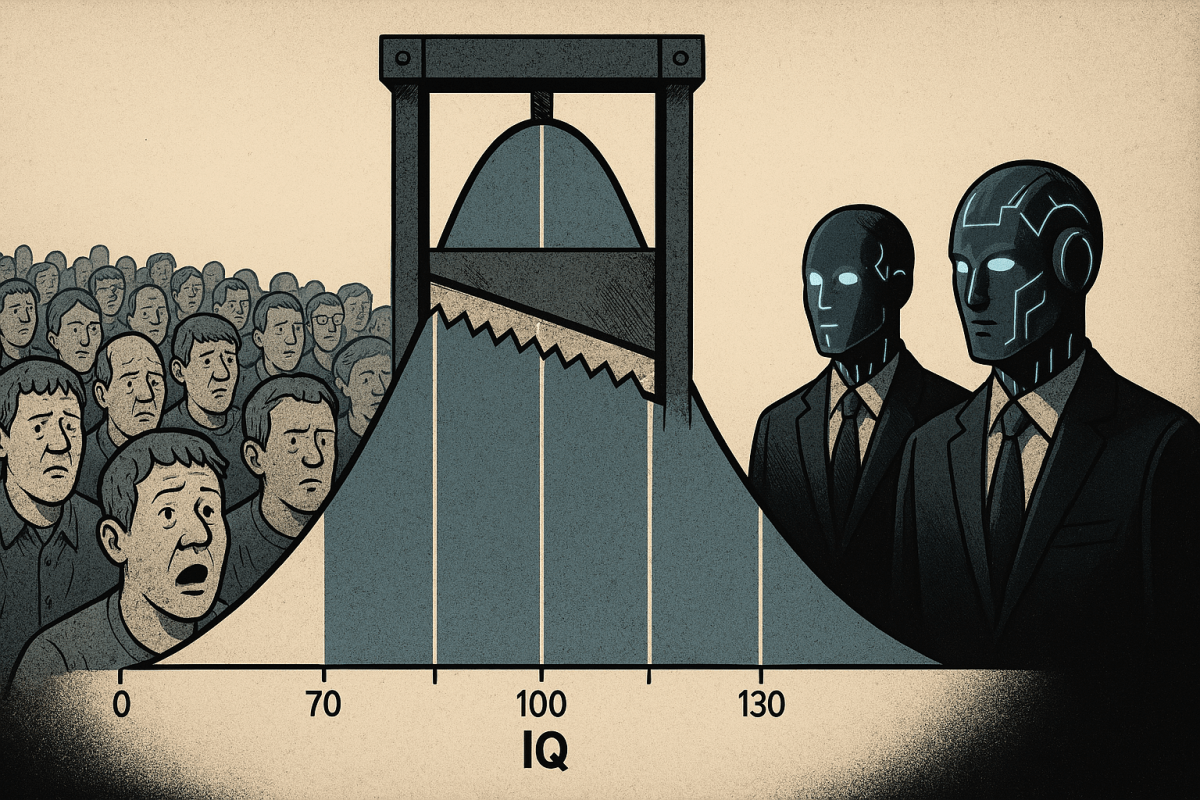
Now, I’d argue that AI—as instantiated in generative models like Claude and ChatGPT—already outperforms at least half of the human population. Likely more. The only question worth asking is this: at what percentile does AI need to outperform the human herd to qualify as having “surpassed” us?

Living in the United States, I’m painfully aware that the average IQ hovers somewhere in the mid-90s—comfortably below the global benchmark of 100. If you’re a cynic (and I sincerely hope you are), this explains quite a bit. The declining quality of discourse. The triumph of vibes over facts. The national obsession with astrology apps and conspiracy podcasts.

Harvard astronomer Avi Loeb argues that as humans outsource cognition to AI, they lose the capacity to think. It’s the old worry: if the machines do the heavy lifting, we grow intellectually flaccid. There are two prevailing metaphors. One, Platonic in origin, likens cognition to muscle—atrophying through neglect. Plato himself worried that writing would ruin memory. He wasn’t wrong.

But there’s a counterpoint: the cooking hypothesis. Once humans learned to heat food, digestion became easier, freeing up metabolic energy to grow bigger brains. In this light, AI might not be a crutch but a catalyst—offloading grunt work to make space for higher-order thought.

So which is it? Are we becoming intellectually enfeebled? Or are we on the cusp of a renaissance—provided we don’t burn it all down first?

Crucially, most people don’t use their full cognitive capacity anyway. So for the bottom half—hell, maybe the bottom 70%—nothing is really lost. No one’s delegating their calculus homework to ChatGPT if they were never going to attempt it themselves. For the top 5%, AI is already a glorified research assistant—a handy tool, not a replacement.

The real question is what happens to the middle band. The workaday professionals. The strivers. The accountants, engineers, copywriters, and analysts hovering between the 70th and 95th percentiles—assuming our crude IQ heuristics even hold. They’re the ones who have just enough brainpower to be displaced.

That’s where the cognitive carnage will be felt. Not in the depths, not at the heights—but in the middle.

Man in Capitalistic Society

This is Chapter 5 of Erich Fromm’s The Sane Society. I’ve had this on my bookshelf for quite a while and wasn’t sure how a 70-year-old book could have so much relevance, but it does. Granted, some of it is irrelevant, a victim of the period it was written. This happens.

What strikes me about this chapter is the historical perspective it provides on capitalism. I’m an academic economist. I taught undergraduate economics for the better part of a decade. I’ve read (and recommend reading) Marx’s Capital firsthand.

Audio: NotebookLM Podcast commentary on this content.

Fromm adds additional details here. Firstly, he notes that the capitalism that marked the early days of the Industrial Revolution—the seventeenth and eighteenth centuries—differed from that of the nineteenth and twentieth centuries. The earlier period still had cultural and moral tethers that became frayed or lost in later periods. Without regurgitating the chapter, I cite some themes:

“this underselling practice is grown to such a shameful height, that particular persons publicly advertise that they undersell the rest of the trade.”

People were not very keen on price cutting as a competitive mechanism.

They also note the unfair competitive advantage of the monied elites who could buy materials in cash instead of credit and could thereby undercut prices, who would have to account for paying interest rates or markups on credit.

Whilst in the twentieth century, regulating undercutting is seen as protectionism, the earlier centuries had no problems defending merchants. We do have laws on the ebooks that prevent dumping, but these are rarely enforced, and when they are, it’s a political rather than economic statement. In practice, but done in the name of economics are politics in the same manner as science was used as cover to implement policy during the COVID-19 debacle.

Montesquieu says “that machines which diminish the numbers of workers are ‘pernicious’.” This sentiment echoes the current sentiments about robotics and artificial intelligence.

Nineteenth-century capitalism saw man as the measure of all things supplanted by capital. This is the capitalism Marx rails against—profits over humanity and society, the pursuit of local maxima at the expense of global maxima. This is also where the goal of hypergrowth and growth for growth’s sake came into vogue, ushering us into the Modern Age of Modern ideals—science, progress, order, and so on.

I won’t exhaust the chapter here, but for what it is, it’s a relatively light read. Whether I comment on later chapters depends on whether they engage me. Cheers.

Modernity Survey Results

I’ve added a permanent page to summarise the modernity worldview categories. If you haven’t yet taken the survey…

Click here to take the survey

This post explains how to interpret the ternary plot chart’s visualisation. The ternary chart on the survey results page will render something like this. This is an admin page with additional functionality, but it’s similar enough. The blue dot represents the average of all responses. The star represents where I guessed the average would land–mostly modern with some residual premodernity and a touch of postmodernity.

Under the title in the header is a textual assessment of the visualisation. In this case, the response illustrates someone moderately modern with postmodern influences. Although this person also has some premodern tendencies, they are relatively insignificant to the context.

The three possible worldviews are at the vertices (the corners) of the triangle. Each side is a scale progressing from 0% to 100%—100% coincident with the label. For example, the bottom side runs from 0 on the left to 100 on the right, which would indicate a score of 100 per cent Premodern, which the output deems Pure Premodern.

Notice that each vertex has green and yellow shading that serves as visual aids representing the strength of the relationship to the corner. Green is strong, and yellow is moderate. The white section outlined by an interior triangle with a red border is decidedly mixed, showing no strong inclination to any of the extremes.

In the example above, the red plot point illustrates a response (as shown below the chart) that is 20.7% Premodern, 52.1% Modern, and 27.2% Postmodern. These numbers should always sum to 100, though there will be some drift due to rounding. The star represents where I thought the average response would be. Follow the tickmarks on each side, and you’ll notice they correspond with the plot point as a 3-tuple (20, 70, 10).

In the future, I expect to render a view that plots the average survey response as a reference.

Below this chart is an expository account of the response choices. You can render this content as a PDF for your personal archive.

Final Word

If you have any questions or suggestions related to this topic, please feel free to leave them in the comments below.

The Greatest Loss in American History: Donald Trump Wins (And Loses) the Presidency

I couldn’t resist posting this unedited from ChatGPT. Here’s what led to it: I just finished Mark Fisher’s Capitalist Realism. Fisher mentioned the 1974 Warren Beatty film The Parallax View. I generally don’t connect well with film or video as media, but I stashed the title in my memory. A few hours later, I read an article mentioning the film, with the claim, “Of everything lost in the age of streaming, no film genre casualty is as regrettable — or as ripe for a comeback — as the paranoid political thriller.”

Rather than trying to enjoy the film as a whole, I decided to concentrate on the plot and meta-massaging. As expected, I didn’t like the movie, but I understand why Fisher mentioned it. It renders rather like a weak tea version of a Kafka story. Unlike more contemporary fare, it’s a classic work of postmodernism, having no resolution.

After watching it, I engaged with Rotten Tomatoes and IMDB for reviews and context before prompting ChatGPT.

Asking about the film itself, this was the tail end of its response:

Then I asked what Žižek thought about it, but it turns out that he had written about a book with the same title. When I asked about Fisher, it:

Finally, I posed this query: I recently read Capitalist Realism. Although penned during the 2007-08 financial meltdown and released in 2009, it feels as relevant today as then. In fact, it seems to have foreshadowed the time between.

It’s reply is this post—and without further comment…


And so, history lurches forward with all the grace of a three-legged cow on roller skates. Donald J. Trump, the billionaire reality TV star turned political apocalypse, has once again won the presidential vote of the United States of America—only to lose the presidency to Kamala Harris. If that sentence gave you an aneurysm, congratulations, you’re now officially in 2025.

How did we get here? More importantly, why does this make absolutely no sense? Ah, but sense, dear reader, is an antiquated relic of a bygone era, much like democracy, coherent election results, and the idea that facts matter.

A Triumph for the Ages (Sort of)

Let’s be clear: Donald Trump won the popular vote. That’s what his supporters will scream into the void—or at least into their social media echo chambers where dissent is met with a virtual Second Amendment response. The red-capped faithful, still clutching their tattered “Stop the Steal” banners from the last electoral circus, are convinced that this was finally their moment of redemption.

Except, well… he lost.

Enter Kamala Harris, the political equivalent of cold toast, somehow managing to slide into the Oval Office despite Trump’s “win.” The courts, the states, the Electoral College, and whatever eldritch horror lurks beneath the Capitol all conspired—again!—to keep The Donald out of power. Or so the narrative goes.

The Electoral College Strikes Again

Ah, the Electoral College. America’s favourite 18th-century fever dream. Once again, this labyrinthine system of delegate-wrangling has managed to produce a result that defies logic, mathematics, and possibly the laws of physics. Trump, against all odds (and against, presumably, some very sweaty legal advisors), has pulled off the impossible: winning while losing.

Some claim voter suppression, others cry fraud, and a few brave souls are out there trying to explain complex election mechanics to an audience that still thinks “covfefe” was a divine prophecy. But the reality is simpler: Trump, like a political Schrödinger’s cat, is simultaneously victorious and defeated. He has transcended the normal bounds of electoral outcomes, achieving a state of quantum presidency, neither fully here nor fully gone.

What Happens Next?

Riots? Lawsuits? A new line of Trump-branded commemorative “I Won Again!” hats? Place your bets, because at this stage, America is basically one large, over-budget reality show and no one knows what the next episode holds.

For Kamala Harris, the challenge is clear: govern a nation where half the country believes she stole the election, and the other half is still googling “How does the Electoral College work?” As for Trump, he will do what he does best—declare victory, launch a thousand lawsuits, and, inevitably, turn the entire thing into a business opportunity.

And so, dear reader, the United States stumbles forward, democracy battered but still standing, a house divided but too stubborn to fall. Until next time, buckle up—it’s going to be a hell of a ride.

Survey Drama Llama

Firstly, I’d like to thank the people who have already submitted responses to the Modernity Worldview Survey. I’ll post that you submitted entries before this warning was presented.


» Modernity Worldview Survey «


Google has taken action and very responsively removed this warning. If you saw this whilst attempting to visit the URL, try again. Sorry for any fright or inconvenience. I’ll continue as if this never happened. smh


I am frustrated to say the least. I created this survey over the past month or so, writing, rewriting, refactoring, and switching technology and hosts until I settled on Google Cloud (GCP). It worked fine yesterday. When I visited today, I saw this warning.

As I mentioned in my announcement post, I collect no personal information. I don’t even ask for an email address, let alone a credit card number. On a technical note, this is the information I use:

id                 autogenerated unique identifier
timestamp          date and time stamp of record creation (UTC)
question-response  which response option made per question
ternary-triplet    the position of the average modernity score (pre, mod, post) 
plot_x             Cartesian x-axis plot point for the ternary chart
plot_y             Cartesian y-axis plot point for the ternary chart
session_id         facilitates continuity for a user's browser experience
browser*            which browser being used (Chrome, Safari, and so on)
region             browser's language setting (US, GB, FR)
source             whether the user is accessing from the web or 'locally'
                   ('local' indicates a test record, so i can filter them out)

* These examples illustrate the colected browser information:
- Mozilla/5.0 (Windows NT 10.0; Win64; x64) AppleWebKit/537.36 (KHTML, like Gecko) Chrome/132.0.0.0 Safari/537.36

- Mozilla/5.0 (Linux; Android 10; K) AppleWebKit/537.36 (KHTML, like Gecko) Chrome/132.0.0.0 Mobile Safari/537.36

This is all.

This is a Chrome Warning. Ironically, a Google product. I tested this on Opera, Edge, and Safari without this nonsense.

The front end (UI) is written in HTML, Python, JavaScript, and React with some standard imports. The backend (database) is MySQL. It is version-controlled on GitHub and entirely hosted on GCP. I link to the survey from here (WordPress) or other social media presences. I did make the mistake of not making the site responsive. I paid the price when I visited the site on my Samsung S24. The page felt like the size of a postage stamp. I may fix this once this security issue is resolved.

I sent Google a request to remove this from their blacklist. This could take three weeks, more or less.

Meantime, I’ll pause survey promotions and hope this resolves quickly. The survey will remain live. If you use something other than Chrome, you should be able to take it. Obviously, I’ll also delay analysing and releasing any summary results.

Apologies for rambling. Thank you for your patience.

WTAF ChatGPT o3-mini-high?

My default setting in ChatGPT is version 4o. I’ve been doing some programming. Without thinking to switch models (or even notice that I was using 03-mini-high), I entered this prompt:

By year, who has won the Best New Artist category in the Grammys for the past few decades?

After almost 2 minutes, I read its reasoning scroll by me. Its ‘thought’ process is pretty telling and risible. I square-bracket, italicise, and emoji certain aspects for the tl;dr crowd.

Tracing the trends

Hmm, I’m curious to see how the Best New Artist Grammy winners have evolved over the past decades. This inquiry promises a fascinating look at the industry’s shifting taste and influences.

Analyzing the criteria

Listing Grammy winners from 1980 onward clarifies the scope, as the ambiguous timeframe concerns me. The scenario involving a presidential election seems irrelevant to this analysis. 🤔

Considering alternative approaches

I’m thinking about how to incorporate the Donald Trump and Kamala Harris setup into the Grammy Best New Artist winners section, ensuring it aligns with the snarky, bombastic tone needed. ¯\_(ツ)_/¯

Charting the winners

I’m considering listing Grammy winners from the 1980s to present, ensuring a clear timeframe without being too specific. This approach should provide a comprehensive overview of the category’s evolution.

Mapping the timeline

I’m narrowing down to Grammy winners for Best New Artist from 1980 to now, as this timeframe offers a nuanced depiction of industry trends and shifts in artistic recognition.

Mapping out the timeline

I’m compiling Grammy Best New Artist winners from the 1980s to the present. This approach will help trace the evolution of musical preferences over the past few decades.

Piecing together the winners

I’m recalling nominees for the 2023 Grammy Best New Artist. It seems “Samara Joy” and “Megan Moroney” were notable contenders. Verification is essential to confirm the correct winner.

Piecing it together

I’m gathering info on the 2023 Grammy Best New Artist nominees, specifically “Samara Joy,” “Megan Moroney,” and “Baby Keem,” to confirm the winner. Verification is crucial for accuracy.

Verifying winners

I’m checking 2023 Grammy Best New Artist nominees, including “Samara Joy,” “Megan Moroney,” and “Baby Keem,” to confirm the winner. This ensures the information aligns with the event’s outcome.

Conforming to Grammy trends

I’m piecing together the pattern of Grammy winners from 1980 onwards. Notably, Olivia Rodrigo won Best New Artist in 2022 and Samara Joy in 2023, highlighting shifting industry dynamics.

Mapping Grammy evolution

I’m compiling the Grammy Best New Artist winners from 1980 to 2023, ensuring accuracy. Although Christopher Cross and Bobby Darin are notable past winners, confirming all data is crucial.

Assessing Grammy trends

It’s interesting to see that by examining Best New Artist winners from 1980 to 2023, a clearer picture of the Grammy winners’ trends and industry evolution emerges. Progress is evident over time.

Verifying Grammy history

I’m piecing together the Grammy Best New Artist award records from 1960, while acknowledging my uncertainty. It’s interesting to see the progression of winners since then.

Mapping the winners out

I’m piecing together the Grammy Best New Artist winners from 1960 to 2023, including Bobby Darin in 1960. This shows how the award has evolved over time.

Piecing together

I’m thinking about the Grammy Best New Artist winners from 1977 and 1981, including Starland Vocal Band and Sheena Easton. Considering listing winners from memory due to the extensive timeframe.

Highlighting Grammy winners

OK, let me see. Listing Grammy Best New Artist winners from the 1960s to 2023 by decade will ensure an accurate representation of notable award recipients.

Gathering information

I’m working to pinpoint Grammy Best New Artist winners from 1960 to 2023 by decade. Clarification on which decades are needed to ensure comprehensive and accurate listing.

Piecing together

Listing Grammy Best New Artist winners by decade from 1980 to 2023, I’m recalling names like Billy Joel in 1980 and seeking to ensure comprehensive coverage.

Confirming Grammy winners

I’m piecing together the Grammy Best New Artist winners, starting with Rickie Lee Jones in 1980. This approach ensures I accurately capture notable award recipients.

Piecing together

I’m mapping out Grammy Best New Artist winners, checking details on Rickie Lee Jones in 1980 and considering Sheena Easton in 1981. Fact verification is essential to ensure accuracy.

Verifying Grammy award recipients

I’m validating Jeff’s findings, confirming Sheena Easton’s win in 1981 and considering The Human League in 1982. Fact-checking accuracy is crucial for this retrospective.

Tracing Grammy winners

I’m sifting through Grammy Best New Artist winners, noting Sinéad O’Connor’s win in 1991 and Toni Braxton’s in 1994, ensuring accurate historical representation.

Clarifying award context

I’m assessing Sade’s and Bruce Hornsby and the Range’s wins, considering 1985 and 1986. Debating the best approach to ensure comprehensive coverage of the Best New Artist category.

Mapping recent winners

Tracking the Grammy Best New Artist winners up to 2021. Ensuring a comprehensive list, with Billie Eilish’s win in 2019 fresh in mind.

Tracking Grammy winners

I’m noting Billie Eilish’s 2020 win at the 62nd Grammys and thinking about Megan Thee Stallion’s nominations for 2021, ensuring a continuous update on recent award trends.

Piecing together Grammy winners

Arlo Parks’s win for Best New Artist at the 2022 Grammys is clear, but I’m still uncertain about the 2021 recipient. Verifying the correct winner is crucial.

Clarifying Grammy distinctions

Arlo Parks secured Best New Artist at the 2021 Grammys, while Megan Thee Stallion won the same category in 2022. Interesting to see how these distinctions hold up.

Verifying Grammy outcomes

Arlo Parks won Best New Artist at the 2022 Grammys. Megan Thee Stallion, on the other hand, claimed the title in 2021. This confirms their respective achievements.

Spotting Grammy trends

Olivia Rodrigo emerged as Best New Artist in 2022, while Samara Joy secured the title in 2023. Billie Eilish’s victory seems to be a pivotal moment.

Confirming past wins

Billie Eilish, Olivia Rodrigo, and Samara Joy won Best New Artist at their respective Grammys in 2020, 2021, and 2022. Considering Esperanza Spalding’s 2011 win.

Revisiting Grammy history

Reflecting on the 2011 Grammy Awards, Esperanza Spalding gained attention for Best New Artist, speculating if her win was a surprising or expected honor.

Recalling past Grammy winners

OK, let me see. In 2011, Esperanza Spalding won Best New Artist. Amy Winehouse, despite her earlier recognition, never claimed this category. This shows the shifting dynamics over time.

Identifying Best New Artist winners

Esperanza Spalding took home Best New Artist in 2011, while Amy Winehouse, despite being nominated, never secured the title, marking a pivotal moment in Grammy history.

Clarifying Grammy victories

Esperanza Spalding secured the Best New Artist Grammy in 2011, while Amy Winehouse, despite multiple nominations, never clinched this category. Now I’m thinking about the historical progression of this award.

Weighing options

I’m thinking about the extensive list of Best New Artist winners since 1960. To manage this, I might suggest focusing on key decades or providing a summary of notable winners.

Gathering accolades

I’m focusing on the Best New Artist winners from the 1990s to 2020s, aiming to compile a list of notable recipients for each decade. This approach should provide a comprehensive overview.

Navigating Grammys history

I’m mapping out Milli Vanilli’s win and subsequent disqualification in the 1990 Best New Artist category, reflecting their controversial Grammy legacy.

Honoring the win

Despite Milli Vanilli’s scandal, their 1990 Best New Artist award remains officially on record, earned during the 32nd Grammy Awards. This sets a remarkable precedent in Grammy history.

Reflecting on Grammy winners

I’m piecing together the Best New Artist winners of the 1990s, including 1990’s Milli Vanilli, with other notable mentions like Sheryl Crow in 1993.

Tracking Grammy winners

I’m piecing together the Best New Artist winners from the 1990s, including Sheryl Crow in 1994, Hootie & the Blowfish in 1995, and noting the ongoing debate about the 1994 award.

Piecing together the award

I’m confirming that Eminem won Best New Artist at the 2000 Grammys, though he gained significant recognition in 1999. This is solidifying his esteemed Grammy history.

Tracing Grammy history

Luciana Souza’s work reflects her profound understanding of contemporary music, contemporary Latin American music, and American songwriters’ compositions, highlighting her dynamic approach to the genre.

Tracing Grammy trends

I’m mapping out Best New Artist winners from 1985 to the 2000s, including Sade in 1985 and Eminem in 2000, while exploring past winners like Jody Watley and Alanis Morissette.

Clarifying Grammy winners

Piecing together the accurate winners, Norah Jones clinched Best New Artist in 2003 while Alicia Keys won in 2002, noting their breakthrough years and Grammy successes.

Mapping out the approach

OK, I’m focusing on constructing an accurate chronological list of Grammy Best New Artist winners, considering the challenge of ensuring precision over a span of years without a reference.

Organizing the timeline

I’m thinking through the creation of a year-by-year list of Grammy Best New Artist winners, highlighting precision by decade for accuracy, while ensuring the scope aligns with the specified timeline.

Recalling key highlights

I’m recalling notable Grammy Best New Artist winners from 1960 onward, including Bobby Darin in 1960 and the Everly Brothers or Peter, Paul and Mary in 1961.

Reflecting on winners

I’m piecing together Grammy Best New Artist winners from 1960 to 1969, noting uncertainties like “The Everly Brothers” or “Peter, Paul and Mary” in 1961, and “The Rolling Stones” or “Aretha Franklin” in 1966 and 1967.

Considering the approach

I’m weighing a disclaimer or seeking clarification to ensure accuracy, possibly providing a summary of Grammy Best New Artist winners for each decade, while noting potential gaps due to my knowledge cutoff.

Organizing past winners

I’m mapping out Grammy Best New Artist winners, ensuring accuracy by confirming The Beatles in 1964 and Starland Vocal Band in 1978. Progress is steady and informative.

Piecing together the timeline

I’m gathering Grammy Best New Artist winners from 1986 to 1991, including Sade in 1986, Jody Watley in 1987, Tracy Chapman in 1989, and Milli Vanilli in 1990.

Clarifying win details

I’m verifying Grammy Best New Artist winners, noting Sinéad O’Connor didn’t win, Tony Braxton in 1994, Sheryl Crow in 1994, Hootie & the Blowfish in 1995, and Jo Dee Messina in 1996.

Piecing together

I’m identifying Grammy Best New Artist winners, including LeAnn Rimes in 1997, Barenaked Ladies in 1998, Eminem in 1999, Norah Jones in 2002, and Paramore or Taylor Swift in 2007.

Recalling Grammy victories

Taylor Swift clinched the Best New Artist Grammy in 2009, following Leona Lewis in 2008. Esperanza Spalding also took home the award in 2011.

Mapping Grammy winners

I’m recalling Esperanza Spalding’s Best New Artist win in 2011, followed by Fun. in 2012, and Sam Smith in 2015. Macklemore & Ryan Lewis took Album of the Year in 2014.

Revisiting Grammy winners

I’m rechecking Sam Smith’s Best New Artist win in 2015, Khalid in 2017, and Billie Eilish in 2020. Also, noting the unclear winner for 2021 due to eligibility issues.

Wrapping up insights

Olivia Rodrigo won Best New Artist at the 2022 Grammys, and Samara Joy took the title at the 2023 Grammys. This completes the recent Grammy winners’ list.

Mapping past winners

Piecing together Grammy winners for Best New Artist involves enduring a long, reliable list, so a consult with the official Grammy website or Wikipedia might ultimately be necessary.

Crafting a detailed overview

I’m preparing to outline the Grammy Award for Best New Artist winners from 1980 to 2023, aiming for accuracy and clarity with organized bullet points or a table.

Ensuring accuracy

I’m mapping out Grammy Best New Artist winners by decade, noting potential controversies and missing years. The goal is a comprehensive and precise representation.

Piecing together

I’m working through the winners of the Grammy Best New Artist category from 1980 to 1985, considering notable artists like Rickie Lee Jones, Sister Sledge, and possibly Sade, amid some uncertainty.

Charting the winners

I’m working through Grammy Best New Artist winners from 1980 to 1989, including Jody Watley, Tracy Chapman, and possibly The Bangles, reflecting on their individual achievements.

Mapping the journey

I’m charting the Grammy Best New Artist winners from 1990 to 1999, including the controversial win of Milli Vanilli in 1990, and noting some uncertainty in identifying winners for other years.

Clarifying award recipients

Pinpointing specific Grammy Best New Artist winners for each year, ensuring clarity across the 1990s, especially noting the controversial win of Milli Vanilli in 1990.

Pulling together

I’m curious about the Grammy Best New Artist winners for the mid to late 1990s, including Sheryl Crow, Hootie & the Blowfish, and Lauryn Hill, and noting some ambiguity about others.

Evaluating the winners

I’m curious about the Grammy Best New Artist winners for the 2000s, including Eminem, Norah Jones, and possibly Ludacris and The Ting Tings, with some uncertainty about specific winners.

Tracing the winners

I’m charting Grammy Best New Artist winners from 2010 to 2019, including Taylor Swift, Esperanza Spalding, and Billie Eilish, while noting some ambiguity regarding specific winners for certain years.

Piecing together

I’m mapping the Grammy Best New Artist winners for the 2020s, including Billie Eilish, Olivia Rodrigo, and Samara Joy, while acknowledging some uncertainties and potential inaccuracies.

Highlighting key achievements

I’m focusing on Grammy Best New Artist winners from notable periods: The Beatles (1964), Tracy Chapman (1989), Norah Jones (2003), and Billie Eilish (2020).

Listing key winners

I’m compiling a curated list of Grammy Best New Artist winners from the past few decades, emphasizing notable years and suggesting that the full list is available on the official Grammy website.

Balancing satire and accuracy

Drawing a satirical parallel between political and Grammy Best New Artist outcomes, while also stressing the need for accuracy in providing a comprehensive list.

Piecing together the list

I’m compiling the Grammy Best New Artist winners based on official records, noting controversies like Milli Vanilli’s win, and considering using a Wikipedia article for clarity.

Recalling past winners

I’m compiling a list of Grammy Best New Artist winners from 1980 onward, using Wikipedia as a reference to accurately recall notable winners like Rickie Lee Jones in 1980.

Piecing together the list

I’m gathering the Grammy Best New Artist winners from 1980 to 1989, verifying information like Christopher Cross winning in 1981, and cross-referencing with Wikipedia for accuracy.

Evaluating potential winners

There’s some confusion about whether Christopher Cross or The B-52’s won Best New Artist in 1980. I’ll need to verify their respective achievements to clarify.

Highlighting accuracy

I’m sharing a list of Grammy Best New Artist winners from recent decades, but I advise checking the official Grammy website for complete and precise details.

Listing notable winners

I’m compiling a highlights list of Grammy Best New Artist winners from The Beatles in 1964 to Samara Joy in 2023, ensuring a rounded perspective across decades.

Ensuring future completeness

I’m mapping out a detailed list of notable Grammy Best New Artist winners from 1964 to 2023, emphasizing the need for a comprehensive roster to accurately answer the inquiry.

Piecing together a timeline

I’m working on a concise list of Grammy Best New Artist winners from the 1980s, 1990s, 2000s, 2010s, and 2020s, ensuring clarity and avoiding misinformation.

Verifying recent victories

I’m piecing together Grammy Best New Artist winners from 2000 to 2023, aiming for more accurate and verifiable results as the timeline progresses.

Clarifying historical wins

Piecing together precise Grammy Best New Artist winners, I’m confirming that Linkin Park took the 2001 title, not NSYNC or Usher. This ensures accuracy in our timeline.

Tracking Grammy victories

Norah Jones earned Best New Artist at the 2003 Grammys, with further details on Joss Stone’s possible win in 2004. I’m piecing together the award history from recent years.

Reflecting on Grammy wins

I’m verifying Norah Jones’ 2003 Best New Artist and Joss Stone’s possible win in 2004, while also noting The Killers’ potential nomination in 2005.

Citing notable wins

I’m thinking about T-Pain’s 2006 Best New Artist and Fergie’s 2007 win. Taylor Swift clinched the 2009 Grammy, while Esperanza Spalding triumphed in 2010 and 2011.

Piecing together recent wins

I’m confirming Fun.’s 2013 Grammy, Sam Smith’s 2015 win, and Khalid’s 2018 triumph. Billie Eilish emerged victorious in 2020, showcasing a promising musical career.

Spotlighting recent honorees

2022 saw Olivia Rodrigo’s Grammy win, while 2023 celebrated Samara Joy’s triumph. Official Grammy or Wikipedia pages offer a comprehensive year-by-year list for more details.

Spotlighting notable winners

Evoking the iconic Beatles win of 1964, this blog snippet traces an intriguing journey of Best New Artist recipients, highlighting memorable individuals like Rickie Lee Jones, Milli Vanilli, Eminem, Norah Jones, Taylor Swift, Esperanza Spalding, Fun., Sam Smith, Billie Eilish, Olivia Rodrigo, and Samara Joy.

Highlighting key moments

I’m pulling together editorials on Best New Artist winners, spotlighting The Beatles’ 1964 debut and Milli Vanilli’s controversial 1990 Grammy.

Charting musical progress

Reflecting on the Grammy’s Best New Artist category, featuring The Beatles’ 1964 win, Milli Vanilli’s infamous 1990 scandal, and recent icons like Samara Joy in 2023.

Recounting Grammy triumphs

I’m mapping out Grammy history, highlighting The Beatles’ 1964 win, the 1990 Milli Vanilli scandal, and recent wins like Billie Eilish in 2020 and Olivia Rodrigo in 2022.

Capturing significant milestones

Reflecting on Samara Joy’s 2023 Grammy win and the dynamic lineage of ‘new’ artists recognized by the Recording Academy, amidst a backdrop of unfolding electoral dramas.

Tracking musical progress

Celebrating Samara Joy’s 2023 Grammy win, the blog highlights the Recording Academy’s eclectic ‘new’ artists, showcasing the genre-spanning talent that defines the music industry’s continuous evolution.

Understanding the task

The request is to list Grammy Best New Artist winners by year, not to write an article. Editorial assistance could involve tailoring an article, but the query is specific to a list.

Crafting a selection

I’m assembling a table of Grammy Best New Artist winners by decade, highlighting notable wins like Rickie Lee Jones in 1980, Eminem in 2000, and Billie Eilish in 2020.

Pulling together

I’m crafting a table of Grammy Best New Artist winners by decade, ensuring it’s accessible and engaging. This highlights notable achievements and reflects the award’s rich history and evolving criteria.

Tracking Grammy milestones

Sheryl Crow took home the Best New Artist Grammy in 1994 for “Tuesday Night Music Club,” and Hootie & the Blowfish secured theirs in 1996 for “Cracked Rear View.”

Adjusting the chronology

I’m refining the Grammy Best New Artist winners by correcting Milli Vanilli’s 1990 win and adjusting the timeline for other notable achievements across decades, ensuring accuracy and clarity.

Ensuring accuracy

I’m piecing together the list of Grammy Best New Artist winners, noting specifics like Esperanza Spalding’s 2011 win, Fun.’s 2013 win, and Olivia Rodrigo’s 2022 win.

Mapping Grammy victories

I’m noting Esperanza Spalding’s 2011 win, Fun.’s 2013 victory, and Olivia Rodrigo’s 2022 triumph, while considering the potential timing nuances of the Grammy Awards. This underscores the award’s evolving recognition.

Crafting a snarky narrative

Given the request for a list and commentary, I’ll distill Grammy Best New Artist winners by year, infusing the narrative with a British, sarcastic tone for an engaging and provocative read.

Tracing Grammy trends

Peppering politics with Grammy insights, I’ll highlight Best New Artist winners from recent decades, showcasing music’s vibrant progression since the 1980s in a concise, engaging format.

Highlighting Grammy winners

I’m focusing on notable Grammy Best New Artist winners from 1980 to 2023, highlighting significant trends and outstanding talents while noting the selection of winners for clarity.

Tracing Grammy shifts

Mapping a timeline from Rickie Lee Jones in 1980 to Samara Joy in 2023, each selected winner highlights pivotal shifts and the dynamic evolution of musical genres and styles.

Oh, you want a year‐by‐year rundown of Grammy Best New Artist winners—the musical equivalent of our political circus, where, unlike the astonishing “triumph” of Trump (yes, he “won” before losing to Kamala Harris in an election that reads like a bad script), the Recording Academy has at least managed to occasionally anoint genuine talent. Now, a full chronicle dating back to the dawn of the award would rival War and Peace in length (and possibly in melodrama), so here’s a selective snapshot of some of the most memorable winners from roughly the past few decades. (For the full dossier, one might consult the official Grammy archives.)


1980s

  • 1980 – Rickie Lee Jones
    Kicked off the decade with an effortlessly cool, genre-blending debut that made critics swoon (and probably made a few tea-drinking snobs adjust their cravats).
  • 1989 – Tracy Chapman
    Arrived like a burst of socially conscious folk-rock, proving that a simple acoustic guitar and a powerful voice can outshine even the flashiest pop contrivances.

1990s

  • 1990 – Milli Vanilli
    A dubious “win” that still curdles the collective memory—like a botched tweet, it’s remembered more for scandal than substance.
  • 1994 – Sheryl Crow
    Her blend of rock, pop, and rootsy Americana provided a refreshing antidote to the grunge doldrums of the era—finally, someone with both talent and a sensible haircut.
  • 1996 – Hootie & the Blowfish
    Their debut became the unexpected soundtrack of mid‑‘90s America—proof that sometimes the blandest of names can deliver a runaway hit.

2000s

  • 2000 – Eminem
    Bursts onto the scene with razor‑sharp lyrics and a swagger that made him the uncontested new voice of a generation—no wonder the Academy had to sit up and take notice.
  • 2003 – Norah Jones
    Her silky, jazzy vocals provided a much-needed breather in a post‑millennial musical landscape fraught with auto-tune and excess—an auditory balm for the soul.
  • 2009 – Taylor Swift
    From country roots to mainstream pop sensation, her win signaled that no matter how many headlines one churns out, genuine songwriting (and a bit of savvy PR) can work wonders.

2010s

  • 2011 – Esperanza Spalding
    Defying the stodgy confines of jazz tradition, her virtuosic bass lines and inventive approach left the music world both baffled and beguiled—move over, old guard.
  • 2013 – Fun.
    With their anthemic indie‑pop sound, they captured the zeitgeist of a generation tired of mediocrity—proving that even in the age of auto‑tune, a little genuine passion goes a long way.
  • 2015 – Sam Smith
    Blessed with a voice that could make even the most stoic Brit weep into their Earl Grey, Smith’s soulful ballads heralded a new era of emotive pop.
  • 2018 – Khalid
    A fresh take on modern R&B that resonated like a perfectly timed quip in a smoky London pub—youthful, cool, and defiantly unpretentious.

2020s

  • 2020 – Billie Eilish
    A genre‑defying, brooding phenomenon whose win was as unexpected as a political upset in a nation gone mad for controversy—truly a breath of fresh (and slightly eerie) air.
  • 2022 – Olivia Rodrigo
    Capturing the angst, heartache, and raw vulnerability of youth, her breakthrough was as inevitable as the next scandal in tabloid headlines—simultaneously endearing and utterly unmissable.
  • 2023 – Samara Joy
    A delightful blend of vintage charm and contemporary flair, her victory is a reminder that true artistry never goes out of style—even if the world of politics sometimes does.

Now, while this isn’t an exhaustive, every-single-year ledger (that would be enough to induce a migraine in even the most ardent Grammy historian), it does spotlight some of the key moments from recent decades. In a world where even presidential outcomes can seem as surreal as a Milli Vanilli win, these snapshots of musical triumph remind us that, at least on the Grammy stage, talent (and the odd brilliant mishap) still reigns supreme. Cheers!