The Matter with Things: Chapter Two Summary: Attention

Index and table of contents

This is my take on the second chapter of The Matter with Things. Chapter one has been posted previously.

Podcast: Audio rendition of this page content

Intro

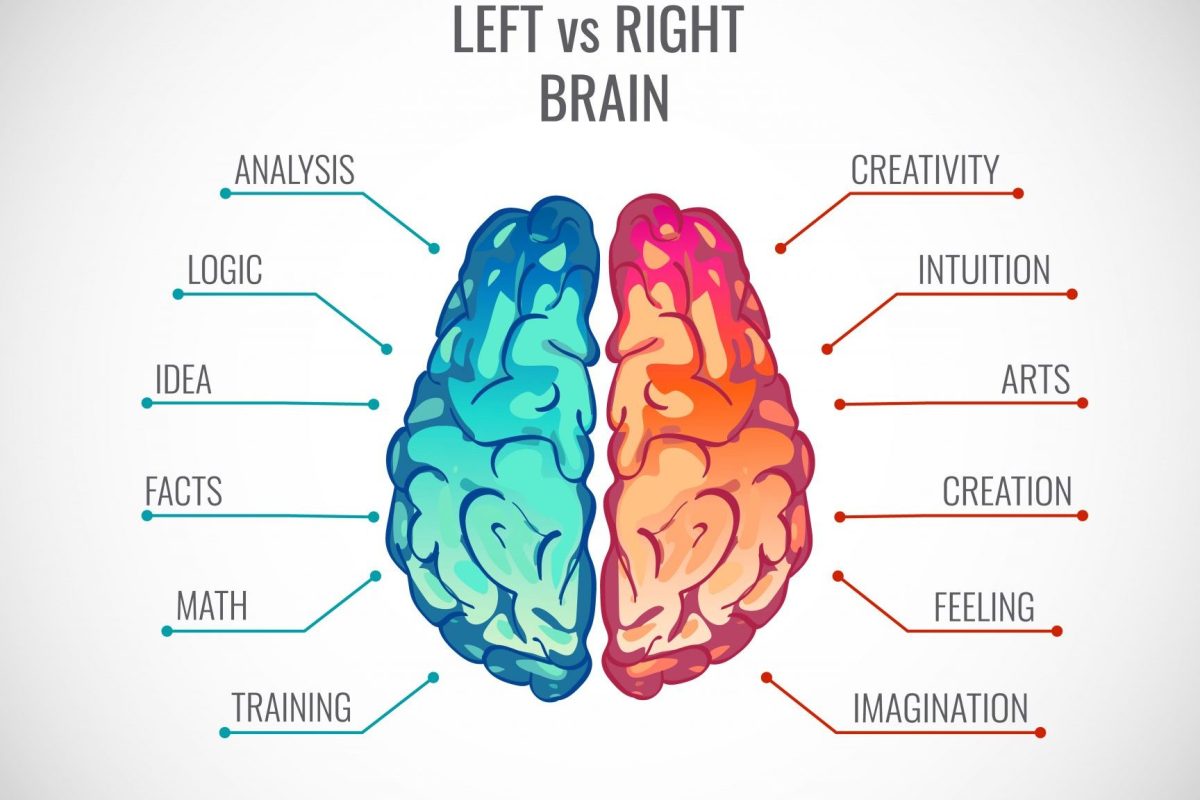
Chapter two is titled Attention. It’s about how what we attend to tends to shape our sense of reality. This is a story of the functional speciality of the hemispheres and their mediating components. Each hemisphere has its own protocols and modus operandi, each with distinct task specialisation. Important to note coming in is that about thirty per cent of all neuronal activity is inhibitory in nature. In fact, the frontal lobe is what inhibits the reflexive animal-reptilian responses allowing for some—I mean, let’s be honest here—human civil capacity. These mediating elements are designed—idiomatically, not literally—to orchestrate hemispheric activities so that each side can do what it’s best suited for.

Content

Both hemispheres attend to their environments, but they have different foci. One way to distinguish which hemisphere is focused on what, McGilchrist regards research oriented toward people with damage to one or the other part, whether by a stroke or accident. In some cases, this separation is accomplished clinically. There is a difference between right- and left-handedness, but I am not going to elaborate here.

Persons with left hemisphere damage noted difficulty writing and spelling whilst right hemisphere damaged people experienced a loss of empathy as well as a range of cognitive and emotional impairments.

Selective Attention: Invisible Gorilla Test

In general, the right hemisphere attends to the broader environment with a trade-off on specificity whilst the left hemisphere is laser-focused at the expense of the wider perspective and ability to maintain attention. Evidently, and I quote, “the left hemisphere has a tendency to ‘space out’ for seconds (sometimes 15 or more) at a time”. McGilchrist cites the invisible gorilla study where viewers are asked to watch a video clip of two teams of basketball players dribbling and passing a ball to count the number of times one team passes the ball. As this is happening, a person dressed in a gorilla costume walks into frame and makes gestures to bring attention to itself and then walks out of frame.

Focusing on the ball passing is a left-brain function that predominates right-brain activity. As it is laser-focused on the task at hand, it is oblivious to the gorilla in the midst. When re-viewing the clip without the focus activity, the gorilla is quite obviously present. He cites another substitution study that again illustrates what happens when the right brain does not have an audience.

Again, whilst “the right hemisphere is sensitive to the whole picture in space and time, background and periphery, the left hemisphere is focussed on what is central in the field of vision and lies in the foreground.” This becomes evident with hemispheric damage. When the left hemisphere is damaged, people can still perceive the full view-frame because the right hemisphere remains intact, but when the right hemisphere is damaged, less than half of the world remains. In the book, some examples follow.

The left hemisphere suffers from a stickiness problem. Without a participating right hemisphere, a person can have their attention fixated on some objects in the environment. And he points out that this is not a problem with visual perception, because tests demonstrate that subjects can be made to fixate on imaginary objects in a dark room. In schizophrenics, this fixation always occurred on the right side of the field of vision. This fixation ties into staring, which he describes as “a special kind of vision, in itself predatory: left hemisphere attention gets locked onto its target.” I’ll guess that many of us have been fixated on some activity and an unexpected interloper startles us when they become apparent. He mentions the discredited Sapir-Whorf hypothesis in passing. I won’t bother.

McGilchrist foreshadows chapter four a bit by informing the reader that the left hemisphere is grasping and apprehending whilst the right hemisphere excels at comprehending. More on this in future segments.

Another feature of the left hemisphere is that it not only ignores the majority of the environment it finds itself in, but it is also a master of denial.

Another feature of the left hemisphere is that it not only ignores the majority of the environment it finds itself in, but it is also a master of denial. For example, a person with right-hemispheric damage was paralysed on the left side of his body, yet he was not only unaware of the paralysis. He denied that he was paralysed.

In a second case, another person with right-hemisphere damage and left-side paralysis, when asked to perform tasks would comply with the requests directed toward the right side of the body but ignore or claim not to understand the directions when directed toward the left side.

What this represents is that the left hemisphere had established a map of the body that was unable to be updated because of the damage to the right hemisphere that would have provided an update. One might consider this in the manner of an old SAT-NAV when map updates needed to be manually applied. If you happen to be travelling in a new development on an obsolete map, the map will not correspond to the terrain.

As mentioned previously, the right hemisphere can be thought to present whilst the left hemisphere can be thought to re-present, having codified and archived the contents for later retrieval. The book has more types of examples including people experiencing reality through a set of freeze-frames and time elapses, but the takeaway is that the hemispheres also differ in how they interpret space, time, and motion. In fact, the right hemisphere is instrumental in perceiving three-dimensional space.

I won’t exhaust the many remaining examples in the book, though I may reference some in summary when I share my reaction and perspective. The final topic I’ll mention is that human infants are right-hemisphere dominant. They are practically all about gathering inputs without being concerned with how they map the terrain for later retrieval. They simply experience the world without the analysis and judgment the left brain later brings to bear.

Perspective

At the end of the chapter, McGilchrist provides a summary. The right hemisphere is always vigilant to what might be out there. For the left hemisphere, if it hasn’t been brought to attention, it doesn’t exist. Consider the invisible gorilla. The left hemisphere’s attention is sharply restricted in space and time. It favours precision over accuracy and at the expense of depth. It is not concerned with the “expansive, always moving, always changing, endlessly interconnected nature of reality.” The left is all about atomisation and stasis.

Unfortunately, despite all these limitations, the left still thinks it’s right. Revisiting the SAT-NAV scenario, the left brain is akin to a person staring at the screen that declares the destination has been reached. The right brain looks out the window and informs that they are decidedly not in the right place. Does one trust the instrumentation or the environment?

One undercurrent I feel is that McGilchrist wants to play the left and right hemispheres against each other to assess which is more veridical. This is where I think we differ, but the jury is still out. In his case, he wants to compare the way that each hemisphere maps to our experience of the real world. In his view, and I don’t think I am putting words into his mouth, our experience is the world because we experience it as it appears to us. In my view, experiences are simply a representative map as limited by our sense-perceptions and cognitive abilities. So, when he assesses the right hemisphere as a better reflection of reality, I say it just better captures the map.

For him, it’s either left or right. But for me, it’s right, left, or none of the above. I believe our disagreement is that I subscribe to a fitness before truth paradigm whilst McGilchrist doesn’t. I feel that fitness is the evolutionary litmus, and evolution doesn’t care about truth. In fact, assessing truth comes at the expense of energy and attention, the subject of this topic. The reason the case studies cited in this chapter are interesting is not that they illustrate some truth deficit that would render them easy prey in a Darwinian world, it’s because their perception leaves them with a fitness penalty. There is no reason to invoke some spectre of truth.

This was an interesting chapter with over a dozen clinical anecdotes. It does well to articulate the differences in hemisphere function and lends credence to left and right brain asymmetry. I feel it’s worth cracking on to the next chapter, Perception.

Before I bring this commentary to a close, I want to make an orthogonal comment. McGilchrist mentioned case studies where people reported freeze-framing. It is understood that certain birds have a faster frame rate than humans, so if they were viewing a movie running at 60 frames per second, they would not see the same continuous motion picture as a typical person; rather, they would perceive it as how we might perceive a slide show or a slow flip book. Of course, this is unrelated to the brain conversation, but the topic reminded me of the difference. For anyone who feels they need to educate me about the fact that the ocular systems don’t operate in frames per second, allow me instead to direct you to the domain of metaphor and analogy.

What are your thoughts on the split function of brain hemispheres? If you’ve read the book or at least this chapter, what was your favourite story? Did I omit your favourite? Leave comments below or on the blog.

The Matter with Things: Chapter One Summary: Some Preliminaries and How We Got Here

Index and table of contents

I’ve decided after all to share my thoughts as I journey through Iain McGilchrist’s The Matter with Things. Come join me.

Podcast: Audio rendition of this page content (6:41)

Intro and Biographical

I’ve decided, perhaps against my better judgement, to have a run at Iain McGilchrist’s The Matter with Things. At almost 3,000 pages this seems a bit daunting at the start. I debate whether I wish to pursue this course because it slows my pace significantly—perhaps allowing me to progress at a rate 15 to 20 per cent of what I might have otherwise been able to maintain. However, creating content affords me at least two offsetting benefits. Firstly, I get to share my experience with a wider audience and do so in the moment. Secondly, it allows me to better absorb and comprehend the material. As a former professor of economics myself, I internalised the aphorism “to teach is to learn twice.” Of course, this is not teaching so much as regurgitating and providing my own reactions and perspectives in places. It may be akin to learning some one-point-some-odd times. Let’s round up to two.

Biographically, McGilchrist was a lecturer of Literature at Oxford before refocusing on Medicine and then Psychiatry with an interest in Neuroscience. Interestingly, he was particularly interested in hemisphere differences in the brain and was advised strongly not to pursue this academically, as it was a certain career-killer. Besides the domain was already over-studied and summarily disproven. Iain persisted.

As it happens, the older notions of hemispheric differences were facile nonsense, but there was evidence of brain asymmetry—which will become readily apparent in the opening chapters—, and this has been his passion project ever since.

Structure

The Matter with Things is a two-volume set presented in three parts, the first two contained in the first volume. Neuropsychology—both neurological and neuropsychological—is the theme of the first part, which is comprised of nine chapters.  The second part consists of 10 chapters with a focus on epistemology.  The second volume, being the third part, is about metaphysics.

Content

The first chapter is aptly named, Some Preliminaries and How We Got Here.  Per the author, this is the most technical chapter with the added encouragement: “If you survive this, you’re good to go.”

This chapter provides some basic history of the evolution of the brain. He establishes that the “raison d’être [of the right hemisphere] is to enable us to be on the lookout for potential predators, to form bonds with mates, and to understand, and interpret the living world around us” whilst the left hemisphere’s purpose “is to enable us to be effective predators.”

This is a gross oversimplification, but details will follow. Essentially, the right hemisphere experiences the external world rather holistically as presented whilst the left hemisphere interprets, codifies, and maps this world for later access. He doesn’t mention it in this chapter, but since I’ve read a bit ahead already—so we’ll return to it presently—the left hemisphere does not, loosely speaking, interact with the external world. It creates map based on what the right hemisphere conveys of the terrain, as I like to call it, and refers only to the map from then on. This sets us up for some peculiar behaviours, but we’ll get to that in upcoming chapters.

Perspective

I don’t have much to say about this first chapter as it is pretty much scientific facts, and I don’t have any unique perspective to offer. As I expect to reserve the tail of these segments for perspective, I’ll use this allotted space for some general thoughts going in.

I am not sure where McGilchrist falls on the Realism versus Idealism front. As I understand from other sources, he believes there is an out there out there, and without our brains, perception couldn’t happen. I also understand that he’s a Panpsychist, which is to say that he believes that everything has consciousness, so it will be interesting how that all comes together. Unfortunately, I feel this is second-volume fare.

As I am an Analytic Idealist, I believe that there is an out there out there as well. But I don’t believe we have any access to its veridical nature. What we experience is a Bayesian approximation, the best guess necessary for us to survive and evolve. I mention this as I believe it is a difference of opinion I have up front, so I am offering full disclosure of a potential bias. Also, I get the feeling that he conflates this paradigm with those espousing views that we live in a Matrix-style simulation, or everything is a hologram or holograph, and one day I’ll understand the difference between the two.

If you know the difference between a hologram and a holograph, let me know in the comments or on the blog.

Have you read this book already? Are you interested in reading it? If so, stick around and perhaps you’ll gather enough information here to catch your attention.

Chapter 2, Perspective, is also available.

Hemispheres

I’ve only read the first four chapters of Iain McGilchrist’s The Matter with Things. My intent is to build up to how his ideas intersect with my workaday life in a future segment, but for now, I’ll summarise some main themes.

Podcast: Audio rendition of this page content (< 5 minutes)

The chapters I’ve read are

  1. Some preliminaries: How we got here
  2. Attention
  3. Perception
  4. Judgment

The next chapter is Apprehension.

Philosophically, or rather I have an interest in McGilchrist’s ontological model, but that appears not to arrive until the second volume, perhaps in chapters 24 or 25, respectively Space and Matter and Matter and Consciousness. Being that this underlaid my reluctance to engage with this book, I did take liberties and skimmed these chapters quickly in an attempt to discern whether he is a Realist or an Idealist.

Until recently, I’ve been a Realist with reservations, but now I consider myself instead to be an Idealist with reservations—though I may have fewer reservations, so perhaps I am moving in the right direction.

As a Realist with reservations, I felt that there was some underlying reality, but sense-perception and cognitive limitations limited access to it, so correspondence to it was necessarily limited.

As an Idealist with reservations, I feel that there is some underlying reality, and sense-perception and cognitive limitations limit access to it, so correspondence to it is still necessarily limited, so we generate an approximation.

I agree with Donald Hoffman’s assertion of Fitness Before Truth, in summary, that it is faster and more efficient to assess environmental fitness and take penalties where the assessment may have been a false positive. If one recoils in error from a coiled garden hose initially perceiving it to be a snake, the penalty is low. If a delay is incurred to assess some ‘snakeness’ truth value, we may have already been bitten. If we see something charging at us, better to avert and assess than to take time to discern. It’s of little consolation to consider, “Ah. I’m being mauled by a cheetah.” Better to have ducked and covered.

My chapter skimming was not enough to ascertain McGilchrist’s position. I’ll wait until I arrive there in due time. No need to spoil the ending. Given the book’s title, I am leaning toward Idealist, but I may be mistaken.

Moving on, these chapters build on each other. Not so much with narrative content as to represent the necessary chain of perceptual events: attention, perception, and judgment—in this order.

We cannot judge what we can’t perceive, and we can’t perceive what doesn’t come into the sense-perception space. McGilchrist reminds the reader that just because something is in a space where it can be perceived does not mean it can or will be perceived. He cites the example of the invisible gorilla in a basketball game study, which I’ll link to separately.

What we attend to is a matter of the situation and experience. Once we bring our attention to it, we can attempt to perceive it. Is it a snake or just a garden hose?  Finally, we can make a judgment—it was just a garden hose. Silly old bear. Or, I sure am thankful my reflexes are lightning quick.

Winnie the Pooh: Silly Old Bear

McGilchrist provides a plethora of examples, though most are tied to split-brain scenarios, which brings me to my last point. One of his theses is that left-right brain hemisphere differences are real and significant. Some had argued that the left-right representation is false, and he wants to take it back and regain that space by asserting arguments to the contrary.

I expect to discuss this more in an upcoming segment and apply my preliminary thoughts to my comprehension.

Reading: The Last Messiah by Peter Zapffe

I decided to try my hand at reading. I came upon Peter Zapffe when I was reading The Conspiracy against the Human Race, and The Last Messiah is a relatively short essay. It’s under 25 minutes.

My first goal was to figure out how to pronounce Zapffe. As it happens, the terminal E is pronounced as a schwa. And that makes sense. My heritage, as it were, is Norwegian. My grandad was born in Norway, emigrating during the so-called World War 2. His family surname is Gade, with the E pronounced the same way, so the name is pronounced as /gäʹdə/, but Anglicised, it the A becomes a long vowel owing to the silent E, so it becomes /geɪd/.

What was new to me is that in Norwegian, Peter is pronounced /pɛt ə/ [as if spelt Petta] rather than /ˈpiːtɚ/ or perhaps /ˈpiːtɹ/ in some American renditions more familiar to English readers.

Postmodernism is Bollox

A short podcast on the reason Postmodernism is rubbish.

Video: YouTube (added 2/9/2022)

Postmodernism is rubbish. It makes no sense, and here’s why.

The term ‘modern’ is analogous to the term ‘now’. It is a time reference that privileges the moment. With time, we have a structure of yesterday, today, and tomorrow. Now fits into a structure of before, now, and later.

Conversely, where ‘modern’ means now, postmodern would mean ‘later’, it makes no sense to label an ongoing pursuit postmodern, anymore than tomorrow can run contemporaneously with today.

Just labelling something as modern is pretentious enough. It’s similar to labels such as New Wave or New Age. It’s just trying to privilege a movement by branding it new.

So, if Modern was the new kid on the block, how might postmodern operate.

Another problem with the term postmodern is that most people considered postmodern, did not consider themselves to be postmodern. In fact, many vehemently disagreed.

A reason for this disagreement, is that the term is not owned by the purported Postmoderns. Rather, it’s a disparaging slur by so-called and improperly named Moderns.

Apart from the nomenclature challenge, postmodern is a reaction to the promise of modernity, but the reactions differ by discipline. Postmodern art and architecture are different to postmodern literature, which is different to postmodern philosophy.

And since postmodernism is rather a disparaging catchall, those with ideas not conformant to mainstream doctrine get tossed into the bin. This means that any number of feminists and post-colonialists are thrown onto the postmodernist pyre.

Here’s some food for thought. I argue that postmodernism cannot have a privileged perspective, because it claims that there is no such perspective available. If a feminist or a post-colonialist is saying anything, they are pointing out, that one needs to look through their lens too. By and large, they are not claiming that it is the lens of lenses.

In essence, if the modern lens is red, they might recommend viewing the same events through a blue lens or from a different angle. Walk a mile in another’s shoes. This shift in perspective can make all the difference.

The difference between a modern and the bolloxed-up postmodern is that the Modern thinks either that they have the only lens, or in any case, they have the right one. Moderns tend to be absolutists and universalists, so subjectivists and relativists rather rub them the wrong way.

The final thing I’d like to say about postmodernism is the notion of Deconstruction as made famous by one Jacques Derrida and misunderstood and misapplied by millions since. I’ll spare you the instruction, but I like to capture the sentiment of the way it is misunderstood by suggesting my own term, Disintegration. Perhaps, I’ll share more on Disintegrationism™ in future. Meantime, it’s just the process of breaking systems down to their core elements to inspect the working parts. Disintegrationism notes that these pieces can be re-integrated into new systems, but it makes no claim that one is better than another because that can only be determined by purpose. Another thing Moderns tend to ‘know’, is what the purpose is. Conditionally, if I know what the purpose is, I can claim to know, by extension, what the best system is.

Abraham Maslow gave us the law of the instrument, popularly conveyed as the aphorism, if you’re a hammer, everything looks like a nail. Moderns are hammers and insist that every solution can be solved as if it were a nail. Only, everything is not a nail. The postmodern reminds us that hammers don’t make the best knives or screwdrivers or spanners.

What are your thoughts on postmoderns and postmodernism? What about moderns? Is there a term you feel might better capture the essence of these two schools?