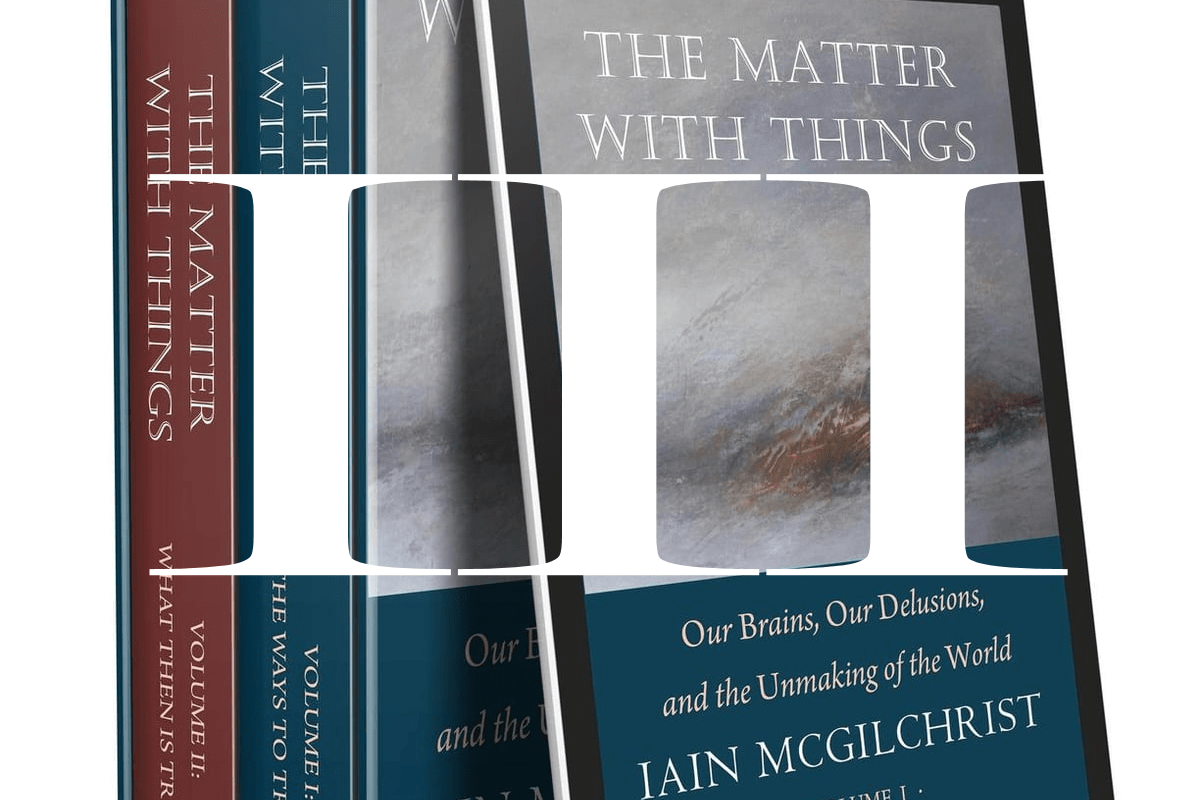
The Matter with Things: Chapter Three Summary: Perception

Index and table of contents

In this segment, I continue the journey through Iain McGilchrist’s masterwork, The Matter with Things by summarising chapter three, Perception, a followup to the previous chapters, respectively titled Some Preliminaries and Attention. I strongly recommend that you listen to these in turn, but feel free to play the rebel and cut queue. No one will even notice but you, and if you don’t tell, neither shall I. Come join me.

Podcast: Audio rendition of this page content

Intro

Chapter two of The Matter with Things is titled Perception. Following the previous chapter, Attention, it’s about how we perceive what we attend to. Without attention, there is no perception, but perception is not always correspondent with the so-called reality “out there”.  

Content

From the start, McGilchrist wants to assess which hemisphere is more veridical. Spoiler Alert: It’s the right half. But you already knew that because you’ve been keeping pace. And you also know that I feel he is leaving an option on the table, that neither is veridical to the actual terrain; rather, one just better maps the map. But the question essentially resolves to the same place, not as much verity as trust.

Sensory perception occurs in both hemispheres, but it is better in the right hemisphere than the left, as the left has been somewhat relegated to re-presentation over time—the same hemisphere that is better suited for codifying and mapping using symbolic language—something reserved for the brains of primates—which gives us a virtually inexhaustible way of mapping the world.

Perception is holistic, something better handled by the right hemisphere, being as the left hemisphere is more about focus and specificity. On balance, the right hemisphere is the arbiter of performance delegation, whether to perform a task or delegate it to the left hemisphere. About three-quarters of perception functions are right hemisphere processes.

McGilchrist is partial to the position advanced by Merleau-Ponty, that is “perception as a reciprocal encounter.” Perception is not a passive act. It is an interactive intercourse with the environment. What and how we perceive is affected by our experience and the situation.

Visual Perception

Perception involves all the available senses—and by definition none of those otherwise unavailable. He starts with vision. The right hemisphere does a lot of heavy lifting here. It handles size, shape and pattern recognition, contour, shadows, distance and depth, for example, three-dimensional space, and motion and time as well as the ability to recognise objects from unusual angles or from incomplete information, which I tend to think of as playing some Gestalt role. The right also handles colour perception, though the left maintains the colour name mapping.

The left hemisphere is slightly faster at detection, but if what is detected has any signal degradation, the right hemisphere tends to be more accurate. And since the left hemisphere is, what I’ll call lazy, it may tire quickly and space out, so the right hemisphere may have to intervene, if even a bit more slowly. Paradoxically, if the left hemisphere is given more time, its recognition error rate increases. Incidentally, one reason the right hemisphere may respond more slowly is that it is deliberating to attempt to deliver the correct response whilst the left tosses out its first best guess and declares victory. Nailed it!

Nailed It!

Recall from the last chapter that the left hemisphere is also a master of denial, so it is unapologetic when it guesses wrong. I imagine it signalling ‘that’s not a bus’ just as it hits you and then insists that it never was a bus; that injury must have been caused by something else. Perhaps it was an untoward wrecking ball. 

Without delving into details here, McGilchrist points out that much early research might be invalid because it employed cathode ray tubes—CRTs—whose mechanisms present biased information to the visual field, thereby invalidating conclusions.

the left hemisphere is better at recognising tools—hammers and spanners—, but not musical instruments, which it perceives more as living entities

An interesting area for me is that the left hemisphere is better at recognising tools—hammers and spanners—, but not musical instruments, which it perceives more as living entities. And this is an apt segue to auditory perception.   

Auditory Perception.

Whereas the left hemisphere is better at symbolic language processing and “the processing of meaningless noises, such as clicks”, the right hemisphere pretty much handles the rest, from pitch, inflexion, tone, phrasing, metre and complex rhythm, and melody. The left keeps tabs on basic rhythmic patterns. It is assumed that rhyming relies on both hemispheres working in concert.

For most people, music processing is a right hemisphere event, but this is not true for professional musicians, who utilise both hemispheres, likely owing to the musical language translation processing unnecessary for the casual listener.

Olfactory Perception

Interestingly, the acuity of the nose is orders of magnitude superior to that of the eyes and ears. Olfactory recognition and discrimination have a right hemisphere preference, but emotional reactions to scent may be stronger in the left hemisphere.

Gustatory Perception

“Apart from five very basic tastes – salt, sweet, sour, bitter and umami – which come from the tongue, all flavours come from the olfactory sense.” In general, gustatory perception is a right hemisphere function. However, there is an exception for professional wine tasters, who like professional musicians need to map experiences to words associated to rating and naming.

Tactile Perception

Remembering that the right hemisphere controls the left half of the body, whilst the left hemisphere controls the right, the sense of touch is superior in the left hand. Feelings of warmth, and temperature discriminations in general, are associated with right hemisphere activation. Interoception, the ability to perceive the internal workings of the body, is another right hemisphere process.

Local versus Global Perception

Recall that the right hemisphere captures the world holistically whilst the left hemisphere has a laser focus. This equates respectively to global and local perception. As it happens, the right can do both, but the left is limited to local. This means that if the left hemisphere is damaged, the right can pick up the slack, but if the right hemisphere is damaged, the left cannot compensate for the lost holistic perspective. In practice, the right runs the show and delegates to the left when it deems it to be appropriate for the circumstance. For some reason, normal adolescents have a bias toward local perception over global.

Pathologies of Perception

This leads us to abnormalities, such as Alzheimer’s disease. Deterioration of right hemisphere function leads to a sense of disorganisation and loss of sensation. This hemisphere is also responsible for constructing a sense of self and self-awareness. McGilchrist calls out that the term self has multiple meanings. Much of the notion of self is associated with the medial prefrontal cortex in both hemispheres, but the objectified self and the self as an expression of will (in the respect Schopenhauer spoke of) are left brain aspects.

Perception of a contiguous self over time is a right hemisphere function, the loss of which is not uncommon in cases of schizophrenia.

In discussing visual hallucinations and distortions, almost ninety per cent of these have been attributable to right hemisphere anomalies. McGilchrist shares examples over several pages, but I’ll summarise by description alone of what can be categorised under the umbrella term of metamorphopsia. These might lead to object impermanence, or viewing things as too large or too small, too close or too distant, skewed, or the wrong shape altogether. In some cases, only half of an object, including self-perception, was outsized. This might occur on a macro level or a micro level, which is to say that it may be entire objects or bodies or just faces, or just familiar faces or just eyes or just one eye.  This might occur on a macro level or a micro level, which is to say that it may be entire objects or bodies or just faces, or just familiar faces or just eyes or just one eye.

Some of these cases involved motion, for example, the sense that some object is receding away from the observer as the observer draws nearer to it.

After a journey through Charles Dodgson, AKA Lewis Carroll, and Alice in Wonderland, provides a plethora of examples in prose of some of these visual effects.

From visual hallucinations, we wonder through hallucinations of the other senses, though the data points on these are much sparser, but the left hemisphere does seem to be the culprit of most auditory hallucinations.

Perspective

To summarise, I am again left to feel that the left hemisphere is a deadbeat hanger-on. It’s there in a pinch, but it’s an unreliable narrator and worker that falls asleep at the wheel. Psychology does have a position on what a normal person should see and hear and taste and touch, but normal doesn’t mean real. 

I was hoping to see some information and perspective on synaesthesia, a condition where people perceive experiences through sense-perception organs different to normal. These people see music and hear smells or taste colours and so on. We consider this to be anomalous, but does it provide a fitness benefit, and are these people ahead of “normal” people or are they carrying excess baggage that creates a burden, even if the condition is otherwise benign.

Now that we’ve covered attention and perception, we’ll be covering judgment in the next chapter.  I hope you’ll join me.

What are your thoughts? What did you think of this chapter? Have you experienced or know of anyone who has experienced any of these so-called anomalies. Are you familiar with any of the effects mentioned in Alice in Wonderland? Leave comments below.
Using AI to Decode Speech from Brain Activity

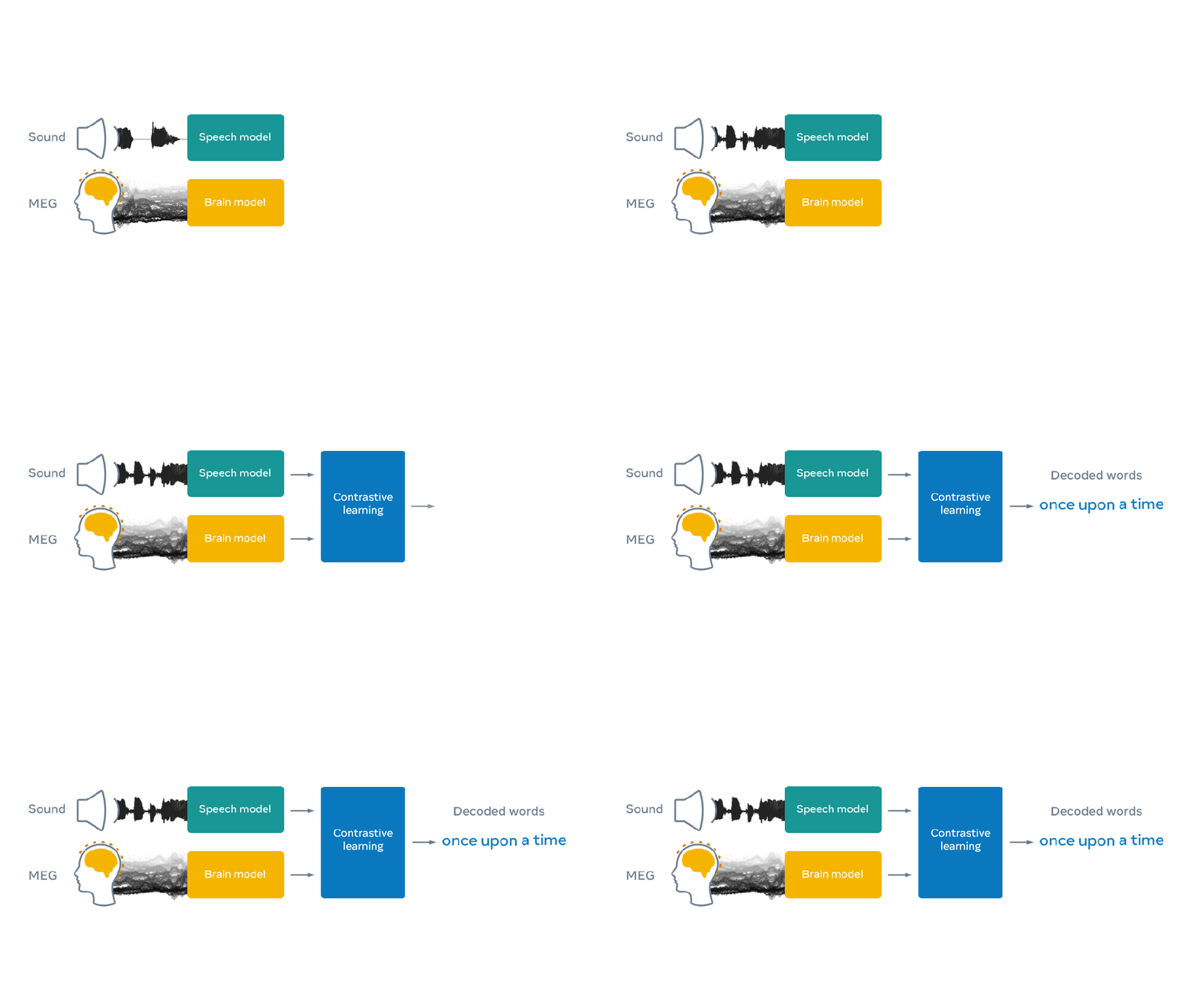
Apologies in advance for sharing PR hype from Meta (formerly known as Facebook),but I want to comment on the essence of the idea, which is using AI to decode speech from brain activity. It seems to imply that one would apply supervised machine learning to train a system to map speech to brain activity as illustrated by the image below.

Podcast: Audio rendition of this page content
To decode speech from noninvasive brain signals, we train a model with contrastive learning to align speech and its corresponding brain activity

The dataset would require the captured patterns of a large enough sample size. In this case, it appears to have been some 417 volunteers.

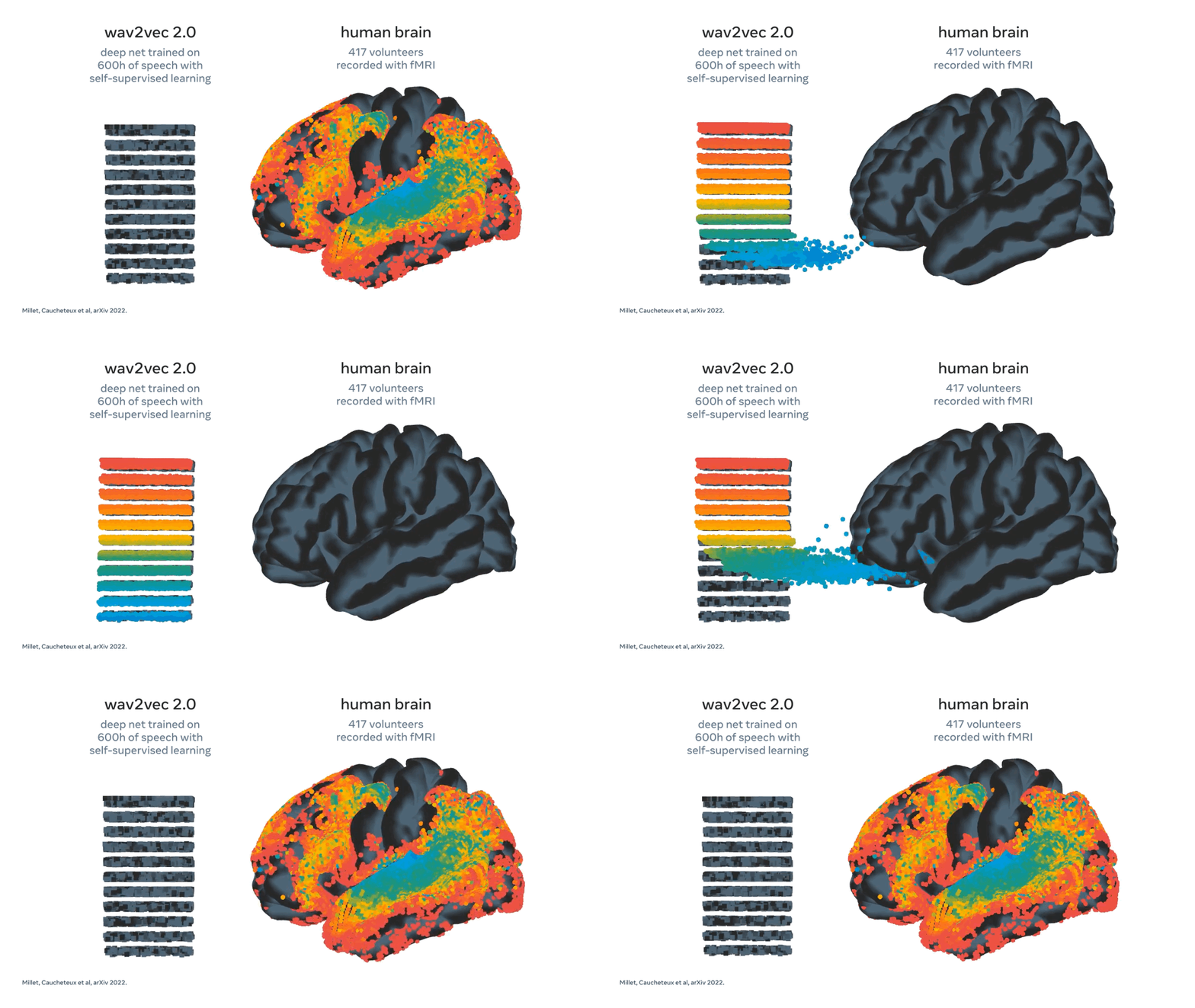
Activations of wav2vec 2.0 (left) map onto the brain (right) in response to the same speech sounds. The representations of the first layers of this algorithm (cool colours) map onto the early auditory cortex, whereas the deepest layers map onto high-level brain regions (e.g. prefrontal and parietal cortex).

This feels like it could have many commercial, consumer, and industrial uses including removing other human-computer interface devices, notably keyboards, but perhaps even mouses. Yes, I said mouses. Sue me.

Given hypotheses related to language and cognition, I am wondering what can be gleaned by mapping different multiple native language speakers to cognitive processes in order to remap them to speech output if it would be able to arrive at some common grammar that could then output a given thought stream into any known (and mapped) language, allowing for instantaneous “translation”.

Of course, a longer-term goal would be to skip the external devices and interface brain to brain. This sounds rogue science fiction scary, as one might imagine an external device trained on a brain to read its contents. One of the last things this world needs is to have to worry about neuro-rights and about being monitored for thought crimes. Come to think of it, isn’t there already a book on this? Nevermind. Probably not.

Technology is generally not inherently harmful or helpful, as that is determined by use. Humans do seem to tend toward the nefarious. Where do you think this will go? Leave a comment.

The Matter with Things: Epigraph and Introduction

Index and table of contents

I am actively engaged in summarising Iain McGilchrist’s book, The Matter with Things, but I’ve been remiss in not sharing the introduction. Rather than do that, I’ve happened upon Iain reading these pages himself, hosted on his YouTube channel.

It’s about a half-hour long. In it, he establishes some main themes and rationales. As this book builds on his previous book, The Master and his Emissary, he shares references to that book rather than rehash it in this one. So whilst he expands on some ideas, he doesn’t necessarily go into the same depth and retread the same grounds. This won’t result in a loss of comprehension for the purposes of this book, but additional depth can be achieved by reading the former.

The Matter with Project Managers

Index and table of contents

Several of my esteemed colleagues prompted me to become familiar with Iain McGilchrist. I had viewed hours upon hours of his lectures before I decided to commit to his latest book and likely magnum opus, though I don’t want to sell him short. The Matter with Things is an approximately 3,000-page, two-volume tome. To be fair, it’s about 1,600 pages of narrative content with the remainder being appendices, a bibliography, an index, and other such back matter.

Podcast: Audio rendition of the content on this page.

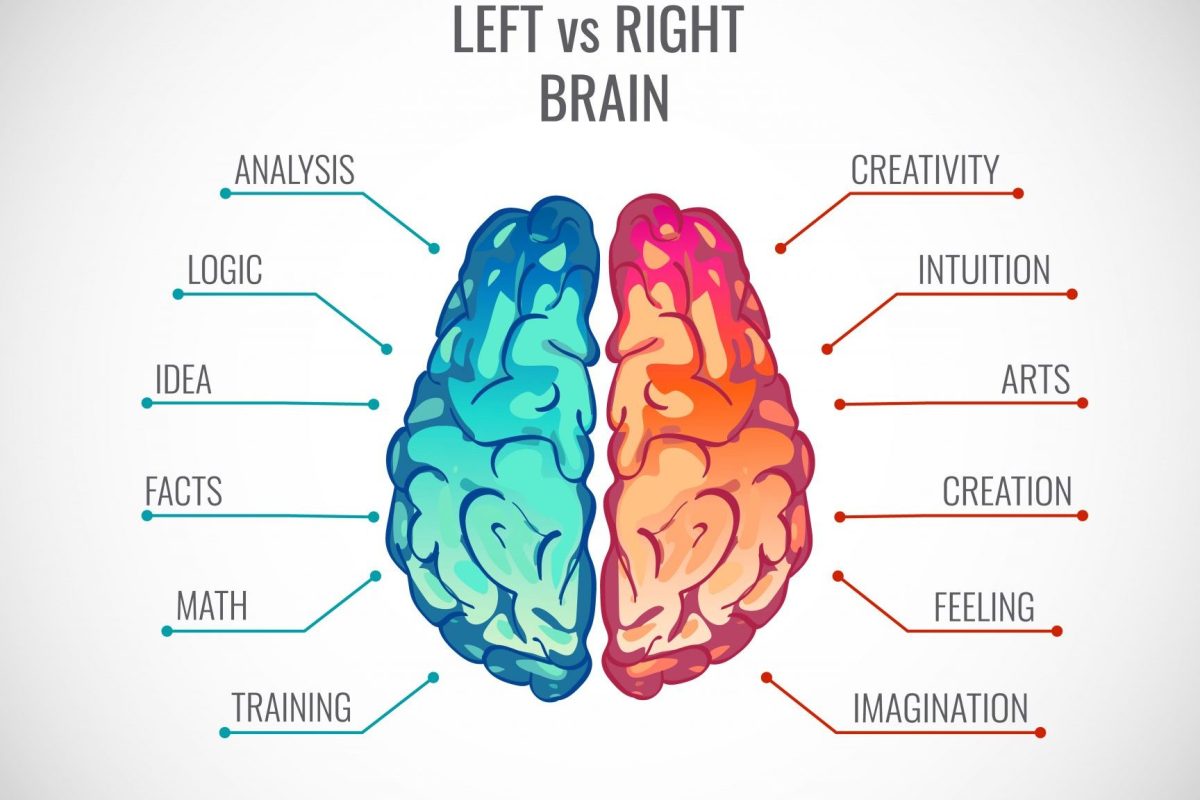
I’ve mentioned much of this before, but I am writing this post with a particular LinkedIn audience in mind, whom I don’t expect to be familiar with my prior commentary, though they are invited to explore more. McGilchrist’s thesis is that the human brain operates with asymmetrical hemispherical differences. These differences are not the facile “left-brain analytical, right-brain creative” distinction of yore, rather the differences are more nuanced. If you are interested in the minutiae of this, stick around and read past and future posts when they arrive, as I’ll be documenting my journey through these volumes presently.

So, what’s the matter with project managers? And why bring up project managers? In my workaday life, I’ve often been asked to perform project management functions, something decidedly not my forte. I could be reading into and am guilty of reductionism, but in reading The Matter with Things, I may have stumbled onto something with explanatory power. So let’s pause for a quick reflection.

Pistachio in hand

In a very small nutshell. I’m talking, perhaps, pistachio-sized here. The right brain hemisphere is the part that experiences the world as it is. The right brain is not about making judgments and categorising. Rather, it’s about just absorbing without interpreting, per se. On the other hand, the left brain hemisphere interprets, codifies, and maps this world for later access. Again, forgive the over-simplification, but this is the information pertinent to the matter at hand—a very left-hemisphere control function, I might add.

It turns out that the left brain is not so much concerned with the outside world at large. Once it has its map, it is rather content to reference it from there on in unless the right brain nudges it to pass along more information. Whereas the right hemisphere opens possibilities, the left hemisphere shuts them down. If you’ve read Daniel Kahneman’s work, Thinking Fast and Slow, you may notice certain parallels. I’d be interested to know if McGilchrist comments on this. Perhaps a later topic.

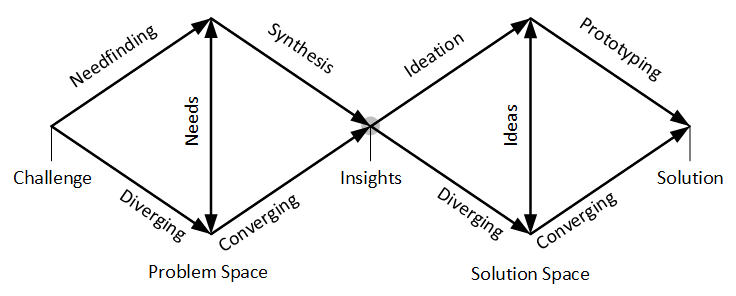
Borrowing from some aspects of Design Thinking, there is a double diamond design process model. I purloined one from the internet that will work for my purposes.

Double Diamond Design Process Model

I feel that I can simplify and assume that the diverging activity represents a right hemisphere strength whilst the converging is more apt to be a left hemisphere activity.

The right brain is not only always open to seeing options and opportunities, it actively seeks them. The left brain just wants to close any discussion and settle on a decision or an answer.

From an evolutionary perspective, the “raison d’être [of the right hemisphere] is to enable us to be on the lookout for potential predators, to form bonds with mates, and to understand, and interpret the living world around us” whilst the left hemisphere’s purpose “is to enable us to be effective predators.”

A right-hemisphere dominant person will likely continue to play what-if until the cows come home. A left-brain dominant person will take the first semi-viable solution and want to run on it. No need for deliberation. In a balanced scenario, the left and right hemispheres will battle for dominance, but they will arrive at a good-enough solution.

And this is where project managers enter the picture, and where I exit. I am decidedly over-indexed on the right brain. Among other things, I see options and possibilities. And, sure, I have enough balance to resolve to take action, but I don’t lose track of the possibilities and I am always ready to change course at a moment’s notice—what we call pivot in the business—or perish as the case might be.

The project manager, on the other hand, sees the map. This represents practically inviolable marching orders.

Disney Sorceror’s Apprentice Brooms-Flood Scene

One aspect of a good project manager is the ability to filter out the noise. Rather, this is what a right-brain person would surmise. Instead, the left-brain person doesn’t even register the noise. Where a right-brain person has to expend energy continually filtering out options and possibilities, the left-brain person never registers these options from the start. So, where I as a right-brain person may find it exhausting to actively and continuously limit this noise, this threshold is never triggered for the left-brainer.

In closing, I want to remind you again and again and again, that this is a gross oversimplification and rather metaphorical in nature. Nonetheless, I feel the that it is germane and offers insights into why some people are more apt at certain tasks than others.

I want to emphasise that one side is not better than the other. A right-dominant person is not superior to e left-dominant person, and vice versa. As with the brain itself, these can be complementary. Some people are very capable of tasking whichever hemisphere is necessary, but this is rarer than one might at first assume. McGilchrist provides many examples, so you can read them for yourself firsthand, or you can follow along as I call out key highlights in The Matter with Things.

If you have any comments or suggestions, feel free to leave them in the space provided.

Hemispheres

I’ve only read the first four chapters of Iain McGilchrist’s The Matter with Things. My intent is to build up to how his ideas intersect with my workaday life in a future segment, but for now, I’ll summarise some main themes.

Podcast: Audio rendition of this page content (< 5 minutes)

The chapters I’ve read are

  1. Some preliminaries: How we got here
  2. Attention
  3. Perception
  4. Judgment

The next chapter is Apprehension.

Philosophically, or rather I have an interest in McGilchrist’s ontological model, but that appears not to arrive until the second volume, perhaps in chapters 24 or 25, respectively Space and Matter and Matter and Consciousness. Being that this underlaid my reluctance to engage with this book, I did take liberties and skimmed these chapters quickly in an attempt to discern whether he is a Realist or an Idealist.

Until recently, I’ve been a Realist with reservations, but now I consider myself instead to be an Idealist with reservations—though I may have fewer reservations, so perhaps I am moving in the right direction.

As a Realist with reservations, I felt that there was some underlying reality, but sense-perception and cognitive limitations limited access to it, so correspondence to it was necessarily limited.

As an Idealist with reservations, I feel that there is some underlying reality, and sense-perception and cognitive limitations limit access to it, so correspondence to it is still necessarily limited, so we generate an approximation.

I agree with Donald Hoffman’s assertion of Fitness Before Truth, in summary, that it is faster and more efficient to assess environmental fitness and take penalties where the assessment may have been a false positive. If one recoils in error from a coiled garden hose initially perceiving it to be a snake, the penalty is low. If a delay is incurred to assess some ‘snakeness’ truth value, we may have already been bitten. If we see something charging at us, better to avert and assess than to take time to discern. It’s of little consolation to consider, “Ah. I’m being mauled by a cheetah.” Better to have ducked and covered.

My chapter skimming was not enough to ascertain McGilchrist’s position. I’ll wait until I arrive there in due time. No need to spoil the ending. Given the book’s title, I am leaning toward Idealist, but I may be mistaken.

Moving on, these chapters build on each other. Not so much with narrative content as to represent the necessary chain of perceptual events: attention, perception, and judgment—in this order.

We cannot judge what we can’t perceive, and we can’t perceive what doesn’t come into the sense-perception space. McGilchrist reminds the reader that just because something is in a space where it can be perceived does not mean it can or will be perceived. He cites the example of the invisible gorilla in a basketball game study, which I’ll link to separately.

What we attend to is a matter of the situation and experience. Once we bring our attention to it, we can attempt to perceive it. Is it a snake or just a garden hose?  Finally, we can make a judgment—it was just a garden hose. Silly old bear. Or, I sure am thankful my reflexes are lightning quick.

Winnie the Pooh: Silly Old Bear

McGilchrist provides a plethora of examples, though most are tied to split-brain scenarios, which brings me to my last point. One of his theses is that left-right brain hemisphere differences are real and significant. Some had argued that the left-right representation is false, and he wants to take it back and regain that space by asserting arguments to the contrary.

I expect to discuss this more in an upcoming segment and apply my preliminary thoughts to my comprehension.

What Is Love?

I love the panels, interviews, and insights presented on The Institute of Art and Ideas channels. In this segment, I am familiar with the host, Robert Lawrence Kuhn, who has put this all together, and two of the panellists, Iain McGilchrist and Donald Hoffman. I am not familiar with Eva Jablonka or Michelle Montague. This is an interesting conversation on consciousness, but I am commenting on McGilchrist’s position on love and how science can never capture the essence or dimensions of it because it is subjective and experiential. I’ve cued the video clip below to just prior to his response to provide he view with a set up.

As I’ve been saying for some decades now, I believe that love is a weasel word in the realm of justice and freedom. It’s an archetypal extreme, but it doesn’t mean anything more than trebled or analogical references.

McGilchrist resorts to the age-old, you don’t know it if you haven’t experienced it. This was famously captured by the US Supreme court’s take on pornography, “I can’t tell you what it is, but I know it when I see it.” This is used with God and faith as well. So, bollox, really. They’ve got nothing. And if you haven’t experienced it, then you aren’t a member of the club, and it’s your loss. Rubbish.

From the transcript, Iain tells the viewer (edited below for clarity),

“Love is a very real experience. and you only know it when you’ve had it. But it’s something that science can only refer to physical correlates of—rather ineffectively… But it’s not the same as knowing what love actually is.

“And the same is true of consciousness. It’s a subjective phenomenon, and as such, it’s not open to the kind of science that that i think is being required.”

Notice that this is the same defence asserted by religions. If you are seeking evidence, you are barking up the wrong tree. The evidence is that you can experience it, but this is not a shared experience. The shared experience occurs when people who feel they have had a similar experience can gather together and compare notes and share stories like they were participating in a 12-Steps program. Hullo, my name is Bukowski, and I’m an alcoholic.

Love is a delusion. Consider the notion of romantic love —just one of several purported flavours of love. What do we mean by this? We mean that we are very attracted to and emotionally attached to some other entity. Let’s limit this to other people. We care for this person and about what happens to this person, and we’d presumably like to remain a partner with this person. Generally, there would also be a sense that the other party reciprocates this feeling, but unrequited love is another aspect.

Given this state, we can measure hormonal changes, pupil dilation, and other physiological changes. And if we want to label this state love, then great. In practice, that’s what we’ve done. But so what? All we’ve really done is to take a bundle of descriptions and collated them into a nebulous term.

There are a couple of perspectives on this type of love. There is the person who senses their own feelings about their experience of love, as in “I love X”. Then there is a target of this love who may experience that they are loved by someone. Finally, there is the observer that might assess that Y loves X and or vice versa.

But what does this really mean? Is it just that Y like X very very much and has painted a picture of a future than includes this person? That Y has constructed some narrative storyline that includes X? That there is likely some lust involved in this particular flavour of love? Is love more than this? Is love more than just a shortcut? Is it just an acronym for “Likes Other Very Extremely”? Alright, I’ll stay out of the acronym construction business and end this just now.

Sovereign Persons

I do not wish to be either ruler or ruled

Pierre-Joseph Proudhon

I have agreed with this sentiment for as long as I can remember, at least stretching back to age 10 or 12 and long before I had ever heard of the likes of Proudhon. I don’t believe that Proudhon is a big focus in the United States. I never encountered him in all of my studies from kindergarten to grad school—and I was an economics major.

In the US, disparaging Marx was always in vogue, with the off-hand remark along the lines of “Communism works on paper, but because of human nature, it can’t work in practice. And by the way, look at the Soviet Union. That’s all the proof you need.” Of course, I was left thinking that at least it worked on paper, something I can’t say with a straight face for Democracy.

For those who are familiar with Proudhon, he is likely remembered for his quote, “Property is theft!” I’ve discussed this before.

La propriété, c’est le vol!

Property is theft!

But this is a different quote: “I do not wish to be either ruler or ruled.” When I was in high school, there was a saying, lead, follow, or get out of the way. As imperfect of a metaphor as it is, I just wanted out of the way. In the world of leaders and followers, I wanted to be an advisor. In a manner—given the false dichotomy of followers and leaders—, this relegated me a de facto follower. Only I am not a follower. I not only question authority and authority figures, I question the legitimacy of their power. Not a great follower, to be sure.

I feel I am the peasant in Monty Python’s Holy Grail who tells King Arthur upon encountering him, “Well, I didn’t vote for you.” Not that voting yields some source of legitimacy. What options does one have?

Philosophically speaking, there is no justification for personal bodily autonomy. Someone just made this claim, and some others agreed. Sounds good to me, but there is no real reason to support the idea save for selfish rationale.

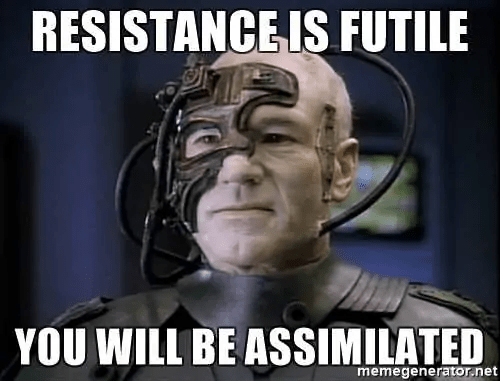
The science fiction staple, Star Trek, famously created a Borg where autonomy was futile. Because of our acculturation, we find this idea perhaps silly or perhaps appalling or absurd, but one is not more justifiable than another except by rhetorical devices. Yet neither is right.

Resistance is futile!

In the West, we tend to prefer a rather middle path, and perception doesn’t actually comply with reality. I think that people believe that they are more autonomous than they are. I’d be willing to argue that this is the same delusion underlying a sense of free will. Sartre might have argued that we each retain a sort of nuclear option as a last resort, but a choice between two options is hardly freedom. It sounds a lot like Sophie’s Choice (spoiler alert).

Not so come across like Hobbes, but I do feel that violence (subject to semantic distinction), or at least the potential for it, is inherent in any living system. With political and legal systems, violence just shifts from explicit to implicit, and so out of sight, out of mind.

In any case, I do not wish to be either ruler or ruled. I just want to advise. I’m an introvert. I want to be left alone. I value the benefits of society and I participate at the margins, and that’s where I prefer to remain. If the direction of the train I am on seems to be running off the tracks I’d presume it should be on, then I’ll get vocal. Otherwise, I’ll take the privilege to concentrate on cerebral and philosophical interests.

I’ll advise you to do the same.

The Meaning of Life for Sisyphus

In pursuit of my travail intellectuel, I stumbled on a thought experiment proposed by Richard Taylor regarding an old crowd favourite, Sisyphus.

Of course, Albert Camus had famously published his Myth of Sisyphus essay (PDF), portraying his life as analogous to the workaday human, absurdly plodding through existence like rinse and repeat clockwork—same gig on a different day.

Given my perspective on human agency and the causa sui argument, I felt commenting on Taylor’s essay, The Meaning of Life (PDF) would be apt.

The story of Sisyphus finds the namesake character, fated by the gods to each day push a stone up a hill only for it to roll back down for him to push it back up every day ad infinitum. Camus leaves us with the prompt, ‘One must imagine Sisyphus happy’. But must we.?

As Taylor puts it,

Sisyphus, it will be remembered, betrayed divine secrets to mortals, and for this he was condemned by the gods to roll a stone to the top of a hill, the stone then immediately to roll back down, again to be pushed to the top by Sisyphus, to roll down once more, and so on again and again, forever. Now in this we have the picture of meaningless, pointless toil, of a meaningless existence that is absolutely never redeemed.

Taylor wants us to consider an amended Sisyphus. He writes,

Let us suppose that the gods, while condemning Sisyphus to the fate just described, at the same time, as an afterthought, waxed perversely merciful by implanting in him a strange and irrational impulse; namely, a compulsive impulse to roll stones.

This significantly alters the dynamic. In the scenario, Sisyphus is not toiling; rather, he is pursuing his passion—following his heart. This is the athlete, artist, politician, or mass murderer following their passion. In fact, one might say that he is being his authentic self. He has no control over his self or his desire to roll stones, but he is in his element.

Taylor’s ultimate point is that in either case, the life of Sisyphus is just as devoid of meaning. Ostensibly, nothing can provide meaning. The best one can do is to have the perception of meaning. He writes,

Sisyphus’ existence would have meaning if there were some point to his labors, if his efforts ever culminated in something that was not just an occasion for fresh labors of the same kind. But that is precisely the meaning it lacks.

Although we cannot control what is within, contentment and happiness derive from perception. As we might be reminded by the quip attributed to Schopenhauer,

We can want what we will,
but we can’t will what we will.

In the end, Taylor wants us to know that nothing out there can make us happy.

The meaning of life is from within us, it is not bestowed from without, and it far exceeds in both its beauty and permanence any heaven of which men have ever dreamed or yearned for.


I’ve subsequently read some critiques of Taylor’s position, but I don’t want to take the time to rejoin them. Suffice it to say that I find them to be weak and wanting.

Blaming and Naming

When I was writing my review of Elbow Room, this categorical syllogism came to mind:

P1: All agents are responsible

P2: I am an agent

C: Therefore, I am responsible

Now I want to unpack it.

Podcast: Audio rendition of this page content

The first premise is that all agents are responsible. Of course, this hinges on how one defines agent and responsibility. It also depends on the scope, especially of the agent but to some extent also the scope of responsibility.

Leveraging the Causa Sui argument, the agent is a social construct and can only be responsible to what extent s/he has been programmed as well as the ability to maintain and process the programming effectively—so without bugs to continue with the parlance.

If the agent is immature or defective, expectations of responsibility are diminished.

If certain inputs were not given, there is no reason to assume a related command would be executed. This is why so much time and energy is spent on programming and evaluating children.

This first premise is predicated on the pathological need to blame. Unwritten behind the responsibility claim is that I feel compelled to blame. Blame requires responsibility, so if I want to blame someone, they must be responsible. In any given circumstances, I may feel the urge to blame anyone, so all agents [eligible people] are worthy of blame. There is no particular reason to exclude myself, so I too am blameworthy. What’s good for the goose is good for the gander, eh?

Goose and Gander. Strike that pose.

As PF Strawson said, even if moral responsibility couldn’t possibly exist, it would be invented because people need to blame. This is in line with Voltaire’s commentary on God.

Si Dieu n’existait pas, il faudrait l’inventer.
If God did not exist, it would be necessary to invent him.

Voltaire

We can all look around and see how pervasive the god delusion is. Moral responsibility is even more insidious. In principle, moral gods were invented for just this purpose. An omnipresent judge was needed to keep the big house in check.

Where I Stand

From my perspective, I do feel that a person in the space of Dennett’s elbow room can have responsibility. Being a non-cognitivist, I have more difficulty accepting the arbitrary imposition of morality, but I understand the motivation behind it.

The problem I have is that mechanisms to ensure that the inputs and processes are all in order and there are no superseding instructions are not in place. Moreover, if the superseding instruction does not comport with the will of the power structure, it will be marginalised or ignored. This is a limitation of morality being a social construct, and none of this gets past the ex nihilo problem causa sui invokes, so we end up cursing the computer we’ve invented. O! monster of Frankenstein. O! Pygmalion.

Freud and Moral Responsibility

Morality is a social construct, but so are notions of identity and self. Upon reflection, psychology, a discipline I already hold in the lowest regard, is only the minutest subset of sociology. Without society, psychology would have nothing to study.

Sociology is more focused on structure and interrelationships whilst psychology concerns itself with the individual agent’s psyche. Sigmund Freud did recognise this by the taxonomy of id, ego and superego. It seems that by Freud’s reckoning, the id is a stand-in for volition, rather unconscious reactions, whereby the ego is more reflexive and tempered by the external world. Employing this model, in at least one way of thinking, the id represents the bare and authentic self whilst the ego is the accumulation of inputs.

Put in causa sui terms, the id is the result of inherited genetic temperament and the ego is the result of societal forces as interpreted by the id and any antecedent ego.

Remember, one function of the brain is as a Bayesian prediction engine that evaluates new inputs and forms a new sense of perceptual reality and fitness to operate in this universe.

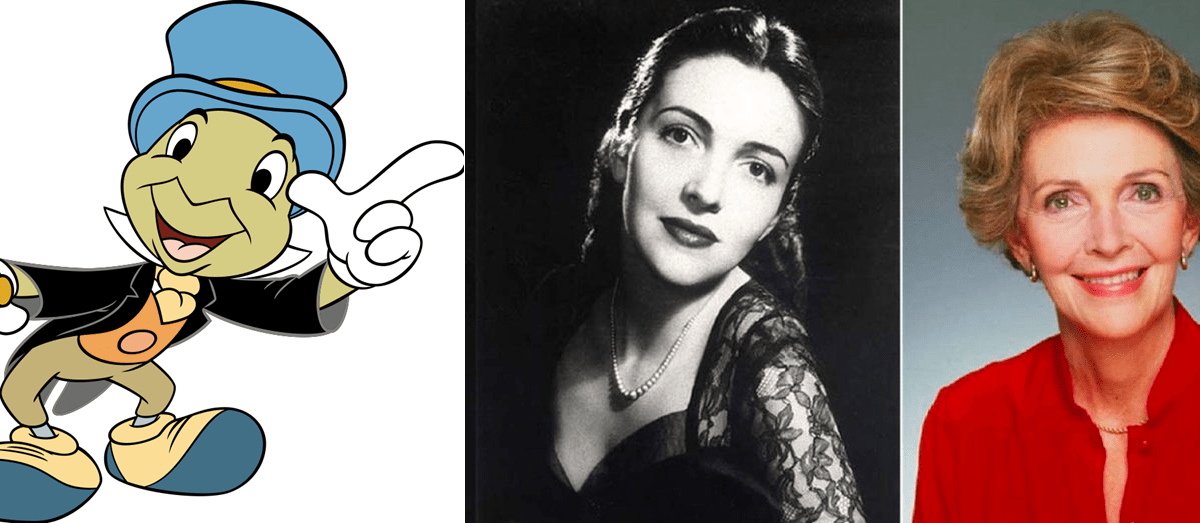
Freud’s superego is ostensibly a part of the ego gone underground—, most of it operating beneath the surface. It’s what I’ll consider being the Nancy Reagan of the psyche—just say no*. It’s Jiminy Cricket. Apologies for not having more contemporary conscience references. I suppose my age is showing.

According to Freud, most of who we are is a social construct, save for the kernel of the id, the proto-self. The ego is the part almost—but not all—above the surface, manifest in consciousness. Conversely, the superego has the reverse configuration, existing almost entirely below the surface. One might even be tempted to argue that the portion of the superego above the surface has actually already been assimilated into the ego.

So, we’re animated sausages, skins stuffed with social cues. Some of these social cues are also moral codes, but many moral codes are inherently unstable and vary by context. And there are local and global morality sources. For example, most religious doctrine is local, so a text authored by a venerated leader in one area may not be venerated outside of that context. In some cases, the directive contains no moral content—don’t eat pork or shellfish or take Saturdays off—whilst others do—love thy neighbour as thyself. Still, they are all social constructs.

If one has no interactions with the other culture, these societies can coexist without challenge, but when a ‘take off on Saturday’ group intersects with a ‘take off Sunday group’, there may be friction, each chiding the other for their nonsensical belief in the manner of Dr Seuss’ Sneetches.

Given this, when discussing morality, we are forced into a structure built on shifting sand. The challenge is that some people believe this ground is bedrock, and power structures insist it is in order to leverage a more solid foundation to maintain power and control.

If we are in some milieu, we are then forced to comply with their norms and morés or be cast out or marginalised, perhaps even scapegoated as Girard might suggest.

Meantime, just take morality with a grain of salt and remember that as will all things human, there are flaws in the logic and outcomes. Also understand that even if these outcomes are flawed and you need to participate in that society, you probably need to remain under the radar—easier for some than others—, conform, play the eccentric, or perish.

* Apparently, Nancy could say no to just about anything except for giving blowjobs. Perhaps this is what saved Ron from the same fate as Bill Clinton, but who am I to say? No shame in that is my position.