My mind is a Pachinko machine; my brain fatigued. Add to this the environmental distractions, such as breakfast, and it’s not conducive to focus. Today, it’s scrambled eggs and dry muffins—sans jam or butter, only some whipped substitute unfit for human consumption,
My prompt for writing the recent post on Professionalism was my reaction to the hospital staff and their demeanour—or as a colleague suggested in a comment, decorum. Perhaps I can remain focused on the words on this page as I type.
For service staff, warmth is a necessary ingredient of professionalism. This is particularly true for persons in the healing arts. The top indicator for pursuing legal action in a medical malpractice suit is the doctor’s bedside manner—personality and disposition—, whether the patient feels a personal connexion—a human connexion.
My experience in hospital is that the Medical Doctors have been hit or miss in the department—more miss than hit. I can even recall the names of the memorable ones. I suppose were I to be ill-treated, I’d remember as well. Here, it’s either treated nicely as a human or otherwise as an object in an assembly line. Thankfully, there have been no mistreatments or abuse.
The Registered Nurses had a better warmth ratio. Asking my circle of family, friends, and associates, this seems to be the general consensus. The rest of the staff were somewhere in between.
This warmth or human connexion extends beyond healthcare and to the service industry where human-to-human contact is made, even where that connexion is virtual—perhaps more so in order to bridge the distance. In my experience, the human factor tends to fall more at or below the level of the Medical Doctors. Any warmth is accidental. I am not saying that the people themselves lack compassion—though that could be the case. Rather, I am saying that they are moulded into automatons by the systems they are part of. It saps people of their humanity.
I started writing a post titled Bureaucracy is Violence, but I never completed it because I got lost in research. In a nutshell, bureaucracy is a Procrustean bed. I’ll leave it there for now. If you know, you know. Meantime, rage against the machine.
Do not go gentle into that good night. Rage, rage against the dying of the light.
It’s good to remember that words are but a small portion of communication, which operates in a larger space. Body language, gesticulation, facial expressions, speed, tone, inflexion, and intonation, all combine to convey at least as much. This is why a written document is always lacking. This is why important or sensitive information should be delivered in person unless you are willing to risk misinterpretation.
In the post-covid reality, some people have moved a lot of their previously face-to-face communication to one of the various videoconference services. Infants rely highly on the face, and they express much through the face. Even domesticated dogs have expressive faces. The face conveys a lot of information. This helps to make videoconference a decent means of communication. It is a step up over the telephone for instant communication, but it still falls short. Even over the phone, one can still use delivery speed and pacing. Tone, inflexion, and intonation should be able to be conveyed, but this may also be limited by connexion quality as well as microphone and speaker quality. However, body language and gesticulation are still largely absent. What may be present can be lost over a small viewing screen or poor video quality.
What gets left behind or limited are cues of authenticity and trust. I remember I had a client in Texas who preferred not to speak with my manager and other executives from the New York office. We had all met in person in the pre-Covid world, and the Texans had judged these people as “fast-talking city folks” instead of real down-to-earth people. I may be a city-slicker, but I’m not as fast-talking. One of these men was a great communicator in my eyes, but these are city eyes. As for the other person, he had snake-oil salesman written all over him, but he tried to hide it in all his erudition. He was very book-smart but lacking in authenticity.
mean what you say, and you say what you mean
Allow me to pause for a moment to riff on authenticity. In one way, I don’t believe in authenticity because I don’t believe there is anything to be authentic to. I write about this in many posts and at length. On the other hand, authenticity is that you believe what you are saying—you mean what you say, and you say what you mean. So what you are asking me to believe, you believe yourself.
If spoken communication is so important, why do you write a blog? That a picture is worth a thousand words is telling. In fact, a picture may convey a thousand words, but it’s probably conveying almost infinite words—or it could be. Words typically fail to transmit metaphor and intent. If we want to be clear, we need to add all sorts of additional words to allay confusion. Perhaps we need to include background information, tangential information, context, and whatnot. By the time we include all of the information that would be conveyed by the face and gesture, we’ve probably overwhelmed the recipients with a document that reads like a terms and conditions page—the ones almost no one reads but tick the box at the end anyway.
What is lost or diminished over video is authenticity and emotional content. Of course, a person can convey sympathy, empathy, and compassion over the phone, but to me, it’s like the wire monkeys in the old psychology experiments by Dr Harry Harlow. You get something to cling to—perhaps even a blanket around the wire is better than nothing. If the telephone is a wire monkey, videoconference is the wire monkey wrapped in a Teri-towel. The human element is still missing. We’re interacting with a simulacrum.
Princess Leia Organa
Some people are amazed at the prospect of holograms in the manner of Princess Leia’s grand entrance. “Help me, Obi-Wan.” Indeed, help us all. It is a step in the right direction, but mind the gap.
In the end, we should at least strive to prioritise in-person communication. At least in the movies, when they want to tell a loved one that their combatant or police officer has fallen (read: died), they do this in person. It should be telling that this also convey’s an emotional message to the audience that is often received as intended. It may cost more, but be sure to evaluate this cost against the benefits. Consider the lost benefits as well.
I’ve just finished reading Iain McGilchrist’s The Master and His Emissary, having paused The Matter with Things to put it to bed. The book is divided into two sections. The first lays down the neuroscientific base whilst the second contains expository forrays. Technically, one might argue that there are three sections as the last unnumbered chapter seems to stand alone from the second part. It’s only one chapter containing some 36 pages, so I’m not going to lose any sleep over it. But this will not be a book review, as highly recommended as it is.
I’ve been a vocal proponent of hiring neurodiverse people into certain roles. Having read the book and absorbed the rationale, it’s easy to see how it aligns with and supports some of my own experiences. In particular, I’ve noticed that many companies hire autism spectrum on the Aspergers end of the scale. These people tend to be hired into IT and programming roles—functions already having reputations for being staffed with socially awkward and low EQ individuals, characteristics of people on the spectrum. It makes sense because left-hemisphere-dominant managers evaluate this hyper-left-hemisphere-dominant cohort as assets. Without getting too deep into the territory of stereotypes, in general, this group are laser-focused and doggedly pursue tasks at hand without tiring. I’ve met plenty of ADHD-diagnosed people in these roles, too—not as many, but also employed in technology-oriented positions.
The underrepresented class are right-hemisphere-dominant people. To be fair, I’ve encountered many Creative people in Agencies, but their right-hemisphere life is separate from their left and not appreciated in the workplace. They mainly exercise their right-hemisphere life outside of office hours on personal passion projects. I’d also be willing to bet that these people are not truly right-hemisphere-dominant. Rather, they have the ability to balance and allow the left hemisphere to take over during business hours.
In some cases, these people happen to have right-hemisphere insights into a project or have some creative inspiration off hours to benefit the work of the next day. But the right hemisphere is not time-boxed. It doesn’t function on demand. In fact, it shuts down on demand, and the left introduces bootleg knock-offs. Of course, this doesn’t matter, as it is probably better than their left-hemisphere managers and clients and good enough in their eyes. I’m not convinced they’d actually recognise the right-hemisphere solution as better because the left hemisphere prefers its own tribe anyway.
If you are reading this and you are saying, “They’re running a business. They can’t wait for weeks or months for a resource to have the epiphany of a creative solution,” you’ve made my point, and you’ve presented strong evidence that you are operating from your left hemisphere as well. There’s no shame in this. The first step is to admit there’s a problem.
My point is not to antagonise left-hemisphere-dominant people or the fact that they’re at home with other like-minded people. It’s only natural. They usually find right-hemisphere types to be too eccentric for their taste anyway.
But these right- or balanced-hemisphere thinkers, not given the space for their right-hemisphere to yield benefit, are likely in a Creative function, whether in art, illustration, copywriting, or some such. They are like unicorns outside of this context.
As for me, I am at times balanced and at times left. At other times, I’m purely right, though this is admittedly short-lived and unsustainable. But in a balanced state—in a right-shifted mode—, this is where my Gestalt comes into play. One of my roles is to evaluate processes. The left hemisphere analyses in components and pieces. Taking an analytical approach, I can document that the knee bone is connected to the shin bone and the shin bone is connected to the ankle bone and so on, but this requires context, something the left hemisphere is weak at. The left hemisphere will tell us that this is the bone connexion process, as it were. But it’s more than this. It’s meaningless without musculature and connective tissue and a nervous system and a circulatory system. And we’d likely want the person to whom the bones belong to be alive. And how do these bones contribute to function and perambulation? This is a larger system thinking approach.
System thinking is a recommendation for looking at processes, but this is right-hemisphere activity. Most people asked to perform this are left-hemisphere-dominant, so they give it short-shrift.
At the end of this rant, my point is that I hear all about equity, diversity, and inclusion, but this cohort is not only underrepresented but almost nonexistent. To be fair, many of these people wouldn’t feel comfortable behind your walls anyway, aren’t likely to prefer the constraint of your walls, and they’d probably feel like outsiders. But this is the challenge with true inclusion.
Classes are a left-hemisphere operation at the start—male, female, black, white, L, B, G, T, and so on. These are left-hemisphere constructs. But since you are already stuck in this place anyway, let’s consider expanding the neurodiverse class to include right-hemisphere people.
In the spirit of full disclosure and to set the stage, I’m an atheist and can’t remember being otherwise. I’ve discussed this here before at length. Iain McGilchrist is not.
Religion is the topic of chapter nine of The Master and His Emissary. I understand what the author is saying, and I think a question I have about a fundamental issue is coming to head. Although I’ve spoken at greater length before, I’ll recapitulate here.
An assertion of McGilchrist’s is that we should judge the hemispheres by how well each corresponds to the truth of reality. He goes on to tell us that the left hemisphere is the controller of words, so we shouldn’t get hung up on the word truth and the definition that pales relative to the intuition of truth. I have an issue with this, but I’ll return to it in a moment.
As I’ve stated countless times by now, the left cerebral hemisphere is convergent and closing whilst the right is divergent and expansive. The left is intellect whilst the right is intuition. The left is categorisation, naming, and re-presentation whilst the right is Gestalt and presentation. The left is literal whereas the right is metaphorical. I’ll return to this presently.
Before touching on religion, I’ll articulate my challenge. He makes an unsubstantiated assertion that we can’t build a whole from a sum of parts. Instead, we need to accept the whole as presented as is, and realise that we may not be able to fully account for all of the parts. Just trust our intuition of the experience.
My contention here is that neither is quite right. Whilst the left hemisphere has the possibility of leaving things out, the right hemisphere has the possibility of adding irrelevant or otherwise injected content. In the case of religion, this would be along the lines of inserting a god of the gaps. I’ll come back to this.
All religions are not created equal. McGilchrist argues that Catholicism is a right-hemisphere religion whilst Protestantism, in particular Lutherans, operates from the left hemisphere. He even cites Max Weber’s writings noting the connexion between Protestantism and Capitalism. Despite being raised in an area with seventy-odd per cent Roman Catholics, I don’t know enough about Catholicism to critique that part of his assertion, but I agree with his statement on Protestants. As for my intuition, I’d say that all of the rote ritualism is a left-hemisphere function, but I’m not sure.
As he continues his argumentation he makes a case that religion needs to be taken metaphorically and cannot be deconstructed. This is to lose the proverbial woods for the trees. Of course, this is not only precisely what the left hemisphere does it’s also what the Protestant reformation did and Protestantism continues to do today. Like Capitalism, the focus is on the individual. For Catholics, it’s communal. Although he doesn’t cite Calvanlism and the ideal of work, the result is the same. Hard work yields a preternatural payoff.
I have no problem with metaphor, whether in speech, writing, art, or music. I’ve been a musician and dabbled in art. Much of my favourite fiction is metaphorical, and I don’t need to dissect it any of these to enjoy the experience.
religion can be experienced metaphorically
I am even willing to grant that religion can be experienced metaphorically. I have no quarrel here. Where his argument tends to lose ground is when it becomes prescriptive and systematised. Again, I am no expert on Catholicism, but I have attended Catholic church ceremonies. I even got ejected from CCD classes I had attended with a mate when I was eight or nine years old—not a great way to win hearts and minds.
When I lived in West Los Angeles—Palms to be exact—, my apartment was across the street from an Anglican church. Down the road, there was a Hare Krishna ashram—very diverse. I poked my nose into each. In fact, the Anglican church was my designated voting location, so I visited there on that occasion periodically. The spectacle of the smoke of frankincense and myrrh billowing out and wafting up is still a pleasant recollection. Frankly, I hadn’t thought of it in years, but writing about it returned the memories. Of course, the ashram had its own incense; only it was nag champa.
Some self-professed ‘spiritual’ people I have encountered, love the spectacle of a Catholic ceremony. There are candles, rituals, chanting, kneeling, chorals, and incantations. I can see how these can be taken metaphorically, but it’s also rote. But that’s not where my difficulty lay.
My problem is not that religion can’t be interpreted metaphorically. In fact, I can’t agree more. My problem is that this metaphor further aligns to God or to gods. But wait. I know what you’re thinking. Those are just metaphors, too. And I agree. The problem isn’t that I don’t grant or understand that. It’s that the parishioners don’t. They think there is an old bearded man in the clouds issuing commandments and listening for their prayers. And if you don’t toe the line and play nice, your eternal life prospects don’t look good.
He does argue that this fire and brimstone are artefacts of the Protestants, but this is what I see depicted in films and books. Obviously, the Southen Baptist preacher at the pulpit shrieking sermons is Protestant fare. On the other hand, Catholics have demons to exorcise and rosary beads and confession. I can see that these are metaphorical. Perhaps he’s right. I don’t know if Catholics have the equivalent of eternal hell. They do have—or did have—a purgatory. Do they have a decalogue. As far as I know, they do. Perhaps he was just speaking in relative terms—that Catholic tradition is just more right-hemisphere-oriented than Protestantism.
If this is the extent of his claim, we agree, but he goes further and invokes the divine. Yet again, I can accept this as a metaphor, but I feel he means it to be taken more literally. In any case, the followers seem to tend to.
With meditation … the idea is to let go and forego attachment
This brings me back to God of the gaps. Metaphors are concepts or notions. I say this because, metaphors don’t, for example, answer prayers. The act of praying may be metaphorical—perhaps I could equate it to singing or meditation—, but no physical action is expected in return. With singing, the effect may be a connexion or an emotion. The music is aiming to lift spirits or make one reflective or sad—perhaps add tension in a suspense movie. With meditation—guided meditation notwithstanding—, the idea is to let go and forego attachment. What do your suspect we are letting go of? What are we detaching from? The fetters of the left hemisphere—the bastion of judgment.
Prayer is different. On one hand, there is the metaphorical aspect of compassion and sharing, But it doesn’t end there. Susie has surgery and we pray for her recovery. Metaphorically, a believer may feel consoled by compassion. Even Susie may feel better, which will lead to a more positive disposition that may lead to faster recovery and healing, even if by placebo effects. On the other hand, perhaps not. And then there’s distance healing where the recipient isn’t even aware of the prayers, but they are either brokered by God or simply permeate the fabric of the universe or Jung’s collective unconsciousness. This is where it goes off the rails.
So, when I am asked to accept religion metaphorically but am also asked to accept magical thinking as part of that equation, I’m just not on board. Sorry. It makes no sense and doesn’t even feel intuitively right.
religion is about power
Call me a cynic, but for me, religion is about power. Perhaps at one time, the religious experience was a feeling, but all evidence points to this being almost immediately exploited by the priest classes and then by Government and other nefarious actors. Some countries are worse than others, but that’s no consolation.
In the end, I get the religion-metaphor connexion, and I trust that Iain is not so naive to see the Foucauldian power-control angle. Besides, if culture is shifting to the left hemisphere and can’t interpret metaphors very well—something experience demonstrates—, so I’m not sure the defence holds as much water as he wants it to.
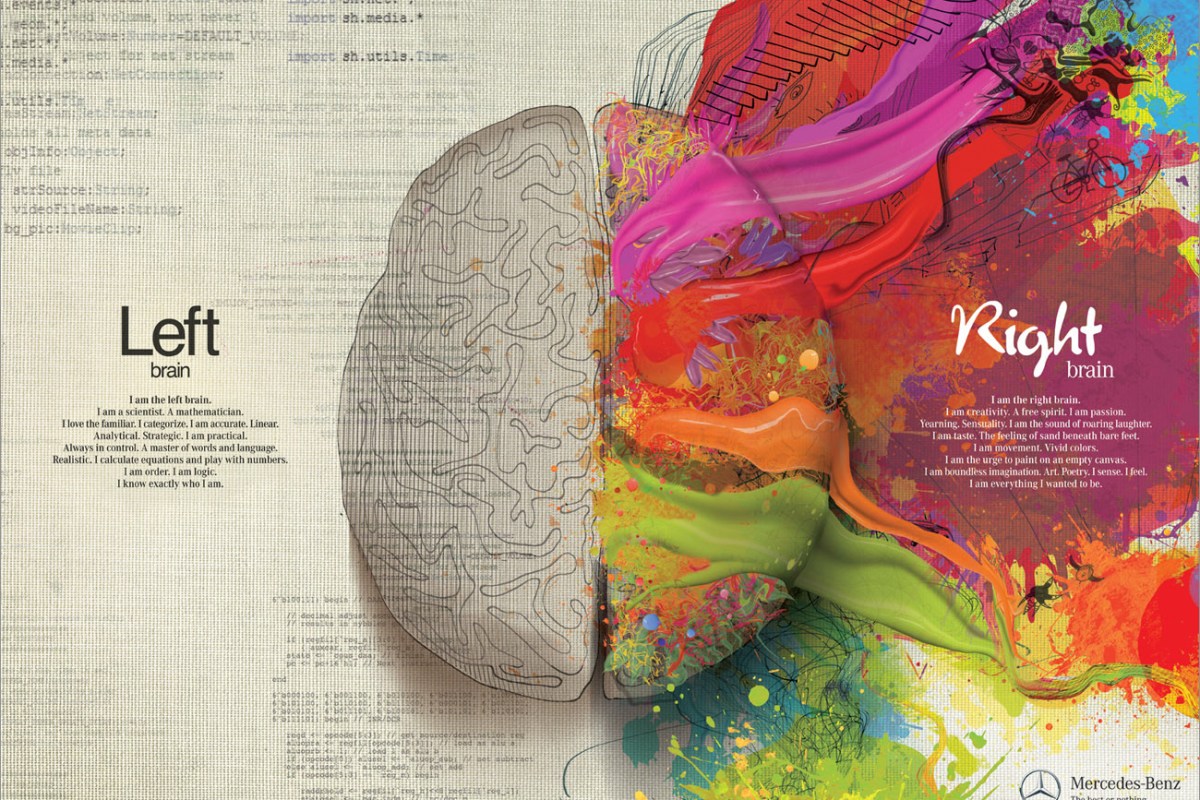
Most people have heard the term schizophrenia. It’s a mental health pathology wherein people interpret reality abnormally. To oversimplify to make a point, in a ‘normal’ brain, the left and right hemispheres operate together to regulate bodily functions and to interpret the world we live in. In brief, schizophrenia is a condition where the left cerebral hemisphere overly dominates the right. Some might be led to believe that schizophrenics interpret reality irrationally, but the opposite is true. Schizophrenics are hyperrational to a fault.
Schizophrenia has been on the rise this past half century or so, but this might just be a symptom of Modernity, as cultures are also experiencing a leftward shift—a shift toward hyperrationality. Cultures have swung like a pendulum from left-hemisphere-dominance to right dominance and back through the ages, but we may be seeing an uncorrected swing further and further to the left, led by science, followed by commerce and politics, dangerously close to the territory of schizophrenia, if not already occupying this territory. Allow me to briefly summarise how the hemisphere function to help the reader understand what it means to be too far left or right.
Cerebral Bilateral Hemispheres
Most people experience the world—what some otherwise known as reality—with both cerebral hemispheres, and each hemisphere has a function. In a nutshell, the right hemisphere experiences reality holistically, which is to say that it views the world through a Gestalt lens. The right hemisphere is open and divergent. It is creative—generative. It knows no categories or subdivisions. All is one and connected. I like to refer to this as Zen. Many people can relate to this Zen notion. The right hemisphere is a creative and empathetic centre that only knows the world as it is presented—without words or naming. Intuition lives here. It distinguishes differences in the world in a manner similar to that of a preverbal child who can tell mum from a bowl of porridge without knowing the word for either. Children are right hemisphere creatures. As we mature toward adulthood, the function of the left hemisphere increases to offset the dominance of the right.
The left hemisphere is the sphere of intellect. Its function is to categorise, to create symbols—words, names, labels, icons, and so on. It doesn’t know how to create, intuit, or empathise. In fact, it doesn’t even experience the world as presented; it relies on re-presentation. To borrow from a computer analogy, when it experiences something in the world, it caches a symbol. Where the right hemisphere experiences a tree and just appreciates its ‘treeness’, and it doesn’t know that it’s a tree by name. It’s just another thing in the world. The left hemisphere, on the other hand, notices these things with ‘treeness’ and categorises them as trees—or des arbres, árboles, Bäume, 木, درختان , पेड़, or whatever. And it reduces the tree to an icon, so it can file it away for later retrieval to compare with other tree-like inputs.
The left hemisphere is where difference, the sense of self, and ego come from
The left hemisphere is where difference, the sense of self, and ego come from. Where the right hemisphere is open and divergent, the left hemisphere is closed and convergent. It is particularly egotistical, stubborn, and always thinks it’s right if I can anthropomorphise analogically. The left hemisphere knows no nuance, and it doesn’t recognise connotation, metaphor, allegory, or allusion. Everything is literal.
The left hemisphere can use similes and understand that a man is like a tiger, but it takes the right hemisphere to know that a man is a tiger, has metaphorically embodied the tiger and assumed its form, say in the manner of indigenous Americans. Poetically, there is a difference between being a tiger and being like a tiger. The left will have none of this. The response to hearing ‘he was a tiger’ would either result in ‘no he isn’t, he’s a human’ or ‘someone must be talking about a male tiger’. The nuance would be lost.
At the risk of further digression, this is why a poem can’t be dissected for meaning—this despite so many valiant attempts by high school teachers and undergraduate professors. Dissecting a living poem is like dissecting a living animal. You might learn something, but at the risk of devitalisation—you’ve killed the subject. It’s like having to explain a joke. If you have to explain it, it didn’t work. You can’t explain a work of art or a piece of music. The best you can do is to describe it. Although we’re likely familiar with the adage, “A picture is worth a thousand words”, a thousand words is not enough to do more than summarise a picture. This sentiment is captured by Oscar Wilde when he wrote, “Education is an admirable thing, but it is well to remember from time to time that nothing that is worth knowing can be taught.” Education is a left-brain function, that can be stuffed like a sausage, but no amount of education can make someone feel a work of art, music, or poetry. This can only be experienced and is apart from language.
A Tree is not a Tree
As already noted, schizophrenics are hyperrational. They are devoid of the empathy and intuition afforded by the right hemisphere. So, they fail to connect the parts to a constructed whole. They presume that a whole is constructed of parts. This is the mistake of Dr Frankenstein, that he could construct a man from parts, but all he could manage is to construct a monster.
In the experienced world, there are only whole objects as experienced by the right hemisphere. As humans, we break them down for easier storage and retrieval, but this is like lossy compression if I can risk losing some in technical lingo.
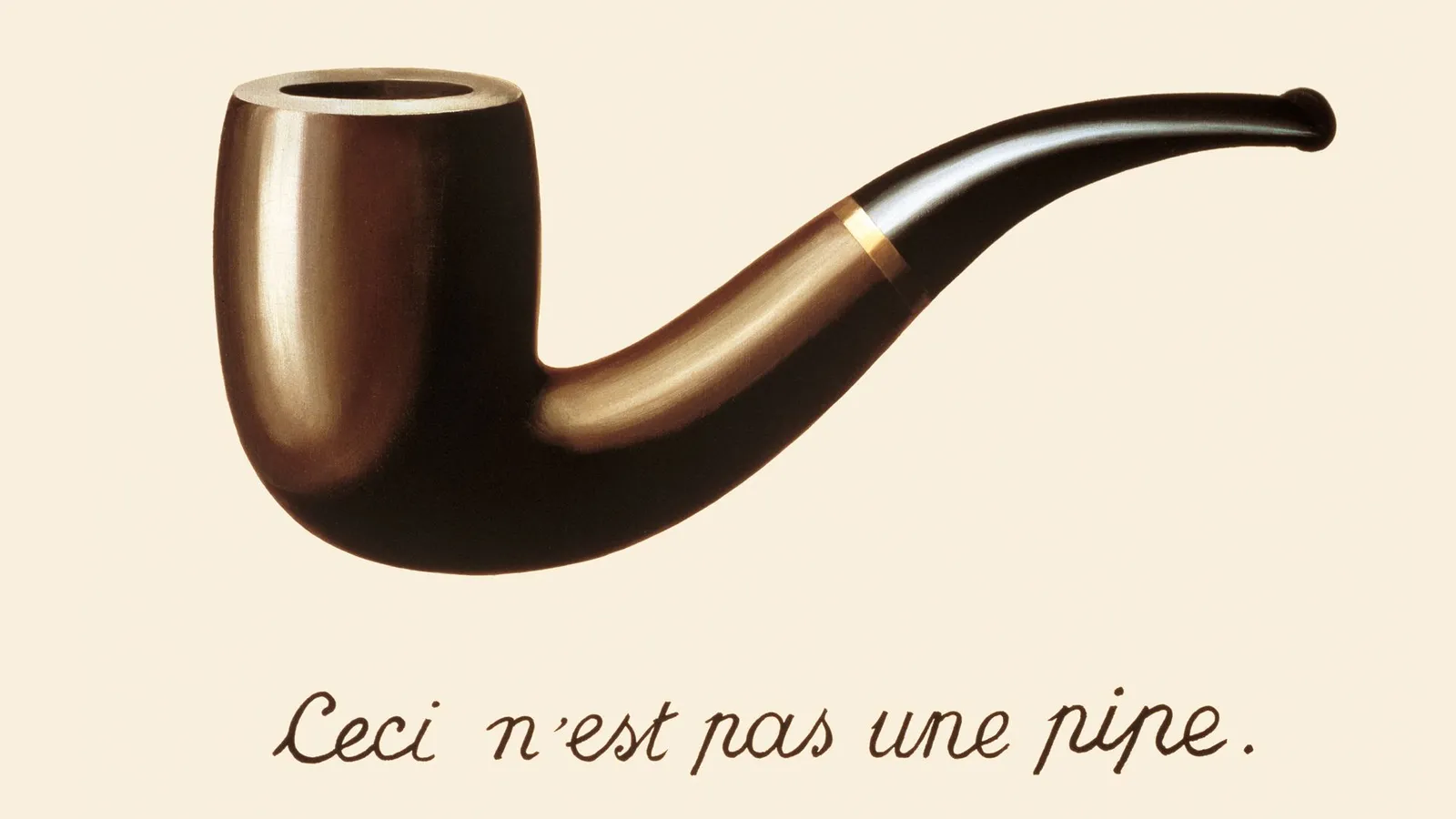
But a tree is not built from parts. It’s just a tree. We can articulate that a tree has a trunk and roots and branches and leaves and seeds and blooms, but it’s just a tree. The rest we impose on it with artificially constructed symbol language. This is what post-modern painter Rene Magritte was communicating with the “Ceci n’est pas une pipe” inscription in his work The Treachery of Images—This is not a pipe. He was not being cute or edgy or trying to be clever. He was making the point that the symbol is not the object.
In the manner that the image is not the pipe, it’s been said that to document a system is to make an inferior copy. The documented system is less optimal. This may feel counterintuitive. In fact, you may even argue that a documented system allows subsequent process participants to plug into the system to allow it to continue to operate into perpetuity. Whilst this is true, it comes at a cost. I’ll leave this here for you to ponder. The right hemisphere understands the difference. The document is not the process.
Getting Down to Business
If you’ve been following along, you may have already noticed that the left hemisphere looks and sounds a lot like the business world. Everything is systematised, structured, and ordered. We have all sorts of symbols and jargon, processes, and procedures. Everything is literal. There is no room for metaphor. There is no room for empathy. HR instructs that there be empathy, but they might as well instruct everyone to speak Basque or Hopi. In fact, it’s worse because at least Basque and Hopi can be learnt.
Sadly, this leftward shift isn’t limited to the world of commerce. It’s affected science, politics, and entire cultures. It’s caused these entities to abandon all that isn’t rational as irrational. But empathy and intuition are irrational. Science says if you can’t measure it and reproduce it, it’s not worth noting, but science is not the arbiter of the non-scientific realm. Business takes a similar position.
Politics of the Left (Hemisphere)
And politics creates categories: left and right, red and blue, black and white, men and women, gay and straight, and this and that. All of this is all left-hemisphere debate.
Categories and names are exclusive provinces of the left hemisphere. If you are hung up on an ideology, whether Democracy, Republicanism, Marxism, or Anarchism, you’re stuck in your left hemisphere. If you defend your positions with logic and words, you’re stuck in your left hemisphere. If you can’t imagine an alternative, you are really stuck in the left. I’ll stop here.
Science and Scientism
How did we get here and come to this? Science was receptive to right hemisphere influence up until about the 1970s. That’s where Scientism began to take hold. Scientism is when faith in science becomes a religion. I feel that many scientists today are less likely to hold a belief in Scientism as a religious belief. Paradoxically, I think this is more apt to be a faith held by non-scientists. Unfortunately, this faith is exploited by politics as exemplified by the recent trust in science campaign perpetrated by politicians, which is to say non-scientists with their own agenda, whether they practised Scientism or not.
The problem is that the left hemisphere has an outsized ego. It thinks it’s always right. In practice, it’s right about half the time. Because of its reliance on stored data and a ‘belief’ that it doesn’t need to fresh its data until it’s effectively overwhelmed and acquiesced. It fails to give enough weight to the experienced world, so that it shifts belief further and further left, which is to say further from reality as it is.
It trusts the symbol of the tree more than the tree itself. We may all be familiar with stories of cars driving down train tracks and off cliffs because the SAT-NAV user put more faith in their device than the world outside. This is the risk companies face as well, choosing to believe that the documented process is superior to the system in and of itself.
Getting on About?
You may be wondering what inspired me to write this and where I get my information. My realisation started in chapter 9 of The Matter with Things and was reinforced by this video interview by its author, Iain McGilchrist.
Actually, it started even before this with The Corporation, a Canadian documentary and companion book released in 2003. One of the points of The Corporation is to articulate the parallels between corporate behaviour relative to the definition of psychopathy as presented in The Diagnostic and Statistical Manual of Mental Disorders, henceforth DSM. Per Wikipedia, the DSM ‘is a publication by the American Psychiatric Association for the classification of mental disorders using a common language and standard criteria and is the main book for the diagnosis and treatment of mental disorders in the United States and is considered one of the “Bibles” of psychiatry’. Essentially, corporations ticked all the boxes.
Methodologically, this assertion is a bit weak, but it is at least sometimes entirely valid despite provoking an emotional trigger reaction. Nonetheless, this established corporations as pathological entities. But that is not my focus here. It simply tilled the soil for me to be more receptive to this topic. This topic is less about the legal fiction that is a corporation and more about the people embodied in it. From the height of the C-suite to the workaday staff, floor workers, warehouse workers, and the mailroom. Do they still have mailrooms? I digress.
I can’t claim to know what it is to be schizophrenic or schizoaffective, but I’ve known enough people who have these diagnoses. My brother was one of those. Although I use these and other labels, I am not a fan of labels, generally, especially psychological labels, specifically this label. Autism is another nonsensical label. Both fall into the realm of medical syndromes, which for the uninitiated is the equivalent of your kitchen junk drawer. It’s equivalent to the other choice when all others fail. I don’t want to go off on a tangent from the start, so I’ll leave it that these categories are overly broad and reflect intellectual laziness. There is no single schizophrenia or autism. There are many, but the distinction is lost in the category. The push to create an autism spectrum for DSM obscures the problem, but it helps for insurance purposes. As the saying goes, follow the money and you can gain clues to the driving force behind why this happened. I suppose you can also label me a conspiracy theorist. If I learned one thing in my undergrad Sociology classes, it’s to eschew labels.
Almost finished
Given the length of this segment, I am not going to summarise it here, save to say that this leftward shift in business and culture doesn’t have a good outlook. We are not only being replaced by machines, but we are also forced into becoming machines, and we aren’t even questioning it. All we need to do is to become more analytic, right?
What I suggest is to watch the six-minute video of Dr Iain McGilchrist discussing this topic, and if you really want a deep dive, read The Matter with Things, an almost three-thousand-page tome, to fill in the details.
Postscript
Here’s a music analogy to help to express why the whole is more important than the sum of the parts. If I want to learn to play a new piece, I will listen to the piece first. Depending on the length and genre, I may have to listen many times. In some cases, once or twice is enough, but let’s say this is at least somewhat complex and not some repetitive three-chord pop song. I’ll probably break the song into pieces or movements—verse, chorus, bridge, and whatever—, and then, I’ll learn each note and each pattern of notes, perhaps as musical phrases. Once I figure out the verse, I might either learn how the next verse differs or move on to the chorus and defer that verse-to-verse step. I’ll rinse and repeat until I’ve got through each of the sections. If I’ve had the luxury of hearing the piece, I’m at an advantage as far as tone, timbre, and dynamics are concerned; otherwise, I’d better hope these are all documented and that I interpret them in the manner they were intended. If the audience is familiar with a tune, they’ll notice the difference.
When I am practising, I need to get the mechanics down pat. All of what I’ve described thus far is left-hemisphere fare. It’s translating the symbolic representation of notes—like letters and words in writing—into an utterance. In this case, it’s a musical utterance. But once I am ready to perform the piece, it needs to be performed through the right hemisphere or it will feel mechanical and stilted.
I used to earn my living as an audio recording engineer and producer. Most of the time I was working with unknown artists recording demo records and trying to get a record deal. For the uninitiated, that usually translated into not having a large recording budget. Occasionally, we want, say string parts—violins, viola, cello, or whatever—but we couldn’t afford union players. We’d hire music students from USC or UCLA. These players would be more than willing to play for cheap in exchange for something to add to their portfolios or experience chops.
Somebody would transcribe the musical notation, and we’d give it to the string player. Of course, it could be a keyboard or wind or reed part, but I’ll stick to strings. Part of music is the vibe. This is something that can’t be captured in symbols. Revisiting Scientism and the left-hemisphere analogy, vibes can’t be real because they can’t be notated.
Almost invariably, if we got someone with Classical training, they could not get the vibe. The music was right in front of them. We’d play it for them on piano, maybe on a synthesiser, but they couldn’t get it—even if they were playing along to a reference track just trying to double the synth part. They would hit every note for the specified duration and dynamic, but it might have as well been the equivalence of a player piano or music box. We could have played it on a synthesiser, but we might be seeking the nuance a real instrument would bring.
We never had the luxury of auditioning players or recording several players and grabbing the best parts. That’s for the bigger-budget artists who go through a half-dozen or more performers to get just the right one. When we got lucky, it was usually because we got someone from the jazz program. These cats seem to have a natural feel for vibe inaccessible to the classical performers.
In business, the classical performer is good enough, but for art, it wasn’t. Business might appreciate the difference if it happens to get it, but it won’t seek it, and it won’t pay for it. A pet peeve of mine is a quip in business I heard often—don’t let perfection be the enemy of the good. This is obviously a left-hemisphere sentiment based on Voltaire’s statement. Besides, even from a left hemisphere perspective, reciting, “Don’t let perfection be the enemy of the good” doesn’t mean you shouldn’t at least strive for good enough because I noticed that mark was missed often enough, too.
Given the number of posts related to Iain McGilchrist’s The Matter with Things, I created a content index followed by a PDF copy of the table of contents for no reason in particular. I hope this doesn’t infringe on any copyrights.
I was browsing YouTube, and I got captivated by reaction videos, where a younger audience listens to music some of us grew up with and reacts to it. Time is a song I grew up on. Pink Floyd were a major influence on my music and my worldview. I have to admit that I am partial to the David Gilmour years and stopped caring about anything released after Roger Waters left. I have spent hours listening to their back catalogue with Syd Barrett and early David Gilmour, but Meddle, released in 1971, is about as far back as I prefer to go—even that old gem, Seamus.
Roger Waters penned the deepest lyrics for Pink Floyd, and this was one of his best. He wrote this in his late twenties, though it feels like he would have been older and wiser. I suppose he’s an old soul. Here’s the first verse:
Ticking away the moments that make up a dull day
Fritter and waste the hours in an offhand way
Kicking around on a piece of ground in your hometown
Waiting for someone or something to show you the way
This speaks to how we tend to take time for granted. Sometimes, we just want the time to pass. We’re bored, and we want to get on to something meaningful, eventful, or perhaps exciting. We might be sat in work or school just waiting for quitting time. We aren’t living in the moment or enjoying the moment. And we might just be kicking around on a piece of ground in our hometowns rather aimlessly. And whilst I am aware that many people are looking for someone to guide them to the next level, whether a religion, a vocation, a guru, or a hero, that bit’s never really resonated with me. I suppose I’ve always been naturally insouciant and Zen. Some have said to a fault.
you missed the starting gun
Tired of lying in the sunshine, staying home to watch the rain
You are young and life is long, and there is time to kill today
And then one day you find ten years have got behind you
No one told you when to run, you missed the starting gun
The second verse picks up where the first one left off. Let’s not forget that this is Britain—London—plenty of rain. But some people do get tired of lying in the sunshine living their routine workaday lives. When we are younger, the days feel longer. Time is stretched. Einsteinian relativity. Again, we’ve got time to pad out and fill. Something’s happening at the weekend. Let’s just fast-forward, but we can’t, so let’s fill the time with mindless prattle and television or somesuch. Once you were 18 and now you’re 28. What happened? Tens years gone. Where’d the time go?
The last line in the second verse is telling. For me, it’s more an indictment of quote-modern-unquote society. It only applies to those who buy into this worldview. I never bought in. It’s’ always been a sham. But for some, they reach 28 and realise they’ve made the wrong decisions for their lives to end up the way they may have envisaged. I’ve never had this grand vision.
one day closer to death
And you run, and you run to catch up with the sun but it's sinking
Racing around to come up behind you again
The sun is the same in a relative way but you're older
Shorter of breath and one day closer to death
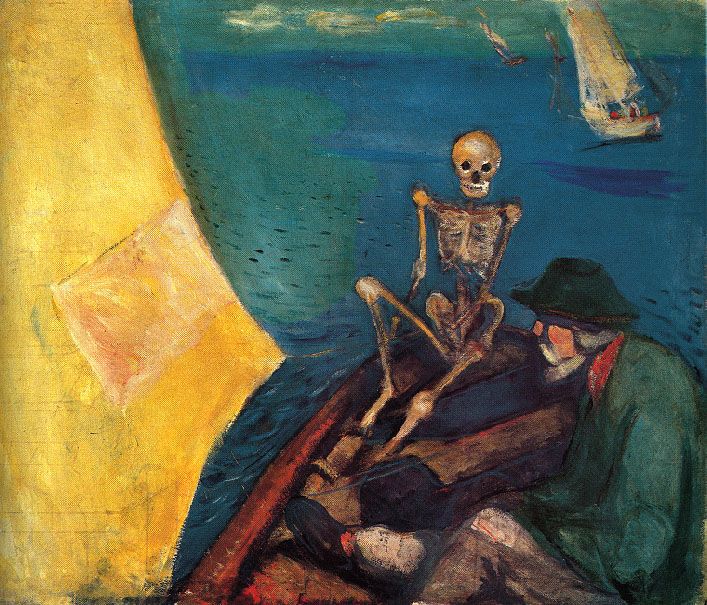
Resistance is futile. You can’t escape the movement of time as represented by the quotidian sun. It will always lap you. The sun ages on a different time scale to you. The sun doesn’t appear to age. It was here when we arrived. It will be here when we leave. It was here before any of us were born. It will be here after we’ve all left. Yet with every lap of the sun, we are each another day closer to death. That day may be tomorrow, next week, or in a hundred years, but as Twelve-Step programmes remind us, we live one day at a time. Perhaps even this is too large of a time slice, as we can only live moment to moment. Anything else is but a construction. Nothing else is real. Memento Mori.
thought I’d something more to say
Every year is getting shorter, never seem to find the time
Plans that either come to naught or half a page of scribbled lines
Hanging on in quiet desperation is the English way
The time is gone, the song is over, thought I'd something more to say
Again, time is relative. When we are young, we yearn for things: perhaps to graduate high school; get a driver’s license; graduate college; get the job we wanted; get some promotion or recognition; get signed to a big label; get a big break; the list goes on.
For those who are planners, the best-laid plans go awry. We dream of whatever and even journal these thoughts, but in the words of another song, “you can’t always get what you want”.
We want to do this or that, but life gets in the way. We can’t do everything. Economists capture this by the notion of opportunity costs. We can do this but not that. It doesn’t matter if we are Elon Musk, Jeff Bezos, Bill Gates, or whomever. Time is the ultimate leveller.
We can just keep a stiff upper lip and persevere. Just occupy some place on this third rock, Next thing you know, the time is gone. I recall my ninety-odd-year-old father-in-law after his wife of seventy-five years died. He just wanted to die. He was done. He was ready to quit, but the music was still playing. Any semblance of hope was exchanged for the hope to reach the ending peacefully.
home again
Home, home again
I like to be here when I can
And when I come home cold and tired
It's good to warm my bones beside the fire
In this verse, Roger becomes reflective. He’s nostalgic for home. Anyone with a home has a place to return to after work, after school, or a childhood memory, but to touring performers, home is an even more special place. It’s a place to return to after life on the road, perhaps for months or years. Consider Odysseus and the travellers of old. This home.
He wants to be in this comfortable, familiar place. And after a long day or excursion, it’s a place to rejuvenate and rekindle by the warmth of the fire.
softly spoken magic spells
Far away across the field
The tolling of the iron bell
Calls the faithful to their knees
To hear the softly spoken magic spells
The final verse is even more metaphorical than the others. There’s an allusion. Religious allegory. In the distance, we hear the peal of the church bell beckoning the parishioners to hear the palliative words of the vicars and priests and whatnot. Or perhaps these softly spoken magic spells are simply the prayers of the individuals.
In deference to Barthes, the author is dead. But it doesn’t matter this is my interpretation—my meaning. Even more so, in deference to chapter eight of the Matter with Things, poetry and music are meant to be appreciated as a whole, not dissected. We can reflect on the words and phrases—even the melodies and rhythms—but the words are less than they sum to. Still, this piece moves me. It always has.
In the last chapters, the topics were about different intelligences. As we’ll see, intelligence is one of the factors for creativity, but there are more. Let’s crack on.
Podcast: Audio rendition of this page content
Content
Creativity is an elusive phenomenon that cannot only not be summoned at will, the very act of trying inhibits it. Unlike left-hemisphere-oriented intelligence, there are no simple tests for creativity because of their very nature. Assessing the left-hemisphere is relatively simple because it is systematic and any tests have definite known solutions—whether calculating some figure, solving a puzzle, choosing analogies, or recounting some trivia. There is no such test for creating something not yet created, but there are some proxies that most people categorically fail.
Psychologist, Colin Martindale, had this to say about the personal characteristics of creativity
“Creativity is a rare trait. This is presumably because it requires the simultaneous presence of a number of traits (e.g., intelligence, perseverance, unconventionality, the ability to think in a particular manner). None of these traits is especially rare. What is quite uncommon is to find them all present in the same person.”
— Colin Martindale
Whereas the left hemisphere is analytical, the right hemisphere (hence creativity) is a Gestalt. When given a difficult time-boxed challenge, the left hemisphere dominant individual who does not arrive at the expected response on time will commit to and defend an incorrect response (think escalating commitment), and the right hemisphere dominant individual will simply not commit to a response under the thought that there were still options to be explored.
Effectively, creativity can be broken down into three phases: preparation, incubation, and illumination.
In essence, for the creative individual, the best we can do is to leave well enough alone. Anything but space and permission will kill the creative impulse.
Preparation is simply the accumulation of a particular domain of knowledge. For an artist, it will be to understand, perhaps, colour, shape, texture, form, shadow, media, or so forth; for a musician, it might be to understand melody, harmony, tempo, timbre, dynamics, and so on; for a mathematician, it might be basic arithmetic, theories, proofs, and on and on. It’s also important to note that accumulated information in multiple domains also forms a foundation leveraged by many polymaths.
Incubation is simply waiting for something to grow in the prepared garden. Incubation is an unconscious activity and cannot be controlled or accessed by the conscious mind. In fact, conscious effort and introspection will serve only to impede cultivation. Digging up planted seeds to see how they are growing will only hinder the process.
Illumination is the final phase. Again, this is unwilled. Prepared and incubated flowers bloom. Of course, this is an imperfect metaphor because the ground must already have been fertile at the start. Tossing seeds on fallow ground still yields no blooms no matter how carefully attended.
In essence, for the creative individual, the best we can do is to leave well enough alone. Anything but space and permission will kill the creative impulse.
McGilchrist discusses generative, permissive, and translational requirements.
“The key element in generation seems to be the ability to think of many diverse ideas quickly, demanding breadth, flexibility and analogical thinking – seeing likeness within apparent dissimilarity.” This can be summed up as divergent thinking. This is the openness afforded by the right hemisphere as opposed to the convergent behaviour of the left. As it happens, this is where artificial intelligence falls flat as it is predicated on convergent activity.
The right hemisphere Gestalten surveys the environment and notes otherwise unperceived parallels. It is not a systematic approach. In the words of Oscar Wilde, “Education is an admirable thing. But it is well to remember from time to time that nothing that is worth knowing can be taught.”
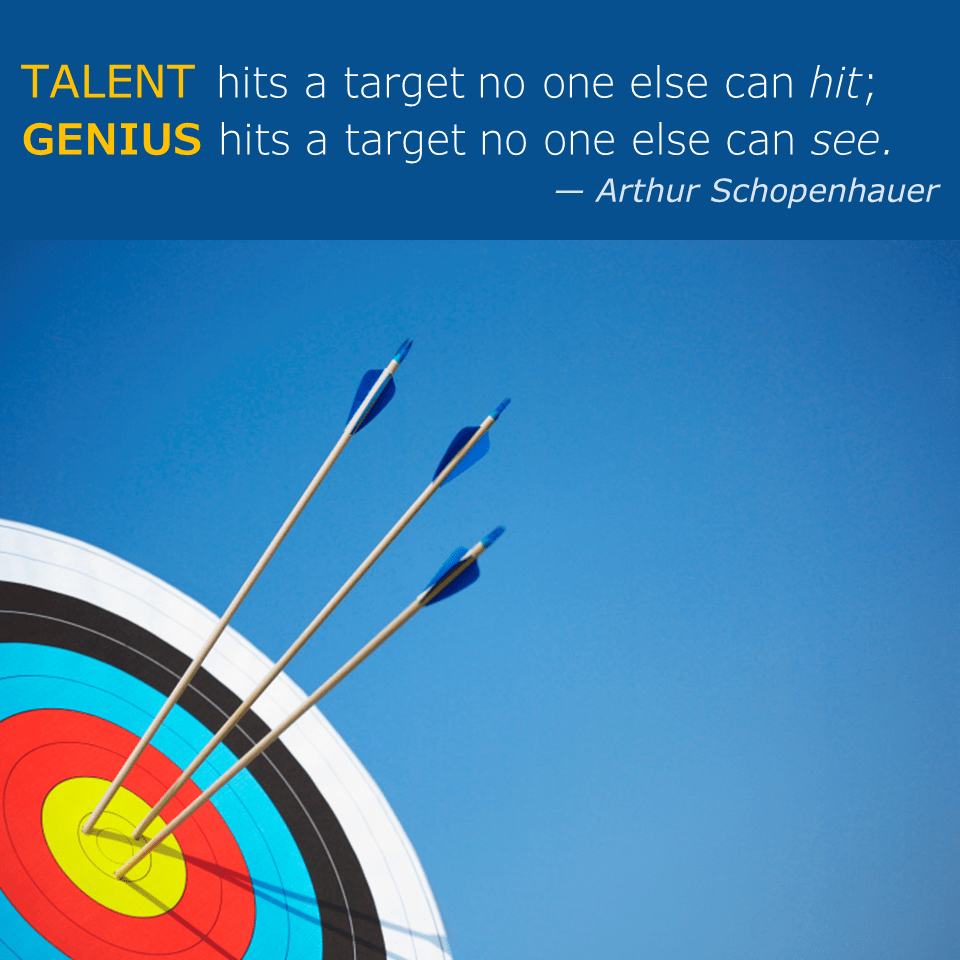
“Talent hits a target no-one else can hit; genius hits a target no-one else can see”.
Arthur Schopenhauer
Schopenhauer sums it up nicely, “Talent hits a target no-one else can hit; genius hits a target no-one else can see”.
Citing Isaac Asimov writing about Darwin’s insight, he notes that before Darwin, many people had read Malthus and studied species, but they lacked the creative spark that Darwin had.
Steve Jobs noted that
“Creativity is just connecting things. When you ask creative people how they did something, they feel a little guilty because they didn’t really do it, they just saw something. It seemed obvious to them after a while. That’s because they were able to connect experiences they’ve had and synthesize new things … A lot of people in our industry haven’t had very diverse experiences. So, they don’t have enough dots to connect, and they end up with very linear solutions without a broad perspective on the problem. The broader one’s understanding of the human experience, the better design we will have.”
— Steve Jobs
This is a failing of the business world and of specialisation more generally. McGilchrist writes, “Linear approaches and analytic thinking, characteristic of the left hemisphere, are fine in the right context, and may at a subsequent phase take part in creativity by narrowing things down and eliminating some of them, but on their own will not achieve creativity”.
There is a direct link between intelligence and creativity. Ego crushes creativity.
There is a direct link between intelligence and creativity. Ego crushes creativity.
He again cites Asimov:
“My feeling is that as far as creativity is concerned, isolation is required. The creative person is, in any case, continually working at it. His mind is shuffling his information at all times, even when he is not conscious of it …The presence of others can only inhibit this process, since creation is embarrassing.”
— Isaac Asimov
Some people excel at maths, but many are systematic and procedural left-hemisphere types; they apply logic and reason—insert tab A into slot B. The famous mathematicians understand the procedures, but their ideas come from intuition rather than reason. The left hemisphere doesn’t recognise this as a viable vector, and therein lies the rub. “Math is not about following directions; it’s about making new directions,” writes mathematician Paul Lockhart.
This is why we hear so many accounts of aha moments, something coming to one person in a dream or Isaac Newton’s falling apple anecdote.
“These thoughts did not come in any verbal formulation. I very rarely think in words at all. A thought comes, and I may try to express it in words afterward”
Albert Einstein
Einstein told Max Wertheimer, founder of Gestalt psychology, “These thoughts did not come in any verbal formulation. I very rarely think in words at all. A thought comes, and I may try to express it in words afterward”. Words are a left-hemisphere phenomenon.
Many accomplished musicians hear a piece whole. All they need to do is to compose it to staff paper or perform it. We hear this regularly: “I was driving from here to there and it just came to me. All I needed to do is to remember it long enough to get it down.”
I found McGilchrist’s inclusion of hemispheric damage quite interesting. He provides many examples of artists, composers, and poets, but I’ll only summarise them. For musicians and Artists with right hemisphere damage, those who even retained the urge to create did so at a lower quality level. However, those with left hemisphere damage operated at the same level and oftentimes at a higher level, without the inhibition and censorship of the left hemisphere.
It’s important to note that most people rely on both hemispheres. When I write left hemisphere dominant, I mean to say that either the right hemisphere simply underperforms or that the left hemisphere does not cede control back to the right hemisphere. Generally speaking, both hemispheres experience the world, and a strong right hemisphere will act as air traffic controller, or perhaps have the right of first refusal, but this is a loose metaphor because sometimes the left hemisphere just fields an experience and takes its best guess how to handle it even if it should have been fielded by the right hemisphere and even if the left hemisphere provides the wrong answer. The left hemisphere is the hemisphere of the ego and identity, so it is somewhat relentless and defensive even when it is wrong.
As a side note, I trust that political identity and escalating commitment are left-hemisphere activities and why modern Western politics feel so intractable.
After a strong argument for right hemisphere dominance and divergent thinking being hallmarks of creativity, he offers some counter-evidence and counters some of it.
A paper by Arne Dietrich and Riam Kanso co-authored a book citing instances of convergent thought processes that led to something innovative or creative. At the onset, McGilchrist calls them out for conflating problem-solving with creativity. In the end, the left hemisphere does play a role. He calls this the translational phase. Essentially, this is Mozart having heard his symphony and needing to put his thoughts to paper. Or the poet.
He goes off on a bit of a tangent noting how words pale concepts, and divergence and convergence are no exception. This fits in with my own insufficiency of language theory, but McGilchrist and I have different rationales for our arguments, so I’ll not side-track this summary.
He cites some statistics correlating creativity with mental health disorders and incidences of suicide. This will set the reader up perfectly for the next chapter about schizophrenia and autism.
Perspective
In summary, creativity has got me riled up more than in the previous chapters. This is partially due to how it comports with my own observations. I have always felt that humans are not very creative or innovative despite protests to the contrary. In fact, I’ve often commented when I’ve heard people say something like “artificial intelligence will never create the next…” Fill in the blank: Mozart, Picasso, Michelangelo, Nabokov, Wordsworth. Or Einstein. Of course, neither will a human be the next of these.
All these people are right cerebral hemisphere dominant. AI operates systematically, in the manner of the left hemisphere. None of these people built up systematically. Instead, their ideas were wholly formed, and their creations were reductive rather than additive. Famously, Michelangelo was to have said, “The sculpture is already complete within the marble block before I start my work. It is already there. I just have to chisel away the superfluous material.” He sees the solution first and then builds towards it.
In my professional life, I have been a strategist as a management consultant as well as a business analyst. In each case, I could quickly assess a situation and then spend weeks or months defending my intuition with words, diagrams, and numbers.
As a business analyst, I would offer a recommendation, and this would need to come with an estimate to deliver the recommendation. This figure would come to me in a matter of minutes. Then, per protocol, I would need to enter micro-level details into a pricing model so it could calculate from the ground up. First, this was time-consuming. Second, this would be circulated for review where different people would (almost invariably) reduce the number of hours estimated, typically due to pressure to reduce the cost. Ultimately, a number would be output and tendered to the client or the person footing the bill. Again (almost invariably), the number initially intuited was more accurate and reflective of what was ultimately invoiced. Unfortunately, business is a left-hemisphere endeavour, and that will be its Achilles’ heel and denouement.
This wraps up the chapter on Creativity. The next chapter is “what schizophrenia and autism can tell us”, and is the end of part one of The Matter with Things.
What are your thoughts and experiences with creativity now that you’ve heard McGilchrist’s take?
I recently posted a YouTube Short video titled You Have No Free Will, but this is still debatable.
Video: You Have No Free Will
The premise of the belief in free-will is that human decisions are made approximately half a second before we are conscious of them, and then the conscious brain convinces itself that it just made a choice. This sounds pretty damning, but let’s step back for a moment.
Podcast: Audio rendition of this page content
If you’ve been following this blog these past few months, you’ll be aware that I feel the question of free will is a pseudo-question hinging primarily on semantics. As well, there’s the causa sui argument that I’d like to ignore for the purpose of this post.
There remains a semantic issue. The free will argument is centred around the notion that a person or agent has control or agency over their choices. This means that how we define the agent matters.
In the study this references, the authors define the agent as having conscious awareness. Since this occurs after the decision is made, then the person must have had no agency. But I think an argument can be made that the earlier decision gateway is formed through prior experience. Applying computer metaphors, we can say that this pre-consciousness is like embedded hardware or read-only logic. It’s like autopilot.
In business, there are various decision management schemes. In particular, the conscious but slow version is for a person to be notified to approve or deny a request. But some decisions are automatic. If a purchase is over, say 50,000 then a manager needs to sign off on the request. But if the purchase is under 50,000, then the request is made automatically and then the manager is notified for later review if so desired.
I am not saying that I buy into this definition, but I think the argument could be made.
You might not know it by the number of posts discussing it, but I am not really concerned about whether or not free will really exists. I don’t lose any sleep over it. At the same time, I tend to react to it. Since I feel it’s a pseudo-problem where tweaking the definition slightly can flip the answer on its head, it’s just not worth the effort. On to better things.








 Philosophics