Video: “Maintenance” Midjourney render of the cover image for no reason in particular.
As many have been before me, I find metaphysical claims to be incredulous. I read these people tear down edifices, yet they seem to have a habit of replacing one for another – as if renaming it makes it disappear. Perhaps Lacan would be curious how this persists at this stage of our supposed development.
Audio: NotebookLM podcast discussing the underlying essay, The Great Substitution: From Metaphysics to Metaphysics
Because of this, I performed a survey – and then a genealogy – to trace the history of substitution. It began as a side note in The Discipline of Dis-Integration, but the pattern grew too large to ignore. Every time someone proclaims the end of metaphysics, a new one quietly takes its place. Theology becomes Reason. Reason becomes History. History becomes Structure. Structure becomes Data. The names change; the grammar doesn’t.
This essay, The Great Substitution: From Metaphysics to Metaphysics, tracks that recursion. It argues that modern thought has never killed its gods – it has merely rebranded them. Kant, Nietzsche, Heidegger, Derrida, Harari – each announced emancipation, and each built a new altar. We like to imagine that progress freed us from metaphysics, but what it really did was automate it. The temples are gone, but the servers hum.
The argument unfolds across ten short sections: from the limits of knowing, through the linguistic machinery of belief, to the modern cults of scientism, economics, psychology, and dataism. The closing sections introduce Dis-Integration – not a cure but a posture. Maintenance, not mastery. Thinking without kneeling.
If the Enlightenment promised illumination, we’ve spent the past three centuries staring directly into the light and calling it truth. This essay is my attempt to look away long enough to see what the glare has been hiding.
The Great Substitution: From Metaphysics to Metaphysics
I recently posted The Ethics of Maintenance: Against the Myth of Natural Purpose. In it, I brushed – perhaps too lightly – against my debt to feminist philosophy. It’s time to acknowledge that debt more directly and explain how it spills into the mundane greasework of daily life.
[Scroll to the bottom to see Midjourney’s take on feminists. You won’t be surprised.]
I tend not to worship at the altar of names, but let’s name names anyway. Beyond the usual French suspects – your Sartres, de Beauvoirs, and Foucaults – I owe much to the feminist philosophers – Gilligan, Tronto, Butler, Bellacasa, and de Beauvoir again – and, while we’re at it, the post-colonialists, whose names I’ll not recite for fear of being pompous. Their shared heresy is a suspicion of universals. They expose the myth of neutrality, whether it parades as Reason, Progress, or Civilisation. They remind us that every “universal” is merely someone’s local story told loud enough to drown out the others.
This isn’t a matter of sex or gender, though that’s how the names have been filed. The core lesson is epistemic, not biological. Feminist philosophy re-centres care, interdependence, and the politics of maintenance, not as sentimental virtues but as systems logic. The post-colonialists do the same at a geopolitical scale: maintenance instead of conquest, relation instead of domination.
On Gender, Behaviour, and the Lazy Binary
I don’t buy into sex and gender binaries, especially regarding behaviour. Even in biology, the dichotomy frays under scrutiny. Behaviourally, it collapses entirely. The problem isn’t people; it’s the linguistic furniture we inherited.
I’m weary of the moral blackmail that calls it misogyny not to vote for a woman, or racism not to vote for a black candidate. These accusations come, paradoxically, from sexists and racists who reduce people to the colour of their skin or the contents of their underwear. Having a vagina doesn’t make one a caretaker; having a penis doesn’t preclude empathy. The category error lies in mistaking type for trait.
When I refuse to vote for a Margaret Thatcher or a Hillary Clinton, it’s not because they’re women. It’s because they operate in the same acquisitive, dominion-driven register as the men they mirror. If the game is conquest, swapping the player’s gender doesn’t change the rules.
Maintenance as Political Praxis
My interest lies in those who reject that register altogether – the ones who abandon the mythology of Progress and its testosterone-addled twin, Innovation. The ethics of maintenance I’ve written about, and the philosophy of Dis-Integration I keep harping on, both gesture toward an alternative mode of being: one that prizes endurance over expansion, care over conquest.
This isn’t new. Feminist philosophers have been saying it for decades, often unheard because they weren’t shouting in Latin or running empires. I’m merely repackaging and re-contextualising, hoping that bundling these neglected insights together might make them audible again.
Knowledge never comes in a vacuum; it circulates. It leaks, cross-pollinates, mutates. To claim “intellectual property” over an idea is to pretend ownership of the air. I’ll spare you the full rant, but suffice it to say that the moment knowledge becomes proprietary, it ceases to breathe.
Conclusion
If I have a creed – and I say this reluctantly – it’s that philosophy should serve as maintenance, not monument-building. Feminist and post-colonial thinkers model that: constant attention, critical care, resistance to the entropy of domination.
I’m just trying to keep the engine running without pretending it’s divine.
Telos is humanity’s most persistent delusion – the idea that existence is crawling toward some luminous conclusion. From Aristotle’s perfect forms to Nietzsche’s Will to Power to Silicon Valley’s AI salvation, the story barely changes: history, we are told, has direction. But direction is not destiny; it is momentum misinterpreted as meaning. Much of my Anti-Enlightenment attention – and my drive toward Dis-Integration – centres on this notion.
Audio: NotebookLM podcast on this topic.
Progress is the Enlightenment’s secular gospel. Its promise – that every change is improvement – keeps the engine of exploitation humming. But change is inevitable; progress is propaganda. The arrow of time doesn’t point toward justice or enlightenment; it just points forward, indifferent to who’s crushed under it.
The Myth of Self-Correcting Systems
We are taught to place faith in systems: markets, democracies, algorithms. If they falter, it’s because of bad actors, not bad architecture. Replace the managers, swap the politicians, tweak the code. But the rot is structural, not moral.
These systems aren’t misfiring; they’re functioning exactly as designed – to preserve their own inertia while leaking meaning, resources, and compassion. The obsession with fixing individuals while sparing the machine is moral sleight of hand. At some point, tightening bolts on a burning engine becomes absurd. What we need is not a tune-up but a renovation.
This is where the philosophy of care and maintenance enters – not as sentimental housekeeping, but as radical engineering. Care is not complacent; it’s insurgent. It means facing the filth under the hood and admitting that the design itself is faulty.
Feminism and the Forgotten Labour of Repair
For centuries, the labour of care has been feminised, dismissed, and exploited – a quiet background hum while men congratulated themselves for building civilisation. Yet it is care, not conquest, that prevents collapse.
Philosophical feminists like Carol Gilligan, Joan Tronto, and María Puig de la Bellacasa saw this long before innovation culture learned to rebrand it as sustainability. They argued that ethical life is not about fulfilment or growth but about tending to fragile systems, material and social. Their revolution is not cosmic; it’s custodial.
The so-called masculine ethos – endless expansion, disruption, will to power – has delivered us burnout disguised as achievement. Its gods are metrics, its sacraments quarterly reports, its apocalypse deferred until after the IPO.
The Maintenance Ethic
Abandon the myth of natural or supernatural telos, and what remains is the duty of upkeep: a civic, psychological, and planetary responsibility. Maintenance is not stagnation; it’s resistance to decay through conscious intervention. It recognises that the world does not move toward betterment but toward breakdown – and that care is the only counter-force we possess.
Progress, as we’ve sold it, is the fever dream of a species mistaking acceleration for evolution. Maintenance is what happens when the dream fades and the mechanic steps in with a wrench.
Societies and cultures are constructs. As with twelve-step programmes, once we recognise this, we can move on to the next step. This is a notion of progress I can endorse: not the myth of inevitable improvement, but the humble acknowledgement that we built these machines and we can rebuild them differently.
The Workshop, Not the Temple
Civilisation doesn’t need another prophet or disruptor. It needs a caretaker with dirty hands. Meaning is not discovered; it is serviced. Systems are not sacred; they are rebuilt.
We can keep worshipping progress and watch the engine seize again, or we can accept the more humbling task of renovation – not of souls or nations, but of the machinery we ourselves assembled. The future, if it exists, will not be a miracle of purpose but a triumph of maintenance.
I maintain this blog for two primary reasons: as an archive, and as a forum for engagement.
Philosophy isn’t a mass-market pursuit. Most people are content simply to make it through the day without undue turbulence, and I can hardly blame them. Thinking deeply is not an act of leisure; it’s a luxury product, one that Capitalism would rather you didn’t afford. Even when I’ve been employed, I’ve noticed how wage labour chokes the capacity for art and thought. Warhol may have monetised the tension, but most of us merely survive it.
Video: Sprouting seed. (No audio)
That’s why I value engagement – not the digital pantomime of ‘likes’ or ‘shares’, but genuine dialogue. The majority will scroll past without seeing. A few will skim. Fewer still will respond. Those who do – whether to agree, dissent, or reframe – remind me why this space exists at all.
To Jason, Julien, Jim, Lance, Nick, and especially Homo Hortus, who has been conversing beneath the recent Freedom post: your engagement matters. You help me think differently, sometimes introducing writers or ideas I hadn’t encountered. We may share only fragments of perspective, but difference is the point. It widens the aperture of thought – provided I can avoid tumbling into the Dunning-Kruger pit.
And now, a note of quiet satisfaction. A Romanian scholar recently cited my earlier essay, the Metanarrative Problem, in a piece titled Despre cum metanarațiunile construiesc paradigma și influențează răspunsurile emoționale – translation: On How Grand Narratives Shape Paradigms and Condition Our Emotional Responses. That someone, somewhere, found my reflections useful enough to reference tells me this exercise in public thinking is doing what it should: planting seeds in unpredictable soil.
If philosophy were a game, Wittgenstein rewrote the rulebook. Then he tore it up halfway through and told us the game was the thing itself.
“Don’t ask for the meaning; ask for the use.”
— Ludwig Wittgenstein
Language Game, the third card in my Critical Theory parody set, isn’t just homage; it’s confession. Wittgenstein is among my top five philosophers, and this card embodies why. His idea that ‘meaning is use’ unhooked language from metaphysics and tethered it to life – to the messy, unpredictable business of how humans actually speak.
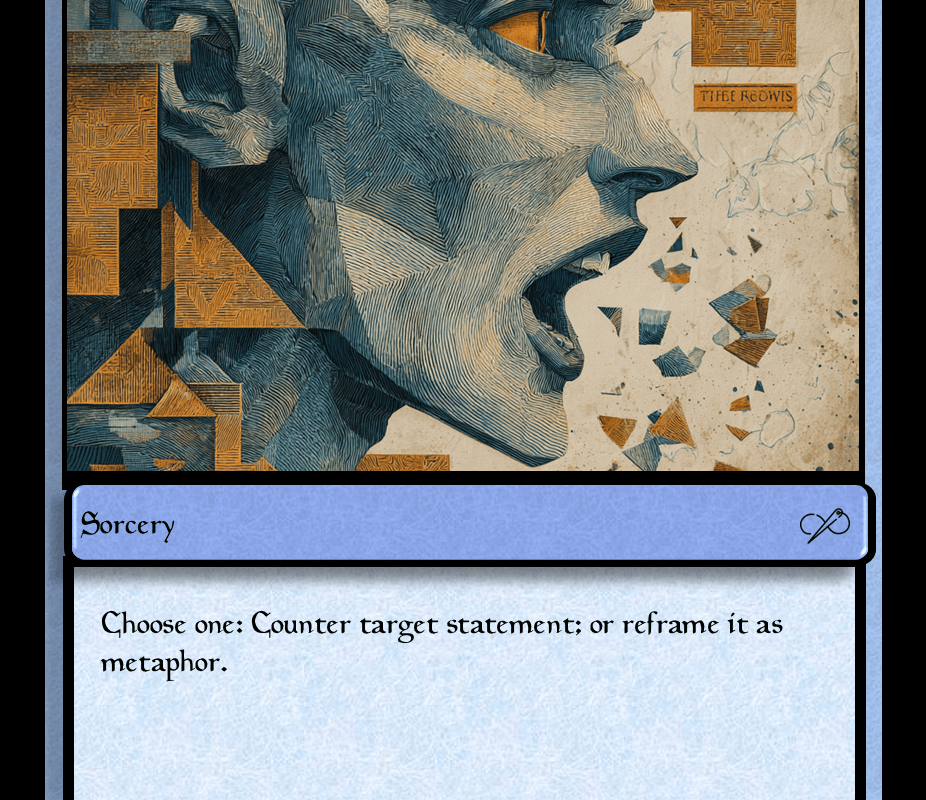
The card’s text reads: Choose one: Counter target statement; or reframe it as metaphor.
At first glance, it sounds like a standard spell from Magic: The Gathering – a blue card, naturally, since blue is the colour of intellect, deceit, and control. But beneath the parody is an epistemic mirror.
To “counter” a statement is to engage in the analytic impulse – to negate, clarify, define. To “reframe it as metaphor” is the continental alternative – reinterpret, play, deconstruct. These are not two distinct acts of philosophy but the alternating heartbeat of all discourse. Every argument, every essay, every tweet oscillates between contradiction and reframing.
The sorcery lies in recognising that both are linguistic manoeuvres within the same game. Meaning is not fixed in the words themselves but in how they’re used – by whom, in what context, and to what end. Wittgenstein’s point was brutally simple: there’s no hidden substance behind language, only a living practice of moves and counter-moves.
The Shattered Face
The artwork visualises this idea: speech breaking into shards, thought fragmenting as it leaves the mouth. Meaning disintegrates even as it’s formed. Every utterance is an act of creation and destruction, coherence and collapse.
I wanted the card to look like a concept tearing itself apart whilst trying to communicate, a perfect visual for the paradox of language. The cubist angles hint at structure, but the open mouth betrays chaos. It’s communication as combustion.
Wittgenstein’s Echo
Wittgenstein once wrote, ‘Philosophy leaves everything as it is’. It sounds passive, almost nihilistic, until one realises what he meant: philosophy doesn’t change the world by building new systems; it changes how we see what’s already there.
He was the great anti-system builder, a man suspicious of his own intellect, who saw in language both the limits of thought and the infinite playground of meaning. He dismantled metaphysics not through scepticism but through observation: watch how words behave, and they’ll tell you what they mean.
In that spirit, Language Game is less an argument than an invitation – to watch the mechanics of speech, to see how our statements perform rather than merely represent.
Personal Reflection
Wittgenstein earns a place in my top five because he dissolves the boundaries that most philosophers erect. He offers no comforting totalities, no grand narratives, no moral architectures. Just language, and us inside it, flailing beautifully.
His work aligns with my larger project on the insufficiency of language – its inability to capture the real, yet its irresistible compulsion to try. Wittgenstein knew that words are our most sophisticated form of failure, and he loved them anyway.
To play Language Game is to remember that communication isn’t about arriving at truth but about keeping meaning in motion. Every conversation is a temporary alliance against silence.
The card’s instruction remains both playful and tragic: Counter target statement; or reframe it as metaphor.
This Magic: The Gathering parody trading card was the first in my Critical Theory series.
It’s an important card for me. As with sex and gender, creating a taxonomic or ontological dichotomy poses categorical challenges. Despite the insufficiency of language, it’s still all I have to attempt to classify the world. In the case of articulating the perception of reality, we can choose between idealism and realism. The problem is that it’s not either; it’s both. Reality cannot be realised without both.
Reality, we’re told, exists. That confident noun has carried a great deal of human arrogance. It has underwritten empires, sciences, and sermons. Yet somewhere between Plato’s cave and the latest TED Talk, we forgot to ask a simpler question: for whom does reality exist, and from where is it seen?
Audio: NotebookLM podcast of this topic.
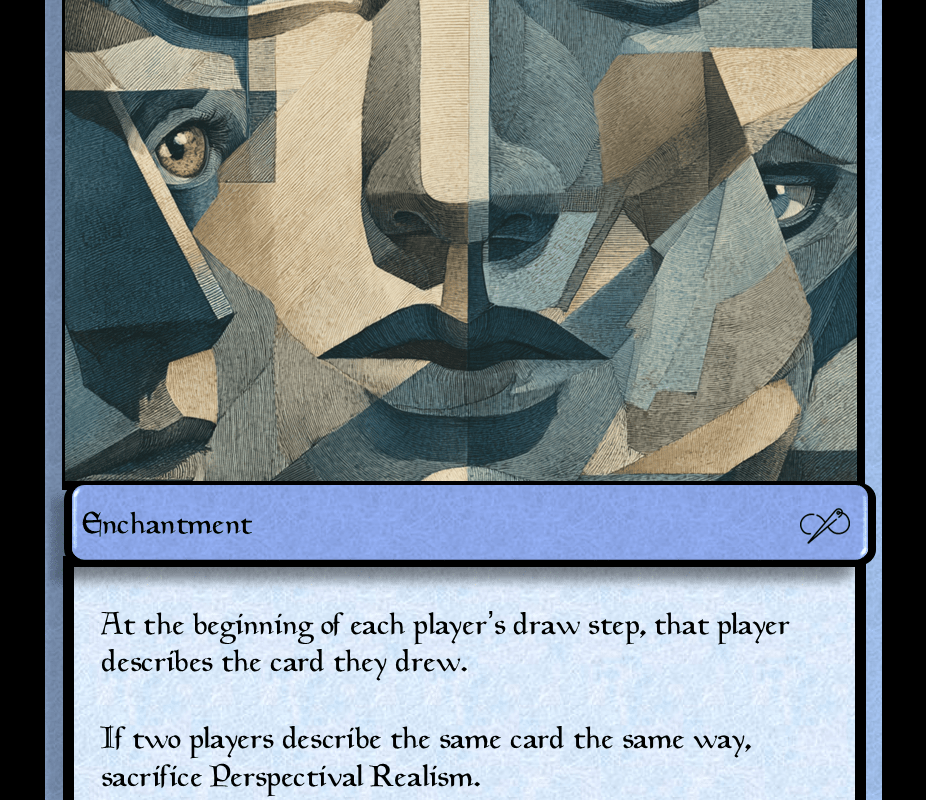
The parody trading card Perspectival Realism was born from that unease. Its mechanic is simple but cruel: at the beginning of each player’s draw step, they must describe the card they drew. The enchantment persists until two players describe a card in the same way—at which point the spell collapses. In other words, consensus kills magic.
Reality is always viewed from somewhere.
—Johannes Jaeger
That rule is the metaphysics of the thing.
When a player ‘describes’ a card, they are not transmitting information; they are constructing the object in linguistic space. The moment the description leaves their mouth, the card ceases to be a piece of paper and becomes a conceptual artefact.
This mirrors the insight of Kant, Nietzsche, and every post-structuralist who ever smoked too much Gauloises: perception isn’t passive. We don’t see reality; we compose it. Language isn’t a mirror but a paintbrush. The thing we call truth is not correspondence but coherence – a temporary truce among competing metaphors.
So the card’s enchantment dramatises this process. So long as multiple descriptions circulate, reality remains vibrant, contested, alive. Once everyone agrees, it dies the death of certainty.
Philosophers have spent centuries arguing whether the world is fundamentally real (existing independent of mind) or ideal (a projection of mind). Both sides are equally tiresome.
Realism, the old bulldog of metaphysics, insists that perception is transparent: language merely reports what’s already there. Idealism, its mirror adversary, claims the opposite – that what’s “there” is mind-stuff all along. Both mistakes are symmetrical. Realism forgets the perceiver; Idealism forgets the world.
Perspectival realism refuses the divorce. It begins from the premise that world and mind are inseparable aspects of a single event: knowing. Reality is not a photograph waiting to be developed, nor a hallucination spun from neurons – it’s a relation, a constant negotiation between perceiver and perceived.
For years, I called myself a Realist™ with an asterisk. That asterisk meant I understood the observer problem: that every ‘fact’ is perspective-laden. Then I became an Idealist™ with an asterisk, meaning I recognised that mind requires matter to dream upon.
The asterisk is everything. It’s the epistemic scar left by perspectival humility – the tacit admission that every claim about the world carries a hidden coordinate: said from here. It is not relativism, but situatedness. It is the philosophical equivalent of depth perception: without the offset, there’s no vision at all.
The card’s rule – sacrifice Perspectival Realism when two players describe a card identically – captures the tragedy of modernity. The Enlightenment taught us to chase consensus, to flatten multiplicity into “objective truth.” We became addicted to sameness, mistaking agreement for understanding.
But agreement is anaesthetic. When all perspectives converge, the world ceases to shimmer; it becomes measurable, predictable, dead. The card’s enchantment disappears the moment reality is stabilised, precisely as our cultural enchantment did under the fluorescent light of ‘reason’.
To live under perspectival realism is to acknowledge that reality is not what is drawn but what is described. And the description is never neutral. It is always written from somewhere – by someone, with a vocabulary inherited from history and stained by desire.
As long as multiple descriptions coexist, the game remains alive. The moment they fuse into one, the spell is broken, and the world returns to grey.
Bernardo Kastrup’s analytic idealism reminded me that consciousness might be primary, but perspectival realism refuses to pledge allegiance. It keeps both flags tattered but flying. The world exists, yes, but only ever for someone.
The enchantment, then, is not belief but perspective itself. So long as difference endures, the game continues.
I’ve just added a new entry to my Anti-Enlightenment corpus, bringing the total to seven – not counting my latest book, The Illusion of Light, that summarises the first six essays and places them in context. This got me thinking about what aspects of critique I might be missing. Given this, what else might I be missing?
Audio: NotebookLM podcast discussion of this topic.
So far, I’ve touched on the areas in the top green table and am considering topics in the bottom red/pink table:
Summary Schema – The Anti-Enlightenment Project – Published Essays
Axis
Core Question
Representative Essay(s)
Epistemic
What counts as “truth”?
Objectivity Is Illusion: An Operating Model of Social and Moral Reasoning
Political
What holds power together?
Rational Ghosts: Why Enlightenment Democracy Was Built to Fail; Temporal Ghosts: Tyranny of the Present
Psychological
Why do subjects crave rule?
Against Agency: The Fiction of the Autonomous Self; The Will to Be Ruled: Totalitarianism and the Fantasy of Freedom
Anthropological
What makes a “normal” human?
The Myth of Homo Normalis: Archaeology of the Legible Human
Ethical
How to live after disillusionment?
The Discipline of Dis-Integration: Philosophy Without Redemption
Summary Schema – The Anti-Enlightenment Project – Unpublished Essays
Axis
Core Question
Representative Essay
Theological (Metaphysical)
What remains sacred once transcendence is dismantled?
The Absent God: Metaphysics After Meaning
Aesthetic (Affective)
How did beauty become moral instruction?
The Aesthetic Contract: Beauty as Compliance
Ecological (Post-Human)
What happens when the world refuses to remain in the background?
1. Objectivity Is Illusion: An Operating Model of Social and Moral Reasoning
Published September 2025
Objectivity, in the social and moral sense, is a performance – a consensus mechanism mistaken for truth. This essay maps how “objectivity” operates as a scaffold for Enlightenment rationality, masking moral preference as neutral judgment. It introduces a five-premise model showing that what we call objectivity is merely sustained agreement under shared illusions of coherence. The argument reframes moral reasoning as provisional and participatory rather than universal or fixed.
2. Rational Ghosts: Why Enlightenment Democracy Was Built to Fail
Published October 2025 The Enlightenment built democracy for rational ghosts – imagined citizens who never existed. This essay dissects six contradictions at the foundation of “rational” governance and shows why democracy’s collapse was prewritten in its metaphysics. From mathematical impossibility to sociological blindness, it charts the crisis of coherence that modern politics still calls freedom. → Read on Zenodo
3. Temporal Ghosts: Tyranny of the Present
Published October 2025 Modern democracies worship the now. This essay examines presentism – the systemic bias toward immediacy – as a structural flaw of Enlightenment thinking. By enthroning rational individuals in perpetual “decision time,” modernity erased the unborn from politics. What remains is a political theology of the short term, collapsing both memory and imagination. → Read on Zenodo
4. Against Agency: The Fiction of the Autonomous Self
Published October 2025 “Agency” is not a metaphysical faculty – it’s an alibi. This essay dismantles the myth of the autonomous self and reframes freedom as differential responsiveness: a gradient of conditions rather than a binary of will. Drawing on philosophy, neuroscience, and decolonial thought, it argues for ethics as maintenance, not judgment, and politics as condition-stewardship. → Read on Zenodo
5. The Discipline of Dis-Integration: Philosophy Without Redemption
Published October 2025
This essay formalises Dis-Integrationism – a philosophical method that refuses synthesis, closure, and the compulsive need to “make whole.” It traces how Enlightenment reason, deconstruction, and therapy culture all share a faith in reintegration: the promise that what’s fractured can be restored. Against this, Dis-Integrationism proposes care without cure, attention without resolution – a discipline of maintaining the broken as broken. It closes the Anti-Enlightenment loop by turning critique into a sustained practice rather than a path to redemption.
6. The Myth of Homo Normalis: Archaeology of the Legible Human
Published October 2025
Modernity’s most persistent myth is the “normal” human. This essay excavates how legibility – the drive to measure, categorise, and care – became a form of control. From Quetelet’s statistical man to Foucault’s biopower and today’s quantified emotion, Homo Normalis reveals the moral machinery behind normalisation. It ends with an ethics of variance: lucidity without repair, refusal without despair.
7. The Will to Be Ruled: Totalitarianism and the Fantasy of Freedom
Published October 2025
This essay examines how the Enlightenment’s ideal of autonomy contains the seed of its undoing. The rational, self-governing subject – celebrated as the triumph of modernity – proves unable to bear the solitude it creates. As freedom collapses into exhaustion, the desire for direction re-emerges as devotion. Drawing on Fromm, Arendt, Adorno, Reich, Han, and Desmet, The Will to Be Ruled traces the psychological gradient from fear to obedience, showing how submission is moralised as virtue and even experienced as pleasure. It concludes that totalitarianism is not a deviation from reason but its consummation, and that only through Dis-Integrationism – an ethic of maintenance rather than mastery – can thought remain responsive as the light fades.
Axis: Theological / Metaphysical Core Question: What remains sacred once transcendence is dismantled?
Concept: This essay would trace how Enlightenment humanism replaced God with reason, only to inherit theology’s structure without its grace. It might read Spinoza, Kant’s moral law, and modern technocracy as secularised metaphysics – systems that still crave universal order. Goal: To show that disenchantment never erased faith; it simply redirected worship toward cognition and control. Possible subtitle:The Enlightenment’s Unconfessed Religion.
9. The Aesthetic Contract: Beauty as Compliance
Axis: Aesthetic / Affective Core Question: How did beauty become moral instruction?
Concept: From Kant’s Critique of Judgment to algorithmic taste cultures, aesthetic judgment serves social order by rewarding harmony and punishing dissonance. This essay would expose the politics of form – how beauty trains attention and regulates emotion. Goal: To reclaim aesthetics as resistance, not refinement. Possible subtitle:Why Modernity Needed the Beautiful to Behave.
10. The Uncounted World: Ecology and the Non-Human
Axis: Ecological / Post-Human Core Question: What happens when the world refuses to remain background?
Concept: Here you dismantle the Enlightenment split between subject and nature. From Cartesian mechanism to industrial rationalism, the natural world was cast as resource. This essay would align Dis-Integrationism with ecological thinking – care without mastery extended beyond the human. Goal: To reframe ethics as co-maintenance within an unstable biosphere. Possible subtitle:Beyond Stewardship: Ethics Without Anthropos.
11. The Fractured Tongue: Language Against Itself
Axis: Linguistic / Semiotic Core Question: How does language betray the clarity it promises?
Concept: Every Anti-Enlightenment text already hints at this: language as both the instrument and failure of reason. Drawing on Nietzsche, Derrida, Wittgenstein, and modern semiotics, this essay could chart the entropy of meaning – the collapse of reference that makes ideology possible. Goal: To formalise the linguistic fragility underlying every rational system. Possible subtitle:The Grammar of Collapse.
12. The Vanished Commons: Between Isolation and Herd
Axis: Communal / Social Ontology Core Question: Can there be community without conformity?
Concept: This would return to the psychological and political threads of The Will to Be Ruled, seeking a space between atomised autonomy and synchronized obedience. It might turn to Arendt’s notion of the world between us or to indigenous and feminist relational models. Goal: To imagine a non-totalitarian togetherness – a responsive collective rather than a collective response. Possible subtitle:The Ethics of the Incomplete We.
* These essays may never be published, but I share this here as a template to further advance the Anti-Enlightenment project and fill out the corpus.
I’ve just released a new book, The Illusion of Light: Thinking After the Enlightenment, now available in paperback through KDP and distributed via Amazon. In November, a clothbound edition will follow through IngramSpark, extending availability to libraries and independent bookstores worldwide, including Barnes & Noble in the United States.
Image: Front cover of The Illusion of Light. Links to Amazon for purchase. The ‘Free Preview’ claim is untrue, as there is no Kindle version available. An ebook will be available presently.
Audio: NotebookLM podcast on this topic.
About the Book
The Illusion of Light opens where the Enlightenment’s glare begins to fade. It asks what happens after reason exhausts itself – after the promise of illumination gives way to overexposure. These essays trace how modernity’s metaphors of light and progress became instruments of management: how objectivity hardened into ritual, agency into alibi, normality into control.
Rather than rejecting the Enlightenment outright, the book lingers in its afterimage. It argues for a philosophy practiced in the half-light – a mode of thought that values nuance over certainty, care over mastery, and maintenance over redemption. To read by residual light, as the preface suggests, is to learn to see again when the world stops pretending to be illuminated.
The preface is available on this prior post, written and audio versions.
The Broader Project
The Illusion of Light forms the threshold of the Anti-Enlightenment Project, a series examining the afterlives of modern reason – how its ideals of progress, agency, objectivity, and normality continue to govern our politics, sciences, and selves long after their foundations have cracked. Each volume approaches the same question from a different room in the old House of Reason: Objectivity Is Illusion, Rational Ghosts, Temporal Ghosts, Against Agency, The Myth of Homo Normalis, and The Discipline of Dis-Integration.
Taken together, they offer not a manifesto but a practice: philosophy as maintenance work, care as critique, and composure as the only honest response to the ruins of certainty. More to follow.
I’m no fan of labels, yet I accumulate them like a cheap suit:
Post-modern. Post-human. Post-enlightenment.
Audio: NotebookLM podcast on this topic.
Apparently, I’m so far post that I may soon loop back into prehistoric.
But what’s with the “post” in post? A prefix with delusions of grandeur. A small syllable that believes it can close an epoch. Surely, it’s a declaration – the end of modernity, humanity, enlightenment. The final curtain, with the stagehands already sweeping the Enlightenment’s broken props into the wings.
Sort of. More like the hangover. Post marks the morning after – when the wine’s gone, the ideals have curdled, and the party’s guests insist they had a marvellous time. It’s not the end of the thing, merely the end of believing in it.
Have we ever been modern? Latour asked the same question, though most readers nodded sagely and went back to their iPhones. Modernity was supposed to liberate us from superstition, hierarchy, and bad lighting. Instead, we built glass temples for algorithms and called it progress. We’re not post-modern – we’re meta-medieval, complete with priestly influencers and algorithmic indulgences.
Can a human even be post-human? Only if the machines have the decency to notice. We talk about transcending biology while still incapable of transcending breakfast. We’ve built silicon mirrors and called them salvation, though what stares back is just the same old hunger – quantised, gamified, and monetised.
And post-enlightenment – how does that work? The light didn’t go out; it just got privatised. The Enlightenment’s sun still shines, but now you need a subscription to bask in it. Its universal reason has become a paywalled blog with “premium truth” for discerning subscribers.
The tragedy of post is that it always flatters the speaker. To call oneself post-anything is to smuggle in the claim of awareness: I have seen through the illusion; I am after it. Yet here I am, a serial offender, parading my prefixes like medals for wars never fought.
So, what other posts might I be missing?
Post-truth. The phrase itself a confession that truth was a brief, ill-fated experiment. We don’t reject it so much as outsource it.
Post-ideological. Usually said by someone with a very loud ideology and a very short memory.
Post-colonial. A hopeful label, but the empires still collect rent—digitally, algorithmically, politely.
Post-gender. Another mirage: we declared the binary dead and then resurrected it for sport.
Post-capitalist. Spoken mostly by people tweeting from iPhones about the end of money.
Post-ironic. The point where irony becomes sincerity again out of sheer exhaustion.
We could go on: post-religious, post-political, post-work, post-language, post-reality. Eventually, we’ll arrive at post-post, the Möbius strip of intellectual despair, where each prefix feeds upon the previous until nothing remains but the syntax of self-importance.
Perhaps it’s time to drop the “post” altogether and admit we’re not beyond anything. We’re stuck within—inside the compost heap of our own unfinished projects. Every “post” is a failed obituary. The modern keeps dying but refuses to stay dead, haunting us through progress reports and TED talks.
Maybe what we need isn’t post but inter: inter-modern, inter-human, inter-light—something that acknowledges the mess of entanglement rather than the fantasy of departure.
Because if there’s one thing the “post” reveals, it’s our pathological need for closure. We crave the comfort of endings, the illusion of progress, the satisfaction of having “moved on.” But culture doesn’t move on; it metastasises. The prefix is just morphine for the modern condition—a linguistic palliative to ease the pain of continuity.
So yes, I’m guilty. I’ve worn these risible labels. I’ve brandished post like a scholar’s rosary, invoking it to ward off the naïveté of belief. Yet beneath the cynicism lies a quiet longing—for an actual after, for the possibility that one day something might really end, leaving room for whatever comes next.
Until then, we keep prefixing the apocalypse, hoping to stay ahead of it by one small syllable.
I’m not sure when I began to seriously consider the wrong path the Enlightenment took. Even before I had the nomenclature and conceptual framework to criticise it, I felt something wasn’t quite right since I was a child. But even then, acculturation and indoctrination are strong countercurrents. I’ve been labelled eccentric and contrarian for as long as I can remember. Most people were vocal in their disagreement.
I’m not oppositional for the sake of opposition, but I interpret the world as I do. As the years passed, I found kindred spirits – at least in dribs and drabs – from Spinoza to Hume, Nietzsche, Foucault, and Latour. In my purported contrarian nature, I rejected the Classics – SPA – preserving mere fragments. I still reject them as quaint, but I need to cite them because they have shaped much of the language intelligible to Moderns, making it uncomfortable for the so-called postmoderns to engage with the concepts. As with the others classified as Postmodern, I reject the label; still, I use it because it conveys meaning – much of it negative, like uttering the names of Nietzsche or Marx, which are forever caricatured by Moderns who are unlikely to have read either. Sort of like their Bibles – yet they maintain an opinion.
Audio: NotebookLM podcast on the underlying essay. (This podcast is a repost.)
All of this to say that during the COVID-19 debacle, I found myself employerless. I decided to take a sabbatical during quarantine and write a book on the absence of agency. Unfortunately, I discovered that many people had written about it less than a decade earlier, though the focus was more toward free will. I read it as input, but decided that I didn’t have anything to add to these authors, who have bigger names than me and stronger academic credentials. They’d been making the conference circuits. I opted out and turned to my Against Democracy project, another popular endeavour – I refer to it as Dumocracy. I did assemble enough material to publish as a book, but I had the misfortune of getting employed again – the bane of intellectual production – and the arts, and who knows what else.
I stopped being employed in March 2023 due to medical reasons. I didn’t stop working; people falsely connect work to employment, but this is a problem of class consciousness – or unconsciousness, as the case might be.
The rest of the story…
Fast forward to today. I had read tens of thousands of pages of material in and around the space I am now writing about. A review of the blog’s contents reveals glimpses and shadows, but now they’ve come into the light.
Against Agency is my best work yet
As I published more essays, I realised the connective tissues – The Anti-Enlightenment Project, I named it. Being near Hallowe’en, the first two share a ghost motif – Rational and Temporal Ghosts; the last is sardonic, but more orthodox. Against Agency is my best work yet – my most serious, escaping the nature of an extended blog article and into an academic space.
Against Agency was a side quest. I began to write a position piece on Dis-integrationism when I realised that this was foundational, so I should describe it first, and so I did.
I suppose this is where it all came together – or maybe where it came apart in a way that finally made sense. None of it was planned. Against Agency wasn’t meant to be a book, or even a thesis. It was an interruption, a side note that kept expanding until everything else had to make room for it.
When I started writing during lockdown, I was mostly arguing with myself – about free will, about why people insist on clinging to a story that clearly doesn’t hold up. I kept waiting for someone to show me the missing piece that made agency make sense again. No one did. So I wrote until I stopped expecting rescue.
It’s strange how a life leaves traces across ideas. Employment, illness, loss, boredom – they all press fingerprints into the page. Somewhere between those fingerprints, I stopped trying to rebuild the Enlightenment and started sweeping up its dust. That became the work.
Now, years later, the ghosts have names. Rational Ghosts, Temporal Ghosts, Against Agency. Each one came out of the same argument with a world that still thinks “choice” is proof of freedom. I guess that’s why I call this an aetiology – it’s not a manifesto; it’s a record of contagion.
I don’t know what comes next. Maybe Dis-Integrationism will, or maybe it already has. The Anti-Enlightenment project keeps pulling at the same loose thread, and I just follow where it frays. For now, that’s enough – to stay curious, to keep tracing the cracks, to let the light leak in where the structure failed.






 Philosophics