“The Queen is dead. Long live the King,” I believe it goes. There is propaganda through symbolism and spectacle. And there is detachment. Witness in this photograph of Queen Elizabeth II’s funeral procession, a sea of mobile devices—black mirrors.
Audio: Podcast rendition of this page content
Are these people living in the moment? I can’t say for sure, but I am thinking they are more interested in laying claim to bragging rights that they were present (in body)—pictures or it didn’t happen, eh?—, but at the same time, they were missing the moment. Perhaps it would have been overwhelming otherwise.
I recall a Buddhist meme where a traveller was more (or as) interested in taking photographs than experiencing the moments—well before the Social Media Age. And what are photographs, except attachments to the past? As if the memory is not enough in and of itself.
I am neither a Royalist nor a Statist, yet I understand that many people are and they have emotional connexions to transitions of this nature. Some ask if the system will persist whilst others wonder if there might be changes conforming to their worldviews. Time will tell.
As for me, I am flexible. Were I Charles, I’d likely abdicate the throne and pass the sceptre to William, whom I would hope would usher the monarchy out of existence in favour of something more modern—and by modern, I mean something in the order of an anachronistic constitutional republic such as (poorly) employed by the United States of America.
Obviously, my preference would be for some autonomous syndicalist structure, but I am not holding my breath, nor do I feel that would fare much better anyway. I feel that’s just another pipe dream anyway as it involves people.
Would you look at the time? I’m off wittering again. Cheers.
Chapter 6 of The Matter with Things is titled Emotional and Social Intelligence, following the previous chapters, Attention, Perception, Judgment, and Apprehension. Chapter 7 is about cognitive intelligence.
The gist of chapter 6 is to convey the importance of emotional and social intelligence in forming a full picture of the world. Absent these, reality becomes increasingly tenuous to retain a grip on because the left hemisphere just doesn’t have the emotional awareness to grasp the full picture.
Audio: Podcast version of this page content
Content
At the start, this chapter reminds us that the right hemisphere not only constructs our sense of self, but it also facilitates the construction of other selves, which allows us to empathise with others. It also allows us to assess intent. And it goes deeper than this.
McGilchrist shares some anecdotes about schizophrenic patients with impaired right hemispheres who believe that nothing is real and that people are play-acting. In hospital, they perceive the ward to be a stage and the medical staff to be actors.
As if by a control knob, changes to the right hemisphere may create a diminished sense of reality as well as an intensified sense—of being hyperaware. This is not dissimilar to certain claims by some with heightened lucidity; however, the data do not permit a clear-cut conclusion. On a related note, the intensified sense may also increase emotional reactions, so one might be more prone to crying—whether tears of joy or sadness.
Abnormal electrical activity in the right hemisphere can heighten a sense of familiarity leading to a sense of déjà vu. A diminished sense has the contrary effect, reducing a sense of familiarity, leading to a sense of jamais vu, ‘never before seen’, Related to déjà vu, there have been cases of déjà vécu, ‘already experienced’ (rather than seen). Together, over 86% of these phenomena are associated with the right hemisphere.
Recall that each hemisphere controls the body contralaterally, so the right hemisphere controls the left side of the body—hands and arms, eyes, and so on. And it’s deeper than this. For example, being the arbiter of empathy, the left hand (being controlled by the right hemisphere) is used for empathetic touch. Beyond humans, bottleneck dolphins tend to stroke other dolphins with their left flippers.
This affects humans and other animals with a sort of left-eye empathy that even affects how babies are held or otherwise attended to, preferring the left side of the body over the right.
Theory of mind (ToM), a topic in its own right, is a right hemisphere-dominant capability that allows us to empathise with another or to put ourselves into another’s shoes. This ability extends to other species like elephants, apes and dogs, whales and dolphins, crows and magpies, and goats and seals.
The left hemisphere is good at understanding the what of actions
The left hemisphere is good at understanding the what of actions, say picking up a cup or flicking a switch; it’s not so great at discerning the why. Recall in a previous chapter the case of the person with right hemisphere damage automatically picking up a pen or pencil but then not having anything particular in mind to write. The left hemisphere noticed the pen as a writing instrument and picked it up. Without the right hemisphere to provide the why, this person just kept accumulating writing implements.
This can be seen in children with autism. They recognise well enough that a person is doing something—performing some action—, but they just can’t understand why.
He tells us that “a huge body of evidence confirms that the right hemisphere is much superior to the left in receiving, interpreting, recalling or understanding anything that involves emotion.”
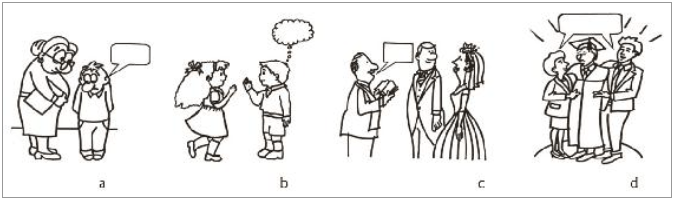
I’ll just share one example, and McGilchrist provides common responses from persons with both hemispheres intact as well as responses with right hemisphere deficits. For image b, a ‘normal’ response is for the respondent to fill in the boy’s talk bubble with ‘Boy, she’s cute.’ A couple of right hemisphere deficit responses were ‘I wonder how big her allowance is’ and ‘Let’s arm-wrestle’, obviously missing context.
The right hemisphere is responsible for understanding emotion, irony, jokes and humour—and the ability to tell the difference between jokes and lies. When told a joke and given an opportunity to fill in the punchline, the language of right hemisphere deficit patients ‘is often excessive and rambling; their comments are often off-colour and their humour is frequently inappropriate; they tend to focus on insignificant details or make tangential remarks’. Moreover, when asked to reconvey a story, the right hemisphere deficit people produced an ‘abundance of embellishments’ to it.
One subject with right hemisphere resection asked, ‘how do you feel?’ responded ‘With my hands’
Other right hemisphere functions are the ability to grasp the semantic nuance and intonation of a speaker. One subject with right hemisphere resection asked, ‘How do you feel?’ He responded, ‘With my hands,’ but he wasn’t joking.
People who have undergone a right hemispherectomy demonstrate a ‘shallow affect, rigidity, [and] lack of imagination’. The left hemisphere seems to prefer denotative speech whilst the right prefers connotative, hence a broader set of possible meanings. Interestingly, yet perhaps not surprisingly, clichés are the domain of the left hemisphere. Poetry and music reside on the right.
Wrapping up this chapter, the right hemisphere tends to serve as the emotional centre, save for anger, which is a left hemisphere activity.
Perspective
In summary, the left brain is very focused. Damage to the right hemisphere mimics the responses of autistic and schizophrenic individuals who interpret inputs differently and without nuance. This nuance often contains emotional or empathetic content that is lost on this cohort.
I am left wondering if schizophrenia and autism are right hemisphere problems, as it were, or if I would be reading into things to arrive at this conclusion.
Having completed Emotional and Social Intelligence next up is a chapter on Cognitive Intelligence. I hope you’ll join me.
What are your thoughts? What did you think of this chapter? Were there any surprises? Anything of particular interest?
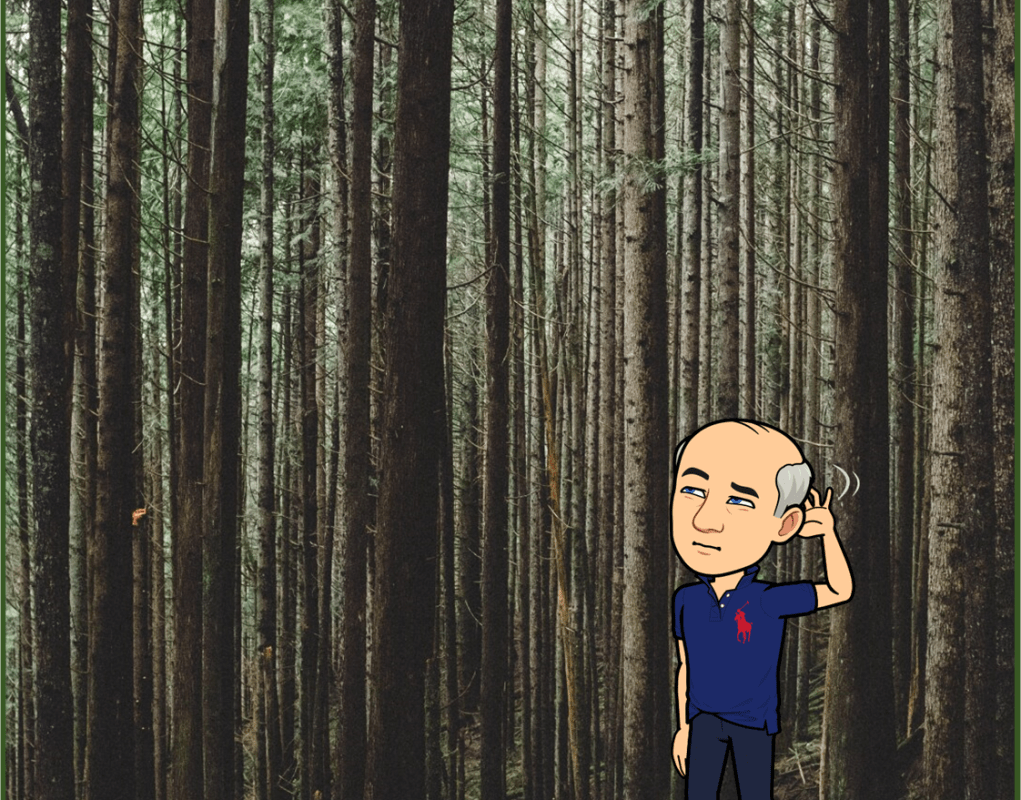
Iain McGilchrist feels that the world is moving too much toward a left hemisphere-dominated world. This has happened before, ebbing and flowing, and perhaps it will change direction again at some point. Although this compartmentalised thinking has its roots at the beginning of the Age of Enlightenment, it has accelerated in the past century as specialisation has too many of us losing the woods for the trees.
Podcast: Audio rendition of this page content
Humans have “a sufficiently strong propensity not only to make divisions in knowledge where there are none in nature, and then to impose the divisions on nature, making the reality thus conformable to the idea, but to go further, and to convert the generalisations made from observation into positive entities, permitting for the future these artificial creations to tyrannise over the understanding.”
— Henry Maudsley, The Physiology and Pathology of the Mind,1867
I hope McGilchrist explores extreme right hemisphere dominance more in The Master and His Emissary, whether relatively due to a deficient left hemisphere or because of the right hemisphere running amok.
McGilchrist warns the reader time and again that both hemispheres are involved in many activities, and it is what they are doing or how they are processing the events that differ. But when we generalise some primary competencies—a decidedly left hemisphere activity—, we notice that the left hemisphere is about constrained thinking with a focus on elements rather than the whole as illustrated previously and creating a map to re-present those data.
A Woman’s Face in the Trees: Gestalt in Action
Conversely, the right hemisphere is about openness and experiencing the world as it is presented rather than a re-presentation. I likened this to a Zen approach. It would probably not be unfair to relate this to the Buddhist notion of oneness and selflessness.
Given Iain’s assessment, perhaps right hemisphere dominance is not our biggest concern at the moment. However, I perceive a potential problem. Given the right hemisphere’s proclivity toward Gestalt, I am concerned that it also overgeneralises things into a whole where they shouldn’t be connected, as such. Gestalt is what fills in spaces in perception to make it appear as a whole. I’ll consider this to be an interpolation. But if it interpolates wrong, we may incur fitness penalties. Aside from this, I consider extrapolation—or perhaps misidentified boundary states, which is to say we include aspects outside of the ‘real’ domain boundary and glom it onto the model because, cognitively speaking, we don’t know what to do with it or how to interpret it. Once it gets passed to the left hemisphere, it (incorrectly) codifies it, from that point onward being mis-re-presented.
So where the left hemisphere loses the woods for the trees, the right hemisphere annexes the neighbours’ woods.
First, accept my heartfelt apology in advance for employing the word preciseness over precision. I was seeking a term closer to lightness, a conceit to the Unbearable Lightness of Being.
Audio: Podcast rendition of this page content
It appears that I am at odds with Iain McGilchrist if I am interpreting The Master and His Emissary correctly, His position is that verbal and written language is too precise for accurate communication. Gestures and facial queues are necessary to convey the entire payload; otherwise, it is easy to miss nuances in empathy and metaphor. Missing most are signals conveyed by the eyes, which are interpreted by the right hemisphere. The left hemisphere is more concerned with the mouth.
Before I get too far ahead of myself, the position I’ve asserted for years is that of the insufficiency of language. As diametric as this might seem at face value, I feel that it’s both, and it depends on the words and the contexts, though it feels that we are in disagreement here as well.
It’s long been said that the eyes are the window to the soul, and these people were onto something. The eyes convey emotional content to be interpreted by the right hemisphere. This hemisphere is all about seeing the big picture as well as metaphor.
The left hemisphere is more concerned with maps and symbols, so it is looking at the mouth and lips for minute details.
People with right hemisphere deficits can’t decode meta information conveyed by the eyes. Practically, this means that they can’t interpret metaphor, innuendo, sarcasm or humour. This is also the case for schizophrenics and people further right on the autism spectrum, including those with Asperger’s syndrome. I don’t know if the connexion between these psychological conditions and right hemisphere effects is due to a deficient right hemisphere or something related to the communication channel between the hemispheres. This has not yet been mentioned.
I also find it interesting that this deficit creates a situation where a sufferer can’t discern a joke from a lie, which is telling. In a manner of thinking, a joke is a bit of an untruth or stretching a fact or omitting some details to make a point, so without the larger context that this is the purpose of the joke, it might easily be interpreted as a lie.
All of this is interesting, but these are not the insufficiencies I am concerned with. In these cases, these deficits inhibit the receipt of relevant information. My contention involves the majority of people—the ones we term as ‘normal’.
One of my pet peeves is weasel words. Justice is a big one among these. I wonder if he feels that the Gestalt of the right hemisphere is what I am missing. This is the pornography the US Supreme Court judge, Potter Stewart, who says he can’t define it, but he’ll know it when he sees it. I say that this imprecision is meant to allow for arbitrary and capricious application on a whim or to meat some ulterior motive. This is decidedly not a problem of over-precision, and this is where I hold issue. Can it be too precise, too sharp to a point it needs the edges rounded? Yes. I can see that as well.
Intermission
I feel that missing non-verbal cues is a massive challenge for videoconference calls—even when the audience is one-to-one. First, the resolution needs to be high enough to see the eyes and face, so the person needs to be in frame and not one of several people barely discernible, presume, of course, that they are showing themselves on camera at the start.
Assuming that the resolution and lighting are appropriate and the person’s face is framed in a manner to reveal their eyes and mouth, gesticulation and body language are likely missing, so we are missing more non-verbal cues. I’ll also assume that we can discern aspects of prosody which as timbre, pitch, and intonation.
Add to this a videoconference with multiple participants. Sure, you might be able to see all of the faces, but there is still something missing from these thumbnail views. In some cases, I’ve seen long shots, say, in a conference room, but the detail is notably lacking. No nuance here.
Can we adapt to this situation? Yes, Of course. Should you meet in person where it’s possible and importance is of the utmost? Of course. You’d be a tone-deaf fool not to.
Epilogue
The last point I’d like to make about language being too precise is that for an erudite person like McGilchrist, it just might be, but most people don’t have large vocabularies and have barely adequate grammatical skills. They are hardly at risk of precision. An apt analogy might be to liken them to three-year-olds with crayons—no offence to three-year-olds with crayons. Plenty of people are a step or two above functional illiteracy, but that’s not saying much. To these people, language is less of a sword than it is a blunt instrument, a proverbial bag of bowling balls.
Voltaire once quipped that he’d have written a shorter letter if he had the time, noting the effort necessary for concision. The problem with trying to encode a message not conveyable by body language into a document is that its word count might need to double or treble, which I argue would at the same time reduce interest and comprehension, opening room to misinterpret the intent—all because missing non-verbal queues were lost.
In the end, I am doubling down on my position. Language is insufficient for all but the simplest and basic communication, and it is not too precise. The word McGilchrist is looking for is blunt.
Continuing with a quick post based on observations in The Master and the Emissary by Iain McGilchrist, another example of hemispheral specialisation is illustrated in the image below.
Podcast: Audio rendition of this page content
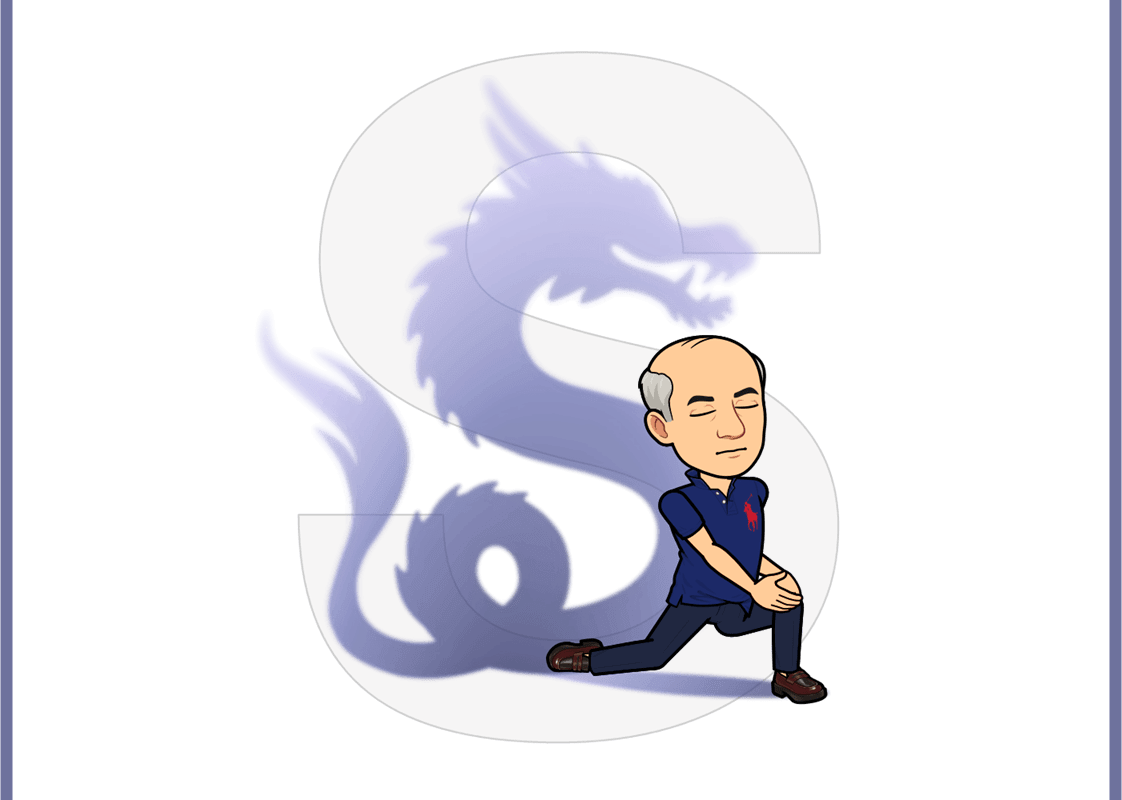
A typical person will envisage this large S composited with smaller Ss (that could be replaced with any symbols, so there is nothing special about the S comprised of Ss) as represented by the centre image of the rendition of the bilateral interpretations.
Where there is left hemisphere damage, the right would envisage something more like the S on the right—seeing the big picture but losing detail. Where there is right hemisphere damage, the left would perceive something more like the S on the left, which is the detail of the composite Ss without recognising that they composed a bigger picture. This is conveyed in the aphorism of losing the woods for the trees whilst the former right hemisphere dominant view might not realise that the forest has trees.
But even this misses the point slightly because if you are viewing this as a typical person, you can assemble the Ss on the left and realise that it makes a larger S whereas a person with right hemisphere damage will just see a mass of Ss and not see the larger S shape. Moreover, it’s not that the right hemisphere wouldn’t ‘see’ the smaller composite Ss, it just wouldn’t put any significance on them, thus ignoring them and considering them to be background noise.
I really do want to share about the non-stereoscopic animals as well as another instalment from The Matter with Things. At least one of these is probable for the next post.
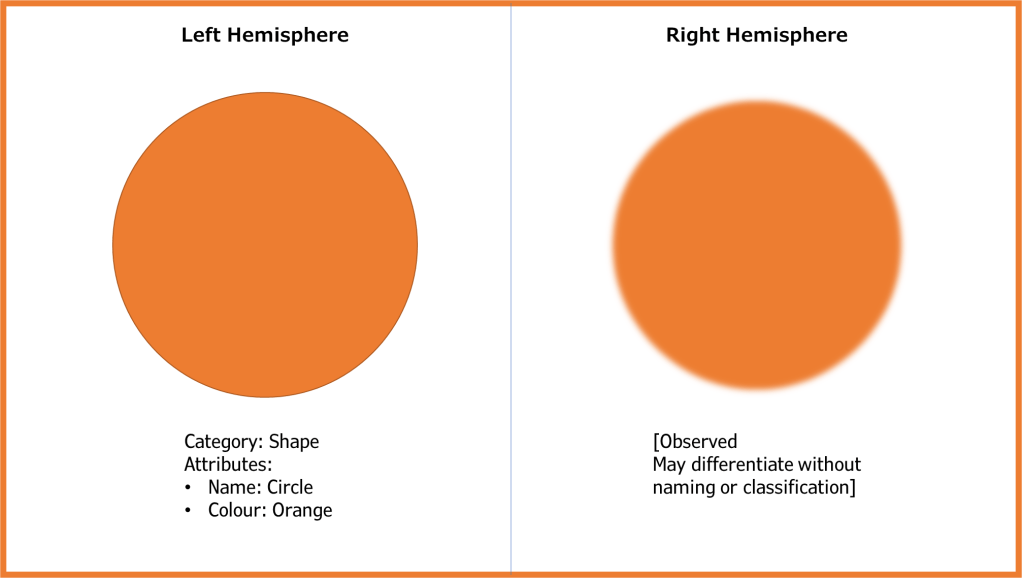
One key aspect of left and right hemisphere differences is the notion of identification versus naming and categorisation. I tend to view the right hemisphere as rather Zen. It just sees things as they are without particular care, judgment, or attachment.
Podcast: Audio rendition of this page content2 Orange Circles as tentatively experienced by the left and right hemispheres of the brain.
I composited a quick illustration to convey the difference. Starting with the right hemisphere, the object is recognised in a global context. Whilst it can be distinguished from a blue thing or a square thing, this is done by holistically surveying the world. The difference is perceived but rather without reflection on memory.
Generally speaking, both hemispheres ‘see’ the object, but where the right hemisphere is interested in the object as presented, the left hemisphere is interested in re-presentation. Where the right hemisphere is about being open to the experience itself, the left closes.
From an evolutionary vantage, the right hemisphere is interested in surveying the world at large and being alert to potential danger or survival queues, perhaps a food source. If the right hemisphere is triggered, the left hemisphere jumps in. This said, the left hemisphere is tightly focused, so if something does alert it—remembering that it is not switched off awaiting the right brain to activate it—, it will respond more quickly than the right hemisphere, though as I’ve noted previously, accuracy is not it’s forte, as the right hemisphere may have to convey that the snake that startled you was, in fact, a garden hose.
The left hemisphere is where categorisation and naming take place. Moreover, it stores the object for later retrieval, creating a map. If a subsequent observation is made, it is compared and contrasted relative to the map. After enough observations are made, the left brain isn’t so interested in observing the external world. It perceives a circle-y shape or perhaps an orangy colour and is convinced (metaphorically) that its cached version is satisfactory.
There is a book named Drawing from the Right Side of the Brain. I don’t want to comment on the book in depth, save to say that the author’s premise is that the so-called left-hemisphere person will look at the face of a subject and draw a generic oval shape. The eyes will be general eye shapes, following the same pattern for the nose and mouth. In the end, they will have rendered a portrait on the level of a child.
Whistler’s Mother, a restoration as reimagined by Mr Bean in the movie Bean.
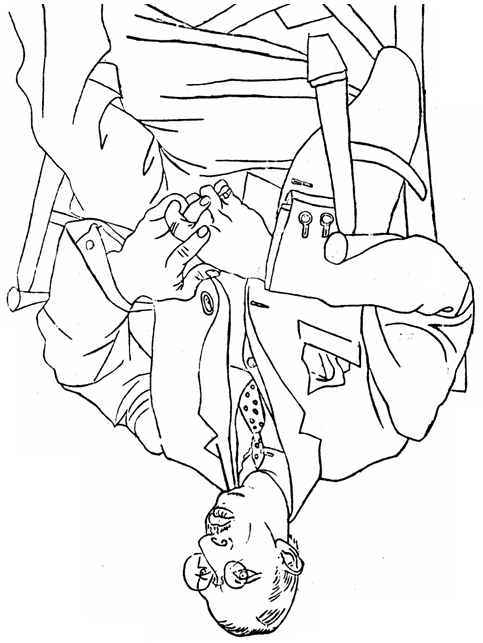
The artist who inhabits the left brain will instead note the contours, shadows, and colours of the face in front of them. One exercise that I had learned in some art class years before I read this was to draw from an inverted portrait. Not being so common as upright faces, the left brain has no representations modelled and so defers to the right hemisphere that is now looking at the object—the terrain—rather than the model.
Inverted image of Igor Stravinsky, a popular subject for breaking left-brain fixedness
I find the divided hemisphere activity in animals without stereoscopic vision to be fascinating. Perhaps, I’ll comment on this next.
* I am not claiming that the right hemisphere sees the world as fuzzy or hazy. Rather, this was me taking artistic licence to not ascribe strict boundaries to the objects in the world, especially as constrained by language.
The only thing I’ll add is the separate notion of the half-life of knowledge—essentially what we treat as fact will in fact (pun intended) not be true for one or another reason. This article gives the same case I mention, which is the invalid notion of a geocentric world. In some cases, it was true in a particular context, but the context is no longer valid. In other cases, the revision has been one of increased precision or accuracy, perhaps Newtonian versus Einsteinian physics.
Even in the case of tautological facts, things can change and meanings can shift. In the case of the colour spectrum, Newton wanted to mimic the Western musical notion of the octave, so he assigned colour names to the light spectrum when viewed through a prism, but there are two differences between his proclamation and our current understanding.
For one, what he labelled blue, we’d today call cyan. Sure, it’s in the family of blues, but when we think ‘blue’, we aren’t likely imagining cyan.
Moreover, he injected indigo to arrive at the seventh colour note, per the octave. But this was just a shoddy addition made in haste. In fact (there I go again), indigo would likely be named dark blue today.
As with chickens, humans can learn through reinforcement AKA operant conditioning.
In this video clip, we see a chicken learning that pecking a red circle yields a payload of food. Yet there is a problem with this algorithm. I don’t expect this study was meant to elucidate this point, but I’ll continue.
Except for one instance where the blue circle was pecked to yield nothing, the chicken learned that packing the red yielded a treat and so became fixed on seeking the red. What the chicken did not explore where the other colours—beige, green, and yellow. Perhaps these might have had a larger payout or a ‘better’ reward. Perhaps even a penalty or punishment, but I’ll ignore that eventuality.
The point is that through operant conditioning, the chicken is habituated. I feel that this is a metaphor for many such habituations in humans. People are indoctrinated (habituated) into all sorts of beliefs and behaviours, from the organisation of social and political systems to economic systems.
When I see people defending Democracy as Churchill did as “the worst form of government, but the best so far,” I can’t help but consider the parallels: Democracy is the red dot; capitalism is the red dot.
This not being a self-help blog, I’ll mention is passing the routines we get ourselves into that are analogous to this chicken—wandering through the world as if with blinders. The difference between a rut and a grave is the depth or dimensions. Are you in a rut on your way to the grave?
This is all I wanted to say. No chickens were harmed during the production of this blog entry.
I wrote about this content in 2019, but I wanted to revisit it for a video as well as create a podcast audio version.
Video: YouTube version of this page content
Podcast: Audio rendition of this page content
In today’s segment, I am going to share my perspectives on the truth about truth. To start, I’ll let the audience know that I do not believe in the notion of truth. I feel the term is ill-defined especially in the realm of metaphysics and morality. I feel that when most people employ the word ‘truth’, what they mean to say is ‘fact.’ That a fire engine is red, for example, may be a fact, if indeed the fire engine happens to be red, but it is not true. This is a misapplication of the term. If you employ truth as a direct synonym for fact, then this is not what’s being discussed here, and perhaps your time might be better spent watching some content by the Critical Drinker.
My argument is that truth is not objective. Rather it is subjective and perspectival. I concede that there may be some objective truth out there somewhere, but it is not and will not ever be accessible to us because of limitations in our sense-perception faculties and cognitive limitations. Per Aristotle, we only have five senses with which we can connect to the world, and these senses are limited. If there is anything out there that would require another sense receptor—a sense receptor not available to us—, we would never be able to sense it, to even know of its existence. Perhaps the universe emits 100 sense signals, but we are only capable of receiving and translating five. We’d be oblivious to 95 per cent of reality.
I am not making any claims that this is the case, but human cognition is so limited, that we can’t even conceive of what another sense might be. If you can, please leave a comment.
To be clear, I am not talking about senses we know other species possess. Bats may have echolocation, and sharks may have electroreception. Some animals may have greater sensory acuity—superior vision and auditory senses, olfactory and gustatory, tactile, or whatever. Some can see into infrared or ultraviolet light spectra. Technology that includes biomimicry provides humans with microscopes for the microworld and telescopes for the macroworld. We have x-rays and sonar and radar, radios and televisions that extend our senses, but these provide no new sensory receptors.
Like the story of the blind people and the elephant, we are left grasping at parts. But even if we are able to step back to view the whole elephant, to hear the elephant, to touch and smell or even taste the elephant, if there is more to the elephant, we cannot know it. The same goes for ourselves.
I know that some people might inject gods or psychic or paranormal energy into this void, and sure, feel free, but I am looking beyond these pedestrian concepts. What else might there be?
But let’s depart this train and head in a different direction. I want us to focus on the senses we do have. For the typical human, sight is our primary arbiter of reality, at least as defined idiomatically. We tend to believe what we see, and what we see, we assume as real—even if we are later mistaken. I guess that wasn’t a unicorn or a pink elephant. I must have been hallucinating or dreaming. I could have sworn that was Auntie Em.
There are several competing theories around truth, but I’ll focus on the Correspondence theory, which is simply put, the notion that, proxying reality for truth, human perception corresponds with the real world. And a pragmatist might argue that’s close enough for the government.
Keep in mind that historically humans have contorted themselves into making calculations. Remember how long people had been tying themselves into knots to show planetary motion in a geocentric system creating epicycles and retrograde motion to map understanding to a perceived reality.
One might even argue that we’ve progressed. It wasn’t true or accurate then, but now it is. And perhaps it is. Let’s look at some illustrations.
NB: Due to an editorial mishap, this paragraph was dropped in the podcast, hence dropped from the video, which shared the podcast audio source. As such, this image was also not used in the video. This is unfortunate, as it was meant to introduce those with limited maths knowledge to the asymptotic curve, as described. Apologies, and I hope this serves to orient any travellers who may have lost their way at this point.
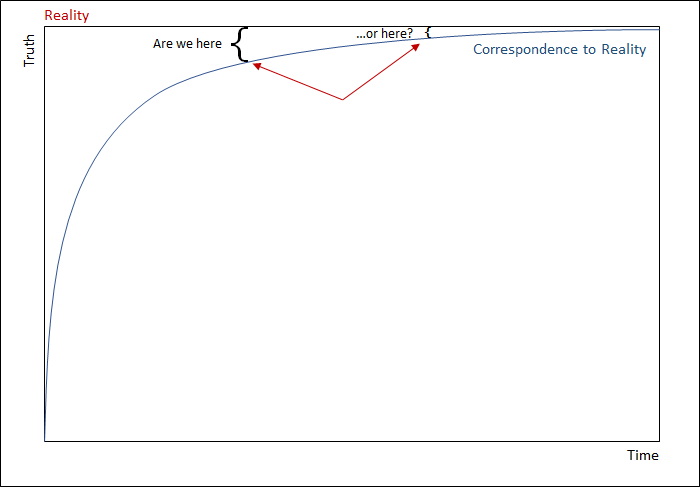
In this first illustration, we see Truth (or relative truthiness) on the Y-axis and Time on the X-Axis. On the top, we see a threshold representing Reality. In the plane, I’ve rendered an asymptotic curve, where over time, we get closer and closer to the Truth. But we never quite get there. More on this later.
The next illustration will help to demonstrate what’s happening.
Notice there is a gap between the curve and the Reality cap. For one thing, we don’t really know where we are relative to Reality. In the case of the geocentric system, we might have been at the leftmost space. Once we determined that the system is actually solar-centric, we might have moved right on the curve to close the gap. We might be tempted to defend that we’ve finally reached the truth, but we’d have been equally willing to make the same defence from the geocentric position, so we need to be mindful of the past.
Perhaps, this last example was too obvious. We feel comfortable staking a truth claim—or at least a claim of fact. So let’s look at another example.
Let’s re-use the same axes—Truth and Time—, but rather than an asymptotic curve, let’s presume something more polynomial in nature—or not particularly cyclic. Rather than retrograde motion in planets, let’s visit the supposed progress of Newtonian over Einsteinian physics.
This takes a bit more setup but bear with me. In this case, I have taken liberties and illustrated the Einsteinian physics gap to capture an inferior vantage on reality over Newtonian physics. Granted, I need to rely on a bit of suspension of disbelief, but in the bigger picture, I am trying to convey a scenario where some new paradigm puts the prior knowledge in perspective.
In this instance, both Newtonian and Einsteinian flavours of physics are based on a materialistic, particles-based model, which is where the modern physics consensus resides. But, let’s say that consensus changes in such a way that it is determined that something else underlies reality, say consciousness per Analytic Idealism as proposed by Bernardo Kastrup or per Integrated Information Theory (IIT) as advanced by Donald Hoffman and others. As with retrograde motion, we might end up finding that we were barking up the wrong tree. This might be a bit different because the particles are a directly perceived manifestation of the underlying consciousness, but I wanted to create a scenario where knowledge thought to have advanced actually regressed, but this wasn’t revealed until a new perspective was available.
Yet again, an important aspect of note is that we don’t actually know the distance between our perceptions and real Reality.
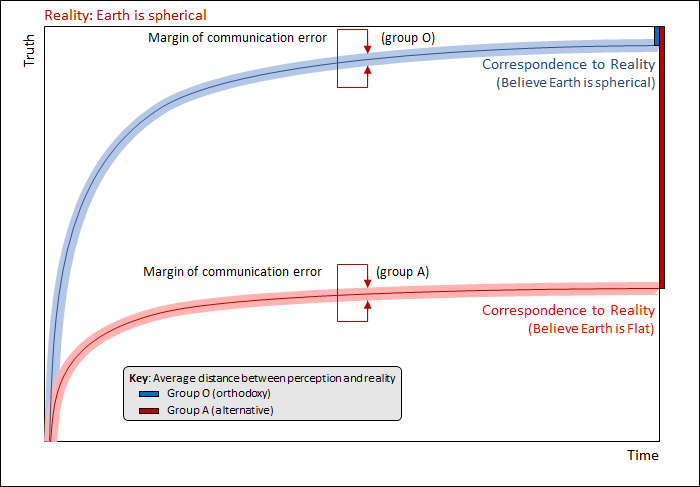
This last illustration builds upon the first asymptotic chart but has an in-built error margin meant to reflect language insufficiencies. There is some concept that people feel they grasp, but the consensus is not as unified as the group thinks.
I’ll share two examples, the first being the concept of justice. To me, Justice is what I deem a weasel word. It’s a word we commonly use, but it means different things to different people. To me, it’s a euphemism for vengeance by proxy, but for others, it transcends that and mirrors some impartial dispensation of just desert—some good old-fashioned law and order.
[Justice is] a euphemism for vengeance by proxy
Without getting stuck down some rabbit hole, my point is that if we aggregate these beliefs, the asymptotic curve represents an average consensus vantage rather than something as obvious as 2 plus 2 equals 4. On this note, allow me to clear the air.
Some viewers might be clamouring to say, “but 2 plus 2 equals four is true.” But this is tautologically true, which is to say that it’s true by definition. It’s a similar tautology to saying that it’s true that snow is white, or coal is black. We’ve already defined snow, white, coal, and black, so these may be facts, but they are true by definition.
Revisiting the chart, notice that there are two curves in the space. In this case, I illustrate competing truth claims from the perspective of an omniscient narrator. The case is whether the earth is an oblate spheroid or is flat. I am going to go out on a limb and assert the earth is spherical, as represented by the top blue curve—and we have some margin of error as to what that might mean. The bottom red curve depicts the perceived truth of the flat earthers, who also have some room for semantic error.
Given that I am presuming that I am in the right adopting the majority position—please be right—, the blue curve is closer to Reality than the red curve. Of course, in the event that the earth is really flat, then it proves my point that we don’t know where we are relative to truth, so we assume that the state of knowledge at any given time is what’s real.
Again, forgive my fanciful examples. Please don’t tell me that this spheroid versus planer earth is tautological too because you’d be correct, but I am already aware. They are just nonsensical illustrations. Nonetheless, I hope they’ve served to express a point.
I could have as well created curves that depicted two cohorts’ beliefs on the efficacy of tarot or astrology in predicting the future. I am sure that it might render somewhat like the last chart, but I’d also presume that both curves would have very low truth values as seen from an objective observer. Secretly, I hope tarot wins the truth battle.
Before I end our time together, I’d like to convey that for an Analytic Idealist, these charts might be more acceptable at face value. For a Realist, Naïve or otherwise, they may argue that this curve is not asymptotic and may in fact reach some tangency. I don’t happen to believe this is the case or I wouldn’t have spent my time assembling and presenting this. Time will tell. Or will it?
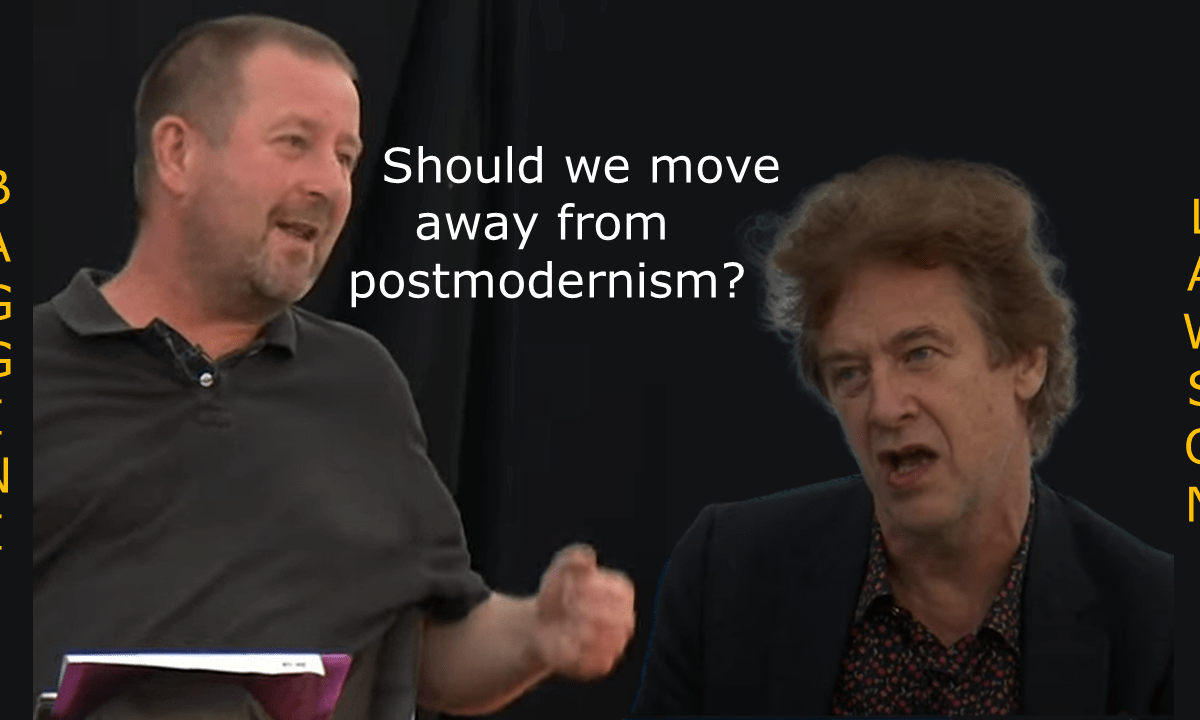
The theme of this Institute of Art and Ideas video is ‘Should we move away from postmodernism?‘
Podcast: Audio rendition of this page content
EDIT: Find my version of this content on YouTube:
Video: Postmodern Defence
At the start, I feel as usual, that the definition of postmodernism is nebulous, and the fora agree, methinks. Toward the end, Hilary Lawson concedes that key actors tied to the early postmodern movement denied being postmoderns, singling out Foucault and Derrida. More on this. Keep reading.
Julian Baggini, the bloke sat on the left and whose positions I am only getting familiar with, starts off the clip. He makes some points, some of which I agree with and others not so much.
He makes a play at claiming that there is some objective truth to be attained, following on with the statement that without this notion, it’s anything goes. I disagree with both of these assertions. Then he cites Thomas Nagel’s The View from Nowhere, wherein he posits that subjectivity and objectivity are extrema on a spectrum and that experience is somewhere in between. This conforms to my beliefs, but there are two provisos. First, the extremum of objective truth is unattainable, objectively speaking. Moreover, as I’ve written before, we have no way of adjudicating whether a given observation is truer than another. It seems that he leaves it that we don’t need to know the absolute truth to know “true enough”, but I think this is both a copout and wrong—but not too wrong for pragmatism to operate.
For example—not mentioned in the clip—, I can imagine that physicists feel that Einsteinian motion physics is truer than Newtonian physics, especially as we need to take measurements nearer to the speed of light. In my thinking, this might provide a better approximation of our notion of the world, but I can also conceive of an Ideal, non-materialistic perspective where both of these are rubbish from the perspective of truth. I feel that people tend to conflate truth with utility.
Julian makes an interesting point about semantics with the claim that “some people” define certain things in such a way as to not possibly be attainable and then claim victory. But what are his three examples? Free will, the self, and objectivity. If you’ve been following me, you’ll know that I might be in his crosshairs because I tend to be in the camp that sees these concepts as sketchy. And to be fair, his claim of defining something in a manner to keep a concept out of bounds is the other side of the same coin as defining something in such a way as to get it into bounds.
The self is different to free will insomuch as it’s a construction. As with any construction, it can exist, but it’s a fiction.
I’ve spoken at length about my position on free will, but I am fairly agnostic and don’t particularly care either way. I feel that the causa sui argument as it applies to human agency is more important in the end. The self is different to free will insomuch as it’s a construction. As with any construction, it can exist, but it’s a fiction. Without interacting with Julian or reading his published works on the self, if there are any, I don’t know how he defines it. And here we are discussing objectivity.
Given Nagel’s objective-subjective polarity, it seems they want to paint postmodernism as claiming that everything is subjective and that science (and religion) hold claims to objectivity. Hilary Lawson, the geezer on the right takes a position between extremes, but he denounces Julian’s claim about objective truth, noting that many people (especially of religious persuasions) make claims on Truth that are diametrically opposed, ostensibly labelling the same object simultaneously black and white. And the object for all intents and purposes is red.
I’ve gotten out of order, but Julie Bindel makes some good points on Feminism and suggests that the philosophical feminists—may I call them pheminists? No? OK then—such as Judith Butler have set women’s rights back by claiming that the category of ‘woman’ is invalid. Minni Salami defended Judith by noting that Butler has helped constructively in some ways and, citing Simone de Beauvoir, that woman is a category established by men to create The Other Sex. Still, Julie—not incorrectly—states that without a category, women (or whatever collective term one decides is representative) cannot be afforded legal protections—because law, as facile as it is, is all about categories and classes.
Hilary reenters the fray and states that it is not acceptable for one person to claim that their lived experience is all that is needed just because that is their truth. To be fair, this feels like a bit of a strawman argument. Perhaps I need to get out more, but I am not familiar with anyone credible making this claim.
I enjoyed watching this clip and processing the information. I hope you do as well. If you have any comments, I’d love to read them.












 Philosophics