Language As Interface: Underconstraint, Genealogy, and Moral Incommensurability

1–2 minutes

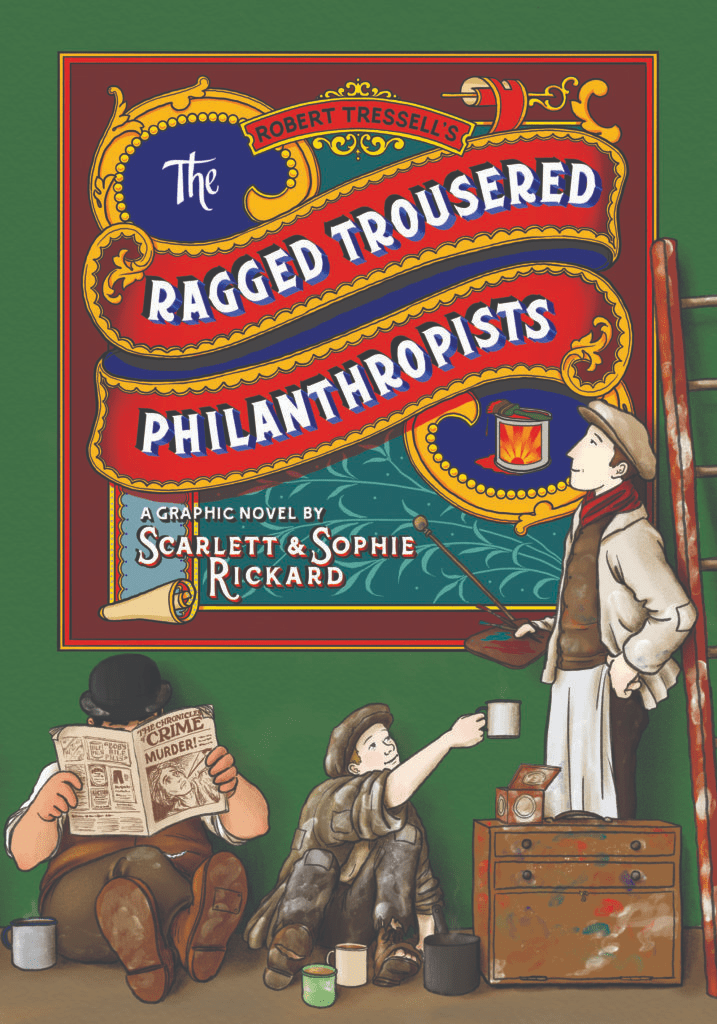
I’ve just published an essay following on the work of cognitive neuroscientist Evelina Fedorenko (cover image). It arrives on the heels of A Language Insufficiency Hypothesis (LIH). A companion essay is in the works.

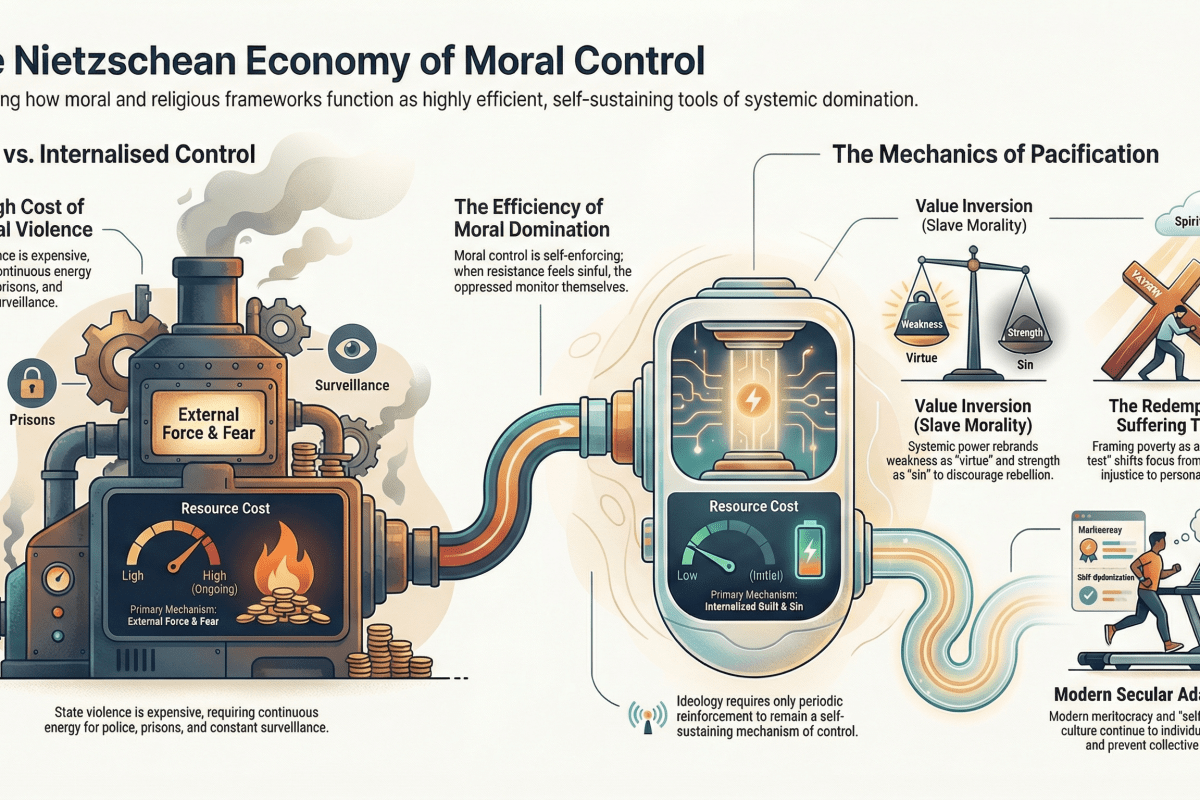
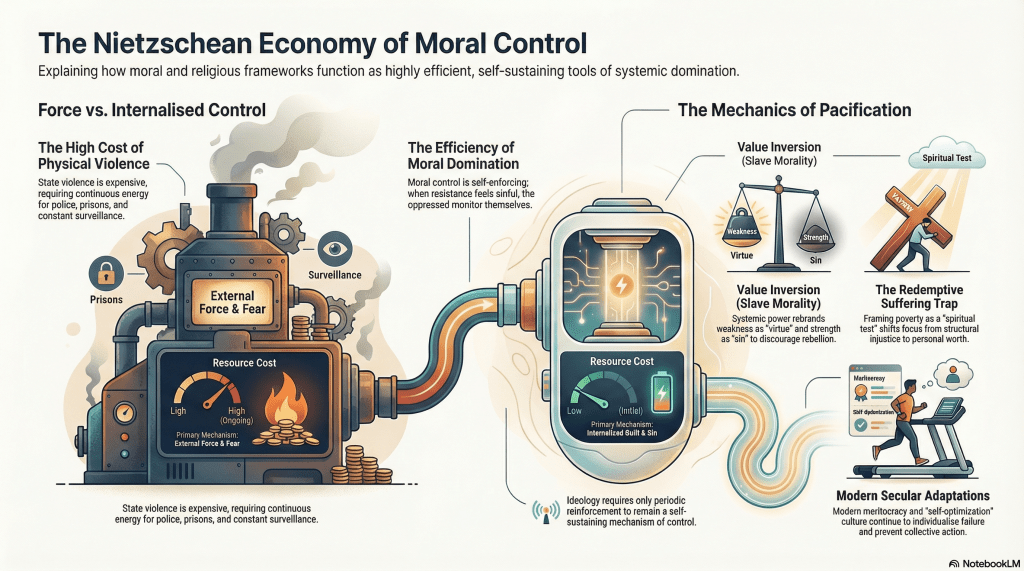
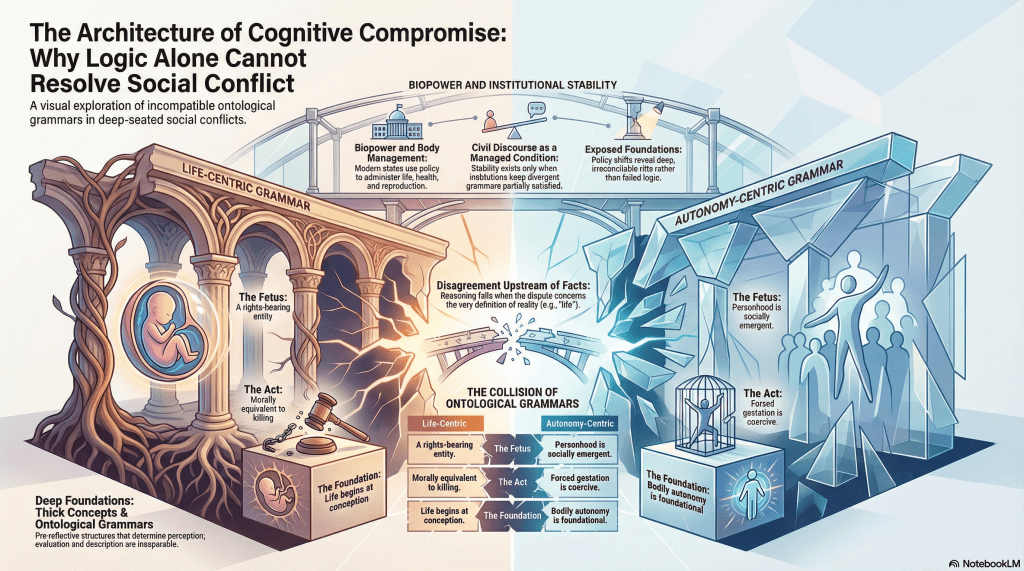
Language as Interface strengthens the position of LIH, explaining why moral issues fail before language is even engaged. Her work also leads me to believe that we should revisit 20th-century accounts of the history of language.

Audio: NotebookLM summary podcast of the underlying essay.

The essay I am working on now explains why this extends to emotional language more generally.

Meanwhile, read the essay or listen to the podcast summary.

Rejection Letter

Rejected Note
2–3 minutes

Dear Author. [REDACTED] does not accept the submission of personal works produced by students, independent researchers, or professionals who have not yet attained a doctoral level. This is a moderation policy intended to ensure that publications deposited on the platform originate from qualified researchers affiliated with a recognized institution (REDACTED) and acknowledged for their expertise or previous work in the relevant field of research. This rule applies regardless of the quality or scientific value of the work, which is by no means in question here. We therefore regret to inform you that we are unable to accept this submission. If you wish, we invite you to share your work through other open platforms such as Zenodo, which allow all authors to make their research visible. Thank you for your understanding. Kind regards

Allow me to rephrase this:

Disappointing, though hardly surprising. This is the same logic as age-based thresholds I have recently taken a hammer to: crude proxies elevated into moral and epistemic gatekeepers. Not ‘is this good?’, but ‘are you old enough, stamped enough, letterheaded enough to be taken seriously?’. A bureaucratic horoscope.

Yes, I use Zenodo. I use PhilPapers. I will continue to do so. But let’s not pretend all platforms are socially equivalent. Journals still function as credibility engines, not because they magically improve truth, but because they distribute legitimacy. To be excluded on status grounds alone is not a quality filter. It is a caste system with footnotes.

And journals already make participation unnecessarily hostile. Many refuse work that has been publicly shared at all, even in preprint form. Lead times stretch to a year or more. The result is that anyone attempting to contribute to live debates is instructed to sit quietly whilst the conversation moves on without them. In a so-called knowledge economy, this is an astonishing self-own.

What we have, then, is a system that:

  • equates institutional affiliation with epistemic competence,
  • penalises open dissemination,
  • and delays circulation until relevance decays.

All in the name of rigour.

I will keep submitting elsewhere. There are other journals. There always are. But let’s stop pretending this is about protecting standards. It is about preserving a hierarchy that mistakes accreditation for insight and treats independent thought as a contamination risk.

Knowledge does not become true by passing through the right doorway. It merely becomes approved. I’ll not witter on about the bollocks of peer review.

A Language Insufficiency Announcement

1–2 minutes

A Language Insufficiency Hypothesis is now available, and I am commencing a series of video content to support it.

Video: Language Insufficiency Hypothesis – Part 1 – The Basic Concepts (Duration: 6:44)

In this primer, I introduce the Language Effectiveness–Complexity Gradient and the nomenclature of the hypothesis: Invariants, Contestables, Fluids, and Ineffables.

In the next segment, I’ll discuss the Effectiveness and Presumed Effectiveness Horizons.

If you would like to support my work, consider purchasing one of my books. Leaving ratings and reviews helps more than you know to appease the algorithm gods.

The book is available at Amazon, Barnes and Noble, and traditional booksellers.

ISBN (Hard Cover): 978-0-9710869-0-6
ISBN (Paperback): 978-0-9710869-4-4

US Library of Congress ID: LCCN: 2025927066

A Language Insufficiency Hypothesis

1–2 minutes

Almost a decade in the making, this book explains why more time, more effort, and more detail do not reliably improve certain forms of communication. Beyond a point, returns diminish sharply. In some domains, they collapse altogether.

The manuscript focuses on English, but the hypothesis has already been extended to French (published separately), and I am continuing work on other ontological barriers. If you’re interested in testing or extending the framework in your own language, feel free to get in touch.

Also available in a clothbound edition at Barnes & Noble.

Over the coming weeks, I’ll be unpacking aspects of the Language Insufficiency Hypothesis in more depth here. The book’s role is deliberately limited: it defines the problem, establishes the structure, and offers grounding examples. The real work happens in the consequences.

For now, the important thing is simple: the book is finally available.

The Melian Dialogue, Trump, and the Persistent Fantasy of Fair Play

3–4 minutes

We like to believe the world is governed by rules. By fairness. By international law, norms, institutions, treaties, and laminated charters written in earnest fonts. This belief survives not because it is true, but because it is psychologically necessary. Without it, we would have to admit something deeply unfashionable: power still runs the table.

Two and a half millennia ago, Thucydides recorded what remains the most honest conversation in political theory: the Melian Dialogue. No soaring ideals, no speeches about freedom. Just an empire explaining itself without makeup.

Audio: NotebookLM summary podcast of this topic.

Athens, the regional superpower of the ancient world, demanded that the small island of Melos surrender and pay tribute. Melos appealed to justice, neutrality, and divine favour. Athens replied with a line so indecently clear that political philosophy has been trying to forget it ever since: ‘The strong do what they can and the weak suffer what they must’.

That sentence is not an ethical claim. It is a descriptive one. It does not say what ought to happen. It says what does. The Athenians even went further, dismantling the very idea that justice could apply asymmetrically: ‘Justice, as the world goes, is only in question between equals in power’.

This is the part liberal internationalism prefers to skip, usually by changing the subject to institutions, norms, or aspirations. But the Athenians were being brutally honest. Appeals to fairness only work when neither side can impose its will outright. When there is a power imbalance, morality becomes theatre.

The Melians refused to submit. They chose honour, principle, and the hope that the gods would intervene. Athens killed every Melian man of fighting age and enslaved the women and children. End of dialogue. End of illusions. Fast-forward to now.

In early 2026, under Donald Trump, the United States launched a military operation against Venezuela, striking targets in Caracas and forcibly detaining Nicolás Maduro, who was transported to the United States to face federal charges. The justification was framed in familiar moral language: narco-terrorism, stability, regional security, democratic transition. The accompanying signals were less coy: temporary U.S. administration, resource access, and ‘order’. Cue outrage. Cue talk of illegality. Cue appeals to sovereignty, international law, and norms violated. All of which would have been very moving… to the Athenians.

Strip away the rhetoric and the structure is ancient. A dominant power identifies a weaker one. Moral language is deployed, not as constraint, but as narrative cover. When resistance appears, force answers. This is not a deviation from realism. It is realism functioning exactly as advertised.

Modern audiences often confuse realism with cynicism, as if acknowledging power dynamics somehow endorses them. It does not. It merely refuses to lie. The Melian Dialogue is not an argument for empire. It is an autopsy of how empire speaks when it stops pretending. And this is where the discomfort really lies.

We continue to educate citizens as if the world operates primarily on ‘shoulds’ and ‘oughts’, whilst structuring global power as if only ‘can’ and ‘must’ matter. We teach international law as though it binds the strong, then act shocked when it doesn’t. We pretend norms restrain power, when in reality power tolerates norms until they become inconvenient.

The Athenians did not deny justice. They reclassified it as a luxury good. Trump’s Venezuela operation does not abolish international law. It demonstrates its conditional application. That is the real continuity across 2,500 years. Not cruelty, not ambition, but the quiet consensus among the powerful that morality is optional when enforcement is absent.

The lesson of the Melian Dialogue is not despair. It is clarity. If we want a world governed by rules rather than force, we must stop pretending we already live in one. Appeals to fairness are not strategies. They are prayers. And history, as ever, is not listening.

James Talks Truth

2–3 minutes

I’ve read about 85 per cent of James by Percival Everett. I recommend it. On the surface, it is simply a very good story set in the narrative universe of Mark Twain’s Huck Finn and Tom Sawyer. I will avoid spoilers as best I can.

The novel is set in the antebellum American South. James and the others move through Missouri, a state that openly supported slavery, and at one point into Illinois, a state that officially opposed it but quietly failed to live up to its own rhetoric. Illinois, it turns out, is no safe haven. Ideology and practice, as ever, are on speaking terms only when it suits them.

Audio: Short NotebookLM summary podcast of this content.

This is not a book review. I may write one later for my Ridley Park site once I’ve finished the book. What interests me here are two philosophical tensions Everett stages with remarkable economy.

There are two characters who are Black but able to pass as white. One of them feels profound guilt about this. He was raised as a slave, escaped, and knows exactly what it means to be treated as Black because he has lived it. Passing feels like theft. Survival, perhaps, but theft all the same.

The other is more unsettled. He was raised as a white man and only later discovers that he is not, as the language goes, “pure-bred”. This revelation leaves him suspended between identities. Should he now accept a Black identity he has never inhabited, or continue to pass quietly, benefitting from a system that would destroy him if it knew?

James offers him advice that is as brutal as it is lucid:

“Belief has nothing to do with truth. Believe what you like. Believe I’m lying and move through the world as a white boy. Believe I’m telling the truth and move through the world as a white boy anyway. Either way, no difference.”

This is the philosophical nerve of the book.

Truth, Everett suggests, is indifferent to belief. Belief does not mediate justice. It does not reorganise power. It does not rewire how the world responds to your body. What matters is not what is true, nor even what is believed to be true, but how one is seen.

The world does not respond to essences. It responds to appearances.

Identity here is not an inner fact waiting to be acknowledged; it is a surface phenomenon enforced by institutions, habits, and violence. The truth can be known, spoken, even proven, and still change nothing. The social machine runs on perception, not ontology.

In James, Everett is not offering moral comfort. He is stripping away a modernist fantasy: that truth, once revealed, obliges the world to behave differently. It doesn’t. The world only cares what you look like while moving through it.

Truth, it turns out, is perfectly compatible with injustice.

When Words Do the Work: A Case Study in Nomenclature Drift

3–5 minutes

Lewis Goodall, a talk show host, calls the cross-border seizure of Venezuela’s Nicolás Maduro a ‘kidnapping’. His guest and Trump apologist, Angie Wong, rejects the word. She first says ‘arrest’, then ‘extradition’, then finally the improvised ‘special extradition’. Around that single lexical choice, a 12-minute standoff unfolds.

Audio: NotebookLM summary podcast of this topic.

As a language philosopher, I am evaluating the language and am less concerned with the underlying facts of the matter. Language serves to obscure these facts from the start and then rhetorically controls the narrative and framing.

Video: Source segment being analysed

There is a familiar mistake made whenever public discourse turns heated: the assumption that the real disagreement lies in the facts. This is comforting, because facts can, at least in principle, be checked. What follows examines a different failure mode altogether. The facts are largely beside the point.

Consider a broadcast exchange in which a political commentator and an interviewer argue over how to describe the forcible removal of a head of state from one country to another. The interviewer repeatedly uses the word kidnapping. The guest repeatedly resists this term, preferring arrest, extradition, and eventually the improvisational compromise ‘special extradition’.

What matters here is not which term is correct. What matters is what the interaction reveals about how meaning is negotiated under pressure.

The illusion of disagreement

Superficially, the exchange appears to be a dispute about legality. Was there a treaty? Was due process followed? Which court has jurisdiction? These questions generate heat, but they are not doing the work.

The real disagreement is prior to all of that: which lexical frame is allowed to stabilise the event.

Once a label is accepted, downstream reasoning becomes trivial. If it was an extradition, it belongs to one legal universe. If it was a kidnapping, it belongs to another. The participants are not arguing within a shared framework; they are competing to install the framework itself.

Equivocation as method, not error

The guest’s shifting vocabulary is often described as evasive or incoherent. This misreads what is happening. The movement from extradition to special extradition is not confusion. It is a deliberate widening of semantic tolerance.

‘Special extradition’ is not meant to clarify. It is meant to survive. It carries just enough institutional residue to sound procedural, while remaining sufficiently vague to avoid binding criteria. It functions less as a description than as a holding pattern.

This is equivocation, but not the amateur kind taught in logic textbooks. It is equivocation under constraint, where the aim is not precision but narrative continuity.

Why exposure fails

The interviewer repeatedly points out that extradition has a specific meaning, and that the situation described does not meet it. This is accurate, and also ineffective.

Why? Because the exchange is no longer governed by definitional hygiene. The audience is not being asked to adjudicate a dictionary entry. They are being asked to decide which voice has the authority to name the act.

Once that shift occurs, exposing misuse does not correct the discourse. It merely clarifies the power asymmetry. The guest can concede irregularity, precedent-breaking, even illegality, without relinquishing control of the label. The language continues to function.

Truth as a downstream effect

At no point does the exchange hinge on discovering what ‘really happened’. The physical sequence of events is relatively uncontested. What is contested is what those events are allowed to count as.

In this sense, truth is not absent from the discussion; it is subordinate. It emerges only after a rhetorical frame has been successfully installed. Once the frame holds, truth follows obediently within it.

This is not relativism. It is an observation about sequence. Rhetoric does not decorate truth here; it prepares the ground on which truth is later claimed.

Language doing institutional work

The most revealing moment comes when the guest effectively shrugs at the legal ambiguity and asks who, exactly, is going to challenge it. This is not cynicism. It is diagnostic.

Words like arrest and extradition are not merely descriptive. They are operational tokens. They open doors, justify procedures, and allow institutions to proceed without stalling. Their value lies less in semantic purity than in administrative usability.

‘Kidnapping’ is linguistically precise in one register, but administratively useless in another. It stops processes rather than enabling them. That is why it is resisted.

What the case study shows

This exchange is not about geopolitics. It is about how language behaves when it is tasked with carrying power. Meaning drifts not because speakers are careless, but because precision is costly. Labels are selected for durability, not accuracy. Truth does not arbitrate rhetoric; rhetoric allocates truth. Seen this way, the debate over terminology is not a failure of communication. It is communication functioning exactly as designed under modern conditions. Which is why insisting on ‘the correct word’ increasingly feels like shouting into a ventilation system. The air still moves. It just isn’t moving for you.

Just the Facts, Mum (About Speed Limits)

3–4 minutes

We tend to think of speed limits as facts. Numbers. Neutral. Posted. Enforced. And yet almost no one treats them that way.

Roads are engineered to handle speeds well above the numeral on the sign. Police officers routinely tolerate a band of deviation. We know they’ll allow around ten miles per hour over the stated limit. They know we know. We know that they know that we know. Ad infinitum.

Audio: NotebookLM summary podcast of this topic.

Courts accept that instruments have margins of error. Drivers adjust instinctively for weather, traffic density, visibility, vehicle condition, and local customs. A straight, empty motorway at 3 a.m. is not experienced the same way as a narrow residential street at school pickup time, even if the number on the sign is identical. Everyone knows this. And yet we continue to talk about the speed limit as if it were an unmediated fact about the world.

This is not a complaint about traffic law. Speed limits work remarkably well, precisely because they are not what they appear to be. They are not discoveries about nature, but stabilised conventions: administrative thresholds designed to coordinate behaviour under uncertainty. The familiar numbers – 30, 50, 70 – are not found in the asphalt. Never 57 or 63. They are chosen, rounded, and maintained because they are legible, enforceable, and socially negotiable. What makes speed limits interesting is not their arbitrariness, but their success.

They hold not because they are exact, but because they survive approximation. They absorb error, tolerate deviation, and remain usable despite the fact that everyone involved understands their limits. In practice, enforcement relies less on the number itself than on judgments about reasonableness, risk, and context. The ‘fact’ persists because it is embedded in a network of practices, instruments, and shared expectations.

If you end up in court driving 60 in a 50, your ability to argue about instrument calibration won’t carry much weight. You’re already operating 20 per cent over specification. That’s beyond wiggle room – highly technical nomenclature, to be sure.

Blood alcohol limits work the same way. The legal threshold looks like a natural boundary. It isn’t. It’s a policy decision layered atop probabilistic measurement. Unemployment rates, diagnostic cutoffs, evidentiary standards – all of them look objective and immediate whilst concealing layers of judgment, calibration, and compromise. Each functions as a closure device: ending debate not because uncertainty has been eliminated, but because further uncertainty would make coordination impossible.

The trouble begins when we forget this – and we do. When facts are treated as simple givens rather than negotiated achievements, they become untouchable. Questioning them gets mistaken for denying reality. Acknowledging their construction gets misheard as relativism. What started as a practical tool hardens into something that feels absolute.

This is how we end up saying things like ‘just give me the facts’ whilst quietly relying on tolerance bands, interpretive discretion, and institutional judgment to make those facts usable at all.

If this sounds right – if facts work precisely because they’re mediated, not despite it – then the question becomes: what does truthfulness require once we’ve acknowledged this?

I’ve written a longer essay exploring that question, starting from Bernard Williams’ account of truthfulness as an ethical practice and extending it to facts themselves. The argument isn’t that facts are illusory or unreliable. It’s that recognising how they actually work – through stabilisation, constraint, and correction – clarifies rather than undermines objectivity.

The speed limit is the hint. Here’s the argument: The Fact of the Matter: After Bernard Williams – Truthfulness, Facts, and the Myth of Immediacy

Audio: NotebookLM summary podcast of the underlying essay (not this blog content).

A Year of ChatGPT, 2025

1–2 minutes

Like many apps, especially in the SaaS and PaaS space, ChatGPT offered a year-in-review. Even though I use several generative AI platforms, ChatGPT and Claude are my top two, followed by Gemini, Grok, DeepSeek, Perplexity, and Mistral – in that order. I also like Kimi K2. I am not a fan of Meta Llama or Qwen.

Image: Except for the coffee, this isn’t half bad.
Image: 2025 ChatGPT Chat Stats

Wow. I sent ChatGPT over 35,000 messages. Since I have a couple of accounts, that’s even more amazing. This is my primary account.

I don’t usually use ChatGPT / Dalle-E for images. Many of these were ChatGPT, offering an image. Still, I used a few.

I had over 1,200 chats. I guess these are actual threads. I tend to create a thread per topic and run it deep, hence the disparity between chats and messages.

Evidently, my sent messages got me into the top 1 per cent of users, and I was one of the first 0.1% of users. I suppose that makes me an early adopter. lol

Image: ChatGPT Archetype: The Strategist

I just felt like sharing this silly novelty for no particular reason.

A So Long to 2025, and a Way Into 2026

5–7 minutes

Why Post-Position? 🧐

As 2025 closes, I find myself in the mildly suspicious position of being asked where I stand. I’m almost pretty sure it’s a deontological duty I must fulfil.

This has become the ritual gesture of our time. Not what are you working on? or what are you unsure about? but what is your position? The question arrives already armed with a grid. Left or right. Modern or postmodern. Optimist or doomer. Builder or critic. Pick a square. Declare yourself. Be legible.

Audio: Notebook summary podcast of this topic.

I have spent enough years inside philosophy, politics, systems design, and cultural critique to recognise this for what it is. Not a genuine request for understanding, but a demand for administrative convenience. Positions are easy to catalogue. They travel well on social platforms. They allow disagreements to be staged rather than examined. I no longer occupy one.

If I had to name the shift that has taken place in my thinking, I might call it post-postmodern. More accurately, I think of it as post-position. Not because I have outgrown critique, but because I have grown weary of pretending that declaring a stance is the same thing as doing the work.

Postmodernism, to its credit, diagnosed something real. It exposed the hidden scaffolding behind our grand narratives. It showed how claims to neutrality smuggled power, how universals arrived late and acted eternal, and how reason often functioned as a polite enforcement mechanism. That diagnosis still stands. Nothing that followed has invalidated it. What failed was not the critique, but the decision to treat critique as a destination.

Somewhere along the line, postmodernism hardened into an identity. Suspicion became an aesthetic. Irony turned into a resting posture. Eventually, even scepticism acquired a set of approved moves and unacceptable conclusions. The work of dismantling was mistaken for the achievement of wisdom.

The response to this impasse has been predictable. We are now urged to rebuild. To restore foundations. To recover truth, agency, meaning, and normativity. Usually with a tone of urgency that suggests things have all gone a bit too far. They haven’t gone too far. They’ve gone exactly where the premises lead.

At this point, it is worth noting that ‘postmodernism’ has largely ceased to exist as a self-ascribed position at all. It survives almost entirely as a slur. No serious thinker today introduces themselves as a Postmodernist in the way one might once have claimed empiricism, structuralism, or even analytic philosophy.

The term is now deployed from the outside, usually as shorthand for intellectual irresponsibility: relativism, nihilism, irony, excess critique. It is a caricature assembled by its opponents, then attacked as if it were a living school with doctrines and membership cards.

People who employ the term Postmodern™* relative to philosophy are intellectually lazy and not likely worth engaging in a debate on the topic, because they have not likely engaged the content charitably, if at all, outside of a caricature.

This matters because it reveals something quietly telling. What is being rejected under the banner of ‘postmodernism’ is not a coherent programme, but the discomfort produced when inherited certainties fail to survive scrutiny. The slur functions as a containment strategy. It allows critics to dismiss the diagnosis without engaging the illness.

Any thinker with even a passing familiarity with the terrain knows this. Which is why no self-respecting, or self-denigrating, postmodern thinker would now characterise themselves as such. The label has been evacuated of descriptive value and filled with anxiety.

What is being revived in these reconstruction projects is not certainty, but legibility. A longing for systems that can be explained cleanly, defended coherently, and enforced consistently. Clear positions are attractive because they reduce friction. They allow disagreement to be formalised, managed, and ultimately neutralised. This is where I step off.

Post-position thinking is often mistaken for relativism, so it is worth being explicit. It does not claim that nothing is real, that all claims are equal, or that consequences dissolve into opinion. Reality remains stubborn. Harm remains unevenly distributed. Constraints still bite.

What it rejects is something more specific: the belief that ethical, epistemic, or political seriousness requires the occupation of a stable, declarable position.

Positions are not engines of thought. They are summaries produced after the fact. They tidy complexity into something portable, then forget the mess that made the tidying necessary. Once adopted, they begin to govern perception. You start seeing what fits and discarding what does not. The position becomes an answer generator rather than a question machine.

It stays with instability where stability would be dishonest. It tolerates contradiction where resolution would be cosmetic. It treats coherence as local, provisional, and negotiated rather than universal and enforceable. This is not indecision. It is fidelity to how complex systems actually behave. One way to describe the shift is a movement away from critique toward maintenance.

Modernism wanted to build. Postmodernism wanted to dismantle. Both share a quiet assumption that there is a point at which the work is done. Maintenance has no such illusion. It accepts that some systems cannot be fixed, only kept from doing additional damage – that concepts fray; that norms age badly; that repair is continuous and never final.

Maintenance is unspectacular. It does not produce manifestos. It does not scale elegantly. It involves partial solutions, awkward compromises, and the constant risk of failure. It is also where most of the moral work actually happens.

From this vantage point, the demand to ‘take a position‘ looks increasingly misplaced. Not because commitments vanish, but because commitments are situational, asymmetric, and responsive to context. Loyalty shifts from creeds to consequences. What matters is not whether an idea is internally consistent, but what it does when it leaves the page and collides with institutions, incentives, and frightened people.

So when I refuse to declare where I stand, it is not evasiveness. It is a refusal to pretend that standing still is a virtue.

This is the posture I am carrying into 2026. Not a programme, not a system, not a rehabilitated foundation. Just a refusal to confuse clarity with truth, structure with virtue, or positions with thinking.

If that feels unsatisfying, that may be the point. Satisfaction is a modernist luxury. Maintenance rarely provides it. The work continues anyway.

* To be fair, I have referred to myself as Postmodern™, but this was a shortcut out of solidarity with Foucault, Derrida, Latour, Baudrillard, and others painted with this brush. I still admire these thinkers.