If you’re reading this, chances are you’re mortal. Bummer. Even worse, you may not be maximizing your odds of wringing every last drop out of your limited lifespan. But fear not! Science has some answers. And the answer, at least in the United States, is shockingly unsecular: religious people, on average, live longer than their non-religious counterparts. They also tend to be happier. But don’t rush to your nearest house of worship just yet—because it’s not God, the afterlife, or divine intervention at work. It’s something far more mundane: people.
Audio: NotebookLM podcast on this topic.
The Religion-Longevity Link: A Holy Miracle or Just Good Networking?
Multiple studies have confirmed what might seem an inconvenient truth for secular folks like myself: religious participation is associated with longer lifespans. A 2018 study published in JAMA Internal Medicine found that attending religious services more than once a week was associated with a roughly 33% lower risk of mortality. That’s a pretty solid statistical incentive to at least pretend to enjoy Sunday sermons.
Why the boost in longevity? No, it’s not divine reward points. It boils down to a few key factors:
Community and Social Support: Regularly showing up to church, temple, mosque, or synagogue means interacting with the same people repeatedly, forming strong social bonds. When life gets tough, these people tend to notice and lend support.
Healthier Lifestyles: Many religious traditions frown upon self-destructive behaviours like smoking, heavy drinking, and drug use.
Lower Stress Levels: Religious belief systems provide coping mechanisms for hardship, instilling a sense of meaning and reducing existential dread.
Volunteerism and Purpose: Many religious folks engage in community service, which has been linked to greater happiness and longevity.
The Not-So-Spiritual Catch: Why Atheists and the “Spiritual but Not Religious” Miss Out
Here’s the kicker: it’s not belief in a deity that grants these benefits. It’s participation in a structured, tight-knit community. That’s why merely identifying as “spiritual” doesn’t deliver the same effects—without a committed social framework, spirituality becomes a solo endeavour. And whilst atheists can certainly find meaning in other ways, they often lack equivalent institutions providing routine, real-world social engagement.
To put it bluntly, God isn’t keeping people alive longer. Other people are. Having a tribe that notices when you don’t show up, checks in when you’re sick, and nags you into a healthier lifestyle has tangible benefits.
The Scandinavian Exception: Thriving Without Religion
“But wait,” you may say, “what about those blissfully secular Scandinavian countries? They’re barely religious, yet they consistently rank among the happiest and longest-living people on Earth.” Good point. The key difference? They have successfully replaced the social function of religion with other strong communal institutions.
Nordic nations boast robust social safety nets, well-funded public spaces, and a culture prioritising collective well-being. They don’t need church groups to function as makeshift welfare systems because the state ensures no one falls through the cracks. They also have thriving clubs, hobby groups, and worker associations that provide built-in social support.
Conclusion: What This Means for Longevity-Seeking Atheists and Introverts
If you, like me, are an atheist and also an introvert who prefers solitude, writing, and the company of generative AI, this presents a bit of a conundrum. How does one reap the benefits of social integration without enduring the horror of group activities?
The lesson here isn’t that you need to feign religious belief or force yourself into suffocating social obligations. But if you want to maximize your lifespan and well-being, some form of consistent, meaningful connection with others is essential. Whether that’s through a socialist co-op, a local philosophy club, a structured hobby group, or even just a tight circle of like-minded misanthropes, the key is to avoid total isolation.
Religion isn’t the magic ingredient—it’s just a well-tested delivery system. And in a society where other forms of community are fraying, it’s not surprising that religious folks seem to be winning the longevity lottery. The real takeaway? Find your people. Even if you’d rather be alone.
perception—My favourite unreliable narrator. We humans love to believe we’ve got nature all figured out. Venomous snakes are brightly coloured to scream “danger.” Butterflies have wings so clever they double as invisibility cloaks. Zebras blend into their herds like barcodes in a supermarket scanner. Simple, right? Evolution explained; case closed.
But then something like this tiger meme smacks you upside the head, reminding you that the animal kingdom didn’t evolve just for our benefit—or our eyes. To a deer or a boar, that glaring orange tiger we associate with breakfast cereal is practically dressed in camouflage green. What we see as flamboyant and conspicuous is, in their dichromatic world, stealth at its finest. It’s not just our story, folks. The world doesn’t revolve around us, no matter how much we try to make it so.
Audio: NotebookLM podcast discussing this topic.
And that’s the punchline here: all those neat evolutionary narratives we’ve packaged up with a bow? They’re “just-so” stories built on our limited sensory toolkit. What if the zebra’s stripes aren’t just for blending into the herd but also for confusing a lion’s depth perception? What if those venomous snakes’ colours aren’t only a warning but also a mating ad in wavelengths we’ll never see? What if we’re just projecting human logic onto a planet with millions of other perspectives—each living in its own bespoke version of reality?
The meme about the tiger is a perfect metaphor for this broader idea. It’s not just about what we see; it’s about what others—be they animals, cultures, or people—experience. The tiger isn’t orange to them. What feels blindingly obvious to one perspective might be invisible to another. It’s a simple truth with profound implications, not just for understanding nature but for navigating the world we humans have made.
Take any argument—politics, culture, morality—and you’ll find the same principle at play. Everyone’s a trichromat in their own little world, convinced they’ve got the full spectrum of truth, when in reality, they’re missing entire wavelengths. Just like the deer who doesn’t see orange, we’re all blind to what we’re not built to perceive.
So next time someone insists their worldview is the only valid one, you might want to remind them that to some creatures, even the loudest tiger is just part of the scenery. Nature didn’t evolve for human eyes alone, and neither did the truth.
If you are reading this, you are likely familiar with David Chalmers’ idea of the Hard Problem of Consciousness—the thorny, maddeningly unsolvable question of why and how subjective experience arises from physical processes. If you’re not, welcome to the rabbit hole. Here, we’ll plunge deeper by examining the perspective of Stuart Hameroff, who, like a philosophical magician, reframes this conundrum as a chicken-and-egg problem: what came first, life or consciousness? His answer? Consciousness. But wait—there’s a slight snag. Neither “life” nor “consciousness” has a universally agreed-upon definition. Oh, the joy of philosophical discourse.
Video: Professor Stuart Hameroff and others promote the idea that consciousness pre-dates life. A fuller version is available at IAI.
Audio: Podcast on this topic.
For the uninitiated, Hameroff’s stance is heavily flavoured with panpsychism—the idea that consciousness is a fundamental feature of the universe, like space or time. In this worldview, consciousness predates life itself. From this vantage, Hameroff’s proposition seems inevitable, a tidy solution that fits neatly into a panpsychistic framework. But let me stop you right there because I’m not signing up for the panpsychism fan club, and I’m certainly not prepared to let Hameroff’s intellectual sleight of hand go unchallenged.
To make his case, Hameroff engages in a curious manoeuvre: he defines both life and consciousness in ways that conveniently serve his argument. Consciousness, for him, is not limited to the complex phenomena of human or even animal experience but is a fundamental property of the universe, embedded in the very fabric of reality. Meanwhile, consciousness eventually orchestrates itself into life—a secondary phenomenon. With these definitions, his argument clicks together like a self-serving jigsaw puzzle. It’s clever, I’ll grant him that. But cleverness isn’t the same as being correct.
This is the philosophical equivalent of marking your own homework. By defining the terms of debate to fit his narrative, Hameroff ensures that his conclusion will satisfy his fellow panpsychists. The faithful will nod along, their priors confirmed. But for those outside this echo chamber, his framework raises more questions than it answers. How does this universal consciousness work? Why should we accept its existence as a given? And—here’s the kicker—doesn’t this just punt the problem one step back? If consciousness is fundamental, what’s the mechanism by which it “pre-exists” life?
Hameroff’s move is bold, certainly. But boldness isn’t enough. Philosophy demands rigour, and redefining terms to suit your argument isn’t rigorous; it’s rhetorical trickery. Sure, it’s provocative. But does it advance our understanding of the Hard Problem, or does it merely reframe it in a way that makes Hameroff’s preferred answer seem inevitable? For my money, it’s the latter.
The real issue is that panpsychism itself is a philosophical Rorschach test. It’s a worldview that can mean just about anything, from the claim that electrons have a rudimentary kind of awareness to the idea that the universe is a giant mind. Hameroff’s take lands somewhere in this spectrum, but like most panpsychist arguments, it’s long on metaphysical speculation and short on empirical grounding. If you already believe that consciousness is a fundamental aspect of reality, Hameroff’s arguments will feel like a revelation. If you don’t, they’ll feel like smoke and mirrors.
In the end, Hameroff’s chicken-and-egg problem might be better framed as a false dichotomy. Perhaps life and consciousness co-evolved in ways we can’t yet fully understand. Or perhaps consciousness, as we understand it, emerges from the complexity of life, a byproduct rather than a prerequisite. What’s clear is that Hameroff’s solution isn’t as tidy as it seems, nor as universally compelling. It’s a clever sleight of hand, but let’s not mistake cleverness for truth.
I’ve recently picked up Kurt Gray’s Outraged!, and it’s got me thinking about metaphysics—more specifically, how the implausibility of metaphysical constructs like “evil” shapes our understanding of harm and morality. Gray’s central thesis—that everyone wants good outcomes for themselves and their society but focuses on different objects of harm—is intriguing, but it hinges on some deeply problematic assumptions.
Take, for instance, his argument that the vitriol between Democrats and Republicans is less about genuine malice and more about divergent harm perceptions. Democrats, he suggests, see harm in systemic inequalities, while Republicans focus on the erosion of traditional values. Both sides, in their own way, think they’re protecting what matters most. But here’s where it gets murky: how do we square this with the fact that these perceived harms often rest on fantastical and unfounded worldviews?
Audio: Podcast speaking on this content
Gray recounts a childhood experience in Sunday school where the question of what happens to unbaptised people was posed. The answer—Hell, of course—was delivered with the enthusiasm of a child parroting doctrine. This made Gray uncomfortable at the time, but as an adult, he reflects that his step-parents’ insistence on baptism wasn’t malicious. They genuinely believed they were saving him from eternal damnation. He argues their actions were driven by love, not malevolence.
On the surface, this seems like a generous interpretation. But dig deeper, and it’s clear how flawed it is. Hell doesn’t exist. Full stop. Actions based on an entirely imaginary premise—even well-intentioned ones—cannot escape scrutiny simply because the perpetrator’s heart was in the right place. Good intentions do not alchemize irrationality into moral virtue.
This same flawed logic permeates much of the political and moral discourse Gray explores. Consider anti-abortion activists, many of whom frame their cause in terms of protecting unborn lives. To them, abortion is the ultimate harm. But this stance is often rooted in religious metaphysics: a soul enters the body at conception, life begins immediately, and terminating a pregnancy is tantamount to murder. These claims aren’t grounded in observable reality, yet they drive real-world policies and harm. By focusing on “intent” and dismissing “malice,” Gray risks giving too much credit to a worldview that’s fundamentally untethered from evidence.
Which brings me to the notion of evil. Gray invokes it occasionally, but let’s be clear: evil doesn’t exist. At least, not as anything more than a metaphor. The word “evil” is a narrative shortcut—a way to denote something as “very, very, very, very bad,” as a precocious toddler might put it. It’s a relic of religious and metaphysical thinking, and it’s about as useful as Hell in explaining human behaviour.
Take the archetypal “evildoers” of history and society: Adolf Hitler, Jeffrey Dahmer, or (for some) Donald Trump. Are these people “evil”? No. Hitler was a power-hungry demagogue exploiting fear and economic despair. Dahmer was a deeply disturbed individual shaped by trauma and pathology. Trump is a narcissist thriving in a culture that rewards spectacle over substance. Labelling them as “evil” absolves us of the responsibility to understand them. Worse, it obscures the systemic conditions and societal failures that allowed them to act as they did.
Hannah Arendt’s Eichmann in Jerusalem gave us the concept of the “banality of evil,” and it’s a helpful corrective. Arendt’s point wasn’t that Eichmann was secretly a great guy but that his actions weren’t driven by some metaphysical malevolence. He was a cog in the machine, an unremarkable bureaucrat following orders. The atrocities he committed weren’t the result of extraordinary wickedness but of ordinary systems enabling ordinary people to do extraordinarily harmful things.
This insight cuts to the core of the issue. If “evil” is banal—if it’s nothing more than the mundane processes of harm scaled up—then it never really existed to begin with. It’s a construct, a tool of storytelling that obscures far more than it reveals.
So, where does this leave us? For one, we must abandon “evil” as an explanatory framework. It’s analytically lazy and morally dangerous. Instead, let’s focus on precision. Rather than labeling someone “evil,” we can describe their actions: harmful, exploitative, cruel. These words invite inquiry; “evil” slams the door shut.
By rejecting metaphysical constructs like evil, we gain a clearer, more grounded understanding of harm and morality. And perhaps that’s what Outraged! inadvertently teaches us: the real outrage isn’t malice; it’s the stubborn persistence of unexamined beliefs masquerading as moral clarity. If we can let go of those, maybe we can finally move forward.
I question whether reviewing a book chapter by chapter is the best approach. It feels more like a reaction video because I am trying to suss out as I go. Also, I question the integrity and allegiance of the author, a point I often make clear. Perhaps ‘integrity’ is too harsh as he may have integrity relative to his worldview. It just happens to differ from mine.
Chapter 1 of Yuval Noah Harari’s Nexus, ironically titled “What is Information?” closes not with clarity but with ambiguity. Harari, ever the rhetorician, acknowledges the difficulty of achieving consensus on what ‘information’ truly means. Instead of attempting a rigorous definition, he opts for the commonsense idiomatic approach—a conveniently disingenuous choice, given that information is supposedly the book’s foundational theme. To say this omission is bothersome would be an understatement; it is a glaring oversight in a chapter dedicated to unpacking this very concept.
Audio: Podcast related to this content.
Sidestepping Rigour
Harari’s rationale for leaving ‘information’ undefined appears to rest on its contested nature, yet this does not excuse the absence of his own interpretation. While consensus may indeed be elusive, a book with such grand ambitions demands at least a working definition. Without it, readers are left adrift, navigating a central theme that Harari refuses to anchor. This omission feels particularly egregious when juxtaposed against his argument that information fundamentally underlies everything. How can one build a convincing thesis on such an unstable foundation?
The Map and the Terrain
In typical Harari fashion, the chapter isn’t devoid of compelling ideas. He revisits the map-and-terrain analogy, borrowing from Borges to argue that no map can perfectly represent reality. While this metaphor is apt for exploring the limitations of knowledge, it falters when Harari insists on the existence of an underlying, universal truth. His examples—Israeli versus Palestinian perspectives, Orthodox versus secular vantage points—highlight the relativity of interpretation. Yet he clings to the Modernist belief that events have an objective reality: they occur at specific times, dates, and places, regardless of perspective. This insistence feels like an ontological claim awkwardly shoehorned into an epistemological discussion.
Leveraging Ambiguity
One can’t help but suspect that Harari’s refusal to define ‘information’ serves a rhetorical purpose. By leaving the concept malleable, he gains the flexibility to adapt its meaning to suit his arguments throughout the book. This ambiguity may prove advantageous in bolstering a wide-ranging thesis, but it also risks undermining the book’s intellectual integrity. Readers may find themselves wondering whether Harari is exploring complexity or exploiting it.
Final Thoughts on Chapter 1
The chapter raises more questions than it answers, not least of which is whether Harari intends to address these foundational gaps in later chapters. If the preface hinted at reductionism, Chapter 1 confirms it, with Harari’s Modernist leanings and rhetorical manoeuvres taking centre stage. “What is Information?” may be a provocative title, but its contents suggest that the question is one Harari is not prepared to answer—at least, not yet.
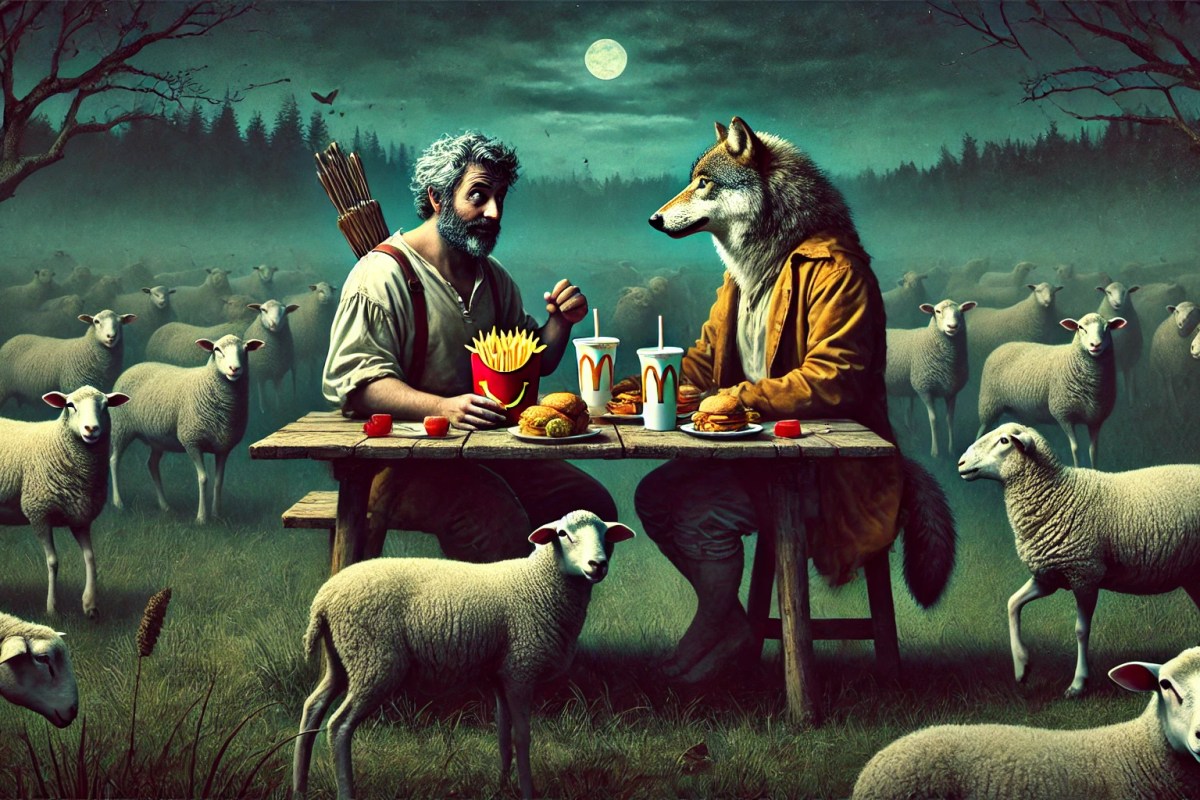
As the clock ticks us into 2025, a peculiar tale has surfaced in the blogosphere: a dark twist on the classic fable of the “wolf in sheep’s clothing,” served with a side of nihilistic absurdity. If you haven’t read it yet, you can find the original story over at Blog for Chumps. It’s a biting little narrative that turns traditional moralising on its head. Here’s why it deserves your attention.
Audio: NotebookLM Podcast on this topic.
The Tale in Brief
A hungry wolf, tired of dodging vigilant shepherds, decides to forgo subterfuge altogether. He waltzes into the flock, making no effort to hide his predatory nature. A naïve lamb follows him, and predictably, the wolf claims his meal. Later, the wolf returns to the sheepfold, where the shepherd — instead of protecting his flock — teams up with the wolf. Together, they butcher a sheep before abandoning the scene entirely to indulge in McDonald’s, leaving the traumatised sheep to accept their grim new reality.
Not exactly bedtime reading for the kids.
Themes: A Cynical Mirror to Our World
This tale is not merely a grotesque subversion of pastoral simplicity; it’s a scalpel slicing into the rotting carcass of modern society. Here’s what lurks beneath its woolly surface:
1. Cynicism Towards Authority
In most fables, the shepherd embodies protection and care. Here, he’s a collaborator in senseless violence. The shepherd’s betrayal critiques the notion of benevolent authority, suggesting that those entrusted with safeguarding the vulnerable often act in their own interests or, worse, align themselves with destructive forces. Sound familiar? Think political complicity, corporate greed, or any number of modern failures of leadership.
2. Normalisation of Atrocity
The sheep, described as cognitively intact, accept their grim reality without resistance. This isn’t a story about oblivious innocence; it’s about the horrifying human capacity to adapt to systemic violence. It reflects how people, faced with injustice, often acquiesce to their oppressors rather than challenge the status quo.
3. Inversion of Expectations
The wolf doesn’t even bother with the traditional sheepskin disguise. His audacity mirrors the brazen nature of modern exploitation, where bad actors operate in plain sight, confident in the public’s apathy or resignation. It’s a commentary on the erosion of shame, accountability, and even the pretence of decency.
4. Absurdity and Nihilism
The shepherd and wolf ditch their victim to grab fast food, trivialising the violence they’ve inflicted. The juxtaposition of archaic brutality with banal consumerism is absurd yet disturbingly resonant. It suggests that, in our era, even cruelty can be relegated to a footnote in the pursuit of comfort or convenience.
Symbols: Layers of Meaning
The tale brims with symbolic resonance:
The Wolf: A stand-in for unchecked greed or predatory systems, the wolf’s brazen behaviour highlights the dangers of apathy and unchallenged power.
The Shepherd: His betrayal symbolises the failure of institutions — governments, corporations, or other entities — to protect those they claim to serve.
The Sheep: Far from being simple-minded, the sheep’s acceptance of their grim new reality is a biting critique of societal complacency.
McDonald’s: A modern symbol of triviality and consumerism, it underscores the absurdity of senseless violence in a world driven by shallow comforts.
A Stark Commentary on Power Dynamics
At its core, the story is a brutal satire of power and complicity. Though ostensibly adversaries, the shepherd and wolf unite to exploit the powerless. It’s a chilling reminder of how often power structures protect their own interests at the expense of the vulnerable.
The sheep’s passive acceptance is equally damning. It forces readers to confront their own role as silent witnesses or even complicit actors in systems of oppression. What happens when we’re no longer shocked by atrocity but instead integrate it into the fabric of our existence?
The Satirical Edge
What makes this story particularly effective is its dark, sardonic, and unapologetically hyperbolic tone. It revels in absurdity while delivering a grim truth about human nature. The shepherd and wolf’s nonchalance is as hilarious as it is horrifying, making the tale an unsettling mirror of a society where injustice and apathy often go hand in hand.
Final Thoughts
This fable may be short, but its implications are vast. It’s a cautionary tale about the dangers of complacency, the betrayal of trust, and the absurdity of modern priorities. More importantly, it’s a call to resist the normalisation of harm — to recognise wolves and shepherds for what they are and demand better from ourselves and those in power.
So, as we usher in a new year, let this tale serve as a grim reminder: the wolf doesn’t always need a disguise, and the shepherd isn’t always your friend. Sometimes, they’re just two blokes on their way to McDonald’s.
Taking Moral Cues from Ants: Because Humans are Too Busy Defending the Indefensible
Ah, ants. Tiny, unassuming, and quite literally beneath us — unless you’re sprawled out on a picnic blanket fighting off a colony swarming your questionable sandwich. Yet, while humanity busies itself polluting oceans, strip-mining rainforests, and justifying corporate bloodsucking as “necessary for the economy,” ants are out here performing life-saving surgeries on their comrades.
ants are out here performing life-saving surgeries on their comrades
You heard that correctly.
Researchers have now observed certain ant species (yes, ants) performing amputations on their injured nestmates to prevent infections from spreading. Picture it: a worker ant limping home, leg shredded by some territorial skirmish, and the squad rolls up like a triage team, deciding whether to (a) gently clean the wound or (b) lop the limb off entirely. Amputation is precise and deliberate — snip at the hip joint if the upper leg is toast. Lower leg injuries? Too risky. Infection spreads faster there, so it’s all hands (or mandibles) on deck for some industrial-strength licking.
It’s a brutal but effective social health system. The results? Injured ants survive. They get patched up, return to work, and contribute to the collective. The colony benefits, everyone thrives, and not a single ant launches into a fevered tirade about how “it’s their individual right to rot from gangrene in peace.”
Contrast this with humanity, where the very notion of collective good seems to spark mass hysteria in certain corners. Here, defending dubious practices — say, unfettered pollution, exploitative labour conditions, or the kind of wealth-hoarding that would make a dragon blush — has become a full-time hobby for some. “Personal responsibility!” they scream whilst someone chokes on smog or shivers in a warehouse set to Arctic temperatures. Heaven forbid we intervene.
Imagine explaining to ants that humans argue about whether everyone deserves basic healthcare
Imagine explaining to ants that humans argue about whether everyone deserves basic healthcare. That we let industries poison rivers because regulations might “hurt innovation.” Some believe that letting people suffer and die without help is somehow noble.
Ants would stare at us — or they would if they had discernible faces. Then they’d probably do what they always do: get back to work ensuring their colony survives and thrives, as any halfway intelligent species might.
A Case for the Collective
What makes this ant behaviour so fascinating isn’t just that it exists, but that it demonstrates something humanity supposedly prides itself on: adaptability. Faced with an existential threat to one of their own, ants don’t moralise. They don’t argue about the costs or logistics of care. They don’t abandon the injured because helping them isn’t “profitable.” They just act. Quickly, efficiently, and for the collective good.
Meanwhile, humans act like the collective good is some leftist fever dream. Suggest tax-funded healthcare or basic environmental protections, and someone inevitably starts shrieking about “slippery slopes” toward tyranny, as though being able to breathe clean air or avoid bankruptcy after surgery is the thin edge of some Orwellian wedge.
We have entire systems built on the premise that it’s fine for some to suffer if others can profit
We have entire systems built on the premise that it’s fine for some to suffer if others can profit. Does that sound hyperbolic? I’ll wait while you Google “externalised costs.” Spoiler alert: your cheap burger came at the expense of rainforest ecosystems and underpaid workers. But hey, as long as we’re prioritising shareholder value, all’s fair, right?
The Ants Would Like a Word
Here’s the thing: ants don’t amputate limbs because they’re altruistic softies. They do it because it makes sense. An injured worker can still contribute to the colony, and the colony’s survival depends on its members pulling together. It’s cold, pragmatic, and effective.
Now consider our own global “colony.” Why do we resist solutions that would make all of us more resilient? Healthcare, environmental protections, workers’ rights — these aren’t radical. They’re practical. Just like amputating a leg to save an ant, safeguarding the vulnerable helps everyone. Yet here we are, letting metaphorical infections spread because someone’s feelings about rugged individualism got in the way.
If Ants Can Do It, So Can We
At this point, humanity doesn’t need a lofty moral awakening. We just need to be marginally smarter than ants. Think about it: they’re tiny-brained insects who figured out that collective care improves survival rates. What’s our excuse?
Perhaps it’s time we take a page out of the ants’ playbook: diagnose the problem, take decisive action, and prioritise the common good. Amputate the rot. Treat the infection. And for the love of whatever deity or science you hold dear, stop defending systems that sacrifice the many for the few.
If ants can do it, we have no excuse.
In Conclusion:
Ants: 1. Humans: 0.
When ants are more socially responsible than we are, it’s time to ask some tough questions. Now get it together, or the ants are going to outlive us all.
“Is the universe really infinite? Or could it loop back on itself like a sphere?” Sabine Hossenfelder’s words on the nature of space-time are arresting, not merely for the cosmological implications but for the deeper metaphor they offer. They strike a resonant chord with anyone wrestling with a different kind of infinite: the slippery expanse of language.
As Sabine walks us through the intricacies of curved space-time, she inadvertently shines a light on something equally abstract yet close to home—how language, like the universe, seems vast and unbounded but is, in practice, riddled with constraints. What if language itself, for all its apparent openness, is its own kind of finite geometry?
Drawing on my Language Insufficiency Hypothesis (LIH), I propose that Sabine’s insights into cosmology can offer a lens to explore the paradoxes of human communication. Language, like space-time, is internally defined, replete with loops, and prone to infinite configurations that fail to expand meaningfully. Let’s explore how the universe’s curvature mirrors the curvatures of our words.
The Closed Systems of Space and Language
In physics, the curvature of space-time is measured internally. You can determine if space is flat or curved by drawing a triangle and adding its angles. If they don’t sum to 180 degrees, you’re in curved space. Sabine highlights that this is true without any external reference point; the geometry is self-contained.
Language operates much the same way. Words and meanings are often bounded by the internal logic of the systems they inhabit—be they legal, technical, or ideological. Much like the curvature of space-time, linguistic meaning is determined not externally but within the context of its own closed system. Think of a term like “justice”: in a legal setting, it might add up to one interpretation, while in a political debate, its angles skew wildly. To an outsider, the system is opaque, even though it seems perfectly flat from within.
Infinite Expanses or Finite Loops?
Sabine explains that the universe might be infinite, but it might also loop back on itself, creating patterns of repetition. Her analogy of light travelling endlessly through a curved universe only to return to its origin provides a striking metaphor for language’s “effectiveness horizons.”
As concepts grow more abstract—freedom, truth, beauty—language seems to expand infinitely. But in practice, it often circles back, repeating itself in kaleidoscopic loops of contested meaning. Philosophers have debated terms like “good” or “justice” for millennia, yet here we are, still tracing the same paths, unable to break free from the system’s internal constraints. Language doesn’t expand into new meaning; it curves back on itself.
Schrödinger’s Words: Infinite Interpretations
One of Sabine’s most evocative ideas is the notion that in an infinite universe, there are infinite copies of you, some slightly different, some wildly so. A version of you with more hair. One with less brain. This multiplicity mirrors what I call Schrödinger’s Weasels: words that exist in multiple, contradictory states until “collapsed” by context.
Take a word like “freedom.” In political discourse, it can simultaneously mean the right to self-determination, freedom from government interference, or the economic liberty to exploit markets. Much like Sabine’s infinite configurations, these meanings coexist until someone forces them into a single interpretive frame. The result? Semantic exhaustion. A single word tries to carry the weight of an infinite universe.
The Precision Paradox
Sabine notes that asking what the universe expands into is a meaningless question because expansion describes relationships within space-time, not beyond it. Similarly, the pursuit of perfect precision in language often collapses into meaninglessness. Trying to pin down a word like “justice” leads to endless definitions, each requiring further clarification. It’s a Zeno’s paradox of semantics: the closer we get to precision, the more distance remains.
Lessons from Curved Space and Twisted Words
What does this tell us about the limits of language? Sabine’s insights reinforce the idea that complexity doesn’t always lead to clarity. Like the universe, language isn’t infinite in the way we might wish; it’s bounded by its own structure. The more abstract the concept, the greater the chance we’ll find ourselves lost in a linguistic loop, navigating words that seem to expand but merely repeat.
Understanding this doesn’t mean abandoning the pursuit of meaning but accepting its constraints. Just as cosmologists use models to map the unobservable edges of the universe, we can use frameworks like the Language Insufficiency Hypothesis to chart the limits of our words. Both efforts are acts of humility in the face of infinite complexity.
Closing Thought
If Sabine is right that there are infinitely many versions of ourselves in the universe, perhaps one of them has already solved the riddle of language. Or, more likely, they’ve just found a new loop to wander.
What do you think? Is language a closed system, forever folding back on itself? Or can we stretch it, like space-time, to infinity and beyond?
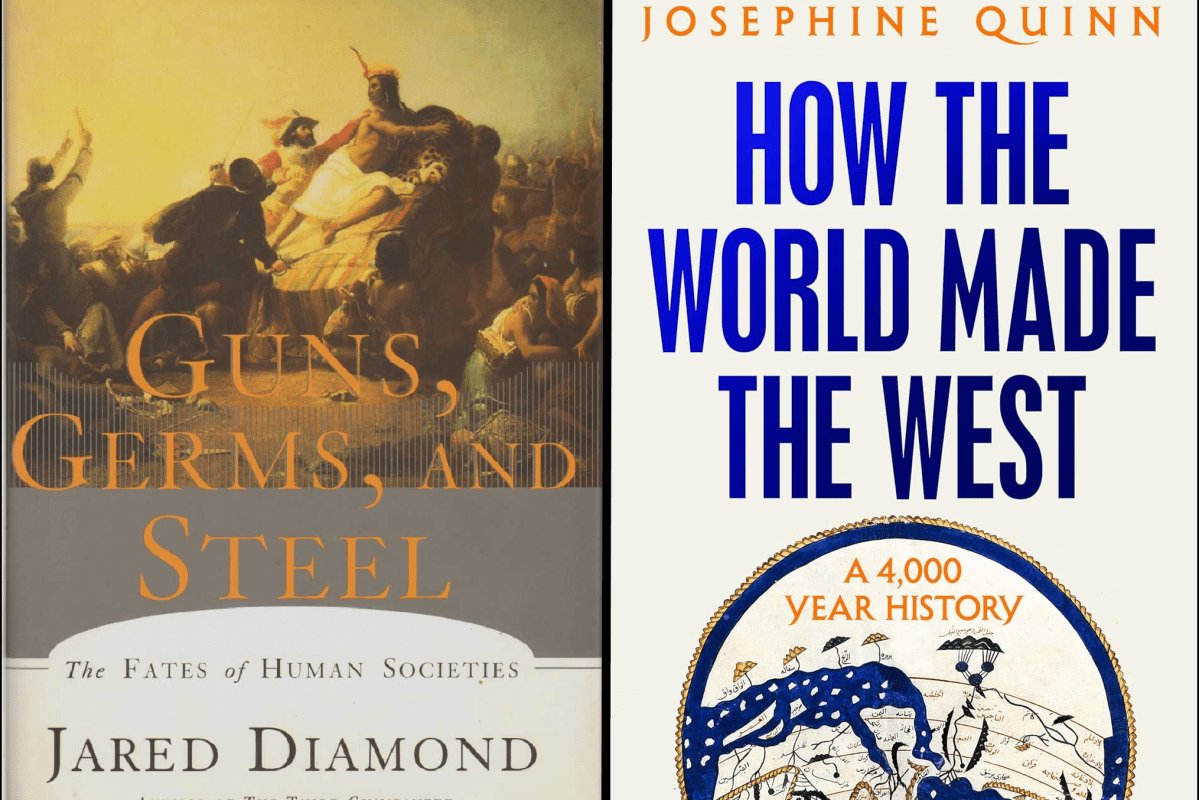
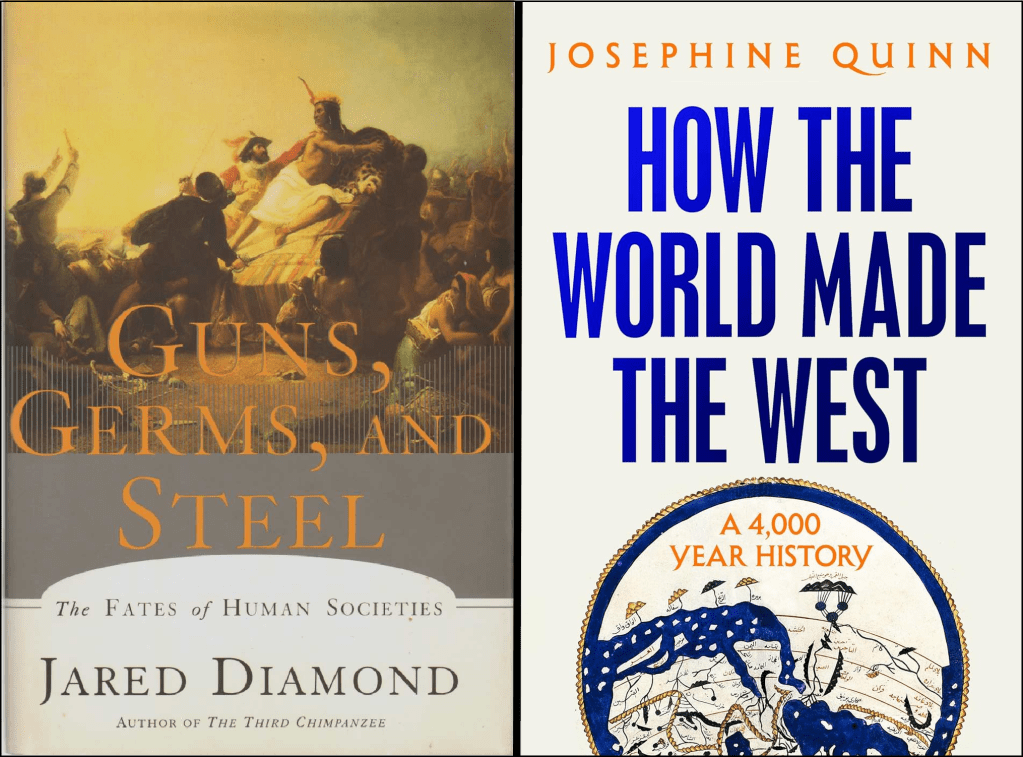
I am reading Jared Diamond’s Guns, Germs, and Steel: The Fates of Human Societies, the first and likely most famous of an informal trilogy. I thought I had already read it, but I think I only saw the PBS show. Having recently finished Josephine Quinn’s How the World Made the West, I wanted to revisit this perspective. The two books are presented in different styles and represent different perspectives, but they seem to be complementary.
Where Diamond focuses on environmental factors (an oft-voiced critique), Quinn focuses on human agency.
Diamond takes a bird’ s-eye view, looking for universal patterns and systemic explanations, whilst Quinn adopts a granular, specific approach, highlighting the fluidity and contingency of history.
Diamond deconstructs European dominance by attributing it to environmental luck, but his narrative risks sidelining the agency of colonised peoples. Quinn critiques the very idea of Western dominance, arguing that the concept of the West itself is a myth born of appropriation and exchange.
Rather than being wholly opposed, Diamond and Quinn’s approaches might be seen as complementary. Diamond provides the structural scaffolding – the environmental and geographic conditions that shape societies – whilst Quinn fills in the cultural and human dynamics that Diamond often glosses over. Together, they represent two sides of the historiographical coin: one focusing on systemic patterns, the other on the messiness of cultural particularities.
A Comparative Analysis of Sarah Perry, Emil Cioran, and Contemporaries
In a world where procreation is often celebrated as a fundamental human aspiration, a group of philosophers challenges this deeply ingrained belief by questioning the ethical implications of bringing new life into existence. Antinatalism, the philosophical stance that posits procreation is morally problematic due to the inherent suffering embedded in life, invites us to reexamine our assumptions about birth, existence, and the value we assign to life itself.
Audio: Podcast related to the content on this page
Central to this discourse are thinkers like Sarah Perry, whose work “Every Cradle is a Grave: Rethinking the Ethics of Birth and Suicide” intertwines the ethics of procreation with the right to die, emphasizing personal autonomy and critiquing societal norms. Alongside Perry, philosophers such as Emil Cioran, David Benatar, Thomas Ligotti, and Peter Wessel Zapffe offer profound insights into the human condition, consciousness, and our existential burdens.
This article delves into the complex and often unsettling arguments presented by these philosophers, comparing and contrasting their perspectives on antinatalism. By exploring their works, we aim to shed light on the profound ethical considerations surrounding birth, suffering, and autonomy over one’s existence.
The Inherent Suffering of Existence
At the heart of antinatalist philosophy lies the recognition of life’s intrinsic suffering. This theme is a common thread among our featured philosophers, each articulating it through their unique lenses.
Sarah Perry argues that suffering is an unavoidable aspect of life, stemming from physical ailments, emotional pains, and existential anxieties. In “Every Cradle is a Grave,” she states:
“Existence is imposed without consent, bringing inevitable suffering.”
Perry emphasises that since every human will experience hardship, bringing a new person into the world exposes them to harm they did not choose.
Similarly, David Benatar, in his seminal work “Better Never to Have Been: The Harm of Coming into Existence,” presents the asymmetry argument. He posits that coming into existence is always a harm:
“Coming into existence is always a serious harm.”
Benatar reasons that while the absence of pain is good even if no one benefits from it, the absence of pleasure is not bad unless there is someone for whom this absence is a deprivation. Therefore, non-existence spares potential beings from suffering without depriving them of pleasures they would not miss.
Emil Cioran, a Romanian philosopher known for his profound pessimism, delves deep into the despair inherent in life. In “The Trouble with Being Born,” he reflects:
“Suffering is the substance of life and the root of personality.”
Cioran’s aphoristic musings suggest that life’s essence is intertwined with pain, and acknowledging this is crucial to understanding our existence.
Thomas Ligotti, blending horror and philosophy in “The Conspiracy Against the Human Race,” portrays consciousness as a cosmic error:
“Consciousness is a mistake of evolution.”
Ligotti argues that human awareness amplifies suffering, making us uniquely burdened by the knowledge of our mortality and the futility of our endeavours.
Peter Wessel Zapffe, in his essay “The Last Messiah,” examines how human consciousness leads to existential angst:
“Man is a biological paradox due to excessive consciousness.”
Zapffe contends that our heightened self-awareness results in an acute recognition of life’s absurdities, causing inevitable psychological suffering.
Ethics of Procreation
Building upon the acknowledgement of life’s inherent suffering, these philosophers explore the moral dimensions of bringing new life into the world.
Sarah Perry focuses on the issue of consent. She argues that since we cannot obtain consent from potential beings before birth, procreation imposes life—and its accompanying suffering—upon them without their agreement. She writes:
“Procreation perpetuates harm by introducing new sufferers.”
Perry challenges the societal norm that views having children as an unquestioned good, highlighting parents’ moral responsibility for the inevitable pain their children will face.
In David Benatar’s asymmetry argument, he extends this ethical concern by suggesting that non-existence is preferable. He explains that while the absence of pain is inherently good, the absence of pleasure is not bad because no one is deprived of it. Therefore, bringing someone into existence who will undoubtedly experience suffering is moral harm.
Emil Cioran questions the value of procreation given the futility and despair inherent in life. While not explicitly formulating an antinatalist argument, his reflections imply scepticism about the act of bringing new life into a suffering world.
Peter Wessel Zapffe proposes that refraining from procreation is a logical response to the human condition. By not having children, we can halt the perpetuation of existential suffering. He suggests that humanity’s self-awareness is a burden that should not be passed on to future generations.
The Right to Die and Autonomy over Existence
A distinctive aspect of Sarah Perry’s work is her advocacy for the right to die. She asserts that just as individuals did not consent to be born into suffering, they should have the autonomy to choose to end their lives. Perry critiques societal and legal barriers that prevent people from exercising this choice, arguing:
“Autonomy over one’s life includes the right to die.”
By decriminalizing and destigmatizing suicide, she believes society can respect individual sovereignty and potentially alleviate prolonged suffering.
Emil Cioran contemplates suicide not necessarily as an action to be taken but as a philosophical consideration. In “On the Heights of Despair,” he muses:
“It is not worth the bother of killing yourself, since you always kill yourself too late.”
Cioran views the option of ending one’s life as a paradox that underscores the absurdity of existence.
While Benatar, Ligotti, and Zapffe acknowledge the despair that can accompany life, they do not extensively advocate for the right to die. Their focus remains on the ethical implications of procreation and the existential burdens of consciousness.
Coping Mechanisms and Societal Norms
Peter Wessel Zapffe delves into how humans cope with the existential angst resulting from excessive consciousness. He identifies four defence mechanisms:
Isolation: Repressing disturbing thoughts from consciousness.
Anchoring: Creating or adopting values and ideals to provide meaning.
Distraction: Engaging in activities to avoid self-reflection.
Sublimation: Channeling despair into creative or intellectual pursuits.
According to Zapffe, these mechanisms help individuals avoid confronting life’s inherent meaninglessness.
Thomas Ligotti echoes this sentiment, suggesting that optimism is a psychological strategy to cope with the horror of existence. He writes:
“Optimism is a coping mechanism against the horror of existence.”
Sarah Perry and Emil Cioran also critique societal norms that discourage open discussions about suffering, death, and the choice not to procreate. They argue that societal pressures often silence individuals who question the value of existence, thereby perpetuating cycles of unexamined procreation and stigmatizing those who consider alternative perspectives.
Comparative Insights
While united in their acknowledgement of life’s inherent suffering, these philosophers approach antinatalism and existential pessimism through varied lenses.
Sarah Perry emphasises personal autonomy and societal critique, advocating for policy changes regarding birth and suicide.
Emil Cioran offers a deeply personal exploration of despair, using poetic language to express the futility he perceives in existence.
David Benatar provides a structured, logical argument against procreation, focusing on the ethical asymmetry between pain and pleasure.
Thomas Ligotti combines horror and philosophy to illustrate the bleakness of consciousness and its implications for human suffering.
Peter Wessel Zapffe analyzes the psychological mechanisms humans employ to avoid confronting existential angst.
Critiques and Counterarguments
Critics of antinatalism often point to an overemphasis on suffering, arguing that it neglects the joys, love, and meaningful experiences that life can offer. They contend that while suffering is a part of life, it is not the totality of existence.
In response, antinatalist philosophers acknowledge the presence of pleasure but question whether it justifies the inevitable suffering every person will face. Benatar argues that while positive experiences are good, they do not negate the moral harm of bringing someone into existence without their consent.
Regarding the right to die, opponents express concern over the potential neglect of mental health issues. They worry that normalizing suicide could prevent individuals from seeking help and support that might alleviate their suffering.
Sarah Perry addresses this by emphasizing the importance of autonomy and the need for compassionate support systems. She advocates for open discussions about suicide to better understand and assist those contemplating it rather than stigmatizing or criminalizing their considerations.
Societal and Cultural Implications
These philosophers’ works challenge pro-natalist biases ingrained in many cultures. By questioning the assumption that procreation is inherently positive, they open a dialogue about the ethical responsibilities associated with bringing new life into the world.
Sarah Perry critiques how society glorifies parenthood while marginalizing those who choose not to have children. She calls for reevaluating societal norms that pressure individuals into procreation without considering the ethical implications.
Similarly, Emil Cioran and Thomas Ligotti highlight how societal denial of life’s inherent suffering perpetuates illusions that hinder genuine understanding and acceptance of the human condition.
Conclusion
The exploration of antinatalist philosophy through the works of Sarah Perry, Emil Cioran, and their contemporaries presents profound ethical considerations about life, suffering, and personal autonomy. Their arguments compel us to reflect on the nature of existence and the responsibilities we bear in perpetuating life.
While one may not fully embrace antinatalist positions, engaging with these ideas challenges us to consider the complexities of the human condition. It encourages a deeper examination of our choices, the societal norms we accept, and how we confront or avoid the fundamental truths about existence.
Final Thoughts
These philosophers’ discussions are not merely abstract musings but have real-world implications for how we live our lives and make decisions about the future. Whether it’s rethinking the ethics of procreation, advocating for personal autonomy over life and death, or understanding the coping mechanisms we employ, their insights offer valuable perspectives.
By bringing these often-taboo topics into the open, we can foster a more compassionate and thoughtful society that respects individual choices and acknowledges the full spectrum of human experience.
Encouraging Dialogue
As we conclude this exploration, readers are invited to reflect on their own beliefs and experiences. Engaging in open, respectful discussions about these complex topics can lead to greater understanding and empathy.
What are your thoughts on the ethical considerations of procreation? How do you perceive the balance between life’s joys and its inherent suffering? Share your perspectives and join the conversation.
References and Further Reading
Perry, Sarah. Every Cradle is a Grave: Rethinking the Ethics of Birth and Suicide. Nine-Banded Books, 2014.
Benatar, David. Better Never to Have Been: The Harm of Coming into Existence. Oxford University Press, 2006.
Cioran, Emil. The Trouble with Being Born. Arcade Publishing, 1973.
Ligotti, Thomas. The Conspiracy Against the Human Race. Hippocampus Press, 2010.
Zapffe, Peter Wessel. “The Last Messiah.” Philosophy Now, 1933.
For more in-depth analyses and reviews, consider exploring the following blog posts:
This ChatGPT o1-generated article aims to thoughtfully and respectfully present the philosophical positions on antinatalism and existential pessimism. The discussions about suffering, procreation, and the right to die are complex and sensitive. If you or someone you know is struggling with such thoughts, please seek support from mental health professionals or trusted individuals in your community.
Next Steps
Based on reader interest and engagement, future articles may delve deeper into individual philosophers’ works, explore thematic elements such as consciousness and suffering, or address counterarguments in more detail. Your feedback and participation are valuable in shaping these discussions.
Let us continue this journey of philosophical exploration together.






 Philosophics