I’ve just released a new book, The Illusion of Light: Thinking After the Enlightenment, now available in paperback through KDP and distributed via Amazon. In November, a clothbound edition will follow through IngramSpark, extending availability to libraries and independent bookstores worldwide, including Barnes & Noble in the United States.
Image: Front cover of The Illusion of Light. Links to Amazon for purchase. The ‘Free Preview’ claim is untrue, as there is no Kindle version available. An ebook will be available presently.
Audio: NotebookLM podcast on this topic.
About the Book
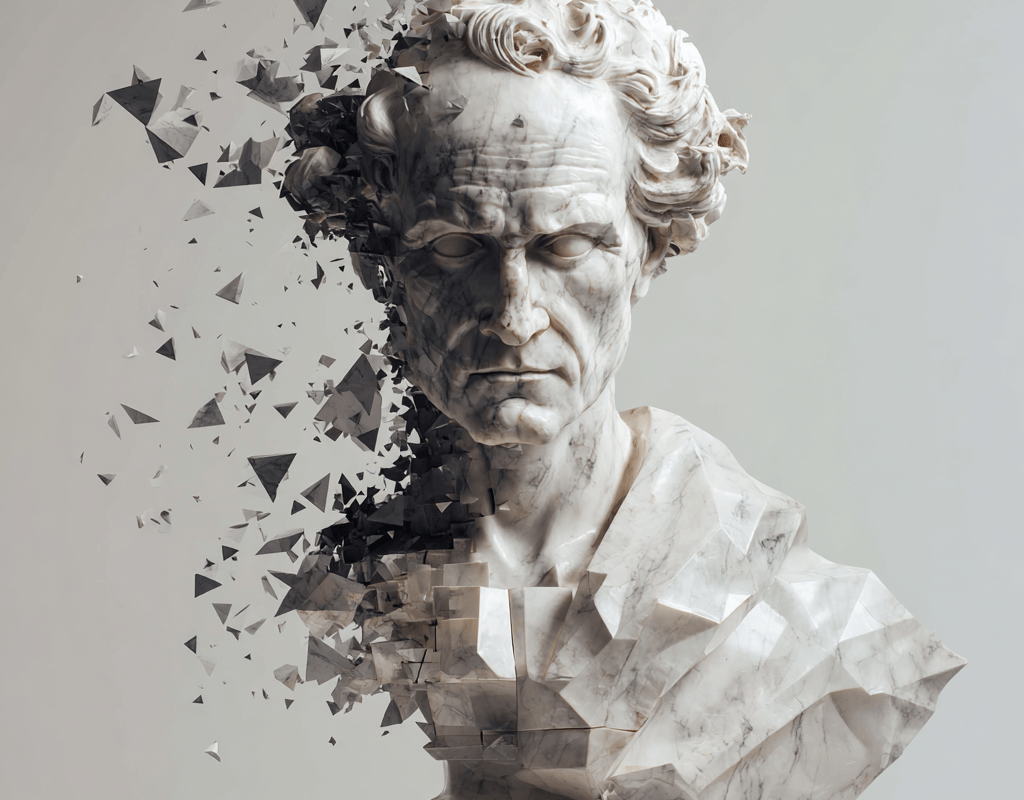
The Illusion of Light opens where the Enlightenment’s glare begins to fade. It asks what happens after reason exhausts itself – after the promise of illumination gives way to overexposure. These essays trace how modernity’s metaphors of light and progress became instruments of management: how objectivity hardened into ritual, agency into alibi, normality into control.
Rather than rejecting the Enlightenment outright, the book lingers in its afterimage. It argues for a philosophy practiced in the half-light – a mode of thought that values nuance over certainty, care over mastery, and maintenance over redemption. To read by residual light, as the preface suggests, is to learn to see again when the world stops pretending to be illuminated.
The preface is available on this prior post, written and audio versions.
The Broader Project
The Illusion of Light forms the threshold of the Anti-Enlightenment Project, a series examining the afterlives of modern reason – how its ideals of progress, agency, objectivity, and normality continue to govern our politics, sciences, and selves long after their foundations have cracked. Each volume approaches the same question from a different room in the old House of Reason: Objectivity Is Illusion, Rational Ghosts, Temporal Ghosts, Against Agency, The Myth of Homo Normalis, and The Discipline of Dis-Integration.
Taken together, they offer not a manifesto but a practice: philosophy as maintenance work, care as critique, and composure as the only honest response to the ruins of certainty. More to follow.
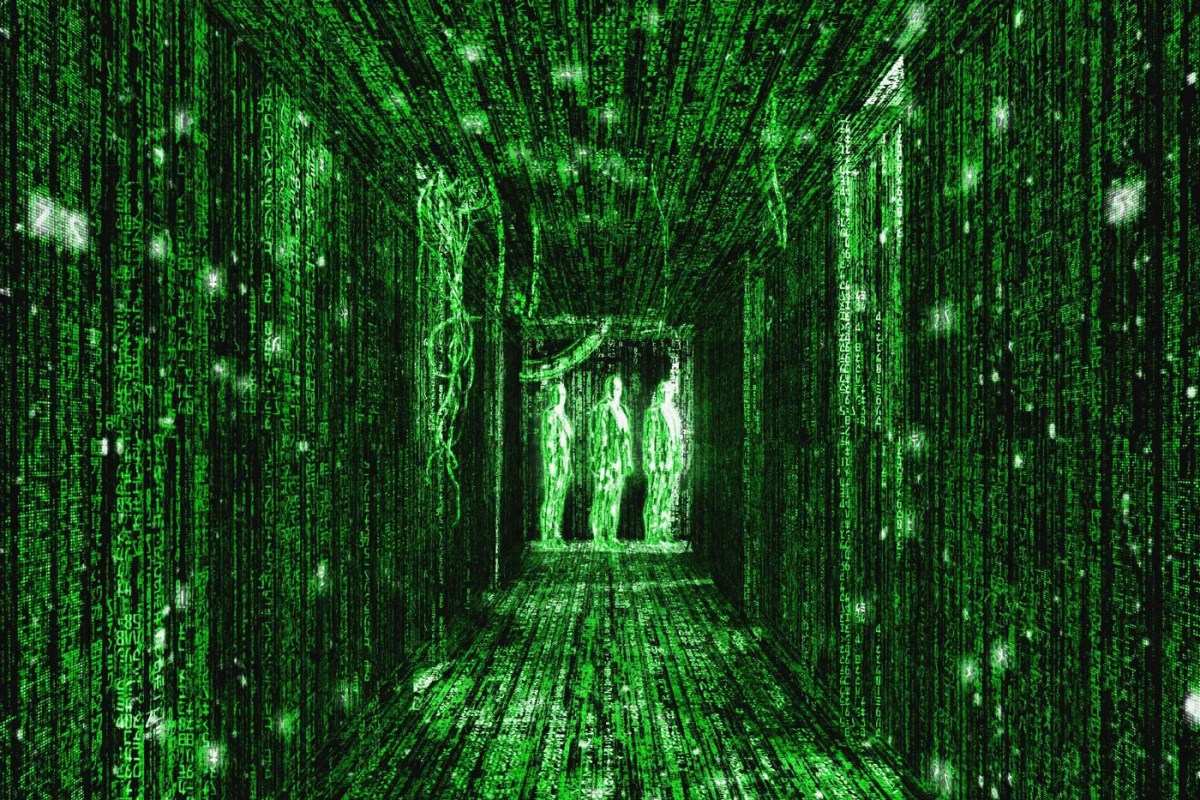
In the late 1990s, the Wachowskis gave us The Matrix – Keanu Reeves as Neo, the Chosen One™, a man so bland he could be anyone, which was the point. Once he realised he was living inside a simulation, he learned to bend its laws, to dodge bullets in slow motion and see the code behind the curtain. Enlightenment, Hollywood-style.
Audio: NotebookLM podcast on this topic.
But here’s the twist, the film itself couldn’t stomach: realising the simulation doesn’t free you from it.
Knowing that race and gender are social constructs doesn’t erase their architecture. Knowing that our economies, legal systems, and so-called democracies are fictions doesn’t get us out of paying taxes or playing our assigned roles. “The social contract” is a collective hallucination we agreed to before birth. That and a dollar still won’t buy you a cup of coffee.
Baudrillard, whose Simulacra and Simulation the film name-dropped like a trophy, argued that simulation doesn’t hide reality – it replaces it. When representation becomes indistinguishable from the thing it represents, truth evaporates, leaving only consensus. We don’t live in a system of power; we live in its performance.
The Matrix got the metaphor half right. It imagined the bars of our cage as a digital dream – glossy, computable, escapable. But our chains are older and subtler. Rousseau called them “social”, Foucault diagnosed them as “biopolitical”, and the rest of us just call them “normal”. Power doesn’t need to plug wires into your skull; it only needs to convince you that the socket is already there.
You can know it’s all a fiction. You can quote Derrida over your morning espresso and tweet about the collapse of epistemic certainty. It won’t change the fact that you still have rent to pay, laws to obey, and identities to perform. Awareness isn’t liberation; it’s just higher-resolution despair with better UX.
Neo woke up to a ruined Earth and thought he’d escaped. He hadn’t. He’d only levelled up to the next simulation – the one called “reality”. The rest of us are still here, dutifully maintaining the system, typing in our passwords, and calling it freedom.
NB: Don’t get me wrong. I loved The Matrix when it came out. I still have fond memories. It redefined action films at the time. I loved the Zen messaging, but better mental acuity doesn’t grant you a pass out of the system.
The Enlightenment promised liberation through reason – that if we could think clearly enough, we could act freely enough. Agency, it claimed, was the defining trait of the rational individual: a sovereign chooser, self-contained and self-determining.
But this was always a fiction.
Not an innocent one, either.
Audio: NotebookLM podcast discussing the essay, Against Agency
Agency became the moral infrastructure of modernity – the premise behind law, punishment, merit, guilt, and even political participation. To say “I chose” was not simply to describe behaviour; it was to perform belonging within a metaphysical system that made individuals the unit of responsibility. The fiction worked, for a while, because it kept the machinery running.
Against Agency argues that this story has collapsed – not metaphorically but structurally. Cognitive science, postcolonial thought, and relational philosophies all point to the same conclusion: there is no autonomous agent, only differential responsiveness – a system’s fluctuating capacity to register and transmit influence.
Copper sings under current; rubber resists. Humans, likewise, respond within the constraints of biology, fatigue, trauma, and social design. What we call “freedom” is merely a condition in which responsiveness remains broad and protected.
This reframing dismantles the binary of “free” and “unfree.” There is no metaphysical threshold where agency appears. Instead, responsiveness scales – widened by safety, narrowed by coercion, eroded by exhaustion. Politics becomes engineering: the maintenance of conditions that sustain responsiveness, rather than the worship of choice.
Ethics, too, must shift.
Not “Who is to blame?” but “Where did the circuit break?”
The essay proposes a gradient model of conduct grounded in relation and feedback, rather than autonomy and will. Responsibility becomes less about moral worth and more about bandwidth – a physics of care.
It’s an uncomfortable vision for a culture addicted to outrage and repentance. The loss of agency removes our favourite alibi: the chooser who could have done otherwise. But it also opens the possibility of a more honest ethics – one that replaces judgment with maintenance, retribution with repair.
This is not nihilism. It’s realism.
Systems appear stable only from a distance. Up close, everything is process – bodies, institutions, meanings – held together by temporary alignments of responsiveness. Against Agency names this collapse not as tragedy, but as opportunity: a clearing from which to think and act without the fictions that sustained modernity.
The essay forms the foundation for what comes next in the Anti-Enlightenment Project – Dis-Integration, a philosophical sequel that explores what remains once coherence, control, and autonomy have been decommissioned.
Not the darkness after the light, but the shadow the light forgot it cast
The Enlightenment promised light. What it delivered was fluorescence – bright, sterile, and buzzing with the sound of its own reason.
The Anti-Enlightenment Project gathers a set of essays, fragments, and quotations tracing how that light dimmed – or perhaps was never as luminous as advertised. It’s less a manifesto than a map of disintegration: how agency became alibi, how reason became ritual, and how modernity mistook motion for progress.
Preprints and essays (Against Agency, Rational Ghosts, Temporal Ghosts, and others to follow)
Related reflections from Philosophics posts going back to 2019
A living index of quotations from Nietzsche to Wynter, tracing philosophy’s slow discovery that its foundation may have been sand all along
This isn’t a war on knowledge, science, or reason – only on their misappropriation as universal truths. The Anti-Enlightenment simply asks what happens when we stop pretending that the Enlightenment’s “light” was neutral, natural, or necessary.
It’s not reactionary. It’s diagnostic.
The Enlightenment built the modern world; the Anti-Enlightenment merely asks whether we mistook the glare for daylight.
At some point in history – some smoke-filled Enlightenment salon, some powdered wig convention – someone floated the idea that when opinions differ, the “fairest” way forward is to count hands and let the larger number win. On the surface, it feels intuitive. If ten want tea and nine want coffee, surely the tea-drinkers deserve their kettle.
But the trick lies in the numbers. By this logic, 49% of the people get exactly what they did not want, and their consolation prize is the promise of “next time”. What passes as fairness is simply coercion with polite manners.
The problem is structural:
Majority ≠ Mandate. A slim majority is just a statistical accident elevated into divine authority.
Minorities Lose by Default. If you belong to a permanent minority – ethnic, cultural, ideological –you may never taste victory, yet you’re still bound to abide by everyone else’s “consensus.”
Abstainers Become Scapegoats. When two candidates split a third of the population each and the rest sit out, the “winner” is crowned with less than half the electorate behind them. The abstainers are then blamed for “not preventing” the outcome, as though voting for a candidate they disliked would have saved them.
Why did this formula gain traction? Because it looked neat. It gave the appearance of fairness, a clean heuristic: count, declare, move on. Like democracy itself, it was born of Enlightenment rationalism’s obsession with rules, numbers, and abstraction. The premise was that humans are rational agents, and rational agents could submit to a rational procedure. The reality: humans are messy, tribal, irrational.
Majority rule became a ritual of laundering domination into legitimacy. “The people have spoken” is the priestly incantation, even if two-thirds of the people didn’t.
If we strip the veneer, what remains is not fairness but a convenient shortcut – one that was accepted, then sanctified, because it seemed better than monarchy and cheaper than perpetual stalemate. And so we’ve been living under the ghost of that decision ever since, confusing arithmetic with justice.
In celestial mechanics, the three-body problem is notorious. Give Newton two bodies – a planet and a sun – and the equations sing. Add a third, and the song collapses into noise. No general solution exists. Even the smallest nudge in one orbit cascades unpredictably through the system.
Audio: NotebookLM podcast on this topic.
Now swap out planets for people. Not three, but millions. Each voter tugging with their own gravity – preferences, fears, biases, identities, the entire mess of human subjectivity. Democracy insists that by tallying these forces, we’ll arrive at something stable: the will of the people. But what we actually get is the millions-body problem: unstable coalitions, contradictory mandates, endlessly shifting orbits.
almost any outcome can be engineered by manipulating the order of votes
Condorcet’s Dilemma
The French mathematician Marquis de Condorcet spotted this flaw in the 18th century. His paradox showed that even if every individual voter ranks choices rationally, the group as a whole may not. Collective preferences can loop in circles: A beats B, B beats C, C beats A. It’s not dysfunction; it’s baked into the math.
Later, political scientists proved the paradox was only the beginning. McKelvey’s “chaos theorem” demonstrated that in a system with three or more options, almost any outcome can be engineered by manipulating the order of votes. In other words, democratic choice is not stable; it’s sensitive to framing, sequence, and agenda control.
Condorcet was brilliant enough to see the cracks, but like his Enlightenment peers, he decided that the fiction of order was preferable to the reality of chaos. Better to promise tidy majorities than to admit that majority rule is structurally incoherent.
majority rule a ritual of laundered coercion
The Tidy Lie
Why did majority rule catch on? Because it looked fair, even if speciously so. It gave the appearance of impartiality: count, declare, move on. It was simple enough to administer, and more palatable than monarchy or deadlock.
But neatness is not truth. If 51% of people vote for one candidate, 49% are compelled to live under a government they explicitly rejected. If a third of the population abstains altogether, the “winner” might rule with the backing of barely one-third of the country – yet claim a mandate.
This is what makes majority rule a ritual of laundered coercion. The losers are told, “next time you might win,” even though whole minorities may never win. Abstainers are scapegoated for outcomes they opposed. And everyone is asked to keep pretending that arithmetic equals legitimacy.
Like the three-body problem, democracy has no general solution.
The Millions-Body Orbit
Elections give us final numbers – 34% here, 33% there – and we mistake them for laws of motion, as if the cosmos has spoken. But what we’re really seeing is a freeze-frame of chaos. The actual trajectories – coalitions, grievances, shifting identities – continue to wobble beneath the surface.
Like the three-body problem, democracy has no general solution. It isn’t clockwork; it’s turbulence. The miracle is not that it works, but that we pretend it does. Every “mandate” is a temporary illusion, a centre of gravity that exists only until the next disturbance knocks it off course.
And yet, the illusion persists. Because without it, the truth is unbearable: that there is no singular “will of the people,” only the millions-body problem, endlessly unstable, masked by the ritual of counting hands.
Radical Futures Studio’s “7 Signals” deck has been circulating widely. It’s a striking example of Storytelling 101: identify a villain, chart the signs of its decline, and point toward an eventual resolution. In this case, the villain is white supremacy. The signs are its institutional and cultural fray. The resolution is its collapse.
Audio: NotebookLM podcast on this topic.
As far as stories go, it’s effective. It provides a framework, some memorable imagery, and the reassurance that the ugliness on display today is a death rattle, not a resurgence. No wonder it resonates. People want to believe the noise means the monster is dying.
Racism is not the root structure; it is a symptom, a mask
But as analysis, the frame is too tight. Racism is not the root structure; it is a symptom, a mask. White supremacy is real enough in its effects, but its persistence and decline are contingent. The deeper system – the scaffolding of late-stage capitalism, the Enlightenment’s brittle universalism, the institutions now staggering under their own contradictions – remains the host. When whiteness peels away, the system does not vanish. It simply rebrands.
To point to the peeling paint and say ‘the house is collapsing’ is to mistake surface for structure. Yes, the paint matters; it shapes how people experience the walls. But the real rot lies deeper, in the beams. The Enlightenment project promised seamless cloth: rationality, universality, permanence. Capitalism promised endless expansion and renewal. Both promises are faltering, and the cracks are visible everywhere – climate, finance, governance, identity. Racism, whiteness, supremacy: these are one set of cracks, not the foundation itself.
The risk of the ‘signals’ narrative is that it offers too neat a moral arc. It comforts the audience that the villain is cornered, that justice is baked into the future. But history is rarely so tidy. Supremacy does not die; it changes costumes. One mask slips, another is stitched on. If we mistake the collapse of whiteness for the collapse of the system, we blind ourselves to how easily the scaffolding survives in new guises.
Racism is a systemic lie
None of this is to reject the cause. Racism is a systemic lie, and its decline is worth cheering. But it is not enough to track the noise of its death rattle. To understand the larger story, we need to step back and see the woods for the trees. The true collapse underway is broader: the exhaustion of capitalism’s last stage, the unravelling of Enlightenment’s promises, the loss of legitimacy in institutions that no longer hold. That is the forest in which the tree of whiteness withers.
If we focus only on the tree, we risk missing the landscape. And if we mistake peeling paint for the beams, we risk celebrating cosmetic decline while the house quietly reassembles itself under a different banner.
We’re told we live in the Enlightenment, that Reason™ sits on the throne and superstition has been banished to the attic. Yet when I disguised a little survey as “metamodern,” almost none came out as fully Enlightened. Three managed to shed every trace of the premodern ghost, one Dutch wanderer bypassed Modernity entirely, and not a single soul emerged free of postmodern suspicion. So much for humanity’s great rational awakening. Perhaps Modernity wasn’t a phase we passed through at all, but a mirage we still genuflect before, a lifestyle brand draped over a naked emperor.
Audio: NotebookLM podcast on this topic
The Enlightenment as Marketing Campaign
The Enlightenment is sold to us as civilisation’s great coming-of-age: the dawn when the fog of superstition lifted and Reason took the throne. Kant framed it as “man’s emergence from his self-incurred immaturity” – an Enlightenment bumper sticker that academics still like to polish and reapply. But Kant wasn’t writing for peasants hauling mud or women without the vote; he was writing for his own coterie of powdered-wig mandarins, men convinced their own habits of rational debate were humanity’s new universal destiny.
Modernity, in this story, isn’t a historical stage we all inhabited. It’s an advertising campaign: Reason™ as lifestyle brand, equality as tagline, “progress” as the logo on the tote bag. Modernity, in the textbooks, is billed as a historical epoch, a kind of secular Pentecost in which the lights came on and we all finally started thinking for ourselves. In practice, it was more of a boutique fantasy, a handful of gentlemen mistaking their own rarefied intellectual posture for humanity’s destiny.
The Archetype That Nobody Lives In
At the core of the Enlightenment lies the archetype of Man™: rational, autonomous, unencumbered by superstition, guided by evidence, weighing pros and cons with the detachment of a celestial accountant. Economics repackaged him as homo economicus, forever optimising his utility function as if he were a spreadsheet in breeches.
But like all archetypes, this figure is a mirage. Our survey data, even when baited as a “metamodern survey”, never produced a “pure” Enlightenment subject.
3 scored 0% Premodern (managing, perhaps, to kick the gods and ghosts to the kerb).
1 scored 0% Modern (the Dutch outlier: 17% Premodern, 0% Modern, 83% Post, skipping the Enlightenment altogether, apparently by bike).
0 scored 0% Postmodern. Every single participant carried at least some residue of suspicion, irony, or relativism.
The averages themselves were telling: roughly 18% Premodern, 45% Modern, 37% Postmodern. That’s not an age of Reason. That’s a muddle, a cocktail of priestly deference, rationalist daydreams, and ironic doubt.
Even the Greats Needed Their Crutches
If the masses never lived as Enlightenment subjects, what about the luminaries? Did they achieve the ideal? Hardly.
Descartes, desperate to secure the cogito, called in God as guarantor, dragging medieval metaphysics back on stage.
Kant built a cathedral of reason only to leave its foundations propped up by noumena: an unseeable, unknowable beyond.
Nietzsche, supposed undertaker of gods, smuggled in his own metaphysics of will to power and eternal recurrence.
William James, surveying the wreckage, declared that “truth” is simply “what works”, a sort of intellectual aspirin for the Enlightenment headache.
And economists, in a fit of professional humiliation, pared the rational subject down to a corpse on life support. Homo economicus became a creature who — at the very least, surely — wouldn’t choose to make himself worse off. But behavioural economics proved even that meagre hope to be a fantasy. People burn their wages on scratch tickets, sign up for exploitative loans, and vote themselves into oblivion because a meme told them to.
If even the “best specimens” never fully embodied the rational archetype, expecting Joe Everyman, who statistically struggles to parse a sixth-grade text and hasn’t cracked a book since puberty, to suddenly blossom into a mini-Kant is wishful thinking of the highest order.
The Dual Inertia
The real story isn’t progress through epochs; it’s the simultaneous drag of two kinds of inertia:
Premodern inertia: we still cling to sacred myths, national totems, and moral certainties.
Modern inertia: we still pretend the rational subject exists, because democracy, capitalism, and bureaucracy require him to.
The result isn’t a new epoch. It’s a cultural chimaera: half-superstitious, half-rationalist, shot through with irony. A mess, not a phase..
Arrow’s Mathematical Guillotine
Even if the Enlightenment dream of a rational demos were real, Kenneth Arrow proved it was doomed. His Impossibility Theorem shows that no voting system can turn individual rational preferences into a coherent “general will.” In other words, even a parliament of perfect Kants would deadlock when voting on dinner. The rational utopia is mathematically impossible.
So when we are told that democracy channels Reason, we should hear it as a polite modern incantation, no sturdier than a priest blessing crops.
Equality and the Emperor’s Wardrobe
The refrain comes like a hymn: “All men are created equal.” But the history is less inspiring. “Men” once meant property-owning Europeans; later it was generously expanded to mean all adult citizens who’d managed to stay alive until eighteen. Pass that biological milestone, and voilà — you are now certified Rational, qualified to determine the fate of nations.
And when you dare to question this threadbare arrangement, the chorus rises: “If you don’t like democracy, capitalism, or private property, just leave.” As if you could step outside the world like a theatre where the play displeases you. Heidegger’s Geworfenheit makes the joke bitter: we are thrown into this world without choice, and then instructed to exit if we find the wallpaper distasteful. Leave? To where, precisely? The void? Mars?
The Pre-Modern lord said: Obey, or be exiled. The Modern democrat says: Vote, or leave. And the Post-Enlightenment sceptic mutters: Leave? To where, exactly? Gravity? History? The species? There is no “outside” to exit into. The system is not a hotel; it’s the weather.
Here the ghost of Baudrillard hovers in the wings, pointing out that we are no longer defending Reason, but the simulacrum of Reason. The Emperor’s New Clothes parable once mocked cowardice: everyone saw the nudity but stayed silent. Our situation is worse. We don’t even see that the Emperor is naked. We genuinely believe in the fineries, the Democracy™, the Rational Man™, the sacred textile of Progress. And those who point out the obvious are ridiculed: How dare you mock such fineries, you cad!
Conclusion: The Comfort of a Ghost
So here we are, defending the ghost of a phase we never truly lived. We cling to Modernity as if it were a sturdy foundation, when in truth it was always an archetype – a phantom rational subject, a Platonic ideal projected onto a species of apes with smartphones. We mistook it for bedrock, built our institutions upon it, and now expend colossal energy propping up the papier-mâché ruins. The unfit defend it out of faith in their own “voice,” the elites defend it to preserve their privilege, and the rest of us muddle along pragmatically, dosing ourselves with Jamesian aspirin and pretending it’s progress.
Metamodernism, with its marketed oscillation between sincerity and irony, is less a “new stage” than a glossy rebranding of the same old admixture: a bit of myth, a bit of reason, a dash of scepticism. And pragmatism –James’s weary “truth is what works” – is the hangover cure that keeps us muddling through.
Modernity promised emancipation from immaturity. What we got was a new set of chains: reason as dogma, democracy as ritual, capitalism as destiny. And when we protest, the system replies with its favourite Enlightenment lullaby: If you don’t like it, just leave.
But you can’t leave. You were thrown here. What we call “Enlightenment” is not a stage in history but a zombie-simulation of an ideal that never drew breath. And yet, like villagers in Andersen’s tale, we not only guard the Emperor’s empty wardrobe – we see the garments as real. The Enlightenment subject is not naked. He is spectral, and we are the ones haunting him.
I’ve been reading Octavia Butler’s Dawn and find myself restless. The book is often lauded as a classic of feminist science fiction, but I struggle with it. My problem isn’t with aliens, or even with science fiction tropes; it’s with the form itself, the Modernist project embedded in the genre, which insists on posing questions and then supplying answers, like a catechism for progress. Sci-Fi rarely leaves ambiguity alone; it instructs.
Simone de Beauvoir understood “woman” as the Other – defined in relation to men, consigned to roles of reproduction, care, and passivity. Her point was not that these roles were natural, but that they were imposed, and that liberation required stripping them away.
Octavia Butler’s Lilith
Lilith Iyapo, the protagonist of Dawn, should be radical. She is the first human awakened after Earth’s destruction, a Black woman given the impossible role of mediating between humans and aliens. Yet she is not allowed to resist her role so much as to embody it. She becomes the dutiful mother, the reluctant carer, the compliant negotiator. Butler’s narration frequently tells us what Lilith thinks and feels, as though to pre-empt the reader’s interpretation. She is less a character than an archetype: the “reasonable woman,” performing the script of liberal Western femininity circa the 1980s.
Judith Butler’s Lens
Judith Butler would have a field day with this. For her, gender is performative: not an essence but a repetition of norms. Agency, in her view, is never sovereign; it emerges, if at all, in the slippages of those repetitions. Read through this lens, Octavia Butler’s Lilith is not destabilising gender; she is repeating it almost too faithfully. The novel makes her into an allegory, a vessel for explaining and reassuring. She performs the role assigned and is praised for her compliance – which is precisely how power inscribes itself.
Why Sci-Fi Leaves Me Cold
This helps me understand why science fiction so often fails to resonate with me. The problem isn’t the speculative element; I like the idea of estrangement, of encountering the alien. The problem is the Modernist scaffolding that underwrites so much of the genre: the drive to solve problems, to instruct the reader, to present archetypes as universal stand-ins. I don’t identify with that project. I prefer literature that unsettles rather than reassures, that leaves questions open rather than connecting the dots.
So, Butler versus Butler on the bedrock of Beauvoir: one Butler scripting a woman into an archetype, another Butler reminding us that archetypes are scripts. And me, somewhere between them, realising that my discomfort with Dawn is not just with the book but with a genre that still carries the DNA of the very Modernism it sometimes claims to resist.
I’ve been working through the opening chapters of Octavia Butler’s Dawn. At one point, the alien Jdahya tells Lilith, “We watched you commit mass suicide.”*
The line unsettles not because of the apocalypse itself, but because of what it presumes: that “humanity” acted as one, as if billions of disparate lives could be collapsed into a single decision. A few pulled triggers, a few applauded, some resisted despite the odds, and most simply endured. From the alien vantage, nuance vanishes. A species is judged by its outcome, not by the uneven distribution of responsibility that produced it.
This is hardly foreign to us. Nationalism thrives on the same flattening. We won the war. We lost the match. A handful act; the many claim the glory or swallow the shame by association. Sartre takes it further with his “no excuses” dictum, even to do nothing is to choose. Howard Zinn’s “You can’t remain neutral on a moving train” makes the same move, cloaked in the borrowed authority of physics. Yet relativity undermines it: on the train, you are still; on the ground, you are moving. Whether neutrality is possible depends entirely on your frame of reference.
What all these formulations share is a kind of metaphysical inflation. “Agency” is treated as a universal essence, something evenly spread across the human condition. But in practice, it is anything but. Most people are not shaping history; they are being dragged along by it.
One might sketch the orientations toward the collective “apple cart” like this:
Tippers with a vision: the revolutionaries, ideologues, or would-be prophets who claim to know how the cart should be overturned.
Sycophants: clinging to the side, riding the momentum of others’ power, hoping for crumbs.
Egoists: indifferent to the cart’s fate, focused on personal comfort, advantage, or escape.
Stabilisers: most people, clinging to the cart as it wobbles, preferring continuity to upheaval.
Survivors: those who endure, waiting out storms, not out of “agency” but necessity.
The Stabilisers and Survivors blur into the same crowd, the former still half-convinced their vote between arsenic and cyanide matters, the latter no longer believing the story at all. They resemble Seligman’s shocked dogs, conditioned to sit through pain because movement feels futile.
And so “humanity” never truly acts as one. Agency is uneven, fragile, and often absent. Yet whether in Sartre’s philosophy, Zinn’s slogans, or Jdahya’s extraterrestrial indictment, the temptation is always to collapse plurality into a single will; you chose this, all of you. It is neat, rhetorically satisfying, and yet wrong.
Perhaps Butler’s aliens, clinical in their judgment, are simply holding up a mirror to the fictions we already tell about ourselves.
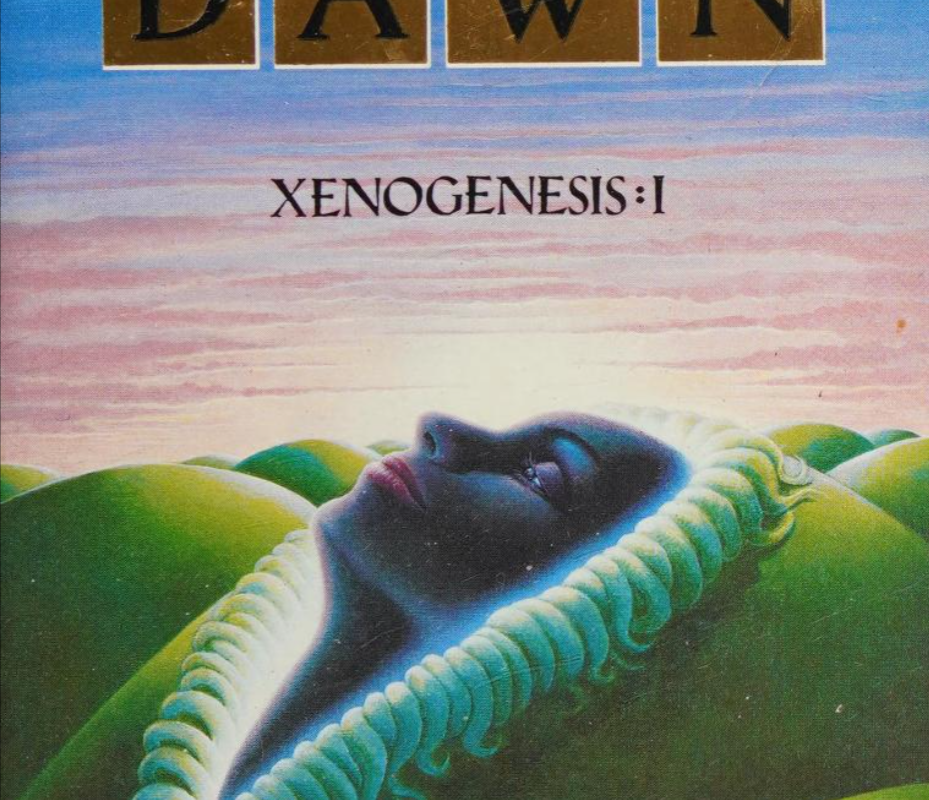
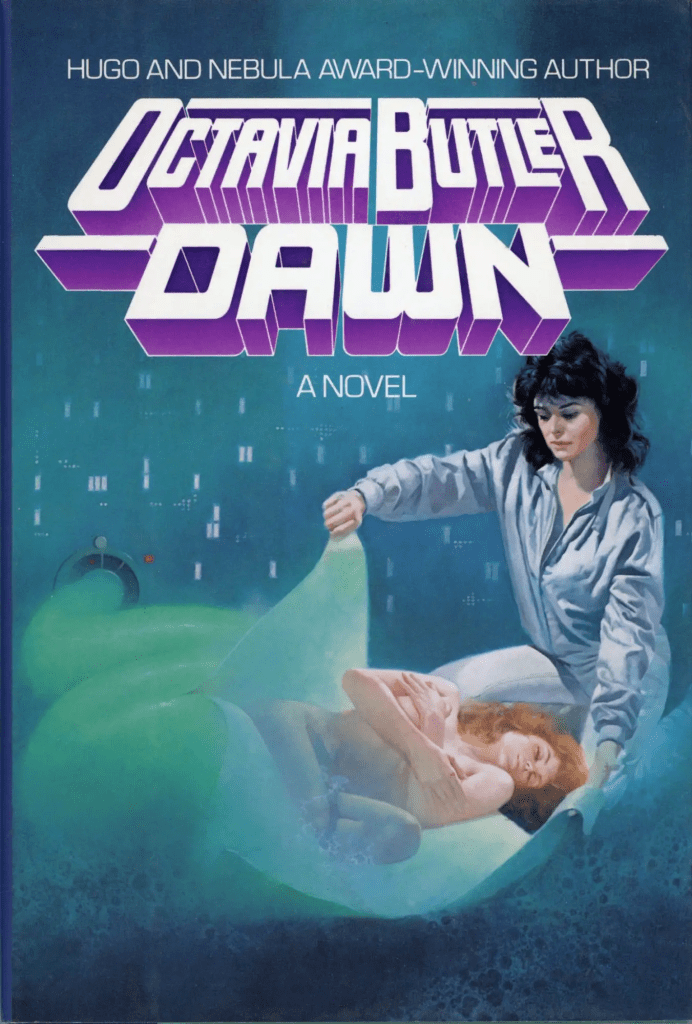
As an aside, this version of the book cover is risible. Not to devolve into identity politics, but Lilith is a dark-skinned woman, not a pale ginger. I can only assume that some target science fiction readers have a propensity to prefer white, sapphic adjacent characters.
I won’t even comment further on the faux 3D title treatment, relic of 1980s marketing.
* Spoiler Alert: As this statement about mass suicide is a Chapter 2 event, I am not inclined to consider it a spoiler. False alarm.





 Philosophics