“In order to gain and to hold the esteem of men, it is not sufficient merely to possess wealth or power. The wealth or power must be put in evidence, for esteem is awarded only on evidence.”
Thorstein Veblin, The Theory of the Leisure Class, 1899
In a world where our worth is increasingly measured by what we own rather than who we are, it’s time to question the hollow pursuit of conspicuous consumption. Thorstein Veblen, over a century ago, saw through the shiny façade of status-driven consumerism. He coined the term conspicuous consumption to describe a phenomenon that has only grown more insidious in our time: the wasteful, performative display of wealth and luxury to signal social standing.
“The world has enough for everyone’s needs, but not enough for everyone’s greed.”
Mahatma Gandhi
From luxury cars to designer handbags, we live in a society that encourages us to broadcast our economic worth at every turn. But what does this ostentatious display really achieve? Veblen would argue that it’s not about personal fulfilment or the intrinsic value of what we buy, but about outshining others—a relentless race with no finish line. We’re not buying goods; we’re buying validation, trying to purchase a place in an imagined hierarchy that is as fragile as the latest trend.
Peter Singer, the moral philosopher known for his advocacy of effective altruism, would take this critique even further. For Singer, conspicuous consumption is not just wasteful; it’s morally indefensible. His ethical stance, grounded in utilitarianism, compels us to consider the opportunity cost of our spending. Every pound spent on a designer item is a pound that could have been used to alleviate suffering—whether through combating extreme poverty, funding life-saving medical treatments, or addressing global environmental crises. In a world where preventable suffering and death are rampant, lavish spending on status symbols is not just misguided; it’s a moral failure.
“The money we spend on luxuries could be donated to help people in need and thereby reduce avoidable suffering.”
Peter Singer, The Life You Can Save, 2009
Singer’s principle of equal consideration of interests demands that we weigh the impact of our actions on others as seriously as we consider their impact on ourselves. When we choose to engage in conspicuous consumption, we’re prioritising superficial self-expression over the tangible needs of those who are suffering. It’s a glaring contradiction to claim we value human life while squandering resources on goods that serve no purpose beyond ostentation.
The issue with conspicuous consumption isn’t just its superficiality—it’s the economic and social rot it perpetuates. It sustains a cycle of pecuniary emulation, where those lower on the socio-economic ladder are pressured to mimic the consumption patterns of those above them. The result? A society locked in an absurd competition, where individuals drown in debt just to keep up appearances, and resources are squandered on goods that serve no practical purpose other than to flaunt.
But why should we care? Isn’t spending on luxury just a harmless personal choice? Not quite. Every pound spent on a status symbol is a pound diverted from something meaningful—education, healthcare, the environment. When the affluent engage in extravagant spending, they set a toxic standard, promoting the idea that personal worth is tied to material excess. It’s not just bad taste; it’s bad ethics, bad economics, and bad for the planet.
More disturbingly, this drive to display wealth erodes the social fabric. It deepens divisions, creating resentment and alienation. The ultra-wealthy, insulated in their gilded cages, become oblivious to the realities faced by the rest of society. Meanwhile, those struggling to maintain the illusion of prosperity are left with the fallout—financial instability, stress, and a gnawing sense of inadequacy.
Veblen saw this trap for what it was: a hollow spectacle. Singer’s ethics give us a way out. He challenges us to shift our focus from self-indulgence to selflessness, from conspicuous consumption to conscious contribution. Instead of spending exorbitantly to bolster our social standing, why not use that wealth to create real, measurable change in the world?
We don’t need another luxury brand or another status symbol. We need a society that values substance over style, sustainability over excess, and human dignity over the incessant demand to buy more to be more. Singer’s challenge is simple: consider the true cost of your choices—not just for yourself, but for the world around you.
Conspicuous consumption is a dead end. It’s time to take a different road—one that leads not to a display case, but to a more equitable, thoughtful, and genuinely prosperous society.
“The mass of men lead lives of quiet desperation. What is called resignation is confirmed desperation.”
The link between language and cognition is interesting though not entirely grasped.
VIDEO: TED Talk on YouTube — Lera Boroditsky
“I speak Spanish to God, Italian to women, French to men and German to my horse.”
― Charles V, Holy Roman Emperor (probably not, but whatevs…)
Perspective
In the West, we tend to be quite self-centric. We are the centres of our universes, and this has several implications. Firstly, we orient conversation around ourselves; occasionally, we orient conversation around others. Instead, some cultures orient themselves around their world.
Self as Centre
Ordinarily, if a Westerner is asked which is their dominant hand, they might answer left or right. If they are asked to describe where something is spatially, one might answer on my left or right or above or below me. If the person asking is present, they may simply point to the object as a gesture.
Other as Centre
In some cases, we might feel it necessary to orient relative to another? The answer to the question, “Where is the book?” might be, “On your left”, or “You’ve got something on your left cheek”.
Terrain as Centre
In the West, we have notions of cardinal directions—North, East, West, and South—, but we still tend to orient communication around ourselves or others. In some regions, the use of cardinal directions is more prominent than in others. For example, when I am in Boston, I didn’t find many people reference places by cardinal directions, but when I am in Los Angeles, much conversation is relative to head north or head east. I notice that Google Maps tend to employ this. It’s often confusing when I am in an unfamiliar place, and the voice instructs me to travel west toward Avenue X. If I happen to have remembered where Avenue X is, I might internally orient toward that. Otherwise, I head in some direction until Google reinforces my choice or it rather recalculates based on my bad choice, if even nonjudgmentally.
In some cultures, this cardinality includes the body, so in comparison with the aforementioned self-as-centre dominant hand query, the response would depend on which way the subject was facing. Were they a southpaw (lefthander) facing north, they would respond that their west hand is dominant. But if they were facing south, it would be their east hand. This may seem to be confusing to a Westerner, but to a native, they would explicitly understand because they would be intimately oriented. As Lera relates in the video, someone might point out an ant crawling on your southwest leg.
To be fair, this space is not entirely alien to some Westerners. For example, mariners can shift the conversation from themselves to their ship or boat. Rather than left and right, relative to themselves or another, they might refer to port and starboard relative to the vessel. Being on the vessel and facing front (the bow), left is port and starboard is right; however, facing the rear (the stern), left is not starboard and right is now port. So, if someone asks where the lifeboat is, landlubbers may say it’s on their left whilst a sailor might say it’s on the starboard side.
Centring Time
Time is another aspect we centre on ourselves. I won’t even endeavour to raise the circular notion of time. If an English speaker thinks about a timeline, we would likely configure it from left to right equating with past to future. This aligns with our writing preference. For native Arabic or Hebrew speakers, they might naturally opt to convey this from right to left in accordance with their preferred writing system.
For the Aboriginal Kuuk Thaayorre in Australia, their rendition of time was contingent on their orientation in the world. Essentially, time flows from east to west, perhaps in accordance with the apparent movement of the sun across the sky relative to Earth. Facing south or north, they rendered time left to right and right to left, respectively. When they faced east, time came toward the subject, with time moving away from the body when facing west.
Counting
So-called modern or advanced societies have developed number systems, but some cultures either have no counting or limited counting, having systems that might extend 1, 2, many, or 1, 2, 3, many. This means that tasks we learn like accounting, inventory management, or comparing counts of apples and oranges are not only not available to these people, they are irrelevant to them.
Categorical Imperitive
Lera tells us about the blues. Not B.B. King Blues, but the categorisation of blue, blues, and colours more generally. I’ve discussed this before in various places. As with numbers, some languages have a lot and some have few; some have only distinctions for light and dark, or equivalents of white, black, red, and so on. Colour names are typically added to a language in a similar order based on the frequency within the visual colour spectrum. I may have written about that earlier as well if only I could find it.
Different cultures and languages categorise colours differently, subdividing them differently. In many non-English languages, pink is simply light red. English opts to assign it a unique label. On the other hand, blue is basically one colour name in English whilst it is further broken down in Russian to goluboi (light blue, голубой) and siniy (darker blue, синий). This mirrors the pattern of pink (lighter red) and red (darker red) in English, a distinction not prevalent in other languages. Of course, we also have variations of reds and blues such as crimson or cyan, but this is rather second-order nuance.
Interestingly, in neurological studies, when measuring a person with a language that splits a colour, say a Russian looking at blues, the instruments capture the event of the subject having noticed the category shift. No such shift occurs in speakers without such a switch. I would be interested to know what the results would be for a bilingual speaker to be asked to respond in each language. Informally, I asked a Russian mate of mine if he experienced anything differently seeing blue whilst thinking in Russian versus English. He said yes, but couldn’t really provide any additional information. If a reader happens to be fluent in two or more languages, I’d be interested in hearing about your experiences.
One last note on colour, I’ve read studies that claim that women on balance have more colour names than men, which is to say where a typical male only sees shades of blue, the typical woman sees periwinkle, ultramarine, cyan, navy, cobalt, indigo, cerulean, teal, slate, sapphire, turquoise, and on and on. Of course, many English-speaking males may be defensive about now, arguing, “I know cyan. I know teal. Who doesn’t know turquoise?” Knowing is different to employing, and perhaps you’re not typical. You’re an atypical male. Let’s not get into gender challenges. Rather, let’s.
Gender Problems
Yet again, gender rears its ugly head. I am wondering when people are going to start demanding fluidity among gendered nouns. Sticking with Lera’s examples, a bridge happens to be grammatically feminine in Germans and masculine in Spanish. When asked to describe a bridge, German speakers are more apt to choose stereotypically feminine adjectives, beautiful or elegant whilst Spanish speakers opted for stereotypically masculine terms, strong or long. I suppose she was reaching for laughter on that last reference.
Structured Events
Objects and subjective injection are other possible conventions. Lera mentions a tourist bumping into a vase. In English, one would be comfortable declaring, “The man knocked the vase off the pedestal.” In Spanish, the same event might more often be described as “The vase fell off the pedestal”. Notice the shift in agency and dispersion of blame. In English, we have some apparent need to inject not only a cause but an agent as a source of the cause. As I see it, one might have these several (possibly inexhaustive) options:
He knocked the vase off the stand.
Someone knocked the vase off the stand.
The vase got knocked off the stand.
The vase fell off the stand.
I decided to note the relationship between the case and the stand. I suppose this is not strictly necessary and might seem superfluous in some contexts.
In case 1, a specific agent (he) is responsible for knocking off the vase. This does not suggest intent, though even negligence carries weight in many circles.
In case 2, the agent becomes indefinite. The speaker wants to specify that the vase didn’t just fall over on its own.
In case 3, agency is not only indefinite, but it also may not have a subject. Perhaps, a cat knocked it off—or the wind or an earth tremor.
In the final case, 4, the agent is removed from the conversation altogether, All that is conveyed is that the vase fell from a stand.
One might want to argue, “So what?” but this is not simply a convention of language; it stems from perception—or perhaps perception was altered by language through acculturation, but let’s not quibble here. It determines what someone pays attention to. When an event was witnessed, people from cultures where agency is a strong component, the witness is more apt to remember the culprit, whereas a non-agency-focused witness, would not be as likely to recall attributes about the person who may have knocked it over. Practically, this leads to issues of blame and culpability. Clearly, a culture with an agent orientation might be quicker to assess blame, where this would be further removed from the conversation from a different cultural perspective. I am speculating here, but I don’t feel it’s a large logical leap.
In a retributive justice system, the language that assigns agency is more likely to mete out harsher punishments because he broke the vase, it wasn’t simply broken. The use of language guides our reasoning. This leads me to wonder whether those who are ‘tough on crime‘ use different language construction than those who are more lenient.
Enfin
I just wanted to share my thoughts and connect language with cognition. I don’t think that the connection is necessarily strong or profound, but there is something, and there are more language nuances than noted here.
As humans, we often leverage systems. They seem to make life easier. Whether a routine or a step-by-step instruction through an unknown process, a system can guide us. Systems are also connected, interactive entities, but that’s not for this segment. I am more interested in the loss of humanity that systematic processes and bureaucracy bring, so I am interested in imposed systems rather than systems we invent to find our keys and wallets.
Podcast: Audio rendition of this page contentImage: Spectrum of System versus Human
If we consider systematisation and humanity on a scale, we can see that any move toward systematisation comes at the expense of humanity. It might make logical sense to make this trade-off to some degree or another. The biggest hit to humanity is the one-size-fits-all approach to a problem. It removes autonomy or human agency from the equation. If a system can be that mechanised, then automate it. Don’t assign a human to do it. This is an act of violence.
As I’ve been reading and writing a lot about Iain McGilchrist’s work lately, I feel one can easily map this to left versus right cerebral hemisphere dominance. System-building is inherently human, but it’s in the domain of the left hemisphere. But my imposition of a system on another is violence—one might even argue that it’s immoral.
As with bureaucracy, these imposed systems are Procrustean beds. Everyone will fit, no matter what. And when human beings need to interact with systems, we can not only feel the lack of humanity, but our own humanity suffers at the same time.
A close friend of mine recently checked herself into a mental health facility. After a few days, she called and asked if I could bring her a change of clothes and some toiletries—deodorant, soap, and shampoo. She had some in her house, but the packaging needed to be unopened and factory sealed. I stopped at a shop to buy these items and I brought them to the facility.
At the reception area, I needed to be cross-referenced as an authorised visitor, so I was asked to show proof of my identity as if it mattered who was delivering clothing that was going to be checked anyway. No big deal, they recorded my licence number on a form and ask me to fill it out—name, phone number, and what I was delivering.
The form stated that any open consumable items would not be allowed. I signed the form. An attendant took the bag and told me that I needed to remove the ‘chemicals’, that they would not be delivered. I pointed to the lines on the form that read that this restriction was for open items and reinforced that I had just purchased these and showed her the sales receipt. She told me that the patient would need to obtain a doctor’s permission, and she assured me that the patients all had soap.
I’m sure she thought she was being compassionate and assertive. I experienced it as patronising. Me being me, I chided her lack of compassion and humanity, not a great match for a mental health attendant. In fact, it reminded me of a recent post I wrote on Warmth. In it, I suggested that service staff should at least fake conviviality. I take that back. Faux congeniality is patronising. She mimicked me. “Yes, systems are so inhumane, but here we follow a system.” My first thought was of Adolf Eichmann, who kept the trains on schedule without a care for the cargo. This is the violence inherent in systems.
Systems are not illogical. In fact, they are hyper-logical. And that’s the problem, logic is traded off at the expense of empathy. And one might have a strong argument for some accounting or financial system process, but I’ll retort that this should be automated. A human should not have to endure such pettiness.
I can tell that this will devolve quickly into a rant and so I’ll take my leave and not foist this violence upon you.
I recently posted a YouTube Short video titled You Have No Free Will, but this is still debatable.
Video: You Have No Free Will
The premise of the belief in free-will is that human decisions are made approximately half a second before we are conscious of them, and then the conscious brain convinces itself that it just made a choice. This sounds pretty damning, but let’s step back for a moment.
Podcast: Audio rendition of this page content
If you’ve been following this blog these past few months, you’ll be aware that I feel the question of free will is a pseudo-question hinging primarily on semantics. As well, there’s the causa sui argument that I’d like to ignore for the purpose of this post.
There remains a semantic issue. The free will argument is centred around the notion that a person or agent has control or agency over their choices. This means that how we define the agent matters.
In the study this references, the authors define the agent as having conscious awareness. Since this occurs after the decision is made, then the person must have had no agency. But I think an argument can be made that the earlier decision gateway is formed through prior experience. Applying computer metaphors, we can say that this pre-consciousness is like embedded hardware or read-only logic. It’s like autopilot.
In business, there are various decision management schemes. In particular, the conscious but slow version is for a person to be notified to approve or deny a request. But some decisions are automatic. If a purchase is over, say 50,000 then a manager needs to sign off on the request. But if the purchase is under 50,000, then the request is made automatically and then the manager is notified for later review if so desired.
I am not saying that I buy into this definition, but I think the argument could be made.
You might not know it by the number of posts discussing it, but I am not really concerned about whether or not free will really exists. I don’t lose any sleep over it. At the same time, I tend to react to it. Since I feel it’s a pseudo-problem where tweaking the definition slightly can flip the answer on its head, it’s just not worth the effort. On to better things.
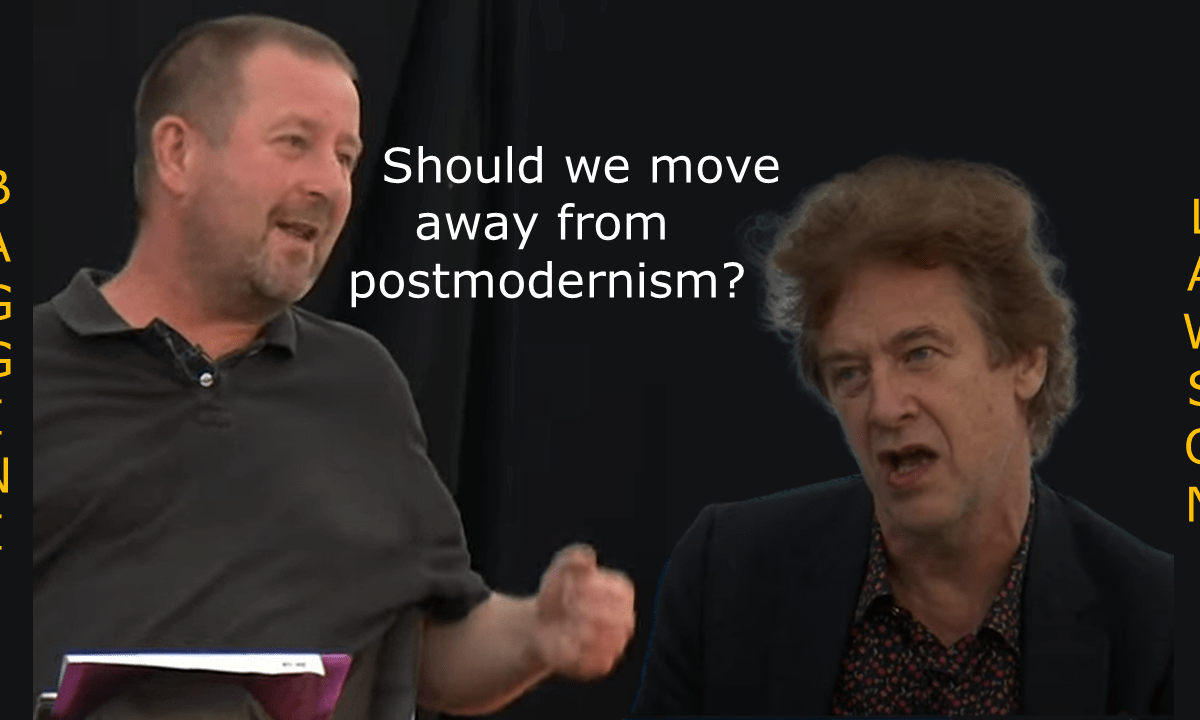
The theme of this Institute of Art and Ideas video is ‘Should we move away from postmodernism?‘
Podcast: Audio rendition of this page content
EDIT: Find my version of this content on YouTube:
Video: Postmodern Defence
At the start, I feel as usual, that the definition of postmodernism is nebulous, and the fora agree, methinks. Toward the end, Hilary Lawson concedes that key actors tied to the early postmodern movement denied being postmoderns, singling out Foucault and Derrida. More on this. Keep reading.
Julian Baggini, the bloke sat on the left and whose positions I am only getting familiar with, starts off the clip. He makes some points, some of which I agree with and others not so much.
He makes a play at claiming that there is some objective truth to be attained, following on with the statement that without this notion, it’s anything goes. I disagree with both of these assertions. Then he cites Thomas Nagel’s The View from Nowhere, wherein he posits that subjectivity and objectivity are extrema on a spectrum and that experience is somewhere in between. This conforms to my beliefs, but there are two provisos. First, the extremum of objective truth is unattainable, objectively speaking. Moreover, as I’ve written before, we have no way of adjudicating whether a given observation is truer than another. It seems that he leaves it that we don’t need to know the absolute truth to know “true enough”, but I think this is both a copout and wrong—but not too wrong for pragmatism to operate.
For example—not mentioned in the clip—, I can imagine that physicists feel that Einsteinian motion physics is truer than Newtonian physics, especially as we need to take measurements nearer to the speed of light. In my thinking, this might provide a better approximation of our notion of the world, but I can also conceive of an Ideal, non-materialistic perspective where both of these are rubbish from the perspective of truth. I feel that people tend to conflate truth with utility.
Julian makes an interesting point about semantics with the claim that “some people” define certain things in such a way as to not possibly be attainable and then claim victory. But what are his three examples? Free will, the self, and objectivity. If you’ve been following me, you’ll know that I might be in his crosshairs because I tend to be in the camp that sees these concepts as sketchy. And to be fair, his claim of defining something in a manner to keep a concept out of bounds is the other side of the same coin as defining something in such a way as to get it into bounds.
The self is different to free will insomuch as it’s a construction. As with any construction, it can exist, but it’s a fiction.
I’ve spoken at length about my position on free will, but I am fairly agnostic and don’t particularly care either way. I feel that the causa sui argument as it applies to human agency is more important in the end. The self is different to free will insomuch as it’s a construction. As with any construction, it can exist, but it’s a fiction. Without interacting with Julian or reading his published works on the self, if there are any, I don’t know how he defines it. And here we are discussing objectivity.
Given Nagel’s objective-subjective polarity, it seems they want to paint postmodernism as claiming that everything is subjective and that science (and religion) hold claims to objectivity. Hilary Lawson, the geezer on the right takes a position between extremes, but he denounces Julian’s claim about objective truth, noting that many people (especially of religious persuasions) make claims on Truth that are diametrically opposed, ostensibly labelling the same object simultaneously black and white. And the object for all intents and purposes is red.
I’ve gotten out of order, but Julie Bindel makes some good points on Feminism and suggests that the philosophical feminists—may I call them pheminists? No? OK then—such as Judith Butler have set women’s rights back by claiming that the category of ‘woman’ is invalid. Minni Salami defended Judith by noting that Butler has helped constructively in some ways and, citing Simone de Beauvoir, that woman is a category established by men to create The Other Sex. Still, Julie—not incorrectly—states that without a category, women (or whatever collective term one decides is representative) cannot be afforded legal protections—because law, as facile as it is, is all about categories and classes.
Hilary reenters the fray and states that it is not acceptable for one person to claim that their lived experience is all that is needed just because that is their truth. To be fair, this feels like a bit of a strawman argument. Perhaps I need to get out more, but I am not familiar with anyone credible making this claim.
I enjoyed watching this clip and processing the information. I hope you do as well. If you have any comments, I’d love to read them.
In pursuit of my travail intellectuel, I stumbled on a thought experiment proposed by Richard Taylor regarding an old crowd favourite, Sisyphus.
Of course, Albert Camus had famously published his Myth of Sisyphus essay (PDF), portraying his life as analogous to the workaday human, absurdly plodding through existence like rinse and repeat clockwork—same gig on a different day.
Given my perspective on human agency and the causa sui argument, I felt commenting on Taylor’s essay, The Meaning of Life (PDF) would be apt.
The story of Sisyphus finds the namesake character, fated by the gods to each day push a stone up a hill only for it to roll back down for him to push it back up every day ad infinitum. Camus leaves us with the prompt, ‘One must imagine Sisyphus happy’. But must we.?
As Taylor puts it,
Sisyphus, it will be remembered, betrayed divine secrets to mortals, and for this he was condemned by the gods to roll a stone to the top of a hill, the stone then immediately to roll back down, again to be pushed to the top by Sisyphus, to roll down once more, and so on again and again, forever. Now in this we have the picture of meaningless, pointless toil, of a meaningless existence that is absolutely never redeemed.
Taylor wants us to consider an amended Sisyphus. He writes,
Let us suppose that the gods, while condemning Sisyphus to the fate just described, at the same time, as an afterthought, waxed perversely merciful by implanting in him a strange and irrational impulse; namely, a compulsive impulse to roll stones.
This significantly alters the dynamic. In the scenario, Sisyphus is not toiling; rather, he is pursuing his passion—following his heart. This is the athlete, artist, politician, or mass murderer following their passion. In fact, one might say that he is being his authenticself. He has no control over his self or his desire to roll stones, but he is in his element.
Taylor’s ultimate point is that in either case, the life of Sisyphus is just as devoid of meaning. Ostensibly, nothing can provide meaning. The best one can do is to have the perception of meaning. He writes,
Sisyphus’ existence would have meaning if there were some point to his labors, if his efforts ever culminated in something that was not just an occasion for fresh labors of the same kind. But that is precisely the meaning it lacks.
Although we cannot control what is within, contentment and happiness derive from perception. As we might be reminded by the quip attributed to Schopenhauer,
We can want what we will, but we can’t will what we will.
In the end, Taylor wants us to know that nothing out there can make us happy.
The meaning of life is from within us, it is not bestowed from without, and it far exceeds in both its beauty and permanence any heaven of which men have ever dreamed or yearned for.
I’ve subsequently read some critiques of Taylor’s position, but I don’t want to take the time to rejoin them. Suffice it to say that I find them to be weak and wanting.
In my quest for background depth, I’m not only reading books, essays, blogs, and researched content, I’m viewing YouTube content, including the videos linked below that were reading and discussion groups. Perhaps I am interpreting it incorrectly, but these participants seem to invariably conflate the concept of determinism with an applied version of it.
In my mind, the concept is meant as a modal abstraction, which is to say if determinism were true, what degrees of freedom might one have? The idea is to accept this as a true premise, whether or not you accept or agree with it.
It’s like introductory physics—pretend there is no gravity; pretend there is no friction. I don’t believe any of these people would argue, “I can’t accept this environment. The world doesn’t work like that”. Except that’s exactly what they do when faced with determinism. It’s a mental model. Just work it as it’s presented.
Determinism: The world is governed by (or is under the sway of) determinism if and only if, given a specified way things are at a time t, the way things go thereafter is fixed as a matter of natural law.
Stanford Encyclopedia of Philosophy, Causal Determinism
By this definition, every event has an antecedent cause, the (future) result of which is one and only one outcome. It’s like viewing a film for the first time; you may not know the ending, but the ending is inevitable. If you rewind the film and replay it, the ending will remain the same at every viewing. Nothing anyone can do will alter the inevitability.
Free Will
Free will is a muddled notion that basically declares at some level humans make free choices based on their own agency; that they have control over how the future is written; that the future is yet unwritten, so the film analogy doesn’t hold water.
Compatibilism
Compatibilism is the belief that even in a fully deterministic universe. i.e., one in which everything is determined by some initial state as captured by the natural laws of physics still affords at least some limited notion of free will or at least proximate agency.
Adopting this belief in a deterministic universe necessitates relying on either metaphysical magic or semantic word games. Of course, there is nothing to say that you have to adopt a deterministic position, but if you do, you need to also explain how free will fits into the equation.
Incompatibilism
If one adopts the position of an incompatibilist this squaring up is no longer a problem, but then you are left to choose one or the other of the options as the two are mutually exclusive and collectively exhaustive.
Indeterminism
Although it is not necessary for any of the aforementioned monologue, indeterminism allows to some extent or another randomness to be introduced into the deterministic world. Effectively, this means that everything still operates in a causal chain or web, but stochastic or chaotic events perturb the future that might have otherwise happened.
This poses no challenges to the free will issue, as these are exogenous events and to the subject, they act the same as a deterministic event. In any case, if the source and behaviour of the indeterminacy were known, it would fold into the deterministic model. The same goes for luck and chance.
Third-Party Video Content
Whilst I found these videos engaging and useful, that the participants were not subject authorities was distracting and confusing. It was nice hearing them attempt to resolve their positions, but in the end, it turned out to reinforce Latour’s point in We Have Never Been Modern: consensus is more common than facts.
This bloke gives a crackup job explaining why compatibility is bollox.
Bonus
Whilst searching for cover art for this post, I happened upon a blog entry that makes my point with the author running off on tangents and non-sequiturs.
When I was writing my review of Elbow Room, this categorical syllogism came to mind:
P1: All agents are responsible
P2: I am an agent
C: Therefore, I am responsible
Now I want to unpack it.
Podcast: Audio rendition of this page content
The first premise is that all agents are responsible. Of course, this hinges on how one defines agent and responsibility. It also depends on the scope, especially of the agent but to some extent also the scope of responsibility.
Leveraging the Causa Sui argument, the agent is a social construct and can only be responsible to what extent s/he has been programmed as well as the ability to maintain and process the programming effectively—so without bugs to continue with the parlance.
If the agent is immature or defective, expectations of responsibility are diminished.
If certain inputs were not given, there is no reason to assume a related command would be executed. This is why so much time and energy is spent on programming and evaluating children.
This first premise is predicated on the pathological need to blame. Unwritten behind the responsibility claim is that I feel compelled to blame. Blame requires responsibility, so if I want to blame someone, they must be responsible. In any given circumstances, I may feel the urge to blame anyone, so all agents [eligible people] are worthy of blame. There is no particular reason to exclude myself, so I too am blameworthy. What’s good for the goose is good for the gander, eh?
Goose and Gander. Strike that pose.
As PF Strawson said, even if moral responsibility couldn’t possibly exist, it would be invented because people need to blame. This is in line with Voltaire’s commentary on God.
Si Dieu n’existait pas, il faudrait l’inventer. If God did not exist, it would be necessary to invent him.
Voltaire
We can all look around and see how pervasive the god delusion is. Moral responsibility is even more insidious. In principle, moral gods were invented for just this purpose. An omnipresent judge was needed to keep the big house in check.
Where I Stand
From my perspective, I do feel that a person in the space of Dennett’s elbow room can have responsibility. Being a non-cognitivist, I have more difficulty accepting the arbitrary imposition of morality, but I understand the motivation behind it.
The problem I have is that mechanisms to ensure that the inputs and processes are all in order and there are no superseding instructions are not in place. Moreover, if the superseding instruction does not comport with the will of the power structure, it will be marginalised or ignored. This is a limitation of morality being a social construct, and none of this gets past the ex nihilo problem causa sui invokes, so we end up cursing the computer we’ve invented. O! monster of Frankenstein. O! Pygmalion.
I’ve finally returned to the second author of Four Views on Free Will. The first author was Robert Kane. Here, I was introduced to John Martin Fischer, who wrote a section on Compatibilism. I’ve never read anything by Fischer. Indeed, I have no familiarity with him or his work. Allow me to start by saying that I was not impressed. Before diving into the content, let’s just say that he was extremely repetitive and circumlocutive. I found myself questioning whether the book was assembled with duplicate pages. Hadn’t I just read that? I’ll spare the reader the examples.
I repeat myself when under stress
I repeat myself when under stress
I repeat myself when under stress
I repeat myself when under stress
— King Crimson, Indiscipline
The topic was 44 pages on compatibilism. The first 30 pages were compatibilism before he changed to his brainchild, semi-compatibilism. Full disclosure: I am not a compatibilist. My recollection is that the majority of contemporary philosophers are compatibilists. Joining Fischer are Dan Dennett, Frithjof Bergmann, Gary Watson, Susan R. Wolf, P. F. Strawson, and R. Jay Wallace. Historically, this cadre are joined by Hobbes, Locke, Hume, and Mill. This motley crew has been opposed by Peter van Inwagen and historical figures, Arthur Schopenhauer, William James, and Immanuel Kant.
Semi-compatibilism is the idea that regardless of whether free will and determinism are compatible, moral responsibility and determinism are.
At a meta-level, Fischer repeatedly—I’ll discontinue using this term as, like Fischer, it will become very, very repetitive—invoked law and common sense. Law is not a moral structure in search of truth. It’s a power structure employed to retain the status quo. And, as Voltaire quipped, ‘common sense is not so common.’ This is an argumentum ad populum (appeal to popularity) fallacy. It also relies on belief and perception. I suppose he’s not familiar with Descartes’ Meditations. It seems he is trying to forge Compatibilism into a cast of soft determinism with hopes that no one notices the switcheroo.
Fischer targets some quotes buy Kant, James, Wallace Matson, and Nietzsche with the general critique that they are expecting too much of an agent by expecting it to be the cause of its own actions. Nevermind, that he is guilty of just this in attempting to parse passive and active agents—passive being insentient dominos and active being conscious entities.
I’m not convinced that maths is a strong point. He sets up a hypothetical scenario where physics has proven that causal determinism is true, so 100 per cent of everything in the universe can be known with certainty. But then he does two things.
First, he exempts human agency—cuz reasons. Second, he creates a parallel scenario where 100 per cent might be 99 or 99.9 per cent.
Second, he claims that because he feels free, he must be free.
Similarly, it is natural and extraordinarily “basic” for human beings to think of ourselves as (sometimes at least) morally accountable for our choices and behavior. Typically, we think of ourselves as morally responsible precisely in virtue of exercising a distinctive kind of freedom or control; this freedom is traditionally thought to involve exactly the sort of “selection” from among genuinely available alternative possibilities alluded to above. When an agent is morally responsible for his behavior, we typically suppose that he could have (at least at some relevant time) done otherwise.
— Fischer, p. 46
Nothing is such that thinking doesn’t make it so.
It seems that when watching a movie for the third time, the victim who gets killed in the cellar won’t descend the stairs this time. Fisher must get perplexed when she does every time. Of course, he’d argue without evidence that an active agent would be able to make a different decision—even under identical circumstances. He insists that the agent possesses this free will.
Whilst sidestepping physicalism and materialism, he simply posits that consciousness is just different and not subject to other causal chain relationships—and that these cannot be deterministic even if everything else is.
I’m going to digress on his next point—that the person who knows not to cheat on taxes, and who does so anyway, is responsible as any normal person would be. Perhaps the person feels that the taxes are being used for illegal or immoral purposes and is taking the moral high ground by depriving the institution of these proceeds.
Around 2007 or so, I paid my taxes due minus about $5,000, which was the calculated amount of the per capita cost of the illegal and immoral Iraq invasion by the United States and its cadre of war criminals in charge. I attached a note outlining my opposition and rationale.
Some months later, the Internal Revenue department sent a legal request to my employer for the withheld sum. Payroll summoned me and conveyed that they were required to comply with the request. I told them my perspective and said if they could sleep with that on their conscience, then they were in their power. And so no nights of sleep were lost.
The point of this anecdote is to say that morals are social constructs. Clearly, Fischer is just an old-fashioned conformist. I suspect he thinks of Valjean as a bad person.
Like many if not most people, he employs a compos mentis approach, exempting persons of reduced cognitive capacity and those under duress or coercion, but he is not a proponent of the causa sui defence.
He has an entire subsection devoted to the libertarian notion of freedom. To recapitulate, he simply regurgitated all of the standard arguments and exempts the aforementioned agents and adds people under hypnosis, the brainwashed, and so on. Nothing to write home about—not here either.
In the next subsection, his focus is on consequences. He calls out Peter van Inwagen’s Consequence Argument.
Similarly, the skeptical argument about our freedom employs ordinary ideas about the fixity of the past and the fi xity of the natural laws (putatively) to generate the intuitively jarring result that we are not ever free, if causal determinism turns out to be true (something we can’t rule out apriori). If this skeptical argument is sound, it calls into question any compatibilist analysis of freedom (that is, freedom of the sort under consideration – involving the capacity for selection among open alternatives). If the argument is sound, then not only both the simple and refined conditional analysis, but any compatibilist analysis (of the relevant sort of freedom) must be rejected.
Fischer p. 53
He leans on Borges’ garden of forking paths and claims (without support) that although the past might be fixed, freedom is the ability to add to the future, citing Carl Ginet as the source of this notion. He misses the point that that’s what the future is, tautologically. It adds now to the past and generates a future. Choice is not necessary for this function to operate, but he continues to insist on invoking it.
Standard Frankfort examples are referenced as well as Locke. Here he wants to point out regulative control—but he skirts the question of where the volition comes from by saying ‘for his own reasons‘, as if these reasons are somehow meaningful. In the end, he recites the scenarios, performs some hand-waving, and summons his accord with Robert Kane’s “dual voluntariness” constraint on moral responsibility.
He leaves us with the thought that if the Consequence Argument were true, it would be compatibilism’s death knell, but it’s not true (in his mind), so all is well in Whoville. Crisis averted.
Source incompatibilism is next. His focus here is on the “elbow room” necessary to exercise free will.
Elbow Room is the title of a book by Daniel Dennett originally published in 1984 and republished in 2015. I’ve recently read this on holiday, but I haven’t had time to review it. Please stand by.
His approach in this subsection is to attack opposing perspectives as reductionist. Of course, he’s right, but they are no more reductionist than anything he’s suggested thus far. Besides, simply injecting favoured concepts to add to a model to make it compatible with one’s hypothesis doesn’t make it less reductionist. It just makes the model more convoluted.
Here he attempts to elevate consciousness into a special category in order to shield it from the physics of the universe. We can’t say for sure what consciousness is, but you can bet it’s a magical place where practically anything can happen. OK, that’s a bit of hyperbole.
He uses the metaphor of trying to assess how a television works by only studying the components. Of course, if that is all one did, one would be left with questions. But that is not where one stops. To be fair, neuroscience has come a long way since this was published in 2007. Neuroscientists are asking questions beyond the hardware.
He sets up a strawman by labelling total control as a chimaera as if anyone is arguing that if a theory doesn’t allow for total control, it will not be accepted. He does allow that…
We do not exist in a protective bubble of control. Rather, we are thoroughly and pervasively subject to luck: actual causal factors entirely out of our control are such that, if they were not to occur, things at least might be very different.
— Fischer, p. 68
We agree on this point, but I feel that he underestimates the remaining degrees of freedom after all of this is accounted for.
He attempts to create a mental model with vertical and horizontal lines. At least he admits that he does “not suppose [to] have offered a knockdown argument” because he doesn’t.
Finally, he wraps up this subsection by invoking Nietzsche’s famous Munchausen Causa Sui statement in Twilight of the Idols. He attacks this rationale as being “both ludicrous and part of commonsense.” He loves his commonsense.
Next, he wants to convince us, Why Be a Semicompatibilist? Semicompatibilism just needs enough elbow room to assert freedom. I suppose that’s the ‘semi‘ part. It feels to me an exercise in self-delusion.
The main idea behind semicompatibilism is to shrink the target size of compatibility and focus centrally on moral responsibility and agent control rather than the larger realm of free will.
Fischer makes what might be considered to be a religious argument. We should adopt this perspective because it feels better and is in our best interest. He cites Gary Watson’s view of using indeterminism to undermine determinism, but he feels that rather etiolates control rather than strengthening it because it “becomes unclear that our choices and actions are really ours.”
In the next subsection, he leads with the argument “that moral responsibility does not require regulative control, but only guidance control, and further that it is plausible that guidance control is compatible with causal determinism.” At least, this is the story he’s sticking to.
In Fischer’s “approach to guidance control, there are two chief elements: the mechanism that issues in action must be the “agent’s own,” and it must be appropriately “reasons-responsive.””
As for the “agent’s own” constraint, he simply notes that counterclaims exist, but he asserts that he doesn’t accept them.
In the final subsection, he writes about the Lure of Semicompatibilism. I do feel he is lured by the concept and makes light of the label. He advances the notion that “Kant believed that compatibility and incompatibilism are consistent“. Say what? But he takes a weaker position on this claim, using the Kant name-drop for cover.
As I said at the start, I don’t know anything about Fischer, but he is obsessed with legal theory as if it has any bearing on philosophical standing. Perhaps I’ll include a summary from a quick internet perusal. After I’ve wrapped this up. He mentions moral desert, which is a concept employed in matters of restorative and retributive justice.
The section concludes with a list of publications by him and others. Perhaps I’ll list them here in future as an addendum. For now, I’ll pop outside of this edit window and see what I can find on John Martin Fischer.
John Martin Fischer (born December 26, 1952) is an American philosopher. He is Distinguished Professor of Philosophy at the University of California, Riverside and a leading contributor to the philosophy of free will and moral responsibility.











 Philosophics