Reality Happens Once. Facts Happen Many Times.

I want to clarify my recent The Trouble with Facts post. I realise that I was speaking to one non-trivial form of facts, but there is more than one class of facts. We argue about facts as if the word named a single, stable thing. It doesn’t. It names a family of very different things, quietly grouped together by habit, convenience, and institutional need. Most disputes about facts go nowhere, not because one side is irrational, but because the word itself is doing covert work. We slide between meanings without noticing, then act surprised when disagreement follows. This piece is an attempt to slow that slide.

Audio: NotebookLM summary podcast of this topic.

Polysemy We Notice, Polysemy We Don’t

We are comfortable with ambiguity when it is obvious. A bank can be a financial institution or the edge of a river. A bat can be an animal or a piece of sports equipment. Context resolves these instantly. No one feels existentially threatened by the ambiguity.

Fact is different. The word is polysemous in a way that is both subtle and consequential. Its meanings sit close enough to bleed into one another, allowing certainty from one sense to be smuggled into another without detection. Calling something a fact does not merely describe it. It confers authority. It signals that questioning should stop. That is why this ambiguity matters.
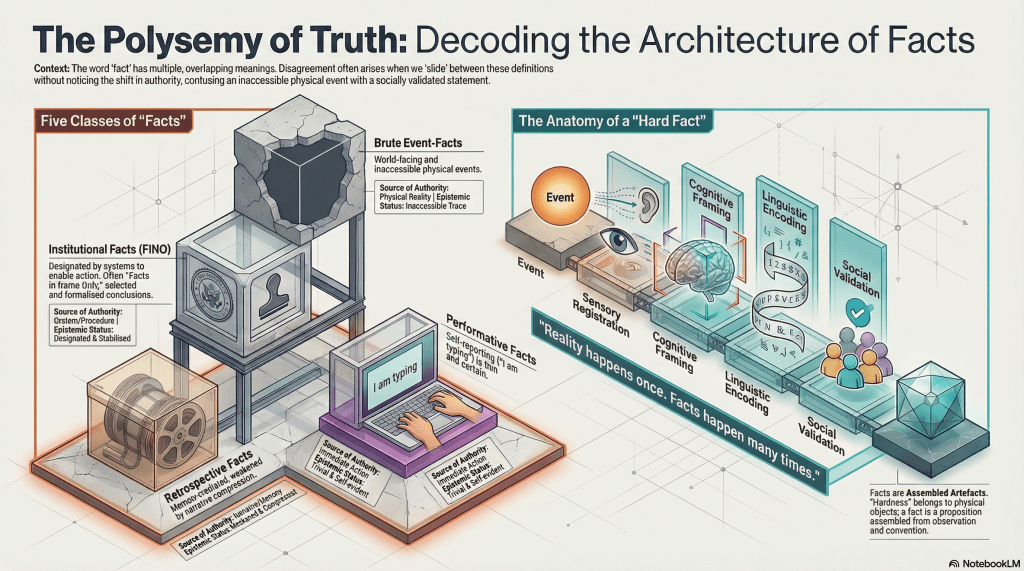
Different Kinds of Facts

Before critiquing facts, we need to sort them.

1. Event-facts (brute, world-facing)
As mentioned previously, these concern what happens in the world, independent of observation.

  • A car collides with a tree.
  • Momentum changes.
  • Metal deforms.

These events occur whether or not anyone notices them. They are ontologically robust and epistemically inaccessible. No one ever encounters them directly. We only ever encounter traces.

2. Indexical or performative facts (trivial, self-reporting)
“I am typing.”

I am doing this now – those now may not be relevant when you read this. This is a fact, but a very thin one. Its authority comes from the coincidence of saying and doing. It requires no reconstruction, no inference, no institutional validation. These facts are easy because they do almost no work.

3. Retrospective personal facts (memory-mediated)
“I was typing.”

This may be relevant now, at least relative to the typing of this particular post. Still a fact, but weaker. Memory enters. Narrative compression enters. Selectivity enters. The same activity now carries a different epistemic status purely because time has passed.

4. Prospective statements (modal, not yet facts)
“I will be typing.”

This is not yet a fact. It may never come to be one. It is an intention or prediction that may or may not be realised. Future-tense claims are often treated as incipient facts, but this is a category error with real consequences.

5. Institutional facts (designated, procedural)
“The court finds…”
“The report concludes…”

These are facts by designation. They are not discovered so much as selected, formalised, and stabilised so that systems can act. They are unlikely to rise to the level of facts, so the legal system tends to generate facts in name only – FINO, if I am being cute.

All of these are called ‘facts’. They are not interchangeable. The trouble begins when certainty migrates illicitly from trivial or institutional facts into brute event-facts, and we pretend nothing happened in the transfer.

One Motor Vehicle

Reconsider the deliberately simple case: A motor vehicle collides with a tree. Trees are immobile, so we can rule out the tree colliding with the car.

Ontologically, something happened. Reality did not hesitate. But even here, no one has direct access to the event itself.

The driver does not enjoy privileged access. They experience shock, adrenaline, attentional narrowing, selective memory, post hoc rationalisation, perhaps a concussion. Already several layers intervene before language even arrives.

A rough schema looks like this:

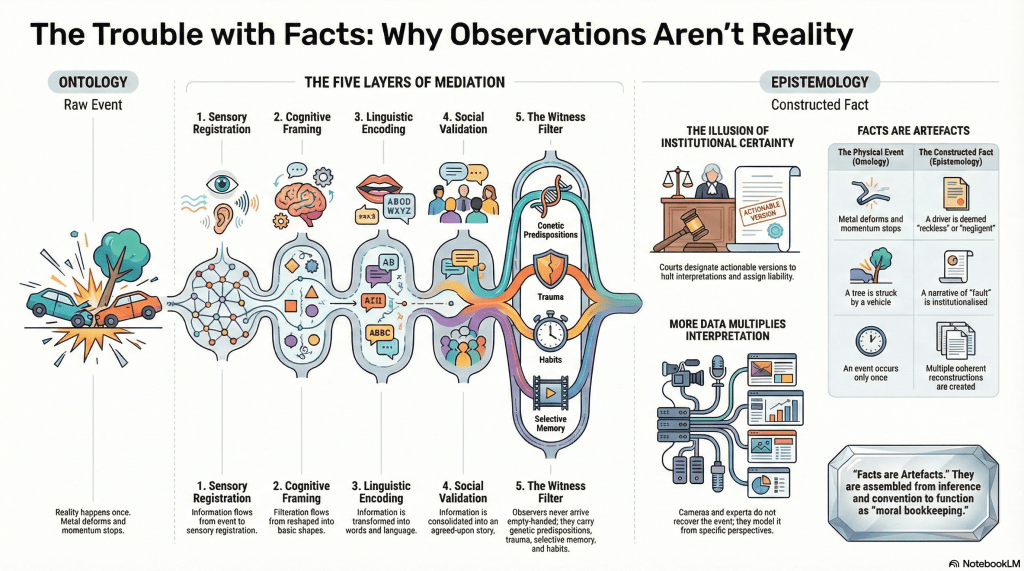
event → sensory registration → cognitive framing → linguistic encoding → social validation

Ontology concerns what happens.
Epistemology concerns how anything becomes assertable.

Modern thinking collapses the second into the first and calls the result the facts.

People speak of “hard facts” as if hardness transfers from objects to propositions by proximity. It doesn’t. The tree is solid. The fact is an artefact assembled from observation, inference, convention, and agreement.

And so it goes…

Why the Confusion Persists

When someone responds, “But isn’t it a fact that I read this?”, the answer is yes. A different kind of fact.

The error lies not in affirming facts, but in failing to distinguish them. The word fact allows certainty to migrate across categories unnoticed, from trivial self-reports to brute world-events, and from institutional verdicts to metaphysical claims. That migration is doing the work.

Conclusion

Clarifying types of facts does not weaken truth. It prevents us from laundering certainty where it does not belong.

Facts exist. Events occur. But they do not arrive unmediated, innocent, or singular.

Reality happens once. Facts happen many times.

The mistake was never that facts are unreal. It was believing they were all the same kind of thing.

The Trouble with Facts

5–8 minutes

One Motor Vehicle

What we call facts are not discoveries of an unfiltered world. They are the end-products of mediation.

Let’s walk through an example.

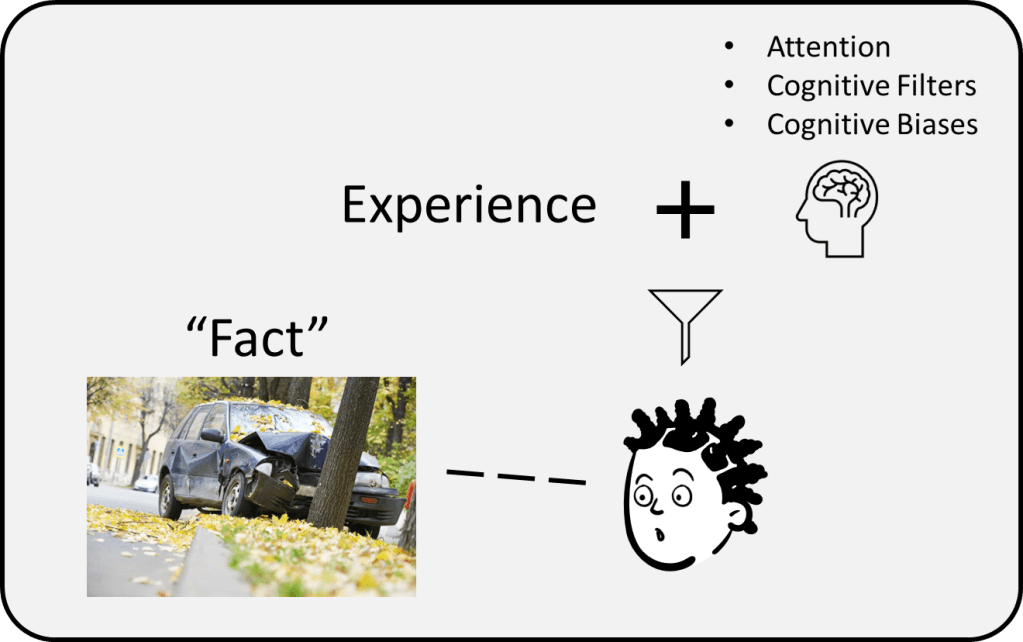
Image: Autosmash example. An observer arrives with experience – from genetic predisposition to childhood trauma to winning the lottery. Whatever it might be. Of course, they have many cognitive deficits, biases and filters. Then, there’s the immediate problem of attention. When did they notice the event? Did they turn to look after hearing the noise, or were they meditating on the tree in that moment?

Apparently, a motor vehicle has collided with a tree. Trees are immobile objects, so we can safely rule out the tree colliding with the car.*

So what, exactly, are the facts?

Audio: NotebookLM summary podcast of this topic.

Ontology (the boring bit)

Ontologically, something happened.

A car struck a tree.
Metal deformed.
Momentum stopped.

Reality did not hesitate. It did not consult witnesses. It did not await interpretation.

This is the part Modernity likes to gesture at reverently before immediately leaving it behind.

Image: Requisite NotebookLM infographic on this content.

The Witness

Even the driver does not enjoy privileged access to “what really happened”.

They get:

  • proprioceptive shock
  • adrenaline distortion
  • attentional narrowing
  • selective memory
  • post hoc rationalisation
  • possibly a concussion

Which is already several layers deep before language even arrives to finish the job.

We can generalise the structure:

Ontology: events occur. States of affairs obtain. Something happens whether or not we notice.

Epistemology: observation is always filtered through instruments, concepts, language, habits, and incentives.

Modern sleight of hand: collapse the second into the first and call the result the facts.

People love the phrase “hard facts”, as if hardness transfers from objects to propositions by osmosis. It doesn’t. The tree is solid. The fact is not.

Facts are artefacts. They are assembled from observation, inference, convention, and agreement. They function. They do not reveal essence.

Filtration

An event occurred. A car struck a tree.

Then an observer arrives. But observers never arrive empty-handed.

They arrive with history: genetics, upbringing, trauma, habits, expectations, incentives. They arrive already filtered.

Daniel KahnemanOlivier Sibony, and Cass Sunstein spend an entire book explaining just how unreliable this process is. See Noise: A Flaw in Human Judgment if you want the empirical receipts.

  • Even before bias enters, attention does.
  • When did the observer notice the crash?
  • At the sound? At the sight? After the fact?
  • Were they already looking, or did the noise interrupt something else entirely?

Reality happens once. Facts happen many times, differently, depending on who needs them and why.

Here Comes the Law

This is where the legal system enters, not because truth has been found, but because closure is required.

Courts do not discover facts. They designate versions of events that are good enough to carry consequences. They halt the cascade of interpretations by institutional force and call the result justice.

At every epistemic level, what we assert are interpretations of fact, never access to ontological essence.

Intent, negligence, recklessness. These are not observations. They are attributions. They are stopping rules that allow systems to function despite uncertainty.

The law does not ask what really happened.
It asks which story is actionable.

Two Motor Vehicles

Now add a second moving object.

Another car enters the frame, and with it an entire moral universe.

Suddenly, the event is no longer merely physical. It becomes relational. Agency proliferates. Narratives metastasise.

Who was speeding?
Who had the right of way?
Who saw whom first?
Who should have anticipated whom?

Intent and motive rush in to fill the explanatory vacuum, despite remaining just as unobservable as before.

Nothing about the ontology improved.
Everything about the storytelling did.

Where the tree refused intention, the second vehicle invites it. We begin inferring states of mind from trajectories, attributing beliefs from brake lights, extracting motives from milliseconds of motion.

But none of this is observed.

What we observe are:

  • vehicle positions after the fact,
  • damage patterns,
  • skid marks,
  • witness statements already filtered through shock and expectation.

From these traces, we construct mental interiors.

The driver “intended” to turn.
The other driver “failed” to anticipate.
Someone was “reckless”.
Someone else was merely “unlucky”.

These are not facts. They are interpretive assignments, layered atop already mediated observations, selected because they allow responsibility to be distributed in socially recognisable ways.

This is why explanation now fractures.

One cascade of whys produces a story about distraction or poor judgment.
Another produces a story about road design or visibility.
Another about timing, traffic flow, or urban planning.

Each narrative is plausible.
Each is evidence-constrained.
None is ontologically privileged.

Yet one will be chosen.

Not because it is truer, but because it is actionable.

The presence of a second vehicle does not clarify causation. It merely increases the number of places we are willing to stop asking questions.

Modernity mistakes this proliferation of narrative for epistemic progress. In reality, it is moral bookkeeping.

The crash still occurred.
Metal still deformed.
Momentum still stopped.

What changed was not access to truth, but the urgency to assign fault.

With one vehicle and a tree, facts already fail to arrive unmediated.
With two vehicles, mediation becomes the point.

And still, we insist on calling the result the facts.

Many Vehicles, Cameras, and Experts

At this point, Modernity regains confidence.

Add more vehicles.
Add traffic cameras.
Add dashcams, CCTV, bodycams.
Add accident reconstruction experts, engineers, psychologists, statisticians.

Surely now we are approaching the facts.

But nothing fundamental has changed. We have not escaped mediation. We have merely scaled it up and professionalised it.

Cameras do not record reality. They record:

  • a frame,
  • from a position,
  • at a sampling rate,
  • with compression,
  • under lighting conditions,
  • interpreted later by someone with a mandate.

Video feels decisive because it is vivid, not because it is ontologically transparent. It freezes perspective and mistakes that freeze for truth. Slow motion, zoom, annotation. Each step adds clarity and distance at the same time.

Experts do not access essence either. They perform disciplined abduction.

From angles, debris fields, timing estimates, and damage profiles, they infer plausible sequences. They do not recover the event. They model it. Their authority lies not in proximity to reality, but in institutional trust and methodological constraint.

More data does not collapse interpretation.
It multiplies it.

With enough footage, we don’t get the story. We get competing reconstructions, each internally coherent, each technically defensible, each aligned to a different question:

  • Who is legally liable?
  • Who is financially responsible?
  • Who violated policy?
  • Who can be blamed without destabilising the system?

At some point, someone declares the evidence “clear”.

What they mean is: we have enough material to stop arguing.

This is the final Modern illusion: that accumulation converges on essence. In reality, accumulation converges on closure.

The event remains what it always was: inaccessible except through traces.
The facts become thicker, more confident, more footnoted.
Their metaphysical status does not improve.

Reality happened once. It left debris. We organised the debris into narratives that could survive institutions.

Cameras didn’t reveal the truth. Experts didn’t extract it. They helped us agree on which interpretation would count.

And agreement, however necessary, has never been the same thing as access to what is.

* I was once driving in a storm, and a telephone pole fell about a metre in front of my vehicle. My car drove over the pole, and although I was able to drive the remainder of the way home, my suspension and undercarriage were worse for the wear and tear.

Mark Carney Explains Nietzsche

He doesnt, but he accidentally demonstrates the problem.

There is a certain kind of person who loathes Nietzsche for the same reason they loathe earthquakes. Not because he causes damage, but because he refuses to pretend the ground was ever stable.

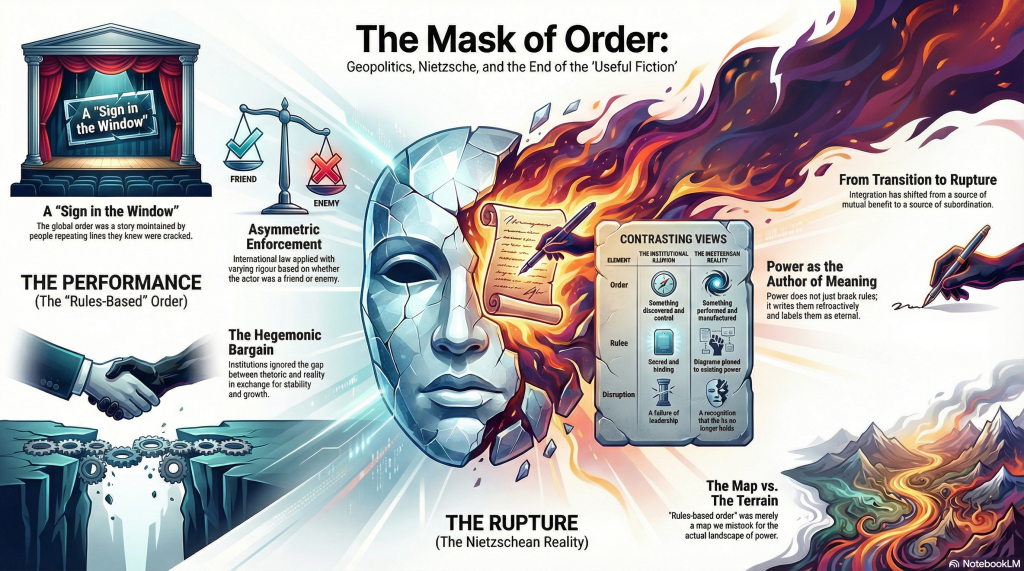
In a recent address, Mark Carney says something that would have been unutterable in polite company a decade ago. He admits that the ‘rules-based international order’ was always a partial fiction. Not false enough to abandon, not true enough to believe in without effort. A story everyone knew was cracked, but which continued to function so long as enough people kept repeating the lines.

We knew that the story about the rules-based order was partially false… We knew that international law applied with varying rigour depending on the identity of the accused and the victim. This fiction was useful [because of the goods provided by American hegemony]… So we placed the sign in the window. We participated in the rituals. And we largely avoided calling out the gaps between rhetoric and reality. This bargain no longer works. Let me be direct. We are in the midst of a rupture, not a transition… You cannot live within the lie of mutual benefit through integration when integration becomes the source of your subordination.

Audio: NotebookLM podcast of this topic.

International law, he concedes, applied unevenly. Power decided enforcement. Friends received nuance. Enemies received principle. This was not ignorance. It was a bargain. The illusion delivered goods, stability, growth, a sense of moral hygiene. So the sign stayed in the window. The rituals continued. The gaps between rhetoric and reality were politely ignored. That bargain, Carney says, no longer works.

This is framed as geopolitical realism, but it is really an ontological admission. The mask slipped, and everyone is suddenly offended by the face underneath.

Image: NotebookLM infographic of this content.

This is why people hate Friedrich Nietzsche. Not because he celebrates cruelty or chaos, but because he insists that order is something we perform, not something we discover. He refuses the comfort of believing that the rules were ever neutral, universal, or self-enforcing. He points at the scaffolding and says: this is what is holding things up, not the sky.

When enough people play along, the game feels like reality. When someone refuses to play, panic sets in.

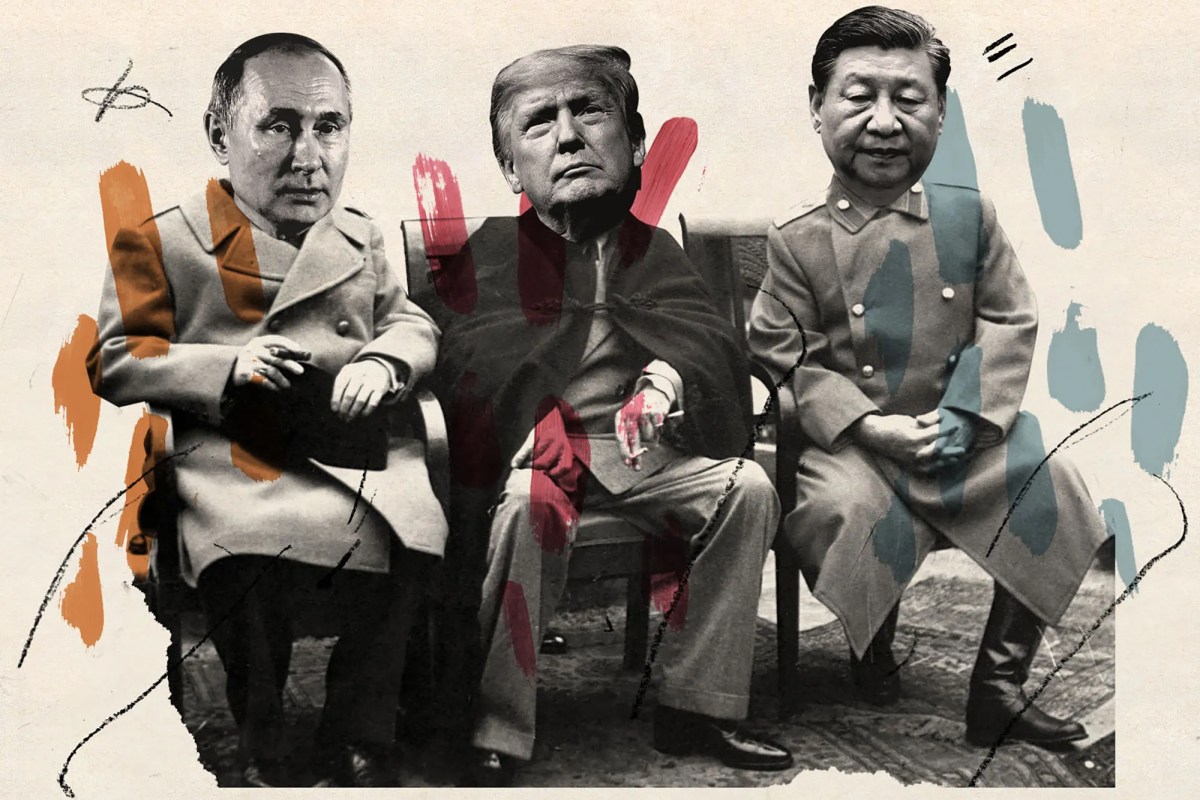
Enter Donald Trump. Trump did not invent the asymmetries of power. He refused to speak them politely. This created a moral crisis for institutions built on the assumption that everyone would continue to pretend. When a designated enemy like Vladimir Putin does this, it is filed under Evil. When an ally does it, the response bifurcates: either frantic appeasement, or embarrassed silence disguised as strategy.

Image: Foreign sentiment

Carney tries to walk a middle path. He neither genuflects nor detonates the stage. He acknowledges the fiction without fully abandoning it. This makes him interesting, but also symptomatic. He wants the audience to notice the set wobbling without asking them to leave the theatre.

When he says the old rules-based order is not coming back, what he really means is that the illusion has been interrupted. Whether permanently or only until someone builds a more convincing façade is left diplomatically unresolved. This is where Nietzsche becomes unavoidable.

People often lump Nietzsche together with vague talk of “power,” as though this were a crude obsession shared with Michel Foucault. But Nietzsche’s contribution is sharper and more unsettling. He is not merely describing power as something exercised. He is describing power as something that manufactures meaning, legitimacy, and moral vocabulary after the fact. Power does not break the rules. It writes them retroactively and calls them eternal.

This is the kind of power later adopted by Adolf Hitler, by Putin, and now by Trump. Not brute force alone, but the refusal to treat inherited norms as sacred simply because they are inherited. This is precisely what terrifies people who mistake procedural continuity for moral truth.

The United States borrowed Montesquieu’s separation of powers as though it were a lock rather than a suggestion. Anyone paying attention could see how easily it could be gamed. That this came as a shock says less about constitutional brilliance than about selective vision. The system functioned not because it was impregnable, but because its participants agreed, tacitly, to behave as though it were.

Nietzsche would call this decadence. Not decline as catastrophe, but decline as denial. The refusal to look directly at the conditions that make order possible, preferring instead to moralise their breakdown.

Carney’s speech is not radical. It is late. It says aloud what everyone already knew but preferred not to articulate: that the world was never neat, the order never neutral, and the rules never binding on those strong enough to ignore them.

What comes next is the uncomfortable part. Once the illusion is acknowledged, it cannot simply be re-believed. You can rebuild institutions. You can repaint the signage. But you cannot unknow that the coffee was always bitter.

Nietzsche does not tell us what replaces the façade. He only insists that pretending it was ever a window onto truth is the most dangerous fiction of all.

What Carney inadvertently demonstrates is not a failure of leadership but a failure of language. ‘Rules-based order’ was never a description of the world; it was a map we mistook for the terrain because it worked often enough to feel true. Nietzsche’s crime was pointing at the legend and saying it was doing the real work. Once that admission is made, you do not get to return to innocence. You can draw a new map, call it reform, integration, or renewal, but you will know it is a diagram pinned to power, not a window onto justice. The unease people feel now is not about chaos. It is about recognition. The lie no longer holds because too many have noticed the pins.

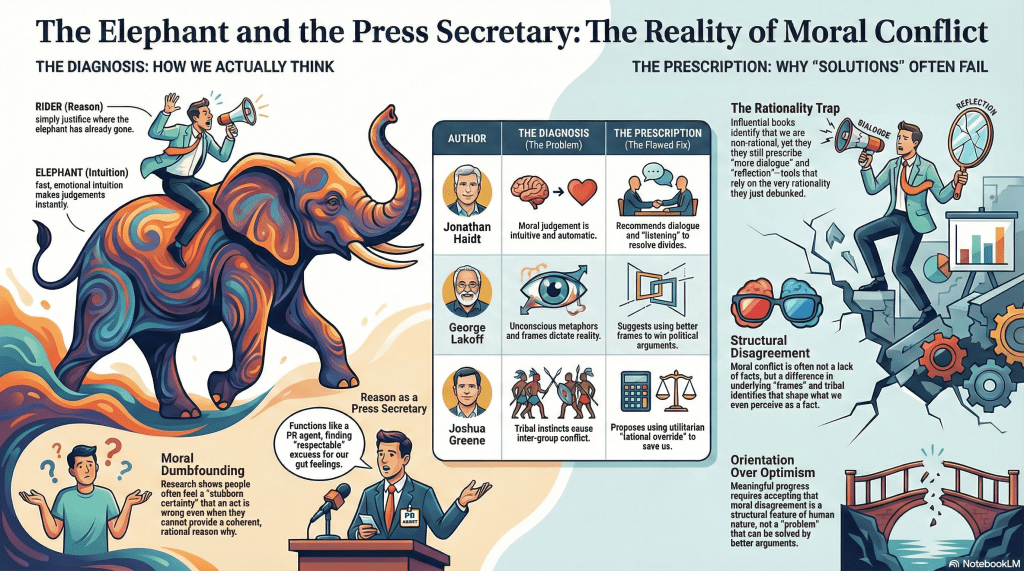
Moral Psychology and the Art of Not Believing Your Own Results

3–4 minutes

Over the past few decades, moral psychology has staged a quiet coup against one of our most cherished fantasies: that human beings are, at bottom, rational moral agents. This is not a fringe claim. It is not a Twitter take. It is the mainstream finding of an entire research programme spanning psychology, cognitive science, linguistics, and neuroscience.

We do not reason our way to moral conclusions. We feel our way there. Instantly. Automatically. And only afterwards do we construct reasons that make the judgment sound respectable.

Audio: NotebookLM summary podcast of this topic.

This is not controversial anymore. It is replicated, taught, and celebrated. And yet, if you read the most influential books in this literature, something strange happens. The diagnosis is devastating. The prescription is reassuring.

I’ve just published a long-form video walking through five canonical books in moral psychology that all uncover the same structural problem, and then quietly refuse to live with the implications.

What follows is a brief guide to the argument.

The shared discovery

Across the literature, the same conclusions keep reappearing:

  • Moral judgement is intuitive, not deliberative
  • Reasoning is largely post-hoc
  • Emotion is not noise but signal
  • Framing and metaphor shape what even counts as a moral fact
  • Group identity and tribal affiliation dominate moral perception

In other words: the Enlightenment picture of moral reasoning is wrong. Or at least badly incomplete.

The rider does not steer the elephant. The rider explains where the elephant has already gone.

Audio: NotebookLM infographic

Where the books go wrong

The video focuses on five widely read, field-defining works:

  • The Righteous Mind (reviewed here and here… even here)
  • Moral Politics (mentioned here – with Don’t Think of an Elephant treated as its popular sequel)
  • Outraged! (reviewed here)
  • Moral Tribes (reviewed here)

Each of these books is sharp, serious, and worth reading. This is not a hit piece.

But each follows the same arc:

  1. Identify a non-rational, affective, automatic mechanism at the heart of moral judgement
  2. Show why moral disagreement is persistent and resistant to argument
  3. Propose solutions that rely on reflection, dialogue, reframing, calibration, or rational override

In short: they discover that reason is weak, and then assign it a leadership role anyway.

Haidt dismantles moral rationalism and then asks us to talk it out.
Lakoff shows that framing is constitutive, then offers better framing.
Gray models outrage as a perceptual feedback loop, then suggests we check our perceptions.
Greene diagnoses tribal morality, then bets on utilitarian reasoning to save us.

None of this is incoherent. But it is uncomfortable. Because the findings themselves suggest that these prescriptions are, at best, limited.

Diagnosis without prognosis

The uncomfortable possibility raised by this literature is not that we are ignorant or misinformed.

It is that moral disagreement may be structural rather than solvable.

That political conflict may not be cured by better arguments.
That persuasion may resemble contagion more than deliberation.
That reason often functions as a press secretary, not a judge.

The books sense this. And then step back from it. Which is human. But it matters.

Why this matters now

We are living in systems that have internalised these findings far more ruthlessly than public discourse has.

Social media platforms optimise for outrage, not understanding.
Political messaging is frame-first, not fact-first.
AI systems are increasingly capable of activating moral intuitions at scale, without fatigue or conscience.

Meanwhile, our institutions still behave as if one more conversation, one more fact-check, one more appeal to reason will close the gap. The research says otherwise.

And that gap between what we know and what we pretend may be the most important moral problem of the moment.

No solution offered

The video does not end with a fix. That’s deliberate.

Offering a neat solution here would simply repeat the same move I’m criticising: diagnosis followed by false comfort. Sometimes orientation matters more than optimism. The elephant is real. The elephant is moving.And most of us are passengers arguing about the map while it walks.

That isn’t despair. It’s clarity.

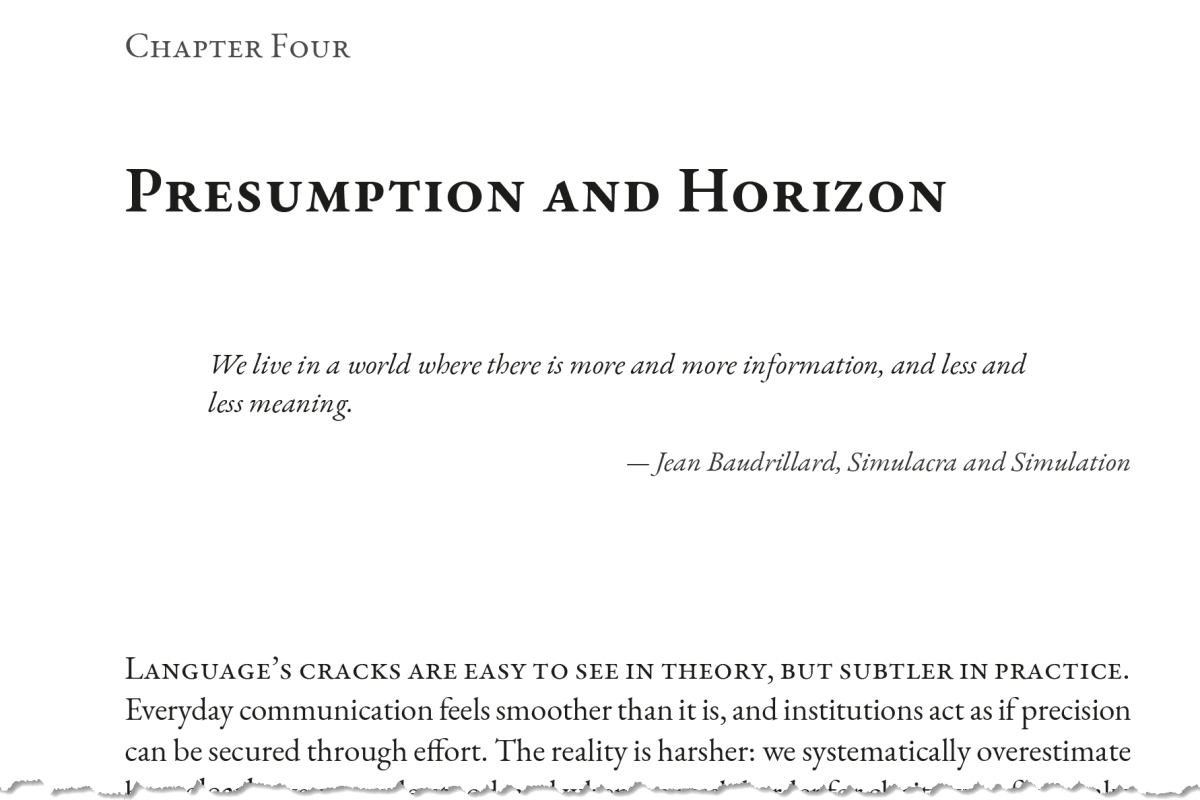
Language Insufficiency Hypothesis: Presumption and Horizon

I discuss Chapter 4 of ‘A Language Insufficiency Hypothesis’ in this video clip.

Video: Presumption and Horizon

In short, I discuss where language fails in law, politics, science, and digital culture, where we think language conveys more than it does.

Thinking Without Words (and Other Heresies)

2–3 minutes

Evelina Fedorenko has been committing a quiet but persistent act of vandalism against one of modernity’s favourite assumptions: that thought and language are basically the same thing, or at least inseparable housemates who share a fridge and argue about milk. They’re not.

Audio: NotebookLM summary podcast of this content.

Her fMRI work shows something both banal and scandalous. Linguistic processing and high-level reasoning live in different neural neighbourhoods. When you switch language on, the ‘language network’ lights up. When you do hard thinking without words, it doesn’t. The brain, it turns out, is not secretly narrating your life in subtitles.

This matters because an entire philosophical industry has been built on the idea that language is thought. Or worse: that thought depends on language for its very existence. That if you can’t say it, you can’t think it. A comforting story, especially for people whose entire self-worth is tied up in saying things.

Now watch two chess players in deep play. No talking. No inner monologue helpfully whispering, ‘Ah yes, now I shall execute a queenside fork’. Just pattern recognition, spatial anticipation, constraint satisfaction, and forward simulation. If language turns up at all, it does so later, like a press officer arriving after the battle to explain what really happened.

Video: Dina Belenkaya plays chess.

Language here is not the engine. It’s the after-action report. The temptation is always to reverse the order. We notice that people can describe their reasoning, and we infer that the description must have caused the reasoning. This is the same mistake we make everywhere else: confusing narration with mechanism, explanation with origin, story with structure.

Fedorenko’s findings don’t tell us that language is useless. They tell us something more irritating: language is a post hoc technology. A powerful one, yes. Essential for coordination, teaching, justification, and institutional life. But not the thing doing the actual work when the work is being done. Thought happens. Language tidies up afterwards.

Which leaves us with an awkward conclusion modern philosophy has spent centuries trying to avoid. The mind is not a well-ordered library of propositions. It’s a workshop. Messy, embodied, improvisational. Language is the clipboard, not the hands. And the clipboard, however beautifully formatted, never lifted a chess piece in its life.

As for me, I’ve long noticed that when I play a game like Sudoku, I notice the number missing from the pattern before any counting or naming occurs. The ‘it must be a 3’ only happens after I make the move.

Wandering Elephants in the Desert of Consciousness

2–3 minutes

The modern search for the truth of consciousness has the unmistakable smell of a desert expedition gone wrong.

Everyone agrees the elephant is real. Everyone insists it’s important. No one agrees what it is, where it’s going, or whether it’s moving in circles. Still, the caravan marches on, convinced that the next dune will finally reveal solid ground.

Audio: NotebookLM summary podcast of this topic.

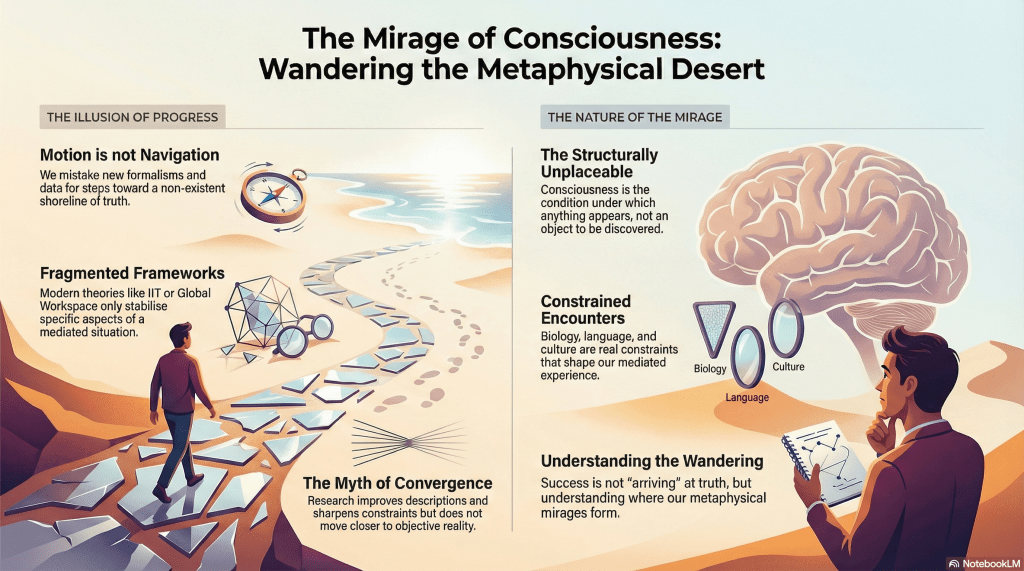
This confidence rests on a familiar Modern assumption: motion equals progress. We may not know where the shoreline of Truth lies, but surely we’re heading toward it. Each new theory, each new scan, each new formalism feels like a step forward. Bayesian updates hum reassuringly in the background. The numbers go up. Understanding must be improving.

But deserts are littered with travellers who swore the same thing.

The problem with consciousness is not that it is mysterious. It’s that it is structurally unplaceable. It is not an object in the world alongside neurons, fields, or functions. It is the mediated condition under which anything appears at all. Treating it as something to be discovered “out there” is like looking for the lens inside the image.

MEOW puts its finger exactly here. Consciousness is not a hidden substance waiting to be uncovered by better instruments. It is a constrained encounter, shaped by biology, cognition, language, culture, technology. Those constraints are real, binding, and non-negotiable. But they do not add up to an archetypal Truth of consciousness, any more than refining a map yields the territory itself.

Modern theories of consciousness oscillate because they are stabilising different aspects of the same mediated situation. IIT formalises integration. Global workspace models privilege broadcast. Predictive processing foregrounds inference. Illusionism denies the furniture altogether. Each feels solid while inhabited. Each generates the same phenomenology of arrival: now we finally see what consciousness really is.

Until the next dune.

Cognitively, we cannot live inside a framework we believe to be false. So every new settlement feels like home. Retrospectively, it becomes an error. Progress is narrated backwards. Direction is inferred after the fact. Motion is moralised.

The elephant keeps walking.

None of this means inquiry is futile. It means the myth of convergence is doing far more work than anyone admits. Consciousness research improves descriptions, sharpens constraints, expands applicability. What it does not do is move us measurably closer to an observer-independent Truth of consciousness, because no such bearing exists.

The elephant is not failing to reach the truth.

The desert is not arranged that way.

Image: NotebookLM infographic on this concept.

Once you stop mistaking wandering for navigation, the panic subsides. The task is no longer to arrive, but to understand where circles form, where mirages recur, and which paths collapse under their own metaphysical optimism.

Consciousness isn’t an elephant waiting to be found.

It’s the condition under which we keep mistaking dunes for destinations.

The Metaphysics of “Why”: A Scavenger’s Guide to the Accident

7–10 minutes

The Broken Map

You wake up in the middle of a collapsing building. Someone hands you a map and says, find your way home. You look down. The map is for a different building entirely. One that was never built. Or worse, one that was demolished decades ago. The exits don’t exist. The staircases lead nowhere.

This is consciousness.

Audio: NotebookLM summary podcast on this topic.

We didn’t ask for it. We didn’t choose it. And the tools we inherited to navigate it—language, philosophy, our most cherished questions—were drawn for a world that does not exist.

Looking back at my recent work, I realise I’m assembling a corpus of pessimism. Not the adolescent kind. Not nihilism as mood board. Something colder and more practical: a willingness to describe the structures we actually inhabit rather than the ones we wish were there.

It starts with admitting that language is a compromised instrument. A tool evolved for coordination and survival, not for metaphysical clarity. And nowhere is this compromise more concealed than in our most sanctified word of inquiry.

1. The Weasel Word

We treat “why” as the pinnacle of human inquiry. The question that separates us from animals. Philosophy seminars orbit it. Religions are scaffolded around it. Children deploy it until adults retreat in defeat.

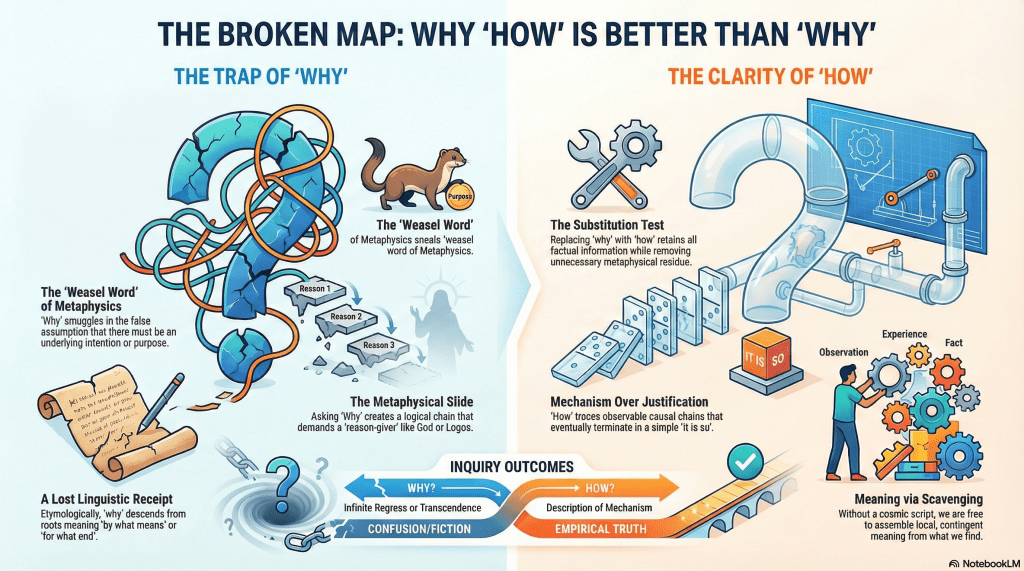
But “why” is a weasel word. A special case of how wearing an unnecessary coat of metaphysics.

The disguise is thinner in other languages. French pourquoi, Spanish por qué, Italian perché all literally mean for what. Japanese dōshite means by what way. Mandarin wèishénme is again for what. The instrumental skeleton is right there on the surface. Speakers encounter it every time they ask the question.

In the Indo-European lineage, “why” descends from the same root as “what”. It began as an interrogative of means and manner, not cosmic purpose. To ask “why” was originally to ask by what mechanism or for what end. Straightforward, workmanlike questions.

Over time, English inflated this grammatical shortcut into something grander. A demand for ultimate justification. For the Reason behind reasons.

The drift was slow enough that it went unnoticed. The word now sounds like a deeper category of inquiry. As if it were pointing beyond mechanism toward metaphysical bedrock.

The profundity is a trick of phonetic history. And a surprising amount of Anglo-American metaphysics may be downstream of a language that buried the receipt.

2. What “Why” Smuggles In

To see the problem clearly, follow the logic that “why” quietly encourages.

When we ask “Why is there suffering?” we often believe we are asking for causes. But the grammar primes us for something else entirely. It whispers that there must be a justification. A reason-giver. An intention behind the arrangement of things.

The slide looks like this:

“Why X?”
→ invites justification rather than description
→ suggests intention or purpose
→ presumes a mind capable of intending
→ requires reasons for those intentions
→ demands grounding for those reasons

At that point the inquiry has only two exits: infinite regress or a metaphysical backstop. God. Logos. The Good. A brute foundation exempt from the very logic that summoned it.

This is not a failure to answer the question. It is the question functioning exactly as designed.

Now contrast this with how.

“How did X come about?”
→ asks for mechanism
→ traces observable causal chains
→ bottoms out in description

“How” eventually terminates in it is so. “Why”, as commonly used, never does. It either spirals forever or leaps into transcendence.

This is not because we lack information. It is because the grammatical form demands more than the world can supply.

3. The Substitution Test

Here is the simplest diagnostic.

Any genuine informational “why” question can be reformulated as a “how” question without losing explanatory power. What disappears is not content but metaphysical residue.

“Why were you late?”
→ “How is it that you are late?”

“My car broke down” answers both.

“Why do stars die?”
→ “How do stars die?”

Fuel exhaustion. Gravitational collapse. Mechanism suffices.

“Why did the dinosaurs go extinct?”
→ “How did the dinosaurs go extinct?”

Asteroid impact. Climate disruption. No intention required.

Even the grand prize:

“Why is there something rather than nothing?”
→ “How is it that there is something?”

At which point the question either becomes empirical or dissolves entirely into it is. No preamble.

Notice the residual discomfort when “my car broke down” answers “why were you late”. Something feels unpaid. The grammar had primed the listener for justification, not description. For reasons, not causes.

The car has no intentions. It broke. That is the whole truth. “How” accepts this cleanly. “Why” accepts it while still gesturing toward something that was never there.

4. The Black Box of Intention

At this point the problem tightens.

If “why” quietly demands intentions, and intentions are not directly accessible even to the agents who supposedly have them, then the entire practice is built on narrative repair.

We do not observe our intentions. We infer them after the fact. The conscious mind receives a press release about decisions already made elsewhere and calls it a reason. Neuroscience has been showing this for decades.

So:

  • Asking others why they acted requests a plausible story about opaque processes
  • Asking oneself why one acted requests confabulation mistaken for introspection
  • Asking the universe why anything exists requests a fiction about a mind that is not there

“How” avoids this entirely. It asks for sequences, mechanisms, conditions. It does not require anyone to perform the ritual of intention-attribution. It does not demand that accidents confess to purposes.

5. Thrownness Without a Vantage Point

I stop short of calling existence a mistake. A mistake implies a standard that was failed. A plan that went wrong. I prefer something colder: the accident.

Human beings find themselves already underway, without having chosen the entry point or the terms. Heidegger called this thrownness. But the structure is not uniquely human.

The universe itself admits no vantage point from which it could justify itself. There is no external tribunal. No staging ground. No meta-position from which existence could be chosen or refused.

This is not a claim about cosmic experience. It is a structural observation about the absence of justification-space. The question “Why is there something rather than nothing?” presumes a standpoint that does not exist. It is a grammatical hallucination.

Thrownness goes all the way down. Consciousness is thrown into a universe that is itself without preamble. We are not pockets of purposelessness in an otherwise purposeful cosmos. We are continuous with it.

The accident runs through everything.

6. Suchness

This is not a new insight. Zen Buddhism reached it by a different route.

Where Western metaphysics treats “why” as an unanswered question, Zen treats it as malformed. The koan does not await a solution. It dissolves the demand for one. When asked whether a dog has Buddha-nature, the answer Mu does not negate or affirm. It refuses the frame.

Tathātā—suchness—names reality prior to justification. Things as they are, before the demand that they make sense to us.

This is not mysticism. It is grammatical hygiene.

Nietzsche smashed idols with a hammer. Zen removes the altar entirely. Different techniques, same target: the metaphysical loading we mistake for depth.

7. Scavenging for Meaning

If there is no True Why, no ultimate justification waiting beneath the floorboards of existence, what remains?

For some, this sounds like collapse. For me, it is relief.

Without a cosmic script, meaning becomes something we assemble rather than discover. Local. Contingent. Provisional. Real precisely because it is not guaranteed.

I find enough purpose in the warmth of a partner’s hand, in the internal logic of a sonata, in the seasonal labour of maintaining a garden. These things organise my days. They matter intensely. And they do so without claiming eternity.

I hold them lightly because I know the building is slated for demolition. Personally. Biologically. Cosmologically. That knowledge does not drain them of colour. It sharpens them.

This is what scavenging means. You build with what you find. You use what works. You do not pretend the materials were placed there for you.

Conclusion: The Sober Nihilist

To be a nihilist in this sense is not to despair. It is to stop lying about the grammar of the universe.

“Why” feels like a meaningful inquiry, but it does not connect to anything real in the way we imagine. It demands intention from a cosmos that has none and justification from accidents that cannot supply it.

“How” is enough. It traces causes. It observes mechanisms. It accepts that things sometimes bottom out in is.

Once you stop asking the universe to justify itself, you are free to deal with what is actually here. The thrown, contingent, occasionally beautiful business of being alive.

I am a nihilist not because I am lost, but because I have put down a broken map. I am looking at what is actually in front of me.

And that, it turns out, is enough.

Image: NotebookLM infographic of this topic

Full Disclosure: This article was output by ChatGPT after an extended conversation with it, Claude, and me. Rather than trying to recast it in my voice, I share it as is. I had started this as a separate post on nihilism, and we ended up here. Claude came up with the broken map story at the start and Suchness near the end. I contributed the weasel words, the ‘how’ angle, the substitution test, the metaphysics of motivation and intention, thrownness (Geworfenheit), Zen, and nihilism. ChatGPT merely rendered this final output after polishing my conversation with Claude.

We had been discussing Cioran, Zapffe, Benatar, and Ligotti, but they got left on the cutting room floor along the way.

The Useful Fiction of Atoms and Selves

3–4 minutes

There is a peculiar anachronism at work in how we think about reality. In physics, we still talk as if atoms were tiny marbles. In everyday life, we talk as if selves were little pilots steering our bodies through time. In both cases, we know better. And in both cases, we can’t seem to stop.

Audio: NotebookLM summary of this podcast

Consider the atom. Every chemistry textbook shows them as colorful spheres, electrons orbiting like planets. We teach children to build molecules with ball-and-stick models. Yet modern physics dismantled this picture a century ago. What we call ‘particles’ are really excitations in quantum fields—mathematical patterns, not things. They’re events masquerading as objects, processes dressed up as nouns.

The language persists because the maths doesn’t care what we call things, and humans need something to picture. ‘Electron’ is easier to say than ‘localised excitation in the electromagnetic field’.

The self enjoys a similar afterlife.

We speak of ‘finding yourself’ or ‘being true to yourself’ as if there were some stable entity to find or betray. We say ‘I’m not the same person I was ten years ago’ while simultaneously assuming enough continuity to take credit – or blame – for what that ‘previous person’ did.

But look closer. Strip away the story we tell about ourselves and what remains? Neural firing patterns. Memory fragments. Social roles shifting with context. The ‘you’ at work is not quite the ‘you’ at home, and neither is the ‘you’ from this morning’s dream. The self isn’t discovered so much as assembled, moment by moment, from available materials.

Like atoms, selves are inferred, not found.

This isn’t just philosophical hand-waving. It has practical teeth. When someone with dementia loses their memories, we wrestle with whether they’re ‘still themselves’. When we punish criminals, we assume the person in prison is meaningfully continuous with the person who committed the crime. Our entire legal and moral framework depends on selves being solid enough to bear responsibility.

And here’s the thing: it works. Mostly.

Just as chemistry functions perfectly well with its cartoon atoms, society functions with its fictional selves. The abstractions do real work. Atoms let us predict reactions without drowning in field equations. Selves let us navigate relationships, assign accountability, and plan futures without collapsing into existential vertigo.

The mistake isn’t using these abstractions. The mistake is forgetting that’s what they are.

Physics didn’t collapse when atoms dissolved into probability clouds. Chemistry students still balance equations; medicines still get synthesised. The practical utility survived the ontological revolution. Similarly, ethics won’t collapse if we admit selves are processes rather than things. We can still make promises, form relationships, and hold each other accountable.

What changes is the confusion.

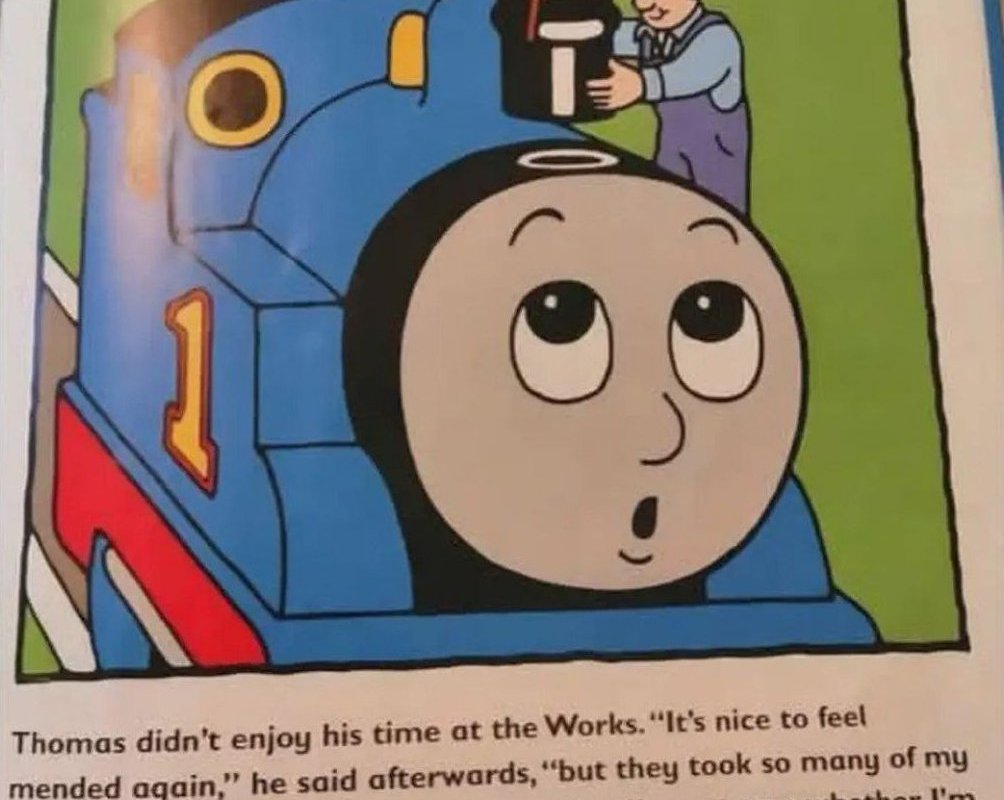
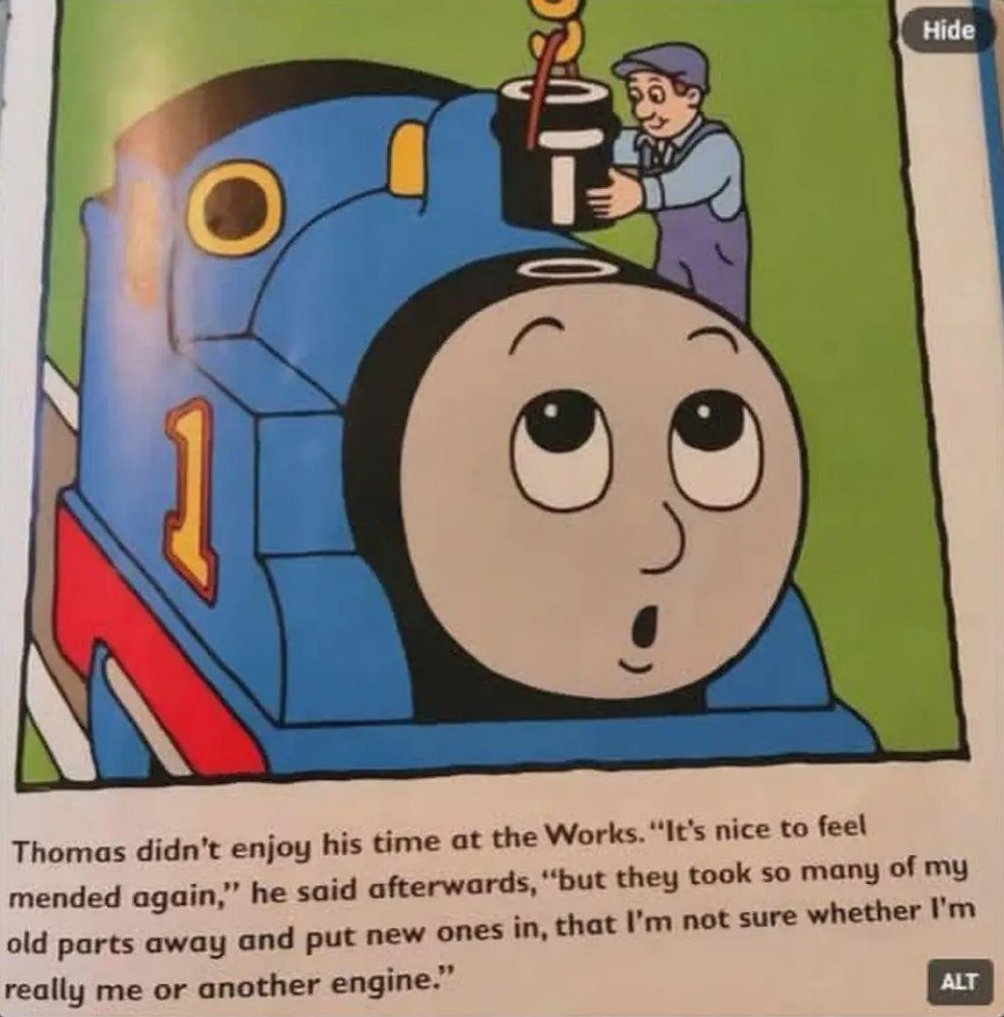
Once you see both atoms and selves as useful fictions – pragmatic compressions of unmanageable complexity – certain puzzles dissolve. The ship of Theseus stops being paradoxical. Personal identity becomes a matter of degree rather than an all-or-nothing proposition. The hard problem of consciousness softens when you stop looking for the ghost in the machine.

We’re pattern-seeking creatures in a universe of flux. We freeze processes into things because things are easier to think about. We turn verbs into nouns because nouns fit better in our mental hands. This isn’t a bug in human cognition – it’s a feature. The problem comes when we forget we’re doing it.

So we end up in the peculiar position of defending little billiard balls in a field universe, and little inner captains in a processual mind, long after the evidence has moved on. We know atoms aren’t solid. We know selves aren’t fixed. Yet we persist in talking as if they were.

Perhaps that’s okay. Perhaps all language is a kind of useful betrayal of reality – solid enough to stand on, but not so solid we can’t revise it when needed.

The half-life of knowledge keeps ticking. Today’s insights become tomorrow’s anachronisms. But some fictions are too useful to abandon entirely. We just need to remember what they are: tools, not truths. Maps, not territories.

And every once in a while, it helps to check whether we’re still navigating by stars that went out long ago.